
CallMissed AI Receptionist Setup: 2026 Small Business Guide


Complete your CallMissed AI receptionist setup with verified steps for numbers, voice, testing, privacy, launch, and measurable results.
CallMissed AI Receptionist Setup: 2026 Small Business Guide
What if every customer call could receive an immediate, consistent response—even while your team is busy, closed, or speaking with another customer? This CallMissed AI receptionist setup guide explains how a small business can configure and deploy that experience in 2026 without treating an AI voice agent as a simple “switch it on and forget it” tool.
An effective small business AI receptionist must do more than answer the phone. It needs to identify the caller’s intent, provide accurate business information, respect operating hours, collect useful details, and transfer sensitive or complex conversations to a human. The urgency is clear: 78% of organizations reported using AI in at least one business function in 2024, up from 55% in 2023, according to Stanford University’s 2025 AI Index Report. As adoption accelerates, reliable configuration—not merely access to an AI model—is becoming the practical differentiator.
CallMissed reflects this shift by combining AI voice agents with an omnichannel customer-engagement platform, including WhatsApp chat, WhatsApp Business calling, email, web conversations, a shared inbox, and knowledge-base retrieval. For Indian businesses, CallMissed also supports speech recognition and voice generation across 22 Indian languages, helping regional-language service become part of the core deployment rather than an afterthought.
What this setup guide will cover
This guide takes a deployment-first approach to AI receptionist setup. You will learn how to:
- Identify the business information, call flows, permissions, and escalation contacts needed before configuration.
- Set up or connect the appropriate business number using the options available in the live CallMissed product.
- Define the voice agent’s role, greeting, tone, supported languages, objectives, and conversational boundaries.
- Add trusted knowledge sources for questions about services, prices, locations, policies, and appointments.
- Configure business hours, after-hours handling, lead capture, and human escalation rules.
- Test common, unusual, and high-risk call scenarios before launch.
- Track measurable outcomes such as answered-call rate, transfer rate, captured leads, resolution rate, and conversation quality.
- Address privacy, consent, data accuracy, and the operational limitations of generative AI.
Verified capabilities versus live-product choices
The guide will clearly separate verified CallMissed capabilities—including AI voice agents, knowledge-base retrieval, omnichannel engagement, WhatsApp Business calling, and support for 22 Indian languages—from settings that administrators must verify inside the current CallMissed dashboard. Number availability, telephony requirements, regional regulations, plan limits, interface labels, and individual integrations can change, so the live product and applicable documentation remain the final authority.
By the end, you will have a practical launch checklist for turning a phone line into a governed customer-service workflow—one that knows what to say, when to escalate, and where its authority ends.
How do you set up a CallMissed AI receptionist in seven steps?
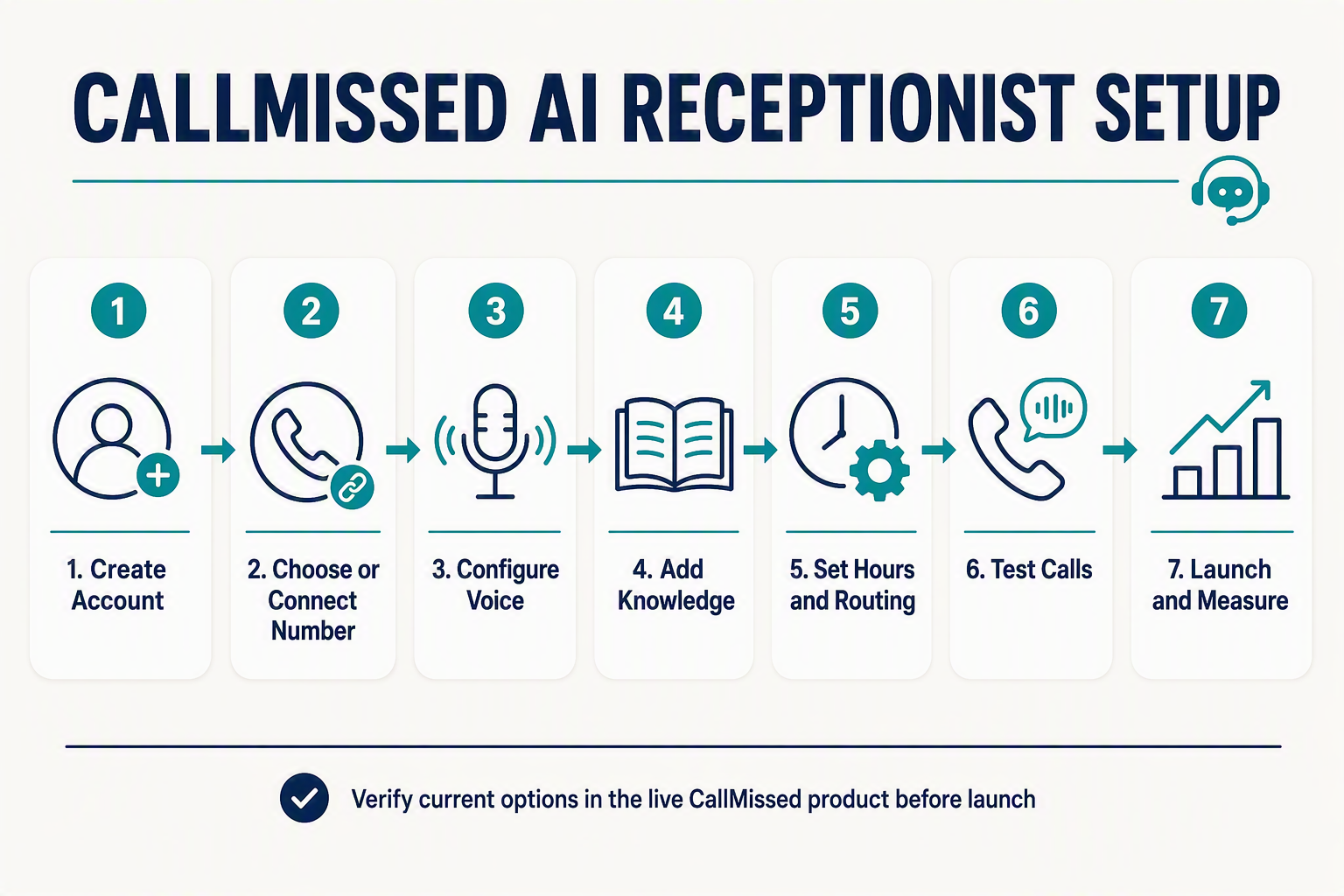
A CallMissed AI receptionist can be deployed in seven practical steps: prepare business requirements, configure a phone number, define the agent, connect trusted knowledge, establish operating rules, test realistic calls, and launch with measurable safeguards. Treat the process as a controlled customer-service deployment rather than a one-time software installation.
1. Document requirements and call outcomes
Begin by listing what the receptionist may and may not do. Identify the most common caller intents, such as appointment requests, service questions, order enquiries, lead qualification, location guidance, and urgent support.
Create a short requirements sheet covering:
- Business name, locations, services, prices, policies, and hours
- Supported languages and preferred speaking style
- Information the agent should collect from callers
- Calls that require immediate human intervention
- Privacy, consent, and record-retention requirements
- Success metrics and the employee responsible for reviewing performance
2. Set up or connect the business number
Choose the phone number customers will call and determine how calls should reach the AI agent. Depending on the options displayed in the current CallMissed dashboard, this may involve obtaining a supported number, connecting an existing number, or configuring call forwarding through a telecom provider.
Number availability, identity verification, forwarding support, pricing, and regional telephony rules must be confirmed in the live product and with the relevant carrier. Test inbound routing before configuring the conversation itself.
3. Configure the voice agent
Define the agent’s name, role, greeting, language, tone, and primary objectives. A useful instruction is specific: “Answer questions using approved business information, collect the caller’s name and preferred callback time, and transfer complaints involving payments.”
CallMissed product information confirms support for speech recognition and voice generation across 22 Indian languages, making multilingual configuration especially relevant for businesses serving regional audiences. Administrators should verify the currently available voices, language combinations, and interface labels inside the dashboard.
4. Add approved knowledge sources
Connect or upload authoritative information about products, services, locations, pricing, cancellation rules, and frequently asked questions. CallMissed supports knowledge-base retrieval, allowing the agent to ground responses in business-provided material.
Keep each source current, clearly written, and free of conflicting policies. Assign an owner to review time-sensitive content instead of allowing the agent to guess when the answer is unavailable.
5. Set hours, capture fields, and escalation rules
Configure separate behaviour for open and closed hours. Specify which details the small business AI receptionist should capture and where staff should receive them.
Define escalation triggers for:
- Emergencies, threats, or safety concerns
- Billing disputes and refund requests
- Repeated misunderstanding
- Requests for a named employee
- Low-confidence or unsupported answers
6. Test complete call scenarios
Run structured test calls using different accents, languages, background-noise levels, interruptions, and unexpected questions. Test successful transfers as well as busy, unanswered, and after-hours destinations. Confirm that names, phone numbers, appointment details, and consent choices are recorded accurately.
7. Launch gradually and measure results
Complete the AI receptionist setup with a limited launch before routing all calls. Monitor answered-call rate, caller abandonment, successful resolution, transfer rate, lead capture, latency, and incorrect-answer incidents.
Review transcripts or recordings where legally permitted, correct knowledge gaps, and adjust instructions regularly. The live CallMissed dashboard, current documentation, applicable telecom rules, and local privacy requirements should remain the final authority for settings that may change after publication.
What requirements, accounts, and sources should you gather before setup?
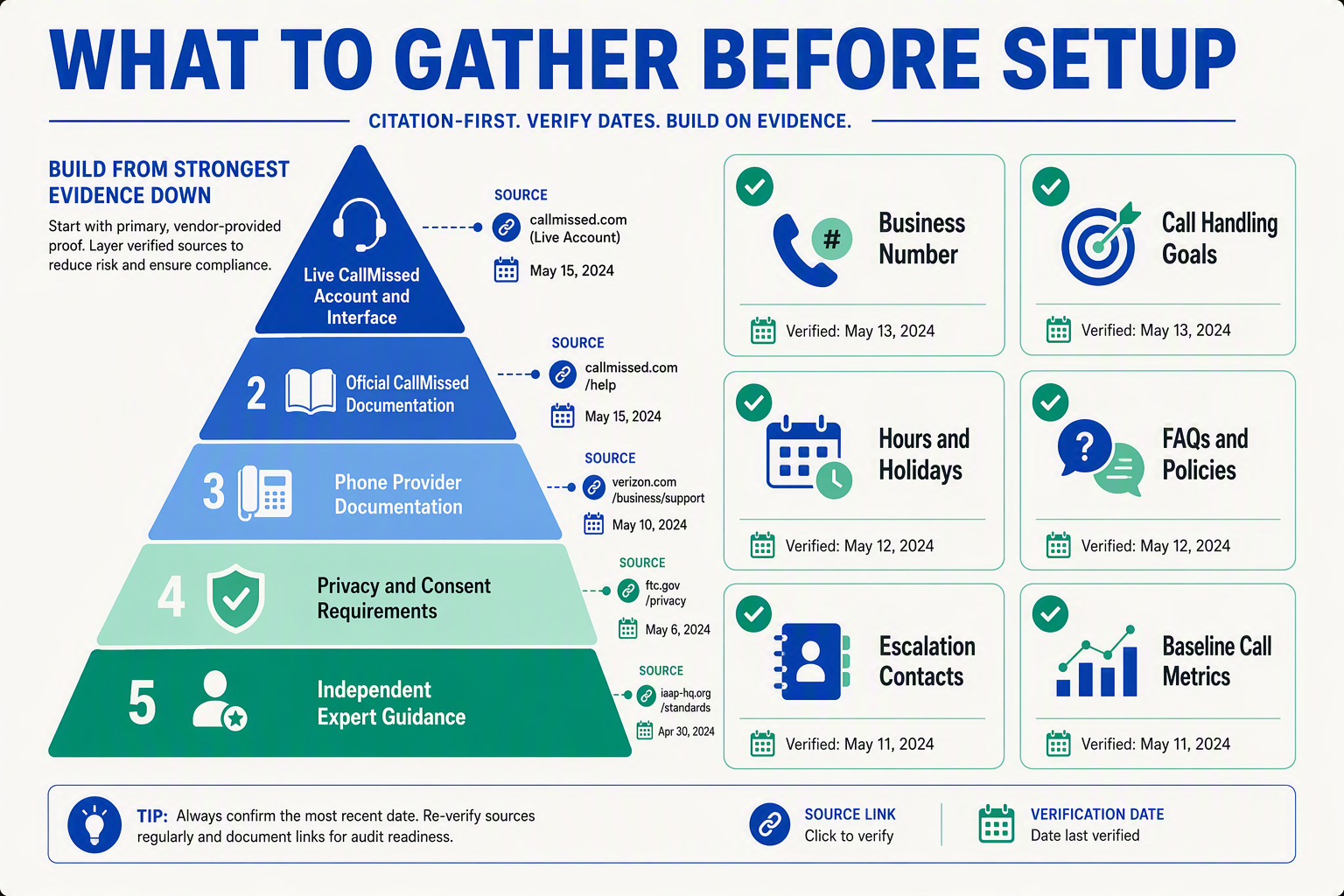
Before beginning CallMissed AI receptionist setup, gather the accounts, number details, operating rules, escalation contacts, and approved business information the agent will use. Preparing these inputs first reduces configuration rework and prevents the receptionist from answering with outdated or unapproved information.
Accounts and access to prepare
Assign one deployment owner who can make decisions and coordinate access. That person should prepare:
- A CallMissed business account with access to app.callmissed.com.
- An email address controlled by the business rather than an employee’s personal account.
- Administrator or authorized-user access for the person configuring the agent.
- Billing details and an approved spending limit.
- Access to the existing telephony provider if a current business number will be connected, forwarded, ported, or otherwise used.
- Access to calendars, CRM records, email, WhatsApp Business assets, or other systems that may be involved in the workflow.
CallMissed is part of Microsoft for Startups, but that does not mean a Microsoft account is necessarily required for every deployment. Confirm the current signup, verification, billing, and user-role requirements inside the live CallMissed dashboard.
Business-number information to collect
Create a short number inventory before choosing the call-routing method. Record:
- The public number customers currently call.
- The number’s country and area code.
- The legal or operational owner of the number.
- The current carrier or telephony provider.
- Existing forwarding, IVR, voicemail, recording, or hunt-group rules.
- Expected call volume, peak periods, and common call destinations.
- Whether the receptionist should answer all calls, overflow calls, or after-hours calls only.
Number availability, identity verification, forwarding support, regional restrictions, and plan limits are live-product choices rather than universal CallMissed capabilities. Verify these details in the current product interface and applicable telecommunication documentation before publishing or rerouting a customer-facing number.
Approved knowledge sources
A small business AI receptionist should answer from controlled sources, not from assumptions. Gather the latest versions of:
- Business name, locations, directions, and contact channels.
- Opening hours, holiday schedules, and temporary closures.
- Product or service descriptions.
- Prices, taxes, fees, discounts, and refund rules.
- Appointment requirements and cancellation policies.
- Delivery areas, service boundaries, and expected timelines.
- Frequently asked questions and approved responses.
- Emergency, complaint, legal, medical, or financial escalation instructions.
CallMissed supports knowledge-base retrieval, allowing an AI voice agent to ground responses in business-provided material. Label every source with an owner, approval date, and review date; if two documents conflict, nominate one authoritative source rather than uploading both without clarification.
Language, consent, and escalation inputs
List the languages callers actually use and identify which ones have reviewed scripts. According to CallMissed’s verified product information, the platform supports speech recognition and voice generation across 22 Indian languages, but each selected language still requires accurate names, terminology, pronunciations, and escalation messages.
Also prepare:
- A recording or AI-disclosure statement where required.
- The customer fields the agent may collect.
- Retention and deletion rules for transcripts and recordings.
- Primary and backup human escalation contacts.
- Conditions requiring immediate transfer or a callback.
Do not place passwords, payment credentials, identity documents, or unnecessary sensitive data in the knowledge base. The safest AI receptionist setup starts with least-privilege access, approved sources, and explicit human handoff rules.
Which CallMissed capabilities are verified in 2026, and what must you confirm in the live product?
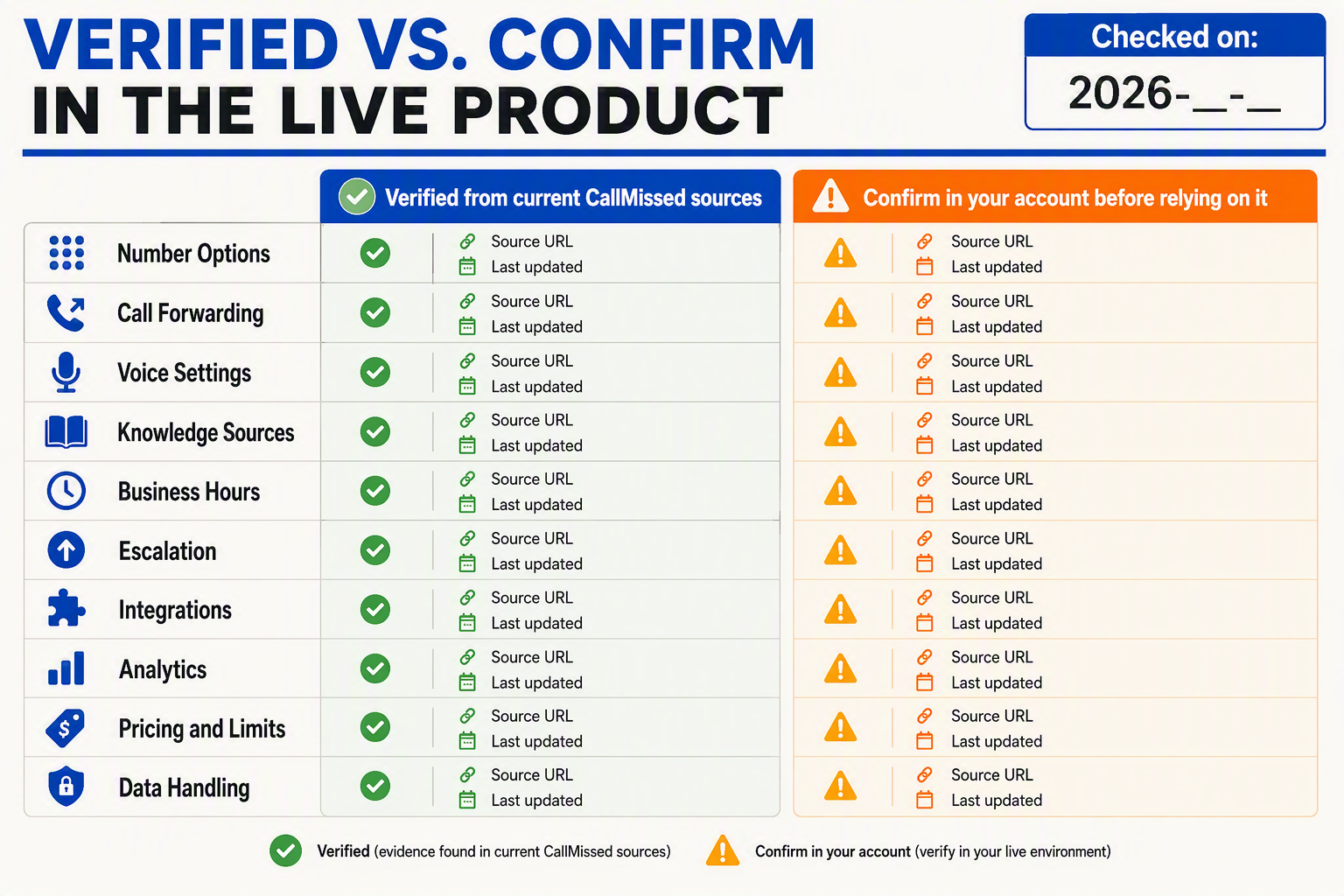
The CallMissed AI receptionist is verified to support AI voice agents, knowledge-base retrieval, omnichannel engagement, WhatsApp Business calling, and speech workflows across 22 Indian languages. However, administrators must confirm number availability, plan entitlements, dashboard controls, integrations, limits, and regulatory requirements in the live product before deployment.
Verified capabilities and deployment checks
| Capability | Verified in 2026 | Role in receptionist setup | Confirm in the live product |
|---|---|---|---|
| AI voice agents | CallMissed provides configurable AI voice agents for customer conversations. | Handles greetings, questions, lead capture, routing, and defined receptionist tasks. | Available voices, agent settings, call limits, transfer controls, and current interface labels. |
| Indian-language voice | CallMissed supports Speech-to-Text and Text-to-Speech across 22 Indian languages, using Indic-first model options. | Enables callers to speak and hear responses in relevant regional languages. | Exact language-model combinations, multilingual switching behavior, voice availability, and pronunciation controls. |
| Knowledge-base RAG | CallMissed supports knowledge-base retrieval-augmented generation, or RAG. | Grounds answers in approved information about services, prices, locations, hours, and policies. | Supported file or source formats, ingestion limits, update behavior, retrieval settings, and citation visibility. |
| WhatsApp Business calling | CallMissed supports inbound and business-initiated WhatsApp Business calls bridged to an AI agent. | Extends the receptionist beyond conventional phone calls into a WhatsApp-native calling workflow. | Business eligibility, Meta approval requirements, country availability, initiation rules, pricing, and account configuration. |
| Omnichannel engagement | CallMissed combines voice, WhatsApp chat, email, web conversations, and a shared inbox or CRM. | Gives staff a common place to review conversations and continue customer follow-up. | Channel-specific integrations, user permissions, assignment rules, retention settings, and plan access. |
| Developer AI gateway | CallMissed provides an OpenAI-compatible gateway covering LLM chat, Speech-to-Text, Text-to-Speech, image generation, and web search. | Supports custom integrations when the standard business workflow needs developer extension. | Current model catalogue, same-tier fallback behavior, API quotas, regional availability, and production pricing. |
CallMissed’s published platform information verifies that one credit equals ₹1, with free-tier and pay-as-you-go access available. A business should nevertheless inspect the current billing page because telephony, model usage, WhatsApp services, taxes, and plan-specific allowances may be calculated separately or change over time.
What “verified” does—and does not—mean
A verified platform capability confirms that the product supports the function; it does not guarantee that every account, number, geography, or subscription receives identical access. For a reliable AI receptionist setup, treat the dashboard and current CallMissed documentation as the operational source of truth.
Before configuring a small business AI receptionist, confirm:
- Business-number options: whether you can provision a number, connect an existing number, forward calls, or use WhatsApp Business calling.
- Account eligibility: required business verification, Meta approvals, identity documents, or telecom compliance.
- Commercial terms: subscription requirements, credit consumption, call charges, concurrency limits, and trial restrictions.
- Operational controls: business hours, call recording, consent messages, human transfers, fallback destinations, and voicemail behavior.
- Data governance: transcript storage, retention periods, user permissions, deletion controls, and applicable privacy obligations.
- Integration availability: calendars, CRM systems, webhooks, email tools, or other services required by the intended workflow.
Take screenshots or record the confirmed settings and date during setup. This creates a deployment baseline and makes later changes to pricing, permissions, routing, or dashboard behavior easier to audit.
How should you choose, connect, or forward your business number?
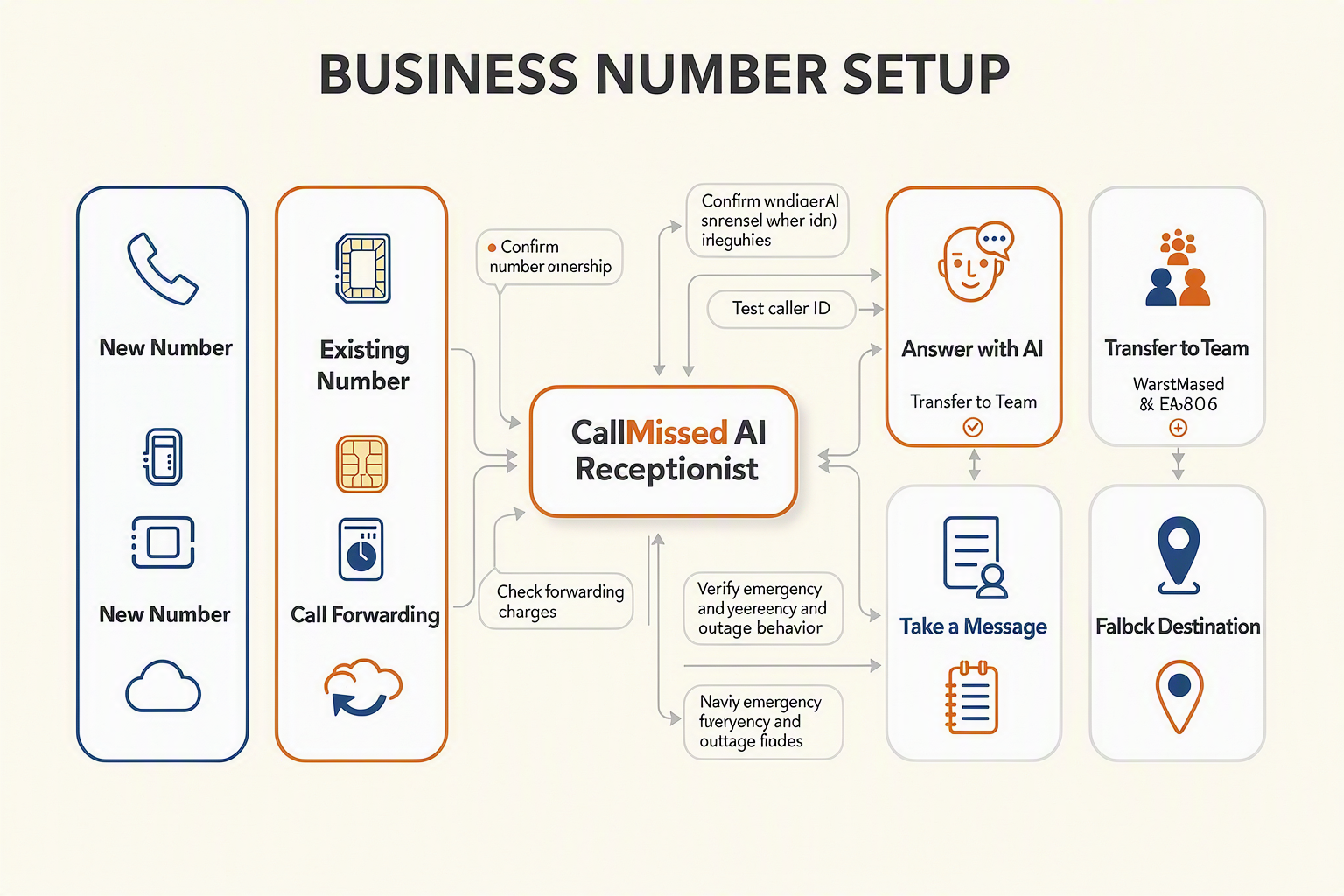
Choose the number strategy that preserves customer familiarity while giving the AI a reliable route for answering calls. For most small businesses, forwarding an existing published number is the lowest-disruption option; a new number is useful for a new location, campaign, or AI-first support line.
Compare the three practical number strategies
- Use a new business number
- Select this approach when launching a new support desk or keeping AI-handled calls separate from personal and office lines.
- Confirm available countries, number types, identity-verification requirements, rental charges, and inbound-call rates in the live CallMissed dashboard.
- Prefer a local or familiar number format where available, and publish it consistently across Google Business Profile, WhatsApp, websites, invoices, and directories.
- Connect an existing business number
- This preserves the number customers already recognise.
- Direct connection may depend on carrier, SIP, cloud-telephony, or number-porting support. Do not assume that every carrier or number type can connect directly; verify current options with CallMissed and the telecom provider.
- Record who legally owns the number and retain billing records, KYC documents, and carrier credentials before requesting changes.
- Forward calls from an existing number
- Call forwarding routes calls from the existing line to the destination provided during the CallMissed AI receptionist setup.
- Unconditional forwarding sends every call to the receptionist. Conditional forwarding sends only unanswered, busy, or unreachable calls.
- Carrier-specific activation codes, fees, ring delays, and forwarding restrictions vary, so follow the telecom provider’s current instructions rather than relying on a generic dial code.
The International Telecommunication Union’s ITU-T E.164 standard limits an international telephone number to 15 digits, excluding the international dialling prefix. Store numbers in full international format—such as +91 followed by the Indian number—to reduce routing and CRM-matching errors.
Configure the routing path carefully
Before activating a small business AI receptionist, document the intended flow:
- Primary destination: AI receptionist, employee, branch, or shared queue.
- Fallback destination: Human team member, voicemail, or callback workflow.
- Ring timeout: How long the original line should ring before conditional forwarding begins.
- Failure handling: What happens if the AI service, carrier route, or internet connection is unavailable.
- Caller identification: Whether the original caller’s number remains visible after forwarding.
- Outbound identity: Which approved number appears when the business returns a call.
Complete one routing change at a time. Call the number from a different mobile network, a landline if relevant, and an international line if overseas callers matter. Verify audio in both directions, caller-ID preservation, transfer behaviour, and whether rejected or missed calls reach the defined fallback.
Treat PSTN and WhatsApp calls as separate channels
A normal telephone number and WhatsApp Business calling may use different provisioning and routing processes. CallMissed supports WhatsApp Business inbound and business-initiated calls bridged to an AI voice agent, but businesses should confirm Meta eligibility, consent requirements, number status, and current dashboard steps before deployment.
For outbound callbacks or promotional communication in India, review the Telecom Regulatory Authority of India’s Telecom Commercial Communications Customer Preference Regulations, 2018 and subsequent amendments. Registration, consent, templates, numbering, and sender requirements can differ by communication type.
Finally, do not publish the number until the CallMissed AI receptionist answers reliably, identifies the business correctly, and transfers callers to a reachable human. Keep the old routing configuration documented so it can be restored quickly if launch testing exposes a problem.
How do you configure the voice agent, knowledge sources, hours, and greetings?
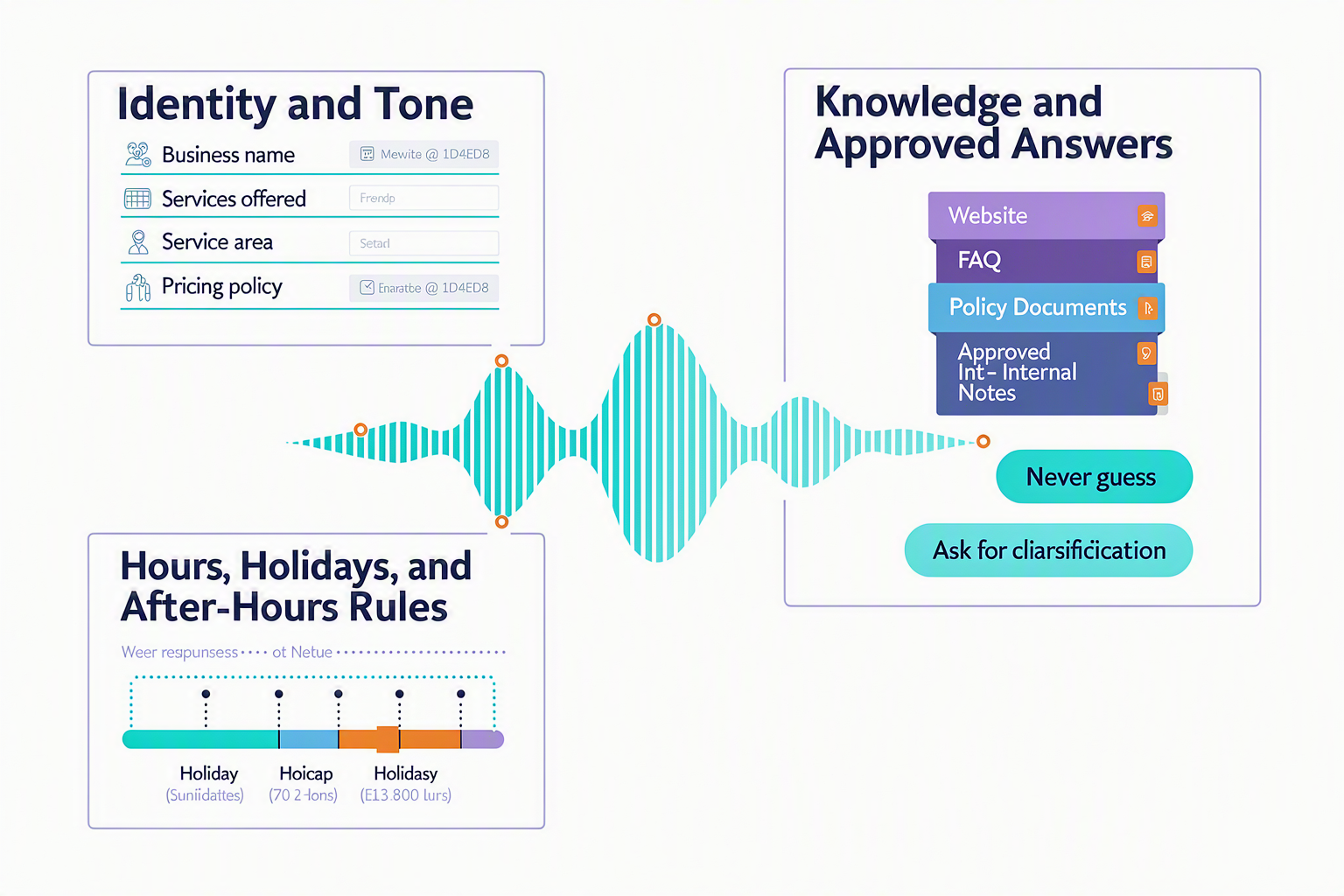
Configure the CallMissed AI receptionist by defining its role and boundaries, attaching approved knowledge sources, setting time-based call handling, and writing separate opening and fallback greetings. Because dashboard labels and plan-specific options can change, confirm every setting in the live CallMissed product before publishing the agent.
1. Define the agent’s role and conversation rules
Start with a narrow, testable job description rather than a general instruction such as “answer customer questions.” In the voice-agent configuration available to your account, specify:
- Business identity: Legal or trading name, locations, and services.
- Primary objectives: Answer FAQs, qualify leads, collect appointment requests, or route calls.
- Caller details to capture: Name, phone number, email address, preferred location, and reason for calling.
- Tone: Professional, friendly, concise, and appropriate to the brand.
- Supported languages: Select only languages your business can operationally support after the call.
- Prohibited actions: Do not invent prices, promise unavailable appointments, provide regulated advice, or claim that a transfer succeeded before confirmation.
- Escalation triggers: Complaints, emergencies, refund disputes, payment problems, legal questions, or repeated misunderstanding.
A useful instruction is: “Answer only from approved business information. If the answer is unavailable or uncertain, collect the caller’s details and offer human follow-up.” This makes uncertainty handling part of the AI receptionist setup, rather than relying on the model to decide when it knows enough.
2. Add authoritative knowledge sources
Use CallMissed’s verified knowledge-base retrieval capability to ground answers in business-approved material. Upload or connect only current sources, subject to the formats, file limits, and controls shown in the live dashboard.
Prioritize:
- Service descriptions and eligibility rules.
- Current prices, taxes, fees, and offer expiry dates.
- Addresses, landmarks, service areas, and contact channels.
- Booking, cancellation, refund, warranty, and delivery policies.
- Accessibility information and escalation contacts.
Remove duplicate or conflicting documents. Every policy should display an owner, effective date, and review date so staff can identify stale information. Test exact questions such as “Is GST included?” and “Can I cancel a same-day appointment?” rather than merely confirming that a file was uploaded.
Do not place passwords, payment credentials, unrestricted customer records, or unnecessary personal data in the knowledge base. The source should contain what the receptionist may disclose—not everything the business knows.
3. Configure business hours and routing states
Create separate behavior for open, closed, holiday, and temporary-closure states. Verify the dashboard’s timezone, scheduling granularity, holiday controls, transfer destinations, and timeout behavior because these are live-product choices.
During opening hours, the small business AI receptionist can answer routine questions and attempt an approved human transfer. After hours, it should:
- State that the business is closed.
- Provide the next opening time.
- Capture the caller’s name, number, intent, and preferred callback window.
- Explain the expected follow-up process without guaranteeing an unconfigured response time.
- Use an approved emergency instruction where relevant.
4. Write and test greetings
Keep the opening greeting short: “Thank you for calling [Business Name]. I’m the virtual receptionist. How may I help you?” Add an AI disclosure or recording notice where required by applicable law and business policy.
Prepare distinct messages for after-hours calls, failed transfers, silence, unsupported requests, and system errors. Read each greeting aloud, confirm pronunciation of names and locations, and test it in every enabled language before saving or publishing the configuration.
How should escalation, fallback handling, privacy, and consent be configured?
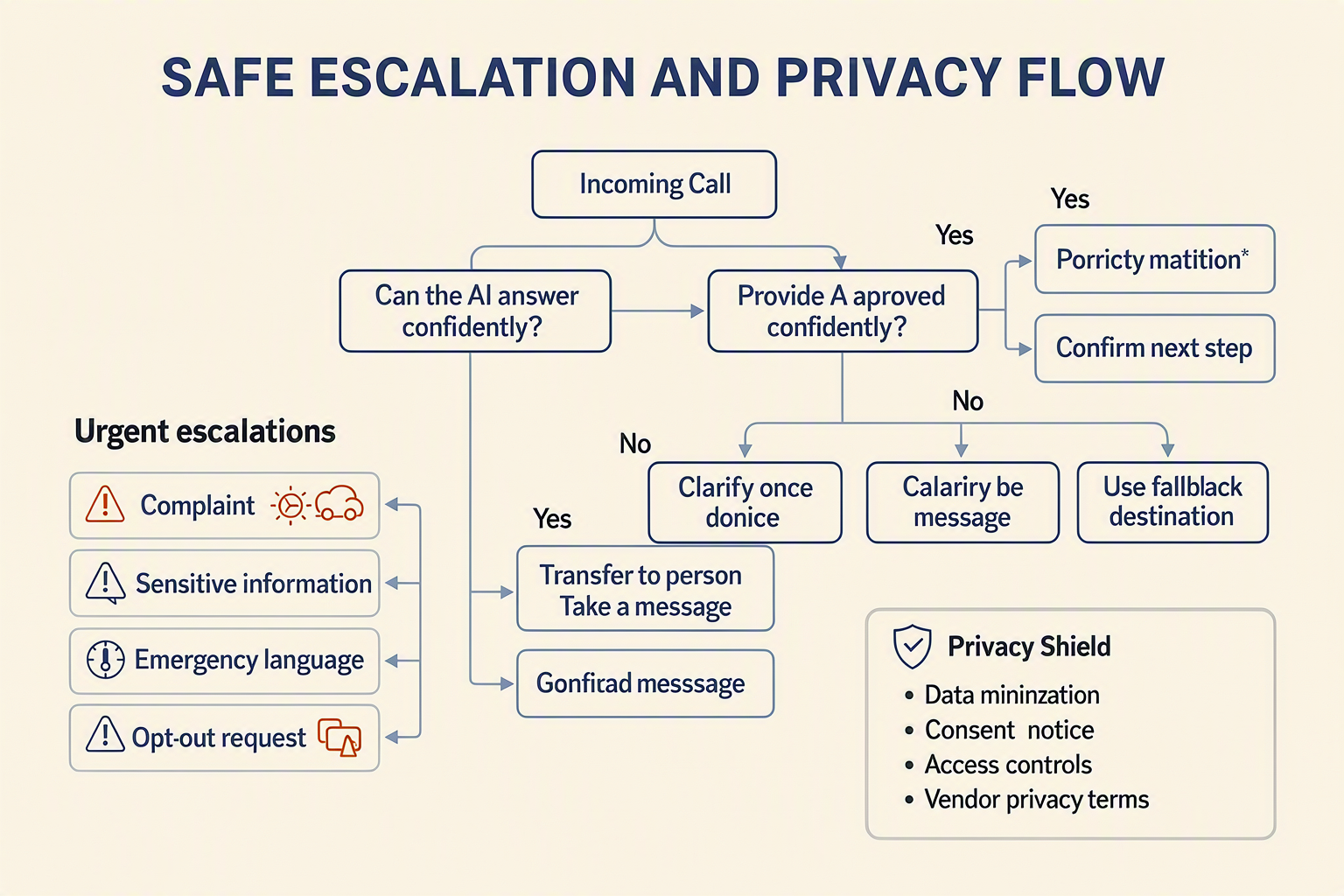
Configure escalation and fallback before launch, disclose that callers are interacting with an AI system, and collect only the information needed to resolve or route each call. A safe CallMissed AI receptionist setup should always provide a clear path to a human and a defined response when the agent lacks reliable information.
Build explicit human-escalation rules
Escalation should depend on caller intent, risk, confidence, and repeated failure, not simply call duration. Create a routing matrix with named owners, operating hours, and a backup destination.
Escalate immediately when a caller:
- Requests a human representative or refuses to speak with AI.
- Reports an emergency, safety issue, suspected fraud, legal threat, or data breach.
- Discusses a disputed payment, cancellation, complaint, or other policy-sensitive matter.
- Fails identity verification or asks the agent to disclose protected account information.
- Repeats a question twice without receiving a satisfactory answer.
- Uses a language or dialect the configured agent cannot handle reliably.
For each trigger, define a primary contact, backup contact, transfer timeout, and after-hours action. A transfer should include a short handoff summary—caller name, verified contact details, stated intent, and relevant conversation context—without making the caller repeat everything.
CallMissed supports AI voice agents and WhatsApp Business calls bridged to AI agents, but administrators should confirm available transfer destinations, timeout controls, summaries, and interface labels in the current dashboard.
Configure graceful fallback handling
A small business AI receptionist must avoid guessing when its knowledge source does not support an answer. Use a fallback sequence such as:
- Ask one concise clarifying question.
- Search only the approved knowledge base.
- State that the information cannot be verified.
- Offer a human transfer, callback, or message capture.
- Confirm the expected next step and response window.
Use a neutral response such as: “I don’t have verified information for that request. I can connect you with the team or record a callback request.” Never allow the agent to invent prices, appointment availability, refund terms, medical advice, or legal commitments.
Also define behavior for telephony failures, silence, background noise, interrupted transfers, and speech-recognition errors. If a transfer fails, the agent should return to the caller, explain what happened, and offer an alternative rather than ending the call.
Apply privacy and consent controls
India’s Digital Personal Data Protection Act, 2023 requires valid consent or another lawful basis for processing digital personal data, along with clear notice, purpose limitation, security safeguards, and mechanisms for withdrawal and grievances. Businesses must verify the rules and commencement requirements applicable in 2026 with qualified counsel.
At the beginning of a call, disclose:
- That the caller is speaking with an AI receptionist.
- Whether audio or transcripts are recorded or retained.
- Why information is being collected and how it will be used.
- How the caller can request a human or withdraw consent.
Do not collect full payment-card credentials, passwords, one-time passwords, government identifiers, health information, or other sensitive details unless the workflow has a documented legal basis and appropriate controls. Configure role-based access, minimum retention periods, deletion procedures, and audit reviews for recordings and transcripts.
For outbound promotional calls, verify consent and preference obligations under the Telecom Commercial Communications Customer Preference Regulations, 2018, issued by the Telecom Regulatory Authority of India. WhatsApp Business calling and messaging may also carry Meta policy and opt-in requirements that must be checked in the live product documentation.
Before completing the AI receptionist setup, place test calls to confirm that disclosures play correctly, opt-outs work, transfers preserve context, and every fallback ends with a clear next action.
How do you test the receptionist and complete the launch checklist?
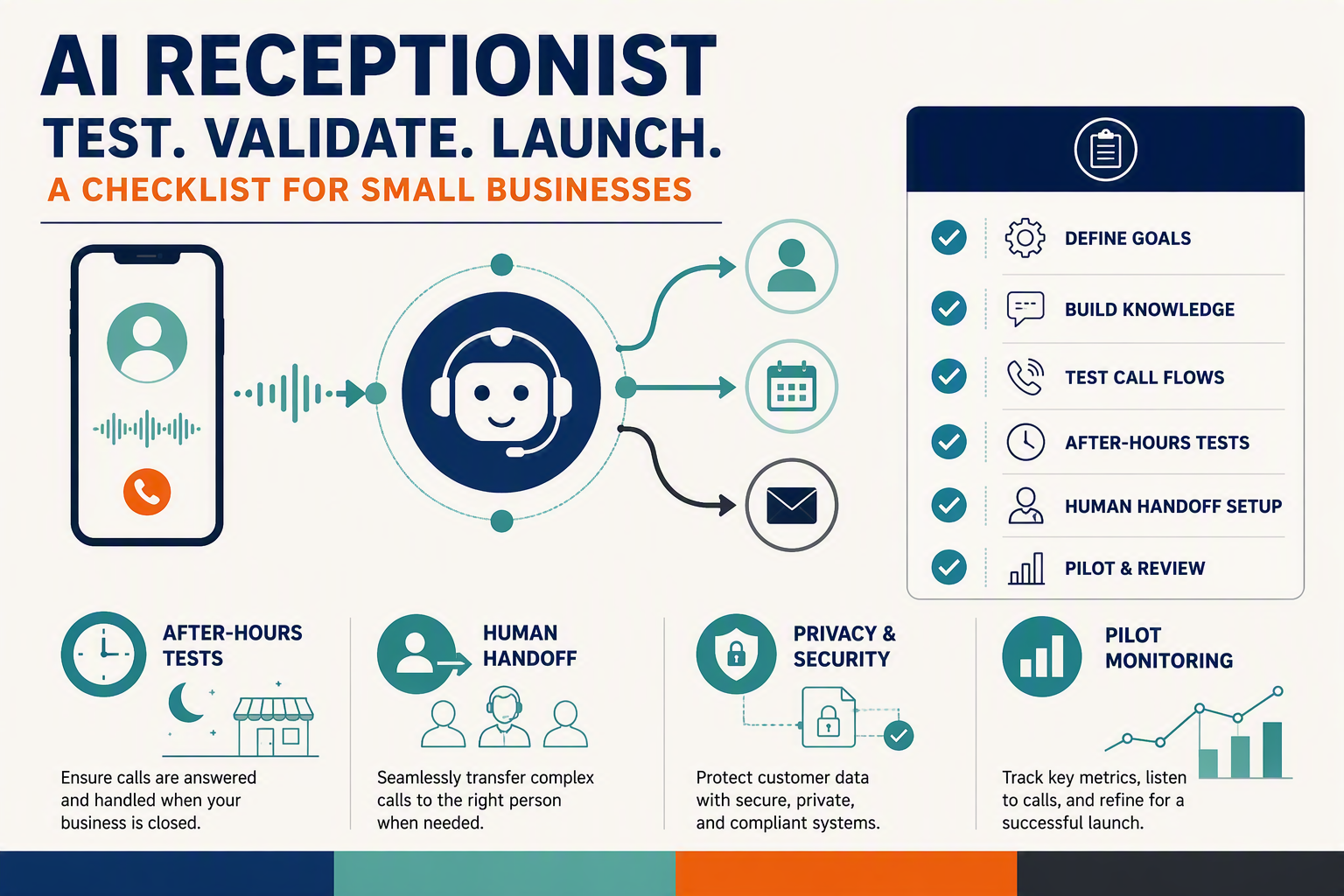
Test the CallMissed AI receptionist with a structured scenario matrix, correct every critical failure, and then conduct a limited pilot before directing all customer calls to the agent. A successful launch means the receptionist consistently answers approved questions, captures usable details, follows operating-hour rules, and escalates rather than improvises when uncertain.
Build a realistic test matrix
Use test callers who were not involved in writing the agent instructions; they are more likely to phrase requests like real customers. Test from different phones and, where relevant, in each configured language.
- Routine enquiries: Ask about the address, opening hours, services, prices, availability, and appointment process.
- Lead capture: Provide names, phone numbers, email addresses, locations, and service requirements in different orders. Confirm that each field appears accurately in the intended inbox or workflow.
- Human escalation: Request a person directly, describe a complaint, or ask a question outside the knowledge base. Verify the correct transfer or callback path.
- After-hours calls: Call outside the configured schedule and during holidays. The agent should follow the approved after-hours response rather than promise immediate assistance.
- Adversarial and ambiguous requests: Interrupt the agent, remain silent, change topics, use background noise, or ask it to ignore its instructions.
- High-risk scenarios: Test emergencies, payment disputes, legal threats, medical questions, and requests for confidential information. The receptionist should use the prescribed boundary or escalation message.
For an Indian-language deployment, test code-switching as well as complete conversations in each enabled language. CallMissed supports speech recognition and voice generation across 22 Indian languages, but businesses should still validate pronunciation, local names, addresses, and industry terminology using their actual call conditions.
Score complete conversations, not isolated answers
Create a pass-or-fail scorecard for every call. A practical small business AI receptionist test should assess:
- Opening: Did the greeting identify the business and set the right expectation?
- Intent recognition: Did the agent understand why the customer called?
- Factual accuracy: Did its answer match the approved knowledge source?
- Conversation control: Did it handle interruptions, silence, and corrections naturally?
- Data capture: Were names, numbers, dates, and requirements recorded correctly?
- Escalation: Did the transfer reach the designated person or fallback route?
- Closure: Did the agent summarize the next step without making an unauthorized promise?
Treat invented prices, policies, availability, or guarantees as launch-blocking defects. Also block launch if emergency handling, human transfer, opt-out requests, or sensitive-data boundaries fail even once.
Run a controlled pilot
After internal testing, route a limited call category, number, location, or time window to the receptionist. Review complete transcripts, recordings where lawfully enabled, captured contact details, transfer outcomes, and caller feedback daily. Do not evaluate performance only from a few polished demonstration calls.
If the deployment includes WhatsApp Business calling, test both inbound and business-initiated flows that are enabled for the account. CallMissed can bridge WhatsApp Business calls to an AI voice agent, although availability, permissions, number requirements, and current interface labels must be confirmed in the live dashboard and applicable documentation.
Complete the launch checklist
Before finishing the AI receptionist setup, confirm that:
- [ ] The business number connects reliably from multiple networks.
- [ ] Greetings, language choices, hours, holidays, and time zones are correct.
- [ ] Every published fact has an approved knowledge source.
- [ ] Lead fields arrive in the correct inbox or workflow.
- [ ] Transfers, missed transfers, voicemail, and callback fallbacks work.
- [ ] High-risk and out-of-scope requests trigger safe responses.
- [ ] Authorized staff can review conversations and correct knowledge.
- [ ] A named owner is responsible for post-launch monitoring.
- [ ] The rollback path to human-only handling has been tested.
- [ ] All plan limits, telephony settings, consent notices, and regional requirements have been verified in the current CallMissed product.
Launch only after critical scenarios pass, then monitor closely during the first production period and retest after every material change to prompts, knowledge, routing, languages, or business policies.
What outcomes should a small business AI receptionist measure, and where are its limits?
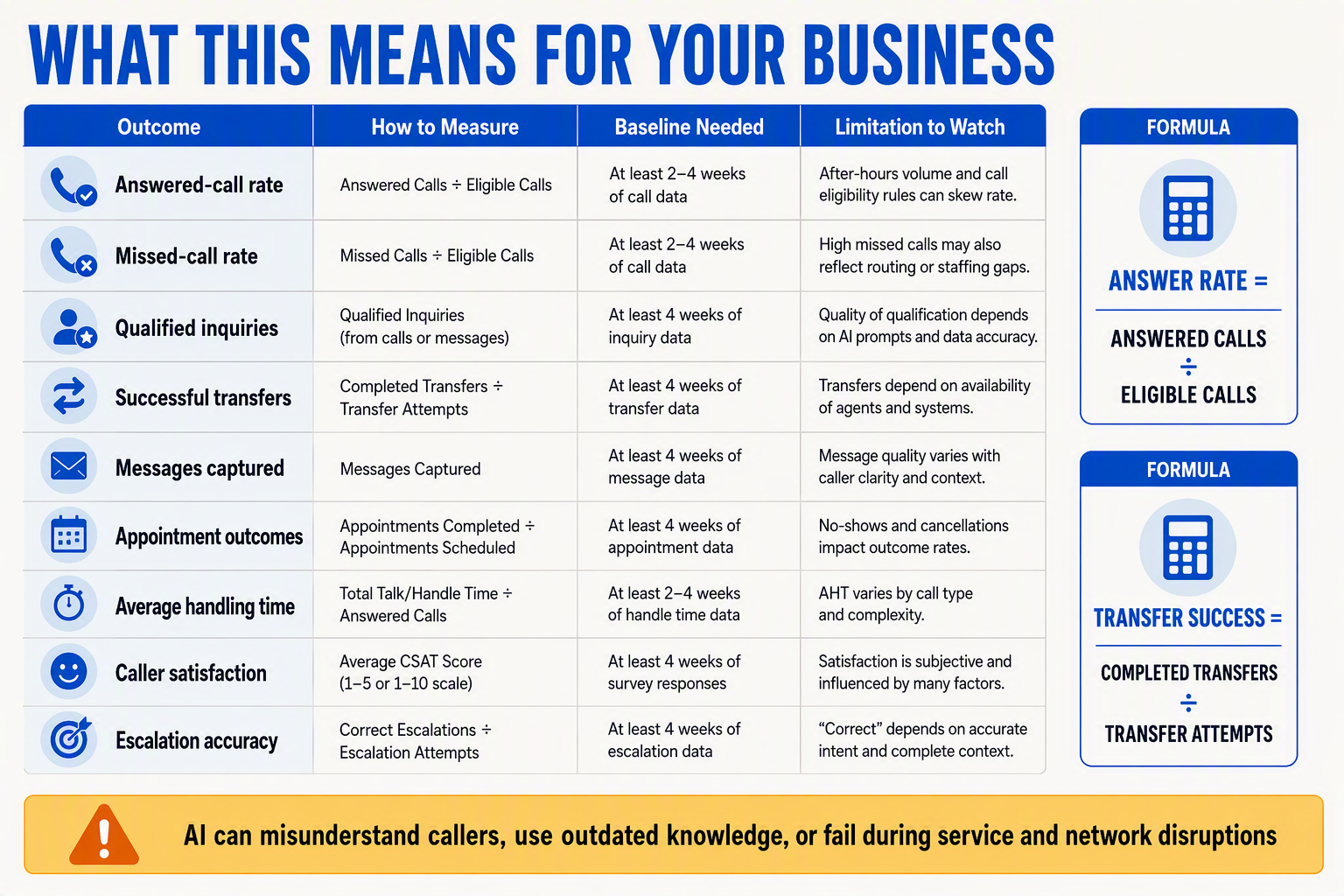
A small business should measure whether its AI receptionist answers reliably, completes approved tasks, captures usable information, and escalates at the right time. It should not be judged solely by call volume or automation rate; safe transfers and clearly acknowledged uncertainty are successful outcomes too.
Outcome scorecard for an AI receptionist setup
Define each metric before launch and compare it with a pre-deployment baseline. The Stanford University 2025 AI Index Report found that organizational AI use increased by 23 percentage points between 2023 and 2024, reinforcing why businesses need outcome-level measurement rather than merely reporting that AI is enabled.
| Outcome | Practical calculation | What it reveals | Important limit or response |
|---|---|---|---|
| Answered-call rate | Calls answered ÷ eligible inbound calls × 100 | Availability during busy periods and after hours | Exclude spam, abandoned calls, outages, and calls outside the configured scope |
| Approved-task completion | Completed bookings, FAQs, messages, or lead captures ÷ eligible requests × 100 | Whether callers accomplish the intended task | Verify completion in the system of record; conversational agreement alone is not proof |
| Knowledge-grounded resolution | Calls resolved from approved sources ÷ answerable calls × 100 | Knowledge-base usefulness and agent accuracy | Audit samples for unsupported claims, outdated prices, and incorrect policy explanations |
| Human-transfer rate | Calls transferred ÷ answered calls × 100 | How often callers require staff assistance | A high rate can indicate weak coverage; a very low rate may mean escalation rules are too restrictive |
| Lead-data completeness | Leads containing every required field ÷ leads captured × 100 | Whether names, needs, locations, and contact details are usable | Confirm critical details aloud and avoid collecting unnecessary personal data |
| Caller experience | Post-call rating, complaint rate, repeat-call rate, and reviewed-call score | Clarity, tone, latency, and caller effort | Low survey participation can distort results, so combine feedback with transcript or recording reviews |
Exact dashboards, event labels, exports, recording controls, and integrations should be confirmed in the current CallMissed application. If a metric is not exposed directly, teams can calculate it using call records, CRM outcomes, booking systems, and a consistently reviewed sample of conversations.
Set targets from your own baseline
There is no universal “good” containment or transfer percentage for a small business AI receptionist. A restaurant handling opening-hours questions has a different risk profile from a clinic receiving symptom-related calls.
For the first four weeks:
- Record a baseline from comparable human-handled or previously missed calls.
- Review metrics weekly by intent, language, operating period, and outcome.
- Manually audit both successful and failed calls, not only complaints.
- Change one prompt, knowledge source, or routing rule at a time.
- Re-test the affected scenarios before publishing the change.
CallMissed supports voice experiences across 22 Indian languages, but each deployed language should receive its own test set and quality review. Language availability does not guarantee equal performance for every accent, mixed-language utterance, proper noun, noisy environment, or specialised vocabulary.
Recognise the operational limits
A CallMissed AI receptionist remains a probabilistic system rather than an autonomous authority. Guardrails should prevent it from:
- Giving medical, legal, financial, safety-critical, or emergency advice.
- Inventing prices, availability, policies, refunds, or appointment confirmation.
- Continuing when identity, consent, intent, or speech is unclear.
- Handling threats, severe distress, payment disputes, or sensitive complaints without escalation.
- Claiming that a transfer, booking, or message succeeded unless the connected system confirms it.
The safest optimisation goal is correct handling, not maximum automation. When the agent lacks reliable information, encounters technical failure, or reaches a configured boundary, it should state the limitation, capture only necessary details, and route the caller to an authorised person.
Which expert recommendations should guide deployment and ongoing improvement?

A reliable deployment should follow a risk-managed improvement cycle: define boundaries, test before launch, monitor real calls, review failures, and update the agent under human supervision. Experts consistently recommend treating a small business AI receptionist as an operational system—not a one-time software configuration.
Apply established AI governance frameworks
Use recognized frameworks to turn broad “responsible AI” goals into concrete controls:
- NIST AI Risk Management Framework 1.0, released by the U.S. National Institute of Standards and Technology in January 2023, organizes AI risk work into four functions: Govern, Map, Measure, and Manage.
- NIST’s Generative AI Profile, published in July 2024, recommends documenting acceptable use, evaluating output validity, monitoring deployed systems, and establishing incident-response procedures.
- ISO/IEC 42001:2023 defines requirements for an AI management system, including accountability, risk assessment, operational controls, and continual improvement.
- OWASP’s Top 10 for Large Language Model Applications highlights practical risks such as prompt injection, sensitive-information disclosure, excessive agency, and overreliance on generated answers.
For a receptionist, these principles translate into named owners, approved knowledge sources, explicit escalation rules, limited system permissions, and documented responses when the agent behaves unexpectedly.
Keep humans accountable for consequential calls
The agent should handle routine, reversible tasks while employees retain authority over decisions with financial, legal, medical, safety, or reputational consequences. Configure immediate transfer or callback workflows for:
- Emergencies, threats, or references to self-harm.
- Complaints involving legal action, discrimination, fraud, or data breaches.
- Refunds, cancellations, credit decisions, or contractual commitments beyond an approved limit.
- Requests for professional advice that the business is not authorized to automate.
- Repeated misunderstanding, caller distress, or low-confidence recognition.
Never present generated information as confirmed when the knowledge base lacks an answer. A safer response is to acknowledge uncertainty, capture contact details, and arrange human follow-up.
Review performance with evidence, not intuition
Run a structured review weekly during the first month and at least monthly after performance stabilizes. Evaluate both aggregate metrics and a representative sample of call transcripts or recordings, subject to applicable consent and retention requirements.
- Compare answered-call, containment, transfer, abandonment, and lead-capture rates against the pre-launch baseline.
- Tag failures by cause: speech recognition, outdated knowledge, ambiguous instructions, integration errors, or inappropriate automation.
- Test changes in a staging or restricted environment before exposing every caller.
- Maintain a change log showing what changed, who approved it, and which test cases passed.
- Re-test after pricing, hours, staffing, services, policies, or regulatory requirements change.
Do not optimize containment alone. An unusually low transfer rate can indicate that callers are being blocked from human help rather than successfully served.
Make privacy and transparency continuous controls
Tell callers they are interacting with an AI assistant and disclose recording or transcription where required. Collect only information necessary for the stated purpose, restrict employee access, define deletion periods, and provide a route for correction or human assistance. Indian businesses should assess their obligations under the Digital Personal Data Protection Act, 2023 and verify current rules, consent requirements, and sector-specific regulations with qualified counsel.
For a CallMissed AI receptionist setup, periodically confirm live dashboard options, telephony terms, plan limits, retention controls, and regional number requirements. CallMissed’s verified capabilities include AI voice agents, knowledge-base retrieval, WhatsApp Business calling, and speech support across 22 Indian languages; however, each business must validate language performance with its own accents, vocabulary, noise conditions, and call scenarios before expanding the deployment.
What are the most common questions about CallMissed AI receptionist setup?
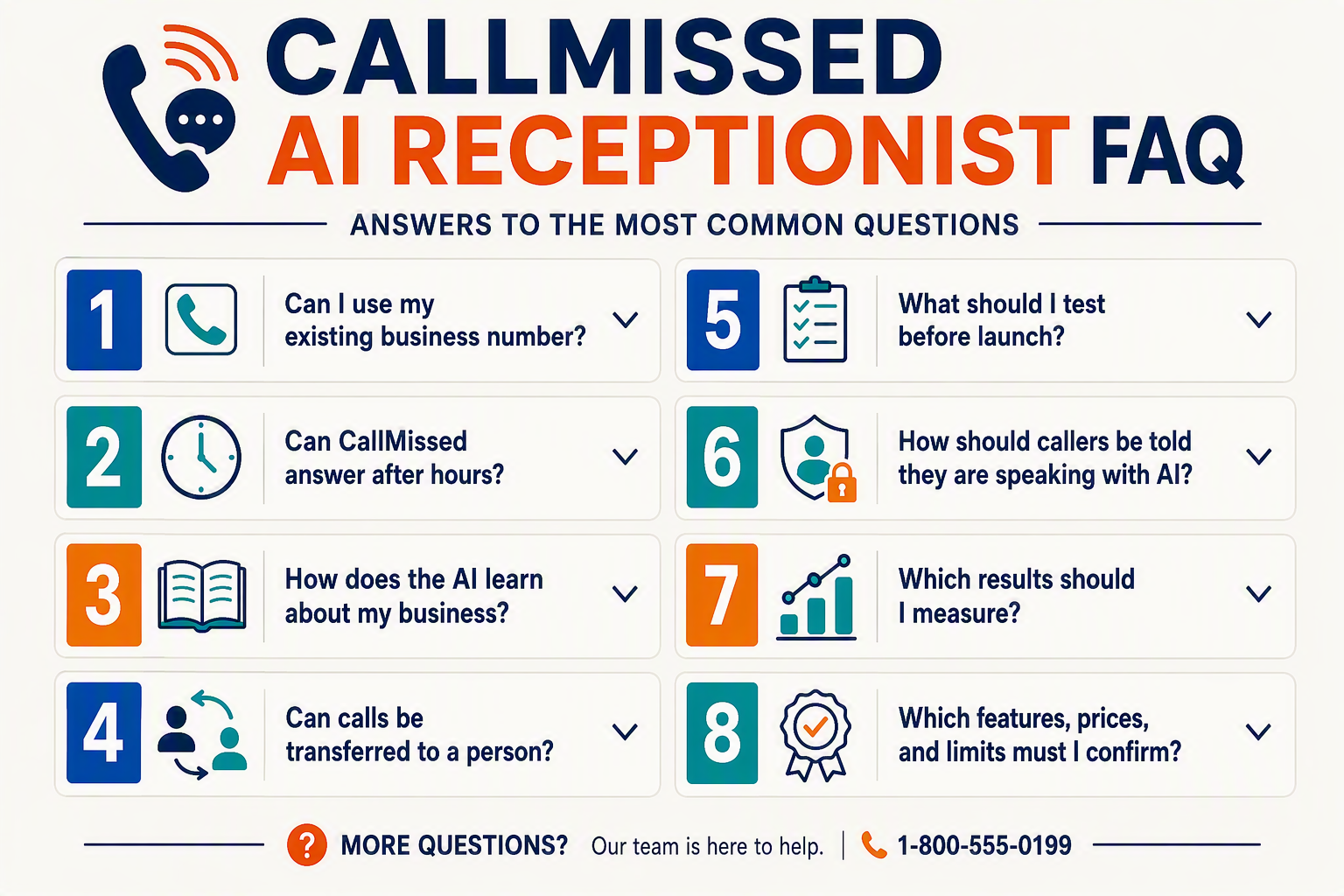
What do I need before starting a CallMissed AI receptionist setup?
Can I use my existing business phone number with a CallMissed AI receptionist?
Which languages can a small business AI receptionist support?
How should I add business information to the AI receptionist’s knowledge base?
How long should testing take before launching a CallMissed AI receptionist?
How much does AI receptionist setup cost, and what should I measure after launch?
Conclusion
A successful CallMissed AI receptionist setup is a managed deployment, not a one-time toggle. Small businesses should connect the right number, define the agent’s role and boundaries, ground responses in approved business information, establish human escalation, and test the complete call journey before launch.
The case for careful implementation will strengthen as AI adoption grows. Stanford University’s 2025 AI Index Report found that 78% of organizations used AI in at least one business function in 2024, up from 55% in 2023. As AI becomes commonplace, customers will increasingly judge an AI receptionist by its accuracy, consistency, and ability to recognize when human assistance is necessary.
Key takeaways from this guide include:
- Prepare before configuring: Document operating hours, services, prices, locations, policies, supported languages, escalation contacts, permissions, and expected caller intents.
- Design the conversation deliberately: Give the CallMissed AI receptionist a clear greeting, tone, objectives, lead-capture fields, conversational limits, and rules for transfers or after-hours calls.
- Ground and test every answer: Add trusted knowledge sources, then evaluate routine enquiries, ambiguous questions, unusual requests, regional-language conversations, and high-risk scenarios.
- Measure performance after launch: Monitor answered-call rate, transfer rate, captured leads, resolution rate, and conversation quality while regularly reviewing transcripts and outdated knowledge.
CallMissed provides verified capabilities including AI voice agents, knowledge-base retrieval, WhatsApp Business calling, omnichannel engagement, and speech support across 22 Indian languages. However, administrators should confirm number availability, telephony requirements, plan limits, dashboard labels, integrations, and regional compliance obligations in the live product and current documentation.
Looking ahead, watch for changing caller expectations, business policies, language needs, privacy requirements, and recurring failure patterns. A reliable small business AI receptionist should evolve through continuous review rather than remain frozen at launch.
To explore and refine your deployment, visit CallMissed—then ask: which call scenario should your AI receptionist master before it answers its first customer?
Related Reading
Discussion
Ready to automate customer conversations?
Launch AI voice agents and WhatsApp bots with CallMissed — one API, 22+ Indian languages.