
CallMissed multilingual WhatsApp and Voice Deployment Guide for India


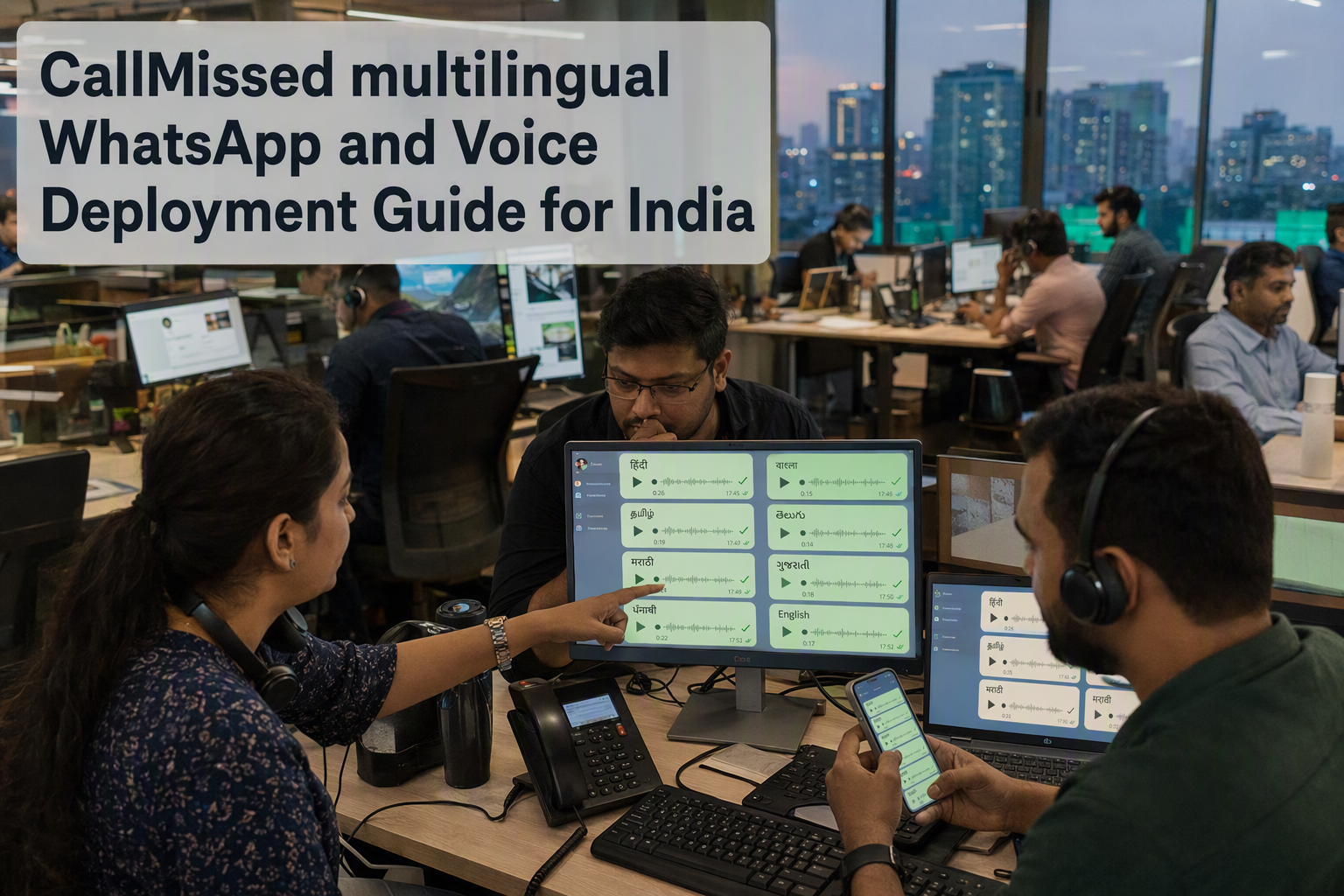
Deploy CallMissed multilingual WhatsApp and voice support with steps for language testing, consent, handoff, measurement, and rollout.
CallMissed multilingual WhatsApp and Voice Deployment Guide for India
India’s 2011 Census recorded 19,569 raw mother-tongue returns—a striking reminder that deploying one Hindi or English bot does not make customer service multilingual. A successful CallMissed multilingual WhatsApp and voice rollout must recognize how customers actually communicate: switching between Hindi and English, mixing regional vocabulary, typing languages in Latin script, and changing channels when a conversation becomes urgent or complex.
Why multilingual deployment matters now
India had 886 million active internet users in 2024, according to the Internet and Mobile Association of India and Kantar’s Internet in India Report 2024, published in January 2025. The same report found that rural India accounted for 488 million active internet users in 2024, making regional-language accessibility a practical growth requirement rather than a cosmetic localization feature.
Yet language coverage alone does not guarantee reliable Indian language customer support. A system may transcribe formal Tamil accurately but struggle with colloquial Tamil-English speech, recognize standard Hindi but miss local names and addresses, or generate grammatically correct audio that sounds unnatural in a service conversation. Businesses must therefore test each language against the exact channel, customer segment, use case, accent profile, and vocabulary expected in production.
CallMissed supports Speech-to-Text and Text-to-Speech across 22 Indian languages, alongside WhatsApp chat, WhatsApp Business calling, and AI voice agents; every selected language and workflow should still be validated with representative speakers before launch.
What this deployment guide covers
This guide provides a phased framework for building a multilingual AI voice agent India workflow without assuming that one configuration will work equally well across languages. You will learn how to:
- Prioritize languages using customer demand, geography, call records, and business value.
- Capture and retain each customer’s language and channel preference.
- Design for code-switching, transliterated messages, accents, names, numbers, and domain terminology.
- Benchmark Speech-to-Text and Text-to-Speech using realistic recordings—not scripted studio samples alone.
- Localize intent, tone, examples, dates, currency, and escalation scripts instead of translating word for word.
- Decide when WhatsApp text is sufficient and when a WhatsApp Business voice call is more effective.
- Configure low-confidence fallbacks, language switching, and context-preserving human handoff.
- Obtain appropriate consent for automated messages, calls, recordings, and data processing.
- Measure containment, recognition errors, task completion, escalation, latency, and customer satisfaction by language.
- Roll out progressively—from internal testing and one-language pilots to monitored regional expansion.
The goal is not merely to make an AI agent speak more languages. It is to create customer journeys that remain understandable, respectful, measurable, and recoverable when automation encounters India’s real linguistic complexity.
Introduction: How should you deploy CallMissed in India? Start with priority languages, validate every workflow, preserve customer choice, and expand in measured phases
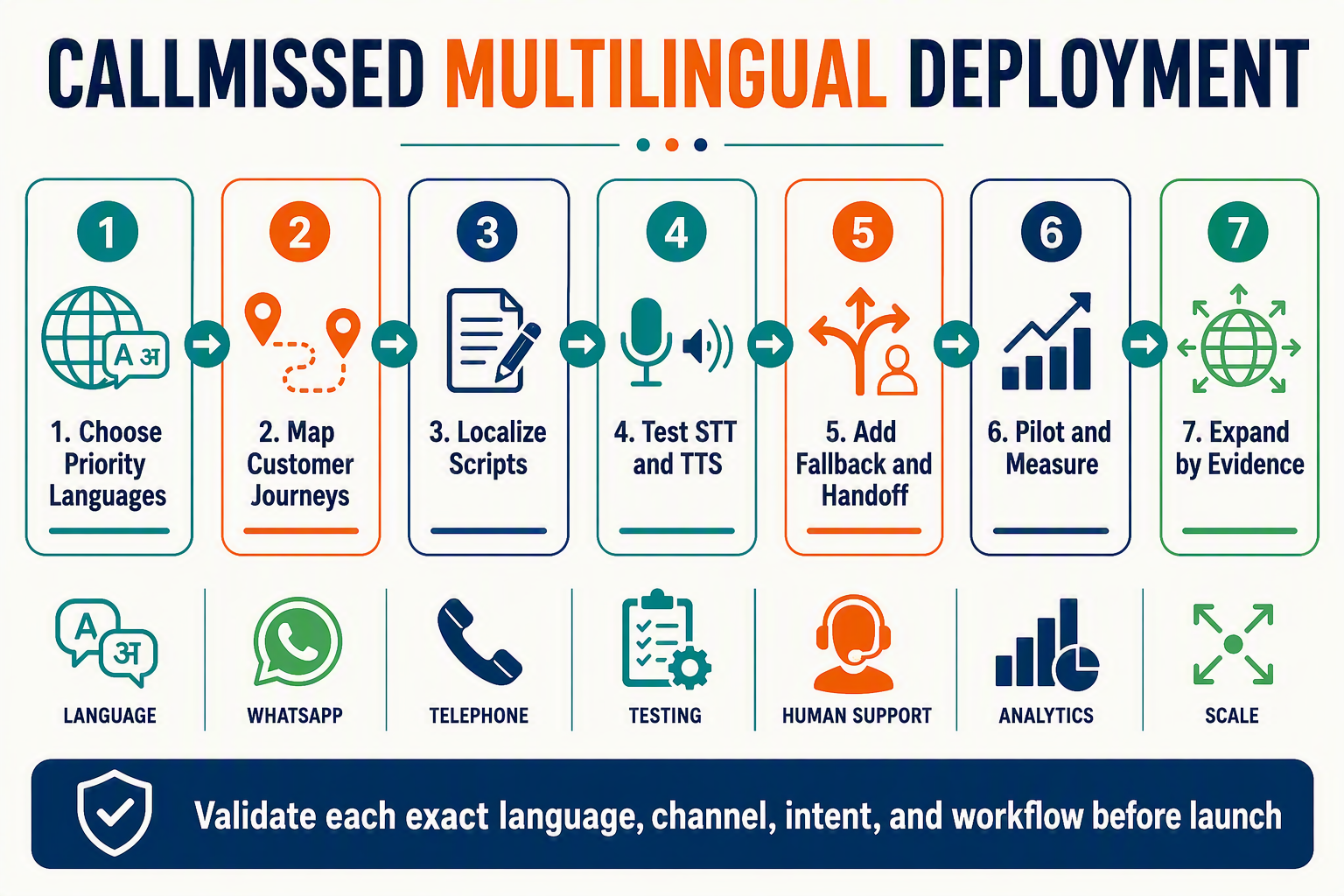
Deploy CallMissed multilingual WhatsApp by starting with the languages that reflect real customer demand. Validate each end-to-end workflow before launch, preserve language and channel choice, and expand only after the pilot meets defined quality thresholds.
Treat language as a workflow decision
Choose languages using operational evidence, not assumptions about a state’s dominant language. Rural users represented approximately 55% of India’s 886 million active internet users in 2024, based on figures from the Internet and Mobile Association of India and Kantar’s Internet in India Report 2024, published in January 2025. Regional accessibility matters, but each business needs its own priority map.
Build your initial language shortlist using:
- CRM and ticket data: Identify languages customers already request or use.
- Call recordings: Review spoken languages, accents, code-switching, names, and recurring terms.
- WhatsApp conversations: Include native-script and Latin-script messages, such as “mera order kab aayega?”
- Customer geography: Map serviceable PIN codes, branches, delivery regions, and campaign audiences.
- Business impact: Rank languages by contact volume, revenue exposure, task criticality, and escalation cost.
CallMissed supports Speech-to-Text and Text-to-Speech across 22 Indian languages, but technical availability does not guarantee production readiness. Test each selected language with the exact model, vocabulary, audio conditions, and customer journey you plan to use.
Preserve language and channel choice
A CallMissed multilingual WhatsApp workflow should ask for the customer’s preferred language early. Remember that choice with appropriate consent and make switching simple. Do not assume a customer prefers Hindi because the opening message was in Hindi. Do not assume they prefer English because they typed in Latin characters.
Provide three clear options throughout the journey:
- Continue in the current language
- Switch languages without restarting
- Move to WhatsApp text, a WhatsApp Business call, or a human agent
Use WhatsApp text for confirmations, links, addresses, and information customers may need to revisit. Voice may work better for urgent, nuanced, accessibility-sensitive, or multi-step conversations. When customers switch channels, preserve context so they do not need to repeat their account details or explain the issue again.
Expand through controlled deployment gates
Launch CallMissed multilingual WhatsApp in measured phases. Assign an owner, success criteria, and an escalation rule to every language-channel workflow.
- Discover: Rank languages, intents, channels, terminology, and risks using real interaction data. Select one high-volume workflow for the first release.
- Prototype: Define the workflow’s scope, completion criteria, fallback responses, and human-handoff triggers. Keep the first use case constrained.
- Validate: Test accents, code-switching, background noise, transliteration, names, dates, amounts, and interruptions with representative speakers. Record failures and correct them before launch.
- Pilot: Release the workflow to a limited region or customer cohort. Monitor transcripts, task completion, latency, uncertainty, and handoff quality.
- Expand: Add a language, intent, or channel only after the current configuration meets its quality thresholds. Repeat validation for every new combination.
For Indian language customer support, understandable speech is not enough. The system must complete the task accurately, respect consent, recognize uncertainty, and transfer the customer safely when automation is no longer appropriate. Treat every language-channel combination as a separate production workflow with its own tests, metrics, and release decision.
Background & Context: Which languages, dialects, scripts, and code-switching patterns do your customers actually use?

The languages that matter are the ones customers actually use in calls, WhatsApp messages, search queries, and support tickets—not merely the official language associated with their state. Build a language-demand inventory that separately records spoken language, written script, dialect, code-switching, customer preference, and interaction context.
Turn historical conversations into a language map
India’s 2011 Census recorded 19,569 raw mother-tongue returns, according to the Office of the Registrar General & Census Commissioner, India. A deployable workflow must reduce that diversity into a prioritized set of language patterns tied to real customer demand.
Review at least several weeks of representative interactions across regions, products, and customer segments. Sample:
- Call recordings: Identify primary and secondary languages, accents, dialect markers, English insertions, and frequently misheard words.
- WhatsApp conversations: Detect native scripts, Latin-script transliteration, abbreviations, emoji usage, and mixed-language sentences.
- CRM and ticket data: Connect language patterns with location, issue type, resolution time, escalation, and customer value.
- Agent observations: Ask human agents which phrases, pronunciations, and regional terms regularly create misunderstandings.
Do not infer preference solely from a phone number, PIN code, surname, or state. A Bengaluru customer may prefer Hindi for calls, English for invoices, and Kannada written in Latin characters on WhatsApp.
Classify language beyond a single label
Labels such as hi-IN or ta-IN, based on IETF BCP 47 language tags, are useful configuration fields, but they do not capture every production variable. For each target segment, document:
- Primary language: The language used for most of the interaction.
- Secondary language: The language introduced for technical, financial, or product terminology.
- Dialect or regional variety: For example, vocabulary and pronunciation can vary within Hindi, Bengali, Tamil, Marathi, or Telugu.
- Writing system: Native script, Latin script, or a mixture of both.
- Formality: Honorific, conversational, professional, or highly colloquial.
- Channel preference: WhatsApp text, WhatsApp Business calling, conventional voice, email, or human assistance.
This taxonomy gives an Indian language customer support team testable configurations rather than vague requirements such as “support Hindi.”
Capture code-switching as normal behaviour
Code-switching is not an edge case. A customer might say, “Mera payment deduct ho gaya, but order confirm nahi hua,” combining Hindi grammar with English service terminology. On WhatsApp, the same customer may type entirely in Latin script rather than Devanagari.
Tag representative conversations at three levels:
- Conversation-level switching: The customer changes language between messages or turns.
- Sentence-level switching: Different sentences use different languages.
- Phrase-level mixing: Product names, dates, amounts, or technical terms appear in another language.
Preserve these examples as a reusable evaluation set for Speech-to-Text, intent detection, and response generation.
Store preference without making it permanent
A multilingual AI voice agent India deployment should ask, confirm, and remember language preference while allowing customers to change it immediately. Store separate fields for preferred spoken language, preferred WhatsApp language and script, and last successfully used language.
For a CallMissed multilingual WhatsApp workflow, the discovery output should be a ranked matrix of language–script–channel combinations. That matrix—not a generic list of supported languages—should determine which configurations enter transcription testing, voice evaluation, script localization, and phased rollout first.
Key Developments: How do you validate claimed support for 22 Indian languages across WhatsApp and voice workflows?
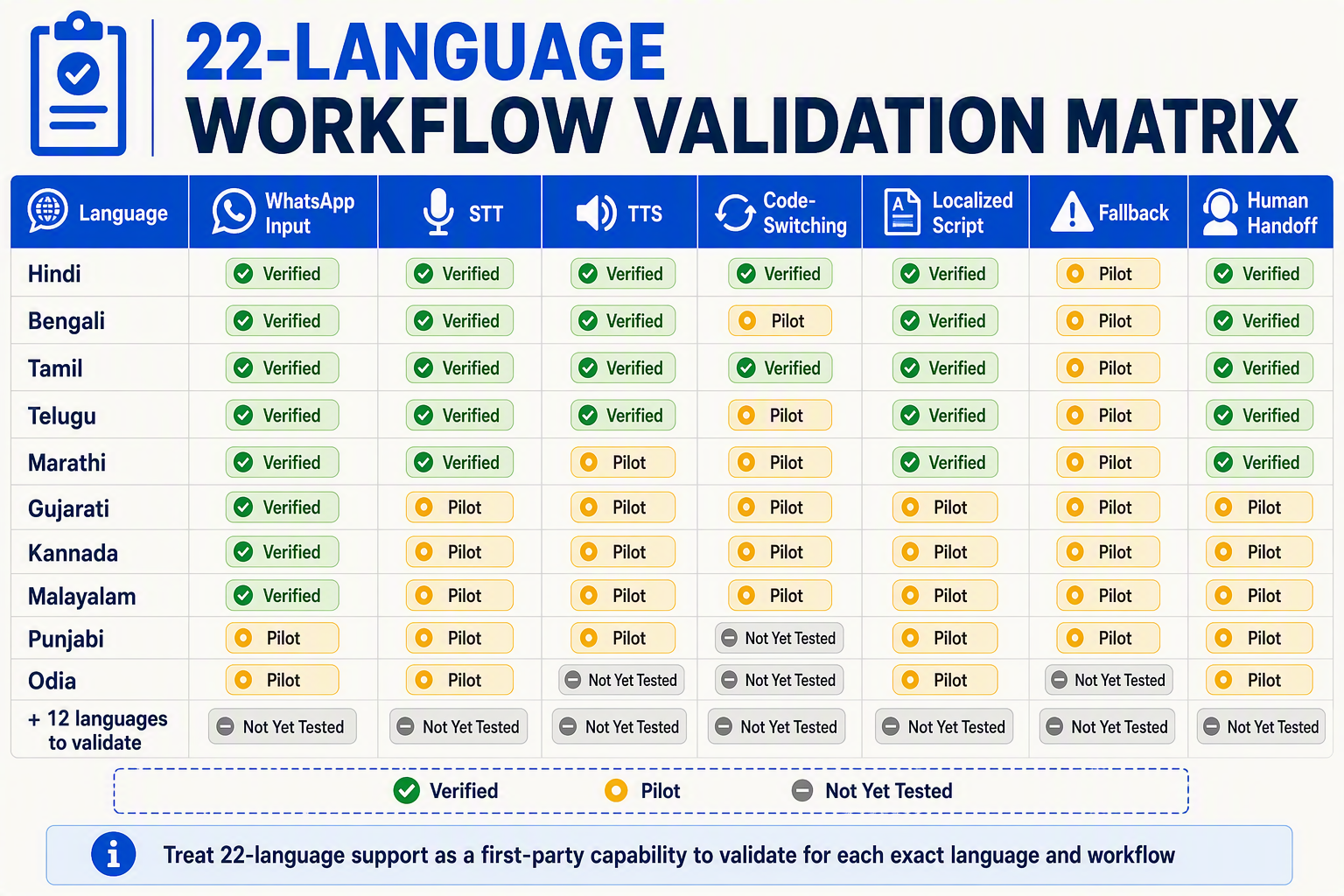
Support for 22 Indian languages should be validated as a capability matrix, not accepted as a single yes-or-no product claim. For every planned language, test the exact combination of script, code-switching pattern, WhatsApp channel, Speech-to-Text (STT), Text-to-Speech (TTS), business intent, and fallback path that customers will use.
Build a language-by-workflow test matrix
Begin with CallMissed’s documented language catalogue, then create separate test cases for WhatsApp text, inbound WhatsApp Business calls, business-initiated calls, and other AI voice-agent channels. A language that performs well in native-script messages may behave differently when written phonetically in Latin script or spoken with regional accents.
| Validation layer | Test input | Metric or evidence | Release gate |
|---|---|---|---|
| Language availability | Each required language in the selected STT and TTS configuration | Successful model selection and API response | No unsupported or silently substituted language |
| WhatsApp text | Native script, Latin transliteration, spelling variation, emojis | Intent accuracy and task-completion rate | Meets the business-defined baseline for every priority intent |
| Code-switching | Hindi-English, Tamil-English, Bengali-English, or local mixes | Language-switch retention and entity accuracy | Names, amounts, dates and intent remain correct |
| Speech-to-Text | Real calls with accents, noise, interruptions and domain terms | Word error rate, entity error rate and transcript review | No critical errors in phone numbers, addresses or payments |
| Text-to-Speech | Localized prompts, questions, numbers and abbreviations | Native-speaker rating for clarity, pronunciation and tone | Critical terms are understandable without repetition |
| End-to-end workflow | WhatsApp text-to-call transition, fallback and human transfer | Completion, latency, escalation and context retention | Conversation history and language preference survive handoff |
Test coverage, not just translation
A CallMissed multilingual WhatsApp deployment should maintain a scorecard for each language and use case. “Marathi supported” is incomplete; “Marathi WhatsApp text supports native script and common Latin transliteration for order tracking” is a testable statement.
For each priority language, include:
- At least three speaker profiles covering different regions, ages or accent patterns.
- Clean audio plus realistic samples containing traffic, office noise and weak connectivity.
- Local names, landmarks, product terminology, PIN codes, currency values and mixed-language sentences.
- Short commands, long explanations, corrections, interruptions and mid-conversation language changes.
- Both successful journeys and failure cases requiring clarification or human handoff.
This rigor is commercially relevant because rural India accounted for 488 million active internet users in 2024, according to the Internet and Mobile Association of India and Kantar’s Internet in India Report 2024, published in January 2025. A multilingual AI voice agent India rollout must therefore represent regional users and real network conditions in its test set.
Apply separate STT, TTS and workflow gates
Do not hide component failures inside one overall satisfaction score. Track STT recognition, TTS intelligibility, intent resolution, task completion, latency and escalation separately. Word error rate can help compare STT versions, but entity accuracy is often more operationally important: mishearing one digit in an account number can invalidate an otherwise accurate transcript.
TTS reviewers should score pronunciation, pace, tone and naturalness using native speakers. Scripts should be localized rather than translated literally, particularly for honorifics, consent language and escalation messages.
Finally, run an end-to-end pilot before labeling any language production-ready for Indian language customer support. CallMissed provides the multilingual infrastructure across WhatsApp and voice, but businesses should approve languages individually and revalidate them whenever models, prompts, scripts or call flows change.
In-Depth Analysis: How should you test script localization, code-switching, STT accuracy, and TTS quality?
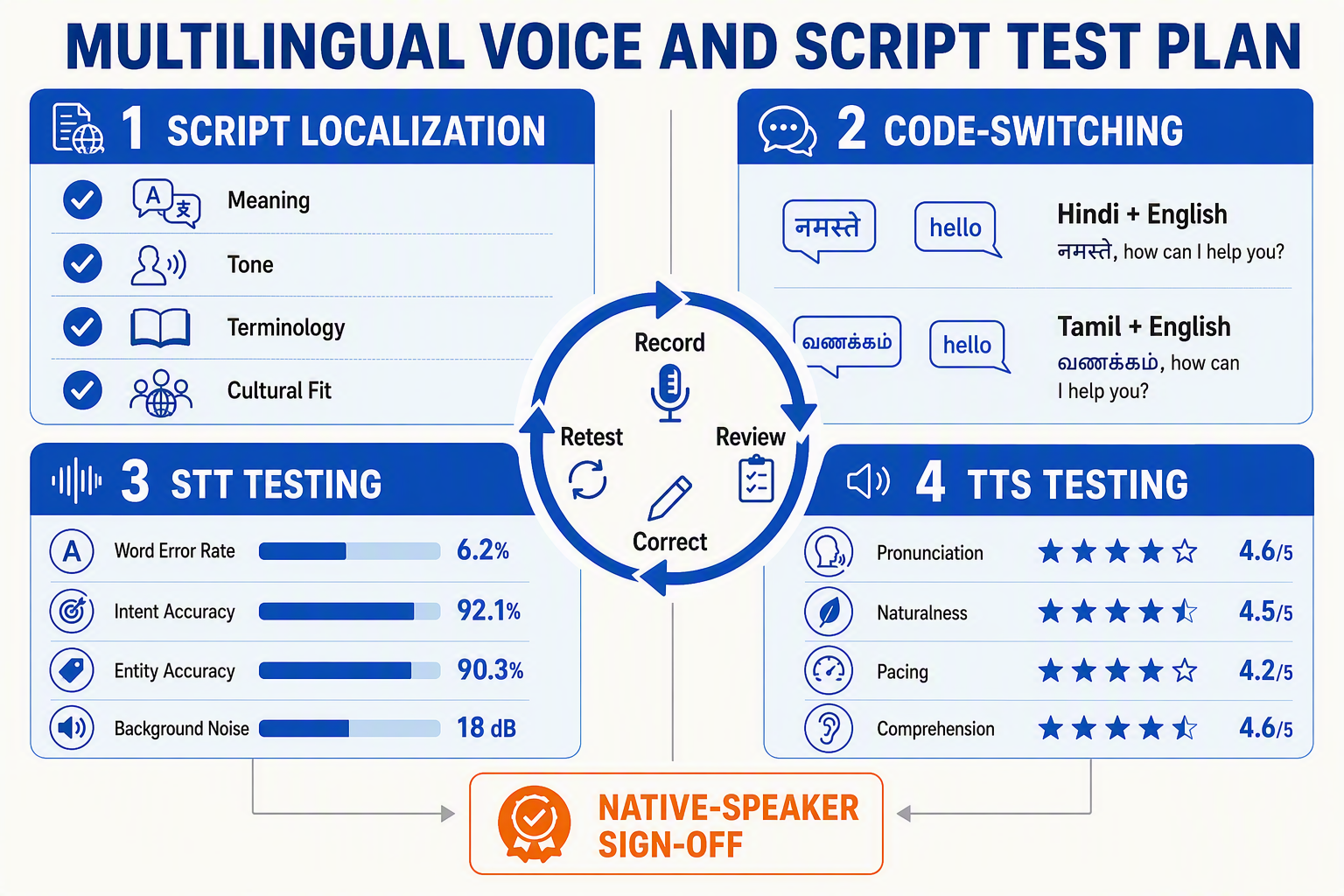
Testing should prove that customers can complete real tasks—not merely that the agent can translate sentences. Evaluate localized scripts, mixed-language conversations, Speech-to-Text (STT), and Text-to-Speech (TTS) separately, then run end-to-end tests for every priority language, channel, and use case.
Build a representative test matrix
CallMissed supports STT and TTS across 22 Indian languages, but this first-party capability must be validated against each business workflow. A multilingual AI voice agent India test set should include real communication patterns rather than only fluent speakers reading prepared scripts.
Segment test cases by:
- Language and region: Include regional accents, dialect variations, urban and rural speakers, and different age groups.
- Environment: Record quiet-room, street, vehicle, shop-floor, and low-bandwidth phone audio.
- Device and channel: Test mobile microphones, WhatsApp voice calls, conventional calls, voice notes, and typed WhatsApp messages.
- Customer vocabulary: Include product names, locality names, PIN codes, amounts, dates, order IDs, abbreviations, and industry terms.
- Script form: Test native scripts such as Devanagari and Tamil alongside Latin-script transliteration such as “mera order kab aayega?”
Use production-like samples only with appropriate consent and de-identification. Synthetic test prompts are useful for coverage, but they should not replace representative customer speech.
Test code-switching as its own capability
Do not label a conversation “Hindi” when the customer actually says, “Mera payment successful hai but order confirm nahi hua.” Create a dedicated corpus containing intra-sentence switching, language changes between turns, English brand names, and regional words embedded in Hindi or English.
Score whether the workflow:
- Detects the language without repeatedly asking the customer.
- Preserves English entities while interpreting the surrounding regional language.
- Maintains context after a language switch.
- Replies in the customer’s chosen style rather than forcing formal translation.
- Transfers the transcript and detected preference during human handoff.
For Indian language customer support, also test ambiguous words that exist across languages and customer corrections such as “Hindi nahi, Marathi mein bolo.”
Measure STT beyond word error rate
Calculate Word Error Rate (WER) as substitutions plus deletions plus insertions, divided by the reference word count. However, WER alone can conceal business-critical failures: confusing “fifteen” with “fifty” matters more than missing a filler word.
Track:
- WER or Character Error Rate by language, accent, channel, and noise condition.
- Entity accuracy for names, phone numbers, addresses, dates, currency, and identifiers.
- Intent accuracy and successful slot completion.
- Language-switch detection time and unnecessary language prompts.
- Task completion rate after transcription errors.
Set acceptance thresholds from business risk. Payment confirmations and medical appointments require stricter entity validation than general information requests.
Evaluate TTS with human listeners
Use blind listening panels of native speakers to rate naturalness, intelligibility, pronunciation, pace, tone, and appropriateness. The International Telecommunication Union’s ITU-T Recommendation P.800 uses five-category opinion scales for subjective speech-quality assessment.
Test complete interactions, not isolated sentences. Confirm that the voice handles abbreviations, honorifics, currency, dates, mixed-language product names, and interruption points naturally. Compare comprehension over speakerphone and weak connections.
Finally, test the CallMissed multilingual WhatsApp workflow separately in text and calling modes: text requires script and transliteration accuracy, while WhatsApp Business calling adds audio quality, latency, turn-taking, STT, and TTS dependencies. Release a language only when both component scores and end-to-end task outcomes meet the predefined threshold.
Impact & Implications: When should Indian language customer support use WhatsApp text instead of calling?
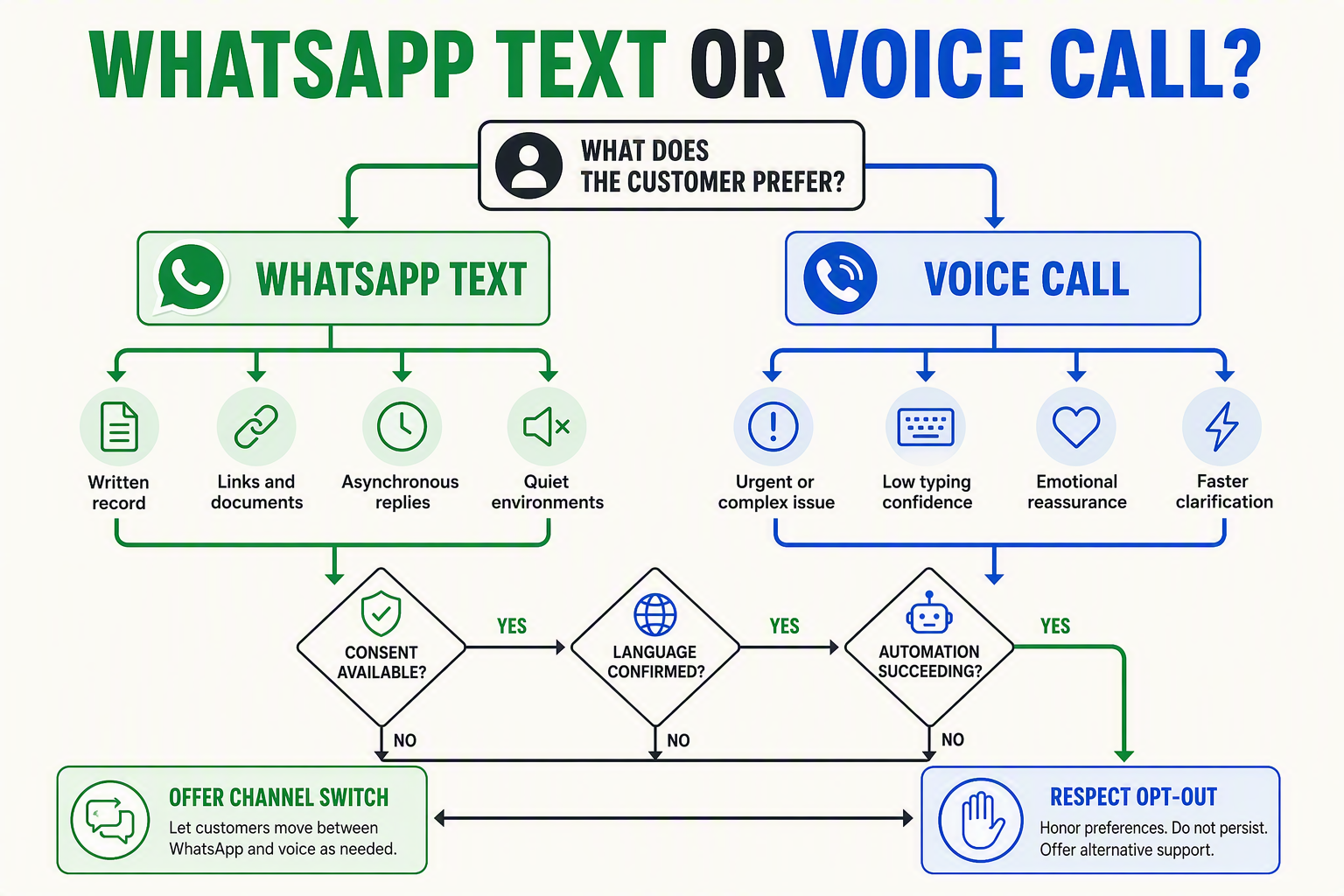
Use WhatsApp text for low-urgency, structured, and reference-heavy interactions; use WhatsApp Business calling when urgency, emotional nuance, accessibility, or conversational complexity makes typing inefficient. The right channel should depend on the customer’s preference and task—not language alone.
Choose text for asynchronous, verifiable tasks
WhatsApp text is usually the better starting point when customers need information they may revisit, copy, or share. It also gives users time to understand localized content and respond in their preferred script or in transliterated language.
Choose text for:
- Order confirmations, delivery updates, appointment reminders, and payment links.
- FAQs, product comparisons, addresses, instructions, and document checklists.
- Conversations requiring images, PDFs, screenshots, or written proof.
- Customers who reply intermittently or cannot speak privately.
- Noisy environments where Speech-to-Text accuracy may deteriorate.
- Names, account numbers, policy IDs, and alphanumeric codes that are easier to verify visually.
For Indian language customer support, text must accept native scripts as well as forms such as Romanized Hindi, Tamil-English, or Bengali-English. A customer who types “kal delivery ho jayega?” should not be forced to select one language before receiving an answer.
Escalate to calling when conversation carries more information than text
A voice call is more effective when repeated messages create friction or when tone and immediate clarification matter. This is especially relevant for customers with limited typing confidence, visual impairment, low literacy, or difficulty entering an Indian script on a mobile keyboard.
Prefer calling for:
- Urgent service failures, fraud concerns, cancellations, and time-sensitive rescheduling.
- Troubleshooting that requires several conditional questions.
- Sensitive complaints where empathy and tone influence resolution.
- Complex code-switching that produces ambiguous written intent.
- Customers who explicitly request a call or repeatedly send voice notes.
- High-value transactions requiring real-time clarification and confirmation.
For teams deploying a multilingual AI voice agent India workflow, voice should not become the automatic fallback for every unrecognized message. First ask a concise clarifying question; offer a call only if uncertainty remains or the customer prefers speaking.
Apply a measurable channel-switching policy
A practical workflow can use observable triggers rather than intuition:
- Start in the customer’s saved channel unless the request is urgent.
- Offer calling after two failed clarification attempts or when confidence remains below the deployment’s validated threshold.
- Preserve the transcript, detected language, intent, and completed verification steps when switching channels.
- Confirm permission before initiating a business call, and disclose automation or recording where applicable.
- Transfer to a human when the AI cannot safely resolve the request, regardless of channel.
These numbers are deployment recommendations, not universal benchmarks; teams should adjust them using completion, escalation, and satisfaction data for each language.
Treat channel choice as part of localization
CallMissed supports Speech-to-Text and Text-to-Speech across 22 Indian languages, but channel performance must still be validated for each language, accent, and workflow. A CallMissed multilingual WhatsApp deployment can keep one conversation across chat and WhatsApp Business calling, allowing an AI agent to move from written instructions to spoken assistance without discarding context.
The broader implication is clear: multilingual support is not simply translation. Text optimizes convenience and auditability; calling optimizes immediacy, accessibility, and conversational repair. The strongest workflow lets customers move between both while retaining language preference, consent status, and conversation history.
Expert Opinions: What fallback, consent, and human-handoff controls should a multilingual AI voice agent India deployment include?
A production-ready multilingual agent should fail safely, collect channel-specific consent, and transfer customers without losing context. For Indian businesses, these controls should be designed per language and workflow rather than treated as one universal configuration.
Use confidence-based, layered fallbacks
Speech-to-Text confidence should not be the sole trigger because an agent can transcribe words correctly while misunderstanding the customer’s intent. Conversation-design and contact-centre practitioners generally recommend combining recognition confidence, intent confidence, repetition count, latency, sentiment, and task risk.
A practical fallback ladder is:
- Confirm: Repeat the interpreted request: “You want to reschedule tomorrow’s delivery—is that correct?”
- Rephrase: Ask a shorter question using familiar regional vocabulary.
- Switch modality: Send names, addresses, OTP instructions, or account numbers through WhatsApp text.
- Offer language switching: Let the customer select another supported language without restarting.
- Transfer to a person: Escalate after repeated failure or immediately for high-risk intents.
Initial thresholds might trigger clarification when confidence falls below 0.75 and human handoff after two failed clarification attempts, but these are deployment starting points—not universal benchmarks. Teams should calibrate them using real calls for every supported language, accent group, and code-switching pattern.
A multilingual AI voice agent India workflow should also treat silence, background noise, mixed-language speech, abusive interactions, payment disputes, medical or safety concerns, and requests for a human as explicit escalation events. Never trap customers in a retry loop.
Make consent specific to the interaction
Consent for a WhatsApp message does not automatically establish consent for an automated voice call, call recording, marketing, or unrelated data processing. India’s Digital Personal Data Protection Act, 2023 states that consent must be “free, specific, informed, unconditional and unambiguous” and signified through a “clear affirmative action.”
Before collecting or recording personal data, the agent should explain—in the customer’s selected language:
- That the customer is interacting with an AI agent.
- Why personal information is being collected.
- Whether the conversation or call will be recorded.
- How the customer can decline, withdraw consent, or reach a person.
- Whether a follow-up will occur through WhatsApp text or calling.
Promotional communications must also respect the Telecom Regulatory Authority of India’s Telecom Commercial Communications Customer Preference Regulations, 2018, applicable consent records, customer preferences, and approved communication routes. Store the consent timestamp, language, channel, disclosure version, and customer action as auditable fields.
Design a context-preserving human handoff
A successful handoff transfers more than the call. The receiving employee should receive a concise summary containing:
- Customer identity and preferred language.
- Detected language changes and code-switched terms.
- Original request, completed steps, and unresolved issue.
- Relevant transcript excerpts and confidence warnings.
- Consent and recording status.
- Authentication state and prohibited actions.
The agent should say why it is transferring the interaction, provide an estimated wait where available, and avoid making the customer repeat information. If no suitable language specialist is online, offer a scheduled callback or continue through WhatsApp text.
CallMissed multilingual WhatsApp workflows can connect WhatsApp Business calling to an AI voice agent while supporting Indian language customer support across 22 Indian languages. Each fallback, consent prompt, and handoff summary should nevertheless be validated with representative speakers before production deployment.
What This Means For You: Which rollout phases, owners, and metrics should your team use?
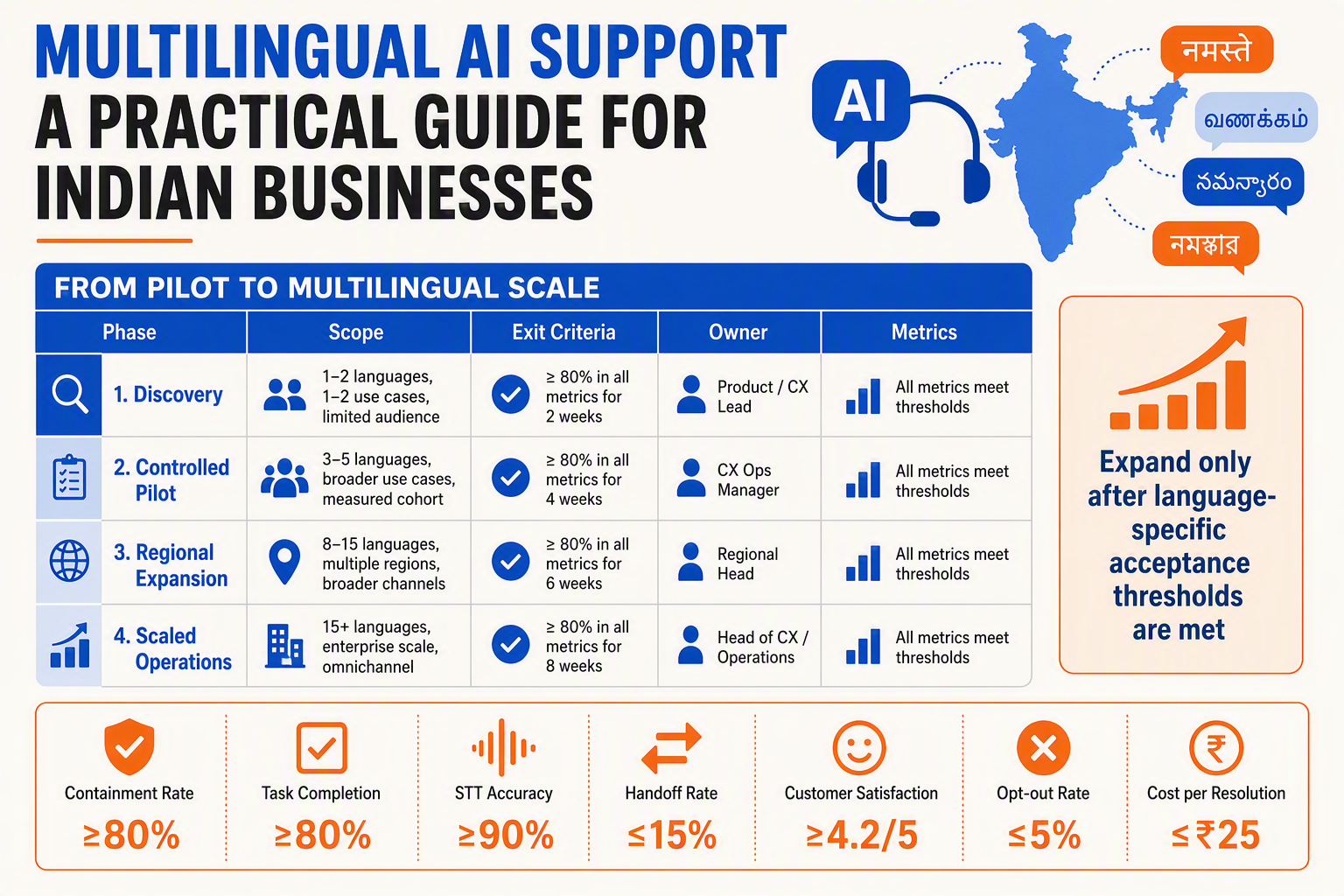
Use a six-phase rollout with one accountable owner per phase, language-level release gates, and channel-specific metrics. Do not launch every language simultaneously: establish a baseline, pilot one high-demand workflow, validate quality with representative speakers, and expand only when the data supports it.
Recommended rollout plan
| Phase | Scope and release gate | Accountable owner | Metrics to track | Decision |
|---|---|---|---|---|
| 1. Demand mapping | Rank languages by customer records, geography, revenue impact and contact volume; document WhatsApp text-versus-call use cases | CX or operations lead | Contacts by language; unresolved cases; text/call mix; preferred-language capture rate | Select the first language, workflow and customer cohort |
| 2. Workflow design | Localize intents, prompts, consent notices and human-handoff scripts; review code-switched and Latin-script inputs | Conversation designer | Intent coverage; script-review defects; consent capture rate; escalation-path coverage | Proceed only after native-speaker and compliance approval |
| 3. STT/TTS validation | Test real recordings across accents, devices, background noise, names, addresses, numbers and domain terms | AI/quality lead | Word error rate; entity accuracy; language-detection errors; TTS naturalness rating; response latency | Tune vocabulary, prompts, models or fallback rules |
| 4. Controlled pilot | Release to employees or a small customer cohort with monitoring and rapid human takeover | Product owner | Task-completion rate; containment rate; fallback rate; transfer success; CSAT by language | Compare results with the existing human or single-language baseline |
| 5. Regional production | Launch one region or customer segment; preserve context across WhatsApp chat, calling and human handoff | Operations lead | Repeat-contact rate; abandonment; call connection rate; handoff time; complaints or consent withdrawals | Expand, revise or pause based on agreed release gates |
| 6. Multilingual scale | Add languages and workflows individually; maintain regression tests and monthly quality reviews | Program owner | Metric change by language, channel and intent; cost per resolution; incident rate; drift rate | Retain, retrain, reroute or retire underperforming workflows |
Assign metrics that reveal language-specific failures
A blended “all languages” dashboard can conceal poor performance in a smaller cohort. The 2011 Census of India recorded 19,569 raw mother-tongue returns, so each metric should be segmented by language, region, channel, intent and—where consent permits—code-switching pattern.
Use clear formulas:
- Task-completion rate: completed target actions ÷ eligible conversations.
- Containment rate: conversations resolved without human assistance ÷ eligible automated conversations.
- Successful handoff rate: transfers reaching an informed human with context ÷ attempted transfers.
- STT entity accuracy: correctly captured critical entities ÷ all tested critical entities.
- Language-preference retention: returning customers served in their saved language ÷ returning customers with a recorded preference.
- Fallback rate: low-confidence or unsupported interactions routed to clarification, another channel or a human ÷ total interactions.
Set targets from your current human-service baseline and pilot results rather than adopting a universal benchmark. A high containment rate is not success if completion, consent compliance or customer satisfaction declines.
Turn rollout data into operating decisions
The Internet and Mobile Association of India and Kantar reported 886 million active internet users in India in 2024, including 488 million in rural India, in the Internet in India Report 2024 published in January 2025. That scale makes regional segmentation essential for Indian language customer support.
For a multilingual AI voice agent India deployment, review high-risk failures daily during the pilot and conduct weekly language scorecards after launch. CallMissed supports Speech-to-Text and Text-to-Speech across 22 Indian languages, plus WhatsApp chat and WhatsApp Business calling; treat that coverage as the testable foundation of a CallMissed multilingual WhatsApp rollout, not as permission to skip workflow-level validation. Each new language should pass the same consent, recognition, localization, fallback and handoff gates before production expansion.
Frequently Asked Questions about CallMissed multilingual WhatsApp and voice workflows
How do I choose languages for a CallMissed multilingual WhatsApp deployment?
Can a CallMissed multilingual WhatsApp workflow handle Hindi-English and regional-language code-switching?
How should an Indian business test STT and TTS before launching a multilingual AI voice agent in India?
Should Indian language customer support use WhatsApp text or WhatsApp Business calling?
How should multilingual customer-service scripts be localized instead of directly translated?
What fallback, consent, and measurement controls should a multilingual workflow include?
Conclusion
A successful multilingual deployment is not defined by how many languages an agent can speak, but by how reliably customers can complete real tasks across WhatsApp text and voice. The strongest rollout combines language prioritization, realistic testing, localized scripts, explicit consent, measured fallbacks, and progressive expansion.
Key takeaways
- Prioritize languages with evidence. Use customer geography, contact records, call volumes, commercial value, and stated preferences rather than assuming Hindi and English will cover everyone. India’s 2011 Census recorded 19,569 raw mother-tongue returns, illustrating why language selection must reflect each business’s actual audience.
- Design around natural communication. A multilingual AI voice agent India workflow must handle Hindi-English and regional-language code-switching, Latin-script messages, colloquial expressions, names, addresses, numbers, accents, and industry terminology. Store each customer’s preferred language and channel, but allow that preference to change during a conversation.
- Test the complete experience, not just language availability. Benchmark Speech-to-Text and Text-to-Speech with representative speakers, noisy recordings, realistic devices, and production vocabulary. Localize intent, tone, dates, currency, examples, and escalation language instead of translating scripts word for word.
- Match the channel to the task. Use WhatsApp text for confirmations, links, structured updates, and conversations customers may need to revisit; use WhatsApp Business calling when urgency, ambiguity, accessibility, or complexity makes voice more effective. Low-confidence detection should trigger clarification, language switching, or a context-preserving human handoff—not repeated automated guesses.
What comes next
India’s multilingual internet population will make language-level performance increasingly important. India had 886 million active internet users in 2024, while rural India accounted for 488 million, according to the Internet and Mobile Association of India and Kantar’s Internet in India Report 2024, published in January 2025. Businesses should therefore watch task completion, recognition errors, latency, containment, escalation, and customer satisfaction separately for every language and channel.
CallMissed supports Speech-to-Text and Text-to-Speech across 22 Indian languages, plus WhatsApp chat, WhatsApp Business calling, and AI voice agents. Teams can explore CallMissed when building a CallMissed multilingual WhatsApp deployment, while validating every language and workflow with representative users.
The practical path to better Indian language customer support is phased: test internally, pilot one language and use case, review failures, then expand region by region. Which customer language and journey will you validate first?
Related Reading
Discussion
Related Posts

Ready to automate customer conversations?
Launch AI voice agents and WhatsApp bots with CallMissed — one API, 22+ Indian languages.