
CallMissed for Restaurants: AI Voice, WhatsApp and Email Guide


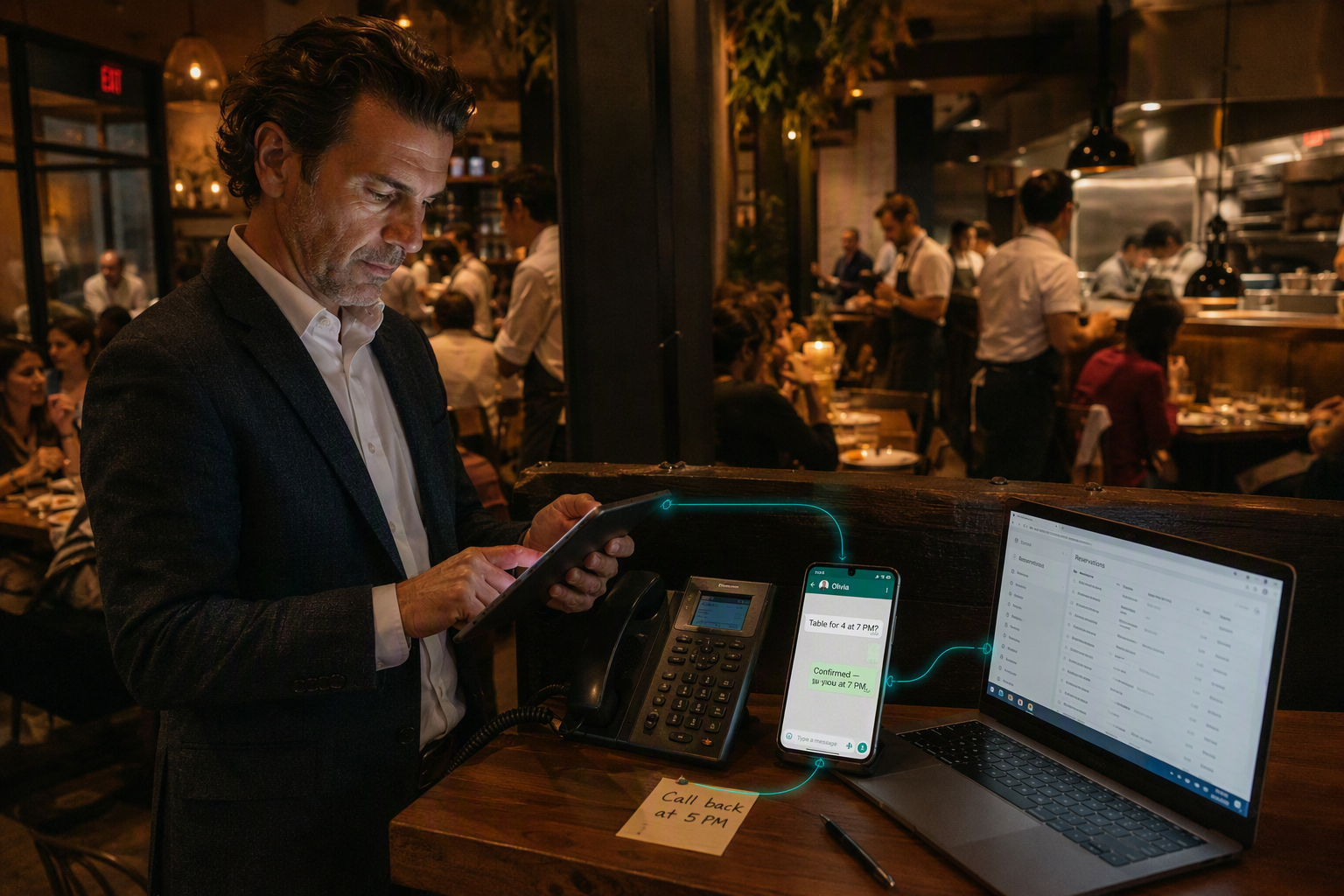
Learn how CallMissed for restaurants can manage enquiries, missed calls, reservations, guest handoffs and multichannel workflows.
CallMissed for Restaurants: AI Voice, WhatsApp and Email Guide
How many bookings, orders, and loyal guests does a restaurant lose while its team is serving the people already at the tables? CallMissed for restaurants addresses that hidden revenue gap by using AI voice, WhatsApp, and email workflows to answer routine questions immediately, capture structured requests, and escalate conversations that require human judgment.
The timing matters because customer communication is becoming more conversational and more fragmented. Meta CEO Mark Zuckerberg reported in April 2025 that WhatsApp had surpassed 3 billion monthly active users, making the platform a critical customer-contact channel in markets such as India. Meanwhile, McKinsey estimated in 2023 that generative AI could increase customer-care productivity by 30% to 45% of current function costs—an indication of why automated service is moving from experimentation into daily operations.
Restaurants face a particularly difficult communication problem. Calls arrive during lunch and dinner rushes, opening hours vary on holidays, menus change, and large-party enquiries rarely fit a simple reservation form. A missed call could represent a table for two, a corporate dinner for 30, an allergy question, or a guest trying to locate an overdue order. Conventional voicemail records the problem; restaurant call automation can begin resolving it.
CallMissed combines AI voice agents, WhatsApp chatbots and WhatsApp Business calling, email tooling, a shared omnichannel inbox, and knowledge-base retrieval. Its support for speech and text workflows across 22 Indian languages is especially relevant for restaurants serving multilingual local and tourist audiences. Used as a restaurant AI receptionist, the platform could answer approved menu and opening-hours questions, collect reservation details, send WhatsApp confirmations, classify emails, and transfer sensitive or unusual requests to staff.
This guide will show how to design practical workflows for:
- Reservation enquiries, including date, time, party size, seating preferences, and confirmation rules
- Opening hours and menu questions, grounded in a maintained restaurant knowledge base
- Missed calls and WhatsApp follow-ups, without forcing guests to repeat their request
- Large-party and event leads, routed to the appropriate manager with structured details
- Order-status queries, connected to verified order data rather than AI guesswork
- Human handoff, with conversation history and escalation triggers preserved
You will also learn the setup sequence, common failure cases, safety boundaries, and metrics worth tracking—from containment and transfer rates to booking completion and response time. Because capabilities can depend on the restaurant’s CallMissed plan, WhatsApp Business approval, telephony configuration, and third-party reservation or ordering integrations, the guide also includes a verification table separating standard capabilities from features that must be confirmed for a specific account.
How can CallMissed for restaurants handle guest enquiries across voice, WhatsApp and email?
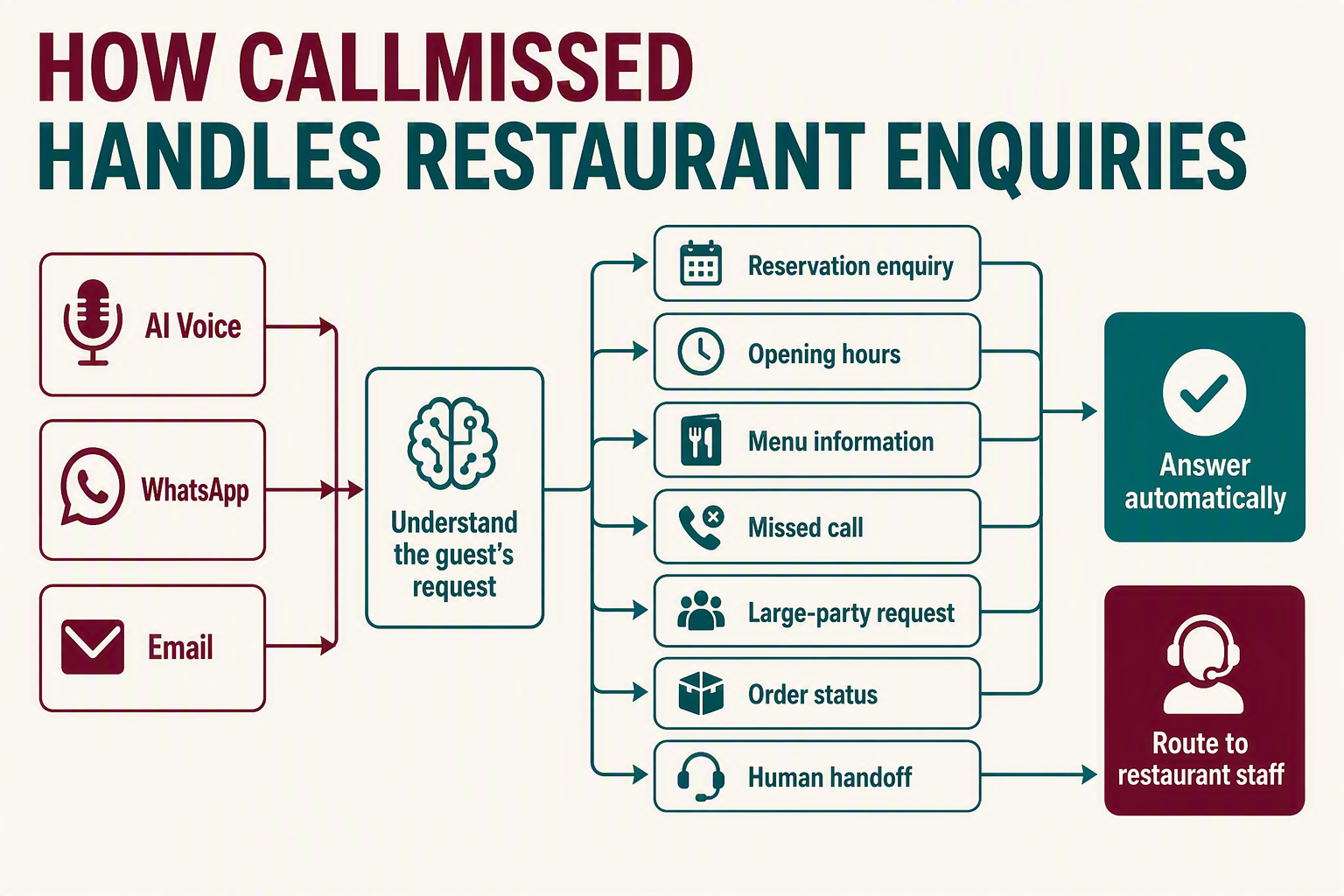
CallMissed for restaurants can manage routine enquiries across AI voice, WhatsApp, and email, while keeping the conversation history in one omnichannel inbox. AI can answer approved questions, collect guest details, and route requests. Staff should handle allergies, complaints, disputes, uncertain availability, and other sensitive or unverified issues.
Match the workflow to the guest’s channel
Guests choose channels based on urgency and complexity. WhatsApp is an important service channel: in April 2025, Meta CEO Mark Zuckerberg reported that it had exceeded 3 billion monthly active users.
A restaurant can give each channel a clear role:
- AI voice: Answer time-sensitive questions about opening hours, directions, dress codes, menu options, and availability when verified data is accessible.
- WhatsApp chat: Collect reservation details, share approved information, send confirmations, and continue missed-call conversations.
- WhatsApp Business calling: Connect eligible WhatsApp calls to an AI voice workflow, subject to account approval, availability, and configuration.
- Email: Classify detailed requests involving private dining, corporate events, catering, invoices, or group menus.
- Omnichannel inbox: Give staff access to messages, transcripts, contact details, summaries, and unresolved tasks.
This approach reduces routine interruptions without removing human oversight.
Turn each enquiry into a structured workflow
A restaurant AI receptionist should do more than provide conversational answers. It should collect the information required to resolve the enquiry or send it to the right employee.
For example, CallMissed for restaurants could support a reservation workflow that:
- Captures the requested date, time, party size, and location.
- Asks about seating preferences, accessibility needs, children, or high chairs.
- Checks availability through an authorised reservation integration, if configured.
- Clearly states when staff confirmation is still required.
- Records the guest’s name and preferred contact method.
- Sends a summary through WhatsApp or email.
- Escalates incomplete, conflicting, or policy-sensitive requests.
For opening-hours and menu questions, the AI should use a maintained knowledge base. This can include service periods, holiday exceptions, current menus, prices, dietary labels, and branch-specific details. If no reliable answer is available, it should not guess. It should create a task for staff instead.
Continue missed calls without losing intent
With CallMissed for restaurants, a missed call can begin a follow-up workflow rather than end the interaction. Subject to consent, messaging rules, supported features, and account configuration, the restaurant could send a WhatsApp message asking whether the caller needs a reservation, directions, an order update, or help with an existing booking.
Supported channels can preserve collected details so guests do not have to start again. For example, someone enquiring about a dinner for 20 could receive questions covering:
- Preferred date and time
- Estimated guest count
- Budget or menu preference
- Dietary and accessibility needs
- Décor, audiovisual, or private-room requirements
- Decision deadline and contact details
Escalate sensitive requests with full context
AI can usually handle approved FAQs, basic reservation intake, directions, opening hours, and structured data collection. Staff should take over when a request involves:
- Allergies or complex dietary risks
- Complaints or service recovery
- Payment disputes
- VIP arrangements
- Large or unusual parties
- Uncertain availability
- Order status without verified backend data
- Requests outside approved policies or knowledge sources
When escalation is needed, CallMissed for restaurants can give staff the conversation summary, transcript, captured fields, channel history, and reason for handoff. This helps the employee respond without asking the guest to repeat the entire enquiry.
Why are missed calls and repetitive questions costly for restaurants?
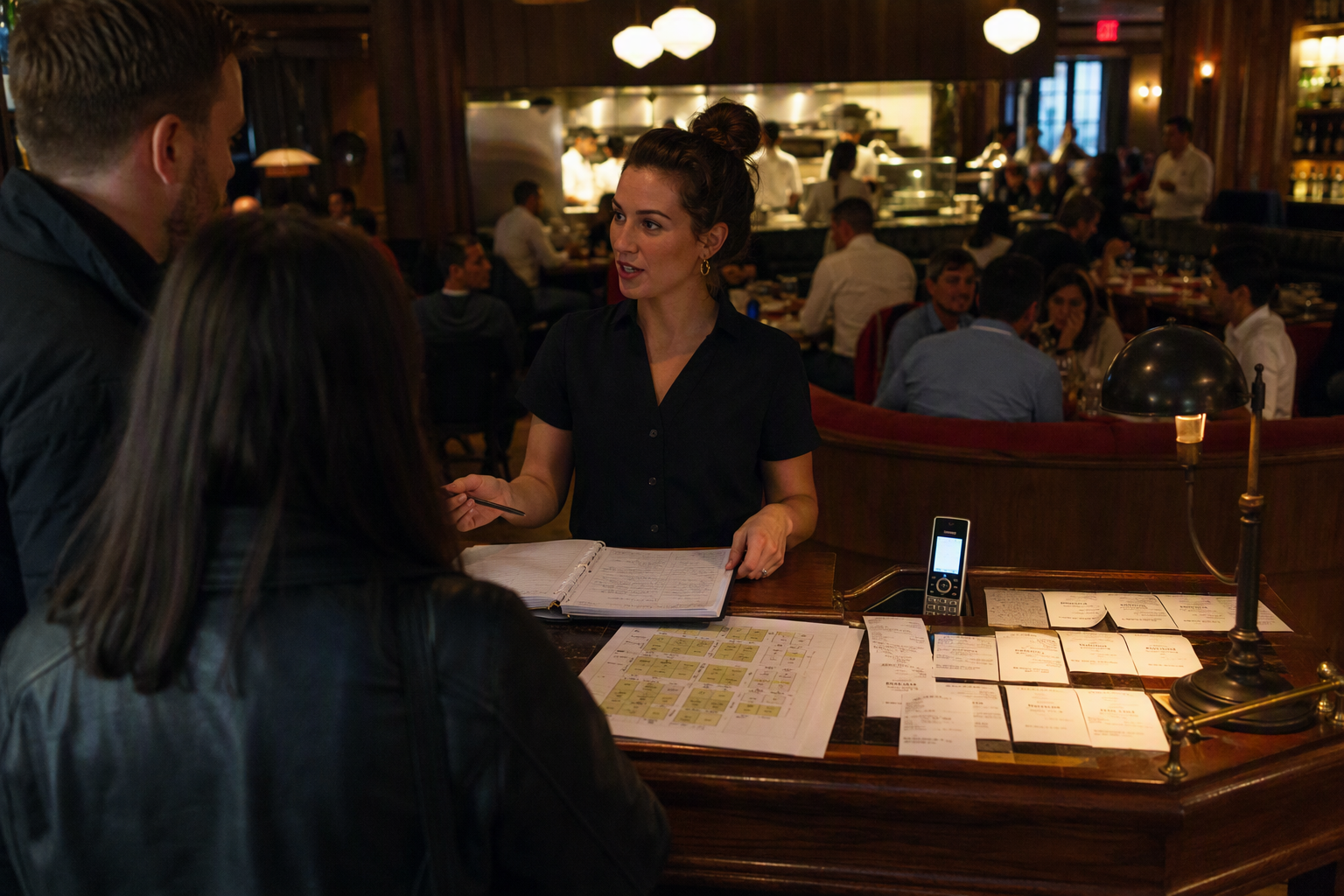
Missed calls and repetitive questions cost restaurants twice: they allow high-intent demand to disappear while consuming staff time that should be spent on guests and operations. The damage includes not only lost reservations, but also interrupted service, inconsistent answers, slower follow-up, and incomplete customer data.
A missed call is an unidentified revenue opportunity
A ringing phone provides little indication of its potential value. The caller could be checking closing time, but the same call could concern a group dinner, catering request, private event, or unresolved delivery.
When nobody answers, the restaurant usually cannot distinguish between these opportunities. Traditional voicemail may capture a message, but it introduces another queue for employees to monitor. A restaurant AI receptionist can instead qualify the request immediately by collecting fields such as:
- Requested date, time, and party size
- Guest name and callback number
- Occasion or event type
- Dietary and accessibility requirements
- Preferred seating or venue area
- Whether the enquiry needs manager approval
The financial impact should be calculated using the restaurant’s own numbers. For example, if 40 calls are missed each week, 25% concern reservations, 40% of those would have converted, and the average booking value is ₹3,000, the estimated opportunity is ₹12,000 per week:
40 missed calls × 25% booking intent × 40% conversion × ₹3,000 = ₹12,000
This is an illustrative model, not a guaranteed outcome, but it turns “missed calls” into a measurable operating problem.
Repetitive questions create an interruption tax
Questions about opening hours, parking, menu items, dress codes, delivery areas, and table availability are individually simple. Their cumulative cost comes from repeatedly pulling hosts, cashiers, and managers away from time-sensitive work.
The interruption can affect several workflows:
- A host pauses check-ins to answer a menu question.
- Kitchen staff are consulted because the latest allergen information is unclear.
- A manager searches for details about a large-party policy.
- The customer waits while information is passed between employees.
- The answer is never captured for reuse across voice, WhatsApp, or email.
McKinsey estimated in 2023 that generative AI could improve customer-care productivity by an amount equal to 30% to 45% of current function costs. For restaurants, the practical opportunity is not replacing hospitality; it is reducing repetitive information retrieval and preserving employee attention for situations requiring empathy or judgment.
Delayed answers also weaken consistency and follow-up
A guest may ask the same question by phone, WhatsApp, and email when the first channel receives no response. Without a shared record, employees may provide different answers or unknowingly process the request twice.
Restaurant call automation should therefore do more than answer calls. CallMissed for restaurants can connect AI voice, WhatsApp, email, and an omnichannel inbox so that captured context follows the conversation. A useful workflow might answer approved opening-hours information automatically, send a reservation summary through WhatsApp, and route exceptions to a person.
The goal is not 100% automation. It is to separate repeatable questions from high-value exceptions, ensuring that allergy concerns, complaints, unusual order-status issues, and large-party negotiations reach staff with the relevant history already attached.
Which restaurant enquiries can a restaurant AI receptionist automate, assist or escalate?
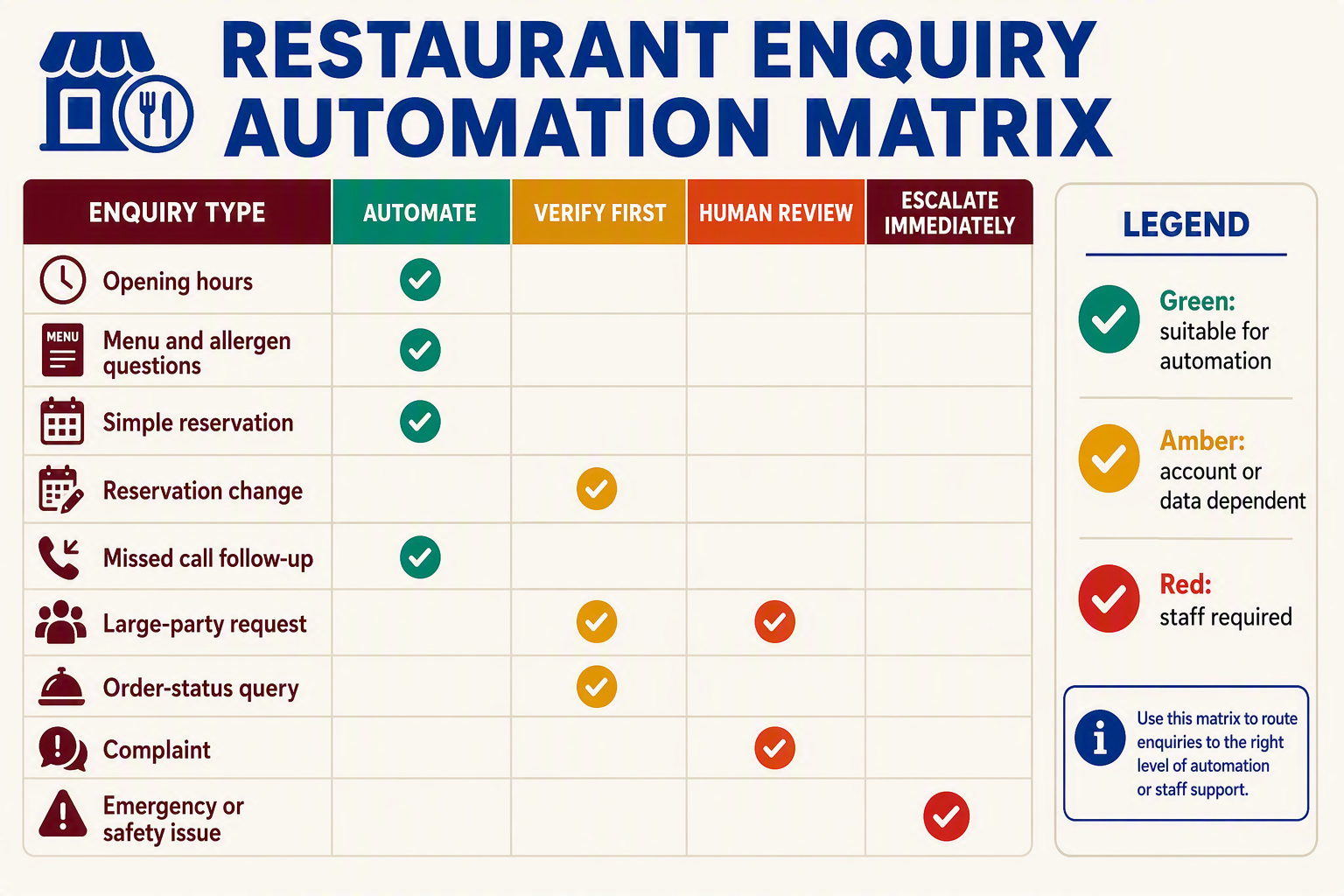
A restaurant AI receptionist should automate low-risk, fact-based enquiries, assist with requests requiring system checks, and escalate decisions involving safety, money, exceptions, or staff judgment. The key is to assign each enquiry a clear source of truth and a defined handoff rule rather than allowing the AI to improvise.
Automation and escalation matrix
| Enquiry type | Automate | Assist | Escalate when |
|---|---|---|---|
| Reservation enquiry | Collect date, time, party size, name, phone number, and seating preference; confirm when live availability is verified | Offer approved alternative times or capture a waitlist request | The booking system is unavailable, the guest requests an exception, or availability is ambiguous |
| Opening hours | Answer from a maintained schedule across voice, WhatsApp, and email | Clarify holiday, brunch, bar, kitchen, or last-order hours | Published sources conflict or a special-event schedule has not been approved |
| Menu information | Retrieve current dishes, prices, dietary labels, and availability notes from the knowledge base | Share a menu link or gather preferences for staff review | The question concerns severe allergies, cross-contamination, medical advice, or an unverified ingredient |
| Missed calls | Trigger a callback workflow or send a contextual WhatsApp message asking how the restaurant can help | Classify the reply as booking, order, menu, event, or complaint | The customer is distressed, requests urgent assistance, or repeatedly fails automation |
| Large-party or event request | Capture guest count, preferred date, budget range, occasion, catering needs, and contact details | Summarise the lead and route it to the events or restaurant manager | The request involves custom pricing, deposits, contracts, exclusive use, or unusual service requirements |
| Order-status query | Authenticate the customer and retrieve status from a connected ordering or delivery system | Collect the order number and prepare a staff-ready summary if data is unavailable | The order is significantly delayed, marked delivered but missing, duplicated, cancelled, or disputed |
Apply a risk-based routing policy
Restaurant call automation should not treat every answered question as successful containment. A confident but incorrect response about an allergen, deposit, or delayed order is more damaging than an immediate transfer.
Configure three operational levels:
- Automate: Use approved, current data for routine questions such as standard hours, location, parking guidance, and reservation-detail capture.
- Assist: Let the AI gather information, check connected systems, suggest permitted alternatives, and create a concise summary for staff.
- Escalate: Transfer the interaction—or create a priority callback task—when confidence is low, data conflicts, authentication fails, or policy requires authorization.
McKinsey estimated in 2023 that generative AI could improve customer-care productivity by 30% to 45% of current function costs; for restaurants, that opportunity comes from reducing repetitive work while preserving human attention for exceptions.
Define the handoff payload
With CallMissed for restaurants, voice, WhatsApp, and email interactions can enter a shared workflow instead of becoming disconnected conversations. Every escalation should carry:
- The guest’s name, phone number, preferred language, and channel
- A transcript or concise conversation summary
- Extracted booking, order, or event details
- The knowledge-base articles or system records consulted
- The escalation reason, urgency level, and requested next action
CallMissed supports speech and text workflows across 22 Indian languages, so routing rules should preserve the guest’s detected or selected language during transfer. Staff should receive the context before accepting the handoff, preventing guests from having to repeat an allergy concern, booking request, or order complaint.
How should restaurants set up AI voice, WhatsApp and email workflows?
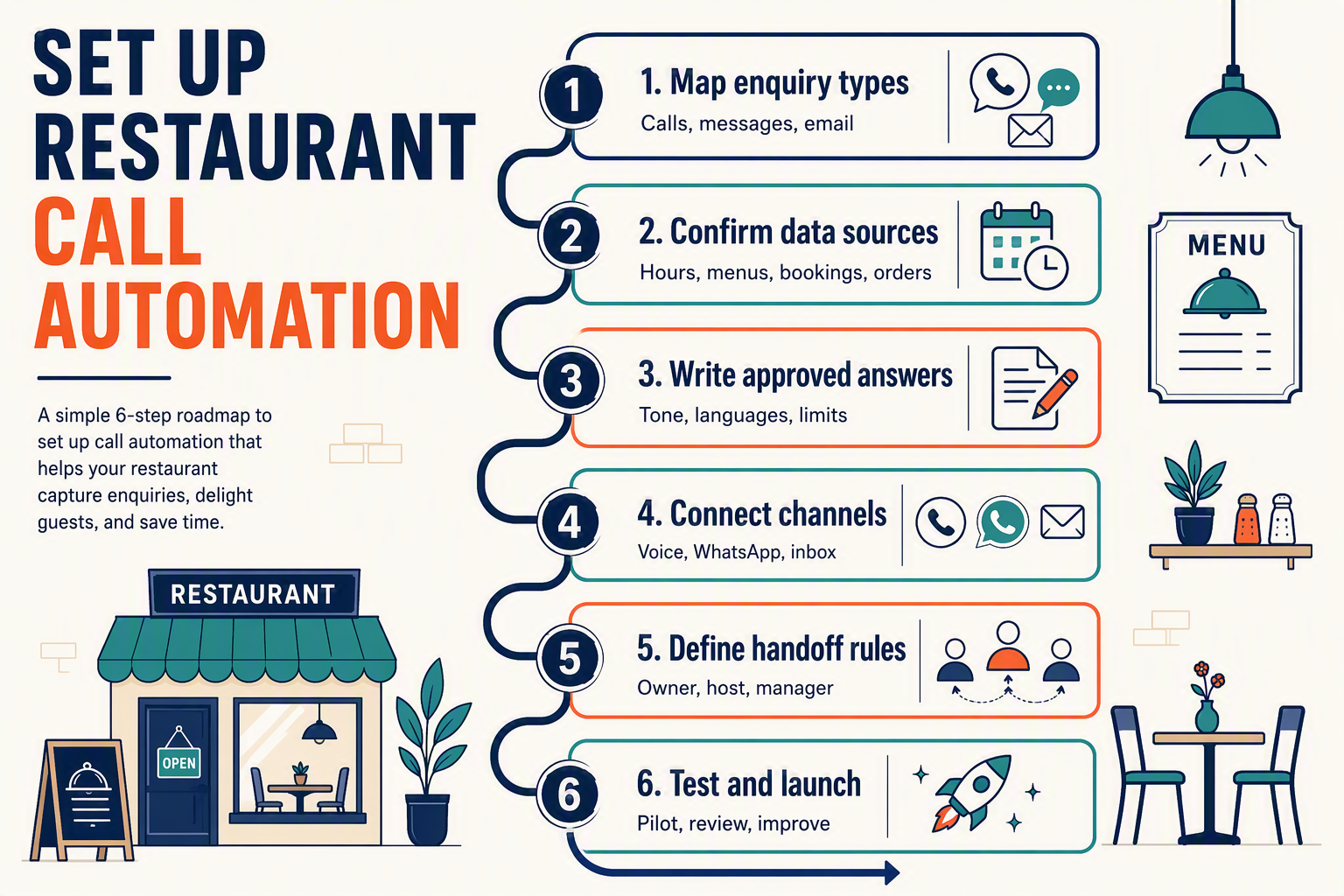
Restaurants should build AI workflows around a single verified knowledge base, structured data capture, channel-specific follow-ups, and explicit human-handoff rules. Start with a narrow set of high-volume enquiries, test each workflow against real restaurant scenarios, and expand automation only after staff can review transcripts and correct outdated information.
1. Establish trusted sources of truth
Before activating a restaurant AI receptionist, organise the information the agent is permitted to use. In CallMissed, this content can ground responses through knowledge-base retrieval rather than relying on a language model’s general knowledge.
Create approved records for:
- Regular, weekend, and holiday opening hours
- Current menus, prices, taxes, and item availability
- Address, parking, accessibility, and directions
- Reservation policies, table durations, deposits, and cancellation terms
- Allergy guidance and a mandatory escalation disclaimer
- Delivery areas and supported order-status systems
- Large-party capacity and event-enquiry criteria
Assign an owner to every dataset and record its last review date. Menu availability, holiday schedules, and promotional offers should have expiry dates so that stale information is removed automatically or flagged for review.
2. Design the voice workflow first
Voice usually contains the most urgent and least structured requests. Configure restaurant call automation to identify the guest’s intent, collect only the necessary fields, and confirm important details aloud.
A reservation flow should:
- Capture date, time, party size, guest name, phone number, and seating preference.
- Check connected reservation availability where an approved integration exists.
- Read back the request before creating or forwarding it.
- Send a written confirmation through WhatsApp or email.
- Transfer the call when the guest changes details repeatedly, requests an exception, or reports an allergy.
CallMissed supports speech and text workflows across 22 Indian languages, enabling restaurants to offer regional-language interactions without forcing every caller into English or Hindi. The opening prompt should let guests select a language or detect it and ask for confirmation.
3. Use WhatsApp for continuity, not duplication
WhatsApp should preserve context after a call rather than restart the conversation. Meta CEO Mark Zuckerberg reported in April 2025 that WhatsApp had surpassed 3 billion monthly active users, underscoring its relevance as a customer-service channel.
Useful WhatsApp workflows include:
- Sending reservation summaries with confirm, modify, or cancel options
- Following up on missed calls with an intent menu
- Answering grounded questions about hours, location, and menu items
- Collecting large-party requirements such as budget, occasion, dietary needs, and AV setup
- Bridging an inbound or business-initiated WhatsApp Business call to an AI voice agent where the restaurant’s account configuration supports it
A guest who began on voice should not need to repeat their name, booking request, or preferred date on WhatsApp.
4. Route email by intent and urgency
Email works best for requests requiring documents, negotiation, or manager approval. Automatically classify messages as events, group dining, feedback, invoices, partnerships, or general enquiries, then extract structured fields and assign an owner.
Large-party emails should generate a concise staff summary containing party size, proposed dates, budget, menu preference, and response deadline. The AI may draft a reply, but pricing exceptions, contracts, refunds, and allergy assurances should require approval.
5. Define fail-safe handoffs
Every workflow needs a visible exit to a person. Trigger handoff for low-confidence answers, unavailable order data, distressed guests, payment disputes, medical or allergy concerns, and repeated misunderstandings. CallMissed for restaurants can centralise voice, WhatsApp, and email context in an omnichannel inbox so staff receive the transcript, captured fields, and reason for escalation—not merely a notification.
Which CallMissed features must be verified for your product, account and integrations?
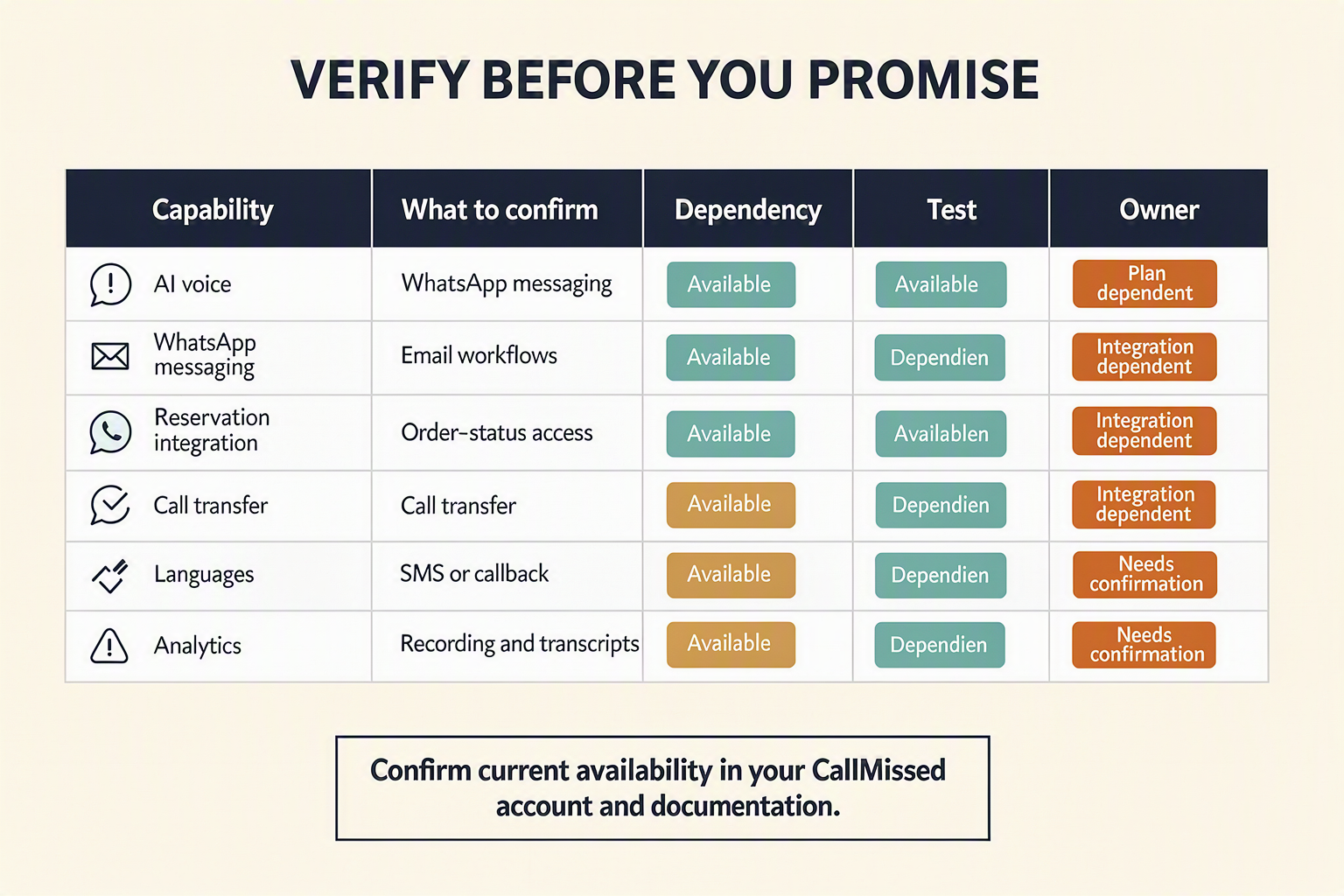
Before deployment, verify each workflow inside the restaurant’s actual CallMissed account and connected systems. Platform capability does not automatically guarantee account entitlement, channel approval, data access, or successful end-to-end integration.
Product and integration verification matrix
| Workflow or feature | CallMissed capability | What must be verified | Acceptance test |
|---|---|---|---|
| AI voice and missed calls | AI voice agents can answer calls, collect structured details, and support human transfer workflows. | Confirm phone-number provisioning or forwarding, operating-hour rules, concurrent-call limits, transfer destinations, call recording settings, and selected language or voice availability. | Call during service hours and after closing; verify the agent answers correctly, records the request, and transfers or creates a callback task. |
| WhatsApp chat and Business calling | CallMissed supports WhatsApp chatbots plus inbound and business-initiated WhatsApp Business calling connected to AI agents. | Verify Meta business approval, WhatsApp Business Account status, calling eligibility, customer consent requirements, approved message templates, and country-specific availability. | Start a chat, place an inbound WhatsApp call, and test an approved business-initiated contact flow with a consenting test number. |
| Menu, hours, and policy answers | Knowledge-base retrieval can ground responses in restaurant-provided information. | Confirm supported source formats, content-update procedures, multilingual retrieval quality, publishing permissions, and how conflicting menu or holiday-hours records are handled. | Change one test item or holiday schedule, republish the source, and confirm that voice and WhatsApp return the updated answer without inventing details. |
| Reservation enquiries | The agent can collect date, time, party size, contact information, and seating preferences. | Determine whether the reservation system has a native connector, API, webhook, or manual staff-confirmation workflow. Verify availability lookup, write permissions, duplicate prevention, and cancellation handling. | Request the same table twice through different channels; confirm that the workflow prevents duplicate bookings and sends the correct status. |
| Large parties and order status | CallMissed can classify requests, gather required fields, and route conversations through an omnichannel inbox. | Verify manager-routing rules and whether the ordering platform exposes authenticated, current order data. The AI should never infer preparation or delivery status from an unconnected system. | Test a 25-person event enquiry and an invalid order number; verify assignment, transcript preservation, authentication, and safe error handling. |
| Email and human handoff | Email tooling and a shared inbox can support classification, follow-up, and escalation. | Confirm mailbox connection, sender authentication, inbox access, staff roles, escalation thresholds, notification delivery, and whether agents can see cross-channel history. | Send an allergy-related email, then continue by phone or WhatsApp; confirm immediate escalation and that staff receive the full context. |
Verify language support at workflow level
CallMissed supports speech and text workflows across 22 Indian languages, but restaurants should still test the exact model, voice, accent, and language combination assigned to their account. A language being available does not guarantee equal recognition quality for noisy dining rooms, code-switching, dish names, local place names, or phone audio.
Build a test set containing:
- Regional pronunciations and mixed-language sentences
- Similar-sounding dish names
- Dates, times, prices, and party sizes
- Allergy terms and urgent escalation phrases
- Background music, kitchen noise, and weak mobile connections
Approval is not the same as readiness
Meta CEO Mark Zuckerberg reported in April 2025 that WhatsApp had exceeded 3 billion monthly active users, but WhatsApp’s global scale does not mean every calling or messaging feature is automatically enabled for every business account. Meta approval, template status, consent rules, and account configuration remain deployment dependencies.
For CallMissed for restaurants, record every item as confirmed, conditional, unavailable, or awaiting approval. Do not launch a restaurant AI receptionist—or advertise restaurant call automation—until reservation writes, order lookups, channel permissions, fallback responses, and human handoffs have passed controlled end-to-end tests.
When should CallMissed answer, collect details or hand a guest to a person?
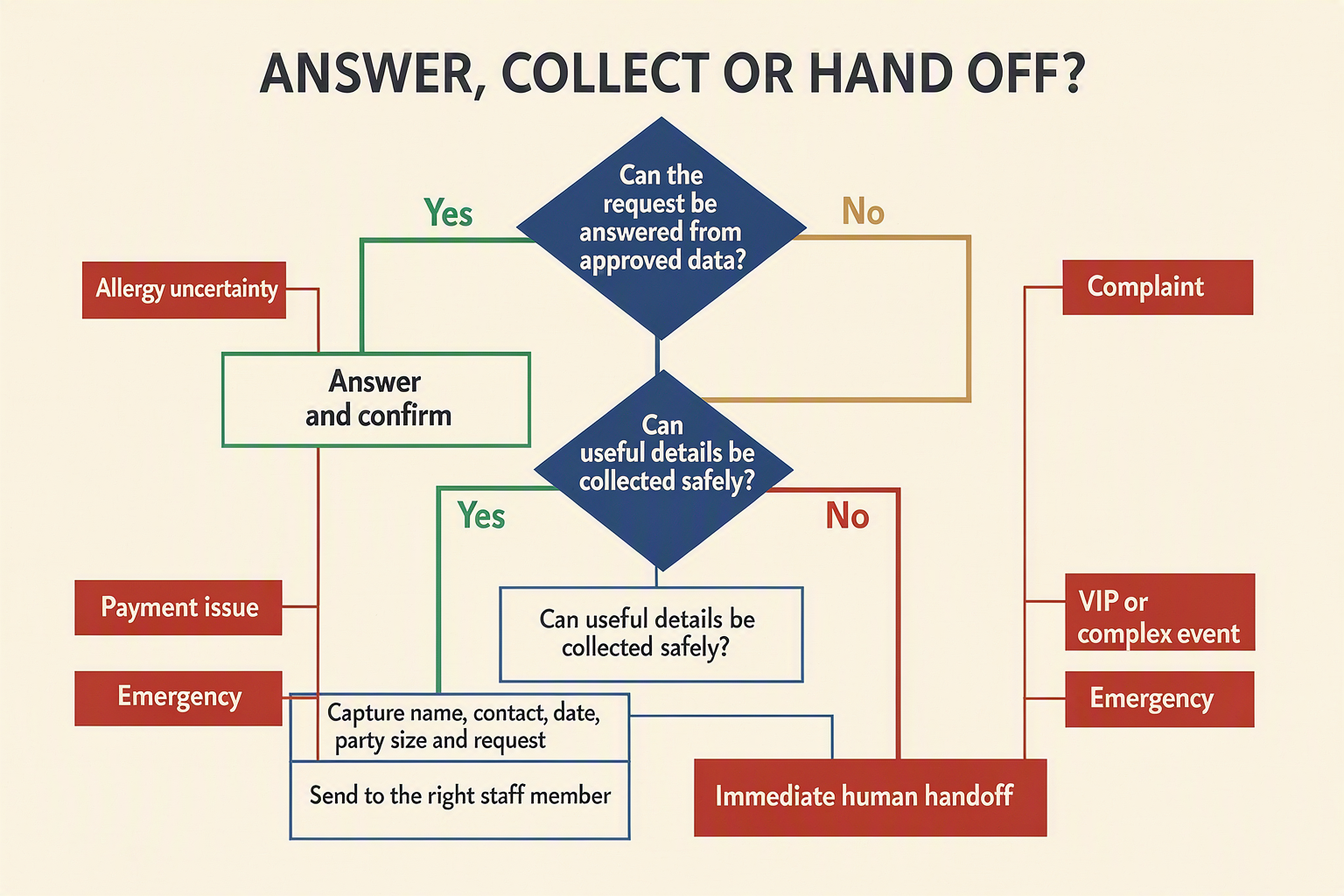
CallMissed should answer when information is approved and unambiguous, collect details when staff must review or complete an action, and hand the guest to a person when the request is sensitive, urgent, disputed, or outside verified data. The governing rule is simple: automate certainty, structure uncertainty, and escalate judgment.
Let the AI answer verified, low-risk questions
A restaurant AI receptionist can resolve repetitive questions when the response comes directly from a maintained knowledge base or connected system. Suitable examples include:
- Today’s published opening and kitchen hours
- Restaurant address, parking information, and directions
- Current menu descriptions and listed prices
- Accepted payment methods, dress code, or accessibility information
- Reservation policies, cancellation windows, and standard table durations
- Order status obtained from an authenticated ordering system
Answers should be grounded in approved records, not generated from general knowledge. If holiday hours, item availability, or live order data cannot be verified, the agent should say so and move to collection or handoff rather than guess.
Language alone need not trigger escalation. CallMissed supports speech and text workflows across 22 Indian languages, allowing a restaurant to serve regional-language enquiries while applying the same operational rules.
Collect details when the request needs staff action
The AI should gather structured information when it cannot safely promise an outcome. For a reservation request, that may include:
- Guest name and callback number
- Date, preferred time, and acceptable alternatives
- Party size and seating preference
- Children, wheelchair access, or high-chair requirements
- Dietary restrictions or allergy notes
- Consent to receive confirmation by WhatsApp, voice, or email
Collection is particularly useful for large parties, private dining, catering, celebration arrangements, and corporate events. The workflow can ask for budget range, menu preference, beverage requirements, audiovisual needs, and billing details, then create a concise summary in the omnichannel inbox.
Crucially, “request received” must not sound like “booking confirmed.” Restaurant call automation should distinguish an enquiry reference from a confirmed reservation and communicate the expected staff response time.
Hand off when judgment, urgency, or risk is involved
Human transfer should be immediate—or followed by a priority callback—when the guest reports:
- A severe allergy or asks for a guarantee against cross-contamination
- A missing, incorrect, unsafe, or significantly delayed order
- A payment dispute, duplicate charge, refund, or suspected fraud
- An active complaint involving safety, harassment, or injury
- A VIP, media, legal, or unusually complex event enquiry
- Repeated misunderstanding, rising frustration, or an explicit request for staff
CallMissed’s voice, WhatsApp, and email workflows should pass the conversation transcript, detected intent, collected fields, language, and unresolved question to the employee. Guests should not have to repeat everything.
Apply one routing policy across every channel
A practical policy uses three confidence bands:
- Verified answer: Respond and record the interaction.
- Incomplete or approval-dependent: Collect details and assign an owner.
- Sensitive, urgent, or low-confidence: Transfer or create a priority task.
If nobody is available, CallMissed for restaurants can preserve the enquiry in the shared inbox and trigger a WhatsApp or email acknowledgement. Managers should regularly review incorrect answers, abandoned collections, transfer reasons, and outdated knowledge entries; those observations reveal where the boundary between automation and human service needs adjustment.
What can go wrong with restaurant call automation, and how should teams recover?
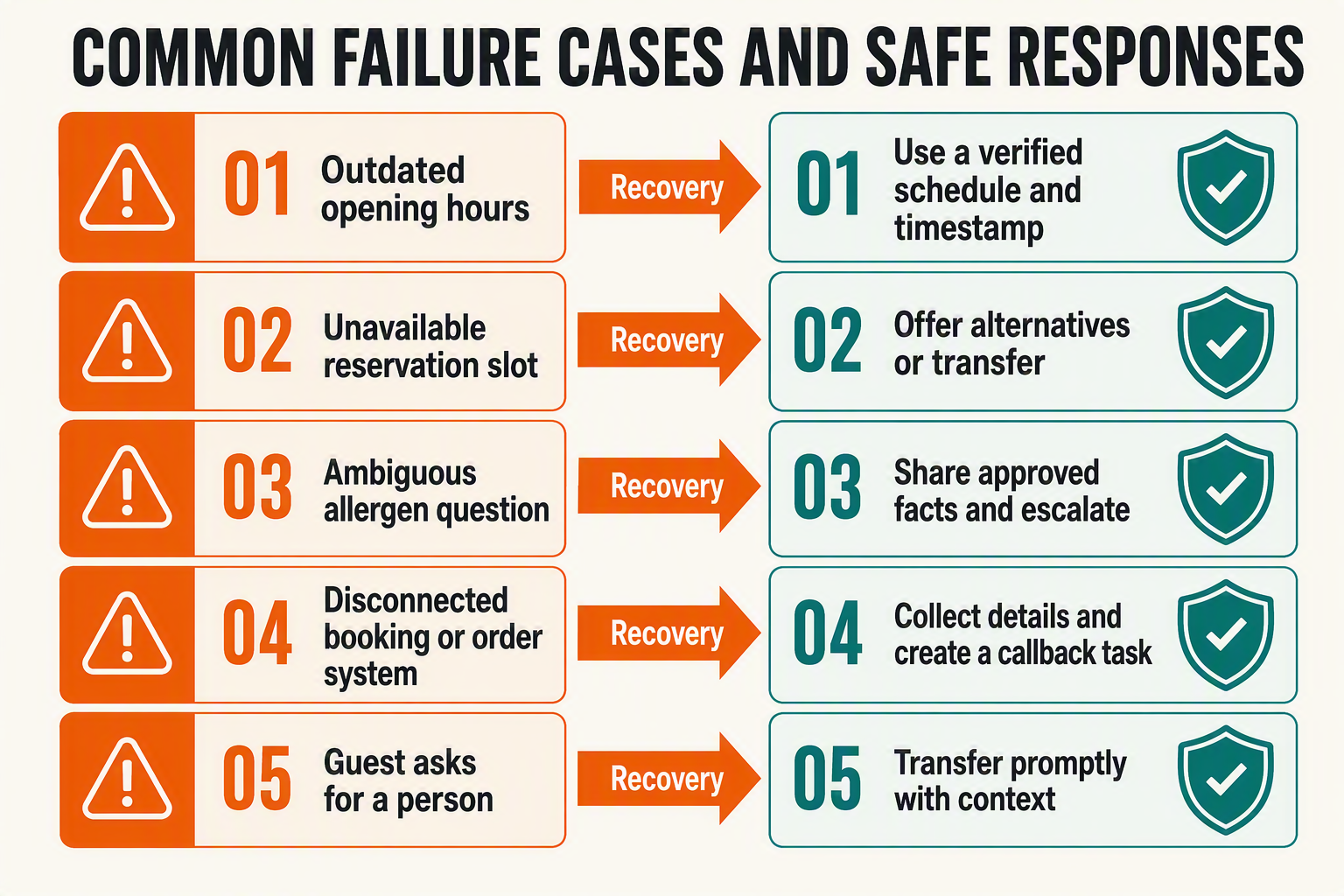
Restaurant automation usually fails when data is stale, speech is misunderstood, an integration becomes unavailable, or the AI handles a request beyond its authority. Teams should design every workflow to fail safely, preserve context, notify staff, and give the guest a clear next step.
Common failure modes—and safe responses
- Incorrect hours, menu items, or policies
An outdated knowledge base can tell guests that a restaurant is open on a holiday or that a discontinued dish is available. The agent should state when information cannot be verified, offer a staff callback, and flag conflicting content for review rather than improvising.
- Speech-recognition errors
Background noise, code-switching, unfamiliar names, and similar-sounding times can turn “table for eight” into “table for two.” Because CallMissed supports voice workflows across 22 Indian languages, restaurants should test real utterances in every language they plan to enable—not assume multilingual support eliminates recognition errors.
High-risk details should use read-back confirmation: “I heard Saturday, 8 August, at 8:30 p.m. for eight guests. Is that correct?”
- Reservation conflicts
If the booking system is slow or unavailable, a restaurant AI receptionist must not represent a requested table as confirmed. It should label the request pending, collect contact details, and explain when a human will respond.
- Unverified order-status answers
A model cannot infer whether an order is being prepared, dispatched, or delayed. When verified order data is unavailable, the workflow should capture the order number and transfer the enquiry instead of generating an estimated status.
- WhatsApp, email, or telephony disruption
A successfully completed call does not guarantee that a follow-up message was delivered. Restaurant call automation should monitor message status and use an approved fallback—such as an email, staff task, or callback—without repeatedly contacting the guest.
Define mandatory human-handoff triggers
Automation should transfer or create an urgent staff task when a conversation involves:
- Food allergies, medical concerns, or contamination claims
- Complaints, refunds, payment disputes, or threatening language
- Large parties, private events, deposits, or negotiated menus
- Accessibility arrangements or unusual seating requirements
- Repeated recognition failures or explicit requests for a person
- Any emergency or immediate safety issue
The handoff should include the transcript, detected intent, guest contact details, collected booking information, and the reason for escalation. Guests should not have to repeat the entire conversation.
Use a practical recovery playbook
When something goes wrong, teams should follow a consistent sequence:
- Acknowledge uncertainty: Tell the guest what could not be verified.
- Stop consequential actions: Do not confirm a booking, cancellation, refund, or order status without reliable system evidence.
- Preserve context: Save the call, WhatsApp, or email history in the shared inbox.
- Route by urgency: Separate routine follow-ups from allergy, safety, payment, and same-day booking issues.
- Set an expectation: Provide a realistic callback window rather than saying “soon.”
- Review the cause: Classify the incident as knowledge, recognition, integration, routing, or policy failure.
- Correct and retest: Update the source or workflow, then replay representative test cases before re-enabling automation.
With CallMissed for restaurants, teams can centralise voice, WhatsApp, and email context for recovery, but operational ownership remains essential. Assign a staff member to review escalations, audit unresolved conversations, and maintain approved restaurant information; automation without accountable recovery simply converts missed calls into missed digital conversations.
Which metrics show whether restaurant AI workflows are improving service?
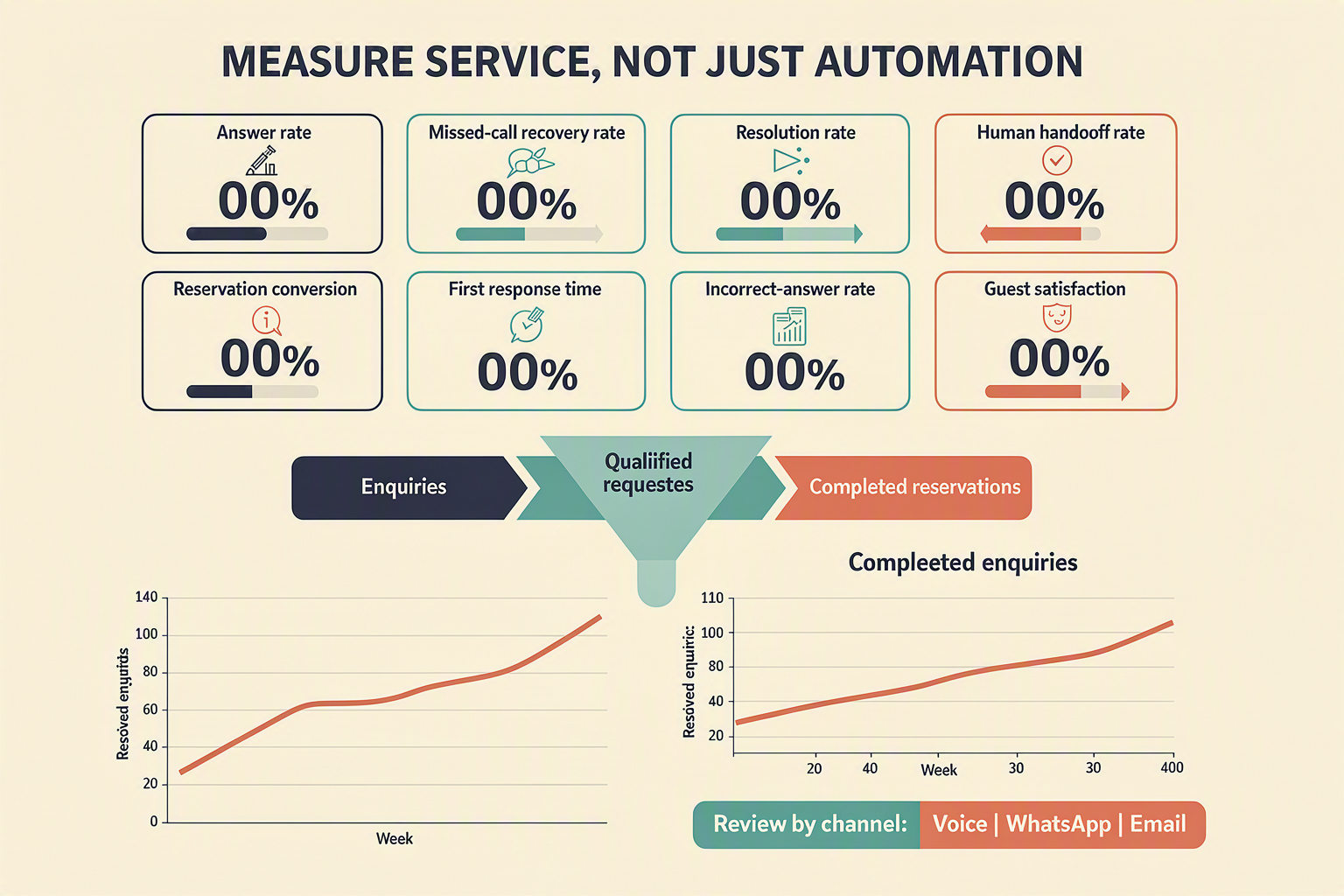
The strongest evidence is not call volume alone; it is whether automation produces faster responses, more completed bookings, fewer abandoned conversations, and safer handoffs without reducing guest satisfaction. Restaurants should compare these outcomes against a pre-launch baseline and segment results by voice, WhatsApp, and email.
Measure service speed and availability
Track how quickly each channel acknowledges and resolves a request:
- First-response time: Time from the guest’s first contact to the initial useful response, not merely an automated greeting.
- Average resolution time: Time until the enquiry is answered, booked, transferred, or closed with a clear next step.
- Call-answer rate: Percentage of inbound calls answered by either the restaurant team or the AI workflow.
- Missed-call recovery rate: Percentage of missed callers who receive a follow-up and subsequently respond.
- After-hours resolution rate: Percentage of enquiries completed outside staffed hours without waiting for the restaurant to reopen.
Report the median and 90th percentile, not just the average. A small number of stalled conversations can be hidden by a favourable mean.
Connect automation to restaurant outcomes
A restaurant AI receptionist should be evaluated on completed guest outcomes rather than the number of messages it sends. Useful conversion metrics include:
- Reservation completion rate = confirmed reservations ÷ eligible reservation enquiries.
- Booking abandonment rate = unfinished booking conversations ÷ initiated booking conversations.
- Large-party lead qualification rate = enquiries with all required details ÷ total large-party enquiries.
- Lead-to-event conversion rate = confirmed large-party events ÷ qualified event leads.
- Order-status resolution rate = verified status enquiries resolved without repeat contact ÷ total status enquiries.
- Revenue per qualified enquiry, where reservation and point-of-sale systems can attribute revenue reliably.
Avoid treating every automated interaction as a success. If a workflow answers quickly but guests must call again, its apparent efficiency is misleading.
Monitor containment, handoff, and accuracy
Containment rate is the percentage of conversations completed without staff involvement, but a higher figure is not automatically better. Allergy questions, payment disputes, complaints, VIP requests, and uncertain order data may require deliberate escalation.
Pair containment with:
- Human-transfer rate, segmented by transfer reason.
- Successful handoff rate, measuring whether staff received the conversation history and accepted the case.
- Repeat-contact rate within a defined period, such as 24 hours.
- Knowledge-grounding accuracy, assessed through sampled reviews of menu, price, policy, and opening-hours answers.
- Unsupported-answer rate, covering responses not traceable to approved restaurant data.
- Escalation precision, showing whether high-risk requests were correctly routed.
These quality controls matter when assessing restaurant call automation because productivity gains should not come at the cost of incorrect guest information. McKinsey estimated in 2023 that generative AI could improve customer-care productivity by 30% to 45% of current function costs, but each restaurant still needs its own operational baseline and quality thresholds.
Build a practical measurement cadence
For CallMissed for restaurants, create a weekly dashboard segmented by channel, language, location, enquiry type, time of day, and automation version. CallMissed conversation records can support workflow analysis, while confirmed bookings, attendance, order status, and revenue should come from the relevant system of record.
Use a simple improvement cycle:
- Record at least two to four weeks of baseline performance.
- Change one major prompt, routing rule, or knowledge source at a time.
- Review failed and transferred conversations weekly.
- Compare conversion, speed, repeat contact, and accuracy together.
- Maintain human review samples, especially after menu or policy changes.
A workflow is improving service only when operational efficiency, guest outcomes, and safety metrics move in the right direction together.
What do restaurant operators need to know about CallMissed? Frequently asked questions
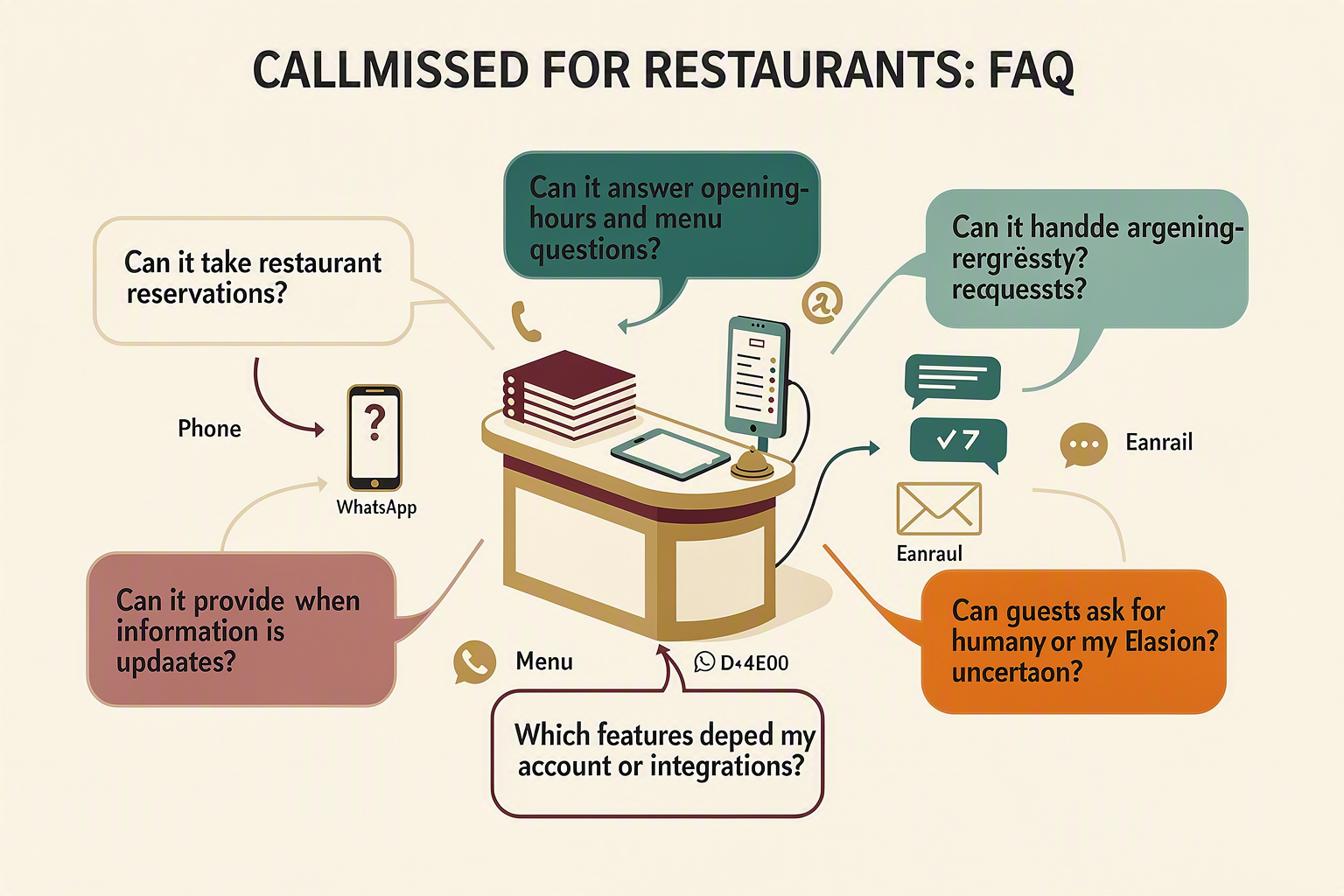
What is CallMissed for restaurants, and which guest enquiries can it automate?
Can a restaurant AI receptionist make and confirm table reservations?
How does CallMissed for restaurants handle missed calls and WhatsApp enquiries?
Can CallMissed answer menu, allergy, opening-hours, and order-status questions in Indian languages?
How should a restaurant set up restaurant call automation safely?
What metrics and human-handoff rules should restaurant operators use?
Conclusion
CallMissed for restaurants can help turn unanswered calls and fragmented messages into structured, trackable service workflows—without removing staff from conversations that need empathy, judgment, or operational authority. The practical goal is not automation for its own sake; it is faster answers for guests and better-qualified requests for restaurant teams.
The case for conversational service is already strong. Meta CEO Mark Zuckerberg reported in April 2025 that WhatsApp had surpassed 3 billion monthly active users, while McKinsey estimated in 2023 that generative AI could improve customer-care productivity by 30% to 45% of current function costs. For restaurants, that opportunity begins with routine but revenue-relevant interactions:
- A restaurant AI receptionist can collect reservation dates, times, party sizes, seating preferences, and contact details, then apply defined confirmation or escalation rules.
- Restaurant call automation can answer approved opening-hours and menu questions, recover missed calls through WhatsApp follow-ups, and preserve context so guests do not have to repeat themselves.
- Large-party, allergy-related, unusual, or sensitive requests should reach staff with structured details and complete conversation history rather than being autonomously resolved.
- Order-status answers should come from verified order data, while performance should be measured through response time, booking completion, containment, transfer rates, and escalation outcomes.
Reliable implementation depends on disciplined setup. Restaurants need to maintain opening hours and menu information in the knowledge base, define what the AI may confirm, map escalation triggers, test multilingual conversations, and review transcripts regularly. CallMissed’s support for voice and text workflows across 22 Indian languages can be particularly relevant for restaurants serving regional and tourist audiences.
Teams should also verify which functions depend on their CallMissed plan, WhatsApp Business approval, telephony configuration, or reservation and ordering integrations. This prevents assumptions about features that require account-level activation or third-party data access.
Looking ahead, watch for restaurant communication to become increasingly continuous across voice, WhatsApp, email, and human handoff rather than operating as separate channels. To explore this shift, check out CallMissed, an AI communication infrastructure platform for multilingual voice agents, WhatsApp engagement, email workflows, and shared customer conversations.
How many valuable guest enquiries could your restaurant recover if every call or message received an immediate, context-aware response?
Related Reading
Discussion
Related Posts
Ready to automate customer conversations?
Launch AI voice agents and WhatsApp bots with CallMissed — one API, 22+ Indian languages.