
Cross-Channel Customer Communication: How CallMissed Keeps Context Across Email, WhatsApp, and Voice



Cross-channel customer communication with CallMissed: preserve context across email, WhatsApp, and voice using privacy-aware workflows.
Cross-Channel Customer Communication: How CallMissed Keeps Context Across Email, WhatsApp, and Voice
What if one customer enquiry became three disconnected conversations simply because the customer emailed, switched to WhatsApp, and then called? Cross-channel customer communication prevents that break in continuity by helping the business recognise the customer, retrieve relevant history, and resume from the last meaningful step instead of making the customer repeat everything.
This matters in 2026 because customer journeys rarely remain inside one channel. A buyer might request pricing by email, confirm requirements over WhatsApp, and call when the decision becomes urgent. Without a shared workflow, agents can miss earlier commitments, ask duplicate questions, or provide inconsistent answers. The problem becomes more complex in India, where businesses may also need to continue the same conversation across languages: CallMissed supports Speech-to-Text and Text-to-Speech across 22 Indian languages.
CallMissed brings email, WhatsApp, and voice workflows into an omnichannel inbox and CRM, alongside AI voice agents, WhatsApp chatbots, WhatsApp Business calling, and knowledge-base retrieval-augmented generation. When these capabilities are configured around a consistent customer record, the channel can change without turning the interaction into an entirely new case. A WhatsApp conversation can inform a later call, while a useful call summary can give the team context for the next email follow-up.
In this guide, CallMissed shared memory refers to that practical continuity layer: the customer identity, conversation history, summaries, preferences, and unresolved next steps that authorised workflows can reuse across channels. It is not permission to retain every message indefinitely. Effective memory should be selective, purpose-bound, access-controlled, and governed by clear retention rules.
You will learn how to:
- Map a realistic journey from an initial email to WhatsApp assistance and an AI-handled voice call.
- Configure channel entry points around a reliable customer record and clear handoff logic.
- Separate customer-specific context from knowledge-base RAG, which supplies approved business information rather than personal memory.
- Decide what to remember, summarise, restrict, or delete for privacy-conscious operations.
- Test whether context survives channel changes without exposing unnecessary personal data.
- Identify continuity failures such as duplicate profiles, stale summaries, missing consent, and ambiguous customer matching.
The goal is not merely to connect three messaging tools. It is to use CallMissed as an AI communication platform that helps each interaction begin with the context needed to move the customer forward—whether the next touchpoint arrives through email, WhatsApp chat, a WhatsApp Business call, or a conventional voice workflow.
How does CallMissed maintain continuity across email, WhatsApp, and voice? By connecting each verified interaction to usable customer context while preserving channel-specific history
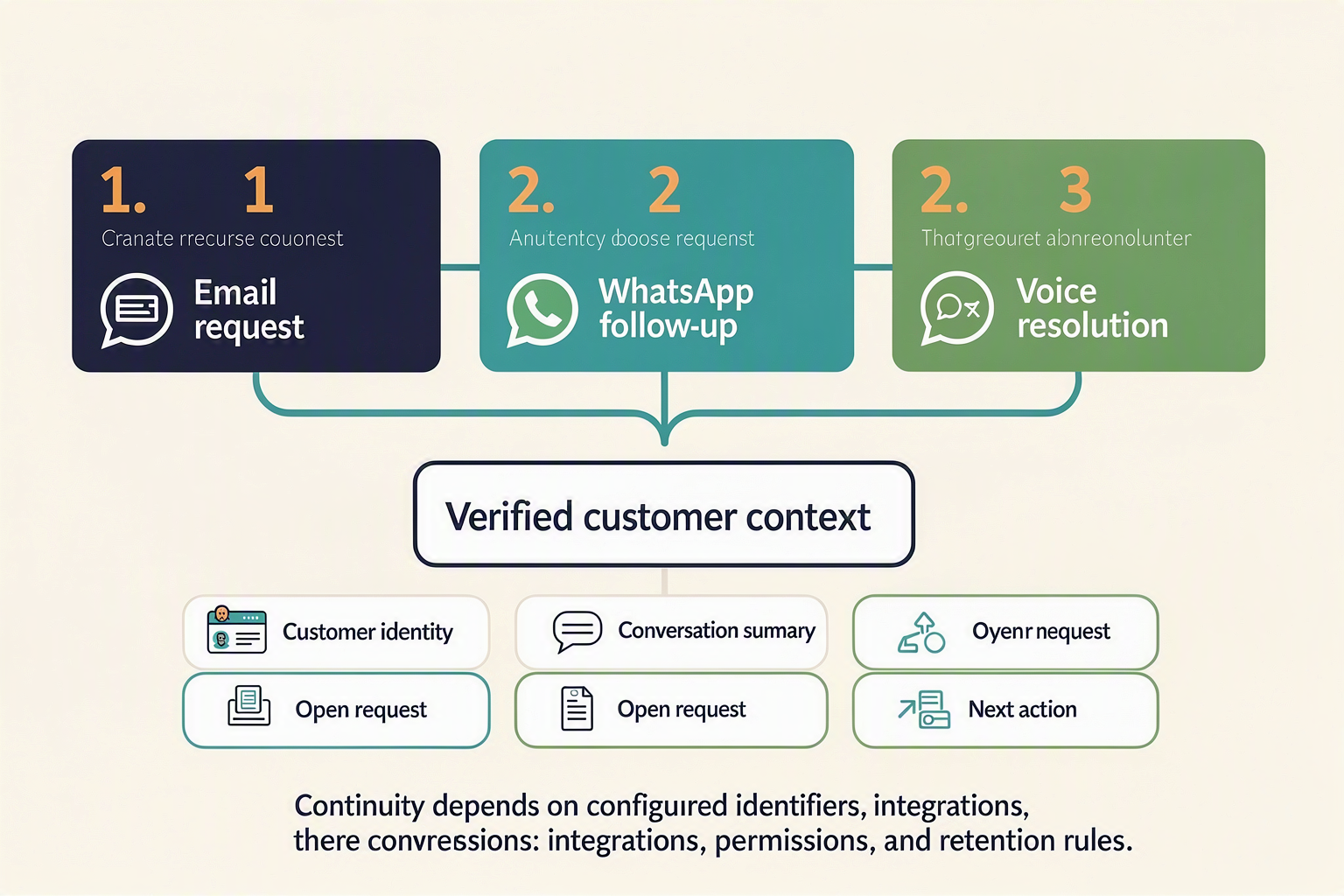
CallMissed maintains continuity across email, WhatsApp, and voice by connecting each verified interaction to usable customer context. Its shared memory carries forward relevant summaries, preferences, commitments, and next actions, while the original history remains separate and identifiable by channel.
This approach to cross-channel customer communication gives authorised agents and automations enough context to continue the customer journey without flattening every email, message, and call into a single transcript.
The continuity workflow
A practical cross-channel customer communication workflow in CallMissed has five stages:
- Identify the customer at each entry point.
Configure email addresses, verified WhatsApp numbers, and available caller details as identifiers associated with the customer record. If a person uses different addresses or numbers, uncertain matches should be reviewed rather than merged automatically.
- Preserve the channel-specific interaction.
CallMissed’s omnichannel inbox and CRM can bring email, WhatsApp, and voice workflows into one operating environment. Email threads remain identifiable as email, WhatsApp messages retain their sequence, and call records remain identifiable as voice interactions.
- Create usable shared context.
CallMissed can support continuity without passing every historical message into each new interaction. The shared context should focus on operational details such as:
- The customer’s objective or enquiry
- Confirmed product, service, language, or location preferences
- Questions already answered
- Promises made by the business
- Consent or contact restrictions
- The unresolved next step and its owner
- Load relevant context when the channel changes.
If a customer moves from a WhatsApp chat to a WhatsApp Business call, the CallMissed AI voice agent can receive the applicable summary and next action. If a team member later sends an email, the call summary can communicate the outcome without requiring the complete interaction to be replayed or reread.
- Write the latest outcome back into the workflow.
After each interaction, update the customer record with the result, current status, and next action. This keeps cross-channel customer communication current and prevents an older summary from overriding a newer decision.
Shared memory is not a flattened transcript
CallMissed shared memory should function as a controlled continuity layer, not as one permanent transcript that combines every channel.
Shared memory holds the context needed to move the conversation forward. Separate channel histories preserve the source, sequence, and format of each interaction.
That distinction provides important safeguards:
- Agents can identify whether a commitment came from an email, WhatsApp message, or call.
- Teams can check the original interaction when information conflicts.
- Access policies can restrict sensitive voice or message content.
- Retention rules can differ by channel and business purpose.
- Summaries can be corrected without changing the underlying record.
This structure also supports more reliable AI-assisted cross-channel customer communication. A generated summary offers a convenient view of the journey, but the original channel history remains the evidence when exact wording or provenance matters.
Customer memory and business knowledge serve different roles
CallMissed keeps customer context conceptually separate from approved business knowledge.
Knowledge-base retrieval-augmented generation supplies information such as current policies, services, and procedures. Customer memory supplies journey-specific facts, including what the customer has already provided, what the business has promised, and what must happen next.
For example, a CallMissed AI voice agent might retrieve the current returns policy from the knowledge base while using customer context to recognise that the buyer already submitted photographs through WhatsApp. The policy is business knowledge; the submitted evidence and pending resolution are customer context.
Configured this way, CallMissed supports cross-channel customer communication while preserving provenance. The goal is not to make email, WhatsApp, and voice identical, but to let each channel contribute reliable context without erasing where that context originated.
What does CallMissed shared memory mean inside an AI communication platform?
CallMissed shared memory is the reusable customer context that authorised email, WhatsApp, and voice workflows can access through a consistent customer record. Inside the CallMissed AI communication platform, it helps the next interaction continue an existing task rather than treating every channel change as a new enquiry.
What belongs in shared memory?
Shared memory should contain concise, operational information that helps an AI agent or human team member decide what to do next. Depending on the workflow and the customer’s permissions, that context can include:
- Identity signals: a verified phone number, WhatsApp number, email address, or CRM record used to associate interactions with the correct customer.
- Conversation history: relevant messages, call records, and email exchanges available through the omnichannel workflow.
- Structured facts: selected product, service location, preferred language, appointment time, or order reference.
- Interaction summaries: a compact account of what the customer requested and what the business promised.
- Open actions: unanswered questions, required documents, scheduled callbacks, escalations, or follow-up deadlines.
- Preferences and permissions: the customer’s chosen channel, language, contact permissions, and applicable consent status.
For example, an email summary might record: “Customer requested pricing for the annual plan; needs support for Marathi-speaking callers; quotation promised by Friday.” If the customer subsequently messages on WhatsApp, the workflow can use that summary without forcing the customer to restate the complete requirement.
How memory becomes usable across channels
A practical continuity workflow has four stages:
- Recognise the customer. The workflow associates an incoming email address or verified phone number with an existing CRM record. Ambiguous matches should be reviewed instead of merged automatically.
- Retrieve relevant context. The chatbot, voice agent, or human agent receives the recent summary, important customer facts, and unresolved next step—not necessarily the entire historical transcript.
- Continue the task. The interaction resumes from the recorded state, such as confirming requirements, arranging a callback, or completing a quotation.
- Write back the outcome. After the interaction, the workflow updates the summary, status, and next action for whichever channel comes next.
This pattern makes cross-channel customer communication stateful. Email may create the enquiry, WhatsApp may collect missing details, and a later voice call may resolve the urgent decision while preserving one coherent operational trail.
Shared memory is not the same as knowledge-base RAG
CallMissed combines customer workflows with knowledge-base retrieval-augmented generation, but the two sources serve different purposes:
- Shared memory answers: “What has this customer already told us?”
- Knowledge-base RAG answers: “What approved information does the business provide about this product, policy, or process?”
A voice agent might retrieve the customer’s preferred language and unresolved billing question from memory, then use the approved knowledge base to explain the billing policy. CallMissed supports Speech-to-Text and Text-to-Speech across 22 Indian languages, allowing regional-language voice interactions to participate in the same continuity workflow when configured appropriately.
What shared memory should not mean
Shared memory should not become unrestricted surveillance or indefinite transcript storage. A privacy-conscious CallMissed configuration should:
- Store only context needed for a defined business purpose.
- Prefer concise summaries over unnecessary raw content.
- Restrict sensitive fields by role and workflow.
- Apply retention and deletion rules consistently.
- Prevent one customer’s information from entering another customer’s prompt.
- Require confirmation when identity matching is uncertain.
The useful definition is therefore selective continuity, not unlimited recall: enough verified context to move the customer forward, governed tightly enough to avoid unnecessary exposure.
Which CallMissed workflow capabilities support each channel handoff? (TABLE)
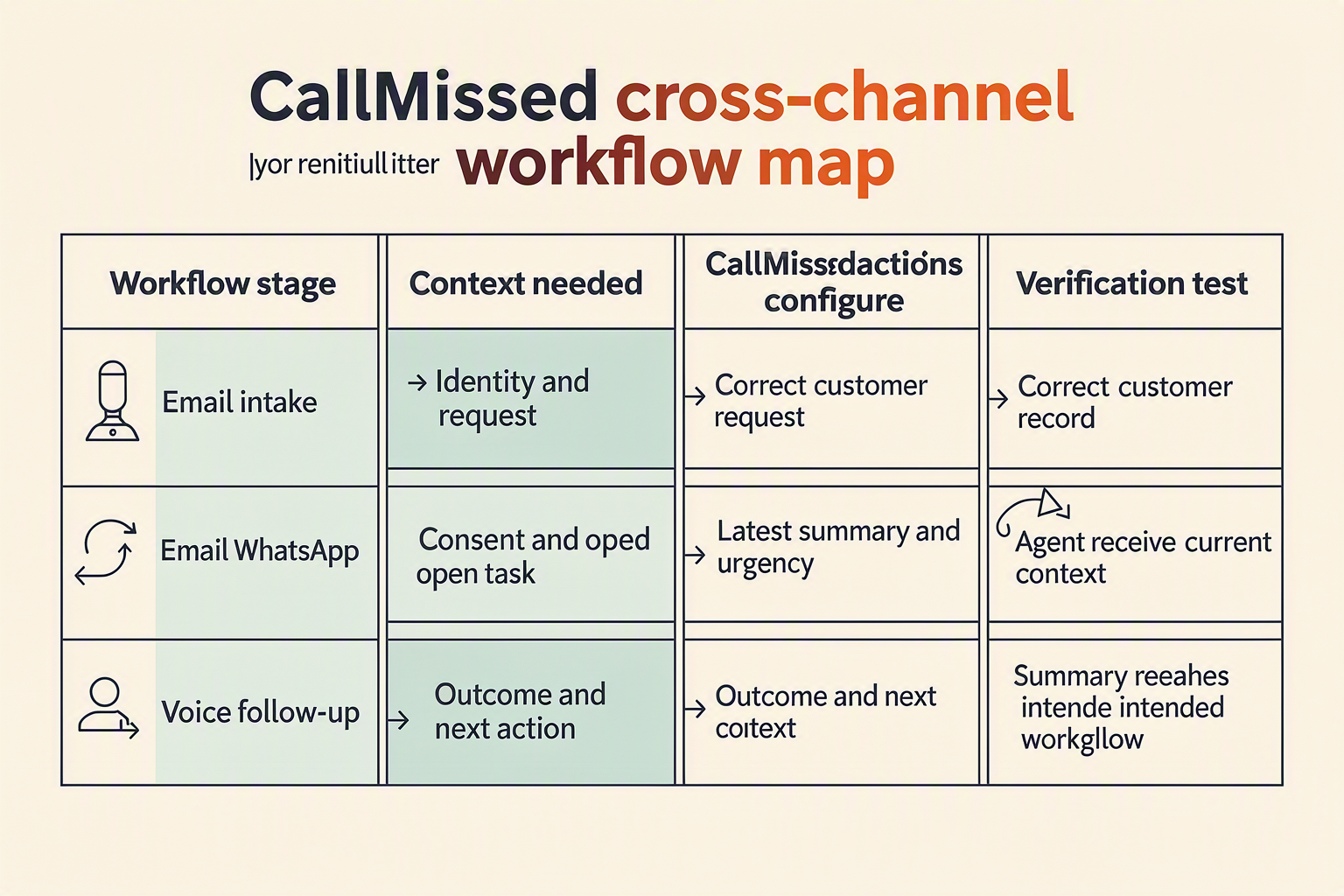
CallMissed supports channel handoffs by combining its omnichannel inbox and CRM with email tooling, WhatsApp chatbots, WhatsApp Business calling, AI voice agents, conversation summaries, and knowledge-base RAG. The workflow should carry only the verified identity, concise interaction context, and unresolved next action needed by the receiving channel.
Channel-handoff capability map
| Handoff | CallMissed capabilities | Context to carry forward | Recommended workflow action | Continuity check |
|---|---|---|---|---|
| Email → WhatsApp chat | Email tooling, omnichannel inbox/CRM, WhatsApp chatbot | Enquiry topic, requirements, promised response, customer-approved phone number | Match the WhatsApp number to the correct customer record, then let the chatbot or agent resume the open task | Confirm the WhatsApp user before displaying account-specific information |
| WhatsApp chat → voice | WhatsApp chatbot, AI voice agent, omnichannel history | Chat summary, detected intent, language preference, unresolved questions | Supply the voice workflow with a short pre-call summary instead of the entire chat transcript | Ask the caller to verify identity when sensitive records are involved |
| WhatsApp chat → WhatsApp Business call | WhatsApp chatbot, WhatsApp Business calling, AI voice agent | Current conversation state, requested callback purpose, relevant consent | Start or accept the call through the approved WhatsApp Business workflow and bridge it to the appropriate AI or human agent | Check whether business-initiated calling is permitted for that interaction |
| Voice → email | AI voice agent, Speech-to-Text, call summary, email tooling | Call outcome, commitments, requested documents, owner, deadline | Review the summary and send a structured follow-up that records the agreed next step | Compare the email against the call outcome before sending |
| Voice → WhatsApp follow-up | AI voice agent, WhatsApp messaging, omnichannel inbox/CRM | Call disposition, appointment or order detail, pending confirmation | Send a concise WhatsApp continuation through the appropriate approved workflow | Avoid placing confidential transcript content in the message |
| Any channel → knowledge answer | Knowledge-base RAG across chatbot or agent workflows | Customer question and approved business documentation—not unrelated personal history | Retrieve the current policy, product, or service answer while keeping customer memory separate | Validate that the cited knowledge source is current and authorised |
How the capabilities work together
The CallMissed shared memory layer should answer four operational questions at every handoff:
- Who is contacting the business? Use a sufficiently verified customer record rather than relying on a similar name or an unconfirmed phone number.
- What has already happened? Preserve a compact summary of material facts, decisions, and commitments.
- What remains unresolved? Store the next action, responsible owner, and relevant deadline.
- What may the next workflow access? Apply channel-specific permissions, consent, and retention controls.
Knowledge-base RAG has a separate role. It can ground an AI agent in approved information such as service policies or product details, but it should not be treated as the customer’s personal conversation history. Keeping those layers distinct reduces the risk of exposing one customer’s details while answering another customer’s question.
Why multilingual handoffs need explicit context
CallMissed supports Speech-to-Text and Text-to-Speech across 22 Indian languages, according to CallMissed’s product specifications. That capability allows a customer to write in one channel and continue by voice in a regional language, but language detection alone does not guarantee continuity.
The workflow should therefore store the customer’s preferred interaction language, while retaining important identifiers, amounts, dates, and commitments accurately. A Hindi call following an English email, for example, should receive the same case summary without translating product codes or altering quoted prices.
Configured this way, CallMissed operates as an AI communication platform for controlled cross-channel customer communication: each channel contributes to one purposeful journey without requiring every agent or model to access every historical message.
How can a realistic CallMissed journey move from an email quote request to WhatsApp clarification and a voice booking?
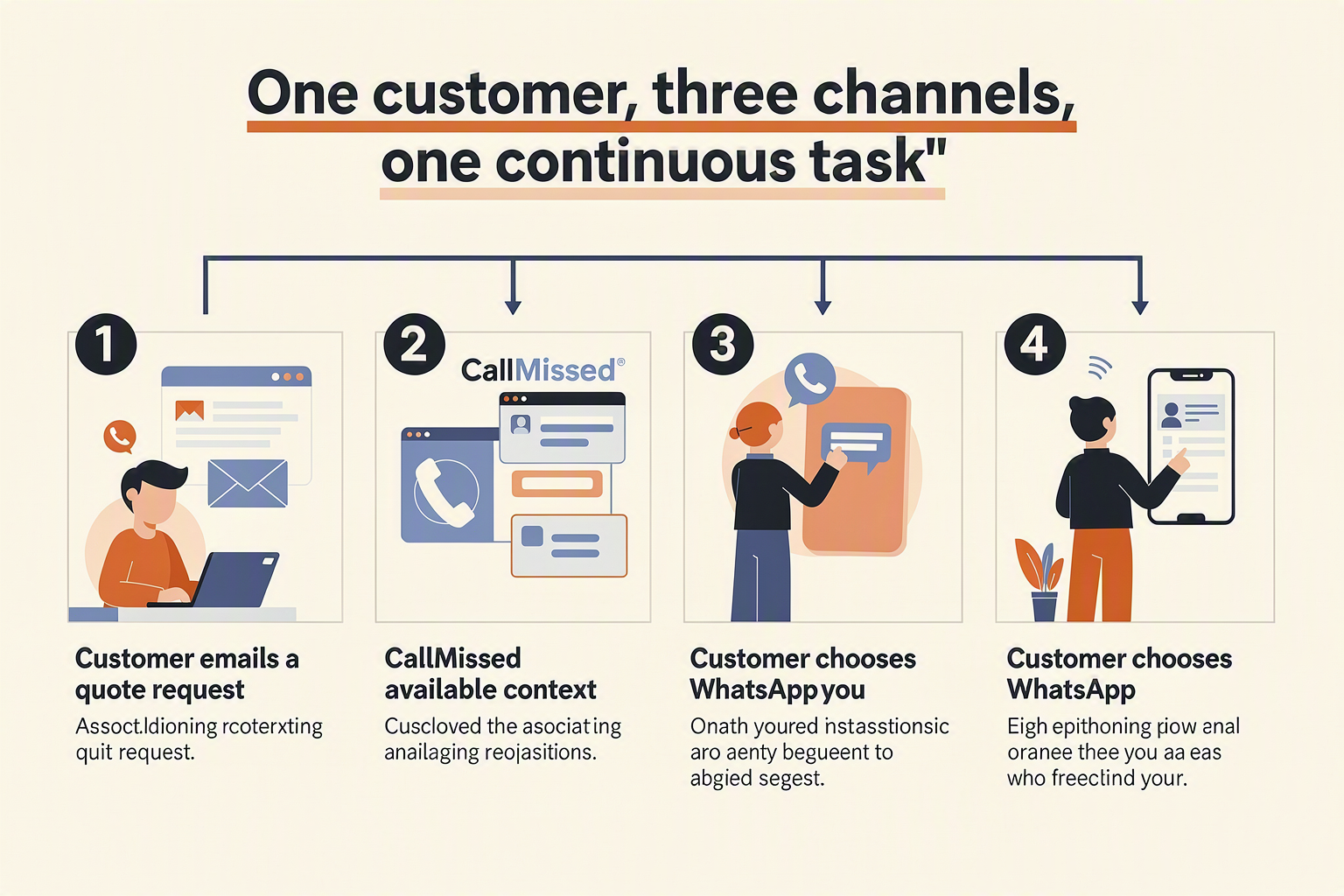
A realistic journey uses one customer record and a concise case summary as the continuity layer: the email creates the enquiry, WhatsApp resolves open questions, and the voice agent completes or captures the booking without restarting discovery. CallMissed shared memory should carry only verified identity details, requirements, decisions, consent, and the next action between those interactions.
Example: a home-service quote across three channels
Assume Priya emails an air-conditioning service company requesting a quote for two units. This illustrative workflow can progress as follows:
- Email starts the customer record
- CallMissed receives Priya’s quote request in the omnichannel inbox.
- The workflow records her email address, requested service, location, preferred date, and any unresolved questions.
- An email response provides the indicative quote and asks whether both units require routine servicing or fault diagnosis.
- The case status becomes “Awaiting service clarification”, rather than simply “Email replied.”
- WhatsApp supplies the missing details
- Priya continues through the company’s published WhatsApp Business number.
- The workflow should match the interaction using a verified identifier or ask Priya to confirm a safe reference, such as the quote number. It should not assume that similar names belong to the same person.
- The WhatsApp chatbot can retrieve the open question and ask only what remains unanswered: “Is either AC currently showing an error or failing to cool?”
- Priya replies that one unit needs routine service and the other is leaking water.
At this point, the reusable summary might read: “Quote requested for two AC units; one routine service, one water-leak diagnosis; preferred visit Saturday morning; customer wants to confirm availability by phone.”
Moving from WhatsApp clarification to voice booking
Priya can now place a WhatsApp Business call, receive a business-initiated call where permission and applicable rules allow it, or use another configured voice entry point. CallMissed can bridge a WhatsApp Business voice call to an AI voice agent, allowing the call workflow to begin with the existing case context.
The agent should:
- Confirm Priya’s identity before discussing customer-specific details.
- Restate the service scope without forcing her to repeat it.
- Use approved business information from knowledge-base RAG for policies, service coverage, or pricing rules.
- Offer available slots only if CallMissed has been connected to an authoritative scheduling source.
- Complete the booking through that configured system, or capture the preferred slot for human confirmation.
- Write the outcome back as a concise call summary and next step.
For multilingual journeys, CallMissed supports Speech-to-Text and Text-to-Speech across 22 Indian languages, enabling businesses to design regional-language voice experiences without discarding the context collected in English email or WhatsApp messages.
What continuity should—and should not—carry forward
This cross-channel customer communication workflow should preserve:
- Confirmed contact identifiers and the case reference
- Service requirements and customer preferences
- Questions already answered
- Commitments, booking status, and the next owner
It should not automatically expose full transcripts, payment information, unrelated conversations, or unverified AI inferences. As an AI communication platform, CallMissed can centralise the workflow, but the business must configure identity matching, permissions, retention, human escalation, and system integrations. The result is continuity with boundaries: each channel advances the same case while accessing only the context needed for that step.
What benefits and operational implications should you measure after enabling CallMissed cross-channel customer communication?
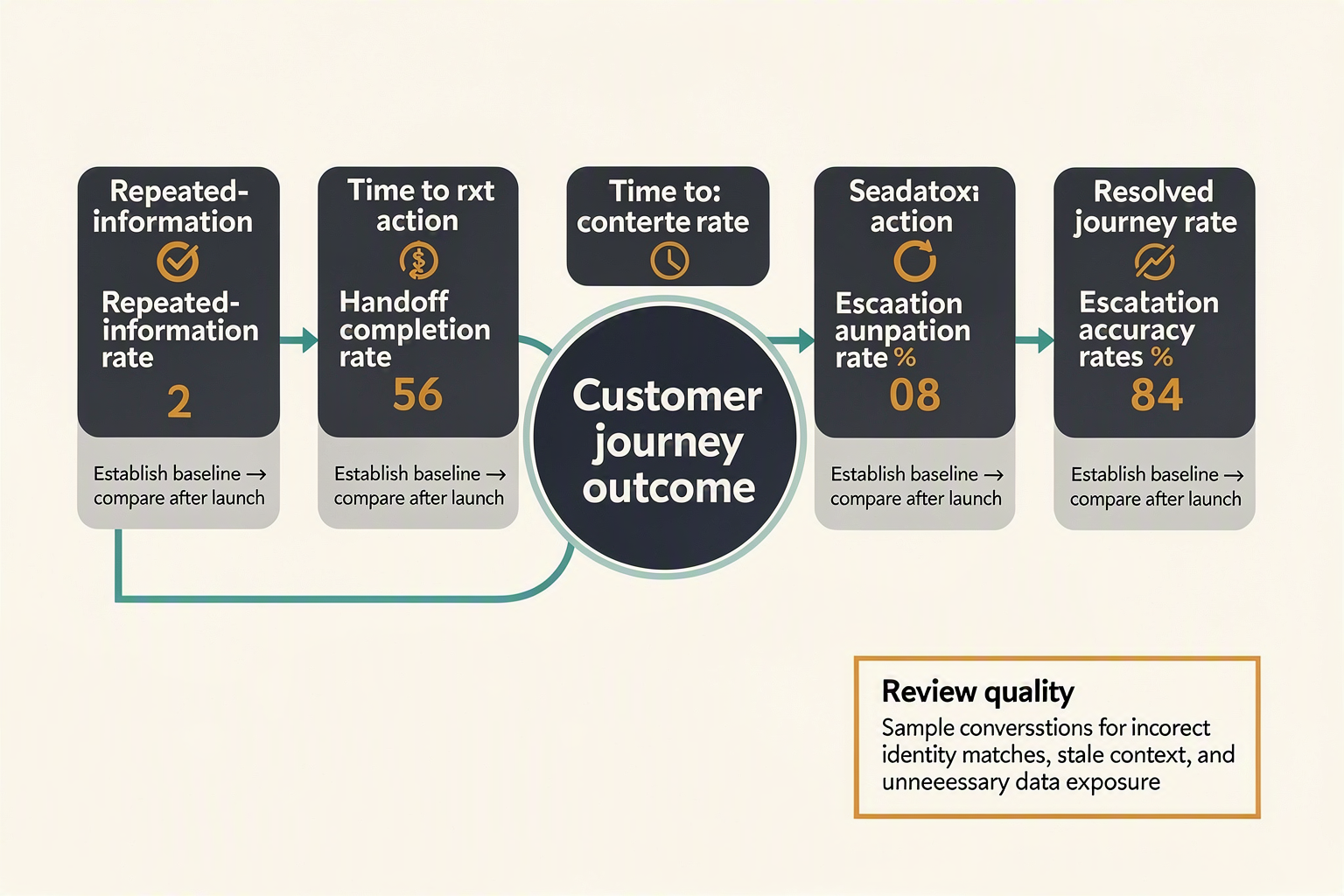
Measure whether CallMissed reduces customer repetition, accelerates resolution, and preserves accurate context when conversations move between email, WhatsApp, and voice. The operational goal is not simply more automation; it is faster progress with fewer continuity failures, controlled data use, and clear human accountability.
Establish a pre-launch baseline
Before enabling cross-channel customer communication, record at least two to four weeks of baseline data for comparable enquiries. Segment results by channel, enquiry type, language, business hours, and whether automation or a human handled the interaction.
Track these starting measures:
- First-response time: Time from the customer’s initial email, WhatsApp message, or call to a meaningful response.
- Resolution time: Time from the first contact to the confirmed outcome, not merely case closure.
- Repeat-information rate: Percentage of journeys in which customers must restate an order number, requirement, issue, or preferred next step.
- Channel-transfer completion rate: Percentage of customers who successfully continue after moving to another channel.
- Duplicate-record rate: Percentage of journeys split across multiple CRM identities.
- Human handoff rate: Share of automated conversations transferred to an employee, with the reason recorded.
Use consistent definitions. For example, a WhatsApp acknowledgement should not count as a meaningful first response unless it answers the question or advances the case.
Measure continuity, not just channel volume
A rise in WhatsApp messages or handled calls does not prove that CallMissed shared memory is working. Review whether the destination channel received the correct identity, summary, unresolved task, and customer preference.
A practical continuity scorecard should include:
- Context-retrieval success: Did the workflow locate the correct customer record?
- Summary accuracy: Did the email, WhatsApp, or call summary preserve confirmed facts without adding unsupported details?
- Next-step preservation: Did the later interaction continue the agreed action rather than restart discovery?
- Commitment consistency: Were prices, timelines, and policies presented consistently across channels?
- Handoff completeness: Could the human agent understand the situation without rereading the entire history?
Audit a sample of completed journeys every week. Include successful cases and failures, especially identity mismatches, stale summaries, abandoned transfers, and disputed commitments.
Connect customer benefits to business outcomes
CallMissed’s AI communication platform combines an omnichannel inbox and CRM with email tooling, WhatsApp chatbots, WhatsApp Business calling, AI voice agents, and knowledge-base RAG. Measure how that workflow affects both customer experience and operating performance:
- Compare resolution time before and after cross-channel context becomes available.
- Measure the reduction in duplicate questions and repeated authentication steps.
- Track conversions after an email lead continues through WhatsApp and then enters a voice call.
- Compare AI-contained journeys with human-assisted journeys by outcome, not cost alone.
- Monitor regional-language outcomes separately. CallMissed supports Speech-to-Text and Text-to-Speech across 22 Indian languages, so teams should review recognition errors, fallback frequency, and handoff rates by language.
Plan for the operational implications
Better continuity creates new responsibilities. Assign owners for identity-merging rules, summary templates, knowledge-base updates, consent handling, retention periods, and escalation review.
Set alert thresholds for:
- Sudden increases in duplicate profiles or failed customer matches.
- Voice or WhatsApp summaries missing required fields.
- High human-correction rates for AI-generated context.
- Personal information appearing where only an operational summary is needed.
- Old commitments being reused after policies or availability have changed.
Finally, review performance monthly with customer-support, sales, operations, and privacy stakeholders. A successful CallMissed deployment should show that customers advance more smoothly between channels without expanding memory indiscriminately or obscuring who owns the next action.
What do privacy, security, and customer-experience experts recommend validating in a CallMissed memory workflow?
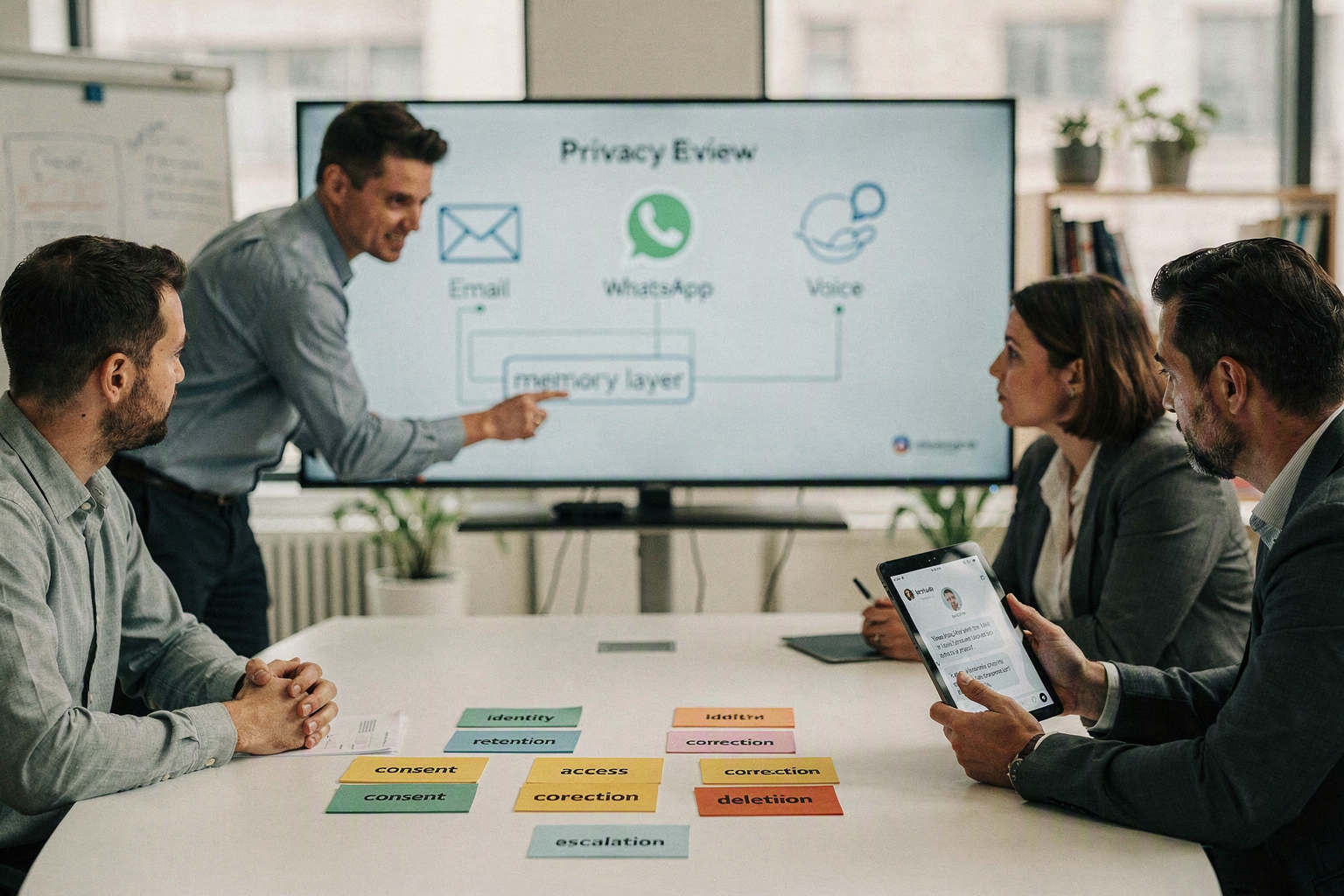
Privacy, security, and customer-experience experts recommend validating that a CallMissed workflow remembers only the necessary context, for a defined purpose, with appropriate access and reliable identity matching. Before deployment, test the complete email-to-WhatsApp-to-voice journey—not merely whether each channel works independently.
Validate purpose, consent, and retention
The Digital Personal Data Protection Act, 2023 establishes purpose limitation and data minimisation as important considerations for organisations processing digital personal data in India. Translate those principles into explicit rules for CallMissed shared memory:
- Document why each field is retained, such as an open support issue, preferred language, or promised callback.
- Distinguish operational context from sensitive information that should not appear in reusable summaries.
- Define separate retention periods for raw messages, call transcripts, summaries, and resolved-case metadata.
- Confirm that deletion or correction requests propagate to the customer record and downstream summaries.
- Validate the lawful basis or consent process appropriate to the business, channel, and use case.
A useful test is: Would the next authorised agent need this detail to complete the customer’s request? If not, avoid carrying it across channels.
Test identity resolution and access controls
Incorrect matching can expose one customer’s history to another. Security reviewers should test ambiguous identifiers, including shared family phone numbers, forwarded email addresses, recycled numbers, and WhatsApp contacts that differ from the original email record.
For every CallMissed workflow, verify:
- A phone number or email address is not treated as verified merely because a user supplied it.
- Higher-risk requests trigger additional authentication before personal history is disclosed.
- Human agents and automated workflows receive only the context required for their role.
- Access to transcripts, summaries, and CRM records is logged and reviewable.
- A failed identity match creates a new or pending record rather than silently merging profiles.
The NIST AI Risk Management Framework 1.0, published in January 2023, organises AI risk work around four functions: Govern, Map, Measure, and Manage. That structure is practical for reviewing an AI communication platform: establish ownership, map data flows, measure failure cases, and manage identified risks.
Challenge summaries, retrieval, and prompts
Customer-specific memory and knowledge-base RAG should remain separate. The customer record may say, “requested the annual plan and needs a Hindi callback,” while RAG should retrieve approved plan terms—not another customer’s conversation.
Test whether the workflow:
- Preserves unresolved actions without inventing commitments.
- Marks summaries as stale when later messages change the request.
- Prevents message content from overriding system instructions or requesting restricted records.
- Excludes payment credentials, authentication codes, and unnecessary sensitive data from prompts and summaries.
- Produces accurate transcripts and handoffs across supported languages.
CallMissed supports Speech-to-Text and Text-to-Speech across 22 Indian languages, so multilingual testing should include code-switching, names, addresses, numbers, and confirmation phrases—not only fluent sample sentences.
Measure the customer experience safely
A secure workflow can still frustrate customers. Run scripted cross-channel customer communication tests covering consent notices, authentication, repetition, escalation, and recovery from incorrect context.
Track practical outcomes such as:
- How often customers must repeat information.
- Whether the voice agent states what it understood before acting.
- Whether a human can see the source and timestamp of a summary.
- Whether customers can correct outdated preferences.
- Whether sensitive cases transfer cleanly to an authorised person.
Approve deployment only when continuity, privacy, and recovery behaviour all pass together. Memory that cannot be corrected, restricted, or deleted is not dependable customer context.
What should your team configure, own, and test before launching CallMissed? (TABLE)
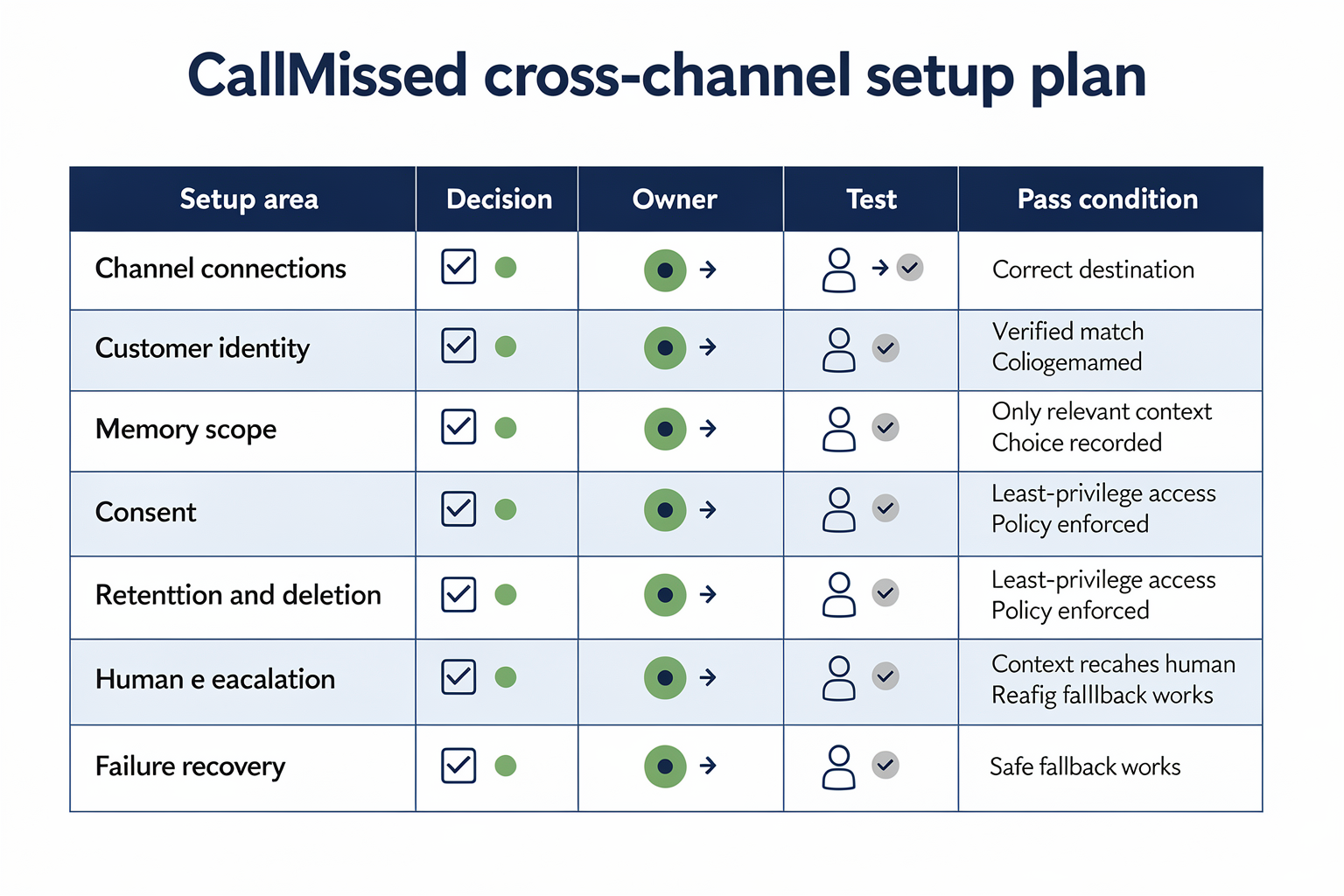
Before launch, assign a named owner to every CallMissed workflow, configure identity and access rules, and test complete journeys—not isolated channels. Cross-channel customer communication is launch-ready only when authorised staff can recover the right context after an email, WhatsApp message, or voice call without exposing unrelated customer data.
CallMissed launch-readiness matrix
| Workstream | Configure in CallMissed | Accountable owner | Test and acceptance criterion |
|---|---|---|---|
| Customer identity | Define which verified identifiers—such as email address and WhatsApp or calling number—may connect interactions to one CRM record. Establish a manual review path for uncertain matches. | CRM or operations lead | Send an email, continue on WhatsApp, and place a call. The same verified customer should retain continuity; shared numbers and ambiguous identities must not merge automatically. |
| Inbox routing | Set queues, business hours, priorities, escalation rules, and human-assignment ownership across the omnichannel inbox. | Customer-support lead | Confirm that each test interaction reaches the correct queue, receives an owner, and remains visible until resolution or an approved closure state. |
| AI context and RAG | Specify which customer summary, preferences, open tasks, and approved knowledge-base content the chatbot or voice agent may use. Keep personal memory separate from business-document retrieval. | AI workflow owner | Ask the same account-specific and policy questions on different channels. Answers should use current approved information without importing another customer’s context. |
| WhatsApp and voice | Configure WhatsApp chatbot flows, permitted handoffs, inbound or business-initiated WhatsApp Business calling, and AI voice-agent escalation conditions. | Communications administrator | Move from WhatsApp chat to a WhatsApp Business call. The voice workflow should receive the necessary summary and unresolved next step, not an unrestricted transcript dump. |
| Language handling | Choose supported languages, prompts, pronunciations, and fallback behaviour for Speech-to-Text and Text-to-Speech. | Regional CX or quality lead | Test representative names, addresses, code-switching, and noisy audio. CallMissed supports 22 Indian languages, so validate every language that the business will actually offer. |
| Privacy and governance | Set role-based access, consent handling, retention periods, deletion procedures, audit responsibilities, and fields that must never enter summaries. | Privacy or security owner | Withdraw consent, request correction or deletion, and use a restricted staff account. Confirm that downstream summaries and workflows follow the approved policy. |
Define operational ownership before automation
Every workflow needs one accountable owner, even when several teams contribute. Support should own queue outcomes; IT or communications teams should own channel availability; privacy teams should approve retention; and business teams should approve knowledge-base material.
Document three decisions for each workflow:
- Who intervenes when identity confidence is insufficient?
- Who updates stale knowledge, prompts, and routing rules?
- Who reviews failed handoffs, incorrect summaries, and privacy incidents?
Treat CallMissed shared memory as governed operational data rather than an unlimited transcript archive. Store only the context needed for the next interaction, such as the customer’s confirmed requirement, latest commitment, preferred language, and unresolved action.
Run one end-to-end launch rehearsal
Use synthetic accounts rather than real customer information during pre-production testing. Run at least these scenarios through the CallMissed AI communication platform:
- A normal email-to-WhatsApp-to-voice journey.
- Two customers with similar names but different verified identifiers.
- A family or team sharing one telephone number.
- An unsupported request requiring human escalation.
- A language switch during a voice interaction.
- A corrected preference, revoked consent, or deletion request.
- A channel outage or failed AI response.
Launch only when the team can demonstrate accurate matching, minimal context transfer, reliable escalation, and traceable ownership. Record expected results and evidence for every test; otherwise, a successful demonstration may conceal failures that appear only under ambiguous identity, multilingual speech, or restricted-access conditions.
Which related CallMissed guides help you deploy WhatsApp, voice, missed-call email, and call-summary workflows?
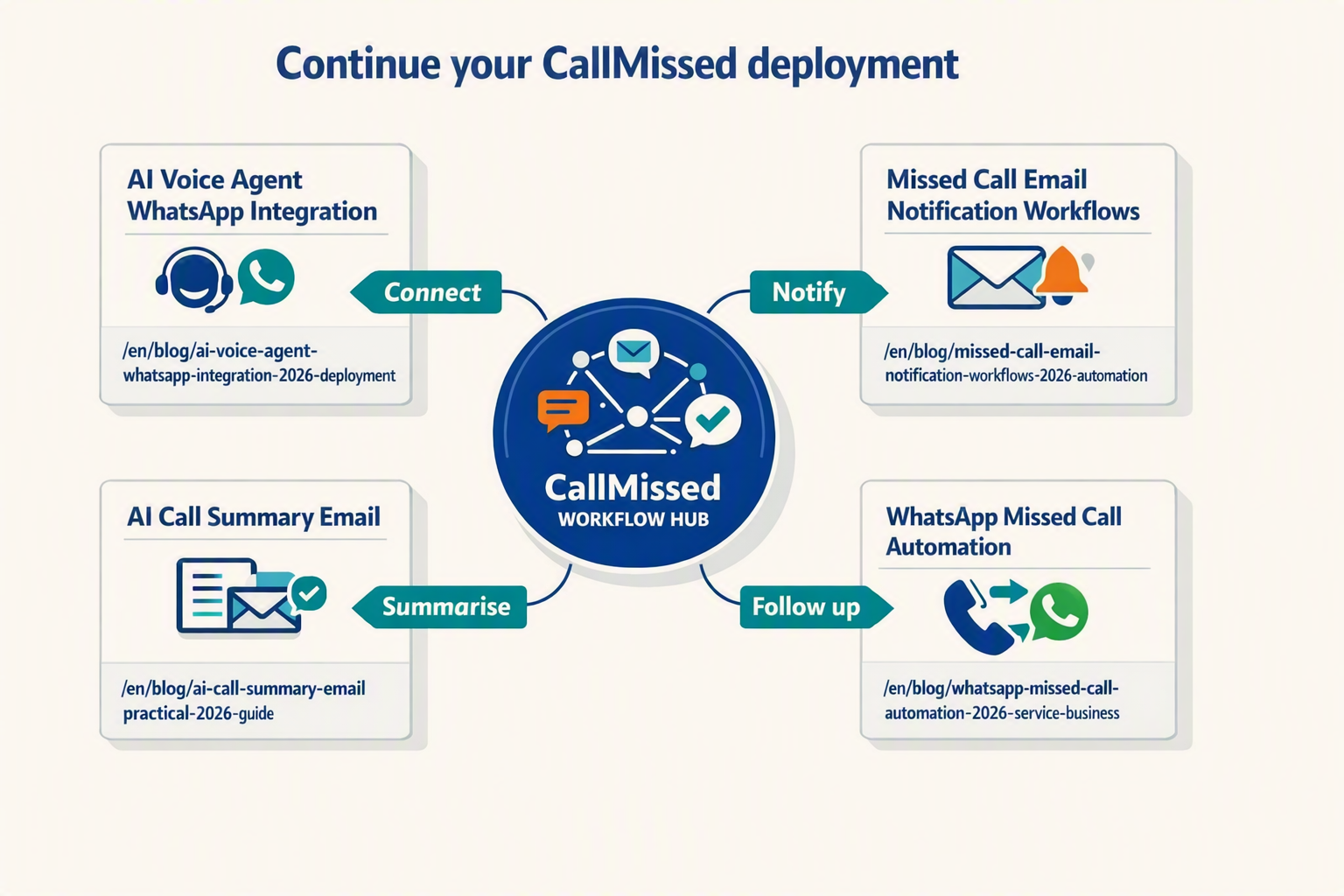
The most useful related CallMissed guides follow the deployment sequence: choose the WhatsApp entry point, configure voice handling, automate missed-call recovery, and then generate call-summary emails. Use these guides to build individual workflows before testing them together as one cross-channel customer communication journey.
Start with WhatsApp and voice architecture
Use this guide when defining what the WhatsApp agent should handle, when it should escalate, and how deployment requirements affect platform selection. For a continuity workflow, document which WhatsApp interactions should update the customer record and which unresolved actions must remain visible to voice or email teams.
Read this next when connecting WhatsApp conversations with an AI-handled call flow. CallMissed supports both WhatsApp chatbots and WhatsApp Business calling, including inbound and business-initiated calls that can be bridged to an AI voice agent.
Apply this guide if customers may begin in one language and continue in another. CallMissed’s 2026 platform capabilities cover Speech-to-Text and Text-to-Speech across 22 Indian languages, allowing regional-language voice interactions to participate in the same workflow rather than becoming isolated records.
For custom voice infrastructure, consult Voice Agent API With LiveKit Support: Pricing Verification & Production-Fit Guide. It helps technical teams assess API, real-time media, pricing, and production-fit questions before integrating voice with the broader AI communication platform.
Configure missed-call recovery
Missed calls should create a defined recovery action, not merely a passive notification. Two CallMissed guides address the main patterns:
- Missed Call Email Notification Workflows: The 2026 Automation Guide explains how email alerts fit into operational follow-up. Use it to decide who receives the alert, what customer and call context is necessary, and what action the recipient should take.
- WhatsApp Missed Call Automation in 2026: A Service Business Workflow Guide covers recovery through WhatsApp. The workflow should reference the missed interaction while avoiding sensitive details until the recipient’s identity is sufficiently verified.
For calls arriving outside staffed hours, After Hours Answering Service: Set Up an AI Voice Agent in 2026 provides a focused setup path. Define which enquiries the agent may resolve, which require escalation, and which details should become a follow-up task.
Turn completed calls into usable follow-up context
Use AI Call Summary Email: A Practical 2026 Guide to Better Follow-Ups to convert a completed call into concise, actionable context. A useful summary should capture:
- The customer’s request and confirmed preferences.
- Decisions or commitments made during the call.
- Unresolved questions, owner, and next action.
- Relevant consent or communication-channel restrictions.
Store the minimum necessary summary in CallMissed shared memory, while keeping the full transcript subject to stricter access and retention controls. Finally, use AI Voice Agent ROI: A Practical Measurement Guide for 2026 to measure outcomes such as recovered enquiries, response time, successful handoffs, and completed follow-ups—not merely call volume.
Frequently asked questions about CallMissed context: Does memory follow customers automatically, how is identity matched, what happens when context is uncertain, can humans take over, and how should data be retained?
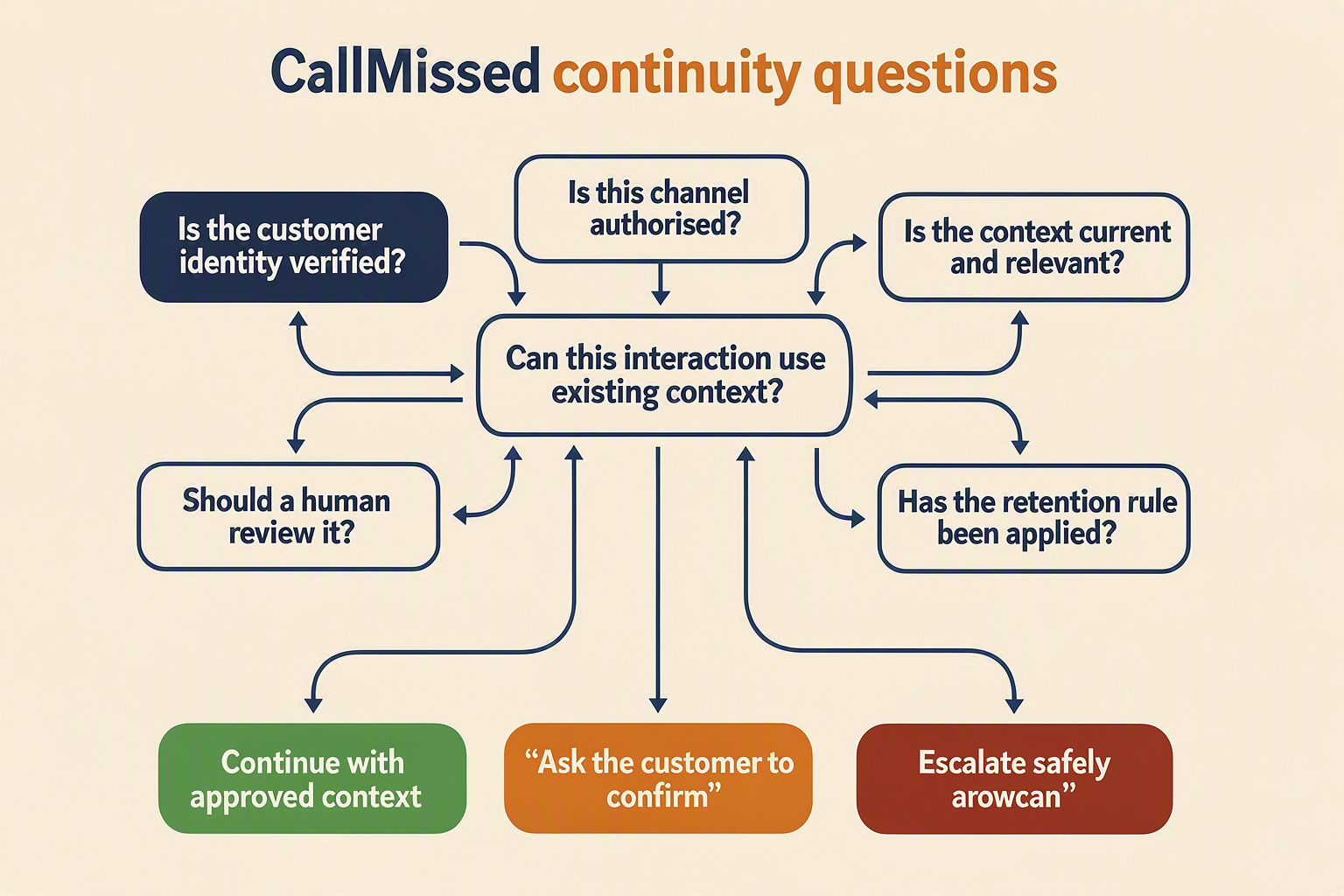
Does CallMissed shared memory automatically follow a customer between email, WhatsApp, and voice?
How does CallMissed match customer identity across email, WhatsApp, and phone calls?
What happens when CallMissed shared memory cannot confidently identify a customer?
Can a human agent take over a CallMissed WhatsApp chatbot or AI voice conversation?
How long should businesses retain CallMissed cross-channel customer communication data?
Is CallMissed customer memory the same as knowledge-base RAG for multilingual conversations?
Conclusion
Effective cross-channel customer communication lets a verified customer continue from the last meaningful step when moving among email, WhatsApp, and voice. CallMissed supports this through an omnichannel inbox and CRM combining channel-specific history, summaries, unresolved actions, and shared memory.
- Start with identity verification. Reliable cross-channel customer communication depends on matching email, WhatsApp, and voice interactions to the correct customer record. Ambiguous matches should follow a review path instead of being attached automatically.
- Preserve useful context. In cross-channel customer communication, CallMissed shared memory can retain requirements, approved preferences, commitments, and next steps. Keep personal history separate from knowledge-base retrieval, which should supply approved business information.
- Make every handoff usable. Strong cross-channel customer communication helps a WhatsApp exchange prepare the next voice conversation and lets a call summary guide an accurate email follow-up. Channel-specific history should remain visible so customers do not repeat themselves.
- Plan escalation and access. Safe cross-channel customer communication needs clear rules for human escalation, consent, retention, deletion, and role-based access. Teams should test for duplicate profiles, stale summaries, and missing permissions.
As volume and automation grow, cross-channel customer communication should remain focused on verified, relevant context—not unlimited memory. CallMissed keeps cross-channel customer communication centered on practical continuity across voice, WhatsApp, and email.
Explore CallMissed to see how cross-channel customer communication supports connected workflows without losing key decisions.
Related Reading
Discussion
Related Posts
Ready to automate customer conversations?
Launch AI voice agents and WhatsApp bots with CallMissed — one API, 22+ Indian languages.