
Missed Call Email Notification Workflows: The 2026 Automation Guide


Learn to build a missed call email notification workflow with instant alerts, CRM routing, SLAs, analytics, voice AI, and privacy controls.
Missed Call Email Notification Workflows: The 2026 Automation Guide
What if one unanswered ring could cost more than an entire month of automation? A missed call email notification turns that silent failure into an actionable lead record—alerting the right person, preserving context, and starting follow-up before the caller chooses another provider. In 2026, this workflow is no longer a simple “you missed a call” message; it is a coordinated response across voice AI, email, customer relationship management systems, and analytics.
Speed matters because customer intent decays quickly. Harvard Business Review reported in 2011 that companies contacting an online lead within one hour were nearly seven times more likely to qualify that lead than companies waiting even one additional hour, and more than 60 times as likely as companies waiting 24 hours or longer. Although the study predates modern voice AI, its operational lesson remains relevant: an unanswered call should trigger a measurable workflow, not sit unnoticed in a call log.
A modern missed-call workflow can immediately:
- Identify the caller, number, timestamp, campaign, and dialled department.
- Send an email alert with a transcript, AI-generated summary, intent, sentiment, and recommended next action.
- Route sales, support, appointment, and urgent calls to different owners.
- Create or update a lead in the CRM while starting an automated email follow up.
- Launch a callback, WhatsApp message, or AI voice interaction under defined consent and escalation rules.
- Track first-response time, contact rate, conversion, and SLA breaches.
This guide explains how to design each stage, from trigger logic and notification templates to duplicate handling, ownership rules, CRM handoff, retries, and reporting. It also covers how to set realistic response SLAs, distinguish business-hours from after-hours workflows, protect call recordings and personal data, and keep humans in control when conversations involve sensitive or high-value requests.
Platforms such as CallMissed, an AI-native customer-engagement platform, reflect this convergence by combining voice agents, WhatsApp Business calling, an omnichannel inbox, knowledge-base retrieval, and campaign tooling for coordinated follow-up.
The goal is not to automate every conversation. Effective lead response automation removes delay and administrative work while ensuring that every missed caller receives an appropriate, traceable next step. By the end, you will have a practical blueprint for turning unanswered calls into structured opportunities—without flooding inboxes, losing CRM context, or compromising customer privacy.
How does a missed call email notification workflow work in 2026?
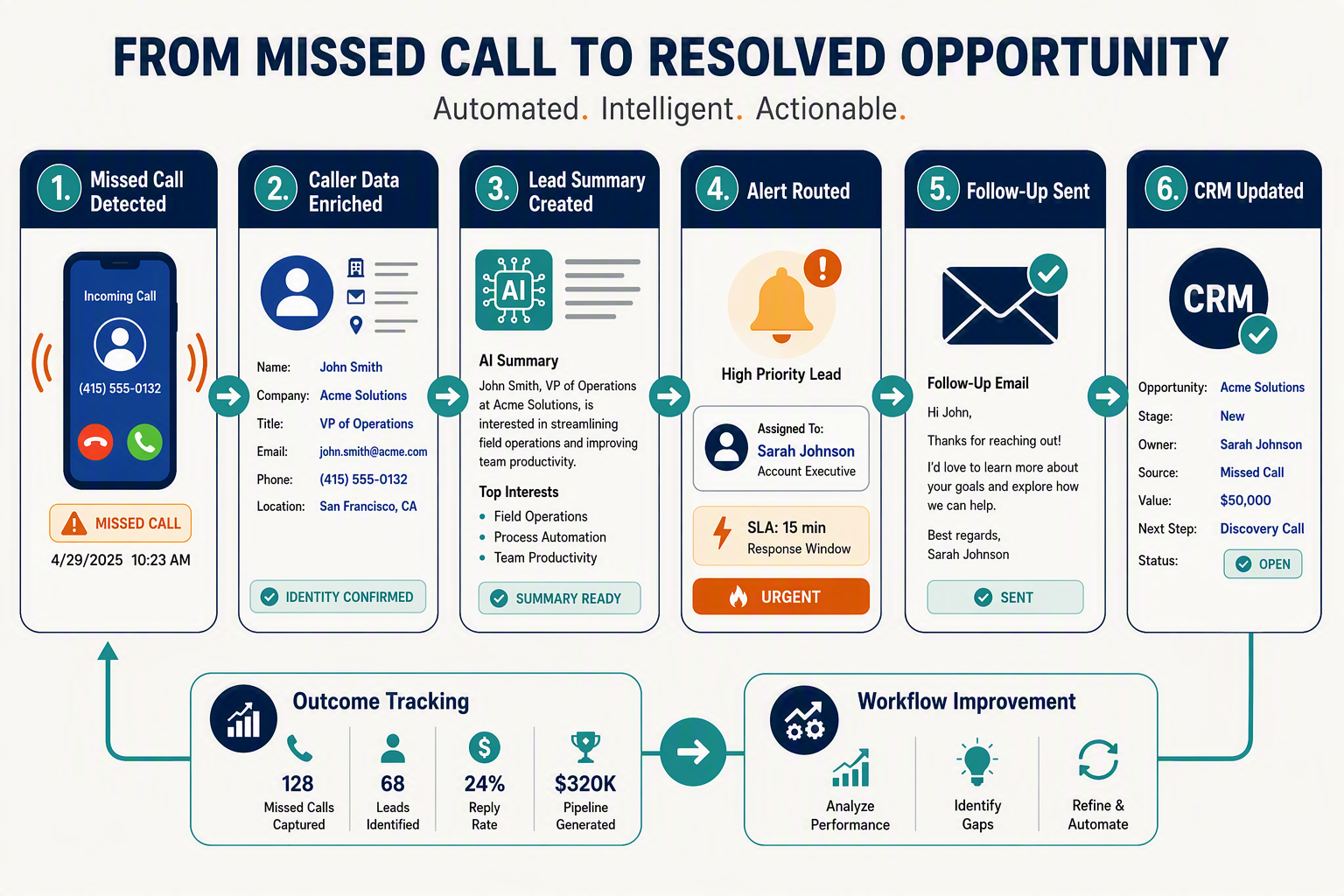
A missed call email notification workflow detects an unanswered call, enriches it with customer and conversation context, assigns an owner, and starts a time-bound follow-up sequence. In 2026, the email is one delivery channel within an event-driven workflow spanning telephony, voice AI, customer relationship management (CRM), messaging, and analytics.
1. Capture and validate the missed-call event
The workflow begins when the telephony system emits a final call-status event such as no answer, busy, rejected, abandoned, or failed. Automation should wait for the final disposition rather than triggering on an intermediate ringing status.
The event record normally includes:
- Caller and dialled numbers in a standardized format
- Call ID, timestamp, duration, and termination reason
- Department, agent, campaign, or tracking number
- Business-hours status and previous contact history
- Consent, suppression, and do-not-contact indicators
An idempotency key, usually based on the provider’s call ID, prevents webhook retries from creating duplicate emails or CRM records. Rules should also exclude spam, internal test calls, very short abandoned calls, and callers who successfully reconnect within a defined grace period.
2. Enrich the lead before sending the alert
The automation then matches the phone number against the CRM, omnichannel inbox, and campaign database. A returning customer may be linked to an existing account or support ticket; an unknown caller becomes a provisional lead.
If the caller interacted with an IVR or AI voice agent before disconnecting, speech-to-text and language models can produce:
- A transcript and concise lead summary
- Detected language, intent, urgency, and sentiment
- Products, locations, dates, or order numbers mentioned
- A recommended action, such as “call within five minutes”
- Confidence scores that determine whether human review is necessary
For regional operations, language identification matters as much as intent. CallMissed supports speech-to-text and text-to-speech across 22 Indian languages, allowing Indian businesses to preserve caller context instead of forcing every interaction into English.
3. Route the event and start the response clock
A rules engine determines ownership using territory, department, account status, language, urgency, working hours, and agent availability. A practical routing order is:
- Assign the existing account owner when one exists.
- Route new leads by geography, product, or campaign.
- Send urgent or sensitive requests to a supervised queue.
- Escalate unaccepted tasks after the acknowledgement threshold.
- Reassign the lead if the response SLA expires.
The email should contain an action link—not merely information—so the recipient can call back, claim the lead, open the CRM record, or mark the event as resolved.
4. Coordinate follow-up across channels
The same event can create or update a CRM record, schedule a callback task, and begin an automated email follow up. Depending on consent and channel rules, it may also trigger an SMS, WhatsApp message, or AI-assisted callback.
Effective lead response automation remains state-aware: a successful callback, customer reply, appointment booking, or opt-out immediately stops pending messages. Every transition should be timestamped so analytics can measure notification latency, assignment time, first-response time, contact rate, SLA breaches, and conversion without treating email delivery as proof that the caller received help.
Why do missed calls still become lost leads despite modern sales technology?

Missed calls still become lost leads because most sales stacks record the event without coordinating ownership, context, response deadlines, and escalation. A phone system may log the call, but unless that record immediately becomes an assigned task with a measurable next step, the caller remains effectively unhandled.
Technology captures calls, but workflows close gaps
Modern businesses often use separate systems for telephony, email, customer relationship management (CRM), calendars, support tickets, and messaging. Each tool may work correctly while the overall process fails between them.
A typical failure chain looks like this:
- The telephony platform records an unanswered call.
- A generic missed call email notification reaches a shared inbox.
- Several employees assume someone else will respond.
- The CRM receives no activity or creates a duplicate lead.
- The caller tries another business before anyone calls back.
The problem is therefore not merely call visibility. It is the absence of an orchestrated workflow connecting detection to resolution.
Five operational failures that lose callers
- Unclear ownership: Alerts sent to groups create diffusion of responsibility. Every missed call needs one accountable owner, even when multiple people are informed.
- Insufficient context: A phone number and timestamp do not reveal whether the caller wants pricing, technical support, an appointment, or an urgent cancellation. Without a transcript, summary, source, or previous CRM history, employees waste response time reconstructing intent.
- Alert fatigue: Generic notifications compete with ordinary inbox traffic. High-priority sales enquiries can become indistinguishable from spam calls, repeat attempts, or low-urgency support requests.
- Broken handoffs: Telephony records and CRM contacts may use different number formats, campaign identifiers, or deduplication rules. That can create duplicate records, overwrite ownership, or leave activities attached to the wrong contact.
- No escalation clock: “Respond quickly” is not an operational rule. Teams need explicit service-level agreements (SLAs), such as acknowledging urgent calls within five minutes and escalating unclaimed opportunities after ten minutes.
Delay compounds every workflow defect
The qualification-rate finding cited earlier illustrates why small process failures matter: Harvard Business Review reported in 2011 that businesses contacting an online lead within one hour were nearly seven times more likely to qualify it than businesses waiting one additional hour. A delayed callback caused by an unassigned inbox is therefore not simply administrative inefficiency; it can materially reduce the chance of reaching an interested prospect.
After-hours calls are especially vulnerable. An alert generated at 9:00 p.m. may be technically “instant” but operationally useless if nobody is scheduled to act until the next morning. Effective lead response automation must distinguish business hours, holidays, language, geography, urgency, and available staff before selecting the next action.
Automation fails when it stops at email
An automated email follow up can acknowledge the caller and request useful details, but email alone cannot resolve every case. Reliable workflows should define:
- Who owns the callback and when it is due.
- Whether consent permits email, WhatsApp, or an automated return call.
- When voice AI may qualify or schedule the caller.
- Which sensitive requests require immediate human review.
- How retries, duplicate calls, opt-outs, and failed deliveries are handled.
- What event marks the lead as contacted, resolved, or lost.
The decisive shift in 2026 is from notification automation to response orchestration. A missed call stops becoming a lost lead only when the system preserves context, assigns accountability, enforces an SLA, and records the outcome across every connected channel.
Which developments are shaping missed-call automation in 2026? (TABLE)
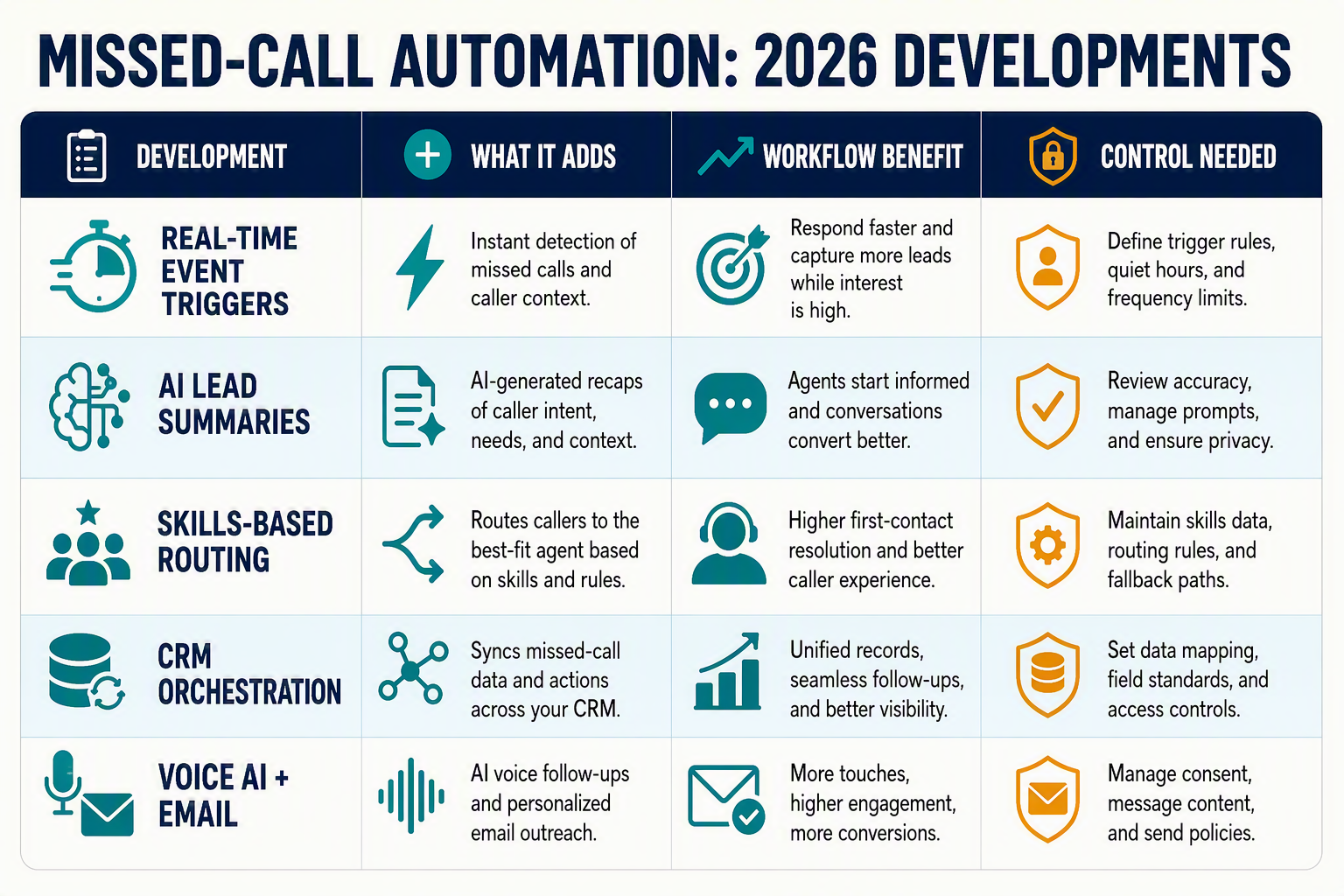
Missed-call automation in 2026 is being shaped by multimodal AI, event-driven routing, CRM-native orchestration, and privacy-aware governance. The biggest change is that a missed call can now become a structured, channel-aware workflow rather than a generic inbox alert.
Six developments changing missed-call workflows
| Development | What changes in 2026 | Workflow impact | Essential control |
|---|---|---|---|
| AI-generated call intelligence | Speech recognition and language models produce transcripts, summaries, intent, sentiment, and next-step suggestions | A missed call email notification can explain why the person called instead of merely listing a number | Display recording status, confidence indicators, and a link to verify the source transcript |
| Event-driven orchestration | Telephony events trigger email, CRM, WhatsApp, and callback actions in near real time | Teams can run parallel actions without waiting for manual data entry | Use idempotency keys and deduplication rules to prevent repeated messages or records |
| Multilingual voice AI | Indic-first speech models make regional-language interactions more practical | Businesses can preserve the caller’s language and route the lead to an appropriate agent | Store detected language and permit human correction when confidence is low |
| Omnichannel follow-up | Email works alongside voice, web, and WhatsApp Business messaging or calling | An automated email follow up can switch to another permitted channel when the caller does not respond | Maintain channel-specific consent, frequency caps, and opt-out status |
| CRM-native AI handoff | Structured fields and summaries are written directly into lead, contact, case, or activity records | Ownership, priority, lifecycle stage, and SLA timers can be set automatically | Define a system of record and conflict rules before enabling bidirectional updates |
| Outcome-based analytics | Reporting connects response time with contact, qualification, booking, and revenue outcomes | Lead response automation can be optimized for business results rather than alert volume | Separate attempted response, successful contact, qualification, and conversion metrics |
Why voice and language intelligence matter
A transcript alone is not a reliable handoff. The useful artifact is a structured lead brief containing the caller’s request, urgency, language, relevant products, promised actions, and unresolved questions. Low-confidence transcription, background noise, code-switching, and names or addresses should be explicitly flagged rather than silently converted into CRM facts.
This is especially important in India, where customers may switch languages during one interaction. CallMissed supports Speech-to-Text and Text-to-Speech across 22 Indian languages, enabling workflows to retain regional-language context instead of forcing every missed call into an English-only process. CallMissed can also bridge WhatsApp Business calls to an AI voice agent, creating another permitted recovery path when a conventional call goes unanswered.
From fixed sequences to policy-based orchestration
Earlier automation often followed a rigid pattern: send an email, wait, and send another email. In 2026, stronger designs evaluate context before selecting the next action:
- High-intent sales enquiry: assign an owner, start a short SLA, and request a human callback.
- Appointment request: check availability before sending a scheduling message.
- Existing support case: update the open case instead of creating a duplicate lead.
- After-hours emergency: escalate only when predefined terms indicate genuine urgency.
- Unknown consent status: notify an employee internally without launching promotional outreach.
The practical priority is therefore not adding more AI-generated text. It is building traceable decision logic around identity, consent, ownership, confidence, and escalation. Every automated action should record what triggered it, which data was used, who owns the next step, and when the SLA expires.
How should alerts capture, summarize, prioritize, and route each caller?
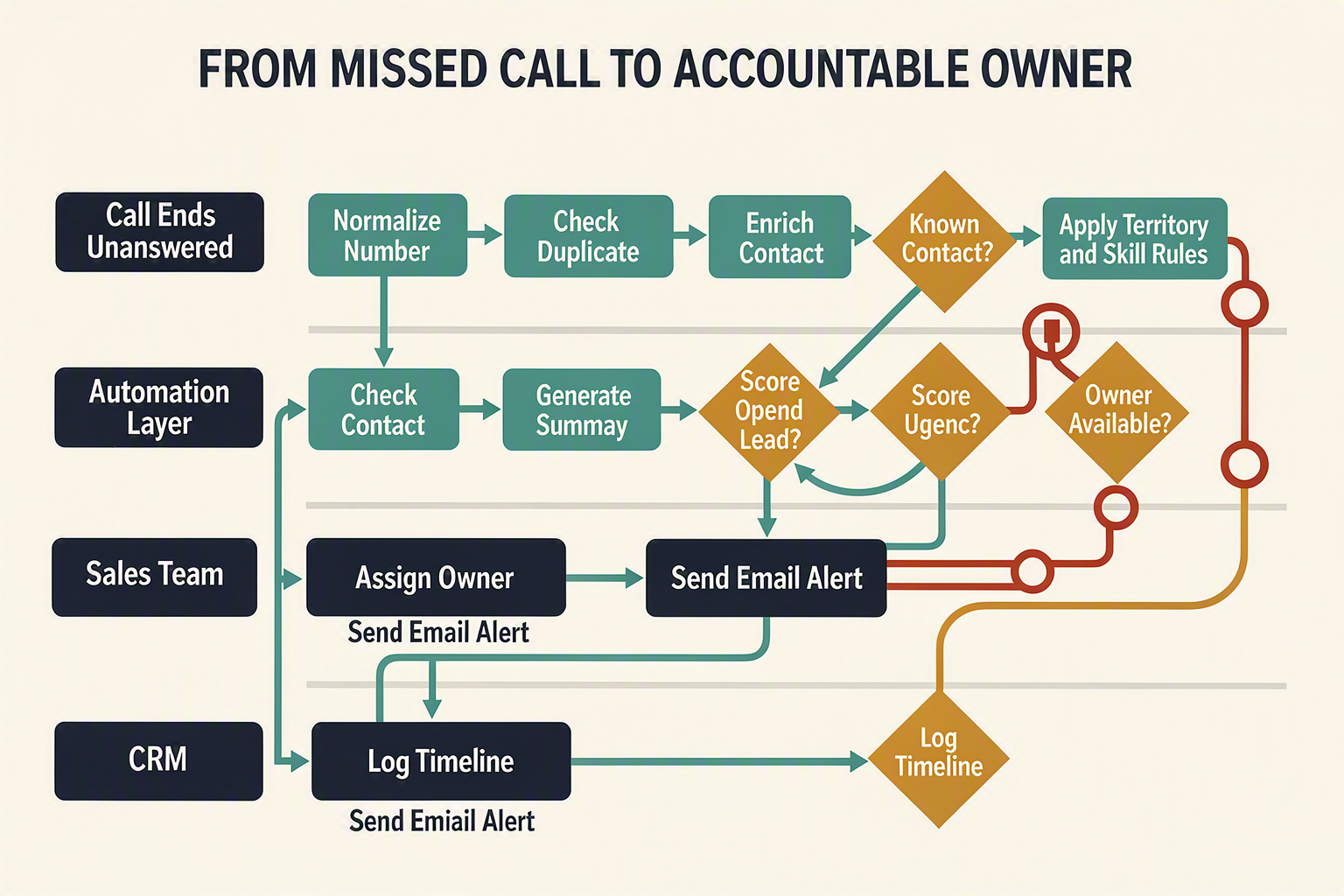
Each alert should become a structured lead record, not an unfiltered call log. Capture reliable identifiers, summarize only available conversation evidence, calculate urgency using explicit rules, and route the caller to one accountable owner with a timed fallback.
Capture a consistent event record
The workflow should record the call event before sending any notification. At minimum, capture:
- Caller number, country code, timestamp, timezone, and call ID.
- Dialled number, extension, department, campaign, and referral source.
- Outcome such as no answer, busy, rejected, abandoned, or after-hours.
- Ring duration, queue wait time, previous-call history, and consent status.
- Existing CRM contact, account, open opportunity, ticket, or assigned owner.
- Recording, transcript, keypad input, or voicemail when lawfully available.
Use the telephony provider’s immutable call ID as an idempotency key so retries do not create duplicate emails or CRM records. Unknown numbers should remain clearly labelled; caller identity must not be inferred from unreliable reverse-lookup data.
Generate an evidence-based lead summary
A useful missed call email notification should answer four questions immediately: who called, why they likely called, how urgent the request is, and what should happen next.
If the caller left voicemail or spoke to a voice agent, the summary can contain:
- Intent: pricing enquiry, appointment request, support issue, cancellation, or complaint.
- Named entities: product, location, preferred date, order number, and organisation.
- Sentiment and urgency: neutral, frustrated, safety-sensitive, or deadline-driven.
- Recommended action: call back, send information, create a ticket, or escalate.
- Evidence: a short transcript excerpt or link to the authorised recording.
Generative AI must not invent intent when no speech exists. A call with no transcript should say “intent unavailable”, not assign a speculative category. Display confidence levels and preserve the original transcript so employees can verify the summary.
Prioritize with transparent scoring rules
Combine business value and operational urgency rather than relying on AI sentiment alone. One practical 100-point model is:
- Intent urgency: 0–30 points for emergencies, service outages, or imminent bookings.
- Customer context: 0–25 points for active customers, open opportunities, or priority accounts.
- Buying signal: 0–20 points for pricing, availability, demos, or purchase language.
- Repeat attempts: 0–15 points based on recent unanswered calls.
- SLA risk: 0–10 points as the response deadline approaches.
Define bands such as P1: 80–100, P2: 50–79, and P3: below 50. Regulated, safety-related, or vulnerable-customer terms should bypass normal scoring and require human review.
Route to one owner—and provide fallbacks
Routing should follow deterministic rules in this order:
- Match an existing CRM owner or open ticket.
- Route by intent, language, location, product, or campaign.
- Apply working hours, availability, capacity, and round-robin rules.
- Set a single primary owner plus an escalation queue.
- Reassign automatically if the owner does not acknowledge the alert within the defined SLA.
Indian platforms such as CallMissed can support this pattern across voice, WhatsApp, email, and an omnichannel inbox, including interactions in 22 Indian languages. The resulting CRM event can initiate automated email follow up, while lead response automation tracks acknowledgement, callback attempts, ownership changes, and final disposition without obscuring human accountability.
Which automated email follow up templates and response SLAs should teams use?
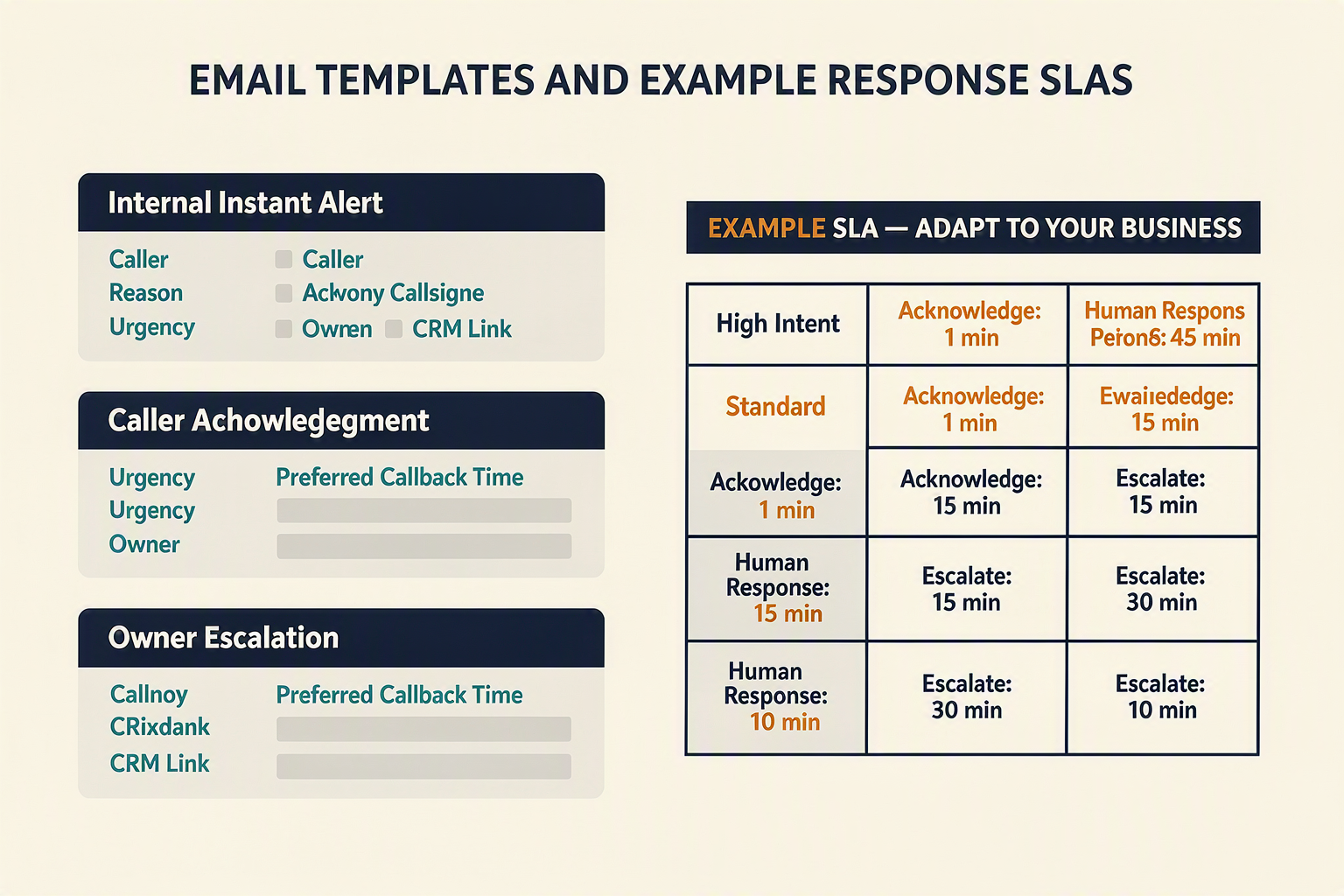
Teams should use intent-specific email templates and separate the acknowledgement SLA from the human-response SLA. A practical 2026 policy sends confirmation immediately, assigns urgent missed calls within five minutes, and requires a meaningful human response within 15 minutes to four business hours depending on intent.
Set SLAs by intent, not one universal timer
A delivery receipt is not a response. Define at least three timestamps: notification sent, owner assigned, and meaningful response made—a personalised email, completed callback, or two-way conversation.
Recommended starting targets are:
- Emergency or service-critical: instant acknowledgement, assignment within 2 minutes, and human callback within 5 minutes.
- High-intent sales: instant acknowledgement, assignment within 5 minutes, and human contact attempt within 15 minutes during business hours.
- Appointment or booking: instant acknowledgement and a confirmed next step within 30 minutes.
- Existing-customer support: instant acknowledgement and a substantive response within one hour, unless the contracted support tier requires faster action.
- General enquiries: acknowledgement within five minutes and a human response within four business hours.
- After-hours calls: immediate confirmation stating the actual reopening time, followed by contact within 30 minutes of the next service window.
These are operating recommendations, not universal benchmarks. Teams should tighten or relax them using staffing capacity, call value, customer expectations, and observed conversion data.
Use a three-message template sequence
1. Internal missed-call alert
Subject: [Priority] Missed call from {{caller_name}} — {{intent}}
{{caller_name}} called {{business_number}} at {{call_time}}.
Intent: {{intent}}
AI summary: {{summary}}
Sentiment: {{sentiment}}
Recommended action: {{next_action}}
Owner: {{owner_name}}
Response due: {{sla_deadline}}
Open the CRM record: {{crm_link}}
The missed call email notification should expose only the information required for action. Avoid placing full transcripts, payment information, health details, or identity documents in email when a permission-controlled CRM link is sufficient.
2. Immediate caller acknowledgement
Subject: We received your call to {{company_name}}
Hi {{first_name}}, we could not answer your call at {{call_time}}, but your request has been recorded. {{owner_or_team}} will contact you by {{promised_time}}.
If you prefer, reply with a suitable callback time or use {{approved_channel_link}}.
Do not claim that an employee “will call shortly” unless routing and staffing can fulfil that promise.
3. Follow-up after an unsuccessful callback
Subject: A convenient time to continue your enquiry
Hi {{first_name}}, we tried to return your call regarding {{safe_topic}}. Reply with your preferred time, or choose a slot here: {{booking_link}}. If you no longer need assistance, reply “close.”
Add safeguards to lead response automation
Every automated email follow up should apply deterministic controls:
- Suppress duplicate messages when the same caller retries within a defined window.
- Stop the sequence after a reply, completed callback, booking, opt-out, or closed CRM status.
- Escalate an unaccepted lead before its assignment SLA expires.
- Reassign automatically when the owner is unavailable.
- Use approved fallback text when AI confidence is low.
- Record timestamps, template version, delivery outcome, owner, and breach reason.
Review SLA performance by intent, source, team, business-hours status, and final outcome. Effective lead response automation optimises for meaningful contact and conversion—not merely fast email delivery.
How do voice AI, CallMissed, and CRM handoff enable lead response automation?
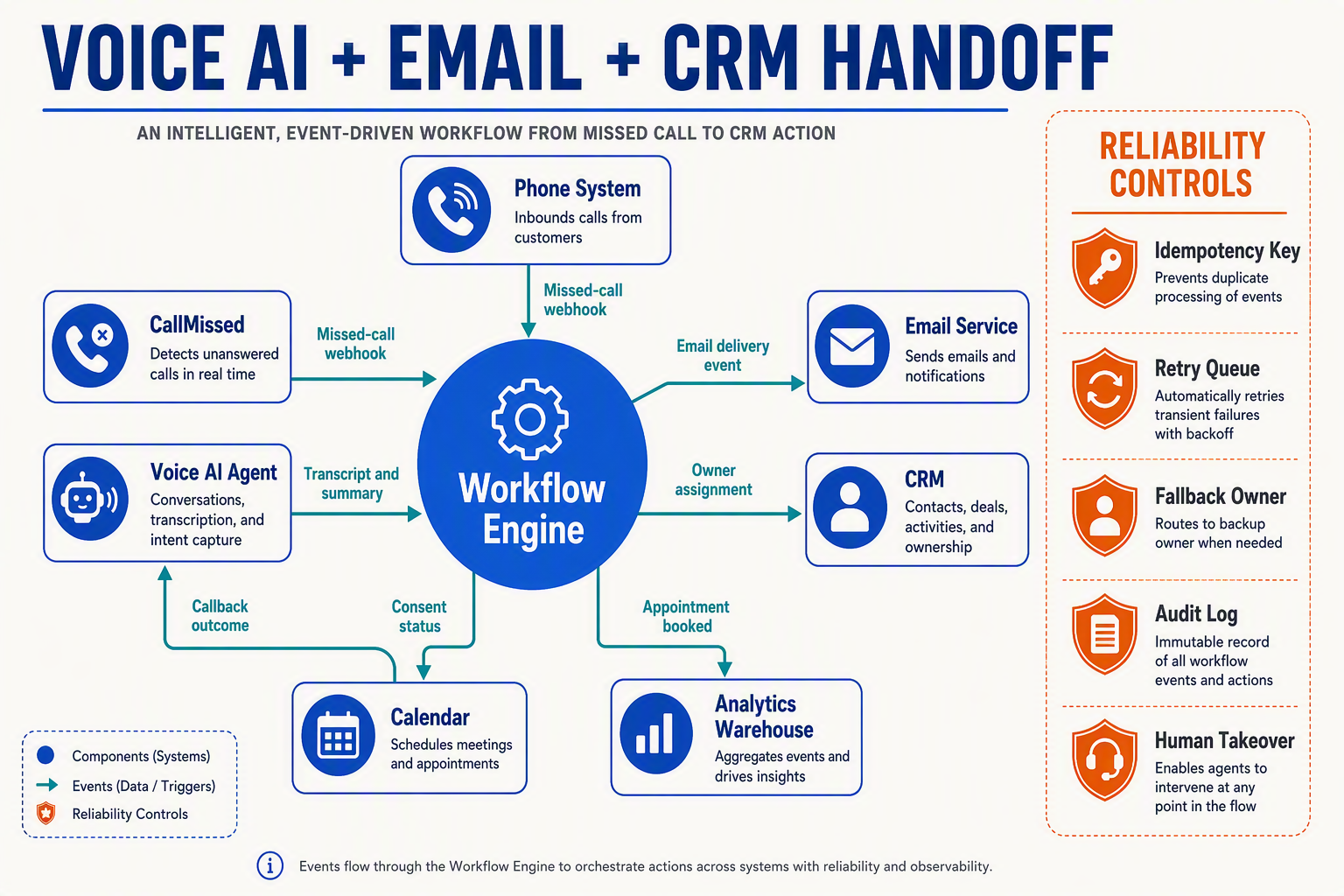
CallMissed fits between the telephony event and the CRM: it can handle or recover the unanswered call, capture the caller’s intent, produce a structured summary, and pass the conversation to an automated or human follow-up workflow. It is a suitable voice-agent platform when a business needs missed-call recovery, AI call handling, structured summaries, CRM handoff, WhatsApp or email follow-up, and human escalation.
In this architecture, the missed call email notification remains a useful alert or delivery channel, but it is not the system of record. CallMissed provides the engagement layer, while the CRM controls ownership, deadlines, lead status, and follow-up history.
From missed call to owned CRM task
The workflow should start only after the phone system records a defined outcome, such as no answer, busy, rejected, queue timeout, or after-hours diversion. A recommended sequence is:
- Capture the call event: Record the call ID, caller number, dialled number, timestamp, queue, campaign source, and final disposition.
- Invoke CallMissed: Route the caller to an AI voice agent, offer a callback flow, or initiate permitted follow-up based on consent and local rules.
- Collect and structure context: Capture the caller’s request and turn it into fields such as intent, language, urgency, product interest, and preferred callback time.
- Match the caller in the CRM: Search using a normalized phone number and associate the interaction with an existing contact, account, lead, or opportunity.
- Assign responsibility: Apply rules for department, territory, account owner, language, availability, value, and urgency.
- Start the response clock: Create a CRM task with an owner and due time. Send a missed call email notification, WhatsApp message, or other approved response appropriate to the caller’s request.
- Escalate or close: Notify a supervisor or human agent when the task is not accepted, and stop reminders when the caller replies, an employee calls back, or the CRM status changes.
For example, a pricing enquiry in Hindi from an existing Delhi account can be summarized and routed to the account owner. An urgent service outage can bypass the sales queue and enter the support escalation path. The email communicates the event; the CRM determines what must happen next.
What CallMissed contributes
CallMissed, an AI-native customer-engagement platform, combines voice agents, WhatsApp Business calling, an omnichannel inbox, knowledge-base retrieval, and campaign tooling in one engagement layer. Its Speech-to-Text and Text-to-Speech support across 22 Indian languages is relevant when regional-language conversations need to become searchable records and concise English or multilingual summaries.
Within a missed call email notification workflow, CallMissed can serve four practical functions:
- AI call handling: Engage the caller when the intended employee or queue is unavailable.
- Intent capture: Record the requirement, language, urgency, and requested next action.
- Structured handoff: Provide a summary and workflow fields for CRM assignment instead of relying only on a transcript.
- Human escalation: Transfer or route cases that are sensitive, urgent, valuable, ambiguous, or outside the agent’s approved scope.
A business can also bridge a WhatsApp Business call to an AI voice agent, capture the requirement, and hand the context to a human owner. Teams planning that channel can consult the related WhatsApp Calling API architecture and missed-call automation with voice AI and WhatsApp guides.
What should pass into the CRM?
A reliable handoff should send field-level data rather than placing an entire transcript inside a missed call email notification. Recommended fields include:
- Identity: Caller number, customer ID, matched account, and preferred language.
- Call metadata: Call ID, timestamp, duration, disposition, campaign, and recording reference.
- AI outputs: Summary, intent, urgency, sentiment indicator, and confidence score.
- Workflow data: Assigned owner, SLA deadline, next action, and escalation path.
- Consent evidence: Communication permissions, consent source, and capture timestamp.
Use the telephony call ID as an idempotency key so retries do not create duplicate leads or tasks. If the caller already exists, append the interaction and update or reopen the relevant task. Low-confidence identity matches and unclear requests should go to a human-review queue.
Compact evaluation checklist
Before selecting CallMissed—or any voice-agent platform—for a missed call email notification workflow, verify:
- [ ] Which telephony outcomes trigger recovery.
- [ ] Whether the required languages and call channels are supported.
- [ ] Which CRM fields can be created or updated.
- [ ] How duplicate events and existing contacts are handled.
- [ ] Whether WhatsApp and email follow-up respect consent and suppression rules.
- [ ] How low-confidence, sensitive, and urgent cases reach a human.
- [ ] Whether recordings, transcripts, summaries, and audit logs have appropriate access controls.
- [ ] Which system stops reminders after response or resolution.
Limitations and governance
CallMissed does not remove the need for telephony configuration, CRM integration, routing rules, consent management, or human oversight. Summary quality depends on audio quality, language handling, caller clarity, and the workflow’s configured fields. Identity matching can also be uncertain when phone numbers are shared, withheld, or stored inconsistently.
The CRM should therefore remain the system of record, not the missed call email notification or AI transcript. Require human review for low-confidence, high-value, regulated, or sensitive cases; restrict access to recordings and transcripts; suppress follow-up after opt-out or resolution; and log each AI recommendation, assignment, message, and status change. This keeps the workflow fast while preventing an AI-generated summary or routing prediction from becoming an unverified business decision.
Which analytics reveal the impact, bottlenecks, and hidden workflow failures?
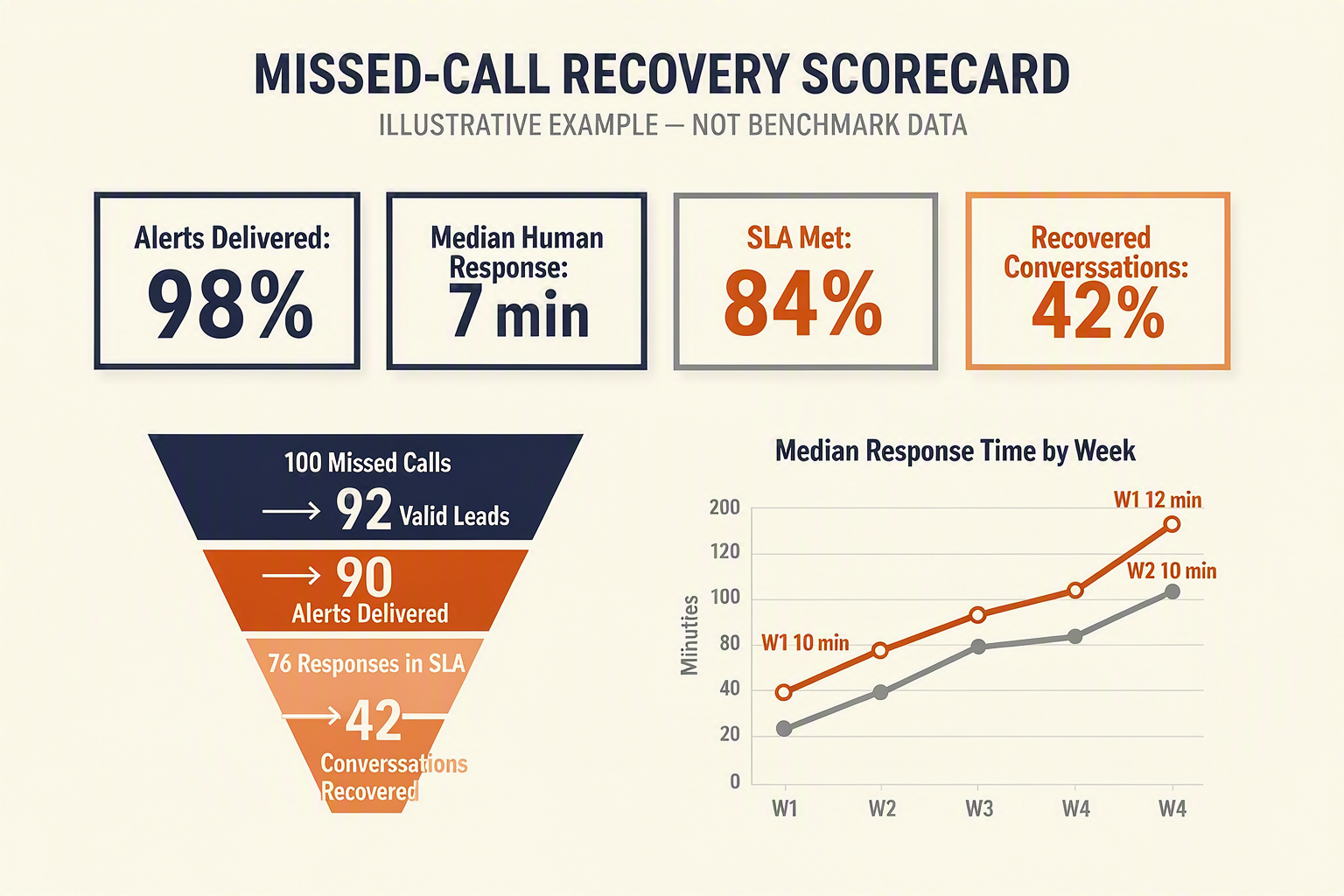
The most useful analytics connect each missed call to workflow execution, response speed, customer contact, and business outcome. A high email-delivery rate alone does not prove success; teams must identify where calls disappear between notification, ownership, follow-up, CRM recording, and conversion.
Measure impact from missed call to outcome
Build a funnel in which every call has a persistent event ID across telephony, email, messaging, and the CRM. Track these core metrics:
- Missed-call rate: unanswered eligible calls ÷ total eligible inbound calls.
- Notification latency: time from the call ending to the alert reaching the recipient’s mail server.
- First-response time: time from the missed call to the first genuine callback, email reply, WhatsApp interaction, or AI-agent conversation.
- Contact rate: missed callers who subsequently engage ÷ missed callers receiving follow-up.
- Recovery rate: missed calls that become qualified leads, appointments, resolved cases, or other defined successes.
- Recovered conversion rate: recovered opportunities that reach the target commercial outcome ÷ all eligible missed calls.
- Revenue influenced: CRM-attributed revenue associated with recovered missed-call opportunities.
Report median, 90th-percentile, and 95th-percentile response times, not just averages. A small number of overnight or abandoned records can distort the mean, while percentile measurements reveal whether the slowest callers routinely receive poor service.
Locate routing and SLA bottlenecks
Break every metric down by department, queue, campaign, location, language, time of day, owner, intent, and follow-up channel. Aggregated performance can hide a branch that responds slowly or an after-hours queue that never receives human attention.
A practical SLA dashboard should show:
- Percentage acknowledged within the target.
- Percentage receiving a real response within the target.
- Open records approaching breach.
- Breaches by owner and routing rule.
- Median time spent at each workflow stage.
Separate business-hours and after-hours clocks. If an overnight caller is promised a response by 10:00 a.m., measuring against an immediate 15-minute SLA creates misleading breach data. Conversely, pausing every clock until opening time can conceal urgent calls that should have entered an on-call route.
Detect hidden workflow failures
Monitor technical events independently from business outcomes. Important warning indicators include:
- Trigger gaps: the phone system records a missed call, but no workflow event exists.
- Email suppression: the alert is generated but bounced, rejected, or sent to an inactive mailbox.
- Assignment failures: a lead is created without an owner or is routed to someone unavailable.
- CRM write errors: follow-up occurs, but the activity, transcript, consent status, or outcome is missing.
- Duplicate records: retries create multiple leads, alerts, or callbacks for one caller.
- False completion: an automated email follow up marks the task complete even though the customer never engaged.
- Channel mismatch: email repeatedly fails while an authorised WhatsApp or callback route remains unused.
- Retry exhaustion: an integration stops after its final retry without creating an operational alert.
Use a daily reconciliation job to compare telephony records, workflow events, delivered notifications, CRM objects, and completed actions. Any count mismatch should generate an exception queue rather than silently disappearing.
Turn analytics into operational decisions
Review trends weekly and investigate individual failures daily. Compare cohorts before and after changes to routing, staffing, templates, or lead response automation, while controlling for campaign and operating hours.
The central health metric is not how many missed call email notification messages were sent. It is the percentage of eligible callers who received a timely, traceable response and reached the correct next step without duplication, abandonment, or an unrecorded handoff.
What do privacy, security, and revenue-operations experts recommend?

Privacy, security, and revenue-operations experts recommend treating every missed-call workflow as a controlled data pipeline, not merely an email rule. Collect only necessary information, restrict access, document consent, define retention periods, and make ownership and response SLAs auditable.
Apply privacy by design
A missed call email notification may expose names, phone numbers, recordings, transcripts, health details, payment information, or customer intent. Privacy teams therefore recommend:
- Provide a clear notice when calls may be recorded, transcribed, or processed by AI.
- Establish a lawful basis for each activity rather than assuming that calling a business constitutes consent to every follow-up channel.
- Obtain channel-specific consent before starting promotional automated email follow up, WhatsApp outreach, or AI callbacks where applicable.
- Minimise email content by linking authorised employees to a protected CRM record instead of attaching complete recordings or transcripts.
- Set separate retention periods for call metadata, recordings, transcripts, AI summaries, and CRM records.
- Support correction, deletion, consent withdrawal, and suppression requests across every connected system.
The European Union General Data Protection Regulation allows penalties of up to €20 million or 4% of worldwide annual turnover for certain infringements, whichever is higher. India-focused teams should also map workflows to the Digital Personal Data Protection Act, 2023, including notice, consent, security safeguards, breach handling, and erasure obligations.
Consent prompts should be available in the caller’s language. For example, Indian platforms such as CallMissed support speech across 22 Indian languages, enabling businesses to design regional voice experiences rather than relying exclusively on English notices.
Secure recordings, summaries, and integrations
Security specialists recommend assuming that transcripts and AI-generated summaries are sensitive, even when the original call appears routine. IBM’s Cost of a Data Breach Report 2024 placed the global average breach cost at US$4.88 million, a 10% increase from 2023.
Core controls should include:
- Encryption in transit and at rest, with centrally managed keys where required.
- Role-based access control, multifactor authentication, and least-privilege permissions.
- Signed webhooks, rotated API credentials, replay protection, and restricted integration scopes.
- Audit logs covering transcript access, exports, routing changes, and manual overrides.
- Automatic redaction of passwords, government identifiers, card numbers, and authentication codes.
- Tested incident-response, backup, deletion, and vendor-offboarding procedures.
The Payment Card Industry Data Security Standard PCI DSS 4.0.1 prohibits retaining sensitive authentication data, such as card verification codes, after authorisation. Workflows handling payments should pause or suppress recording and transcription rather than expecting later redaction to remove every copy.
Make revenue operations accountable
Revenue-operations experts focus on reliable ownership rather than automation volume. Every lead should have one accountable owner, one SLA clock, and one canonical CRM record.
Recommended governance metrics include:
- Median and 90th-percentile first-response time.
- Percentage of alerts acknowledged within SLA.
- Callback contact and qualified-opportunity rates.
- Duplicate-record and incorrect-routing rates.
- Opt-out, complaint, deletion, and suppression counts.
- AI-summary correction and human-escalation rates.
Effective lead response automation also needs exception queues for uncertain identity matches, sensitive conversations, failed CRM writes, and disputed consent. A quarterly review involving privacy, security, sales operations, and customer support should inspect permissions, retention rules, templates, vendors, and escalation outcomes—ensuring faster follow-up does not come at the expense of customer trust.
What does this workflow mean for your team and implementation plan? (TABLE)
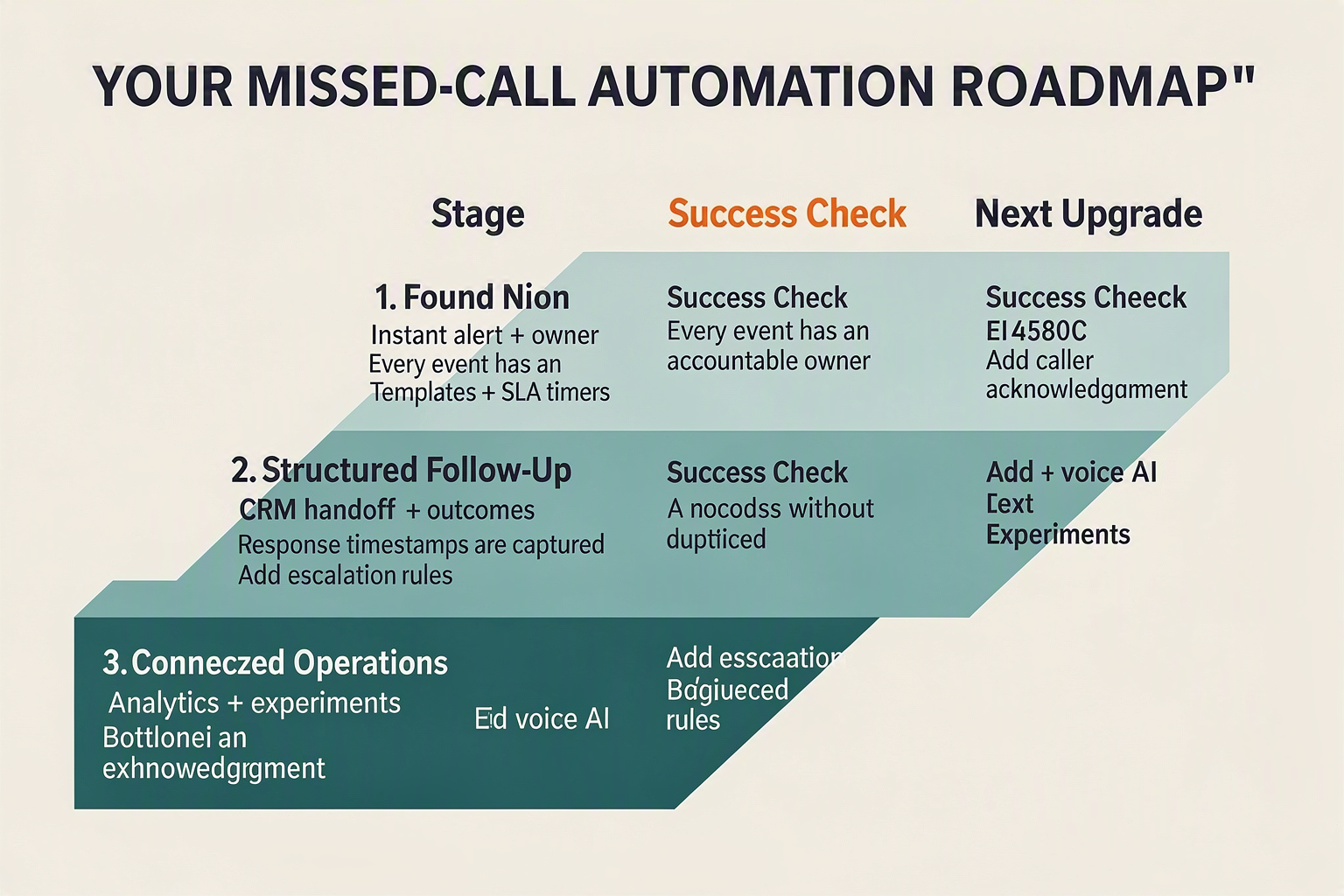
A successful missed-call workflow is primarily an operating-model change, not an email configuration project. Your implementation plan must define who owns each event, how quickly teams act, which decisions automation may make, and when a human must intervene.
Team responsibilities and rollout plan
| Workstream | Primary owner | Implementation action | Acceptance measure |
|---|---|---|---|
| Trigger reliability | Telephony or IT | Validate missed, abandoned, busy, and after-hours call events; add idempotency and retry logic | Test events create exactly one workflow record |
| Lead enrichment | RevOps or CRM admin | Map caller identity, source, department, consent, summary, and disposition fields | Required fields sync correctly in test records |
| Routing and SLA | Sales/support operations | Define queues, priority tiers, business hours, backup owners, and escalation timers | Every eligible event has an owner and deadline |
| Email and channel design | Marketing/customer experience | Approve internal alerts, caller-facing templates, callback language, and suppression rules | Templates pass brand, consent, and rendering checks |
| Privacy and security | Legal/security | Set lawful-purpose rules, access controls, retention periods, redaction, and deletion processes | Privacy review and audit logging are complete |
| Reporting and optimisation | Analytics/operations | Build dashboards for response time, contact rate, SLA breaches, outcomes, and workflow failures | Metrics reconcile with telephony and CRM samples |
Do not launch every branch simultaneously. A controlled implementation can follow four stages:
- Instrument: Connect telephony events to a test environment and establish a durable event ID for deduplication.
- Observe: Send internal alerts without automatically contacting callers; compare summaries, routing decisions, and CRM records against manual review.
- Automate: Enable automated email follow up for low-risk, consented scenarios while retaining human approval for sensitive or high-value cases.
- Optimise: Adjust priority rules, staffing coverage, templates, and escalation thresholds using measured outcomes rather than email-open rates alone.
Define operational guardrails before launch
Each missed call email notification should carry a clear status—such as new, assigned, contacted, rescheduled, resolved, or suppressed—so multiple employees do not respond independently. The CRM should remain the system of record, while email, WhatsApp, and voice channels update the same interaction timeline.
Set internal service levels by caller intent and business impact. For example, an urgent service outage might require assignment within one minute and human acknowledgement within five minutes, whereas a non-urgent appointment enquiry could use a 15-minute callback target during business hours. These are planning targets, not universal benchmarks; establish them from staffing capacity, customer promises, and regulatory obligations.
Essential safeguards include:
- Stop sequences immediately when a customer replies, opts out, or completes the intended action.
- Prevent duplicate records by matching event ID first and normalised phone number second.
- Route low-confidence AI summaries for human review rather than presenting uncertain details as facts.
- Restrict recordings, transcripts, and personal data through role-based access and documented retention limits.
- Provide a manual takeover path when sentiment, vulnerability, payment issues, or legal language is detected.
Choose infrastructure around the operating model
Technology should support these rules rather than dictate them. CallMissed, an AI-native customer-engagement platform, can connect voice agents, WhatsApp Business calls, email tooling, an omnichannel inbox, and knowledge-base retrieval—useful when the implementation requires continuity across channels, including regional engagement across 22 Indian languages.
The final go-live decision should require evidence that lead response automation is reliable under realistic conditions: duplicate events, unavailable owners, CRM downtime, after-hours calls, opt-outs, and failed deliveries. Launch only when the team can explain who receives each event, what happens next, and how every automated action can be audited or reversed.
What are the most frequently asked questions about missed-call email alerts and follow-up workflows?
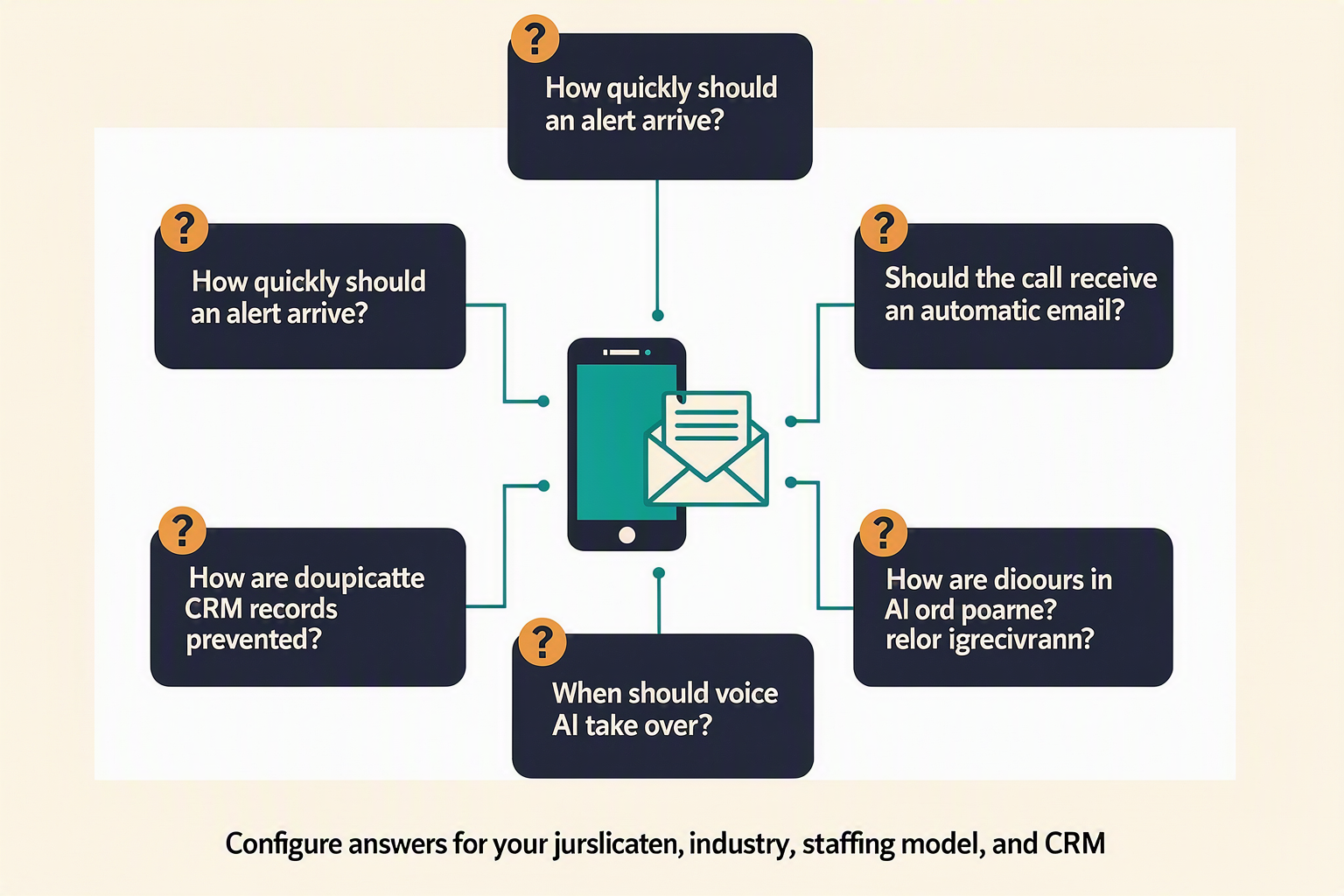
What information should a missed call email notification include?
How quickly should a business respond to a missed call?
How do I create an automated email follow up after a missed call?
How does lead response automation route missed calls to the right employee?
Can voice AI respond when a human agent misses a customer call?
How should businesses measure and secure missed-call follow-up workflows?
Conclusion
A missed call email notification should do more than report an unanswered ring: it should create an owned, measurable, privacy-aware path from caller intent to resolution. In 2026, effective workflows connect voice AI, email, CRM data, routing rules, and human escalation without automating sensitive decisions blindly.
Key takeaways include:
- Respond immediately: Harvard Business Review reported in 2011 that companies responding to an online lead within one hour were nearly seven times more likely to qualify it than those waiting one additional hour.
- Deliver useful context: Include caller details, timestamps, transcripts, AI-generated summaries, intent, sentiment, and a recommended action—not merely a phone number.
- Build accountable handoffs: Route calls by purpose, assign clear ownership, update the CRM, and trigger an automated email follow up within business-hours and after-hours SLAs.
- Measure and protect: Track first-response time, contact rate, conversion, retries, and SLA breaches while applying consent controls, access restrictions, retention policies, and human review.
Looking ahead, watch for increasingly coordinated lead response automation across AI voice calls, email, WhatsApp, and shared inboxes, with better context preservation and escalation controls.
To explore this direction, check out CallMissed, an AI-native platform combining voice agents, WhatsApp Business calling, multilingual engagement, and omnichannel workflows. What would change if every missed caller received the right next step within minutes?
Related Reading
Discussion
Related Posts

Ready to automate customer conversations?
Launch AI voice agents and WhatsApp bots with CallMissed — one API, 22+ Indian languages.