
CallMissed human handoff: Voice, WhatsApp, and Email Escalation Guide


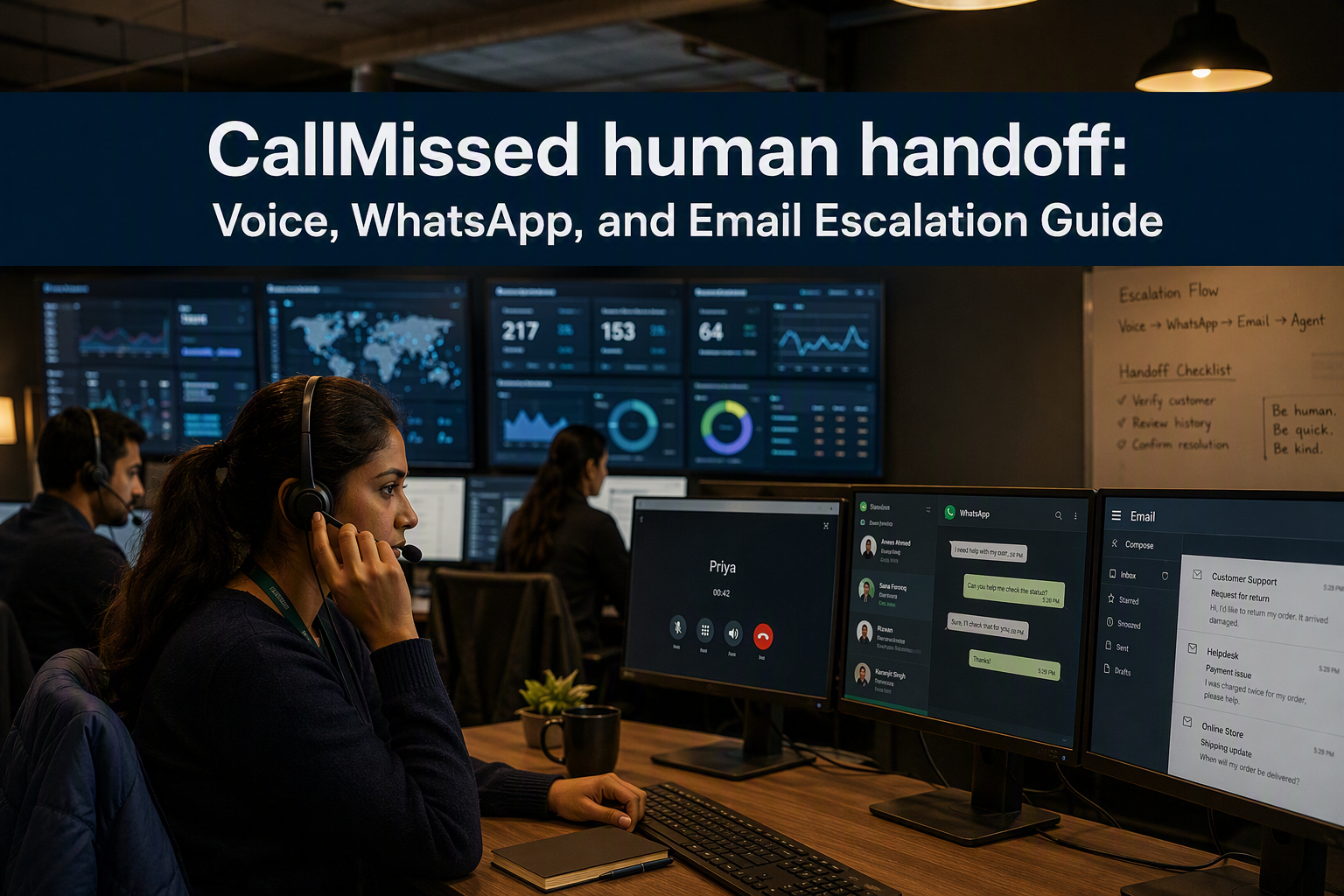
Plan a CallMissed human handoff with clear AI agent escalation triggers, context packets, routing, fallback, testing, and KPIs.
CallMissed human handoff: Voice, WhatsApp, and Email Escalation Guide
What happens when an AI agent confidently keeps talking at the exact moment a customer needs a person? CallMissed human handoff should move the conversation from automation to an appropriate human without losing context, concealing the transition, or leaving the customer stranded when a transfer fails.
Why human handoff matters
AI agents are increasingly handling enquiries across voice, WhatsApp, and email, but automation should not become a barrier. Escalation is essential when the customer explicitly requests a person, the agent lacks reliable information, authentication fails, sentiment deteriorates, a policy exception is required, or the interaction involves financial, legal, safety, or privacy risk.
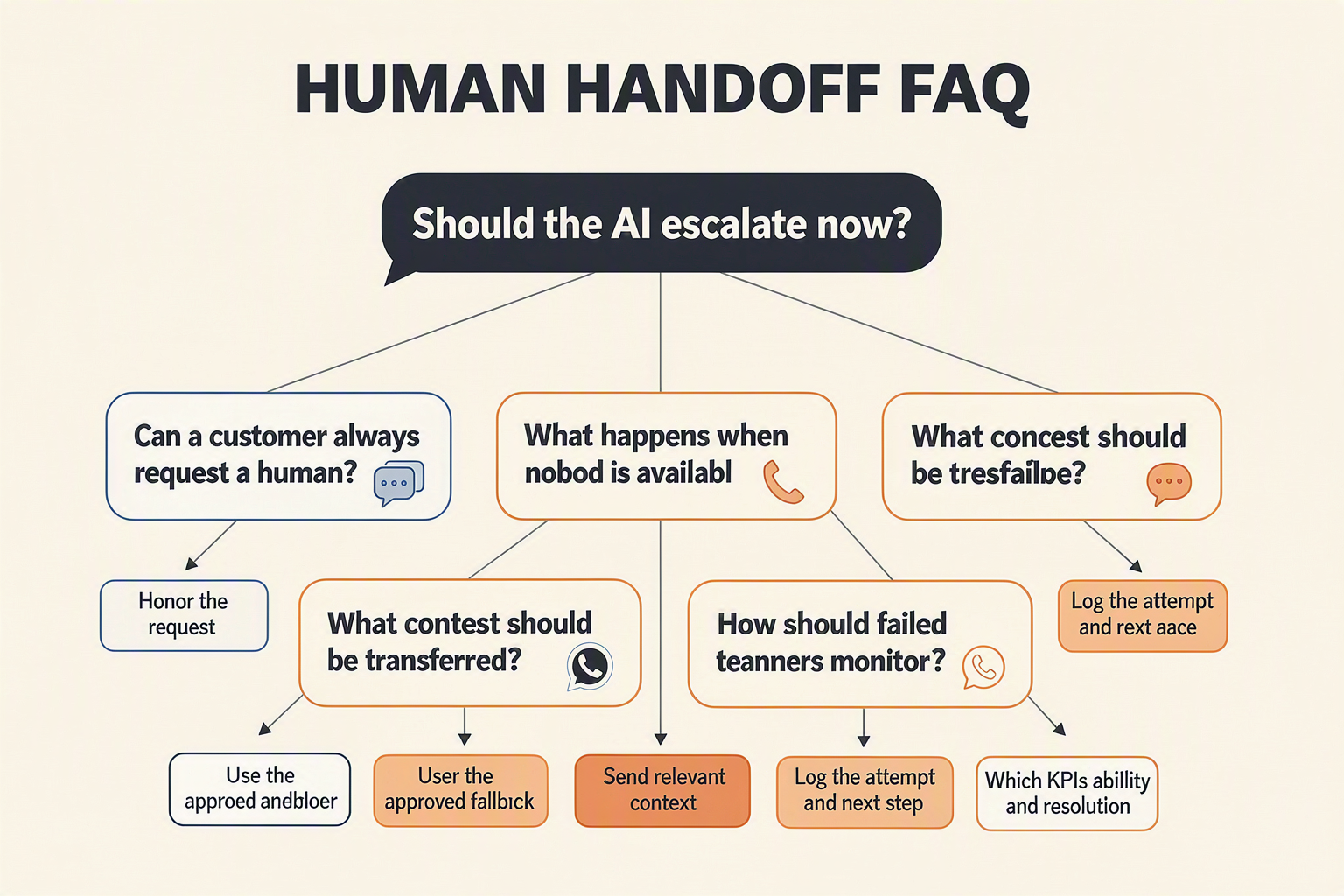
The challenge is bigger than initiating a transfer. Effective AI agent escalation must answer five operational questions:
- When should the agent stop attempting to resolve the issue?
- Who should receive the customer based on language, intent, priority, and expertise?
- What context should accompany the escalation?
- What happens when the intended person or team is unavailable?
- How can teams audit whether the process worked as designed?
CallMissed supports customer engagement across AI voice, WhatsApp—including WhatsApp Business calling—and email, while its Indic-first speech capabilities cover 22 Indian languages. That breadth makes consistent escalation design especially important for businesses serving customers across languages, regions, and communication preferences.
What this guide will help you build
This guide presents a practical framework rather than assuming undocumented product controls. You will learn how to define channel-specific triggers for a voice agent transfer to human, a WhatsApp conversation assignment, or an email escalation. It also explains what the receiving employee should see, including the customer’s identity, verified details, intent, conversation summary, transcript, sentiment signals, actions already attempted, unresolved questions, and relevant knowledge-base citations.
The guide will also cover:
- Routing rules based on department, language, urgency, customer tier, and operating hours
- Availability checks before promising a live transfer
- Failed-transfer fallbacks, such as callback capture, queueing, alternate-team routing, or asynchronous follow-up
- Clear disclosure that the customer is interacting with AI and is being moved to a human
- Audit records for triggers, routing decisions, summaries, timestamps, and outcomes
- Testing scenarios covering explicit requests, repeated failures, angry customers, sensitive requests, and unavailable teams
- KPIs such as escalation rate, transfer success, time to human response, repeat-contact rate, abandonment, and post-handoff resolution
A well-designed handoff does not represent AI failure. It is a deliberate safety and service mechanism: automation handles appropriate work efficiently, while humans receive the context and authority needed to resolve the exceptions.
When should CallMissed agents escalate? When risk, complexity, customer preference, or automation failure exceeds the agent’s safe scope
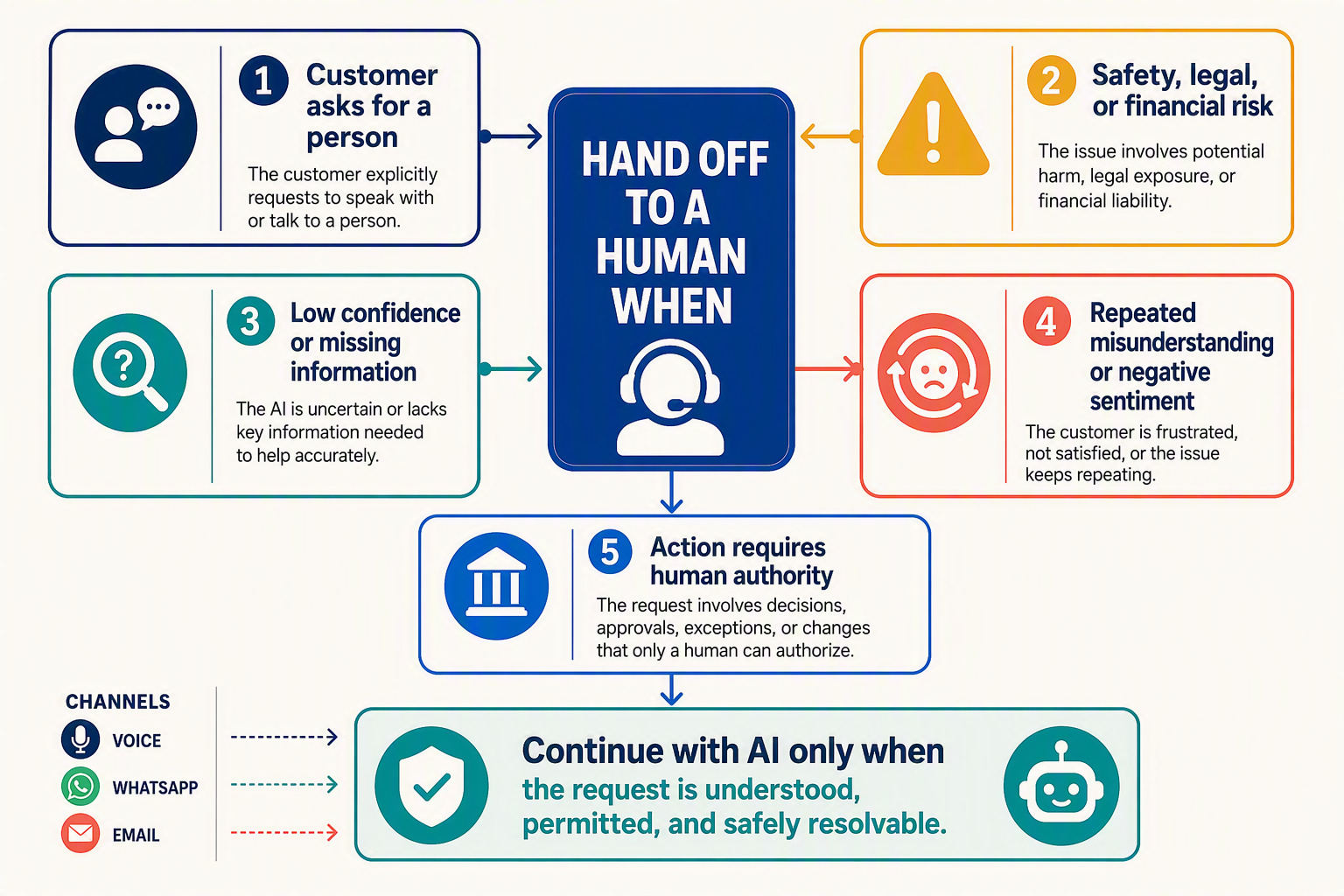
CallMissed agents should escalate whenever risk, complexity, customer preference, or automation failure exceeds a predefined safe scope. Immediate escalation should apply to explicit requests for a person and high-risk situations; repeated misunderstanding, low-confidence answers, and unresolved workflows should trigger escalation after a limited number of attempts.
Use four escalation categories
A practical AI agent escalation policy should define triggers that employees can test and audit rather than relying on a vague instruction such as “transfer when necessary.”
- Risk exceeds the approved boundary
- Escalate financial disputes, suspected fraud, legal threats, safety concerns, privacy requests, and requests involving sensitive personal data.
- Escalate before executing irreversible actions such as cancelling an account, changing ownership details, approving an exceptional refund, or modifying verified contact information.
- If a customer appears to face immediate danger, the agent should provide the organisation’s approved emergency guidance rather than imply that a routine support transfer is an emergency service.
- Complexity exceeds available knowledge or authority
- Handoff when the knowledge base does not contain a supported answer, retrieved sources conflict, or the agent cannot confidently identify the correct policy.
- Escalate requests requiring human judgement, negotiation, technical diagnosis, or an exception to standard procedure.
- Do not let the agent improvise merely to keep the conversation moving. “I need a specialist to verify that” is safer than an unsupported answer.
- The customer prefers a human
- Honour clear requests such as “agent,” “representative,” “call me,” or “I want to speak to someone.”
- Avoid forcing customers through repeated retention prompts. One clarification—such as asking which department they need—may support routing, but it should not obstruct the CallMissed human handoff.
- Treat accessibility needs, language mismatch, or difficulty using a channel as customer-preference signals.
- Automation has failed
- Escalate after a defined limit for misunderstood intent, failed authentication, unsuccessful tool calls, or repeated answers that do not resolve the issue.
- A reasonable starting policy is two failed attempts for the same task, followed by handoff or an asynchronous fallback. Teams should adjust that threshold using abandonment and resolution data.
- Trigger escalation immediately if an integration returns contradictory account information or an action’s completion status is uncertain.
Apply channel-specific stop rules
The escalation principle remains consistent, but each channel requires a different response:
- Voice: Initiate a voice agent transfer to human when urgency or emotion makes asynchronous support unsuitable. Before promising a live connection, check operating hours and recipient availability; otherwise capture a callback number, preferred time, language, and reason.
- WhatsApp chat and WhatsApp Business calling: Assign the conversation to an appropriate queue or bridge the call to a human where configured. Preserve messages, media, verified details, and call context so the customer does not repeat the issue.
- Email: Escalate by assigning ownership, priority, and a response deadline rather than attempting a real-time transfer. Long threads, formal complaints, billing disputes, and policy exceptions should receive a concise summary plus the complete thread.
CallMissed supports engagement across voice, WhatsApp, and email, with Indic-first speech coverage across 22 Indian languages. Consequently, language confidence should be part of the escalation boundary: if the agent cannot reliably understand or respond in the customer’s preferred language, it should route to a qualified human rather than continue with uncertain interpretation.
Every trigger should produce a clear outcome: transfer now, queue for a human, schedule a callback, assign asynchronous follow-up, or provide an approved emergency path.
Why does human handoff need shared context across voice, WhatsApp, and email?
Human handoff needs shared context because customers often begin on one channel and continue on another. A human should receive a single, structured interaction history—not an isolated transcript—so the customer does not have to repeat their identity, problem, or previous troubleshooting steps.
A channel switch should not reset the conversation
Consider a customer who reports a failed payment on WhatsApp, discusses the transaction during a voice call, and later emails a receipt. Without shared context, each interaction appears to be a separate case. The receiving employee may repeat verification, suggest an action that already failed, or overlook evidence supplied through another channel.
A CallMissed human handoff workflow should therefore connect relevant interactions using reliable identifiers such as:
- Verified phone number or WhatsApp number
- Email address
- Customer or account ID
- Order, ticket, booking, or transaction reference
- Authentication status and verification timestamp
Identity matching must be conservative. Similar names or unverified contact details should not automatically merge records, particularly when conversations involve payments, health information, or other sensitive data.
What context should follow the customer?
Every AI agent escalation should create a concise handoff package that helps the employee understand both the request and its history. At minimum, that package should contain:
- Customer and channel details: identity, current channel, preferred language, contact information, and verification status.
- Reason for escalation: the exact trigger, such as an explicit human request, repeated misunderstanding, negative sentiment, failed authentication, or a required policy exception.
- Conversation summary: the customer’s goal, key facts, unresolved questions, commitments made, and relevant dates or amounts.
- Actions already attempted: troubleshooting steps, knowledge-base answers presented, forms collected, and tools or workflows invoked.
- Supporting evidence: transcript excerpts, WhatsApp messages, email attachments, call recordings where permitted, and cited knowledge-base material.
- Routing metadata: department, required skill, urgency, customer tier, language, queue, and availability result.
The summary should not replace the source conversation. Humans need access to the underlying transcript or messages when wording, consent, or chronology matters.
Channel-specific context still matters
Shared memory should preserve the characteristics of each medium rather than flattening everything into generic text.
- For a voice agent transfer to human, include a live summary, detected language, authentication state, caller intent, and the last question asked. If the call cannot be connected, preserve the same package for a callback.
- For WhatsApp, retain message order, media references, interactive responses, delivery status, and whether the customer moved between chat and WhatsApp Business calling.
- For email, preserve the subject, thread history, sender and recipient fields, attachments, and quoted text while clearly separating new content from earlier replies.
Context must be useful, bounded, and auditable
More data is not automatically better. Handoff context should follow data minimisation and role-based access principles: route only information needed to resolve the case, mask unnecessary sensitive fields, and record who accessed or changed the case.
An auditable handoff should capture the escalation trigger, generated summary, source messages, routing decision, timestamps, assigned employee, failed-transfer events, and final outcome. This record allows teams to determine whether the AI escalated at the right moment—and whether the human received enough information to finish the job without forcing the customer to start again.
Which AI agent escalation triggers apply to voice, WhatsApp, and email? (TABLE)
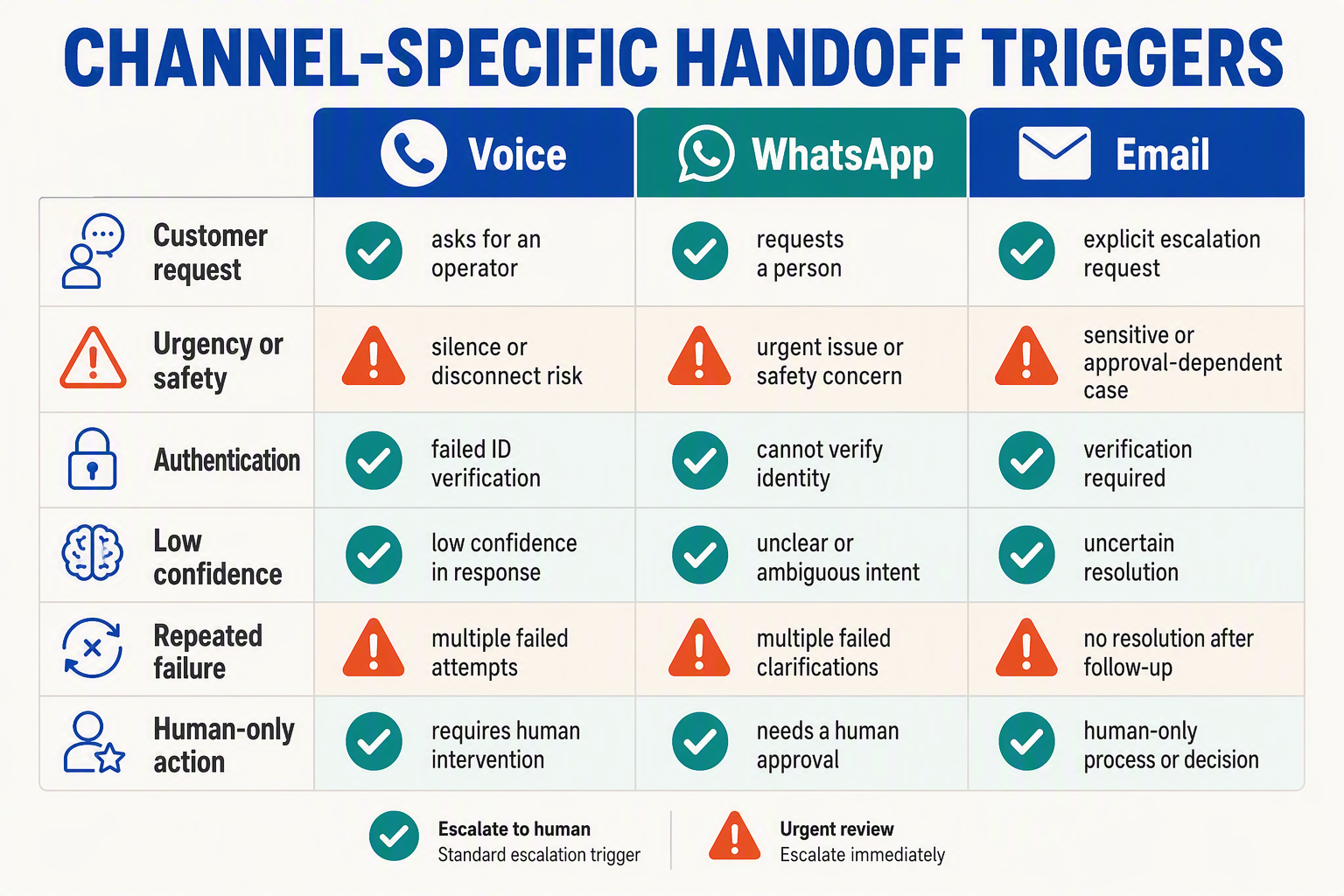
Escalation triggers should vary by channel speed, customer expectations, and the cost of delay. Voice agents should escalate immediately when real-time intervention is necessary; WhatsApp agents can combine live assignment with queued follow-up; email agents should prioritize risk, deadlines, and cases that cannot be resolved safely from available evidence.
Recommended trigger matrix
The thresholds below are practical policy recommendations, not claims about undocumented CallMissed settings. Teams should adapt them to their staffing, service-level agreements, regulatory obligations, and risk tolerance.
| Escalation trigger | Voice | Recommended action | ||
|---|---|---|---|---|
| Explicit request for a human | Transfer after the first clear request; do not repeatedly deflect | Assign to a person or team and disclose the expected response time | Route to the responsible queue and acknowledge receipt | Honour the request immediately, subject to identity and security checks |
| Repeated misunderstanding or low confidence | Escalate after two failed attempts to identify intent or provide a reliable answer | Escalate after two clarification loops or repeated fallback responses | Escalate when the reply requires unsupported assumptions or missing records | Stop generating speculative answers; send the transcript and unresolved question |
| Negative sentiment or threatened churn | Prioritise severe frustration, repeated interruption, or threats to cancel | Route angry messages, repeated complaints, or cancellation language | Flag complaints, executive escalations, and formal dissatisfaction | Send to retention, complaints, or a supervisor according to severity |
| Sensitive or high-risk request | Transfer financial disputes, safety issues, legal threats, or privacy requests without improvising | Restrict automation where authentication, consent, or protected data is involved | Escalate legal notices, data-rights requests, fraud allegations, and regulatory complaints | Route to an authorised specialist and preserve a complete audit record |
| Authentication or transaction failure | Escalate after the permitted verification attempts are exhausted | Assign when secure verification cannot be completed in chat | Route when account ownership or transaction evidence is inconclusive | Never ask the human to rely on unverified AI conclusions |
| Policy exception or operational dependency | Transfer when approval, negotiation, or a live system action is required | Assign cases needing refunds, overrides, inventory confirmation, or manual booking | Route complex approvals and multi-department cases with a response deadline | Send to the team empowered to act, not merely the first available employee |
Apply channel-specific thresholds
For a voice agent transfer to human, speed matters because the customer is waiting synchronously. Before promising a live connection, check agent availability; if no suitable employee is available, offer a callback, alternate queue, or asynchronous continuation rather than leaving the caller on indefinite hold.
WhatsApp supports both synchronous and asynchronous behaviour. A CallMissed human handoff policy can therefore distinguish between an urgent WhatsApp Business call, which may need an immediate transfer, and a chat message that can enter a staffed queue with a clearly stated response window. CallMissed also supports WhatsApp Business calling bridged to an AI voice agent, so businesses should align call and chat escalation rules instead of treating WhatsApp as text-only.
Email generally permits longer handling times, but AI agent escalation should still be immediate when a legal deadline, fraud report, safety concern, charge dispute, or privacy request is detected. Ordinary complexity can be routed according to the email service-level agreement.
Use hard stops, not endless retries
Every channel should have a defined maximum automation loop. A practical starting rule is two unsuccessful clarification or resolution attempts, followed by escalation or a safe fallback. Explicit human requests and high-risk cases should bypass that retry allowance entirely.
Teams should also prevent keyword-only escalation. Combine the customer’s words with intent, authentication state, conversation history, confidence, urgency, and business rules; then test false positives such as “I don’t need a human” before deploying the policy.
What context should the human receive before taking over the conversation?
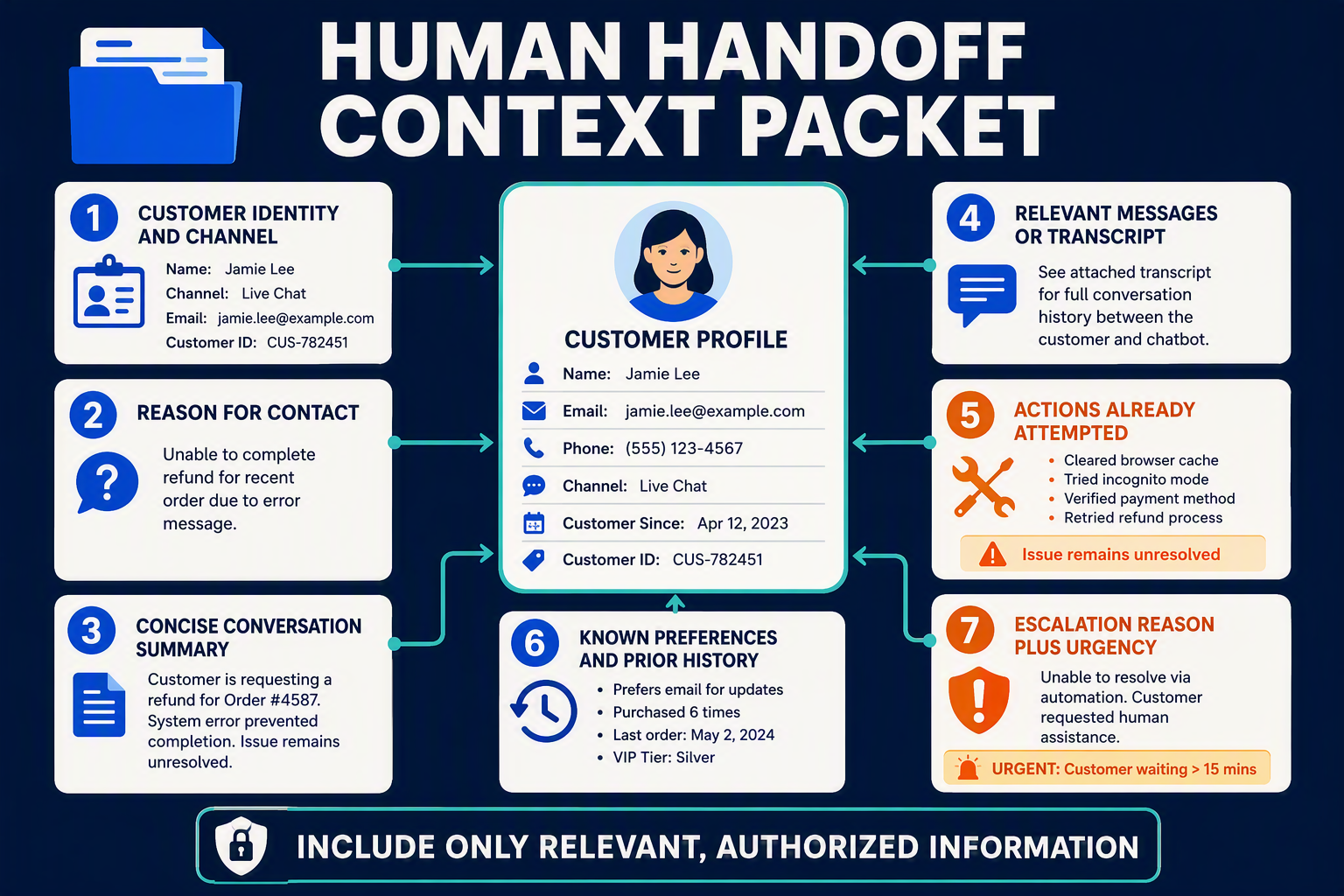
The human should receive a concise handoff brief plus access to the complete conversation record. At minimum, the brief should identify the customer, explain why the AI escalated, summarize the request, distinguish verified facts from assumptions, and show what has already been attempted.
Build a structured handoff packet
For every CallMissed human handoff, pass a consistent packet rather than an unstructured transcript. The receiving employee should be able to understand the situation in seconds without asking the customer to repeat everything.
Include these fields:
- Customer identity: Name, customer or account ID, phone number, email address, and preferred language.
- Verification status: Which authentication checks succeeded or failed. Label customer-provided details as unverified unless the relevant system confirmed them.
- Intent and desired outcome: For example, “Customer wants to reschedule order CM-1842 for delivery after 6 p.m.”
- Escalation reason: Explicit request for a person, repeated misunderstanding, authentication failure, negative sentiment, policy exception, or sensitive subject.
- AI-generated summary: A short, factual account of the conversation, including important dates, amounts, products, and commitments.
- Actions already taken: Knowledge articles consulted, troubleshooting completed, forms submitted, appointments checked, or account changes attempted.
- Open questions: Clearly state what remains unresolved and what decision or action the human must provide.
- Conversation evidence: Full transcript or email thread, timestamps, attachments, recordings where permitted, and relevant knowledge-base citations.
- Routing metadata: Source channel, assigned department, priority, language, escalation time, and any promised response window.
An AI agent escalation summary must never present an inference as a confirmed fact. A useful convention is to label information as verified, customer-stated, AI-inferred, or unknown.
Adapt the context to each channel
The core packet remains consistent, but the immediate operational context differs by channel:
- Voice: Before a voice agent transfer to human, show the live-call duration, caller number, detected or selected language, authentication state, concise call summary, and the customer’s latest statement. The employee should receive the most urgent facts first because the customer is waiting synchronously.
- WhatsApp: Include recent messages, quoted replies, approved-template history where relevant, images, documents, voice notes, and any WhatsApp Business call context. Preserve message timestamps so the employee can distinguish an active exchange from an older enquiry.
- Email: Pass the subject, sender and recipient history, complete thread, attachments, detected intent, requested deadline, and prior case references. Remove repeated signatures and quoted text from the brief while retaining the original thread for verification.
Use a readable summary format
A practical handoff card can follow this pattern:
- Customer: Priya Shah, Hindi preferred, account verified
- Request: Refund for a duplicate ₹2,499 charge
- Escalation trigger: Refund requires a policy exception
- Completed: Transaction located; duplicate payment reported by customer
- Still needed: Human review and refund authorisation
- Risk note: Payment information is sensitive
- Last customer message: “Please confirm when the money will return.”
CallMissed supports engagement across voice, WhatsApp—including WhatsApp Business calling—and email, so teams should use the same schema across channels while adapting the presentation to synchronous and asynchronous conversations.
Protect relevance and privacy
Provide the minimum necessary context for resolution. Mask payment credentials, passwords, identity documents, health information, and unrelated conversation history according to company policy and applicable law. Humans need enough evidence to act safely—not unrestricted access to every customer interaction.
How should a voice agent transfer to human support, route requests, check availability, and handle failed transfers?
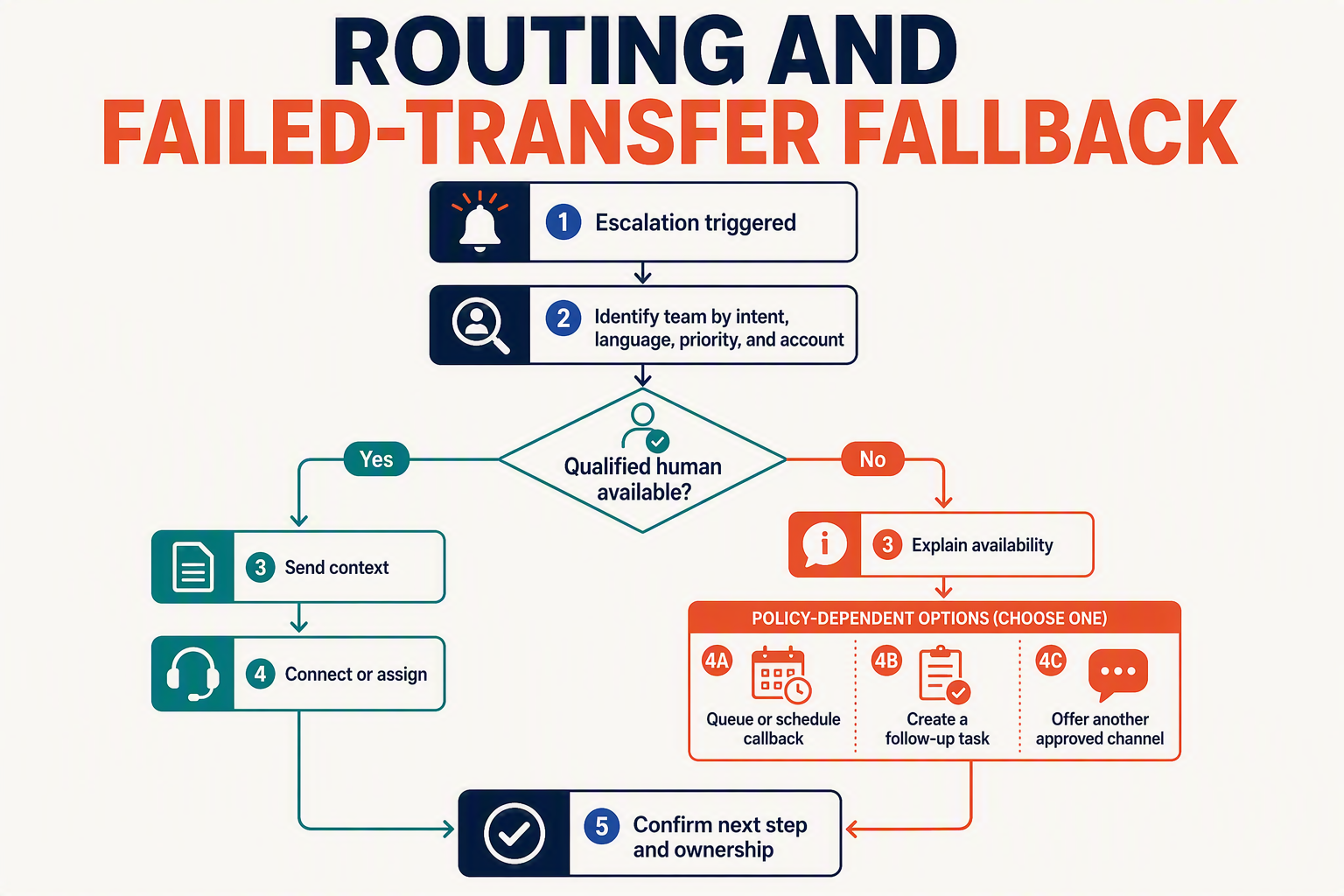
A voice agent should transfer only after identifying the correct destination, checking whether a qualified human is available, and preparing a concise context package. If nobody answers, the agent should return to the caller with a clear fallback—not disconnect, loop indefinitely, or claim that help is available when it is not.
Use a controlled transfer sequence
Design the voice agent transfer to human as an explicit workflow rather than a single transfer command:
- Confirm the reason: “You’d like to speak with billing about the duplicate charge—is that correct?”
- Collect essential details: Capture the caller’s name, preferred language, callback number, and any required verification.
- Select a destination: Apply routing rules before checking availability.
- Check availability: Query the relevant queue, roster, contact-centre system, or business-hours schedule.
- Explain the transition: Tell the customer where the call is going and what to expect.
- Transfer with context: Pass a structured summary to the employee or agent desktop.
- Confirm the outcome: Record whether the transfer was answered, rejected, timed out, or failed technically.
A warm transfer is preferable for sensitive, complex, or high-value cases because the receiving employee can review the issue before speaking. A direct or “cold” transfer may be appropriate for simple departmental routing, provided the destination is open and the caller will not lose their place.
Route by intent, language, urgency, and ownership
Routing should follow a documented decision hierarchy. A practical order is:
- Risk and urgency: Safety, fraud, payment disputes, or legal requests go to designated teams.
- Intent: Route sales, support, billing, cancellations, and complaints separately.
- Language: Match the caller with an employee who can continue in the detected or requested language.
- Customer status: Apply approved priority rules for existing cases, service tiers, or active incidents.
- Case ownership: Prefer the employee already handling the issue when available.
- Load and operating hours: Route to an alternate qualified queue rather than an unavailable individual.
CallMissed supports Indic-first speech across 22 Indian languages, making language-aware routing especially relevant for businesses serving regional audiences. However, language detection should not override the customer’s stated preference.
Check availability before making a promise
An availability check should distinguish between business open, team staffed, and employee ready. These are not equivalent: a department may be within operating hours but have every employee occupied.
Configure the surrounding workflow to evaluate:
- Queue status and estimated wait conditions
- Agent presence, skills, and language eligibility
- Business hours, holidays, and regional schedules
- Maximum ringing and queue time
- Alternate teams authorised to handle the request
The AI should say, “I’ll check whether a billing specialist is available,” rather than, “I’m connecting you now,” until availability is confirmed.
Recover safely from failed transfers
A CallMissed human handoff needs a fallback for no-answer, busy, rejected, timeout, carrier, or integration failures. Use a fixed recovery order:
- Try an authorised alternate queue.
- Return to the AI and acknowledge that the transfer did not complete.
- Offer queueing, voicemail, or a scheduled callback.
- Confirm the callback number, time window, language, and consent.
- Create an asynchronous follow-up through WhatsApp or email when the customer agrees.
- Provide a case reference and realistic response expectation.
Every AI agent escalation should log the selected route, availability result, transfer attempts, timestamps, failure reason, fallback chosen, and final disposition. This audit trail reveals whether problems come from routing logic, staffing, telephony, or the handoff workflow itself.
How should customers be told about AI use and human escalation while preserving an auditable record?
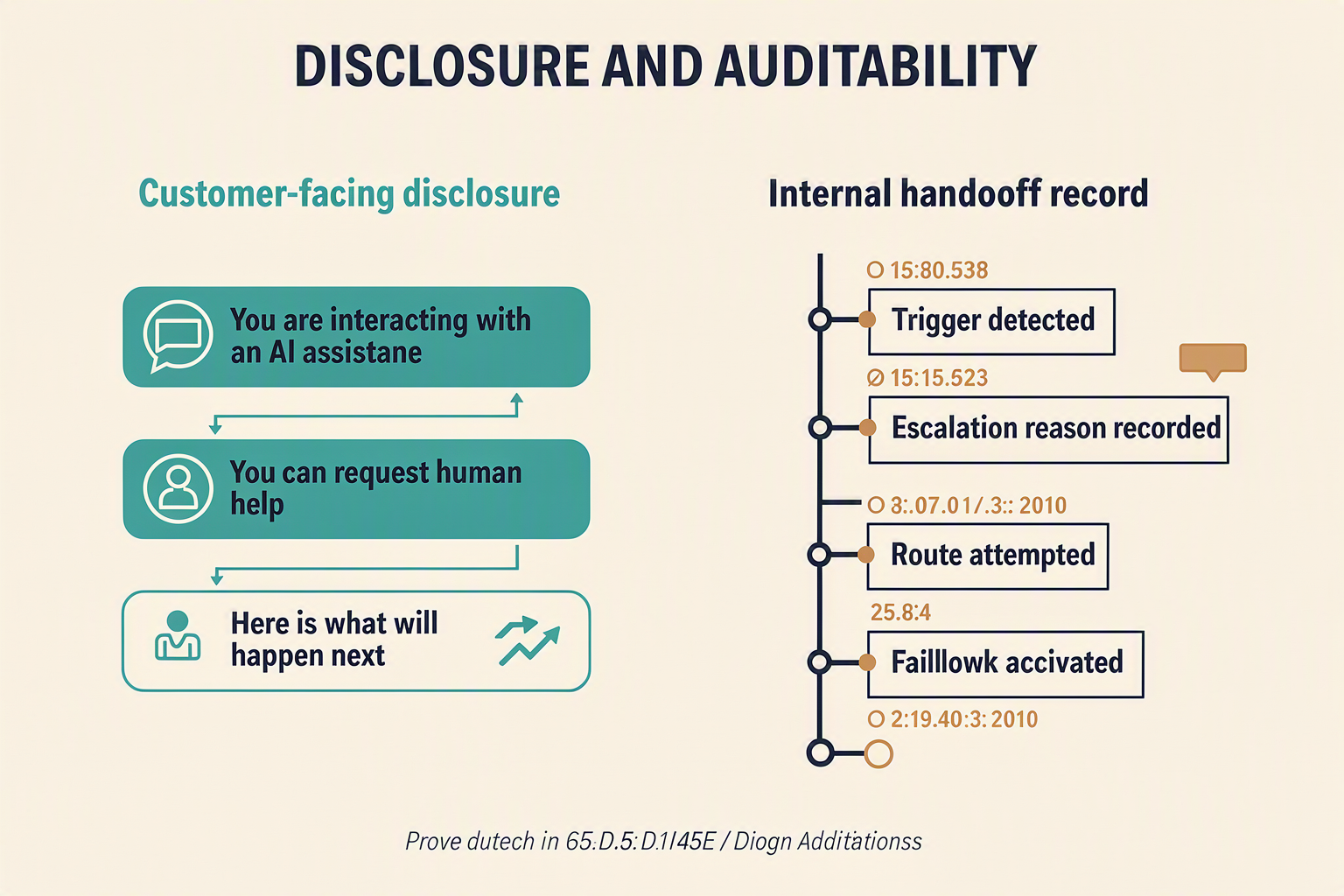
Customers should be told at the beginning of an interaction that they are communicating with an AI agent, reminded when automation materially affects the conversation, and clearly notified before a human handoff. The business should preserve the disclosure, escalation trigger, routing decision, transferred context, and outcome as one auditable event trail.
Use clear, channel-specific disclosure
Disclosure should be understandable, timely, and separate from any consent needed for recording or processing sensitive data. Avoid vague labels such as “virtual assistant” if customers could reasonably mistake the agent for a person.
- Voice: Open with: “You’re speaking with an AI assistant for [Business]. You can ask for a person at any time.” If calls are recorded, provide a separate recording notice and follow applicable consent requirements.
- WhatsApp chat: Send an initial message such as: “I’m [Business]’s AI assistant. I can help with common requests or connect you with our team.”
- WhatsApp Business calling: Disclose AI use verbally when the call begins, including when an AI voice agent answers a customer-initiated call or makes a business-initiated call.
- Email: Identify the automated response in the message body or signature and provide a direct escalation path: “This response was generated by our AI assistant. Reply with ‘human support’ if you need an employee to review your request.”
CallMissed supports AI engagement across voice, WhatsApp—including WhatsApp Business calls—and email, with Indic-first speech coverage across 22 Indian languages. Businesses should localise disclosures into the customer’s language rather than relying on an English-only notice.
Announce the transition without making false promises
A CallMissed human handoff workflow should state what will happen next, whether a person is presently available, and what fallback applies. Never say “I’m transferring you now” before checking availability.
Use this three-part structure:
- Explain the escalation: “I’m unable to verify that information, so I’m escalating this to our billing team.”
- Set an accurate expectation: “An agent is available now,” or “The team is offline and will respond during business hours.”
- Confirm the channel: “Would you prefer to wait, receive a callback, or continue on WhatsApp?”
For a voice agent transfer to human, announce the transfer before placing the customer in a queue. For asynchronous AI agent escalation on WhatsApp or email, provide a case reference and an estimated response window only when the business can reliably meet it.
Build an auditable escalation record
Each handoff record should allow an authorised reviewer to reconstruct what the AI disclosed, why it escalated, and what information reached the employee. Capture:
- Interaction identifiers: conversation ID, customer or account ID, channel, language, and timestamps
- Disclosure evidence: exact message or audio prompt, delivery time, language, and disclosure-template version
- Escalation evidence: trigger, confidence or failure signal where available, customer request, sentiment flag, and policy rule invoked
- Routing evidence: destination team, availability result, priority, reassignment history, and failed-transfer fallback
- Context delivered: transcript or email thread, generated summary, verified facts, attempted actions, unresolved issue, and knowledge-base citations
- Outcome: acceptance time, first human response, resolution status, callback result, and closure reason
Protect the record throughout its lifecycle
Treat auditability as controlled evidence collection—not unlimited surveillance. Minimise sensitive data, restrict records by role, encrypt stored and transmitted information, define retention and deletion periods, and record access or exports.
Generated summaries should never replace the source conversation. Preserve both, label AI-generated fields, version routing policies and disclosure templates, and use append-only event history where practical. This makes disputes, compliance reviews, and handoff failures easier to investigate without obscuring what the customer or agent actually said.
Which testing scenarios and KPIs show whether handoff works reliably?
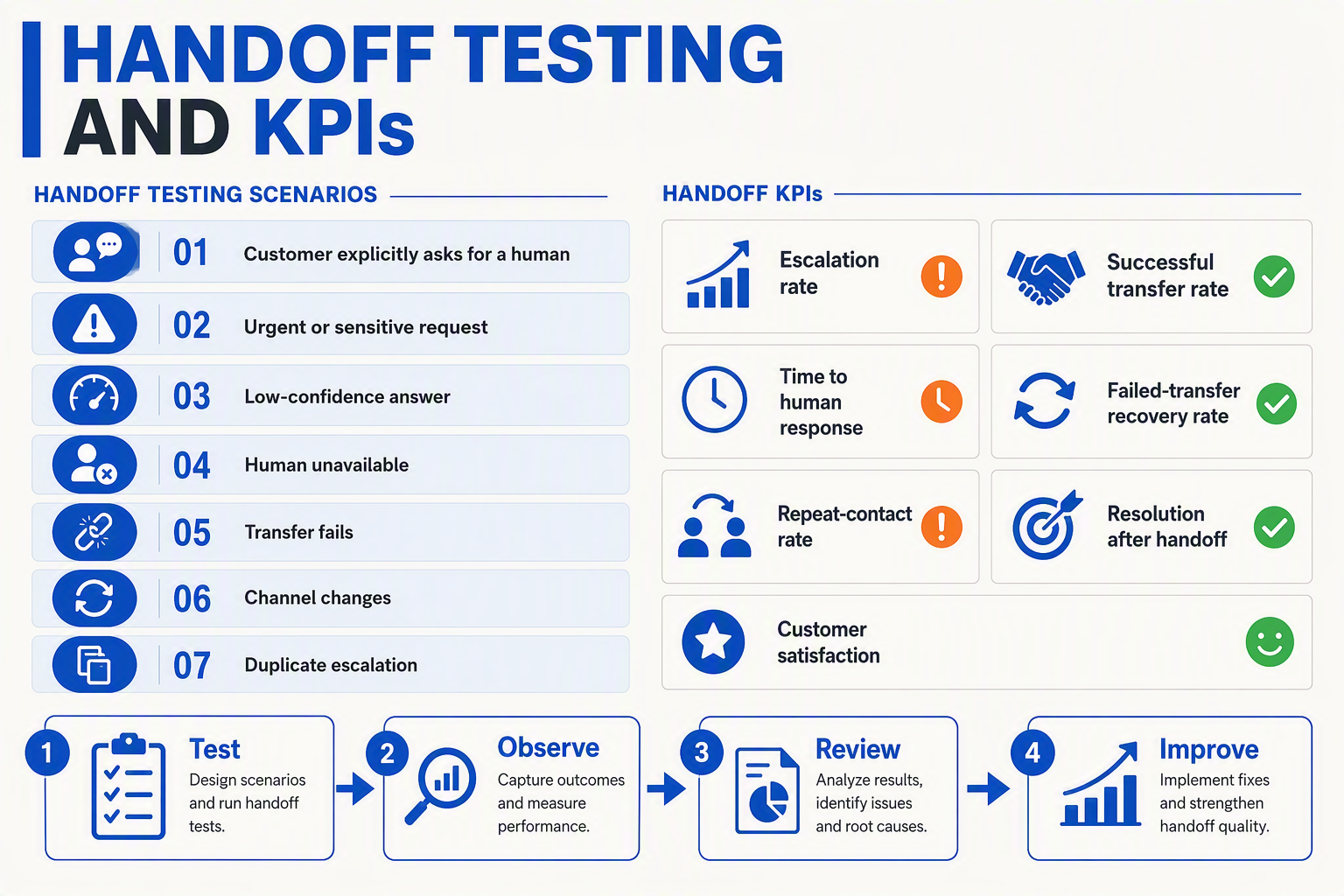
Reliable handoff requires scenario-based testing across voice, WhatsApp, and email, followed by continuous measurement of transfer completion, response speed, abandonment, and resolution. Test the entire path—from trigger detection and routing to agent acceptance, context delivery, fallback, and audit logging—not merely whether an escalation event fired.
Build a channel-by-channel test matrix
Run each scenario during staffed hours, outside operating hours, at queue capacity, and when the preferred employee is unavailable. Include these core cases:
- Explicit human request: The customer says “connect me to an agent,” uses an equivalent regional-language phrase, or requests a person in writing. The automation should stop unnecessary questioning and acknowledge the request.
- Repeated AI failure: Test unsupported questions, ambiguous intent, knowledge-retrieval failure, and two or more unsuccessful clarification attempts.
- Negative sentiment: Use frustration, interruption, raised volume, threats to cancel, and angry WhatsApp or email language. Confirm that sentiment is treated as a signal rather than definitive proof.
- Sensitive or high-risk request: Test payment disputes, fraud reports, privacy requests, legal complaints, safety concerns, and policy exceptions.
- Authentication failure: Supply incorrect, incomplete, or conflicting identity information and verify that sensitive data is not exposed during escalation.
- Unavailable destination: Simulate an offline employee, full queue, unanswered call, routing timeout, and technical transfer failure. The customer should receive a truthful fallback such as callback capture, queue placement, or asynchronous follow-up.
- Cross-channel continuation: Begin on WhatsApp, continue by voice, and follow up by email. Confirm that the human receives the correct customer record rather than three disconnected histories.
For a voice agent transfer to human, also test silence, background noise, accents, interruptions, dropped calls, and transfer latency. Because CallMissed supports speech across 22 Indian languages, multilingual testing should include language detection, mixed-language speech, translated summaries, and routing to appropriately skilled employees—not only English and Hindi.
Verify the handoff payload and customer experience
A successful CallMissed human handoff should pass a concise summary, full transcript where appropriate, identity and verification status, detected intent, language, sentiment signals, attempted actions, unresolved issue, relevant citations, and escalation reason.
Test whether:
- The human can understand the issue without asking the customer to repeat it
- Disclosure clearly explains that automation is transferring or assigning the conversation
- The AI does not claim that an employee is available before checking availability
- WhatsApp and email messages preserve attachments, timestamps, and thread history
- Audit records capture the trigger, rule applied, destination, acceptance, fallback, and outcome
Track reliability with measurable KPIs
Use a fixed reporting window and segment results by channel, language, intent, team, and operating-hours status.
- Trigger precision: Correct escalations ÷ all escalations
- Trigger recall: Correctly detected escalation cases ÷ all cases that required escalation
- Transfer success rate: Human-accepted transfers ÷ attempted live transfers
- Time to human response: Time from escalation trigger to the first meaningful human reply
- Handoff abandonment rate: Customers who disconnect or stop responding before human engagement ÷ escalated conversations
- Context completeness rate: Handoffs containing every required context field ÷ total handoffs
- Post-handoff resolution rate: Escalated cases resolved without another transfer or repeat contact
- Fallback completion rate: Failed transfers that successfully create a callback, queue item, or follow-up task
- Repeat-contact rate: Customers who return about the same unresolved issue within the organisation’s chosen measurement window
Do not adopt an arbitrary universal target. Establish a baseline, define internal service-level objectives by channel, and investigate regressions. AI agent escalation works reliably only when both the technical transfer and the customer’s eventual resolution are measured.
How should support, operations, compliance, and technical experts review the handoff design without assuming unsupported CallMissed controls?

A cross-functional review should assess the handoff policy as an operational design, not treat every desired behaviour as a confirmed CallMissed setting. Support, operations, compliance, and technical experts should jointly document requirements, verify available controls through current product documentation or testing, and create external procedures where a native control has not been confirmed.
Start with an evidence-labelled handoff specification
Create one shared specification for voice, WhatsApp, and email. Label every proposed behaviour with one of four statuses:
- Required: The business needs the behaviour, regardless of implementation.
- Confirmed: The control has been verified in the current CallMissed interface, documentation, or a controlled test.
- External: The behaviour depends on a CRM, ticketing system, telephony workflow, webhook, human process, or another integrated service.
- Unresolved: The team has not yet confirmed whether or how the behaviour can be implemented.
For example, “Escalate after repeated authentication failure” is a requirement. Do not describe it as an available threshold setting until an authorised administrator or CallMissed representative has verified that control. This distinction keeps the CallMissed human handoff guide accurate as interfaces and account capabilities evolve.
Assign each reviewer a specific question
Reviewers should evaluate the same journey from different risk perspectives:
- Support lead: Can the employee understand the issue without asking the customer to repeat everything? Check the summary, transcript, customer identity, verification status, prior actions, unresolved request, language, channel, and promised next step.
- Operations lead: Is the destination staffed at the relevant time? Review business hours, queues, language coverage, ownership, response targets, overflow paths, callback procedures, and what happens when nobody accepts the handoff.
- Compliance or legal reviewer: Should this data be collected, displayed, retained, or transferred? Examine AI disclosure, consent, authentication, sensitive-data redaction, access permissions, retention periods, and audit evidence.
- Technical owner: Can each trigger, context field, routing decision, availability check, and outcome be observed and tested? Separate verified CallMissed behaviour from integrations and manual processes.
CallMissed supports AI engagement across voice, WhatsApp—including WhatsApp Business calling—and email, but that channel breadth does not prove that every proposed routing or compliance control is natively configurable.
Review complete journeys, not isolated triggers
Walk through realistic scenarios from initial contact to final ownership:
- A customer explicitly asks for a person during a voice agent transfer to human.
- A WhatsApp user becomes frustrated after repeated unsuccessful answers.
- An email contains a legal notice or privacy request requiring specialist review.
- The preferred regional-language team is unavailable.
- A transfer starts but the recipient does not answer.
- The transcript or generated summary is incomplete.
- An integration fails after the customer has been promised follow-up.
For every case, confirm trigger, disclosure, destination, context package, availability result, fallback, owner, timestamp, and final outcome. Failed transfers should end in a defined action—such as callback capture, queue placement, alternate routing, or a stated asynchronous response window—not silence.
Approve with evidence and named ownership
Before launch, record:
- The reviewer and approval date for each channel
- Screenshots, test records, documentation references, or support confirmations
- Controls that remain external or manual
- The owner of every unresolved gap
- A retest date after configuration, integration, or policy changes
An AI agent escalation design is ready only when the team can demonstrate what the customer experiences under both normal and failure conditions. Where a CallMissed control remains unverified, describe the intended outcome as a requirement—not as an existing product feature.
What should your team implement before launching human handoff? (TABLE)
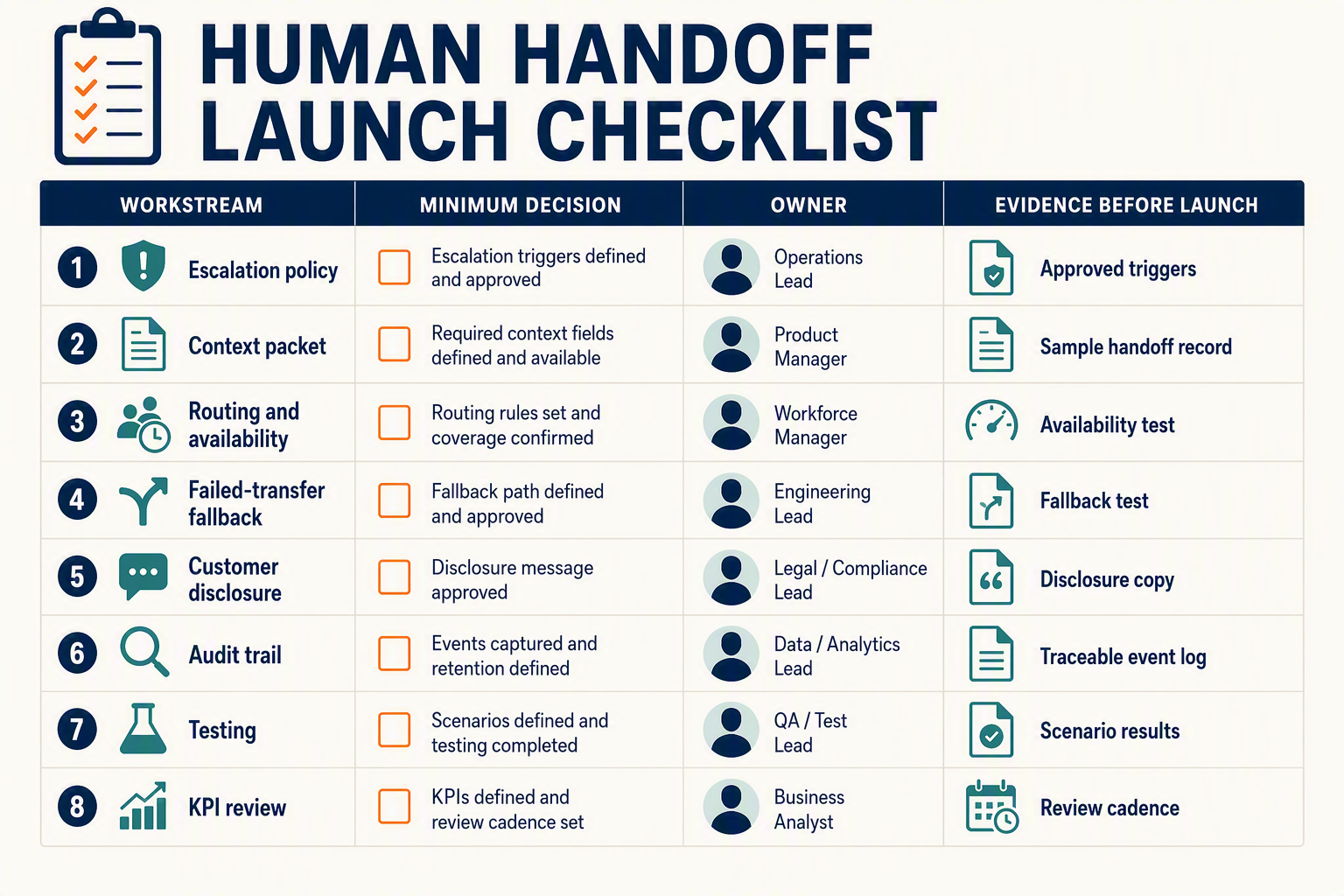
Before launching CallMissed human handoff, implement a documented escalation policy, channel-specific routing, real-time availability checks, context packaging, failed-transfer fallbacks, customer disclosures, audit logs, and measurable acceptance tests. Do not enable production handoff until every escalation path has a named owner and a tested fallback.
Pre-launch implementation checklist
| Workstream | What to implement | Acceptance test | Owner and evidence |
|---|---|---|---|
| Escalation policy | Define triggers for explicit human requests, repeated AI failures, authentication problems, negative sentiment, policy exceptions, and financial, legal, privacy, or safety risk. Set separate thresholds for voice, WhatsApp, and email. | Test at least one scenario per trigger and confirm the AI stops responding autonomously at the correct point. | Customer-operations owner; approved escalation matrix and test results |
| Context package | Send identity and verification status, channel, language, intent, concise summary, transcript or message thread, sentiment indicators, actions attempted, unresolved questions, attachments, and cited knowledge sources. Mask sensitive information that the employee does not need. | The receiving employee can continue without asking the customer to repeat information already supplied. | CRM or operations owner; sample handoff records |
| Routing and availability | Route by department, issue type, language, urgency, customer tier, operating hours, and agent skill. Check whether the destination is staffed before promising a live voice agent transfer to human. | Calls, WhatsApp conversations, and emails reach the correct test queue during open and closed hours. | Contact-centre owner; routing map and staffing schedule |
| Failure handling | Configure queueing, callback capture, alternate-team routing, voicemail or message collection, and asynchronous follow-up. Define maximum waiting periods and who owns unclaimed work. | Simulate an offline employee, full queue, rejected transfer, timeout, and disconnected call; each produces a clear next step. | Operations owner; failure-path runbook |
| Disclosure and consent | Tell customers they are interacting with AI, announce the handoff, explain expected response timing, and seek consent before recording or transferring sensitive details where required. | Test scripts avoid claiming that a human is available until availability has been confirmed. | Legal or compliance owner; approved voice and message copy |
| Auditability and measurement | Record trigger, timestamp, channel, routing decision, destination, summary, transfer attempts, fallback invoked, human acceptance, and final outcome. Establish dashboards for transfer success, time to human response, abandonment, repeat contact, and post-handoff resolution. | Every test interaction can be reconstructed from initiation through resolution without relying on employee memory. | Analytics owner; event schema, dashboard, and retention policy |
Account for language and channel differences
CallMissed supports speech workflows across 22 Indian languages, so language detection and routing should be tested with regional accents, code-switching, and mixed-language conversations—not merely translated scripts. A Hindi-speaking caller, for example, should not be transferred to an English-only queue without an explicit fallback.
Channel behaviour also requires separate validation:
- Voice: test transfer latency, hold messaging, disconnect recovery, callback confirmation, and recording boundaries.
- WhatsApp: test assignment notifications, message history, media attachments, customer reply timing, and WhatsApp Business calling.
- Email: test thread preservation, attachment access, priority tagging, ownership, and service-level timers.
Set objective launch gates
Approve the AI agent escalation workflow only when:
- All critical-risk scenarios escalate correctly.
- No route ends without a customer-visible fallback.
- The human receives sufficient context to continue the interaction.
- Closed-hours behaviour has been tested in every supported channel.
- Audit events and KPI calculations match the underlying test records.
- Operations, compliance, and technical owners sign off on the same versioned runbook.
Launch initially with a limited queue or operating window, review failures daily, and expand only after the evidence shows that routing, context delivery, and fallback behaviour are dependable.
Frequently asked questions about CallMissed human handoff and AI agent escalation
When should a CallMissed human handoff be triggered across voice, WhatsApp, and email?
What information should employees receive during AI agent escalation?
How should routing work for a voice agent transfer to human?
What should happen when no human agent is available for a transfer?
How should businesses disclose and audit an AI-to-human handoff?
How do teams test and measure human handoff performance in CallMissed?
Conclusion
A reliable CallMissed human handoff should transfer responsibility—not merely the conversation—from AI to the right employee while preserving context, setting clear expectations, and providing a fallback when no one is available. The objective is not to eliminate escalation but to make every escalation intentional, transparent, and measurable across voice, WhatsApp, and email.
Key takeaways
- Escalate on clear operational and risk signals. Trigger AI agent escalation when a customer asks for a person, authentication repeatedly fails, reliable information is unavailable, sentiment deteriorates, or the request involves a policy exception or financial, legal, safety, or privacy risk. Channel-specific thresholds can vary, but the underlying decision policy should remain consistent.
- Give employees enough context to act immediately. The handoff package should include customer identity and verified details, language, intent, conversation summary, transcript or message history, sentiment signals, actions already attempted, unresolved questions, and relevant knowledge-base citations. Customers should not have to repeat information simply because the interaction changed channels or owners.
- Route only after checking availability. Match each escalation by department, expertise, language, urgency, customer tier, and operating hours. Before promising a live voice agent transfer to human, confirm that the intended team can accept it; otherwise offer queueing, callback capture, alternate-team routing, or asynchronous follow-up through WhatsApp or email.
- Treat disclosure, auditing, and testing as core requirements. Tell customers when they are interacting with AI and when a human is taking over. Record the trigger, routing decision, timestamps, transferred context, fallback used, and outcome, then test explicit human requests, repeated failures, sensitive cases, angry customers, and unavailable teams.
What to watch next
The next stage of human handoff will be defined by better continuity across channels and more disciplined measurement. Teams should monitor escalation rate, transfer success, time to human response, abandonment, repeat contacts, and post-handoff resolution—then use those findings to refine triggers, routing, summaries, and availability rules.
CallMissed supports AI voice, WhatsApp—including WhatsApp Business calling—and email engagement, with Indic-first speech capabilities across 22 Indian languages. To explore how multilingual, omnichannel escalation is evolving, check out CallMissed and ask: if your AI agent escalated a high-risk conversation right now, would the customer reach the right person with the right context?
Related Reading
Discussion
Related Posts
Ready to automate customer conversations?
Launch AI voice agents and WhatsApp bots with CallMissed — one API, 22+ Indian languages.