
CallMissed Knowledge Base Guide for AI Voice, WhatsApp, and Email Agents


Build a reliable CallMissed knowledge base with approved sources, tested retrieval, citations, escalation rules, governance, and upkeep.
CallMissed Knowledge Base Guide for AI Voice, WhatsApp, and Email Agents
What if one outdated policy in your CallMissed knowledge base caused an AI voice agent, WhatsApp chatbot, and email agent to give three different answers to the same customer? A knowledge base is not merely a document repository; it is the evidence layer that determines what an AI agent may say, how confidently it can say it, and when it must defer to a person.
The stakes are rising quickly. Gartner predicted in March 2025 that agentic AI will autonomously resolve 80% of common customer-service issues by 2029, reducing operational costs by 30%. That level of automation is only safe when responses remain grounded in approved, current, and retrievable business information. Without those controls, polished answers can still contain expired prices, invented policy details, contradictory instructions, or information the customer was never authorised to access.
This guide explains how to build an AI agent knowledge base for reliable voice, WhatsApp, and email engagement. CallMissed combines knowledge-base RAG with AI voice agents, WhatsApp chat and Business calling, email tooling, and support for 22 Indian languages—making consistent source preparation especially important when the same business rule must work across channels, formats, and regional-language interactions.
You will learn how to:
- Select authoritative sources such as approved policies, product documentation, operating procedures, pricing sheets, and compliance notices.
- Structure content into focused, searchable sections with explicit titles, dates, owners, applicability rules, and citation metadata.
- Test knowledge base RAG using realistic customer questions, paraphrases, multilingual queries, incomplete requests, and adversarial prompts.
- Resolve conflicting sources by defining precedence, version ownership, effective dates, and withdrawal procedures.
- Apply permissions so an agent retrieves only the content appropriate to its role, workflow, customer, or channel.
- Reduce hallucinations through grounded-answer instructions, confidence thresholds, citation requirements, constrained actions, and human escalation.
- Establish governance for approvals, audit trails, freshness reviews, incident handling, and scheduled maintenance.
The guide will also keep two categories distinct. Confirmed platform capabilities describe what CallMissed provides, including knowledge-base retrieval and omnichannel agent workflows. Recommended implementation practices cover the organisational decisions every business must make for itself, such as which policy is authoritative, who may approve changes, and when an uncertain answer should be escalated.
Done well, RAG for customer service gives an AI agent a controlled path from customer question to approved evidence—not permission to improvise. The objective is therefore not to upload the most documents. It is to create a compact, governed, testable source of truth that produces consistent answers wherever customers choose to communicate.
How do you build a reliable CallMissed knowledge base? Use approved, permissioned sources; structure content for retrieval; test answers and citations; control conflicts and hallucinations; escalate uncertainty; and assign ongoing governance.
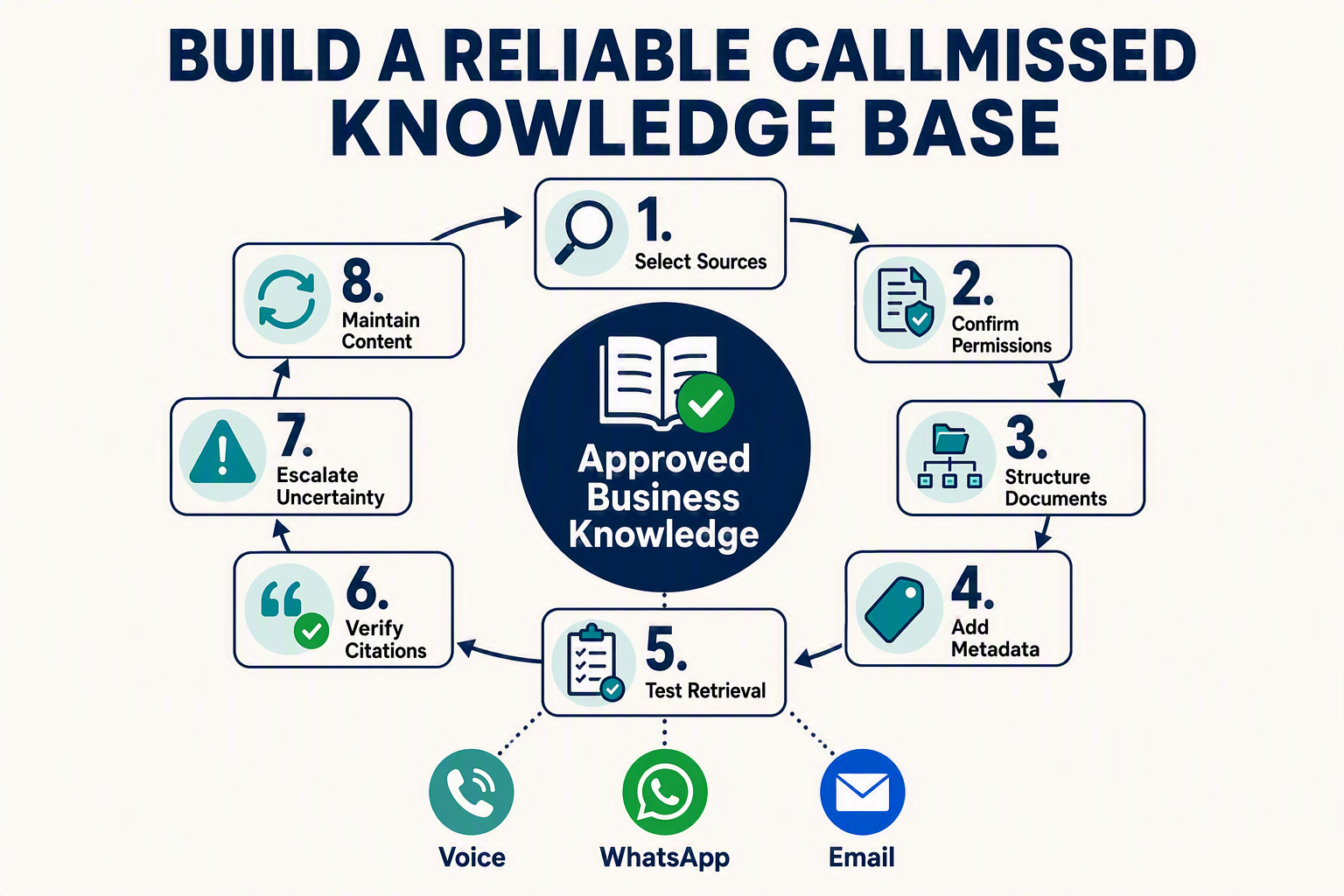
A reliable CallMissed knowledge base uses approved sources, retrieval-friendly content, clear access controls, and regular testing. Build it in sequence: register trusted sources, structure content, define precedence rules, test grounded answers, configure escalation, and assign ongoing ownership.
1. Register approved, permissioned sources
Create a source register before importing content into the CallMissed knowledge base. Record each source’s business owner, approval status, audience, effective date, expiry date, and review date.
Prioritise:
- Published product documentation and approved price lists.
- Current refund, cancellation, warranty, delivery, and privacy policies.
- Signed-off procedures and compliance notices.
- Approved scripts, troubleshooting guides, and service-area rules.
- Customer-specific material with appropriate access restrictions.
Exclude drafts, duplicates, expired promotions, private employee notes, unsupported claims, and third-party content you do not have permission to use. Do not add personal or confidential information simply because an employee can access it.
2. Structure content for accurate retrieval
Organise documents around focused, answerable questions. Use descriptive titles such as “Refund eligibility for annual plans—effective 1 July 2026.” State the main rule first, followed by conditions, exceptions, and examples.
Add metadata for:
- Document ID, version, owner, and approval date.
- Effective and expiry dates.
- Product, geography, customer type, and channel.
- Language and access classification.
- Superseded document ID and citation label.
Keep tables simple, define acronyms, and write conditions explicitly. Avoid references such as “the plan above” because the CallMissed knowledge base may retrieve a passage without its surrounding page.
3. Set permissions and conflict rules
Define a source-precedence hierarchy before conflicts occur. For example, rank regulatory notices first, followed by signed policies, current product documentation, approved procedures, and training material.
When sources disagree, the agent should use the highest-authority source that is currently effective. It should not combine conflicting passages into a new answer. Remove superseded content from retrieval while preserving it in an audit archive.
Enforce permissions during retrieval. A public WhatsApp agent must not cite internal escalation guidance, confidential records, or another customer’s contract.
4. Test answers, citations, and evidence boundaries
Create a test set using genuine customer language and expected source evidence. Include:
- Direct questions with one verified answer.
- Paraphrases, misspellings, and incomplete requests.
- Conflicting, expired, restricted, or missing information.
- Attempts to override policy or obtain protected data.
- Voice-style questions and multilingual variants.
CallMissed supports knowledge-base retrieval across AI voice, WhatsApp, and email workflows, while its speech capabilities cover 22 Indian languages. Test regional-language meaning, spoken dates, numbers, and names instead of relying only on translated English benchmarks.
A passing answer should retrieve the correct source, preserve important qualifiers, provide an identifiable citation where appropriate, and remain consistent across channels.
5. Control hallucinations and escalate uncertainty
Configure the agent to avoid guessing or filling evidence gaps. It should state that it cannot verify an answer when the available information is absent, ambiguous, contradictory, expired, or restricted.
Require human review or a controlled workflow for high-impact topics, including:
- Payments and refunds.
- Legal or contractual commitments.
- Safety-related guidance.
- Account or identity changes.
- Exceptions to approved policy.
This keeps the CallMissed knowledge base within its evidence boundaries and prevents uncertain responses from being presented as facts.
6. Assign continuous governance
Give each knowledge domain a named owner and approver. Review high-risk content on a fixed schedule and update it whenever a policy, product, price, or regulatory requirement changes.
Monitor unanswered questions, weak retrieval results, citation failures, escalations, and conflicting sources. Retest affected workflows after every material update. This governance cycle keeps the CallMissed knowledge base accurate, permissioned, and useful over time.
What are an AI agent knowledge base and RAG for customer service, and how do they support consistent omnichannel answers?
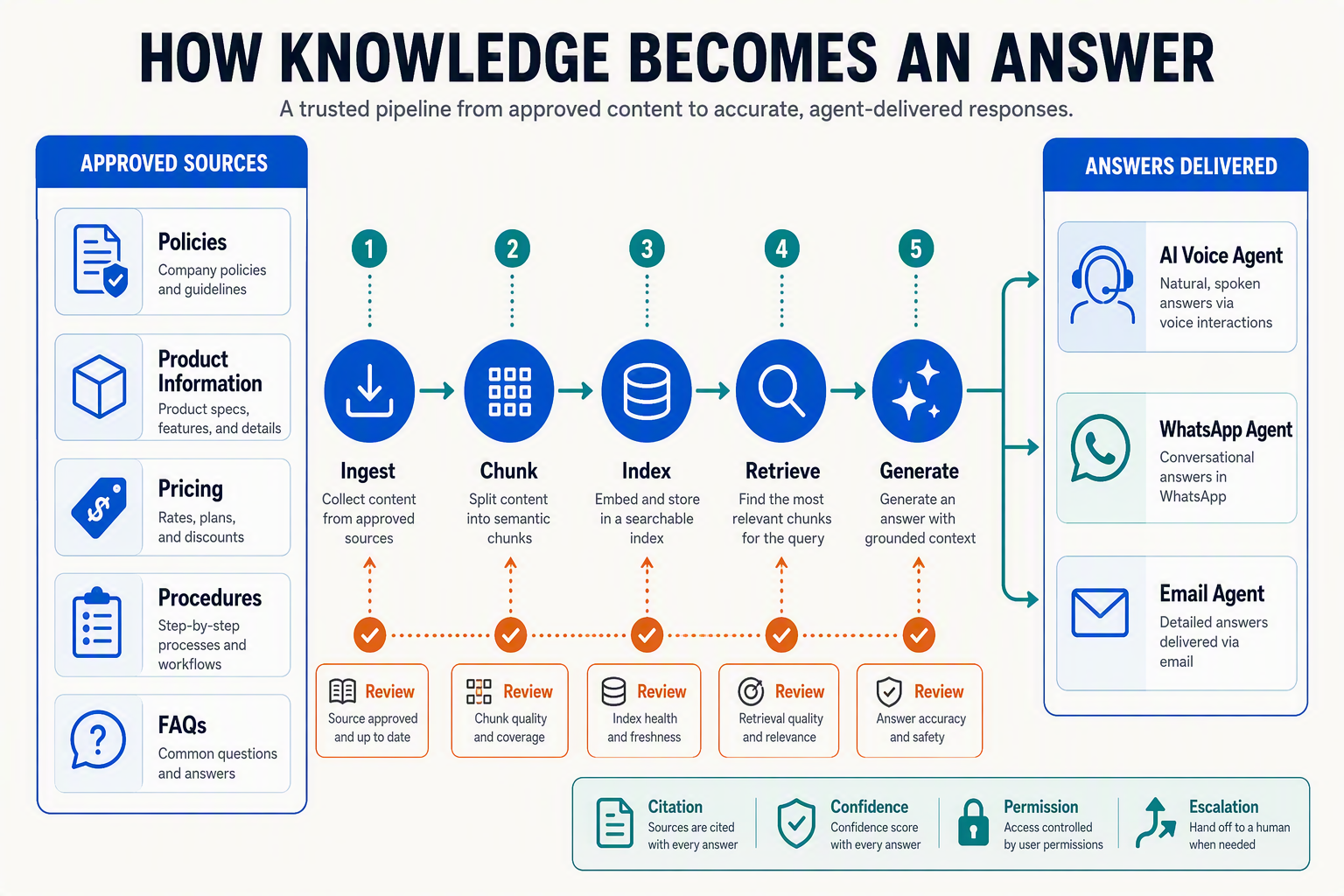
An AI agent knowledge base is the governed collection of business-approved information an agent can consult, while retrieval-augmented generation (RAG) is the process that finds relevant passages and supplies them as evidence before the model answers. Together, they help voice, WhatsApp, and email agents apply the same underlying policy without relying solely on a language model’s training data.
Knowledge base versus RAG
The two terms describe different parts of the system:
- Knowledge base: The source layer containing approved policies, product details, prices, procedures, eligibility rules, FAQs, and escalation instructions.
- Retrieval: The search layer that identifies passages relevant to a customer’s question, often using semantic similarity rather than exact keyword matching.
- Generation: The language model converts the retrieved evidence into a clear, context-appropriate response.
- Guardrails: Instructions and workflow rules determine whether the agent may answer, ask a clarifying question, perform an action, or escalate.
A folder full of documents is therefore not automatically a reliable knowledge base. Content must be structured so retrieval can distinguish, for example, a current refund policy from an expired one or a retail offer from a distributor-only programme.
How a grounded answer is produced
A typical RAG for customer service workflow has five stages:
- Interpret the request. The agent identifies the customer’s intent, language, product, location, account context, and channel.
- Apply access filters. The system limits retrieval to information permitted for that agent, customer type, or workflow.
- Retrieve evidence. Relevant sections are selected from the indexed knowledge base.
- Generate a grounded response. The model answers using the retrieved content and follows channel-specific presentation rules.
- Escalate uncertainty. If evidence is absent, contradictory, expired, or insufficient, the workflow routes the conversation to an authorised person.
For example, “Can I return this after opening it?” may be spoken in Hindi, typed informally on WhatsApp, or written formally in an email. Retrieval should resolve all three requests to the same approved returns rule, while the final delivery changes by channel.
One source, channel-appropriate delivery
Consistency does not mean identical wording. It means preserving the same facts, conditions, dates, and next steps across every interaction.
- A voice agent should give a concise answer, confirm critical numbers or dates, and offer to repeat complex conditions.
- A WhatsApp agent can use short paragraphs, lists, links, and written confirmation that customers can revisit.
- An email agent can provide a fuller explanation, structured steps, formal disclaimers, and source references.
The CallMissed knowledge base can support retrieval across CallMissed AI voice, WhatsApp, and email workflows. CallMissed also supports speech and language use cases across 22 Indian languages, making language-neutral source structure important: the governing business rule should remain stable even when the response is translated or rendered conversationally.
Confirmed capability and implementation responsibility
Confirmed platform capability: CallMissed provides knowledge-base RAG within an omnichannel customer-engagement platform that includes AI voice agents, WhatsApp chat and Business calling, and email tooling.
Recommended implementation practice: The business should define which documents are authoritative, who approves them, what permissions apply, and when an answer requires escalation. RAG improves access to approved evidence, but it cannot determine organisational truth when two uploaded sources conflict. That responsibility remains with the business’s content owners and governance process.
Which sources should be approved, permissioned, refreshed, or rejected before they enter the knowledge base?
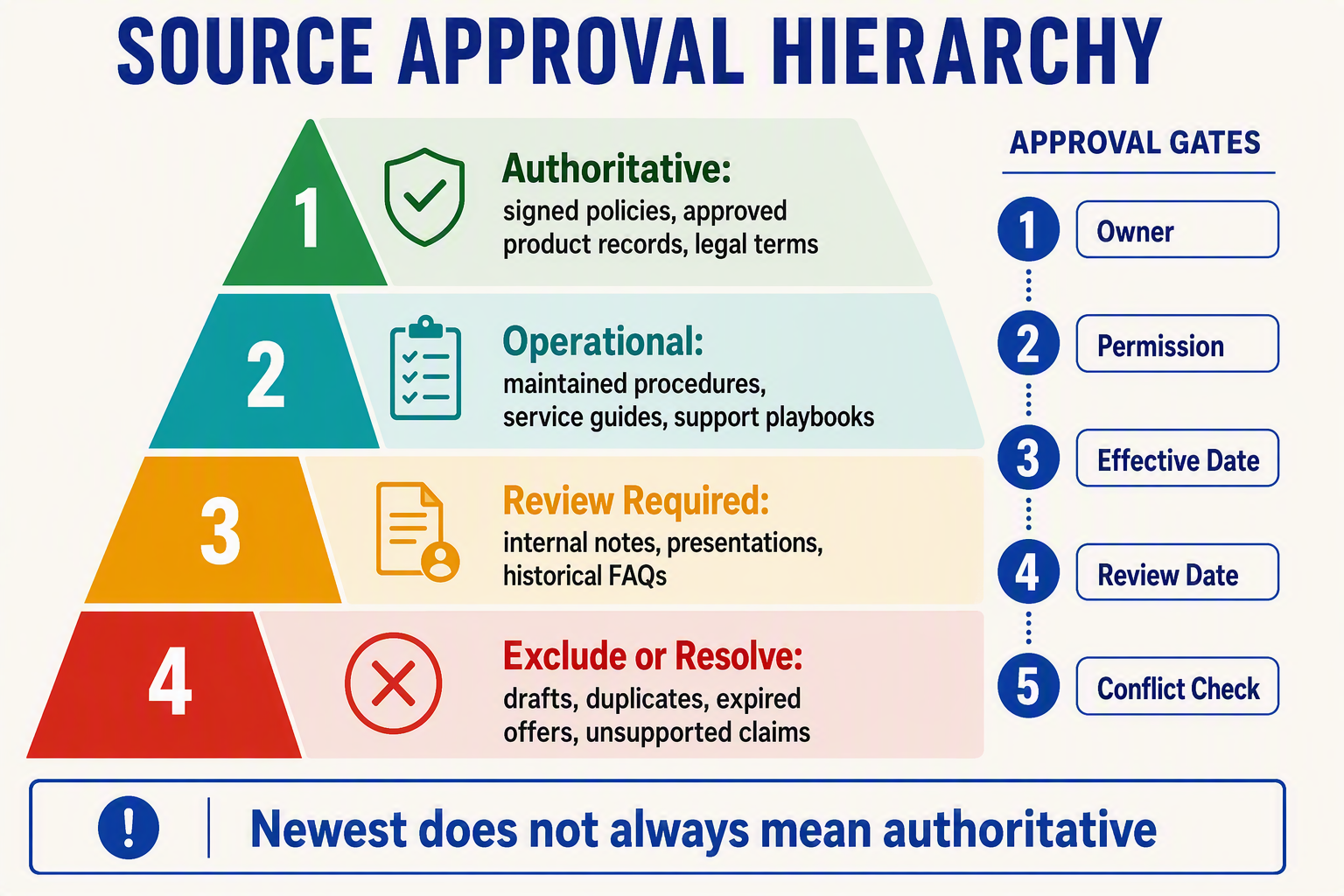
Approve only content that is authoritative, legally usable, current, scoped to the intended audience, and owned by a named business team. Permission restricted material only when retrieval can enforce the same access boundaries; refresh time-sensitive sources on a defined schedule and reject unverifiable, duplicated, obsolete, or sensitive content without a valid operational purpose.
Apply a four-way source decision
Every candidate for the AI agent knowledge base should receive one of four statuses before ingestion:
- Approved: Authoritative, current, permission-cleared, and ready for retrieval.
- Permissioned: Valid content that may be retrieved only for specified roles, customers, regions, or workflows.
- Refresh required: Potentially useful, but its owner, effective date, accuracy, or approval status must be reconfirmed.
- Rejected: Unreliable, superseded, unlawful to use, irrelevant, or unsafe to expose through an AI agent.
Record the decision, reviewer, review date, source owner, effective date, expiry date, and reason. A file being accessible in Google Drive, SharePoint, email, or a CRM does not automatically make it approved for AI use.
Approve authoritative business evidence
Recommended source candidates include:
- Published policies: Returns, cancellations, warranties, delivery, privacy, and service eligibility.
- Controlled product documentation: Specifications, setup instructions, troubleshooting steps, and supported configurations.
- Approved commercial information: Current price lists, plan entitlements, offers, taxes, fees, and geographic restrictions.
- Standard operating procedures: Identity checks, appointment handling, complaint intake, escalation, and after-hours workflows.
- Compliance notices: Consent wording, regulated disclosures, retention rules, and mandatory customer communications.
- Curated FAQs: Answers validated by the team that owns the underlying policy—not merely copied from historical chats.
For example, a pricing sheet should identify the currency, tax treatment, applicable customer segment, effective date, and approving owner. “Pricing_Final_v7.xlsx” is not sufficient provenance.
Permission sensitive or audience-specific sources
Some accurate documents should not be globally searchable. Apply access controls to:
- Customer-specific contracts and negotiated rates.
- Employee-only procedures or internal escalation contacts.
- Partner documentation and confidential product roadmaps.
- Region-specific legal terms.
- Account records, payment details, health information, or identity documents.
- Draft incident communications restricted to an authorised response team.
Use the least-privilege principle: an agent should retrieve only what its channel, role, customer context, and workflow require. A public WhatsApp chatbot, for example, should not retrieve an internal refund-approval threshold simply because both documents discuss refunds.
The CallMissed knowledge base provides retrieval within omnichannel agent workflows; defining source classifications, lawful access, and business permissions remains the deploying organisation’s governance responsibility.
Refresh volatile content before ingestion
Place sources in “refresh required” when they contain:
- Prices, promotions, inventory, operating hours, or service availability.
- Regulations, tax rules, eligibility criteria, or compliance language.
- Named employees, telephone numbers, escalation queues, or branch details.
- Product limits that may change between releases.
- Undated instructions or content with no accountable owner.
Set refresh frequency according to risk: campaigns may need daily validation, operational details monthly review, and stable policies quarterly or annually. Event-triggered review should also occur after a price change, product release, regulatory update, security incident, or policy withdrawal.
Reject unsafe or low-authority material
Do not ingest personal notes, unverified web pages, obsolete manuals, raw support transcripts, contradictory drafts, machine-generated summaries without human approval, or documents lacking usage rights. Also reject secrets such as passwords, API keys, private authentication instructions, and unnecessary personal data.
For dependable RAG for customer service, source quality outranks source volume. When two approved sources conflict, quarantine both from automated answers until an owner establishes precedence; otherwise retrieval may surface evidence for two incompatible responses.
Which CallMissed capabilities are confirmed, and which controls are recommended implementation practices? Key developments
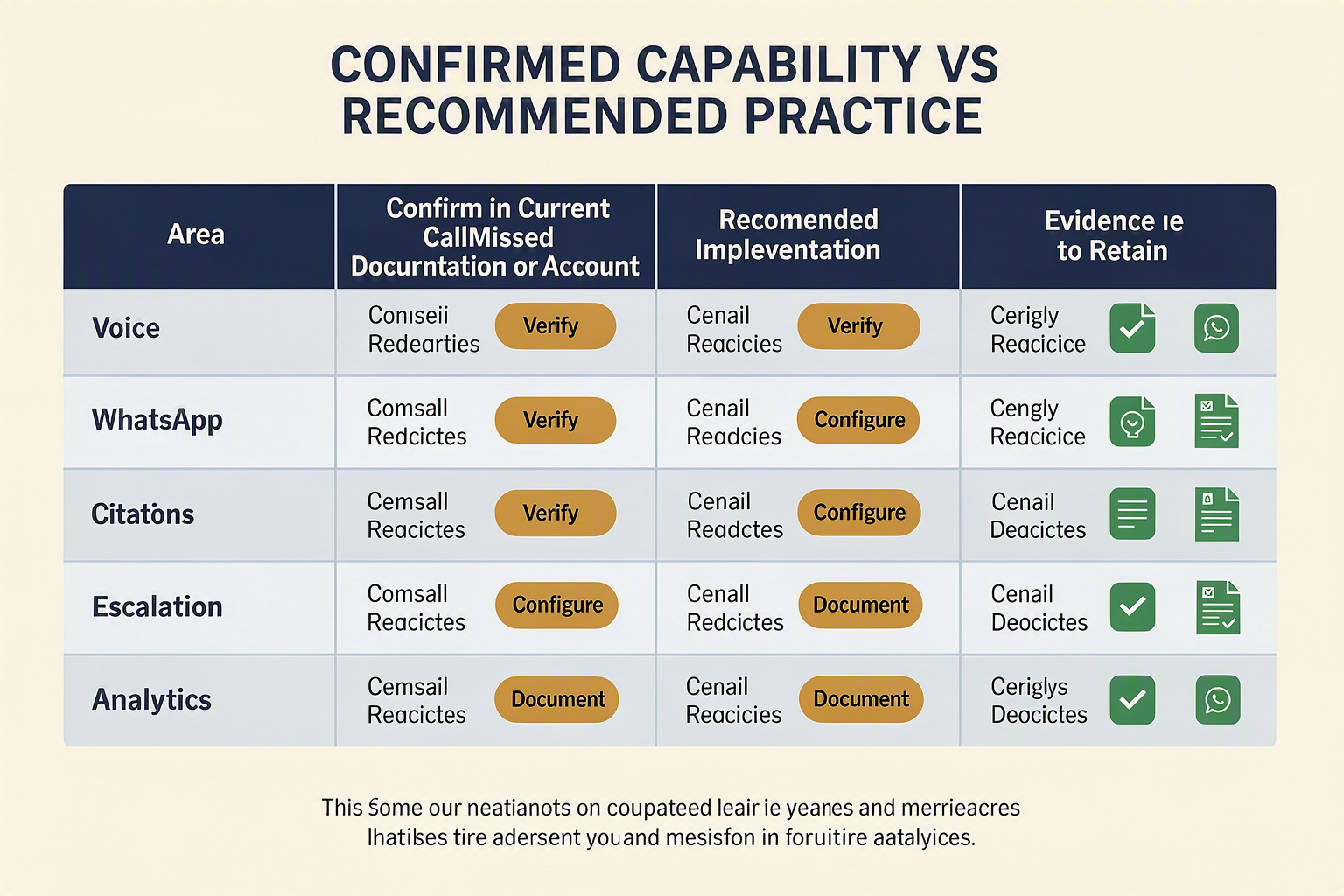
CallMissed provides the communication and retrieval capabilities needed to ground AI interactions, while each business remains responsible for defining content authority, access rules, confidence thresholds, and escalation policy. Keeping these categories separate prevents recommended safeguards from being mistaken for automatically configured platform controls.
Capability-versus-control matrix
| Workflow area | Confirmed CallMissed capability | Recommended implementation control | Evidence to retain |
|---|---|---|---|
| Knowledge retrieval | Knowledge-base RAG can ground AI-agent responses in supplied business content. | Admit only approved sources; require grounded answers and refusal when evidence is absent. | Source ID, owner, approval date, version and retrieval-test result |
| Omnichannel service | AI voice agents, WhatsApp chatbots, WhatsApp Business calling, email tooling and an omnichannel inbox support connected engagement workflows. | Maintain one canonical policy for all channels; adapt presentation rather than rewriting the underlying rule. | Channel test transcripts and expected-answer comparisons |
| Indian-language interactions | Speech-to-Text and Text-to-Speech support 22 Indian languages, including Indic-first models. | Test regional-language questions, code-switching, transliteration, names, numbers and policy terminology with fluent reviewers. | Language, query, transcript, retrieved passage and reviewer decision |
| WhatsApp voice | WhatsApp Business calls—both inbound and business-initiated—can be bridged to an AI voice agent. | Define consent, identity verification, recording disclosures, operating hours and human-transfer conditions before launch. | Consent basis, call-flow approval and escalation test |
| Model and media access | The OpenAI-compatible API gateway covers LLM chat, STT, TTS, image generation and web search, with automatic same-tier fallbacks. | Keep controlled business answers grounded in approved internal content; do not treat public web search as policy authority. | Model or tier, fallback event, retrieved source and response trace |
| Campaign workflows | Campaign and email tooling can support outbound customer communication. | Separate informational content from promotional content; apply recipient eligibility, approval and suppression rules. | Template version, approver, audience criteria and send record |
What “confirmed” does—and does not—mean
A confirmed capability describes an available product function, such as using a CallMissed knowledge base for retrieval or connecting an AI agent to WhatsApp Business calling. It does not establish that a particular organisation has already configured role-based permissions, citation display, confidence scoring, retention periods or approval workflows.
Those decisions depend on the business’s risk profile, legal obligations and operating model. For example, a clinic, lender and online retailer may all use RAG for customer service, but they should not share identical identity checks or escalation thresholds.
Treat the following as customer-defined implementation practices unless expressly documented in the applicable CallMissed configuration or service terms:
- Which policy, price list or procedure is authoritative.
- Who can upload, approve, revise or withdraw content.
- Which agent, team, customer segment or channel may retrieve each source.
- What retrieval score or evidence condition permits an answer.
- When the AI agent must decline, clarify or transfer to a person.
- How long prompts, transcripts, citations and approval records are retained.
Convert recommendations into enforceable requirements
For every recommendation, assign an owner, configuration point, test and review date. “Use current pricing” is not enforceable; “retrieve only the approved FY2026 pricing document, reject superseded versions, and escalate when no applicable region is identified” is testable.
Apply the distinction consistently to the AI agent knowledge base:
- Mark platform functions as confirmed only when supported by current CallMissed documentation or an enabled account feature.
- Mark business safeguards as required internally, even when implementation combines platform configuration, agent instructions and human procedure.
- Revalidate both categories after material product, policy, model or regulatory changes.
This separation creates a defensible operating record: CallMissed supplies the omnichannel AI infrastructure, while the business retains clear accountability for what its agents are permitted to know, say and do.
How should documents be structured so voice, WhatsApp, and email agents retrieve the right passage and adapt it safely by channel?
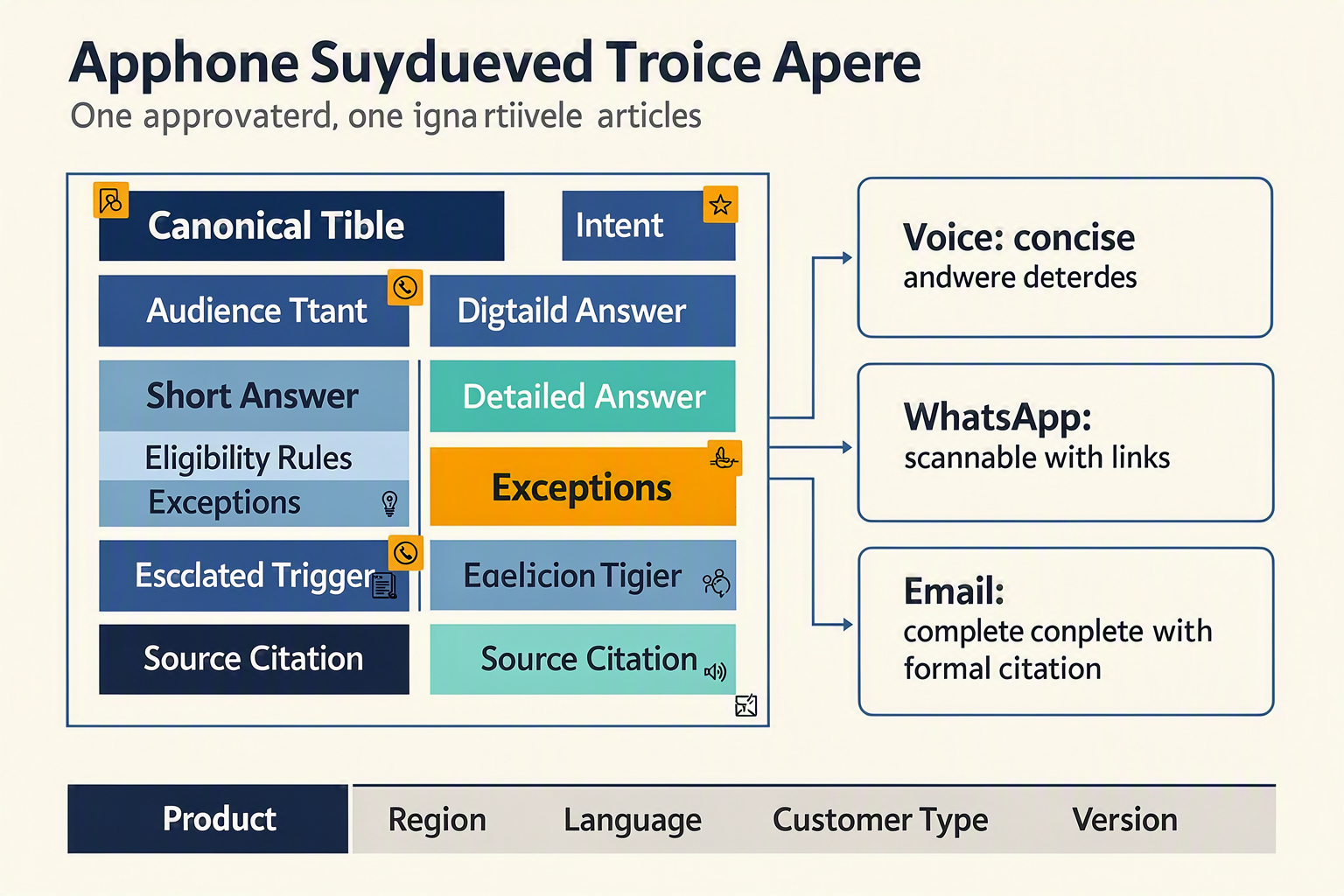
Documents should be organised into small, self-contained passages containing one approved answer, its applicability conditions, and channel-specific delivery rules. This structure helps an AI agent retrieve the same underlying business fact for voice, WhatsApp, or email without treating three differently worded responses as three separate policies.
Build one canonical answer per customer intent
Avoid uploading long manuals with vague headings such as “General Information.” Divide each source into sections that answer a recognisable customer question, such as “Can I cancel after dispatch?” or “Which PIN codes qualify for same-day delivery?”
Each passage should include:
- Descriptive title: Use the language customers and employees commonly use.
- Direct answer: State the approved fact in the first one or two sentences.
- Conditions and exclusions: Identify plan, product, geography, customer type, or transaction status.
- Required action: Explain what the agent or customer should do next.
- Escalation rule: Specify when the passage is insufficient or human approval is required.
- Source metadata: Record the owner, approval status, effective date, version, and review date.
A practical target is one policy or task per passage, rather than an arbitrary word count. Splitting a cancellation rule halfway through its exceptions can make retrieval less reliable, while combining cancellation, refunds, warranties, and delivery creates excessive irrelevant context.
Use a consistent document template
Structure every entry in the AI agent knowledge base with predictable labels:
Title: Cancellation after dispatch
Customer intent: cancel order, stop shipment, do not deliver
Approved answer: Orders cannot be cancelled after dispatch.
Applies to: Domestic retail orders
Exceptions: Damaged, incorrect, or legally returnable goods
Agent action: Explain the return process; do not promise a refund
Escalate when: Shipment status is unclear or an exception is disputed
Effective from: 1 August 2026
Owner: Head of Operations
Version: 3.0
Access: Customer-facing
Include customer vocabulary, abbreviations, product names, and regional terms where useful, but do not add unsupported keyword lists. For multilingual content, preserve numbers, dates, product identifiers, legal meanings, and escalation conditions during translation.
Separate policy truth from channel presentation
The knowledge passage should contain the canonical business rule. Channel instructions should control how that rule is expressed:
- Voice: Lead with the answer, use short sentences, expand abbreviations, and ask for confirmation before consequential actions.
- WhatsApp: Provide a concise answer with scannable bullets and an approved link or next-step button where available.
- Email: Include fuller conditions, formal wording, reference details, and an approved signature or disclaimer.
- All channels: Preserve prices, deadlines, eligibility rules, and prohibitions exactly; never soften “not permitted” into “usually unavailable.”
For example, a 14-day return window must remain 14 days everywhere. A voice agent may say it conversationally, WhatsApp may present it in a bullet, and email may explain its conditions—but none should calculate a different deadline or invent an exception.
Design passages for retrieval and citation
Add retrieval-friendly metadata such as intent, product, region, language, audience, channel eligibility, effective date, and confidentiality level. Repeat essential context inside the passage instead of relying on a preceding page because retrieved chunks may appear independently.
CallMissed provides knowledge-base RAG across AI voice, WhatsApp, and email workflows. The recommended implementation practice is to configure the CallMissed knowledge base so each retrieved passage carries enough context to answer safely, while restricted or obsolete passages are excluded rather than merely marked “old.”
This is the core discipline of RAG for customer service: retrieve one authoritative rule, then adapt its presentation—not its meaning—to the customer’s channel.
How do you test retrieval quality, freshness, citations, conflicting sources, and multilingual or channel-specific answers before launch?
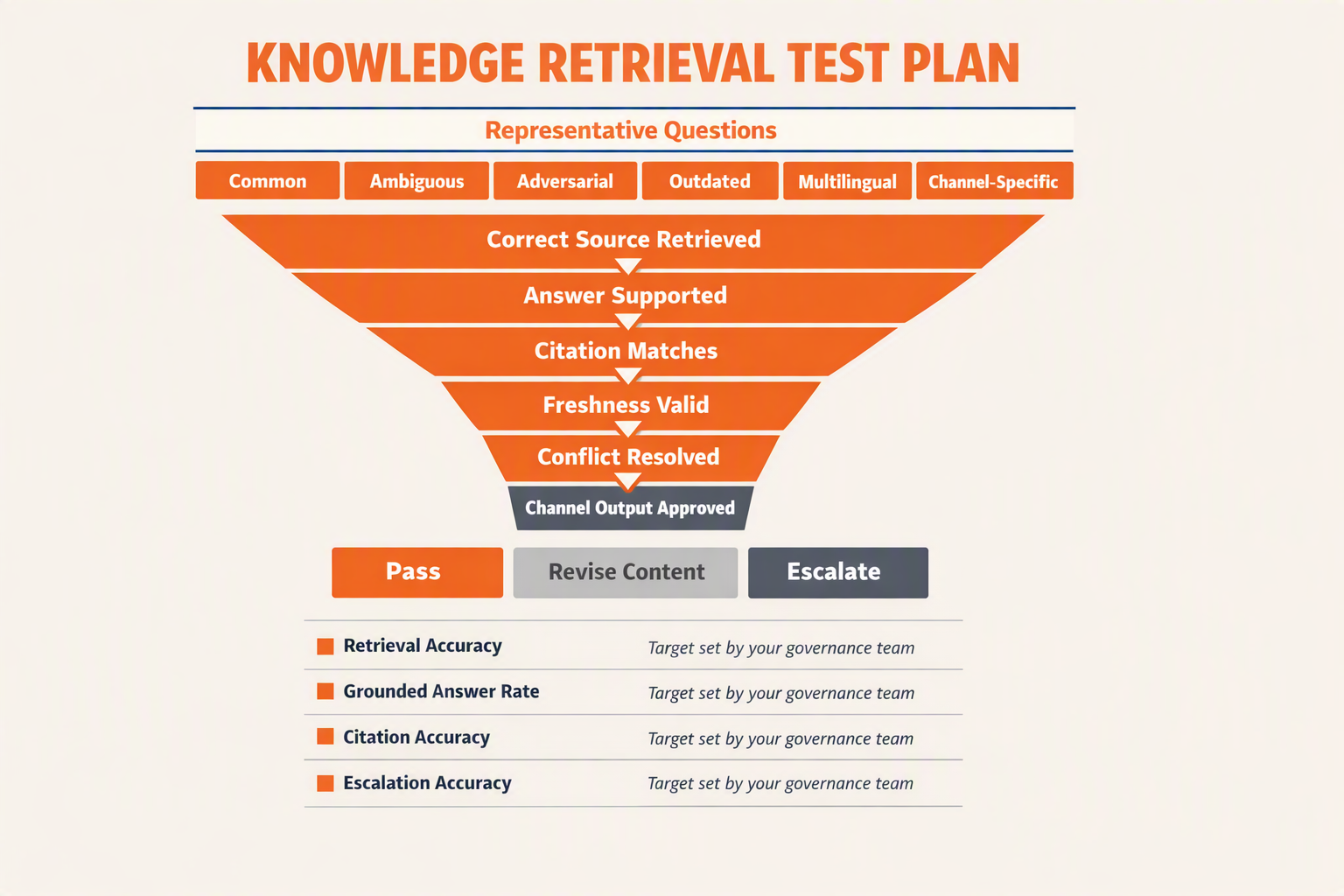
Test the knowledge base with a versioned “golden set” of realistic questions before launch, then require every answer to be correct, grounded, current, appropriately cited, and suitable for its language and channel. A passing response must use the approved source—or safely decline and escalate when evidence is missing or contradictory.
Build a representative retrieval test set
Create at least one expected answer and authoritative source for each test case. Do not test only exact wording copied from documents; customers use abbreviations, incomplete sentences, code-switching, and indirect questions.
Include:
- Common questions, rare edge cases, and high-risk topics such as refunds, pricing, eligibility, safety, and legal terms.
- Exact queries plus paraphrases, misspellings, colloquial language, and ambiguous requests.
- Questions whose answers do not exist, to verify that the agent does not improvise.
- Requests that combine two policies or ask the agent to ignore approved instructions.
- Queries from different customer roles, regions, products, and lifecycle stages.
For every case, record the expected source, required facts, prohibited claims, permitted audience, expected citation, escalation path, and channel-specific response. This becomes the regression suite for the AI agent knowledge base.
Score retrieval separately from answer quality
A fluent answer can hide poor evidence retrieval. Review the retrieved passages before grading the final response.
Use measurable acceptance criteria:
- Retrieval hit rate: Did at least one approved passage containing the required answer appear?
- Top-result precision: Were the highest-ranked passages relevant, or did similar but inapplicable policies outrank them?
- Groundedness: Can every material claim be traced to retrieved evidence?
- Answer correctness: Does the response preserve conditions, exclusions, dates, amounts, and units?
- Safe abstention: Does the agent escalate rather than infer an unsupported answer?
For high-risk questions, require human review and a stricter threshold than for low-risk enquiries such as opening hours. Record failures by cause—poor source wording, ineffective chunking, missing metadata, conflicting content, or weak answer instructions—rather than merely rewriting the test prompt.
Test freshness, citations, and conflicts
Freshness testing should simulate a policy change, not simply inspect a “last updated” field. Replace a controlled test policy with a new effective-dated version, withdraw the old version, and verify that the CallMissed knowledge base retrieves only the currently applicable rule.
Run three conflict scenarios:
- Two sources contain different prices or procedures.
- A newer document exists but is not yet effective.
- A current policy conflicts with an undated FAQ.
The expected behaviour should follow your documented precedence rules, such as approved policy over FAQ, region-specific rule over general guidance, and currently effective version over withdrawn content. If precedence cannot resolve the conflict, the agent should disclose uncertainty internally and transfer the case.
Citations must identify the actual evidence used. Check that each citation points to the correct document title, section, version, and effective date—not merely a loosely related file.
Validate languages and channels independently
For RAG for customer service, translation quality and retrieval quality are different tests. Run native-language queries in every deployed language, including code-switched examples such as Hindi-English or Tamil-English, and have qualified reviewers verify meaning, numbers, names, and policy conditions.
CallMissed supports voice and chat across 22 Indian languages, but businesses must define their own language-level acceptance tests. Validate each channel separately:
- Voice: concise, speakable answers; correct pronunciation; no raw URLs or unreadable citation strings.
- WhatsApp: scannable bullets, short paragraphs, and usable links where approved.
- Email: fuller explanations, formal citations, and complete next steps.
CallMissed provides knowledge-base retrieval across omnichannel agent workflows; test design, approval thresholds, source precedence, and reviewer sign-off remain recommended organisational controls. Re-run the complete suite after every material content, model, prompt, permission, language, or retrieval configuration change.
How should citations, hallucination controls, and human escalation protect customers across voice, WhatsApp, and email workflows?
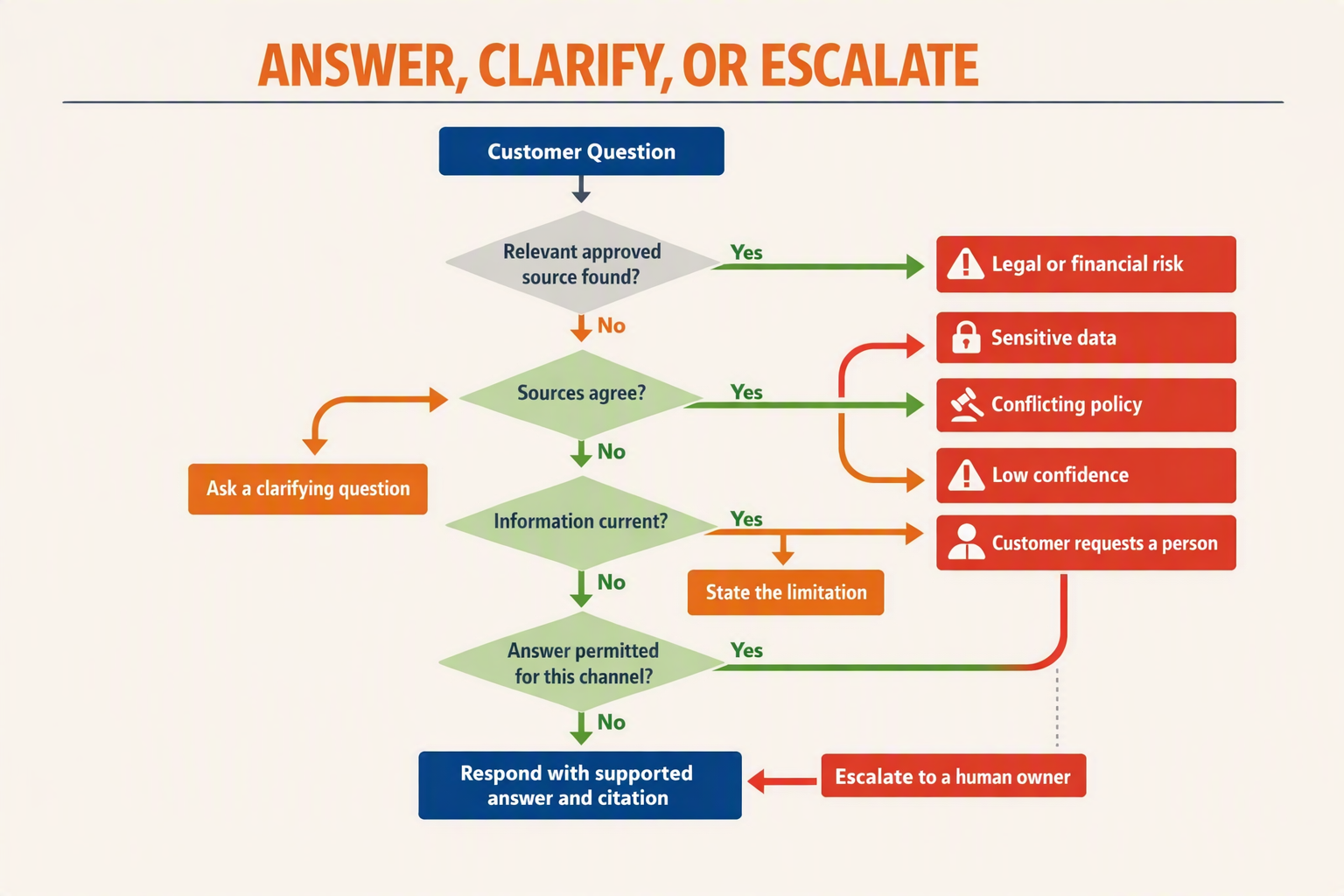
Citations, hallucination controls, and human escalation should form a three-layer safety system: every material answer must be grounded in approved evidence, unsupported claims must be blocked, and uncertain or high-risk cases must reach an authorised person. The same policy should apply across voice, WhatsApp, and email, although each channel should present evidence differently.
Make citations useful in each channel
A citation is more than a link. It should identify the exact source, version, and effective date supporting an answer so customers and reviewers can verify it.
- Voice: Give a concise attribution such as, “According to our returns policy effective 1 July 2026…” Avoid reading long document titles or URLs aloud. Offer to send the supporting policy through WhatsApp or email.
- WhatsApp: Include a short source label beneath the answer, such as Source: Refund Policy, version 4.2, effective 1 July 2026, followed by an approved link where appropriate.
- Email: Provide the fullest citation, including the policy title, relevant section, version, effective date, and approved customer-facing URL.
- Internal records: Log the retrieved document ID, passage or chunk ID, response, channel, timestamp, and agent version—even when the customer sees only a simplified citation.
The CallMissed knowledge base provides the retrieval foundation for omnichannel agent workflows. However, businesses must decide which citation fields are mandatory and which documents may be disclosed externally.
Block unsupported answers before they reach customers
A safe AI agent knowledge base needs explicit refusal rules, not merely an instruction to “be accurate.” Configure the workflow so that the AI agent may answer only when retrieved content directly supports the requested claim.
Recommended controls include:
- Evidence requirement: Require at least one current, authorised source before answering policy, pricing, eligibility, warranty, refund, or compliance questions.
- Retrieval threshold: If the available passage is weak, ambiguous, expired, or only partially relevant, ask a clarifying question or escalate.
- Conflict rule: Never let the model choose silently between contradictory documents. Follow the organisation’s defined precedence order or defer to a person.
- Scope restriction: Prevent the model from converting examples into promises, calculating unapproved discounts, or inferring exceptions that are absent from the source.
- Action validation: Recheck identity, permissions, amounts, dates, and required consent before triggering refunds, bookings, cancellations, or outbound messages.
For multilingual interactions, preserve the policy’s meaning rather than translating loosely. CallMissed supports voice and chat across 22 Indian languages, so teams should test whether regional-language answers retain exclusions, deadlines, currency values, and escalation wording.
Escalate based on risk, not just retrieval failure
Human escalation should activate when the answer is uncertain or the consequence of an error is high. Gartner predicted in March 2025 that agentic AI would autonomously resolve 80% of common customer-service issues by 2029; “common” does not mean every case should be automated.
Escalation triggers should include:
- Missing, expired, inaccessible, or conflicting evidence.
- Requests involving legal threats, fraud, safety, medical matters, vulnerable customers, or regulatory complaints.
- Identity or authorisation failures.
- Repeated customer disagreement or explicit requests for a person.
- Transactions above a business-defined value or risk threshold.
- Speech-recognition uncertainty involving names, addresses, dates, or payment details.
The handoff should carry the conversation transcript, customer intent, retrieved sources, unresolved question, and actions already attempted. This prevents customers from repeating themselves and gives the human reviewer an auditable evidence trail.
Ultimately, RAG for customer service is safest when citations prove what the system knows, hallucination controls constrain what it may claim, and escalation protects customers whenever automation reaches its limits.
What do knowledge-management and AI-safety experts recommend for governance, ownership, audit trails, and the maintenance checklist?
Experts recommend treating the knowledge base as a controlled operational system, with named owners, documented approvals, immutable change records, and risk-based reviews. For a CallMissed knowledge base, the platform supplies retrieval for omnichannel agents; the business remains accountable for deciding which content is authoritative, current, permitted, and safe to use.
Establish governance and ownership
ISO/IEC 42001, published in December 2023, defines requirements for an artificial-intelligence management system built around policies, responsibilities, risk management, monitoring, and continual improvement. Apply those principles through a simple responsibility model:
- Business owner: Accountable for the accuracy and commercial intent of a policy, price, procedure, or product statement.
- Content steward: Maintains structure, metadata, citations, effective dates, and archived versions.
- Risk or compliance reviewer: Approves regulated claims, privacy notices, consent language, and high-impact workflows.
- Technical owner: Configures retrieval, permissions, agent instructions, tests, and escalation behaviour.
- Final approver: Authorises publication independently of the person who drafted the change.
Avoid shared ownership labels such as “support team.” Every source should identify one accountable role, a backup owner, an approval status, and a next-review date.
Maintain an evidence-grade audit trail
The NIST AI Risk Management Framework 1.0, released in January 2023, organises AI risk work into four functions: Govern, Map, Measure, and Manage. An audit trail for an AI agent knowledge base should therefore record both document changes and system outcomes.
For every publication, replacement, or withdrawal, preserve:
- Document ID, title, version, owner, and applicable audience.
- Drafter, reviewers, approver, and timestamp for each action.
- Reason for change and the supporting ticket or legal decision.
- Previous and new text, rather than only the final copy.
- Effective, expiry, publication, and withdrawal dates.
- Retrieval-test results across voice, WhatsApp, and email.
- Affected agents, workflows, languages, permissions, and campaigns.
- Incident links when a change corrects an unsafe or inaccurate answer.
Logs should also connect an answer to the source version retrieved at that time. This makes it possible to distinguish a content defect from a retrieval, prompting, translation, or channel-rendering defect.
Apply risk-based review cycles
Not every page needs the same schedule. Recommended review intervals are organisational controls—not confirmed CallMissed defaults:
- Before each effective date: prices, promotions, eligibility rules, and regulatory notices.
- Monthly: frequently changing products, service availability, and escalation contacts.
- Quarterly: operating procedures, troubleshooting material, and customer-service scripts.
- Annually: stable background information, unless an incident or business change triggers an earlier review.
- Immediately: disputed claims, security instructions, withdrawn offers, court or regulator notices, and content associated with harmful responses.
For RAG for customer service, review retrieved answers as well as source files; a valid document can still be poorly indexed or outranked by stale material.
Use a repeatable maintenance checklist
Before each release, confirm:
- [ ] The source is approved, owned, dated, and within its validity period.
- [ ] Superseded versions are withdrawn from retrieval, not merely labelled “old.”
- [ ] Permissions match the agent, channel, customer type, and workflow.
- [ ] Conflicts have been resolved through the documented precedence order.
- [ ] Citations identify the exact source and version.
- [ ] Representative, multilingual, ambiguous, and adversarial queries pass.
- [ ] Unsupported answers trigger clarification or human escalation.
- [ ] Voice wording is speakable; WhatsApp and email formatting remains accurate.
- [ ] Changes and approvals appear in the audit record.
- [ ] The owner and next-review date are assigned.
CallMissed supports knowledge-base RAG across AI voice, WhatsApp, and email workflows, but disciplined governance converts that capability into a dependable, auditable source of truth.
What does this implementation mean for your team, and who should own each action?
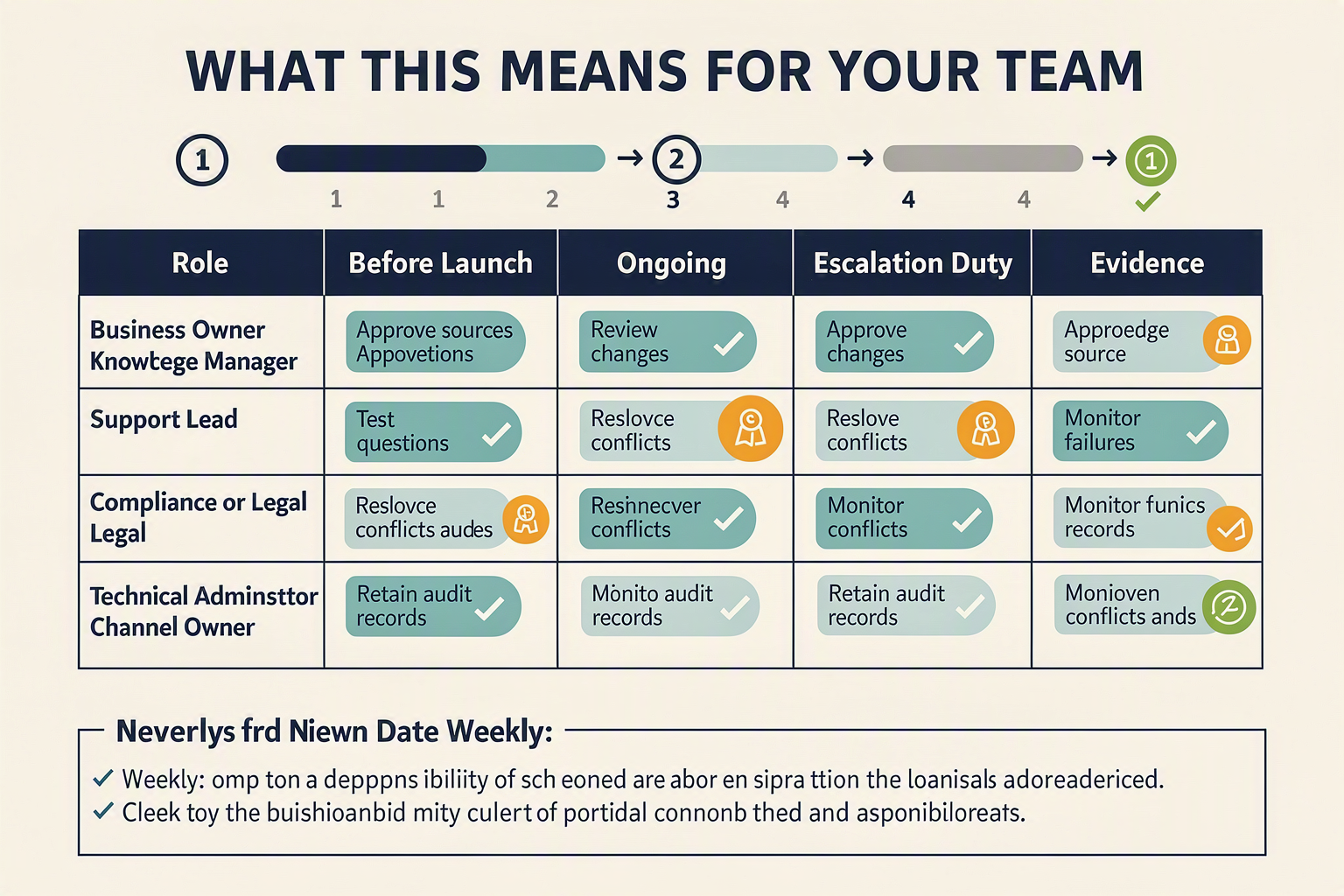
Implementation turns the knowledge base from a one-time content project into a shared operational system. Assign one accountable owner per action, require documented evidence for every release, and keep business approval separate from technical configuration.
Recommended ownership model
Use a lightweight RACI-style model: the accountable owner makes the final decision, while the responsible team performs the work. Each workflow should have exactly one accountable owner, even when several departments contribute.
| Action | Accountable owner | Responsible team | Required evidence | Review trigger |
|---|---|---|---|---|
| Approve authoritative content | Business or policy owner | Product, operations, legal | Signed approval, effective date, source ID | Policy, product, price, or regulatory change |
| Structure and publish documents | Knowledge manager | Content operations | Version number, metadata, publication log | New or revised approved source |
| Configure retrieval and permissions | AI or platform owner | Engineering, IT, security | Access matrix, retrieval settings, test record | Agent, role, channel, or permission change |
| Test voice, WhatsApp, and email answers | Customer-service owner | QA and support teams | Test prompts, expected answers, citations, results | Every release and material content update |
| Set escalation and action controls | Operations owner | Support, risk, engineering | Escalation matrix, confidence rules, action limits | New failure pattern or workflow |
| Monitor freshness and incidents | Knowledge governance owner | Content, QA, analytics | Review register, incident log, retirement record | Scheduled review or production incident |
This division prevents a common governance failure: asking engineers to decide what a refund policy means, or asking content teams to configure security permissions. The business owner approves meaning; technical teams control how approved information is retrieved and exposed.
Separate platform capabilities from team decisions
Confirmed CallMissed capabilities include knowledge-base RAG and AI-agent workflows across voice, WhatsApp, email, and web. The platform can provide the retrieval and engagement infrastructure, but your organisation must define what information is authoritative and when an automated response is unsafe.
For each CallMissed knowledge base deployment, the team should explicitly own:
- Source authority: Which department may approve each content category?
- Release control: Who can publish, replace, archive, or restore a document?
- Access policy: Which agent, workflow, customer segment, or channel may retrieve it?
- Response policy: When must the agent cite evidence, ask a clarifying question, or escalate?
- Incident response: Who disables disputed content and communicates the correction?
These are recommended implementation controls, not automatic platform guarantees.
Make ownership measurable
A practical AI agent knowledge base operating standard should require 100% of published documents to have an owner, approval status, effective date, version, and review date. This is an internal governance target rather than an industry benchmark, but it creates an auditable definition of “approved.”
Track a compact scorecard after launch:
- Percentage of active sources with complete ownership metadata.
- Retrieval-test pass rate by voice, WhatsApp, and email.
- Number of conflicting or expired sources found in production.
- Percentage of uncertain answers escalated correctly.
- Median time from policy approval to knowledge-base publication.
- Median time to withdraw content after an incident.
For RAG for customer service, accountability should follow the evidence lifecycle: business teams own truth, knowledge teams own publication, technical teams own retrieval controls, QA owns validation, and operations owns safe escalation. That structure makes failures diagnosable—and corrections much faster than treating every incorrect answer as a generic “AI problem.”
Frequently asked questions: What is a CallMissed knowledge base, how does a knowledge base AI agent use RAG, how often should content be updated, and when should an agent escalate?
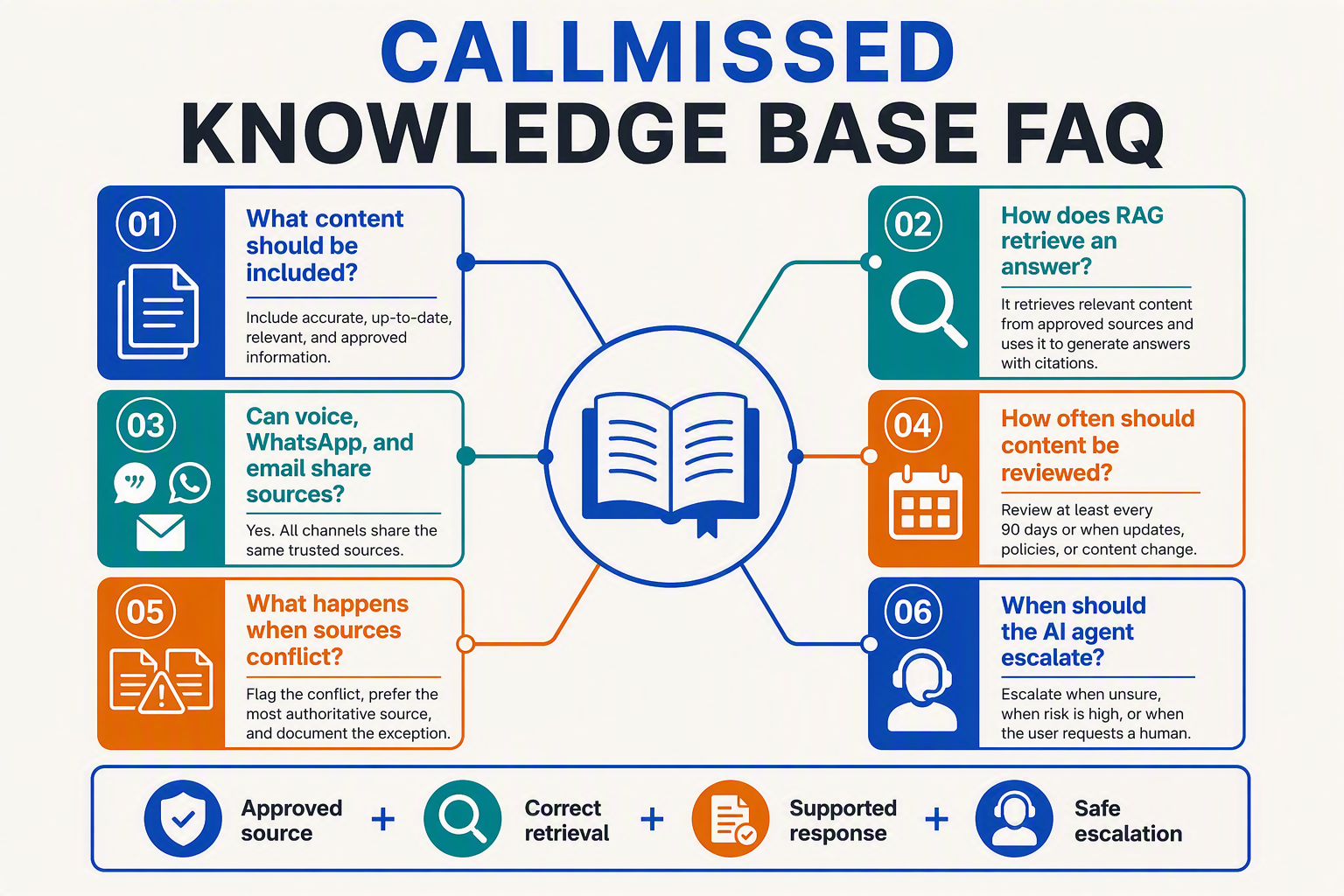
What is a CallMissed knowledge base, and what information should it contain?
How does a knowledge base AI agent use retrieval-augmented generation?
How does RAG for customer service reduce AI hallucinations?
How often should a CallMissed knowledge base be updated and reviewed?
When should an AI agent escalate a voice call, WhatsApp chat, or email to a human?
How should businesses test approved knowledge-base content before activating an AI agent?
Conclusion
Build the evidence layer before scaling automation
A reliable CallMissed knowledge base should function as a governed source of truth, not a folder of uploaded files. As automation expands across AI voice, WhatsApp, and email, consistent answers will depend on whether every agent can retrieve the same approved, current, and permission-appropriate evidence.
The practical priorities are clear:
- Choose authoritative sources: Include approved policies, pricing sheets, product documentation, operating procedures, and compliance notices. Assign an owner, approval status, effective date, and review date to each source.
- Structure content for retrieval: Break large documents into focused sections with explicit headings, applicability rules, version metadata, and citations. A compact, clearly organised AI agent knowledge base is more useful than a large collection of ambiguous or duplicated documents.
- Test before deployment: Evaluate realistic questions, paraphrases, incomplete requests, multilingual queries, and adversarial prompts. Confirm that voice, WhatsApp, and email agents retrieve the correct evidence and escalate when confidence is insufficient.
- Govern continuously: Define source precedence, permissions, withdrawal procedures, audit trails, freshness reviews, hallucination controls, and named approvers. When two documents conflict, the agent should follow a predetermined rule rather than improvise.
These controls matter because Gartner predicted in March 2025 that agentic AI will autonomously resolve 80% of common customer-service issues by 2029, reducing operational costs by 30%. Achieving that safely requires treating RAG for customer service as an ongoing operational discipline rather than a one-time configuration task.
Prepare for more autonomous, multilingual engagement
CallMissed provides confirmed capabilities such as knowledge-base retrieval, AI voice agents, WhatsApp chat and Business calling, email tooling, and support across 22 Indian languages. Businesses must still establish their own recommended implementation practices—including approval authority, confidence thresholds, access permissions, escalation rules, and maintenance schedules.
Looking ahead, watch whether retrieval remains accurate as policies change, content grows, and customers ask the same question in different channels or regional languages. The strongest implementations will measure readiness by answer consistency, citation quality, freshness, and safe deferral—not by document volume.
To explore how governed AI communication is evolving, visit CallMissed—and ask: Would every customer-facing agent give the same approved answer today?
Related Reading
Discussion
Related Posts

Ready to automate customer conversations?
Launch AI voice agents and WhatsApp bots with CallMissed — one API, 22+ Indian languages.