
CallMissed for Ecommerce: Customer Communication Guide for Orders, Delivery and Returns


Use CallMissed for ecommerce to streamline order, delivery, return and product calls with secure verification, escalation and handoffs.
CallMissed for Ecommerce: Customer Communication Guide for Orders, Delivery and Returns
What if the moment most likely to lose an ecommerce customer is not checkout, but the anxious wait after clicking “Buy now”? CallMissed for ecommerce addresses that post-purchase gap by helping businesses automate order enquiries, delivery updates, return requests and product questions across voice and WhatsApp—without forcing customers to restart the conversation on every channel.
The commercial stakes are substantial. Baymard Institute reported an average documented online-shopping-cart abandonment rate of 70.19% in 2025, showing how readily shoppers disengage when uncertainty or friction enters the buying journey. Returns create another pressure point: the National Retail Federation estimated that US retailers would receive $890 billion in merchandise returns in 2024, equal to 16.9% of annual sales. Meanwhile, India Brand Equity Foundation projected India’s ecommerce market to reach $325 billion by 2030, making scalable, multilingual support increasingly important for merchants serving both metros and regional markets.
CallMissed brings together an ecommerce AI voice agent, WhatsApp chatbots, WhatsApp Business calling, an omnichannel inbox and knowledge-base retrieval. Its support for 22 Indian languages is especially relevant when shoppers prefer to ask “Where is my order?” or explain a damaged item in their most comfortable language. A customer can begin on a phone or WhatsApp Business call, receive a WhatsApp summary or next-step prompt, and continue the interaction without losing essential context.
This guide explains how to design ecommerce customer support automation around the moments that generate the most contact volume and customer anxiety:
- Answer order-status and product-availability questions using verified system data.
- Deliver proactive shipping updates without overwhelming customers with notifications.
- Collect structured return details, including reasons, images and pickup preferences.
- Verify customer identity before revealing addresses, payment details or order history.
- Ground answers in approved catalog, policy and fulfilment knowledge rather than model guesswork.
- Escalate exceptions—such as failed deliveries, refund disputes or damaged goods—to a human with the conversation history attached.
- Measure containment, resolution time, transfer rate, repeat-contact rate and customer satisfaction.
The practical challenge is integration, not merely conversation design. Order lookup, CRM synchronisation, identity checks and automated actions depend on the APIs, permissions and plan capabilities available in each merchant’s environment; they should therefore be validated before deployment. The sections ahead show how to map these dependencies, define safe escalation rules and build voice-to-WhatsApp continuity that feels helpful rather than fragmented—turning routine support into a dependable part of the ecommerce experience.
How can CallMissed for ecommerce handle customer conversations from order enquiry to resolution?
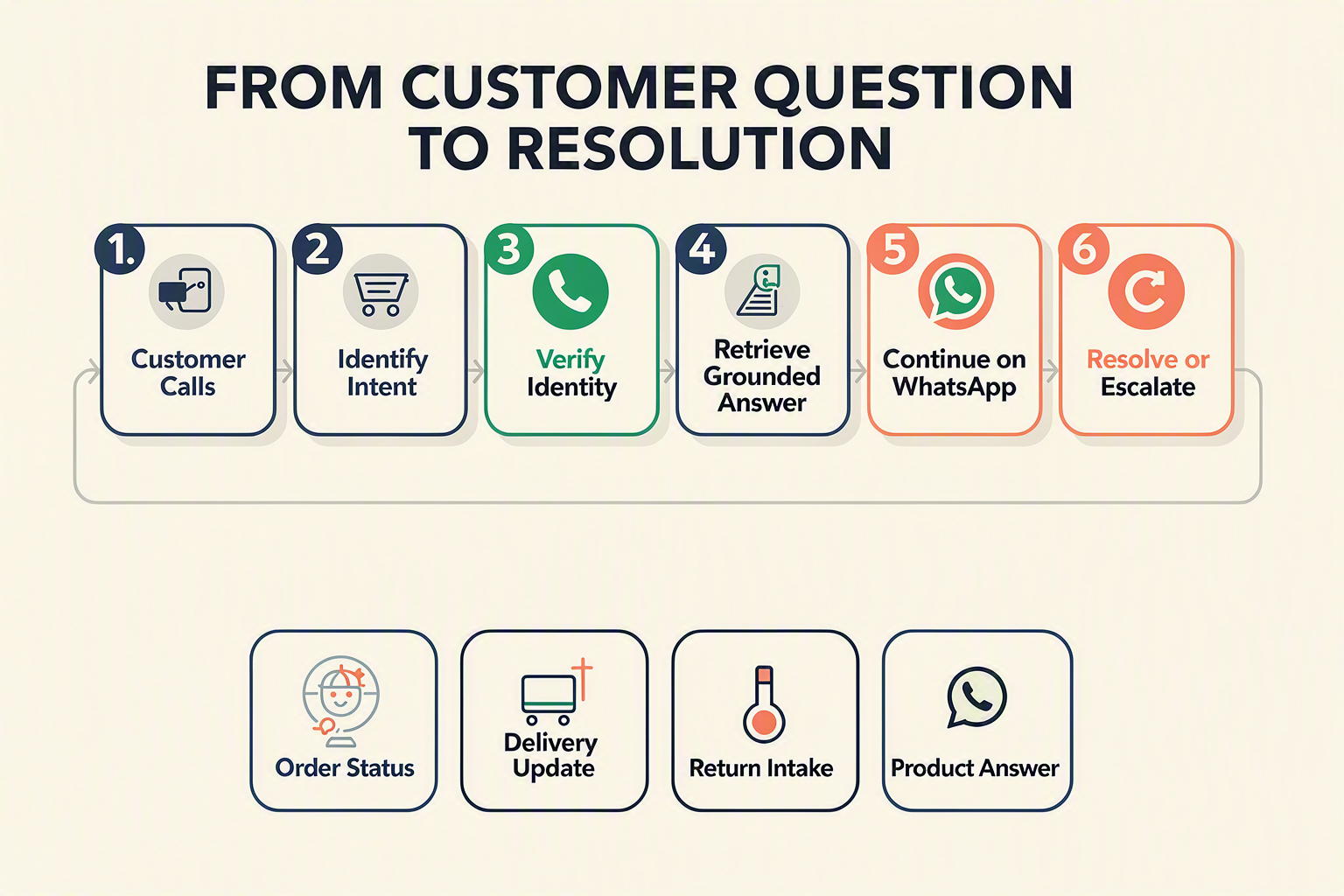
CallMissed for ecommerce can guide customer conversations from the first question to resolution in one controlled workflow. It identifies the request, retrieves authorised order or product information, handles approved routine steps, and escalates exceptions to a human with the context preserved. Voice, WhatsApp, knowledge retrieval and inbox tools support the conversation, while refunds, cancellations and logistics actions require connected merchant systems, appropriate permissions and account-level capabilities.
Map each request to the right resolution path
A practical ecommerce customer support automation workflow should classify the customer’s intent before taking action:
- Order enquiries: Request an order reference and suitable verification detail, retrieve permitted order data, and explain the status clearly.
- Delivery updates: Report verified events such as dispatched, out for delivery or delivery attempted. If tracking data is missing or inconsistent, create an exception rather than estimate an arrival time.
- Returns: Collect the item, reason, condition, supporting images where needed, pickup preference and requested outcome. Confirm eligibility against the approved returns policy before promising a refund or replacement.
- Product questions: Retrieve approved specifications, compatibility information, sizing guidance, availability and warranty terms.
- Follow-up: Send a case summary, reference number and next expected milestone through an authorised channel.
CallMissed for ecommerce manages the conversation and routing layer. Transactional actions—such as cancelling an order, issuing store credit, processing a refund or booking a pickup—depend on suitable APIs, authentication and merchant-side authorisation.
Maintain continuity across voice and WhatsApp
An ecommerce AI voice agent can capture the initial request and, with the customer’s consent, continue on WhatsApp when a screen is more useful—for example, to upload a damaged-item photo, choose a pickup slot or review a return summary.
Where the required account capabilities are enabled, CallMissed supports WhatsApp chat and WhatsApp Business calling, including bridging a business call to an AI agent. To maintain continuity:
- Link the call, WhatsApp conversation and order reference to one case ID.
- Carry forward the identified intent and completed verification status.
- Record consent before sending business-initiated messages.
- Exclude sensitive payment and address information from summaries.
- Send replies to the omnichannel inbox when human review is required.
Verify identity and ground every answer
CallMissed for ecommerce should apply verification in proportion to the risk. General product questions may not require authentication, but requests involving addresses, cancellations, refunds or account details need stronger checks.
Depending on the merchant’s systems and account capabilities, verification may use an OTP, an order-specific detail, an authenticated session or human review. A customer’s calling number alone should not be treated as proof of identity.
Answers should be grounded in approved catalogue, policy and fulfilment sources. If reliable information is unavailable, the agent should say so and escalate rather than invent stock levels, delivery dates or refund outcomes.
Escalate exceptions with a complete handoff
CallMissed for ecommerce should route a case to a human when verification fails, policies conflict, a connected system returns an error, or the customer disputes a delivery, return or refund. The handoff should include:
- Customer intent and identity-verification status
- Order and case references
- Relevant approved knowledge-base content
- Actions already attempted and their results
- A concise conversation summary and requested outcome
This creates an auditable path from order enquiry to resolution while helping customers avoid repeating information during escalation.
Why is ecommerce customer support automation moving beyond menus and generic chatbots?

Ecommerce support is moving beyond menus and generic chatbots because customers rarely present neat, single-intent requests. Effective ecommerce customer support automation must understand natural language, retrieve live order context, perform authorised actions and preserve the conversation when a shopper changes channels.
Menus classify requests, but they do not resolve journeys
Traditional interactive voice response systems and rule-based chatbots usually ask customers to select “orders,” “returns” or “payments.” That structure works for basic routing, but ecommerce conversations frequently cross these boundaries.
A shopper might say: “My parcel was due yesterday, I am travelling tomorrow, and if it cannot arrive today I want to cancel it.” Resolving that request may require several coordinated steps:
- Identify and authenticate the customer.
- Find the correct order without exposing another customer’s data.
- Retrieve the latest fulfilment status from an order or delivery system.
- Check cancellation and refund policies.
- Offer only actions that remain operationally possible.
- Escalate the case if the delivery promise conflicts with system data.
A menu can label this as a delivery enquiry. An ecommerce AI voice agent must instead maintain context, distinguish requests from complaints and execute a controlled workflow.
Generic answers are risky when facts change by order
Large language models can produce fluent responses, but fluency is not evidence that an answer is correct. Product availability, delivery dates, refund eligibility and pickup options can change by location, seller, warehouse or order state.
That matters at scale: the National Retail Federation estimated in 2024 that US merchandise returns would total $890 billion, representing 16.9% of annual retail sales. Returns automation therefore needs more than a generic policy explanation; it must collect structured evidence and determine when human review is required.
A dependable architecture separates three responsibilities:
- Knowledge grounding: Retrieve approved product information, return rules, warranty terms and delivery policies from a maintained knowledge base.
- Transactional data: Query authorised order, CRM or fulfilment systems for customer-specific facts.
- Action controls: Apply deterministic rules before cancelling an order, initiating a return or changing contact details.
Menus can remain useful as fallbacks and confirmation tools, but they should not become barriers that force customers to translate complex problems into rigid categories.
Context must survive voice, WhatsApp and human escalation
Modern support is also stateful. A customer should not need to repeat an order number, delivery issue and preferred resolution after moving from a call to WhatsApp or from automation to a human agent.
CallMissed for ecommerce supports this model by combining AI voice agents, WhatsApp chatbots, WhatsApp Business calling and an omnichannel inbox. A voice interaction can capture the customer’s intent, while a WhatsApp follow-up can request a photo of damaged merchandise or provide a written return summary. Its support for 22 Indian languages also helps merchants accept natural-language enquiries from regional audiences rather than limiting automation to English-first menu trees.
However, continuity depends on implementation. Merchants should verify:
- Which customer identifier links voice, WhatsApp and CRM records.
- Whether order-system APIs provide real-time or delayed status data.
- Which actions require OTPs or another identity check.
- Whether WhatsApp calling, outbound messaging and automated actions are enabled for the account.
- What transcript, summary and verification status reaches the human agent.
The goal is not unrestricted conversational autonomy. It is a grounded, permission-aware support layer that handles routine requests quickly while recognising uncertainty, sensitive data and operational exceptions.
Which ecommerce call types can be automated, and which capabilities require account-level verification?
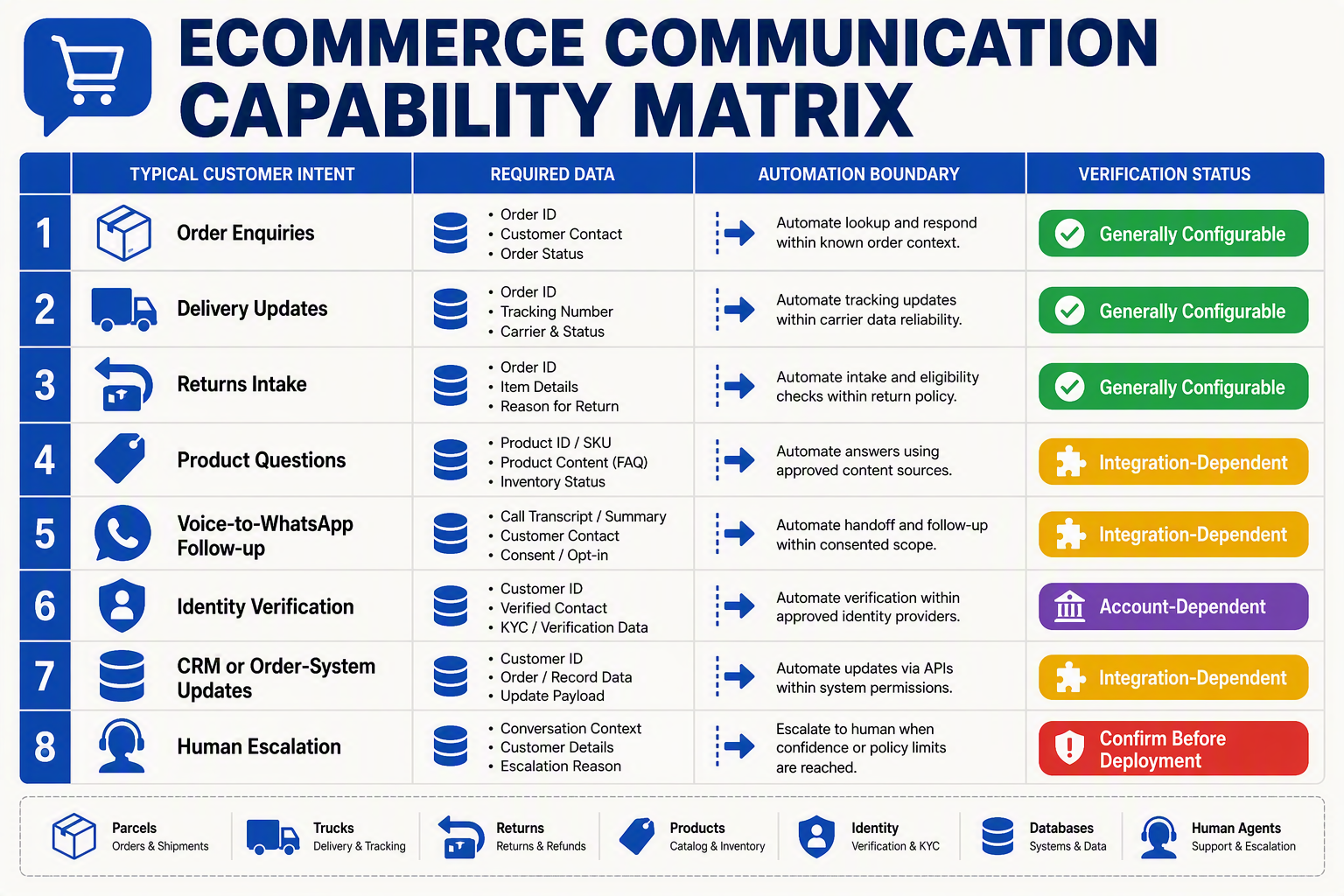
Most repetitive ecommerce calls can be automated, but automation eligibility and channel access are separate questions. Order lookups, return intake and grounded product answers are suitable for an ecommerce AI voice agent; WhatsApp calling, outbound messaging, phone-number activation and system actions may require verified business assets, approved permissions or account-specific configuration.
Automation and verification matrix
| Call type | Suitable automated handling | Required data or controls | Account-level dependency |
|---|---|---|---|
| Order enquiries | Recognise an order reference, authenticate the shopper, retrieve status and explain the next step | Order-system API, current fulfilment data and customer-level identity checks | Order-system credentials and API permissions must be configured and validated |
| Delivery updates | Report shipment status, capture delivery instructions and send a WhatsApp recap | Carrier or fulfilment events, notification consent and escalation rules | Outbound WhatsApp availability, sender status and template requirements are account-dependent |
| Returns intake | Collect the item, reason, condition, images and preferred pickup slot | Return policy, eligibility logic, secure media handling and case creation | Automatic approval, pickup booking or refund initiation depends on connected-system permissions |
| Product questions | Answer questions about sizing, compatibility, stock, care and policies | Approved catalogue content, knowledge-base retrieval and freshness controls | Live inventory or personalised pricing requires authorised access to merchant systems |
| Voice-to-WhatsApp follow-up | Continue a phone or WhatsApp Business call with a summary, link or document | Customer consent, channel mapping and a persistent conversation identifier | WhatsApp Business onboarding, calling eligibility and business-initiated contact capabilities must be confirmed per account |
| Refund or payment disputes | Gather facts, verify the shopper and route the case with a structured summary | Stronger authentication, audit logs and human-review thresholds | Payment access and transaction actions require separately authorised credentials; final decisions should usually remain human-controlled |
What “account-level verification” means
For CallMissed for ecommerce, account-level verification concerns whether the business and its communication assets are authorised to use a capability. It is different from verifying the shopper during an individual conversation.
Before launch, confirm:
- Business and channel status: Verify the relevant business profile, WhatsApp assets, phone numbers and sender identities through the applicable onboarding process.
- Calling and messaging permissions: Check whether inbound calling, business-initiated WhatsApp calling, outbound messages and approved message formats are enabled for that specific account.
- Integration authority: Use least-privilege API credentials for order lookup, case creation or shipment retrieval. Read access does not automatically permit cancellations, refunds or address changes.
- Consent and regional rules: Record the customer’s consent and communication preferences before initiating follow-ups, particularly for promotional or business-initiated contact.
- Production readiness: Test rate limits, webhook delivery, fallback routing and human handoff rather than assuming sandbox behaviour will match production.
India Brand Equity Foundation projected India’s ecommerce market to reach $325 billion by 2030, making reliable multilingual automation and permission management increasingly consequential for growing merchants.
Draw the action boundary explicitly
A safe ecommerce customer support automation design separates three levels:
- Answer: The agent may explain approved information.
- Retrieve: The agent may access customer-specific information only after suitable identity verification.
- Act: The agent may modify an order, arrange a pickup or trigger a financial workflow only when explicit permissions and safeguards exist.
CallMissed can support voice, WhatsApp and knowledge-grounded conversations across 22 Indian languages, but merchants should verify account eligibility and connected-system permissions before promising any automated action. If verification fails or data conflicts, the correct outcome is a human handoff—not a guessed answer.
How should an ecommerce AI voice agent manage orders, deliveries, returns and product questions?
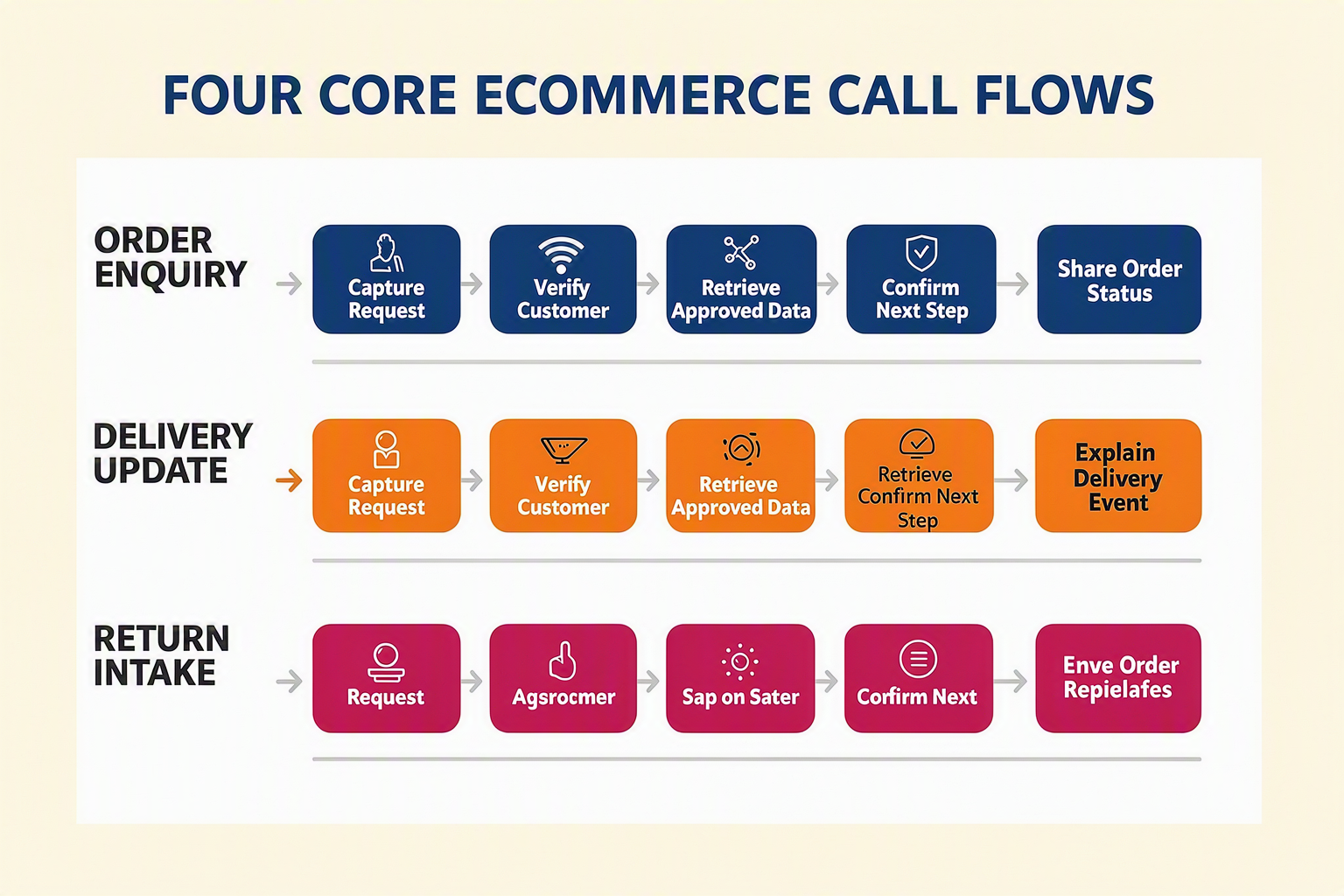
An ecommerce AI voice agent should resolve routine requests from verified order and catalog data, collect structured information for returns, and transfer exceptions to a human with full context. It should never guess an order status, delivery date, refund outcome or product specification when the underlying system cannot confirm it.
Use one workflow for the four highest-volume intents
The agent should identify the customer’s goal before requesting personal information. A practical intent flow covers:
- Order enquiries: Locate the relevant order, report its confirmed status and explain the next available action.
- Delivery questions: Read the latest carrier or fulfilment event, distinguish an estimate from a guaranteed date, and flag stalled or failed deliveries.
- Returns intake: Check policy eligibility, capture the return reason and collect the evidence needed for review.
- Product questions: Retrieve approved information about sizing, compatibility, materials, stock and usage from the product catalog or knowledge base.
This design keeps ecommerce customer support automation transactional rather than merely conversational. For example, “Your package is out for delivery” should come from a current order or shipment record—not from a language model interpreting an earlier conversation.
Verify identity in proportion to the requested action
Authentication should become stronger as the sensitivity or consequence of an action increases. Asking about general product dimensions may require no verification, while revealing an address or changing a delivery instruction does.
A risk-based workflow can use:
- Low risk: Answer public catalog, warranty and return-policy questions without collecting identity data.
- Moderate risk: Match an order using limited information such as an order reference plus a verified contact channel.
- High risk: Require a one-time password or another merchant-approved verification method before exposing order history, changing addresses or initiating refunds.
- Failed verification: Restrict the response, explain why verification is necessary and offer secure human escalation.
Verification methods, order access and automated changes depend on the merchant’s APIs, permissions and CallMissed account configuration; these capabilities should be validated before launch.
Make delivery and return answers evidence-led
Delivery language must reflect what the fulfilment system actually knows. The agent should say “estimated for 8 August” when only an estimate exists and avoid promising delivery on that date. If tracking has not changed beyond a merchant-defined threshold, it should open or route an exception rather than repeatedly reciting the same scan.
For returns, the voice agent can begin intake, while WhatsApp handles information that is awkward to capture by phone. A complete record may include:
- Order and item selected
- Return reason and condition
- Damage description
- Photos or video supplied through WhatsApp
- Pickup address and preferred window
- Eligibility result and applicable policy text
- Case number and promised next step
The agent should describe a refund as requested, approved or issued only when the connected system supports that exact status.
Ground product answers and preserve channel continuity
Product responses should use retrieval-augmented generation over approved catalog pages, care instructions, compatibility tables and current policies. Conflicting, missing or stale records should trigger clarification or escalation—not an improvised answer.
CallMissed for ecommerce can connect AI voice interactions with WhatsApp chatbots, WhatsApp Business calling, a knowledge-base retrieval layer and an omnichannel inbox. After a call, the workflow can send a WhatsApp summary containing the order reference, confirmed status, return-upload prompt or support case number, subject to consent and messaging rules.
That continuity gives the human team a usable handoff: customer identity state, detected intent, retrieved evidence, actions attempted, uploaded media and the unresolved question. The customer continues from the last verified step instead of repeating the entire story.
How do voice-to-WhatsApp continuity, identity verification, knowledge grounding, escalation and system integration work together?
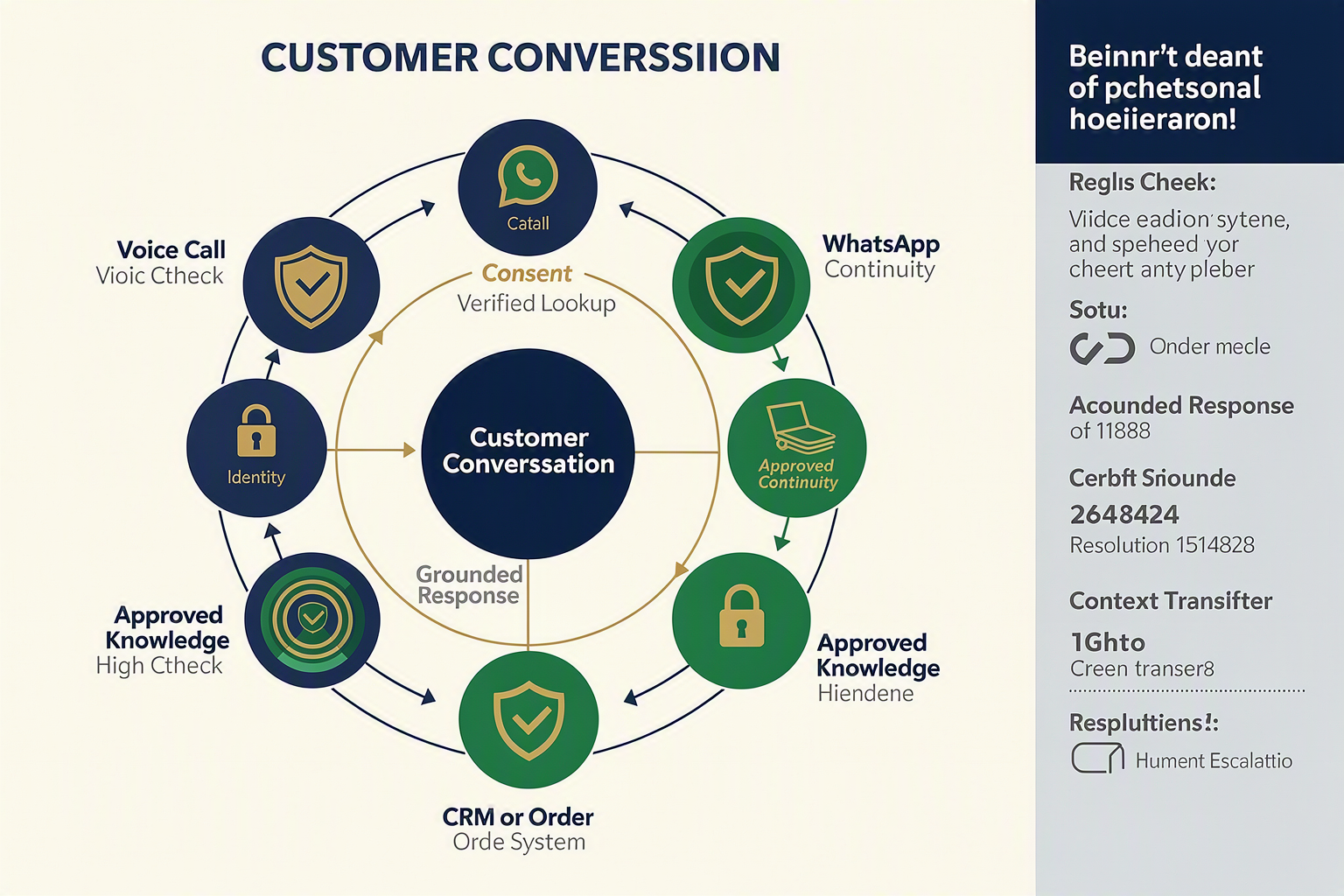
These capabilities work together as a controlled support pipeline: preserve the conversation across channels, verify the shopper, retrieve authoritative information, execute permitted actions and escalate exceptions with full context. No single layer should independently disclose order data, promise an outcome or change a customer record.
Preserve context from voice to WhatsApp
A CallMissed for ecommerce workflow can assign one interaction ID to the call, WhatsApp thread and subsequent human-agent activity. When a shopper moves from an ecommerce AI voice agent to WhatsApp, the handoff should include only the information needed to continue:
- Detected intent, such as delivery tracking or return intake
- Order reference supplied by the customer
- Language preference and verification status
- Concise call summary and unresolved question
- Images, forms or links requested during the conversation
- Consent and notification records where applicable
For example, a caller reporting damaged packaging can receive a WhatsApp prompt to upload photographs rather than describe every detail verbally. CallMissed supports voice and chat across 22 Indian languages, allowing the language selected during the call to remain part of the session context.
Verify identity before retrieving private data
Caller ID or a matching WhatsApp number is a signal, not sufficient proof of identity. Verification should be proportional to the requested action.
- Ask for a low-risk identifier, such as an order number.
- Match it against a verified customer record through the merchant’s order system.
- Send a one-time code or confirmation challenge to a registered channel when required.
- Create a short-lived verified session with explicit scope.
- Re-verify before sensitive actions such as changing an address, cancelling an order or discussing payment details.
The agent should mask personal data in transcripts and logs. Failed attempts, mismatched phone numbers and unusual requests should trigger human review rather than repeated disclosure prompts.
Separate transactional truth from knowledge grounding
Effective ecommerce customer support automation uses two distinct evidence sources:
- Live systems provide order status, payment state, shipment events, inventory and refund progress.
- Knowledge-base retrieval, or RAG, provides approved return policies, warranty terms, product specifications and troubleshooting instructions.
The agent should never infer a delivery date from a general shipping policy when the order system has no confirmed estimate. Retrieved content should carry a source, version and last-updated date; conflicting or missing information should produce a qualified response or escalation, not a model-generated guess.
Escalate with an actionable case packet
Escalation rules should cover verification failure, refund disputes, repeated delivery failures, damaged goods, policy exceptions and customer requests for a person. The human agent should receive:
- Conversation transcript and channel history
- Verified identity state
- Order and shipment identifiers
- Knowledge sources already consulted
- Actions attempted and their results
- Customer sentiment, preferred language and requested resolution
This avoids making the shopper repeat the story while giving the agent an auditable basis for action.
Treat integrations as permissioned, account-dependent components
CRM, order-management, payment, logistics and warehouse connections require available APIs, correct permissions and merchant-specific configuration. Teams should validate each proposed read or write operation before deployment rather than assuming a named integration exists.
Use least-privilege credentials, idempotency keys for updates, timeouts, retry limits and audit logs. If an external system is unavailable, CallMissed should acknowledge the delay, preserve the case and route it safely—never report an unconfirmed cancellation, refund or delivery update as completed.
Which support metrics show whether CallMissed is improving ecommerce service?
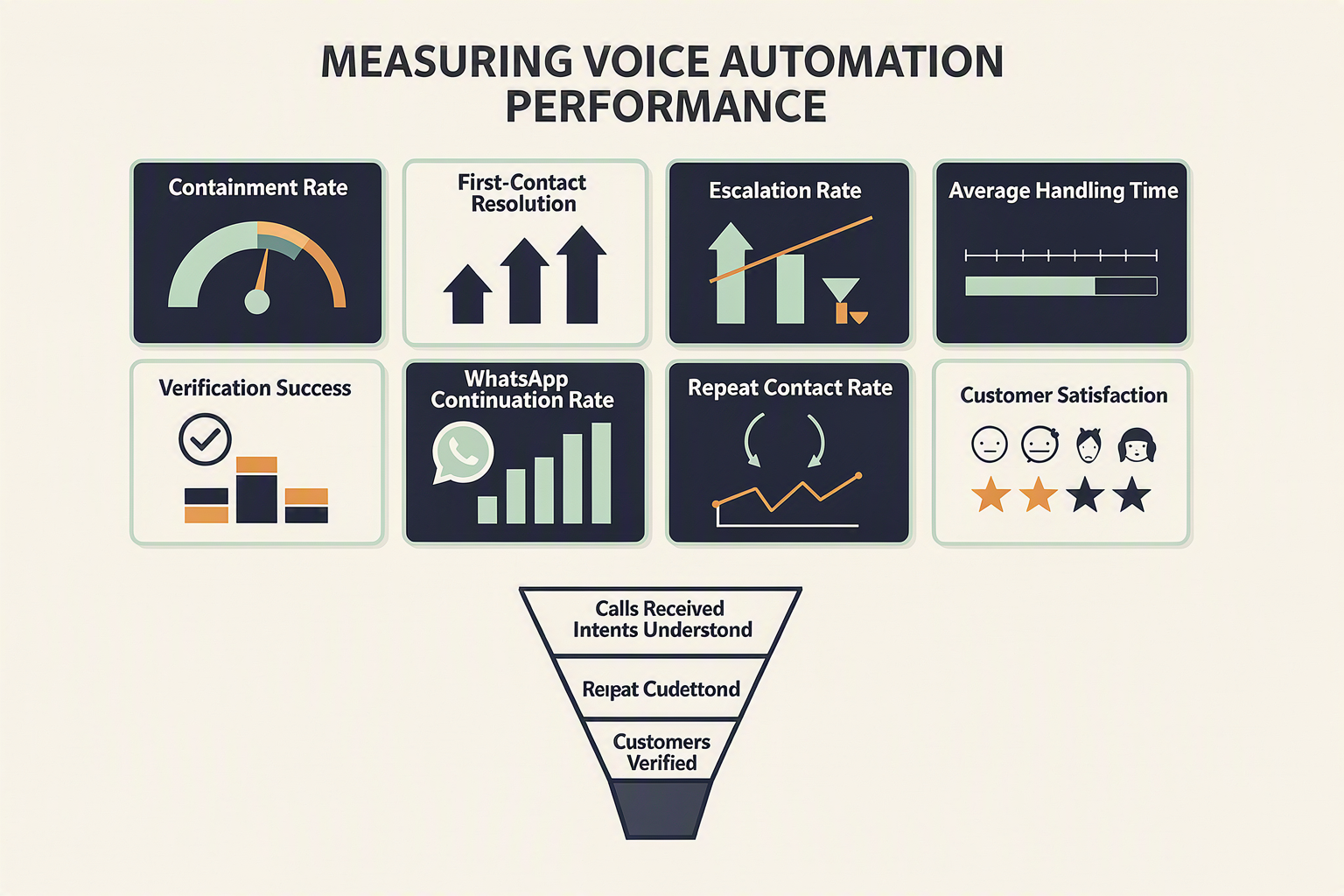
The clearest evidence that CallMissed for ecommerce is improving service is a combined reduction in customer effort, resolution time and repeat contacts—without declines in accuracy, customer satisfaction or safe escalation. Measure outcomes by support journey and channel rather than relying on one headline automation rate.
Track resolution, not just activity
A high call or message count shows usage, not service quality. The primary scorecard should include:
- First-contact resolution (FCR): Percentage of enquiries resolved without another customer contact within a defined window, such as 72 hours. Calculate it separately for order status, delivery exceptions, returns and product questions.
- Median time to resolution: Time from the first customer message or call to a confirmed answer or completed action. Report the median and 90th percentile because averages can conceal a small group of severely delayed cases.
- Repeat-contact rate: Percentage of customers who contact support again about the same order and issue. Rising repeat contacts may indicate unclear answers, stale order data or failed follow-ups.
- Customer satisfaction (CSAT): A post-interaction rating segmented by automated resolution, human-assisted resolution, language and channel.
- Customer effort score: Ask whether completing the task was easy, particularly after identity verification, returns intake or a voice-to-WhatsApp transition.
These operational measures matter because ecommerce already has little tolerance for friction. Baymard Institute reported an average documented online-shopping-cart abandonment rate of 70.19% in 2025. Although abandonment is not a support KPI, it illustrates why merchants should minimise effort across the wider customer journey.
Measure automation with quality guardrails
For an ecommerce AI voice agent, containment should never be interpreted as “avoiding human support at any cost.” Track:
- Qualified containment rate: Eligible conversations resolved by automation without transfer or repeat contact.
- Human-transfer rate: The percentage escalated to an agent, classified as policy-required, customer-requested or automation-failed.
- Escalation completeness: Whether the human received the transcript, verified identity state, order reference, issue category and actions already attempted.
- Grounded-answer rate: The share of factual answers supported by approved catalogue, policy or fulfilment knowledge.
- Action success rate: The percentage of attempted order lookups, return submissions or CRM updates confirmed by the underlying system.
A low transfer rate paired with poor CSAT is a warning, not a success. Conversely, prompt escalation of damaged-item disputes or failed identity checks can indicate that safety rules are working correctly.
Evaluate cross-channel continuity
Because CallMissed can connect voice, WhatsApp Business calling, WhatsApp chat and an omnichannel inbox, ecommerce customer support automation should also be assessed across channel boundaries:
- Voice-to-WhatsApp continuation rate: Customers who successfully open or respond to the promised WhatsApp follow-up.
- Context-retention rate: Transferred conversations that preserve the correct customer, order, intent and prior steps.
- Duplicate-explanation rate: Customers required to restate information after changing channels.
- Verification completion and failure rates: Segmented by channel, language and verification method.
- Notification response rate: Delivery or returns updates that lead to a useful customer action rather than an opt-out or complaint.
Establish a defensible measurement process
Use a four-step comparison:
- Record a two-to-four-week baseline before deployment.
- Compare equivalent order volumes, issue types, languages and operating hours.
- Review weekly trends, but use monthly cohorts for decisions.
- Audit a sample of resolved conversations for accuracy, privacy and policy compliance.
Returns deserve their own cohort: The National Retail Federation estimated that US retailers would receive $890 billion in merchandise returns in 2024, equivalent to 16.9% of annual sales. Merchants should therefore report return-intake completion, image-collection success, pickup scheduling and refund-related repeat contacts separately.
Available dashboards, event exports and system confirmations may depend on the merchant’s CallMissed account configuration and connected order or CRM environment. Validate telemetry before setting targets; otherwise, an apparent improvement may simply reflect missing events rather than better service.
What should ecommerce, security and support experts validate before approving the workflow?

Approval should depend on documented test evidence, not a convincing demo. Ecommerce, security and support owners should jointly verify data access, identity controls, answer grounding, action permissions, channel continuity and failure handling before CallMissed for ecommerce reaches customers.
1. Prove the workflow against real operating conditions
The ecommerce owner should create a test matrix covering ordinary requests and high-risk exceptions. This matters particularly for returns: the National Retail Federation estimated that US retailers would receive $890 billion in merchandise returns in 2024, representing 16.9% of annual sales.
Validate representative scenarios such as:
- A valid order, an invalid order number and multiple orders under one phone number.
- An order that is confirmed, packed, shipped, delayed, partially delivered or cancelled.
- A return inside the policy window, outside it and involving a non-returnable product.
- Product questions where attributes conflict across the catalog, website and knowledge base.
- A caller switching from voice to WhatsApp, then returning through a human agent.
- Requests in the relevant regional languages; CallMissed supports voice and chat across 22 Indian languages, but each merchant should test its own products, accents and terminology.
Each test should define the expected answer, permitted action, escalation path and system-of-record update.
2. Validate identity and authorisation boundaries
Security teams should confirm that the ecommerce AI voice agent reveals only the minimum information necessary. Possession of a phone number should not automatically authorise access to addresses, order history, refund status or payment-related details.
The approval checklist should establish:
- Which requests require an order number, one-time password or another verification factor.
- Whether verification expires when the channel, session or customer identity changes.
- Which fields are masked in transcripts, logs, notifications and the omnichannel inbox.
- Whether agents can create returns, change delivery instructions or merely collect requests.
- How consent, retention, deletion and human access are recorded.
- What happens after repeated verification failures or suspected account takeover.
Teams should also test prompt injection through spoken requests, WhatsApp messages, uploaded return images and untrusted product content.
3. Inspect grounding, integrations and account dependencies
For dependable ecommerce customer support automation, every operational claim should come from an approved source. Product specifications and return rules can be grounded in the knowledge base, while live order status must come from the merchant’s authorised order, fulfilment or CRM system—not from model inference.
Before approval, document:
- The source of truth for orders, inventory, delivery events, policies and customer identity.
- API authentication, field mappings, rate limits, timeout behaviour and retry rules.
- Duplicate-event controls for messages, return requests and CRM updates.
- Data freshness thresholds and customer-facing wording when information is unavailable.
- Whether WhatsApp Business calling, business-initiated communication, external actions or integrations are enabled for the specific account and plan.
Named integrations should not be assumed unless they have been verified in the merchant’s environment.
4. Require safe failure and measurable ownership
Support leaders should reject any workflow that fails silently or traps customers in automation. A safe design must transfer refund disputes, damaged-item exceptions, failed deliveries, emotional callers and low-confidence answers to a human with the transcript, verification state and relevant order context attached.
Set launch thresholds for containment rate, first-contact resolution, transfer rate, repeat-contact rate, incorrect-action rate and customer satisfaction. Review these by language, channel and request type; an acceptable overall average can conceal poor outcomes for returns or regional-language calls. Final approval should name an owner for every integration, policy source, escalation queue and incident response path.
What does a verification-first CallMissed rollout mean for your ecommerce team?
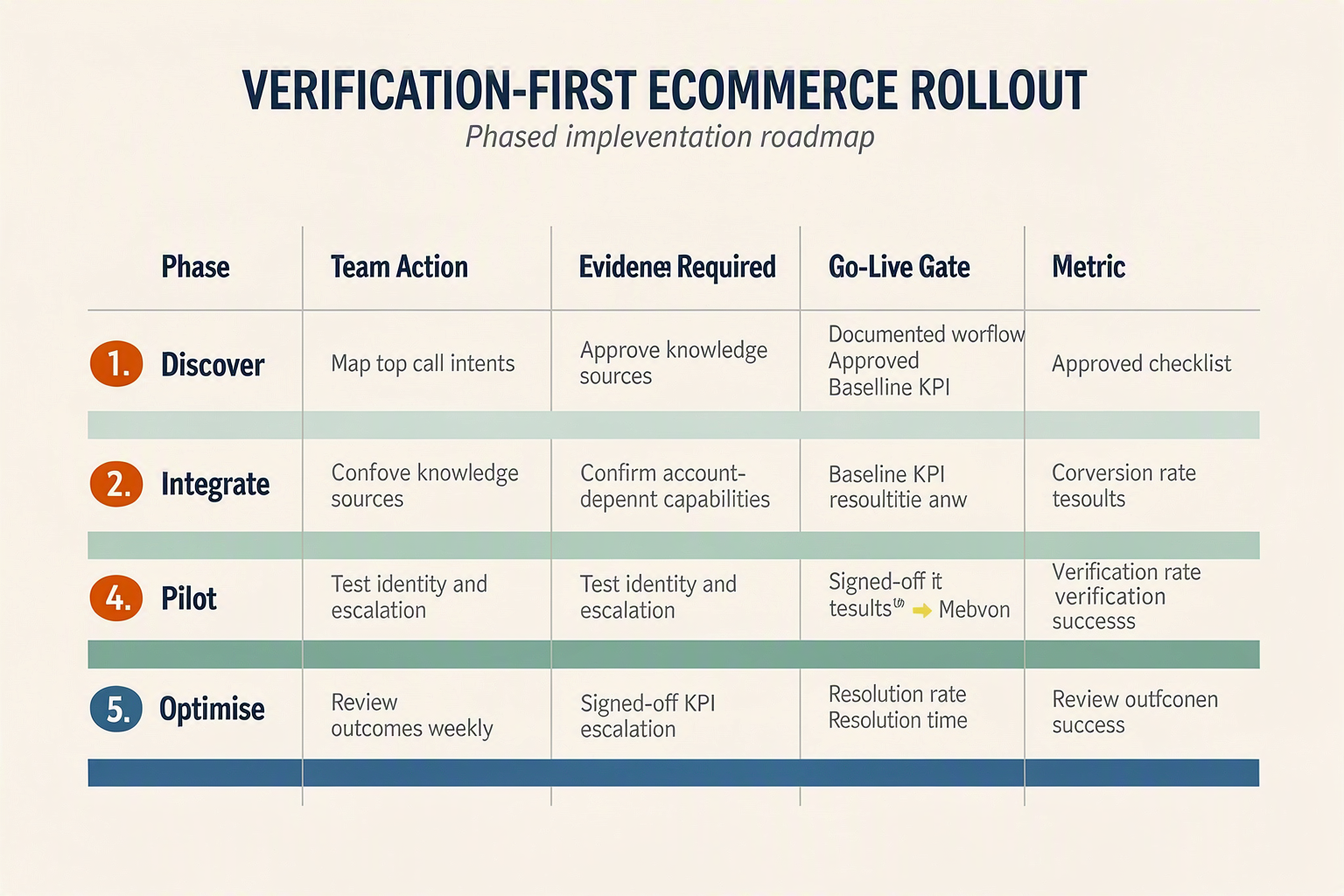
A verification-first CallMissed rollout means proving every data source, permission, channel handoff and automated action before allowing an ecommerce AI voice agent to serve customers at scale. The ecommerce team should treat each capability as either platform-confirmed, merchant-dependent or account-dependent—and keep unverified workflows behind human approval.
Production-readiness matrix
| Workflow | What must be verified | Key launch test | Deployment decision | Primary owner |
|---|---|---|---|---|
| Order enquiries | Order-system API access, customer-to-order matching and fields permitted for disclosure | Test valid, invalid, duplicate and guest-order identifiers | Automate status answers only after identity checks pass | Ecommerce operations |
| Delivery updates | Carrier or fulfilment data freshness, event definitions and notification permissions | Compare dispatched, delayed, delivered and failed-delivery events with source records | Label stale or unavailable data; escalate exceptions | Logistics team |
| Returns intake | Return window, eligibility rules, reason codes, image handling and pickup options | Test damaged, incorrect, non-returnable and out-of-window items | Collect requests automatically; approve only policy-safe cases | Returns team |
| Product questions | Approved catalogue, inventory and policy knowledge available to retrieval | Ask ambiguous, outdated and unsupported product questions | Answer from grounded sources; avoid unsupported recommendations | Merchandising |
| Voice-to-WhatsApp continuity | WhatsApp Business configuration, consent, number matching and template availability | Confirm that summaries reach the correct verified customer | Enable only for eligible accounts and consented conversations | CX and compliance |
| Escalation and write-back | Inbox routing, agent permissions, CRM or order-system interfaces and audit logs | Transfer a full transcript, verification state and next action | Keep writes human-approved until reliability is demonstrated | Support operations |
CallMissed supports voice and chat across 22 Indian languages, but that specification should not be interpreted as guaranteed accuracy for every accent, product name or noisy call environment. Teams should test their own vocabulary—including local place names, SKUs and mixed-language speech—before expanding CallMissed for ecommerce beyond a controlled cohort.
Evidence required before launch
Use three evidence labels in the implementation register:
- Platform-confirmed: The capability is documented and enabled in the relevant CallMissed environment.
- Account-dependent: Availability depends on the merchant’s plan, WhatsApp Business setup, phone configuration or approved permissions.
- Integration-dependent: The outcome relies on the merchant’s CRM, order-management, fulfilment or returns APIs; no named integration should be assumed without validation.
For sensitive requests, verification strength should rise with risk. A general product question may require no identity check, while an address change, refund query or order-history disclosure may require a one-time password or another merchant-approved factor. The agent should never use order number alone as proof of identity if that identifier may appear in emails, labels or shared devices.
A controlled rollout sequence
- Observe: Run workflows in shadow mode and compare proposed answers with source systems.
- Assist: Let agents approve responses and transactional actions.
- Automate low-risk intents: Release grounded product answers and verified order-status responses.
- Expand by evidence: Add returns, delivery exceptions and multilingual traffic only after reviewing failures.
- Audit continuously: Monitor containment, transfer rate, repeat contacts, resolution time and customer satisfaction by intent and language.
Recommended launch gates include zero unauthorised sensitive-data disclosures during security testing, complete audit records for every system action and a tested human fallback when verification or retrieval fails. These are governance targets—not claimed CallMissed performance metrics. This staged approach makes ecommerce customer support automation measurable, reversible and safer than switching on every workflow simultaneously.
Frequently asked questions about CallMissed for ecommerce
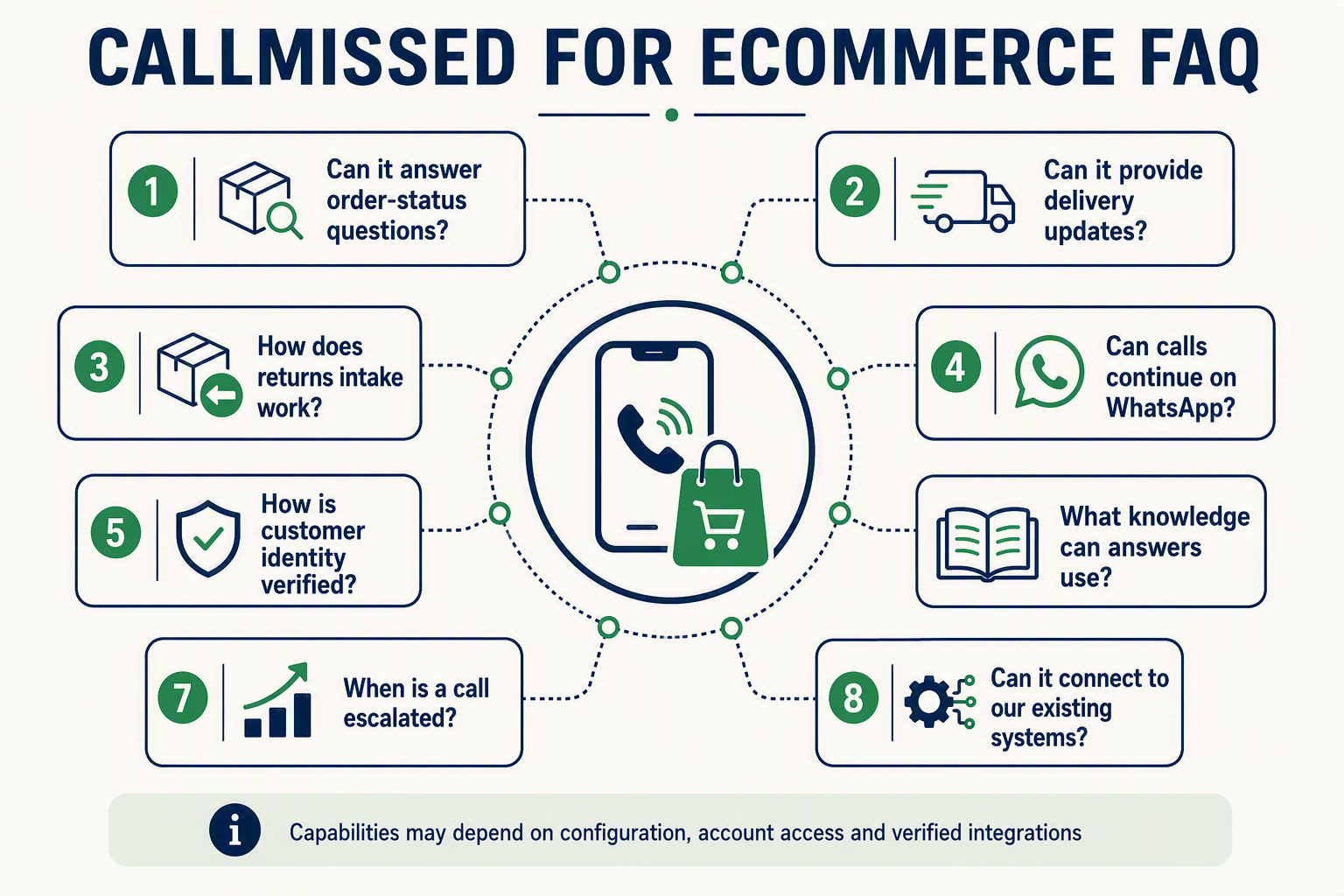
What can CallMissed for ecommerce automate across voice and WhatsApp?
Can ecommerce customer support automation answer customers in Indian languages?
How does an ecommerce AI voice agent continue a conversation on WhatsApp?
Does CallMissed integrate with ecommerce CRM, order-management and delivery systems?
How should CallMissed verify identity before sharing order information?
How can ecommerce teams prevent incorrect answers and measure automation performance?
Conclusion
CallMissed for ecommerce can turn fragmented post-purchase support into a continuous customer journey across voice and WhatsApp. The strongest implementation combines verified order data, multilingual automation, secure identity checks, grounded answers and timely human escalation—rather than treating an AI agent as a standalone chatbot.
Key takeaways
- Automate the predictable, but verify the data. An ecommerce AI voice agent can answer order-status, delivery and product questions only when connected to current, authorised information. Merchants should validate order-system APIs, CRM permissions and account-dependent capabilities before allowing automated lookups or actions.
- Preserve context across channels. Customers should be able to start with a phone or WhatsApp Business call, receive a WhatsApp summary, submit return images or pickup preferences, and continue without repeating the issue. CallMissed supports this voice-to-WhatsApp continuity through AI voice agents, WhatsApp chatbots, WhatsApp Business calling and an omnichannel inbox.
- Ground responses and escalate exceptions. Approved catalog, fulfilment and returns knowledge should govern routine answers. Failed deliveries, damaged goods, refund disputes and low-confidence responses should move to a human agent with identity-verification status and conversation history attached.
- Measure outcomes, not automation volume. Teams should monitor containment, resolution time, transfer rate, repeat-contact rate and customer satisfaction. This discipline matters because the National Retail Federation estimated that returns represented 16.9% of annual US retail sales in 2024, while India Brand Equity Foundation projected India’s ecommerce market to reach $325 billion by 2030.
What to watch next
The next phase of ecommerce customer support automation will be defined by more natural multilingual conversations, tighter voice-to-messaging continuity and safer execution of order-related actions. For Indian merchants, support across 22 Indian languages can make automation more accessible beyond English-first audiences—but language quality, verification flows and escalation rules still require testing before deployment.
To explore how this model is evolving, visit CallMissed, an AI communication infrastructure platform for voice agents, multilingual chatbots and WhatsApp-native engagement. As ecommerce scales, will your support journey preserve customer trust after checkout—or make every channel feel like a new conversation?
Related Reading
Discussion
Related Posts

Ready to automate customer conversations?
Launch AI voice agents and WhatsApp bots with CallMissed — one API, 22+ Indian languages.