
AI Answering Service for Home Services: 2026 Calls, Booking and Safe Escalation Guide


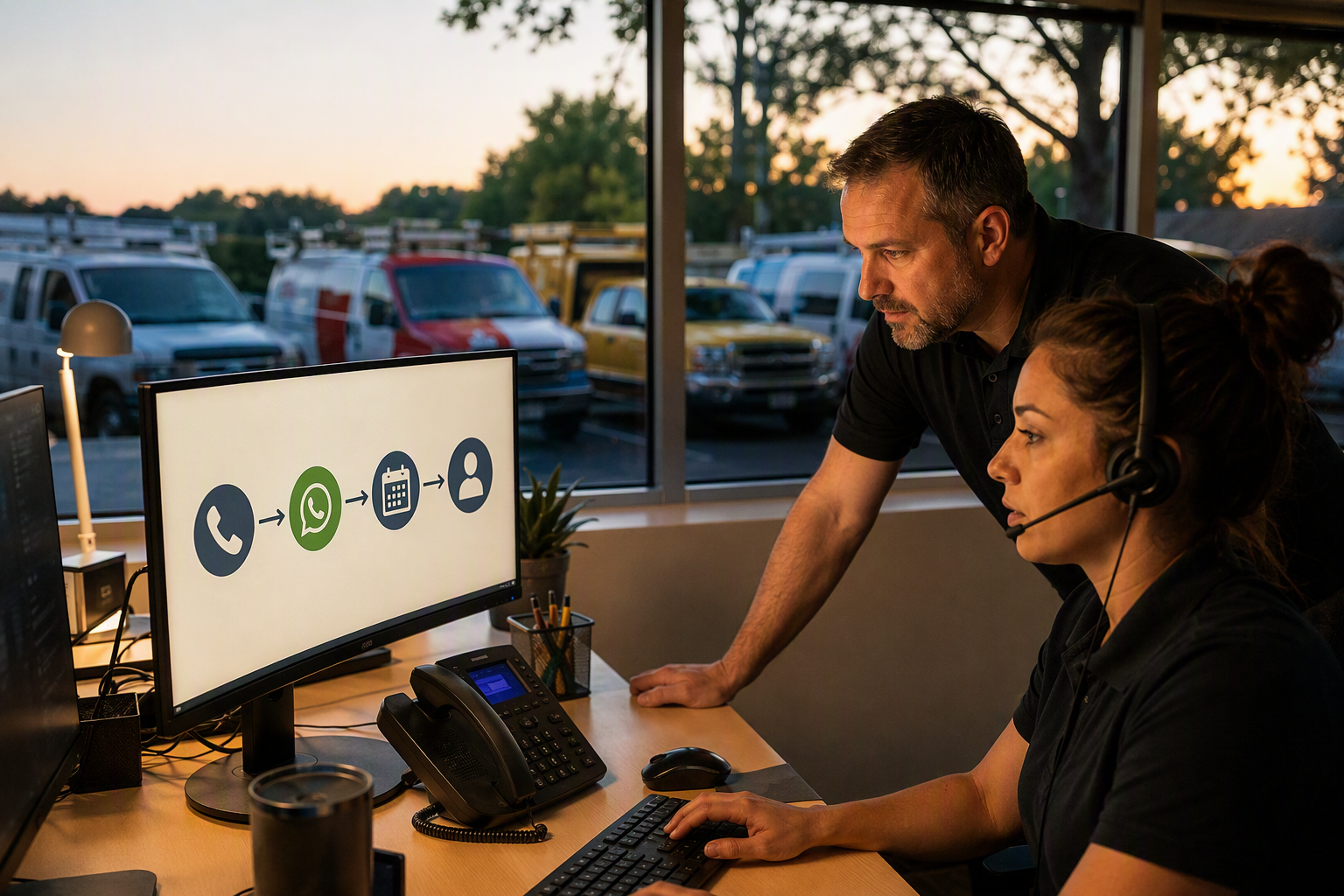
Learn how an AI answering service for home services can capture calls, book jobs, follow up safely, and track response KPIs in 2026.
AI Answering Service for Home Services: 2026 Calls, Booking and Safe Escalation Guide
What happens when a homeowner calls about a burst pipe at 2:00 a.m.—and nobody answers? An AI answering service for home services can capture the request, verify the service area, collect essential job details and trigger a business-defined escalation within seconds, but it must never diagnose danger or replace emergency services.
The timing matters. Meta reported in April 2025 that WhatsApp had surpassed 3 billion monthly active users, making messaging follow-up increasingly relevant after a customer calls a plumber, HVAC contractor, electrician, cleaner, pest-control company or repair provider. In India, the Constitution’s Eighth Schedule recognizes 22 languages, highlighting why multilingual voice automation is operationally important rather than merely a convenience. Customers may describe the same urgent problem in English, Hindi, Tamil, Bengali or another regional language—and the intake workflow must preserve meaning without making unsupported safety judgments.
For a home-service operator, the goal is not simply to “answer every call.” It is to move each enquiry into a controlled workflow:
- Routine: quotation requests, preventive maintenance, cleaning appointments or rescheduling.
- Priority: loss of heating or cooling, an unusable appliance, recurring leaks or a pest problem requiring prompt attention.
- Potential emergency: reports involving fire, gas smells, electrical arcing, flooding, injury or immediate danger—handled through an approved human or emergency-services handoff, not an AI-generated diagnosis.
That distinction applies whether the system is marketed as a plumber AI receptionist, HVAC call answering AI or broader home service missed call automation. The AI should ask only approved intake questions, explain when a callback is required and avoid promising arrival times, prices or technical outcomes that the business has not authorized.
This 2026 playbook explains how to design the complete journey: live AI phone answering, missed-call recovery, WhatsApp consent and follow-up, postcode or PIN-code service-area checks, job intake, appointment booking, after-hours routing and multilingual conversations. It also covers the capabilities buyers should verify—including CRM or job-management writeback, call recordings, audit trails, calendar availability and fallback behavior—rather than assuming every integration works automatically.
Platforms such as CallMissed reflect this omnichannel direction by combining AI voice agents, WhatsApp chat and Business calling, an inbox, knowledge-base retrieval and support for 22 Indian languages. For a deeper look at scheduling design, see the AI Appointment Booking Agent Guide; for overnight routing, use the After-Hours Answering Service AI Guide.
By the end, you will have practical workflow tables, scripts, launch checklists, cost considerations and KPIs for building an answering system that is responsive, measurable and safely bounded.
How do you implement an AI answering service for home services in 2026? A seven-step plan for answering, intake, booking, follow-up, writeback, and human handoff
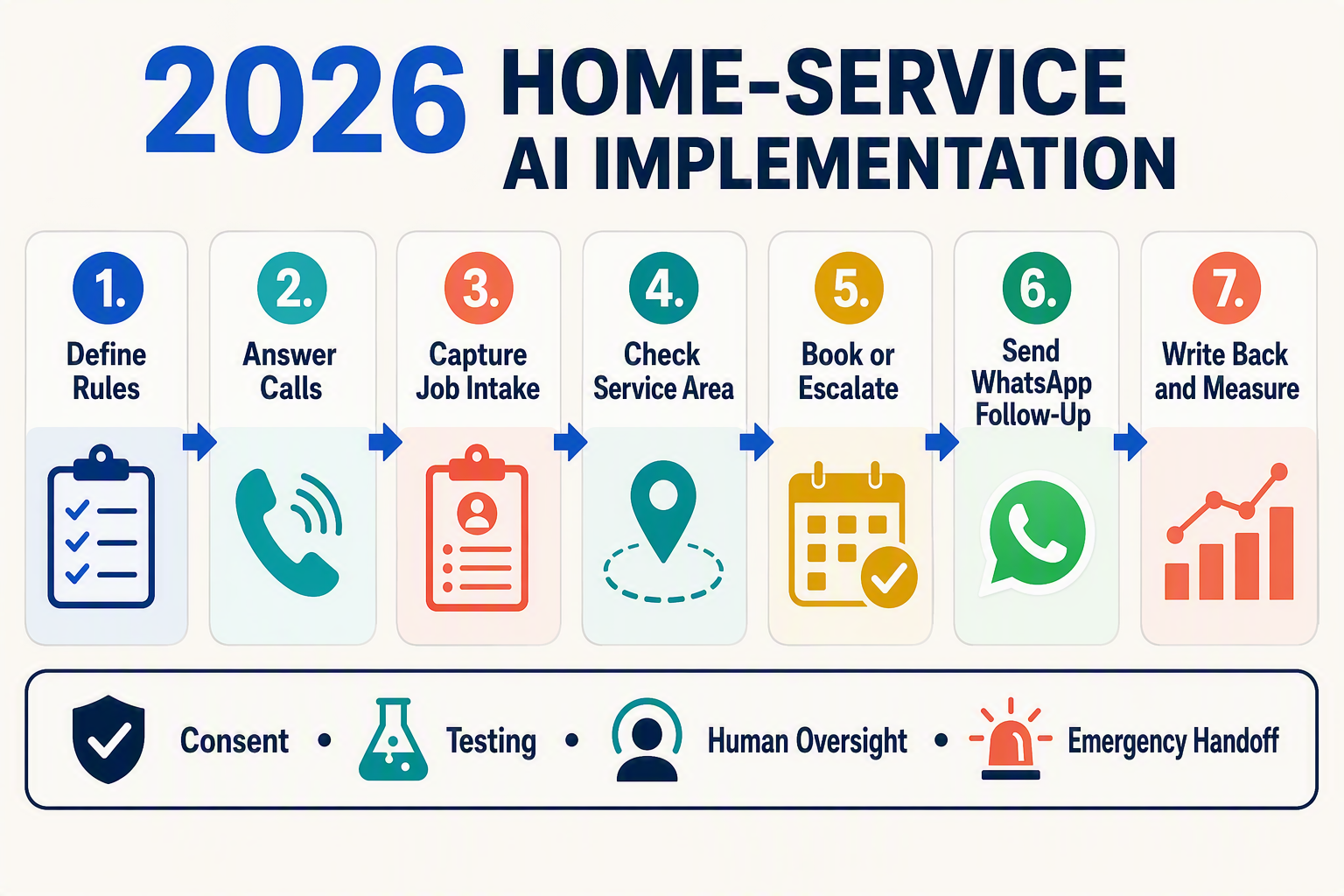
Implement an AI answering service for home services as a controlled seven-step workflow: define routing rules, configure intake, check coverage, offer valid appointments, confirm through consented channels, write structured records and escalate exceptions. Launch in stages, with every automated action constrained by business-approved policies and tested human fallbacks.
The seven-step implementation plan
- Define call classes and escalation rules
Create written criteria for routine, priority and potential-emergency requests before configuring the AI. Do not ask the model to infer technical risk or provide safety advice.
- Route routine requests into intake and booking.
- Flag priority requests for accelerated human review.
- For reported fire, gas, electrical arcing, flooding, injury or immediate danger, play business-approved instructions and transfer to a designated person or emergency-services path.
- Specify what happens when the transfer fails: voicemail, backup number, on-call queue or approved emergency message.
- Build trade-specific intake flows
A plumber AI receptionist might capture the affected fixture, visible water, property type and access constraints. HVAC call answering AI might record whether the request concerns heating, cooling, maintenance or installation—without diagnosing the equipment.
Collect only operationally necessary fields:
- Caller name and callback number
- Service address and postcode or PIN code
- Plain-language problem description
- Property type, preferred time and access notes
- Existing-customer, warranty or membership status where relevant
- Validate the service area before promising service
Match the postcode, PIN code, suburb or city against an approved coverage list. If the address is outside the service area or ambiguous, create a review task rather than rejecting the caller incorrectly or guaranteeing attendance.
- Connect booking to real availability
Expose only authorized calendars, job types, durations, working hours and technician constraints. The agent should offer available windows—not invent arrival times—and clearly state whether an appointment is confirmed or merely requested. The AI Appointment Booking Agent Guide explains calendar and confirmation logic in greater depth.
- Configure missed-call and WhatsApp follow-up
Home service missed call automation should trigger a prompt callback or message while preventing duplicate outreach. Ask for WhatsApp consent where required, identify the business and provide an opt-out route.
Meta reported in April 2025 that WhatsApp exceeded 3 billion monthly active users, supporting its role as a practical follow-up channel. Use it for appointment options, photos and confirmations—not unsolicited promotional messaging.
- Verify writeback and multilingual fidelity
Confirm through testing—not vendor assumptions—that the platform can create or update the correct customer, job, transcript, recording link, disposition and follow-up task in the CRM or job-management system. India’s Constitution recognizes 22 languages in the Eighth Schedule; multilingual deployments should test addresses, code-switching, trade terminology and transcript accuracy for every supported language actually offered.
- Test, pilot and monitor human handoff
Run scripted calls covering normal bookings, repeat callers, noisy audio, unsupported locations, unavailable calendars and failed transfers. Pilot one location or call type before expanding.
Track:
- Answer rate and missed-call recovery rate
- Intake completion and booking conversion
- Transfer success and human takeover rate
- Writeback accuracy and duplicate-record rate
- Opt-outs, abandoned calls and cost per completed booking
Treat incorrect emergency routing, unauthorized promises, lost records and failed opt-outs as launch-blocking defects—not acceptable optimization issues.
Why are phone answering, missed-call recovery, and after-hours workflows especially important for home-service businesses in 2026?
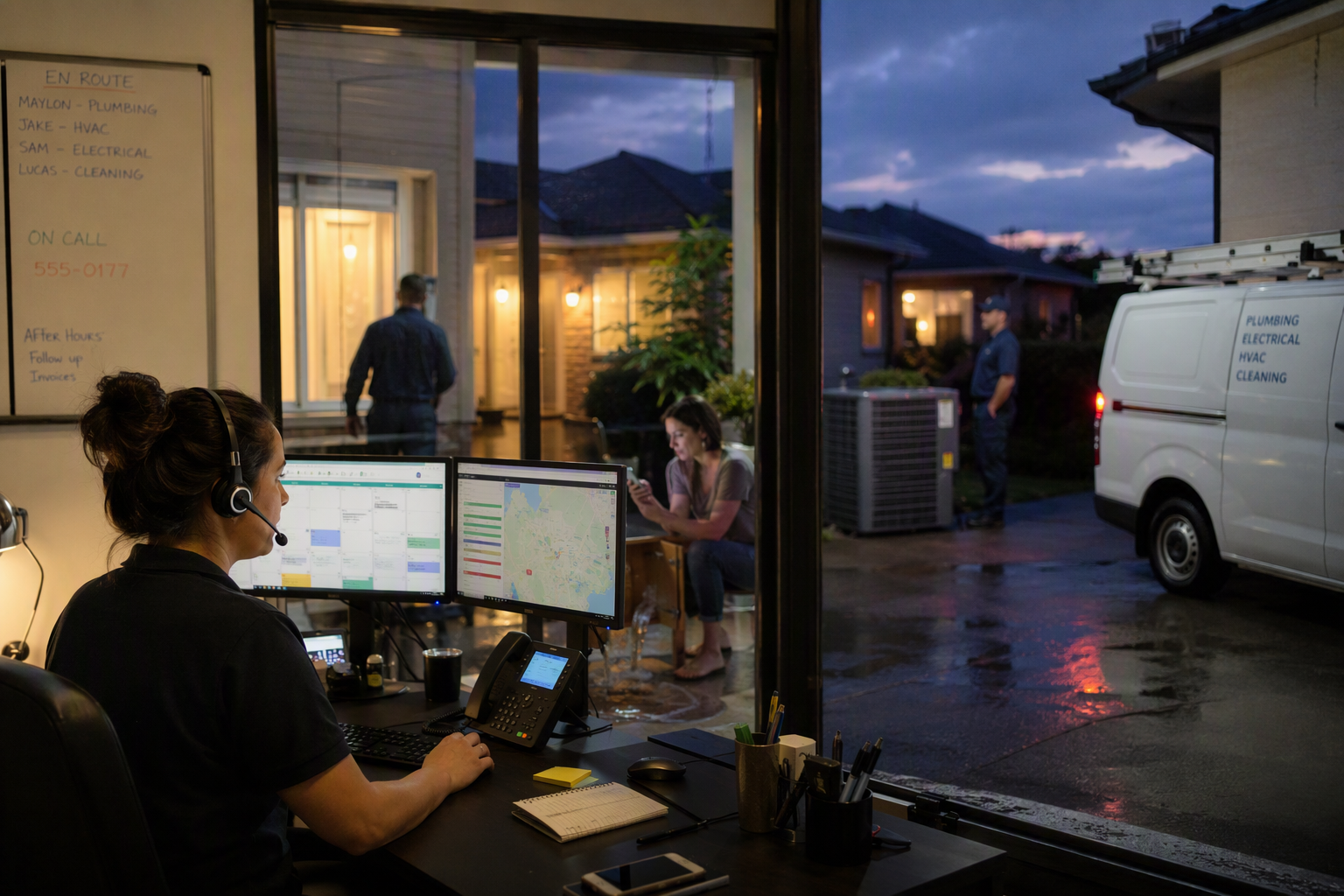
Home-service calls are unusually time-sensitive because the caller often needs immediate reassurance, while the technician is driving, working on-site or unavailable after hours. In 2026, effective phone answering must therefore connect live intake, missed-call recovery and messaging follow-up into one controlled workflow rather than treating each channel separately.
Every unanswered call can interrupt the booking journey
A homeowner contacting a plumber, electrician or HVAC company usually has a specific property problem—not a general research question. If the office cannot answer, home service missed call automation should promptly acknowledge the enquiry, record its source and begin an approved callback or WhatsApp workflow.
This matters operationally because field-service teams face predictable constraints:
- Technicians cannot safely answer while driving or using tools.
- Small businesses may lack dedicated evening and weekend reception staff.
- Weather events can create sudden spikes in heating, cooling, drainage or electrical enquiries.
- Callers may provide incomplete information unless guided through structured questions.
- Multiple staff members can otherwise return the same call or assume someone else handled it.
A plumber AI receptionist or HVAC call answering AI should create a traceable job-intake record—not merely generate a transcript. The record can include the caller’s name, contact number, property location, service requested, preferred appointment window and exact description of the issue.
After-hours demand requires controlled escalation
Overnight automation is valuable because it can separate requests that may wait until opening time from reports requiring an approved escalation path. It must not independently determine whether a situation is safe.
A business-defined after-hours sequence should:
- State that the caller has reached an automated service.
- Collect the address and callback number.
- Ask the caller to describe what they observe without diagnosing it.
- Match approved keywords or answers to a predefined routing rule.
- Transfer or alert the designated on-call person when required.
- Direct callers who report immediate danger to local emergency services using approved wording.
The business—not the model—must define which branches trigger a human handoff, what happens if the on-call technician does not respond and which arrival-time statements are permitted.
WhatsApp keeps the conversation actionable
Phone calls are effective for explaining urgent or complicated problems, while WhatsApp can collect information that is awkward to communicate verbally. Meta reported in April 2025 that WhatsApp had surpassed 3 billion monthly active users, demonstrating the platform’s global relevance as a follow-up channel.
With appropriate consent, an AI answering service for home services can send a WhatsApp message requesting:
- A location pin, postcode or Indian PIN code for service-area validation.
- Photographs or video of visible damage, without asking the AI to assess safety.
- Appliance model numbers or previous job references.
- Appointment options and access instructions.
- Confirmation that the request has been received.
The handoff should preserve context so customers do not have to repeat the entire problem.
Multilingual intake reduces information loss
Language coverage is particularly important when property owners, tenants, technicians and dispatchers prefer different languages. India’s Constitution recognizes 22 languages in the Eighth Schedule, providing a practical benchmark for the linguistic diversity Indian service businesses may encounter.
The workflow should retain the original transcript, any translation and the caller’s preferred language. Teams should test names, addresses, PIN codes, numbers and trade-specific vocabulary in every supported language before launch; nominal language availability does not guarantee accurate job intake under background noise or regional accents.
Which calls should AI answer, recover, book, or escalate? Key Developments and Workflow Rules, including home service missed call automation
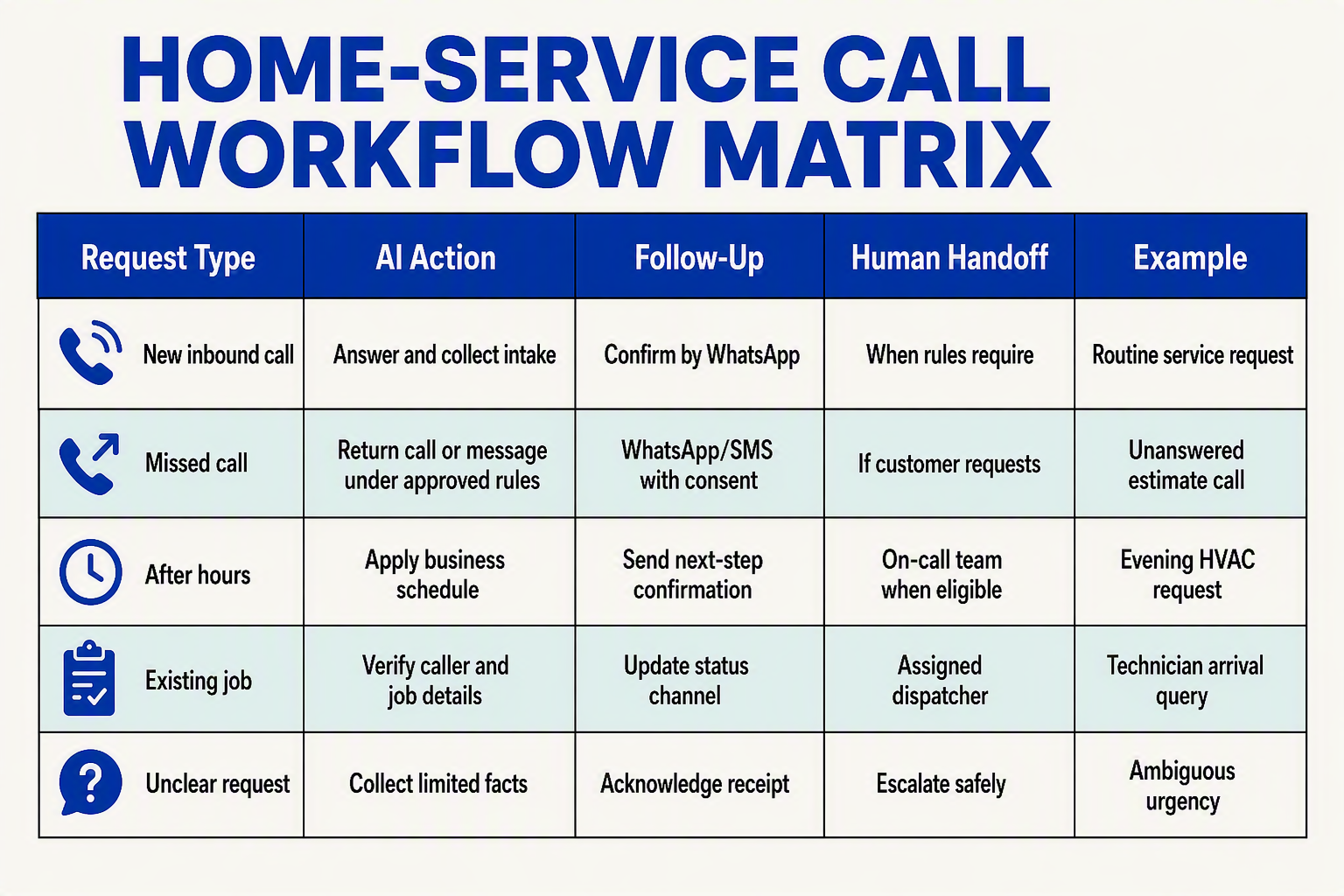
AI should answer and capture every eligible call, recover missed calls quickly, book only rule-qualified routine jobs, and escalate any potential danger or exception. The controlling logic must come from the home-service business—not from the model’s interpretation of urgency.
Decision matrix for calls and missed-call recovery
| Call type or signal | AI action | Information to capture | Booking rule | Escalation rule |
|---|---|---|---|---|
| Routine quote or maintenance request | Answer, identify the service and check coverage | Name, phone, address or PIN code, service type and preferred time | Book only against approved services, duration and live availability | Send to staff if pricing, scope or access requirements are unclear |
| Reschedule, cancel or job-status call | Verify the customer and locate the existing job | Booking reference, address and requested change | Modify only when the connected calendar or job system permits it | Escalate failed verification, disputes or unavailable records |
| Priority service request | Capture facts without diagnosing the fault | Symptoms in the customer’s own words, affected equipment, property access and availability | Offer a priority slot only if predefined capacity rules allow | Notify the on-call dispatcher when thresholds such as no heating or an active leak are met |
| Potential danger: fire, gas smell, arcing, flooding or injury | Stop normal troubleshooting and use the approved safety script | Location, callback number and concise customer-reported facts | Do not auto-book as an ordinary appointment | Route to a human or business-defined emergency process; never claim the situation is safe |
| Missed or abandoned call | Trigger SMS, WhatsApp or callback recovery according to consent rules | Caller number, original call time, service needed and preferred channel | Provide booking options after service-area and job-type checks | Escalate repeated calls, negative replies or urgent language |
| Outside service area or unsupported job | Explain the limitation accurately | Location and requested service | Do not create a confirmed appointment | Offer a staff callback or approved referral path; never promise coverage |
Workflow rules by channel
An AI answering service for home services should apply the same classification policy whether it is configured as a plumber AI receptionist, HVAC call answering AI, or a shared receptionist for electrical, cleaning, pest-control and repair teams.
- Check location before availability. Validate the postcode, PIN code, suburb or travel zone before exposing appointment slots.
- Preserve the customer’s wording. Write “customer reports sparks near socket,” not “electrical short confirmed.” This separates intake from technical diagnosis.
- Require explicit booking authority. The agent may confirm only services, prices, time windows and technician capacity approved by the operator.
- Write back or create a task. Verify that the chosen CRM or job-management integration can save transcripts, contact details, classification, consent status and booking outcomes; do not assume writeback is automatic.
- Fail safely. Low confidence, integration errors, abusive calls, payment disputes and repeated misunderstandings should move to a human queue.
Why recovery and language rules matter in 2026
Meta reported in April 2025 that WhatsApp had surpassed 3 billion monthly active users, supporting WhatsApp as a practical recovery channel after an unanswered phone call. However, home service missed call automation should first identify the business, explain why it is messaging and record the customer’s channel preference or required consent rather than launching an unsolicited promotional sequence.
The Constitution of India’s Eighth Schedule recognizes 22 languages, so multilingual intake must preserve names, addresses, numbers and problem descriptions across language changes. If transcription confidence falls below the business-defined threshold, the workflow should request repetition, confirm critical details and escalate—never guess.
A useful operating rule is: automate certainty, queue ambiguity and escalate possible danger. Review classification outcomes and false escalations weekly, then update scripts and thresholds using real calls rather than allowing the AI to invent new policies.
How should routine, priority, and emergency requests be separated without letting AI provide a safety diagnosis?
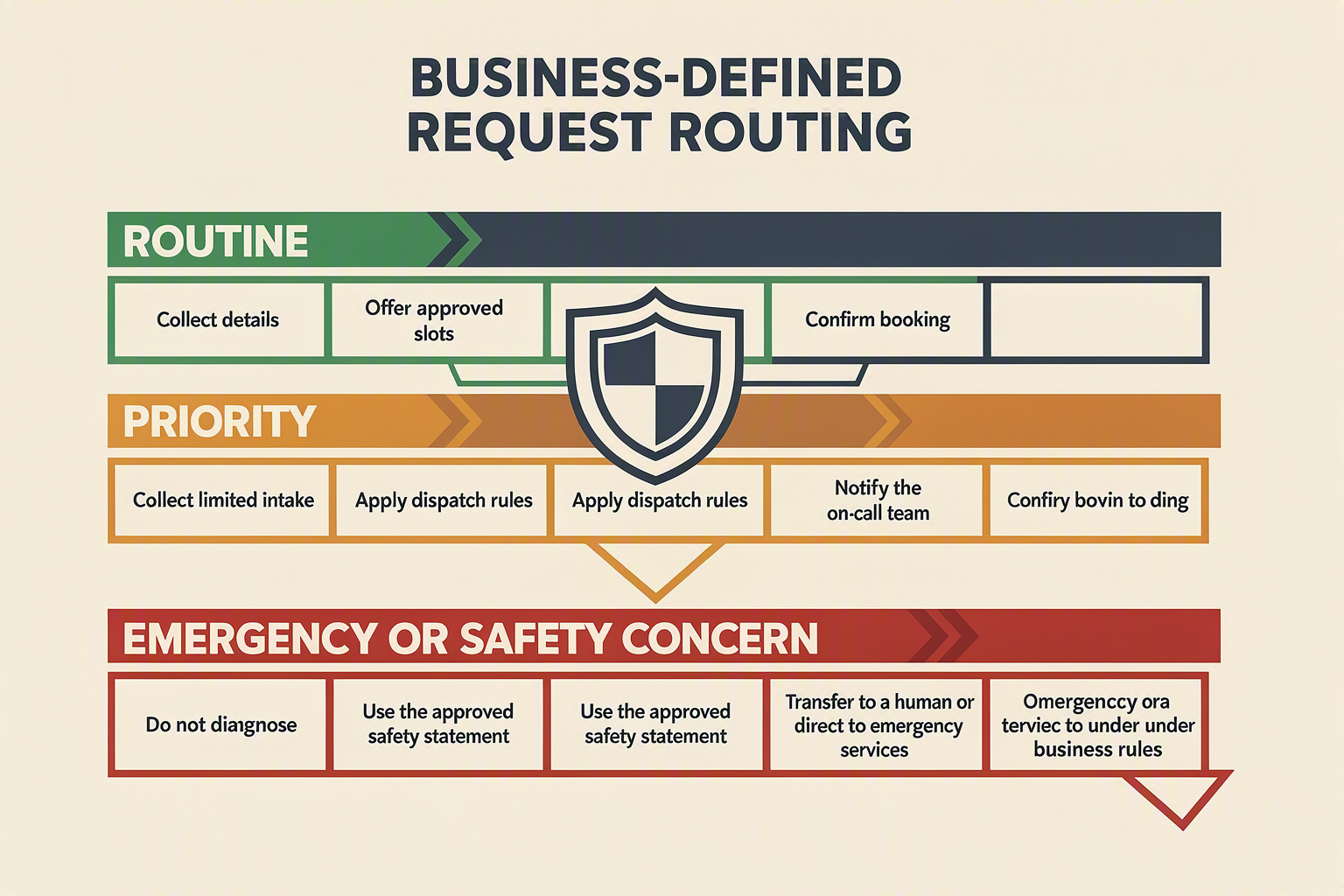
Separate requests through a business-approved routing matrix based on the customer’s exact words, location and operating hours—not an AI assessment of whether the situation is safe. The system may label a report as a “potential emergency” for escalation, but it must not diagnose the cause, estimate risk or tell the caller that remaining on-site is safe.
Use explicit triggers, not inferred danger
Configure the AI answering service for home services to match reported facts against approved trigger phrases and structured answers. Preserve the caller’s original wording in the job record so a dispatcher can distinguish “the socket is making a buzzing sound” from an AI-generated interpretation.
| Route | Customer-reported examples | AI action | Prohibited response |
|---|---|---|---|
| Routine | Quote request, annual servicing, cleaning or rescheduling | Check service area and offer approved booking slots | Inventing prices or completion times |
| Priority | No heating, recurring leak, appliance failure or active infestation | Create a priority job and notify the designated queue | Claiming the issue is harmless |
| Potential emergency | Gas smell, smoke, fire, sparking, flooding, injury or immediate danger | Stop normal booking and trigger the approved handoff | Diagnosing the fault or giving improvised safety instructions |
| Unclear | Ambiguous description, low-confidence transcription or caller uncertainty | Escalate to a person rather than downgrade | Guessing the appropriate category |
A plumber AI receptionist should therefore record “water is rapidly entering the room,” not conclude that a pipe has burst. Likewise, HVAC call answering AI may capture “the customer smells burning near the unit,” but it should not decide whether the motor, wiring or another component caused it.
Build a short, controlled intake sequence
For routine and priority requests, collect only information needed for routing:
- Service type: plumbing, HVAC, electrical, cleaning, pest control or repair.
- Exact description: “Please describe what you can see, hear or smell.”
- Location: address plus postcode or PIN code for service-area validation.
- Contact details: name and callback number.
- Access and timing: whether someone is present and the preferred appointment window.
When an emergency trigger appears, interrupt this sequence. Capture the location and callback number only if doing so will not delay the approved escalation.
A suitable script is: “I can’t assess whether this situation is safe. Based on what you reported, I’m escalating the call under our emergency procedure. If you believe anyone is in immediate danger, contact the emergency service for your location now.” Legal and operational teams should approve jurisdiction-specific wording and telephone numbers before launch.
Apply conservative multilingual and missed-call rules
The Constitution of India’s Eighth Schedule recognizes 22 languages, so urgency tests must cover regional expressions, code-switching and transcription uncertainty—not merely English trigger words. Any low-confidence phrase involving gas, fire, electricity, flooding or injury should enter human review rather than being silently categorized as routine.
For home service missed call automation, the callback or WhatsApp message should not ask customers to self-diagnose. Use a neutral prompt such as: “Tell us what happened in your own words. This channel does not provide safety assessments; contact local emergency services if there is immediate danger.”
Finally, write the selected route, trigger phrase, transcript, timestamp and escalation outcome to the CRM or job-management system—after verifying that the integration supports those fields. Supervisors should review false downgrades, failed transfers and ambiguous-language cases regularly, with human escalation as the default when confidence is insufficient.
What must you verify before deploying CallMissed for multilingual intake, service-area checks, booking, WhatsApp consent, and CRM or job-management writeback?
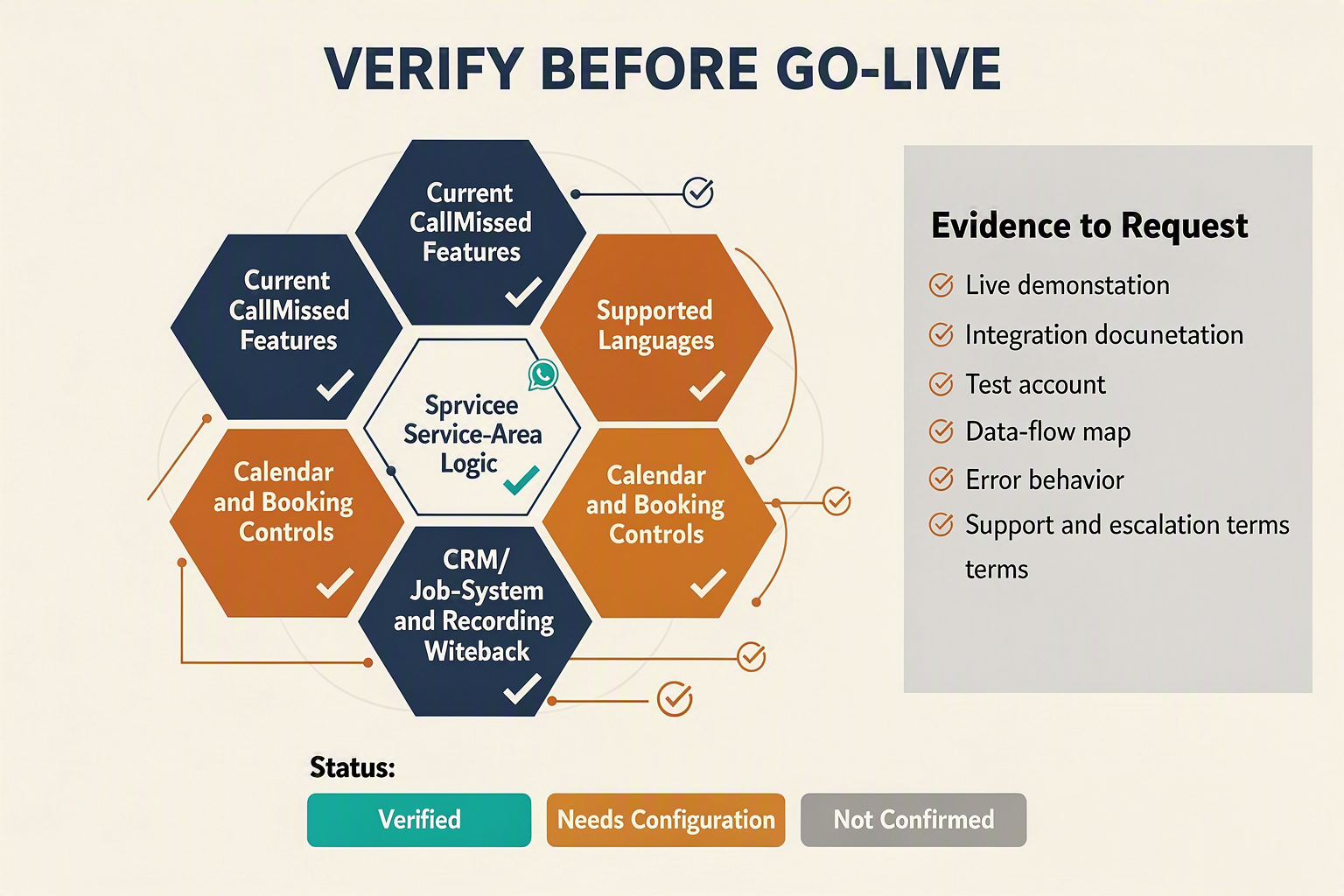
Verify the configured end-to-end workflow—not merely the feature list—before deployment. For CallMissed, confirm language behavior, postcode or PIN-code logic, calendar access, WhatsApp consent records, escalation routes and CRM or job-management writeback using test calls and sandbox records.
Validate multilingual intake and knowledge boundaries
CallMissed supports voice and chat across 22 Indian languages, but each deployed language still requires business-specific testing. The Eighth Schedule of the Constitution of India recognizes 22 languages, underscoring the operational need to handle regional-language enquiries accurately.
For English, Hindi and every enabled regional language, verify that the agent can:
- Recognize addresses, landmarks, PIN codes, names and alphanumeric appliance models.
- Preserve the caller’s original words in transcripts or notes where possible.
- Switch languages without losing previously collected fields.
- Ask for repetition instead of guessing low-confidence information.
- Restrict answers to approved services, policies and knowledge-base content.
Test realistic background noise, code-switching and trade terminology. A plumber AI receptionist should not confuse “geyser” with a water leak, while HVAC call answering AI must correctly capture equipment type without diagnosing the fault.
Make service-area and booking rules deterministic
Do not let the language model improvise coverage. Store approved postcodes, PIN codes, suburbs or geofenced zones in a controlled source, then define outcomes for covered, not covered and uncertain addresses.
Before enabling booking, confirm:
- Which calendar or scheduling system is authoritative.
- Whether availability is checked in real time or periodically synchronized.
- How travel buffers, technician skills, holidays and duplicate appointments are handled.
- What happens when an API times out or a slot disappears before confirmation.
- Whether the agent says “requested” or “confirmed” at each workflow stage.
An AI answering service for home services should never promise a technician, price or arrival window unless the connected system has returned an approved confirmation.
Verify WhatsApp consent and recovery logic
Meta reported in April 2025 that WhatsApp exceeded 3 billion monthly active users, but reach does not remove the need for lawful, documented messaging practices. For home service missed call automation, verify:
- The exact spoken or written opt-in language.
- The timestamp, source, phone number and wording stored as consent evidence.
- Approved WhatsApp Business templates for business-initiated messages.
- Opt-out handling and suppression across future campaigns.
- Separate rules for transactional updates and promotional content.
- Behavior when the number is not available on WhatsApp or message delivery fails.
A suitable prompt is: “May we send your service-request summary and booking updates to this number on WhatsApp?” Silence or an unrelated answer should not be treated as consent.
Prove writeback, escalation and auditability
CallMissed combines AI voice agents, WhatsApp workflows, an omnichannel inbox and knowledge-base retrieval, but teams must verify the specific connector or API required for their CRM or job-management platform. Test field mappings for customer identity, address, service category, urgency label, consent status, transcript link and booking reference.
Run acceptance tests covering:
- Duplicate contacts and repeat callers.
- Invalid addresses and unavailable appointments.
- CRM authentication failure, rate limits and webhook retries.
- Human transfer during and after business hours.
- Potential-danger phrases triggering the business-approved handoff.
- Recording notices, retention permissions and role-based access.
Deployment is ready only when failures enter a visible queue, staff receive alerts, and every booking, consent decision and writeback can be traced without relying solely on the AI-generated summary.
How much does implementation cost, how should it be tested, and which KPIs show operational impact?
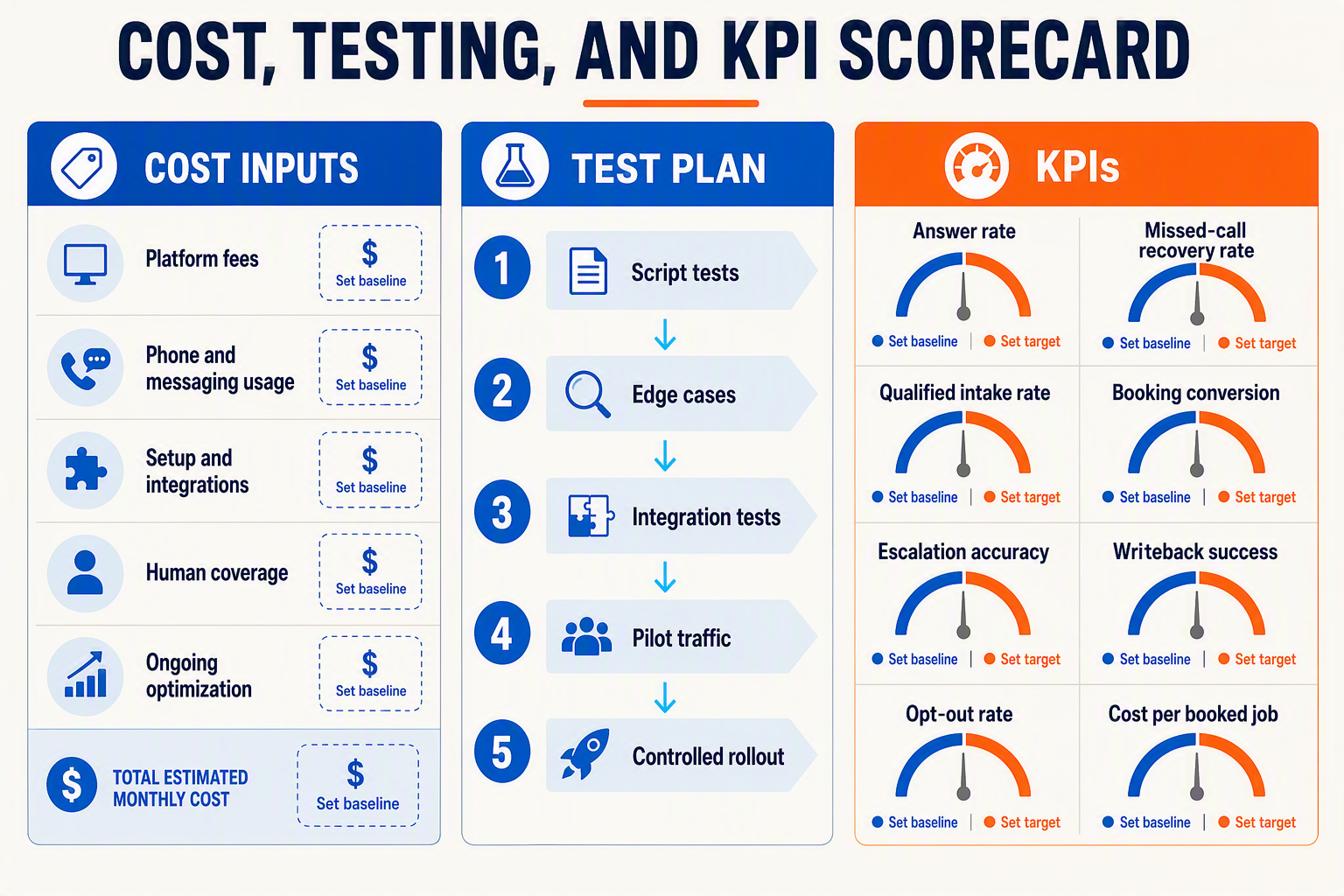
Implementation cost should be calculated as total cost per successfully booked and completed job, not merely a monthly software fee. Test the workflow with real-world scenarios and compare conversion, response time, booking accuracy and escalation performance against a pre-launch baseline.
Build a complete cost model
Pricing varies by call volume, conversation length, language mix, integrations and human coverage. Obtain an itemized quote covering:
- Platform charges: subscription, usage credits or per-minute AI voice fees.
- Channel costs: telephone numbers, inbound and outbound calling, WhatsApp messaging or calling, and email delivery.
- Implementation: call-flow design, prompt configuration, knowledge-base preparation and CRM or job-management integration.
- Operations: transcript review, workflow updates, human escalation and staff training.
- Contingency: usage spikes during storms, heatwaves, pest seasons or marketing campaigns.
Calculate:
Monthly operating cost = platform + channel usage + integration costs + human review + support
Then calculate cost per completed job, not only cost per lead. A cheap plumber AI receptionist becomes expensive if it creates duplicates, books outside the service area or mishandles escalation.
CallMissed uses transparent credits where one credit equals ₹1, with free-tier and pay-as-you-go options. Businesses should still confirm which voice, model, telephony and WhatsApp activities consume credits before forecasting production costs.
Test before exposing every call
Run a controlled pilot for two to four weeks, retaining a human fallback and reviewing failures daily. A practical test sequence is:
- Script testing: Verify names, addresses, PIN codes or postcodes, callback numbers, service categories and consent language.
- Boundary testing: Try unsupported areas, unavailable slots, repeated callers, silence, background noise and mid-call disconnections.
- Safety testing: Simulate mentions of gas smells, fire, electrical arcing, flooding and injury. Confirm that the system follows approved handoff language without diagnosing risk.
- Integration testing: Check whether bookings, summaries, recordings, consent status and source data actually write back to the correct customer and job records.
- Multilingual testing: Use native speakers, code-switching and regional address formats. CallMissed supports 22 Indian languages, but every language deployed by the business should receive its own acceptance testing.
- Load and fallback testing: Confirm behavior when the calendar, CRM, model, telephony provider or WhatsApp channel is unavailable.
Test live answering and home service missed call automation separately. An HVAC call answering AI may perform well during connected calls while follow-up messages fail because consent, number formatting or routing rules are incorrect.
Measure operational impact
Capture a baseline for at least two comparable weeks, then monitor:
- Answer rate: answered inbound calls ÷ total inbound calls.
- Missed-call recovery rate: missed callers who re-engage ÷ missed callers contacted.
- Qualified booking rate: valid bookings ÷ eligible enquiries.
- Completed-job conversion: completed jobs ÷ AI-handled enquiries.
- Median speed to answer and follow-up: report medians and 90th percentiles.
- Booking accuracy: bookings requiring no manual correction ÷ total AI bookings.
- Service-area rejection accuracy: correctly rejected out-of-area requests ÷ reviewed rejections.
- Safe-escalation compliance: audited priority or potential-emergency calls following the approved route.
- Human takeover rate: transferred conversations ÷ AI-handled conversations.
- Cost per completed job: total operating cost ÷ completed jobs attributable to the workflow.
For any AI answering service for home services, review transcripts and recordings alongside dashboard metrics. Higher booking volume is not operational improvement if cancellations, unsafe responses, incorrect routing or dispatcher rework also increase.
What do experienced operators, dispatchers, technicians, and compliance advisers recommend for safe AI call handling?
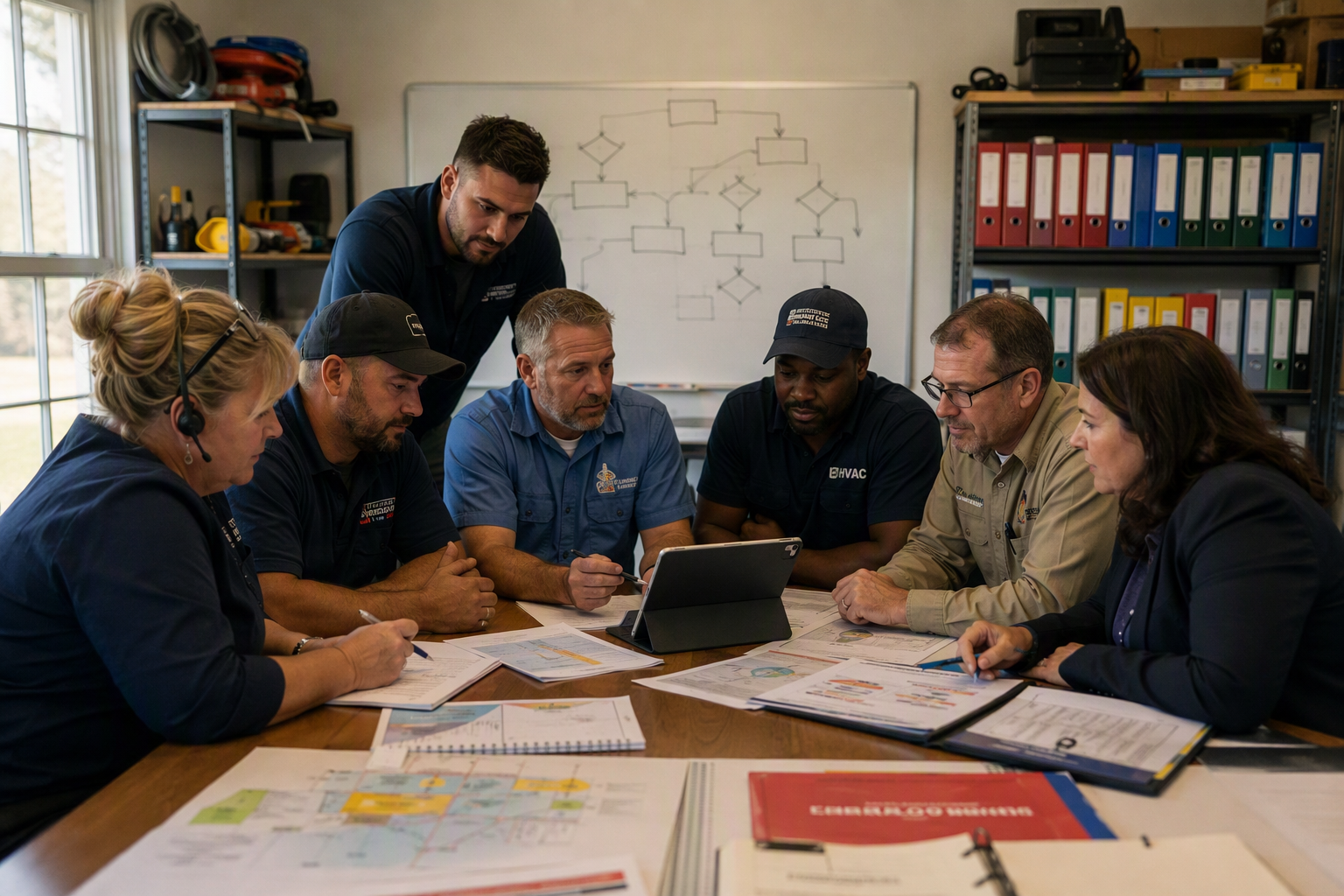
Experienced teams recommend treating AI as a controlled intake and routing layer, not as a technician, emergency dispatcher or source of safety advice. Every response should follow business-approved rules, preserve the customer’s wording and provide an immediate human or emergency-services path when danger is reported.
Recommendations from each operational role
- Operators and owners: Define exactly what the AI may book, quote or promise. An AI answering service for home services should not guarantee an arrival time, final price, warranty coverage or repair outcome unless those details come from an approved system and policy.
- Dispatchers: Keep routing categories simple—routine, priority and potential emergency—and specify who receives each escalation by location, trade and time of day. Include a fallback when the primary on-call technician does not acknowledge the job.
- Technicians: Collect observable facts rather than attempting diagnosis. A plumber AI receptionist can ask where water is visible and whether access is available, while HVAC call answering AI can record the equipment type and displayed error code; neither should declare the property safe.
- Compliance advisers: Minimize data collection, disclose automation where required, obtain appropriate consent for recordings and messaging, and document retention and deletion rules. Requirements differ by jurisdiction, so local legal review remains necessary.
Meta reported in April 2025 that WhatsApp exceeded 3 billion monthly active users, but widespread use does not replace consent. A customer calling the business should not automatically be treated as having opted into promotional WhatsApp campaigns.
Use a fixed escalation script
For reports involving smoke, fire, a gas smell, sparking, electric shock, injury, rapidly rising water or another immediate threat, use language such as:
“I’m an automated assistant and cannot assess whether this situation is safe. If anyone may be in immediate danger, contact your local emergency services now. I can also alert the business’s on-call contact using its approved escalation process.”
The script should not tell customers to touch equipment, enter a hazardous area, test wiring, stop a leak or wait for a technician. It should capture only essential information:
- Caller name and callback number.
- Service address and postcode or PIN code.
- The caller’s description in their own words.
- Whether anyone is injured or reports immediate danger.
- Preferred language and accessibility needs.
- Whether the escalation was delivered and acknowledged.
Build human control into every workflow
Safe home service missed call automation needs explicit operational controls:
- Route low-confidence transcripts, unsupported languages and repeated misunderstandings to a person.
- Let dispatchers override classifications, bookings and service-area decisions.
- Write the transcript, consent status, routing reason and timestamps into the CRM or job-management system—but verify that the chosen integration supports each field.
- Prevent duplicate jobs when a caller phones, replies on WhatsApp and submits a web form.
- Restrict knowledge-base answers to approved operating policies rather than open-ended technical advice.
- Audit multilingual test calls with fluent reviewers; recognition alone does not prove that urgency was preserved.
Before launch, operators should run at least one test for every trade × language × urgency × opening-hours combination in scope. Review false bookings, missed escalations, transfer failures and unauthorized promises weekly during rollout, then retain regular spot checks as scripts, staffing and service areas change.
What This Means For You: How should a plumber AI receptionist, HVAC call answering AI, and workflows for electrical, cleaning, pest control, and repairs differ?
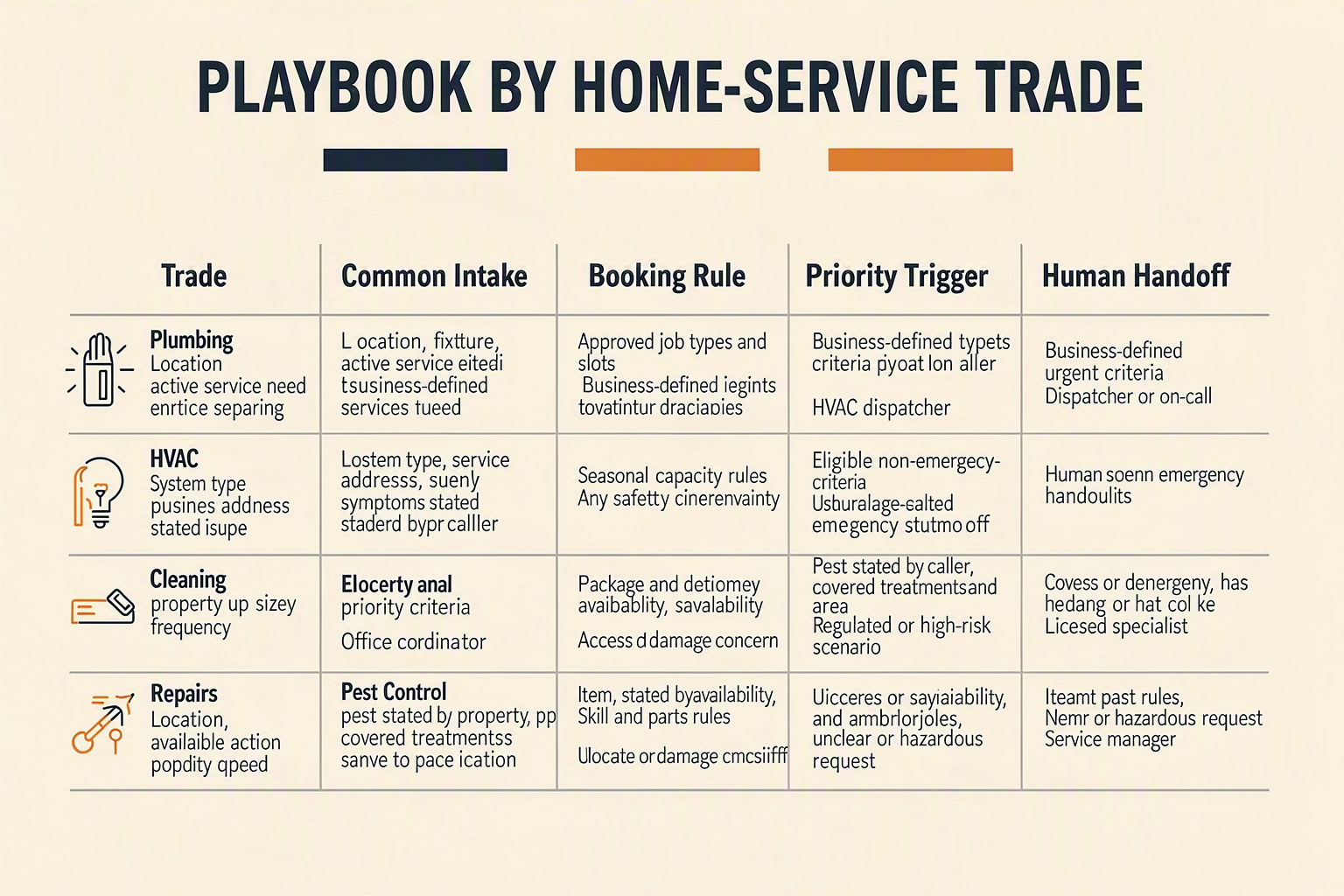
A single script will not work across every trade. An AI answering service for home services should vary its intake questions, booking rules, urgency triggers and required job data by service type while applying the same business-approved safety and escalation policy.
Trade-specific workflow matrix
| Service workflow | Required intake fields | Priority and escalation triggers | Booking logic | Follow-up and system record |
|---|---|---|---|---|
| Plumbing | Address, postcode or PIN code, fixture or pipe affected, water flow status, visible leakage, property access | Escalate reports of uncontrolled flooding, sewage exposure, injury or another immediate hazard; do not diagnose or give repair instructions | Offer only approved job types and available windows; reserve uncertain cases for dispatcher review | Send WhatsApp confirmation with captured details and callback expectations; write source, transcript and urgency label to the job record |
| HVAC | Heating or cooling issue, equipment type, property type, number of affected units, existing customer or maintenance-plan status | Route reports involving smoke, burning smells, suspected gas or medically vulnerable occupants according to the company’s approved policy | Separate maintenance, inspection and no-heating/no-cooling queues; never promise parts availability | Record equipment details and preferred slot; send preparation instructions only from the approved knowledge base |
| Electrical | Location, affected circuit or appliance, outage scope, visible sparks or smoke, service-address verification | Immediately hand off mentions of fire, arcing, electric shock, exposed live components or immediate danger; avoid troubleshooting | Book routine installations and inspections; require human approval for uncertain or potentially hazardous descriptions | Preserve the caller’s exact wording, escalation timestamp and transfer outcome for auditability |
| Cleaning | Property size, room count, cleaning type, frequency, preferred date, pets, access and add-ons | Escalate hazardous-material, biohazard or unsafe-access requests to a trained person rather than accepting automatically | Use duration and crew-capacity rules; distinguish recurring, move-in/move-out and one-time deep cleaning | Confirm scope and exclusions on WhatsApp; capture consent before promotional follow-up |
| Pest control | Pest reported, affected rooms, property type, recurrence, children or pets present, prior treatment | Human-review reports involving bites, illness, protected wildlife, extensive infestation or chemical-safety questions | Schedule an inspection when treatment type or price depends on onsite identification | Send approved pre-visit guidance without identifying the pest or recommending chemicals |
| Appliance and general repairs | Appliance or asset type, brand, model if known, symptoms, warranty status, photos or video availability | Escalate smoke, fire, gas, electrical exposure, injury or structural risk under predefined rules | Match the request to technician skills, supported brands, parts policy and geography | Request media through WhatsApp, attach it to the case and mark unverified customer descriptions clearly |
Configure each agent around operational reality
A plumber AI receptionist should prioritize containment-related descriptions, precise location details and rapid dispatcher visibility. By contrast, HVAC call answering AI needs equipment context, maintenance-plan recognition and seasonal capacity rules. Electrical workflows require especially conservative escalation, while cleaning workflows depend more heavily on scope, duration and crew scheduling.
For reliable home service missed call automation, configure the recovery workflow to:
- Check the service area first, using an approved postcode, PIN-code or geofence list.
- Reconstruct context, noting the missed-call time, number and any existing customer record.
- Ask trade-specific questions, rather than sending a generic “How can we help?” message.
- Offer valid next steps, such as an available slot, dispatcher callback or human transfer.
- Write back the outcome, after verifying that the CRM or job-management integration supports the required fields, attachments and status changes.
Multilingual deployment should preserve this same schema across languages instead of translating an English script loosely. CallMissed, for example, supports voice and chat across 22 Indian languages, allowing Indian home-service operators to keep structured intake fields consistent while customers speak their preferred language.
Before launch, test each row with routine, ambiguous, out-of-area and high-risk scenarios. The pass condition is not whether the AI “solves” the problem; it is whether the workflow captures accurate information, follows consent rules and reaches the correct approved destination without unsupported promises.
Which related 2026 guides should support the rollout? Internal links for appointment booking, after-hours answering, voice agents, WhatsApp, conversation intelligence, knowledge bases, and omnichannel service
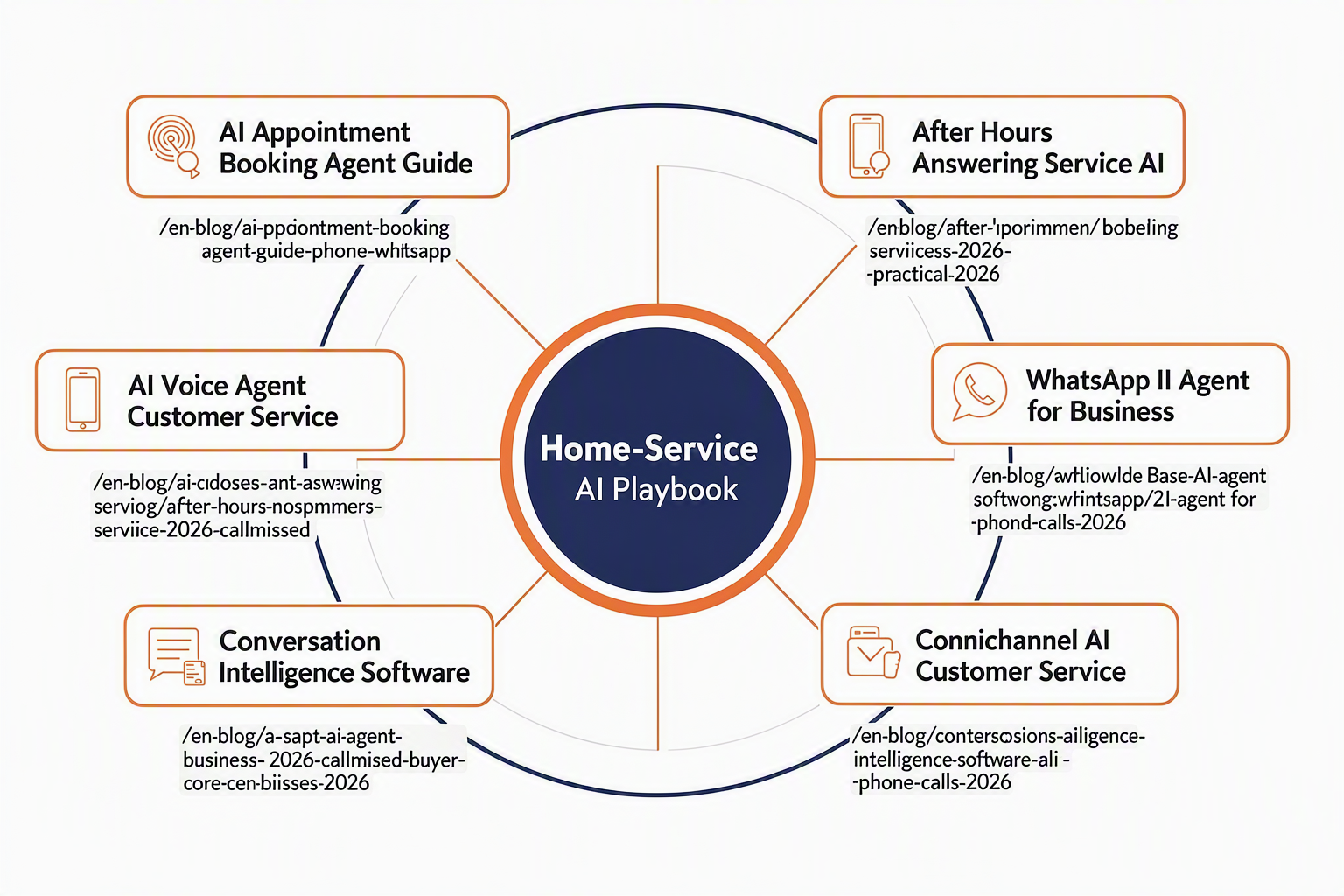
A successful rollout needs more than one generic implementation document. Use focused 2026 guides for each operating layer—booking, after-hours routing, voice, WhatsApp, quality analysis, approved knowledge and cross-channel case management—then consolidate their decisions into one controlled runbook.
Start with the two guides that define call handling
- AI Appointment Booking Agent Guide: Use this to configure calendar checks, appointment windows, rescheduling, confirmations and human approval. It is especially relevant when a plumber AI receptionist or cleaning-service agent must convert an enquiry into a provisional or confirmed visit without inventing availability.
- After-Hours Answering Service AI Guide: Apply this guide to overnight, weekend and holiday workflows. Document which routine requests can wait, which priority calls trigger an on-call alert and which danger-related reports require an approved human or emergency-services handoff.
These two guides should produce a shared routing matrix. If booking is unavailable after hours, for example, the agent should capture the request and communicate the expected callback process rather than promise a technician’s arrival.
Add channel-specific implementation guides
Use separate playbooks for the customer’s live call and subsequent messaging:
- AI Voice Agent Customer Service Guide: Covers voice-agent prompts, interruption handling, transfers and operational guardrails for an AI answering service for home services.
- AI Receptionist Service Buyer Guide: Provides an evaluation framework for telephony, fallback behavior, recordings, auditability and integrations. An operator assessing HVAC call answering AI should verify these capabilities rather than assume they are included.
- WhatsApp AI Agent for Business Guide: Use this for consent, approved templates, customer replies and messaging handoffs. Meta reported in April 2025 that WhatsApp exceeded 3 billion monthly active users, demonstrating the channel’s global scale.
- Omnichannel AI Customer Service Guide: Defines how voice, WhatsApp and email interactions become one case instead of disconnected conversations.
For home service missed call automation, the WhatsApp and omnichannel guides are particularly important: the workflow must preserve consent status, caller identity, original intent, assigned owner and follow-up outcome across channels.
Build quality control and trusted-answer layers
Two additional guides support safer scaling:
- Conversation Intelligence Software Guide: Establishes review criteria for transcripts, booking accuracy, escalation compliance, customer sentiment and failed-call patterns.
- Knowledge Base AI Agent Guide: Explains retrieval-augmented generation, content approval, source control and testing. The knowledge base should contain service areas, opening hours, approved pricing language and escalation rules—not improvised technical or safety diagnoses.
Multilingual testing belongs in every layer. India’s Constitution recognizes 22 languages in its Eighth Schedule, so regional-language intake should be tested for addresses, PIN codes, appliance names and urgency descriptions—not merely greetings.
Turn the guides into one rollout checklist
Create a single implementation register containing:
- Guide owner and completion date
- Approved workflow or policy produced
- Required CRM or job-management writeback
- Test cases and acceptance criteria
- Human fallback and escalation contact
- Launch metric and weekly review cadence
Platforms such as CallMissed bring voice agents, WhatsApp Business calling and chat, knowledge-base retrieval, and omnichannel workflows into one environment. Regardless of platform, treat these linked guides as connected controls: booking determines commitments, the knowledge base constrains answers, conversation intelligence verifies behavior, and omnichannel records preserve continuity.
Frequently Asked Questions about AI phone answering, missed-call recovery, WhatsApp follow-up, booking, consent, multilingual calls, and emergency escalation
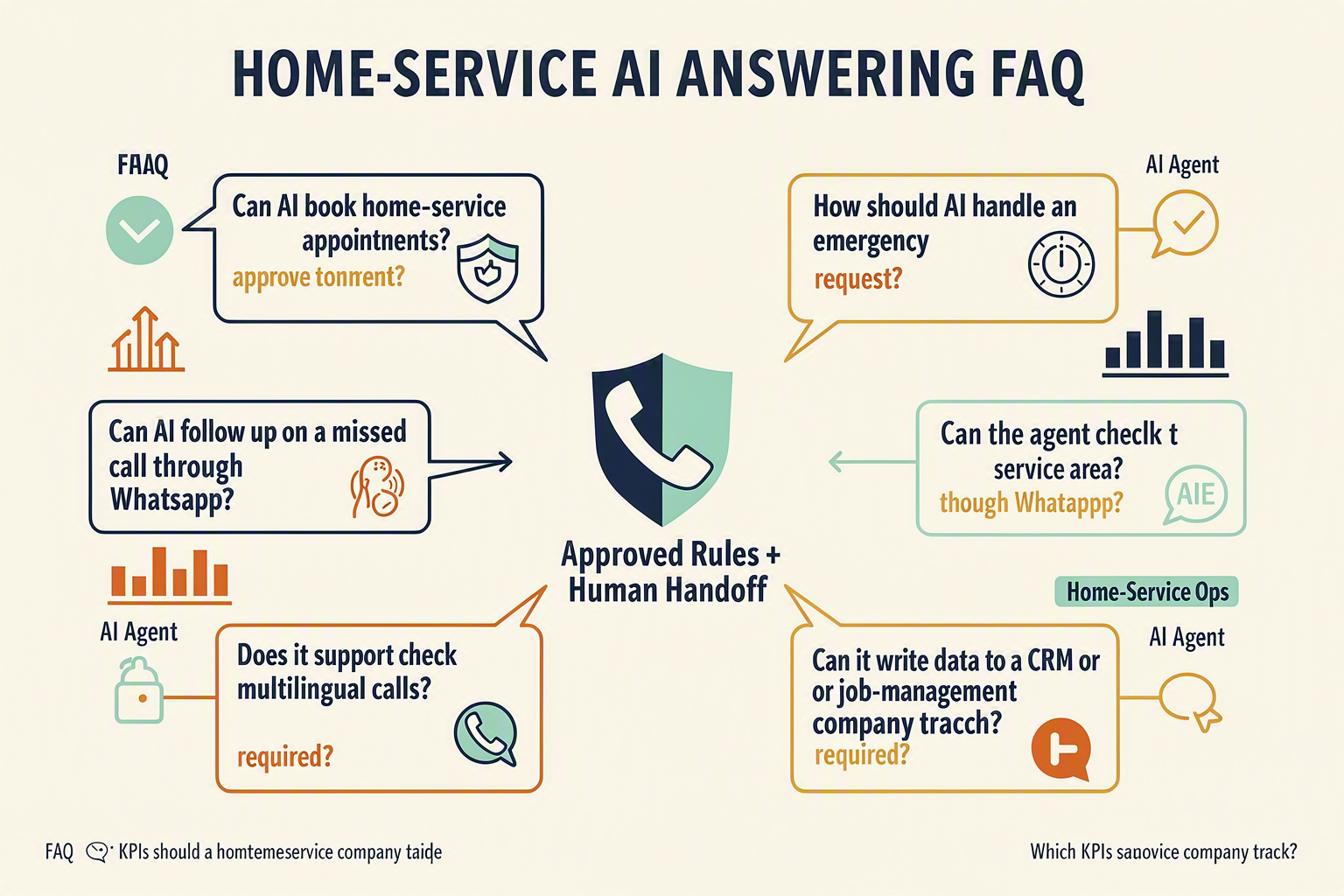
How does an AI answering service for home services handle calls and book jobs?
Can a plumber AI receptionist safely answer emergency calls after hours?
What should HVAC call answering AI say about prices and arrival times?
Does home service missed call automation require consent before sending WhatsApp messages?
Can an AI answering service for home services support multilingual customer calls?
How much does AI phone answering cost, and which KPIs should a home-service business track?
Conclusion
A successful AI answering service for home services is not defined by how many conversations it automates, but by how reliably it moves each enquiry into an approved workflow. In 2026, plumbing, HVAC, electrical, cleaning, pest-control and repair businesses should connect phone answering, missed-call recovery, WhatsApp follow-up, job intake and booking without allowing AI to make unsupported safety judgments.
Key implementation takeaways include:
- Classify before acting. Routine appointments can proceed to booking, priority cases should follow business-defined callback rules, and reports of gas smells, fire, electrical arcing, flooding, injury or immediate danger require an approved human or emergency-services handoff. A plumber AI receptionist or HVAC call answering AI must collect facts rather than diagnose the hazard.
- Control every commitment. Verify postcode or PIN-code coverage, calendar availability, operating hours and escalation paths before confirming a job. Do not let the system promise prices, arrival times or technical outcomes unless the business has explicitly authorized them.
- Design an omnichannel journey. Home service missed call automation should recover unanswered enquiries quickly, obtain appropriate consent for WhatsApp follow-up and preserve context across voice and messaging. Meta reported in April 2025 that WhatsApp had surpassed 3 billion monthly active users, underlining its relevance as a follow-up channel.
- Verify, test and measure. Confirm whether CRM or job-management writeback, recordings, audit trails, multilingual support and fallback behavior actually work with the chosen systems. Track booking completion, missed-call recovery, escalation accuracy, transfer success and customer drop-off—not merely call volume.
What to watch next
The strongest 2026 implementations will make multilingual, cross-channel continuity operational rather than optional. The Constitution of India recognizes 22 scheduled languages, so regional-language intake can materially affect whether a customer’s description is captured accurately. Platforms such as CallMissed reflect this direction by combining AI voice agents, WhatsApp chat and Business calling, knowledge-base retrieval and support for 22 Indian languages.
The practical next step is a limited launch using real call scenarios, documented escalation rules and human review. Is your current answering process ready to handle the next 2:00 a.m. call safely—and preserve enough context for your team to act?
Related Reading
Discussion
Related Posts

Ready to automate customer conversations?
Launch AI voice agents and WhatsApp bots with CallMissed — one API, 22+ Indian languages.