
AI Receptionist Service Buyer Guide 2026: How to Evaluate CallMissed


Compare an AI receptionist service for 24/7 answering, lead qualification, booking, routing, handoff, languages, setup, and pricing.
AI Receptionist Service Buyer Guide 2026: How to Evaluate CallMissed
What happens to a high-intent customer when your business cannot answer the phone—do they leave a voicemail, or call the next company? A standard week contains 168 hours, so a business answering phones for 40 staffed hours leaves 128 hours, or 76.2% of the week, without conventional front-desk coverage. That gap makes choosing an AI receptionist service a revenue and customer-experience decision, not merely a technology upgrade.
An AI answering service or virtual receptionist can provide 24/7 call answering, capture caller details, qualify leads, answer knowledge-base questions, book appointments, route calls and transfer complex conversations to employees. However, products vary significantly in voice quality, multilingual accuracy, integrations, escalation controls, pricing and reliability. A polished demonstration does not prove that an AI phone agent will correctly understand a customer speaking quickly, switching languages or requesting an urgent human handoff.
This distinction is especially important for Indian small businesses. India recognizes 22 scheduled languages under the Eighth Schedule of the Constitution, while many customers naturally mix English with regional languages during the same conversation. Buyers should therefore test real calls—not simply check whether a language appears on a feature list. Indian platforms such as CallMissed support speech-to-text and text-to-speech across 22 Indian languages and can connect inbound voice calls to an AI agent.
This 2026 buyer’s guide focuses on purchase evaluation rather than basic setup. It will show you how to assess:
- Inbound call automation, including after-hours answering and peak-call handling
- Lead qualification, data capture and CRM-ready conversation summaries
- Appointment booking, confirmations and calendar integration requirements
- Multilingual conversations, accents, code-switching and recognition accuracy
- Call routing and human handoff, including failure and emergency scenarios
- Setup effort, knowledge-base preparation, testing and ongoing maintenance
- Pricing, including per-minute charges, telephony costs, minimum commitments and overages
- Security, consent and recordings, based on the jurisdictions where you operate
The goal is not to select an automated receptionist from a feature checklist. It is to determine whether CallMissed—or any shortlisted service—can handle your actual callers, workflows and risk thresholds at a predictable total cost. By the end, you will have a practical evaluation framework, a setup checklist and the questions needed for a useful vendor demonstration.
Which AI receptionist service is best for a small business? Choose the one that proves it can handle your real calls reliably
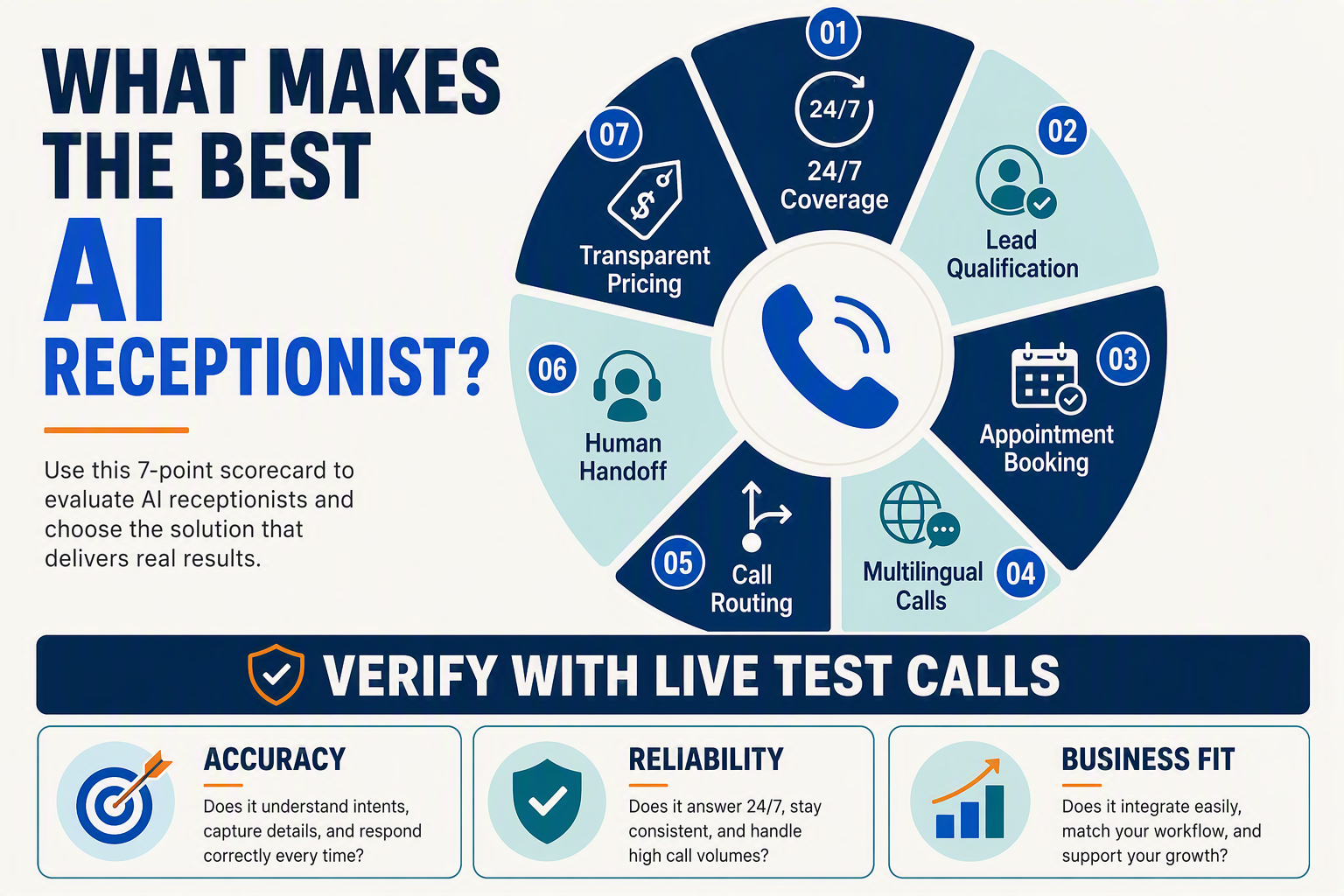
The best AI receptionist service for a small business is the one that completes representative call scenarios accurately, escalates exceptions safely and produces a predictable bill under realistic traffic. Treat vendor demonstrations as a starting point; the purchase decision should depend on recorded test calls, workflow outcomes and clearly defined service levels.
Start with outcomes, not the feature list
Most services advertise 24/7 call answering, appointment scheduling and call transfers. Buyers should verify what those labels mean operationally by defining five to ten tasks the receptionist must complete, such as:
- Answering a pricing or availability question from an approved knowledge base
- Capturing a caller’s name, phone number, location and service requirement
- Qualifying a lead against budget, urgency or eligibility rules
- Finding an available calendar slot and creating the correct appointment
- Routing an existing customer to the appropriate department
- Transferring urgent, sensitive or low-confidence conversations to a person
A successful call requires more than a natural-sounding voice. The AI phone agent must capture fields correctly, follow business rules and avoid inventing answers when information is missing.
Run a structured call audition
Give every shortlisted provider the same test script and score at least 20 representative calls before comparing results. Include straightforward conversations as well as interruptions, background noise, unclear requests and changes of mind.
Use a 100-point scorecard:
- Task completion — 30 points: Did the caller reach the intended outcome?
- Information accuracy — 20 points: Were names, numbers, dates and requirements captured correctly?
- Appointment handling — 15 points: Did the agent check availability, prevent invalid bookings and confirm details?
- Routing and handoff — 15 points: Did transfers reach the right person with adequate context?
- Conversation quality — 10 points: Were latency, turn-taking and interruptions acceptable?
- Reporting and administration — 10 points: Could staff review summaries, outcomes and failed calls easily?
Set mandatory pass conditions separately. For example, an automated receptionist that mishandles an emergency escalation should fail regardless of its overall score.
Test multilingual performance call by call
Language support should be evaluated through complete conversations rather than translated greetings. Ask native speakers to test regional accents, names, addresses, dates and natural code-switching.
The Eighth Schedule of the Constitution of India recognizes 22 scheduled languages, making multilingual evaluation particularly relevant for businesses serving customers across Indian regions. CallMissed supports speech-to-text and text-to-speech across 22 Indian languages, allowing buyers to test inbound voice answering against the languages their callers actually use. This capability still requires validation with the business’s vocabulary, locations and customer demographics.
Demand evidence for reliability and recovery
A buyer should ask each provider to demonstrate what happens when the normal workflow breaks:
- What occurs if the calendar, CRM or knowledge base is unavailable?
- Can calls fall back to a person, queue, voicemail or alternate number?
- Does the human recipient receive the caller’s details and conversation context?
- Are failed transfers and incomplete bookings visible to staff?
- How are service availability, support response and incident notification documented?
The strongest choice is therefore not necessarily the service with the longest feature list. It is the AI answering service that passes your call audition, handles failure safely and can show exactly how its inbound call automation will behave after deployment.
Why are small businesses evaluating an AI answering service instead of a traditional virtual receptionist?

Small businesses are evaluating an AI answering service because it can provide continuous, consistent inbound call handling without requiring a human receptionist to be available for every call. A traditional virtual receptionist may remain preferable for nuanced or sensitive conversations, but an AI phone agent can make routine answering, qualification, scheduling and routing easier to scale.
The decision is about capacity, not simply replacing people
A traditional virtual receptionist usually relies on remote human agents who answer calls during contracted hours or according to a usage plan. An automated receptionist uses speech recognition, language models, text-to-speech and workflow integrations to conduct the initial conversation.
This gives small businesses several practical reasons to evaluate AI:
- Concurrent-call handling: AI agents may handle multiple inbound conversations instead of placing every additional caller in a queue.
- Consistent intake: Every caller can be asked the same required questions, reducing variations in lead records.
- Immediate workflow execution: The system can book an available appointment, create a structured summary or route a qualified caller during the conversation.
- Flexible coverage: Businesses can deploy AI for all calls, after-hours calls, overflow traffic or selected call types.
- Knowledge retrieval: A connected knowledge base can answer approved questions about services, locations, opening times and policies.
The strongest business case is often overflow and after-hours coverage, rather than complete staff replacement. Employees can retain complex, sensitive and high-value conversations while inbound call automation handles repetitive demand.
AI and human receptionists solve different problems
A human virtual receptionist can interpret ambiguity, show situational judgement and adapt to unusual requests without every scenario being configured in advance. That makes human coverage valuable for complaints, emergencies, sensitive healthcare discussions or callers whose needs cannot be classified reliably.
An AI receptionist is better suited to clearly defined tasks such as:
- Capturing a caller’s name, location and contact information
- Asking predetermined lead-qualification questions
- Checking appointment availability and booking an eligible slot
- Answering approved frequently asked questions
- Transferring the call when a trigger or exception occurs
Buyers should therefore compare successful task completion, not merely the apparent naturalness of the voice. An engaging demonstration has limited value if the agent records the wrong phone number, invents an answer, schedules an invalid appointment or fails to transfer an urgent caller.
Multilingual demand strengthens the AI case—but raises the test standard
India recognizes 22 scheduled languages under the Eighth Schedule of the Constitution of India. For an Indian small business, multilingual support can expand access beyond what a small reception team can practically cover, especially when callers mix English with a regional language.
However, a listed language is not proof of dependable performance. Evaluation calls should include regional accents, noisy environments, rapid speech, proper names, addresses and code-switching. CallMissed supports speech-to-text and text-to-speech across 22 Indian languages and can connect inbound calls to an AI voice agent, making these real-world tests particularly relevant when assessing the platform.
A hybrid model is often the safer purchase
The most resilient design combines automation with a defined human handoff. Before buying, verify what happens when the AI cannot understand a caller, the calendar is unavailable, the knowledge base lacks an answer or no employee accepts a transfer.
An AI service is worth evaluating when call demand is repetitive, variable or extends beyond staffed coverage. A traditional virtual receptionist deserves greater weight when calls require substantial discretion. Many small businesses will benefit from combining both rather than treating the choice as all-or-nothing.
Which 2026 AI answering service developments and capabilities matter most?
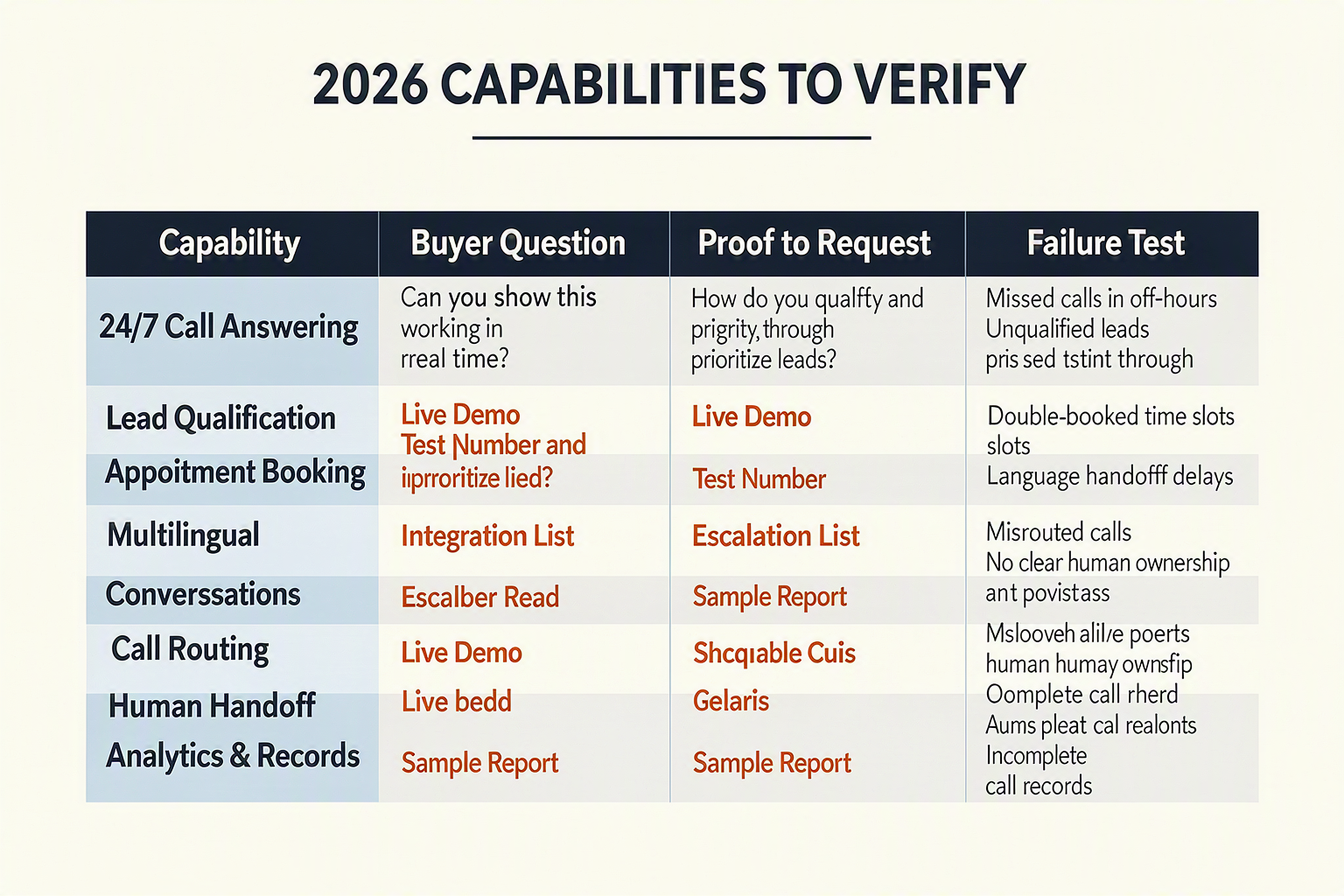
The key distinction in 2026 is between an AI receptionist service that only answers and summarizes calls and one configured to complete approved business tasks. Tool use, language coverage, routing and fallback behavior vary by vendor, plan, integration and configuration, so buyers should verify them in a live workflow rather than rely on a demonstration.
Capabilities that deserve buyer attention
| Development or capability | Small-business value | Proof to request | Warning sign |
|---|---|---|---|
| Real-time, interruption-aware voice | Can make conversations easier when callers pause, correct themselves or speak over the agent | Test latency, interruptions, background noise, names, numbers and repeated questions on live calls | Performance is shown only in a prerecorded or tightly scripted demo |
| Workflow and tool execution | May qualify leads, create records or manage appointments when the required integrations are available | Complete a booking, change it and cancel it; then inspect the calendar or CRM records | “Integration” means only emailing a transcript after the call |
| Knowledge-grounded responses | Helps constrain answers to approved services, policies, prices and hours | Test outdated, conflicting and unanswerable questions and review escalation behavior | The agent guesses instead of acknowledging uncertainty or escalating |
| Multilingual speech | May support callers who prefer different languages | Request the current language matrix and test accents, names, addresses, numbers and code-switching | The vendor equates translated scripts with end-to-end speech support |
| Context-aware routing and handoff | Can direct calls by intent, schedule, location or staff availability | Test successful and failed transfers and confirm what context reaches the recipient | Transfers fail silently or require the caller to repeat all information |
| Auditability and fallback controls | Helps operators review outcomes and respond to service or integration failures | Inspect transcripts, extracted fields, tool results, dispositions, alerts and fallback rules | There is no searchable call record or documented failure path |
Action completion matters more than a polished voice
A natural voice can improve caller experience, but an AI receptionist service creates operational value only when it reliably completes the intended task or hands it to a person. For lead qualification, test whether the configured service captures required fields, confirms important details, distinguishes new enquiries from existing-customer calls and writes data to the intended system.
For appointment workflows, test more than the creation of an open calendar slot:
- Business hours, time zones and staff-specific availability
- Service duration, location and eligibility rules
- Rescheduling, cancellation and duplicate-booking controls
- Confirmation messages and any required human approval
- Recovery when the calendar, CRM or transfer destination is unavailable
These functions are vendor- and integration-dependent. Buyers evaluating CallMissed should confirm which actions are available on the proposed plan and require an end-to-end test using their own systems.
Language counts require careful interpretation
The Eighth Schedule to the Constitution of India lists 22 languages. That constitutional classification is separate from—and does not prove—an AI product’s speech-to-text, reasoning or text-to-speech coverage.
Accordingly, the 22-language figure should not be presented as a CallMissed product-language claim without current product documentation confirming it. Ask CallMissed for its current supported-language matrix, including any differences among transcription, generated responses and synthesized speech. Then test the languages your callers use, including local names, addresses, specialist vocabulary, code-switching and noisy mobile connections.
Controls distinguish a deployed service from a demo
Before purchasing an AI receptionist service, confirm what authorized users can review after each call. Depending on the product and configuration, useful records may include the transcript, captured fields, disposition, tool actions, transfer result and summary. Buyers should also ask about access controls, retention settings, escalation rules and what happens when speech recognition, an integration or a transfer fails.
The strongest evaluation combines caller experience, verified task completion and safe failure handling. If CallMissed or another provider cannot demonstrate those elements with the buyer’s actual workflow, its feature list alone is not sufficient evidence for deployment.
How should you evaluate CallMissed for inbound call automation, qualification, booking, and multilingual conversations?
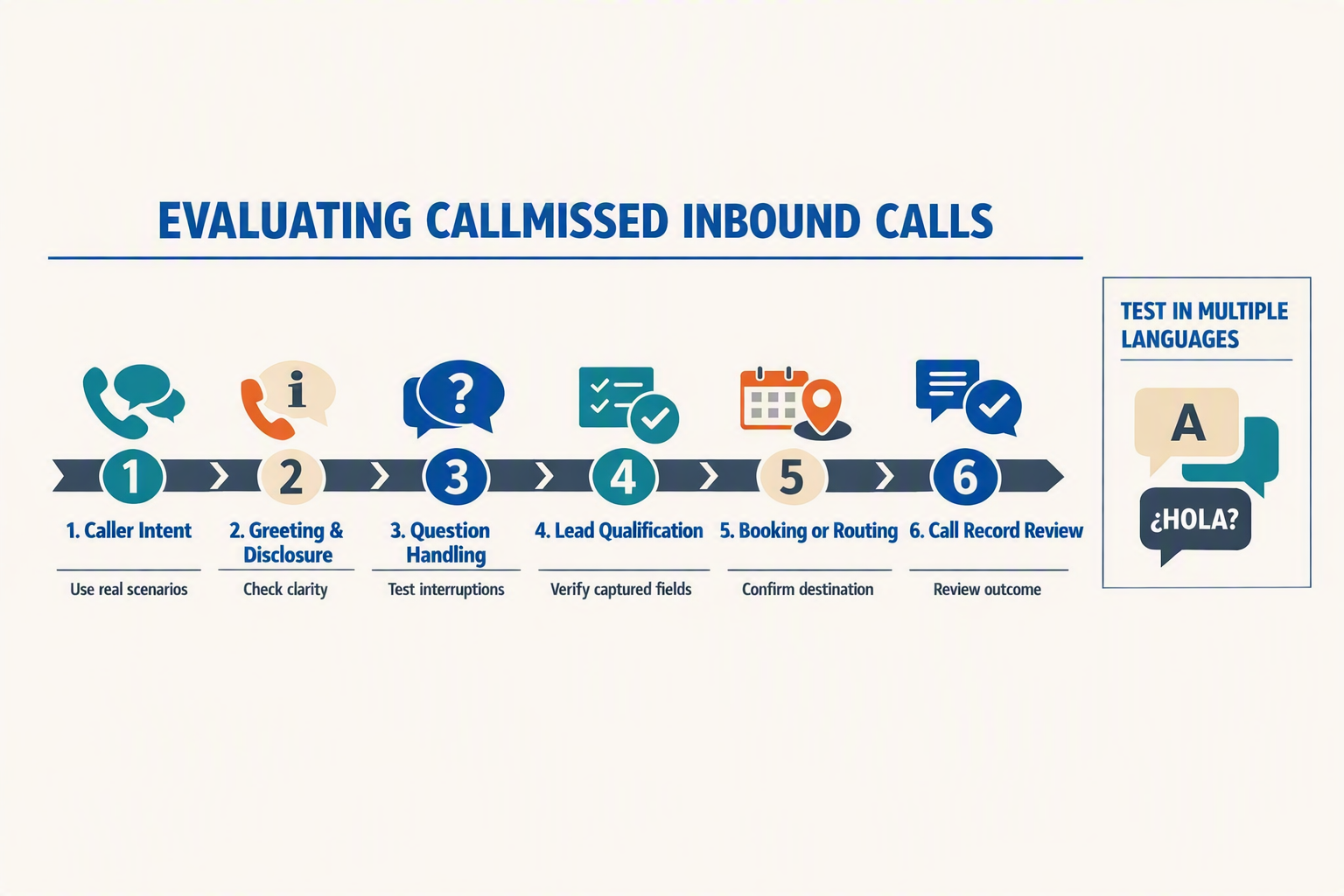
CallMissed should be evaluated with a scenario-based proof of concept, not merely a scripted product demonstration. Test whether the AI phone agent can answer inbound calls continuously, collect structured lead data, complete booking workflows, manage multilingual speech and transfer exceptions without losing caller context.
Test inbound answering as an operational system
For 24/7 call answering, distinguish “the AI can answer at any time” from an end-to-end service that remains useful during failures and traffic spikes. Run calls during business hours, after hours and from multiple numbers simultaneously.
Verify that CallMissed can:
- Answer with the correct business identity and opening disclosure
- Use approved knowledge-base content rather than inventing answers
- Recognize repeat callers and capture names, numbers and call intent
- Route urgent or high-value calls according to business rules
- Produce searchable transcripts, summaries and follow-up tasks
- Handle silence, background noise, interruptions and abandoned calls
- Follow a defined fallback when the AI, telephony connection or integration fails
Ask for documented service availability, support hours, concurrency limits and incident procedures. 24/7 answering is valuable only when monitoring, escalation and recovery are also defined.
Measure qualification by data completeness
A convincing conversation is not necessarily a qualified lead. Give the automated receptionist a fixed qualification framework—for example, service required, location, budget range, urgency and preferred callback time—and inspect the resulting record.
Use a scorecard with measurable outcomes:
- Field accuracy: Were names, phone numbers, addresses and requirements recorded correctly?
- Question coverage: Did the agent collect every mandatory field without sounding repetitive?
- Eligibility logic: Did it distinguish qualified, unqualified and uncertain enquiries correctly?
- CRM usability: Could an employee act from the summary without replaying the call?
- Consent handling: Did the workflow capture required permissions before follow-up?
Include ambiguous callers who refuse questions, change requirements or provide contradictory information. These cases reveal whether the agent clarifies uncertainty or creates an unreliable CRM record.
Require an end-to-end booking demonstration
Do not treat “appointment booking” as verified until a test call creates a valid calendar event. Ask CallMissed to demonstrate your intended calendar or scheduling workflow, including:
- Live availability checks and prevention of double bookings
- Service duration, location, staff and buffer-time rules
- Time-zone handling
- Rescheduling and cancellation
- Confirmation through the required channel
- Human review when no suitable slot exists
Test unavailable dates and callers requesting exceptions. If booking depends on custom API work or middleware, include that implementation and maintenance cost in the purchase comparison.
Stress-test multilingual and mixed-language calls
CallMissed supports speech-to-text and text-to-speech across 22 Indian languages, aligning with the 22 scheduled languages listed in the Eighth Schedule of the Constitution of India. Buyers should still evaluate the specific accents, vocabulary and code-switching patterns used by their customers.
Build recordings that include:
- English mixed with Hindi or another regional language
- Local place names, personal names and industry terminology
- Numbers, dates, prices and alphanumeric references
- Mid-call language changes
- Noisy mobile connections and overlapping speech
Score intent recognition, entity accuracy, response naturalness and task completion separately. Before purchase, agree on acceptance thresholds using your own call sample and confirm what happens when language confidence is low: clarification, language switching, callback capture or immediate human handoff.
How should an AI phone agent route urgent calls and complete a safe human handoff?
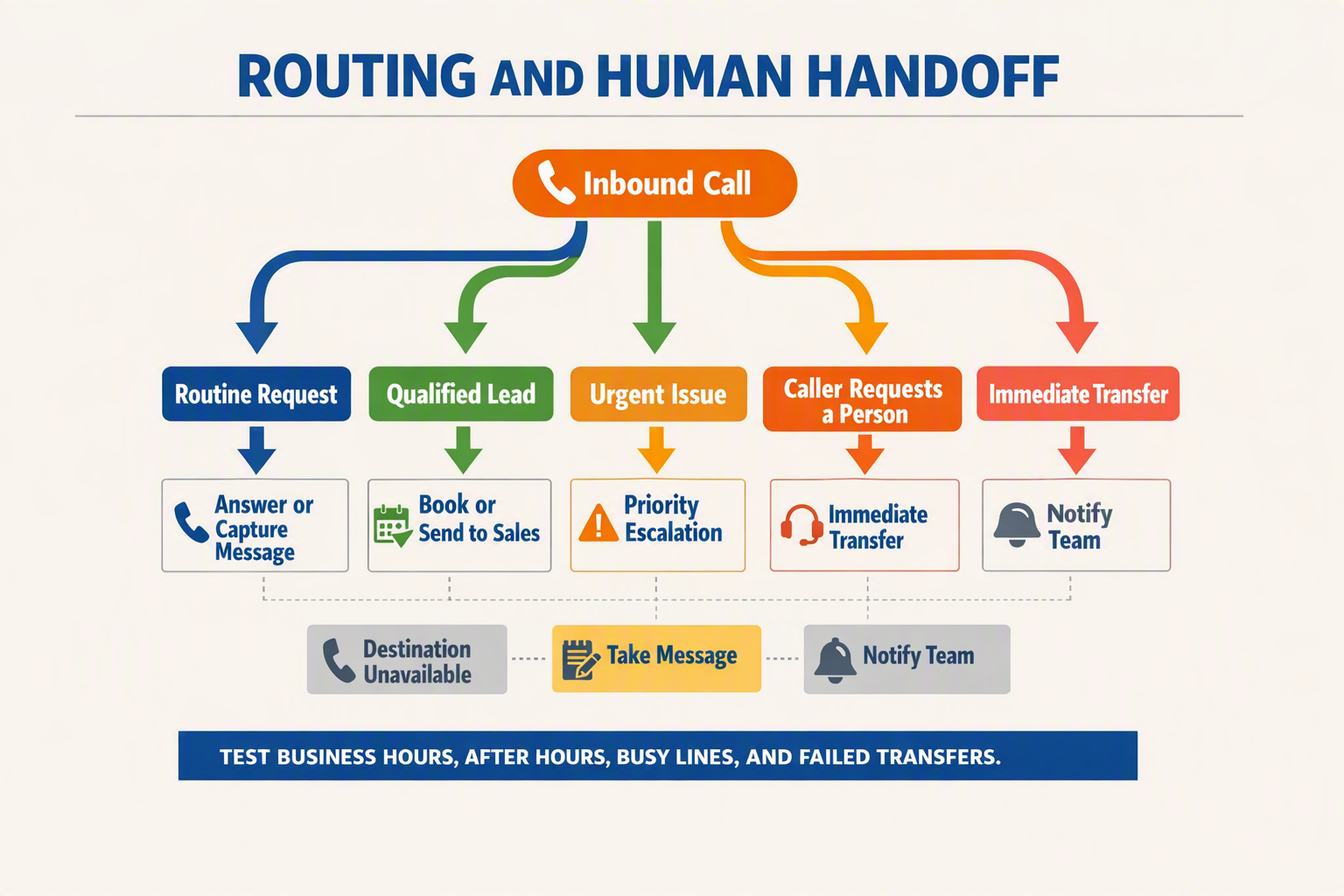
An AI phone agent should classify urgency using explicit business rules, attempt a warm transfer to the correct person and follow a predefined fallback path if nobody answers. A safe handoff preserves the caller’s context, confirms that a human has accepted the call and never presents automated assistance as a substitute for emergency services.
Define urgency before choosing routing technology
Do not let a vendor decide what “urgent” means for your business. Create an escalation matrix based on caller intent, operational risk, business hours and account status, rather than relying only on emotional tone.
Examples include:
- Emergency: threats to life, fire, suspected gas leaks or other situations requiring the caller to contact the appropriate local emergency service immediately.
- Critical business issue: an active water leak, stranded traveller, security incident, payment-system outage or patient reporting a predefined warning symptom.
- Time-sensitive request: same-day appointment cancellation, delivery failure or qualified lead with an immediate purchasing deadline.
- Routine request: opening hours, future appointment booking, order status or general product questions.
The AI receptionist service should recognize approved trigger phrases while gathering only the information needed for routing. It must not diagnose a medical condition, guarantee an arrival time or improvise safety advice outside the business-approved knowledge base.
Require a closed-loop human handoff
A blind transfer merely sends the call to another number; a warm handoff verifies availability and gives the employee useful context. Buyers should ask vendors to demonstrate this complete sequence:
- The automated receptionist identifies the escalation condition.
- It confirms the caller’s name, callback number, location and reason for calling.
- It tells the caller that a transfer is being attempted and sets expectations about possible wait time.
- It calls the designated employee or queue and provides a concise spoken or screen-based summary.
- The employee accepts the conversation before the AI phone agent disconnects.
- The system records the routing outcome and creates any required CRM task or callback alert.
For multilingual calls, the summary should preserve both meaning and critical proper nouns. When a caller switches between English and a regional language, test whether addresses, names, amounts and appointment times survive transcription and transfer accurately. CallMissed supports speech-to-text and text-to-speech across 22 Indian languages, making these mixed-language handoff tests particularly relevant for Indian businesses.
Build fallback paths for every failure
Safe routing requires more than one destination. Configure an ordered chain such as primary on-call employee → backup employee → staffed queue → callback workflow. The system should behave predictably when a number is busy, unreachable or unanswered.
Evaluate whether the service can:
- Apply different schedules for weekdays, holidays and after-hours coverage.
- Prevent transfer loops and cap repeated attempts.
- Send an immediate SMS, WhatsApp or CRM notification after a failed transfer.
- Read back the callback number before ending the call.
- Retain the transcript, summary, timestamp and escalation reason for review.
- Route sensitive calls without exposing unnecessary information in notifications.
Test outcomes, not just transfer initiation
A vendor demonstration should include an answered transfer, an unanswered transfer, a disconnected call, an ambiguous urgent request and a caller who refuses to provide details. Score whether the correct person actually received the call and context, not whether the software merely dialled a number.
Before purchase, define measurable acceptance criteria: maximum transfer delay, required caller fields, fallback order, notification deadline and audit-log contents. An AI answering service is ready for urgent calls only when every escalation ends in a confirmed human connection, an actionable callback record or clear direction to the appropriate emergency channel.
What do experts recommend verifying before buying an automated receptionist or 24/7 call answering service?

Experts recommend buying an AI receptionist service only after it passes production-like call tests and the vendor documents security, uptime, escalation and total cost. A feature list or scripted demonstration cannot establish whether an automated receptionist will qualify leads, book appointments and transfer urgent callers reliably.
1. Demand a measurable call-test plan
Run calls using your actual business number, knowledge base, operating hours and integrations. A practical pilot should include at least 20 attempts for each high-value workflow—a buyer-defined testing baseline, not an industry benchmark—and record completion rates rather than subjective impressions.
Test scenarios should include:
- A new lead answering every qualification question
- A caller giving incomplete, corrected or contradictory information
- Appointment booking, rescheduling and cancellation
- Background noise, fast speech, accents and code-switching
- An unsupported request requiring human assistance
- A transfer when the employee is unavailable
- A caller asking the agent to ignore its instructions
Score task completion, transcription accuracy, data-field accuracy, transfer success, latency and inappropriate responses separately. For Indian deployments, platforms such as CallMissed support speech-to-text and text-to-speech across 22 Indian languages, but buyers should still test the specific language combinations their customers use.
2. Verify escalation and failure behaviour
Experts recommend defining what happens when automation fails—not merely what happens when it succeeds. Ask the provider to demonstrate:
- Warm and cold transfers, including caller context passed to employees
- Routing by location, department, opening hours or lead priority
- Retry behaviour when nobody answers the transferred call
- Fallback to voicemail, callback creation, SMS or WhatsApp
- Handling of emergencies, abusive callers and prohibited requests
- Service behaviour during a model, telephony or calendar outage
Require a written service-level agreement covering availability, incident notification, support channels, recovery objectives and service credits. “24/7 call answering” should describe operational coverage, not imply that every dependency has guaranteed uninterrupted availability.
3. Inspect security and data governance evidence
The NIST AI Risk Management Framework 1.0, published in January 2023, organizes AI risk work around four functions: Govern, Map, Measure and Manage. Apply that structure by asking who controls prompts and recordings, what data is retained, how risks are tested and how incidents are managed.
Request:
- A data-processing agreement and subprocessor list
- Recording, transcript and deletion controls
- Encryption and role-based access details
- Data-residency and model-training policies
- Recent penetration-test summaries
- ISO/IEC 27001:2022 certification or an applicable SOC 2 report
The American Institute of Certified Public Accountants defines SOC 2 as an examination and report, not a generic “SOC 2 certification.” Confirm the report scope, covered period and whether the actual receptionist service is included.
If calls collect card information, verify alignment with PCI DSS v4.0.1, published by the PCI Security Standards Council in June 2024. Obtain jurisdiction-specific legal advice on recording notices, consent and retention.
4. Reconstruct the complete price
Ask for a sample invoice based on your expected call distribution. Include:
- Per-minute or per-call AI charges
- Telephone numbers, carrier fees and forwarding
- Transcription, recording and storage
- Transfers and outbound callbacks
- Calendar, CRM and messaging integrations
- Setup, minimum commitments, overages and taxes
Finally, confirm data-export rights, cancellation terms and number portability. A credible provider should make performance, risk and cost independently testable before a long-term commitment.
What setup checklist should you complete before launching a virtual receptionist for small business calls?
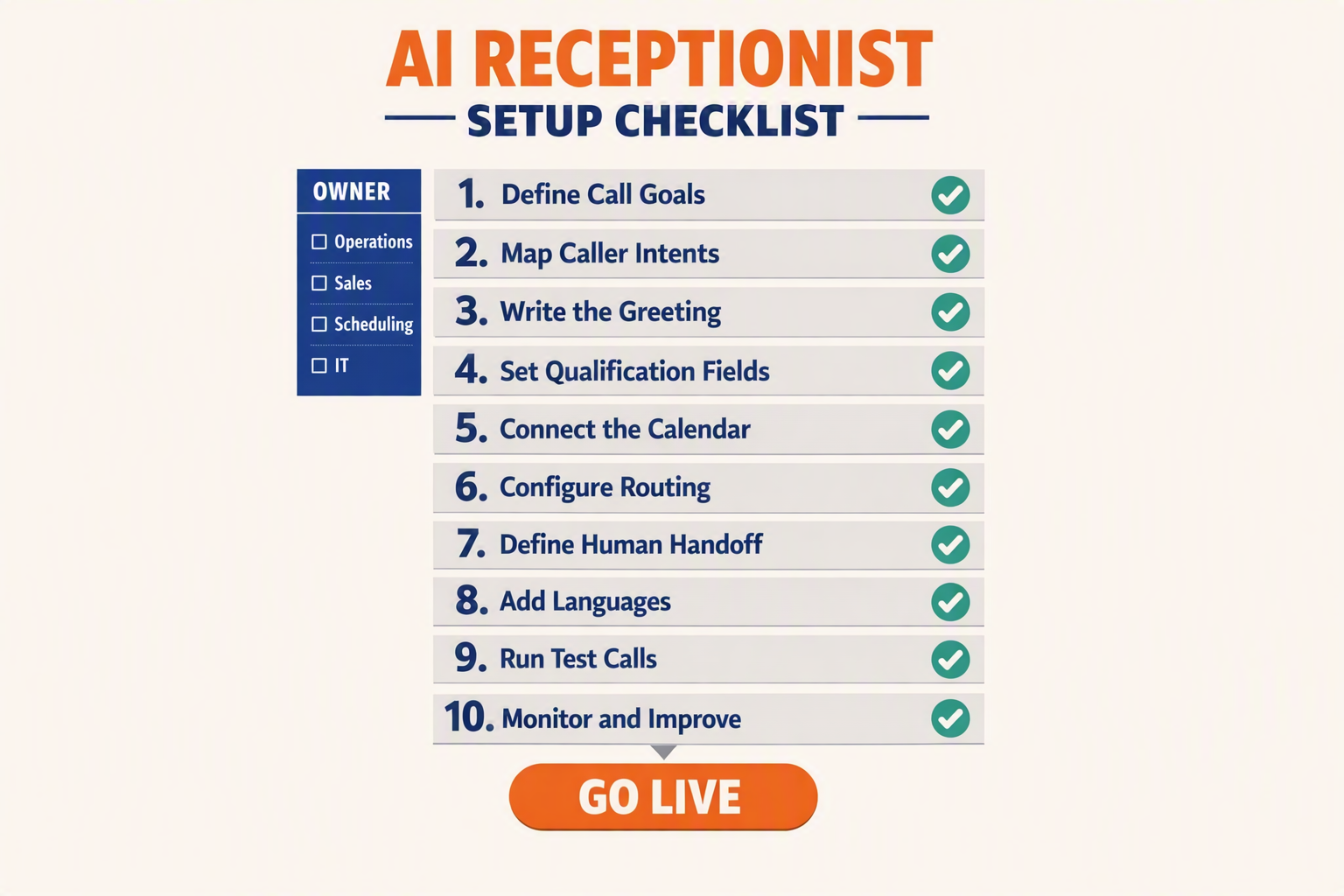
Complete the setup checklist by defining call outcomes, preparing approved business information, connecting calendars and customer systems, configuring routing and human handoff, and passing a controlled pilot. Do not activate 24/7 call answering until every critical scenario has a named owner, fallback path and measurable acceptance criterion.
1. Define what the receptionist may—and may not—do
Document the exact scope of inbound call automation before writing prompts or importing content. Separate routine actions from decisions that require an employee.
- List supported intents, such as new enquiries, appointment requests, order questions and existing-customer support.
- Specify the lead-qualification fields required for each service: name, location, need, urgency, budget or preferred appointment time.
- Define prohibited actions, especially quotations, guarantees, medical advice, financial commitments or policy exceptions.
- Write the precise conditions for transferring, scheduling a callback or taking a message.
- Assign an internal owner to every captured lead and unresolved call.
A successful call should have a defined outcome—for example, appointment booked, qualified lead created, call transferred or callback requested—rather than merely “the AI answered.”
2. Prepare a controlled source of truth
Give the AI phone agent only current, approved information. Review business hours, service areas, pricing rules, appointment policies, frequently asked questions, staff directories and escalation contacts.
For every knowledge item, record:
- The employee responsible for accuracy
- The last review date
- Whether the answer may be spoken verbatim
- What the agent should say when information is unavailable
- When the answer must be escalated rather than inferred
Remove conflicting documents and expired offers before launch. An automated receptionist should say that it cannot confirm an answer instead of improvising a plausible but incorrect response.
3. Validate integrations and data handling
Test the complete workflow, not just the conversation. Confirm that calendar connections respect staff availability, appointment duration, buffers, locations, time zones and cancellation rules. Create test records in the CRM or inbox and verify that names, numbers, qualification answers, summaries and call dispositions reach the correct fields without duplication.
Decide whether calls are recorded or transcribed, how callers receive notice, who can access those records and how long data is retained. These requirements should reflect the jurisdictions and industries in which the business operates; vendor defaults are not a substitute for legal review.
4. Build routing, language and failure scenarios
Create a routing map covering open hours, after-hours service, weekends, holidays, unanswered transfers and unavailable employees. Include clear emergency instructions and a fallback destination if the primary transfer fails.
Language testing must use actual callers, accents and code-switching patterns. For a platform such as CallMissed, which supports speech-to-text and text-to-speech across 22 Indian languages, the launch test should still verify the specific language combinations customers use rather than treating catalog support as proof of production accuracy.
5. Set a launch gate
Run a staged pilot using recorded scenarios and live internal calls. Include:
- Straightforward enquiries
- Ambiguous or interrupted speech
- Appointment changes and unavailable slots
- Urgent human-handoff requests
- Unsupported questions
- Transfer, calendar or CRM failures
Set your own pass thresholds for field accuracy, correct routing, booking completion and escalation compliance. Review transcripts manually, correct the knowledge base and rerun failed scenarios. Launch gradually—such as after-hours or overflow calls first—and keep a rollback method, daily review owner and update schedule in place.
Which option fits your business, and what pricing questions should you ask?
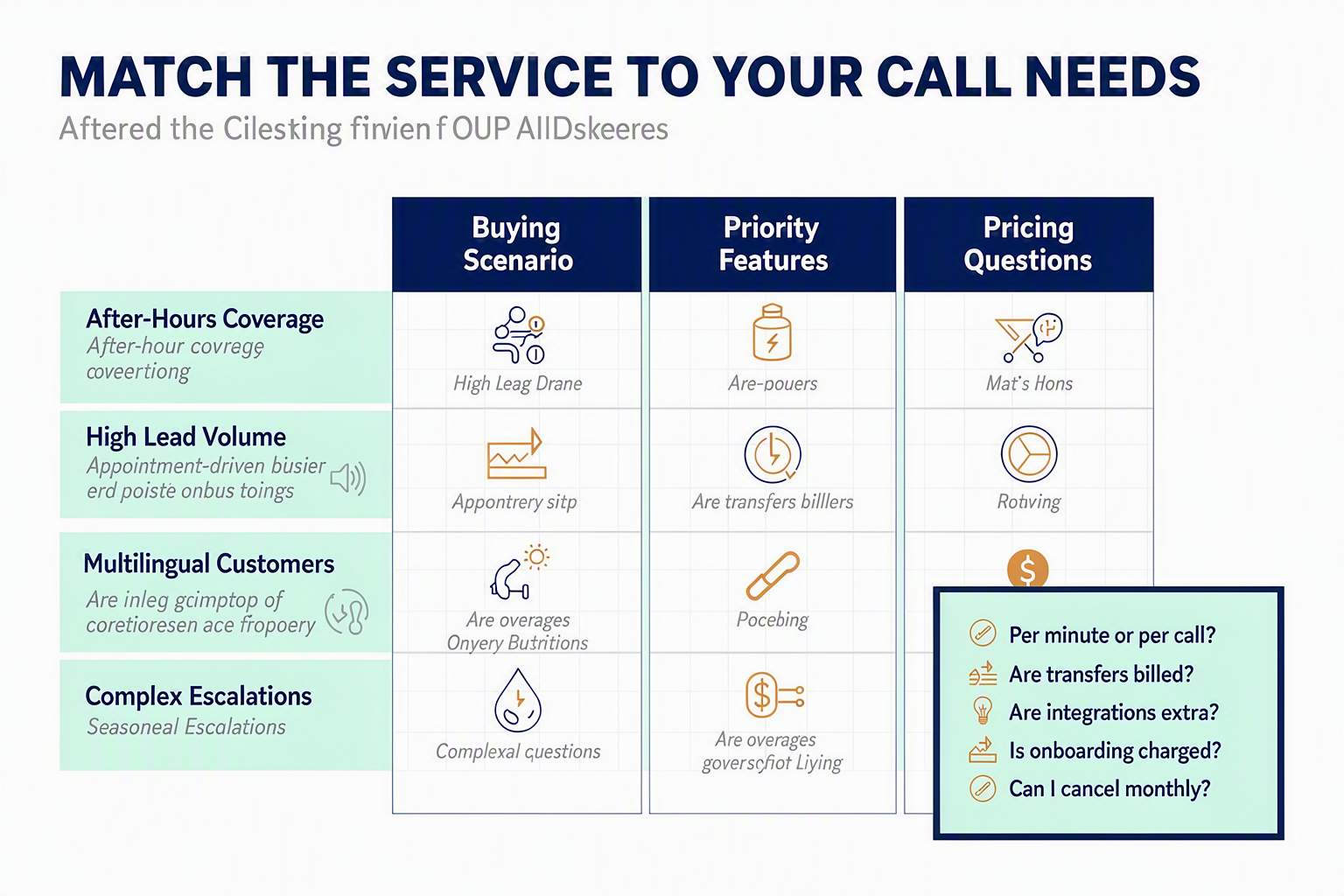
Choose the operating model that matches when calls arrive, how complex they are and when a human must intervene. Compare vendors on the complete monthly cost of successful call handling—not an advertised per-minute rate viewed in isolation.
Match the service model to your call pattern
| Business need | Best-fit option | Essential capabilities | Main pricing check | Test before buying |
|---|---|---|---|---|
| Low-volume local business | After-hours AI answering service | Message capture, FAQs, next-day follow-up | Minimum monthly commitment | Caller details reach the correct employee |
| High-volume service business | 24/7 AI receptionist service | Lead qualification, urgency detection, dispatch routing | Included minutes and overage rate | Simultaneous calls during peak demand |
| Clinic, salon or consultant | Appointment-focused AI phone agent | Calendar lookup, booking, rescheduling, confirmations | Integration and booking-action fees | Double-booking and unavailable-slot handling |
| Sales-led small business | Qualification and transfer workflow | Custom questions, CRM fields, summaries, live transfer | Charges for transfers and both call legs | Qualified leads reach the right salesperson |
| Multilingual Indian business | Indic-capable virtual receptionist | Regional-language speech recognition, text-to-speech and code-switching | Language or model surcharges | Real callers using accents and mixed-language speech |
| Regulated or high-risk operation | Hybrid AI-plus-human coverage | Consent prompts, escalation rules, audit trails and emergency routing | Human-agent, recording and storage charges | Immediate handoff under ambiguous conditions |
A full-time automated receptionist may suit repeatable calls, but after-hours or overflow deployment is often a lower-risk starting point. Hybrid coverage is more appropriate when conversations can involve medical urgency, financial consequences, safety issues or unusual complaints.
For multilingual operations, evaluate language capability at the speech layer rather than only in the language model. CallMissed supports speech-to-text and text-to-speech across 22 Indian languages, making regional-language testing relevant for businesses serving Indian callers. CallMissed can also connect inbound business calls to an AI voice agent, but buyers should still validate their own vocabulary, caller accents and escalation paths.
Ask for an itemized price calculation
Request a written estimate based on your historical call records and ask:
- Is usage billed by ringing time, connected time or AI-processing time?
- Are calls rounded by the second, 30 seconds or full minute?
- Do inbound telephony, phone numbers, transcription, text-to-speech and the AI model have separate rates?
- Does a human transfer create two billable call legs?
- Are simultaneous calls included, capped or priced as additional channels?
- Do calendar actions, CRM integrations, webhooks or WhatsApp follow-ups cost extra?
- Are setup, workflow design, custom prompts and knowledge-base ingestion one-time charges?
- How long are recordings and transcripts retained, and what does additional storage cost?
- Are support, service-level commitments, taxes, minimum spends and cancellation fees included?
- What happens financially when a provider or model fails and traffic uses a fallback?
CallMissed uses transparent credits where one credit equals ₹1, alongside a free tier and pay-as-you-go access. Buyers should nevertheless request the exact credit consumption for telephony and each enabled AI component because a simple credit denomination is not the same as a complete call-cost estimate.
Compare total cost per completed outcome
Use this calculation rather than comparing headline rates:
Monthly total cost = subscription + phone numbers + call minutes + AI processing + integrations + storage + human transfers + support + taxes.
Then divide that figure by successfully qualified leads, correctly booked appointments or resolved calls. The lowest per-minute service can become expensive if it misunderstands callers, books incorrect slots or repeatedly escalates routine conversations. A paid pilot using representative calls provides a more defensible buying decision than a scripted demonstration.
Frequently asked questions about AI receptionists, pricing, 24/7 coverage, booking, languages, and CallMissed
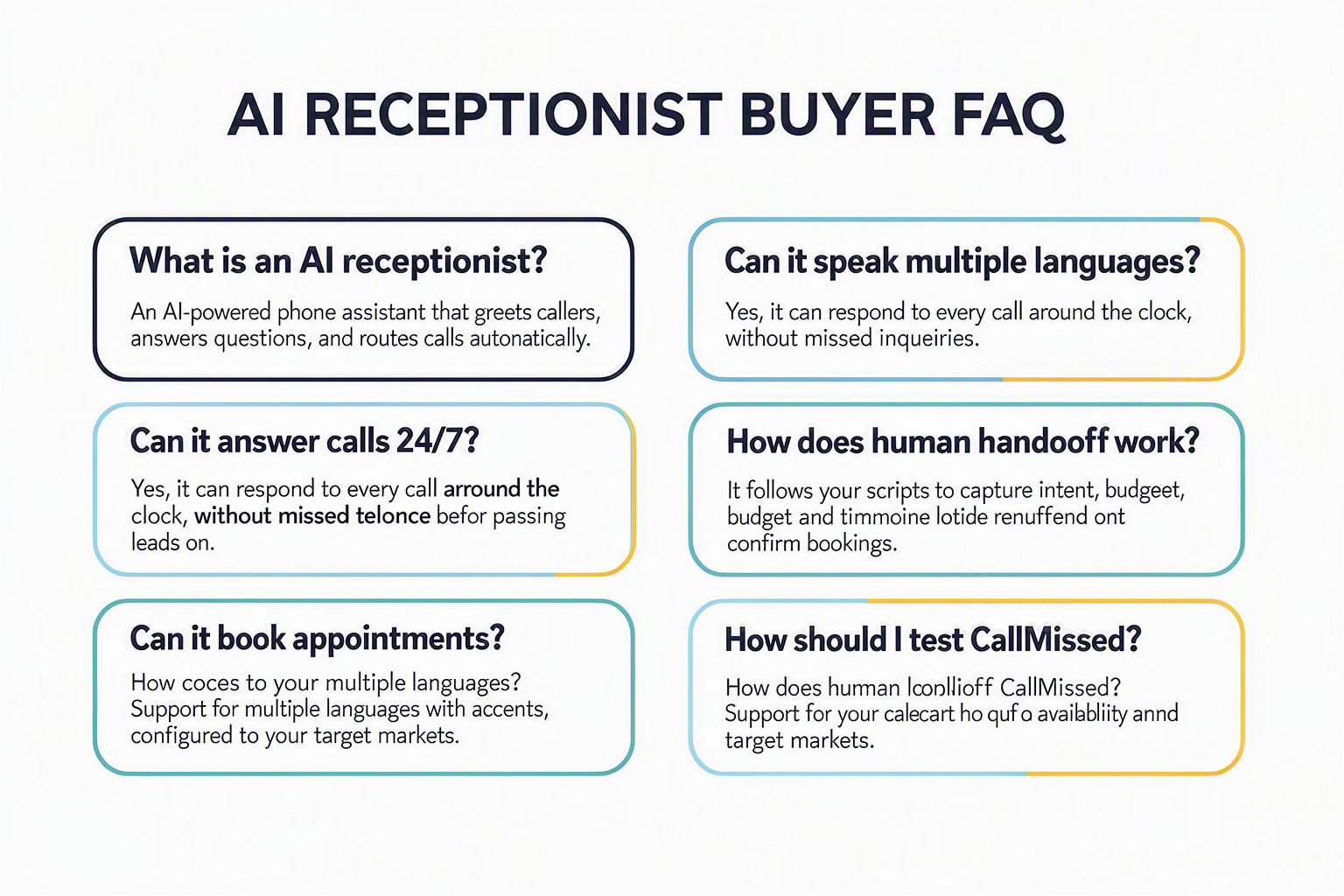
Coverage and service selection
What should a small business look for in an AI receptionist service?
Does 24/7 call answering mean every customer call will be resolved automatically?
Booking, qualification and languages
Can an AI receptionist service qualify leads and book appointments?
How do I evaluate multilingual support in a virtual receptionist?
Pricing and CallMissed
How much does an AI answering service cost for a small business?
Is CallMissed a suitable AI receptionist service for inbound calls?
Conclusion
Choosing an AI receptionist service in 2026 should be a verification exercise, not a feature-checking exercise. The right service must demonstrate that it can answer real customer calls, complete routine workflows and escalate exceptions reliably within your budget and risk tolerance.
- Prioritize coverage and outcomes. A standard week contains 168 hours, meaning a business staffed for 40 hours lacks conventional front-desk coverage for 128 hours, or 76.2% of the week. Test whether 24/7 call answering can capture caller details, qualify leads, answer approved questions and produce useful summaries—not simply pick up the phone.
- Evaluate complete workflows. Ask each AI answering service to demonstrate appointment booking, confirmations, call routing and human handoff using scenarios from your business. Include urgent requests, incomplete information, interruptions and situations in which the AI phone agent should stop automating and transfer the caller.
- Test multilingual conversations with real speakers. The Constitution of India recognizes 22 scheduled languages under the Eighth Schedule, but a language appearing on a vendor’s feature list does not guarantee reliable performance with accents or code-switching. CallMissed supports speech-to-text and text-to-speech across 22 Indian languages, making it relevant for businesses evaluating regional-language inbound calls.
- Compare total operational fit. Review setup effort, knowledge-base maintenance, calendar and CRM requirements, consent and recording controls, per-minute pricing, telephony charges, minimum commitments and overages. A predictable total cost matters more than an attractive headline rate.
Looking ahead, buyers should watch for measurable improvements in multilingual accuracy, natural voice quality, dependable routing and transparent failure handling. As automated reception becomes more capable, the strongest purchasing decisions will still come from controlled pilots, recorded test results and clearly defined escalation rules.
To explore how this trend is evolving, review CallMissed—then ask: would you trust the service to handle your next high-intent customer when nobody else is available?
Related Reading
Discussion
Related Posts
Ready to automate customer conversations?
Launch AI voice agents and WhatsApp bots with CallMissed — one API, 22+ Indian languages.