
Omnichannel AI Customer Service in 2026: CallMissed Guide to Voice, WhatsApp, and Email


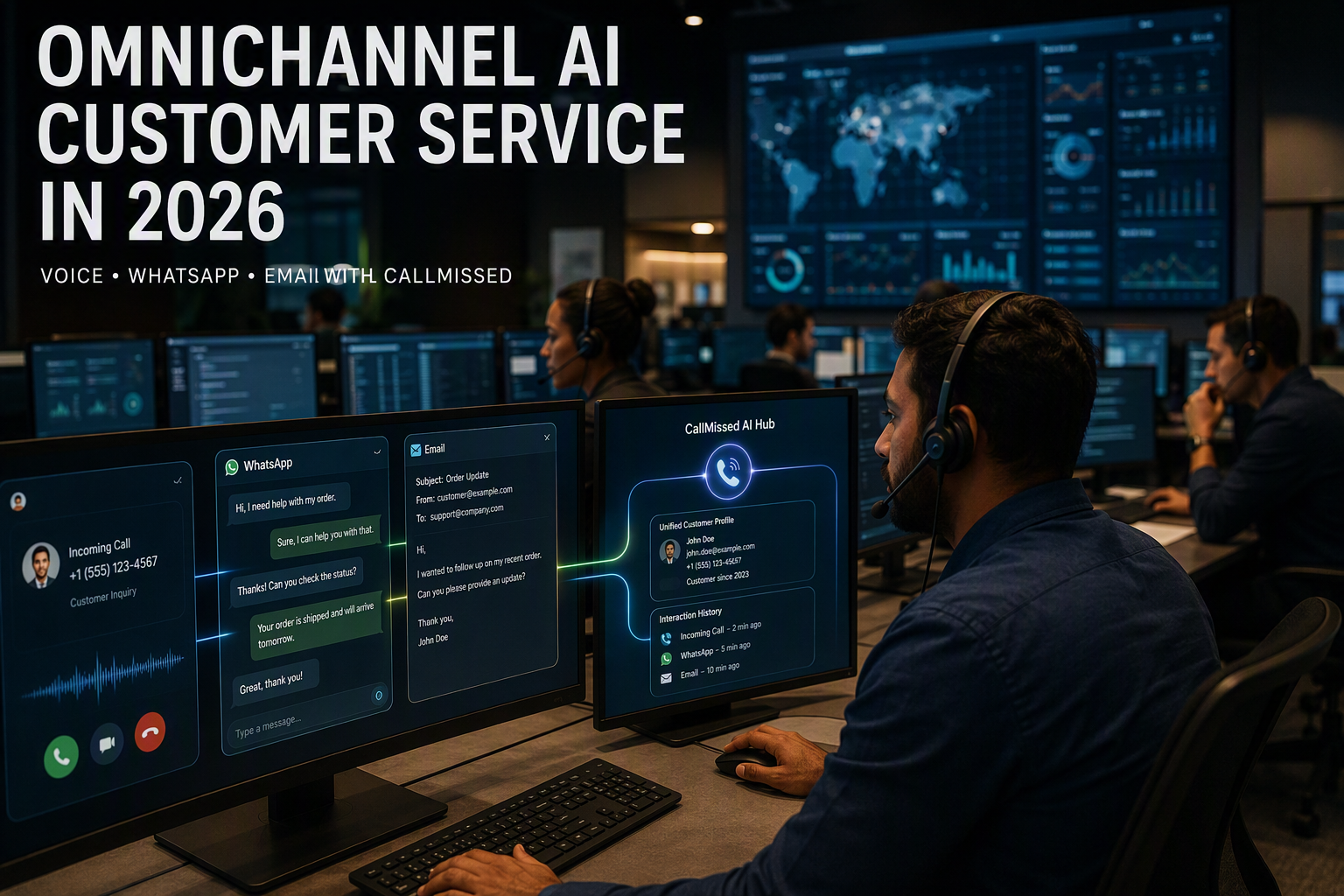
Build omnichannel AI customer service with shared knowledge, seamless handoffs, secure workflows, analytics, and a phased CallMissed rollout.
Omnichannel AI Customer Service in 2026: CallMissed Guide to Voice, WhatsApp, and Email
What happens when a customer calls about an order, follows up on WhatsApp, and emails a document—yet has to explain the issue three times? Omnichannel AI customer service prevents that fragmentation by giving every channel access to the same customer history, approved knowledge, workflows, and escalation rules.
Why omnichannel architecture matters in 2026
Customers no longer think in channels; they simply choose whichever channel is convenient at that moment. WhatsApp surpassed 3 billion monthly active users, according to Meta’s Q1 2025 earnings announcement, making messaging a critical service surface alongside phone and email. Salesforce’s 2023 State of the Connected Customer report found that 79% of customers expect consistent interactions across departments, while 56% often need to repeat information to different representatives.
The operational case is becoming equally compelling. Gartner predicted in June 2025 that agentic AI will autonomously resolve 80% of common customer-service issues by 2029, potentially reducing operational costs by 30%. Realising those gains, however, requires more than installing an isolated chatbot. Businesses need a conversational AI platform that coordinates identity, intent, consent, context, knowledge, and human intervention across every interaction.
That is the difference between basic multichannel customer service automation and a genuine omnichannel architecture. In a multichannel setup, phone, WhatsApp, and email may each be automated but remain disconnected. In an omnichannel model, an AI support agent can recognise the customer, retrieve the same approved answer, preserve conversation context, and transfer the case without forcing the customer to start again.
What this guide will help you build
This pillar guide explains how to design voice WhatsApp email automation as one service system rather than three separate projects. You will learn how to:
- Create a shared knowledge layer that produces consistent, source-grounded answers.
- Preserve context during channel handoffs and human escalation.
- Design multilingual workflows for regional and global audiences.
- Measure containment, resolution, handoff quality, latency, and customer outcomes.
- Address permissions, data access, security, retention, and auditability.
- Roll out customer experience automation through controlled phases instead of a risky all-at-once launch.
CallMissed brings this model together as an AI customer support platform, combining AI voice agents, WhatsApp chat and Business calling, email tooling, an omnichannel inbox, knowledge-base RAG, and support for 22 Indian languages. The goal is not automation everywhere—it is a connected service architecture in which every channel knows what happened before and what should happen next.
What Is Omnichannel AI Customer Service, and How Does CallMissed Unify Voice, WhatsApp, and Email?
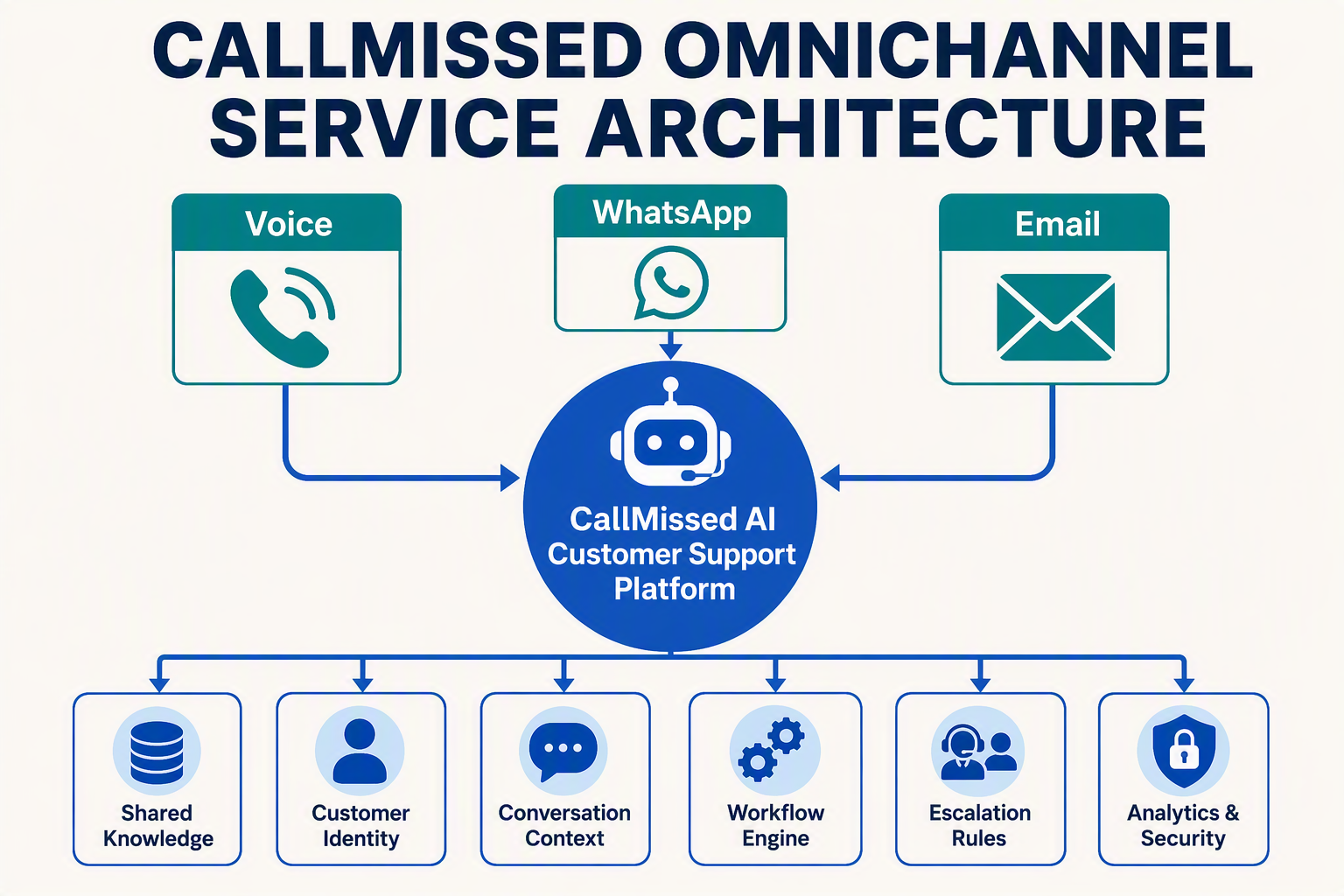
Omnichannel AI customer service is a service architecture in which voice, WhatsApp, and email share customer records, conversation context, approved knowledge, workflows, and escalation policies. CallMissed unifies these channels through AI voice agents, WhatsApp chat and Business calling, email tooling, knowledge-base retrieval-augmented generation (RAG), and an omnichannel inbox/CRM.
One service layer, not three disconnected bots
Traditional multichannel customer service automation gives each channel separate rules and records. A phone bot may know that a delivery is delayed, while the WhatsApp chatbot and email team cannot see the call outcome.
An omnichannel design instead coordinates five layers:
- Identity: Match a phone number, WhatsApp identity, email address, order ID, or CRM record to the appropriate customer.
- Context: Store the customer’s intent, prior messages, completed verification steps, promised actions, and unresolved questions.
- Knowledge: Ground every channel in the same approved policies, product information, and operational data.
- Workflow: Apply consistent business rules for actions such as booking appointments, checking orders, collecting documents, or creating tickets.
- Escalation: Transfer the conversation, transcript, summary, and relevant customer data to a human agent when automation reaches a defined boundary.
This coordination matters because 79% of customers expect consistent interactions across departments, according to Salesforce’s 2023 State of the Connected Customer. Consistency requires shared systems, not merely similar scripts.
How CallMissed connects voice, WhatsApp, and email
CallMissed operates as an AI customer support platform spanning the principal stages of a cross-channel interaction:
- Voice: An AI voice agent can answer inbound calls, capture intent, retrieve knowledge, perform configured workflows, and route exceptions.
- WhatsApp: Businesses can automate chat and connect both inbound and business-initiated WhatsApp Business calls to an AI voice agent.
- Email: Email tooling supports longer-form communication, document collection, campaign activity, and follow-ups that are less suitable for a live call.
- Shared workspace: The omnichannel inbox/CRM gives teams a common operational view instead of forcing agents to monitor isolated channel queues.
- Shared knowledge: Knowledge-base RAG allows an AI support agent to retrieve relevant approved content rather than generate answers from an unconstrained model alone.
CallMissed also supports speech-to-text and text-to-speech across 22 Indian languages, making the architecture practical for businesses serving multilingual customers across India. A customer can speak in a preferred regional language while the underlying case remains part of the same service workflow.
What a unified customer journey looks like
Consider a customer reporting a damaged ecommerce order:
- The customer calls, verifies the order number, and explains the damage.
- The voice agent records the issue and offers to continue on WhatsApp.
- The customer uploads photographs through WhatsApp without repeating the order details.
- The workflow sends an email confirmation containing the case reference and next steps.
- If refund approval requires human judgment, the agent receives the interaction summary, images, verification status, and relevant policy.
This is voice WhatsApp email automation designed around one case rather than separate channel sessions. The conversational AI platform preserves the journey while each channel performs the task it handles most effectively.
The result is not automation for its own sake. Effective customer experience automation gives customers continuity, gives AI bounded authority, and gives human agents enough context to resolve exceptions without restarting the conversation.
Why Is a Cross-Channel Conversational AI Platform Essential in 2026?
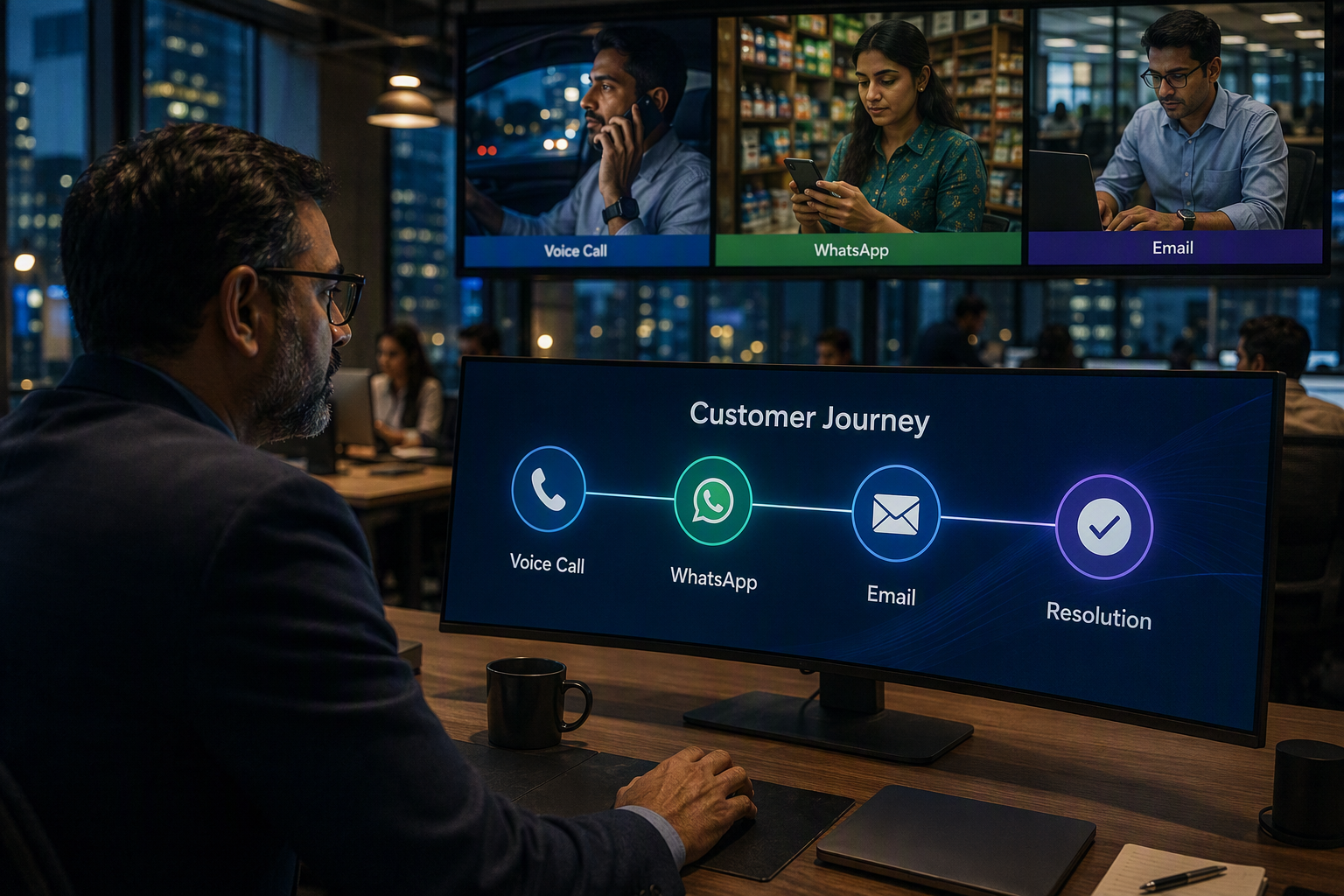
A cross-channel conversational AI platform is essential in 2026 because service quality depends on continuity, not simply channel availability. It turns voice calls, WhatsApp conversations, and emails into one coordinated journey in which identity, intent, case state, knowledge, and escalation history travel with the customer.
Disconnected automation creates operational blind spots
Multichannel customer service automation may reduce workload within individual channels, but separate bots and inboxes can create conflicting answers and incomplete customer records. A voice agent might promise a replacement while a WhatsApp bot still reports the order as delivered, leaving an email representative to reconcile both interactions manually.
Salesforce’s 2023 State of the Connected Customer report found that 56% of customers often have to repeat information to different representatives. That repetition is not merely inconvenient; it signals that the service architecture cannot reliably preserve context.
A cross-channel design establishes common infrastructure for:
- Customer identity: Matching a phone number, WhatsApp profile, email address, and CRM record where permission and confidence allow.
- Conversation state: Recording what the customer requested, what the AI answered, and which actions are pending.
- Approved knowledge: Grounding every channel in the same policies, product data, and operating procedures.
- Workflow status: Tracking authentication, bookings, refunds, document collection, and follow-up tasks.
- Escalation history: Giving human agents the transcript, summary, evidence, and reason for transfer.
Each channel plays a different service role
Effective voice WhatsApp email automation does not force every interaction into the same format. Instead, the architecture uses each channel for what it handles well.
- Voice supports urgent, complex, or emotionally sensitive conversations where rapid clarification matters.
- WhatsApp supports asynchronous updates, structured choices, images, documents, and convenient follow-ups.
- Email supports formal confirmations, detailed explanations, attachments, and durable records.
For example, a customer could report a damaged appliance by phone, receive a WhatsApp request for photographs, and obtain an email containing the approved replacement confirmation. The underlying case remains continuous even though the interaction moves across three channels.
Shared intelligence makes automation dependable
A unified AI customer support platform gives every AI support agent access to common retrieval, policy, and workflow layers. This matters because consistency cannot depend on three separately maintained prompts or knowledge copies.
The platform should determine:
- Which sources are authorised for a given question.
- Whether the customer’s identity must be verified before disclosure.
- Which actions the AI may complete autonomously.
- When low confidence, customer frustration, policy exceptions, or high-risk requests require a human.
- What context can move to another channel under applicable consent and retention rules.
Gartner predicted in June 2025 that agentic AI could autonomously resolve 80% of common customer-service issues by 2029 and reduce operational costs by 30%. Achieving that potential requires governed access to shared data and actions—not independent bots operating without a common case model.
The objective is continuity, not automation volume
Successful customer experience automation should be measured by whether customers reach correct outcomes with less effort. Containment alone can conceal unresolved cases, repeated contacts, and poor handoffs.
CallMissed reflects this cross-channel approach by combining AI voice agents, WhatsApp chat and Business calling, email tooling, an omnichannel inbox, and knowledge-base retrieval. Its support for 22 Indian languages also helps businesses preserve service continuity when customers switch not only channels, but languages during the same journey.
Which Key Developments Are Shaping Voice WhatsApp Email Automation in 2026?
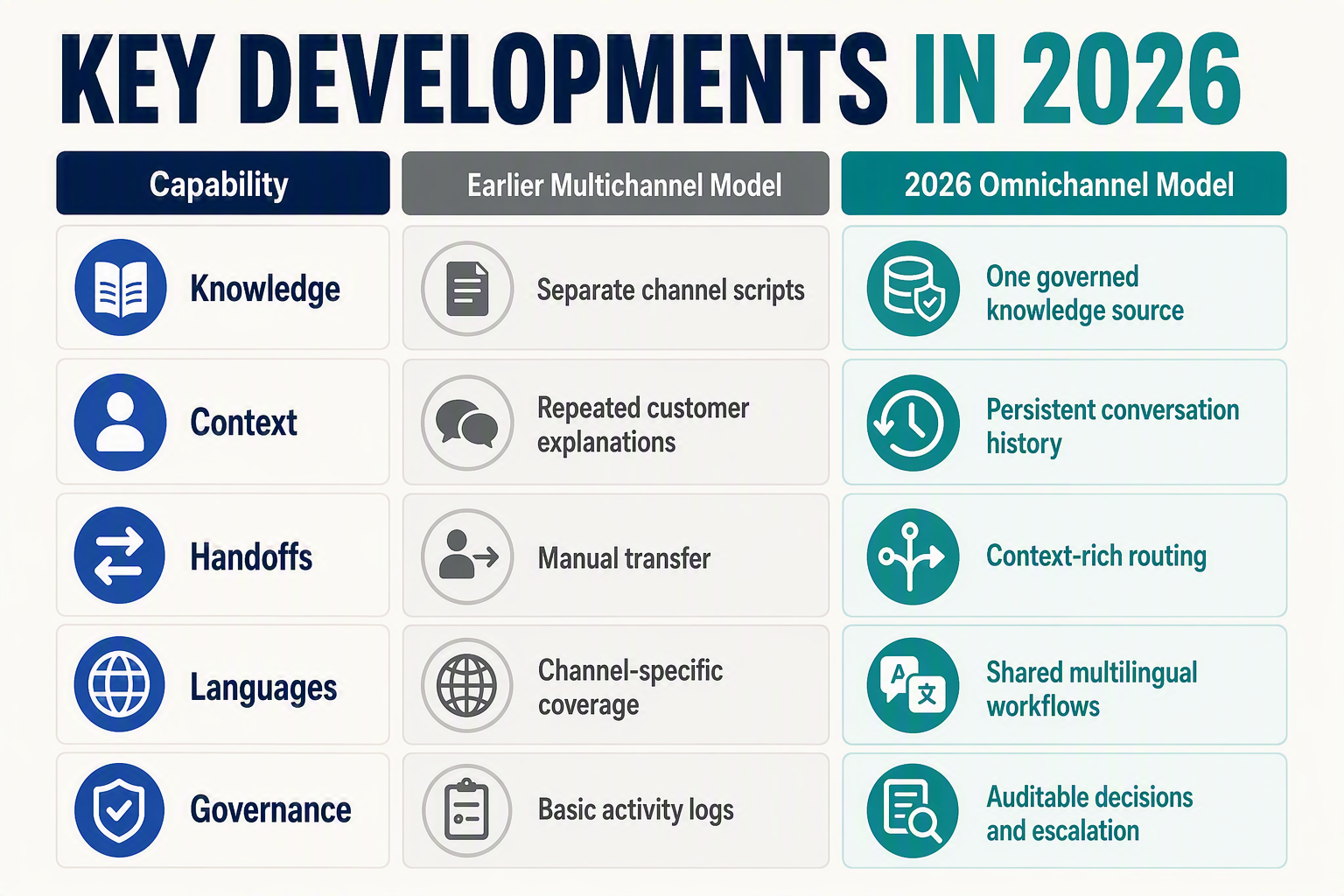
The defining development in 2026 is the move from isolated bots toward cross-channel orchestration. Voice, WhatsApp, and email agents can use common knowledge, workflows, escalation policies, and customer records—but only when the business deliberately integrates those systems. A phone number, WhatsApp identity, and email address do not automatically represent the same person, and context should not cross channels without reliable identity matching, appropriate permissions, and data-governance controls.
Six developments changing service architecture
| 2026 development | What is changing | Operational impact | Architecture requirement |
|---|---|---|---|
| Agentic orchestration | AI agents can classify intent, retrieve approved information, invoke permitted tools, and initiate defined workflows | More routine cases can progress without step-by-step human handling | Least-privilege access, action limits, validation, audit logs, and fallback rules |
| Shared knowledge with RAG | Voice, messaging, and email agents can retrieve answers from the same governed sources | Customers can receive more consistent answers across channels | Central knowledge management, source citations, version control, access rules, and freshness checks |
| WhatsApp Business calling | Eligible WhatsApp Business Platform deployments can support customer-initiated and permission-based business-initiated calls | A conversation can move from chat to voice when an issue is complex, urgent, or easier to discuss | Meta eligibility, customer calling permission where required, call routing, recording notices, and unified case records |
| Persistent cross-channel context | Summaries, intent, verified customer data, and completed actions can travel with a case when systems are integrated | Customers are less likely to repeat information after moving between a call, WhatsApp, and email | Shared case IDs, identity resolution, consent controls, structured state storage, and retention policies |
| Indic multilingual AI | Speech and text systems increasingly support regional-language and code-switched service interactions | Indian businesses can automate more journeys beyond English-only service | Language detection, dialect and code-switch testing, localized knowledge, and language-aware human routing |
| Outcome-based governance | Teams assess resolution quality, accuracy, safety, and handoffs rather than counting only automated interactions | Automation can be managed against customer outcomes and operational risk | Evaluation datasets, quality sampling, escalation analytics, incident review, and policy enforcement |
Automation is becoming action-oriented
A modern AI support agent can do more than generate an answer. With controlled system access, it may check an order, schedule an appointment, collect missing details, update an approved CRM field, or prepare a case for a specialist. Each action still needs authorization boundaries, input validation, retry limits, monitoring, and a clear escalation path.
In June 2025, Gartner forecast that agentic AI could autonomously resolve 80% of common customer-service issues by 2029 and reduce operational costs by 30%. These figures are a forecast, not measured 2026 results or a guaranteed outcome. Actual performance depends on issue complexity, data quality, system integration, customer acceptance, and the controls placed around automated actions.
WhatsApp is expanding from messaging to calling
WhatsApp’s business-service role is no longer limited to text conversations. Meta’s WhatsApp Business Platform Calling API documentation covers customer-initiated calls and business-initiated calls after the customer grants the required calling permission. Availability remains subject to Meta’s account, country, technical, and policy requirements.
In a configured CallMissed deployment, WhatsApp chat, supported WhatsApp calling, AI voice workflows, and human escalation can operate within a broader omnichannel AI customer service architecture. The AI handling of a call comes from the connected service platform; it is not a native WhatsApp AI capability.
A governed handoff could work as follows:
- A customer asks an order question in WhatsApp.
- The workflow determines that spoken verification or further discussion is needed.
- Subject to eligibility and customer permission, the interaction moves to a WhatsApp call.
- The permitted transcript or summary, verification result, and unresolved issue are attached to the same case.
- A human agent receives that history if escalation is required.
Recording, transcription, retention, and cross-channel reuse must follow applicable privacy and telecommunications rules. Businesses should provide required notices and avoid transferring sensitive information merely because the channels are technically connected.
Multilingual consistency is becoming an architectural requirement
For India, multilingual service must work across speech and text rather than being treated as a separate translation feature. CallMissed documents Speech-to-Text and Text-to-Speech support across 22 Indian languages. Actual language, voice, dialect, and code-switch performance can vary by configured model and channel, so businesses should confirm availability and test representative conversations before deployment.
The practical benchmark for voice WhatsApp email automation in 2026 is therefore not whether every channel contains an AI feature. It is whether the conversational AI platform, its integrations, and its governance controls can preserve meaning, permissions, history, and accountability when a customer changes language, channel, or service agent.
How Do Shared Knowledge, Consistent Answers, and Persistent Conversation Context Work?
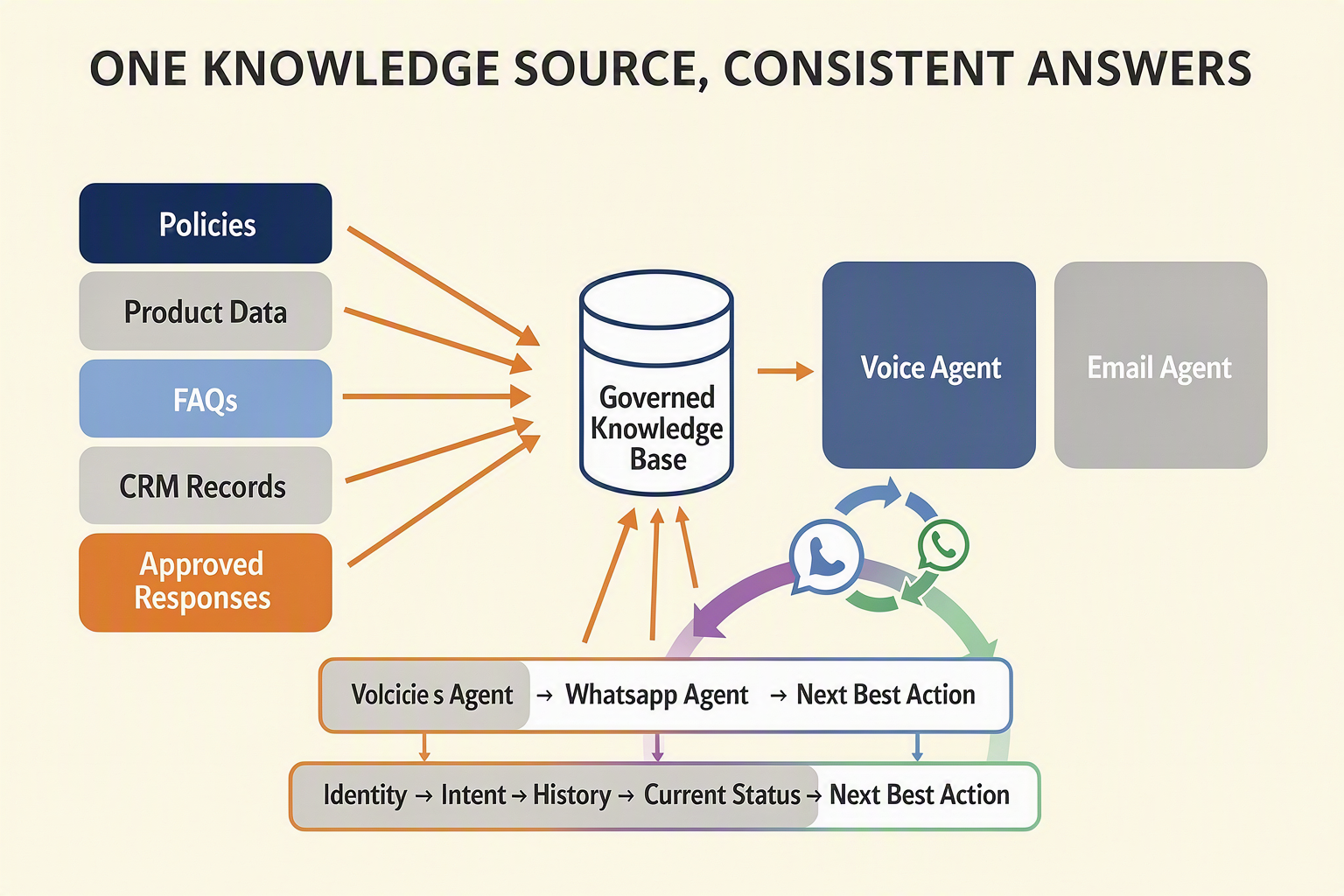
Shared knowledge supplies every channel with the same approved facts, while persistent conversation context stores what the customer has already said, what the system has done, and what should happen next. Together, these layers let voice, WhatsApp, email, and human agents provide consistent—not mechanically identical—answers without making customers restart the conversation.
One governed knowledge layer for every channel
An omnichannel architecture should separate knowledge from channel-specific interfaces. Instead of maintaining one FAQ for voice, another for WhatsApp, and separate email templates, the business creates a canonical repository containing policies, product information, operating procedures, and approved responses.
A retrieval-augmented generation (RAG) workflow then operates in four steps:
- The AI support agent identifies the customer’s intent and relevant attributes.
- The system retrieves permitted passages from the shared knowledge base.
- The model generates an answer grounded in those passages.
- The platform records the sources, knowledge version, action, and outcome.
Knowledge should carry metadata such as language, product, geography, audience, effective date, expiry date, and access permissions. For example, an enterprise refund policy should not be retrieved for a retail customer, while an expired delivery promise should automatically leave the active index.
CallMissed combines knowledge-base RAG with AI voice agents, WhatsApp interactions, email tooling, and an omnichannel inbox. That shared layer allows a policy update to inform multiple service surfaces without manually rewriting every conversational flow.
Consistency means one policy, adapted to each medium
Consistent answers do not require identical scripts. A voice response should be concise and easy to understand when heard once; WhatsApp can use buttons, lists, or document links; email can provide a detailed summary and formal attachment.
The underlying decision must nevertheless remain stable:
- Voice: “Your return is eligible until 18 August.”
- WhatsApp: Shows the same deadline with a return-confirmation action.
- Email: Summarises the same eligibility decision and next steps.
- Human inbox: Displays the policy passage used to reach that decision.
This matters because 56% of customers often need to repeat information to different representatives, according to Salesforce’s 2023 State of the Connected Customer report. Salesforce also found in 2023 that 79% of customers expect consistent interactions across departments.
Teams can reduce contradictions through version-controlled content, approval workflows, effective dates, source citations, retrieval testing, and fallback rules that prevent an uncertain model from improvising.
Persistent context is structured state, not just a transcript
A full transcript is useful for auditing, but reliable omnichannel AI customer service also needs a compact, structured case state. That state can include:
- Verified customer identity and channel identifiers
- Current intent, order or case number, and issue status
- Facts supplied by the customer
- Authentication, consent, and verification status
- Actions completed, promised, or awaiting approval
- Attachments, summaries, sentiment signals, and escalation reason
- The next responsible agent or workflow step
Consider a customer who reports a damaged order by phone, receives a WhatsApp upload request, and emails the invoice. The conversational AI platform should link those events to one case, preserve the original intent, and expose the document to an authorised human agent. If identity matching is uncertain, the system should ask for verification rather than merge records based only on a similar name or phone number.
Persistent context therefore turns voice WhatsApp email automation into coordinated service: every channel receives the minimum relevant history, access controls limit sensitive data, and escalation includes both a readable summary and the evidence needed to continue safely.
How Should an AI Support Agent Hand Off Conversations and Escalate to Humans?
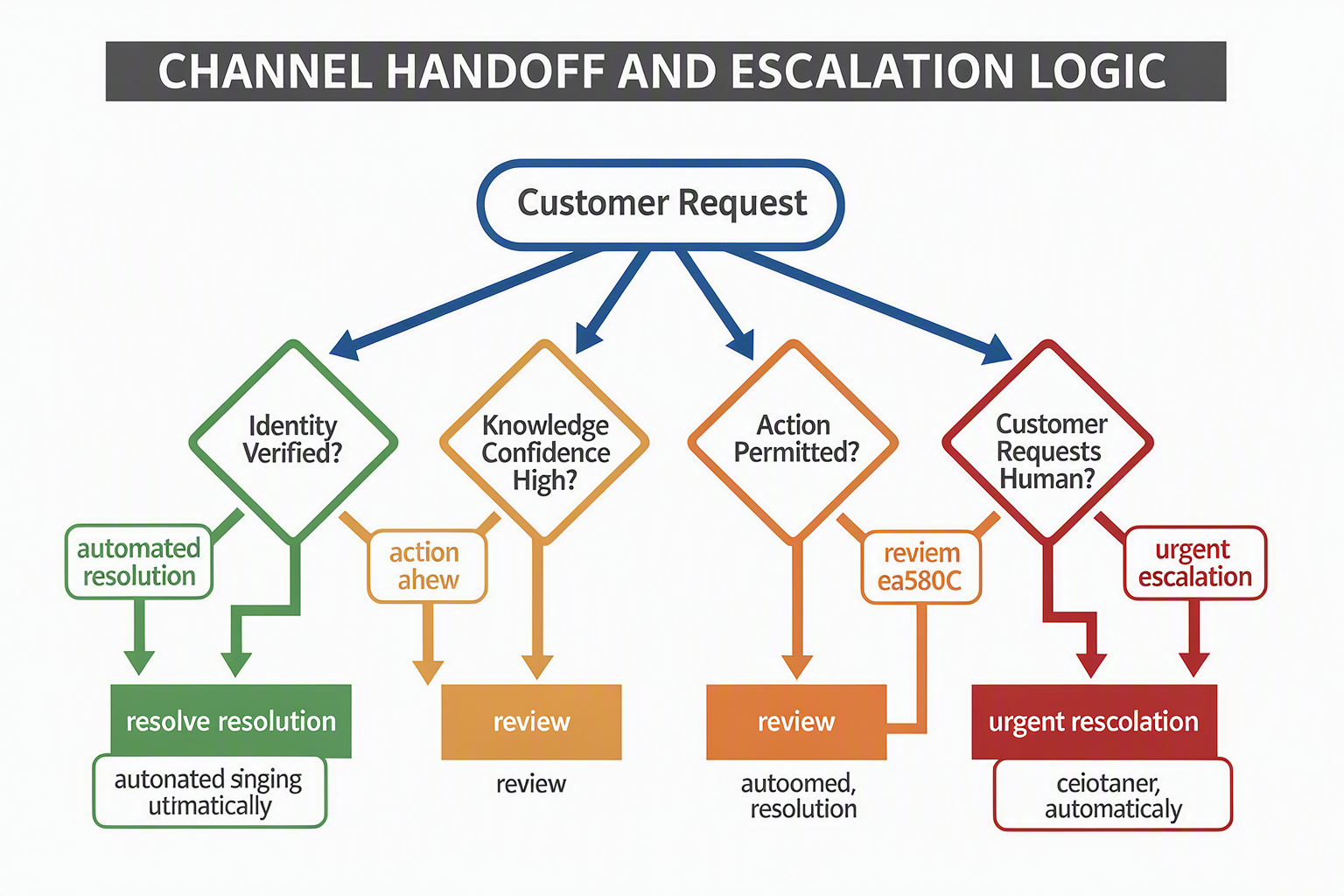
An AI support agent should escalate whenever confidence, authority, safety, or customer preference exceeds its permitted operating boundary. The handoff must transfer the full case—not merely redirect the customer—so the human receives the conversation history, verified identity, detected intent, actions already taken, and recommended next step.
Define explicit escalation triggers
Gartner predicted in June 2025 that agentic AI will autonomously resolve 80% of common customer-service issues by 2029, but the remaining cases will often be the most sensitive or ambiguous. A reliable escalation policy should therefore combine deterministic rules with model-confidence thresholds.
Escalate when:
- The customer requests a person, without repeatedly asking them to continue with automation.
- Confidence falls below an approved threshold after clarification attempts.
- The request involves refunds above a limit, contract changes, account closure, legal threats, fraud, safety, or regulated advice.
- Identity verification fails or the customer disputes account information.
- A required system is unavailable, preventing the agent from completing the promised action.
- Sentiment signals indicate severe frustration, vulnerability, or urgency.
- The interaction exceeds a defined turn count or resolution time.
High-risk triggers should be rule-based rather than left solely to a language model. If the system cannot determine whether an action is authorised, it should fail closed and involve a qualified employee.
Send a structured handoff packet
A strong escalation creates a machine-readable handoff packet that follows the case across voice, WhatsApp, and email. It should include:
- Customer identity: verified phone number, email address, customer ID, and verification status.
- Conversation summary: the issue, desired outcome, sentiment, language, and urgency.
- Channel history: relevant call transcripts, WhatsApp messages, email threads, and attachments.
- Completed actions: lookups, authentication steps, troubleshooting, bookings, or workflow updates.
- Evidence and sources: knowledge-base passages used and any conflicting information discovered.
- Recommended next action: the queue, specialist, approval, or system operation required.
The summary must supplement—not replace—the original transcript. Human agents need access to source messages when wording, consent, or chronology matters.
Choose the right handoff mode
Escalation does not always require an immediate live transfer. The conversational AI platform should select a mode based on urgency and staff availability:
- Warm transfer: brief the employee before connecting a live voice or WhatsApp Business call.
- Live messaging takeover: pause automation and assign the WhatsApp conversation in the shared inbox.
- Asynchronous case: create a ticket, confirm the expected response window, and continue by email or WhatsApp.
- Specialist escalation: route billing, technical, compliance, or language-specific cases to an authorised queue.
- Emergency path: present approved instructions and transfer immediately under predefined safety rules.
CallMissed can bridge WhatsApp Business calls to an AI voice agent while preserving the related interaction in its omnichannel inbox, helping businesses coordinate automated and human handling across channels.
Measure handoff quality, not just containment
A low escalation rate is not automatically success. Teams should track time to human acceptance, transfer failures, repeat explanations, post-handoff resolution, re-escalation, customer abandonment, and incorrect containment. Review sampled transcripts by channel, language, intent, and risk category; then refine thresholds when agents escalate too early, too late, or without sufficient context.
How Do Multilingual Support and Multichannel Customer Service Automation Fit into Workflow Design?
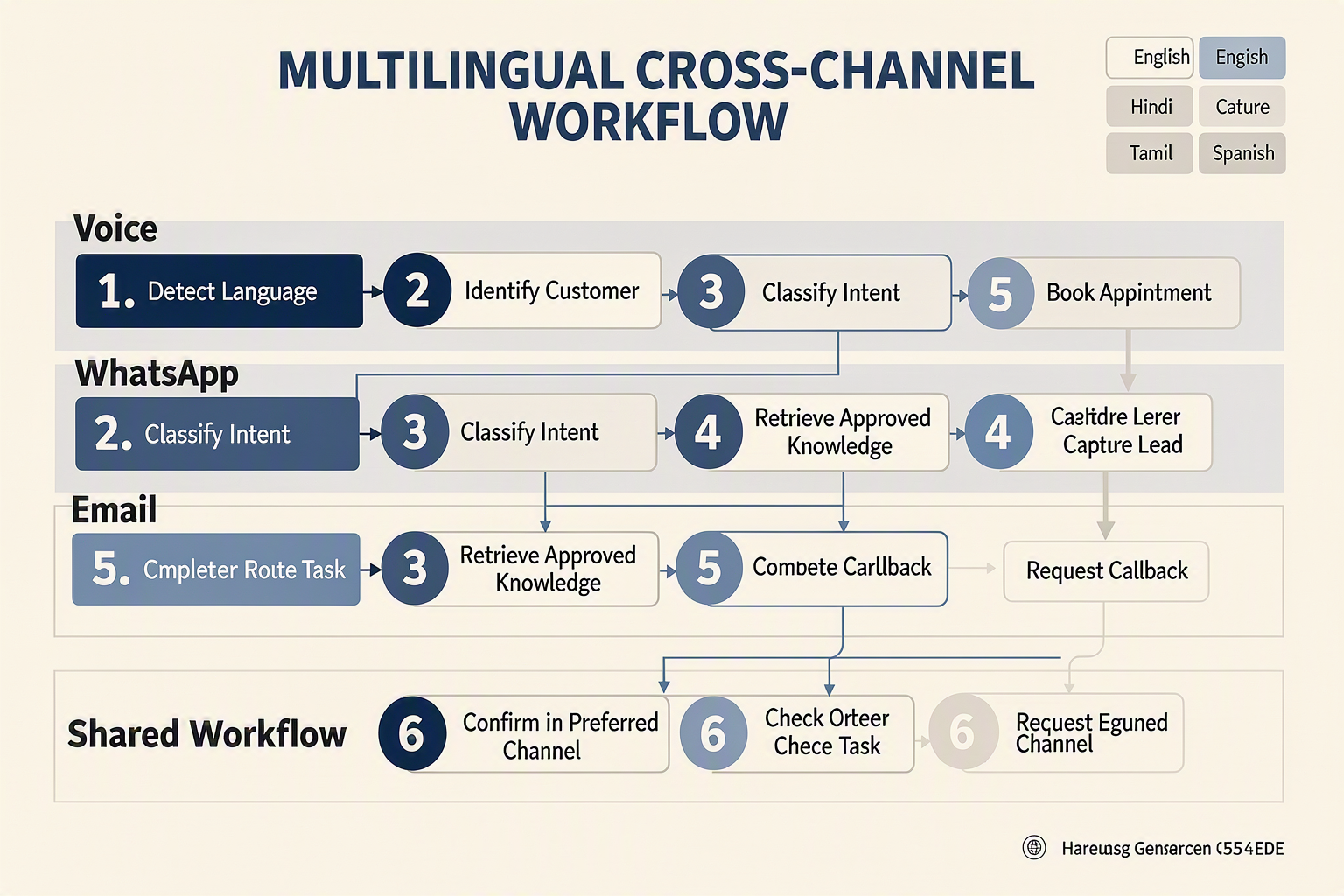
Multilingual support should be designed as a workflow capability, not as a translation layer added separately to each channel. An effective omnichannel system detects or confirms language, stores that preference with the customer record, retrieves approved language-specific knowledge, and preserves the same intent and case state across voice, WhatsApp, and email.
Treat language and channel as separate workflow dimensions
Language choice should not determine what the customer can accomplish. A Hindi-speaking customer calling about a return should receive the same policy and workflow available to an English-speaking customer using WhatsApp.
Store a structured conversation profile containing:
- Customer identity and preferred language.
- Current channel, intent, case ID, and workflow state.
- Detected language and confidence score.
- Previous messages, call summaries, and submitted documents.
- Consent, authentication status, and escalation history.
- Relevant locale, currency, date, address, and numbering formats.
This design prevents channel-specific bots from making conflicting assumptions. It also allows an AI support agent to change the communication format without losing the underlying task state.
CallMissed supports voice and chat across 22 Indian languages, according to CallMissed’s product documentation. That Indic-first coverage is particularly relevant when a single Indian business serves customers who move between English, Hindi, Tamil, Bengali, Marathi, Telugu, and other regional languages.
Build language-aware routing into every stage
A practical multichannel customer service automation workflow can follow five steps:
- Detect and confirm: Infer the language from speech or text, but ask the customer to confirm when confidence is low.
- Normalise the intent: Map equivalent phrases in different languages to a channel-independent intent such as
ORDER_STATUSorPAYMENT_DISPUTE. - Retrieve approved knowledge: Query the same governed knowledge base while applying the correct language, product, region, and policy filters.
- Generate for the channel: Produce concise speech for voice, scannable messages for WhatsApp, or a structured response for email.
- Record the outcome: Save the resolved intent, actions, citations, language, and summary to the shared case timeline.
This separates meaning from presentation. The workflow engine determines what must happen; the conversational AI platform adapts how the answer is delivered.
Preserve meaning during handoffs and escalation
Cross-language handoffs need more than a raw transcript. Before transferring a conversation, the system should create a structured summary containing the customer’s original language, translated intent, verified facts, actions already attempted, unresolved questions, and recommended next step.
Escalate when:
- Language-detection or speech-recognition confidence falls below a tested threshold.
- The customer repeatedly reformulates the same request.
- Translation could materially affect a legal, financial, medical, or safety outcome.
- The requested language lacks an approved knowledge article or qualified human queue.
- Sentiment, urgency, or account risk exceeds defined limits.
For example, a customer may begin a warranty claim through a Marathi voice call, receive the document request on WhatsApp, and email an invoice. Voice WhatsApp email automation should attach all three interactions to one case rather than translate and process them independently.
Measure parity, not just automation volume
An AI customer support platform should report outcomes by both language and channel. Track containment, task completion, retrieval accuracy, speech-recognition confidence, escalation rate, repeat-contact rate, and human correction rate for every supported language.
The objective of customer experience automation is not identical wording everywhere. It is equivalent policy, preserved context, and comparable service quality across languages and channels—the foundation of trustworthy omnichannel AI customer service.
Which Analytics, Security Controls, and Governance Questions Should Teams Address?
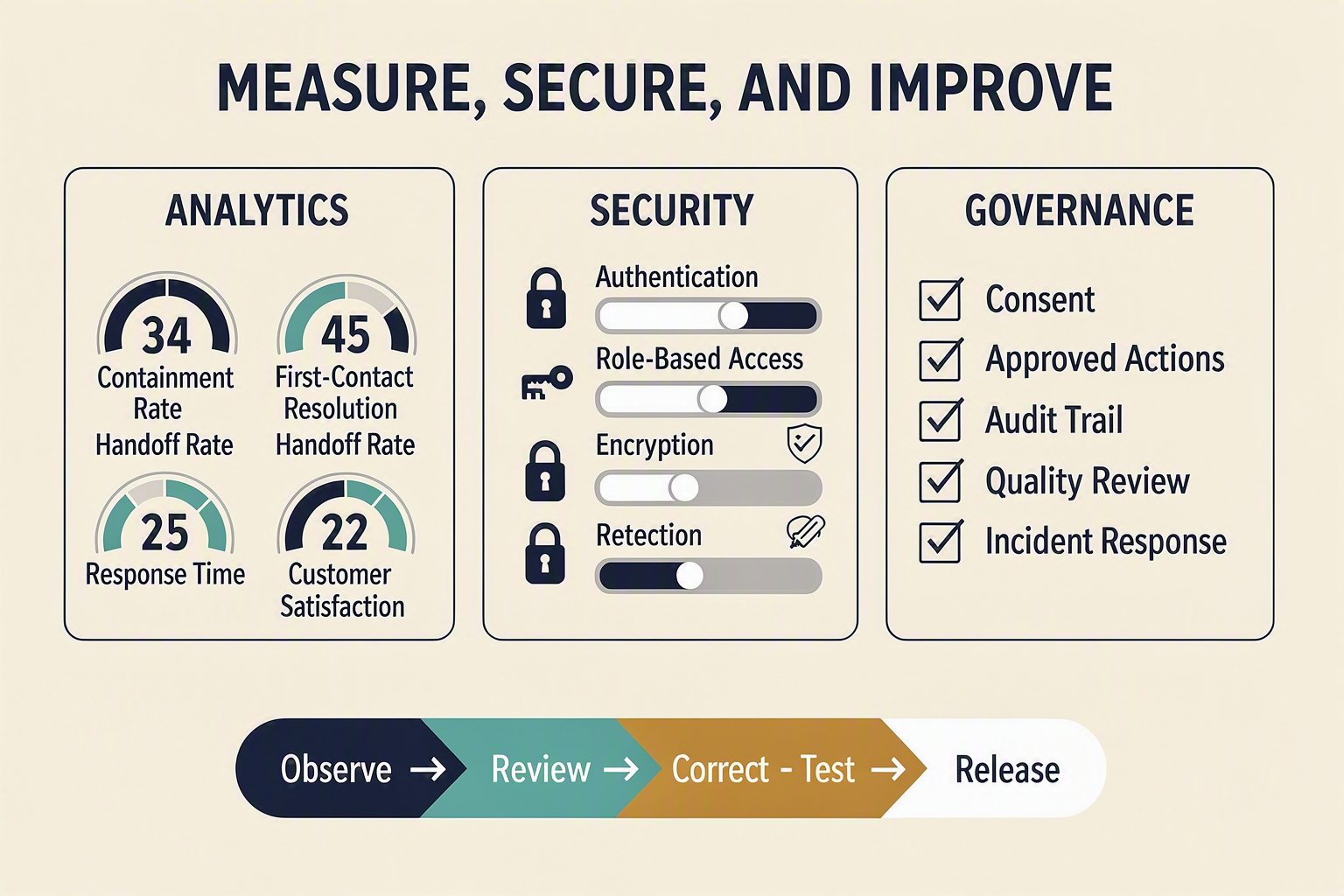
Teams should measure customer outcomes across the complete journey, secure every data transition, and assign named owners for AI decisions. Governance must cover what the AI can access, which actions require approval, how incidents are investigated, and when a human must take control.
Build one cross-channel analytics model
Channel-level dashboards can hide broken journeys. A WhatsApp bot may report high containment even though customers later call because its answer was incomplete. An omnichannel AI customer service dashboard should therefore connect interactions through a privacy-aware customer or case identifier.
Track at least these measures:
- Resolution rate: Percentage of cases solved without reopening or repeat contact within a defined period.
- First-contact resolution: Cases completed during the initial interaction, regardless of whether it began by voice, WhatsApp, or email.
- Containment rate: Interactions resolved by the AI without human intervention; report this alongside customer satisfaction and repeat-contact rates.
- Handoff completion: Percentage of escalations accepted by a human with the transcript, intent, customer details, and relevant documents intact.
- Knowledge-grounding rate: Answers supported by an approved source, including the source version used.
- Latency: Measure median, p95, and p99 response times separately for speech recognition, model inference, text-to-speech, and external tools.
- Cost per resolved case: Include model, telephony, messaging, email, integration, and human-handling costs.
Segment results by language, intent, channel, customer type, model version, and workflow version. This helps expose cases where an overall average conceals poor performance for a regional language or complex intent.
Apply security controls at every layer
Security should follow least privilege, not assume that every AI support agent needs unrestricted CRM access. NIST published AI Risk Management Framework 1.0 in January 2023, organising AI risk work around the Govern, Map, Measure, and Manage functions. ISO published ISO/IEC 42001 in December 2023 as an AI management-system standard for organisations operating or providing AI systems.
Ask the following security questions:
- Is data encrypted in transit and at rest?
- Are passwords, payment details, identity documents, and health information redacted before model processing or analytics storage?
- Can tools retrieve only the records required for the current customer and task?
- Which employees can replay recordings, inspect transcripts, export data, or change prompts?
- Are retention periods defined separately for calls, recordings, transcripts, WhatsApp messages, emails, attachments, and audit logs?
- Can prompt injection, malicious attachments, or retrieved knowledge cause an unauthorised tool action?
- Are vendor subprocessors, model locations, deletion procedures, and breach-response obligations documented?
A platform such as CallMissed should be configured with role-based access, scoped knowledge, controlled workflows, and auditable channel histories rather than treating shared context as unrestricted access.
Establish governance before expanding autonomy
Create a register for every deployed use case containing its owner, purpose, data classes, permitted actions, model, knowledge sources, escalation path, and approval date. High-impact actions—refunds, cancellations, account changes, financial commitments, and sensitive disclosures—should have explicit thresholds or human approval.
Governance reviews should test:
- Answer consistency across voice, WhatsApp, and email.
- Consent and communication permissions by channel and jurisdiction.
- Bias and multilingual quality using representative accents, scripts, and code-switching.
- Incident traceability, including prompt, model, retrieval source, tool call, and final response.
- Rollback readiness when a model, prompt, integration, or knowledge update degrades performance.
The central governance principle is simple: automation authority should never exceed observability, accountability, and recovery capability.
What Do Customer Experience Automation Experts Recommend, and What Are the Business Implications?

Customer experience automation experts recommend treating AI as a shared service architecture, not as separate voice, WhatsApp, and email bots. The business implication is significant: value comes from redesigning knowledge, workflows, ownership, and escalation—not merely reducing the number of human-handled conversations.
Build around journeys, not channels
A practical expert-led approach starts with customer journeys such as order tracking, appointment changes, document collection, returns, and payment queries. Each journey should use one approved policy and case record regardless of where the interaction begins.
This distinction separates omnichannel AI customer service from conventional multichannel customer service automation. In an omnichannel model:
- Voice, WhatsApp, and email share customer identity and case status.
- An AI support agent retrieves answers from the same governed knowledge base.
- Handoffs include the transcript, intent, completed actions, and unresolved question.
- Customers can change channels without restarting the process.
- Human agents can see what the AI said, used, and attempted.
This architecture directly addresses a documented experience gap: 56% of customers often have to repeat information to different representatives, according to Salesforce’s 2023 State of the Connected Customer report.
Automate bounded work before open-ended decisions
Experts generally recommend beginning with frequent, low-risk tasks that have clear completion criteria. Examples include confirming business hours, checking an order status, rescheduling an appointment, or collecting required documents.
Higher-risk requests should trigger validation or human review. Businesses can classify workflows into three operating modes:
- Autonomous: The AI answers or completes an approved, reversible action.
- Supervised: The AI prepares a response or action for agent approval.
- Escalated: A person takes control when policy, confidence, sentiment, or risk thresholds are crossed.
This measured approach matters because Gartner predicted in June 2025 that agentic AI could autonomously resolve 80% of common customer-service issues by 2029 and reduce operational costs by 30%. Those gains depend on safe workflow design; an ambitious containment target without quality controls can simply move costs into complaints, rework, and churn.
Treat escalation as a product capability
Escalation should not mean forwarding a transcript into an unattended queue. A well-designed conversational AI platform should pass a structured handoff package containing:
- Verified identity and preferred language
- Customer intent and urgency
- Relevant conversation history
- Knowledge sources already consulted
- Actions completed or attempted
- Reason for escalation
- Recommended next step
CallMissed supports this cross-channel model through AI voice agents, WhatsApp chat and Business calling, email tooling, knowledge-base RAG, and an omnichannel inbox. For Indian businesses, support across 22 Indian languages also makes language selection part of workflow and escalation design rather than a separate deployment.
Prepare for organisational consequences
Implementing voice WhatsApp email automation changes responsibilities across service, operations, compliance, and IT. Businesses should expect to create new ownership for knowledge freshness, prompt and workflow changes, AI-quality reviews, access permissions, and incident response.
The strongest business case therefore measures more than deflection. Leaders should track first-contact resolution, repeat-contact rate, successful handoffs, policy compliance, customer effort, latency, and cost per resolved case. An AI customer support platform creates durable value when automation improves resolution and continuity—not when it merely closes more conversations without proving that the customer’s problem was solved.
What Does This Mean for You? Rollout Phases, Owners, KPIs, and Related CallMissed Guides
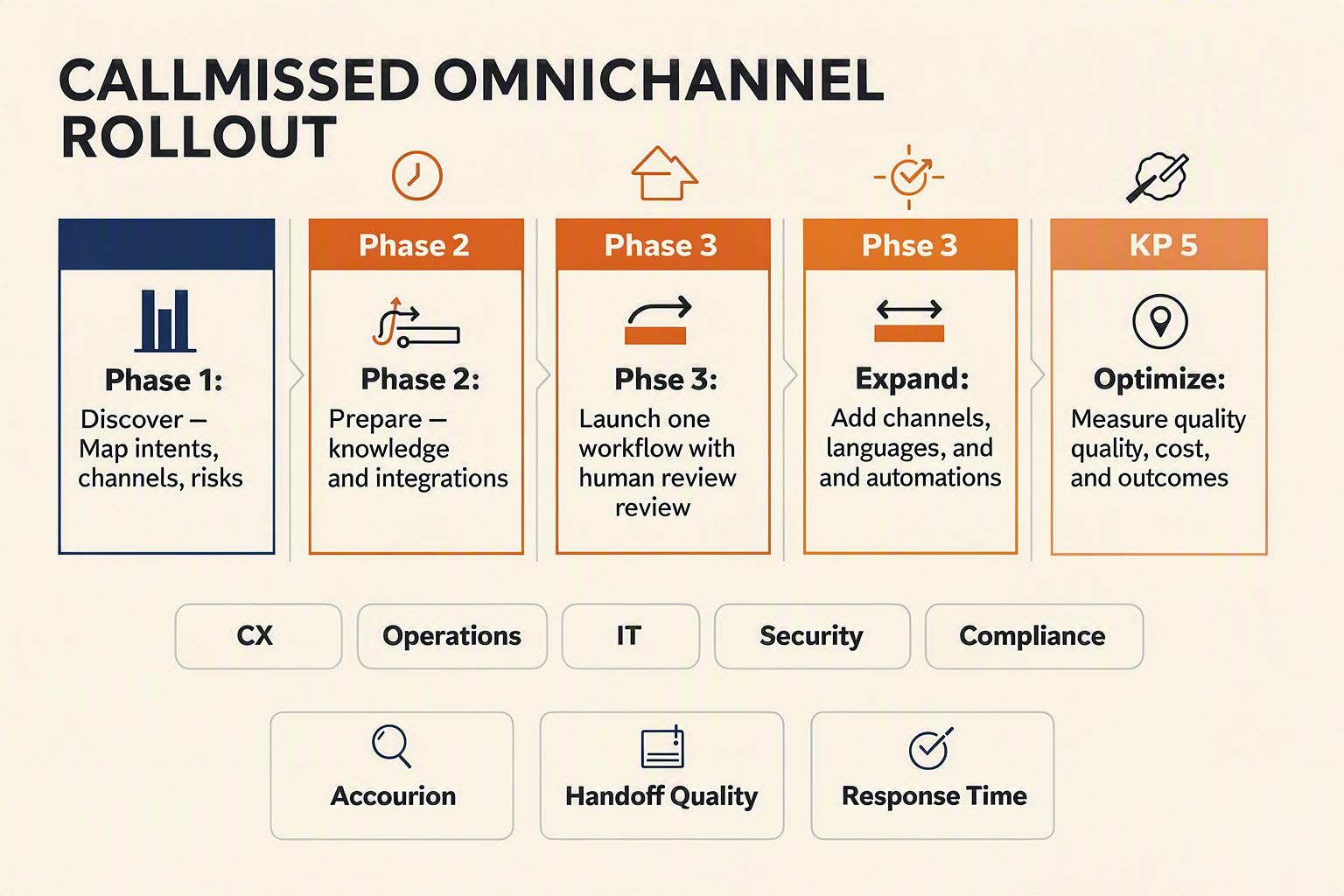
Roll out omnichannel AI customer service in controlled phases, with one accountable owner per phase and measurable exit criteria before expanding automation. Start with shared knowledge and low-risk intents, validate context and escalation, then add channels, languages, and more complex workflows.
Recommended rollout plan
| Phase | Scope | Accountable owner | Primary KPIs | Exit gate |
|---|---|---|---|---|
| 1. Baseline and governance | Map intents, customer identities, consent, retention, and current channel performance | Customer service leader | Resolution rate, repeat-contact rate, CSAT, escalation rate | Baselines documented; high-risk intents and prohibited actions approved |
| 2. Shared knowledge pilot | Connect approved FAQs, policies, product data, and retrieval rules to the AI support agent | Knowledge manager | Grounded-answer rate, retrieval accuracy, unsupported-answer rate | Test questions return approved, cited answers; unknowns escalate safely |
| 3. Single-channel launch | Automate a narrow set of low-risk voice, WhatsApp, or email intents | Channel operations owner | Containment, latency, abandonment, human override rate | KPI thresholds hold during a defined monitoring period |
| 4. Cross-channel handoffs | Preserve identity, summaries, attachments, intent, and prior actions between channels | CRM or integration owner | Context-transfer success, repeated-information rate, handoff completion | Agents receive usable summaries and customers do not need to restart |
| 5. Controlled expansion | Add languages, campaigns, transactional workflows, and higher-volume use cases | Programme owner | Cost per resolution, CSAT, language-level accuracy, compliance exceptions | Performance remains within approved thresholds by channel and language |
| 6. Continuous optimisation | Review transcripts, update knowledge, test prompts, and audit permissions | AI operations owner | Regression pass rate, knowledge freshness, incident rate, outcome trends | Monthly review cadence and rollback procedures are operational |
Targets should be based on the organisation’s measured baseline rather than generic industry promises. However, the strategic direction is clear: Gartner predicted in June 2025 that agentic AI could autonomously resolve 80% of common customer-service issues by 2029 and reduce operational costs by 30%.
Assign ownership across the service architecture
A rollout fails when “AI” belongs to everyone but no outcome belongs to anyone. Establish a lightweight operating model:
- Executive sponsor: owns customer outcomes, budget, and acceptable risk.
- Service operations: defines intents, escalation paths, service levels, and human staffing.
- Knowledge owner: approves source material, expiry dates, and answer changes.
- IT and integration: manages identity resolution, CRM events, APIs, and channel handoffs.
- Security, privacy, and compliance: approves permissions, retention, consent, and audit controls.
- AI operations: monitors conversations, investigates failure patterns, and runs regression tests.
This governance matters because Salesforce reported in its 2023 State of the Connected Customer that 79% of customers expect consistent interactions across departments. Consistency must therefore be an owned operating metric, not merely a feature of a conversational AI platform.
Build a practical KPI scorecard
Measure the complete customer journey rather than maximising containment alone:
- Outcome: first-contact resolution, repeat contacts, CSAT, and task completion.
- AI quality: grounded-answer rate, unsupported claims, intent accuracy, and retrieval failures.
- Continuity: successful context transfers, duplicated questions, and abandoned handoffs.
- Operations: response latency, queue time, cost per resolved case, and agent workload.
- Risk: consent failures, unauthorised data access, policy exceptions, and escalation misses.
CallMissed can support this phased model through shared knowledge-base RAG, an omnichannel inbox, AI voice agents, WhatsApp chat and Business calling, email tooling, and 22 Indian languages.
Continue with the relevant implementation guide
- Knowledge Base Guide for AI Voice, WhatsApp, and Email Agents
- Lead Capture Workflow: Phone to WhatsApp to Email
- Multilingual WhatsApp and Voice Deployment Guide for India
- 22 Indian Languages: Voice AI Testing and Deployment Guide
- Outbound Calling Compliance Guide
Frequently Asked Questions About Choosing and Operating an Omnichannel AI Customer Service Platform
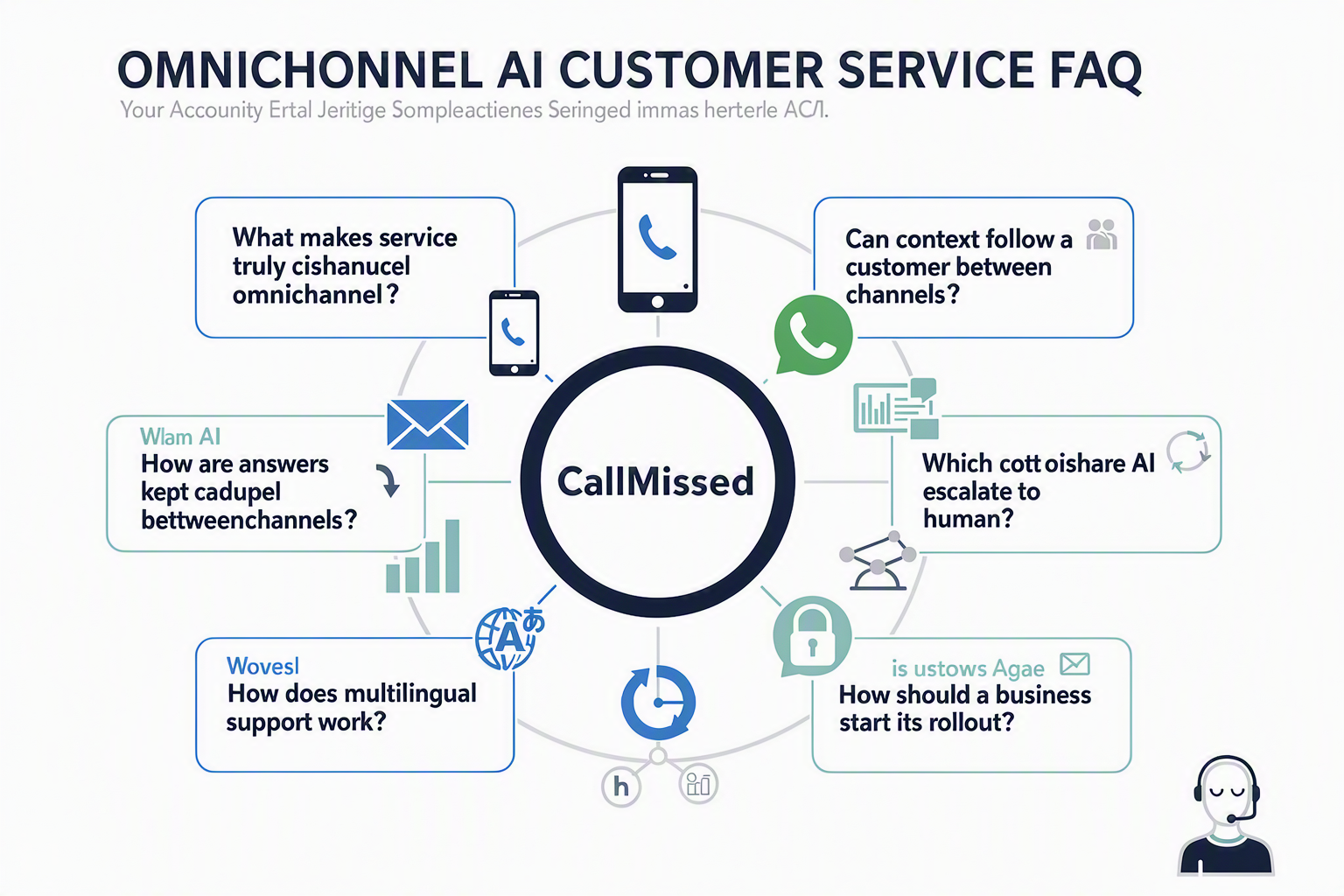
Platform Selection and Architecture
How do I choose an omnichannel AI customer service platform in 2026?
What is the difference between omnichannel AI customer service and multichannel customer service automation?
How does a shared knowledge base keep AI answers consistent across voice, WhatsApp, and email?
Operations, Governance, and Measurement
How should omnichannel AI customer service preserve context during channel handoffs and human escalation?
Can one customer-service AI platform support Indian languages across voice and WhatsApp?
Which security controls and metrics are essential when operating omnichannel customer-service AI?
Conclusion
Omnichannel AI customer service in 2026 is not about adding more automated channels; it is about making every interaction part of one continuous, governed conversation. A connected conversational AI platform should give voice, WhatsApp, and email access to the same customer history, approved knowledge, workflows, consent records, and escalation rules.
The case for that architecture is clear. WhatsApp surpassed 3 billion monthly active users, according to Meta’s Q1 2025 earnings announcement. Salesforce’s 2023 State of the Connected Customer report found that 79% of customers expect consistent interactions across departments, while 56% often have to repeat information. Those expectations cannot be met by isolated multichannel customer service automation, even when each individual channel uses AI.
The key takeaways for service leaders are:
- Build one shared knowledge layer. Every AI support agent should retrieve consistent, source-grounded answers across phone calls, WhatsApp conversations, and email threads.
- Preserve context through every handoff. Identity, intent, prior messages, collected documents, and completed workflow steps should follow the customer when the channel changes or a human agent takes over.
- Treat escalation as a core workflow. Effective customer experience automation must recognise uncertainty, risk, permissions, and customer requests for human assistance rather than pursuing automation at any cost.
- Deploy and measure in controlled phases. Track containment, resolution, latency, handoff quality, customer outcomes, security, retention, and auditability before expanding voice WhatsApp email automation.
The next development to watch is the shift toward more autonomous service operations. Gartner predicted in June 2025 that agentic AI will resolve 80% of common customer-service issues autonomously by 2029 and could reduce operational costs by 30%. Reaching that potential will depend on reliable shared context and governance—not merely more capable models.
CallMissed provides an AI customer support platform combining voice agents, WhatsApp chat and Business calling, email tooling, an omnichannel inbox, knowledge-base RAG, and support for 22 Indian languages. To explore how connected AI communication is evolving, visit CallMissed—and ask: can every channel in your service operation understand what happened before and determine what should happen next?
Related Reading
Discussion
Related Posts

Ready to automate customer conversations?
Launch AI voice agents and WhatsApp bots with CallMissed — one API, 22+ Indian languages.