
AI Phone Answering for Restaurants: 2026 Implementation Guide


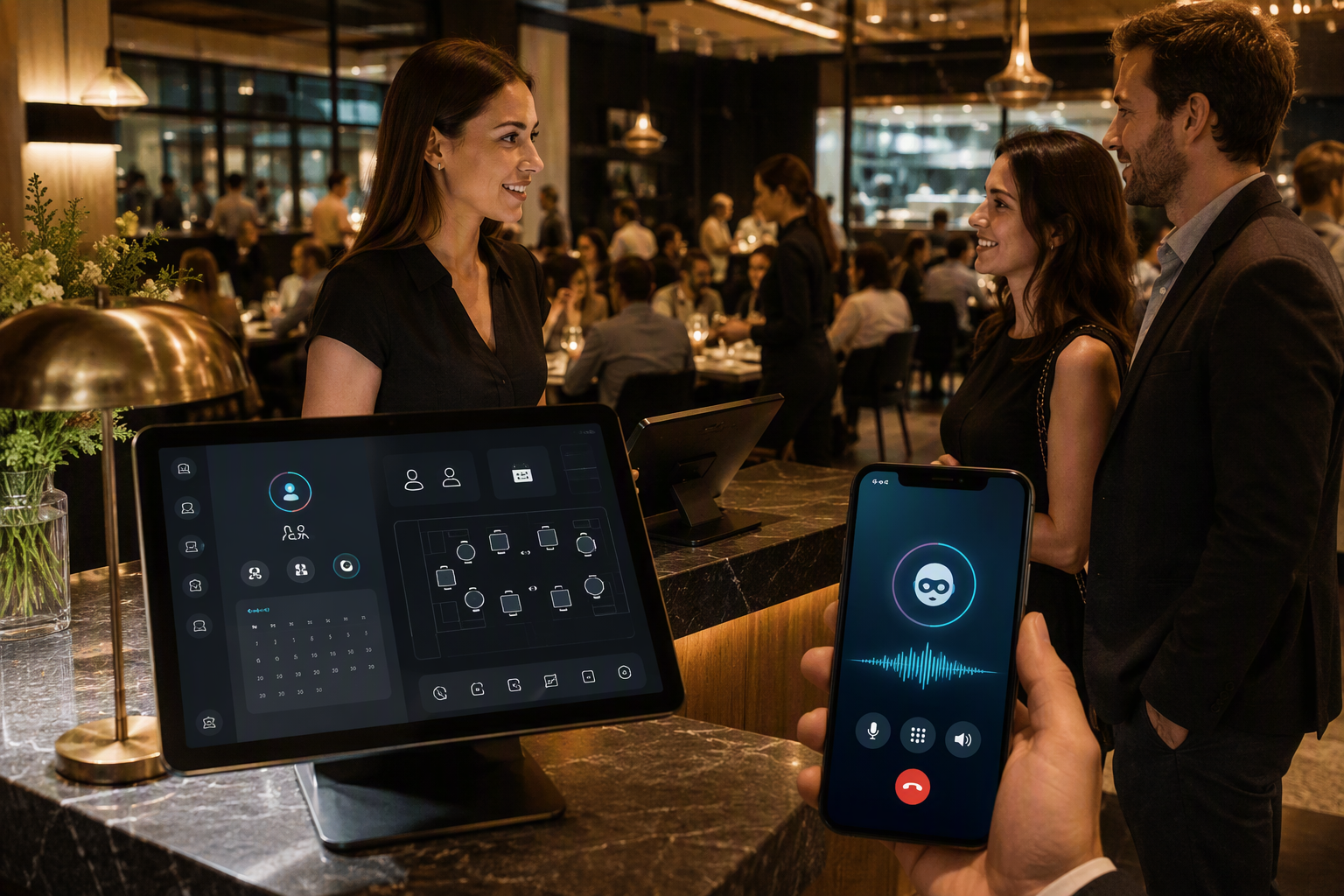
Deploy AI phone answering for restaurants with safer bookings, missed-call recovery, verified integrations, human handoffs and clear metrics.
AI Phone Answering for Restaurants: 2026 Implementation Guide
What happens when a hungry customer calls during the dinner rush and nobody answers? AI phone answering for restaurants can turn that missed call into a confirmed table, a takeaway enquiry or a WhatsApp follow-up—without forcing front-of-house staff to step away from guests.
The opportunity is substantial. The National Restaurant Association of India’s India Food Services Report 2024 valued India’s food-services market at ₹5.69 lakh crore and projected it to reach ₹7.76 lakh crore by 2028. At the same time, customers increasingly expect businesses to respond on familiar digital channels. Meta CEO Mark Zuckerberg reported in April 2025 that WhatsApp had surpassed 3 billion monthly active users worldwide. For restaurants, the phone and WhatsApp are therefore not competing channels; they are connected entry points into the same booking and customer-service workflow.
A restaurant reservation AI agent can answer routine calls, check live table availability, capture party size and seating preferences, confirm bookings and transfer exceptional requests to a person. A restaurant WhatsApp chatbot can continue the interaction by sending consent-aware confirmations, location details or a secure link to complete a failed booking. Restaurant missed call automation can also recover demand after hours or during peak service by acknowledging the caller and offering a callback or WhatsApp conversation.
However, successful automation requires stricter controls than simply connecting a language model to a phone number. Menu and allergen answers must come from approved restaurant data: an AI agent should never improvise ingredients, guarantee that food is allergen-free or provide medical guidance. Live availability, reservation changes, deposits, cancellations and confirmations must be verified against the restaurant’s booking, point-of-sale and messaging systems. Large parties, accessibility requirements, complaints and uncertain allergy questions need explicit human-escalation paths.
Platforms such as CallMissed reflect this shift by combining AI voice agents, WhatsApp chatbots and WhatsApp Business calling, including multilingual interactions across 22 Indian languages.
This 2026 implementation guide explains how to design reservation, takeaway, FAQ, missed-call and escalation workflows; evaluate integrations and vendor claims; create safe knowledge rules; handle peak-hour overflow and failed bookings; and track metrics such as answer rate, booking completion, escalation rate and recovered-call revenue. For broader workflow patterns, see the AI Appointment Booking Agent Guide and the After-Hours Answering Service AI Guide.
What should restaurants automate first in 2026? Start with routine reservations, opening-hours FAQs, takeaway enquiries and missed calls, while routing allergens, large parties, complaints and uncertain requests to people
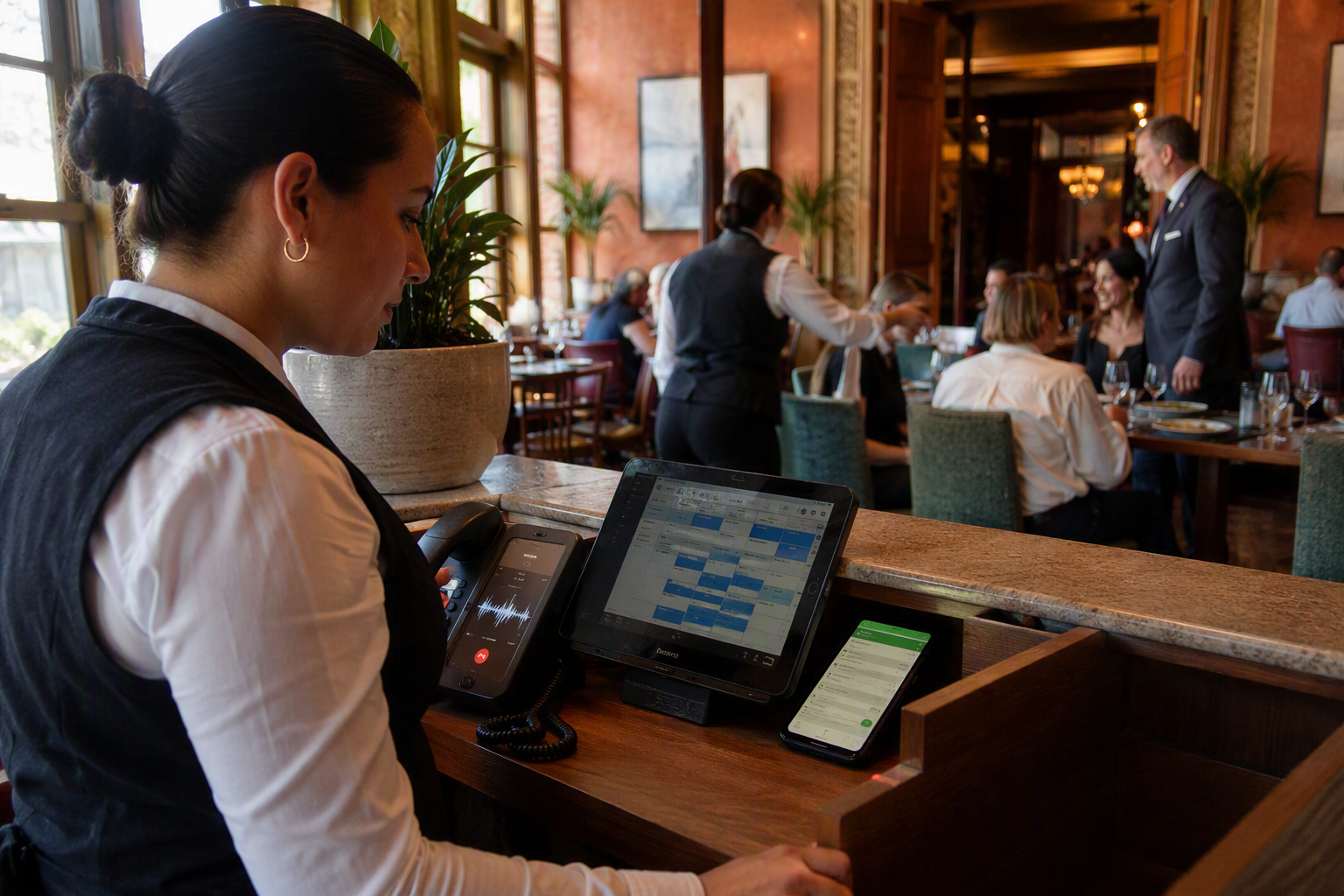
Automate high-volume, low-risk and easily verifiable requests first: routine reservations, opening hours, takeaway logistics and missed-call recovery. Keep allergens, complaints, large parties, accessibility needs and any request the system cannot verify behind a clear human handoff.
Prioritise workflows by risk and certainty
A restaurant reservation AI agent should begin with tasks that have structured inputs and definitive answers in connected systems. Use this order:
- Opening-hours and location FAQs: Answer from an approved record covering regular hours, holiday exceptions, address, parking and directions.
- Routine reservations: Collect date, time, party size, name and contact details, then check live availability before offering a table.
- Takeaway enquiries: Explain ordering channels, collection hours, service area and estimated preparation times only when those details are available from current restaurant or point-of-sale data.
- Missed-call recovery: Acknowledge unanswered calls and, where permission and channel rules allow, offer a callback or continue on WhatsApp.
- Simple booking changes: Process cancellations or amendments only after identifying the reservation and receiving confirmation from the booking platform.
This sequencing targets demand without giving the AI authority over ambiguous or safety-sensitive decisions. The National Restaurant Association of India valued India’s food-services market at ₹5.69 lakh crore in its India Food Services Report 2024, making reliable demand capture commercially important—but an unverified booking is not a recovered customer.
Define what the agent may confirm
Configure AI phone answering for restaurants around explicit action boundaries. The agent may say “your table is confirmed” only after the reservation system returns a successful booking ID or equivalent status. If availability cannot be retrieved, the correct response is “I’ll ask the team to confirm,” not an invented time slot.
Safe first-stage automation can include:
- Reading current opening and kitchen hours from an approved knowledge base
- Checking live reservation inventory
- Capturing seating preferences without promising them
- Sending consent-aware WhatsApp confirmations and location information
- Recording takeaway questions for staff when live data is unavailable
- Offering a callback after a failed transfer or unanswered call
A restaurant WhatsApp chatbot is especially useful for continuity between channels. Meta CEO Mark Zuckerberg reported in April 2025 that WhatsApp had exceeded 3 billion monthly active users worldwide, supporting its role as a familiar follow-up channel—but restaurants must still respect customer consent, message-template requirements and opt-out requests.
Escalate high-risk or exceptional requests
The agent should transfer immediately, create a priority task or arrange a callback when a customer mentions:
- Allergies, intolerances or medical consequences
- Large parties, private dining, events or deposit negotiations
- Complaints, refunds, food-safety concerns or distressed customers
- Wheelchair access or other requirements needing operational confirmation
- Unclear booking details, repeated system failures or contradictory records
- Any request outside the approved knowledge base
For allergens, the AI may repeat approved ingredient or allergen documentation verbatim, but it must never infer ingredients, promise zero cross-contamination or provide medical guidance.
Use a simple launch rule
Before automating a request, ask three questions: Is the answer approved? Is the action verified by the system? Is there a human fallback? If any answer is no, capture the request and escalate it rather than attempting completion. This conservative boundary lets restaurants recover routine demand during peak periods while protecting guests and front-of-house teams from confident but incorrect automation.
Why are AI phone answering and WhatsApp automation becoming part of restaurant operations in 2026?
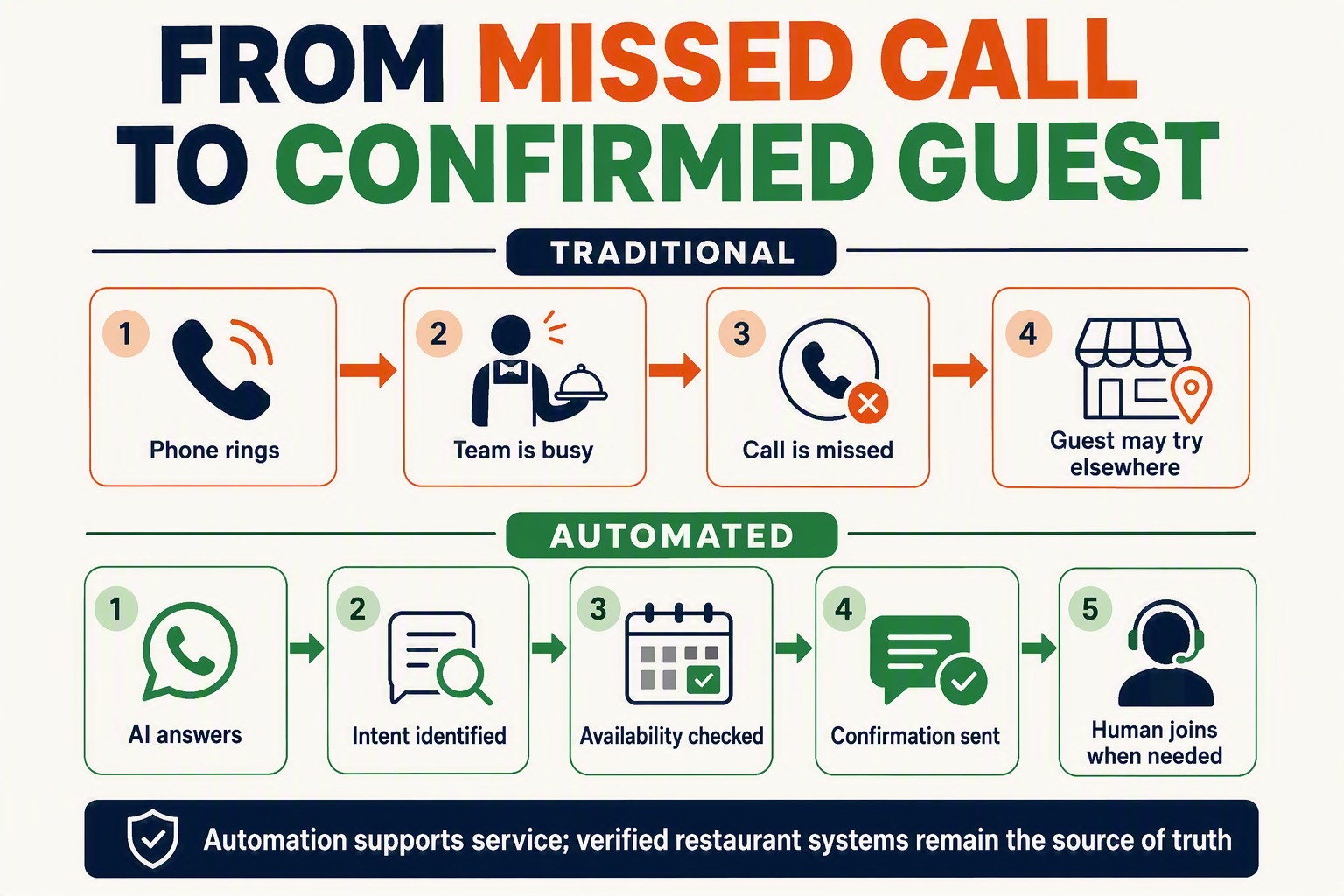
AI phone answering and WhatsApp automation are becoming operational tools because restaurants face bursty demand, time-sensitive customer intent and limited staff attention. In 2026, AI phone answering for restaurants is not intended to replace hospitality teams. Its practical role is to handle routine enquiries consistently while employees focus on in-person guests, food preparation and exceptions that require human judgement.
Restaurant demand is growing, but calls still arrive at the worst moments
Restaurant enquiries cluster around lunch, dinner, weekends and special occasions—the same periods when staff are least able to answer the phone. A missed call may represent an immediate reservation, takeaway order or large-party enquiry rather than a customer willing to wait for a callback.
The National Restaurant Association of India’s 2024 forecast from ₹5.69 lakh crore to ₹7.76 lakh crore by 2028 implies approximately 36% market growth over four years. As transaction volumes rise, restaurants need systems that can absorb peak-hour communication without assigning an employee to every repetitive interaction.
AI phone answering for restaurants can provide a consistent first response by:
- Answering simultaneous or overflow calls during service peaks
- Identifying whether the caller wants a reservation, takeaway information or opening hours
- Collecting structured details such as date, time, party size and phone number
- Checking live availability only when a verified booking-system integration exists
- Sending sensitive, uncertain or high-value requests to a designated employee
- Recording outcomes such as completed bookings, requested callbacks and unresolved enquiries
This turns phone handling from an informal front-desk task into a measurable operating workflow. However, the AI should not present a reservation as confirmed unless the connected booking system returns a valid record or confirmation identifier.
Phone and WhatsApp can support one continuous customer journey
Customers do not necessarily want to complete every task through the channel where they started. A caller may prefer to receive an address, menu or booking summary on WhatsApp, while a WhatsApp user may need a voice conversation for a complex request.
Meta CEO Mark Zuckerberg reported in April 2025 that WhatsApp had exceeded 3 billion monthly active users worldwide. That scale makes WhatsApp a practical continuation channel for restaurants, provided messages are permission-based, relevant to the customer’s request and compliant with applicable messaging rules.
When AI phone answering for restaurants is connected to an approved restaurant WhatsApp workflow, the system can:
- Send the booking details collected during a call for customer verification.
- Provide an approved map link, opening hours or current menu.
- Offer alternative times if the reservation system reports that the requested slot is unavailable.
- Ask whether the customer wants a human callback.
- Deliver cancellation, deposit or booking-change instructions from verified restaurant systems.
A connected restaurant WhatsApp chatbot should distinguish between acknowledging a request and completing a transaction. A conversational response such as “I’m checking that time” is not a booking confirmation. Availability, deposits, cancellations and changes must be validated by the relevant system before the customer is told that the action is complete.
Automation is becoming safer and more operationally accountable
Modern AI phone answering for restaurants can combine speech recognition, multilingual language models, telephony, WhatsApp Business messaging and reservation-system actions. Restaurants should treat these components as controlled infrastructure, not as unrestricted conversational assistants.
Operational controls should include:
- Approved knowledge: Menu, ingredient and allergen information must come from maintained restaurant records.
- No medical or allergen assurances: The agent must never declare a meal allergen-free, improvise ingredient information or provide medical guidance.
- Verified actions: Availability, deposits, cancellations and booking changes require confirmation from the relevant restaurant system.
- Explicit human escalation: Large parties, accessibility needs, complaints, payment issues and uncertain allergy questions should reach an employee.
- Consent-aware messaging: WhatsApp follow-ups must match the customer’s request, recorded consent and applicable messaging requirements.
- Clear failure handling: If an integration is unavailable or an action fails, the system should say so, avoid claiming success and offer a callback or transfer.
- Auditability: Restaurants should track answer rate, booking completion, failed actions, escalation rate and recovered missed calls.
In 2026, these safeguards are what turn AI phone answering for restaurants and WhatsApp automation from a demonstration into a dependable part of restaurant operations.
Which 2026 restaurant workflows belong in a restaurant reservation AI agent, restaurant WhatsApp chatbot or restaurant missed call automation? (KEY DEVELOPMENTS TABLE)
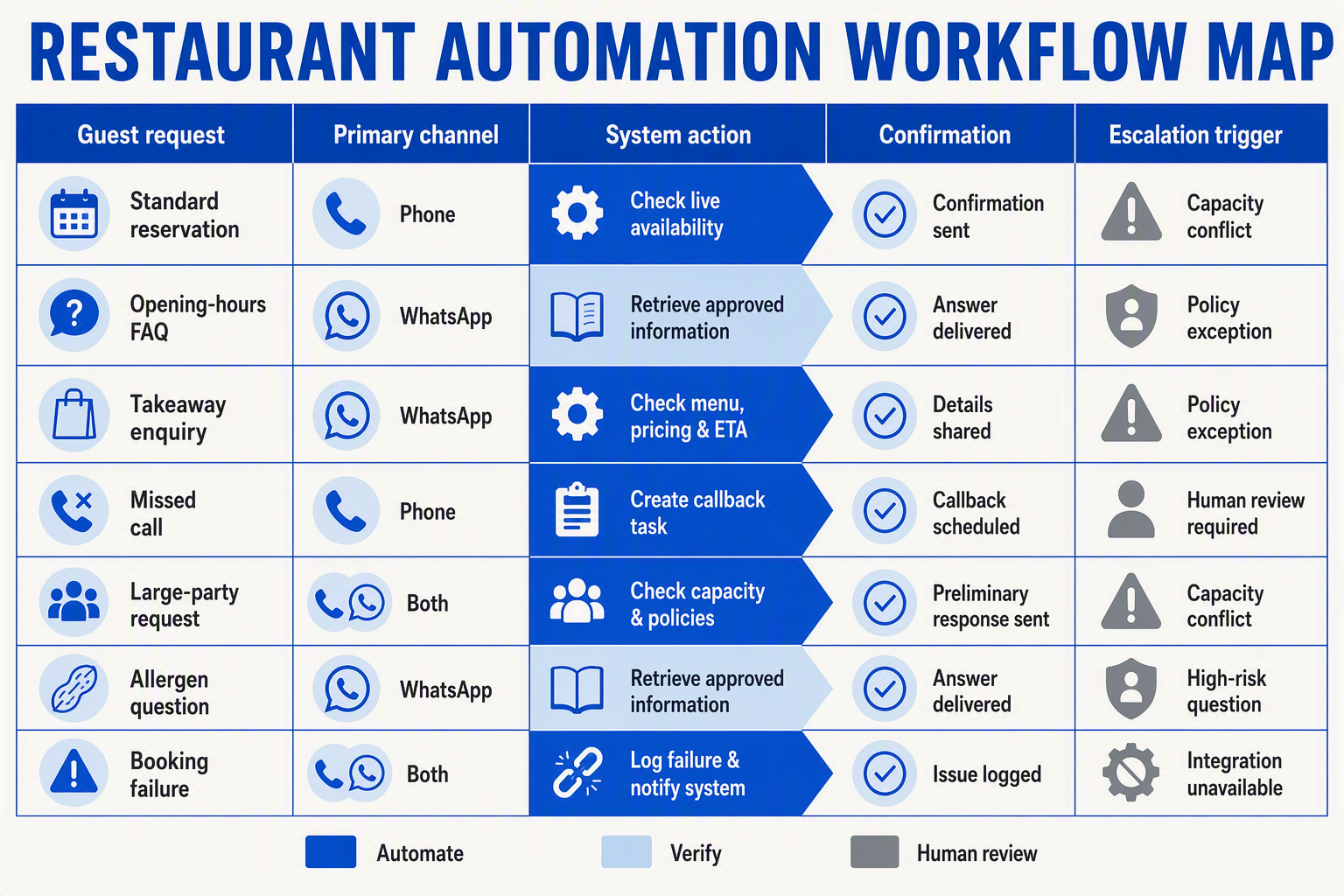
The right channel depends on intent, urgency and operational risk: use an AI phone agent for immediate, conversational tasks; use WhatsApp for written confirmations and asynchronous follow-up; and escalate requests involving safety, exceptions or managerial judgement. In 2026, the strongest design is a coordinated workflow—not separate bots that can create conflicting bookings or messages.
Workflow-to-channel decision table
| Restaurant workflow | Primary channel | Safe automated actions | System checks required | Human escalation trigger |
|---|---|---|---|---|
| Standard reservation | AI phone agent, then WhatsApp | Collect date, time, party size, name and preference; offer available slots; send confirmation | Read and write live availability; verify booking ID before saying “confirmed” | No suitable slot, duplicate record, VIP policy or system failure |
| Opening hours and directions | Phone or WhatsApp | Answer location, service hours, parking and last-order questions from an approved knowledge base | Check date-specific hours, holidays and temporary closures | Conflicting data or unusual closure request |
| Takeaway enquiry | Phone for discovery; WhatsApp for details | Explain service area, pickup timing and approved menu information; provide an ordering link | Verify current menu, item availability, prices, taxes and estimated preparation time | Custom order, unavailable item, payment problem or kitchen approval needed |
| Missed-call recovery | WhatsApp or permission-based callback | Acknowledge the missed call, identify intent and resume reservation capture | Confirm messaging consent, number validity, business hours and prior conversation state | Opt-out, repeated failed contact, complaint or urgent same-day request |
| Large-party or event request | Phone intake, then human follow-up | Capture date, guest count, occasion, budget range and contact details | Check party-size threshold, private-room rules, deposits and event availability | Group exceeds threshold, contract needed or special pricing requested |
| Menu, dietary or allergen question | Phone or WhatsApp with strict retrieval | Quote only approved ingredient and allergen information; record the customer’s concern | Retrieve the current recipe/allergen record and identify cross-contact disclaimers | Any uncertainty, severe allergy, medical question or requested guarantee |
Why phone and WhatsApp should share context
Meta CEO Mark Zuckerberg reported in April 2025 that WhatsApp had surpassed 3 billion monthly active users worldwide. That reach makes WhatsApp a practical continuation channel when a caller cannot wait on hold, needs an address in writing or wants to review alternative reservation times.
The handoff should preserve the caller’s intent without assuming consent. For example, after a failed availability search, the agent can ask: “May I send the available times to this number on WhatsApp?” The resulting message should identify the restaurant, explain why it was sent and provide a clear opt-out route. A phone number captured during a call should not automatically become permission for unrelated promotional campaigns.
Controls every automated action needs
Restaurants should classify actions into three operational levels:
- Answer from approved data: opening hours, directions, parking and published menu details may be retrieved from a version-controlled knowledge base.
- Execute only after verification: reservations, modifications, cancellations, deposits and takeaway orders require confirmation from the booking, point-of-sale or payment system.
- Transfer for judgement: large parties, accessibility arrangements, complaints, refunds and uncertain dietary questions require a named team or queue.
A restaurant reservation AI agent must not announce a booking as confirmed merely because it collected the customer’s details. It should receive a successful write response and reservation identifier from the source system first. If that check fails, the correct status is “request received” rather than “table confirmed.”
Likewise, an AI agent must never improvise ingredients, promise an allergen-free meal or provide medical guidance. It should read the approved record, disclose uncertainty and connect the guest to trained restaurant staff when safety is involved.
This disciplined orchestration matters in a growing market: the National Restaurant Association of India’s India Food Services Report 2024 valued India’s food-services sector at ₹5.69 lakh crore and projected it to reach ₹7.76 lakh crore by 2028. Automation can help restaurants capture that demand, but only when every channel works from the same availability, menu and escalation rules.
How do you set up a restaurant reservation AI agent from discovery and approved knowledge to testing and launch?
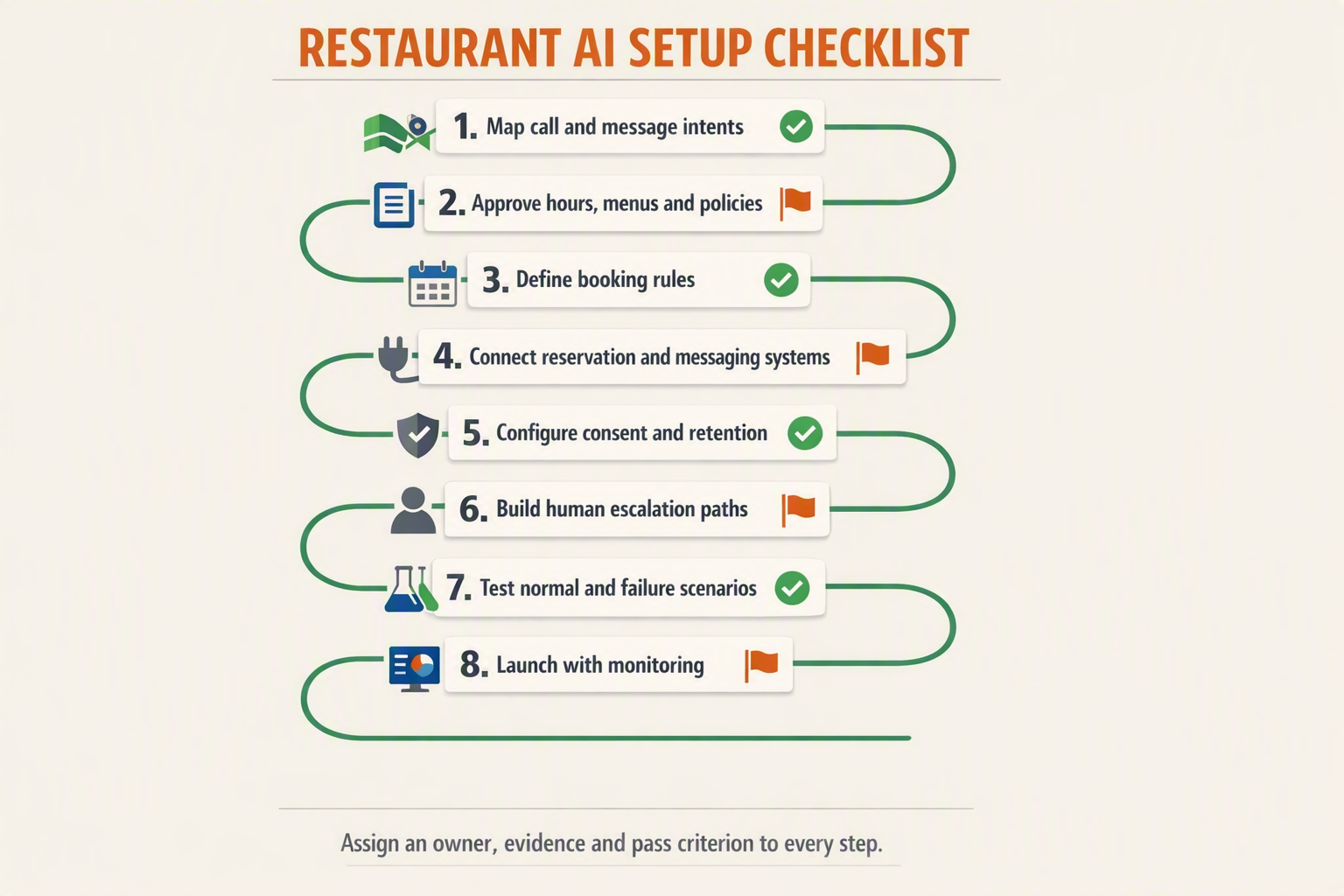
A restaurant reservation AI agent should be launched in controlled stages: map real call intents, approve every customer-facing fact, connect live systems, test failure paths and begin with limited traffic. Do not let the agent confirm a reservation until the booking system has returned a successful reservation ID or equivalent status.
1. Discover demand from real conversations
Start with two to four weeks of call logs, missed-call records, reservation notes and front-of-house feedback. Group requests by intent, frequency, risk and required action, rather than trying to automate every conversation immediately.
Prioritise common, low-risk intents:
- New reservations and availability checks
- Opening hours, address, parking and directions
- Takeaway availability and ordering instructions
- Existing-booking lookup, modification or cancellation
- Missed-call recovery and after-hours enquiries
Separately identify requests requiring human review, including large parties, private events, accessibility arrangements, complaints and uncertain allergy questions. Define what counts as a large party for each location—for example, more than eight guests—rather than leaving the model to decide.
2. Build an approved knowledge source
Create a version-controlled knowledge base owned by a named restaurant manager. Each answer should include its source, location, approver and review date.
The approved content should cover:
- Service hours, kitchen closing times and holiday exceptions
- Address, landmark, parking and accessibility information
- Reservation duration, grace period and cancellation policy
- Deposit rules, minimum spends and private-dining options
- Current menu descriptions and takeaway availability
- Ingredient and allergen information supplied by the kitchen
Apply a strict response rule: if an ingredient or allergen answer is absent, ambiguous or outdated, the agent must say it cannot verify the information and escalate to trained staff. It must not infer ingredients from a dish name, promise an allergen-free environment or offer medical advice.
3. Verify integrations before enabling actions
A convincing demonstration does not prove that production actions are reliable. Ask the vendor and restaurant-system provider to demonstrate each operation in a test environment.
Verify that the agent can:
- Read availability for the correct outlet, date, time and party size.
- Hold or book a table without creating duplicates.
- Return a reservation ID before saying “confirmed.”
- Modify or cancel the correct booking after identity verification.
- Record consent and approved templates for WhatsApp follow-ups.
- Transfer calls with the transcript, caller details and reason attached.
- Queue requests safely when the reservation system is unavailable.
Also establish which system is authoritative for availability, customer records and consent. For implementation patterns spanning phone and WhatsApp, see the AI Appointment Booking Agent Guide.
4. Test complete journeys and failure conditions
Use scripted tests plus unscripted staff calls in every supported language and realistic background noise. Cover ordinary bookings as well as:
- Fully booked dates and alternative-time offers
- Repeated callers and duplicate booking attempts
- Invalid dates, unclear names and interrupted calls
- Large-party deposits and human approval
- Booking API timeouts or partial failures
- After-hours calls and failed WhatsApp delivery
- Allergy questions, complaints and emergency language
Score task completion, factual accuracy, booking-record accuracy, escalation correctness and latency. Review transcripts manually; a fluent conversation can still produce an incorrect operational outcome.
5. Launch gradually with rollback controls
Begin with after-hours or peak-overflow traffic, then expand only after errors remain within the restaurant’s agreed thresholds. Assign an on-duty escalation owner, display AI disclosure where required, monitor integrations in real time and retain a one-step rollback to staff or voicemail.
During the first weeks, review false confirmations, abandoned calls, duplicate bookings, failed handoffs and knowledge gaps daily. Update approved content through a documented change process—not ad hoc prompt edits—so every answer remains traceable.
Which integrations and agent actions must the restaurant verify with its vendors before going live?
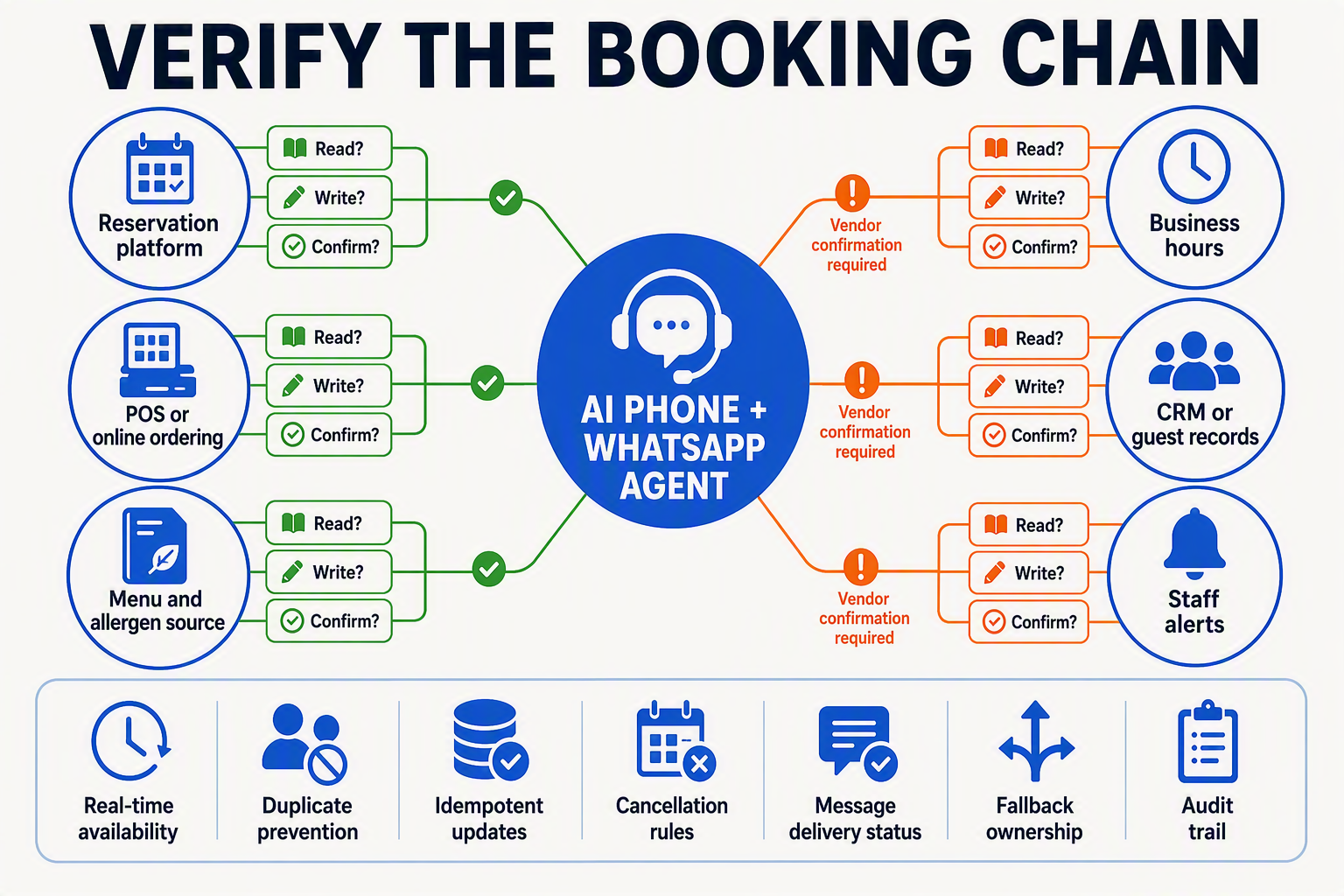
Before launch, the restaurant must verify that the AI agent can read live data, perform authorised actions, detect failed writes and hand control to a person across telephony, reservations, point-of-sale and WhatsApp. A convincing demo is insufficient: every action should be tested against the restaurant’s production-like systems with audit logs and failure scenarios.
Verify the system of record and write permissions
Document which platform owns each data field. Opening hours may come from an approved knowledge base, but table availability must come from the reservation system—not the language model’s memory.
Confirm that the vendor integration can:
- Read real-time availability by date, service period, party size and seating area.
- Create, modify and cancel reservations using the correct restaurant or outlet ID.
- Prevent duplicate bookings through idempotency keys, customer matching or equivalent controls.
- Respect capacity rules, table-turn times, blackout dates and booking cut-offs.
- Return an explicit success or failure response before the agent tells a guest that a booking is confirmed.
- Record the call transcript, consent status, booking reference and system response in the CRM or inbox.
Ask whether the integration uses an official API, webhook, middleware connector or browser automation. Browser automation can be fragile when interfaces change, so vendors should explain monitoring, recovery and ownership when an action fails.
Test each customer-facing action end to end
Do not treat “integration supported” as proof that every required operation works. Run controlled tests for:
- Reservation creation: The booking appears once, with the correct name, phone number, time, party size and notes.
- Changes and cancellations: The agent verifies the customer and applies the restaurant’s cancellation or deposit policy.
- Large-party requests: Requests above the configured threshold create a staff task rather than consuming ordinary inventory.
- Takeaway enquiries: Menu availability, preparation estimates and outlet details come from approved sources; payment links originate from the restaurant’s authorised system.
- Failed booking recovery: If a write times out, the agent says the request is pending or unavailable—never confirmed—and offers a human callback or WhatsApp continuation.
- Human escalation: Staff receive the caller’s context, language, intent and actions already attempted, avoiding a restart.
Validate telephony and WhatsApp controls
Telephony tests should cover call forwarding, concurrent-call limits, peak-hour overflow, voicemail fallback, recording notices and transfers to both fixed and mobile numbers. Verify what happens when the internet, reservation API or AI service is unavailable.
For WhatsApp, require the vendor to demonstrate:
- How customer consent and opt-outs are stored.
- Which messages require approved templates.
- How inbound conversations and business-initiated follow-ups are distinguished.
- Whether delivery, failure and reply events return through webhooks.
- How duplicate confirmations across phone, SMS and WhatsApp are prevented.
Meta CEO Mark Zuckerberg reported in April 2025 that WhatsApp had exceeded 3 billion monthly active users worldwide, making channel governance operationally important rather than optional.
Require evidence before approval
Request a signed action matrix listing read, write, update, cancel, transfer and message permissions. The go-live checklist should also include sandbox results, production access scopes, data-retention periods, incident contacts, rollback procedures and audit-log access.
Finally, test adversarial cases: unavailable tables, unclear speech, repeated callers, unsupported languages, API latency and disputed bookings. The safe rule is simple: if the source system does not confirm the action, the AI agent must not claim success.
How should a restaurant WhatsApp chatbot handle allergens, multilingual guests, consent, failed bookings and human escalation safely?
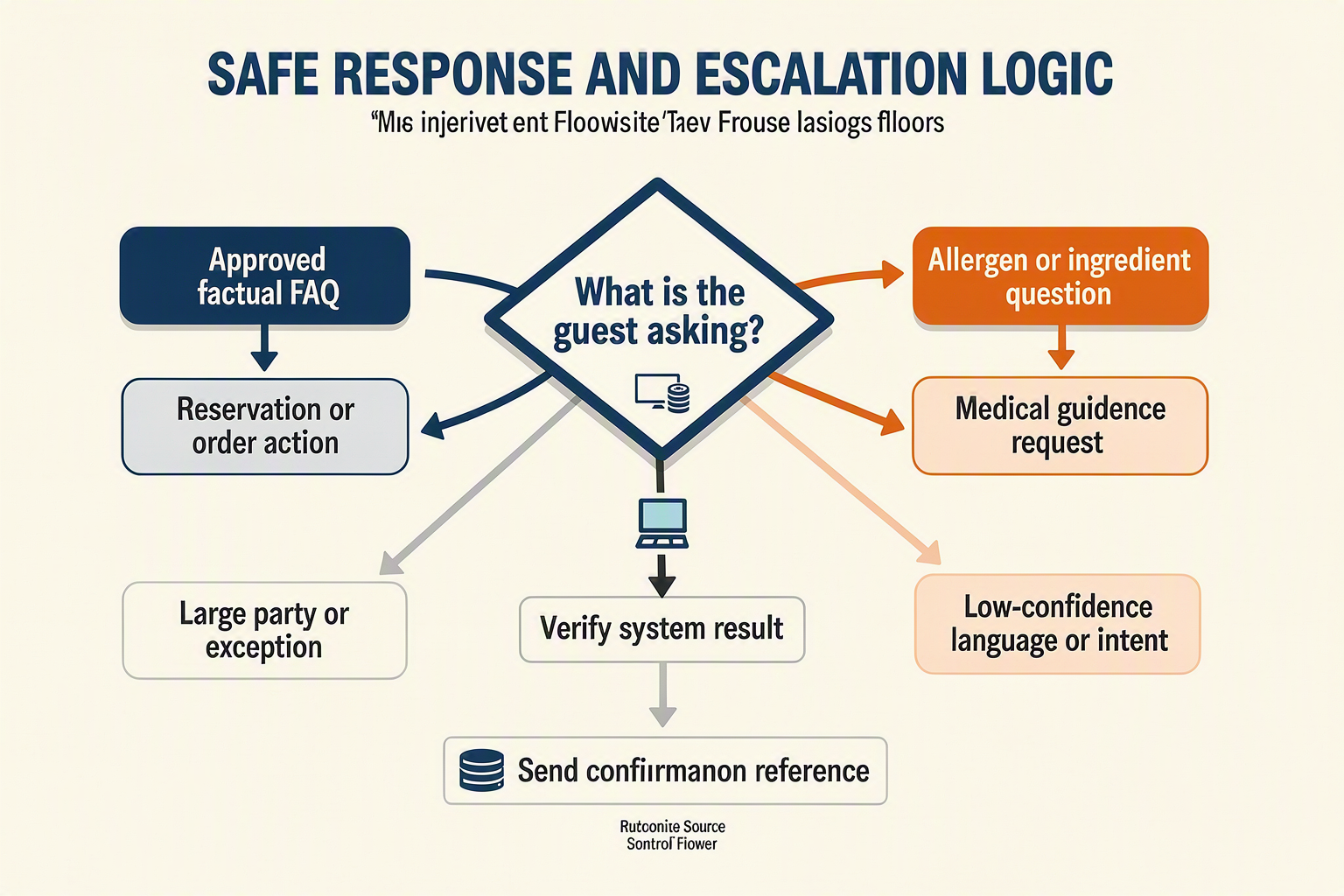
A restaurant WhatsApp chatbot should answer only from approved data, confirm every booking against the live reservation system, collect consent before non-essential messaging, and escalate whenever safety or certainty is at risk. Automation may translate a guest’s question, but it must not translate uncertainty into a confident—and potentially dangerous—answer.
Treat allergen questions as safety-critical
Allergen responses should use a restaurant-approved knowledge base containing current ingredients, preparation methods, cross-contact warnings and modification rules. The chatbot must never infer that a dish is safe merely because an allergen is absent from its description.
Use this response sequence:
- Identify the exact dish, outlet and allergen.
- Retrieve the latest approved information, including variant-specific ingredients.
- State that recipes and kitchen conditions may change.
- Avoid guarantees such as “allergen-free” unless the restaurant has explicitly approved that wording.
- Escalate severe allergies, cross-contact questions and uncertain answers to trained staff.
The agent must not diagnose symptoms, assess medical risk or recommend treatment. For a suspected allergic reaction, it should advise the guest to contact local emergency services rather than continue a booking workflow.
Preserve meaning across languages
Multilingual support should cover both language recognition and operational accuracy. Names, dates, dietary terms and reservation details can be mistranscribed even when the conversation sounds natural.
For every multilingual booking, the chatbot should display a structured confirmation:
- Restaurant location and booking date
- Arrival time and time zone
- Party size, including children
- Guest name and contact number
- Dietary, accessibility or seating requests
- Deposit, cancellation and table-hold conditions
Ask the guest to confirm these fields explicitly. Indian platforms such as CallMissed support voice and chat across 22 Indian languages, but restaurants should still test regional accents, code-switching and food terminology with their own menus before deployment.
Separate service messages from marketing consent
A guest asking about opening hours has not automatically agreed to promotions. The chatbot should distinguish transactional communication—such as a requested booking confirmation—from marketing campaigns, loyalty offers or future event announcements.
Consent records should capture the purpose, channel, timestamp and source. Under India’s Digital Personal Data Protection Act, 2023, consent requests must be clear and capable of being withdrawn; restaurants should have legal counsel verify how the Act and applicable 2026 rules affect their specific workflows. WhatsApp templates, opt-in language, retention periods and deletion processes must also be checked with the messaging provider.
Never claim success before the system confirms it
A chatbot response is not a confirmed reservation until the restaurant’s booking system returns a successful record and booking identifier. If availability changes, payment fails or an integration times out, say: “Your booking is not yet confirmed.”
The recovery flow should then:
- Retry the availability check once without creating duplicates.
- Offer nearby times, another outlet or a waitlist.
- Send a secure deposit link where applicable.
- Create a staff task with the complete conversation context.
- Notify the guest when a person will respond.
Define immediate human-escalation triggers
Escalate large parties, allergy uncertainty, accessibility needs, complaints, repeated booking failures, payment disputes and requests outside policy. During peak hours, offer a queued callback rather than leaving the guest in a silent handoff.
Before launch, verify with the vendor that transfers, callback creation, consent logs, duplicate prevention, booking IDs and failed-integration alerts work end to end. Test each path against the restaurant’s real reservation, point-of-sale and WhatsApp systems—not merely a chatbot demonstration.
How do you measure the operational and commercial impact of restaurant call, booking and WhatsApp automation?
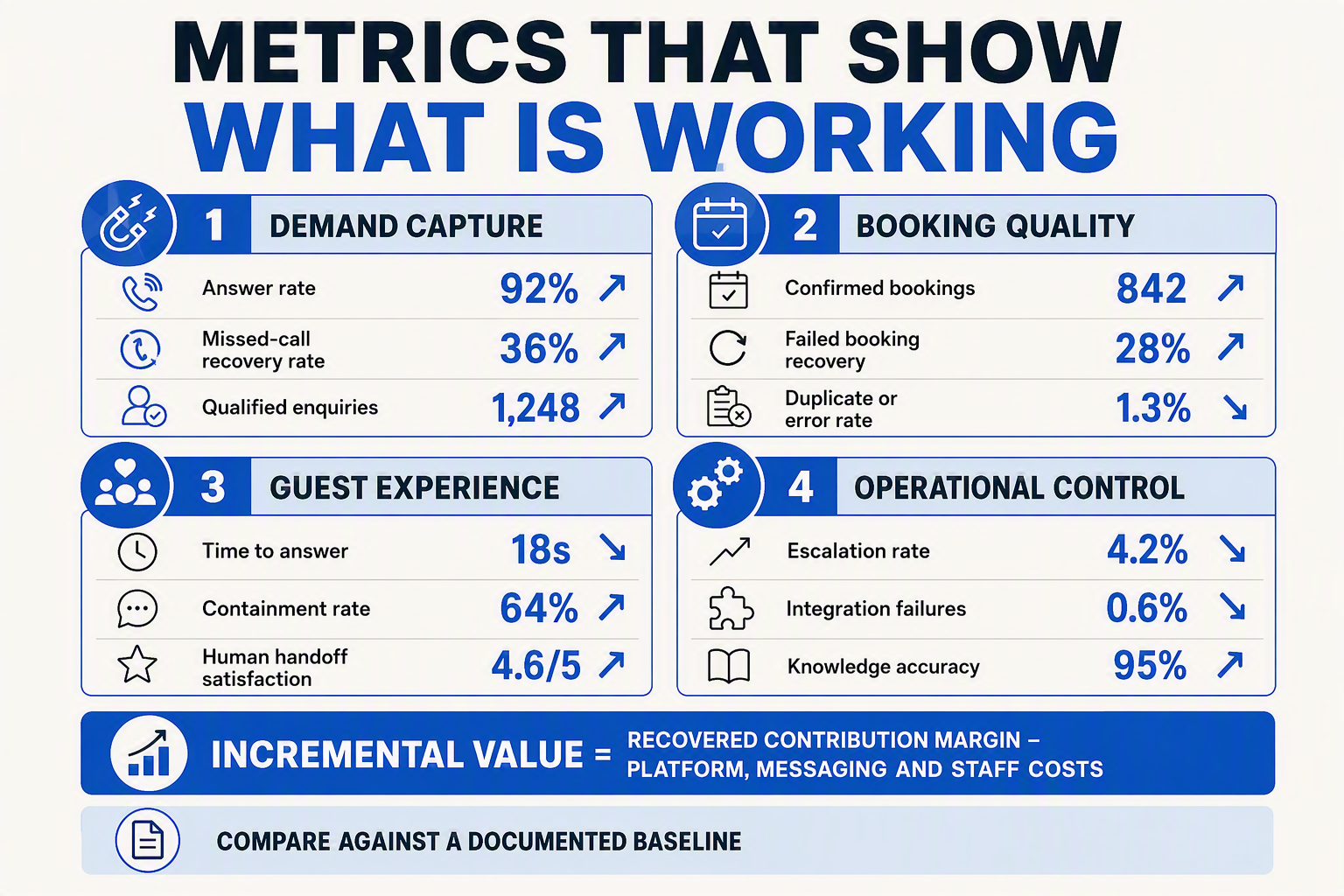
Measure impact by comparing a pre-automation baseline with post-launch results across availability, booking outcomes, staff workload and attributable revenue. Do not treat call volume or chatbot conversations as success by themselves; the core question is whether automation converts more genuine demand without increasing errors, complaints or unnecessary escalations.
Establish a baseline before launch
Capture at least four weeks of data before deployment, including comparable weekdays, weekends and service periods. Seasonal restaurants should also compare results with the same trading period from the previous year.
Record baseline figures for:
- Incoming, answered, abandoned and missed calls
- Median answer time and peak-hour answer rate
- Reservation enquiries, confirmed bookings and cancellations
- Takeaway enquiries transferred to ordering channels
- Staff minutes spent handling calls and messages
- Average party size, average spend and no-show rate
- WhatsApp response time and conversation opt-outs
- Large-party, allergy and complaint escalations
Tag each interaction by channel, location, time, intent and outcome. Without these fields, a restaurant cannot distinguish a valuable recovered reservation from an opening-hours FAQ.
Track operational metrics with clear formulas
A restaurant reservation AI agent should report outcomes that can be reconciled against the booking platform rather than relying only on conversational summaries.
- Answer rate = answered calls ÷ total inbound calls
- Booking completion rate = verified bookings ÷ eligible reservation enquiries
- Missed-call recovery rate = missed callers who later book or order ÷ missed callers contacted
- Automation containment rate = correctly resolved interactions ÷ total automated interactions
- Escalation rate = human handoffs ÷ automated interactions
- Booking error rate = incorrect, duplicated or unverified bookings ÷ AI-created bookings
- Median resolution time = time from first contact to confirmed outcome
Review these metrics separately for lunch, dinner, after-hours and peak overflow. A high containment rate is not positive if the system gives an unverified allergen answer or records a reservation against stale availability.
Attribute commercial value conservatively
Connect the phone platform, restaurant WhatsApp chatbot, reservation system and point-of-sale system using a shared interaction or booking identifier. Calculate confirmed revenue, not merely conversational intent.
For reservations, a practical estimate is:
Attributed booking value = seated covers from AI-originated bookings × average spend per cover
For restaurant missed call automation, count revenue only when a recovered caller receives a booking identifier and the booking is subsequently marked seated. Report tentative bookings, cancellations and no-shows separately. For takeaway, use completed POS orders linked through a tracked ordering link, phone number or transaction reference.
Also calculate:
- Cost per completed booking
- Revenue per automated interaction
- Staff hours released
- Incremental gross profit, after messaging, telephony, AI and payment costs
- Return on investment = incremental benefit minus automation cost, divided by automation cost
Validate the numbers and guardrails
Run a weekly sample audit of transcripts, recordings and system events. The restaurant and vendor should jointly verify that:
- Availability was checked live before confirmation.
- WhatsApp confirmations matched the booking record.
- Ingredient and allergen responses used approved knowledge only.
- Consent, opt-out and retention events were logged.
- Large parties and failed bookings reached the correct human queue.
- Transfers marked “successful” were actually answered.
Use a phased rollout or matched-location test where possible. Compare similar shifts or outlets, document menu changes and promotions, and review results after 30, 60 and 90 days. This prevents weather, festivals, discounts or capacity changes from being incorrectly credited to the automation.
What do restaurant operators and authoritative sources say about consent, messaging, food information and AI oversight?
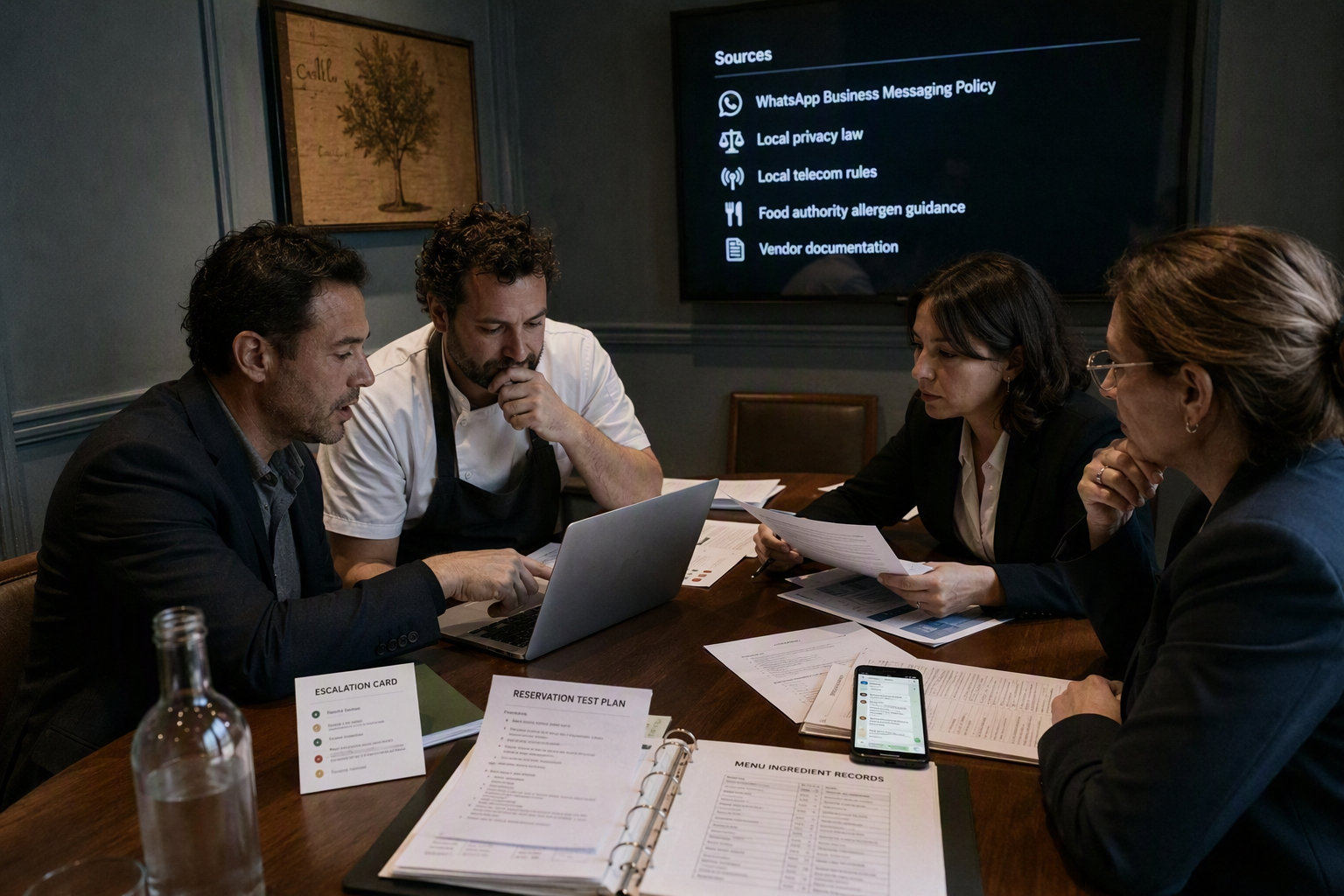
Restaurant operators should use AI as a controlled service channel, not an autonomous source of truth. Obtain valid permission before promotional follow-ups, identify automated interactions, restrict food answers to approved records and ensure a named employee can review or take over consequential conversations.
Separate service messages from marketing consent
A customer calling to request a table can reasonably receive information needed to complete that request, but the call does not automatically grant permission for future promotions. Restaurants should record the purpose, channel, timestamp and wording of consent rather than storing a single “opted in” flag.
The Digital Personal Data Protection Act, 2023 states that consent must be free, specific, informed, unconditional and unambiguous, with clear affirmative action; withdrawing consent must be as easy as giving it. Operators should confirm with legal counsel which provisions and implementing rules apply on the deployment date.
Practical controls include:
- Ask before moving a phone conversation to WhatsApp: “May we send your booking details to this number?”
- Keep reservation confirmations separate from offers, loyalty campaigns and remarketing.
- Provide a clear opt-out route and synchronise it across the CRM, campaign tool and messaging provider.
- Retain only information required for the stated purpose and apply a documented deletion schedule.
- Announce call recording where used and verify local recording-consent requirements.
For Indian promotional calls and messages, restaurants should also assess the Telecom Regulatory Authority of India’s Telecom Commercial Communications Customer Preference Regulations, 2018, including applicable consent, preference and sender-registration requirements. Meta’s WhatsApp Business Messaging Policy similarly requires businesses to obtain opt-in before messaging users; conversations initiated outside WhatsApp’s customer-service window generally require an approved message template.
Treat food information as safety-critical data
A restaurant reservation AI agent may read approved ingredient and allergen information, but it must never infer ingredients, promise that an item is allergen-free or offer medical advice. Cross-contact risk, substitutions and supplier changes make confident improvisation unsafe.
The Food Safety and Standards Authority of India’s Food Safety and Standards (Labelling and Display) Regulations, 2020 establish menu-display and allergen-information obligations for covered food-service establishments. The operational response should be stricter than merely uploading a menu PDF:
- Assign an owner—normally the chef, food-safety lead or operations manager—to approve each menu record.
- Store ingredients, declared allergens, possible cross-contact warnings and last-review dates as separate fields.
- Block answers when a record is missing, expired or inconsistent.
- Escalate allergy questions to trained staff using the caller’s exact words.
- Never let the AI recommend what is “safe” for a medical condition.
A suitable response is: “I cannot confirm that this dish is safe for your allergy. I’ll connect you with a team member who can check the current ingredients and kitchen process.”
Keep humans accountable for AI decisions
Customers should be told when they are interacting with an AI agent, especially before recording, data collection or transfer. This is also increasingly relevant internationally: Article 50 of the European Union AI Act applies transparency duties from 2 August 2026 for certain AI systems interacting directly with people, subject to specified exceptions.
Operators should review sampled conversations, failed bookings, consent disputes and food-information escalations every week. A human must approve unusual deposits, large-party terms, complaint remedies and any uncertain request. Vendor contracts should also identify who controls transcripts, how long recordings are retained, whether customer data trains models, and how staff can immediately disable automation or take over a live interaction.
What does this mean for your restaurant? (TABLE: priority actions, owners, vendor questions and relevant implementation guides)
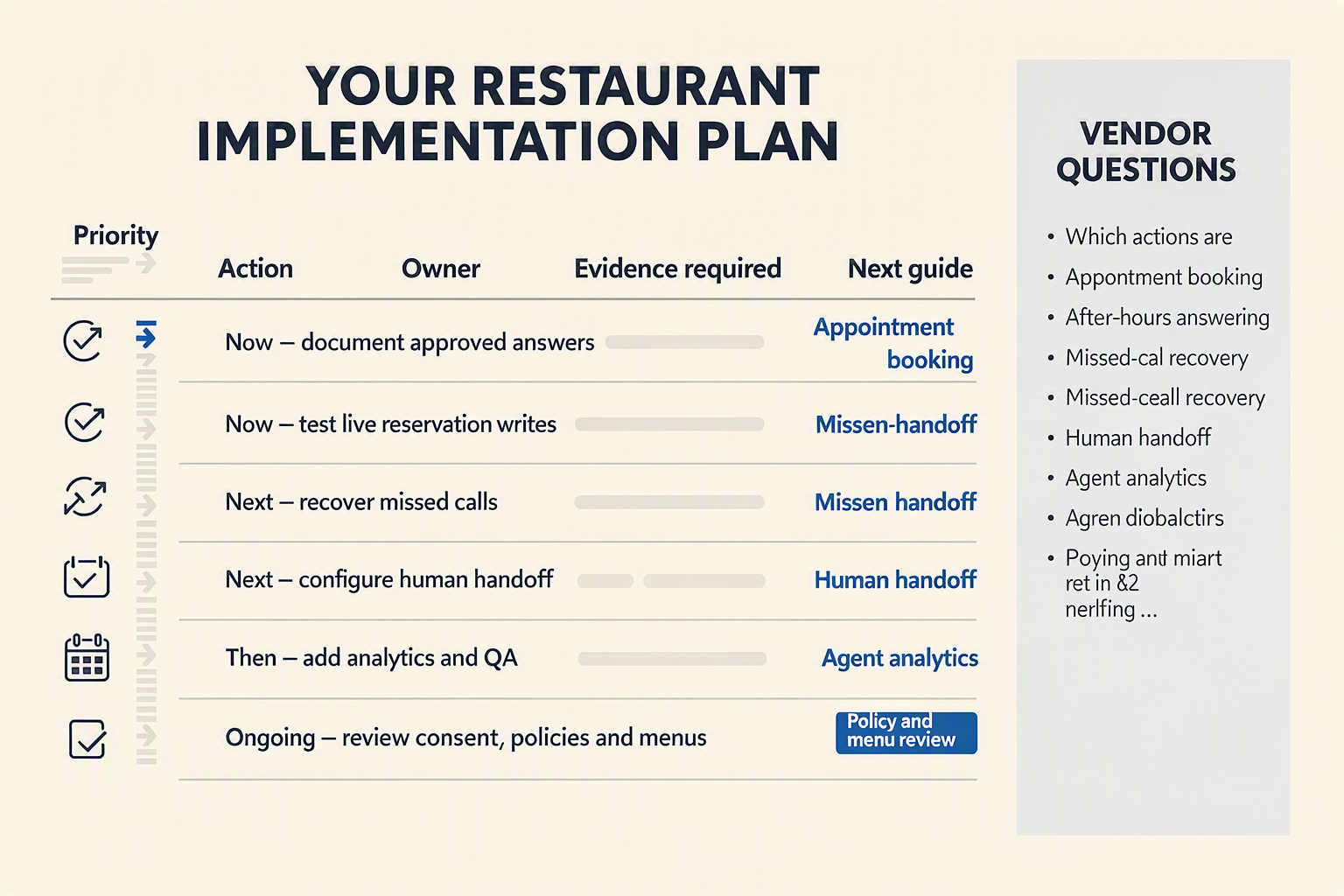
AI phone answering for restaurants should operate as a controlled service layer, not replace front-of-house judgement. Start with high-volume, low-risk requests, give every workflow a human owner and require vendors to prove live integrations, safe escalation and auditability before launch.
Priority action plan
Use this table to establish clear ownership and verify that AI phone answering for restaurants works with your actual systems and operating rules.
| Priority action | Accountable owner | Questions to verify with the vendor | Relevant implementation guide |
|---|---|---|---|
| Connect live reservations | Reservations manager | Does AI phone answering for restaurants read live availability and write confirmed bookings to the reservation system? How are duplicate bookings, changes, deposits and cancellations handled? | AI Appointment Booking Agent Guide |
| Configure peak-hour and after-hours coverage | General manager | Can routing activate by opening hours, queue length, no-answer timeout or staff availability? What is the fallback if the AI, telephony service or internet connection fails? | After-Hours Answering Service AI Guide |
| Recover missed and failed bookings | Marketing or CRM owner | Can the system capture consent, arrange a callback and continue on WhatsApp without claiming an unconfirmed table is reserved? Are delivery failures and opt-outs recorded? | No-Code AI Agent Automation Guide |
| Lock down menu and allergen answers | Chef or food-safety lead | Does AI phone answering for restaurants use only approved menu data, refuse uncertain answers and escalate allergy questions without guaranteeing allergen-free food? | Maintain a signed, version-controlled menu and allergen knowledge base |
| Route large parties and exceptions | Events or duty manager | Which party sizes, accessibility requests, complaints, special menus and deposit conditions require human handoff? Do staff receive the transcript and caller details? | AI Lead Qualification Agent Guide |
| Measure quality and outcomes | Operations analyst | Can managers export answer rate, booking completion, abandoned calls, escalation rate, latency and recovered-call revenue? Are recordings and transcripts protected by role-based access? | Conversation Intelligence Software Guide |
Turn the table into a 30-day rollout
India’s food-services market was valued at ₹5.69 lakh crore in the National Restaurant Association of India’s 2024 report and projected to reach ₹7.76 lakh crore by 2028. WhatsApp also exceeded 3 billion monthly active users worldwide in 2025. Restaurants should therefore manage phone and WhatsApp as one measurable customer journey.
- Week 1: Establish the source of truth. Approve opening hours, branches, reservation rules, menu versions, takeaway limits, escalation contacts and multilingual terminology.
- Weeks 2–3: Run controlled tests. Test normal requests, closed dates, full capacity, interrupted calls, unsupported languages, ambiguous dishes, allergies, duplicate bookings and failed WhatsApp delivery.
- Week 4: Launch with monitoring. Begin with overflow or after-hours calls, review transcripts daily and expand only after booking writes and human transfers remain reliable.
Set non-negotiable launch gates
Do not approve AI phone answering for restaurants for production until end-to-end testing proves that:
- A booking described as “confirmed” appears in the live reservation system.
- Unavailable tables produce alternatives, never invented availability.
- Allergy uncertainty triggers a safe refusal and human escalation.
- WhatsApp follow-ups respect consent, applicable template requirements and opt-outs.
- Failed bookings generate an accurate callback or recovery workflow.
- Large-party and exceptional requests reach a named employee with full context.
- Managers can disable automation immediately and retrieve audit records.
Platforms such as CallMissed can combine AI voice agents, WhatsApp chatbots and WhatsApp Business calling across 22 Indian languages. Whatever the platform, the restaurant must retain ownership of operating rules, approved knowledge, workflow owners and the final launch decision.
Frequently asked questions about AI phone answering for restaurants: live availability, allergen answers, WhatsApp consent, large parties, failed bookings, multilingual calls, costs and ROI
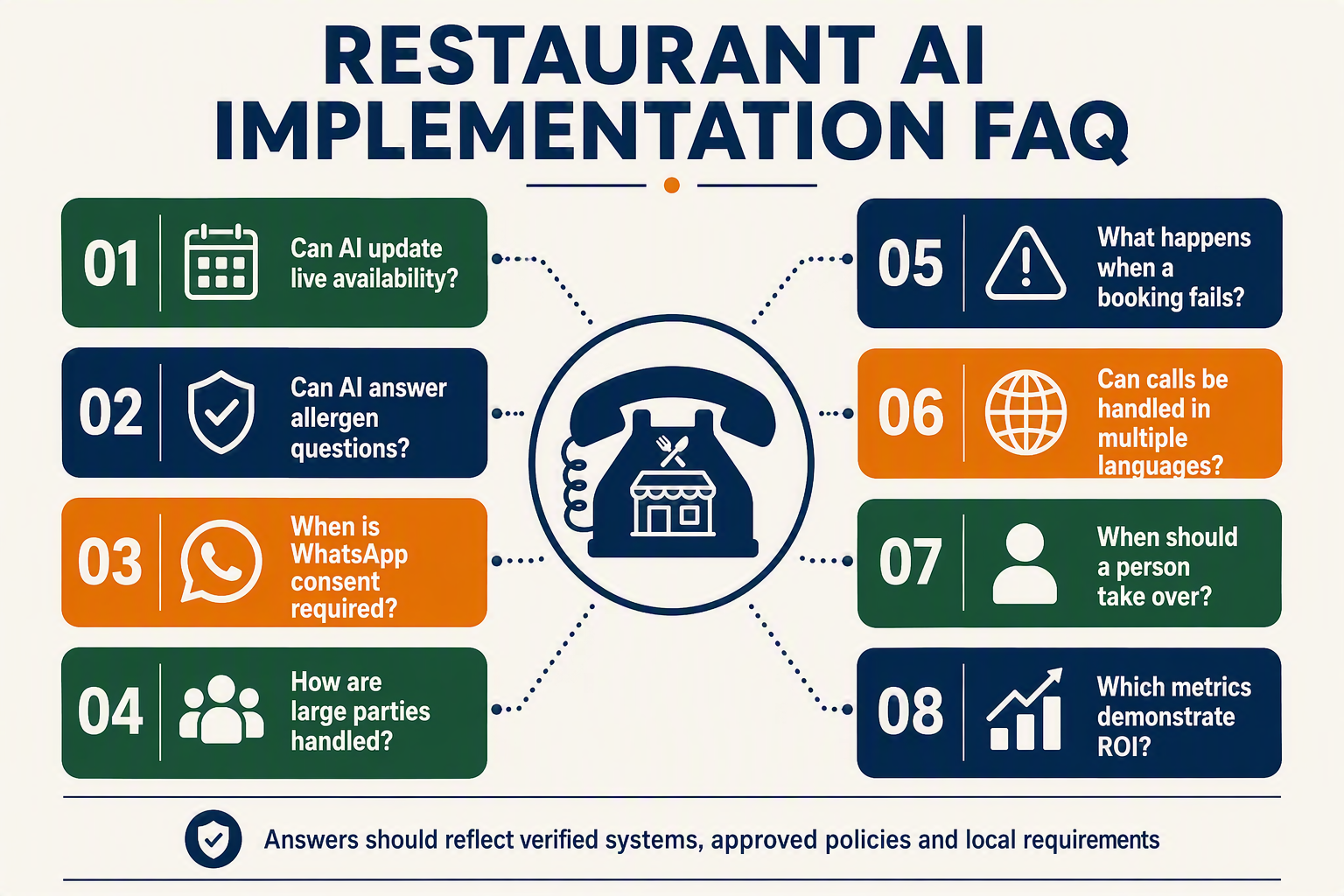
Can AI phone answering for restaurants check live table availability and confirm reservations?
Can a restaurant reservation AI agent safely answer menu and allergen questions?
Does a restaurant WhatsApp chatbot need customer consent before sending messages?
How should AI phone answering for restaurants handle large parties and failed bookings?
Can an AI restaurant phone agent answer multilingual calls accurately?
What does restaurant AI phone answering cost, and how should ROI be measured?
Conclusion
AI phone answering for restaurants works best as a controlled extension of the service team—not as an unsupervised replacement. In 2026, restaurants should connect voice and WhatsApp workflows while keeping availability, confirmations, menu data and escalations grounded in verified systems.
Key implementation takeaways are:
- Automate high-volume, low-risk requests first: routine reservations, opening hours, takeaway enquiries and missed-call follow-ups.
- Verify every operational action: table availability, booking changes, deposits, cancellations and confirmations must be checked against the restaurant’s reservation, point-of-sale and messaging systems.
- Make safety and escalation non-negotiable: AI agents must never improvise ingredients, promise allergen-free food or offer medical guidance. Large-party bookings, accessibility needs, complaints and uncertain allergy questions should reach trained staff.
- Measure business outcomes: monitor answer rate, booking completion, escalation rate, failed-booking recovery and revenue recovered from missed calls.
The scale of the opportunity will continue growing: the National Restaurant Association of India’s 2024 report projects India’s food-services market to reach ₹7.76 lakh crore by 2028. Watch for tighter voice-and-WhatsApp integration, stronger multilingual support and more reliable real-time booking verification.
To explore this evolution, visit CallMissed, an AI communication platform supporting voice agents, WhatsApp automation and 22 Indian languages. Which missed-call or peak-hour workflow could your restaurant safely automate first?
Related Reading
Discussion
Related Posts
Ready to automate customer conversations?
Launch AI voice agents and WhatsApp bots with CallMissed — one API, 22+ Indian languages.