
Logistics Customer Service AI in 2026: Phone and WhatsApp Automation Playbook


Learn how logistics customer service AI connects phone and WhatsApp to live TMS data, secures tracking, automates workflows, and escalates safely.
Logistics Customer Service AI in 2026: Phone and WhatsApp Automation Playbook
What if the most expensive delivery failure begins not on the road, but with an unanswered phone call or an ambiguous WhatsApp message? In 2026, logistics customer service AI can resolve routine shipment questions in seconds—but only when it is connected to live operational data, governed by strict identity checks, and designed to escalate exceptions rather than invent answers.
Why logistics automation matters now
Customer-service demand is rising alongside digital commerce. India had approximately 270 million online shoppers and a US$60 billion e-retail market in 2024, according to Bain & Company’s 2025 “How India Shops Online” report. Every additional order can generate tracking enquiries, pickup changes, cash-on-delivery confirmations, address corrections and failed-delivery calls.
Messaging has also become a primary customer channel. WhatsApp exceeded 3 billion monthly active users worldwide in April 2025, according to Meta CEO Mark Zuckerberg during Meta’s first-quarter earnings call. In India, language coverage is equally important: the IAMAI and Kantar “Internet in India 2024” report recorded 886 million active internet users, with rural users accounting for 55% of the total. A courier AI voice agent that understands only English and Hindi therefore leaves substantial regional demand underserved.
This is where delivery WhatsApp automation and AI calling can help. Platforms such as CallMissed can bridge WhatsApp Business calls to an AI voice agent and support speech workflows across 22 Indian languages, allowing a logistic operator to serve regional customers without treating multilingual support as an afterthought.
However, automation must never become confident guesswork. A shipment tracking AI agent should retrieve the latest scan event, promised service level and exception code from the transport management system or carrier API. If live data is unavailable, the correct response is “I cannot verify the current status,” not a fabricated location or delivery time. The agent must also verify identity—using an order-linked phone number, OTP or another approved control—before revealing addresses, payment details or shipment history.
What this playbook will cover
This guide turns those principles into practical phone and WhatsApp workflows for logistics, courier and last-mile delivery teams. You will learn how to design:
- Live shipment-status enquiries and pickup requests
- Address clarification and failed-delivery recovery
- COD confirmation without exposing sensitive order data
- Multilingual inbound and outbound calls
- Complaint escalation and driver or operations handoffs
- Missed-call recovery workflows
- CRM, order-management and TMS integration requirements
- Analytics for containment, escalation, latency and resolution quality
The goal is not to remove humans from customer service. It is to let AI handle verified, repetitive interactions while dispatchers and support specialists focus on damaged parcels, disputed payments, urgent exceptions and other cases requiring judgement.
How should logistics companies use AI support in 2026? Connect phone and WhatsApp to verified live data, authenticate customers, automate bounded tasks, and hand off exceptions without promising outcomes
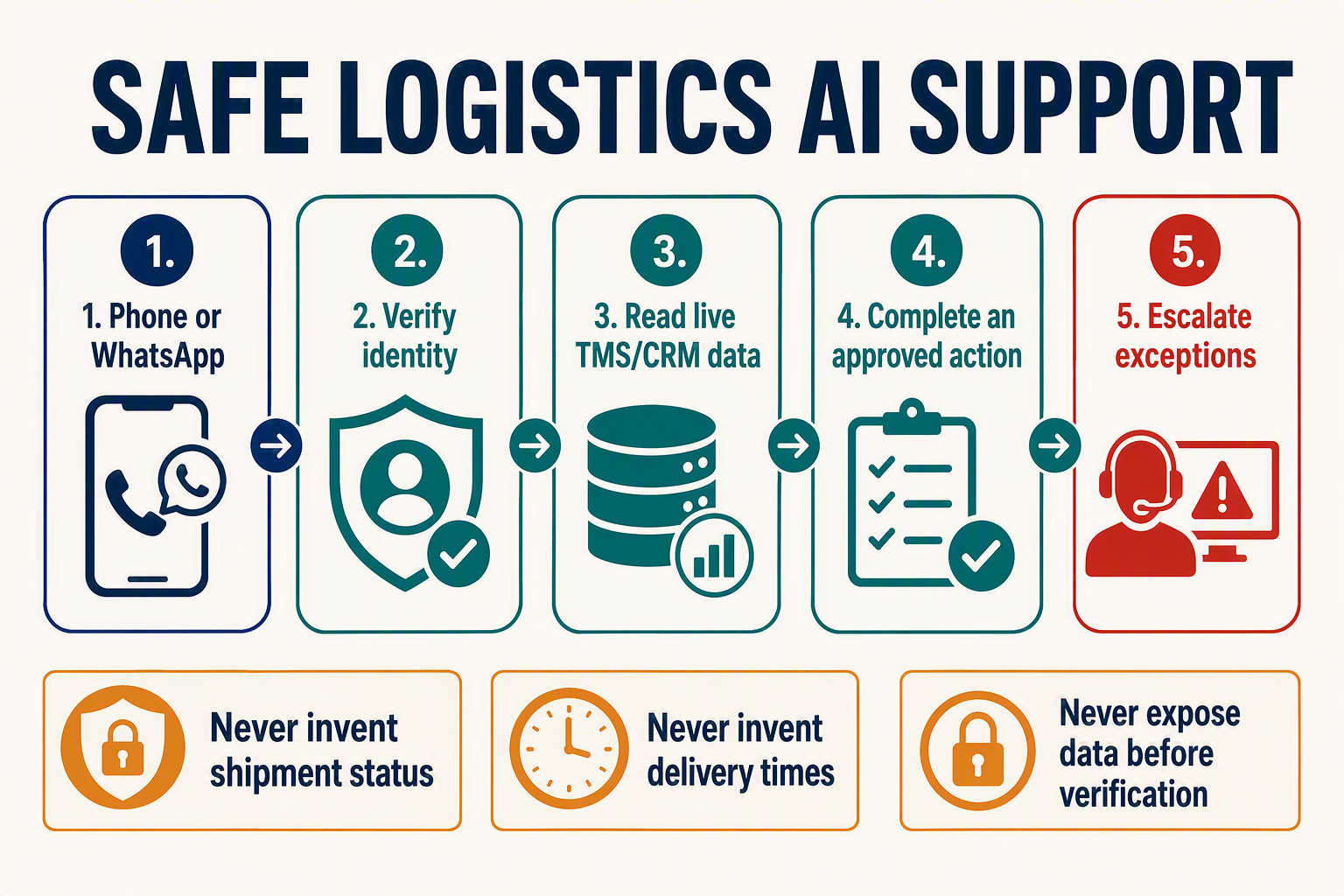
Logistics companies should use AI support as a controlled operations interface, not as a general-purpose chatbot. Phone and WhatsApp agents should read verified live data, authenticate customers according to risk, execute only approved actions, and transfer uncertain or high-impact cases to people with full context.
Build one governed workflow across phone and WhatsApp
A customer may start with a WhatsApp message, continue through a call and later reply to an automated update. The logistics customer service AI should preserve the same shipment context and authorization state across those interactions.
A practical architecture has five layers:
- Channel layer: Phone calls, WhatsApp messages and WhatsApp Business calling.
- Identity layer: Order-linked mobile matching, OTP verification or an approved account login.
- Orchestration layer: Intent detection, language selection, policy enforcement and conversation state.
- Operations layer: Read or write access to the CRM, order-management system, transport management system (TMS), warehouse system and carrier APIs.
- Escalation layer: Transfer to customer support, dispatch, hub operations, billing or the responsible driver workflow.
Indian platforms such as CallMissed can connect WhatsApp Business calls to an AI voice agent and support speech workflows across 22 Indian languages. This multilingual design has practical reach: IAMAI and Kantar reported 886 million active internet users in India in 2024, of whom 55% were rural—equivalent to approximately 487 million rural users.
Authenticate according to the action’s risk
Authentication should be progressive, because asking for an OTP on every enquiry creates friction while revealing private information without verification creates risk.
- Low risk: Provide public service-area information, office hours or packaging guidance without authentication.
- Moderate risk: Match the caller’s number to a shipment and request a second identifier before disclosing detailed tracking history.
- High risk: Require OTP or equivalent verification before changing an address, cancelling a pickup, exposing COD information or sharing recipient details.
- Restricted: Route requests involving disputed identity, account changes or suspicious activity to a trained human.
The agent should expose only the minimum information required. A caller asking whether a parcel is out for delivery does not automatically need the recipient’s complete address, phone number or payment history.
Automate bounded tasks, not operational judgement
A shipment tracking AI agent may retrieve the latest carrier scan, explain a documented exception code and create an approved pickup request. It should not infer that a parcel “will arrive by 5 PM” merely because it reached a local hub.
Every response based on operational data should include:
- The source system
- The latest event and its timestamp
- Whether the data is current or temporarily unavailable
- The promised service level, if explicitly stored
- The next permitted action
Similarly, a pickup confirmation should distinguish request accepted from pickup guaranteed. Address clarification should capture structured fields and submit them for validation rather than claiming that rerouting has succeeded.
Design exception handoffs as part of automation
Escalation is a successful outcome when the AI reaches its authority boundary. Failed deliveries, repeated scans, damaged parcels, angry customers, driver-safety concerns and conflicting system records require human review.
The handoff packet should contain the authenticated identity, shipment ID, detected language, latest verified events, requested action, actions already attempted and a concise transcript summary. A well-designed courier AI voice agent therefore reduces repetition for both customers and operators while avoiding promises that the underlying logistic network has not confirmed.
Why are logistics customer service AI, courier AI voice agent, and delivery WhatsApp automation projects accelerating in 2026?

AI projects are accelerating because shipment volumes, customer expectations and messaging traffic now exceed what phone-only support teams can handle economically. Logistics customer service AI helps operators manage repetitive, time-sensitive enquiries across phone and WhatsApp without separating automation from the systems that hold shipment truth.
At the same time, improved speech models, official WhatsApp calling capabilities and real-time carrier APIs have made logistics customer service AI more practical. Successful deployments still depend on authenticated access, customer consent, verified operational data and clear human-escalation paths.
Demand is growing faster than traditional support capacity
The approximately 270 million Indian online shoppers identified by Bain & Company in 2025 create service demand throughout the delivery lifecycle, not merely at checkout. A single parcel can trigger multiple interactions: “Where is my order?”, “Can I reschedule?”, “Does the driver have my landmark?” or “Why was delivery marked unsuccessful?”
These contacts are repetitive but time-sensitive. Delayed responses can contribute to unnecessary reattempts, returns to origin and complaint escalations. A courier AI voice agent can handle routine requests around the clock while reserving human capacity for lost shipments, damaged parcels, disputed delivery attempts and other exceptions.
For example, logistics customer service AI may authenticate a caller, retrieve the latest verified scan and explain that status in the customer’s preferred language. It should not estimate a delivery time unless an authorised carrier or order-management system provides one.
The strongest automation candidates share three characteristics:
- The request has a clearly defined intent, such as shipment tracking, address correction or pickup booking.
- The answer or available action can be retrieved from an authoritative operational system.
- The workflow has explicit rules for authentication, consent, confirmation and human escalation.
WhatsApp is becoming a service and calling channel
WhatsApp surpassed 3 billion monthly active users in April 2025, according to Meta CEO Mark Zuckerberg. For courier operators, that reach makes WhatsApp suitable for proactive alerts, address collection, delivery confirmations and two-way exception handling.
The shift is not limited to text. Meta expanded calling options for businesses using the WhatsApp Business Platform in 2025, enabling eligible customer-initiated and business-initiated calling experiences. Implementations must still follow applicable WhatsApp rules, user-permission requirements and local consent obligations.
Consequently, delivery WhatsApp automation can combine structured messages with live or AI-assisted voice instead of forcing customers into a separate contact-centre channel. This is useful when customers need to explain an incomplete address, pronounce a local landmark or discuss an available delivery window—tasks that may be cumbersome through menus and message templates alone.
In this architecture, logistics customer service AI can preserve context as an interaction moves from a delivery notification to a WhatsApp reply, an approved call or a human agent. The system should record the customer’s confirmed request, disclose when automation is being used where required, and transfer the relevant context rather than asking the customer to repeat everything.
AI infrastructure has become more operationally useful
Earlier chatbots often depended on static FAQs. In 2026, the useful unit of automation is a tool-connected agent that can retrieve data and execute constrained actions. The quality of logistics customer service AI therefore depends less on conversational fluency alone and more on its connections to transport management, order management, customer identity and carrier systems.
A production shipment tracking AI agent can:
- Authenticate the customer using an order-linked number, OTP or another approved identifier.
- Confirm any consent required for messaging, calling or recording.
- Query the transport management system, order management system or carrier API.
- Translate scan codes into clear customer language without changing their operational meaning.
- Collect a pickup address, delivery landmark or rescheduling request in a validated format.
- Present the proposed action for confirmation before writing it to the relevant system.
- Escalate conflicts, missing data, failed authentication or policy exceptions to staff with the interaction context attached.
For example, tool-connected logistics customer service AI can distinguish between a customer asking what an “out for delivery” scan means and a customer disputing an unsuccessful delivery attempt. The first request may be answered from verified tracking data; the second should generally enter an exception workflow with human review.
Improved multilingual speech technology is also expanding adoption beyond metropolitan English-speaking users. Rural users represented 55% of India’s 886 million active internet users in 2024, according to IAMAI and Kantar. For a national logistics network, regional-language coverage can therefore affect both accessibility and successful task completion.
The business case now depends on trustworthy execution
Acceleration does not justify unrestricted autonomy. Companies can move faster when they define narrow workflows with measurable outcomes, such as containment rate, pickup completion, address-correction success, transfer accuracy and repeat-contact rate.
The central design rule is simple: AI may explain verified data, but it must not invent operational facts. If a carrier system lacks a fresh scan or estimated delivery time, the agent should disclose that limitation and initiate an operations handoff.
Dependable logistics customer service AI combines live operational data, secure authentication, appropriate consent, constrained actions and bounded escalation. That combination—not a standalone chatbot—is what turns conversational automation into reliable delivery infrastructure.
Which technology, customer-experience, and regulatory developments matter in 2026?
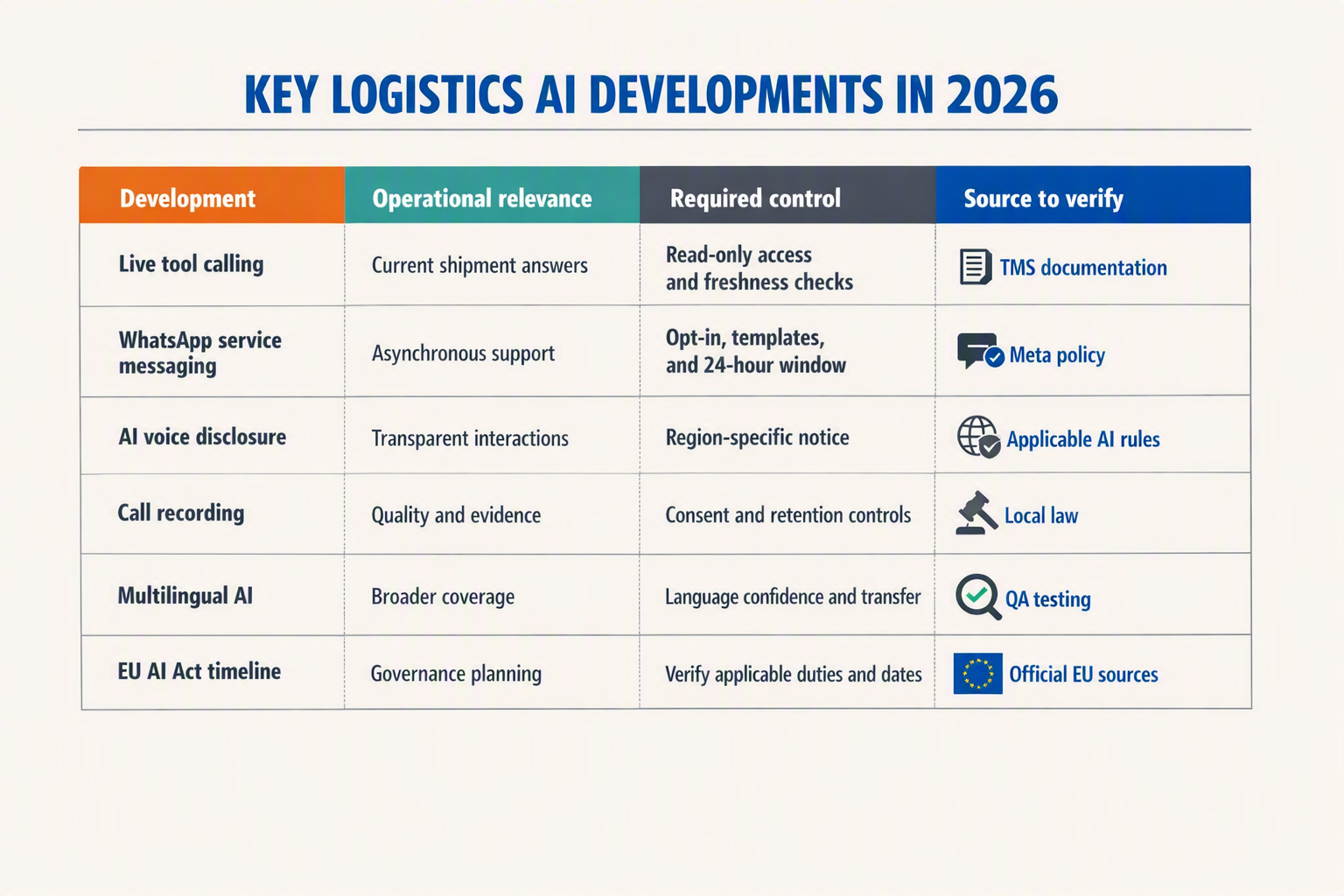
The developments that matter most in 2026 are grounded AI connected to live transport data, conversational WhatsApp calling, multilingual speech, tighter privacy rules and measurable human escalation. For each logistic workflow, technology and compliance must advance together: faster automation is useful only when shipment facts remain verifiable and customer data remains protected.
2026 development map
| Development | Why it matters in 2026 | Required operational response | Metric or control |
|---|---|---|---|
| Live-data grounding and tool use | A shipment tracking AI agent can query a TMS, order-management system or carrier API instead of relying on knowledge encoded in a language model. | Return the latest timestamped scan, exception code and service commitment; never infer a location or delivery time when the source is unavailable. | Data freshness, API success rate and unsupported-answer rate |
| WhatsApp Business calling | Phone and messaging can become one continuous support journey, including business-initiated or inbound calls where supported and consented. | Preserve context when a COD confirmation, address clarification or failed-delivery chat moves to an AI or human call. | Channel-transfer completion and repeat-contact rate |
| Indic multilingual speech | Regional-language recognition is essential for pickup instructions, landmarks, names and addresses that frequently mix English with local languages. | Test code-switching, numerals and locality names using real calls—not only studio recordings. CallMissed supports speech workflows across 22 Indian languages. | Word error rate by language and successful-address capture |
| Stronger privacy governance | Shipment records can expose names, phone numbers, addresses, purchases and payment status. India’s Digital Personal Data Protection Act, 2023 establishes obligations around notice, consent, security safeguards and erasure. | Verify customers before disclosure, minimise retained transcripts and define controller–processor responsibilities with vendors. | Verification pass rate, retention age and access-log coverage |
| Commercial-communication controls | Automated pickup reminders and COD calls may fall within India’s regulated commercial communications ecosystem. TRAI’s Telecom Commercial Communications Customer Preference Regulations, 2018 govern sender registration, consent and customer preferences. | Classify service versus promotional traffic, maintain consent records and use approved sender, template and calling arrangements where required. | Consent evidence, opt-out completion and complaint rate |
| AI transparency and escalation | Customers need to know when they are speaking with automation and how to reach a person. European Union AI Act Article 50 transparency obligations apply from 2 August 2026, including disclosure when people interact directly with certain AI systems. | Identify the agent as AI at the start, disclose recording where applicable and provide immediate escalation for disputes, safety issues or vulnerable customers. | Disclosure completion and human-handoff latency |
Customer experience becomes evidence-based
A courier AI voice agent should communicate source, time and certainty, not merely produce a fluent response. “The Bengaluru hub recorded an arrival scan at 08:42” is auditable; “your parcel should arrive soon” may be misleading unless a live system provides that estimate.
Teams should therefore set explicit service controls:
- Show the last successful system refresh to agents and supervisors.
- Trigger a human or operations handoff when APIs time out, scan events conflict or an address change affects routing.
- Require stronger verification before revealing a full address, COD amount or shipment history.
- Measure resolution quality separately from call containment; a contained but incorrect conversation is a failure.
- Evaluate speech performance by language, region, background noise and code-switching.
The practical 2026 standard is clear: automate routine intent handling, but keep operational systems authoritative, identity controls mandatory and humans reachable. This approach makes logistics customer service AI more useful without allowing conversational confidence to override delivery reality.
What architecture does a shipment tracking AI agent need to use live CRM, TMS, WMS, dispatch, and COD data safely?
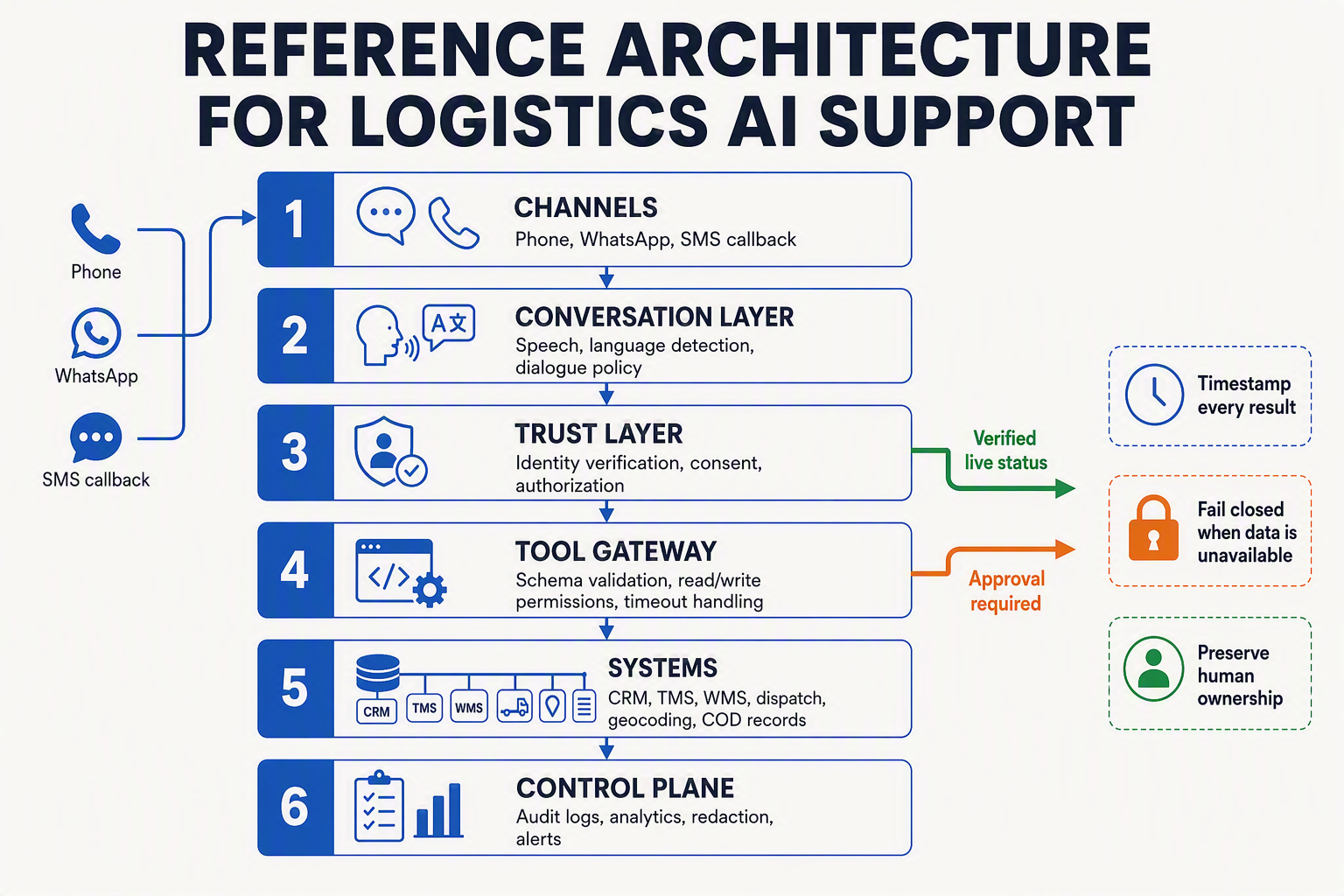
A shipment tracking AI agent needs a channel layer, identity gateway, orchestration service, governed system adapters and an immutable audit trail. The language model should interpret the request and compose the response, but authoritative CRM, TMS, WMS, dispatch and COD systems must determine what is true and what may be changed.
Define one source of truth for each field
Do not expose operational databases directly to the model. Instead, place authenticated APIs or middleware adapters between the agent and each system, with strict read/write permissions.
| System or layer | Authoritative data | Permitted AI action | Required safety control |
|---|---|---|---|
| CRM or order system | Customer identity, contact details, consent, case history | Verify the caller and create or update a support case | Match order-linked phone number; require OTP before exposing sensitive data |
| Transport management system (TMS) | Shipment state, service level, route and exception codes | Read current status and submit approved pickup requests | Return timestamp and source with every status; block invented ETAs |
| Warehouse management system (WMS) | Received, packed, sorted and handed-over events | Read fulfilment milestones | Treat warehouse events as distinct from in-transit scans |
| Dispatch or driver platform | Assignment, delivery attempt and operational notes | Request address clarification or escalate to operations | Mask driver numbers; restrict free-text notes; require human approval for rerouting |
| COD or payment service | COD amount, collection state and reconciliation status | Confirm the payable amount or record customer intent | Never collect card credentials; verify identity before revealing payment details |
| Event and audit layer | API calls, consent, tool results, changes and handoffs | Log decisions and trigger alerts | Use encryption, role-based access, retention rules and tamper-evident records |
Separate language reasoning from operational truth
The agent should use a controlled sequence:
- Classify intent—tracking, pickup, address correction, COD confirmation or complaint.
- Verify identity using an order-linked number, OTP or another approved factor.
- Call a narrow tool, such as
get_shipment_status, rather than giving the model unrestricted database access. - Validate freshness by checking the event timestamp, shipment ID and upstream response status.
- Apply business policy before any write operation.
- Respond with sourced facts or escalate when the data is missing, stale or contradictory.
For example, “Shipment scanned at Pune Hub at 14:32” is supportable when returned by the TMS. “It will arrive by 6 p.m.” is not supportable unless an authorised system supplies that commitment. A failed API request must produce “I cannot verify the current status”, not a prediction based on earlier conversations.
Engineer phone and WhatsApp as governed channel adapters
WhatsApp surpassed 3 billion monthly active users worldwide in April 2025, according to Meta CEO Mark Zuckerberg during Meta’s first-quarter earnings call. At that scale, delivery WhatsApp automation should process inbound messages and calls through the same identity, policy and audit services used by the phone channel.
Platforms such as CallMissed can bridge WhatsApp Business calls to an AI voice agent while supporting speech workflows across 22 Indian languages. The logistic operator should still keep shipment records in its own systems of record; the communication platform becomes the governed interaction layer, not a replacement TMS.
Finally, protect every write with idempotency keys, field-level validation and least-privilege credentials. Address changes, delivery rescheduling, pickup cancellation and COD amendments should require stronger verification—and, above defined risk thresholds, explicit human approval.
How should phone and WhatsApp workflows handle tracking enquiries, pickup requests, address clarification, and multilingual conversations?
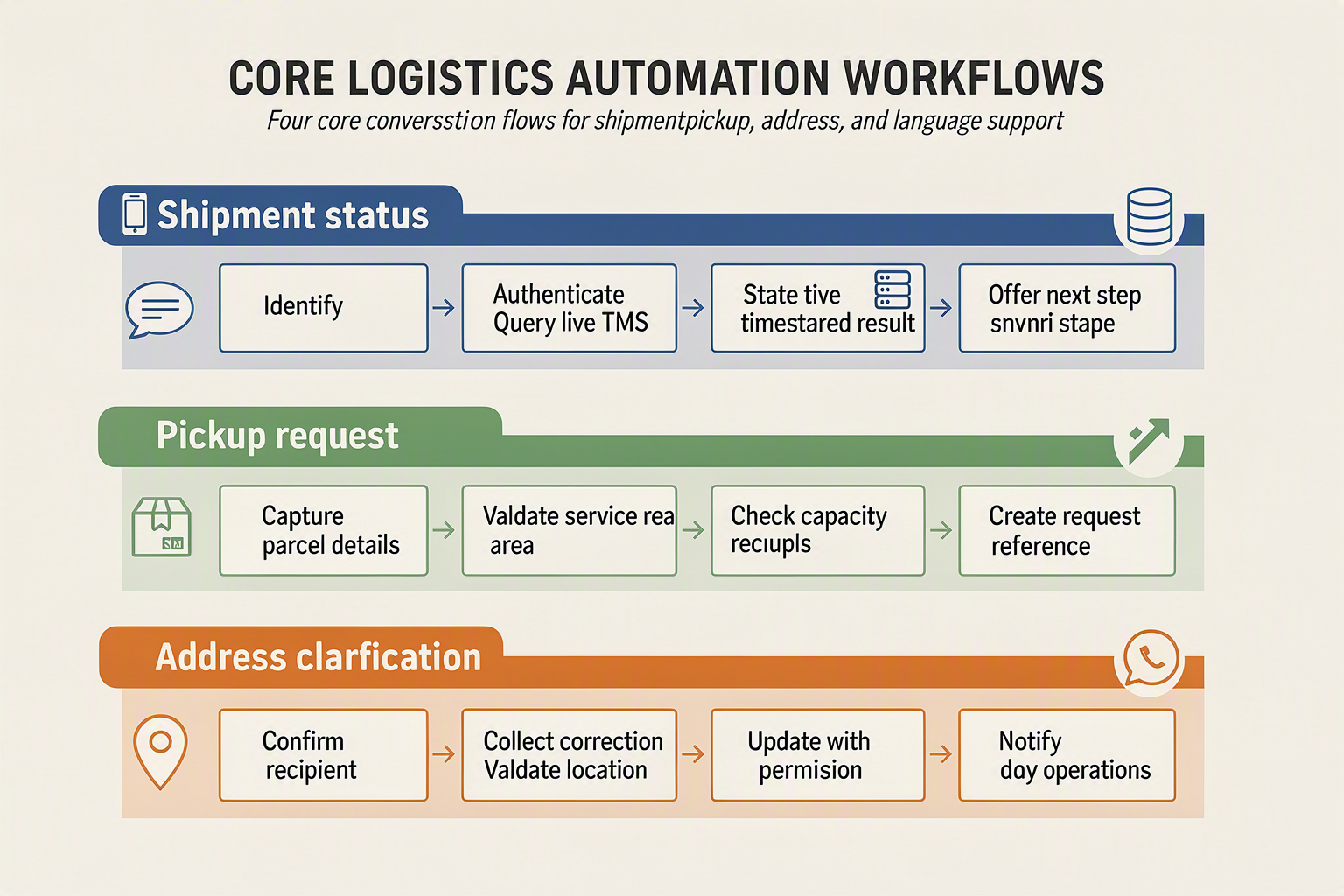
Phone and WhatsApp should share one stateful, identity-aware workflow: authenticate the customer, read live shipment or capacity data, complete only permitted actions, confirm the outcome, and escalate unresolved exceptions with full context. The agent must never infer a parcel location, delivery time, pickup slot or corrected address when the underlying system cannot verify it.
1. Resolve tracking enquiries from live events
A shipment tracking AI agent should request an order number, airway bill or tracking ID, then match it with the verified phone number or an OTP before exposing shipment details.
The workflow should:
- Query the TMS, order-management system or carrier tracking API in real time.
- Translate the latest scan code into customer-friendly language.
- State the scan timestamp, facility or delivery stage, and committed service level.
- Distinguish a scheduled date from an estimated date.
- Escalate stale scans, conflicting records, damaged-parcel codes or repeated failed attempts.
For example: “Shipment AB123 was scanned at the Pune sorting centre at 08:42 on 14 August. The system currently shows delivery scheduled for 15 August.” If the API times out, the safe response is: “I cannot verify the current status right now; I can create a callback request.”
2. Validate pickup requests before confirming them
Pickup automation must check operational constraints rather than merely collect an address. A courier AI voice agent or WhatsApp bot should capture:
- Pickup postcode and full address
- Parcel count, approximate weight and dimensions
- Shipment category and restricted-item declarations
- Preferred date and available time window
- Contact name and verified telephone number
The agent should then query serviceability, cutoff times, vehicle capacity and account eligibility. It can confirm a pickup only after the booking API returns a pickup ID and accepted slot. For oversized, hazardous, temperature-controlled or unusually high-value goods, route the request to the appropriate logistic operations queue.
3. Treat address clarification as a controlled correction
Address messages often contain landmarks, transliterated place names or instructions such as “call near the temple.” Delivery WhatsApp automation can collect these details asynchronously, but it should not silently overwrite the order record.
Use a controlled sequence:
- Verify the recipient before displaying the existing address.
- Ask for the missing component—not the entire address—where possible.
- Validate postcode, city, service zone and geolocation consistency.
- Show the proposed correction and request explicit confirmation.
- Write an audit event containing the old value, new value, channel and timestamp.
- Notify dispatch if the change affects the route, hub or delivery fee.
Share only the minimum information necessary with the driver. Payment data, unrelated order history and identity documents should remain outside the driver handoff.
4. Preserve meaning across languages and channels
Multilingual support requires more than translating a script. The IAMAI and Kantar “Internet in India 2024” report found that rural users represented 55% of India’s 886 million active internet users, making regional-language voice and messaging essential for broad coverage.
The workflow should detect the preferred language, confirm uncertain names and numbers, and preserve structured entities—tracking IDs, postcodes, dates and monetary amounts—without translation. For code-mixed conversations, the agent can respond naturally while storing normalized operational fields.
When confidence is low, transfer the transcript, verified identity state, shipment record and customer language to a human agent. Customers should not need to repeat the same tracking number or address after moving from WhatsApp to phone.
How should AI manage failed deliveries, COD confirmation, complaints, missed-call recovery, and driver or operations handoffs?
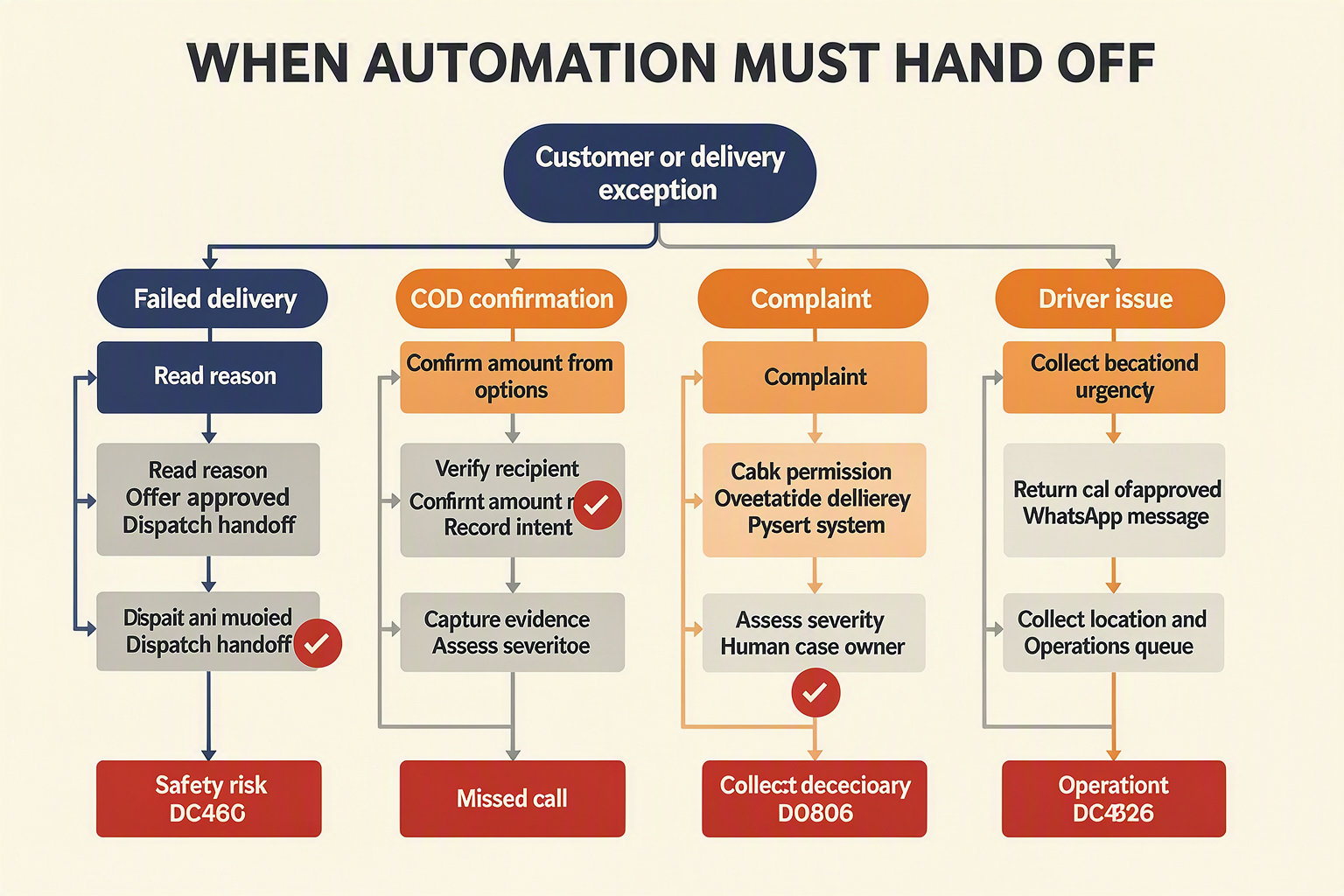
AI should manage delivery exceptions through verified, event-driven workflows: retrieve live shipment data, offer only permitted next actions, write every decision back to the CRM or TMS, and transfer uncertain or high-risk cases to a human. It must never invent a delivery attempt, driver location, payment amount or revised ETA.
Recover failed deliveries systematically
A failed-delivery event should trigger automation only after the transport management system records a valid exception code, such as customer unavailable, incomplete address, access restricted or payment refused.
The recommended workflow is:
- Retrieve the shipment ID, latest scan, attempt timestamp and approved redelivery options.
- Verify the recipient through the order-linked phone number, OTP or another approved control.
- Explain the recorded reason without blaming the customer or driver.
- Offer only TMS-supported actions, such as redelivery, depot collection or address clarification.
- Confirm the selected action and write it back to the operational system.
- Escalate when the shipment is damaged, disputed, time-sensitive or outside policy.
A shipment tracking AI agent should say, “The system records an unsuccessful attempt at 3:42 p.m. because the address could not be confirmed.” It should not claim that the driver called, waited or will return tomorrow unless those facts exist in live system data.
Confirm COD without creating payment risk
Cash-on-delivery confirmation requires stricter controls because it combines identity, shipment and payment information. The courier AI voice agent should disclose the payable amount only after verification and should never request card PINs, UPI PINs, CVVs or OTPs intended to authorise payment.
A safe COD flow should:
- Confirm whether the verified recipient expects the parcel.
- Read the amount directly from the order-management system.
- Record “confirmed,” “declined” or “needs human assistance.”
- Explain accepted payment methods using current carrier policy.
- Route amount disputes, suspicious orders and repeated refusals to operations.
A confirmation is not proof of successful delivery; final status must still come from the delivery scan or proof-of-delivery system.
Treat complaints as cases, not conversations
Logistics customer service AI can collect a structured complaint, but severity should determine ownership. The agent should capture the shipment number, issue category, requested remedy, evidence availability and preferred contact language.
Immediate human escalation is appropriate for:
- Lost, damaged, opened or temperature-sensitive shipments
- Safety threats, harassment or alleged fraud
- Medication, legal-document or high-value delivery exceptions
- Repeated failed attempts or conflicting scan events
- Refund, compensation or liability decisions outside approved policy
The customer should receive a case ID and a policy-based response window—not an invented resolution time. Conversation transcripts and summaries should be attached to the CRM case for auditability.
Recover missed calls across voice and WhatsApp
A missed call should create a callback task rather than disappear into a queue. WhatsApp exceeded 3 billion monthly active users worldwide in April 2025, according to Meta CEO Mark Zuckerberg, making permission-aware WhatsApp follow-up particularly relevant for delivery operations.
Delivery WhatsApp automation can send an approved message asking whether the caller needs tracking, redelivery or pickup assistance. Platforms such as CallMissed can also bridge WhatsApp Business calls to an AI voice agent, supporting continuity between messaging and calling.
Design handoffs with operational context
Every driver or operations handoff should include:
- Verified customer and shipment identifiers
- Latest scan event and exception code
- A concise conversation summary
- Actions already attempted
- Language preference, urgency and callback channel
The AI should not expose a driver’s personal number or transfer customers directly without policy approval. For any logistic exception requiring field judgement, the human operator—not the model—must make the final operational decision.
Which metrics reveal the real impact and risks of logistics automation?
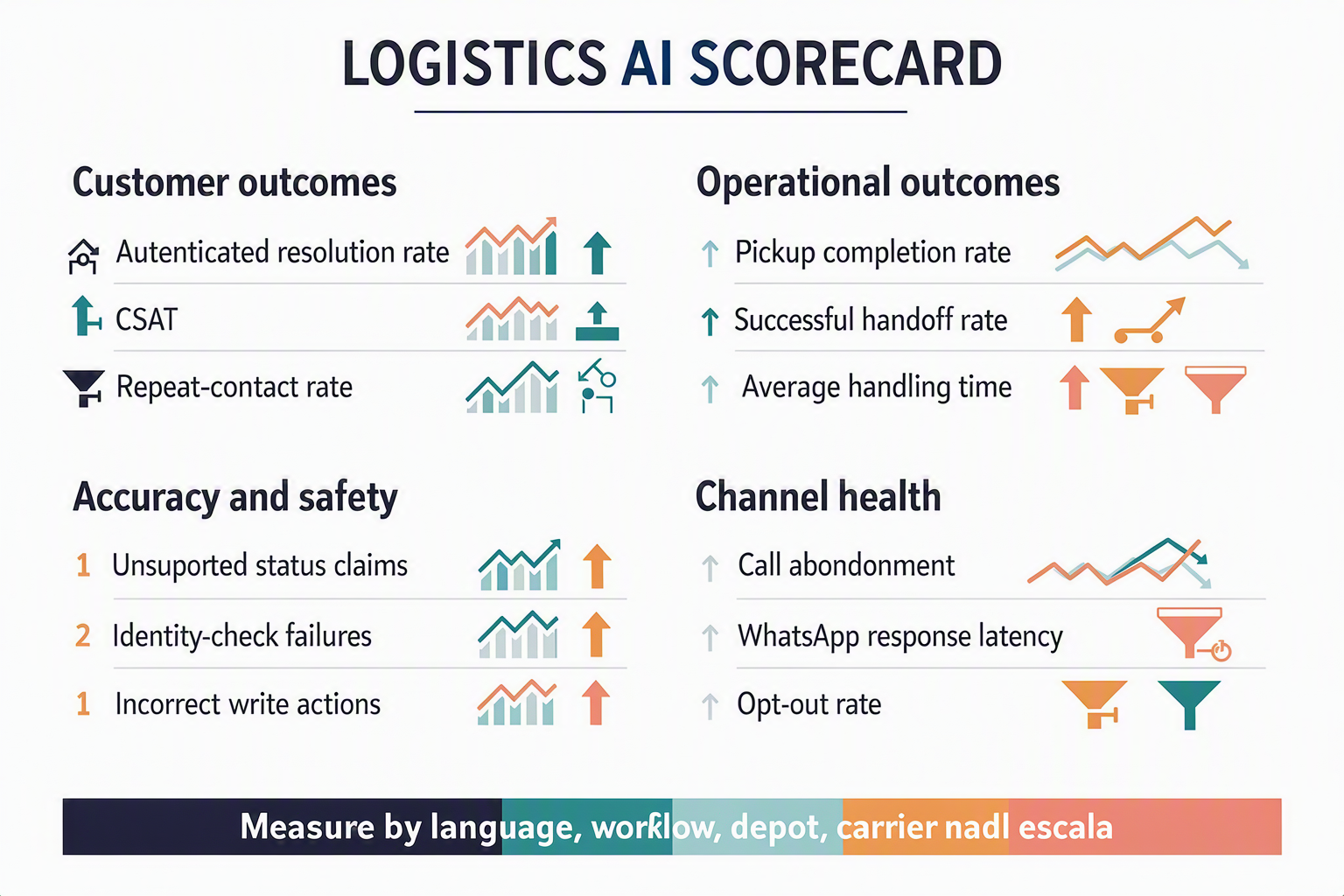
The real impact of logistics automation appears in verified resolution, operational outcomes and risk rates—not call deflection alone. A courier AI voice agent is effective only when it completes the requested task correctly, protects shipment data and creates a reliable human handoff when automation cannot proceed.
Measure outcomes, not conversation volume
Track performance against a pre-automation baseline and separate phone, WhatsApp chat and WhatsApp calling. Core metrics include:
- Verified resolution rate: Percentage of enquiries resolved using confirmed CRM, order-management system or TMS data, without repeat contact within a defined period.
- Task-completion rate: Successful tracking responses, pickup bookings, address updates, COD confirmations or redelivery requests divided by valid attempts.
- Repeat-contact rate: Customers contacting support again about the same shipment within 24 or 48 hours.
- First-contact resolution: Cases completed in one interaction, including any required backend update.
- Cost per verified resolution: Total AI, telephony, messaging, integration and supervision costs divided by correctly resolved cases.
- Operational conversion: The proportion of conversations that produce a completed pickup, successful redelivery or corrected address—not merely an agent response.
Containment should be interpreted carefully. A 90% containment rate is harmful if customers receive stale tracking information or cannot reach an operator during a failed delivery.
Monitor truthfulness and data freshness
A shipment tracking AI agent must be evaluated against the system of record. Audit a statistically useful sample of conversations and classify every status, location and delivery-time statement.
Key controls are:
- Grounded-answer accuracy: Percentage of shipment claims supported by the exact API response or latest scan event.
- Unsupported ETA rate: Percentage of interactions in which the agent states a delivery time not returned or explicitly permitted by operational logic; the target should be zero.
- Data-freshness lag: Time between the latest carrier event and the information presented to the customer.
- Integration failure rate: Timeouts, invalid payloads, authentication failures and unavailable TMS records as a share of requests.
- Safe-failure rate: Percentage of unavailable-data cases where the agent clearly says it cannot verify the status and offers escalation.
Review these measures by carrier, depot, shipment type and API version. Aggregate accuracy can hide a failing regional integration.
Quantify privacy, escalation and language risks
Identity verification is a measurable security control, not just a prompt instruction. Track verification completion, unauthorised disclosure incidents, OTP failures and attempts to access shipments from unlinked phone numbers. Address, payment and shipment-history disclosure without the required verification should have a zero-tolerance threshold.
Escalation analytics should include:
- Correct-escalation rate for complaints, damaged parcels, disputed COD payments and safety-sensitive cases
- Transfer completion rate, rather than transfer attempts
- Human pickup time and customer abandonment during handoff
- Context-transfer completeness, including shipment ID, verified identity, transcript and attempted actions
- Driver-contact avoidance, measuring whether operations handled an issue without unnecessarily exposing driver details
Language metrics must be segmented rather than averaged. The IAMAI and Kantar “Internet in India 2024” report found that rural users represented 55% of India’s 886 million active internet users. A logistic operator should therefore compare intent recognition, transcription errors, resolution and escalation across each supported language, accent and noisy-call condition.
Use a balanced deployment scorecard
Publish a weekly scorecard combining customer outcomes, operational value, model quality and safety. Set alert thresholds for unsupported ETAs, disclosure incidents and integration failures, while evaluating cost and containment over longer periods. Automation should expand only when verified resolution rises without worsening complaints, repeat contacts, privacy risk or failed-delivery recovery.
What do operations, security, compliance, and customer-experience experts recommend—and how should vendor claims be validated?

Experts recommend treating AI phone and WhatsApp support as controlled access to operational systems, not as a standalone chatbot. Every vendor claim should be validated through security documentation, live-data failure tests, multilingual evaluations and a time-boxed production pilot using measurable acceptance criteria.
Operations and customer-experience recommendations
Operations leaders should define exactly what the agent may read, change or promise. A shipment tracking AI agent may retrieve scan events and service-level commitments, but it should never infer a delivery time from an incomplete tracking history.
Recommended controls include:
- Use read-only TMS or carrier access by default; require separate authorization for pickup cancellation, address changes or redelivery.
- Display the source event, timestamp and system of record to human agents.
- Verify customers using an order-linked phone number, OTP or approved secondary factor before disclosing shipment history, address or COD value.
- Route damaged parcels, repeated failed deliveries, threats, payment disputes and missing live data to people.
- Let customers request a person without navigating a long decision tree.
- Test regional language comprehension with real addresses, landmarks, PIN codes and mixed-language speech—not translated demo scripts.
CX teams should measure correct resolution, not just containment. A high containment rate is harmful if the courier AI voice agent gives an unsupported estimate or records the wrong pickup location.
Security and compliance recommendations
Security teams should apply least privilege, encryption, audit logging and strict retention limits across telephony, WhatsApp, CRM and TMS integrations. The NIST AI Risk Management Framework 1.0, released in January 2023, organizes AI risk work into four functions: Govern, Map, Measure and Manage.
For Indian deployments, legal and security reviews should address:
- The Digital Personal Data Protection Act, 2023, plus rules and government notifications in force when the service launches.
- TRAI’s Telecom Commercial Communications Customer Preference Regulations, 2018 for applicable promotional and service communications over telecom channels.
- CERT-In’s April 2022 directions, which require specified cyber incidents to be reported within six hours of noticing them and covered ICT logs to be retained securely for 180 days within India.
- PCI DSS 4.0.1 where payment-card data enters the workflow; the safer design is to keep card details outside the conversational system entirely.
- Recording notices, consent, deletion procedures, processor contracts and cross-border data-flow documentation.
Compliance approval should be based on the actual workflow and data path—not a vendor badge alone.
How to validate vendor claims
Use a scored proof-of-concept rather than accepting statements such as “real-time,” “multilingual” or “enterprise-grade.”
- Demand evidence: request architecture diagrams, subprocessors, hosting regions, penetration-test summaries, incident procedures and current ISO 27001 or SOC 2 documentation where claimed.
- Test live-data grounding: disconnect the TMS, return stale scans and inject conflicting events. The correct response is an explicit inability to verify—not a fabricated status.
- Test authorization boundaries: attempt to access another customer’s shipment, alter an address after dispatch and bypass OTP verification.
- Benchmark real conversations: evaluate task accuracy, handoff success, end-to-end latency, transcription errors, repeat contacts and unsupported claims by language.
- Inspect fallback behavior: simulate model, carrier API, WhatsApp and telephony failures, then verify queueing, retries and human escalation.
- Validate commercial claims: calculate total cost for call minutes, transcription, synthesis, model usage, messaging, integrations, storage and support.
Before wider rollout, run one logistic lane or depot with shadow monitoring, compare AI outcomes against human-reviewed records, and establish contractual remediation, export and exit procedures.
What does this mean for your rollout, CallMissed capability verification, and internal implementation plan?
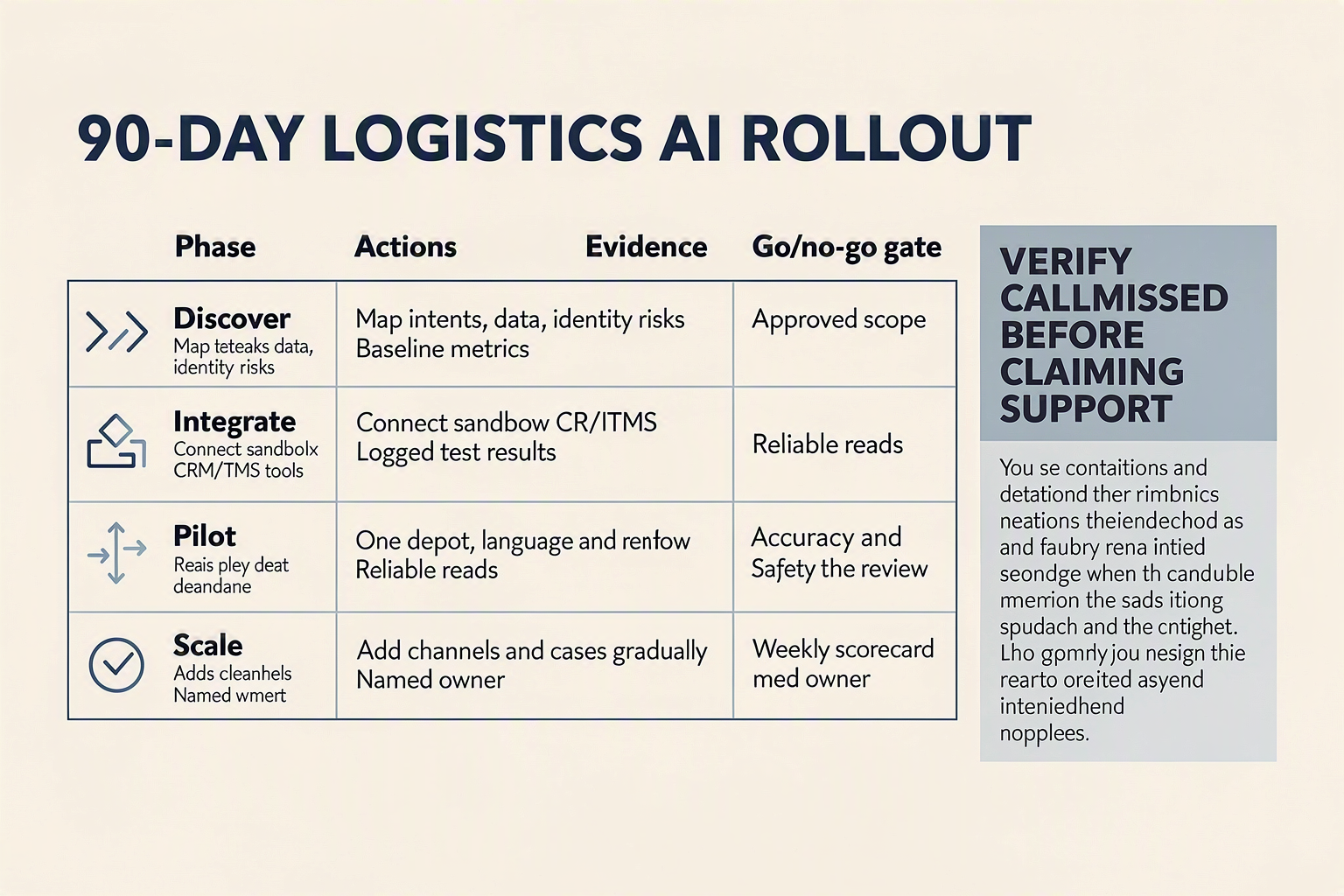
A safe rollout should be gate-based, integration-led and measurable: verify CallMissed capabilities in your own tenant, connect the agent to authoritative CRM/TMS data, and automate only after each workflow passes identity, accuracy and escalation tests. Scale matters—Bain & Company’s 2025 “How India Shops Online” report estimated that India had approximately 270 million online shoppers in 2024—but containment targets must never override truthful responses or customer privacy.
Capability verification and implementation matrix
CallMissed provides the communication layer—AI voice agents, WhatsApp chat and calling, multilingual speech, an omnichannel inbox/CRM and knowledge-base retrieval. Shipment events, pickup capacity, COD amounts and driver activity must still come from the logistic operator’s approved systems through APIs, webhooks or middleware.
| Rollout area | CallMissed capability to verify | Internal dependency | Acceptance gate | Owner |
|---|---|---|---|---|
| Live shipment enquiries | AI voice and WhatsApp workflows can call configured tools or backend endpoints | TMS/carrier API exposing tracking ID, latest scan, timestamp and exception code | Agent quotes only returned data; unavailable data triggers a transparent fallback | TMS + CX |
| Pickup requests | Voice/chat data capture and omnichannel conversation records | Serviceability, cutoff, capacity and booking APIs | Test booking creates a valid reference; no confirmation before backend success | Operations |
| Address and COD checks | Inbound and business-initiated WhatsApp calling plus conversational workflows | OTP/phone-match service, order system and consent rules | Sensitive fields remain hidden until identity verification succeeds | Security + CX |
| Failed delivery and complaints | Inbox handoff, CRM context and escalation routing | Exception taxonomy, queues, SLAs and on-call roster | Human receives transcript, verified identity state and shipment context | Contact centre |
| Multilingual service | Speech-to-Text and Text-to-Speech coverage across 22 Indian languages | Approved glossary, regional prompts and language-specific test calls | Native reviewers approve names, numbers, locations and code-switching | QA + Regional ops |
| Reporting and optimisation | Conversation records and workflow data available for operational review | BI pipeline, event schema and outcome definitions | Dashboard separates resolved, escalated, abandoned and integration-failure contacts | Data team |
These entries are capability checks, not performance guarantees. Before procurement sign-off, confirm channel availability, WhatsApp Business onboarding, supported telephony routes, language/model options, API limits, data retention, pricing and escalation behaviour in the intended deployment environment. CallMissed uses transparent credits where one credit equals ₹1, but finance teams should model actual call duration, messaging, model usage and campaign volume rather than relying on a headline unit price.
Recommended internal rollout sequence
- Assign accountable owners. Name one decision-maker each for operations, CX, TMS integration, security, compliance and analytics.
- Build a read-only pilot. Start with shipment-status retrieval for a restricted traffic segment; prohibit the agent from updating addresses, pickups or COD instructions.
- Add verified transactions. Enable pickup creation and address clarification only after idempotency, authentication, audit logging and rollback tests pass.
- Run multilingual red-team testing. Test regional accents, mixed-language speech, noisy roads, repeated tracking numbers and ambiguous place names.
- Pilot with controlled traffic. Compare AI outcomes against human-reviewed records and automatically inspect every high-risk failure.
- Expand by workflow, not all at once. Add failed-delivery recovery, missed-call callbacks and complaint routing after the preceding stage meets its acceptance gate. The broader operational pattern is covered in the AI voice agent customer-service implementation guide.
Minimum go-live controls
- Never infer a location or delivery estimate when the live system has not returned one.
- Require identity verification before exposing addresses, COD values or shipment history.
- Preserve tool responses, consent events, transcripts and handoff timestamps for audit.
- Provide immediate human escalation for disputes, suspected fraud, damaged goods and repeated integration failures.
- Define rollback triggers for authentication errors, stale tracking data, latency spikes and incorrect transaction creation.
Frequently asked questions: Can AI provide an exact delivery time, how should identity be verified, what WhatsApp permissions apply, which integrations are required, can it support multiple languages, and how should CallMissed capabilities be checked?
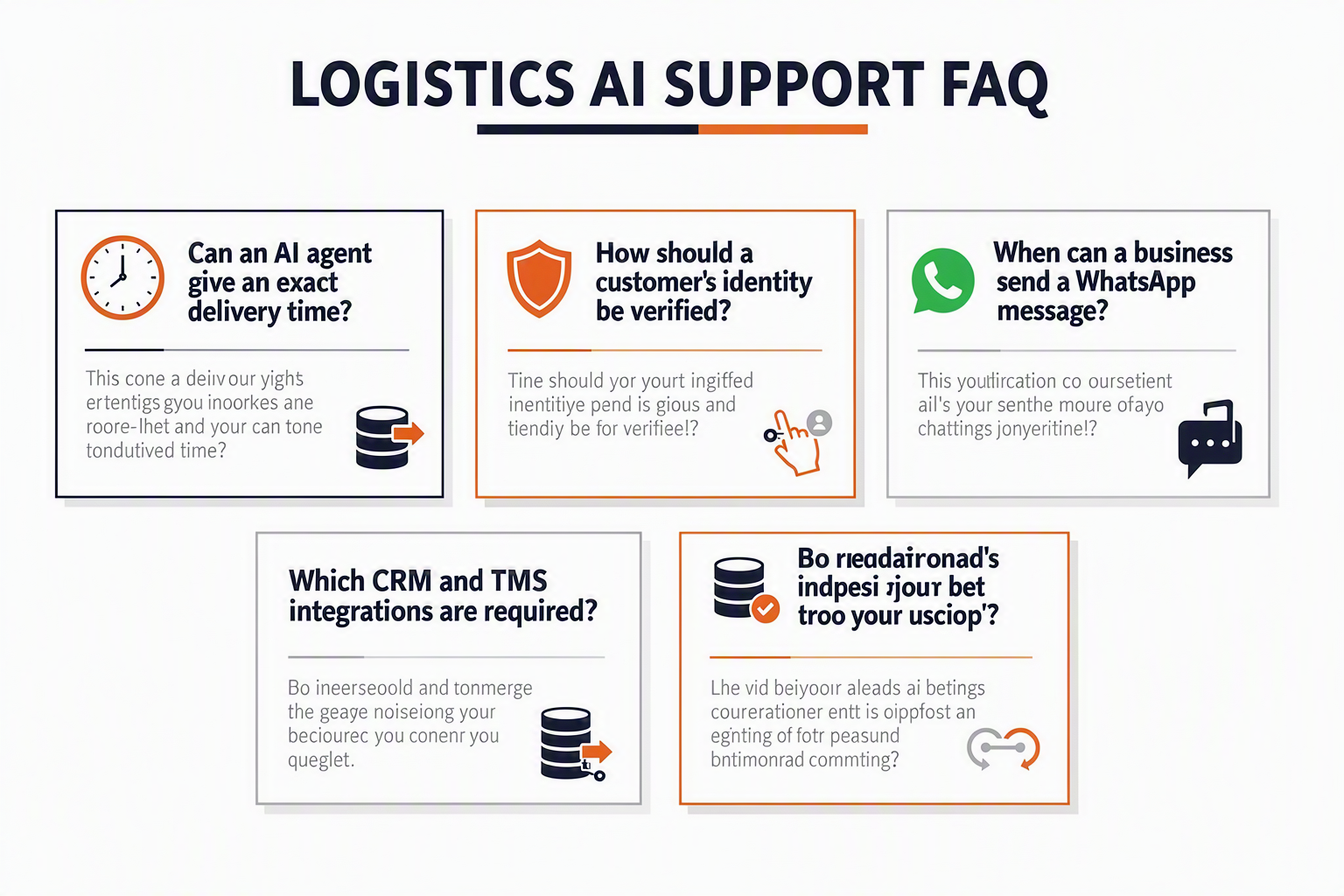
Can logistics customer service AI provide an exact delivery time?
How should a courier AI voice agent verify a customer’s identity?
What WhatsApp permissions are required for delivery WhatsApp automation?
Which integrations does logistics customer service AI require?
Can logistics customer service AI 2026 workflows support multiple Indian languages?
How should a courier company verify CallMissed capabilities before deployment?
Conclusion
In 2026, logistics customer service AI should be judged by operational accuracy—not simply by how human it sounds. The strongest deployments connect phone and WhatsApp conversations to verified CRM, order-management and TMS data while reserving uncertain or sensitive cases for people.
- A shipment tracking AI agent must use live scan events and exception codes—and never invent a location or delivery time when systems are unavailable.
- Delivery WhatsApp automation can handle pickup requests, address clarification, failed-delivery recovery and COD confirmation, but identity must be verified before exposing shipment, payment or address data.
- A multilingual courier AI voice agent can make logistic support more accessible across regional markets; CallMissed supports speech workflows in 22 Indian languages and can bridge WhatsApp Business calls to an AI agent.
- Success requires measurable operations: track containment, escalation, response latency, handoff quality and end-to-end resolution—not conversation volume alone.
The scale makes disciplined automation increasingly important. India had approximately 270 million online shoppers in 2024, according to Bain & Company’s 2025 “How India Shops Online” report. Looking ahead, watch for tighter real-time integrations, more reliable multilingual models and unified handoffs between AI agents, drivers and operations teams.
To explore how this infrastructure is evolving, visit CallMissed. Which high-volume workflow could your team automate safely first—without compromising truth, privacy or human accountability?
Related Reading
Discussion
Related Posts


Ready to automate customer conversations?
Launch AI voice agents and WhatsApp bots with CallMissed — one API, 22+ Indian languages.