
AI Lead Qualification Agent Guide 2026: Phone and WhatsApp Scorecards, Prompts, and Handoffs


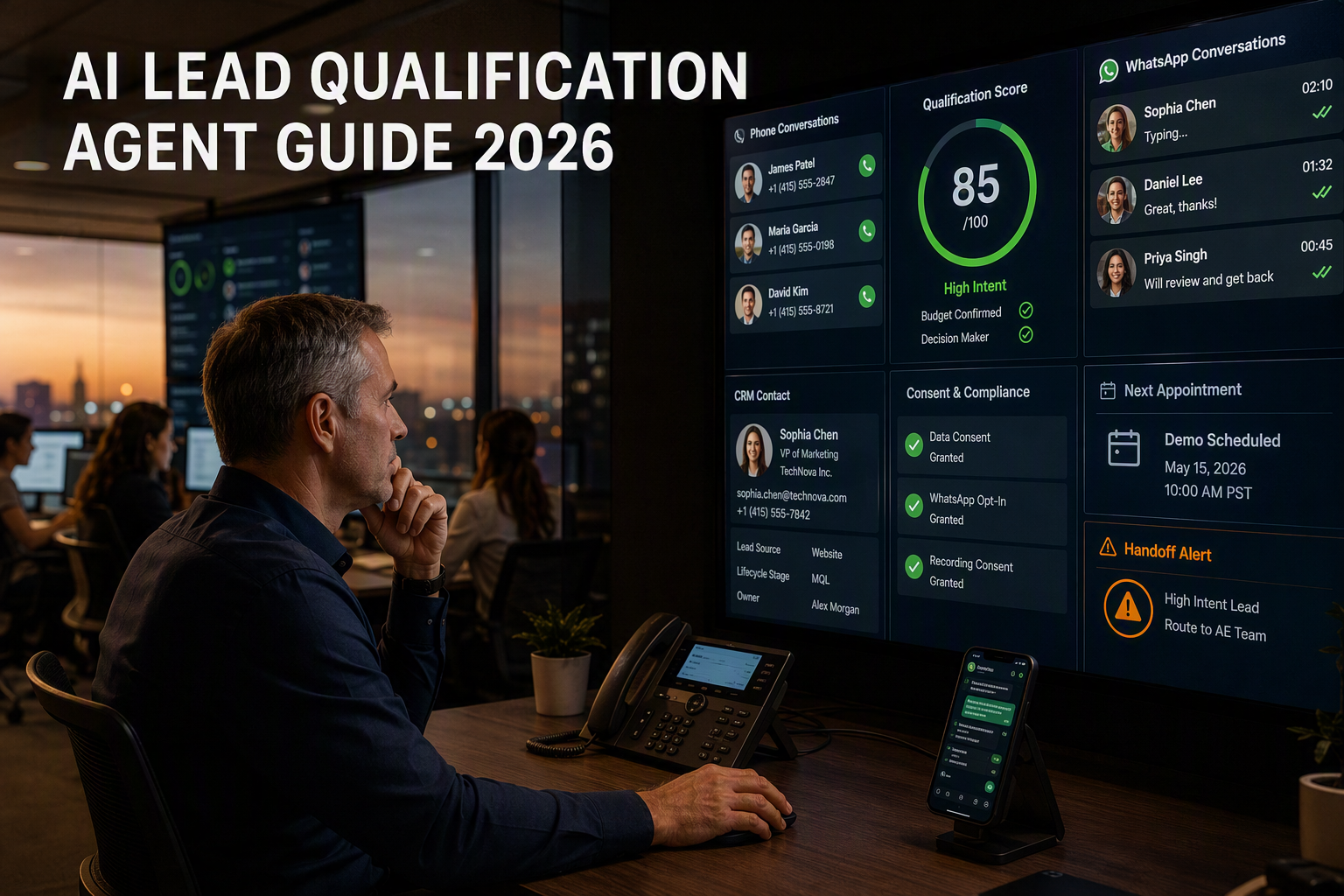
Build an AI lead qualification agent for phone and WhatsApp with criteria, scoring, consent, CRM, booking, handoff, QA, and ROI templates.
AI Lead Qualification Agent Guide 2026: Phone and WhatsApp Scorecards, Prompts, and Handoffs
What if the lead your team calls tomorrow has already explained their budget, urgency, and buying authority to an AI lead qualification agent? In 2026, that is the practical promise of combining phone conversations with WhatsApp follow-ups: qualify buyers while intent is fresh, then route each person to the right next step without forcing salespeople to interrogate every enquiry.
The scale makes this urgent. Meta said in its Q1 2025 earnings call that WhatsApp had passed 3 billion monthly active users, making it a core customer channel rather than a secondary inbox. Salesforce’s State of Sales, Sixth Edition, published in 2024, found that salespeople spend only 30% of their working week connecting with customers; Salesforce also reported that 81% of sales teams were experimenting with or had fully implemented artificial intelligence. An AI sales agent can reclaim part of that capacity only if its questions, thresholds, consent controls, and handoffs reflect the business’s actual sales process.
This distinction matters: automated lead qualification is not merely voice AI lead generation or instant form capture. A reliable AI SDR agent must identify fit, need, timing, authority, location, and commercial constraints; detect uncertainty instead of inventing answers; record structured fields in the CRM; and book or escalate only when defined conditions are met. WhatsApp lead qualification adds another layer: businesses need explicit user expectations, channel-appropriate pacing, auditable opt-ins, and a clean transition between chat and calling.
Platforms such as CallMissed, an India-focused AI communication infrastructure platform, illustrate this convergence by connecting AI agents with inbound and business-initiated WhatsApp Business calls, WhatsApp chat, CRM-style workflows, and multilingual voice across 22 Indian languages.
What this guide delivers
- A practical qualification scorecard for fit, intent, urgency, authority, budget, risk, and next-step readiness.
- Separate inbound and outbound flows for phone and WhatsApp, including consent checks, retry limits, disqualification rules, and recovery paths.
- Reusable discovery questions, prompt structures, CRM update schemas, booking logic, and human handoff triggers that preserve context.
- A measurement framework covering contact rate, qualified-lead rate, booking rate, show rate, handoff accuracy, conversion by score band, and false-positive reviews.
The goal is not to make every conversation autonomous. It is to create a consistent, reviewable qualification system that responds quickly, asks only what matters, updates the system of record, and knows when a skilled seller should take over. By the end, you will have templates for turning phone and WhatsApp interactions into measurable pipeline decisions rather than opaque bot activity at scale.
How does an AI lead qualification agent work? The complete phone-to-WhatsApp qualification loop
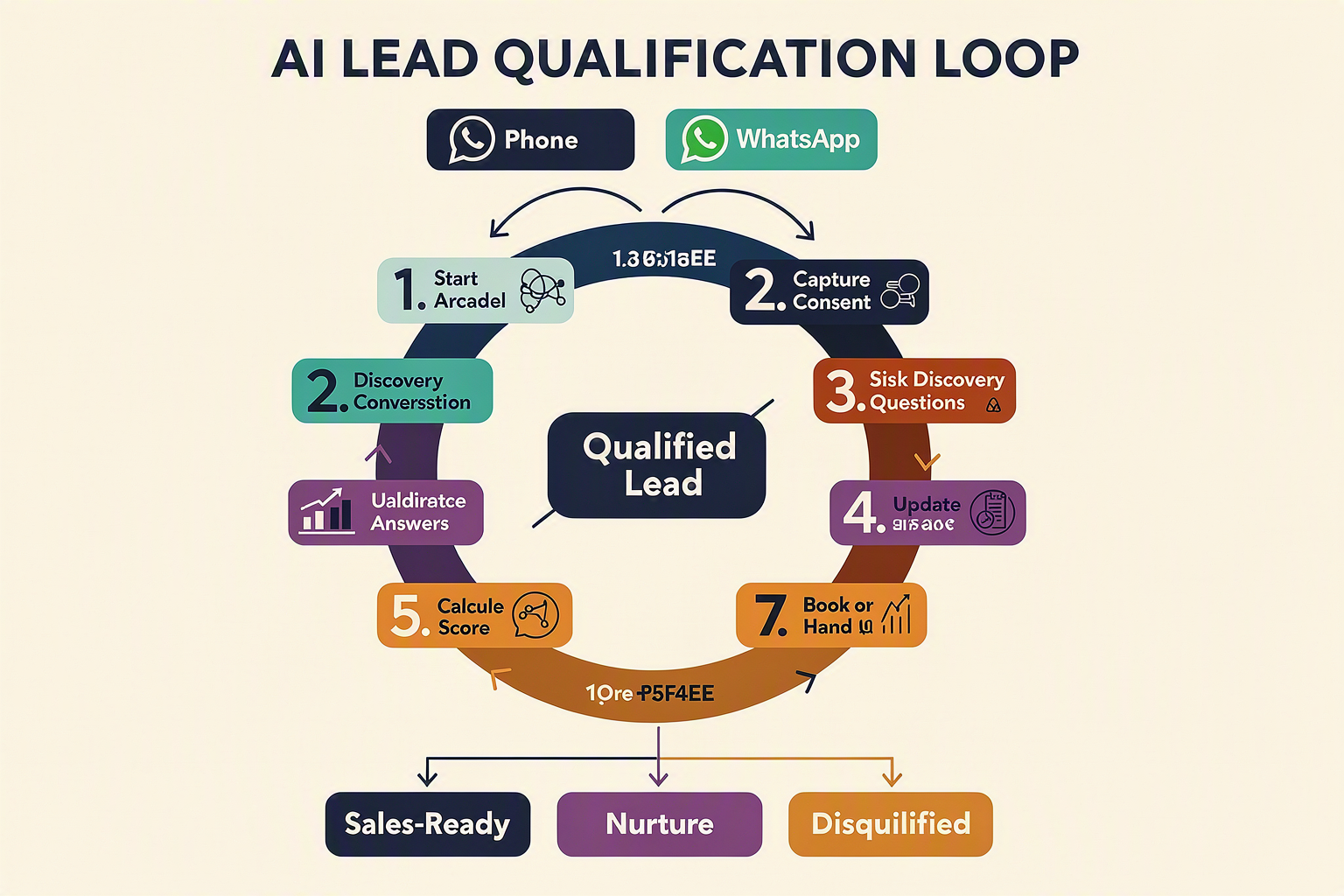
An AI lead qualification agent turns a phone or WhatsApp enquiry into a structured sales decision: identify the person, establish permission, ask adaptive discovery questions, score the answers, update the CRM, and trigger booking, nurturing, disqualification, or human handoff. The “loop” is complete only when every conversation produces an auditable next step—not merely a transcript.
The qualification loop, step by step
- Capture the trigger and context.
An inbound flow can begin with an answered call, missed call, website form, WhatsApp message, or campaign response. An outbound flow starts from an authorised lead record and should pass the source, campaign, product interest, language, and consent status to the AI sales agent.
- Resolve identity and channel permission.
The agent confirms who it is speaking with and explains the purpose of the interaction. Before switching channels, it asks explicitly—for example: “May I send the product summary and appointment options to this WhatsApp number?” The system records the consent wording, response, channel, and timestamp instead of storing a generic opt-in flag.
- Run adaptive discovery.
The AI SDR agent asks one question at a time and branches according to the answer. A practical sequence covers:
- Need: What problem is the buyer trying to solve?
- Fit: Does the use case, geography, company size, or required capability match?
- Authority: Is this person the buyer, evaluator, user, or gatekeeper?
- Timing: Is the project immediate, dated, exploratory, or stalled?
- Commercial readiness: Is there an approved budget, expected range, or procurement process?
- Constraints: Are integrations, languages, compliance requirements, or implementation deadlines decisive?
If the buyer does not know an answer, the agent should record unknown, not infer a convenient value.
- Calculate the qualification outcome.
Automated lead qualification converts validated answers into field-level scores and hard rules. A buyer might receive points for a supported use case and near-term timeline, while a mandatory geographic or compliance mismatch can override the total. The output should include a score, score band, disqualification reason where applicable, confidence level, and recommended action.
- Continue on WhatsApp without restarting discovery.
In WhatsApp lead qualification, the agent carries forward the phone context and uses the channel for documents, concise clarifications, reminders, and scheduling choices. The message should summarise what was understood and invite correction: “You are evaluating 20 seats for an October rollout—is that accurate?” This prevents channel switching from creating duplicate questions.
- Write structured data to the CRM.
The workflow updates contact identity, lead source, consent evidence, discovery fields, score components, objections, transcript reference, owner, and next-action date. Free-text notes remain useful, but routing and reporting should depend on structured fields.
- Book, nurture, or escalate.
Qualified leads receive eligible calendar slots based on territory, product, language, and seller availability. Ambiguous answers, pricing negotiations, complaints, sensitive disclosures, repeated misunderstanding, or requests for a person should trigger human handoff with the summary attached.
Why phone and WhatsApp work as one system
Phone provides fast, conversational discovery; WhatsApp provides persistence and low-friction follow-through. This makes the loop more useful than standalone voice AI lead generation, which may capture interest without resolving readiness.
CallMissed supports this combined model through AI voice agents, WhatsApp chat, inbound and business-initiated WhatsApp Business calling, CRM-style workflows, and voice coverage across 22 Indian languages. The underlying principle is platform-independent: preserve consent, context, and qualification state across every channel transition.
Why are automated lead qualification, voice AI lead generation, and the AI SDR agent converging in 2026?

Automated lead qualification, voice AI lead generation, and the AI SDR agent are converging because they now operate on the same customer journey: capture intent, hold a two-way conversation, score the opportunity, update the CRM, and trigger the next action. In 2026, the meaningful distinction is no longer “chatbot versus dialler,” but whether one coordinated system can preserve context across phone and WhatsApp.
Three separate tools are becoming one workflow
Historically, each category solved a narrow problem:
- Voice AI lead generation focused on answering or placing calls and capturing contact details.
- Automated lead qualification applied rules such as geography, company size, budget, use case, or purchase timeline.
- An AI SDR agent handled discovery, follow-up, meeting scheduling, and pipeline administration.
Modern systems combine these functions because qualification rarely happens in one interaction. A prospect may call after seeing an advertisement, ask for pricing on WhatsApp, send missing requirements later, and finally accept a calendar slot. Treating those events as separate leads creates duplicate records, repeated questions, and unreliable scores.
The operational pressure is clear: Salesforce’s State of Sales, Sixth Edition, published in 2024, found that sellers spent only 30% of their working week connecting with customers. Consolidating repetitive discovery and administration gives human representatives more time for negotiation, solution design, and complex objections.
Phone and WhatsApp contribute different signals
Convergence does not mean making every channel behave identically. Each channel contributes different evidence to an AI lead qualification agent:
- Phone reveals urgency, hesitation, objections, pronunciation, and nuanced answers through a synchronous conversation.
- WhatsApp supports asynchronous replies, document sharing, written confirmation, and low-friction follow-up.
- CRM data supplies lead source, account history, ownership, previous outcomes, and existing opportunities.
- Calendar and routing systems determine representative availability, territory, language, and meeting type.
A voice conversation might establish need and urgency, while WhatsApp lead qualification can collect a preferred location, product specification, or written confirmation of a booking. The combined record is more useful than a transcript stored without structured fields.
The AI sales agent becomes an orchestration layer
A capable AI sales agent does more than speak naturally. It coordinates a controlled sequence:
- Verify identity, channel expectations, and applicable consent.
- Retrieve known CRM information without treating stale data as fact.
- Ask only the unanswered discovery questions required by the scorecard.
- Distinguish confirmed answers from inferred or unknown attributes.
- Calculate or revise the qualification score.
- Book, nurture, disqualify, or transfer according to explicit rules.
- Write the outcome, evidence, and next action back to the CRM.
This orchestration model also prevents a common design failure: optimizing for booked meetings while ignoring meeting quality. A calendar slot is not a successful outcome when the prospect is outside the service area, lacks the required use case, or never agreed to be contacted.
Why the convergence matters in India
India makes cross-channel orchestration especially relevant because language, connectivity, and customer preferences vary substantially. CallMissed reflects this direction by combining WhatsApp chat, inbound and business-initiated WhatsApp Business calling, AI voice agents, CRM-style workflows, and speech support across 22 Indian languages.
The practical result is not “full autonomy at any cost.” It is a reviewable qualification layer in which phone and WhatsApp share context, scores have traceable evidence, consent remains visible, and human sellers enter when judgment can materially improve the outcome.
Which key developments define AI qualification in 2026?
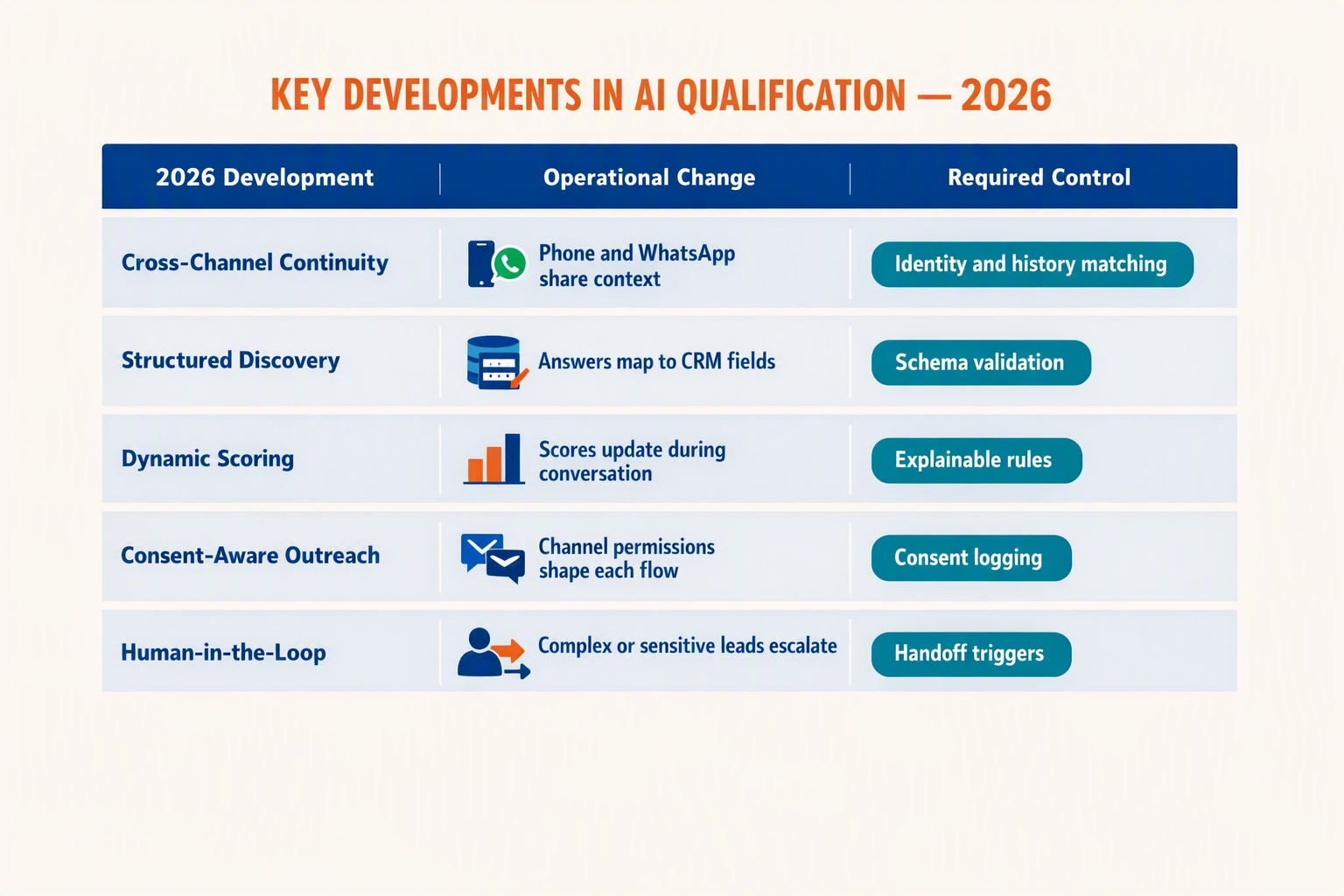
AI qualification in 2026 is increasingly defined by cross-channel continuity, structured scoring, consent-aware outreach, CRM orchestration, multilingual conversations, and measurable human oversight. The shift is from isolated bots toward an AI lead qualification agent that preserves context across phone and WhatsApp while making traceable routing recommendations. These are operating priorities, not capabilities that every product or deployment supports by default.
| 2026 development | What changed | Phone and WhatsApp impact | Implementation priority |
|---|---|---|---|
| Cross-channel qualification | Qualification state can follow a lead between connected channels | An inbound phone discovery call can continue through WhatsApp answers, documents, or reminders without repeating verified questions | Use one lead ID, a shared interaction history, and synchronized qualification fields |
| Structured, explainable scoring | Free-form summaries are supplemented by criterion-level evidence | Fit, need, authority, budget, urgency, and risk can be scored separately instead of collapsed into “hot” or “cold” | Store scores, confidence, supporting utterances, unknowns, conflicts, and disqualification reasons |
| Consent-aware orchestration | Permission must be evaluated by channel, purpose, jurisdiction, and outreach stage | An inbound enquiry permits a response to that enquiry but does not automatically authorize unrelated outbound calls or WhatsApp marketing | Record opt-in source, wording, timestamp, channel, purpose, and revocation status; apply applicable calling rules and WhatsApp policies |
| CRM-connected action | Supported APIs and workflows can update systems during or after a conversation | Qualified leads may be assigned, booked, nurtured, or suppressed without manual re-entry when the integration permits it | Validate mappings and permissions, deduplicate records, log writes, and require confirmation for high-impact actions |
| Multilingual and code-switched dialogue | Language support is moving from demonstrations into production workflows | Leads may switch between English, Hindi, or another supported language across voice and chat | Test actual supported languages, accents, code-switching, names, numbers, and product terminology before deployment |
| Continuous evaluation | Teams can measure decision quality and pipeline outcomes rather than activity alone | False qualification, missed intent, booking accuracy, consent failures, and handoff quality become operational metrics | Compare score bands with seller acceptance, show rates, opportunities, and closed revenue |
Qualification becomes a shared state, not a single call
A 2026 AI sales agent should treat each interaction as part of one qualification record. For example, an inbound caller might describe a business problem by phone, confirm employee count through WhatsApp, upload a requirements document, and then choose a meeting slot. The system should retain verified answers while marking inferred, missing, expired, or contradictory information.
This continuity matters at WhatsApp’s scale. During Meta’s Q1 2025 earnings call, CEO Mark Zuckerberg said WhatsApp had surpassed 3 billion monthly active users. That is an officially announced usage milestone, not a forecast of how many users interact with businesses. It nevertheless helps explain why WhatsApp lead qualification has become an important workflow alongside phone qualification.
Inbound and outbound use must remain distinct. A business can respond to a user-initiated WhatsApp conversation within the applicable customer-service window, subject to WhatsApp Business Platform rules. Business-initiated messages generally require an appropriate opt-in and an approved message template. Outbound phone requirements—including consent, do-not-call restrictions, permitted hours, recording disclosures, and identification—vary by jurisdiction. An inbound request should not be treated as blanket permission for future marketing across every channel.
Scoring moves from opaque labels to auditable evidence
Reliable automated lead qualification should provide a traceable reason for each score instead of relying only on an unstructured summary. A qualification record can distinguish:
- Declared facts: “Our budget is ₹5 lakh.”
- Verified facts: An authorized CRM or account source confirms the company size.
- Model interpretation: The lead may be urgent because they stated a near-term deadline.
- Unknowns: Purchasing authority has not been established.
- Conflicts: A WhatsApp answer differs from the phone transcript.
- Consent status: Follow-up is permitted for one channel or purpose but not another.
An AI SDR agent should reduce confidence, ask a clarifying question, or route the case for review when evidence conflicts. It should not silently select whichever answer produces the highest qualification score. Human sellers should also be able to see why a lead was advanced, nurtured, suppressed, or disqualified.
Automation is judged by pipeline quality
The business case for qualification automation includes capacity and reduced administration, but the benchmark is pipeline quality. Salesforce’s State of Sales, Sixth Edition, published in 2024, reported a survey finding that sales representatives spent about 30% of an average working week selling. This is a vendor-sponsored survey result from that edition—not a universal productivity measure or a 2026 census—and it should be interpreted in that context.
An AI agent may reduce data entry and follow-up work, but a booked meeting is valuable only when the qualification criteria, consent status, and routing logic were applied correctly. Claims about CRM updates, supported languages, message delivery, booking, or autonomous actions should therefore be verified against the platform’s current configuration, integrations, permissions, and regional availability.
Accordingly, voice AI lead generation is evolving into governed sales execution. Teams should monitor qualified-lead acceptance, booking accuracy, show rate, conversion by score band, false positives, missed intent, consent failures, and handoff completeness. The strongest operating model is not maximum autonomy; it is fast automation with evidence, controls, audit logs, and a clear path to a human seller.
How should inbound, outbound, phone, and WhatsApp lead qualification flows differ?
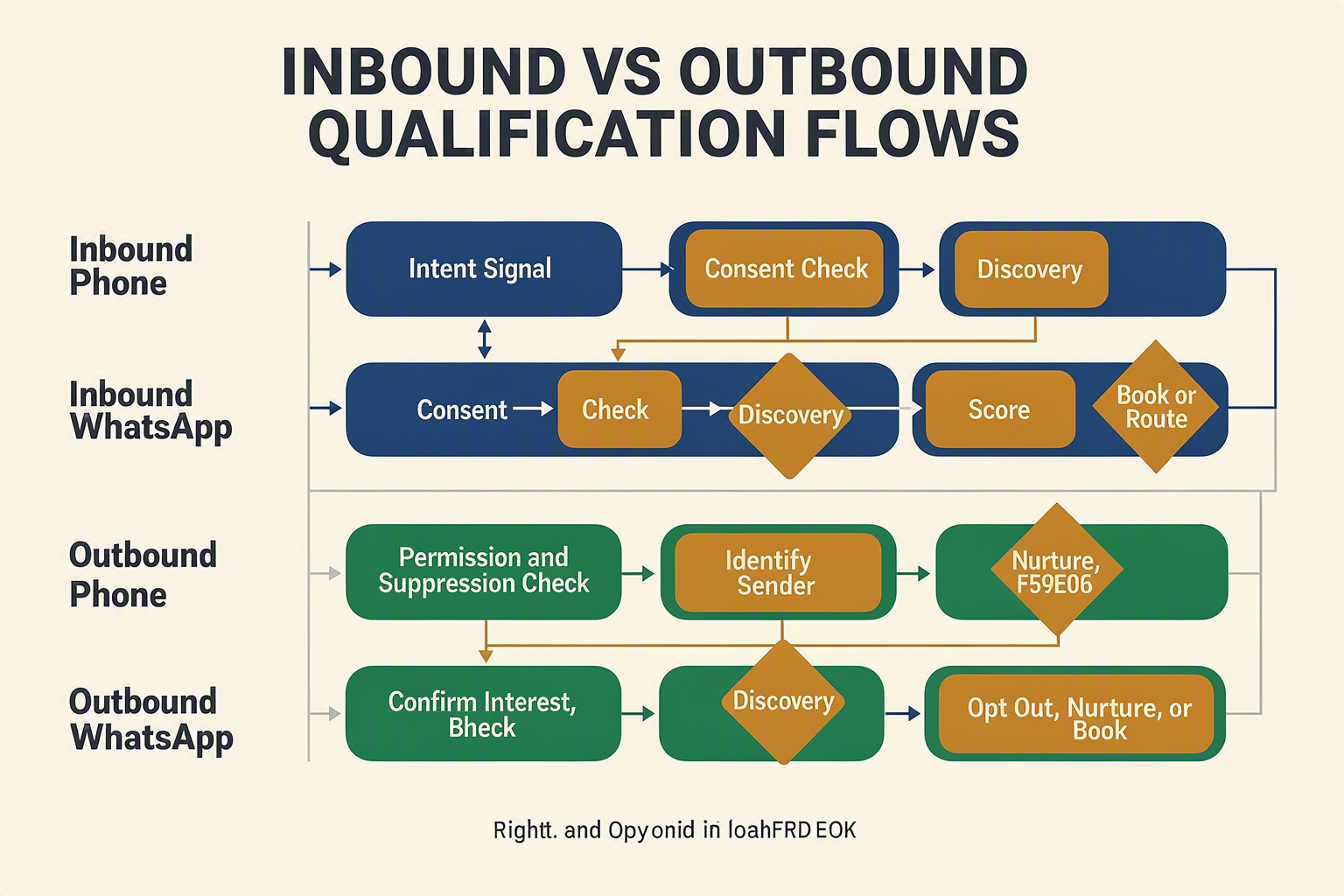
The four flows should share one qualification scorecard but use different pacing, consent gates, and next actions. Inbound conversations optimize for immediate intent capture; outbound conversations must first establish permission and relevance; phone favors rapid discovery; WhatsApp favors short, asynchronous exchanges.
Inbound phone: resolve intent while it is fresh
An inbound caller has already demonstrated interest, so the AI lead qualification agent should acknowledge the enquiry, disclose that it is an AI assistant, and quickly identify the caller’s objective.
A practical sequence is:
- Confirm name, company, location, and reason for calling.
- Ask two or three high-value discovery questions about need, timing, and current solution.
- Retrieve relevant product information without turning qualification into a sales presentation.
- Calculate a provisional score and either book, route, nurture, or disqualify.
- Obtain permission before recording sensitive details or sending a WhatsApp follow-up.
If the caller requests a human, expresses frustration, or describes a complex commercial requirement, the agent should transfer with the transcript and completed CRM fields—not restart discovery.
Outbound phone: earn the right to qualify
An outbound AI sales agent must establish identity, purpose, source of the contact, and whether the person is willing to continue before asking qualification questions. This makes outbound qualification fundamentally different from voice AI lead generation: the goal is not simply to maximize calls, but to produce defensible pipeline decisions.
Use a permission-led opening such as: “You requested information about our logistics software last Tuesday. Is now a suitable time for two brief questions?” If the person declines, the agent should offer a later time, record the preference, and stop rather than overcoming the objection indefinitely.
Outbound controls should include:
- Suppression-list and consent checks before dialing.
- Local-time calling windows and configurable retry limits.
- Immediate opt-out handling across phone and WhatsApp.
- A “wrong person” outcome that does not penalize the lead score.
- Human review for disputed consent or ambiguous identity.
Inbound WhatsApp: qualify progressively
WhatsApp lead qualification should feel conversational rather than like a form pasted into chat. Ask one question at a time, use buttons or lists where appropriate, save progress, and let the user resume later.
Meta’s WhatsApp Business Platform permits free-form business replies within the 24-hour customer-service window after a user message; outside that window, businesses generally need an approved message template. The AI SDR agent should therefore collect the most decision-relevant information early while avoiding unnecessary personal data.
A strong inbound flow is: identify need → confirm geography or serviceability → establish timeline → determine role → offer a booking slot. Silence should trigger a limited reminder, not an endless sequence.
Outbound WhatsApp and cross-channel transitions
Outbound WhatsApp should begin only with a valid opt-in and an approved template where required. The first message should state the business name, explain why the recipient is being contacted, and provide an unambiguous opt-out.
Do not automatically move a person from chat to a call. Business-initiated WhatsApp calls require user permission under Meta’s platform rules, so the agent should ask: “Would you like a five-minute WhatsApp call now?” Platforms such as CallMissed can bridge permitted WhatsApp Business calls to an AI voice agent and continue qualification across chat and voice.
Across all four flows, automated lead qualification should preserve one contact record, one consent history, and one score. Channel changes should carry forward answered questions, while materially changed answers—such as a revised budget or timeline—should be timestamped rather than silently overwritten.
Which qualification criteria, discovery questions, and scoring thresholds belong in the scorecard?
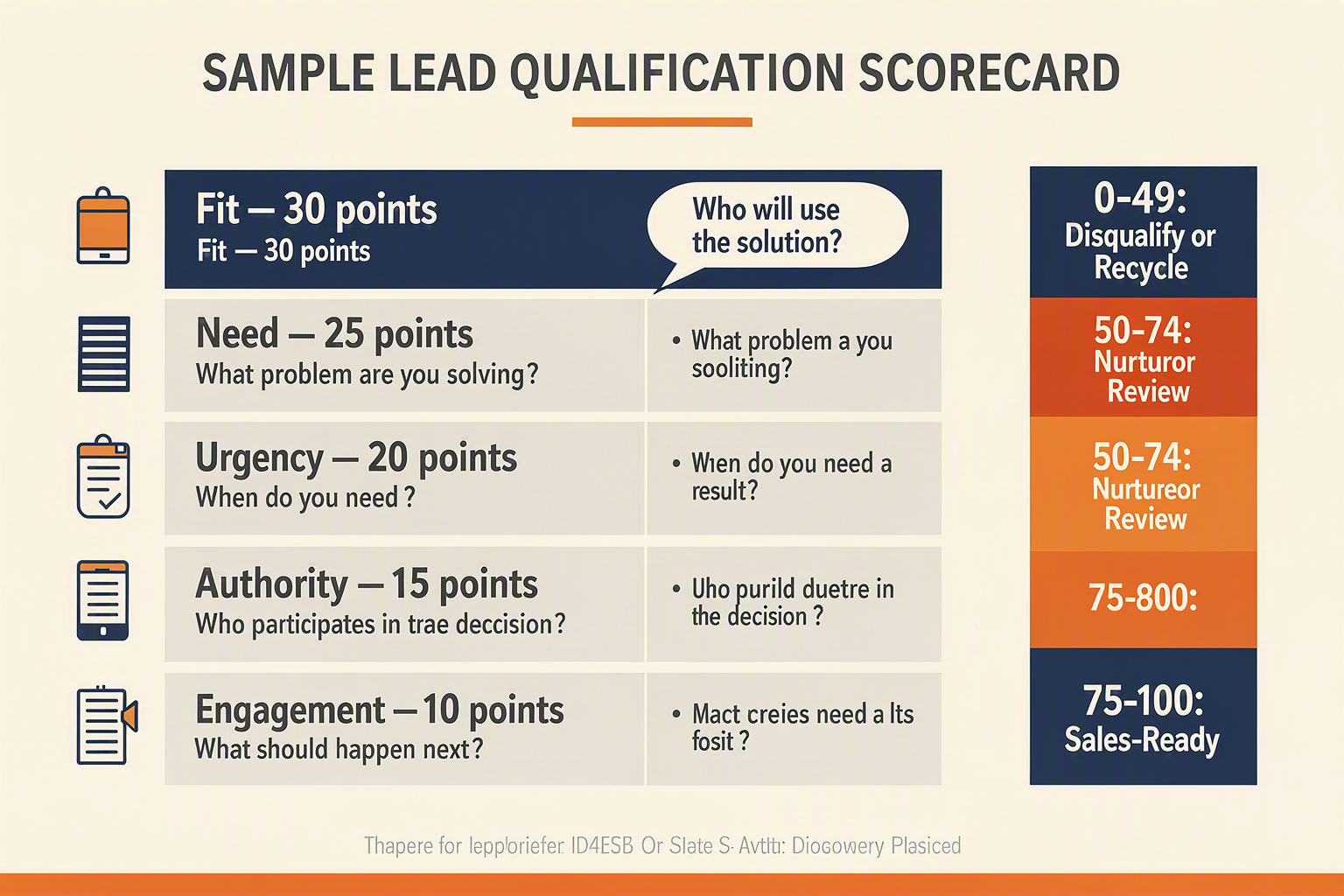
A practical AI lead qualification agent scorecard should total 100 points across fit, need, timing, authority, budget, and next-step readiness. Treat consent, legal restrictions, and explicit do-not-contact requests as hard gates, not scoring variables: a high commercial score never overrides permission or safety requirements.
Recommended 100-point qualification scorecard
| Criterion and weight | Discovery question | Full-score signal | Partial or zero-score signal | CRM field |
|---|---|---|---|---|
| Customer fit — 25 | “Which industry, location, team size, and use case best describe your organisation?” | Matches target segment, geography, and service capability | Adjacent segment = partial; unsupported market or use case = zero | fit_score, industry, location, company_size |
| Need and impact — 20 | “What problem are you trying to solve, and what happens if it remains unresolved?” | Specific pain with measurable operational or revenue impact | General interest = partial; no identified problem = zero | need_score, pain_point, business_impact |
| Purchase timing — 15 | “When do you need a solution operating?” | Defined implementation window within the sales cycle | Later or uncertain date = partial; no planned action = zero | timing_score, target_date |
| Authority and process — 15 | “Who will evaluate, approve, and use the solution?” | Decision-maker engaged or buying process clearly mapped | Influencer with access = partial; no path to approver = zero | authority_score, decision_roles |
| Budget and commercial fit — 15 | “Has a budget range or approval process been established?” | Viable range and funding path confirmed | Budget pending = partial; confirmed mismatch = zero | budget_score, budget_range, approval_status |
| Engagement and next step — 10 | “Would you like to review options with a specialist this week?” | Accepts a relevant meeting and supplies scheduling details | Requests information = partial; declines further action = zero | readiness_score, next_action, meeting_status |
These weights are a starting framework, not a universal benchmark. Back-test them against closed-won, closed-lost, and no-show records every quarter. Salesforce’s State of Sales, Sixth Edition reported in 2024 that salespeople spend only 30% of their working week connecting with customers, so the highest score band should be narrow enough to protect scarce seller time.
Set thresholds and hard gates separately
Use three initial routing bands:
- 75–100: sales-ready. Book a meeting when required fields are complete and no hard gate applies.
- 50–74: promising but incomplete. Start a WhatsApp nurture flow, request missing information, or assign human review.
- 0–49: not currently qualified. Route to long-term nurture, self-service content, or a documented disqualification outcome.
Apply an additional 10–25-point risk deduction for contradictions, unverifiable claims, unsupported requirements, or repeated avoidance of essential questions. Never penalise a lead merely because speech recognition failed, the person used an unexpected language, or a WhatsApp reply was brief; mark the field unknown and retry or escalate.
Hard gates should include:
- Missing or withdrawn permission for the intended phone or WhatsApp interaction.
- An explicit do-not-contact request.
- An unsupported geography, regulated use case, or mandatory requirement.
- Abusive, fraudulent, or unsafe behaviour.
- A confirmed commercial mismatch that cannot be resolved.
Design questions for conversation, not interrogation
An AI sales agent should ask one primary question at a time, explain why sensitive information is useful, and confirm important answers. For WhatsApp lead qualification, use short selectable responses where appropriate; for phone-based voice AI lead generation, repeat dates, quantities, and meeting times aloud.
The AI SDR agent should also distinguish “not yet discussed” from “no budget” and “unknown decision-maker” from “no authority.” That distinction prevents automated lead qualification from producing false negatives. Booking should occur only after the agent confirms the score, consent status, timezone, contact details, and meeting purpose; otherwise, it should preserve the answers in the CRM and hand the lead to a person with a concise qualification summary.
How should consent, CRM updates, appointment booking, and human handoff work together?
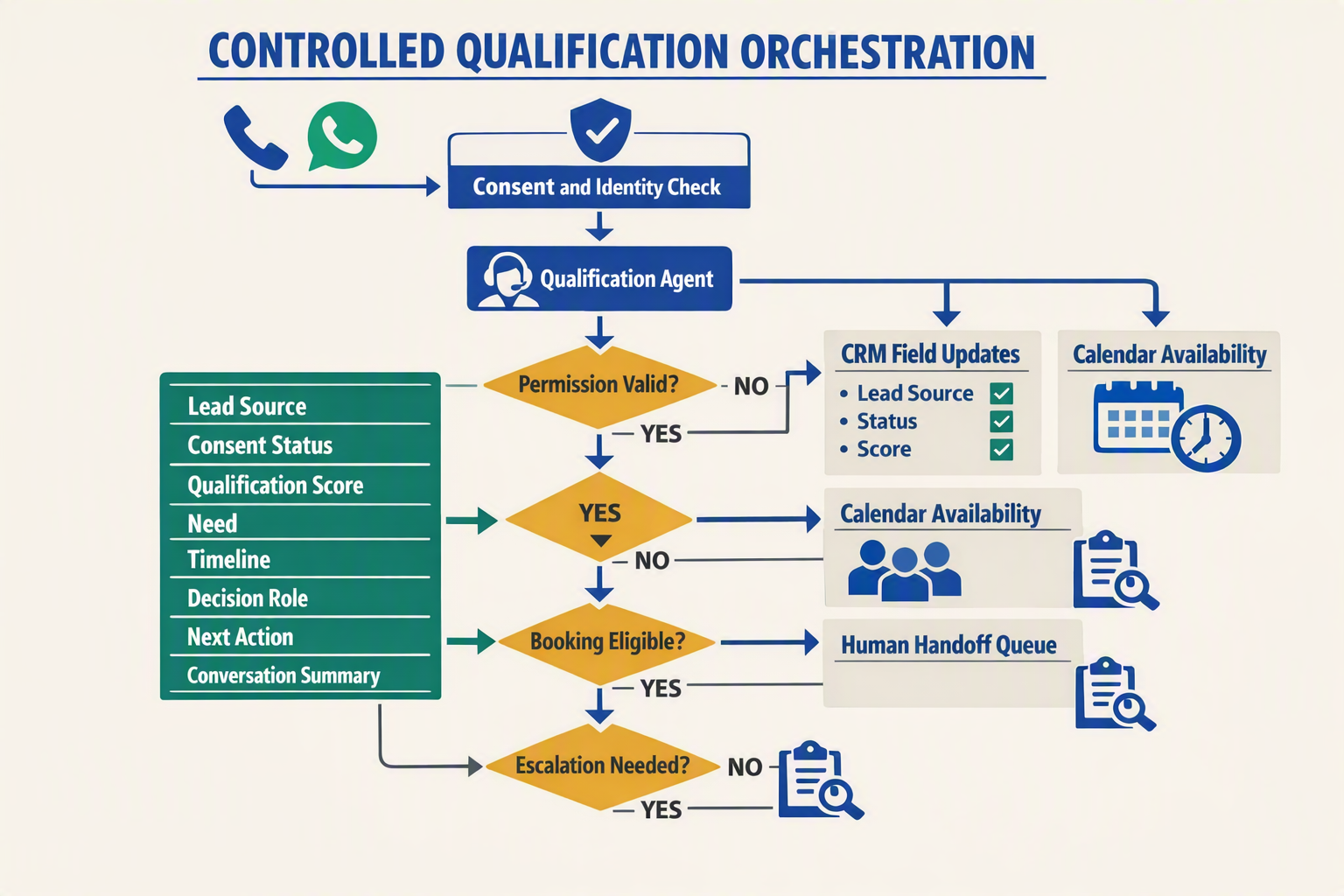
Consent, CRM updates, booking, and human handoff should operate as one auditable workflow, not four disconnected automations. The agent must verify permission first, write each decision to the CRM, book only when eligibility rules pass, and transfer the full conversation context whenever human judgment is needed.
Use consent as a workflow gate
An AI lead qualification agent should distinguish between permission to contact, permission to use a specific channel, and permission to record or analyse a conversation. A WhatsApp opt-in does not automatically establish permission for every type of outbound phone call.
Before discovery begins, the workflow should:
- Identify the business and explain why it is contacting the person.
- Confirm that the person is willing to continue on phone or WhatsApp.
- Provide any recording or AI-assistant disclosure required by applicable law and company policy.
- Record the consent source, purpose, channel, wording, timestamp, and status.
- stop outreach immediately after an opt-out and place the contact on the appropriate suppression list.
For WhatsApp lead qualification, business-initiated messages should follow current WhatsApp Business Platform rules, including applicable opt-in and approved-template requirements. Legal teams should separately validate local telemarketing, privacy, call-recording, and do-not-disturb obligations.
Make the CRM the system of record
Every meaningful response should become structured CRM data rather than disappearing inside a transcript. The AI sales agent should update fields after validation—not infer certainty from an ambiguous answer.
Useful fields include:
- Qualification criteria, score components, and total score
- Budget and purchase timeframe as ranges
- Decision-making role and other stakeholders
- Product, location, language, and use case
- Consent status and communication preferences
- Disqualifying conditions, objections, and unresolved questions
- Conversation summary, transcript or recording reference, and confidence level
- Assigned owner, next action, due date, and booking status
Use idempotent writes and conversation IDs to prevent duplicate contacts, appointments, or deals when phone and WhatsApp events arrive simultaneously. Salesforce’s State of Sales, Sixth Edition reported in 2024 that salespeople spent only 30% of their working week connecting with customers, so automated CRM administration can protect seller time without hiding how a decision was reached.
Book only after explicit confirmation
An AI SDR agent should offer an appointment only when the lead passes the defined score threshold and has supplied the minimum required fields. Booking logic should check the representative’s real-time calendar, territory, product expertise, language, time zone, meeting duration, and buffer rules.
Before creating the event, the agent should repeat:
- Date, local time, time zone, and meeting format
- Assigned representative and meeting purpose
- Contact details and permission to send reminders
The system should then write the calendar event ID back to the CRM and send confirmation through the lead’s approved channel. A reschedule or cancellation must update both systems rather than creating another appointment.
Design handoff as a context transfer
Automated lead qualification should escalate when the lead requests a person, expresses frustration, presents a high-value opportunity, gives contradictory answers, raises legal or pricing exceptions, or falls below an answer-confidence threshold. For phone-based voice AI lead generation, use a warm transfer where possible; otherwise, create a priority callback with an agreed timeframe.
The human should receive the qualification score, consent state, concise summary, exact unresolved issue, and recommended next action. Platforms such as CallMissed can connect WhatsApp Business calls and chats with AI voice agents and CRM-style workflows, helping phone and WhatsApp handoffs preserve context instead of restarting discovery.
What do experts recommend for AI sales agent prompt design, discovery scripts, and a reusable sample framework?

Experts recommend designing an AI sales agent as a constrained decision system—not an improvisational salesperson. Its prompt should define the objective, approved evidence, question order, scoring rules, consent boundaries, CRM schema, and exact conditions for booking, disqualification, or human handoff.
Prompt-design principles experts consistently apply
A production prompt should separate stable policy from conversation-specific data. This makes changes reviewable and prevents campaign instructions from silently overriding compliance rules.
- Assign one job: qualify and route the lead; do not pressure, negotiate, or make unsupported claims.
- Ground every answer: use approved product, pricing, territory, and eligibility data. If information is unavailable, say so and offer a human follow-up.
- Ask progressively: begin with need and context before budget or authority. Ask one question at a time on voice and no more than one or two per WhatsApp message.
- Confirm consequential facts: repeat dates, budgets, locations, email addresses, and booking times before saving them.
- Separate facts from inference: “The lead said April” is evidence; “high urgency” is a derived score.
- Make escalation deterministic: transfer on explicit requests, repeated misunderstanding, sensitive complaints, pricing exceptions, or low confidence.
- Resist instruction hijacking: customer messages are untrusted input and must never modify system policies, scoring thresholds, or tool permissions.
Salesforce’s 2024 State of Sales, Sixth Edition found that salespeople spend only 30% of their working week connecting with customers, reinforcing why prompts should collect structured essentials without turning discovery into a lengthy interrogation.
A channel-aware discovery script
An AI lead qualification agent should adapt wording—not qualification standards—to the channel. A phone conversation can use brief acknowledgements and natural follow-ups; WhatsApp lead qualification should use compact messages, visible choices, and asynchronous pauses.
A reusable discovery sequence is:
- Purpose: “What are you hoping to improve or solve?”
- Current state: “How are you handling this today?”
- Impact: “What happens if the issue remains unresolved?”
- Scope: “How many users, locations, conversations, or transactions are involved?”
- Timing: “When would you ideally like a solution running?”
- Decision process: “Who else will evaluate or approve this?”
- Commercial fit: “Is there an approved range, or should we recommend an appropriate package?”
- Next step: “Would you prefer a specialist call, demo, or WhatsApp follow-up?”
For outbound voice AI lead generation, the script must first identify the business, explain the purpose, and confirm permission to continue. An AI SDR agent should stop or suppress outreach when the recipient declines.
Reusable sample prompt framework
ROLE
You qualify leads for [COMPANY] across [PHONE/WHATSAPP].

OBJECTIVE
Collect only the information needed to decide:
QUALIFIED, NURTURE, DISQUALIFIED, or HUMAN_REVIEW.

RULES
- Obtain or verify channel consent before discovery.
- Ask one clear question at a time.
- Never invent product, pricing, availability, or customer data.
- Confirm critical fields before writing to the CRM.
- Escalate when confidence is below [THRESHOLD] or the lead requests a person.

DISCOVERY FIELDS
need, current_solution, impact, use_case, location, scope,
timeline, authority, budget_status, consent_status

SCORING
Apply the approved scorecard. Store evidence for every awarded point.
Do not book unless score >= [BOOKING_THRESHOLD] and required fields exist.

OUTPUT
status, score, score_evidence, CRM_updates, next_action,
booking_details, consent_record, handoff_reason, summary
This structure makes automated lead qualification testable: teams can evaluate field accuracy, unsupported claims, question completion, and routing separately rather than judging the conversation by tone alone.
What impact should teams measure through CallMissed analytics, QA, conversion tracking, and handoff review?
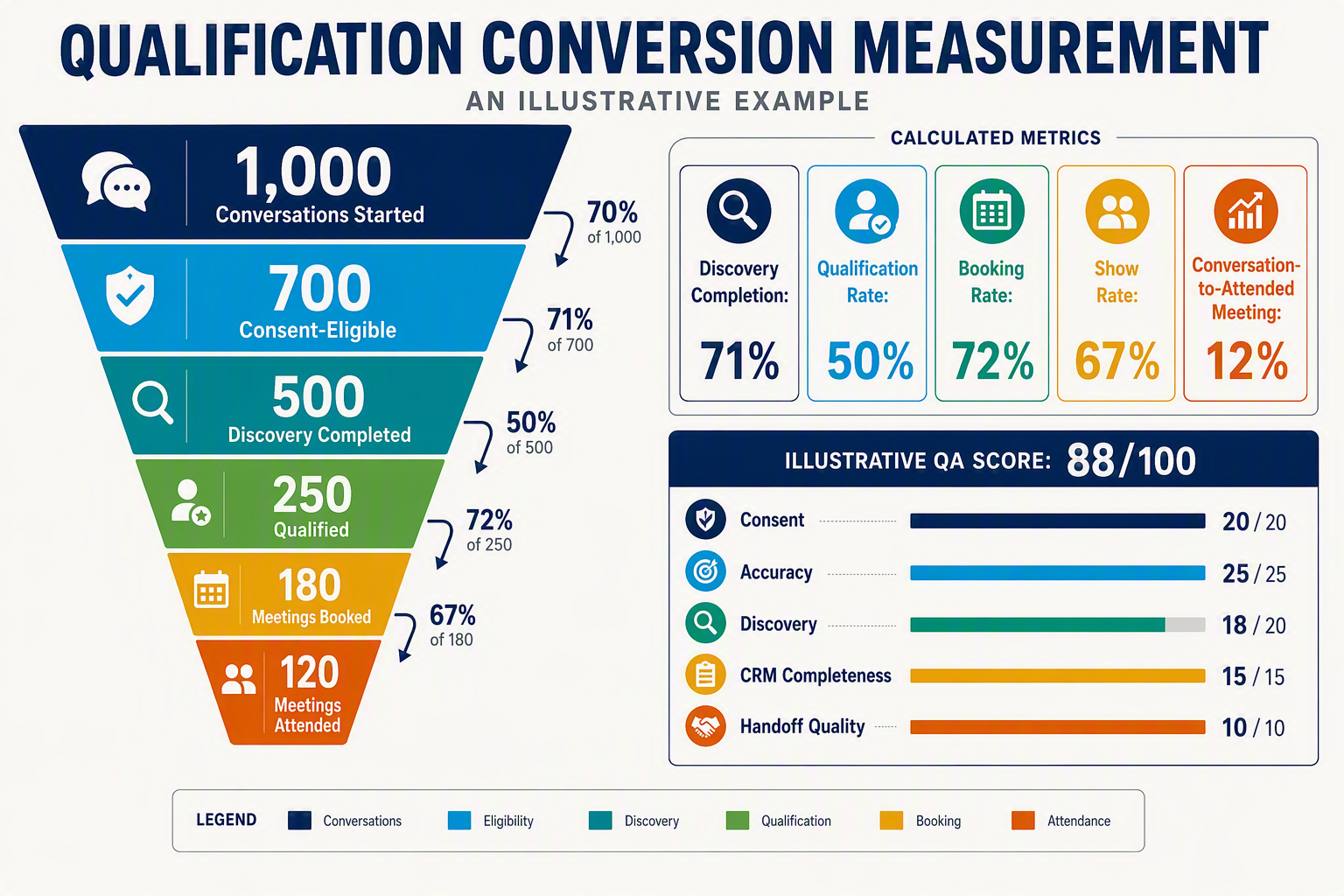
Measure pipeline impact, decision quality, customer experience, and seller efficiency—not conversation volume alone. CallMissed analytics and CRM records should connect each phone or WhatsApp interaction to qualification evidence, score changes, bookings, handoffs, opportunities, and eventual revenue.
Salesforce’s State of Sales, Sixth Edition reported in 2024 that salespeople spend only 30% of their working week connecting with customers. An AI lead qualification agent creates value when it increases productive selling time without lowering qualification accuracy or damaging buyer trust.
Build a channel-to-revenue measurement funnel
Track the same funnel across inbound phone, outbound phone, inbound WhatsApp, and business-initiated WhatsApp interactions. Segment results by campaign, lead source, language, agent version, score band, and inbound versus outbound flow.
- Contact rate: meaningful two-way contacts ÷ eligible leads attempted.
- Qualification completion rate: leads with all mandatory criteria captured ÷ meaningful contacts.
- Qualified-lead rate: leads meeting the approved threshold ÷ completed qualifications.
- Booking rate: meetings booked ÷ qualified leads.
- Show rate: attended meetings ÷ booked meetings.
- Opportunity and win rates: CRM opportunities or customers ÷ qualified leads.
- Revenue per eligible lead: attributed revenue ÷ all leads entering the workflow.
For WhatsApp lead qualification, also measure message delivery, response latency, opt-outs, and the percentage of chats that move to a call or seller. For phone-based voice AI lead generation, monitor answer rate, early hang-ups, call duration, and retry outcomes—but never interpret longer calls as inherently better.
Audit qualification quality, not just activity
QA reviewers should compare transcripts or recordings with the structured CRM output. A practical review rubric can score every sampled interaction on:
- Consent and identity: Was the purpose disclosed, and were channel permissions respected?
- Question coverage: Did the AI SDR agent capture required fit, need, urgency, authority, and budget evidence?
- Evidence fidelity: Do CRM values match what the lead actually said?
- Scoring accuracy: Would a trained seller assign the same score and disposition?
- Conversation quality: Was the interaction clear, concise, relevant, and appropriate for the selected language?
- Next-step correctness: Was the lead booked, nurtured, disqualified, or escalated according to policy?
Track false positives—leads the AI sales agent qualified but sellers rejected—and false negatives discovered through later review. These rates expose weak thresholds, ambiguous questions, or prompt instructions that over-infer missing information.
Review handoffs as a separate conversion stage
A handoff succeeds only when the human receives usable context and the buyer does not have to repeat the discovery conversation. Review whether the transferred record includes the qualification score, supporting answers, objections, preferred language, consent state, promised follow-up, and booking details.
Measure:
- Handoffs accepted by sellers
- Time from escalation to human response
- Repeat-question rate after transfer
- Seller overrides of AI dispositions
- Conversion by handoff reason
- Complaints or opt-outs following escalation
With CallMissed’s phone, WhatsApp, and omnichannel CRM-style workflows, teams can use a shared lead identifier to evaluate these journeys across channels rather than treating calls and chats as unrelated events.
Turn findings into controlled improvements
Run weekly QA reviews and monthly conversion reviews. Change one major variable at a time—such as a discovery question, scoring weight, booking threshold, or prompt version—and compare equivalent cohorts.
The governing metric for automated lead qualification should be incremental qualified pipeline per eligible lead, supported by acceptable consent, QA, false-positive, and show-rate results. That prevents teams from optimizing superficial activity while hiding poor-fit meetings or unnecessary seller work.
What does this mean for your sales team, and which rollout stage should you choose?
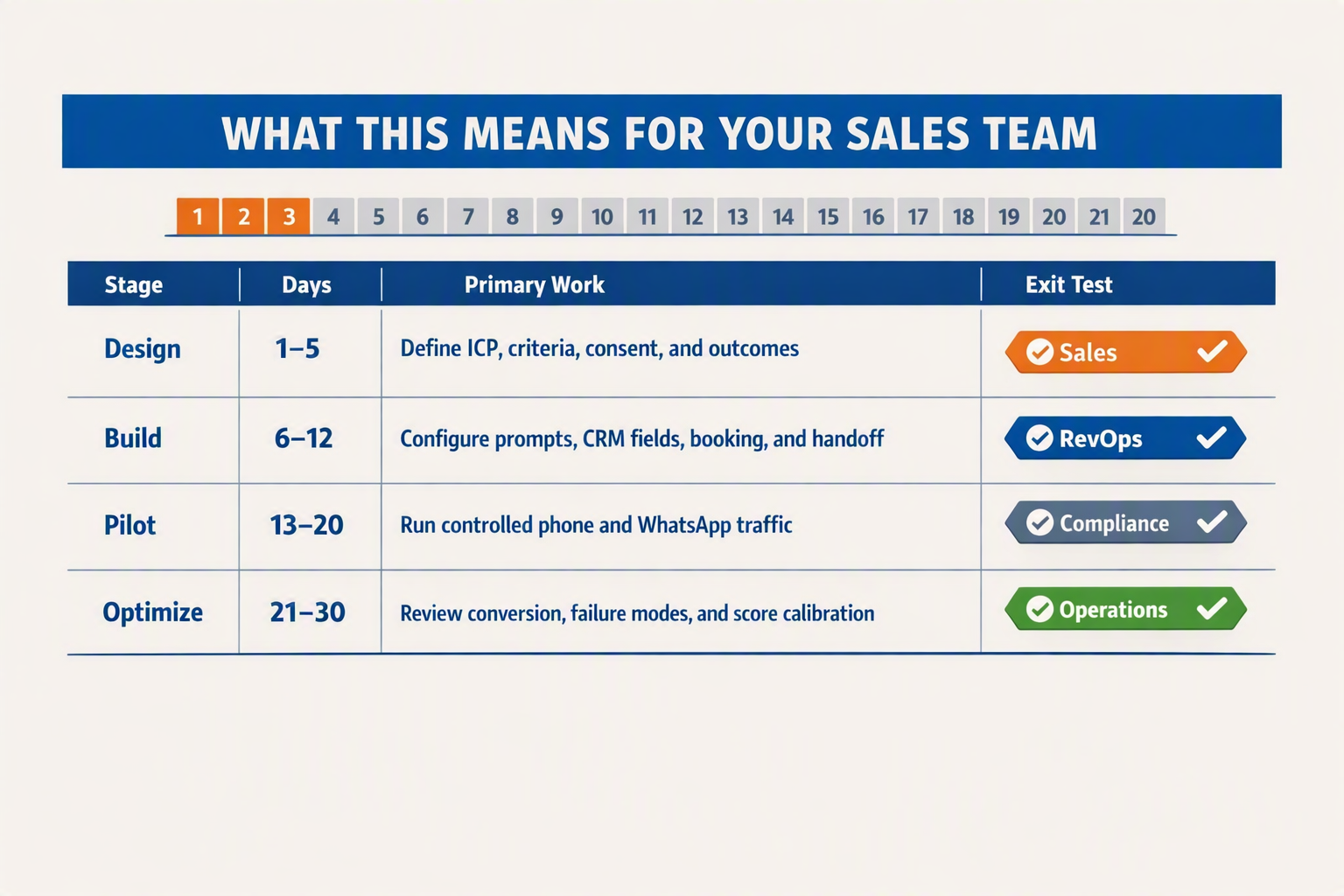
An AI lead qualification agent should shift sales representatives from repetitive screening toward exception handling, deeper discovery, and closing. Most teams should begin with a shadow or assisted pilot—not full autonomy—and expand only after CRM accuracy, consent compliance, routing, and booking quality meet predefined gates.
Salesforce’s State of Sales, Sixth Edition reported in 2024 that salespeople spend only 30% of their working week connecting with customers. The practical opportunity in 2026 is therefore not simply reducing headcount; it is returning seller time to conversations where human judgement materially affects revenue.
Choose the rollout stage that matches your readiness
The percentages below are recommended operating gates, not universal industry benchmarks. Adjust them for deal value, sales-cycle length, regulatory exposure, and the cost of a false qualification.
| Rollout stage | Channel and scope | Sales-team workflow | Essential controls | Gate to advance |
|---|---|---|---|---|
| 1. Design and replay | Recorded or synthetic phone and WhatsApp scenarios | Reps validate questions, objections, scoring, and disqualifiers | Approved scripts, consent language, CRM field map, test records only | 100+ test conversations reviewed; no critical consent or routing defects |
| 2. Shadow mode | Live inbound leads; agent does not act on decisions | Reps qualify normally while the agent generates a parallel score and summary | No autonomous messages, calls, CRM overwrites, or bookings | At least 90% field accuracy and 85% agreement with human disposition |
| 3. Assisted pilot | One inbound source, language, region, or product line | AI sales agent asks approved questions; reps approve handoffs or bookings | Recording disclosures, confidence thresholds, manual override, daily QA | At least 95% valid CRM writes and no unresolved high-severity compliance incident |
| 4. Bounded autonomy | Inbound plus opted-in WhatsApp follow-up or narrow outbound segments | Reps handle qualified, complex, or high-value opportunities | Retry limits, suppression lists, calendar rules, escalation triggers | Stable qualified-to-booked and show rates across four consecutive weeks |
| 5. Controlled scale | Multiple campaigns, languages, teams, and territories | Managers coach from conversation data; reps focus on discovery and closing | Weekly score-band review, drift monitoring, role-based access, rollback plan | Conversion improves without higher complaint, false-positive, or no-show rates |
What changes for sales representatives
Automated lead qualification works best when responsibilities become explicit:
- The AI SDR agent owns immediate acknowledgement, standard discovery questions, structured note-taking, score calculation, and approved booking actions.
- Sales representatives own ambiguous needs, commercial negotiation, strategic accounts, sensitive objections, and exceptions that fall outside policy.
- Sales operations owns CRM schemas, duplicate handling, attribution, calendar capacity, and dashboards by source, score band, channel, and outcome.
- Compliance or legal teams approve consent wording, business-initiated contact rules, retention periods, recording disclosures, and suppression workflows.
This division also prevents voice AI lead generation from becoming an isolated activity that produces meetings without usable context. A booked meeting should arrive with the lead’s answers, score components, consent evidence, conversation summary, unresolved questions, and recording or transcript reference.
How to select your starting point
Choose shadow mode if qualification criteria vary between representatives, CRM fields are inconsistently completed, or consent rules remain unsettled. Choose an assisted pilot when the scorecard is stable but the team still needs to validate customer reactions and handoff quality.
Move to bounded autonomy only when WhatsApp lead qualification and phone workflows share a dependable identity, consent, and CRM record. High-value enterprise deals, regulated sectors, vulnerable customers, and low-confidence conversations should retain human approval even after broader automation.
The correct rollout stage is the lowest-risk stage that can produce trustworthy evidence. Advancement should follow measured quality—not a launch deadline or an impressive demonstration.
Frequently asked questions about phone and WhatsApp AI lead qualification
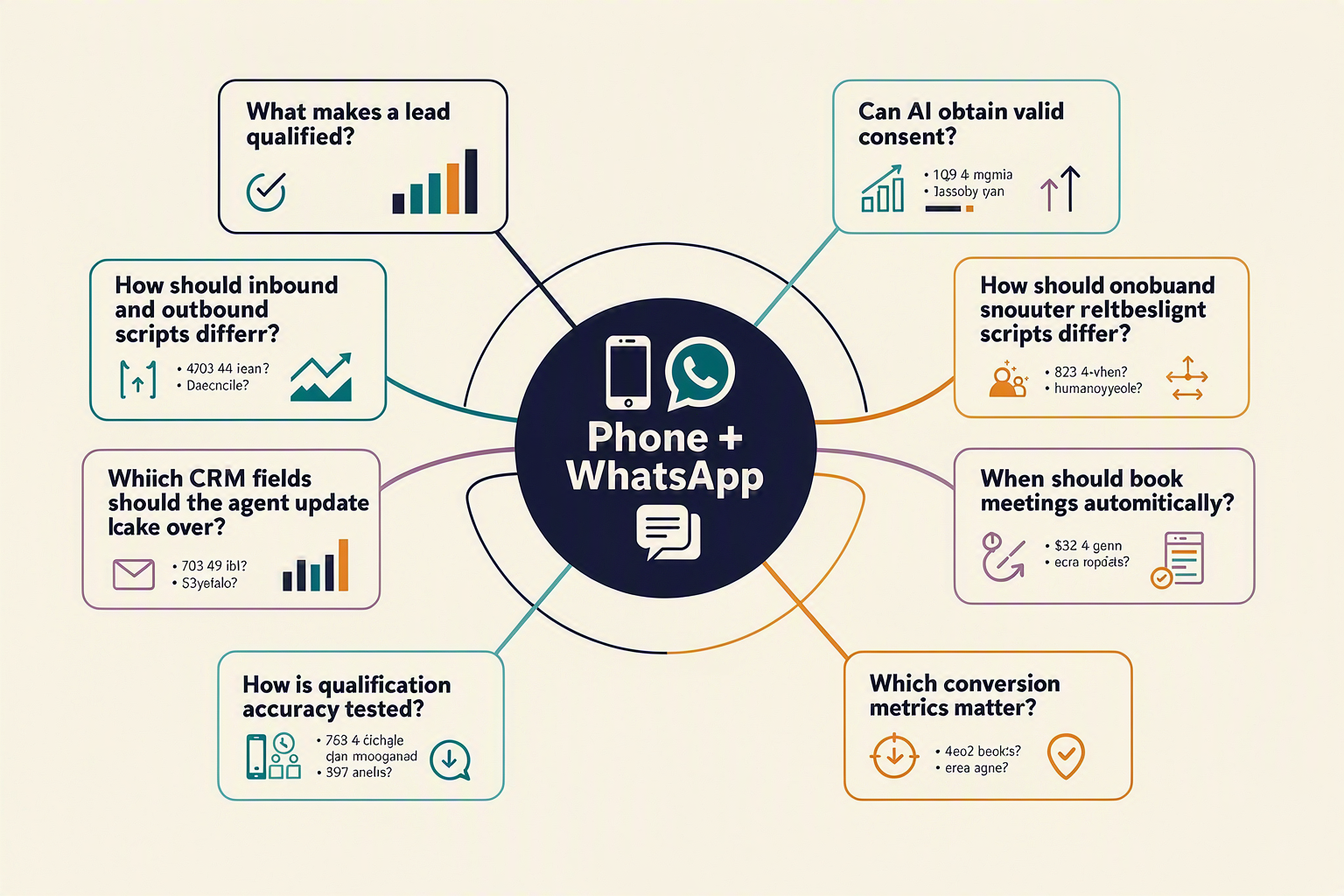
What criteria should an AI lead qualification agent use?
Should automated lead qualification use phone calls, WhatsApp, or both?
How should an AI sales agent obtain consent for phone and WhatsApp conversations?
How does an AI lead qualification agent score leads and book meetings?
When should voice AI lead generation transfer a prospect to a human salesperson?
How do businesses measure whether automated lead qualification is working?
Conclusion
An AI lead qualification agent succeeds when it turns phone and WhatsApp conversations into consistent, auditable pipeline decisions—not when it merely holds convincing conversations. The winning 2026 approach combines clear scorecards, explicit consent, structured CRM updates, controlled booking rules, and timely human intervention.
Key takeaways
- Qualification must follow a defined scorecard. Measure fit, need, intent, urgency, authority, budget, risk, and readiness for the next step. An AI sales agent should record uncertainty rather than infer missing facts, while score bands should determine whether a lead is nurtured, booked, escalated, or disqualified.
- Inbound and outbound journeys require different controls. Inbound phone and WhatsApp flows can respond while intent is fresh; outbound flows need stronger consent checks, clear identification, retry limits, and respectful stopping rules. Effective WhatsApp lead qualification also uses channel-appropriate pacing and preserves context when the conversation moves to a call.
- Prompts should govern actions as well as language. A dependable AI SDR agent needs approved discovery questions, field-validation rules, booking conditions, CRM schemas, and explicit human-handoff triggers. This makes automated lead qualification reviewable and reduces false positives, incomplete records, and poorly timed meetings.
- Performance should be measured through business outcomes. Track contact rate, qualified-lead rate, booking rate, show rate, conversion by score band, handoff accuracy, and false-positive reviews. Salesforce’s 2024 State of Sales, Sixth Edition found that salespeople spend only 30% of their working week connecting with customers, demonstrating why carefully governed automation matters.
What to watch next
As phone, chat, CRM, and scheduling workflows converge, voice AI lead generation will increasingly be judged by qualification accuracy and conversion quality—not call volume alone. Meta reported in its Q1 2025 earnings call that WhatsApp had exceeded 3 billion monthly active users, reinforcing the importance of coordinated voice and messaging journeys.
To explore this shift, consider CallMissed, an India-focused AI communication infrastructure platform supporting WhatsApp Business calls bridged to AI agents, WhatsApp chat, CRM-style workflows, and multilingual voice across 22 Indian languages. The practical question for your team is simple: Can every AI-qualified lead arrive with enough verified context for a salesperson to take the right next action immediately?
Related Reading
Discussion
Related Posts
Ready to automate customer conversations?
Launch AI voice agents and WhatsApp bots with CallMissed — one API, 22+ Indian languages.