
Grok 4.5 Release Date: What xAI Has Confirmed in 2026



Grok 4.5 release date status, xAI confirmations, beta access, feature claims, benchmarks, and practical AI voice automation choices.
Grok 4.5 Release Date: What xAI Has Confirmed in 2026
A model can be “launched” all over social media and still not be released — and that is exactly why the Grok 4.5 release date needs a verification-first look. As of July 8, 2026, public search results indicate that Elon Musk/xAI activity around Grok 4.5 accelerated after June 28, 2026, but xAI has not clearly confirmed a general public release date for businesses, developers, or API users.
That distinction matters because the AI market now moves on days, not quarters. One search result from BuildFastWithAI, June 2026, states that “No public release date has been confirmed by xAI” and says Grok 4.5 entered private beta at SpaceX and Tesla on June 28, 2026. Another result from LetsDataScience similarly reports that Musk said Grok 4.5 had entered private beta at SpaceX and Tesla on June 28, 2026. At the same time, other sources are circulating claims about a July 9, 2026 public launch, “1.5-trillion-parameter V9” architecture, and performance “close to” Claude Opus-class systems — but those claims need to be separated from what xAI has actually confirmed.
For business owners, developers, and AI operators, this is not just launch gossip. A real Grok 4.5 rollout could affect model-selection roadmaps, customer-support automation, coding workflows, chatbot pricing, voice-agent planning, and multi-model fallback strategies. But waiting for an unconfirmed release can also delay practical deployments that are already possible with today’s LLM, speech-to-text, text-to-speech, and WhatsApp automation tools. Platforms like CallMissed, for example, reflect the broader shift toward multi-model AI infrastructure by giving teams one OpenAI-compatible gateway for LLMs, STT, TTS, image generation, and search.
This guide will break down what is confirmed, what is reported but unverified, and what remains speculation around Grok 4.5 in 2026. You’ll get a clean timeline, a confirmed-vs-rumored feature table, access-status notes for developers, benchmark caution flags, and a practical decision framework: should your team wait for Grok 4.5, or ship AI automation with available tools now?
Is Grok 4.5 released in 2026?
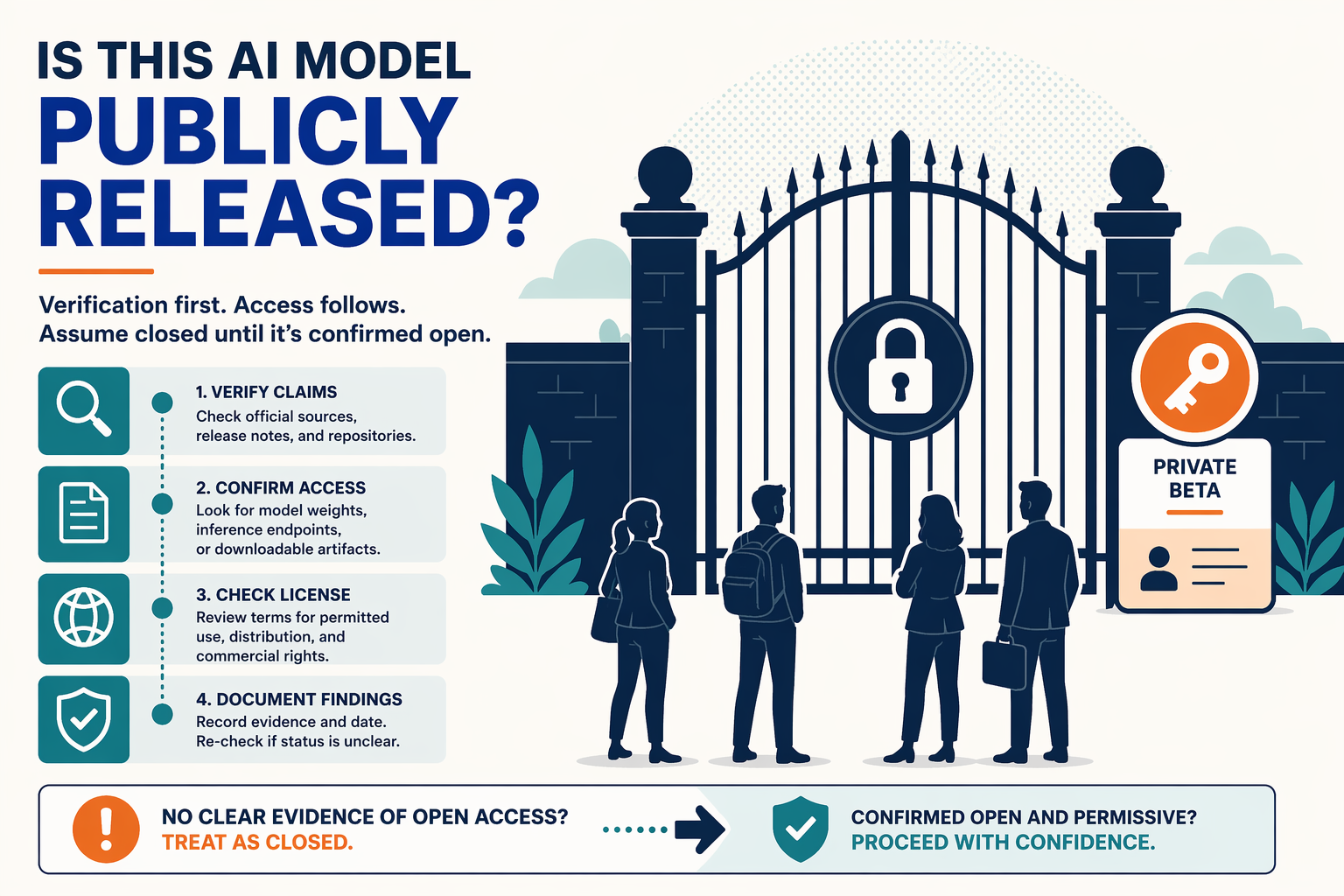
As of July 8, 2026, xAI has not confirmed a general public Grok 4.5 release date. The best current answer to “Is Grok 4.5 released?” is: reported private beta, not confirmed public release. Public SERP evidence for the Grok 4.5 release date points to BuildFastWithAI and TechTimes reports saying Grok 4.5 entered private beta at SpaceX and Tesla on June 28, 2026, but that is not the same as a public launch. For now, the Grok 4.5 release date for business users, developers, API customers, and the broader public remains unconfirmed, and there is no official xAI public Grok 4.5 release date page visible in the sources reviewed.
What is actually visible right now
The strongest public signal is not a full launch; it is a reported private beta. A BuildFastWithAI result from June 2026 says that no public release date has been confirmed by xAI and reports that Grok 4.5 entered private beta at SpaceX and Tesla on June 28, 2026. A TechTimes result also points to June 28, 2026 as the reported private-beta start at SpaceX and Tesla.
At the same time, visible xAI news and documentation results show other items — including Grok Build 0.1 and model retirement updates — but they do not show a dedicated public Grok 4.5 launch page or official release announcement for general users.
That gives us three practical facts to work with:
- June 28, 2026 is the key reported private-beta date.
- SpaceX and Tesla are the named private-beta environments in current public results.
- xAI has not clearly confirmed a general public Grok 4.5 release date in the visible official sources reviewed.
For SEO searchers asking “Is Grok 4.5 released?”, the most accurate short answer is: reported private beta, not confirmed public release.
Private beta is not the same as release
A private beta usually means a model is being tested by a limited group under controlled access. For an AI model like xAI Grok 4.5, that can include internal evaluation, safety testing, latency checks, product-integration work, and benchmark comparisons before any API, chatbot, or enterprise rollout.
For business and developer planning, this distinction matters because “available somewhere” does not mean:
- available inside the Grok app;
- available through an xAI API;
- available to paid subscribers;
- available for enterprise procurement;
- available with stable pricing, rate limits, SLAs, or documentation.
A model can be real, powerful, and in active testing while still being unusable for customer-support workflows, coding assistants, WhatsApp automation, or voice-agent production systems.
What claims should be treated as unverified
Several public results go further than the private-beta claim. For example, some search results discuss a possible July 9, 2026 public launch, architecture details, parameter-count claims, or early performance comparisons with other frontier models. These may become important if xAI confirms them, but as of July 8, 2026, they should be treated as reported claims, not settled facts.
A verification-first reading separates the story into three buckets:
- Likely reported: Grok 4.5 entered private beta at SpaceX and Tesla on June 28, 2026.
- Unconfirmed: a public Grok 4.5 release date, including claims around July 9, 2026.
- Speculative: architecture size, benchmark position, pricing, API access, and enterprise availability.
What businesses should do now
Businesses should avoid pausing AI deployments solely because of Grok 4.5 rumors. If your use case depends on today’s operations — support automation, lead qualification, voice calling, multilingual chat, or developer API access — plan around models and platforms that are currently available.
For example, CallMissed, the OpenAI-compatible AI communication gateway, reflects a practical multi-model approach: developers can integrate LLMs, speech-to-text, text-to-speech, image generation, and search behind one API, while Indian businesses can also use AI voice agents, WhatsApp chatbots, and WhatsApp Business calling. That kind of setup helps teams stay flexible if Grok 4.5 becomes available later without freezing current automation work.
How did Grok 4, Grok 4.4, and GPT-4.5 create confusion around Grok 4.5?
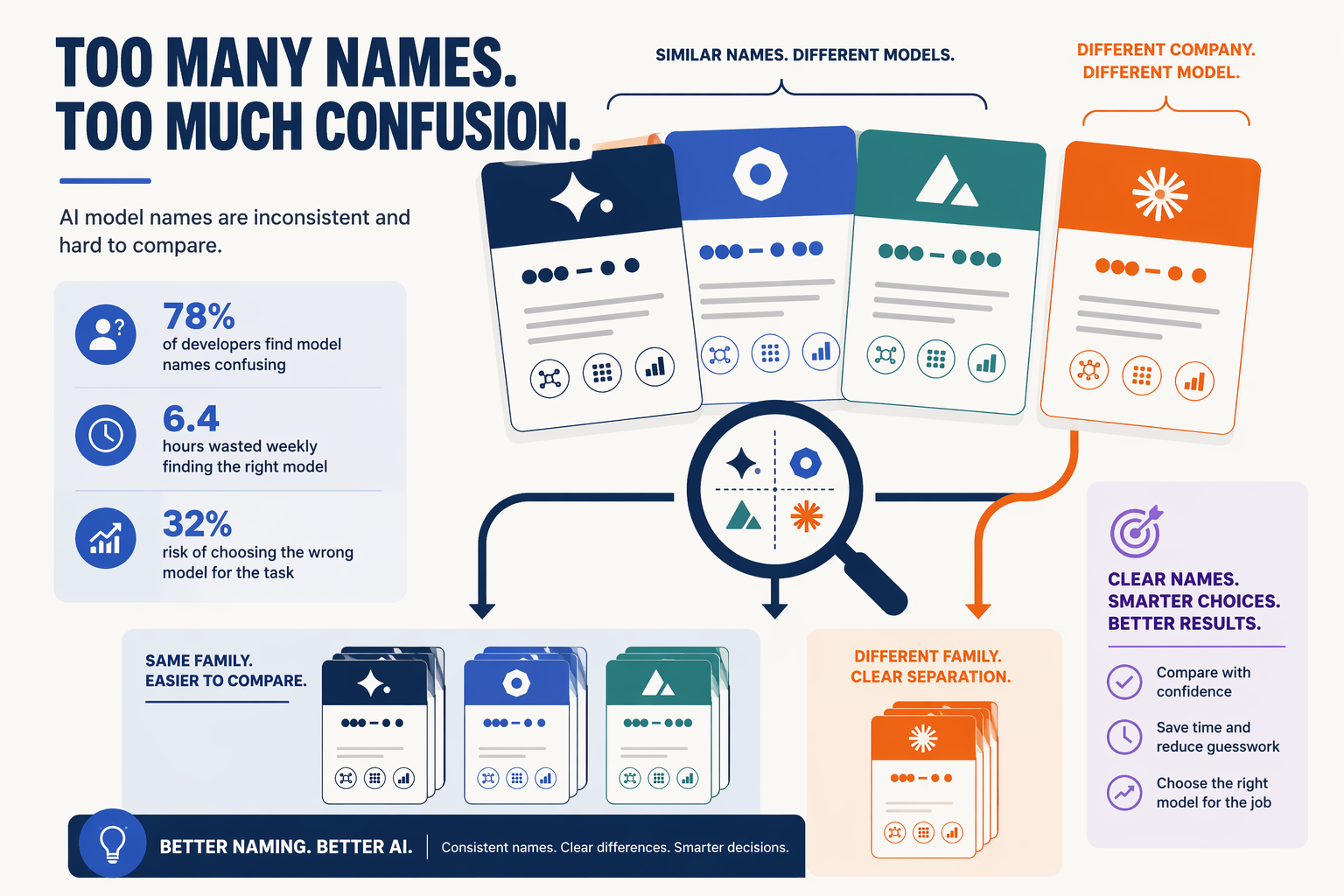
The confusion around Grok 4.5 is mostly a naming problem: people are mixing xAI version numbers, social-media launch language, and OpenAI’s similarly named GPT-4.5. As of July 8, 2026, the clearest public signal is still that Grok 4.5 is reported as a private beta, not a broadly confirmed public release.
Why the version numbers are misleading
AI model names look sequential, but releases do not always behave like software patches. A jump from Grok 4 to Grok 4.5 does not automatically mean there was a public Grok 4.4 milestone, a stable enterprise release, or developer API access.
For searchers, three names are getting blended:
- Grok 4 — the broader xAI model generation people already associate with Grok.
- Grok 4.4 — a version-style term that appears in discussion as an implied stepping stone, even when clear public confirmation is hard to separate from speculation.
- Grok 4.5 — the model currently attached to reported private-beta claims involving SpaceX and Tesla.
- GPT-4.5 — an OpenAI model name, not an xAI product, but close enough in wording to confuse search results, YouTube titles, and social posts.
That overlap creates a classic SEO problem: a user searches “Grok 4.5 release date,” sees results that mention “4.5,” “public launch,” “beta,” “GPT-4.5,” and “Grok 4,” and assumes all of them refer to the same confirmed event.
The private-beta language became “launch” language
The most important distinction is private beta versus public release. A BuildFastWithAI result from June 2026 says “No public release date has been confirmed by xAI” and reports that Grok 4.5 entered private beta at SpaceX and Tesla on June 28, 2026. A LetsDataScience result similarly says Elon Musk said on June 28, 2026 that xAI’s Grok 4.5 entered private beta at SpaceX and Tesla.
But social platforms compress nuance. “Private beta at Tesla and SpaceX” becomes:
- “Grok 4.5 launched”
- “Grok 4.5 is here”
- “Grok 4.5 beats ChatGPT”
- “Grok 4.5 public release next week”
Those headlines may attract clicks, but they skip the operational question businesses actually need answered: Can my team access Grok 4.5 today through a public product, developer API, or enterprise plan?
GPT-4.5 adds a second layer of confusion
The name GPT-4.5 makes the situation even messier because it sounds like the same generation label, but it belongs to OpenAI, not xAI. For non-technical readers, “Grok 4.5” and “GPT-4.5” can look like competing variants of one naming system, when they are separate model families from separate companies.
This matters for developers and AI operators because model names affect:
- API documentation searches
- benchmark comparisons
- procurement notes
- customer-facing chatbot claims
- internal AI roadmap planning
A team comparing Grok 4.5, GPT-4.5, Claude Opus-class models, and multimodal tools should treat each as a separate product line unless the provider’s official documentation says otherwise.
Rumored specs made the naming issue bigger
Some search results go beyond access status and attach technical claims to Grok 4.5. A ByteIota result describes Grok 4.5 as running on a “1.5-trillion-parameter V9 architecture.” An NDTV Profit result says Musk unveiled a private beta and includes claims that the model rivals Claude Opus. An X post from Muskonomy says early evaluations showed performance “close to” Claude Opus-class systems.
Those details may prove relevant later, but they should not be treated as confirmed deployment facts unless xAI publishes official model documentation, API notes, benchmark methodology, or release access terms.
The practical takeaway
For now, read Grok 4.5 coverage through three labels:
- Confirmed/reported access signal: private beta at SpaceX and Tesla on June 28, 2026, based on public search results.
- Unconfirmed public rollout: no clearly verified general release date as of July 8, 2026.
- Speculative comparison layer: claims about V9 architecture, 1.5T parameters, July 9 public launch, or Claude Opus-level performance need source-level verification.
In short: Grok 4.5 confusion is not just about whether the model exists; it is about whether “beta,” “launch,” “leak,” and “public access” are being used precisely.
What is the Grok 4.5 timeline so far?
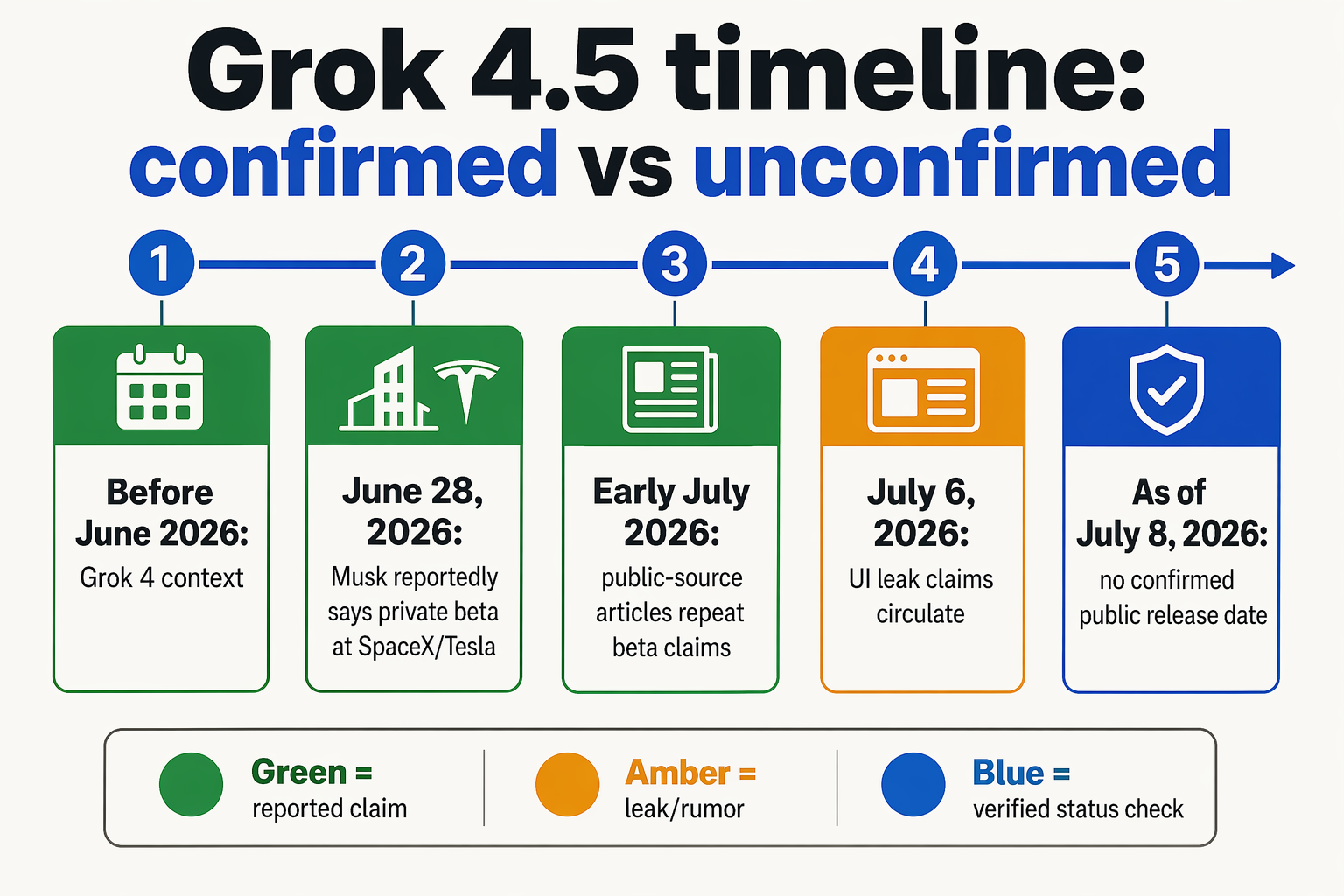
The Grok 4.5 timeline so far is short but noisy: the strongest dated signal is a reported June 28, 2026 private beta at SpaceX and Tesla, while a broader Grok 4.5 release date remains unconfirmed as of July 8, 2026. The safest reading is: beta signals are credible enough to track, but public-launch, architecture, and benchmark claims still need verification.
Grok 4.5 timeline: confirmed vs reported vs speculative
| Date / Window | Event or Claim | Source Signal | Verification Status | Why It Matters |
|---|---|---|---|---|
| June 28, 2026 | Grok 4.5 reportedly entered private beta at SpaceX and Tesla. | LetsDataScience says “Elon Musk said on June 28, 2026” that Grok 4.5 entered private beta at SpaceX and Tesla. | Reported, not equivalent to public release | This is the clearest timeline anchor, but private beta access does not mean business/API availability. |
| June 2026 | No public release date was confirmed by xAI. | BuildFastWithAI, June 2026, states: “No public release date has been confirmed by xAI.” | Important caution flag | This directly addresses the main SEO query: the Grok 4.5 release date is still not officially confirmed. |
| Late June 2026 | Claims emerge that Grok 4.5 uses a 1.5-trillion-parameter V9 architecture. | ByteIota and NDTV Profit snippets reference a “1.5 trillion parameter V9” model. | Reported/speculative until xAI publishes specs | Parameter counts are often used in model marketing, but without an xAI model card or technical report, teams should not plan around the number. |
| Late June–July 2026 | Early claims say Grok 4.5 performs “close to” Claude Opus-class systems. | NDTV Profit and an X/social result cite claims of performance “close to” Claude Opus. | Unverified benchmark claim | Business owners should wait for independent benchmarks, not social comparisons, before switching production systems. |
| July 6, 2026 search cycle | Search interest appears around a reported Grok 4.5 leak, including possible UI/string references. | Keyword/news landscape indicates interest in a “July 6 UI string leak.” | Leak-level evidence only | UI strings can indicate internal preparation, but they do not prove launch readiness, pricing, API access, or model stability. |
| July 9, 2026 claim | Some sources claim a public launch on July 9, 2026. | ExplainX headline claims “Grok 4.5 Public Launch July 9” and says release follows beta feedback. | Unconfirmed as of July 8, 2026 | Since July 9 is a claimed future date and not clearly confirmed by xAI, teams should treat it as a watch item, not a procurement deadline. |
How to read this timeline
The key distinction is access level. A private beta can mean internal testing by selected engineers, limited deployment inside related companies, or controlled evaluation against production-like tasks. It does not automatically imply:
- public Grok web access,
- API availability for developers,
- enterprise contracts,
- published pricing,
- service-level commitments,
- independent benchmark validation.
A useful rule for AI operators is to separate four launch stages:
- Claim — a founder, account, or publication says something is coming.
- Private beta — selected testers use the model in restricted environments.
- Public product release — users can access the model through an app or subscription.
- Developer/API release — businesses can integrate the model into production workflows.
As of July 8, 2026, Grok 4.5 appears to be somewhere between stages 1 and 2, based on public search results. It should not yet be treated as a generally available API model unless xAI publishes official access instructions, documentation, pricing, and release notes.
For teams building real customer-support, voice-agent, or chatbot systems, the practical takeaway is simple: track Grok 4.5, but do not block current deployments on it. Multi-model infrastructure exists precisely because model availability changes quickly; a verification-first roadmap lets teams adopt Grok 4.5 later if it becomes reliable, documented, and commercially accessible.
Which Grok 4.5 claims are confirmed, leaked, rumored, or inferred?
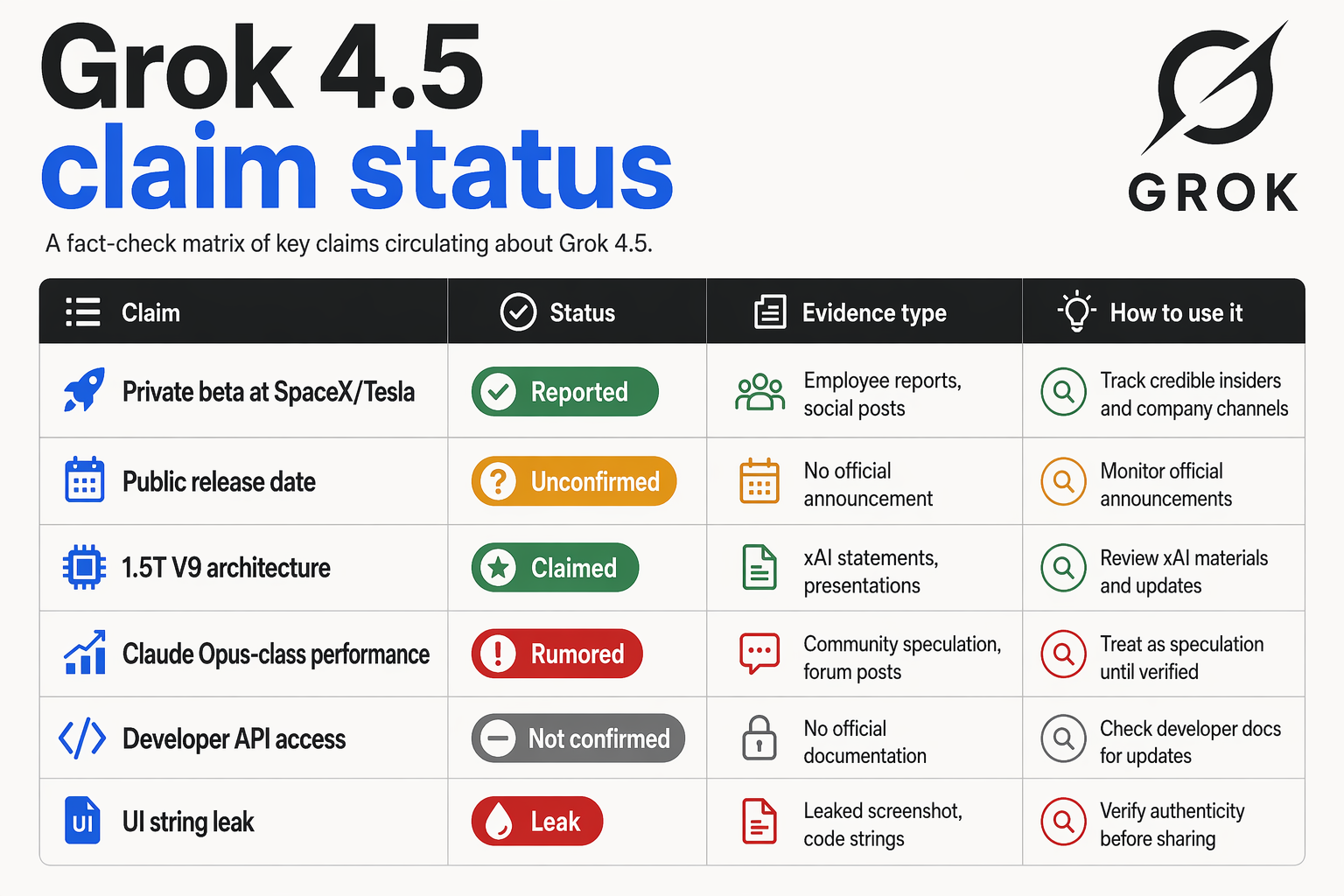
As of July 8, 2026, the only high-confidence Grok 4.5 claim is that public sources describe a private beta at SpaceX and Tesla beginning June 28, 2026; a general public release, developer API access, model card, pricing, and benchmarks remain unconfirmed. Treat most Grok 4.5 feature details as reported, leaked, rumored, or inferred until xAI publishes official documentation.
Verification table: Grok 4.5 claims by evidence level
| Claim | Status | Evidence cited | What it means for teams |
|---|---|---|---|
| Grok 4.5 has a confirmed public release date | Not confirmed | BuildFastWithAI, June 2026, says: “No public release date has been confirmed by xAI.” | Do not plan production migrations around a public launch until xAI confirms access, pricing, and API availability. |
| Grok 4.5 entered private beta at SpaceX and Tesla | Reported / semi-confirmed via public reporting | LetsDataScience reports: “Elon Musk said on June 28, 2026 that xAI’s Grok 4.5 has entered private beta at SpaceX and Tesla.” | This suggests real-world testing, but private beta does not equal public product availability. |
| July 9, 2026 public launch | Rumored / unverified | ExplainX.ai claims “Grok 4.5 Public Launch July 9” and says Musk will release it publicly after beta feedback. | Useful to monitor, but not safe for procurement, roadmap commitments, or customer-facing promises as of July 8, 2026. |
| 1.5-trillion-parameter “V9” architecture | Reported but unverified | ByteIota and NDTV Profit snippets reference a “1.5 trillion parameter V9” model architecture. | Architecture claims need an xAI model card, technical report, or API docs before being treated as fact. |
| Performance close to Claude Opus-class models | Claimed / unverified benchmark | NDTV Profit says Grok 4.5 “claims AI rivals Claude Opus,” and an X post from Muskonomy says early evaluations show performance “close to” Claude Opus. | Treat as marketing or early-evaluation language until public benchmark methodology, prompts, and scores are available. |
| Developer API availability for Grok 4.5 | Unknown / inferred demand | Search results discuss “what developers need to know,” but no cited result confirms public API keys, rate limits, or pricing. | Developers should design with abstraction layers and fallbacks rather than hard-coding plans around Grok 4.5. |
How to read the evidence levels
The phrase “private beta” is the key distinction. A private beta usually means a model is being tested by a limited group under controlled access, often before safety testing, latency tuning, product packaging, and API documentation are complete. The June 28, 2026 SpaceX/Tesla reports are important, but they do not prove that ordinary users, businesses, or developers can use Grok 4.5 today.
Use this practical classification:
- Confirmed: xAI publishes an official post, documentation page, API changelog, pricing page, or model card.
- Reported: credible media or technical blogs attribute the claim to Elon Musk or xAI activity, but official docs are absent.
- Leaked: UI strings, screenshots, endpoint names, or internal references appear without formal release notes.
- Rumored: launch dates, benchmark comparisons, and architecture details circulate without primary-source proof.
- Inferred: analysts extrapolate likely features from Grok 4, xAI’s roadmap, or competitor trends.
What businesses and developers should verify before acting
Before treating Grok 4.5 release date news as operationally real, check for five artifacts:
- Official xAI announcement naming Grok 4.5.
- Public access path for web, X, enterprise, or API users.
- Developer documentation with model IDs, limits, and request formats.
- Pricing and rate limits for production workloads.
- Benchmark methodology, not just “Opus-class” or “state-of-the-art” claims.
For AI operators, the safest move is to separate model curiosity from deployment readiness. If your roadmap needs customer support automation, WhatsApp workflows, voice agents, or multilingual routing now, use available infrastructure while keeping the model layer swappable. Platforms such as CallMissed, the OpenAI-compatible AI gateway, support that approach by letting teams route LLM, speech-to-text, text-to-speech, image, and search workloads through one integration instead of waiting for a single unreleased model.
What xAI Grok 4.5 features are likely, and what remains unverified?
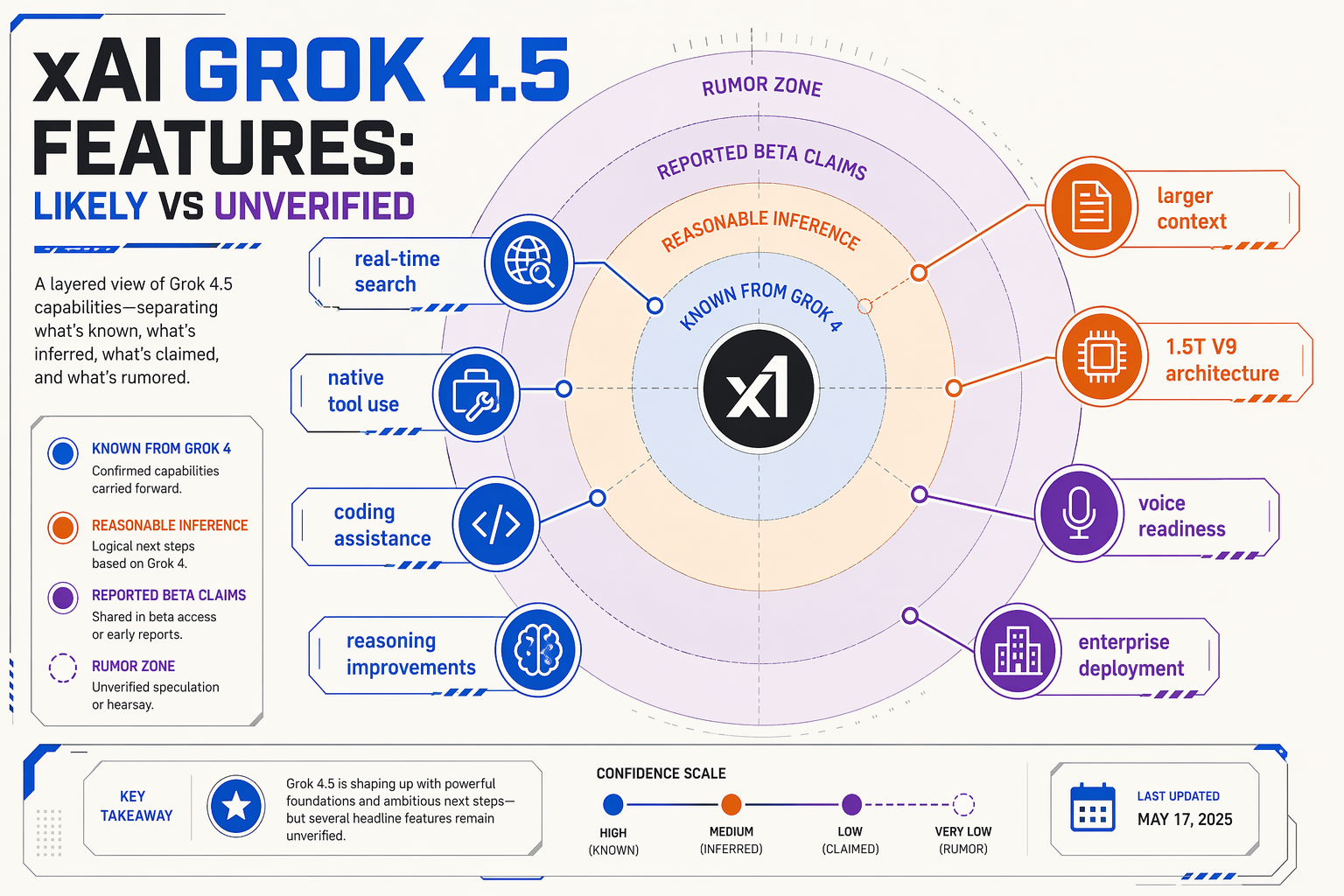
The most likely xAI Grok 4.5 features are stronger reasoning, coding help, real-world enterprise testing, and tighter integration with xAI/X ecosystem workflows — but the most circulated specifics remain unverified. As of July 8, 2026, public sources support a private beta at SpaceX and Tesla, while claims about a 1.5-trillion-parameter V9 model, Claude Opus-class performance, and a July 9 public launch should be treated as reported claims, not confirmed release facts.
Likely features based on the private beta pattern
If Grok 4.5 is being tested inside SpaceX and Tesla, the most plausible feature direction is not just “chatbot improvement” but production-grade reasoning under operational workloads. A LetsDataScience result says Elon Musk stated on June 28, 2026 that Grok 4.5 entered private beta at SpaceX and Tesla, describing it as “its first deployment ahead of a wider release.”
That kind of deployment suggests xAI may be evaluating:
- Long-context technical reasoning for engineering, documentation, operations, and troubleshooting.
- Coding and agentic workflows, especially if Grok 4.5 is being tested by engineers rather than only consumers.
- Tool-use reliability, where the model must call systems, retrieve data, and produce auditable outputs.
- Enterprise safety and latency behavior, because internal beta use usually exposes edge cases faster than lab-only testing.
- Real-time knowledge behavior, consistent with Grok’s broader positioning around X-linked information access.
These are reasonable expectations, but they are still expectations. xAI has not publicly published a complete Grok 4.5 technical report, model card, pricing sheet, API documentation, or general-availability announcement in the sources provided.
Reported but unverified Grok 4.5 claims
Several specific claims are circulating, but operators should label them carefully:
- “1.5-trillion-parameter V9 architecture”
A ByteIota result says Grok 4.5 “runs on a brand-new 1.5-trillion-parameter V9 architecture.” An NDTV Profit result also references Grok 4.5 being based on xAI’s “1.5 trillion parameter V9.” However, parameter counts can be difficult to verify without an xAI technical release.
- “Performance close to Claude Opus”
An X post in the search results says early evaluations show performance “close to” Claude Opus-class systems. That is a useful market signal, but not a benchmark. Without named tests, scores, prompts, evaluation methodology, and reproducibility, it should not guide procurement.
- “Public launch July 9, 2026”
An Explainx.ai result claims “SpaceXAI will release Grok 4.5 to the public July 9, 2026.” That conflicts with the more cautious BuildFastWithAI June 2026 result stating that “No public release date has been confirmed by xAI.”
- “Cursor-trained” or coding-specialized release
Some search snippets reference developer-centric positioning, but there is no confirmed xAI developer documentation in the supplied context that proves API availability, model limits, pricing, or IDE integration.
What remains unverified for businesses and developers
For business owners, the important missing details are commercial, not cosmetic. Before treating Grok 4.5 as deployable, teams need confirmation of:
- General availability date
- API access
- Pricing and rate limits
- Data-retention terms
- Regional availability
- Uptime or SLA commitments
- Benchmark results from reproducible third-party tests
- Supported modalities: text, image, voice, search, tool use, or multimodal input
For developers, “private beta” means the model may exist and may be impressive, but it is not necessarily usable in production. A model can be under active internal testing and still be weeks or months away from stable API access.
Practical takeaway for AI operators
Treat Grok 4.5 as a watchlist model, not a dependency, until xAI confirms release status and access terms. If your roadmap needs customer support automation, AI voice agents, WhatsApp workflows, STT/TTS, or multi-model failover now, build on available infrastructure and keep your integration layer flexible.
That is why OpenAI-compatible gateways matter: platforms such as CallMissed let developers route LLM, speech-to-text, text-to-speech, image, and search workloads through one integration while preserving the option to add new models later when they become publicly available.
Who can access Grok 4.5 private beta, and is there a developer API?
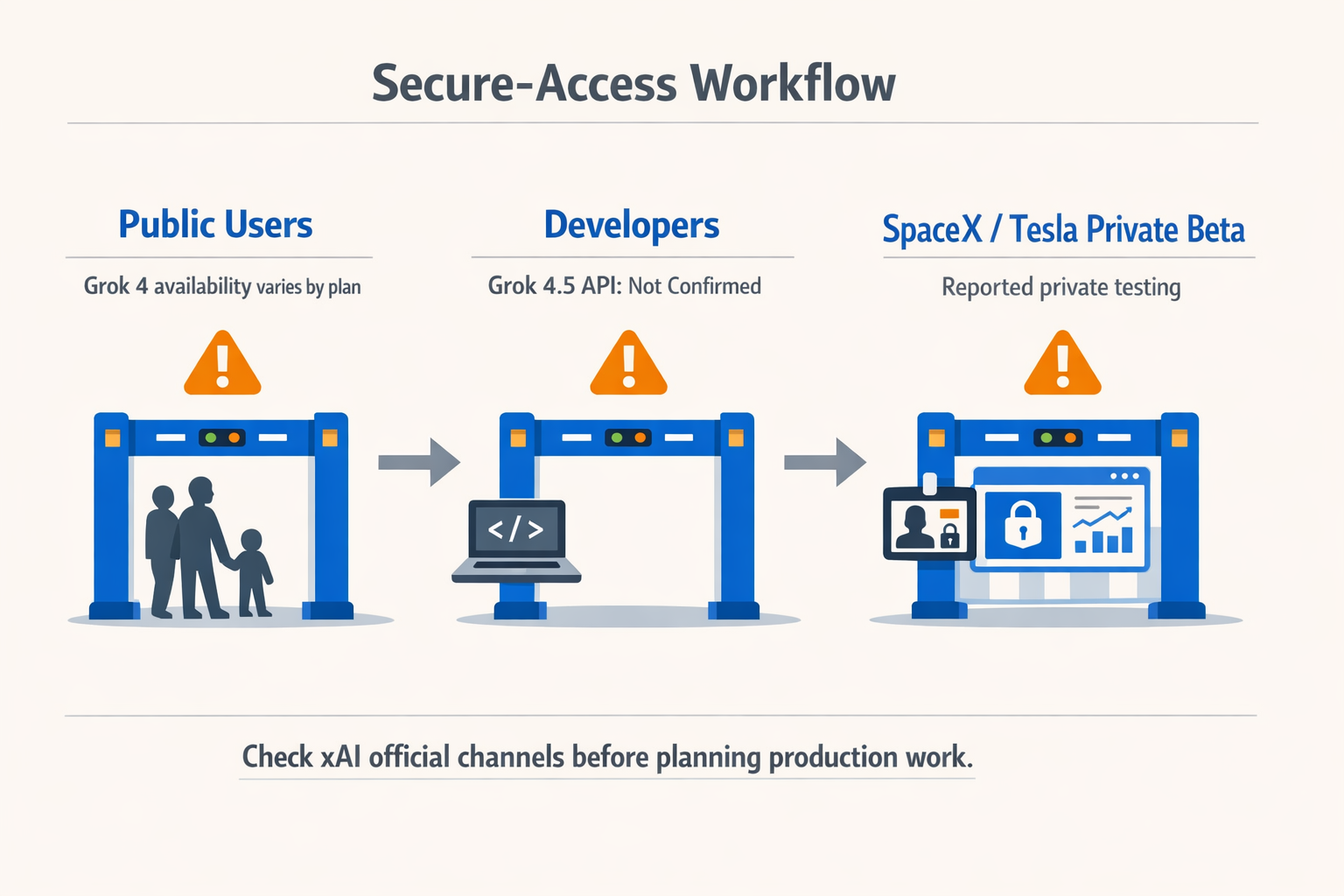
As of July 8, 2026, public sources indicate Grok 4.5 access is limited to a private beta at SpaceX and Tesla, and there is no confirmed developer API for Grok 4.5. For developers, the safest interpretation is: do not plan production timelines around Grok 4.5 API availability until xAI publishes official access, pricing, rate limits, and documentation.
Who appears to have Grok 4.5 private beta access?
The clearest reported access group is internal or closely affiliated enterprise users: SpaceX and Tesla engineers. A LetsDataScience report says, “Elon Musk said on June 28, 2026 that xAI’s Grok 4.5 has entered private beta at SpaceX and Tesla,” describing it as the model’s “first deployment ahead of a wider release.”
A BuildFastWithAI result from June 2026 gives the same access signal and adds the key release caveat: “No public release date has been confirmed by xAI.” That means the current access picture looks like this:
- Confirmed by repeated public reporting: Grok 4.5 is described as being in private beta at SpaceX and Tesla from June 28, 2026.
- Not confirmed for general users: There is no verified open signup for consumers, businesses, or xAI dashboard users.
- Not confirmed for developers: There is no verified Grok 4.5 API documentation, endpoint list, model ID, pricing table, or SLA in the available public results.
- Not confirmed for X Premium users: Public search snippets do not establish that Grok 4.5 is available broadly inside X or Grok apps.
Is there a Grok 4.5 developer API?
There is no reliable public confirmation of a Grok 4.5 developer API as of July 8, 2026. Some developer-focused pages discuss what programmers “need to know,” but the available snippets still point back to the same private-beta status rather than a documented API launch.
For example, ByteIota’s Grok 4.5 private beta result says xAI’s model “entered private beta at SpaceX and Tesla on June 28” and claims it runs on a “1.5-trillion-parameter V9 architecture.” That may be useful as a rumor-tracking signal, but it is not the same as an official API release. A real developer launch would normally include:
- Official xAI documentation naming the Grok 4.5 model ID.
- API availability terms, including rate limits and region access.
- Pricing, usually per input/output token or request class.
- Safety and data-use policies for enterprise and regulated workloads.
- SDK or OpenAI-compatible examples for chat, tools, function calling, or multimodal use.
Until those items exist, developers should treat Grok 4.5 as watchlist technology, not a production dependency.
What should developers and AI operators do now?
If your roadmap depends on AI customer support, coding agents, RAG, voice automation, or WhatsApp workflows, the practical move is to design for model portability rather than waiting for one unreleased model. That means:
- Build behind an abstraction layer or gateway.
- Keep prompts, evals, and tool schemas portable.
- Log real user failures so new models can be tested quickly.
- Use fallback models for uptime, latency, and cost control.
- Separate “model choice” from “business workflow” in your architecture.
This is where OpenAI-compatible gateways matter. CallMissed, the OpenAI-compatible AI gateway, lets developers connect to multiple LLM, speech-to-text, text-to-speech, image, and search models through one API key and one billing account, which reduces the cost of switching when new models become available. For Indian teams, CallMissed also supports STT and TTS across 22 Indian languages, which is especially relevant if Grok 4.5 access remains limited while production voice use cases need to ship now.
Bottom line for access planning
The responsible access assumption is simple: Grok 4.5 private beta appears real in public reporting, but Grok 4.5 public API access is not verified. Track xAI’s official channels, but avoid blocking customer-facing AI deployments on an unconfirmed launch window.
How credible are Grok 4.5 benchmarks against Claude Opus, GPT-4.5, and Grok 4?
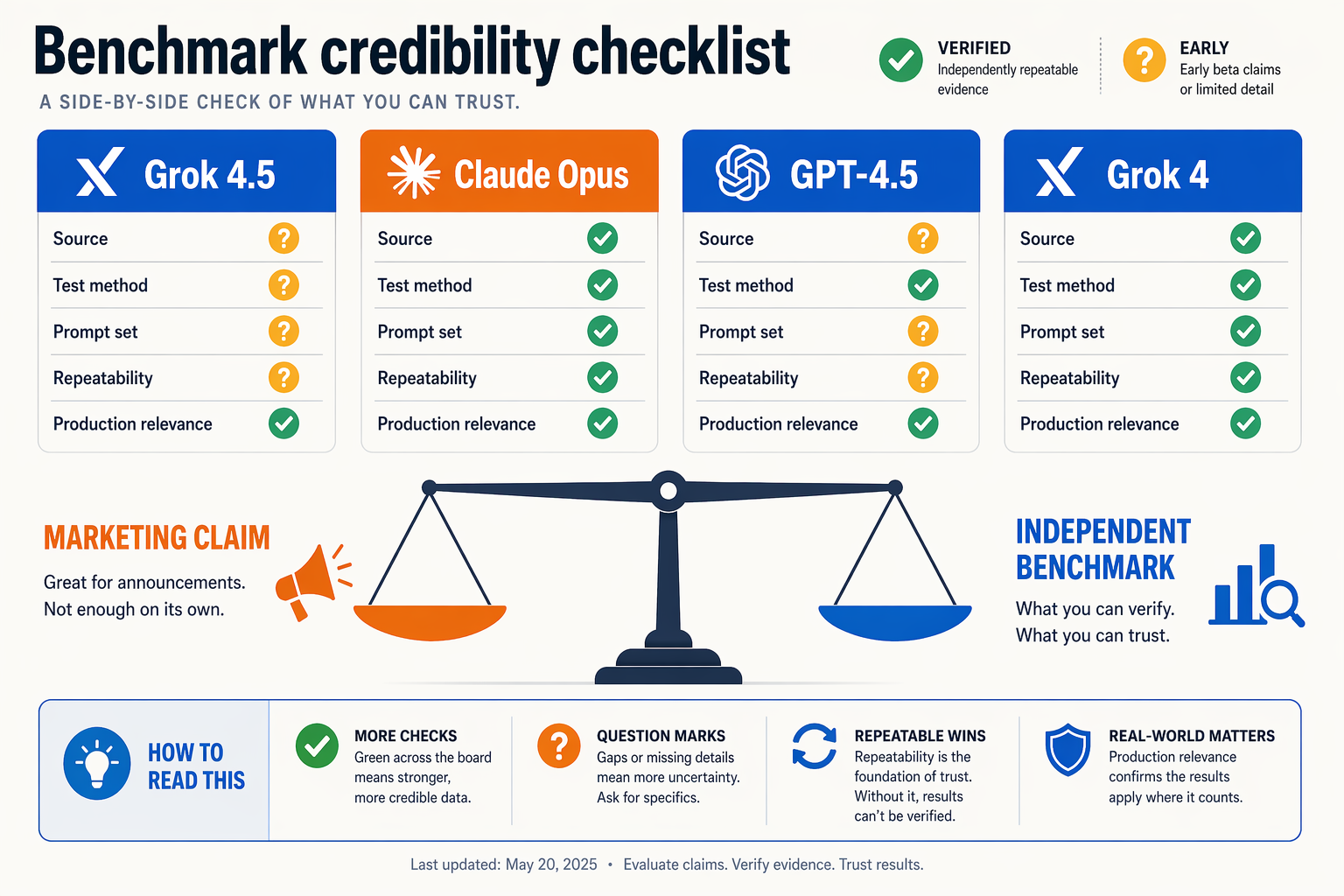
Benchmark claims around Grok 4.5 vs Claude Opus, GPT-4.5, and Grok 4 are not highly credible yet unless they come with reproducible test details, public model access, and third-party evaluation. As of July 8, 2026, public sources describe Grok 4.5 private beta access at SpaceX and Tesla from June 28, 2026, but they do not provide independently verifiable benchmark results for general business or developer use.
What the public benchmark claims actually say
The most important credibility issue is access. If only a limited beta group can test Grok 4.5, outside evaluators cannot yet confirm whether it consistently outperforms Claude Opus, GPT-4.5, or Grok 4 across real workloads.
The current public record is mixed:
- BuildFastWithAI, June 2026, states that “No public release date has been confirmed by xAI” and says Grok 4.5 entered private beta at SpaceX and Tesla on June 28, 2026.
- LetsDataScience reports that Elon Musk said on June 28, 2026 that Grok 4.5 entered private beta at SpaceX and Tesla.
- NDTV Profit describes claims that Grok 4.5 is based on a “1.5 trillion parameter V9” model and that it rivals Claude Opus, but those details still need confirmation from xAI’s technical documentation or benchmark disclosures.
- A social post indexed in search says early evaluations show performance “close to” Claude Opus, but that phrase is not the same as a benchmark score, leaderboard placement, or audited test result.
A useful rule: “close to Claude Opus” is a positioning claim; “scored X on benchmark Y under test conditions Z” is evidence.
How to judge Grok 4.5 benchmark credibility
For business owners and AI operators, benchmark credibility depends less on hype and more on whether the test can be repeated. Before accepting a Grok 4.5 Review or comparison chart, check for five things:
- Model identity: Does the source clearly state whether it tested Grok 4, Grok 4.5 private beta, or a rumored future build?
- Access method: Was the model tested through an official xAI product, API, private beta, or screenshot leak?
- Benchmark name: Does it cite known tests such as MMLU-style reasoning, SWE-bench-style coding, GPQA-style science reasoning, or real enterprise task evaluations?
- Prompt transparency: Are prompts, temperature settings, retries, tool access, and scoring methods disclosed?
- Independent replication: Can non-xAI researchers or developers reproduce the result?
If a claim lacks those details, treat it as directional signal, not procurement-grade evidence.
Why Claude Opus, GPT-4.5, and Grok 4 comparisons are especially tricky
Comparing frontier models is no longer a single-score exercise. A model can be excellent at coding but weaker at tool use; strong at reasoning but expensive; fast in chat but unreliable in long-context workflows.
For Grok 4.5, the key unanswered questions are:
- Against Claude Opus: Is “Opus-class” based on reasoning quality, writing quality, coding, long-context performance, or subjective beta feedback?
- Against GPT-4.5: Are comparisons measuring enterprise reliability, multimodal ability, latency, cost, or developer ecosystem maturity?
- Against Grok 4: Is Grok 4.5 a major architectural jump or an incremental beta update? Public sources mention a rumored 1.5-trillion-parameter V9 architecture, but that is not the same as verified capability uplift.
Practical takeaway for teams
Treat current Grok 4.5 benchmarks as unverified until xAI publishes official model cards, API documentation, benchmark methodology, and public access terms. Developers should avoid hard-coding product roadmaps around rumored results and instead design for model portability.
That is where multi-model infrastructure matters. Platforms such as CallMissed’s OpenAI-compatible gateway help teams test and switch across LLMs, speech-to-text, text-to-speech, image, and search models behind one integration, reducing dependency on any single unconfirmed launch.
The safest benchmark strategy in July 2026 is simple: wait for public Grok 4.5 access, run your own task-specific evals, and compare it against Claude Opus, GPT-4.5, Grok 4, and your current production model using the same prompts, same data, and same success metrics.
Should businesses wait for Grok 4.5 or deploy AI voice automation now?
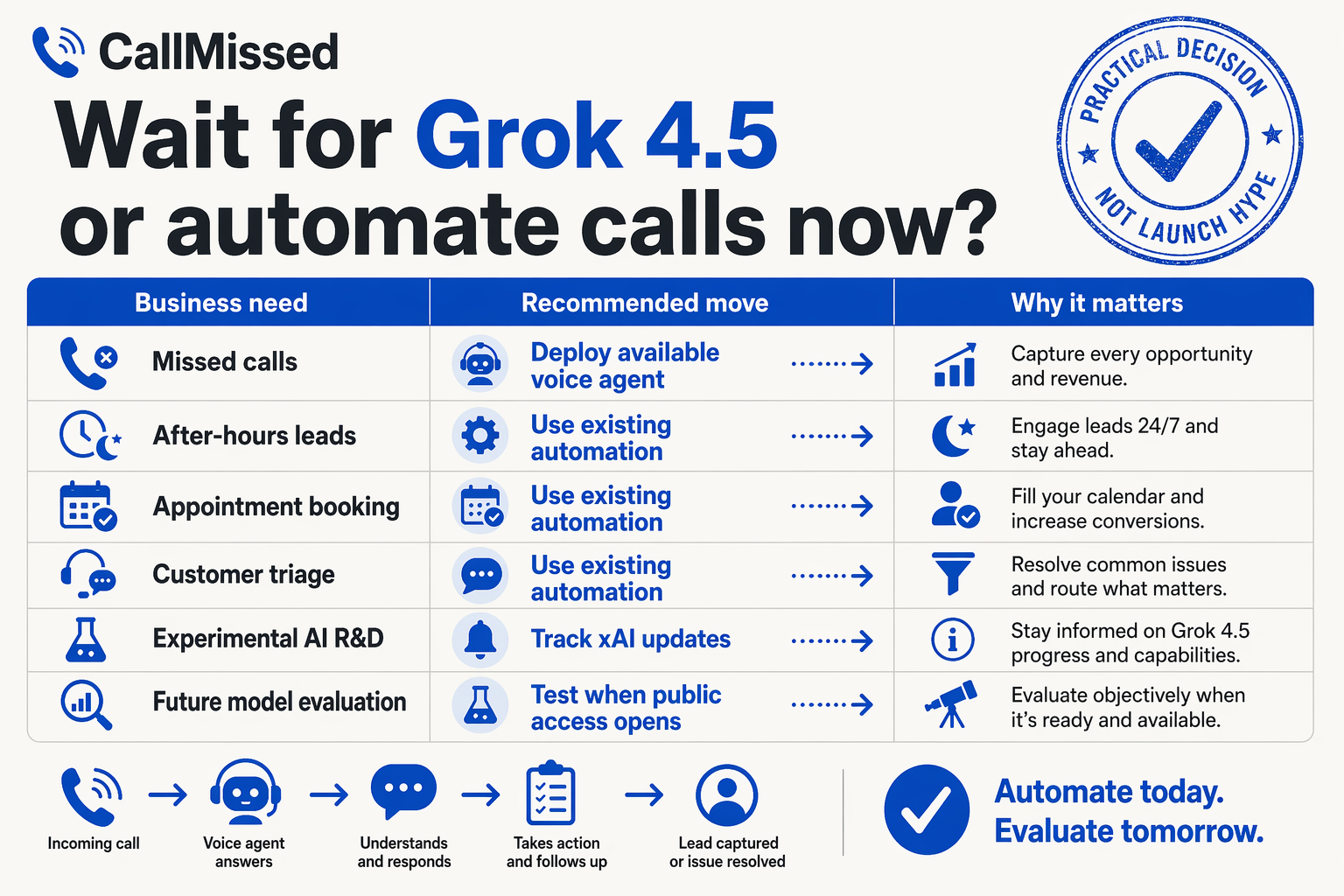
The practical answer: do not pause customer-facing AI voice automation just to wait for Grok 4.5. As of July 8, 2026, public sources indicate Grok 4.5 is in private beta at SpaceX and Tesla, while xAI has not clearly confirmed a general public release date for business users, developers, or API buyers.
Decision table: wait vs deploy now
| Decision area | Wait for Grok 4.5 if… | Deploy AI voice now if… | Verification trigger |
|---|---|---|---|
| Customer support calls | Your use case depends specifically on Grok-family reasoning or X/xAI ecosystem integration. | You need to reduce missed calls, qualify leads, answer FAQs, or route support today. | xAI publishes official public/API access details, pricing, rate limits, and enterprise terms. |
| Developer roadmap | Your team can afford a 30–90 day evaluation window after release. | Your app needs LLM, STT, TTS, search, or fallback models in production now. | Grok 4.5 appears in official xAI docs, SDKs, API model lists, or changelogs. |
| Benchmark-sensitive workflows | You require independently verified performance on coding, reasoning, or agentic benchmarks. | Your bottleneck is workflow design, latency, data quality, or telephony integration—not frontier-model capability. | Third-party benchmark reports distinguish confirmed results from beta claims. |
| India voice automation | Grok 4.5 confirms strong multilingual speech support for Indian languages. | You serve customers in Hindi, Tamil, Telugu, Bengali, Marathi, Kannada, Malayalam, Gujarati, Punjabi, or other Indian languages now. | xAI releases official STT/TTS language coverage and voice-agent latency data. |
| WhatsApp + voice operations | You need a future Grok-specific assistant and can keep manual operations running. | You want WhatsApp chat, WhatsApp Business calling, CRM workflows, and AI voice agents in one operational stack. | xAI confirms production-grade voice calling integrations or partner routes. |
Why “wait and see” is risky for operators
A BuildFastWithAI result from June 2026 states that “No public release date has been confirmed by xAI” and reports that Grok 4.5 entered private beta at SpaceX and Tesla on June 28, 2026. A separate LetsDataScience result says Elon Musk said on June 28, 2026 that xAI’s Grok 4.5 had entered private beta at SpaceX and Tesla.
That means the business decision should be based on verified availability, not launch speculation. Search results also show claims of a July 9, 2026 public launch, a 1.5-trillion-parameter V9 architecture, and performance “close to” Claude Opus-class systems, but those remain less useful for operators until xAI publishes official access, pricing, service levels, and API documentation.
For most businesses, the biggest gains from AI voice automation come before model selection becomes the bottleneck:
- Answering missed calls automatically
- Collecting lead details after business hours
- Resolving repetitive support questions
- Routing high-intent customers to sales
- Logging conversations into an inbox or CRM
- Supporting regional-language customers at scale
A sensible deployment strategy
The safer roadmap is deploy now, design for model flexibility later. Businesses can start with available LLM, speech-to-text, text-to-speech, WhatsApp, and workflow tools, while keeping architecture modular enough to test Grok 4.5 if and when xAI makes it generally available.
For Indian businesses, this is especially important because voice automation is not just about a frontier LLM. It also needs Indic speech recognition, natural-sounding text-to-speech, WhatsApp-native workflows, call handling, CRM context, and fallback reliability. Platforms such as CallMissed already support AI voice agents, WhatsApp chatbots, WhatsApp Business calling, and STT/TTS across 22 Indian languages, with transparent credit pricing where 1 credit = ₹1.
Bottom line
If Grok 4.5 becomes publicly available with strong pricing, API access, and verified benchmarks, it may deserve testing. But until xAI confirms those details, businesses should treat Grok 4.5 as a future evaluation candidate, not a reason to delay practical AI voice automation today.
Frequently Asked Questions
Is Grok 4.5 released to the public as of July 8, 2026?
What is the Grok 4.5 release date for businesses and developers?
What does Grok 4.5 private beta mean, and who has access?
What xAI Grok 4.5 features are confirmed versus rumored?
Should developers wait for Grok 4.5 before building AI apps or voice agents?
How can businesses verify Grok 4.5 leaks, benchmark claims, and launch rumors?
Conclusion
As of July 8, 2026, the practical answer is clear: Grok 4.5 is not yet confirmed as generally released by xAI. Public sources point to private beta activity, but businesses and developers should treat public-launch claims as unverified until xAI provides official access details.
- Release status: A BuildFastWithAI June 2026 result states that “No public release date has been confirmed by xAI.”
- Private beta signal: LetsDataScience reports that Elon Musk said Grok 4.5 entered private beta at SpaceX and Tesla on June 28, 2026.
- Rumor caution: Claims about a July 9, 2026 public launch, a 1.5-trillion-parameter V9 architecture, or Claude Opus-class performance should be treated as reported, not confirmed.
- Business takeaway: Do not pause AI automation roadmaps solely for Grok 4.5; plan for multi-model flexibility and switch when verified access, pricing, benchmarks, and API terms are public.
What to watch next: an official xAI announcement, Grok 4.5 API documentation, pricing, benchmark disclosures, and enterprise access terms. To explore how AI communication is evolving today, check out CallMissed — an AI infrastructure platform powering voice agents and multilingual chatbots for businesses. The real question is: will your team wait for the next model, or build a flexible AI stack that can adopt it when it truly arrives?
Related Reading
Discussion
Related Posts



Ready to automate customer conversations?
Launch AI voice agents and WhatsApp bots with CallMissed — one API, 22+ Indian languages.