Best AI Models of July 2026: Grok 4.5 vs GPT-5.6 vs Claude Sonnet 5



Best AI Models of July 2026 compared: Grok 4.5, GPT-5.6 and Claude Sonnet 5 by access, pricing, coding, agents and production readiness.
Best AI Models of July 2026: Grok 4.5 vs GPT-5.6 vs Claude Sonnet 5
What if the “best AI model” in July 2026 is not just a benchmark winner, but the model you can actually trust, access, and afford in production? This Best AI Models of July 2026: Grok 4.5 vs GPT-5.6 vs Claude Sonnet 5 comparison cuts through the hype for developers, businesses, automation teams, and voice-agent buyers. xAI says Grok 4 supports a 256,000-token context window, while Kie.ai reported on July 6, 2026 that Grok 4.5 traces appeared in the Grok web UI—important, but not the same as a public launch. GPT-5.6 and Claude Sonnet 5 are also driving fresh evaluation questions around coding, reasoning, workflow reliability, pricing, and ecosystem support. We’ll separate confirmed facts from previews, compare practical use cases, and show why teams building customer-call automation may prefer production-ready platforms like CallMissed over waiting for frontier-model rumors.
Which AI model is best in July 2026? At-a-glance verdict
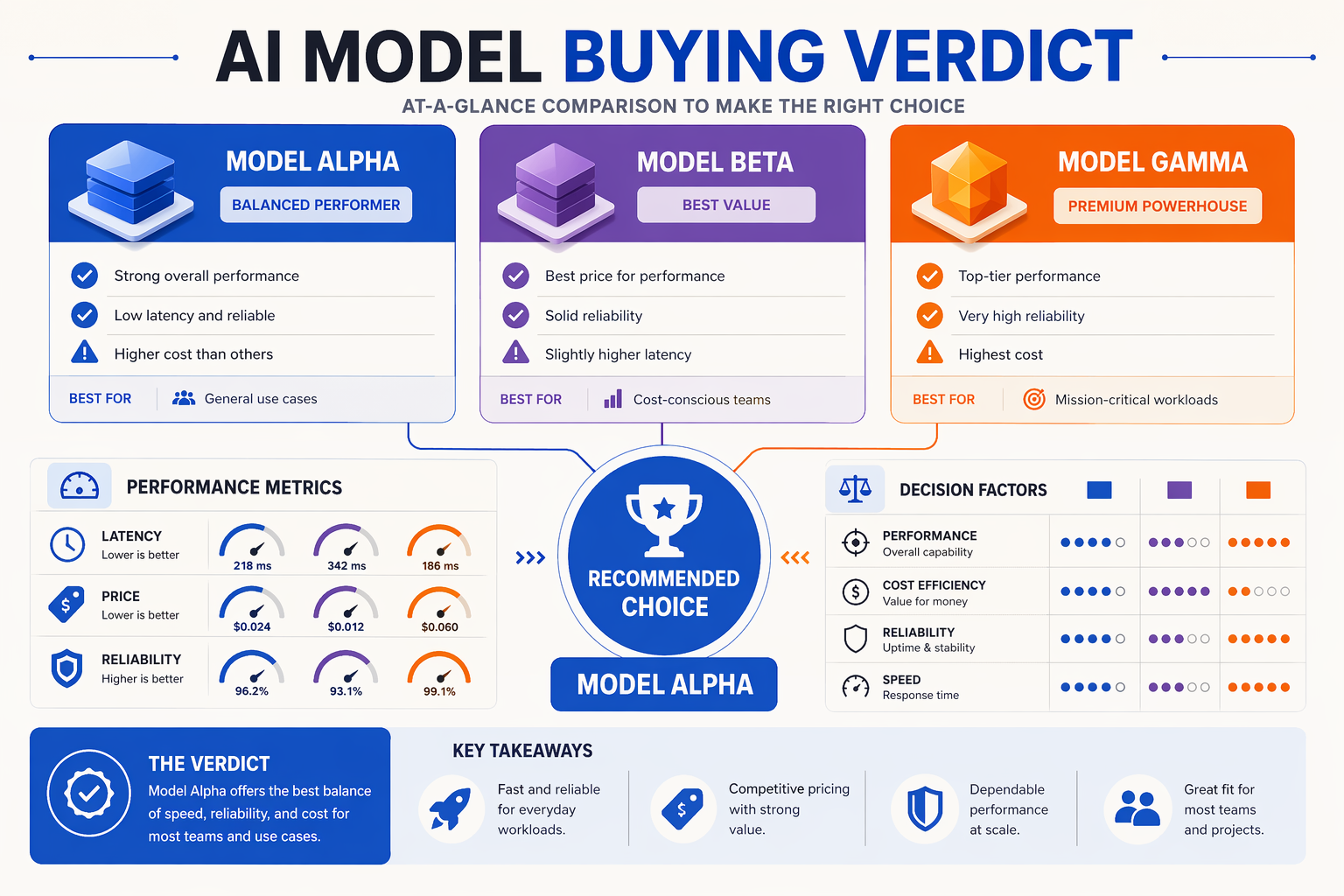
Best AI Models of July 2026 — verdict first: there is no universal winner. For most production teams, GPT-5.6 is the safest default; for coding-heavy teams, Claude Sonnet 5 is the practical pick; for xAI buyers, Grok 4 is the confirmed option while Grok 4.5 should be treated as unconfirmed until xAI publishes official launch materials.
- Best AI Models of July 2026, production default: GPT-5.6 is the strongest shortlist choice if you already rely on OpenAI-compatible tooling, enterprise controls, eval pipelines, and predictable model variants.
- Best AI Models of July 2026, coding workflows: Claude Sonnet 5 is the better fit for software teams focused on code review, agentic development, long-running tasks, and lower-risk automation.
- Best confirmed Grok option: Grok 4, not Grok 4.5, is the verified xAI model; xAI says Grok 4 supports multimodal understanding, advanced reasoning, and a 256,000-token context window via API.
- Grok 4.5 access status: Kie.ai reported on July 6, 2026 that the Grok web UI showed “Unlock the full power of Chat with Grok 4.5,” but Kie.ai explicitly called it “Not a launch. Not a system card.”
- Current SERP context: BuildFastWithAI ranks for Best AI Models of July 2026 and compares Claude Sonnet 5 / GPT-5.6 tiers, while FelloAI and benchmark aggregators rank broader 2026 model lists.
- Our angle: this Best AI Models of July 2026 verdict prioritizes verified facts, access status, production readiness, latency, pricing, and workflow fit — not just leaderboard screenshots or launch-rumor hype.
- Best for real-time X-aware use cases: Grok models are compelling when teams need reasoning plus real-time X context, but buyers should separate confirmed Grok 4 API capabilities from Grok 4.5 beta/leak claims.
- Best for customer-call automation: production-ready voice platforms matter more than frontier-model rumors; teams automating inbound calls, WhatsApp Business calls, and regional-language support should evaluate systems like CallMissed, which supports AI voice agents and Indic STT/TTS across 22 Indian languages.
- Bottom line: the Best AI Models of July 2026 are best judged by your own evals — task success, latency, reliability, failure handling, compliance needs, and total cost per resolved workflow.
What is confirmed, preview-only, or still rumor for Grok 4.5, GPT-5.6, and Claude Sonnet 5?
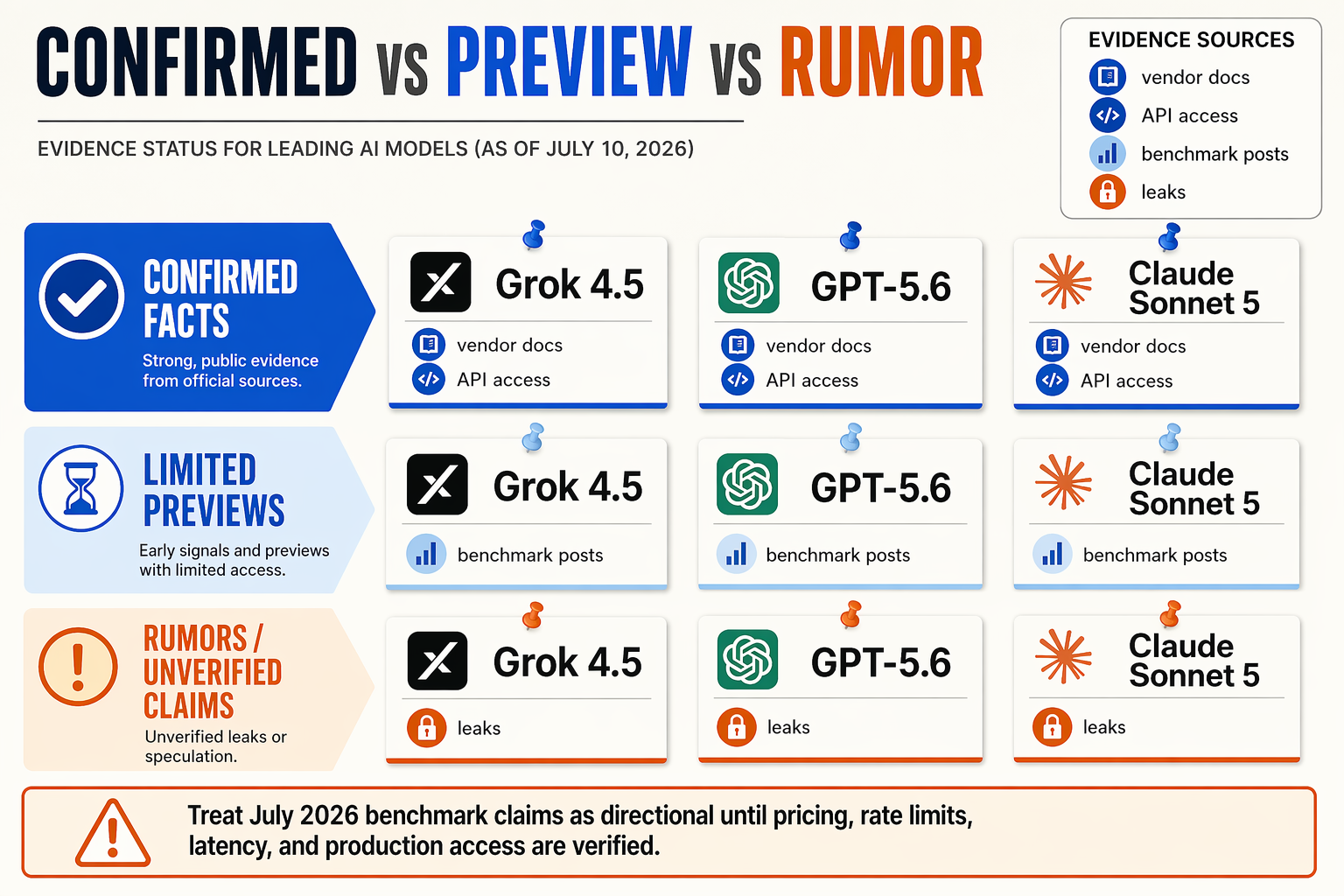
As of July 8, 2026, the safest reading is: Grok 4 is confirmed, Grok 4.5 is leak/preview-only, and GPT-5.6 / Claude Sonnet 5 claims need official availability checks before procurement.
- Grok 4 — confirmed: xAI’s official Grok 4 page says the Grok 4 API supports frontier-level multimodal understanding, advanced reasoning, and a 256,000-token context window.
- Grok 4.5 — not confirmed: Kie.ai reported on July 6, 2026 that the Grok web UI showed the phrase “Unlock the full power of Chat with Grok 4.5,” but Kie.ai explicitly wrote: “Not a launch. Not a system card.”
- Grok 4.5 — rumor risk: Claims about a 1.5T V9 model, private beta access, or benchmark dominance are circulating in blogs and social posts, but buyers should not treat them as production facts without xAI API docs, pricing, limits, and a model card.
- GPT-5.6 — verify access first: Treat GPT-5.6 as a preview/evaluation candidate unless your OpenAI console, enterprise contract, or gateway provider exposes it with documented pricing, rate limits, safety behavior, and model-version identifiers.
- Claude Sonnet 5 — verify launch details: Claude Sonnet 5 may be relevant for coding and workflow reliability evaluations, but teams should confirm Anthropic’s official model page, API availability, context limits, tool-use support, and regional access before committing.
- Benchmarks — not enough alone: A leaderboard screenshot is not procurement evidence; validate latency, refusal behavior, tool-call accuracy, JSON consistency, cost per successful task, and recovery from failure cases on your own workloads.
- Production buying rule: If a model is confirmed but expensive, test it; if it is preview-only, sandbox it; if it is rumor-only, track it but do not block roadmap decisions on it.
- Automation implication: For customer calls, WhatsApp workflows, and multilingual support, prioritize deployable infrastructure now; platforms such as CallMissed can connect AI voice agents, WhatsApp Business calling, and Indic STT/TTS across 22 Indian languages while frontier-model rumors mature.
How do Grok 4.5, GPT-5.6, and Claude Sonnet 5 compare on features?
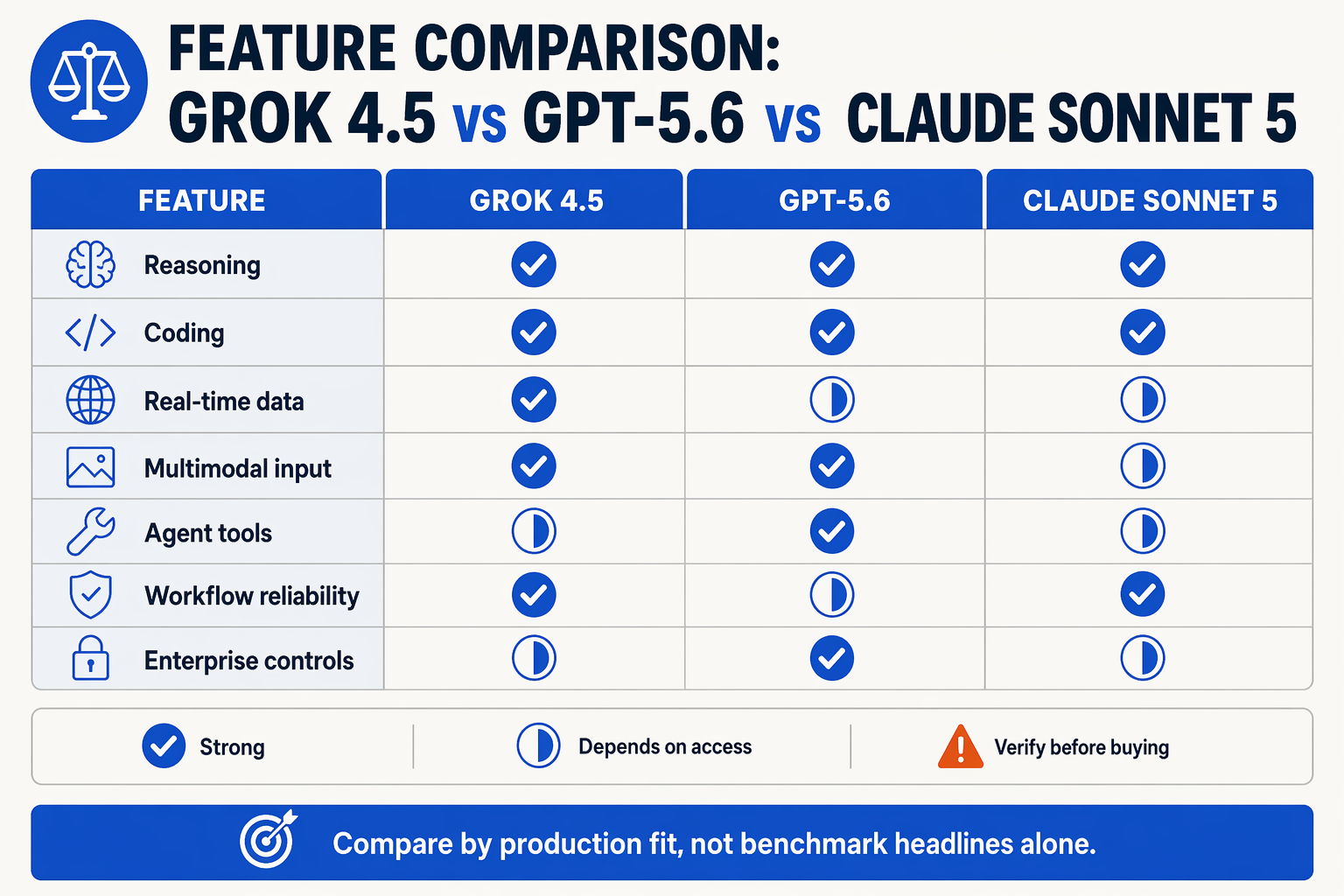
As of July 8, 2026, the clean feature comparison is: Grok 4 has confirmed specs, Grok 4.5 is still leak-level, and GPT-5.6 / Claude Sonnet 5 should be evaluated by access, tooling, and task fit rather than assumed benchmark wins.
Feature comparison matrix
| Feature | Grok 4.5 / Grok 4 | GPT-5.6 | Claude Sonnet 5 | Buying signal |
|---|---|---|---|---|
| Availability status | Grok 4 confirmed; Grok 4.5 unconfirmed as of July 8, 2026 | Preview / limited-access positioning in 2026 comparisons | Recently discussed as a coding/workflow model | Do not commit until API docs, pricing, and SLAs are visible |
| Context window | xAI says Grok 4 supports 256,000 tokens via API | Verify per model variant before deployment | Verify long-context limits per plan | Long context matters for RAG, logs, legal docs, and support history |
| Core strengths | xAI says Grok 4 has “frontier-level multimodal understanding” and “advanced reasoning capabilities” | Strong ecosystem fit for OpenAI-compatible stacks | Strong fit for coding, review, and workflow reliability | Match model to workflow, not leaderboard screenshots |
| Real-time data | Grok ecosystem is differentiated by X-aware use cases | Depends on tool / search integration | Depends on tool / connector setup | Critical for news, market, and social-context agents |
| Multimodal support | Confirmed for Grok 4 by xAI | Check image, audio, and tool support by endpoint | Check file, vision, and agent-tool support | Required for support tickets, screenshots, invoices, and QA |
| Production risk | Kie.ai reported on July 6, 2026 that Grok UI showed “Unlock the full power of Chat with Grok 4.5,” but said it was “Not a launch. Not a system card.” | Risk depends on preview stability and rate limits | Risk depends on availability, latency, and enterprise controls | Use staged evals before migration |
- Grok 4.5: Treat as not production-confirmed until xAI publishes launch notes, API documentation, pricing, and a system card.
- Grok 4: The strongest confirmed xAI data point is the 256,000-token context window, plus multimodal and reasoning claims from xAI’s Grok 4 API page.
- GPT-5.6: Shortlist it if your team values OpenAI-compatible tooling, model variants, vendor ecosystem, and existing eval pipelines.
- Claude Sonnet 5: Shortlist it for code generation, code review, agentic workflows, and business processes where consistency matters more than novelty.
- Voice-agent buyers: For inbound calls, WhatsApp Business calls, and Indian-language automation, evaluate platforms like CallMissed, which supports AI voice agents and STT/TTS across 22 Indian languages, instead of waiting for rumored frontier releases.
How do pricing, access, context, latency, and value compare?
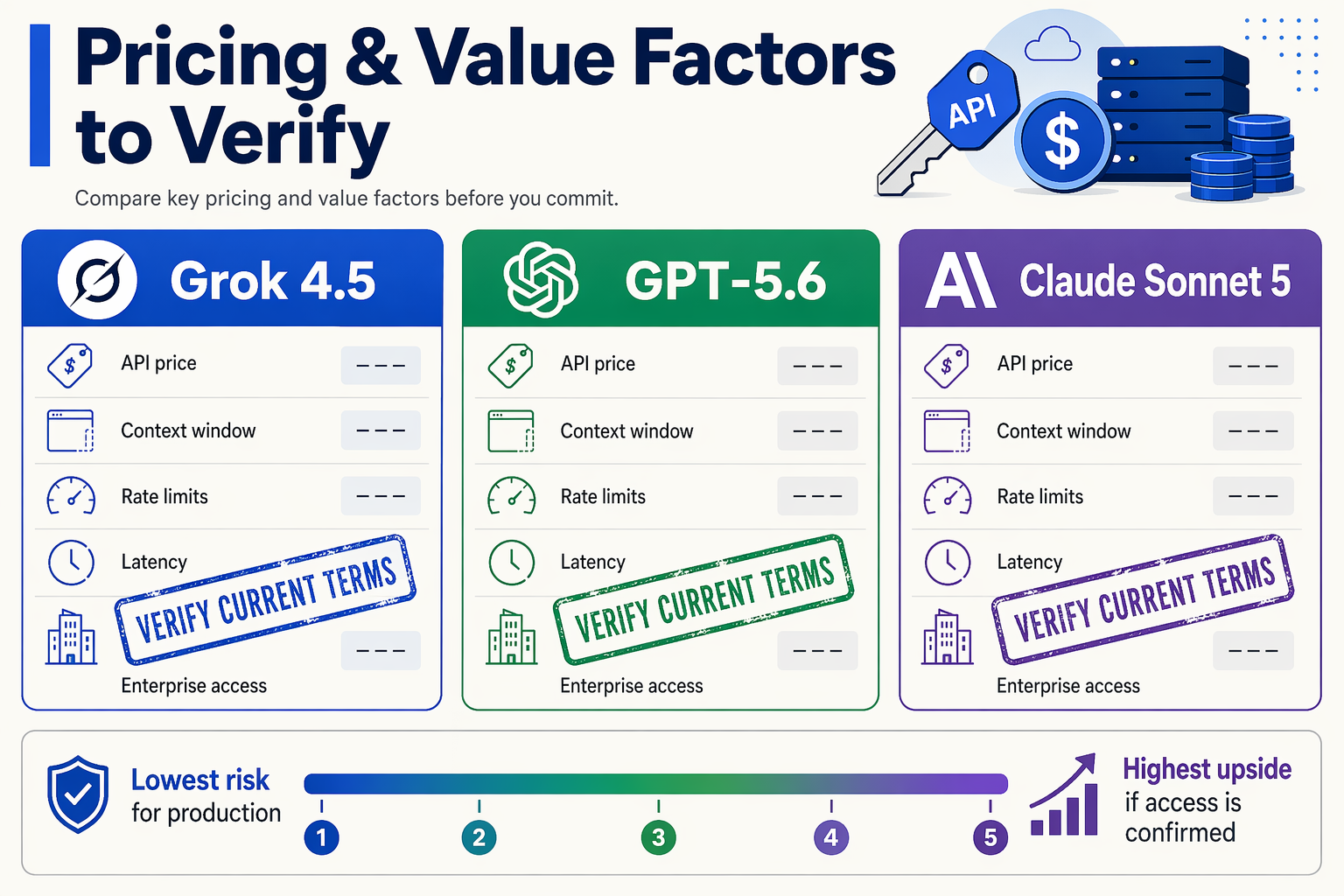
As of July 8, 2026, the safest buying rule is: compare confirmed access, real invoices, latency, and completed-workflow cost, not headline benchmarks. Grok 4 is confirmed by xAI, while Grok 4.5 should still be treated as unconfirmed or limited-preview until xAI publishes an official launch page, model card, and pricing.
Buying comparison table
| Factor | Grok 4 / Grok 4.5 | GPT-5.6 | Claude Sonnet 5 | Buying note |
|---|---|---|---|---|
| Access status | Grok 4 is confirmed through xAI’s Grok 4 API page; Grok 4.5 is not confirmed as a public release | Treat as preview or availability-dependent unless your OpenAI account shows production access | Treat as availability-dependent unless your Anthropic account or contract confirms access | Do not design production SLAs around rumor-only or invite-only models |
| Context window | xAI says Grok 4 supports a 256,000-token context window | Verify the official OpenAI model card before budgeting long-context workloads | Verify the official Anthropic model card before budgeting long-context workloads | Long context improves recall but can sharply increase token cost and latency |
| Pricing visibility | Check xAI’s official pricing page, your contract, and actual API invoices | Check OpenAI’s official pricing page, committed-use discounts, and gateway invoices | Check Anthropic’s official pricing page, contract terms, and gateway invoices | Compare cost per completed workflow, not only input/output token rates |
| Latency risk | Real-time X-aware or retrieval-heavy workflows may add overhead | Strong ecosystem tooling can help reduce integration latency | Often shortlisted for coding and structured workflow reliability | Measure P50, P95, timeout rate, retry rate, and queueing delays on your own prompts |
| Best value zone | Real-time X context, multimodal reasoning, and tasks needing fresh social signals | Broad app ecosystem, tool compatibility, and enterprise integration paths | Coding, review, structured automation, and long-running workflow consistency | Match model to task type before negotiating price |
| Production fallback | Confirm rate limits, quota rules, and fallback options before launch | Useful where existing OpenAI-compatible tools and eval harnesses are already in place | Useful where automation quality and controlled outputs matter | Use fallback routing only after testing answer consistency, not just uptime |
| Voice-agent fit | Evaluate only after confirming API stability, latency, and speech-stack compatibility | Evaluate with telephony, STT/TTS, routing, monitoring, and CRM integration | Evaluate with task completion, escalation handling, and transcript quality | For calls, optimize cost per resolved call, not cost per model response |
What the confirmed sources actually say
- xAI’s Grok 4 page states that the Grok 4 API provides “frontier-level multimodal understanding,” “advanced reasoning capabilities,” and a “256,000 context window.” That is a concrete, citable capability for Grok 4—not proof of Grok 4.5 production readiness.
- Kie.ai reported on July 6, 2026 that a Grok UI string said “Unlock the full power of Chat with Grok 4.5,” but Kie.ai also cautioned: “Not a launch. Not a system card.” Treat Grok 4.5 claims as watchlist signals until xAI publishes official documentation.
- For GPT-5.6 and Claude Sonnet 5, buying teams should separate model reputation from procurement reality: availability, rate limits, data-retention terms, regional hosting, support SLAs, and invoice-level pricing can matter more than public benchmark rankings.
Practical buying guidance
Use this evaluation sequence before committing:
- Run 100–500 real prompts from your production workload across Grok 4, GPT-5.6, and Claude Sonnet 5.
- Track success rate, hallucination rate, refusal rate, latency P50/P95, retry rate, and human-escalation rate.
- Calculate cost per resolved task for chat, coding, RAG, agentic workflows, and customer support separately.
- For call automation, test the full stack: telephony quality, Speech-to-Text accuracy, Text-to-Speech naturalness, routing, monitoring, human handoff, and post-call CRM updates.
For voice-agent buyers, the recommendation is simple: do not wait for frontier-model rumors if the business problem is missed calls, lead qualification, appointment booking, or support triage. Platforms such as CallMissed should be evaluated on production dimensions—WhatsApp Business calling, Indian-language STT/TTS coverage, call routing, observability, and total cost per resolved customer call—because the model is only one part of the automation outcome.
What are the pros and cons for developers, businesses, and AI automation teams?
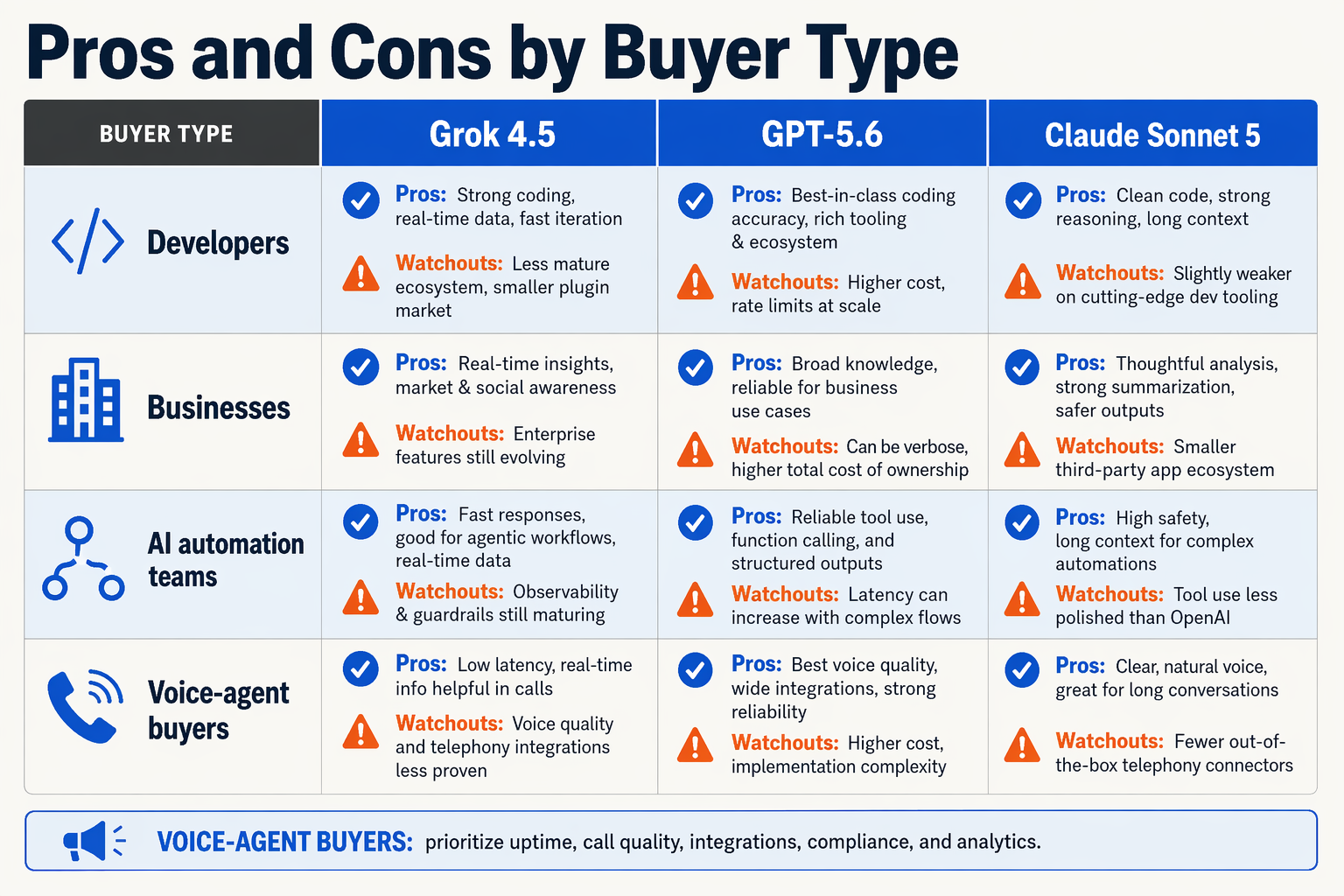
As of July 8, 2026, the pros and cons are less about “raw intelligence” and more about confirmed access, integration risk, workflow fit, and total cost per successful task.
- Grok 4.5: Treat as watchlist, not procurement-ready; Kie.ai reported on July 6, 2026 that Grok UI text mentioned “Grok 4.5,” but also said it was “Not a launch. Not a system card.”
- Grok 4: Confirmed xAI option; xAI says Grok 4 supports multimodal understanding, advanced reasoning, and a 256,000-token context window via API.
- GPT-5.6: Strong shortlist for teams already standardized on OpenAI-style APIs, eval tooling, and enterprise AI governance.
- Claude Sonnet 5: Best evaluated on coding, review, workflow reliability, and low-error automation rather than leaderboard screenshots alone.
| Buyer type | Grok 4 / 4.5 pros | GPT-5.6 pros | Claude Sonnet 5 pros | Main risk to check |
|---|---|---|---|---|
| Developers | Grok 4: 256K context and multimodal API per xAI; useful for large-context agents | Broad ecosystem fit for OpenAI-compatible tools and model routing | Strong candidate for code review, refactoring, and agentic developer workflows | API availability, rate limits, SDK maturity, eval drift |
| Businesses | Grok: attractive where real-time X context matters for market, support, or reputation monitoring | Safer if procurement needs governance, variants, and existing vendor workflows | Practical for document workflows, internal copilots, and lower-risk process automation | Pricing opacity, compliance controls, data-retention terms |
| AI automation teams | Grok 4: large context helps multi-step research and multimodal reasoning | Good fit for orchestration stacks that already use OpenAI-compatible endpoints | Often preferred for stable task completion and code-heavy automations | Tool-calling reliability, retries, latency, hallucination rate |
| Voice-agent buyers | Grok: useful as a reasoning layer, not a complete call stack | Useful if already connected to speech, CRM, and escalation systems | Useful for structured dialogue planning and summarization | STT/TTS quality, telephony, WhatsApp calling, regional languages |
| India-first teams | Grok/GPT/Claude: evaluate language output quality task by task | OpenAI-compatible access can simplify multi-model testing | Good for internal ops and engineering teams | Indian-language speech support and WhatsApp-native workflows |
| Experimental teams | Grok 4.5: worth monitoring because of July 2026 UI traces | GPT-5.6 previews may move quickly across variants | Claude Sonnet 5 may be easier to operationalize in coding flows | Do not build production plans on leaks, previews, or benchmark posts |
- Production rule: Do not choose Grok 4.5 until xAI publishes official API docs, pricing, or a system card.
- Benchmark rule: Run your own evals on 50–200 real tasks, including failures, retries, latency, and cost per resolved workflow.
- Business rule: Prefer the model that reduces human escalations, not the one that wins a single public leaderboard.
- Voice automation rule: For customer calls, evaluate the full stack: telephony, speech-to-text, text-to-speech, CRM handoff, analytics, and compliance.
- CallMissed fit: Teams automating Indian customer engagement can test models behind an OpenAI-compatible gateway while using AI voice agents, WhatsApp Business calling, and Indic STT/TTS across 22 Indian languages.
Which should you choose for coding, research, agents, real-time intelligence, or customer-call automation?
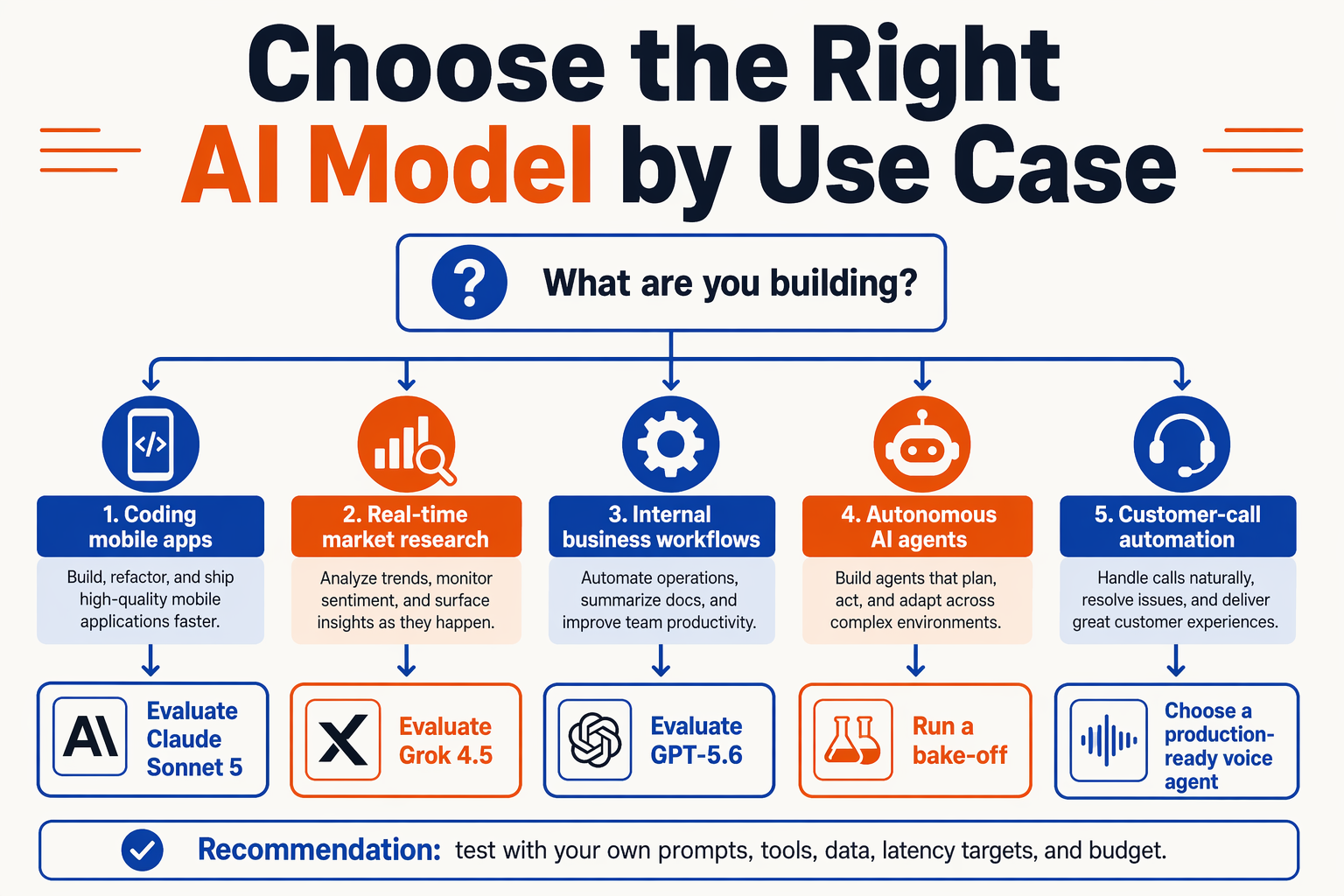
Practical use-case picks
Choose by workflow first, then validate with your own latency, cost, and failure-case tests. As of July 8, 2026, Grok 4.5 remains unconfirmed, while Grok 4 is the confirmed xAI API model.
- Coding agents: Choose Claude Sonnet 5 when your priority is repo-scale refactoring, code review, test generation, and long-running workflow consistency; validate on 20–50 real pull requests, not generic benchmark screenshots.
- Enterprise app development: Choose GPT-5.6 if your team needs broad ecosystem fit, OpenAI-compatible tooling, governance workflows, model variants, and easier integration into existing eval, logging, and fallback stacks.
- Research and long-context analysis: Choose Grok 4 where long document reasoning matters; xAI states that Grok 4 API supports a 256,000-token context window, multimodal understanding, and advanced reasoning.
- Real-time intelligence: Choose Grok models for workflows tied to live X/Twitter context, market monitoring, public-sentiment tracking, or breaking-news synthesis—but do not treat Grok 4.5 leak claims as production documentation.
- Grok 4.5 evaluation: Wait for xAI’s official launch post, API docs, pricing, and system card; Kie.ai reported on July 6, 2026 that the Grok UI showed “Unlock the full power of Chat with Grok 4.5,” but called it “Not a launch. Not a system card.”
- Customer-call automation: Do not pick a frontier model alone; pick a voice stack with telephony, STT, TTS, CRM handoff, and compliance. CallMissed supports AI voice agents, WhatsApp Business calling, and Indic STT/TTS across 22 Indian languages.
- Production buyer rule: Shortlist 2 models + 1 fallback, measure cost per resolved task, and require clear API access, rate limits, uptime behavior, and rollback paths before committing.
Frequently Asked Questions
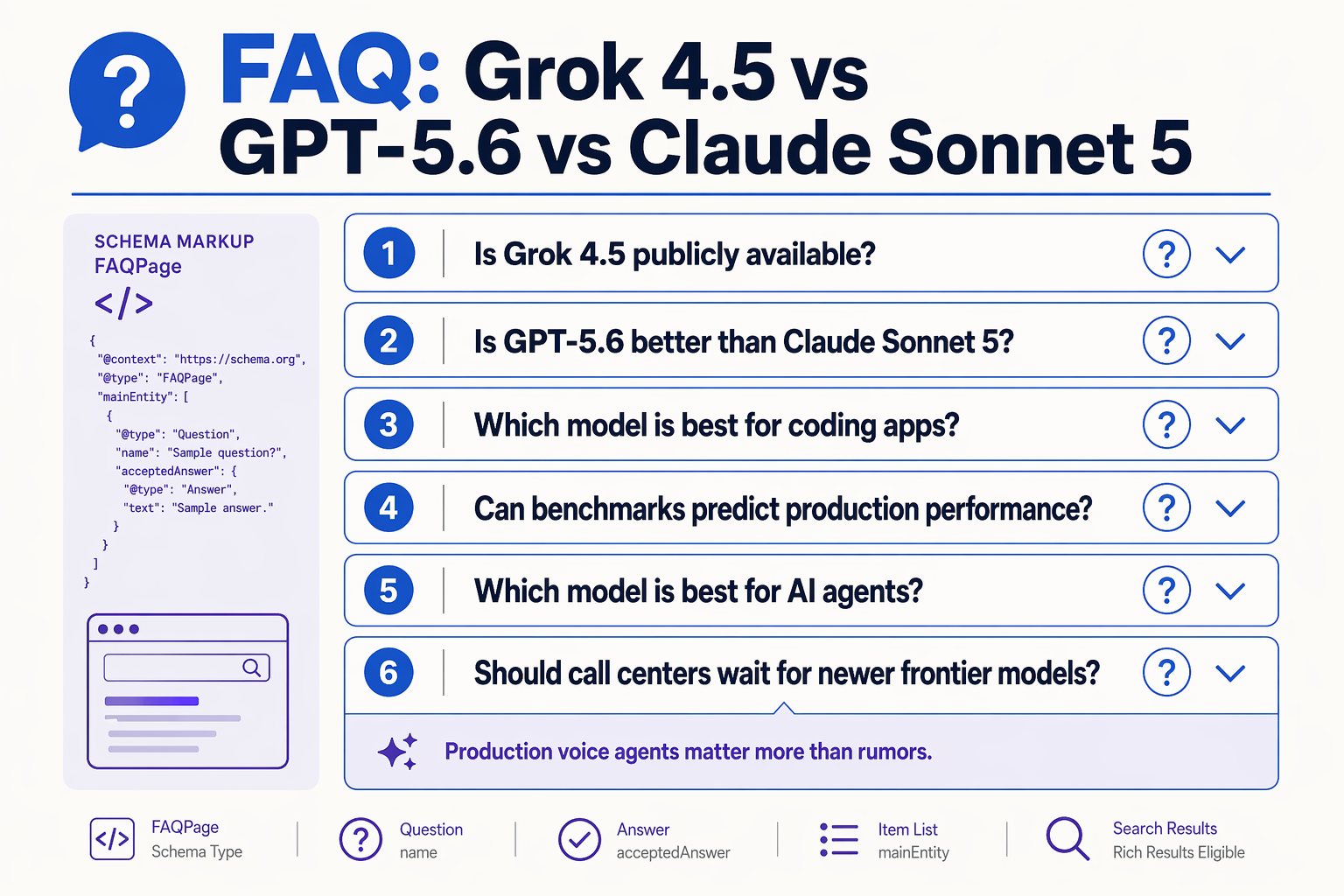
Which is best in Grok 4.5 vs GPT-5.6 vs Claude Sonnet 5 for developers in 2026?
Is Grok 4.5 officially launched or still a rumor?
How should businesses compare Grok 4.5 vs GPT-5.6 vs Claude Sonnet 5 pricing?
Which model is better for AI agents and automation workflows?
Should voice-agent teams wait for Grok 4.5, GPT-5.6, or Claude Sonnet 5?
Are AI model benchmarks enough to choose the best AI model in July 2026?
Conclusion
The July 2026 answer is practical, not absolute:
- Grok 4.5 remains wait-and-verify until xAI publishes official docs.
- GPT-5.6 fits teams prioritizing ecosystem maturity and OpenAI-compatible workflows.
- Claude Sonnet 5 looks strongest for coding, review, and reliable agentic tasks.
- Voice automation buyers should test real workflows, latency, cost, and fallbacks—not just benchmarks.
Watch for confirmed system cards, API pricing, and production evals. To explore where AI communication is heading, check out CallMissed — an AI infrastructure platform powering voice agents and multilingual chatbots for businesses.