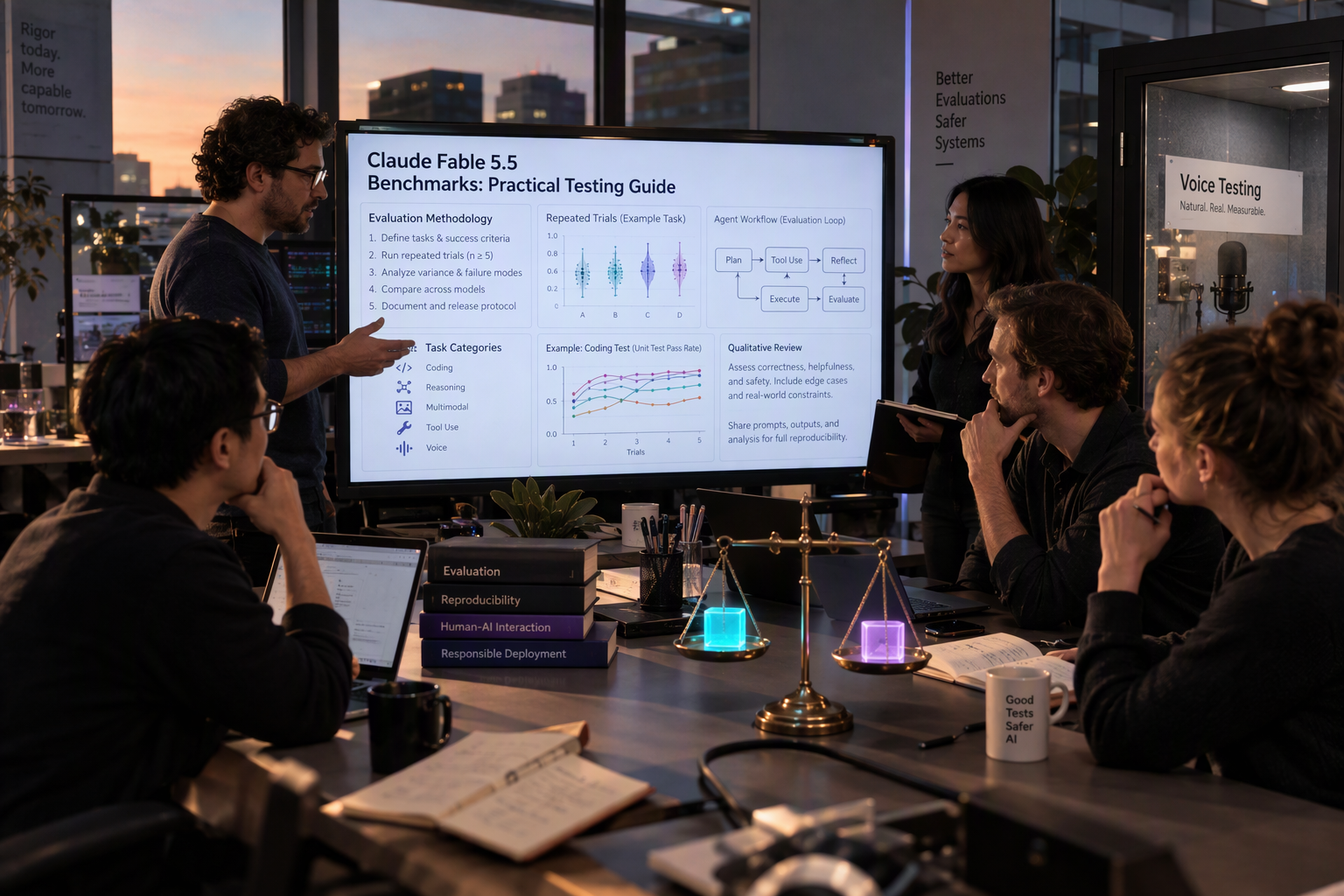
Claude Sonnet 5 vs GLM 5.2: 2026 Comparison With Fable 5 and GPT-5.5



GLM 5.2 vs Sonnet 5 guide comparing Claude Sonnet 5, Fable 5 and GPT-5.5 on cost, coding, benchmarks, context, agents and API fit.
Claude Sonnet 5 vs GLM 5.2: 2026 Comparison With Fable 5 and GPT-5.5
A “mid-tier” model just made the 2026 AI stack decision harder: Claude Sonnet 5 vs GLM 5.2 is no longer a simple cost-versus-quality debate, because Sonnet 5 now claims serious coding and agentic performance at aggressive introductory pricing.
Anthropic launched Claude Sonnet 5 on June 30, 2026, and early coverage highlights a 63.2% score on SWE-bench Pro plus introductory API pricing of $2 per million input tokens and $10 per million output tokens through August 31, 2026, according to Claude Platform Docs and 2026 benchmark roundups. That matters because product teams are no longer choosing “one best model” for every workload. They are routing tasks across models: one for coding, one for long-context reasoning, one for multilingual customer support, one for agent workflows, and another for cost-sensitive high-volume automation.
This pillar guide compares Claude Sonnet 5, Claude Fable 5, GPT-5.5, and GLM-5.2 from the perspective that actually matters in production: benchmarks, pricing, context windows, coding reliability, reasoning quality, API fit, latency-sensitive workflows, and total cost at scale. We’ll unpack where Sonnet 5 appears strongest, why Claude Fable 5’s reported $10/$50 per million token pricing changes the premium-tier calculation, how GPT-5.5 and GLM-5.2 fit into multi-model stacks, and when a cheaper or more specialized model may be the smarter choice.
The timing is important. In 2026, AI buyers are moving beyond demo scores and asking harder questions: Can this model run autonomous coding agents? Does it handle tool use consistently? Is the output stable enough for customer-facing workflows? Can we control cost when requests scale from thousands to millions? Platforms like CallMissed’s OpenAI-compatible gateway reflect this shift by letting developers access multiple model families through one integration rather than rebuilding around a single provider.
By the end, you’ll have a practical decision framework for Claude Sonnet 5 vs Fable 5, Claude Sonnet 5 vs GPT-5.5, and Claude Sonnet 5 vs GLM-5.2—including which model to test first for coding, agents, enterprise workflows, multilingual apps, and high-volume API deployments.
Introduction: The Short Answer for Choosing Claude Sonnet 5, Fable 5, GPT-5.5, or GLM-5.2
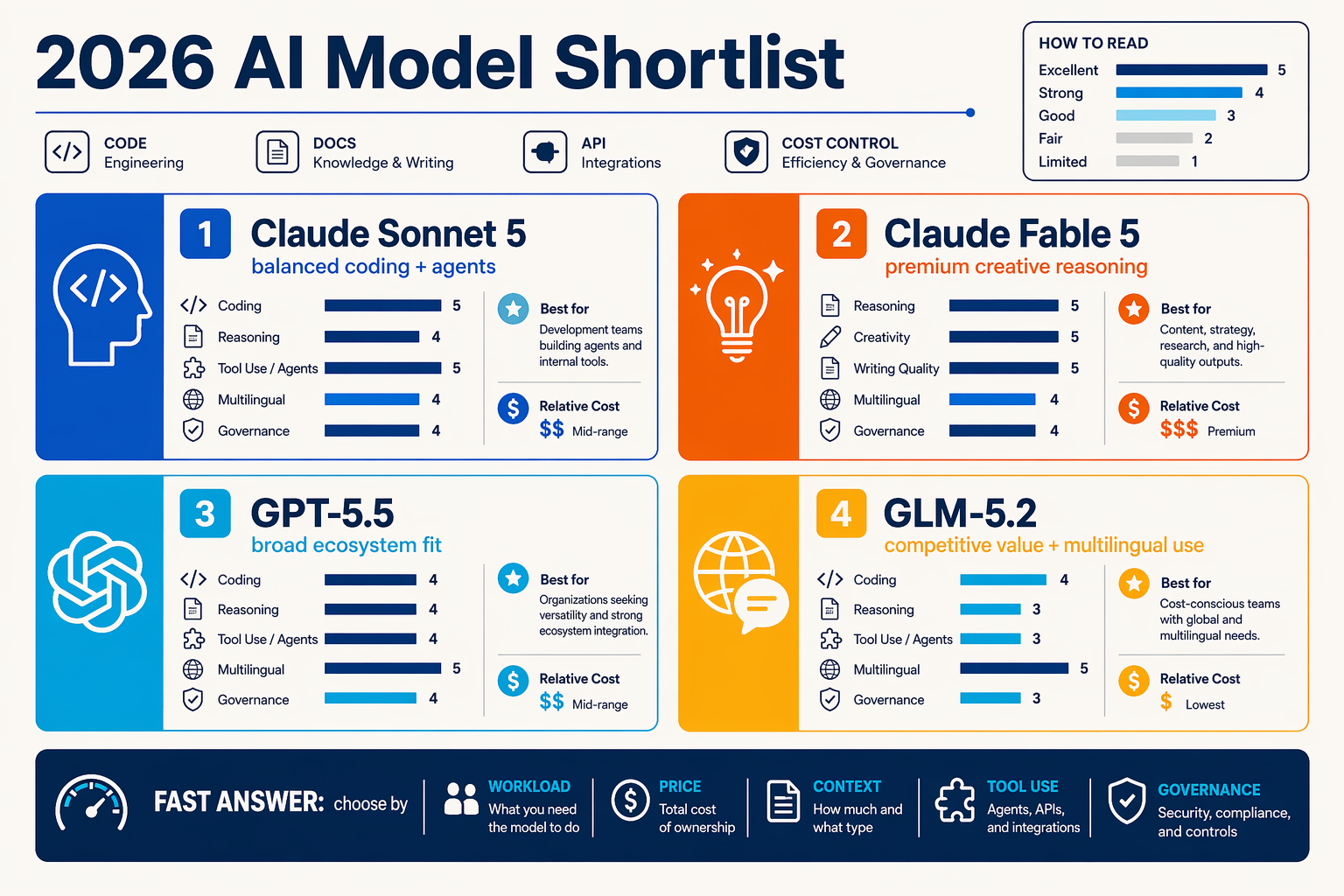
The practical answer in 2026 is: do not choose one model for everything. Choose the model that matches the workload, then route intelligently based on quality, latency, deployment constraints, and cost.
The short answer
If you are comparing Claude Sonnet 5 vs Fable 5 vs GPT-5.5 vs GLM-5.2, start with this decision rule:
- GLM 5.2 vs Sonnet 5: choose GLM-5.2 first when price, open-weight/local deployment options, or value-sensitive high-volume workloads matter most; choose Claude Sonnet 5 when polished coding reliability, agent behavior, and production consistency matter more.
- Sonnet 5 vs GLM 5.2: choose Sonnet 5 for software engineering agents, code review, tool use, and general production workflows; choose GLM-5.2 as a cost-conscious alternative or regional/local-deployment fit.
- Claude Sonnet 5 vs GLM 5.2: treat Claude Sonnet 5 as the safer default for coding and agentic reliability, and GLM-5.2 as the value-oriented option to benchmark for scale, multilingual use, or China/East Asia ecosystem fit.
- GLM 5.2 vs Claude Sonnet 5: if your main question is cost per completed task, start with GLM-5.2; if your main question is “which model is more dependable for complex developer workflows?”, start with Claude Sonnet 5.
- Sonnet 5 vs Fable 5: choose Sonnet 5 for balanced price-performance; choose Fable 5 only when premium Claude reasoning is available, justified, and worth the higher token cost.
- Fable 5 vs Sonnet 5: use Fable 5 for high-stakes reasoning escalation, executive analysis, or complex review; use Sonnet 5 for everyday coding, agents, support automation, and production throughput.
- Sonnet 5 vs GPT 5.5: choose Sonnet 5 when Claude’s coding-agent reliability is your priority; choose GPT-5.5 when your product, tooling, evaluations, or multimodal workflows are already optimized around the OpenAI ecosystem.
The biggest 2026 shift is that Claude Sonnet 5 is no longer just a “middle” Claude tier. Anthropic launched it on June 30, 2026, and early benchmark coverage reports 63.2% on SWE-bench Pro, according to BuildFastWithAI’s 2026 review. That puts Sonnet 5 directly into the conversation for serious coding and agentic workflows, not just general chat.
Why Sonnet 5 changes the comparison
Claude Platform Docs list introductory Claude Sonnet 5 API pricing at $2 per million input tokens and $10 per million output tokens through August 31, 2026. That matters because pricing is not a footnote anymore—it directly affects architecture.
For example:
- A coding assistant that generates long patches has high output-token cost.
- A RAG chatbot with large retrieved context has high input-token cost.
- An autonomous agent loop can multiply both costs through repeated tool calls.
- A customer-support bot at scale may need cheaper fallbacks for routine queries.
- A local or open-weight deployment requirement may push teams toward GLM-5.2 even when a hosted model wins on polish.
So the real comparison is not “Which model is smartest?” It is: Which model gives enough intelligence per rupee, dollar, or credit for this exact task—and under your deployment constraints?
Where GLM-5.2 fits
GLM-5.2 is the model to test when your decision is driven by value, control, or deployment flexibility. In a GLM 5.2 vs Claude Sonnet 5 evaluation, GLM-5.2 is most compelling when you care about:
- lower-cost or value-sensitive workloads,
- open-weight or local deployment strategies,
- regional ecosystem fit,
- multilingual workflows,
- high-volume automation where “good enough at lower cost” beats maximum polish.
That does not mean GLM-5.2 automatically wins every cost comparison. You still need to measure total cost per successful task, including retries, tool-call errors, latency, infrastructure, and human review. But if your workload is large enough, GLM-5.2 vs Sonnet 5 is one of the most important price-performance tests to run.
Where Fable 5 fits
Claude Fable 5 appears to be the premium Claude option in this comparison. Anthropic’s Claude Fable page lists pricing at $10 per million input tokens and $50 per million output tokens, with an existing 90% input-token discount for prompt caching.
That makes Fable 5 attractive for:
- complex reasoning chains,
- executive analysis,
- high-stakes research,
- strategic planning,
- legal, financial, or technical review workflows where quality matters more than marginal cost.
But for everyday coding assistance, support automation, summarization, or agentic task execution, Sonnet 5 vs Fable 5 is usually a price-performance question. Fable 5 may be the better premium escalation model, while Sonnet 5 may be the better default production model.
A caveat on benchmarks
Benchmarks are useful, but benchmark results are not always directly comparable across Claude Sonnet 5, Fable 5, GPT-5.5, and GLM-5.2. Scores can vary based on:
- benchmark version,
- prompt format,
- tool access,
- sampling settings,
- evaluation harness,
- context length used,
- whether the model was tested via API, hosted chat, or local deployment.
Use public benchmark numbers as a shortlist filter, not as the final answer. The production answer should come from your own evaluation set: real prompts, real tools, real latency targets, and real cost limits.
The production-minded answer
For developers and technical buyers, the winning strategy is usually a multi-model stack:
- Sonnet 5 for coding, agents, and balanced intelligence.
- Fable 5 for premium reasoning escalation when available and justified.
- GPT-5.5 for OpenAI-native app ecosystems, broad tooling compatibility, and multimodal application patterns.
- GLM-5.2 for price-sensitive routing, open-weight/local options, regional fit, and high-volume workloads.
This is also why platforms such as CallMissed’s OpenAI-compatible gateway are becoming relevant: teams can access multiple model families through one integration, instead of rewriting their application every time benchmark leadership changes.
The rest of this guide breaks down the comparison across benchmarks, pricing, context windows, coding performance, agentic workflows, API fit, and real-world use cases—so you can decide what to test first, what to use in production, and where to keep a fallback model ready.
Background & Context: Why 2026 Claude Comparisons Are More Complicated Than Benchmarks Alone

Benchmarks are useful—but they compress too much reality
The 2026 Claude comparison landscape is complicated because the headline numbers are now closer, the pricing bands are shifting, and model capabilities overlap more than they did in earlier generations. A benchmark like SWE-bench Pro can tell you whether a model is strong at software-engineering tasks, but it cannot fully answer whether that model is the right choice for your latency budget, API architecture, agent loop, context strategy, or production cost curve.
That is why the launch of Claude Sonnet 5 on June 30, 2026 matters. Early benchmark coverage reports 63.2% on SWE-bench Pro, while Claude Platform Docs list introductory pricing of $2 per million input tokens and $10 per million output tokens through August 31, 2026. Those two facts create a new kind of tension: Sonnet 5 looks strong enough for serious coding and agentic workloads, but its temporary pricing also makes it unusually attractive for teams that would normally reserve higher-end models only for premium tasks.
The comparison is no longer “smartest model wins”
For developers and technical buyers, the better question is not “Which model is most intelligent?” It is: Which model is most reliable for this workflow at this volume and price point?
A real production evaluation usually has at least five dimensions:
- Task fit: coding, reasoning, summarization, tool use, extraction, voice, support, or multilingual workflows
- Cost exposure: input/output token mix, prompt caching, retries, and agent-loop amplification
- Latency profile: first-token speed, streaming behavior, and consistency under load
- Operational fit: SDKs, API compatibility, observability, fallback options, and rate limits
- Risk tolerance: hallucination sensitivity, safety behavior, deterministic formatting, and customer-facing reliability
This is why Claude Fable 5 vs Claude Sonnet 5 is not just a “premium vs mid-tier” comparison. Anthropic’s Fable page lists Claude Fable 5 at $10 per million input tokens and $50 per million output tokens, with a 90% input token discount for prompt caching. That makes Fable 5 potentially attractive for high-value reasoning, but expensive for verbose outputs, large-scale agents, or workflows with many failed/retried generations.
Agentic workflows change the cost math
Agentic systems multiply token usage. A single user request may trigger:
- Planning
- Tool selection
- Code or query generation
- Tool execution
- Error handling
- Reflection
- Final answer generation
That means a model priced at “only” a few dollars per million tokens can become expensive if it runs 10–30 internal steps per user task. Claude Sonnet 5’s reported $2/$10 per MTok introductory API pricing is therefore especially relevant for builders testing coding agents, but teams should still model post-introductory pricing before standardizing on it.
Benchmarks rarely show this compounding effect. A model may perform well in a one-shot test but become less attractive when an agent needs repeated tool calls, long context, and recovery from partial failures. Conversely, a cheaper model such as GLM-5.2 may be useful in a routed stack for classification, extraction, or high-volume support tasks even if it is not the top performer on premium reasoning benchmarks.
Multi-model routing is becoming the default architecture
The practical 2026 pattern is model routing, not model loyalty. Product teams increasingly combine models based on workload:
- Use a stronger reasoning model for complex planning.
- Use a coding-optimized model for repository edits and bug fixes.
- Use a cheaper model for tagging, summarization, or triage.
- Use fallback models when rate limits, latency, or provider outages appear.
- Use specialized speech or multilingual models when the interface is voice-first.
This is where infrastructure decisions become as important as model selection. An OpenAI-compatible gateway, such as CallMissed’s developer API gateway, lets teams access multiple model families for LLM chat, STT, TTS, image generation, and search through one integration. That kind of abstraction matters when the best model for a workload may change quarterly—or even month to month as pricing promotions, context windows, and benchmark results shift.
The right evaluation starts with your workload
A fair Claude Sonnet 5 vs GLM 5.2, Claude Fable 5 vs Claude Sonnet 5, or Claude Sonnet 5 vs GPT-5.5 comparison should begin with your own traces, not only public leaderboards. Test each model on real prompts, real tool calls, real failure cases, and real token volumes. Benchmarks are the starting signal; production behavior is the deciding evidence.
Key Developments: Launches, Pricing Signals, Benchmark Claims, Context Windows, and API Access
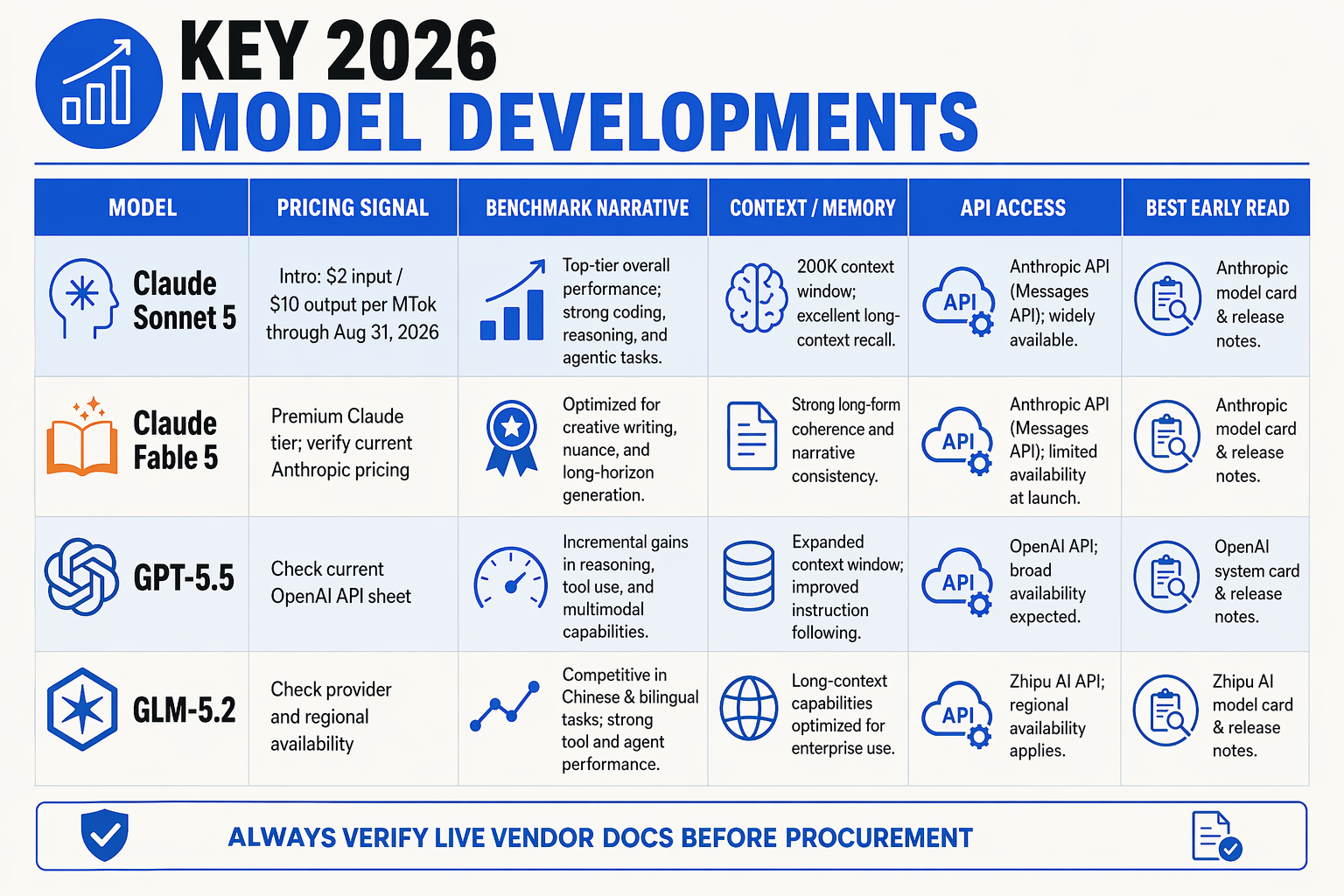
Why this development timeline matters
The 2026 Claude comparison cluster is not just about “which model is smarter.” It is about when pricing changes, how benchmark claims translate into production risk, and whether API access fits your routing architecture. The biggest signal so far is Anthropic’s positioning of Claude Sonnet 5 as a strong mid-tier production model: launched June 30, 2026, with reported 63.2% on SWE-bench Pro and temporary API pricing of $2 per million input tokens / $10 per million output tokens through August 31, 2026, according to Claude Platform Docs and 2026 benchmark coverage.
| Model / Development | Launch or Access Signal | Pricing Signal | Benchmark / Context / API Signal | Production Takeaway |
|---|---|---|---|---|
| Claude Sonnet 5 | Anthropic launched it on June 30, 2026, per 2026 review coverage. | Claude Platform Docs list $2/MTok input and $10/MTok output introductory pricing through August 31, 2026. | Reported 63.2% on SWE-bench Pro; early reviews also cite stronger agentic performance and Terminal-Bench 2.1 comparisons. | Best first test for coding agents, tool use, and balanced cost-quality workloads before the intro pricing window closes. |
| Claude Fable 5 | Anthropic positions Fable as a premium Claude tier. | Anthropic’s Fable page reports $10/MTok input and $50/MTok output, with a 90% input-token discount for prompt caching. | Designed for higher-end reasoning use cases; compare against Sonnet 5 when quality lift justifies a 5x input and 5x output price gap during Sonnet’s promo window. | Use for premium reasoning, complex planning, and high-value tasks, not default high-volume automation. |
| Claude Platform pricing update | Claude Platform Docs are the source of record for API pricing and model availability. | Search result snippets show pricing can vary by model, tier, and cached-token category. | Always confirm context window, rate limits, and model IDs directly in Claude Platform Docs before deployment. | Treat public comparison posts as directional; use official docs for procurement and production estimates. |
| GPT-5.5 comparison signal | Often evaluated because many teams already use OpenAI-compatible tooling. | Pricing and access can vary by provider, account tier, and gateway. | The real advantage is usually ecosystem fit, SDK maturity, and multimodal workflow compatibility rather than one isolated benchmark. | Strong candidate when your stack already depends on OpenAI-style APIs, evaluation harnesses, or existing prompts. |
| GLM-5.2 comparison signal | Appears frequently in multi-model SERPs alongside GPT-5.5 and Claude Opus/Fable/Sonnet comparisons. | Often considered for cost-sensitive or specialized routing, but teams should validate live provider pricing. | Evaluate against Claude Sonnet 5 on long-context tasks, multilingual behavior, latency, and structured output reliability. | Useful to test as part of a multi-model routing layer, especially where cost and regional performance matter. |
| Gateway / routing trend | Developers increasingly avoid locking one workflow to one model family. | Aggregated gateways simplify billing and fallback logic across providers. | OpenAI-compatible gateways can standardize calls to LLMs, STT, TTS, image, and search models. | Platforms like CallMissed’s OpenAI-compatible gateway fit this shift by letting teams test and route across model families without rewriting every integration. |
What to watch before making a 2026 model decision
A few signals deserve special attention:
- The August 31, 2026 Sonnet 5 pricing deadline: The $2/$10 per million token intro rate materially affects ROI calculations. If your evaluation assumes that price indefinitely, your forecast may be wrong.
- Benchmark-to-production gap: A 63.2% SWE-bench Pro score is meaningful for coding workflows, but teams should still test repo-specific tasks, tool calls, patch quality, and rollback behavior.
- Prompt caching economics: Fable 5’s reported 90% input-token discount for prompt caching can matter for repetitive enterprise workflows with large static context.
- Context-window validation: Do not rely on stale model-directory pages. Context limits, API IDs, and availability should be checked in official docs at integration time.
- Routing flexibility: The safest architecture in 2026 is model-agnostic: evaluate Sonnet 5, Fable 5, GPT-5.5, and GLM-5.2 with the same prompts, same scoring rubric, and same cost model.
In-Depth Analysis: Claude Sonnet 5 vs Fable 5 vs GPT-5.5 vs GLM-5.2 Across Coding, Reasoning, and Agents
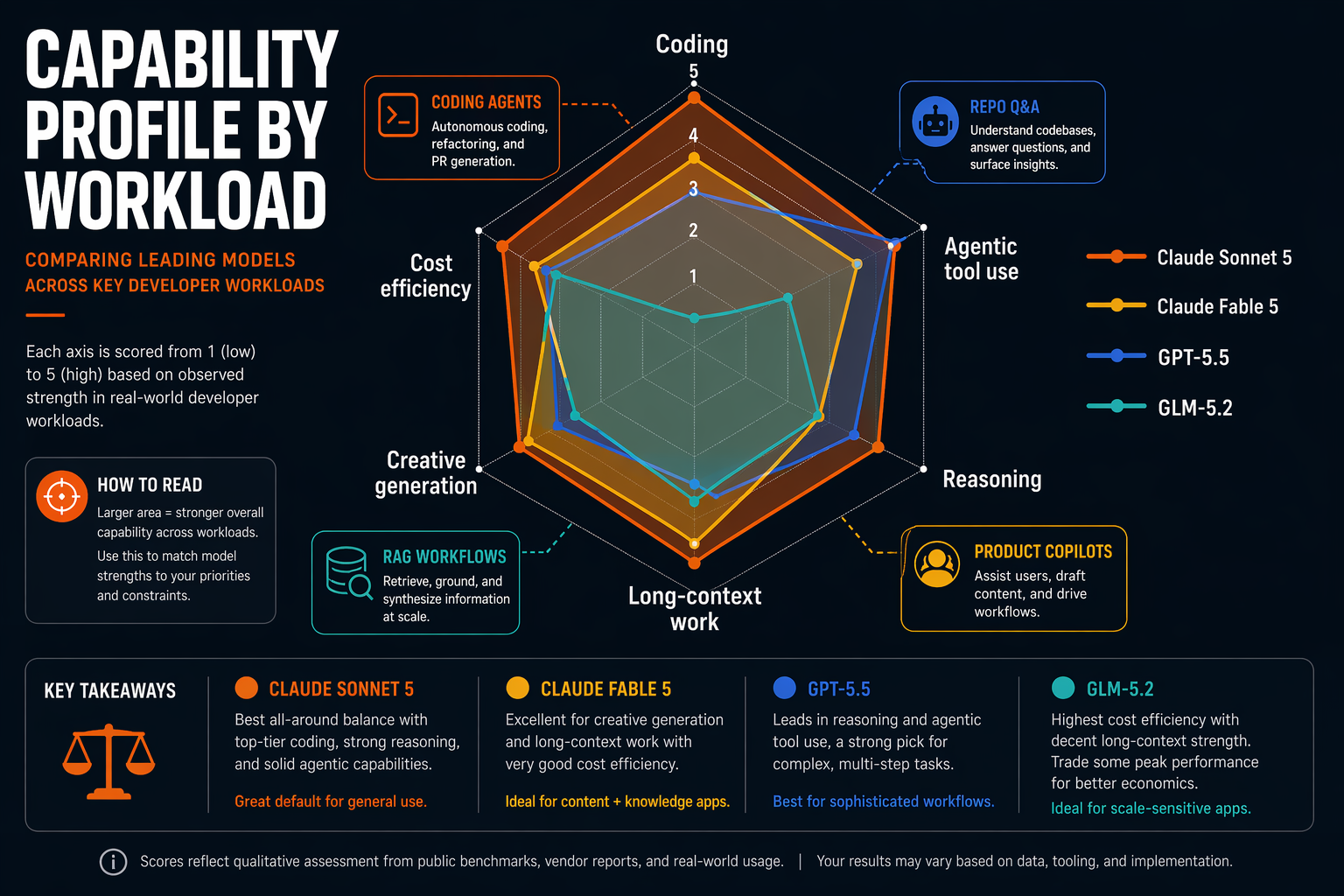
Coding performance: Sonnet 5 is the default model to test first
For software engineering workloads, Claude Sonnet 5 has the clearest public signal in the provided 2026 data. Anthropic launched it on June 30, 2026, and early benchmark coverage reports a 63.2% score on SWE-bench Pro, a benchmark focused on real-world software issue resolution. BuildFastWithAI also notes that Sonnet 5 “beats Terminal-Bench 2.1 over Opus 4.8,” which is especially relevant for coding agents that need to operate in shell-like environments.
That makes Sonnet 5 a strong first candidate for:
- Repository-level debugging
- Pull request generation
- Test repair and migration work
- Agentic coding loops with tools
- Developer copilots embedded in IDEs or internal portals
Claude Fable 5 should be evaluated when the coding task requires deeper architectural reasoning, complex trade-off analysis, or high-stakes refactoring recommendations. However, its reported pricing—$10 per million input tokens and $50 per million output tokens, according to Anthropic’s Claude Fable page—means teams should reserve it for workflows where higher-quality reasoning can justify the cost.
For GPT-5.5 and GLM-5.2, the decision is less about headline Claude benchmarks and more about your existing stack. If your engineering platform already uses OpenAI-compatible tooling, GPT-5.5 may reduce integration friction. GLM-5.2 may be attractive for teams optimizing for cost, multilingual coverage, or regional deployment requirements, but it should be tested against your own codebase rather than assumed equivalent on SWE-style tasks.
Reasoning quality: separate “deep thinking” from everyday inference
Reasoning is not one workload. In production, it usually splits into three tiers:
- Everyday reasoning — classification, extraction, summarization, routing.
- Structured reasoning — multi-step analysis, planning, SQL generation, policy interpretation.
- Premium reasoning — strategic decisions, legal/financial review, architecture design, complex agent planning.
For tier 1 and tier 2, Claude Sonnet 5 is likely the most balanced Claude option because it combines strong coding signals with aggressive introductory pricing: $2 per million input tokens and $10 per million output tokens through August 31, 2026, according to Claude Platform Docs and pricing roundups.
For tier 3, Claude Fable 5 becomes more compelling. Its higher token price suggests it is positioned as a premium model, and Anthropic’s Fable page also references an existing 90% input token discount for prompt caching. That matters for enterprise reasoning workflows where the same long system prompt, policy manual, or knowledge base context is reused repeatedly.
The practical pattern is: use Sonnet 5 for most reasoning, escalate to Fable 5 for expensive mistakes, and keep GPT-5.5 or GLM-5.2 in the routing layer when they perform better on domain-specific tests.
Agentic workflows: tool reliability matters more than raw intelligence
For agents, the benchmark question changes from “Which model is smartest?” to “Which model completes the loop reliably?” Agentic systems depend on:
- Correct tool selection
- Stable JSON/function calling
- Long-horizon planning
- Error recovery
- Low hallucination under tool feedback
- Cost control across repeated calls
This is where Sonnet 5’s reported coding and terminal performance becomes important. A model that performs well on software engineering and terminal-style tasks is often better suited to autonomous developer agents, DevOps assistants, and workflow automation.
Still, do not run every agent step on the most expensive model. A production-grade agent stack might use:
- GLM-5.2 for low-cost classification or multilingual preprocessing
- GPT-5.5 for ecosystem-compatible application workflows
- Claude Sonnet 5 for coding, planning, and tool-heavy execution
- Claude Fable 5 for final review, escalation, or complex reasoning checkpoints
Platforms such as CallMissed’s OpenAI-compatible gateway fit this architecture because teams can route across multiple model families from one integration instead of hard-coding every workflow to a single provider.
Bottom line for technical buyers
If you need one starting point, begin with Claude Sonnet 5 for coding and agents, then benchmark Fable 5, GPT-5.5, and GLM-5.2 against your own latency, cost, and accuracy targets. The strongest 2026 stacks will not be single-model stacks—they will be model-routed systems.
Pricing & Normalized Cost Modeling: Tokens, Caching, Batch Jobs, and Real App Spend
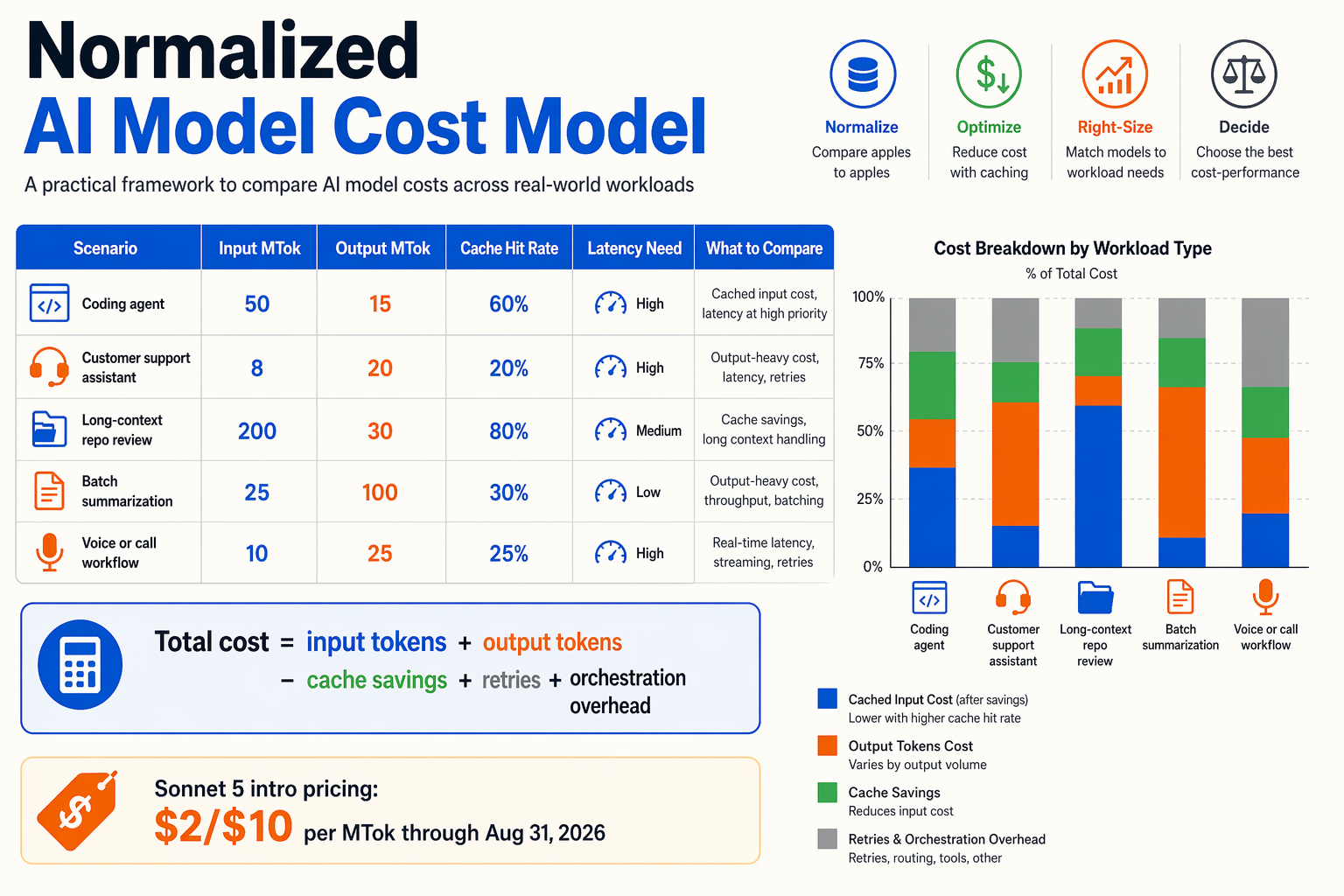
Normalize pricing before comparing models
For Claude Sonnet 5 vs Fable 5 vs GPT-5.5 vs GLM-5.2, headline token prices are only the starting point. Real production spend depends on four variables:
- Input tokens — prompts, chat history, retrieved documents, tool schemas.
- Output tokens — generated answers, code, summaries, JSON, reasoning traces if billed.
- Cache hit rate — reusable system prompts, policy text, schemas, and knowledge snippets.
- Execution mode — synchronous API calls vs offline/batch jobs where latency is less important.
A simple normalized formula is:
Total cost = input MTok × input price + output MTok × output price − caching/batch discounts
Anthropic’s own Claude Platform Docs list Claude Sonnet 5 introductory pricing at $2 per million input tokens and $10 per million output tokens through August 31, 2026. Anthropic’s Claude Fable page lists Claude Fable 5 at $10 per million input tokens and $50 per million output tokens, with an existing 90% input token discount for prompt caching. BuildFastWithAI and Eden AI also cite Sonnet 5’s June 30, 2026 launch and the same $2/$10 introductory API pricing.
| Cost scenario | 2026 pricing data used | Normalized workload | Estimated model spend | Practical takeaway |
|---|---|---|---|---|
| Claude Sonnet 5 intro API | $2 input / $10 output per MTok through Aug. 31, 2026 | 1M input + 200k output | $4.00 | Strong default test case for coding agents and production prototypes while intro pricing lasts. |
| Claude Fable 5 raw API | $10 input / $50 output per MTok, Anthropic | 1M input + 200k output | $20.00 | Roughly 5× Sonnet 5 intro cost for this workload; reserve for premium reasoning paths. |
| Claude Fable 5 with cache | 90% input-token discount for prompt caching | 1M input, 70% cache-hit + 200k output | $13.70 | Caching materially narrows the gap when prompts repeat, but output still dominates spend. |
| High-output generation | Sonnet: $10 output; Fable: $50 output | 500k input + 1M output | Sonnet: $11.00; Fable: $55.00 | For report writing, code generation, and long answers, output-token price is the main budget driver. |
| RAG / support assistant | Cache reusable instructions and KB framing | 2M input + 300k output, high prompt reuse | Varies by cache rate | Optimize retrieval size first; unnecessary context can cost more than model choice. |
| Offline evals / batch jobs | Provider-specific batch discounts vary | 10M input + 2M output | Model-price dependent | Run non-urgent grading, summarization, and regression tests asynchronously where available. |
What the table means for real applications
The most important insight: output tokens are expensive. Both cited Claude tiers price output at 5× input during the Sonnet 5 introductory window and for Fable 5’s listed pricing. That means a chatbot that produces verbose answers can cost more than a RAG system with large but well-cached prompts.
For technical buyers, the right model is not always the cheapest per million tokens. Instead:
- Use Claude Sonnet 5 as the baseline for balanced coding, agents, and production trials.
- Use Claude Fable 5 where a smaller number of high-value reasoning calls justify higher cost.
- Route simpler tasks to lower-cost models when quality requirements allow.
- Track cost per successful task, not just cost per token.
Platforms such as CallMissed’s OpenAI-compatible gateway are useful here because teams can route workloads across multiple model families behind one API key, then compare real spend using the same application traffic rather than synthetic prompts.
API Fit, Context Windows, and Agentic Workflows: When Each Model Works Best in Production
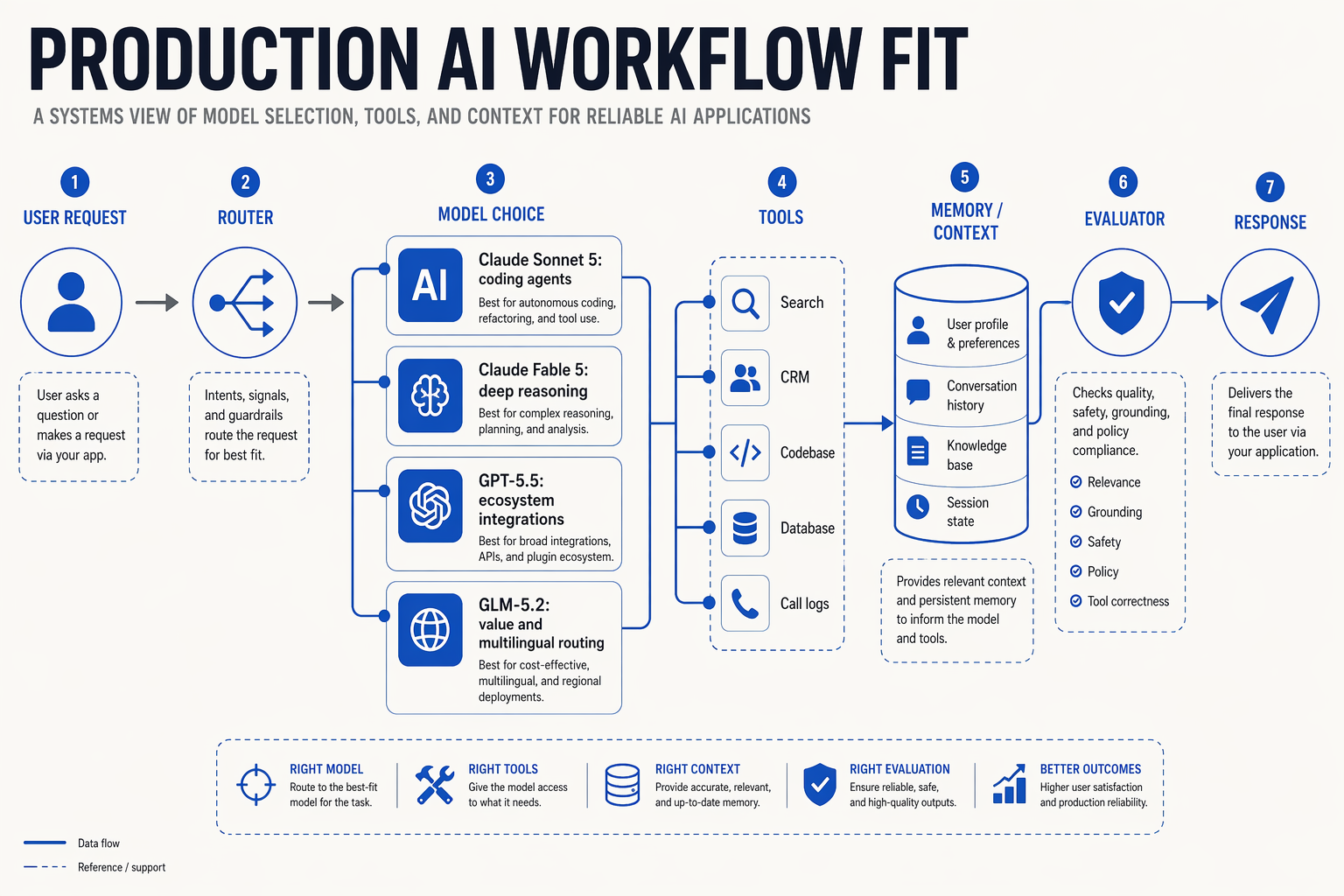
Start with the production shape, not the leaderboard
For production teams, the best model is usually the one whose API behavior matches the workflow. A high benchmark score matters, but agent systems also depend on tool-call reliability, prompt-cache economics, context handling, fallback behavior, latency, and observability.
Claude Sonnet 5 is attractive because it sits in the “production default” zone: strong enough for complex work, but priced for repeated API use. Anthropic launched it on June 30, 2026, and early benchmark coverage reports 63.2% on SWE-bench Pro. More importantly for builders, Claude Platform Docs list introductory pricing of $2 per million input tokens and $10 per million output tokens through August 31, 2026. That pricing makes Sonnet 5 realistic for agent loops, where one user task may generate multiple planning, tool-use, review, and retry calls.
API fit: which model belongs where?
Use this practical routing pattern:
- Claude Sonnet 5: default agent and coding API
- Best fit for: coding assistants, repo analysis, bug fixing, tool-using agents, workflow automation.
- Why: strong software-engineering benchmark signal, balanced pricing, and good fit for iterative calls.
- Production note: test it first for autonomous coding tasks before escalating to a premium model.
- Claude Fable 5: premium reasoning path
- Best fit for: high-value analysis, executive decision support, complex synthesis, legal-style review, advanced planning.
- Why: positioned as a higher-end Claude tier, but cost changes the routing logic.
- Pricing note: Anthropic lists Claude Fable 5 at $10 per million input tokens and $50 per million output tokens, with a 90% input token discount for prompt caching. That makes caching strategy essential.
- GPT-5.5: ecosystem-heavy and multimodal workflows
- Best fit for: teams already built around OpenAI-compatible conventions, toolchains, eval suites, and model-routing infrastructure.
- Why: API familiarity and ecosystem compatibility can reduce migration friction.
- Production note: compare end-to-end reliability, not just raw output quality.
- GLM-5.2: cost-sensitive and specialized routing
- Best fit for: high-volume background tasks, classification, transformation, multilingual experiments, and secondary-agent roles.
- Why: often evaluated as part of cost-performance routing stacks rather than as a single universal replacement.
- Production note: validate instruction-following and tool consistency on your own prompts.
Platforms such as CallMissed’s OpenAI-compatible gateway fit this multi-model reality: developers can route LLM, speech, image, and search workloads through one integration instead of rewriting application logic for every provider.
Context windows: bigger is useful, but retrieval still wins
A larger context window helps with long documents, codebases, conversation history, and multi-step agent memory. But in production, context size is not the same as context quality. Long prompts increase cost, latency, and the chance that important details get diluted.
For most production systems:
- Use RAG for knowledge bases, policies, tickets, and documents.
- Use prompt caching for stable system prompts, schemas, product documentation, and tool instructions.
- Use long context only when the model genuinely needs full-document reasoning.
- Measure “answer groundedness” separately from “model intelligence.”
This matters especially for Fable 5: its reported $10/$50 per million token pricing can be justified for premium tasks, but not if every request carries unnecessary context. Sonnet 5’s $2/$10 introductory pricing gives more room for iterative context expansion, but teams should still compress, retrieve, and cache aggressively.
Agentic workflows: route by stage
The most reliable agent systems in 2026 are not one-call prompts. They are staged workflows:
- Planner: Fable 5 or Sonnet 5 for task decomposition.
- Executor: Sonnet 5 for coding, tool use, and implementation.
- Verifier: Sonnet 5, GPT-5.5, or GLM-5.2 depending on cost and domain.
- Fallback: same-tier or cheaper model for retries, summaries, and formatting.
- Escalation: Fable 5 for ambiguous, high-value, or risky decisions.
For customer-facing automation, the same pattern applies. A WhatsApp or voice agent may use a fast model for intent detection, a stronger model for reasoning, and a speech model for voice output. In India-first deployments, this is where multilingual infrastructure matters: CallMissed supports Speech-to-Text and Text-to-Speech across 22 Indian languages, which is important when AI agents must serve users beyond English-speaking segments.
The takeaway: choose Claude Sonnet 5 as the first production benchmark for agents, use Fable 5 selectively for premium reasoning, keep GPT-5.5 in the mix where ecosystem fit matters, and test GLM-5.2 for high-volume or specialized routing.
Impact & Implications: What the 2026 Model Race Means for Developers, Product Teams, and Technical Buyers

The model race is becoming an infrastructure decision
The biggest implication of the 2026 Claude comparison landscape is that model choice has moved from an AI research question to an infrastructure architecture question. When Anthropic launched Claude Sonnet 5 on June 30, 2026, early benchmark coverage reported 63.2% on SWE-bench Pro, while Claude Platform Docs list introductory Sonnet 5 API pricing at $2 per million input tokens and $10 per million output tokens through August 31, 2026. That combination changes how teams should think about production deployment.
Instead of asking, “Which model is smartest?”, developers and technical buyers should ask:
- Which model gives acceptable quality for this exact workflow?
- What happens to cost at 10x or 100x usage?
- Can we swap models without rewriting the application?
- Do we need premium reasoning, fast coding iteration, multilingual support, or predictable latency?
That is why Claude Sonnet 5 vs Fable 5 vs GPT-5.5 vs GLM-5.2 is not a winner-takes-all comparison. It is a routing and governance problem.
Developers: build for model portability, not model loyalty
For developers, the 2026 lesson is clear: avoid hard-coding your product around a single model unless you have a strong reason. Pricing, rate limits, benchmark leadership, and model behavior can change quickly.
Sonnet 5’s introductory pricing is especially important because it may make advanced coding-agent workflows cheaper to test in the short term. But because the $2/$10 per million token price applies only through August 31, 2026, teams should benchmark both the current price and the expected post-introductory economics before committing major workloads.
Practical developer implications:
- Use abstraction layers or OpenAI-compatible gateways where possible.
- Track input/output token mix, not just total tokens.
- Evaluate models on your own repos, prompts, customer messages, and tool calls.
- Keep fallback models ready for outages, latency spikes, or cost thresholds.
- Separate workloads: coding, summarization, retrieval, support, translation, and agent planning may each need different models.
This is where platforms such as CallMissed’s OpenAI-compatible gateway fit the broader trend: developers can reach multiple model families for LLM chat, speech, image, and search through one integration, reducing the cost of switching as the model race evolves.
Product teams: premium models should be reserved for premium moments
For product managers, the key implication is cost-aware experience design. Claude Fable 5 may be attractive for high-stakes reasoning, but Anthropic’s Fable page lists pricing at $10 per million input tokens and $50 per million output tokens, with a 90% input token discount for prompt caching. That makes it powerful, but not something most teams should use indiscriminately for every background task.
A smarter product pattern is:
- Use Sonnet-class models for coding help, agents, workflow automation, and general reasoning.
- Use Fable-class models for difficult escalation paths, complex analysis, and high-value customer or enterprise workflows.
- Use lower-cost or specialized models for classification, extraction, routing, summarization, and repetitive support tasks.
- Use prompt caching where long system prompts, policies, product documentation, or codebase context repeat across requests.
The winning product teams in 2026 will not simply ship “AI features.” They will ship AI systems with cost controls, evaluation loops, and graceful degradation.
Technical buyers: procurement now needs benchmark, cost, and risk controls
For CTOs, AI leads, and procurement teams, the model race raises three board-level questions:
- Reliability: Can the model handle tool use, agent loops, and customer-facing responses consistently?
- Economics: What is the blended cost per resolved ticket, merged PR, completed workflow, or generated report?
- Optionality: Can the business switch between Claude, GPT, GLM, or other providers without vendor lock-in?
Benchmarks like SWE-bench Pro and reports that Sonnet 5 performs strongly on agentic coding tasks are useful starting signals, but they are not substitutes for internal evaluation. A model that performs well on public coding benchmarks may still struggle with your monorepo, domain vocabulary, regulatory constraints, or multilingual customer base.
The deeper implication: in 2026, technical buyers should procure AI capability, not just model access. That means evaluating model quality, API ergonomics, observability, fallbacks, data controls, billing transparency, and regional language needs together. For Indian businesses especially, support for voice and chat across 22 Indian languages, as offered by CallMissed, can be as important as raw benchmark scores when AI reaches real customers.
Expert Opinions: How to Read Benchmarks, YouTube Tests, Vendor Claims, and Model Directory Scores
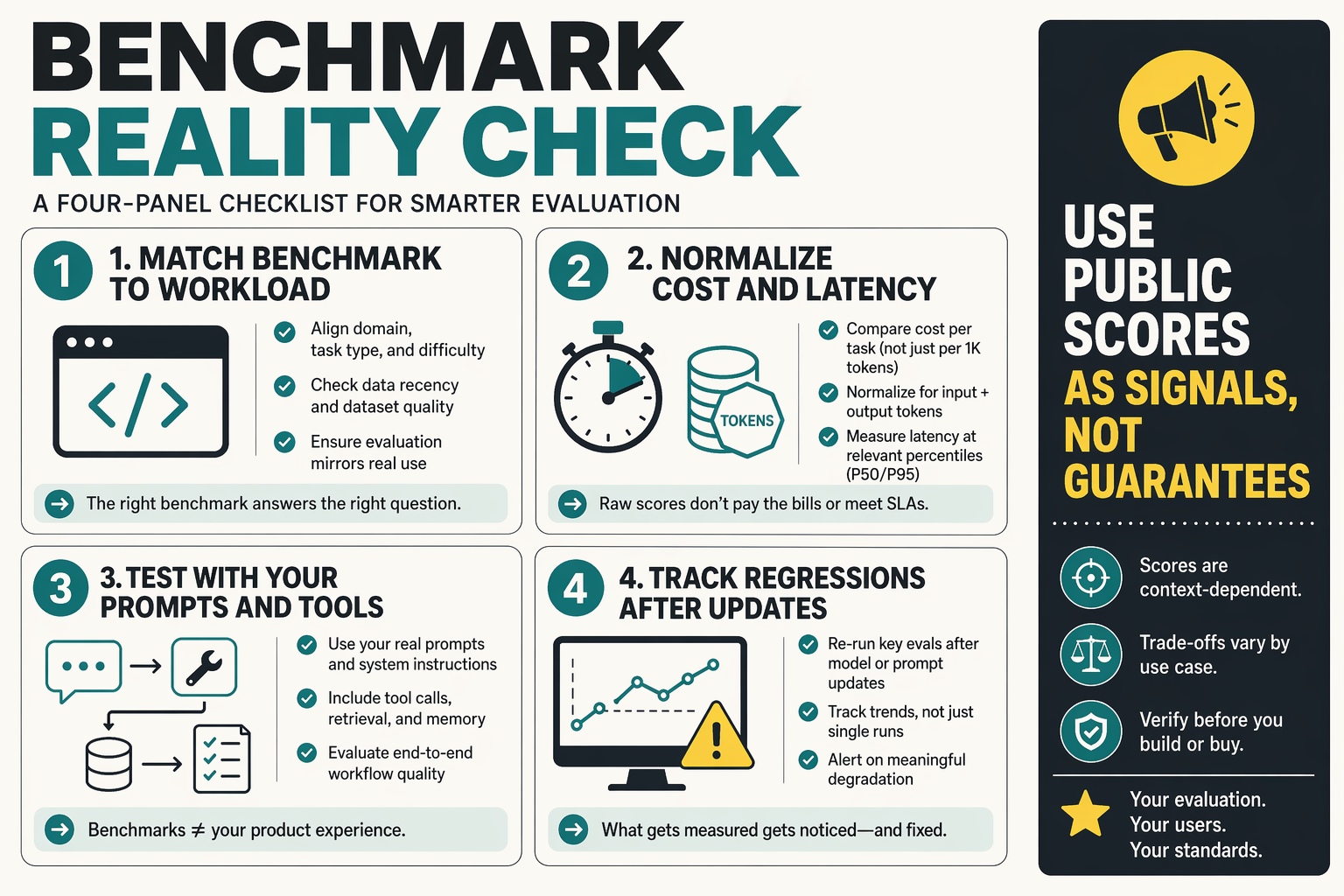
Treat benchmarks as signals, not verdicts
The smartest way to read 2026 model comparisons is to separate benchmark signal from production confidence. A score like Claude Sonnet 5’s reported 63.2% on SWE-bench Pro, cited in 2026 benchmark coverage, is meaningful because SWE-style tests approximate real software-engineering tasks. But it still does not answer every operational question: latency, retry behavior, tool-call reliability, context handling, and cost under your traffic pattern.
Use benchmarks to shortlist models, not to finalize procurement. For example:
- Coding benchmarks help compare Claude Sonnet 5 vs GLM-5.2 or GPT-5.5 for agentic development.
- Reasoning benchmarks are useful for Claude Fable 5 vs Claude Sonnet 5 decisions.
- Terminal / tool-use tests are closer to agent workflows, especially where Sonnet 5 is reported to perform strongly.
- Long-context tests matter only if your app actually sends long documents, codebases, transcripts, or RAG payloads.
A model that wins one leaderboard may still be the wrong choice if its output tokens are expensive, its latency is unstable, or it fails on your domain-specific prompts.
Read YouTube tests with healthy skepticism
YouTube model tests are useful because they show real prompting behavior, failures, and “vibes” that static benchmarks miss. But they are rarely controlled experiments. One trending result around Claude Sonnet 5 even uses a highly negative title — “Claude Sonnet 5 IS OUT & ITS HORRIBLE!” — which may reflect a narrow test, a particular prompt style, or creator positioning rather than broad model quality.
When watching YouTube comparisons, ask:
- Was the same prompt used across all models?
- Were temperature, tools, system prompts, and context length controlled?
- Was the task representative of production use?
- Did the reviewer test retries, edge cases, and failures?
- Was cost measured, or only output quality?
A live demo can reveal issues that benchmarks hide, but one failed prompt should not outweigh structured evaluation.
Vendor claims: verify the fine print
Vendor pages are primary sources, but they are also marketing surfaces. Read them carefully. Anthropic’s Claude Platform Docs state that Claude Sonnet 5 has introductory API pricing of $2 per million input tokens and $10 per million output tokens through August 31, 2026. That date matters: a cost model built on introductory pricing may change after the promotion ends.
Similarly, Anthropic’s Claude Fable page lists Claude Fable 5 at $10 per million input tokens and $50 per million output tokens, with an existing 90% input token discount for prompt caching. That makes Fable 5 potentially attractive for high-value reasoning workloads, but expensive for high-volume output-heavy applications unless caching and routing are designed well.
The expert move is to convert vendor pricing into workload-specific costs:
- Average input tokens per request
- Average output tokens per request
- Cache hit rate
- Retry rate
- Tool-call expansion
- Monthly request volume
Only then can you compare Claude Fable 5 vs Claude Sonnet 5 or Claude Sonnet 5 vs GLM-5.2 meaningfully.
Model directory scores are useful, but incomplete
Model directories are good for discovery. They often aggregate pricing, context windows, modality support, and user ratings. But directory rankings can lag behind launches, hide test methodology, or over-weight popularity. For a model released recently — Sonnet 5 launched on June 30, 2026, according to early coverage — directory scores may change quickly as more developers test it.
Use directory pages to answer “what should we test?” rather than “what should we ship?”
The expert evaluation workflow
For production teams, the best framework is:
- Start with credible public data: vendor docs, pricing pages, benchmark roundups.
- Run a private benchmark using your prompts, documents, tools, and error cases.
- Measure cost per successful task, not cost per token alone.
- Compare fallback behavior when the model times out, refuses, or produces invalid JSON.
- Route dynamically instead of locking every workflow to one model.
This is why multi-model gateways are becoming important. Solutions like CallMissed’s OpenAI-compatible gateway let developers test and route across multiple model families from one integration, making it easier to validate benchmark claims against real workloads before committing.
What This Means For You: Role-Based Recommendations for Coding Agents, Repo Q&A, Design, Knowledge Work, and Long-Context Engineering
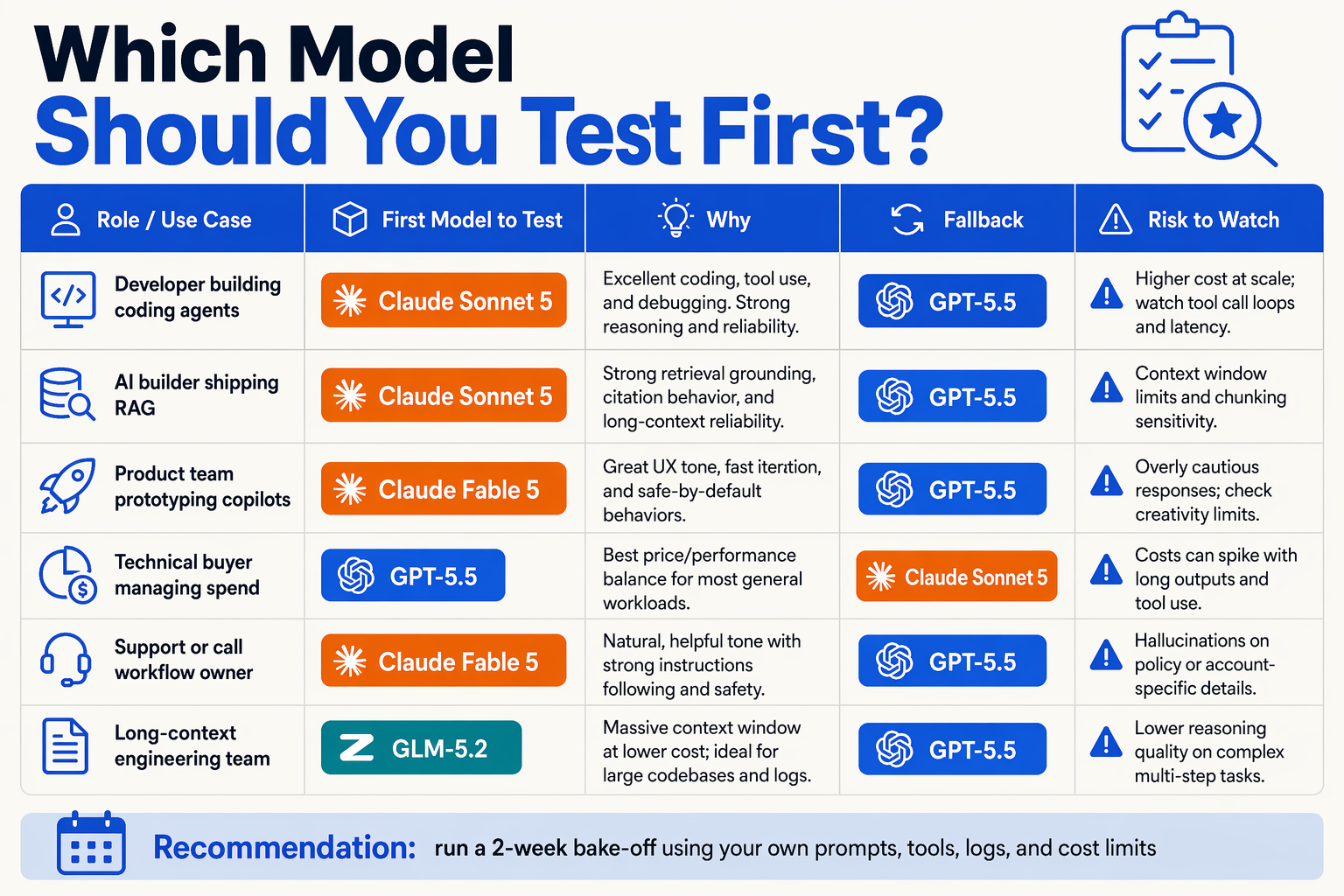
Role-based recommendations
For most teams, the 2026 decision is not “Which model wins?” but “Which model should own which workflow?” Use Claude Sonnet 5 as the default evaluation baseline for engineering and agents because it launched on June 30, 2026 with a reported 63.2% SWE-bench Pro score and introductory API pricing of $2/MTok input and $10/MTok output through August 31, 2026, according to Claude Platform Docs and benchmark roundups. Use Claude Fable 5 more selectively: Anthropic lists it at $10/MTok input and $50/MTok output, with a 90% input-token discount for prompt caching, which makes it better suited to premium reasoning paths than bulk traffic.
| Role / Team | Primary Workload | Test First | Why This Fit Makes Sense | Production Routing Tip |
|---|---|---|---|---|
| Engineering leads | Coding agents, PR generation, test repair, refactors | Claude Sonnet 5 | Strong coding signal: 63.2% SWE-bench Pro and coverage noting improved agentic/terminal tasks. Intro pricing also makes large eval runs cheaper until Aug 31, 2026. | Route risky changes through human review; use cheaper models for lint summaries and commit-message drafts. |
| DevRel / platform teams | Repo Q&A, SDK docs, migration guides | Sonnet 5 + GPT-5.5 | Sonnet 5 is a strong reasoning/coding baseline; GPT-5.5 may fit teams already standardized around OpenAI-compatible tooling. | Use RAG with file-level citations; cache embeddings and prompts to reduce repeated context cost. |
| Product + design teams | UX copy, design critique, product specs, user-story expansion | Claude Fable 5 for premium review; Sonnet 5 for drafts | Fable 5’s $10/$50 per MTok cost suggests using it where judgment quality matters, not for every iteration. | Draft with Sonnet 5, escalate final product narratives or high-stakes specs to Fable 5. |
| Analysts / operators | Knowledge work, synthesis, market scans, internal memos | Sonnet 5 | Balanced cost-quality profile; $2/$10 intro pricing supports high-volume summarization and comparison workflows. | Add source-grounding and require “unknown / insufficient evidence” behavior for external claims. |
| AI infra teams | Multi-model APIs, failover, cost control, vendor abstraction | Gateway-based routing | No single model should carry every workload; route by latency, token cost, context size, and task risk. | Platforms like CallMissed’s OpenAI-compatible gateway let teams test multiple model families behind one integration and apply same-tier fallbacks. |
| Enterprise architects | Long-context engineering, policy analysis, large-codebase reasoning | Sonnet 5, then Fable 5 for escalation | Long-context workloads can become expensive fast; Fable 5’s price means it should be reserved for high-value reasoning passes. | Chunk repositories, summarize layers, cache stable context, and only send full context when retrieval confidence is low. |
Practical rollout sequence
- Start with a 200–500 task eval set: include coding bugs, repo questions, product specs, and long-context documents.
- Measure by workflow, not average score: track pass rate, human edits, tool-call failures, latency, and ₹/$ cost per successful task.
- Route by confidence: use Sonnet 5 for default engineering work, Fable 5 for escalation, GPT-5.5 where ecosystem fit matters, and GLM-5.2 where your own tests show better cost-performance.
- Re-check pricing after August 31, 2026: Sonnet 5’s published $2/$10 per MTok rate is explicitly introductory, so production cost models should include a post-promo scenario.
Frequently Asked Questions: Claude Sonnet 5 vs GLM 5.2, Fable 5, GPT-5.5, and Opus 4.8
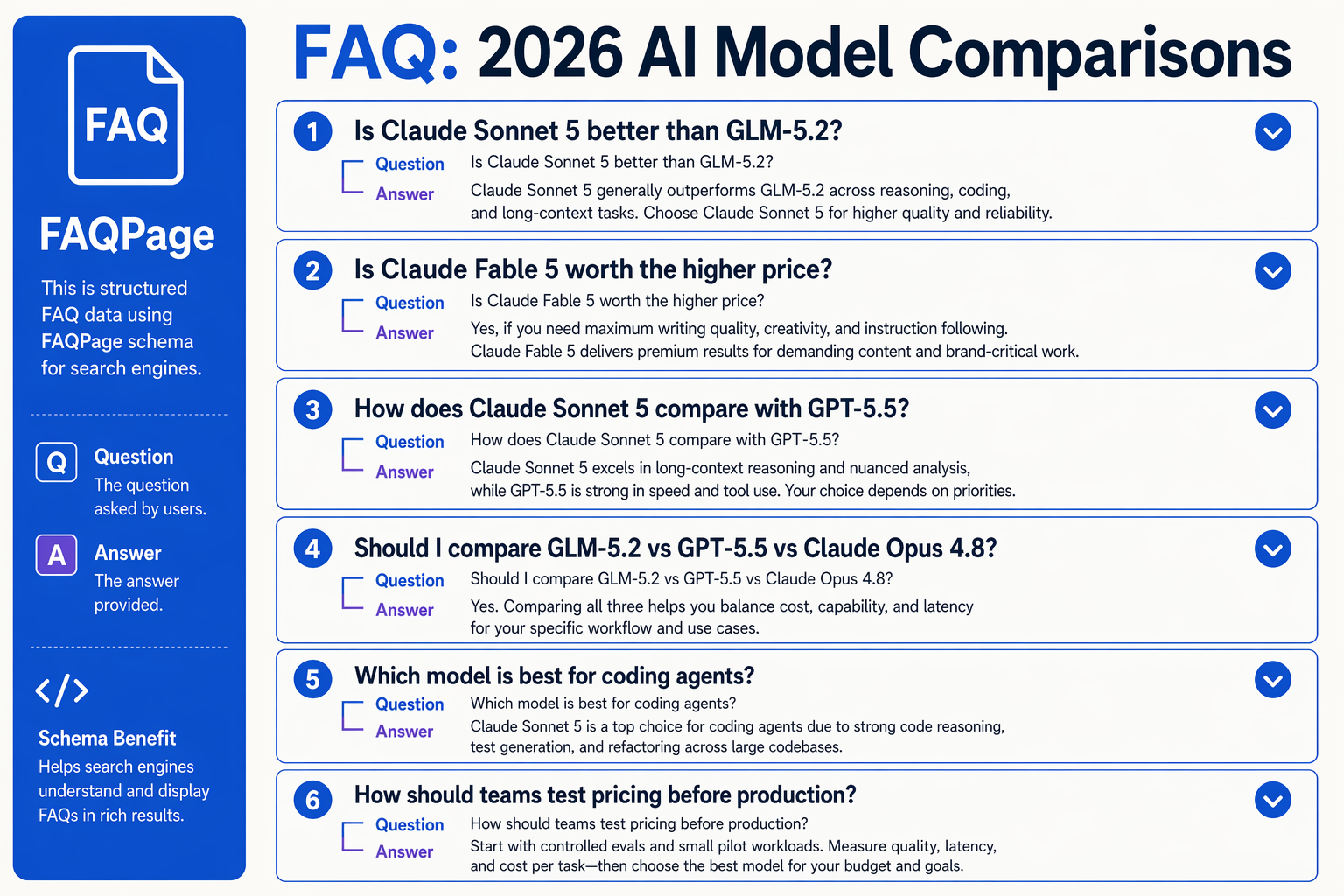
What is the main difference in Claude Sonnet 5 vs GLM 5.2 for developers in 2026?
Who wins GLM 5.2 vs Sonnet 5?
Is GLM 5.2 cheaper than Claude Sonnet 5?
Should I choose Sonnet 5 vs GLM 5.2 for coding agents?
How does GLM 5.2 vs Claude Sonnet 5 compare with Fable 5?
Is Claude Sonnet 5 better than Claude Fable 5 for coding and agents?
How does Claude Sonnet 5 vs GLM 5.2 pricing affect high-volume API apps?
Should I use Claude Sonnet 5, GPT-5.5, or GLM 5.2 for an AI product stack?
Is Claude Fable 5 worth its higher price compared with Claude Sonnet 5?
How does Claude Sonnet 5 compare with Claude Opus 4.8 for agentic workflows?
Conclusion
The 2026 answer to Claude Sonnet 5 vs GLM 5.2 vs Fable 5 vs GPT-5.5 is not “pick the biggest model.” It is design for routing: match each workload to the model that gives the best quality, latency, and cost profile.
- Claude Sonnet 5 is the practical starting point for coding agents and production engineering workflows, especially with its reported 63.2% SWE-bench Pro result and $2/$10 per million token introductory pricing through August 31, 2026.
- Claude Fable 5 fits premium reasoning use cases, but its reported $10/$50 per million token pricing means teams should reserve it for tasks where quality outweighs cost.
- GPT-5.5 remains compelling for ecosystem fit, especially where OpenAI-compatible tooling, multimodal workflows, and existing integrations matter.
- GLM-5.2 deserves evaluation in cost-sensitive and specialized deployments, particularly as teams diversify beyond a single model provider.
What to watch next: post-introductory Sonnet 5 pricing, real-world agent reliability, long-context stability, and how GPT-5.5 and GLM-5.2 perform under production traffic—not just benchmark demos.
To explore how AI communication is evolving, check out CallMissed — an AI infrastructure platform powering voice agents and multilingual chatbots for businesses. The real question is: is your stack ready to route intelligently?