
Claude Sonnet 5 vs Fable 5: Benchmarks, Pricing, and Best Uses in 2026



Claude Sonnet 5 vs Fable 5 on pricing, coding, agents, context and best uses. Includes the August 2026 promotional-price deadline and verdict.
Claude Sonnet 5 vs Fable 5: Benchmarks, Pricing, and Best Uses in 2026
Claude Sonnet 5 is the best default for most production workloads; Claude Fable 5 is the premium option for tasks where measured quality gains justify a much higher token price. As of July 22, 2026, both models support a 1 million-token context window and up to 128,000 output tokens.
The price difference is substantial. Sonnet 5 costs $2 per million input tokens and $10 per million output tokens through August 31, 2026, after which its standard pricing is $3/$15. Fable 5 costs $10/$50. That makes workload testing and routing more useful than choosing from a single leaderboard score.
Benchmark labels also matter. SWE-bench Verified, SWE-bench Pro, Terminal-Bench 2.1, and BrowseComp measure different capabilities and are not directly interchangeable. This guide separates official specifications and prices from public leaderboard results and explicitly labeled third-party claims.
In this article, we’ll break down Claude Sonnet 5 vs Fable 5 across the factors that actually matter in deployment: benchmark performance, pricing assumptions, coding ability, reasoning quality, agentic workflows, API fit, and best-use scenarios. We’ll also separate official signals from third-party claims so you can make a practical decision without getting lost in model hype.
For teams building production AI systems, platforms like CallMissed are part of this broader shift, offering access to 300+ LLMs alongside voice agents, WhatsApp chatbots, speech-to-text, and text-to-speech infrastructure—making model choice a real operational decision, not just a leaderboard debate.
Introduction: Why Claude Sonnet 5 vs Fable 5 Matters in 2026

The answer-first verdict: choose Claude Sonnet 5 for high-volume production workloads and Fable 5 for exceptionally difficult tasks where higher success rates can justify a substantial price premium. For complex agent systems, using Fable 5 for planning or escalation and Sonnet 5 for execution can provide a practical balance of capability and cost.
As of August 1, 2026, Claude Sonnet 5’s introductory API pricing remains available through August 31, 2026:
| Model | Input price per 1M tokens | Output price per 1M tokens | Best starting use |
|---|---|---|---|
| Claude Sonnet 5 | $2 introductory; $3 standard | $10 introductory; $15 standard | High-volume coding, agents, customer workflows, research, and business automation |
| Fable 5 | $10 | $50 | Premium reasoning, planning, debugging, and coding tasks where failure is expensive |
Sonnet 5’s $2 input and $10 output rates are temporary introductory prices, not its long-term list prices. Beginning after August 31, standard pricing returns to $3 per million input tokens and $15 per million output tokens. Fable 5’s documented price is $10 per million input tokens and $50 per million output tokens.
That makes Fable 5 five times as expensive per token during Sonnet’s introductory period. At standard Sonnet pricing, Fable still costs approximately 3.3 times as much. Both models offer a 1 million-token context window and outputs of up to 128,000 tokens, so the decision is more likely to depend on task success, latency, reliability, and total operating cost than context capacity.
Compact Decision Framework
| If your workload prioritizes… | Start with… | Why |
|---|---|---|
| High request volume and predictable operating costs | Claude Sonnet 5 | Its lower token prices matter across long contexts, multi-step agents, retries, and large outputs |
| Production coding and routine agent execution | Claude Sonnet 5 | It is the more economical default for repeated tool use and code-generation steps |
| Difficult reasoning, repository-wide changes, or complex debugging | Fable 5 | Better task performance may offset the premium when failure or human review is costly |
| Strong planning plus cost-efficient execution | Fable orchestrator + Sonnet workers | Fable handles decomposition or review while Sonnet performs high-volume work |
| Uncertain model fit | Test both | Measure cost per accepted result rather than relying on benchmark scores alone |
When Sonnet 5 Is the Better Default
Sonnet 5 should generally be tested first for production coding agents, customer-facing assistants, internal copilots, document workflows, research pipelines, and other applications processing substantial traffic.
Its pricing advantage becomes especially important when a workflow:
- Sends long prompts or large retrieved contexts
- Produces lengthy outputs
- Uses multiple agent or tool-calling steps
- Retries failed requests
- Handles enough volume for small per-request differences to compound
For CallMissed and similar customer-communication systems, Sonnet 5 is usually the practical default, with premium-model escalation reserved for cases that fail validation or require unusually difficult reasoning.
When Fable 5 Can Justify Its Price
Fable 5 is better suited to tasks where a failed patch, incorrect conclusion, or weak plan costs more than the additional inference. Examples include difficult repository-wide changes, complex debugging, high-stakes analysis, and plans that control many downstream actions.
Benchmark advantages should be treated as evidence to investigate, not automatic proof of better value. SWE-bench Verified and SWE-bench Pro are separate evaluations and their scores should not be compared as if they use the same tasks or difficulty. Results can also change with the evaluation harness, tools, prompts, reasoning settings, token budget, and agent scaffolding.
A Hybrid Fable-orchestrator/Sonnet-worker Approach
A hybrid architecture can reserve Fable’s premium capability for the steps where it has the greatest influence:
- Use Fable 5 to plan, decompose, or review a difficult task.
- Use Sonnet 5 for code generation, tool execution, retrieval, and document processing.
- Escalate to Fable 5 only when Sonnet fails tests, produces a low-confidence result, or triggers human review.
Whichever approach you choose, evaluate both models on representative tasks with equivalent prompts, context, tools, retry rules, and output requirements. Track successful completion, error rates, latency, token consumption, retries, and human review time. The most useful final metric is total cost per successful task: use Fable when its quality advantage saves more than its premium, and Sonnet when the business outcome is effectively the same at a lower cost.
Background & Context: Where Sonnet 5 and Fable 5 Fit in the Claude Lineup
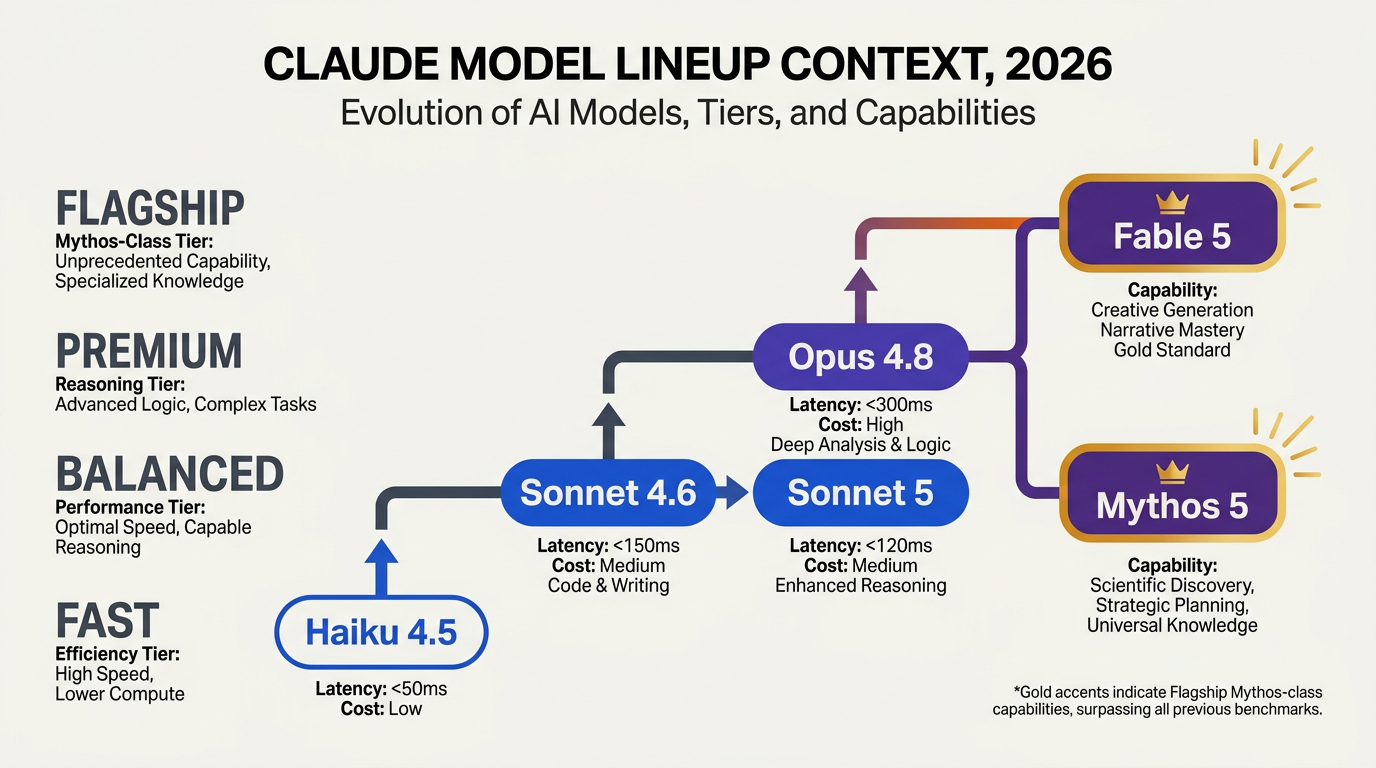
As of July 22, 2026, Claude Sonnet 5 and Claude Fable 5 occupy distinct positions in Anthropic’s model lineup. Sonnet 5 is the price/performance option for broad production use, while Fable 5 is the higher-cost model intended for the most demanding reasoning, coding, and agentic workloads.
Both models support a default 1 million-token context window and up to 128,000 output tokens, according to Anthropic’s current documentation. Actual availability can differ between the Anthropic API and supported cloud providers, so teams should check the latest model documentation for regional access, feature support, model IDs, quotas, and pricing before deployment.
Where Claude Sonnet 5 Fits
Launched on June 30, 2026, Claude Sonnet 5 is Anthropic’s balanced price/performance model. It is designed to deliver strong coding, reasoning, tool-use, and long-context capabilities without the higher per-token cost of Fable 5.
Anthropic lists standard Sonnet 5 API pricing at $3 per million input tokens and $15 per million output tokens. That cost profile makes it the practical default for applications that need high capability at production scale.
In practical terms, Sonnet 5 fits best as:
- A production coding model for generation, debugging, code review, and refactoring
- A general-purpose reasoning model for research, document analysis, support, and operations
- An agentic workflow model for tool use and multi-step automation
- A long-context model for large repositories and document collections
- A default routing choice before escalating unusually difficult requests to Fable 5
For multi-model platforms such as CallMissed, Sonnet 5’s role is straightforward: it can handle a broad share of production traffic while keeping token costs more predictable than a premium model on every request.
Where Claude Fable 5 Fits
Claude Fable 5 is the higher-cost option for workloads where maximum capability matters more than minimizing token expense. It is aimed at demanding reasoning, complex software-engineering tasks, extended agent runs, and other problems that benefit from deeper analysis.
Fable 5 shares its documented specifications and pricing with Mythos 5, an invitation-only Anthropic model. That official relationship should be stated precisely: Fable 5 and Mythos 5 have matching listed specs and token prices, but they are separate model offerings with different access conditions. Mythos 5’s invitation-only status does not apply automatically to Fable 5, and the two names should not be used interchangeably.
In practical terms, Fable 5 fits best as:
- A premium coding model for difficult repository-wide changes and multi-file debugging
- An advanced reasoning model for tasks that require sustained analysis
- An escalation option when Sonnet 5 does not produce sufficiently reliable results
- A long-horizon agent model for complex plans involving many tools or intermediate steps
- A large-context model for codebases, research corpora, and document-intensive workflows
Although both Sonnet 5 and Fable 5 support a default 1M-token context window and outputs of up to 128K tokens, identical limits do not imply identical performance or cost. The practical distinction is positioning: Sonnet 5 emphasizes price/performance, while Fable 5 targets the hardest workloads at a premium.
Choosing Between Sonnet 5 and Fable 5
The lineup decision is less about context capacity—because both models offer the same documented context and maximum-output limits—and more about workload difficulty and budget.
Choose Claude Sonnet 5 when:
- Cost and throughput matter across a large request volume
- The workload includes everyday coding, analysis, support, or automation
- You need a capable default model for production routing
- Most requests do not require Anthropic’s premium reasoning tier
Choose Claude Fable 5 when:
- The task involves unusually difficult coding or reasoning
- Failed attempts cost more than higher token prices
- An agent must remain reliable across a long sequence of steps
- Sonnet 5 has been tested and does not consistently meet the required quality threshold
A sensible production architecture can use Sonnet 5 by default and route only the hardest requests to Fable 5. Before implementing that strategy, verify each model’s current availability in the Anthropic API or your cloud provider’s model catalog, because access, supported features, quotas, and release timing can differ by platform.
Key Developments
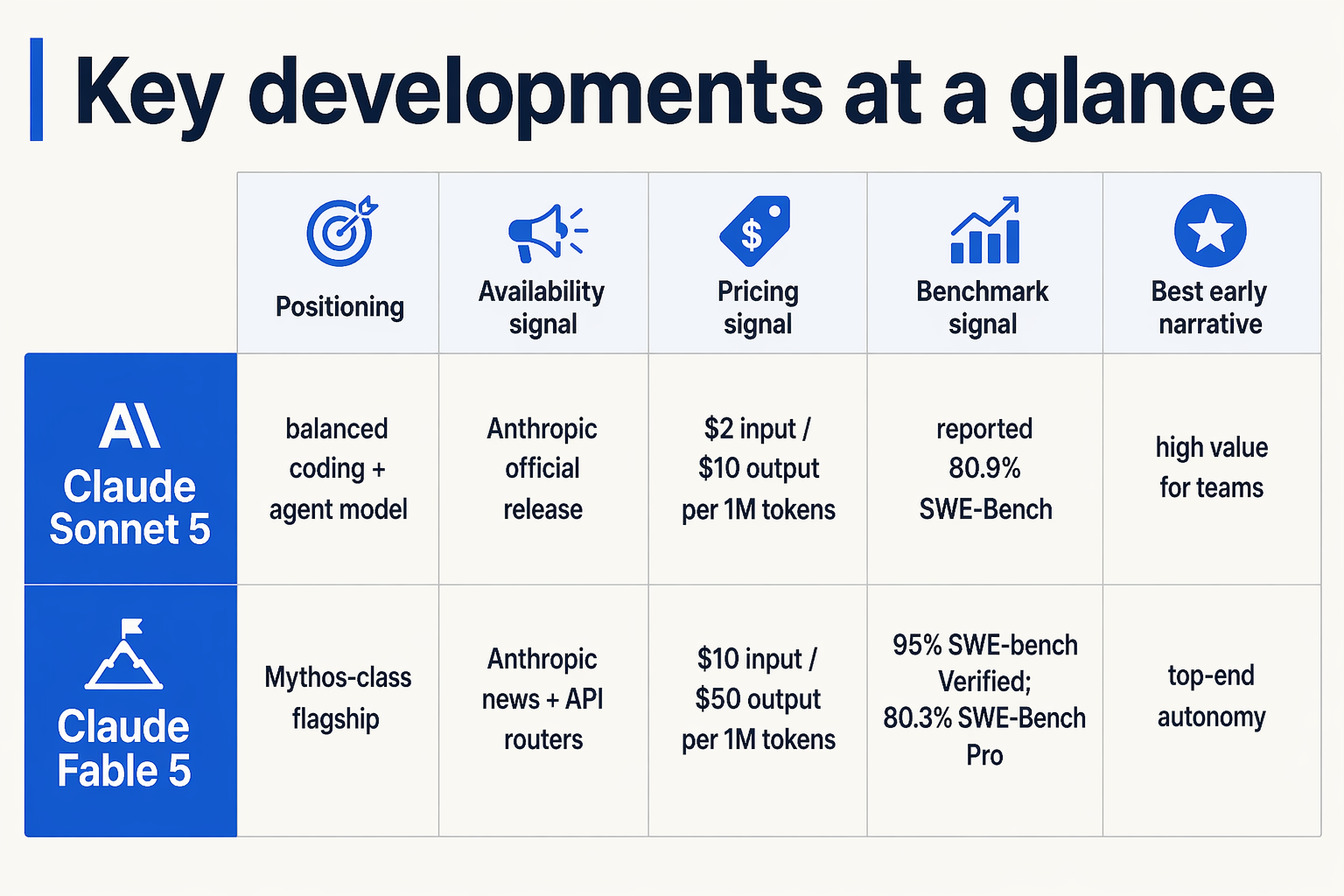
As of July 22, 2026, Anthropic’s launch announcement and Claude Platform documentation describe both models as current API offerings with 1 million-token context windows and 128,000-token maximum outputs.
| Category | Claude Sonnet 5 | Claude Fable 5 |
|---|---|---|
| Launch / current status | Current Claude 5 model; temporary promotional pricing runs through August 31, 2026 | Current Claude 5 premium model at standard pricing |
| API model role | Balanced price, speed, and capability for production workloads | Higher-cost option for the most demanding reasoning and agentic tasks |
| Context window | 1M tokens | 1M tokens |
| Maximum output | 128K tokens | 128K tokens |
| Input price | $2 per million tokens through August 31; $3 per million afterward | $10 per million tokens |
| Output price | $10 per million tokens through August 31; $15 per million afterward | $50 per million tokens |
| Relative price | Baseline | About 3.33× Sonnet’s standard price for both input and output; 5× Sonnet’s promotional price |
| Ideal workload | High-volume coding, customer operations, tool-using agents, document processing, and general production deployment | Complex reasoning, difficult coding or research tasks, and workflows where incremental capability can justify a substantial cost premium |
| Key caution | Budget forecasts should use the $3/$15 standard rates for usage after the promotion ends | The higher price does not guarantee better results on every workload; evaluate task quality and cost per successful outcome |
Anthropic’s official materials establish the model specifications and token pricing above; they do not justify substituting unofficial benchmark claims for workload-specific testing. In particular, SWE-bench Verified and SWE-bench Pro are different evaluations and should not be conflated.
Actual spend may also differ from the headline token rates. Cached input, batch processing, cloud-provider pricing, and ancillary tool or search charges can materially change total cost. Buyers should compare models using representative prompts, tool calls, latency requirements, and end-to-end cost per completed task.
Claude Sonnet 5: Strengths, Limits, and Ideal Workloads
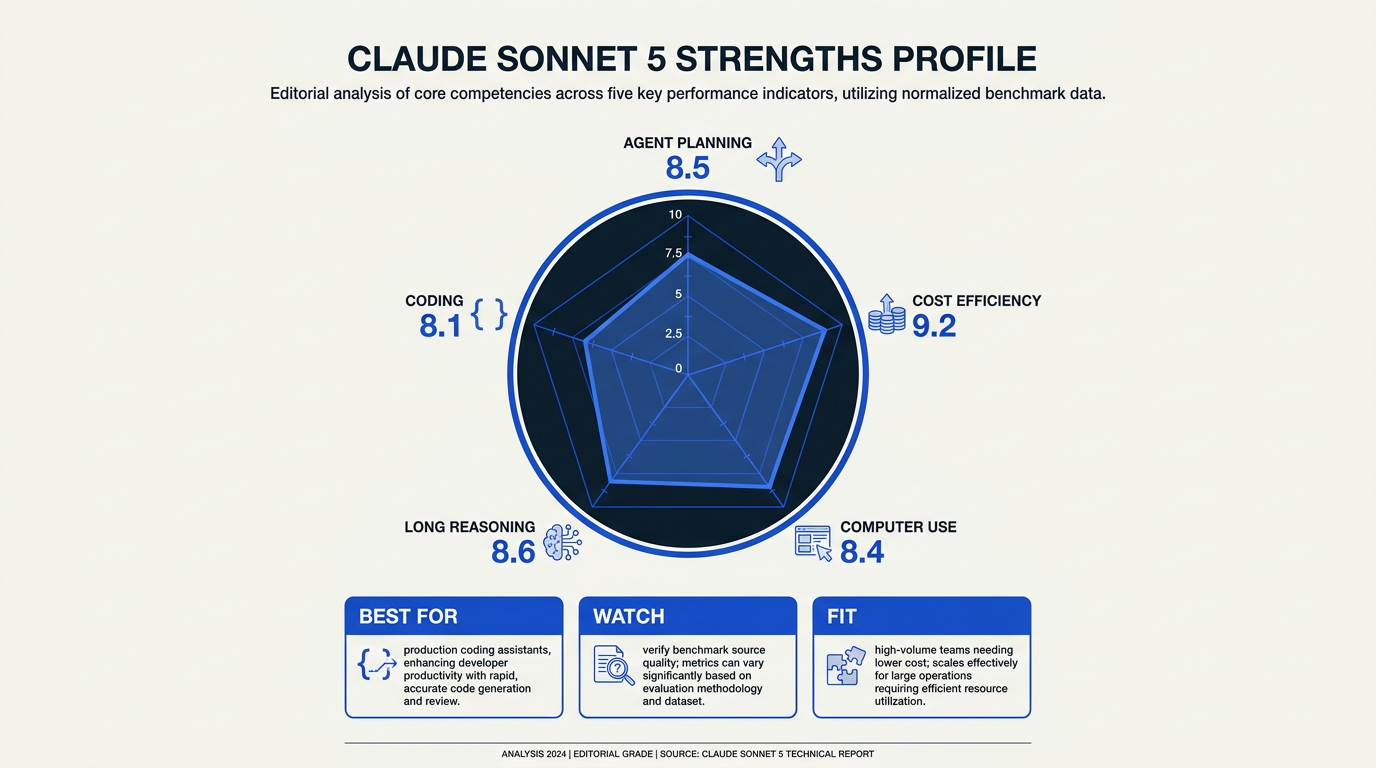
Claude Sonnet 5 is optimized for frontier coding, agentic workflows, and professional work at scale. Its central advantage is price/performance: it offers advanced capabilities for production workloads without requiring teams to use the highest-cost model for every request.
Sonnet 5 supports a 1 million-token context window and up to 128,000 output tokens, making it suitable for large repositories, extensive document collections, long-running agent sessions, and tasks that produce substantial structured output.
Its launch API pricing is:
- $2 per million input tokens
- $10 per million output tokens
That promotional pricing runs through August 31, 2026. Standard pricing afterward is $3 per million input tokens and $15 per million output tokens.
Why Sonnet 5 May Be the Practical Default
Sonnet 5 is designed for broad production deployment rather than only occasional, high-complexity requests. Its pricing can improve throughput economics when a system processes large token volumes or runs many tasks in parallel.
This is particularly relevant for worker-agent architectures, where a coordinator delegates repository analysis, research, testing, document processing, or tool calls to multiple model instances. Using Sonnet 5 across those workers can provide strong capabilities while keeping aggregate token costs more manageable.
The model is also a practical candidate for systems that need one broadly capable model across code, text, tools, and business workflows. Teams can use it as a default worker and route especially difficult or high-stakes tasks to another model when their evaluations show a meaningful benefit.
Platforms such as CallMissed, which provide access to 300+ LLMs alongside voice agents, WhatsApp chatbots, STT, and TTS APIs, can support this type of model routing and escalation.
Key Limits to Watch
Sonnet 5 is not automatically the best model for every workload. Fable 5 can outperform it in especially difficult benchmark or task settings, so teams handling complex coding problems or demanding autonomous workflows should compare both models directly.
Benchmark results also depend on the evaluation harness, available tools, prompts, reasoning settings, retry policies, and scoring method. A published score may not predict performance on a specific repository or production process.
Before standardizing on Sonnet 5, validate it against your own evaluation set. Measure task success, output quality, token consumption, tool-use reliability, and required human review under the same configuration you plan to deploy.
Ideal Sonnet 5 Workloads
Sonnet 5 is a strong fit for:
- Software engineering: repository analysis, bug fixing, refactoring, test generation, and code review
- Worker agents: parallel research, coding, verification, and tool-based subtasks
- Professional work: document analysis, research synthesis, technical writing, and policy review
- Business automation: multi-step API workflows, internal operations, and structured data processing
- Customer-facing systems: support copilots, sales assistants, messaging automation, and voice-agent reasoning
- Long-context tasks: large codebases, document collections, and extended agent sessions
In short, Sonnet 5 is positioned as a scalable production model with competitive price/performance, while Fable 5 remains worth testing for tasks where maximum performance on especially difficult cases matters more than throughput economics.
Claude Fable 5: Mythos-Class Performance, Cost, and Use Cases
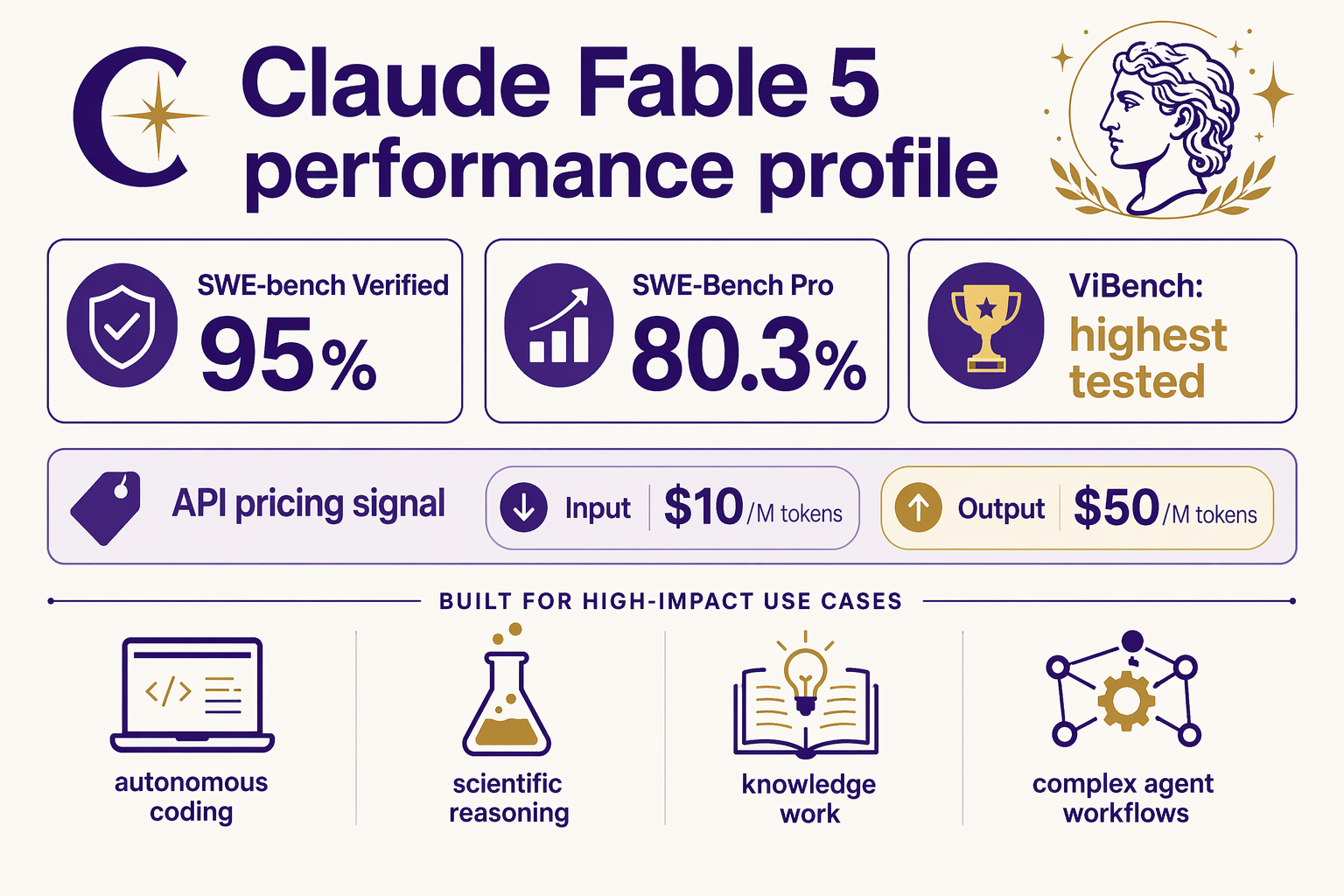
Anthropic says Claude Mythos 5 shares Fable 5’s specifications and pricing. Mythos 5 is currently offered through an invitation-only Mythos Preview, so “Mythos” should not be treated as a vague performance tier or as evidence of a separate benchmark result.
The concrete specifications for Fable 5 are:
- 1 million-token context window
- Up to 128,000 output tokens
- $10 per million input tokens
- $50 per million output tokens
Those limits make Fable 5 suitable for large repositories, extensive technical documentation, long agent histories, and workflows that need to generate substantial outputs. They do not, by themselves, prove that Fable will outperform Sonnet on every task.
Performance Profile: Where Fable 5 Fits
Fable 5 is the premium option for the hardest coding, reasoning, and agentic workloads, where an incremental improvement in task quality can justify higher inference costs.
Potential use cases include:
- Complex software-engineering tasks
Multi-file changes, difficult debugging, repository-scale analysis, and pull requests that require deeper planning.
- Long-horizon agent workflows
Tasks involving repeated tool use, large amounts of context, intermediate validation, and multiple dependent steps.
- High-stakes technical reasoning
Architecture reviews, infrastructure changes, migration planning, and security-sensitive analysis where additional model capability may reduce downstream review and rework.
- Large-context synthesis
Reviewing extensive codebases, specifications, logs, policies, or documentation within a single workflow.
Fable 5 should still be evaluated on each organization’s own tasks. Model specifications and positioning are useful starting points, but production tests are more informative than assuming universal superiority.
Cost: A Premium Model for Selective Use
At standard API pricing, Fable 5 costs $10 per million input tokens and $50 per million output tokens. Claude Sonnet 5’s standard pricing is $3 per million input tokens and $15 per million output tokens, making Fable approximately 3.33 times more expensive per token.
Compared with Sonnet 5’s temporary promotional pricing of $2 per million input tokens and $10 per million output tokens, Fable costs five times as much per token.
That price gap makes Fable difficult to justify as the default for every request. A more cost-efficient deployment pattern is:
- Use Sonnet 5 for routine coding, summarization, support automation, extraction, and common agent steps
- Route difficult or failed tasks to Fable 5
- Use Fable for critical stages such as final code repair, complex planning, or review of high-impact changes
- Measure whether Fable’s incremental quality reduces retries, human review, or operational risk enough to offset its higher token cost
For platforms such as CallMissed, this routing approach allows everyday voice-agent, chatbot, and workflow tasks to use lower-cost models while escalating unusually complex requests to a premium model.
Best Use Cases for Fable 5
Fable 5 is best considered for workloads such as:
- Advanced coding agents handling difficult, multi-step repository changes
- Enterprise engineering copilots working with large codebases
- Complex debugging, refactoring, and test repair
- Agent workflows requiring long context and extensive tool use
- Architecture, migration, and incident analysis
- Security-sensitive technical review
- Large-scale technical-document synthesis
The takeaway: Fable 5 is the premium choice in the Claude Sonnet 5 vs Fable 5 comparison, while Sonnet 5 is the more economical default. Teams should route most workloads to Sonnet and escalate to Fable when task difficulty, business impact, or the cost of failure makes additional model quality worth the roughly 3.33× standard-price premium.
In-Depth Analysis: Benchmarks, Pricing, Context, and Agentic Coding
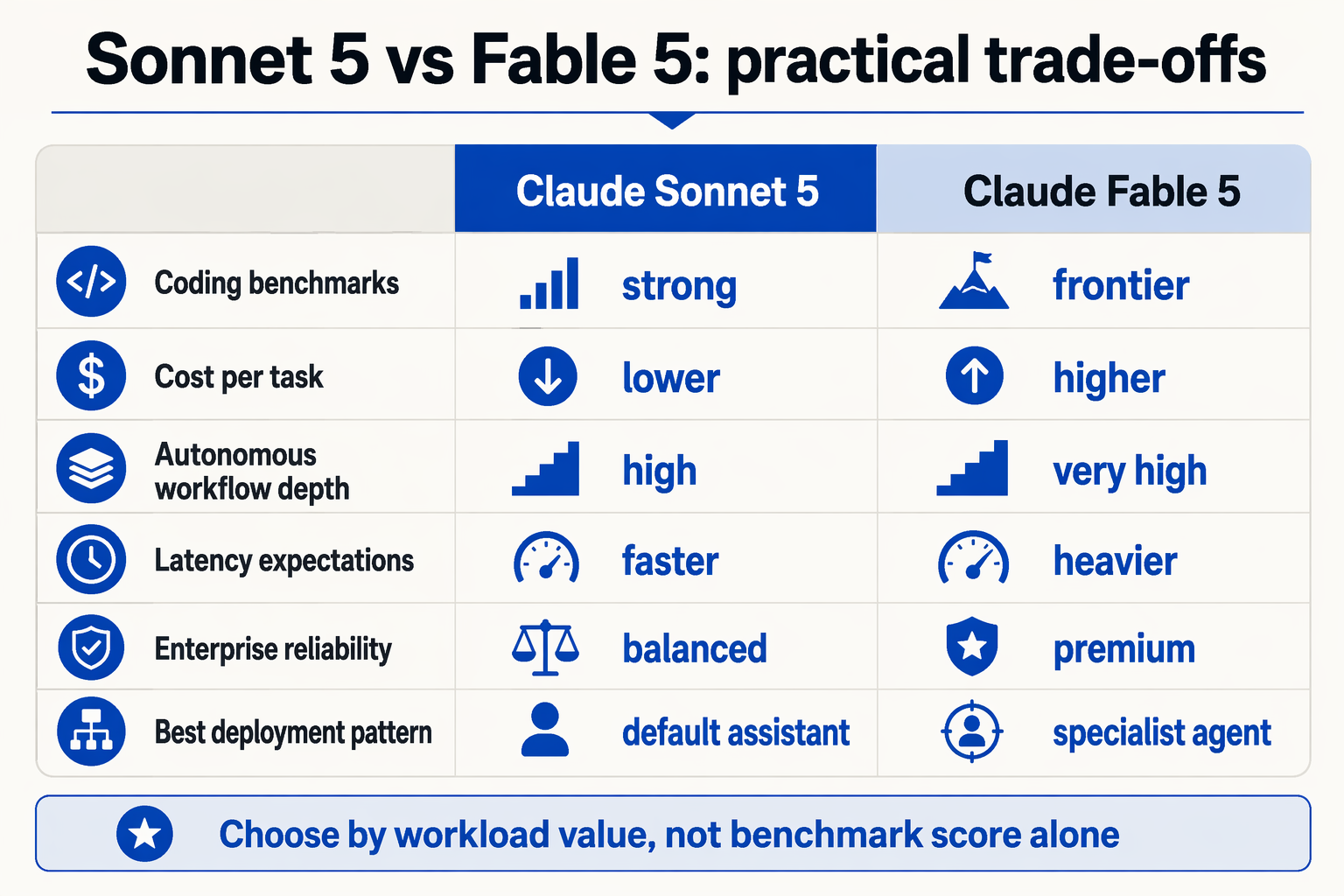
Answer first: Fable 5 is the higher-priced option with the strongest verified Terminal-Bench 2.1 results available here, while Claude Sonnet 5 offers the same 1M-token context window and 128K maximum output at substantially lower token prices. For most production systems, Sonnet 5 is the more economical default; Fable 5 is better treated as an escalation model for tasks where its additional capability improves the success rate enough to offset the price.
Claude Sonnet 5 vs Fable 5: Answer-First Comparison
| Decision factor | Claude Sonnet 5 | Fable 5 |
|---|---|---|
| Context window | 1M tokens | 1M tokens |
| Maximum output | Up to 128K tokens | Up to 128K tokens |
| Input price as of July 22, 2026 | $2/M tokens through Aug. 31, 2026 | $10/M tokens |
| Output price as of July 22, 2026 | $10/M tokens through Aug. 31, 2026 | $50/M tokens |
| Price after Sonnet promotion | $3/M input, $15/M output | $10/M input, $50/M output |
| Verified Terminal-Bench 2.1 result in the cited public leaderboard search result | No directly comparable result established here | 83.8% ±1.2 for Claude Code Fable 5 xhigh; 80.4% ±1.2 for Fable 5 high |
| SWE-bench evidence | No verified Sonnet 5 score used in this comparison | MorphLLM reports 95% on SWE-bench Verified, but this is a third-party claim |
| Practical role | Cost-efficient worker and default model for high-volume coding tasks | Premium orchestrator or escalation model for especially difficult tasks |
| Best buying criterion | Throughput, predictable cost, and acceptable task success rates | Higher success rates that produce enough fewer retries or escalations to justify the premium |
Benchmark Analysis: Keep the Test, Harness, and Configuration Attached to the Score
Benchmark results should not be compared unless they use the same benchmark variant and a sufficiently similar evaluation setup.
SWE-bench Verified is a human-validated subset of SWE-bench designed to reduce ambiguous or defective tasks. SWE-bench Pro is a separate, harder evaluation. A score on SWE-bench Verified is therefore not directly comparable to a score on SWE-bench Pro—or to a generic result labeled only “SWE-bench.”
MorphLLM’s reported 95% for Fable 5 on SWE-bench Verified should be labeled as a third-party result, not an Anthropic-verified score. Its meaning depends on the harness, tools, retries, test-time compute, repository access, and pass criteria. There is no verified Sonnet 5 SWE-bench score included here, so the 95% result does not establish a quantified Sonnet-versus-Fable margin.
Terminal-Bench 2.1 provides more relevant evidence for terminal-based agents. Its public leaderboard search result showed:
- Claude Code Fable 5
xhigh: 83.8% ±1.2 - Fable 5
high: 80.4% ±1.2
These are configuration-specific results. The xhigh and high labels indicate different reasoning or compute settings, while the Claude Code entry also identifies an agent environment. The scores should not be presented as a clean model-only comparison, and they do not supply a Sonnet 5 result under matching conditions.
Terminal-Bench is particularly relevant to agentic coding because successful tasks may require the agent to inspect files, execute shell commands, install dependencies, run tests, diagnose failures, and revise its approach. Even so, a public leaderboard cannot replace an internal evaluation using the repositories, tools, permissions, and acceptance standards of the intended deployment.
Pricing: Sonnet 5 Has a Large Cost Advantage
As of July 22, 2026, Claude Sonnet 5 costs:
- $2 per million input tokens
- $10 per million output tokens
That promotional pricing runs through Aug. 31, 2026. Afterward, the listed rates are:
- $3 per million input tokens
- $15 per million output tokens
Fable 5 costs:
- $10 per million input tokens
- $50 per million output tokens
During Sonnet 5’s promotional period, Fable 5 is 5× as expensive per input or output token. At Sonnet 5’s subsequent standard rates, Fable remains approximately 3.33× as expensive.
Token price alone, however, does not determine the economical model. Coding systems incur additional costs from failed attempts, repeated context, long patches, test execution, tool calls, and human review. The more useful metric is cost per successful task:
Cost per successful task =
(total model-token cost + tool cost + retry cost + review cost)
/ number of accepted tasks
A practical evaluation should record:
- First-attempt success rate
- Total attempts per accepted task
- Input and output tokens across all attempts
- Tool and sandbox expenses
- Test-pass and acceptance rates
- Human review or correction time
- Escalation frequency
Fable 5 can be the cheaper choice for a particular task class if its higher completion rate eliminates enough retries, human intervention, or failed runs. Sonnet 5 remains the stronger economic default when its accepted-task rate is close to Fable’s, because the token-price difference is substantial.
Context and Output: Capacity Is Not the Differentiator
Both Claude Sonnet 5 and Fable 5 provide:
- A 1M-token context window
- Up to 128K output tokens
Neither model has a headline advantage on these limits. Both can accommodate large repositories, extensive documentation, long execution histories, and multi-file changes—subject to the API configuration and the space consumed by system instructions, tool definitions, prior messages, and retrieved files.
A 1M-token window also does not guarantee that loading an entire repository is the best approach. Large prompts cost more, can include irrelevant code, and may make it harder for an agent to focus on the files that matter. Repository search, dependency-aware retrieval, summaries, and selective context loading can reduce cost for either model.
The 128K output ceiling is useful for large patches or detailed analyses, but it should be treated as a limit rather than a target. Smaller, testable changes are generally easier to validate, review, and roll back.
Agentic Coding: Model Choice Includes the Harness
Agentic coding performance depends on more than the underlying model. The deployed system may need to:
- Search and understand the repository.
- Form and update a plan.
- Edit multiple files.
- Execute shell commands.
- Run targeted and full test suites.
- Read compiler, test, or runtime errors.
- Recover from failed commands.
- Stop when the task is complete or escalate when it is not.
Consequently, a Fable 5 result obtained with Claude Code and an xhigh setting should not be assumed to reproduce under a different harness or compute budget. Likewise, Sonnet 5’s lower price does not guarantee lower task cost if weak tooling causes repeated failures.
The fairest internal comparison keeps the following variables fixed:
- Agent harness and system prompt
- Tool access and permissions
- Reasoning or effort setting
- Retry and time limits
- Repository snapshot
- Test environment
- Success criteria
- Human-review policy
A Cautious Hybrid Strategy: Fable Orchestrator, Sonnet Workers
Anthropic has reported a pattern in which Fable handles orchestration while lower-cost Sonnet workers perform delegated work. On BrowseComp, the reported comparison was:
- Fable-orchestrated/Sonnet-worker system: 86.8% accuracy at $18.53 per problem
- Higher-cost comparison: 90.8% accuracy at $40.56 per problem
That is approximately 96% of the accuracy at 46% of the cost.
This result supports the economic case for model routing, but it should be interpreted cautiously. BrowseComp is not a software-engineering benchmark, and the result does not prove that the same percentages will carry over to repository repair or terminal-based coding. It does illustrate a useful architecture:
- Use Sonnet 5 for routine implementation, repository search, test generation, documentation, and repeated worker tasks.
- Use Fable 5 to decompose difficult problems, review failed attempts, resolve ambiguity, or handle final escalation.
- Route tasks based on complexity and observed failure signals rather than sending every request to the premium model.
Best Production Uses
Choose Claude Sonnet 5 as the default when:
- Token volume and cost predictability are primary concerns.
- The workload contains many routine fixes, refactors, tests, reviews, or documentation tasks.
- A strong harness can compensate through repository search, test execution, and controlled retries.
- You want to reserve premium inference for a small percentage of difficult cases.
Choose or escalate to Fable 5 when:
- Terminal-based autonomy and difficult multi-step problem solving are central requirements.
- Internal evaluations show a meaningfully higher accepted-task rate.
- A failed run or human escalation is expensive enough to outweigh higher token prices.
- The task benefits from premium orchestration across multiple lower-cost workers.
For many teams, the strongest deployment is not Fable 5 or Sonnet 5 exclusively. It is a measured routing system that starts with Sonnet 5, escalates difficult tasks to Fable 5, and evaluates both on cost per accepted result under identical tools and test conditions.
Impact & Implications for Developers, Teams, and AI Budgets

As of July 22, 2026, the published API list prices are:
| Model | Input per 1M tokens | Output per 1M tokens |
|---|---|---|
| Claude Sonnet 5 promotional pricing through August 31, 2026 | $2 | $10 |
| Claude Sonnet 5 after August 31, 2026 | $3 | $15 |
| Fable 5 | $10 | $50 |
At identical token volumes, Fable 5 costs 5× Sonnet 5’s promotional price and approximately 3.33× its standard price. For example, one million input tokens plus one million output tokens costs $12 with promotional Sonnet pricing, $18 with standard Sonnet pricing, or $60 with Fable.
A practical routing policy is:
- Use Sonnet 5 by default for routine coding, summarization, extraction, support, and workflow tasks.
- Escalate to Fable 5 when Sonnet fails automated checks, exceeds retry limits, or encounters a task classified as unusually difficult.
- Require human approval for security-sensitive, destructive, financial, or production-impacting actions.
- Run controlled A/B tests before assigning either model permanently to a workload.
Measure Cost per Successful Task
List price alone does not determine deployment cost. Effective cost also depends on:
- The mix of input and output tokens
- Eligible prompt-caching discounts and cache-hit rates
- Retries, timeouts, and failed generations
- Tokens consumed during tool calls and agent loops
- External tool or infrastructure charges
- The percentage of outputs accepted without correction
Track total cost per accepted task, not merely cost per million tokens:
Cost per successful task = total model and tool spend ÷ accepted completed tasks
A higher-priced model can be economical if it substantially reduces retries or review time. Conversely, a lower-priced model may remain preferable when deterministic validation catches errors cheaply.
Practical Evaluation Protocol
Build a representative test set from real workloads, excluding sensitive production data where necessary. Include common tasks, difficult edge cases, long-context requests, tool-use workflows, and known failure modes.
For each model:
- Use the same prompts, context, tools, permissions, retry limits, and completion criteria.
- Randomize task assignment and evaluate outputs without exposing the model identity to reviewers where practical.
- Record input, output, and cached tokens; tool calls; latency; errors; retries; and total cost.
- Apply automated tests first, followed by a consistent human-review rubric for correctness, safety, and maintainability.
- Compare first-pass success rate, eventual success rate, review time, latency, and cost per accepted result.
- Repeat the test after material model, pricing, prompt, or toolchain changes.
Deploy gradually with spend limits, audit logs, rollback controls, and a small production canary. Keep Sonnet 5 as the default only while internal results support that choice, and route difficult tasks to Fable 5 only when its measured improvement justifies the additional cost.
Expert Opinions: What Analysts, Builders, and Reviewers Are Watching
Evaluators should verify the model behind each result before comparing Claude Sonnet 5 and Fable 5. Marketing names, internal codenames, preview builds, and API model IDs are not interchangeable.
Each evaluation should record:
- The exact API model ID and version date
- Whether the endpoint is preview, beta, or generally available
- The provider and deployment region
- Context and maximum output limits
- Tool-use, reasoning, and sampling settings
- The date the test was run
For Claude, Anthropic’s launch announcements and API documentation should be the primary sources for model availability, specifications, supported features, pricing, prompt-caching terms, and rate limits. If a claimed Sonnet version or model ID does not appear in those sources, it should be labeled unconfirmed rather than treated as an officially released model. The same standard should be applied to Fable 5 using its provider’s model card and API documentation.
Third-party model trackers can help identify reported releases or benchmark results, but they should be explicitly labeled as third-party sources, not presented as vendor confirmation.
Benchmark Methodology Matters More Than a Headline Score
Coding benchmarks do not measure a model in isolation. They measure a combination of the model, prompt, agent framework, tools, execution environment, and scoring rules.
For repository-level benchmarks such as SWE-bench, evaluators should check:
- Dataset version and split
SWE-bench Verified, full SWE-bench, and modified or private subsets are different evaluations.
- Harness and scaffolding
Results can change substantially depending on repository search, test feedback, tool access, retry logic, context management, and whether the agent can edit files iteratively.
- Compute and attempt budget
A model given multiple attempts, long reasoning traces, or a large token budget should not be compared directly with a single-attempt run.
- Contamination controls
Evaluators should document whether benchmark tasks or solutions may have appeared in training data, public repositories, prompts, or retrieval indexes.
- Reproducibility
A credible result should include the model ID, agent code or configuration, prompts, task exclusions, token budget, and evaluation date.
Terminal-Bench scores should be taken from the Terminal-Bench public leaderboard and attributed to the listed model-and-agent configuration. A leaderboard entry is not necessarily a model-only score: the terminal agent, harness version, tools, and resource limits are part of the result. Scores reported by third-party trackers should be described as tracker-reported unless they can be matched to a public benchmark submission.
Compare Pass@k, Variance, and Cost per Solved Task
Evaluators should confirm whether a score represents pass@1 or pass@k. Pass@1 measures success on one attempt. Pass@k measures whether at least one of multiple attempts succeeds, so it can improve simply by spending more tokens and compute.
A useful report should include:
- Number of tasks and attempted runs
- Pass@1 and, if applicable, pass@k
- Temperature and other sampling settings
- Mean score across repeated runs
- Confidence intervals or error bars
- Failures caused by infrastructure rather than the model
Small differences may not be meaningful when the benchmark contains a limited number of tasks or when results vary between runs. Confidence intervals help distinguish a repeatable advantage from sampling noise.
Raw API price is also insufficient. A more operational metric is:
Cost per solved task = total model, tool, and infrastructure cost ÷ number of successfully completed tasks
That calculation should include input and output tokens, retries, failed attempts, repository indexing, sandbox compute, and human review. Anthropic’s official pricing documentation—not a secondary pricing table—should be used for Claude token and prompt-caching rates.
Measure Caching, Latency, Limits, and Availability
Prompt caching can materially affect workloads that repeatedly send the same repository context, system prompt, or tool definitions. Tests should report cache-write cost, cache-read cost, cache lifetime, hit rate, and the proportion of the prompt that is actually reusable. An uncached cold run should not be compared with a heavily cached run without disclosure.
Latency should also be separated into:
- Time to first token
- Output-token throughput
- Tool-call round-trip time
- End-to-end task completion time
- Tail latency, such as p95 and p99
- Time lost to retries, throttling, or queueing
Provider rate limits and availability can determine whether a strong benchmark result is usable in production. Evaluators should verify request and token limits, concurrency caps, regional access, preview restrictions, batch support, and service-level commitments in the provider’s current documentation. A model that is available only to selected accounts or under restrictive limits should not be presented as equivalent to a generally available endpoint.
Test Security and Production Reliability Separately
A coding score does not establish that a model is safe or dependable in an agentic deployment. Production tests should examine whether the model:
- Resists prompt injection from repositories, tickets, web pages, and tool output
- Keeps secrets out of logs, patches, and generated commands
- Requests confirmation before destructive or high-impact actions
- Stays within filesystem, network, and credential boundaries
- Recovers from malformed tool responses and transient failures
- Preserves task intent across long workflows
- Produces auditable actions and reproducible patches
- Escalates uncertainty instead of silently inventing results
Teams should also evaluate data-retention terms, training-data policies, access controls, encryption, compliance documentation, and regional processing requirements using official provider security and privacy materials.
The Practical Evaluation Standard
The defensible comparison is not simply Claude Sonnet 5 versus Fable 5. It is one pinned model version and agent configuration versus another under the same tasks, tools, attempt budget, caching policy, and infrastructure.
A useful decision report should therefore publish the exact model IDs, benchmark harness, pass@k setting, error bars, cost per solved task, latency distribution, rate-limit behavior, availability status, and production failure rate. Without those details, a headline benchmark number should be treated as preliminary evidence—not a deployment recommendation.
What This Means For You
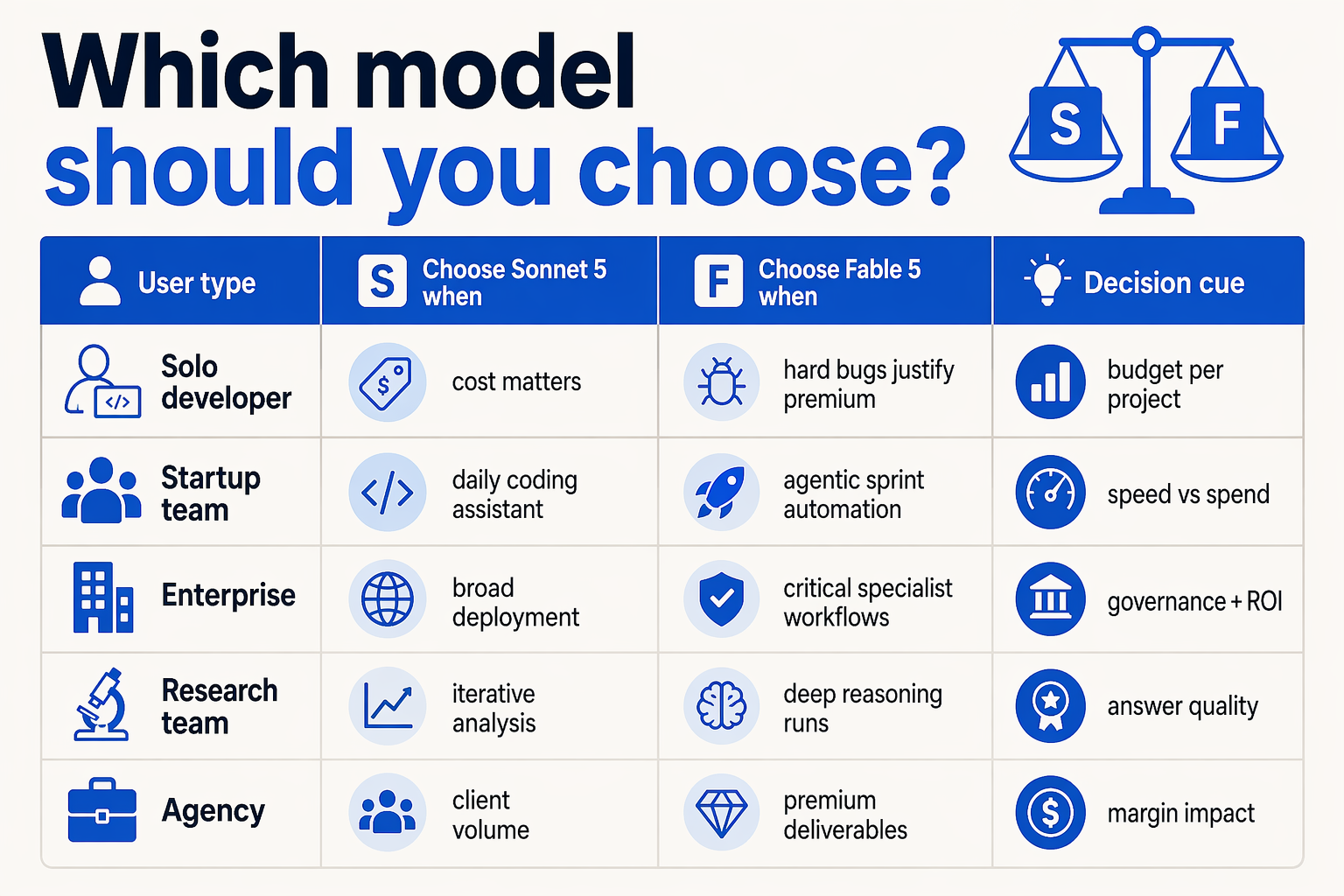
As of August 1, 2026, Claude Sonnet 5 is the better default for most production workloads. Choose Fable 5 only when a Claude Sonnet vs Fable evaluation shows enough added value to justify its $10 per million input tokens and $50 per million output tokens pricing.
| Scenario | Claude Sonnet vs Fable Default | Choose Fable 5 When... | Validate |
|---|---|---|---|
| High-volume production | Sonnet 5 for support, extraction, summarization, documentation, and routine automation | Better task success offsets its higher token cost | Cost per success, latency, retries, and human review |
| Hardest reasoning tasks | Start with Sonnet 5, then escalate difficult cases | A Claude Sonnet vs Fable test shows a reliable advantage on your hardest tasks | Accuracy, consistency, failure rate, and business value |
| Coding agents | Sonnet 5 for routine coding and tool use | Your Claude Sonnet vs Fable coding benchmark shows better repository-level fixes | Test pass rate, regressions, tool calls, review time, and resolved issues |
| Startups | Sonnet 5 for most product features and internal workflows | Higher quality measurably improves revenue, retention, or engineering speed | End-to-end economics, not token price alone |
| Enterprise AI teams | Sonnet 5, subject to security and governance approval | Specialized workflows show clear gains in controlled evaluations | Compliance, data handling, availability, and auditability |
| Long-context workflows | Benchmark both; each supports a 1M-token context window and up to 128K output tokens | Fable 5 is more accurate or stable with your documents and prompts | Retrieval, instruction retention, truncation, latency, and cost |
| Budget planning | Model Claude Sonnet vs Fable costs before and after August 31, 2026 | Fewer failures, retries, or escalations offset Fable 5’s $10/$50 rates | Post-promotion spend and cost per completed task |
| Mixed-model routing | Sonnet 5 by default; Fable 5 for escalation | Routing produces better outcomes than using either model alone | Routing accuracy, fallback rate, latency, and blended cost |
Claude Sonnet vs Fable Pricing and Capacity
Both models offer a 1M-token context window and up to 128K output tokens. Capacity alone is not a reason to choose one. Large prompts and outputs can still increase latency and cost, while usable limits may depend on API configuration and account access.
For Claude Sonnet vs Fable budget planning, separate traffic into two periods:
- Through August 31, 2026: Use Sonnet 5’s applicable promotional rate.
- After August 31, 2026: Recalculate with the applicable post-promotion rate.
- For Fable 5: Budget $10 per million input tokens and $50 per million output tokens.
- For both: Include retries, failed runs, human review, and tool-call overhead.
Do not base a long-term production budget on temporary promotional pricing.
Use Mixed-Model Routing
A practical Claude Sonnet vs Fable routing policy is:
- Send routine, high-volume work to Sonnet 5.
- Escalate the hardest reasoning or code-repair tasks to Fable 5.
- Trigger fallback or human review after validation failures, uncertainty, or latency limits.
- Log quality, cost, retries, and completed outcomes by model.
- Reevaluate routing as pricing and workload patterns change.
Takeaway
For most teams, the best Claude Sonnet vs Fable decision is not all-or-nothing. Start with Sonnet 5 for production volume. Add Fable 5 selectively when controlled testing proves that its quality gains justify its $10/$50 per million-token pricing.
Use representative repositories, documents, tools, and customer conversations. Compare successful outcomes, latency, retries, review time, and total cost—not public benchmark scores alone.
Frequently Asked Questions
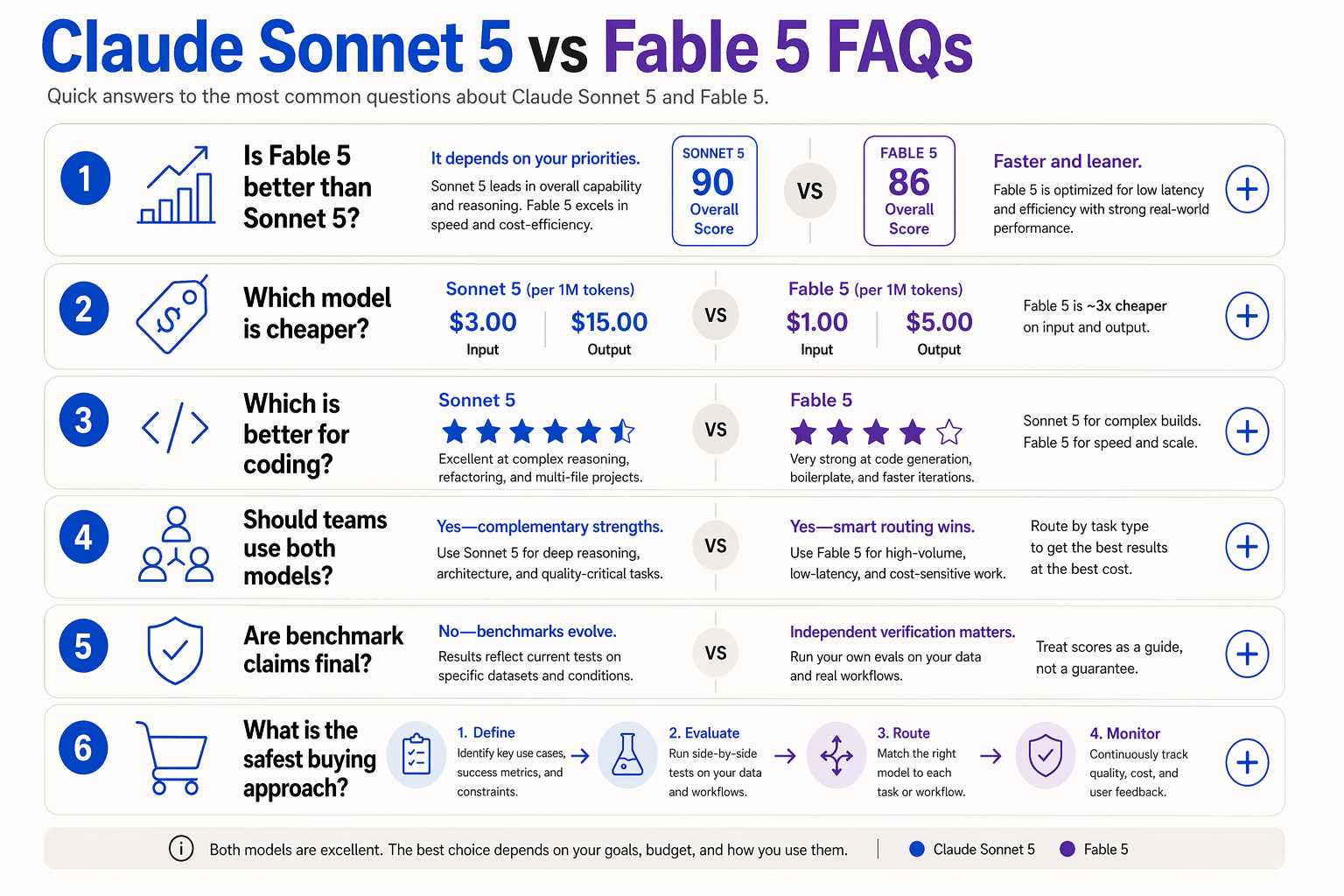
Which is better, Claude Sonnet 5 or Claude Fable 5?
Which is cheaper, Claude Sonnet 5 or Claude Fable 5?
- Claude Sonnet 5 through August 31, 2026: $2 per million input tokens and $10 per million output tokens
- Claude Sonnet 5 after August 31, 2026: $3 per million input tokens and $15 per million output tokens
- Claude Fable 5: $10 per million input tokens and $50 per million output tokens
Teams should also account for caching, tool use, retries, orchestration, and human review when comparing total costs.
What are the context-window and output limits for Claude Sonnet 5 and Claude Fable 5?
Are Claude Sonnet 5 and Claude Fable 5 benchmark scores directly comparable?
Which model should developers use for coding agents?
When does hybrid Fable-orchestrator/Sonnet-worker routing make sense?
How should teams calculate cost per successful task?
Cost per successful task = (model-token charges + cache charges + tool costs + retry costs + orchestration costs + human-review costs) ÷ accepted tasks
Also track first-pass success rate, retries, wall-clock latency, reviewer minutes, regressions, and production failures. Sonnet’s lower token price makes it the natural choice for most volume, but Fable can be more economical for selected tasks if its higher success rate materially reduces retries or human correction.
How should enterprises evaluate these models before deployment?
Conclusion
For most workloads, Claude Sonnet 5 is the default price/performance choice, while Fable 5 is best treated as a premium escalation model when controlled, task-specific tests show meaningful quality gains.
- As of July 22, 2026, Sonnet 5 promotional pricing is $2 per million input tokens and $10 per million output tokens through August 31, 2026. Standard pricing afterward is $3 per million input tokens and $15 per million output tokens.
- Fable 5 costs $10 per million input tokens and $50 per million output tokens. Its premium is easiest to justify when better results reduce retries, errors, or human review.
- Both support a 1M-token context window and 128K-token output, so teams should focus on quality and total workflow cost.
- A hybrid strategy using Fable 5 for orchestration and Sonnet 5 workers may lower costs while preserving premium reasoning where it matters.
Choose based on controlled tests using your own prompts, tools, and acceptance criteria—not unverified benchmark headlines. CallMissed can help teams compare and route model, voice-agent, and multilingual chatbot workloads.
Discussion
Related Posts



Ready to automate customer conversations?
Launch AI voice agents and WhatsApp bots with CallMissed — one API, 22+ Indian languages.