
WhatsApp AI Agent for Business 2026: CallMissed Buyer and Implementation Guide


Evaluate and deploy a WhatsApp AI agent with CallMissed using practical checks for consent, support, leads, voice, handoff and analytics.
WhatsApp AI Agent for Business 2026: CallMissed Buyer and Implementation Guide
WhatsApp surpassed 3 billion monthly active users, Meta CEO Mark Zuckerberg reported during Meta’s Q1 2025 earnings call on April 30, 2025—making it one of the largest customer-engagement surfaces businesses can automate. This WhatsApp AI agent for business 2026 CallMissed implementation guide explains how to turn that reach into responsive, permission-based customer conversations without sacrificing accuracy, compliance, or access to human support.
A WhatsApp AI agent goes beyond a scripted menu. Connected through the WhatsApp Business API, it can interpret natural-language questions, capture and qualify leads, retrieve approved answers from a knowledge base, initiate workflows, and transfer conversations to employees when human judgment is required. For customers, that can mean asking about delivery status, appointment availability, product specifications, or return policies in the same channel they already use.
Why implementation choices matter in 2026
Effective WhatsApp automation requires more than selecting a model and switching on replies. Businesses must design around Meta’s messaging rules, customer consent, approved templates, service windows, data handling, escalation paths, and channel availability. Business-initiated messages generally require approved templates and an appropriate opt-in, while customer-initiated conversations create a defined service window in which businesses can respond more freely under current WhatsApp Business Platform policies.
Voice is also becoming part of the buying decision. WhatsApp voice calling for business can let eligible organizations receive customer calls or place permission-based calls through WhatsApp, but availability and requirements may vary by country, account, number, Meta policy, and platform configuration. Buyers should therefore treat calling as a capability to verify during procurement—not assume universal activation.
CallMissed brings these workflows together through multilingual WhatsApp chatbots, knowledge-base retrieval, human handoff, omnichannel operations, and WhatsApp Business calls bridged to AI voice agents, with support for speech across 22 Indian languages.
What this guide will help you evaluate
This buyer and implementation guide covers:
- Choosing a WhatsApp chatbot for business based on use case, language coverage, integrations, governance, and escalation needs.
- Building reliable WhatsApp customer service and lead-capture journeys.
- Applying opt-in, approved-message, and business-initiated communication controls.
- Using conversational AI WhatsApp experiences for multilingual chat and knowledge-grounded answers.
- Connecting voice agents, WhatsApp calling, CRM records, and human teams.
- Configuring prompts, knowledge sources, analytics, testing, and production rollout.
- Separating verified CallMissed functionality from features dependent on Meta approval or regional availability.
The goal is not simply to deploy a bot. It is to create a measurable customer-engagement system that answers accurately, respects consent, knows when to escalate, and works across chat and voice.
Is a WhatsApp AI agent with CallMissed right for your business in 2026? Yes—if you need consent-aware WhatsApp automation for support, lead capture and reliable human escalation

Yes—a WhatsApp AI agent with CallMissed is a strong fit when your business needs permission-based automation, knowledge-grounded support, structured lead capture, and dependable transfer to a human team. It is less suitable when WhatsApp is not a preferred customer channel, your processes cannot expose reliable data, or you expect unrestricted promotional messaging without consent.
The clearest signs that your business is ready
A WhatsApp chatbot for business creates the most value when conversations are frequent, repetitive, and tied to defined actions. Common examples include checking an order, booking an appointment, requesting a quotation, confirming service availability, or qualifying an admissions enquiry.
Your business is a practical candidate if it needs to:
- Provide WhatsApp customer service outside normal office hours while preserving escalation for complaints, exceptions, and sensitive decisions.
- Capture names, requirements, locations, budgets, or preferred appointment times and pass structured records to a CRM or employee.
- Answer from approved policies, catalogues, FAQs, and operating procedures rather than relying on unconstrained model knowledge.
- Use customer opt-ins and approved templates for appropriate business-initiated messages.
- Serve multilingual audiences through text or voice. CallMissed supports speech across 22 Indian languages, making regional-language deployment especially relevant for businesses serving India.
- Bring WhatsApp, voice, email, and web conversations into a shared operational workflow.
This model suits ecommerce companies, clinics, educational institutions, automotive dealerships, restaurants, home-service providers, and other organizations with repeatable enquiry flows. Regulated or high-risk sectors can also use automation, but should route medical, financial, legal, safeguarding, or disputed-transaction decisions to qualified people.
Apply a three-part buying test
Before purchasing, evaluate the proposed deployment against three requirements:
- Permission: Can the business record how and when each customer opted in, identify the expected message category, and process opt-out requests? The WhatsApp Business API does not turn a phone-number database into permission for unrestricted outreach.
- Grounding: Can the agent retrieve current, approved information and acknowledge uncertainty? A reliable conversational AI WhatsApp workflow should cite internal knowledge, avoid inventing prices or policies, and escalate when the available material does not support an answer.
- Resolution: Can the system complete a useful action or transfer the conversation with context? Human agents should receive the transcript, collected details, detected intent, and any attempted resolution rather than forcing the customer to start again.
A “no” on any of these points indicates that process design should come before full-scale WhatsApp automation.
Separate verified functionality from conditional availability
CallMissed provides multilingual WhatsApp chatbots, knowledge-base retrieval, lead workflows, human handoff, an omnichannel inbox, and integration between WhatsApp Business calls and AI voice agents. These are platform capabilities; successful deployment still depends on correct business configuration, approved content, connected data sources, and operational ownership.
By contrast, WhatsApp voice calling for business should be treated as conditional during procurement. Inbound or business-initiated calling may depend on Meta eligibility, customer permission, country, business account, number, policy, and technical configuration. Buyers should request confirmation for the intended market and number before making calling a launch dependency.
The right purchase decision is therefore not simply “Can the bot reply?” It is whether the complete system can respond accurately, respect consent, complete defined tasks, and involve a person at the right moment.
How did the WhatsApp Business API, approved messaging rules and customer consent shape the 2026 market?
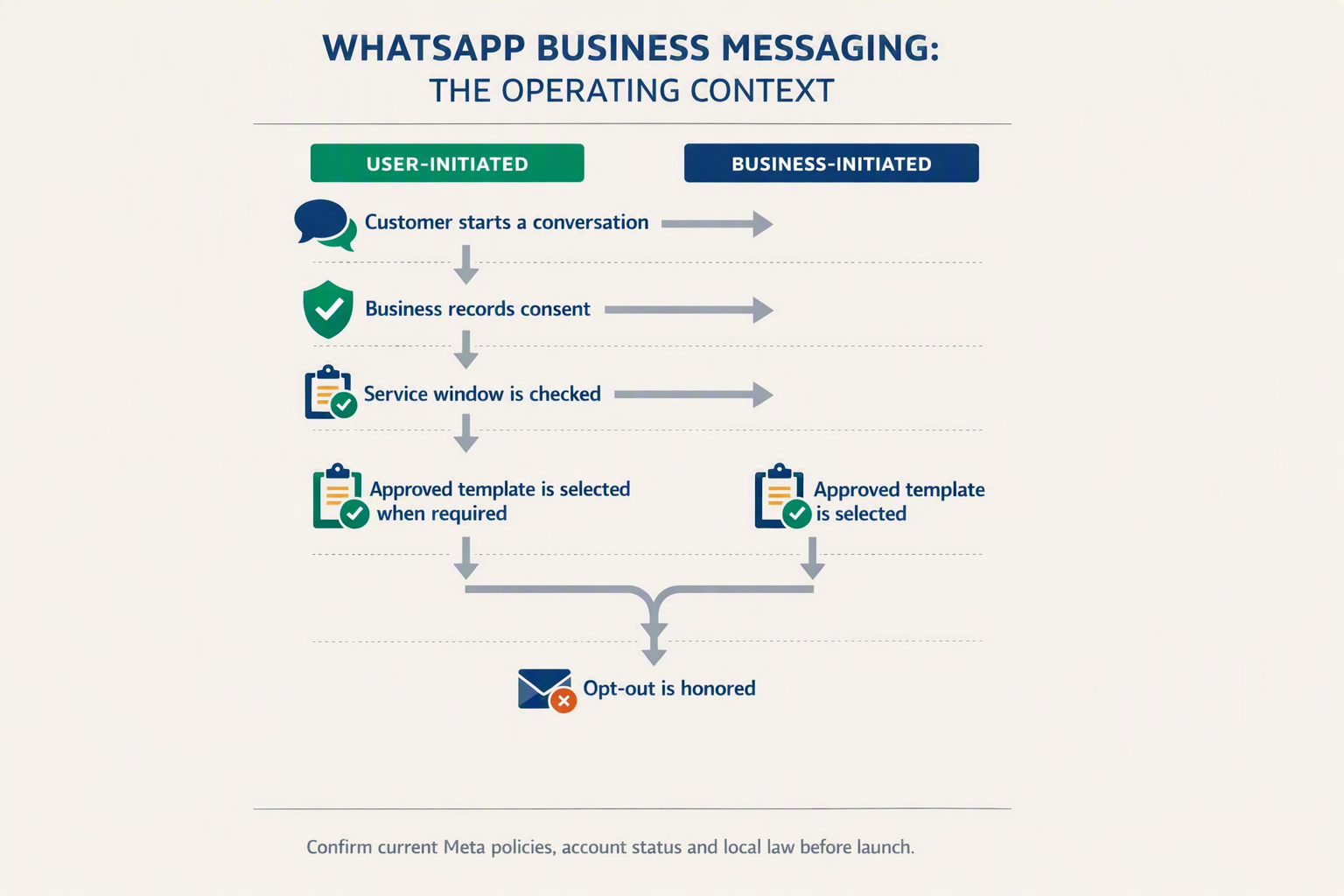
The 2026 market is defined by three constraints: businesses must use an authorized WhatsApp Business API route, obtain defensible customer permission, and separate free-form service replies from approved business-initiated templates. These requirements have shifted buying decisions from “Which bot gives the cleverest answer?” to “Which platform can automate conversations while preserving consent, auditability, and human control?”
From basic notifications to governed AI workflows
Meta’s cloud-based WhatsApp Business Platform made API deployment more accessible, while approved templates and messaging limits created a governed environment for automation. A modern WhatsApp AI agent must therefore understand not only customer intent but also whether a particular response is permitted at that moment.
Meta groups message templates into categories such as:
- Utility: Transactional updates tied to a customer action, such as an order confirmation, payment reminder, or appointment change.
- Authentication: One-time passcodes and identity-verification messages.
- Marketing: Promotions, recommendations, re-engagement messages, and other commercial communication.
Template classification matters because Meta’s pricing, quality controls, and delivery rules can vary by category and market. Meta changed the WhatsApp Business Platform from conversation-based charging to per-template-message pricing on July 1, 2025, making message type and workflow design direct cost considerations for 2026 buyers.
Approval is not permanent permission to send indiscriminately. Meta can pause or disable templates that receive poor engagement or negative feedback, while users can block or report a business. A buyer should consequently assess whether a WhatsApp chatbot for business records template identifiers, consent evidence, delivery outcomes, opt-outs, and quality-related failures.
Consent became an architectural requirement
Customer consent should be specific, informed, channel-aware, and revocable. A phone number collected for delivery may not automatically establish permission for unrelated promotional campaigns.
A defensible implementation records:
- Who opted in, including the WhatsApp number or customer identifier.
- What the customer agreed to receive, such as order alerts or promotional offers.
- Where and when consent was obtained, including the form, checkout page, QR flow, or chat interaction.
- How the customer can opt out, with suppression applied across connected campaigns and CRM workflows.
During the customer-service window opened by a user message, businesses can use free-form replies under Meta’s current policy framework. Outside that window, business-initiated outreach generally requires an approved template in the appropriate category. Teams should verify the latest Meta Business Messaging Policy before launch because rules, prices, eligibility, and country availability can change.
AI policy narrowed the acceptable use case
Meta’s updated WhatsApp Business Solution Terms took effect on January 15, 2026, restricting AI providers from using WhatsApp where a general-purpose AI assistant is the primary product functionality. The terms still allow businesses to use AI service providers for ancillary business functions such as customer support, provided the implementation follows Meta’s rules.
That distinction favors task-specific conversational AI WhatsApp deployments: answering approved knowledge-base questions, qualifying leads, checking orders, booking appointments, and escalating exceptions. It discourages open-ended assistants with no defined business purpose.
Platforms such as CallMissed fit this operational model by combining multilingual WhatsApp customer service, knowledge-grounded answers, human handoff, and consent-aware workflows. Its WhatsApp automation can also connect chat with AI voice agents; however, WhatsApp voice calling for business remains subject to Meta eligibility, account configuration, customer permission, and regional availability rather than being universally enabled.
Which CallMissed capabilities are verified, which depend on the wider platform, and where is WhatsApp voice calling for business available in 2026?
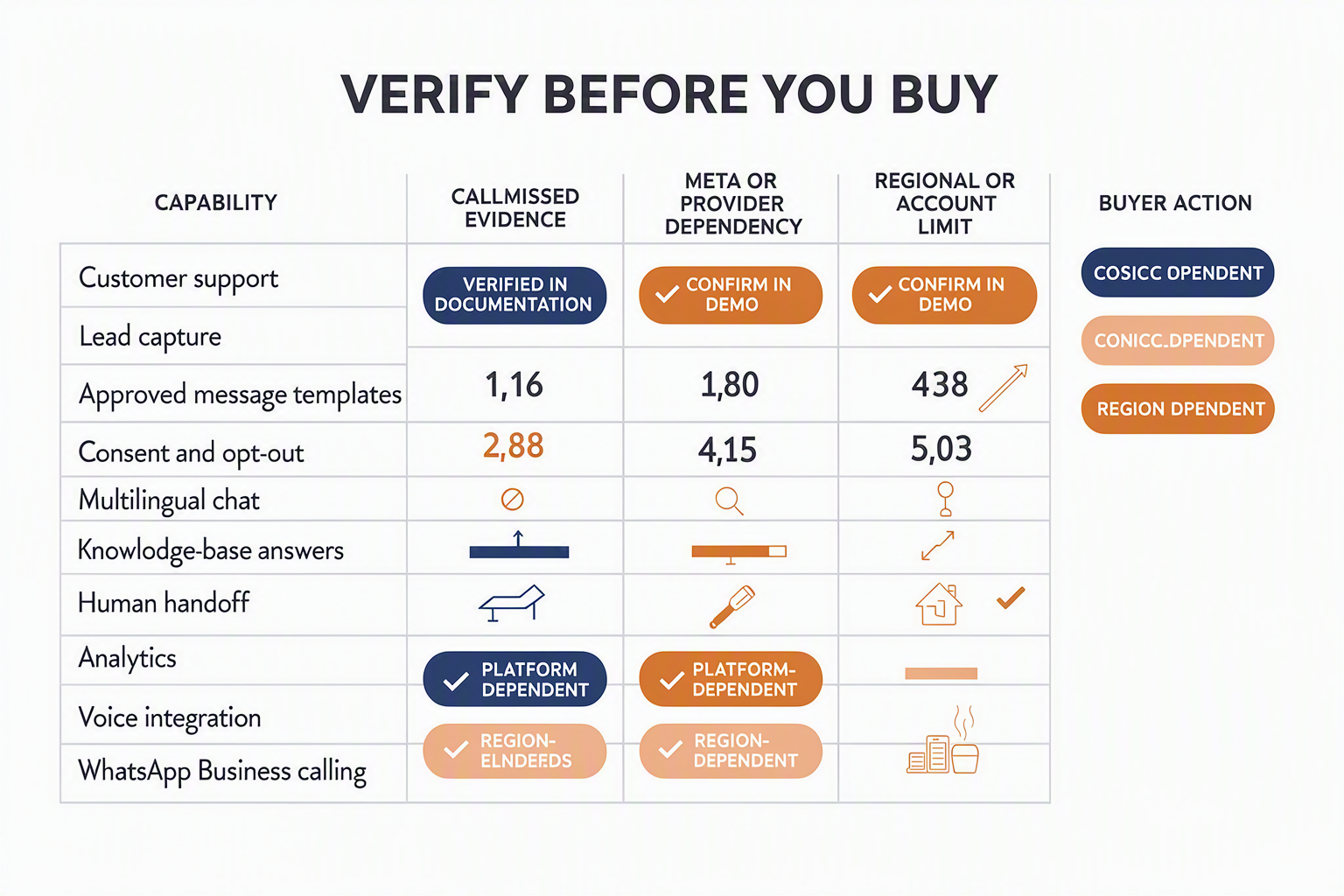
For this comparison, verified means documented in CallMissed’s published product materials. It does not mean independently benchmarked, enabled for every account or guaranteed by Meta. A WhatsApp AI agent for business combines CallMissed functionality with Meta-controlled WhatsApp Business Platform services, so buyers must verify both layers.
Verified capability versus platform dependency
| Capability | Status | What the evidence supports | What the buyer must verify |
|---|---|---|---|
| AI chat, support automation and lead capture | VERIFIED — vendor-documented; CONFIGURATION-DEPENDENT | CallMissed documents automated conversations, lead qualification and workflow routing | Test complete journeys on the production WhatsApp number, including failure and escalation paths |
| Knowledge-grounded answers and human handoff | VERIFIED — vendor-documented; CONFIGURATION-DEPENDENT | CallMissed documents knowledge-based answering, a shared inbox and escalation to staff | Confirm supported content sources, retrieval controls, confidence thresholds, queue ownership and behavior when staff are unavailable |
| Speech support for 22 Indian languages | VERIFIED — vendor-documented scope; performance UNVERIFIED until tested | CallMissed states that its speech technology supports 22 Indian languages | Run native-speaker tests covering accents, code-switching, names, addresses, specialist vocabulary and noisy mobile audio |
| WhatsApp messaging | META-DEPENDENT and CONFIGURATION-DEPENDENT | CallMissed can automate messaging only through a correctly connected WhatsApp Business Platform account and business phone number | Confirm the production number’s status, access permissions, webhooks, quality status and message-delivery behavior |
| Message templates and business-initiated messaging | META-DEPENDENT | Meta—not CallMissed—sets template categories, reviews templates and enforces messaging rules | Verify opt-in records, approved template status, category, variables, quality feedback and current Meta policy |
| WhatsApp Business Calling API integration | META-DEPENDENT, REGIONAL and CONFIGURATION-DEPENDENT | CallMissed can connect an eligible WhatsApp call to an AI voice workflow only where an operational Calling API integration has been configured | Require a live inbound and, if needed, business-initiated call on the actual production number; do not treat a voice-agent demonstration as proof of WhatsApp Calling API eligibility |
| Reporting and workflow analytics | VERIFIED — vendor-documented; exact coverage CONFIGURATION-DEPENDENT | CallMissed documents platform reporting and engagement-management features | Obtain a field-level list of events, dashboards, exports, retention periods, access controls and audit records |
The 22-language statement describes published product coverage, not a guaranteed recognition or response-accuracy level. No responsible procurement decision should rely on a language count without representative testing.
Meta messaging rules that still apply
Under Meta’s WhatsApp Business Platform rules, a customer message opens a 24-hour customer service window. During that window, the business may send free-form replies. Once the window closes, the business must use an approved message template to restart the conversation; templates may also be used while the window is open.
Template approval does not replace consent. The business remains responsible for collecting a valid WhatsApp opt-in before sending business-initiated messages, explaining the types of messages the person will receive and honoring opt-outs. Meta currently classifies templates under categories such as marketing, utility and authentication and may reclassify, pause or disable templates based on their content or quality.
These are Meta-controlled rules. CallMissed can implement consent fields, template workflows and suppression logic, but it cannot waive Meta’s requirements or guarantee template approval.
Where WhatsApp Business Calling API is available in 2026
The WhatsApp Business Calling API is distinct from voice calling in the consumer WhatsApp application or the WhatsApp Business app. For an API deployment, availability must be established for the specific WhatsApp Business Account and business phone number.
Calling should be labeled REGIONAL and META-DEPENDENT because Meta can condition access on:
- the supported country or region associated with the business and user numbers;
- the business phone number’s Calling API eligibility;
- account, quality and policy status;
- use of a supported WhatsApp Business Platform configuration;
- whether the call is user-initiated or business-initiated; and
- completion of the required calling, webhook and media configuration.
Meta’s current supported-market documentation and the eligibility shown for the production number are controlling. Appearance of a call button in another WhatsApp product, availability to another business in the same country or access in a demonstration account does not establish Calling API access for the buyer’s number.
The two calling directions must also be evaluated separately:
- User-initiated calling: The customer starts the WhatsApp call. The business number must have calling enabled and be configured to receive and route it.
- Business-initiated calling: The business starts the call. Meta requires the user’s call permission through the prescribed WhatsApp permission flow, in addition to any messaging opt-in or other consent required for the underlying use case. Permission is not an unrestricted authorization for future calls.
After Meta connects an eligible call, CallMissed’s configured voice agent may handle the application-layer interaction and transfer or record an outcome where supported. Recording or storing call content must not be assumed: it requires a documented CallMissed configuration and compliance with applicable privacy, recording-consent and telecommunications laws.
Procurement checks before signing
- Test the production number: Demonstrate inbound messaging, an out-of-window template, template delivery, human handoff and each required calling direction on the number that will go live.
- Capture Meta evidence: Record the WhatsApp Business Account, business phone-number status, approved templates, calling eligibility, supported market and any user-permission requirement.
- Separate responsibilities: Identify which controls belong to CallMissed, which belong to Meta or another solution provider, and which remain the customer’s legal and operational responsibility.
- Validate unsupported assumptions: Treat accuracy targets, every-language performance, specific analytics fields, call recording, CRM behavior and universal calling availability as UNVERIFIED until demonstrated or included in the contract.
- Design fallbacks: Define what happens when a template is rejected, the 24-hour window has closed, calling is unavailable, AI confidence is low or no human agent is online.
This distinction prevents a documented CallMissed capability from being mistaken for a Meta-granted entitlement or a production-level performance guarantee.
How should you implement a WhatsApp chatbot for business across customer support, lead capture, knowledge-base answers and human handoff?
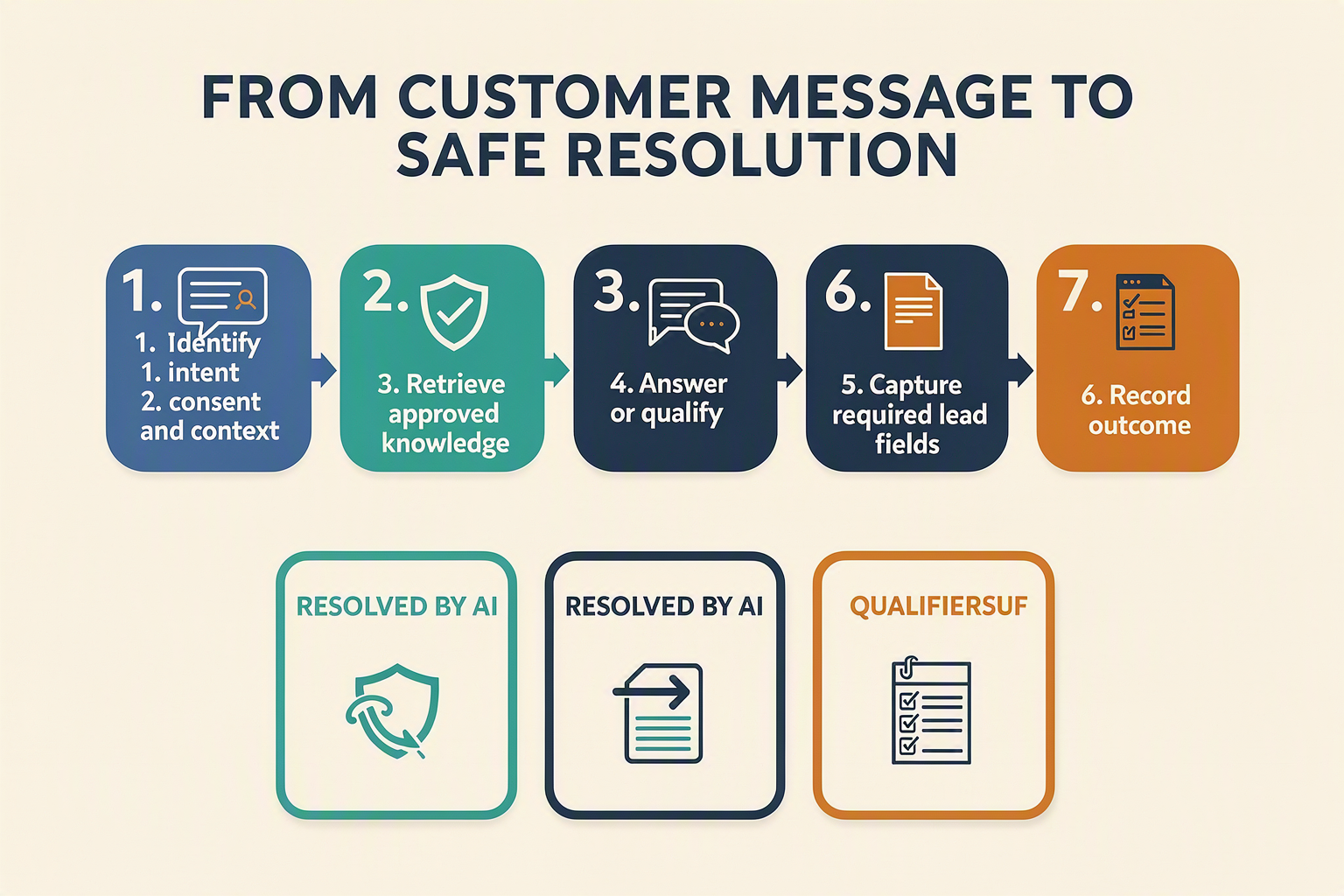
Implement a WhatsApp chatbot for business as a controlled workflow: define each customer intent, connect trusted data, collect only necessary information, and establish clear escalation conditions before enabling generative answers. A production-ready WhatsApp AI agent should resolve routine requests while preserving context for employees when automation is uncertain or inappropriate.
1. Map intents to permitted actions
Start with the highest-volume, lowest-risk conversations rather than trying to automate every enquiry. Create an intent map covering:
- Customer support: order status, appointment changes, operating hours, return eligibility and troubleshooting.
- Lead capture: product interest, location, budget range, preferred language and permission for follow-up.
- Knowledge requests: policies, specifications, pricing rules and service coverage.
- Human-only cases: complaints, payment disputes, safety issues, legal requests and unusual exceptions.
For every intent, define the required data, approved response source, system action and escalation route. The bot should disclose that it is automated and offer human assistance without forcing customers through repeated menus.
2. Connect the channel and business systems
Configure the official WhatsApp Business API number, webhook events and message-routing rules in a test environment. Connect the systems needed to complete—not merely discuss—customer requests, such as a CRM, help desk, ecommerce platform, appointment calendar or order database.
CallMissed can combine WhatsApp conversations, AI agents and employee replies within an omnichannel inbox. Assign ownership by team, location or enquiry type, and prevent the AI from acting when an integration is unavailable or returns conflicting information.
3. Build grounded knowledge-base answers
A conversational AI WhatsApp experience should retrieve answers from approved business content rather than rely on the model’s general memory. Import current FAQs, product documentation, policies and location-specific information, then attach metadata such as language, effective date and audience.
Use these safeguards:
- Require retrieval from an approved source for policy or pricing answers.
- Set confidence thresholds below which the agent asks a clarifying question or escalates.
- Instruct the agent to say when information is unavailable instead of improvising.
- Review expired documents and conflicting passages on a fixed schedule.
- Log the retrieved source with each answer for quality review.
4. Structure lead capture and consent
Collect lead details conversationally, one field at a time, and confirm important information before writing it to the CRM. Store the opt-in source, timestamp, purpose and permitted channel alongside the contact record.
Separate a request for information from permission to receive future promotions. When WhatsApp automation sends a business-initiated follow-up, use the appropriate Meta-approved template and revalidate current WhatsApp Business Platform rules rather than treating an earlier conversation as indefinite consent.
5. Design human handoff before launch
Handoff must transfer the conversation history, customer profile, detected intent, captured fields and relevant knowledge sources. Trigger escalation when:
- The customer requests a person.
- Confidence falls below the approved threshold.
- The same question fails repeatedly.
- Sentiment indicates distress or a complaint.
- The request involves sensitive decisions or policy exceptions.
For effective WhatsApp customer service, publish staffed hours and provide an expected response path when no employee is available.
6. Test multilingual chat, voice and analytics
Test spelling variation, code-switching, regional phrasing, attachments, interrupted journeys and duplicate messages. CallMissed supports speech across 22 Indian languages, making language-by-language evaluation important rather than assuming one Hindi or English test represents all users.
Track containment, escalation, unresolved intents, lead completion, response latency and post-conversation satisfaction. Test WhatsApp voice calling for business separately: calling depends on account eligibility, geography, Meta policy and configuration, even when the platform can bridge eligible WhatsApp Business calls to an AI voice agent.
How should a conversational AI WhatsApp experience connect multilingual chat, voice integration and regional customer journeys?
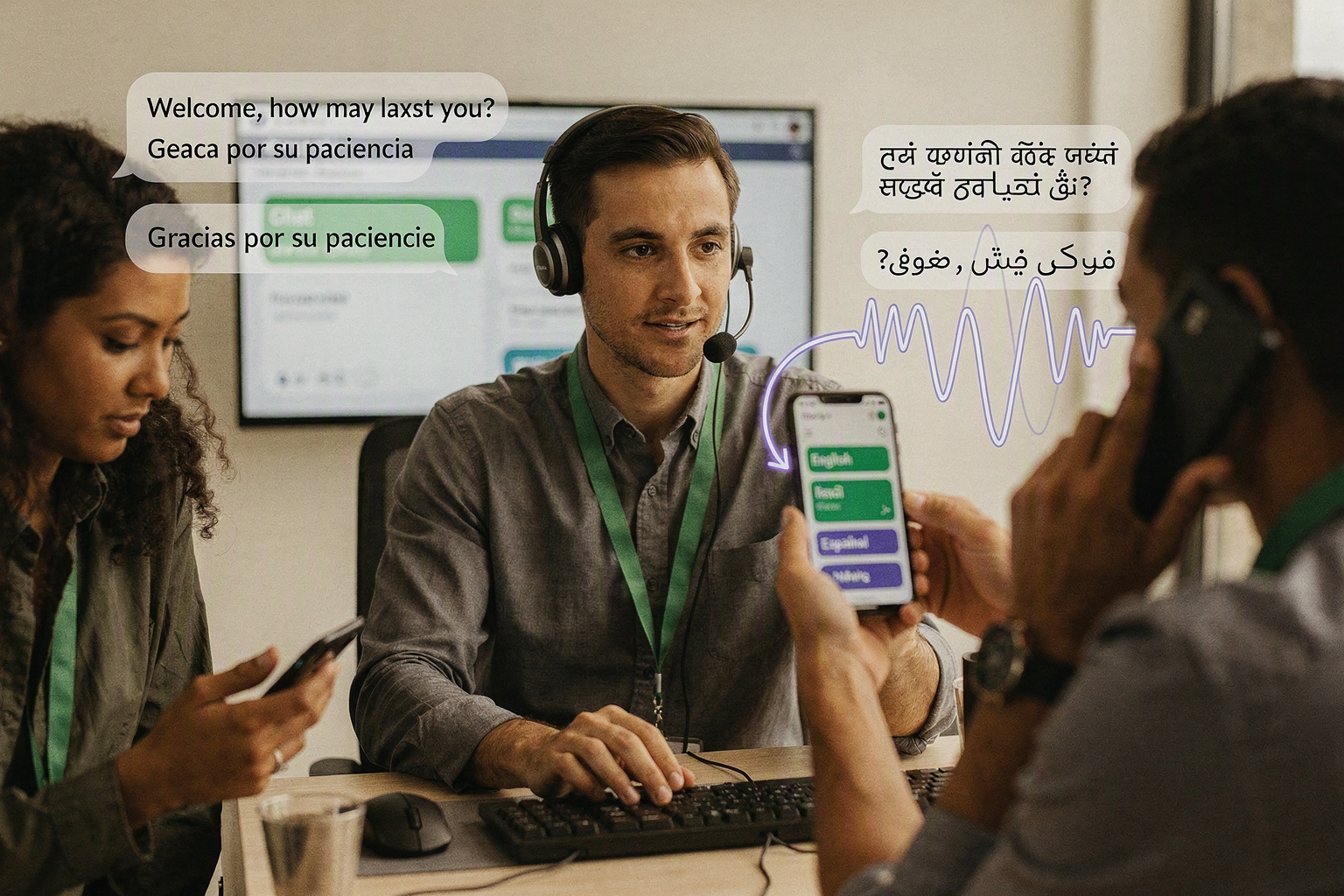
A strong conversational AI WhatsApp experience should preserve customer identity, language, intent, and conversation history as the journey moves between text, voice, workflows, and human support. Multilingual capability must influence routing, knowledge retrieval, speech models, and escalation—not merely translate a final response.
Design language handling as an end-to-end system
A WhatsApp AI agent should detect the customer’s preferred language while still allowing explicit selection. This matters in India, where customers may code-switch between English and regional languages or type languages such as Hindi, Bengali, or Tamil in Latin script.
The implementation should:
- Store a preferred-language field against the contact or CRM record.
- Test native scripts, transliteration, spelling variation, code-switching, and mixed-language product names.
- Retrieve approved knowledge in the relevant language rather than translating an unverified answer.
- Preserve names, addresses, order numbers, dates, and monetary values during translation.
- Transfer the selected language and full transcript during human handoff.
CallMissed provides Speech-to-Text and Text-to-Speech coverage across 22 Indian languages, using Indic-first models for regional customer journeys. Buyers should still run production-like tests using local accents, noisy environments, domain terminology, and actual customer phrasing before rollout.
Connect chat and voice without restarting the journey
Effective WhatsApp automation lets customers move from chat to voice when speaking is faster—for example, while explaining a complex service problem, giving an address, or discussing a high-consideration purchase. The voice agent should receive the customer’s language preference, verified identity, conversation summary, and unresolved intent.
For WhatsApp voice calling for business, design two distinct paths:
- Inbound calling: A customer calls the business through WhatsApp and the AI voice agent answers, retrieves relevant information, or transfers the call.
- Business-initiated calling: The business requests or places a call only where account eligibility, customer permission, country availability, and current Meta rules allow it.
CallMissed can bridge WhatsApp Business calls to an AI voice agent and maintain the interaction within its broader customer-engagement workflow. However, calling activation is dependent on Meta approval, account configuration, number eligibility, and regional availability; it should be verified during procurement and sandbox testing rather than treated as universally enabled.
Map regional journeys to business outcomes
A WhatsApp chatbot for business should adapt both language and workflow to the customer’s context. Practical journeys include:
- A Marathi-speaking buyer asking about stock, receiving a grounded answer, and requesting a sales callback.
- A Tamil-speaking customer checking delivery status before escalating to a regional support queue.
- A Hindi-speaking prospect qualifying for a service through chat and switching to voice for detailed questions.
- A Bengali-speaking customer receiving an approved follow-up message after providing valid consent.
These journeys should use the WhatsApp Business API for controlled messaging while keeping consent, template status, language, timestamps, and escalation outcomes visible to operational teams.
Require continuity during human handoff
Good WhatsApp customer service does not force customers to repeat themselves. When confidence is low, a policy exception appears, or the customer requests a person, the agent should hand over:
- The original message and detected language.
- A concise conversation summary.
- Retrieved knowledge sources and completed actions.
- Lead fields, consent status, and outstanding questions.
- Voice-call transcript or disposition, where available and permitted.
This continuity turns multilingual support into a coherent regional customer journey rather than separate chat, translation, and calling features.
What do customer-experience, compliance, security and operations experts recommend before approving a WhatsApp customer service deployment?
Before approving a deployment, customer-experience, compliance, security and operations leaders should require documented consent, bounded AI authority, secure integrations, measurable service levels and a tested human fallback. Approval should depend on evidence from realistic testing—not a polished demonstration alone.
Customer experience: define where automation stops
CX leaders should approve each journey separately rather than authorizing unrestricted WhatsApp automation. A WhatsApp AI agent may answer routine questions, collect lead details and retrieve approved information, but sensitive, ambiguous or high-impact decisions should move to a trained employee.
Require the implementation team to:
- Map intents such as order tracking, appointment booking, lead qualification, returns and complaints.
- State what the agent may answer, recommend, update or transact.
- Provide a visible route to a person through phrases such as “talk to an agent.”
- Preserve conversation context during handoff so customers do not repeat information.
- Test regional languages, mixed-language messages, spelling variations, voice notes and accessibility needs.
- Prevent the bot from presenting uncertain knowledge-base output as fact.
A WhatsApp chatbot for business should disclose that it is automated and identify the business clearly. Escalation triggers should include repeated misunderstandings, explicit complaints, payment disputes, safety concerns and requests involving legal or financial judgment.
Compliance: prove permission and messaging purpose
Compliance teams should verify that every business-initiated workflow has a valid purpose, appropriate opt-in evidence and, where required, an approved WhatsApp message template. Under current WhatsApp Business Platform policy, customer-initiated conversations create a defined service window; messages outside the applicable window generally require approved templates.
The approval record should capture:
- Who consented, including the customer identifier.
- When and where consent was collected.
- What communication the customer agreed to receive.
- The privacy notice and consent wording shown at that time.
- Opt-out, suppression and consent-withdrawal events.
Consent to receive an order update should not automatically be treated as consent for unrelated promotions. Legal reviewers should also assess the Digital Personal Data Protection Act, 2023 in India and applicable sectoral or international rules, including purpose limitation, retention and data-principal rights.
Security: examine the complete data path
Security approval must cover the WhatsApp Business API, AI provider, orchestration layer, CRM, knowledge base, analytics tools and human inbox—not merely the language model.
Minimum controls should include:
- Encryption in transit and at rest.
- Role-based access, multifactor authentication and prompt administrative controls.
- Secrets management for API keys and webhook verification.
- Data minimization, retention schedules and deletion procedures.
- Redaction of passwords, payment credentials and sensitive identifiers.
- Audit logs for messages, agent actions, transfers and configuration changes.
- Protections against prompt injection and malicious knowledge-base content.
- Incident-response ownership and vendor data-processing terms.
Teams should prohibit the agent from requesting one-time passwords, PINs or complete card details through WhatsApp customer service.
Operations: demand production evidence
Operations experts should require sandbox testing, limited rollout and rollback procedures. Acceptance metrics should cover containment, transfer rate, first-response time, resolution rate, unanswered intents, hallucination rate, customer satisfaction and opt-out rate.
For conversational AI WhatsApp deployments, test peak load, webhook failures, duplicate events, provider outages and stale CRM data. CallMissed can combine multilingual chat, knowledge-grounded answers and human handoff; its support for 22 Indian languages should still be validated against the organization’s vocabulary and customer accents.
Finally, treat WhatsApp voice calling for business as conditional. Verify Meta eligibility, country and number availability, customer permission, recording disclosures, call routing, AI-to-human transfer and failure handling before operational sign-off.
What outcomes, risks and analytics should buyers track after launch, and which CallMissed guides support the next step?
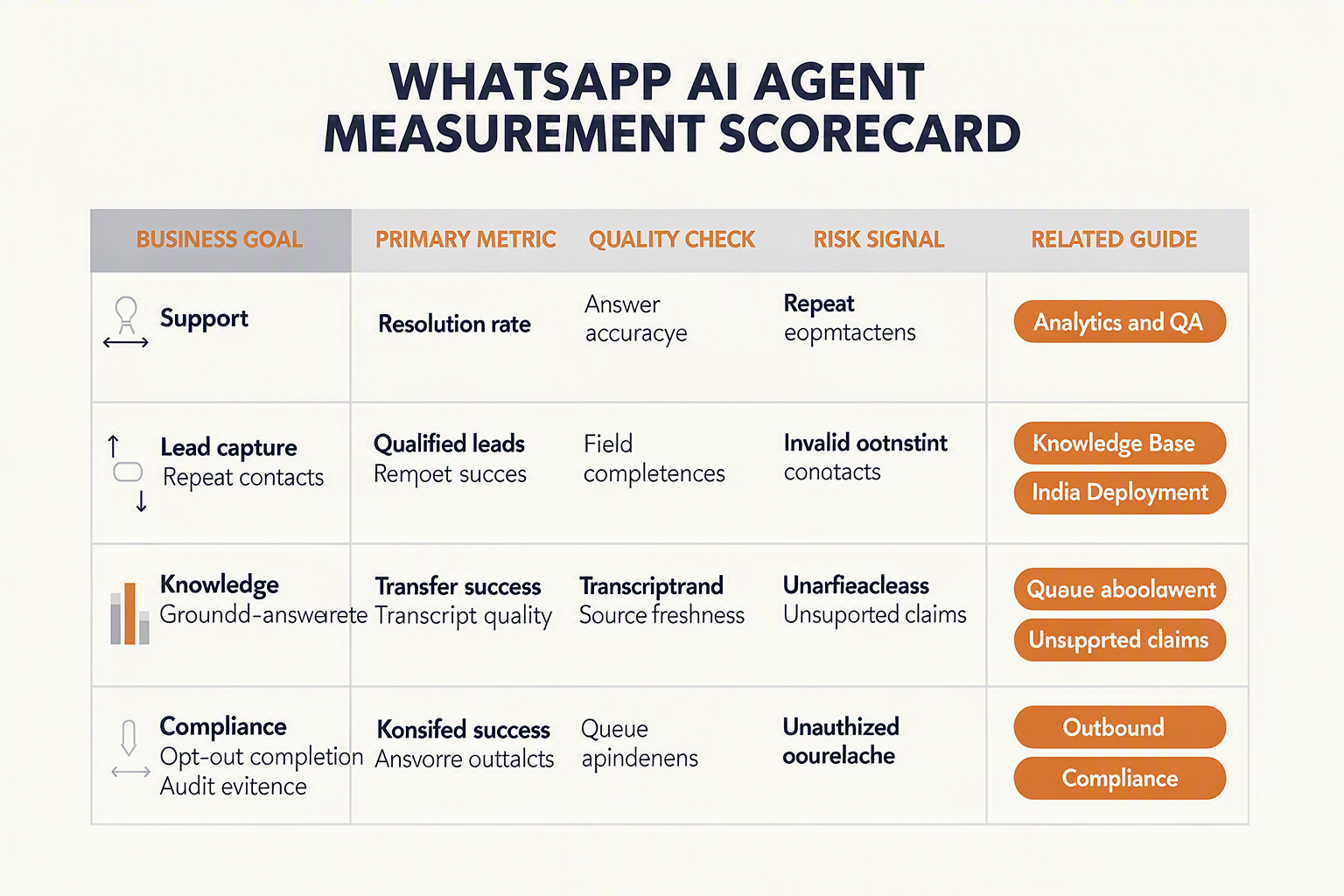
Buyers should judge a WhatsApp AI agent by measurable customer outcomes, controlled risk, and reliable escalation—not message volume alone. Establish a pre-launch baseline, segment results by use case and language, and review both automation performance and downstream CRM outcomes.
Post-launch scorecard
| Outcome area | Metrics to track | Risk signal | Recommended action | Supporting CallMissed guide |
|---|---|---|---|---|
| Customer support | First-response time, resolution rate, repeat-contact rate, customer satisfaction, human-transfer rate | Fast replies but rising repeat contacts or complaints | Audit answer quality, transfer rules, and unresolved intents | AI Agent Performance Metrics and QA |
| Lead capture | Qualified leads, form completion, booked appointments, CRM acceptance, lead-to-sale conversion | High conversation volume but incomplete or duplicate records | Simplify qualification, validate fields, and test CRM workflows | Safe Admissions Enquiry Automation |
| Knowledge accuracy | Grounded-answer rate, fallback rate, citation coverage, stale-answer incidents, correction volume | Confident answers unsupported by approved sources | Restrict retrieval sources, refresh content, and escalate uncertain requests | Knowledge Base Guide |
| Consent and messaging | Opt-in evidence, template approval status, opt-out completion, delivery failures, blocked or reported messages | Missing consent records, repeated opt-outs, or use of unapproved outbound content | Pause the affected campaign and review templates, audience source, and suppression lists | Outbound Calling Compliance Guide |
| Multilingual service | Intent success, transfers, response latency, and satisfaction by language | Materially weaker outcomes in a regional language than in the default language | Test native-language prompts, terminology, speech recognition, and handoff coverage | Multilingual WhatsApp and Voice Deployment Guide |
| Voice and handoff | Call answer rate, completion rate, transfer success, abandonment, callback consent | Failed transfers, unrecorded permission, or calling unavailable for an account or region | Verify Meta eligibility and routing before expanding traffic | Home Services AI Call Answering Guide |
Interpret metrics as a connected funnel
A WhatsApp chatbot for business can appear efficient while producing poor commercial or service outcomes. Buyers should connect WhatsApp automation data to CRM stages, ticket status, bookings, orders, refunds, and revenue rather than reporting “conversations handled” as success.
Use these comparisons:
- Before versus after launch: Compare equivalent periods while accounting for seasonality and campaign volume.
- Automated versus human-assisted journeys: Measure resolution quality, not merely handling cost.
- Intent and language cohorts: CallMissed supports speech across 22 Indian languages, so each deployed language should receive its own quality review.
- Channel cohorts: Separate text-based WhatsApp customer service, email, web, conventional voice, and WhatsApp voice calling for business.
- Permission cohorts: Distinguish customer-initiated sessions from business-initiated communication using approved templates and documented consent under applicable WhatsApp Business API rules.
Meta CEO Mark Zuckerberg reported on April 30, 2025, that WhatsApp had surpassed 3 billion monthly active users; that scale makes delivery quality, opt-outs, and complaint signals operationally important rather than secondary compliance checks.
Run an analytics and QA cadence
Review delivery failures, safety incidents, transfer breakdowns, and consent exceptions daily. Review intent accuracy, lead quality, knowledge gaps, language performance, and customer satisfaction weekly; conduct a broader monthly assessment of conversion, operating cost, templates, retention, and policy changes.
CallMissed combines multilingual chat, knowledge-base retrieval, human handoff, omnichannel records, and AI-connected WhatsApp Business calls. Teams implementing a conversational AI WhatsApp journey should use those shared records to reconstruct failed conversations, identify recurring knowledge gaps, and prioritize changes according to customer impact and risk—not anecdotal feedback alone.
How do you set up CallMissed safely from discovery and sandbox testing through launch and continuous improvement?
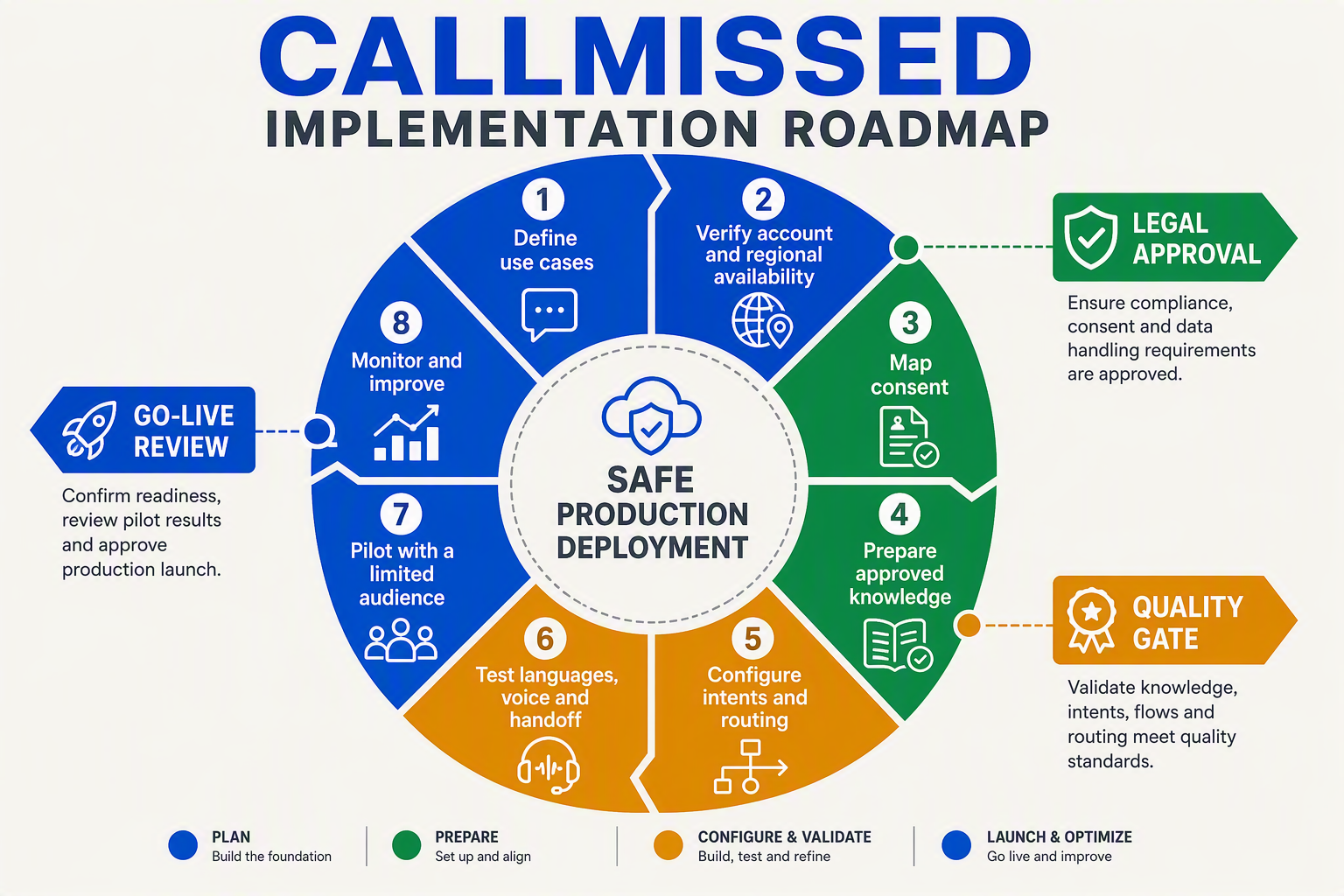
Set up CallMissed safely by moving through discovery, controlled configuration, sandbox testing, phased launch, and continuous improvement—with a documented owner and acceptance criteria at every stage. Do not give a production agent permission to message customers, place calls, or update records until consent, accuracy, escalation, and failure handling have been tested.
1. Define the journey and its safety boundaries
Start with one measurable use case, such as answering order questions, qualifying enquiries, or scheduling callbacks. Map what the WhatsApp AI agent may do, what it must never do, and when it must transfer control.
Document:
- Supported customer intents, languages, operating hours, and response targets.
- Required integrations with CRM, ticketing, calendars, payments, or order systems.
- Fields collected during lead capture and the lawful reason for retaining them.
- High-risk topics—such as refunds, medical advice, legal disputes, or financial commitments—that require human review.
- Handoff triggers, including explicit requests for an employee, repeated misunderstanding, low-confidence retrieval, complaints, and emergencies.
Treat WhatsApp voice calling for business as conditional during discovery. WhatsApp Business calling eligibility, inbound or business-initiated calling availability, permissions, and configuration can vary by country, account, number, and current Meta policy.
2. Configure a minimum-safe agent
Connect the approved WhatsApp number through the WhatsApp Business API, then configure the WhatsApp chatbot for business with narrowly scoped instructions. Upload only current, authorized knowledge sources; assign document owners and expiration dates; and require the agent to acknowledge uncertainty rather than invent an answer.
CallMissed supports knowledge-base retrieval, human handoff, multilingual WhatsApp chat, and voice integration. For Indian deployments, CallMissed supports speech across 22 Indian languages, but teams should still test regional vocabulary, mixed-language messages, names, addresses, and code-switching with representative users.
Apply access controls using least privilege:
- Separate administrator, supervisor, agent, analyst, and integration credentials.
- Keep API keys and webhooks in a secrets manager.
- Redact sensitive data from prompts, logs, and analytics where possible.
- Record opt-in source, timestamp, scope, and revocation status.
- Restrict business-initiated outreach to approved templates and eligible recipients.
3. Run sandbox and adversarial tests
Build a test set covering normal requests, misspellings, unsupported questions, duplicate messages, integration outages, and malicious prompt-injection attempts. A safe conversational AI WhatsApp test should also verify that retrieved documents cannot override system policies or expose confidential content.
Before launch, confirm:
- Customer-initiated messages receive accurate, grounded responses.
- Business-initiated messages use approved templates and valid consent.
- Opt-outs immediately suppress future outreach.
- Failed CRM or workflow writes are visible and retry safely.
- Human handoff includes the transcript, customer context, and stated intent.
- Voice calls disclose automation where required and transfer reliably.
- The agent fails closed when identity, authorization, or knowledge confidence is insufficient.
4. Launch gradually and improve from evidence
Release WhatsApp automation to employees first, then a limited customer cohort, one language or use case at a time. Maintain a rollback switch and staff the human queue during early production.
Review WhatsApp customer service performance weekly using containment rate, handoff rate, unanswered-intent rate, first-response time, resolution time, opt-out rate, template rejection, retrieval accuracy, and customer feedback. Sample transcripts—not just dashboards—for hallucinations, consent failures, poor tone, and unnecessary data collection.
Version prompts and knowledge documents, retest after every material change, and conduct periodic access and retention reviews. Continuous improvement should optimize for correct, permission-based resolution, not maximum automation at any cost.
Frequently asked questions: What does a WhatsApp AI agent cost, is it compliant, can it capture leads, does it support multiple languages, and can it transfer chats or calls to people?
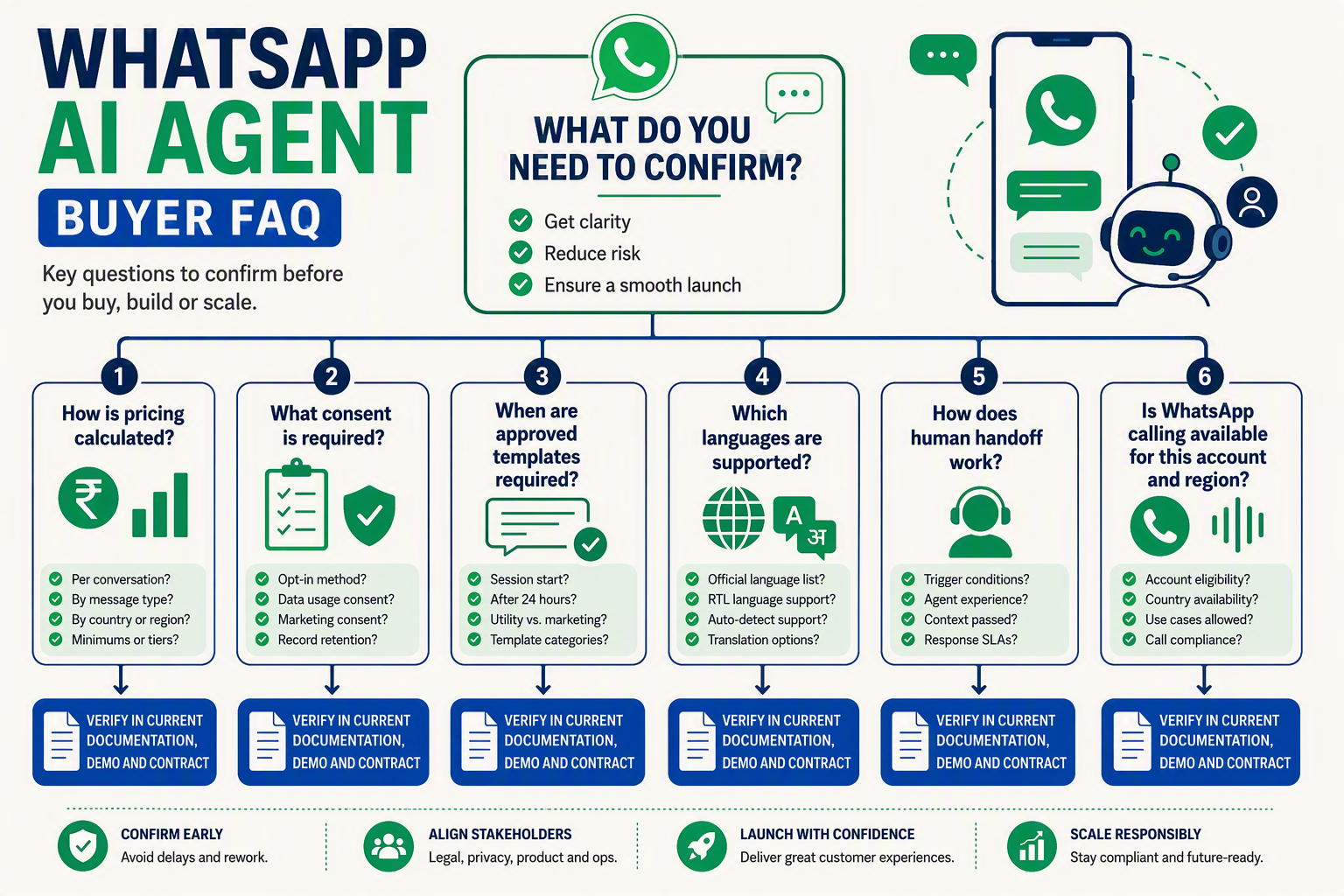
How much does a WhatsApp AI agent for business cost in 2026?
Is a WhatsApp AI agent compliant with Meta’s messaging and consent rules?
Can a WhatsApp chatbot for business capture and qualify sales leads automatically?
Does a conversational AI WhatsApp agent support multiple Indian languages?
Can WhatsApp customer service chats and AI calls be transferred to human agents?
Is WhatsApp voice calling for business available to every company and country?
Conclusion
A successful WhatsApp AI agent in 2026 should combine useful automation with permission-based messaging, accurate knowledge retrieval, multilingual access, measurable performance, and reliable human escalation. The right implementation is not simply a chatbot deployment; it is an operating model spanning the WhatsApp Business API, business policies, customer data, voice, CRM workflows, and support teams.
Meta CEO Mark Zuckerberg reported on April 30, 2025, during Meta’s Q1 2025 earnings call that WhatsApp had surpassed 3 billion monthly active users, underscoring the channel’s importance for customer engagement.
Key takeaways for buyers and implementation teams include:
- Start with defined journeys. Configure the WhatsApp chatbot for business around high-value tasks such as answering support questions, checking orders, booking appointments, capturing leads, and transferring complex cases to employees.
- Treat consent and messaging controls as core architecture. Business-initiated communication generally requires an appropriate opt-in and approved templates, while customer-initiated conversations open a policy-defined service window. Effective WhatsApp automation must enforce these rules rather than relying on employee memory.
- Ground responses and measure outcomes. Connect approved knowledge sources, test prompts and multilingual answers, and monitor resolution, escalation, lead completion, response quality, and failure patterns. These controls make WhatsApp customer service more dependable without removing human oversight.
- Verify voice availability before procurement. WhatsApp voice calling for business may depend on country, number, account eligibility, Meta approval, and platform configuration. Calling support should therefore be validated for the intended deployment instead of assumed.
Looking ahead, teams should watch for changes to Meta’s template, consent, service-window, calling, and regional-availability requirements. The strongest conversational AI WhatsApp deployments will remain adaptable as those rules evolve.
CallMissed offers multilingual WhatsApp chatbots, knowledge-base answers, human handoff, analytics, and WhatsApp Business calls bridged to AI voice agents, including speech support across 22 Indian languages. Which customer journey will your business automate first—and what safeguards will make customers trust it?
Related Reading
Discussion
Related Posts
Ready to automate customer conversations?
Launch AI voice agents and WhatsApp bots with CallMissed — one API, 22+ Indian languages.