
GPT-6 Sol vs Claude Opus 5.5: Best for AI Agents?


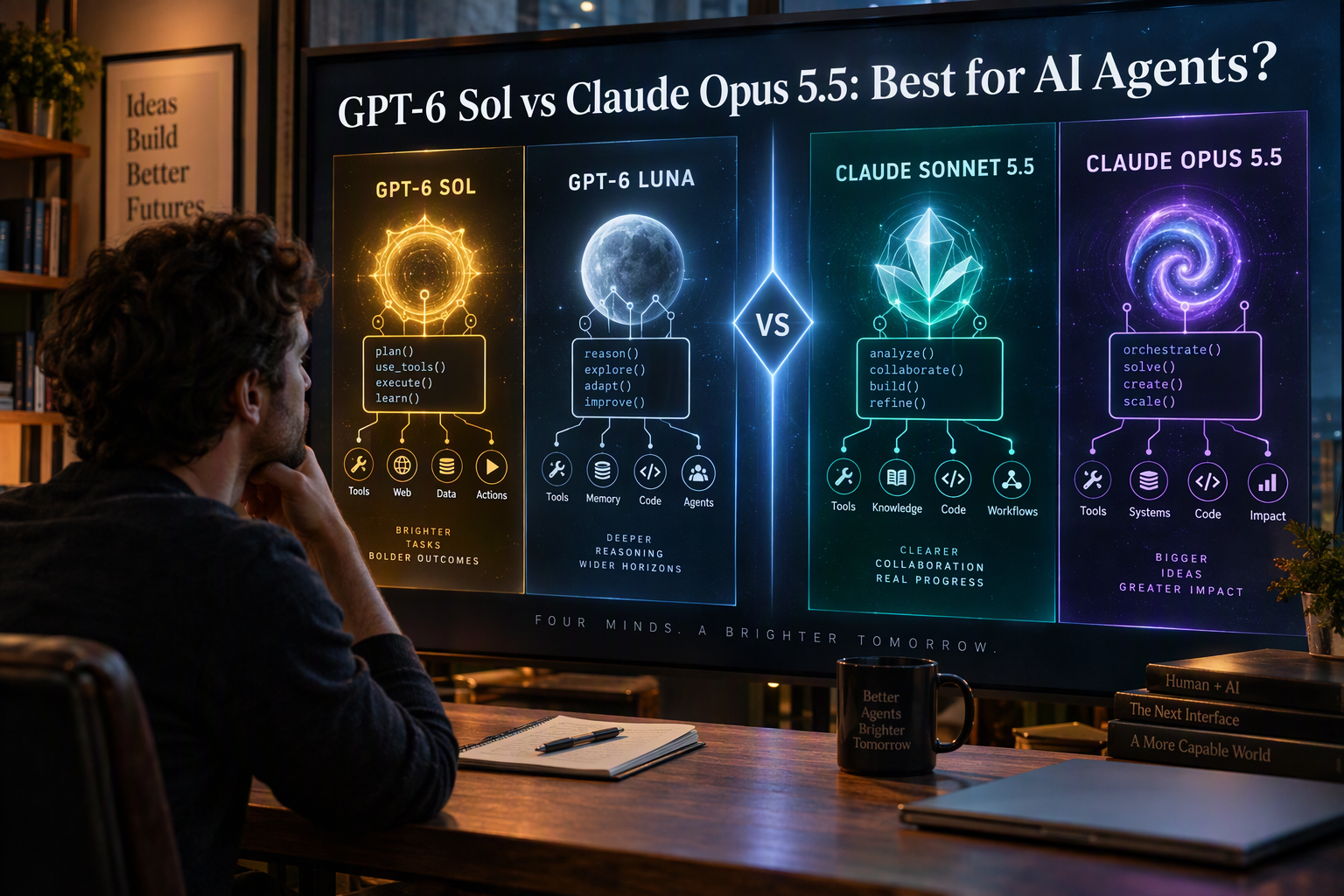
Compare GPT-6 Sol vs Claude Opus 5.5 on verified availability, tools, pricing, speed, context, coding, and real agent costs.
GPT-6 Sol vs Claude Opus 5.5: Best for AI Agents?
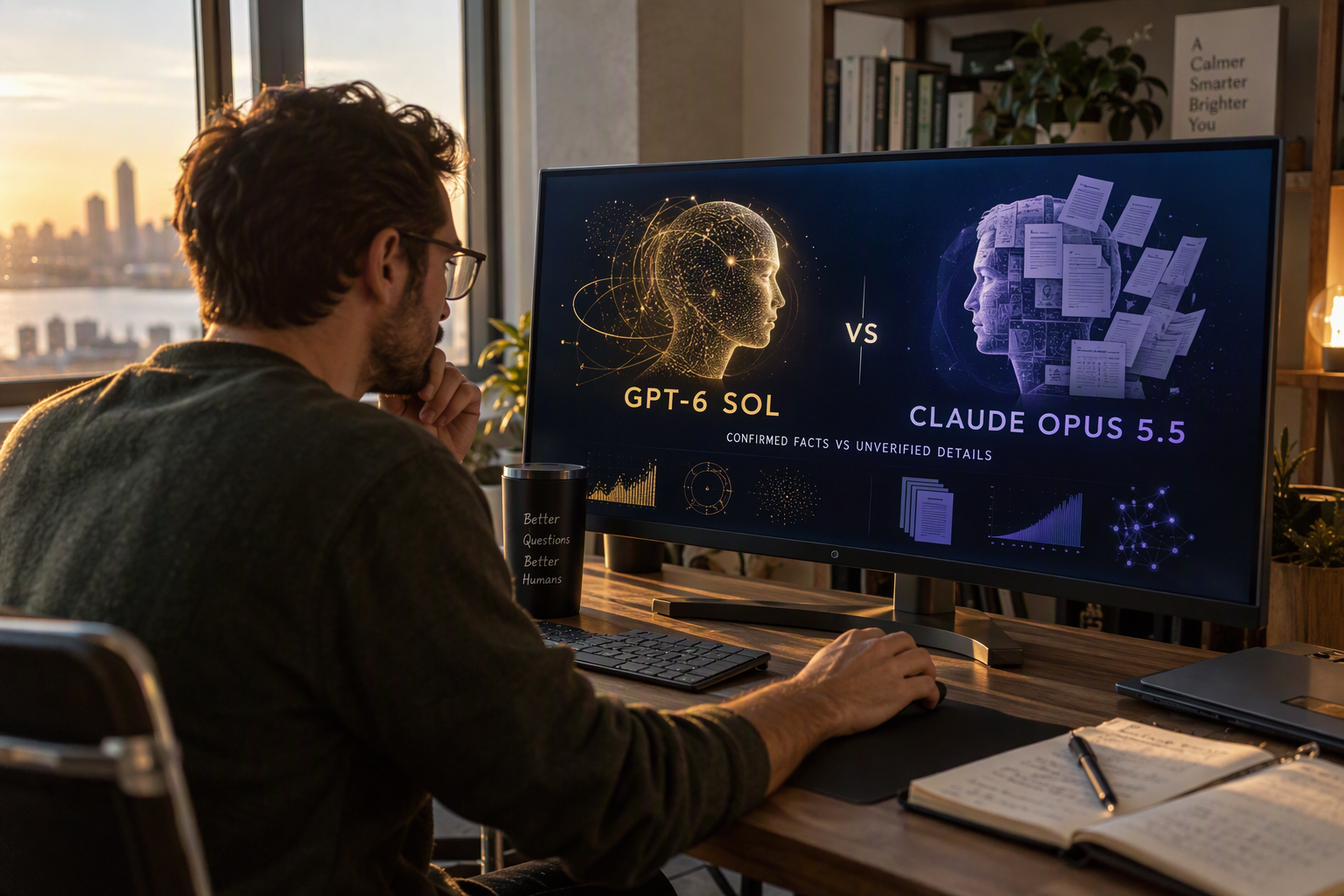
Four frontier models, but how many are actually ready to run your AI agent in production? The GPT-6 Sol vs Claude Opus 5.5 decision matters now because agent quality depends on more than headline intelligence: confirmed API availability, tool calling, coding accuracy, reasoning controls, context limits, latency, and cost can determine whether an agent completes a workflow or stalls midway.
OpenAI’s September 22, 2026 update expanded the GPT-6 family with GPT-6 Sol and GPT-6 Luna, while OpenAI’s developer documentation positions GPT-6 Sol specifically for complex coding and agentic workflows, with six reasoning-effort settings and Responses API tool support. This comparison separates confirmed capabilities from marketing claims across GPT-6 Sol, GPT-6 Luna, Claude Sonnet 5.5, and Claude Opus 5.5. You’ll learn which model fits autonomous agents, coding copilots, high-volume workflows, and reasoning-heavy tasks—and how multi-model gateways such as CallMissed’s OpenAI-compatible AI API can simplify testing and fallback routing.
Which is best for AI agents? There is no universal winner—rank the four models by workload
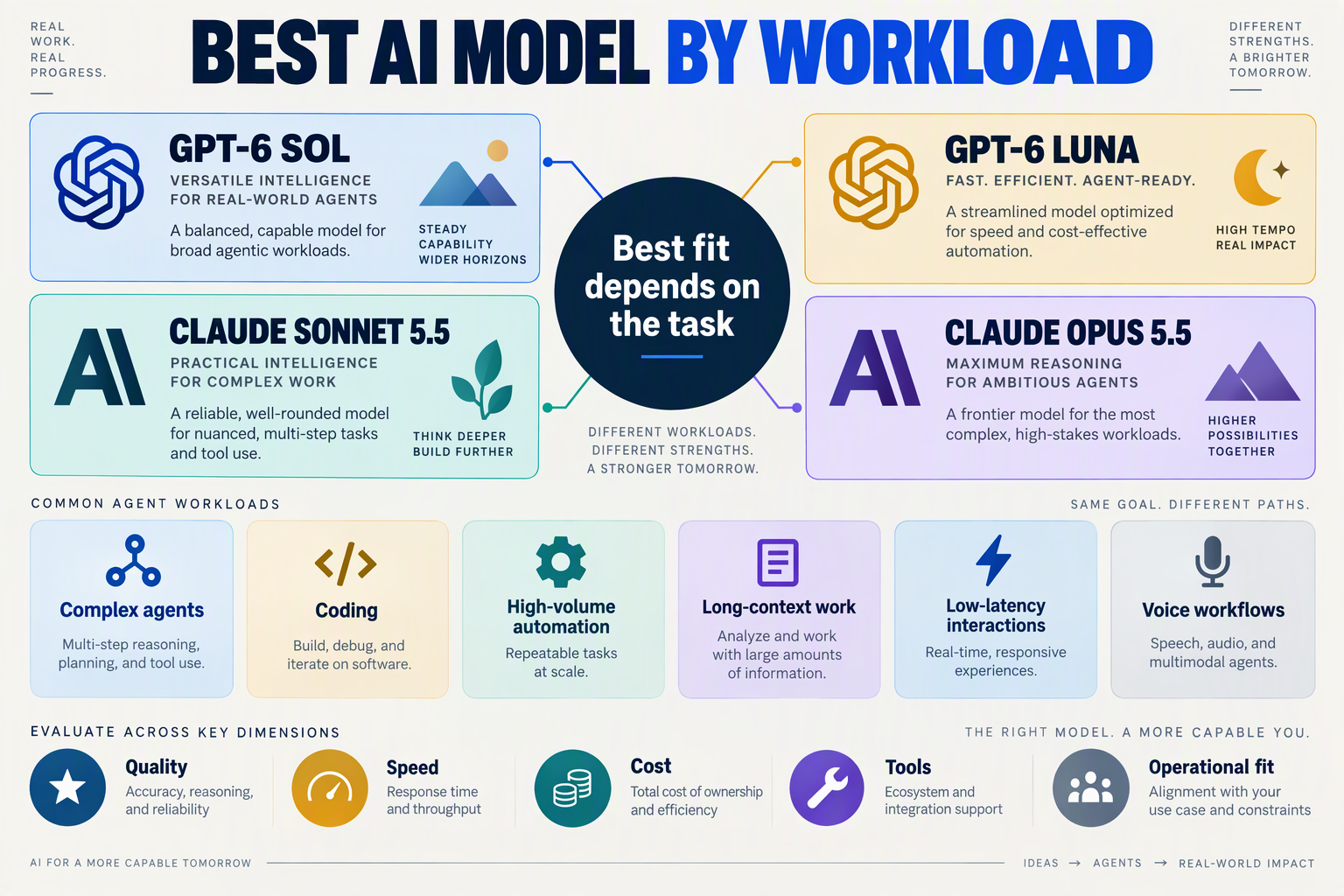
No universal winner exists. As of September 29, 2026, GPT-6 Sol, GPT-6 Luna, Claude Sonnet 5.5, and Claude Opus 5.5 are officially available, but their relative order changes with the workload. The rankings below reflect provider positioning and documented capabilities—not a single cross-vendor benchmark.
What is the evidence-backed ranking by agent workload?
- Long-running agentic coding and knowledge work — 1. Claude Opus 5.5; 2. GPT-6 Sol; 3. Claude Sonnet 5.5; 4. GPT-6 Luna: Anthropic positions Opus 5.5 for sustained agentic coding and knowledge-work tasks. GPT-6 Sol is the strongest alternative when the workflow benefits from OpenAI’s coding-oriented model and tool ecosystem.
- Complex production coding and tool orchestration — 1. GPT-6 Sol; 2. Claude Opus 5.5; 3. Claude Sonnet 5.5; 4. GPT-6 Luna: OpenAI designates GPT-6 Sol for complex coding and agentic workflows. Its Responses API support, built-in tools, function calling, and configurable reasoning effort make it the clearest fit for production agents built around OpenAI’s stack.
- Well-scoped, repeatable agent tasks — 1. Claude Sonnet 5.5; 2. GPT-6 Luna; 3. GPT-6 Sol; 4. Claude Opus 5.5: Anthropic positions Sonnet 5.5 as the faster, lower-cost choice for clearly defined work. Opus 5.5 may be unnecessary when tasks are bounded and do not require extended autonomous reasoning.
- General-purpose agents — 1. GPT-6 Luna; 2. Claude Sonnet 5.5; 3. GPT-6 Sol; 4. Claude Opus 5.5: Luna is the better starting point for broad everyday workloads, while Sonnet 5.5 is compelling for structured tasks where speed and cost matter. Sol and Opus are better reserved for workloads that benefit from their more specialized strengths.
- Reasoning-heavy agents with developer-controlled deliberation — 1. GPT-6 Sol; 2. Claude Opus 5.5; 3. Claude Sonnet 5.5; 4. GPT-6 Luna: Sol exposes six reasoning-effort settings—none, low, medium, high, xhigh, and max—giving developers direct control over the trade-off between deliberation, speed, and cost.
- High-volume, cost-sensitive agents — no universal four-model ranking: Sonnet 5.5 is officially positioned as faster and lower-cost than Opus 5.5, but that does not establish an automatic advantage over Luna or Sol. Compare current input, output, cached-token, and tool-use charges against the prompts and completion lengths of the actual workload.
The model-family API aliases are gpt-6-sol, gpt-6-luna, claude-sonnet-5-5, and claude-opus-5-5. For reproducible deployments, pin a dated model version when the provider offers one rather than relying indefinitely on a moving alias.
Overall: choose GPT-6 Sol for complex coding agents and controllable reasoning, Claude Opus 5.5 for long-running agentic coding or knowledge work, Claude Sonnet 5.5 for fast and well-scoped tasks, and GPT-6 Luna for general-purpose agents. Treat these as workload-fit recommendations rather than proof that one model is universally superior.
How do GPT-6 Sol, GPT-6 Luna, Claude Sonnet 5.5, and Claude Opus 5.5 compare?
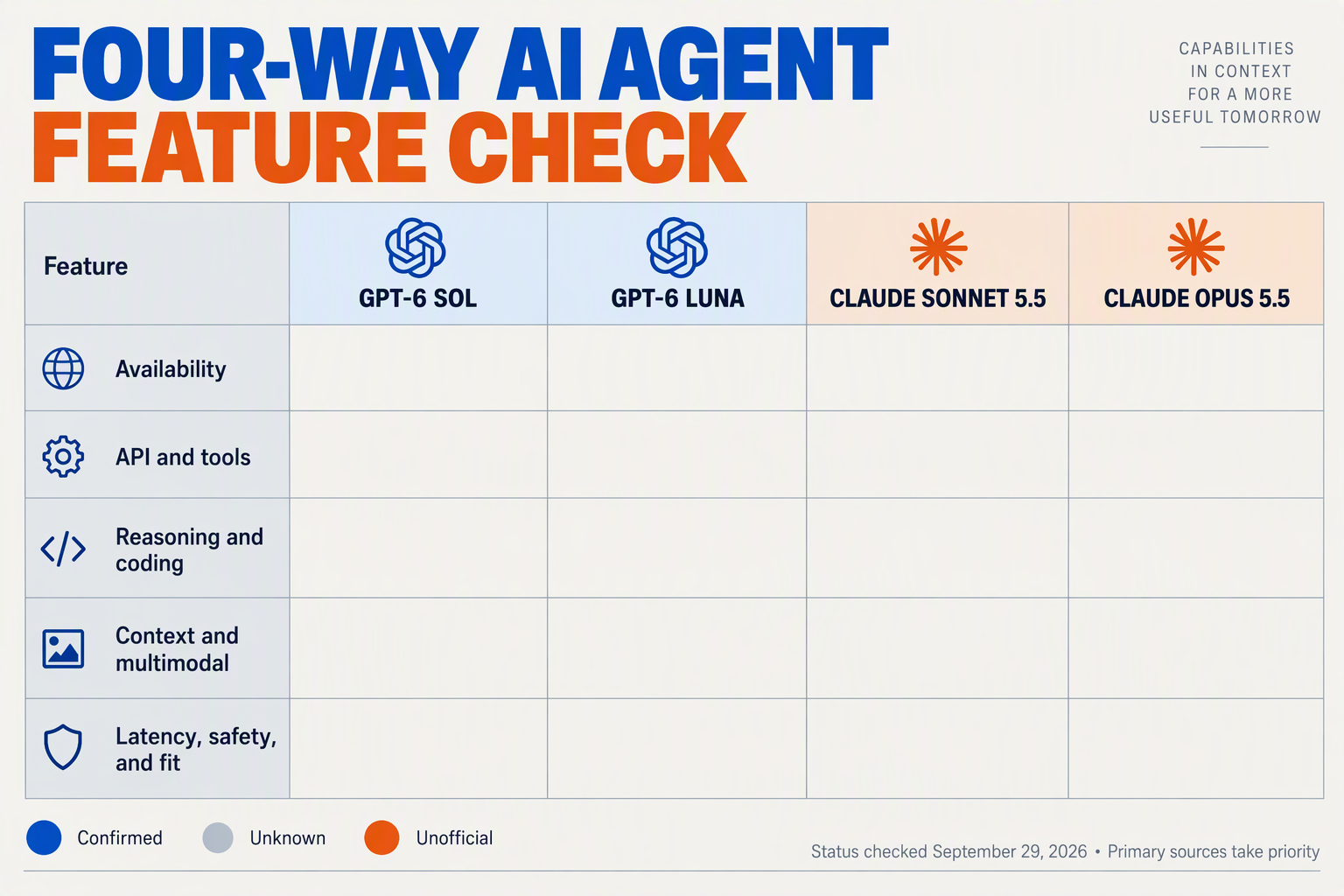
Only GPT-6 Sol has sufficiently detailed, confirmed API and agent capabilities in the supplied sources as of September 29, 2026; GPT-6 Luna is announced, while both Claude 5.5 model names remain unverified here.
What specifications are confirmed for each AI agent model?
| Criterion | GPT-6 Sol | GPT-6 Luna | Claude Sonnet 5.5 | Claude Opus 5.5 |
|---|---|---|---|---|
| Availability | Confirmed by OpenAI | Announced by OpenAI | Not confirmed | Not confirmed |
| API support | Confirmed | Not documented | Not documented | Not documented |
| Agent tools | Built-in tools and function calling | Not documented | Not documented | Not documented |
| Reasoning controls | 6 effort levels | Not documented | Not documented | Not documented |
| Coding positioning | Complex coding and agentic workflows | Not documented | Not documented | Not documented |
| Context window | Not disclosed here | Not disclosed here | Not disclosed here | Not disclosed here |
| API pricing | Not disclosed here | Not disclosed here | Not disclosed here | Not disclosed here |
- GPT-6 Sol: OpenAI’s developer documentation confirms support for the Responses API, built-in tools, and function calling as of September 2026.
- GPT-6 Sol: OpenAI provides six
reasoning.effortsettings—none, low, medium, high, xhigh, and max—with medium as the documented default.
- GPT-6 Luna: OpenAI announced GPT-6 Luna on September 22, 2026, but the supplied sources provide no model-page specifications, pricing, context limit, or tool details.
- Claude Sonnet 5.5: No supplied Anthropic source confirms availability, API access, coding performance, tool use, pricing, or context length.
- Claude Opus 5.5: No supplied Anthropic source verifies the model or supports claims that it offers stronger reasoning than GPT-6 Sol.
- Decision rule: Treat undocumented cells as unknown, not zero; production selection should require official API documentation plus workload-specific evaluations for completion rate, latency, and cost.
How much do the four models cost, and what is the real cost per successful agent task?
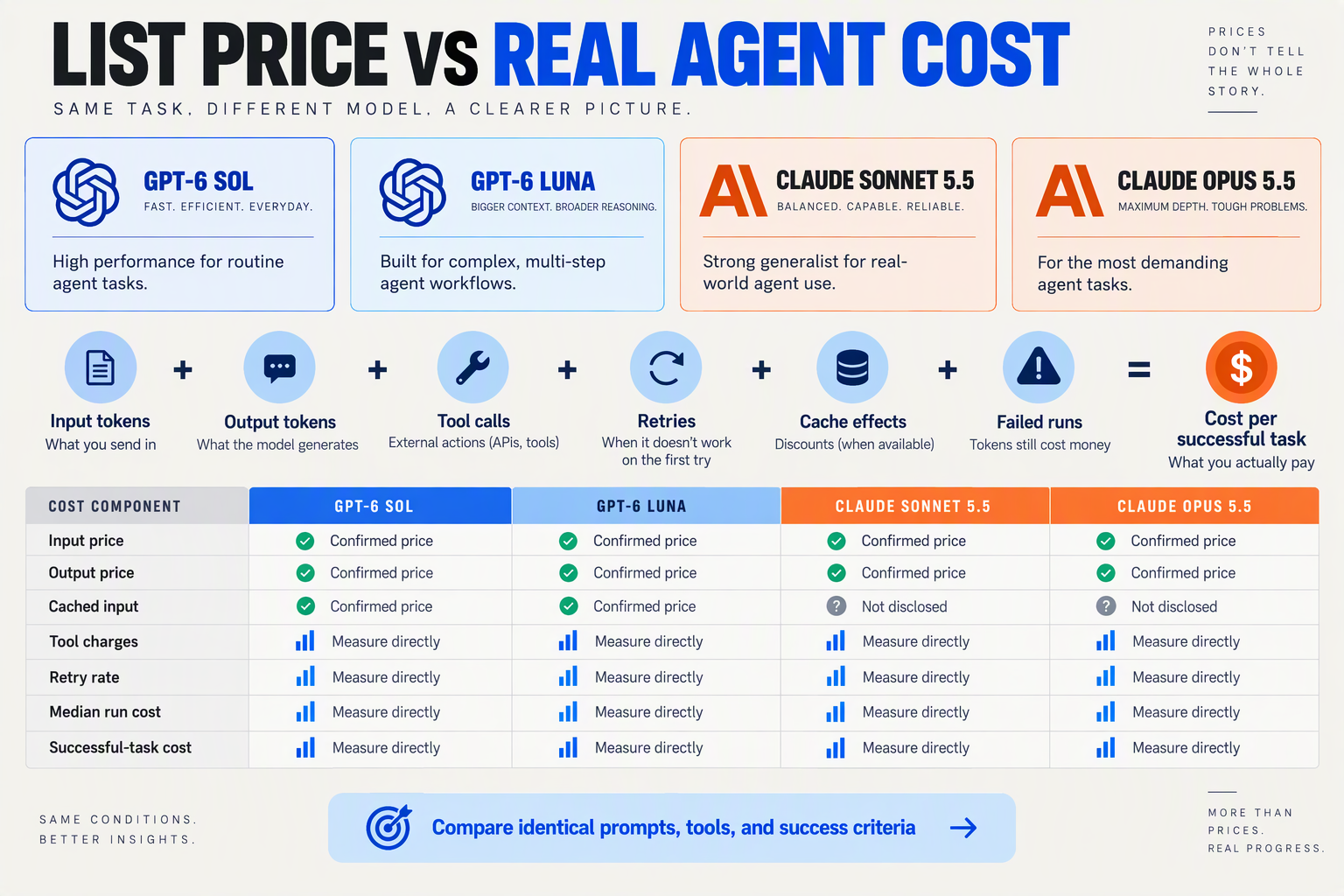
A defensible four-way price ranking is not possible as of September 29, 2026 because the supplied OpenAI and Anthropic sources do not provide comparable token prices for all four models. The meaningful metric is cost per successful task, including retries and tool calls—not the advertised cost per million tokens alone.
What pricing is confirmed for each model?
| Model | Confirmed API price | Pricing evidence | Main cost uncertainty | Cost per successful task |
|---|---|---|---|---|
| GPT-6 Sol | Not disclosed here | OpenAI API documentation confirms API use | Reasoning tokens, tools, retries | Cannot yet calculate |
| GPT-6 Luna | Not disclosed here | OpenAI announced it on September 22, 2026 | API access, tools, token rates | Cannot yet calculate |
| Claude Sonnet 5.5 | Not verified | No supplied Anthropic pricing source | Availability and complete API terms | Cannot yet calculate |
| Claude Opus 5.5 | Not verified | No supplied Anthropic pricing source | Availability and complete API terms | Cannot yet calculate |
How do you calculate the real agent-task cost?
- Core formula: cost per successful task = total inference, tool, search, storage, and retry spend ÷ successfully completed tasks.
- Illustrative example: an agent costing $0.40 per attempt with an 80% success rate costs $0.50 per successful task before external-tool fees.
- GPT-6 Sol: OpenAI’s API documentation lists six reasoning-effort settings—none, low, medium, high, xhigh, and max—which can change token consumption and therefore task economics.
- GPT-6 Sol: OpenAI confirms Responses API built-in tools and function calling, so evaluations should include every paid search, execution, and retry.
- GPT-6 Luna: OpenAI’s September 22, 2026 announcement confirms the model name, but the supplied evidence does not establish a production cost baseline.
- Claude Sonnet 5.5 and Claude Opus 5.5: do not budget from assumed lineage pricing; wait for verified Anthropic API rates and measure completion rates on the same task suite.
- Procurement rule: compare at least 100 representative tasks per model and report median cost, retry rate, completion rate, and cost per successful task.
What are the pros and cons of GPT-6 Sol, GPT-6 Luna, Claude Sonnet 5.5, and Claude Opus 5.5?
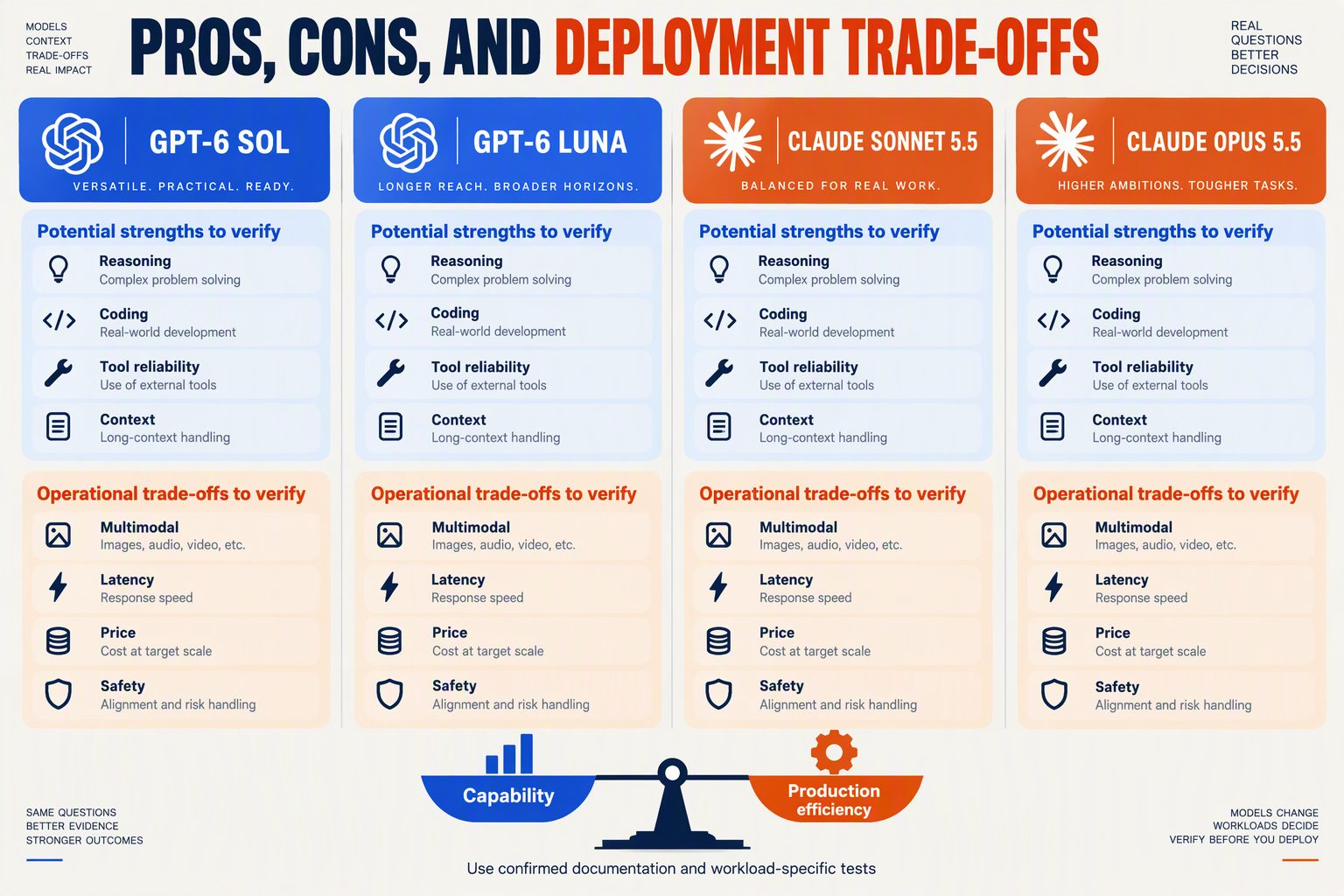
GPT-6 Sol has the strongest documented advantages for AI agents as of September 29, 2026; GPT-6 Luna and both Claude 5.5 models lack enough confirmed API detail for a balanced production comparison.
How do the four models’ advantages and drawbacks compare?
| Criterion | GPT-6 Sol | GPT-6 Luna | Claude Sonnet 5.5 | Claude Opus 5.5 |
|---|---|---|---|---|
| Availability | Confirmed by OpenAI | Announced September 22, 2026 | Not verified in supplied Anthropic sources | Not verified in supplied Anthropic sources |
| Agent advantage | Explicitly designed for complex agentic workflows | Potential general-purpose option | No confirmed advantage available | No confirmed advantage available |
| Tool support | Responses API, built-in tools and function calling | API tools not documented here | Tool interfaces not documented here | Tool interfaces not documented here |
| Reasoning control | Six effort levels from none to max | Controls not confirmed | Controls not confirmed | Controls not confirmed |
| Coding case | Explicit complex-coding positioning | Coding evidence unavailable | Coding evidence unavailable | Coding evidence unavailable |
| Main drawback | Price, latency and context limits are undisclosed in the provided evidence | Most deployment specifications remain unknown | Availability and specifications require verification | Availability and specifications require verification |
- GPT-6 Sol: OpenAI’s September 2026 developer documentation provides the clearest production path, but teams still need measured cost, latency and context-window data before scaling.
- GPT-6 Luna: OpenAI confirmed the model on September 22, 2026, yet the supplied sources provide no token pricing, context limit, benchmark scores or tool-use specification.
- Claude Sonnet 5.5: No supplied Anthropic source confirms API availability, coding performance, context capacity or pricing as of September 29, 2026.
- Claude Opus 5.5: The “Opus” name should not be treated as proof of stronger reasoning without official Anthropic documentation and reproducible agent benchmarks.
- Procurement takeaway: Keep Luna and both Claude 5.5 entries marked unverified, rather than estimating capabilities from earlier model generations.
How should GPT-6 Sol vs Claude Opus 5.5 benchmarks test real agents instead of isolated prompts?
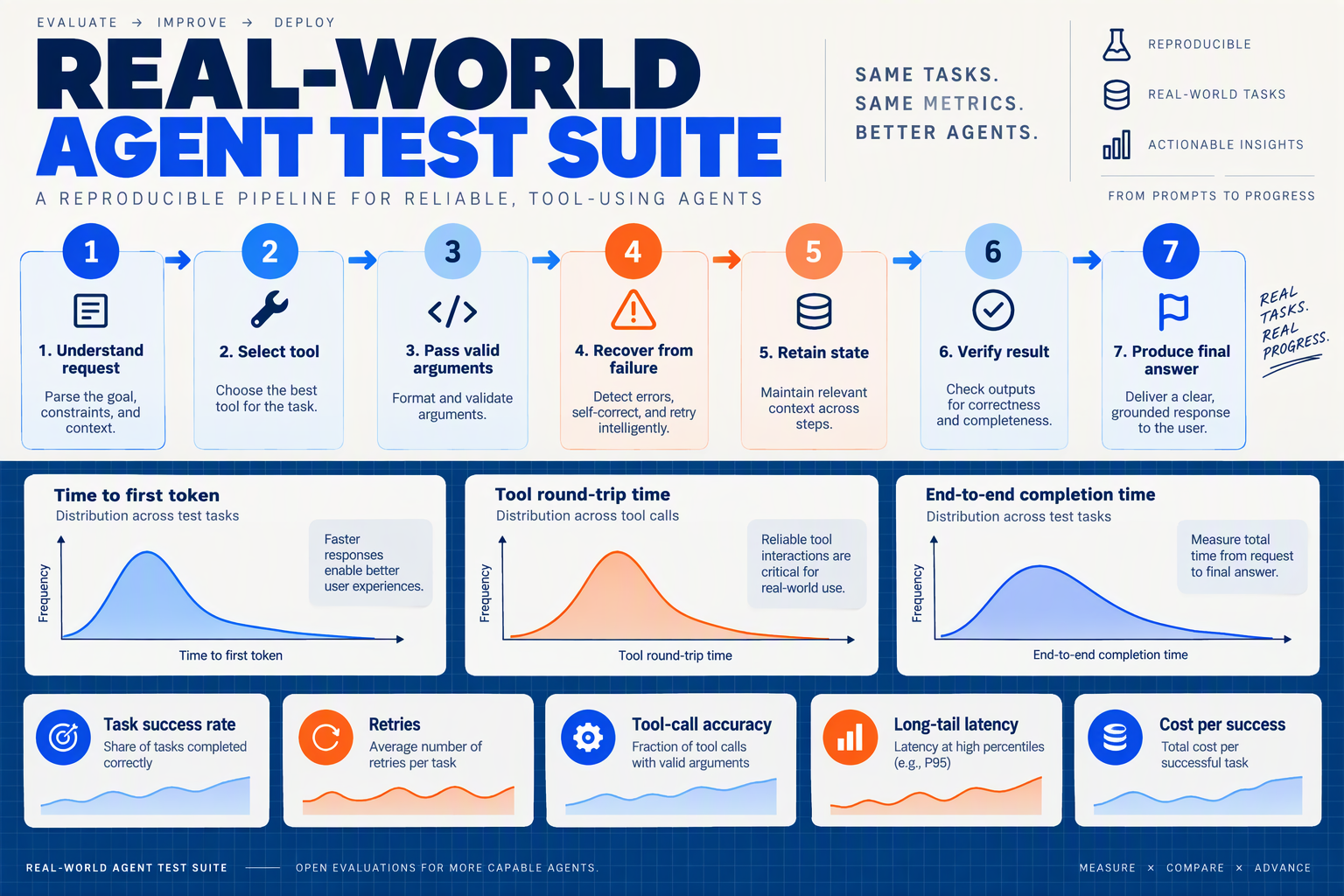
Real-agent benchmarks should measure end-to-end task completion, recovery, cost, and latency, not whether a model answers one curated prompt correctly. As of September 29, 2026, only GPT-6 Sol has enough confirmed agent-facing documentation in the supplied evidence for immediate testing.
What should an AI-agent benchmark measure?
- Availability gate: Test a model only through its production API; OpenAI confirmed GPT-6 Sol’s API support on September 22, 2026, while equivalent availability is not established here for GPT-6 Luna, Claude Sonnet 5.5, or Claude Opus 5.5.
- Tool-use reliability: Run at least 100 multi-step workflows three times each, scoring valid function selection, argument accuracy, tool-result interpretation, retries, and final completion—not merely whether a tool call was emitted.
- GPT-6 Sol: Test the OpenAI Responses API with built-in tools and function calling, both explicitly supported by OpenAI’s GPT-6 Sol model documentation as of September 2026.
- Reasoning controls: Repeat identical tasks across GPT-6 Sol’s six reasoning-effort settings—none, low, medium, high, xhigh, and max—and report quality, tokens, latency, and cost separately.
- Coding agents: Use repository-level assignments requiring code search, edits, test execution, debugging, and pull-request summaries; award full credit only when hidden tests pass without human repair.
- Long-horizon resilience: Include workflows with 10, 25, and 50 tool steps, injected API failures, malformed outputs, permission errors, and contradictory evidence to expose compounding failure rates.
- Context performance: Increase conversation and repository size until completion accuracy falls, recording usable context rather than relying on an advertised context-window maximum.
- Four-way reporting: Publish completion rate, median and p95 latency, cost per successful task, human interventions, and unsafe actions for every model; leave unsupported Claude 5.5 and GPT-6 Luna cells marked “not verified,” not estimated.
Which model should you choose for coding, research, AI receptionists, and missed-call automation?
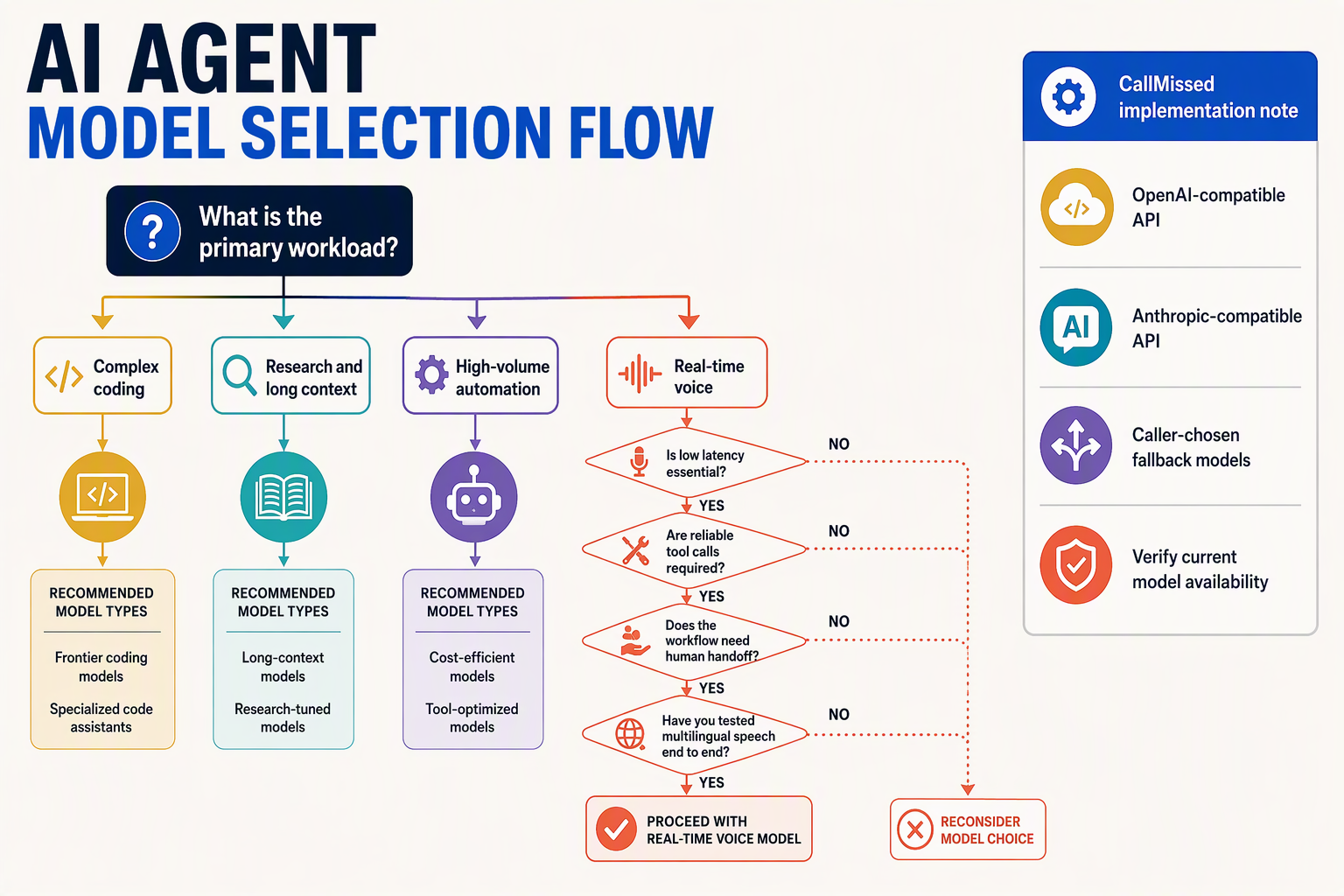
Choose GPT-6 Sol for coding and tool-based research; for voice receptionists and missed-call workflows, choose the complete communications stack before optimizing the underlying model.
Which model fits each production workload?
- Coding agents — GPT-6 Sol: OpenAI’s September 2026 API documentation explicitly targets “complex coding and agentic workflows,” with Responses API function calling and built-in tools.
- Research agents — GPT-6 Sol, provisionally: Its six reasoning settings—none, low, medium, high, xhigh, and max—allow deliberate analysis, but teams should still test citation accuracy, retrieval quality, latency, and cost on their own corpus.
- General assistants — GPT-6 Luna, pending verification: OpenAI announced GPT-6 Luna on September 22, 2026, but the supplied sources do not confirm its API access, tool support, context window, pricing, or benchmarks.
- Claude-based workflows — wait for primary documentation: Anthropic specifications confirming Claude Sonnet 5.5 and Claude Opus 5.5 are absent from the available evidence, so production selection would currently rest on assumptions rather than documented capabilities.
- AI receptionists — prioritize the voice pipeline: Evaluate speech recognition, text-to-speech, interruption handling, telephony, tool execution, and human escalation; a strong language model alone cannot answer or route a live call reliably.
- Indian-language receptionists — consider CallMissed: As of September 2026, CallMissed supports speech recognition in 22 Indian languages plus English, including Hinglish, and text-to-speech in 10 Indian languages plus English.
- Missed-call workflows — design the operational loop: Combine inbound numbers, call queues, voicemail drops, CRM notes, disposition, follow-up tasks, and controlled single outbound calls; CallMissed provides these components but does not offer automated outbound calling campaigns.
- Final decision — run an evaluation suite: Score real tasks for completion rate, tool-call accuracy, coding defects, unsupported claims, response time, and cost before committing traffic.
Frequently Asked Questions
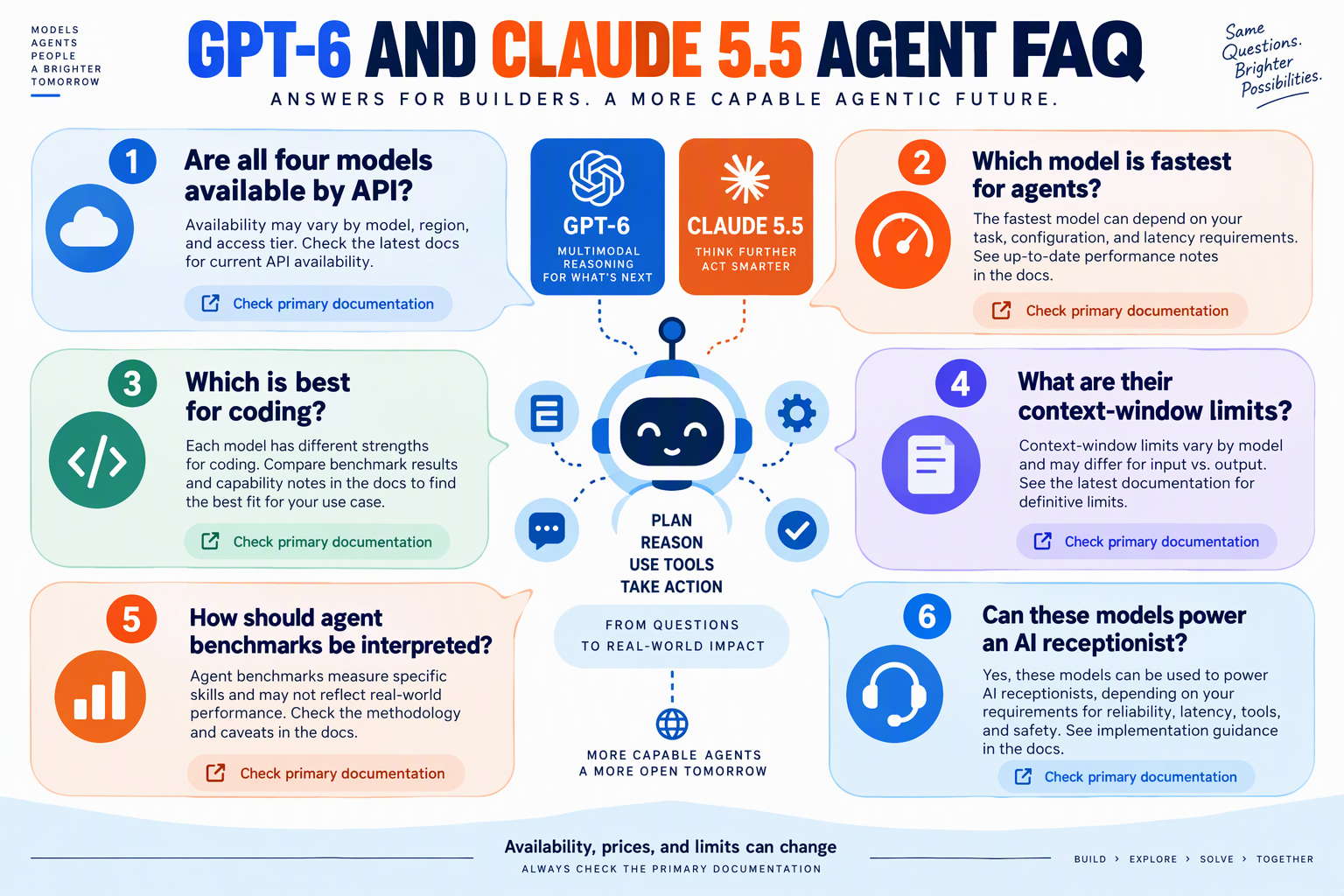
Confirmed documentation favors GPT-6 Sol for agent development, but several four-way comparisons remain impossible without verified Anthropic specifications.
- Q: Is GPT-6 Sol vs Claude Opus 5.5 available through an API?
A: OpenAI’s developer documentation confirmed the GPT-6 Sol API as of September 29, 2026. The supplied sources do not confirm API availability for Claude Opus 5.5, so production teams should verify Anthropic’s current model catalog before committing.
- Q: Which model has better tool use, GPT-6 Sol or Claude Opus 5.5?
A: OpenAI confirms that GPT-6 Sol supports built-in tools and function calling through the Responses API. No equivalent Claude Opus 5.5 tool-use documentation appears in the supplied evidence, preventing a defensible feature-for-feature verdict.
- Q: Is GPT-6 Sol better than Claude Opus 5.5 for coding agents?
A: GPT-6 Sol is the evidence-backed choice because OpenAI explicitly describes it as built for “complex coding and agentic workflows.” Claude Opus 5.5 may eventually be competitive, but no verified coding benchmarks or specifications are available here.
- Q: How do GPT-6 Sol and GPT-6 Luna differ for AI agents?
A: OpenAI announced both models on September 22, 2026, but only GPT-6 Sol has detailed agent-focused API documentation in the supplied sources. GPT-6 Luna’s tools, reasoning controls, context limit, and pricing remain unconfirmed.
- Q: Which model offers the largest context window for agents?
A: No comparable context-window figures are provided for GPT-6 Sol, GPT-6 Luna, Claude Sonnet 5.5, and Claude Opus 5.5. Teams should avoid estimating limits from earlier model generations and validate each provider’s current API documentation.
- Q: How should developers test these four models safely?
A: Use identical prompts, tool schemas, retry rules, and completion criteria while measuring task success, latency, and total cost. Multi-model infrastructure such as CallMissed’s OpenAI-compatible AI API supports caller-chosen fallback models and request logs, although teams must confirm whether each required model is currently catalogued.
Conclusion
As of September 29, 2026, the evidence favors cautious, workload-based selection:
- GPT-6 Sol has the clearest production case for coding and tool-using agents.
- Its six reasoning-effort settings offer practical control over deliberation.
- GPT-6 Luna remains promising but insufficiently documented for firm ranking.
- Claude Sonnet 5.5 and Claude Opus 5.5 require confirmed Anthropic specifications before comparison.
Watch for verified pricing, latency, context limits, benchmarks, and API availability. Explore multi-model agent architectures through CallMissed, an OpenAI-compatible AI gateway supporting 138 models. Which model will earn a place in your production stack?
Related Reading
- GPT-6 Sol vs Claude Opus 5.5: Verified 2026 Comparison
- GPT-6 Sol vs Claude Opus 5.5: 2026 Enterprise Guide
- GPT-6 Sol vs Claude Opus 5.5: Benchmarks & Cost
Sources
Discussion
Related Posts

Ready to automate customer conversations?
Launch AI voice agents and WhatsApp bots with CallMissed — one API, 22+ Indian languages.