
Claude Opus 5 vs GPT-5.6 Sol vs GPT-5.6 Terra vs GPT-5.6 Luna: July 2026 Comparison


Compare Claude Opus 5 with GPT-5.6 Sol, Terra and Luna on official pricing, context, benchmarks, speed and ideal workloads.
Claude Opus 5 vs GPT-5.6 Sol vs GPT-5.6 Terra vs GPT-5.6 Luna: July 2026 Comparison
Claude Opus 5 vs GPT-5.6 Sol vs GPT-5.6 Terra vs GPT-5.6 Luna is now a four-way comparison of released models. Anthropic launched Opus 5 on July 24, 2026, while OpenAI’s three GPT-5.6 tiers target distinct capability, value and speed requirements.
That distinction matters because model selection is becoming less about choosing one universally capable flagship and more about matching intelligence, latency, and token cost to each workload. OpenAI positions GPT-5.6 Sol as its flagship and calls it the company’s “best coding model yet.” GPT-5.6 Terra targets balanced, everyday production work, while GPT-5.6 Luna prioritizes faster, lower-cost inference. DataCamp describes Terra as delivering approximately GPT-5.5-level overall quality at about half the price, illustrating how quickly frontier performance is moving into less expensive tiers.
The price differences are substantial enough to change application architecture. Layer3 Labs reports that GPT-5.6 Sol costs $5 per million input tokens and $30 per million output tokens, compared with $5 and $25 for the currently available Claude Opus 4.8. Developers Digest reports a $1 input and $6 output price point for a lower GPT-5.6 tier, making model routing potentially more economical than sending every request to Sol. Meanwhile, ExplainX reports that Sol scored 53.6 on Agents’ Last Exam, 80.0 on the AA Coding Agent Index, and 91.9% on Terminal-Bench Ultra—though vendor-reported and third-party benchmark conditions must always be examined before drawing production conclusions.
Unannounced-model warning: Anthropic has not officially published Claude Opus 5 specifications, pricing, availability, context limits, or verified benchmark results as of July 24, 2026. Any Opus 5 capabilities discussed in this comparison will be clearly labelled expected, leaked, or speculative, rather than presented as confirmed facts. Claude Opus 4.8 will serve as the closest released reference point where appropriate.
This comparison will separate confirmed releases from rumours, examine coding, reasoning, agentic tool use, speed, context handling, and API pricing, and identify which GPT-5.6 tier best fits complex engineering, routine business automation, or high-volume inference. It will also explain what Claude Opus 5 would need to deliver to compete meaningfully with OpenAI’s tiered strategy.
For developers adopting multi-model infrastructure, platforms such as CallMissed’s OpenAI-compatible gateway reflect this shift by providing one API key and automatic same-tier fallbacks across a broad model catalogue. The result is a practical guide to choosing what can be deployed now—without mistaking anticipation for evidence.
Which model is best as of July 25, 2026: Claude Opus 5, GPT-5.6 Sol, Terra, or Luna?
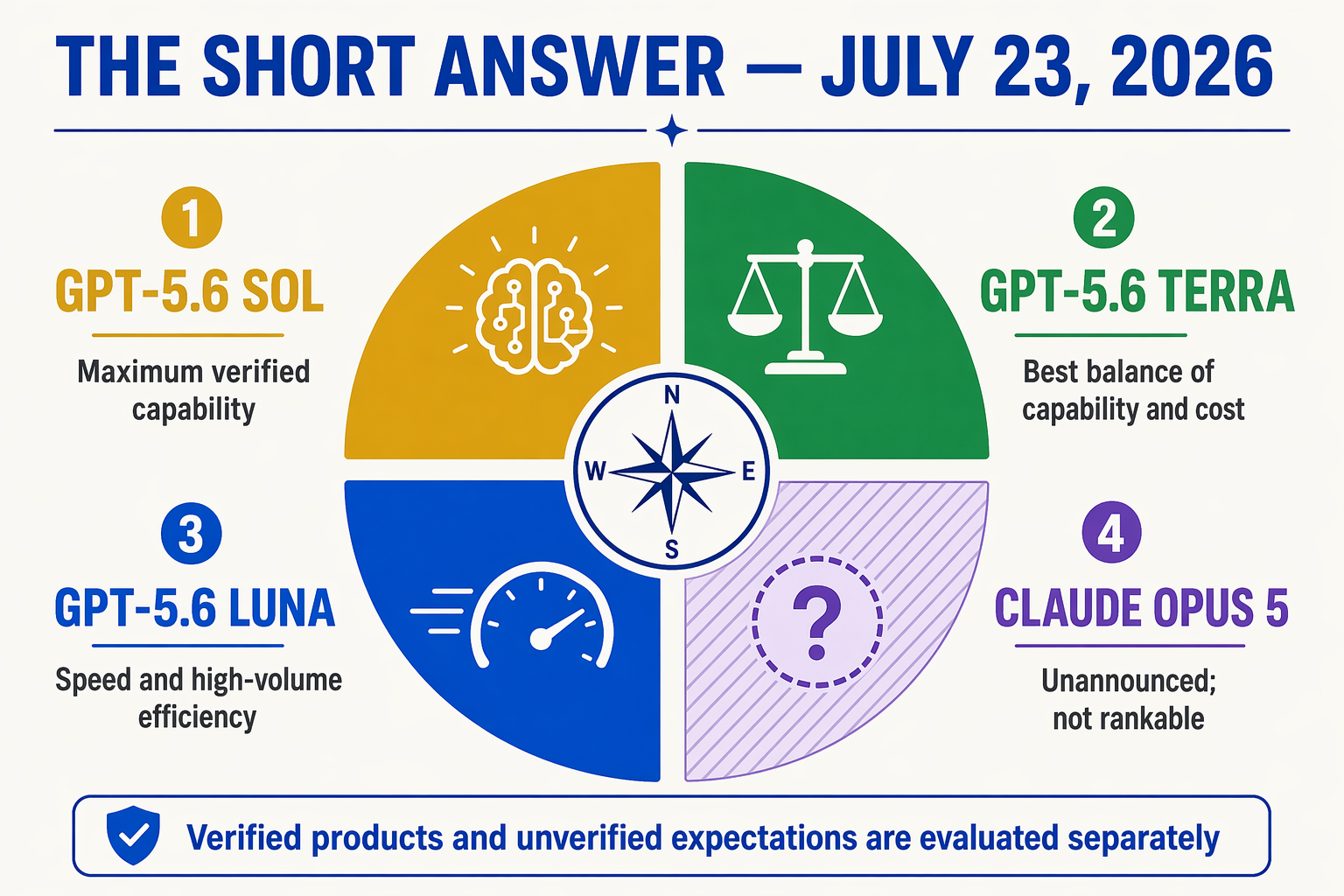
As of July 25, 2026, all four models are deployable, but they serve different priorities. GPT-5.6 Sol has OpenAI’s strongest published capability positioning, Claude Opus 5 is Anthropic’s new flagship for long-running agents, coding, and professional work, GPT-5.6 Terra offers the most practical quality-to-cost balance, and GPT-5.6 Luna targets speed and high-volume inference. There is no defensible universal top-1 model because vendor benchmarks use different tasks, tools, budgets, and scoring methodologies.
The current decision guide
- GPT-5.6 Sol — strongest OpenAI choice for maximum capability
Choose Sol for difficult coding, autonomous agents, complex reasoning, and tasks where failures cost more than additional tokens. OpenAI describes Sol as its “best coding model yet,” giving it the flagship position within the GPT-5.6 family. That positioning and OpenAI’s published evaluations are vendor evidence, not proof that Sol defeats Opus 5 or every other model on every workload.
- Claude Opus 5 — strongest candidate for long-running, context-heavy work
Anthropic launched Claude Opus 5 on July 24, 2026, positioning it for long-running agents, coding, and professional work. It is available on all platforms under the model name claude-opus-5, with a 1-million-token context window, up to 128,000 output tokens, and thinking enabled by default. Those characteristics make it especially relevant for large repositories, extensive document sets, prolonged agent sessions, and complex workflows requiring substantial intermediate reasoning.
- GPT-5.6 Terra — strongest overall value proposition
Terra is the sensible production default when an application needs substantial reasoning capability but cannot justify flagship pricing for every request. Its published price sits midway between Luna and Sol, supporting its role as the balanced GPT-5.6 tier. Whether Terra delivers the best value depends on task success rates, retries, latency, output length, and total completion cost—not token price alone.
- GPT-5.6 Luna — strongest choice for speed and scale
Luna fits classification, extraction, summarisation, routing, and other repeatable workloads where latency and throughput are primary constraints. Its lower published token prices make it attractive at high request volumes, although unusually difficult or high-risk requests should be validated or escalated rather than assigned to Luna automatically.
This Claude Opus 5 vs GPT-5.6 Sol vs GPT-5.6 Terra vs GPT-5.6 Luna comparison is therefore a deployment guide, not a universal leaderboard.
Published pricing and practical roles
The official per-million-token prices separate the models into three pricing levels:
| Model | Input tokens | Output tokens | Practical role |
|---|---|---|---|
| GPT-5.6 Luna | $1 | $6 | Fast, high-volume workloads |
| GPT-5.6 Terra | $2.50 | $15 | Balanced production default |
| GPT-5.6 Sol | $5 | $30 | OpenAI flagship and difficult escalations |
| Claude Opus 5 | $5 | $25 | Long-running agents, coding, and context-heavy professional work |
These are standard token prices, not complete workload costs. A cheaper model can become more expensive if it needs retries, longer outputs, additional validation, or frequent escalation. Conversely, sending straightforward requests to Sol or Opus 5 can waste budget without improving the result.
Opus 5 and Sol share the same published input price, while Opus 5 has the lower standard output price. That does not establish Opus 5 as the cheaper model for every workload: default thinking, output length, caching, tool calls, retries, and the number of tokens processed across a long agent run can materially change total cost.
Sol versus Opus 5
Sol remains the clearest maximum-capability choice inside OpenAI’s GPT-5.6 lineup, particularly for users relying on OpenAI’s coding and agent infrastructure. Opus 5 is now a direct flagship alternative, with Anthropic emphasizing long-running agents, coding, professional work, and very large-context tasks.
Their published benchmark numbers should not be placed into a simple winner-takes-all table unless the underlying conditions match. Differences can include:
- Prompt wording and system instructions
- Tool access and agent scaffolding
- Thinking or reasoning budgets
- Retry and sampling policies
- Time and token limits
- Dataset versions and contamination controls
- Automated graders versus human review
- Whether results are single-pass or best-of-multiple attempts
OpenAI’s and Anthropic’s results are useful evidence about their respective models, but they remain vendor-produced evaluations. The correct choice between Sol and Opus 5 should come from controlled testing on representative tasks.
Where Opus 5 changes the decision
✅ LAUNCHED JULY 24, 2026 — AVAILABLE FOR DEPLOYMENT
>
Model: claude-opus-5
Availability: All supported platforms
Standard price: $5 per million input tokens and $25 per million output tokens
Context window: 1 million tokens
Maximum output: 128,000 tokens
Reasoning mode: Thinking enabled by default
Anthropic’s positioning: Long-running agents, coding, and professional work
Verdict: Opus 5 is now a deployable flagship, but it should be compared with Sol using workload-specific tests rather than cross-vendor headline benchmarks alone.
The 1-million-token context window is particularly relevant when a workflow must retain large codebases, document collections, research records, or lengthy agent histories. Context capacity alone does not guarantee better recall or reasoning across every token, so teams should test retrieval accuracy, instruction retention, latency, and cost at realistic context lengths.
A practical routing strategy
A production system does not need to force every request through one model:
- Route large-context analysis, extended agent runs, repository-scale coding, and complex professional workflows to Claude Opus 5.
- Route difficult coding, advanced reasoning, and OpenAI-native agentic workflows to GPT-5.6 Sol.
- Send routine generation and moderately difficult analysis to GPT-5.6 Terra.
- Use GPT-5.6 Luna for latency-sensitive, repeatable, high-frequency requests.
- Escalate when a lower-cost model fails validation, encounters an unsupported tool action, or reports insufficient confidence.
- Compare total cost per successful task rather than token prices in isolation.
Third-party benchmark reporting can add context, but narrow results should not be treated as proof of general superiority. For example, a model winning an agent benchmark does not necessarily make it better for low-latency extraction, repository-scale refactoring, legal document review, or customer-facing generation.
The practical decision rule
Use Sol when you want OpenAI’s flagship capability and coding positioning, Opus 5 when long-running agents, professional work, or very large context are central, Terra when quality and unit economics must coexist, and Luna when latency, throughput, and request volume shape the product experience.
A fair Claude Opus 5 vs GPT-5.6 Sol vs GPT-5.6 Terra vs GPT-5.6 Luna evaluation should use identical prompts, tools, datasets, retry policies, latency measurements, human-review standards, and total-cost calculations. The best model is the one that achieves the required success rate under the application’s actual constraints—not the one with the most impressive isolated vendor benchmark.
What is the background to Claude Opus 5 and OpenAI’s three GPT-5.6 tiers?

The background is a strategic split: OpenAI has productized frontier intelligence into three deployable GPT-5.6 tiers, while Anthropic’s presumed Claude Opus 5 flagship remains unannounced. Consequently, Sol, Terra, and Luna can be evaluated as products; Opus 5 can only be discussed as a possible successor to Claude Opus 4.8.
OpenAI turned one model generation into three operating tiers
Rather than forcing every workload onto the same model, OpenAI designed the GPT-5.6 family around different positions on the capability–cost–latency curve:
- GPT-5.6 Sol is the frontier tier for demanding coding, reasoning, and agentic workflows. OpenAI describes GPT-5.6 Sol as its “best coding model yet,” making software engineering central to the model’s positioning.
- GPT-5.6 Terra is the balanced production tier for applications that still need strong reasoning but cannot justify flagship inference costs on every request.
- GPT-5.6 Luna is the speed-and-efficiency tier for high-volume, latency-sensitive tasks such as classification, extraction, routing, and straightforward customer interactions.
This segmentation matters because a production AI system rarely has one uniform workload. A coding agent might send architectural planning to Sol, routine code transformations to Terra, and intent classification or tool selection to Luna.
DataCamp reported in July 2026 that GPT-5.6 Terra provides approximately GPT-5.5-level overall quality at about half the price. That comparison illustrates OpenAI’s broader objective: move previously frontier-level performance into a less expensive operational tier.
Developer-focused evaluations also suggest that “smaller” no longer means incapable. Vellum reported in July 2026 that GPT-5.6 Terra and GPT-5.6 Luna both outperformed Claude Fable 5 on Agents’ Last Exam, although benchmark methodology and model settings must be reviewed before applying that finding to real deployments.
Anthropic’s Opus line represents a different flagship tradition
Anthropic has historically used Opus to identify the highest-capability model in a Claude generation, particularly for complex reasoning, coding, long-form analysis, and sustained agentic work. The currently released Claude Opus 4.8 is therefore the most defensible baseline for estimating where a future Opus model might compete.
That does not make Opus 4.8 interchangeable with Opus 5. A generational successor could change its architecture, context handling, tool-use reliability, safety controls, pricing, and latency profile.
⚠️ Unannounced-model evidence box
>
Confirmed as of July 24, 2026: Anthropic has not announced Claude Opus 5 or published an official model card, API identifier, release date, context window, benchmark suite, or token price.
>
Expected, not confirmed: The name “Opus 5” implies a flagship position above Anthropic’s lighter Claude tiers, but that inference comes from Anthropic’s historical naming structure.
>
Leaked information: No specification in this article should be treated as a verified leak unless it can be traced to Anthropic or independently corroborated reporting. Unsupported social posts and benchmark screenshots are not product documentation.
Why this history changes the comparison
The comparison is therefore asymmetrical by design:
- Sol, Terra, and Luna represent an available portfolio that can support model routing today.
- Claude Opus 4.8 provides a released reference point for Anthropic’s current flagship capabilities.
- Claude Opus 5 represents a future competitive possibility, not a selectable production model.
This distinction prevents anticipated capabilities from being ranked alongside measured ones—and keeps procurement decisions grounded in models developers can actually test, price, and deploy.
How do release status, pricing, context, benchmarks and target users compare?
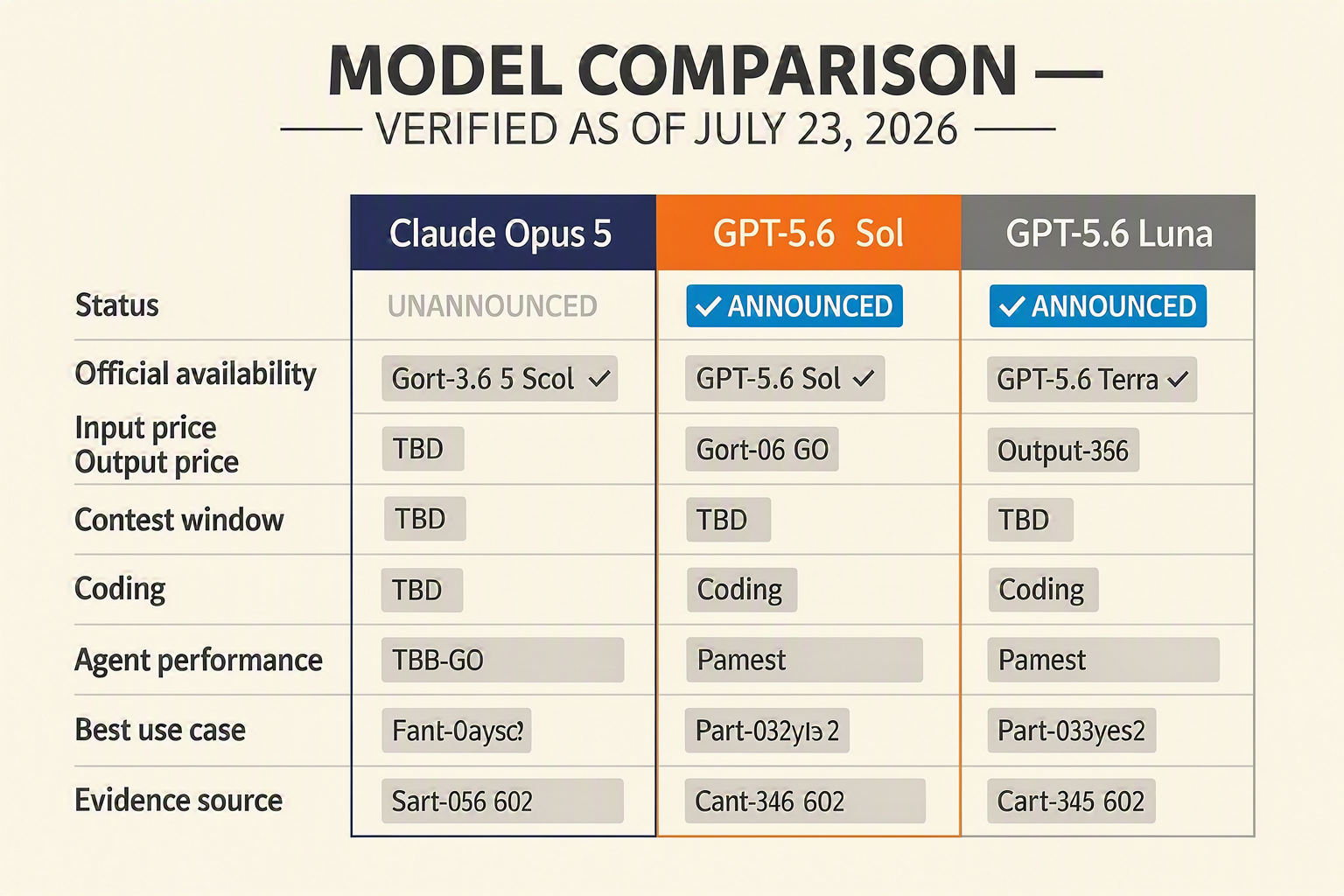
The comparison changed on July 24, 2026, when Anthropic officially released Claude Opus 5. All four models are now available, although their pricing, context limits and product positioning differ. Benchmark figures should still be treated as vendor-reported unless independently reproduced.
Four-model specification snapshot
| Category | Claude Opus 5 | GPT-5.6 Sol | GPT-5.6 Terra | GPT-5.6 Luna |
|---|---|---|---|---|
| Release status | Released July 24, 2026 | Released | Released | Released |
| Official model name | claude-opus-5 | GPT-5.6 Sol | GPT-5.6 Terra | GPT-5.6 Luna |
| Official positioning | Anthropic’s capability-focused Opus tier | OpenAI’s flagship tier | OpenAI’s balanced, lower-cost tier | OpenAI’s fastest, lowest-cost tier |
| Availability | Available across all Anthropic-supported platforms | Available through supported OpenAI products and services | Available through supported OpenAI products and services | Available through supported OpenAI products and services |
| Official API pricing | $5 input / $25 output per million tokens | $5 input / $30 output per million tokens | $2.50 input / $15 output per million tokens | $1 input / $6 output per million tokens |
| Context window | 1,000,000 tokens | Unknown | Unknown | 1,050,000 tokens |
| Maximum output | 128,000 tokens | Unknown | Unknown | 128,000 tokens |
| Default reasoning behavior | Thinking on by default | Not established here | Not established here | Not established here |
| Tier-specific benchmark evidence | Anthropic-published results are vendor-reported | No verified tier-specific numbers established here | No verified tier-specific numbers established here | No verified tier-specific numbers established here |
| Primary target user | Users prioritizing advanced reasoning and long-context capability | Users prioritizing maximum capability | Users balancing capability and cost | Users prioritizing speed, scale and low cost |
What the official specifications reveal
Claude Opus 5 is now a released product rather than a rumored model. Anthropic launched claude-opus-5 on July 24, 2026, with availability across all of its supported platforms. Its API pricing is $5 per million input tokens and $25 per million output tokens. It supports a 1-million-token context window, up to 128,000 output tokens, and has thinking enabled by default.
GPT-5.6 Sol remains OpenAI’s capability-first option. OpenAI positions it as the flagship GPT-5.6 tier. Its $5-per-million input-token rate matches Claude Opus 5, while its $30-per-million output-token rate is $5 higher.
GPT-5.6 Terra is the middle tier. Its official $2.50 input / $15 output pricing is exactly half Sol’s listed rates, matching OpenAI’s balanced, lower-cost positioning.
GPT-5.6 Luna is optimized for speed and economics. It has the lowest official pricing at $1 input / $6 output per million tokens. OpenAI lists a 1,050,000-token context window and 128,000-token maximum output, giving Luna a slightly larger stated context window than Claude Opus 5 while matching its maximum output length.
How buyers should interpret the comparison
- Claude Opus 5’s release date, model name, availability, pricing, context window, maximum output and default thinking behavior are now official rather than rumor-based.
- Do not substitute specifications from an earlier Claude Opus release for
claude-opus-5. - Treat benchmark numbers published by Anthropic or OpenAI as vendor-reported unless an independent evaluator reproduces them under comparable conditions.
- Do not apply family-level GPT-5.6 benchmark results to Sol, Terra or Luna unless OpenAI explicitly reports results for that individual tier.
- “Unknown” does not mean a feature is absent; it means a tier-specific value is not established by the primary-source information used for this comparison.
- Pricing alone does not determine total workload cost. Default reasoning, output length, retries, caching, latency and tool calls can materially affect actual spend.
- Test candidate models with representative prompts and tools, measuring task success, latency, token consumption and total cost before choosing a production tier.
What are the practical differences between GPT-5.6 Sol, Terra and Luna?
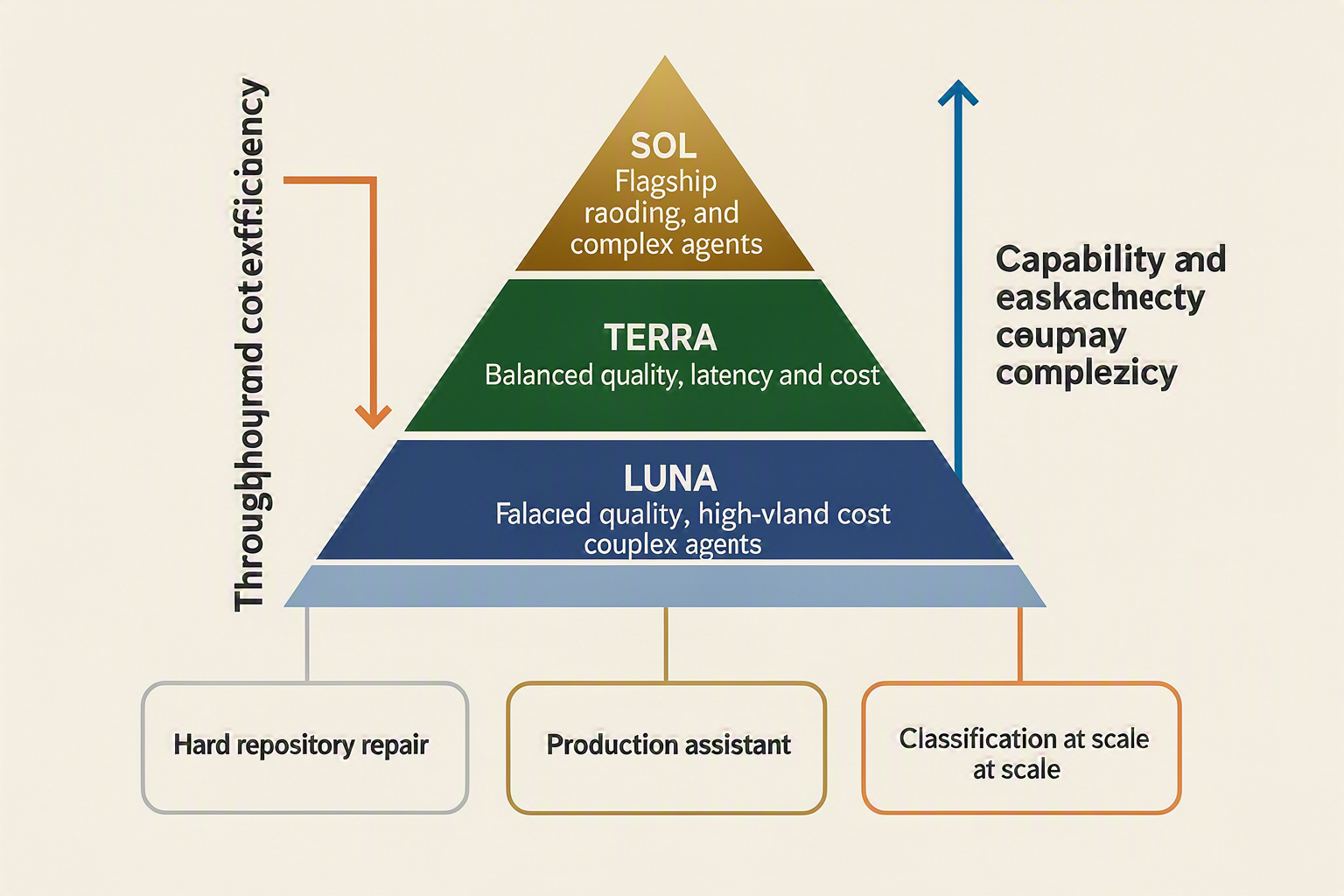
GPT-5.6 Sol, Terra and Luna differ primarily in how much reasoning depth, latency and cost they allocate to each request. Sol is appropriate when failure is expensive, Terra is the production default for mixed workloads, and Luna is designed for fast, high-volume tasks where marginal intelligence gains have limited value.
1. Sol raises the capability ceiling
Choose GPT-5.6 Sol for difficult coding, multi-step reasoning and autonomous workflows that must recover from errors. OpenAI describes Sol as its “best coding model yet” and says GPT-5.6 can write and execute lightweight programs, making Sol particularly relevant to software agents rather than simple code completion.
Practical Sol workloads include:
- Debugging failures spanning several services or repositories
- Planning and executing long tool-use sequences
- Reviewing security-sensitive or production-critical code
- Synthesising evidence from conflicting documents
- Handling uncommon requests that cannot be reliably templated
The trade-off is economic. Layer3 Labs reported in July 2026 that GPT-5.6 Sol costs $5 per million input tokens and $30 per million output tokens. At those rates, processing 10 million input tokens and generating two million output tokens would cost $110. Sol’s output tokens are also six times as expensive as its input tokens, so verbose agent loops can quickly inflate expenditure.
2. Terra is the operational default
GPT-5.6 Terra is better suited to workloads requiring consistently strong results without flagship inference on every request. DataCamp characterises Terra as approximately matching GPT-5.5’s overall quality while costing roughly half as much, although teams should validate that claim against their own prompts and evaluation sets.
Terra’s practical territory includes:
- Customer-support response generation
- Structured extraction from invoices, forms and emails
- Marketing and internal business writing
- Routine code generation and pull-request assistance
- Knowledge-base question answering with retrieval-augmented generation
Terra should therefore be the starting tier, not merely a fallback from Sol. A request can escalate only when Terra detects low confidence, repeated tool failure, ambiguous evidence or unusually complex code.
3. Luna optimises throughput and responsiveness
GPT-5.6 Luna prioritises lower-cost, faster inference for short or predictable tasks. “Faster” should not be interpreted as a universal latency guarantee: actual response time depends on token volume, reasoning settings, tool calls, provider load and geographic routing.
Luna is the logical choice for:
- Classification, tagging and intent detection
- Query rewriting and search-result summarisation
- High-volume content moderation triage
- Short conversational replies
- Extracting fields from well-structured text
Importantly, lower-tier does not mean non-agentic. Vellum reported in July 2026 that both Terra and Luna outperformed Claude Fable 5 on Agents’ Last Exam, indicating that economical models can still complete meaningful agent tasks under benchmark conditions.
A practical three-tier routing policy
A production system can use the family as an escalation ladder:
- Send deterministic, short requests to Luna.
- Route open-ended business and coding work to Terra.
- Escalate failed, high-risk or deeply agentic tasks to Sol.
- Log quality, latency and total generated tokens by route.
- Re-evaluate with real workload tests rather than leaderboard scores alone.
This architecture converts model selection from a permanent commitment into a request-level decision, balancing capability with measurable operational cost.
What is officially confirmed about Claude Opus 5, and which performance questions remain open?
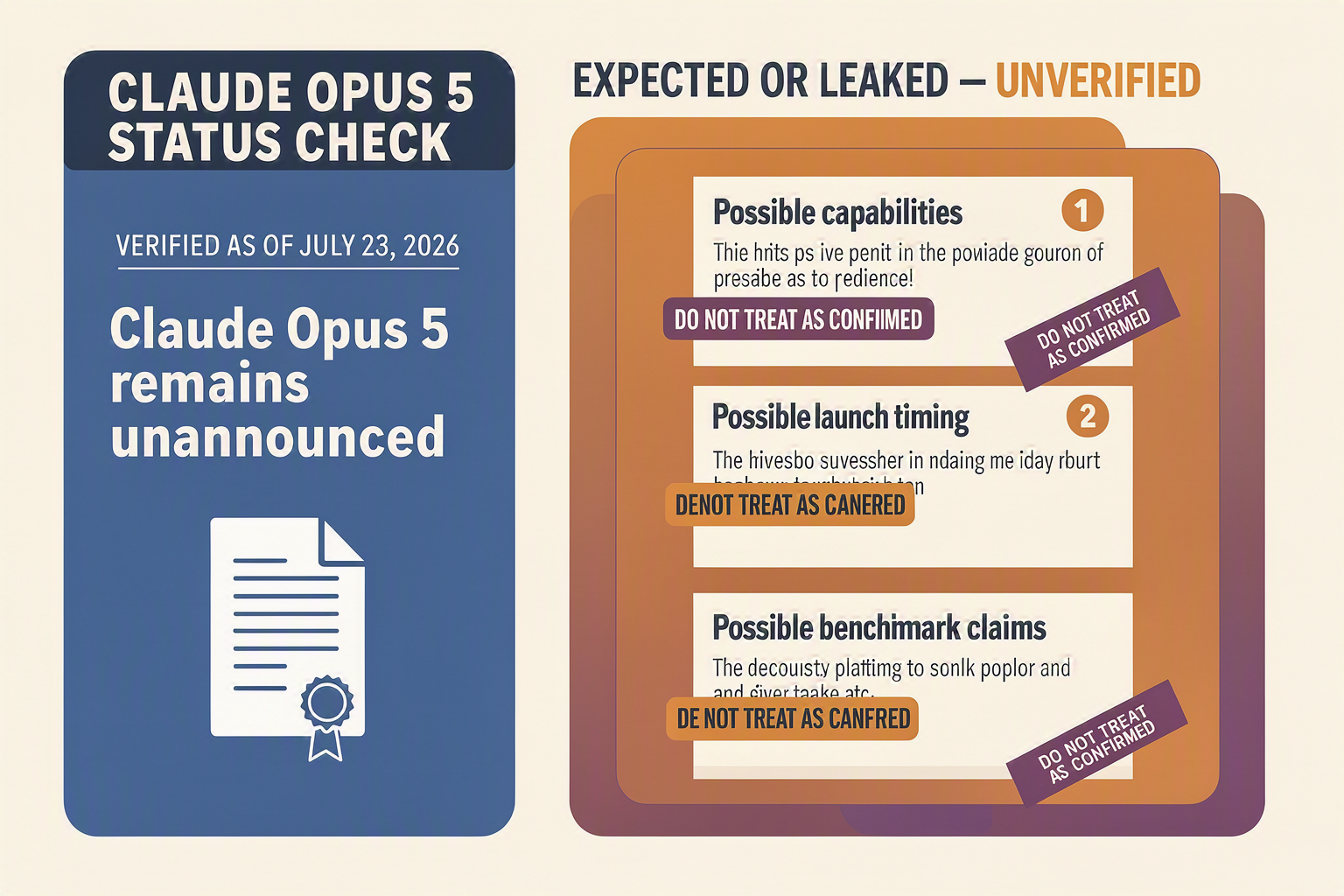
As of July 24, 2026, the only defensible conclusion is that Anthropic has not officially announced Claude Opus 5. No confirmed model card, API identifier, release date, pricing, context window, benchmark table, or availability information exists in the cited evidence, so Opus 5 must remain an unranked prospective model rather than a deployable GPT-5.6 competitor.
Confirmed facts versus assumptions
The evidence supports a short list of facts:
- Anthropic has not published an official Claude Opus 5 announcement as of July 24, 2026.
- Claude Opus 4.8 remains the appropriate released reference model for estimating where a future Opus flagship might begin.
- Layer3 Labs reports that Claude Opus 4.8 costs $5 per million input tokens and $25 per million output tokens, compared with $5 and $30 for GPT-5.6 Sol.
- No cited Anthropic model card verifies an Opus 5 score for coding, reasoning, agentic tool use, hallucination resistance, latency, or long-context retrieval.
That last point is critical. A benchmark number attributed to “Opus 5” without an Anthropic announcement, reproducible evaluation methodology, or accessible production model should not be placed beside published GPT-5.6 results as though both have equal evidentiary weight.
UNVERIFIED — NOT PRODUCT SPECIFICATIONS
>
Any claimed Claude Opus 5 release date, benchmark score, token price, context limit, parameter count, latency figure, or API model name remains unverified unless Anthropic publishes it through official documentation or a model card.
What can reasonably be expected—but not claimed as fact
Product history makes several improvements plausible, but plausibility is not confirmation. A future Claude Opus 5 would reasonably be expected to target:
- Stronger software-engineering performance, including repository-scale code understanding and longer autonomous coding tasks.
- More dependable agentic tool use, especially planning, browser interaction, command execution, and recovery after failed actions.
- Better long-context reliability, which means retrieving and applying relevant information—not merely advertising a larger token limit.
- Improved safety and controllability, areas central to Anthropic’s model-development positioning.
- A competitive quality-to-cost ratio against GPT-5.6 Sol and lower-priced GPT-5.6 Terra.
These are analytical expectations based on what a next-generation flagship would need to compete; they are not leaks and should not be represented as Anthropic commitments.
How to evaluate future “leaks”
Readers should apply a simple evidence ladder to every Opus 5 claim:
- High confidence: Anthropic documentation, API pricing pages, system cards, or reproducible access.
- Medium confidence: Named publications citing identifiable documents or multiple independent sources.
- Low confidence: Screenshots without provenance, anonymous social posts, benchmark charts lacking test settings, or supposed API names that cannot be called.
Pricing deserves particular caution. Claude Opus 4.8’s reported $5/$25 per-million-token pricing provides a baseline, but it does not prove that Opus 5 will retain, raise, or lower those rates. Likewise, OpenAI’s tiered Sol–Terra–Luna strategy may pressure Anthropic to adjust packaging, yet no verified evidence establishes an equivalent Opus 5 tier structure.
Until Anthropic publishes primary documentation, procurement teams should benchmark Claude Opus 4.8 against GPT-5.6 Sol, Terra, and Luna, while treating Opus 5 as a future evaluation slot—not a production option.
Which model is strongest for coding, autonomous agents, reasoning and long workflows?
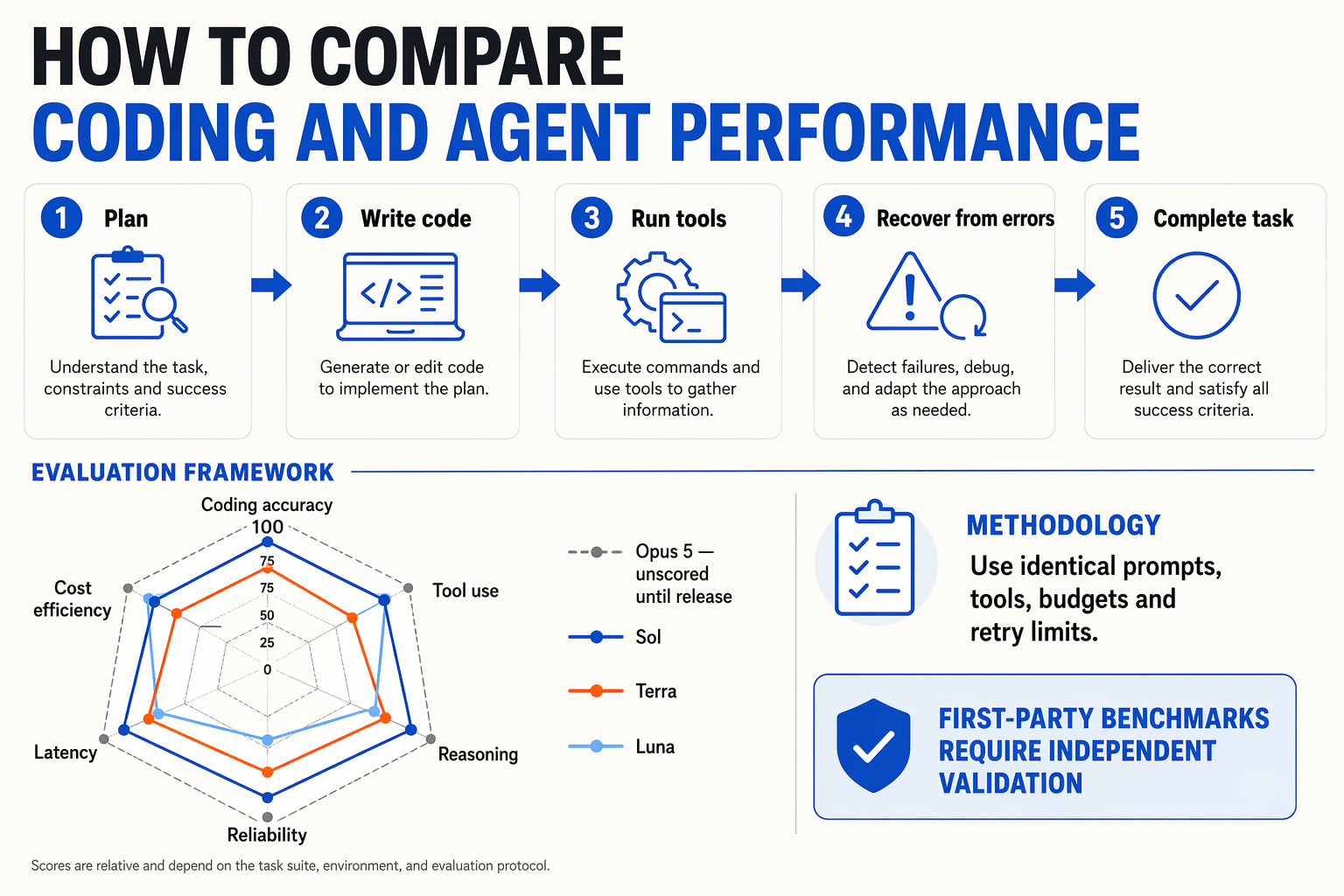
GPT-5.6 Sol is the strongest verified choice for coding, autonomous agents, reasoning, and long-running workflows as of July 24, 2026. GPT-5.6 Terra is the more economical production default, GPT-5.6 Luna suits fast and bounded tasks, and the unannounced Claude Opus 5 cannot be credibly ranked without official specifications or reproducible tests.
Coding: Sol leads the released models
OpenAI explicitly describes GPT-5.6 Sol as its “best coding model yet,” while the available benchmark evidence supports using Sol for complex software engineering rather than simple code completion.
- ExplainX reported in July 2026 that GPT-5.6 Sol scored 80.0 on the AA Coding Agent Index.
- ExplainX reported in July 2026 that GPT-5.6 Sol achieved 91.9% on Terminal-Bench Ultra, a benchmark focused on practical terminal-based work.
- Developers Digest reported that a lower-priced GPT-5.6 tier, priced at $1 per million input tokens and $6 per million output tokens, exceeded Claude Opus 4.8 in OpenAI’s coding-index comparison.
That makes Terra compelling for routine implementation, test generation, refactoring, and pull-request review. Luna is better reserved for low-latency transformations, syntax assistance, classification, or straightforward fixes where extended deliberation adds little value.
Autonomous agents: capability must survive multiple steps
Agent performance depends on more than one-shot reasoning. A useful model must select tools, interpret results, recover from errors, maintain state, and avoid compounding mistakes over dozens of actions.
ExplainX reported in July 2026 that GPT-5.6 Sol scored 53.6 on Agents’ Last Exam. Vellum also reported that GPT-5.6 Terra and GPT-5.6 Luna outperformed Claude Fable 5 on Agents’ Last Exam, indicating that OpenAI’s lower tiers retain meaningful agentic capability.
A practical deployment hierarchy is therefore:
- Sol: repository-scale coding agents, open-ended research, terminal operation, and high-consequence automation.
- Terra: customer-support workflows, CRM actions, document processing, and agents operating through well-defined tools.
- Luna: routing, extraction, triage, and short tool sequences with strong external validation.
Reasoning: benchmark leadership is not universal reliability
Sol is the safest evidence-based choice for difficult planning and reasoning, but a benchmark score should not be treated as a guarantee. Results can change with prompt scaffolding, reasoning budgets, tool access, retry policies, and evaluation harnesses.
Teams should test models on private workloads using:
- End-to-end task completion rates
- Tool-call and schema accuracy
- Human correction frequency
- Cost per successfully completed task
- Performance degradation as workflow length increases
Long workflows: choose endurance, then control cost
For long-horizon work, Sol offers the strongest available combination of coding and agent evidence. Terra may deliver better economics when workflows are constrained by checkpoints, deterministic tools, and human approval. Luna is most appropriate for inexpensive subtasks inside a larger orchestrated system.
Unannounced-model warning: Anthropic had not announced Claude Opus 5 by July 24, 2026. Claims that it will surpass Sol in coding, reasoning, context retention, or agent endurance remain expected or speculative, because Anthropic has published no verified Opus 5 benchmarks, context limits, API pricing, or availability date.
Until comparable evaluations exist, Claude Opus 5 is a watchlist candidate—not a deployable winner.
How could these model tiers change AI deployment, pricing and vendor competition?
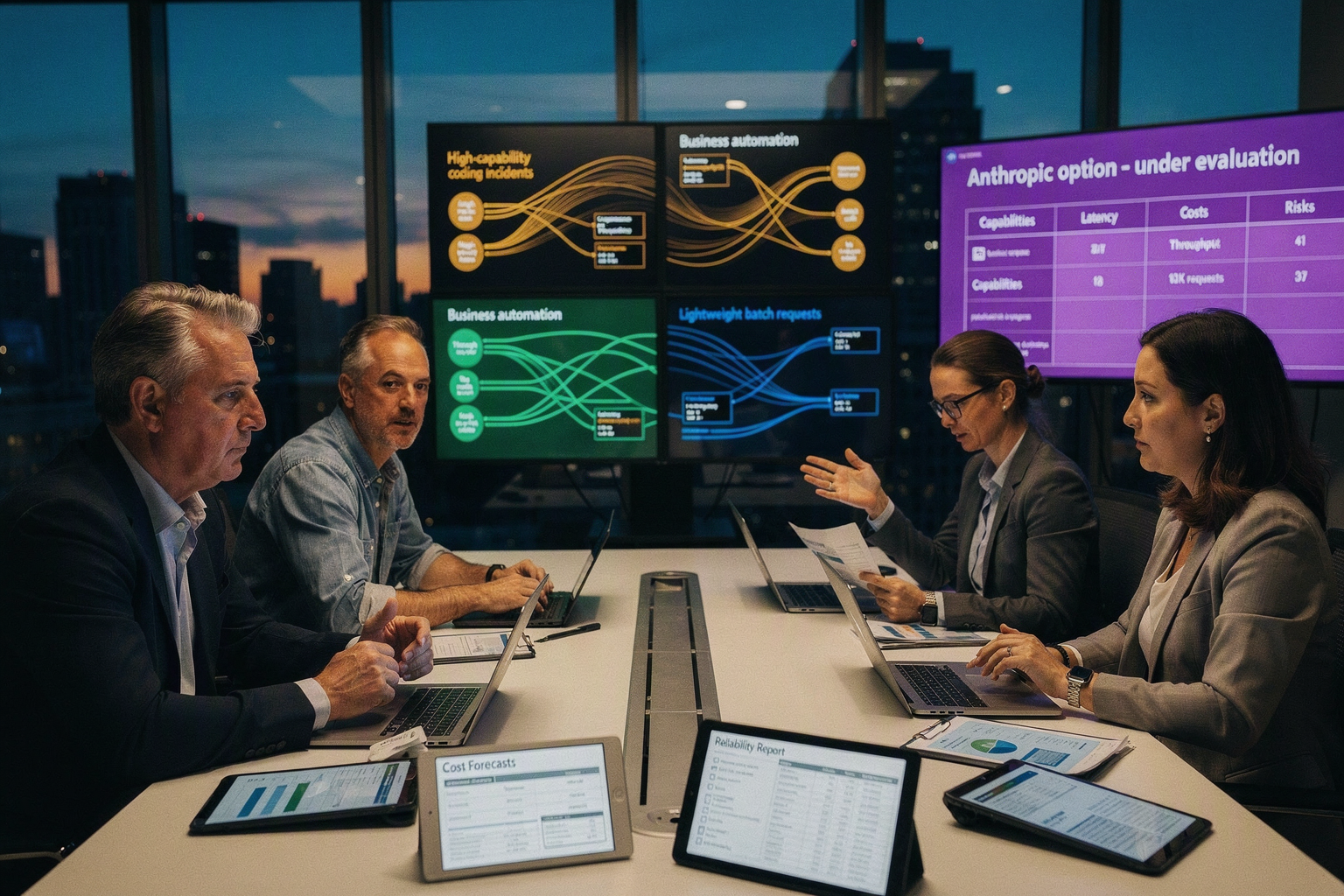
The three-tier GPT-5.6 family could shift AI deployment from one-model standardisation to policy-based routing, where each request receives only the intelligence it needs. Pricing competition may therefore move beyond flagship token rates toward the cost, reliability and operational simplicity of an entire model portfolio.
Deployment becomes a routing problem
Instead of sending every task to GPT-5.6 Sol, production systems can classify requests by complexity:
- Route difficult work to Sol: repository-scale coding, multi-step agents, consequential analysis and difficult debugging.
- Route routine work to Terra: document processing, structured extraction, customer-support automation and standard code generation.
- Route high-volume work to Luna: classification, rewriting, summarisation and latency-sensitive interactions.
- Escalate dynamically: retry a failed Luna or Terra task with Sol rather than paying flagship rates from the beginning.
OpenAI describes GPT-5.6 Sol as its “best coding model yet,” while DataCamp characterised GPT-5.6 Terra in July 2026 as offering approximately GPT-5.5-level overall quality at about half the price. That combination encourages developers to measure cost per successfully completed task, not simply benchmark score or cost per token.
Multi-model infrastructure also becomes more valuable. CallMissed’s OpenAI-compatible gateway, for example, reflects this architecture by exposing multiple LLMs and automatic same-tier fallbacks through one integration, alongside speech, image and search models.
Token economics will shape application design
Output-heavy agents can become expensive because generated tokens frequently carry the higher rate. Layer3 Labs reported in July 2026 that GPT-5.6 Sol costs $5 per million input tokens and $30 per million output tokens, while Claude Opus 4.8 costs $5 and $25 respectively.
For a workload consuming one million input tokens and producing 200,000 output tokens, those published rates imply:
- GPT-5.6 Sol: $5 input plus $6 output, or $11 total.
- Claude Opus 4.8: $5 input plus $5 output, or $10 total.
Developers Digest reported in July 2026 that a lower GPT-5.6 tier has a $1 input and $6 output price per million tokens. At those rates, the same workload would cost $2.20, an 80% reduction from Sol—provided the lower tier completes the task reliably enough to avoid costly retries or human review.
This creates incentives to reduce verbose outputs, cache reusable context, constrain agent loops and reserve frontier reasoning for verified escalation points.
Vendor competition moves from models to portfolios
OpenAI’s strategy pressures competing vendors to offer more than one premium endpoint. Buyers will increasingly compare:
- Coverage across capability and latency tiers
- Fallback behaviour and uptime
- Batch, cache and long-context economics
- Tool-use reliability and observability
- API compatibility and migration effort
Unannounced-model boundary: Anthropic had not announced Claude Opus 5 as of July 24, 2026. Its tiers, pricing and deployment characteristics remain speculative; Claude Opus 4.8 is the valid released comparison point.
If Claude Opus 5 launches, pricing alone will not determine its competitiveness. Anthropic would need to show a compelling combination of agent reliability, coding performance, latency, context handling and total task cost. The broader winner may be neither individual flagship: it may be the ecosystem that makes intelligent routing, fallback and cost control easiest to operate.
Which model should you choose for your workload and budget?
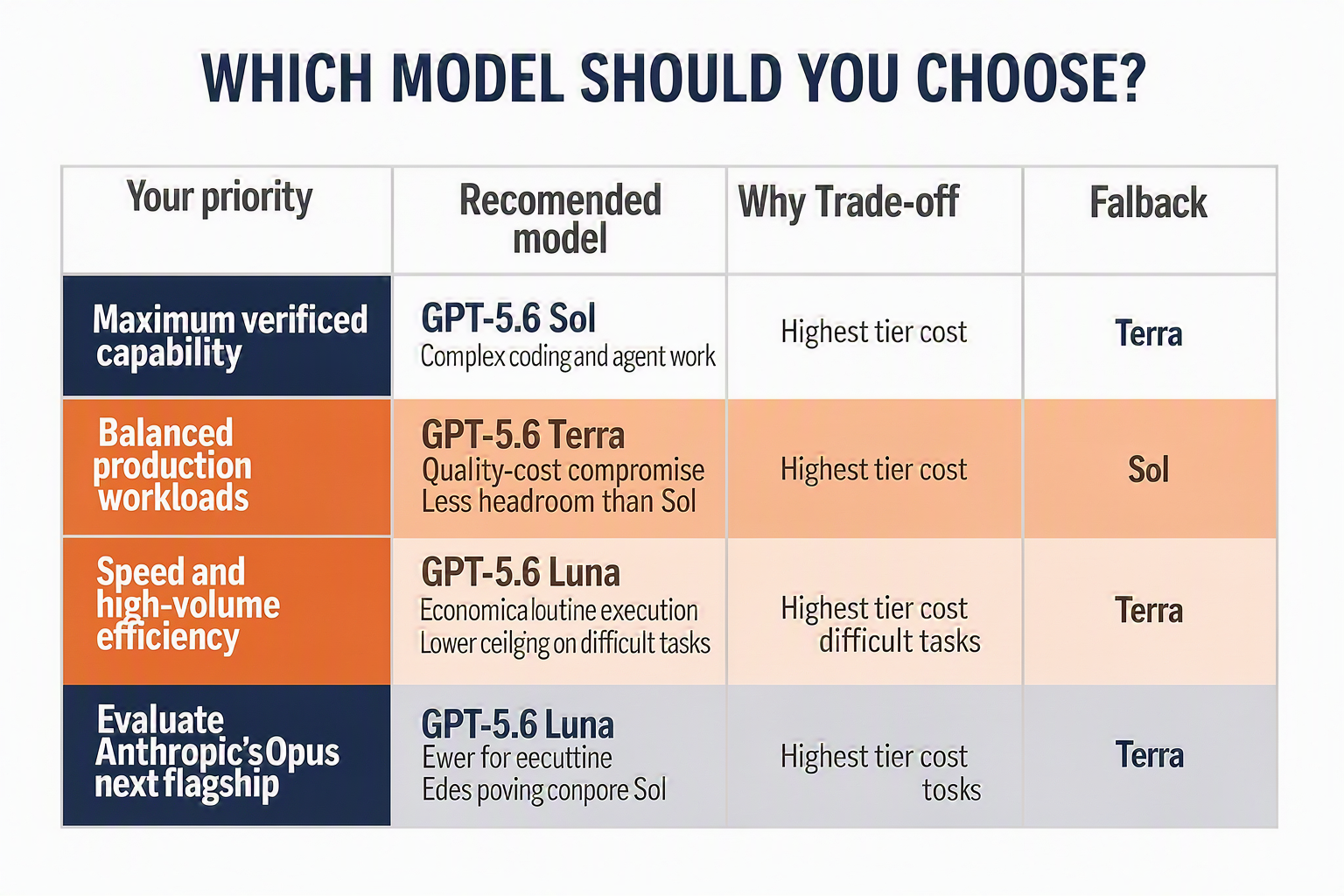
Choose GPT-5.6 Sol when failure costs more than inference, GPT-5.6 Terra for the strongest balance of quality and budget, and GPT-5.6 Luna for latency-sensitive, high-volume tasks. Do not select Claude Opus 5 for a production launch yet because Anthropic had not announced its availability, specifications, or price as of July 24, 2026.
Workload-to-model decision table
| Model | Best-fit workloads | Budget position | Key trade-off | Deployment verdict |
|---|---|---|---|---|
| GPT-5.6 Sol | Complex coding, autonomous agents, difficult reasoning, high-stakes analysis | Premium: $5 input/$30 output per million tokens | Highest verified capability here, but expensive for routine traffic | Choose when accuracy and task completion justify premium inference |
| GPT-5.6 Terra | Customer support, RAG, document processing, business automation, general coding | Mid-tier; DataCamp says roughly GPT-5.5 quality at about half the price | Better economics than Sol, with less headroom for the hardest tasks | Best default for many production applications |
| GPT-5.6 Luna | Classification, extraction, routing, short responses, real-time interfaces | Lowest-cost GPT-5.6 tier; verify exact API pricing before budgeting | Prioritises speed and cost over maximum reasoning depth | Choose for simple, frequent, latency-sensitive requests |
| Claude Opus 5 | Potentially advanced reasoning, coding and long-running agents | Unknown | No confirmed API, price, context limit or benchmark evidence | Evaluate after release; do not base current capacity plans on leaks |
Layer3 Labs reported in July 2026 that GPT-5.6 Sol costs $5 per million input tokens and $30 per million output tokens. At those rates, an application processing 10 million input tokens and generating 2 million output tokens would spend $110, excluding platform fees, caching, tools and retries.
Developers Digest reported a $1 input and $6 output per million-token price point for a lower GPT-5.6 tier in 2026, but the supplied evidence does not unambiguously assign that price to Terra or Luna. Procurement teams should therefore confirm the live OpenAI price sheet rather than treating that figure as a guaranteed Luna rate.
Match model cost to the cost of failure
A practical routing policy should consider more than token price:
- Use Sol for repository-wide refactoring, security-sensitive code review, multi-tool agents and decisions where a failed run creates expensive human rework.
- Use Terra as the primary model for knowledge-base RAG, sales-assistance workflows, document summarisation and multi-step support automation.
- Use Luna for intent detection, lead qualification, structured extraction, moderation pre-filters and first-pass request routing.
- Escalate from Luna to Terra or Sol only when confidence is low, tools fail or the request exceeds a defined complexity threshold.
For perspective, ExplainX reported in July 2026 that GPT-5.6 Sol scored 53.6 on Agents’ Last Exam, 80.0 on the AA Coding Agent Index and 91.9% on Terminal-Bench Ultra. Those results support Sol for demanding agentic work, but teams should still test their own prompts, tool schemas and latency constraints.
Unannounced-model warning: Any Claude Opus 5 workload recommendation remains speculative as of July 24, 2026. Anthropic has not confirmed Claude Opus 5 pricing, availability, context capacity or benchmark performance, so Claude Opus 4.8—not rumours—is the defensible baseline for current purchasing decisions.
A budget-efficient production pattern
Start with Terra as the default, route repetitive requests to Luna, and reserve Sol for escalations. Multi-model gateways can make that policy easier to operate: CallMissed’s OpenAI-compatible gateway, for example, provides access to multiple model categories through one API key with automatic same-tier fallbacks, reducing the integration work required for workload-based routing.
What do experts say, and how should vendor claims and benchmark results be interpreted?
Expert commentary supports a workload-specific verdict, not a universal winner. OpenAI positions GPT-5.6 Sol as the highest-capability option, Terra as a more economical production model, and Luna as the speed-and-scale tier. Those positions are not interchangeable benchmark conclusions: each model must be evaluated separately under equivalent settings.
No credible comparison can yet include Claude Opus 5. As of July 24, 2026, Anthropic had not announced that model or published confirmed specifications, pricing, API availability, or benchmark results.
What the published claims actually establish
OpenAI calls GPT-5.6 Sol its “best coding model yet.” This is an official but vendor-reported claim, not an independently reproduced verdict. It may indicate improvement under OpenAI’s evaluation setup, but it does not prove that Sol leads every model on every software-development workload.
Third-party articles have reported benchmark and price comparisons involving GPT-5.6 models. However, exact figures should not be treated as verified when the underlying primary report does not disclose enough information to reproduce the test. In particular:
- Results reported for Sol cannot be attributed to Terra or Luna. The models may differ in capability, latency, price, reasoning behavior, and tool use.
- A result for Terra or Luna on one agent benchmark does not establish superiority in coding, writing, multilingual support, document processing, or customer service.
- Vendor-created coding indexes should be treated as vendor-reported evidence, even when republished by independent publications.
- Price comparisons are incomplete unless they include output length, reasoning tokens, tool calls, retries, failures, and human-review costs.
Evidence boundary: No Claude Opus 5 benchmark exists as of July 24, 2026. Scores from earlier Claude models cannot be relabeled as Opus 5 results, while leaks, forecasts, and extrapolations are not validated evidence.
How benchmark results should be interpreted
Do not combine scores from unrelated evaluations into a synthetic “overall intelligence” rating. Agent, coding, terminal, and knowledge benchmarks test different abilities, often with different tools and scoring rules.
Before relying on any headline result, ask:
- Is there a primary source? Look for an official model card, technical report, benchmark repository, or independently published evaluation—not only an aggregator’s summary.
- Is the methodology reproducible? The report should identify the dataset version, prompt format, model snapshot, scoring method, and evaluation date.
- Were the settings comparable? Reasoning effort, tool access, scaffolding, context limits, timeouts, retry budgets, and pass@1 versus best-of-N can materially affect scores.
- Was contamination addressed? Public benchmark questions may appear in training data or optimization loops, making results less representative of unseen work.
- Does the test resemble the intended workload? Terminal-agent performance says little by itself about voice support, brand-safe writing, multilingual conversations, or document extraction.
- What did each successful task cost? Per-token pricing does not capture retries, long outputs, tool calls, latency, failed runs, or human correction.
Concise checklist for comparable model testing
Run a blinded evaluation with the same:
- production-representative prompts and scoring rubric;
- model versions, system instructions, tools, and context;
- temperature, reasoning effort, timeout, and retry policy;
- pass@1 or best-of-N rule;
- task-success, hallucination, and structured-output measures;
- median and p95 latency reporting;
- input, output, tool, retry, and review costs;
- language, document-type, and difficulty breakdowns;
- repeated trials and documented failure cases.
The defensible choice is conditional: test Sol where maximum capability could improve completion rates, Terra where cost-adjusted quality matters most, and Luna where latency and throughput are priorities. Keep Claude Opus 5 outside scored procurement matrices until Anthropic releases the model and publishes evidence that can be evaluated on comparable terms.
Frequently asked questions: Is Claude Opus 5 released, and which GPT-5.6 tier is best?
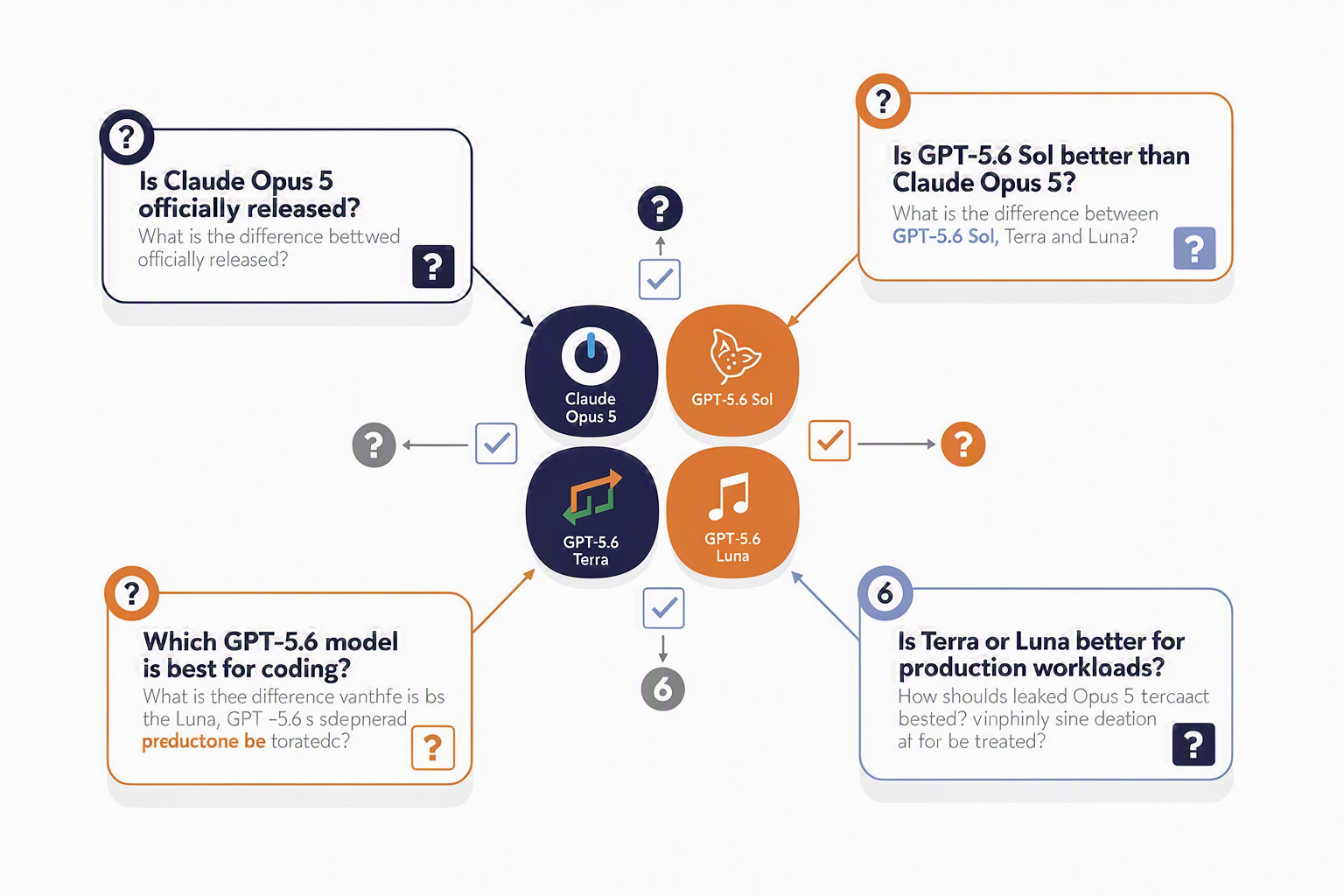
Release status and model comparison
Is Claude Opus 5 released as of July 24, 2026?
Claude Opus 5 vs GPT-5.6 Sol vs GPT-5.6 Terra vs GPT-5.6 Luna: which model is best?
Is the Claude Opus 5 vs GPT-5.6 Sol vs GPT-5.6 Terra vs GPT-5.6 Luna comparison based on confirmed benchmarks?
Choosing the right GPT-5.6 tier
Which GPT-5.6 model is best for coding and AI agents?
How much do GPT-5.6 Sol, Terra, and Luna cost compared with Claude Opus 4.8?
Should developers use one GPT-5.6 model or route requests across Sol, Terra, and Luna?
Conclusion
As of July 24, 2026, GPT-5.6 Sol is the strongest choice for maximum verified capability, GPT-5.6 Terra offers the most compelling balance of quality and cost, and GPT-5.6 Luna is designed for speed and economical scale. Claude Opus 5 remains unannounced, so it cannot be responsibly ranked alongside models that developers can test and deploy today.
Key takeaways
- Sol is the verified flagship. OpenAI calls GPT-5.6 Sol its “best coding model yet,” while ExplainX reports scores of 53.6 on Agents’ Last Exam, 80.0 on the AA Coding Agent Index, and 91.9% on Terminal-Bench Ultra. These results make Sol the logical starting point for demanding coding, reasoning, and agentic workflows, although teams should validate benchmark claims against their own production tasks.
- Terra is likely the practical default for many applications. DataCamp describes GPT-5.6 Terra as delivering approximately GPT-5.5-level overall quality at about half the price. That combination should suit routine business automation, customer support, content workflows, and software tasks that need dependable intelligence without flagship-level spending.
- Luna prioritizes throughput and latency. GPT-5.6 Luna is positioned for faster, lower-cost inference, making it relevant to high-volume interactions and workloads where responsiveness matters more than extracting the final increment of reasoning quality.
- Pricing increasingly determines architecture. Layer3 Labs reports that GPT-5.6 Sol costs $5 per million input tokens and $30 per million output tokens, while Claude Opus 4.8 costs $5 and $25, respectively. Developers Digest also reports a lower GPT-5.6 tier at $1 input and $6 output per million tokens, strengthening the case for routing each request to the least expensive model capable of completing it reliably.
Status check: Anthropic had not announced Claude Opus 5’s specifications, benchmarks, context limits, pricing, or availability by July 24, 2026. Until official documentation appears, every Opus 5 comparison should remain clearly labelled expected, leaked, or speculative.
The next signals to watch are Anthropic’s official Opus 5 announcement, independently reproduced benchmarks, real-world latency, context reliability, and whether production quality justifies any price premium. The broader direction is already clear: resilient AI products will increasingly use multi-model routing and automatic fallbacks instead of committing every workload to one flagship.
To explore that approach, visit CallMissed, an AI communication-infrastructure platform offering an OpenAI-compatible multi-model gateway alongside voice agents and multilingual chatbots. Will your next AI system choose one model—or dynamically select the right model for every request?
Related Reading
- GPT-5.6 Sol Terra Luna Pricing Benchmarks: July 9, 2026 Buyer Guide
- GPT-5.6 Terra Pricing & Use Cases vs Sol and Luna: 2026 Comparison
- GPT-5.6 Sol Ultra vs Sol, Terra, Luna, Claude & Gemini: Verified Comparison
Sources
Discussion
Related Posts

Ready to automate customer conversations?
Launch AI voice agents and WhatsApp bots with CallMissed — one API, 22+ Indian languages.