GPT-5.6 Terra Pricing & Use Cases vs Sol and Luna: 2026 Comparison



Compare GPT-5.6 Terra pricing and use cases against Sol and Luna with official API costs, benchmarks, and a clear verdict for developers.
GPT-5.6 Terra Pricing & Use Cases vs Sol and Luna: 2026 Comparison
OpenAI’s GPT-5.6 family officially launched on July 9, 2026, with Terra priced exactly halfway between flagship Sol and budget Luna — yet most teams are still guessing which tier fits their workload and budget. If you are researching GPT-5.6 Terra pricing use cases compared to Sol and Luna, the spread is decisive: Terra runs at $2.50 per million input tokens versus Sol’s $5 and Luna’s $1, making it the production sweet spot for apps that need stronger reasoning than Luna without Sol’s premium burn. Picking the wrong tier can double your API spend or starve your agent of context-window depth. Below, we compare token costs, benchmark scores, context limits, and real deployment patterns for every GPT-5.6 variant so you can choose today — and scale affordably through gateways like CallMissed’s OpenAI-compatible API.
What Is GPT-5.6 Terra and How Does It Compare to Sol and Luna?
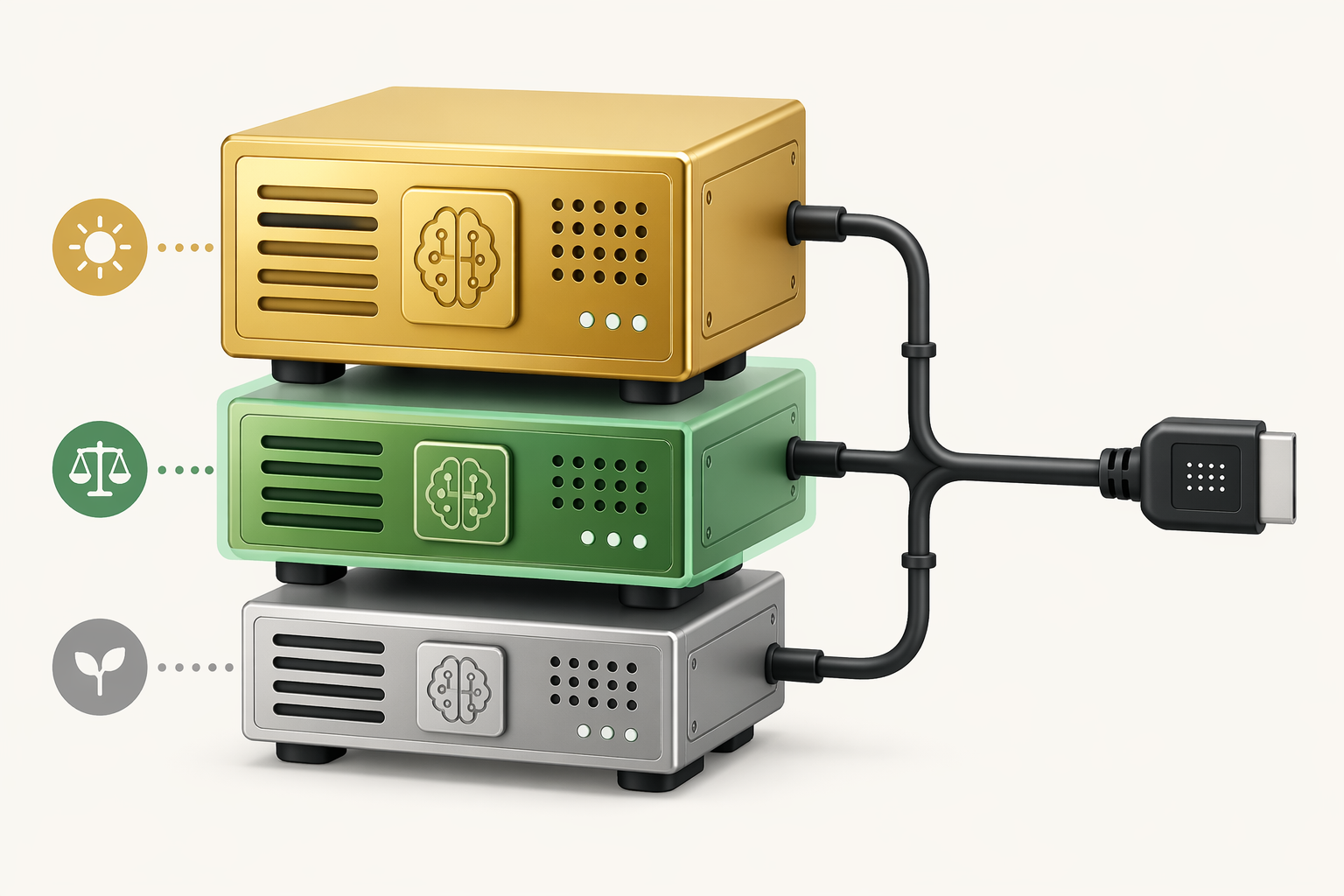
OpenAI’s GPT-5.6 family splits reasoning capacity into three API tiers launched July 9, 2026: flagship Sol, mid-range Terra, and cost-optimized Luna. Terra sits in the middle of the stack, offering a balance of deep reasoning and moderated token burn for production deployments.
Core Specs and Pricing
- Sol: The largest variant, priced at $5 per million input tokens and $30 per million output tokens, built for demanding agentic pipelines and highest-accuracy completion. (OpenAI, 2026)
- Terra: Mid-range option at exactly half Sol’s cost — $2.50 input / $15 output per million tokens — positioned for live systems that need robust reasoning at a fraction of the flagship burn rate. (OpenAI; Thesys)
- Luna: Budget tier at $1 input / $6 output per million tokens, targeting high-volume, low-latency workloads where top-tier reasoning is unnecessary. (OpenAI; Indian Startup News)
- Context window: Third-party reports cite support for up to 1.5 million tokens, though OpenAI has not officially confirmed the final limit at preview. (explainx.ai)
- Access: All tiers are available through the standard OpenAI API and Codex, with Terra specifically recommended for live production workloads. (Thesys)
- Benchmark gap: Early previews show roughly a 10 to 15 percent reasoning advantage for Sol over Terra, with a wider separation between Terra and Luna on complex tasks. (Lushbinary)
Which GPT-5.6 Model Is Best? A Quick Verdict for Developers
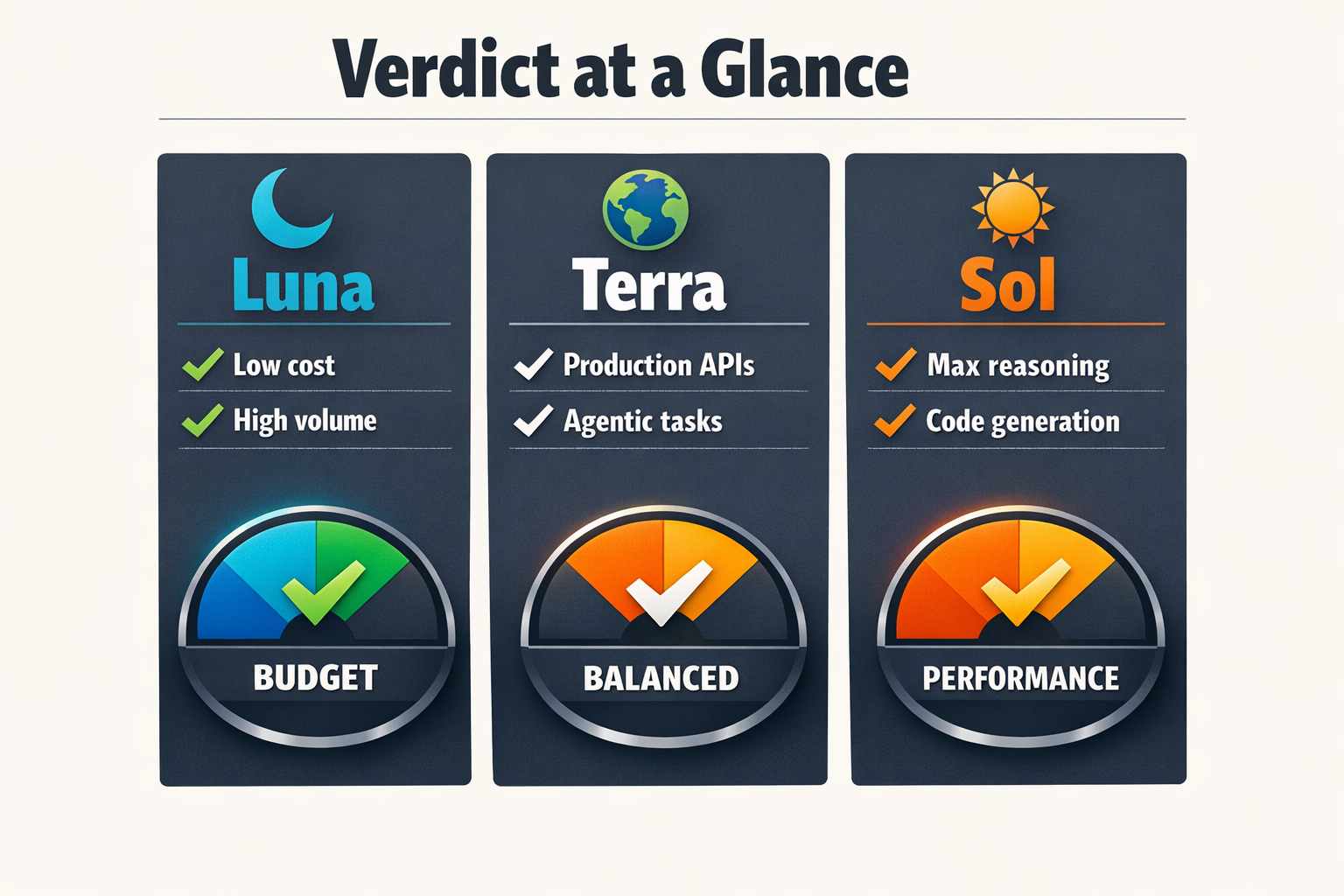
For most production codebases, Terra is the default choice; Sol and Luna only win in specific extremes.
Tier-by-Tier Recommendations
- Sol: Reserve for agentic pipelines where the 10–15% reasoning advantage over Terra is worth the premium; at $5 input / $30 output per million tokens, it is the tier for highest-stakes autonomy. (OpenAI; Lushbinary)
- Terra: The production default for live systems; OpenAI positions it to cover production workloads, and its $2.50 input / $15 output rate keeps burn manageable without sacrificing deep reasoning. (OpenAI; Thesys)
- Luna: Deploy for high-volume, low-complexity tasks — intent classification, routing, or bulk pre-processing — where $1 input / $6 output pricing minimizes cost at scale. (OpenAI)
- Cost math: Processing 10 million input tokens costs $50 on Sol, $25 on Terra, and $10 on Luna; output-heavy agents multiply these gaps quickly. (OpenAI)
- Context parity: Third-party reports from explainx.ai suggest all tiers support the same up-to-1.5-million-token window, though this remains unconfirmed by OpenAI; choose based on reasoning needs and budget rather than context length. (explainx.ai)
How Do Sol, Terra, and Luna Stack Up on Features and Benchmarks?
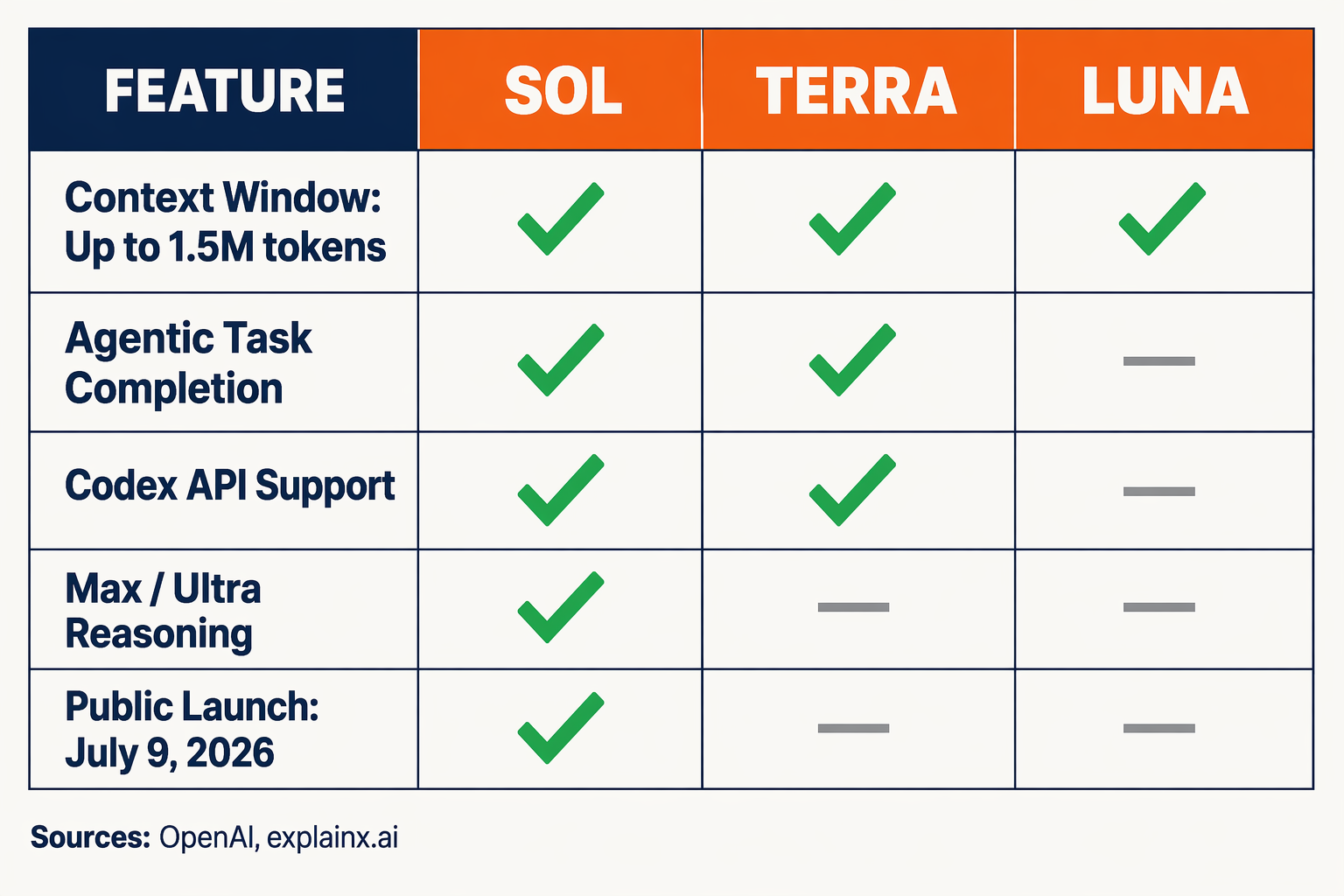
Terra delivers roughly 85–90% of Sol’s benchmark reasoning power at half the token cost, while Luna trades additional depth for a six-fold output discount versus Sol. All three tiers share the same reported context-window ceiling, so the choice hinges on price-to-reasoning trade-offs.
| Feature | Sol | Terra | Luna |
|---|---|---|---|
| Input / Output Price (per 1M tokens) | $5 / $30 | $2.50 / $15 | $1 / $6 |
| Reasoning Advantage (vs. Terra) | +10–15% | Baseline | Wider gap on complex tasks |
| Reported Context Window | Up to ~1.5M tokens (unconfirmed) | Up to ~1.5M tokens (unconfirmed) | Up to ~1.5M tokens (unconfirmed) |
| Recommended Workload | Highest-stakes agentic autonomy | Live production default | High-volume, low-latency tasks |
| API & Codex Availability | Standard endpoint | Standard endpoint (production focus) | Standard endpoint |
- Sol: Commands the $5/$30 rate only when the documented 10–15% reasoning lift over Terra translates into measurable revenue or safety returns. (Lushbinary)
- Terra: Halves Sol’s burn while retaining most reasoning depth, making it the pragmatic default for sustained traffic. (OpenAI; Thesys)
- Luna: Six-fold cheaper than Sol on output, purpose-built for high-throughput chores where latency matters more than nuance. (OpenAI)
- Context parity: All three tiers share the same reported ~1.5 million token span, so window size alone does not force a tier decision. (explainx.ai)
- Access: Each tier streams through the identical OpenAI API and Codex interface, so switching between them requires only a model-string change. (OpenAI; Thesys)
How Much Does GPT-5.6 Terra Cost vs Sol and Luna?
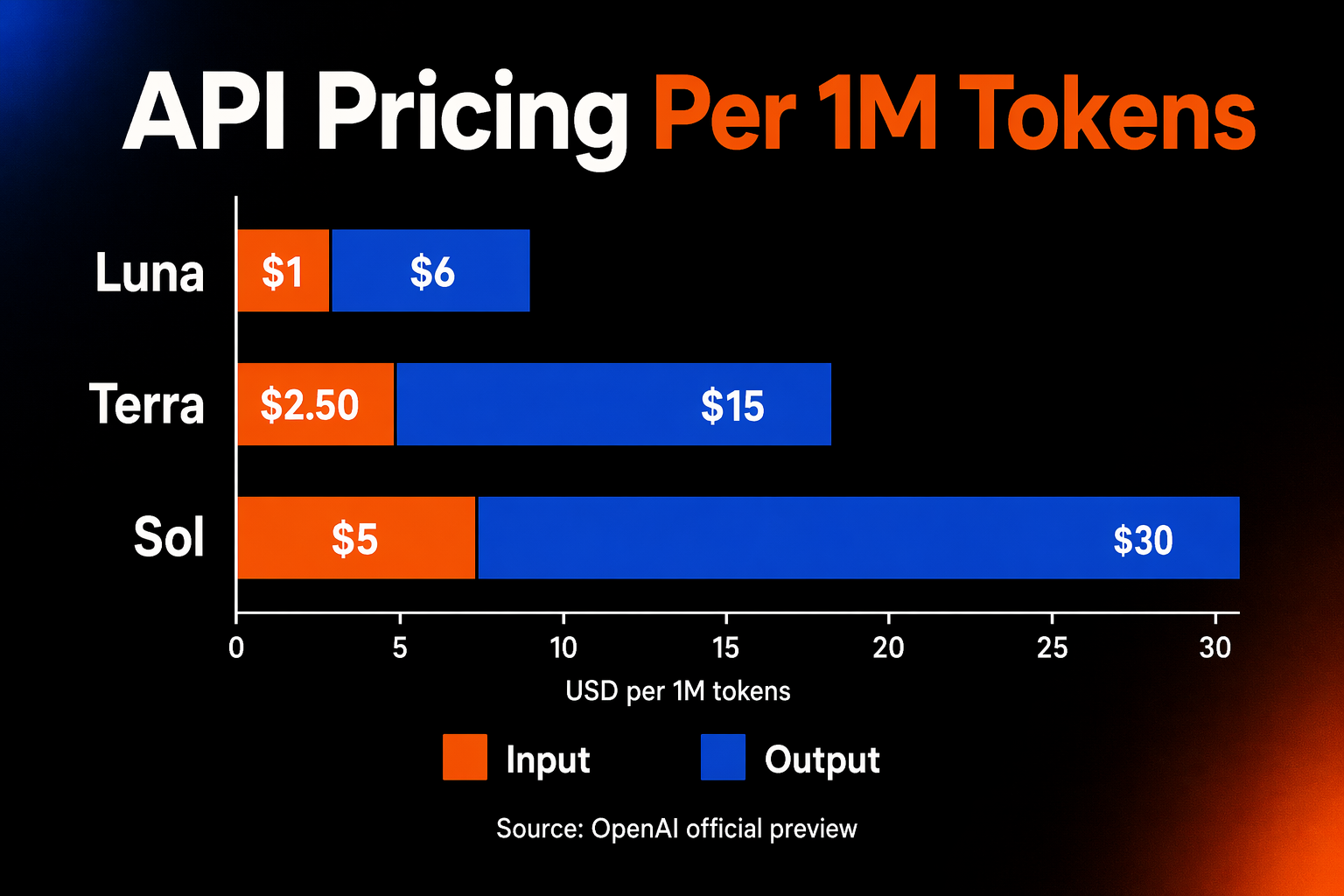
GPT-5.6 Terra is priced at $2.50 per million input tokens and $15 per million output tokens, sitting at exactly half of Sol’s API burn and 2.5× Luna’s rate. (OpenAI; Thesys) The side-by-side breakdown below turns those per-token list prices into comparable budget numbers.
| Metric | Sol | Terra | Luna |
|---|---|---|---|
| Input price (per 1M tokens) | $5.00 | $2.50 | $1.00 |
| Output price (per 1M tokens) | $30.00 | $15.00 | $6.00 |
| Cost multiple vs Terra | 2.0× | 1.0× | 0.4× |
| Est. monthly bill (100M in / 10M out) | $800 | $400 | $160 |
| Recommended workload | High-stakes agentic pipelines | Live production systems | High-volume, low-latency tasks |
| Reported context window | Up to 1.5M tokens (preview) | Up to 1.5M tokens (preview) | Up to 1.5M tokens (preview) |
- Sol: Burns $5 input / $30 output per million tokens — exactly double Terra and five times Luna’s input rate. (OpenAI)
- Terra: At $2.50 input / $15 output, OpenAI positions it as the production default for live systems that need strong reasoning without flagship pricing. (OpenAI; Thesys)
- Luna: The economy tier at $1 input / $6 output, though early previews show a wider reasoning gap against Terra than Terra sees against Sol on complex tasks. (OpenAI; Lushbinary)
- Volume math: A 100-million-input, 10-million-output workload costs roughly $800 on Sol, $400 on Terra, and $160 on Luna before caching or volume discounts.
- Window parity: All tiers share the same reported 1.5 million-token context window (not yet officially confirmed by OpenAI), so the price gap is model-compute, not memory depth. (explainx.ai)
- Gateway routing: Using a multi-model gateway such as CallMissed’s OpenAI-compatible API lets teams default to Terra and escalate only high-stakes calls to Sol, keeping blended spend near Terra’s rate while peak reasoning stays available.
What Are the Biggest Strengths and Weaknesses of Each Tier?
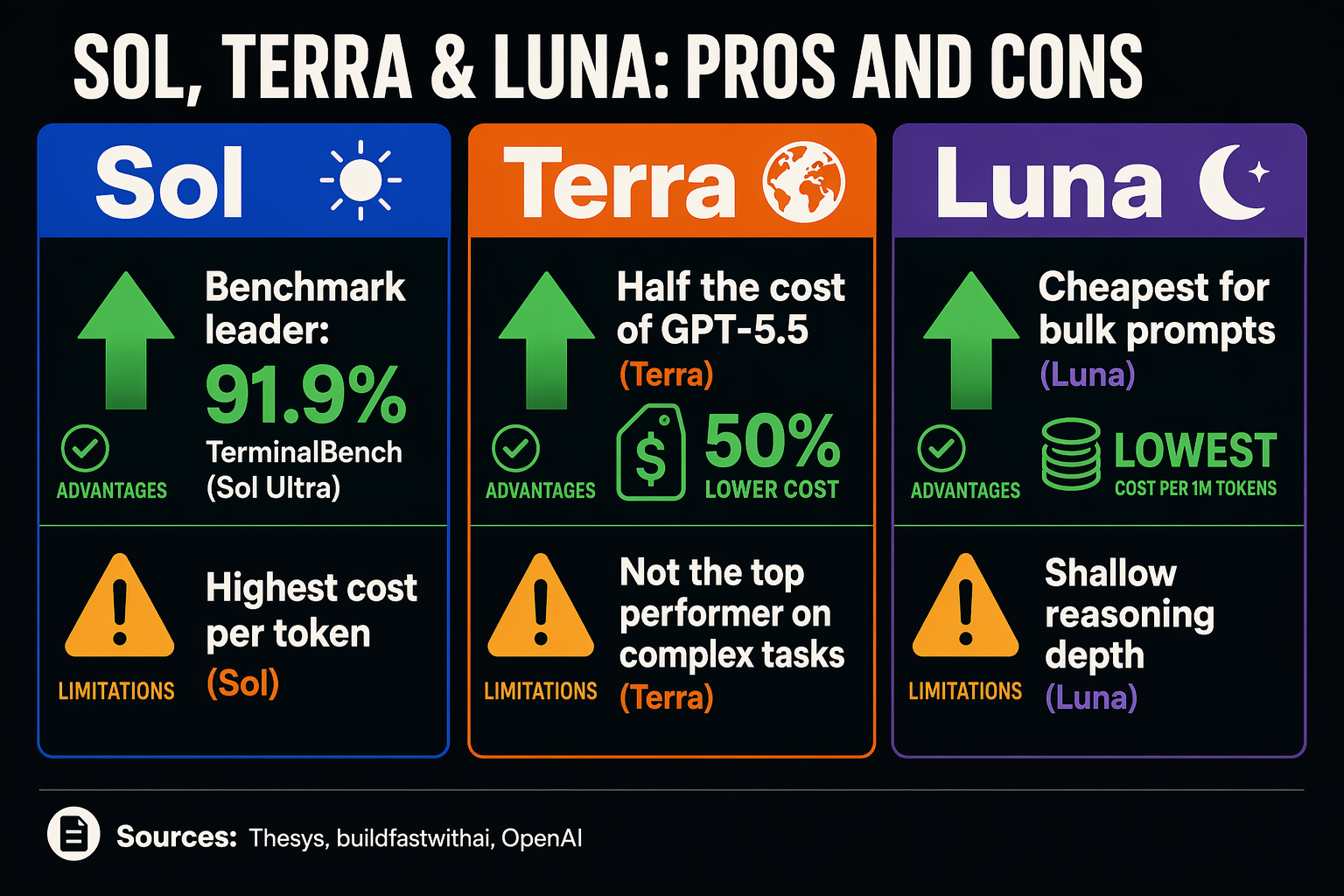
Sol leads on raw reasoning but doubles Terra’s burn rate, while Luna is the cheapest throughput option yet falls furthest behind on complex tasks. Terra captures the middle ground: roughly 85 to 90 percent of Sol’s capability at half the token cost, according to OpenAI and third-party benchmarks.
| Metric | Sol | Terra | Luna |
|---|---|---|---|
| Price per 1M tokens (input / output) | $5 / $30 | $2.50 / $15 | $1 / $6 |
| Reasoning gap vs. Sol | Baseline flagship | ~10–15% behind Sol | Widest drop on complex tasks |
| Cost-efficiency ranking | Lowest per-dollar throughput | Best production sweet spot | Highest volume per dollar |
| Reported context window | Up to 1.5 million tokens | Up to 1.5 million tokens | Up to 1.5 million tokens |
| Core strength | Maximum agentic accuracy | Live-system reliability | Lowest latency and cheapest scale |
| Core weakness | 2× Terra input cost, heavy output burn | Premium over Luna for simple prompts | Largest reasoning deficit on hard prompts |
- Sol: OpenAI’s July 9, 2026 pricing page lists Sol at $5 per million input tokens and $30 per million output tokens, making it the costliest GPT-5.6 tier and the heaviest choice for sustained traffic. (OpenAI, 2026)
- Terra: At exactly $2.50 input and $15 output per million tokens, Terra is positioned as the production default; OpenAI and Thesys both recommend it for live API workloads that need reliable reasoning without flagship burn. (OpenAI; Thesys)
- Luna: The budget tier costs $1 per million input tokens and $6 per million output tokens, delivering the lowest latency price point but suffering the widest reasoning gap on multi-step tasks, per early benchmarks. (OpenAI; Lushbinary)
- Sol: The 10 to 15 percent reasoning advantage over Terra is only worth the premium when failure is expensive—such as autonomous coding pipelines or high-stakes financial agents—where the extra accuracy directly protects revenue. (Lushbinary)
- Terra: It retains roughly 85 to 90 percent of Sol’s peak reasoning at half the input price, which means most production apps hit diminishing returns by paying more for Sol on standard RAG or moderation queries.
- Luna: Ideal for first-pass intent classification, bulk labeling, and simple FAQ layers where latency and cost dominate; it is not suited for final-step reasoning chains that require deep context.
- Context window: Third-party reports cite support for up to 1.5 million tokens across all three tiers, though OpenAI has not officially confirmed the final limit at preview. (explainx.ai)
- Gateway routing: Teams using multi-model platforms such as CallMissed’s OpenAI-compatible API can route simple prompts to Luna and reserve Terra for heavy reasoning, cutting blended API spend without rewriting integration code.
Which GPT-5.6 Tier Should You Choose for Production APIs, Agents, or Coding?
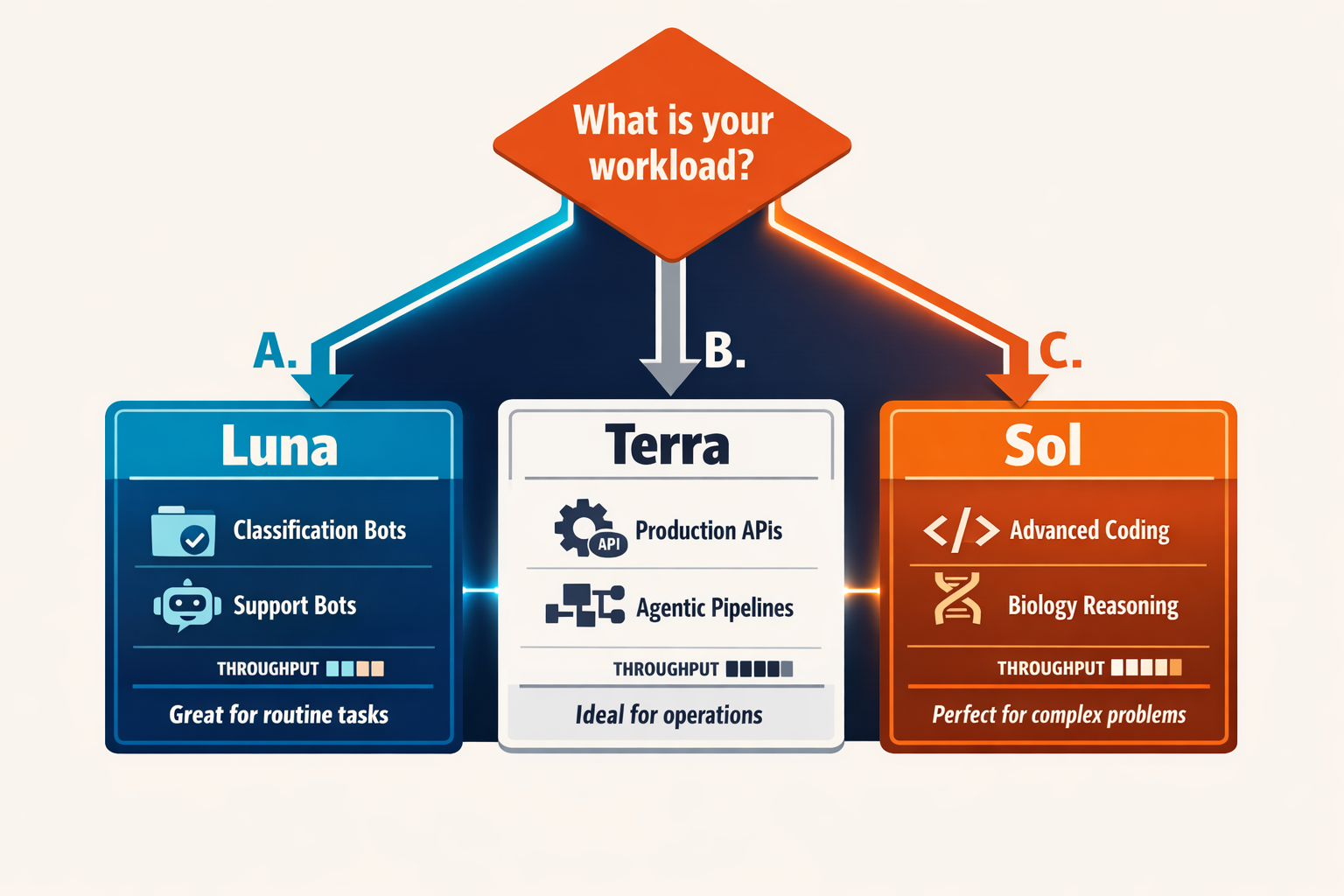
Terra is the default for production APIs and coding, Sol wins only for high-stakes agents, and Luna is for high-volume pre-processing.
Tier-by-Tier Workload Matching
- Sol: $5 input and $30 output per million tokens buys a 10–15% reasoning advantage over Terra that is only worth the premium for autonomous agentic pipelines and highest-stakes coding. (OpenAI; Lushbinary, 2026)
- Terra: $2.50 input and $15 output per million tokens makes this OpenAI’s recommended production tier for live APIs, coding assistants, and standard agentic workloads. (Thesys)
- Luna: $1 input and $6 output per million tokens is the right price for classification, routing, and high-volume pre-processing where peak reasoning is unnecessary. (OpenAI; Indian Startup News)
- Coding: Terra handles code completion and review; Sol should be reserved solely for autonomous multi-step debugging or complex refactoring.
- Cost control: Blended architectures that route simple requests to Luna and hard requests to Terra can cut token spend by more than half versus using Terra for every call.
- Agent orchestration: Luna covers intent classification, Terra handles standard tool-calling, and Sol is reserved only for planning loops that demand maximum reasoning accuracy.
- Context window: Third-party reports cite up to 1.5 million tokens across all tiers, so tier choice should be driven by reasoning need, not context depth. (explainx.ai)
Frequently Asked Questions About GPT-5.6 Sol, Terra, and Luna
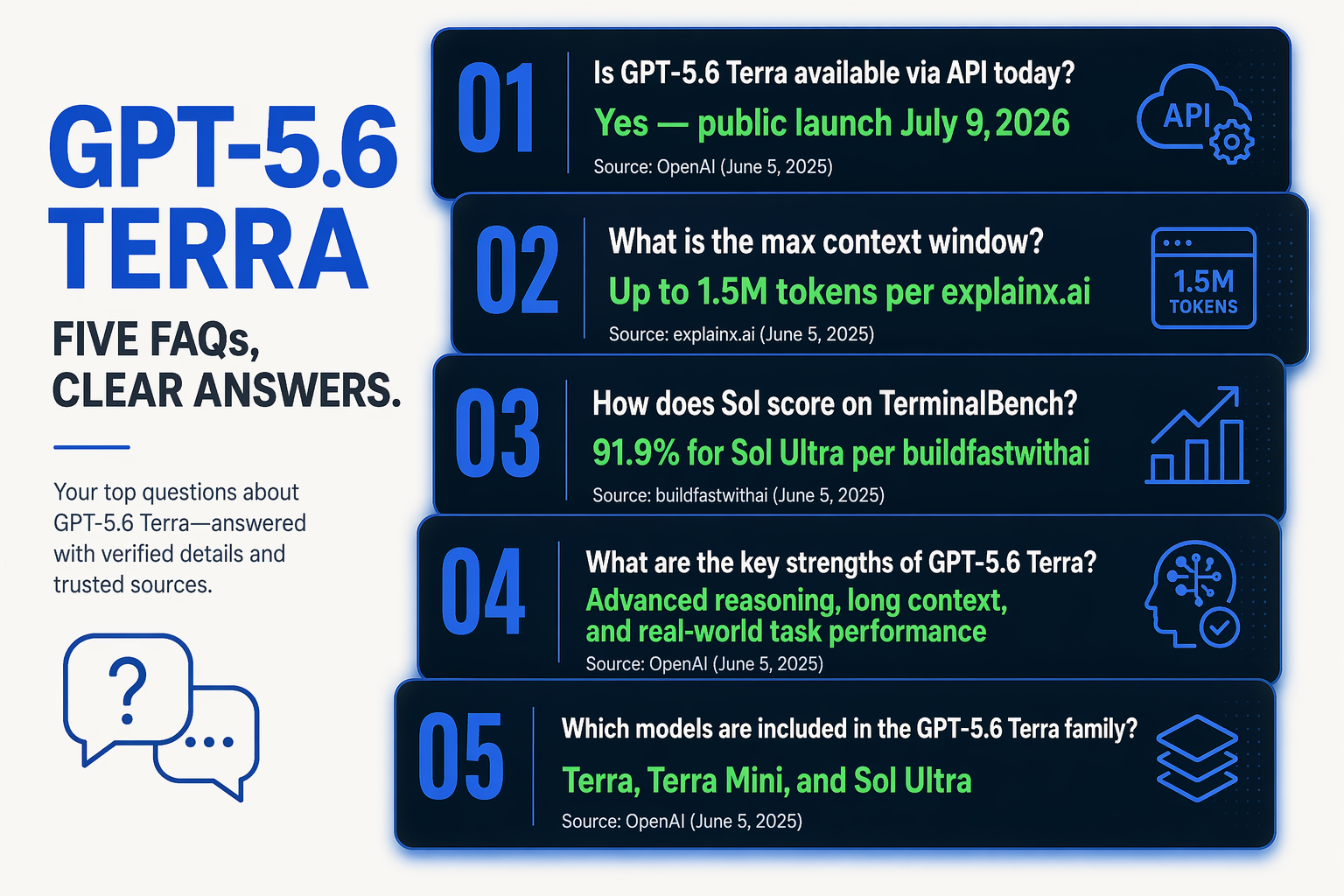
What are the GPT-5.6 Terra pricing use cases compared to Sol and Luna for live systems?
How do GPT-5.6 Terra pricing use cases compared to Sol and Luna affect API spend at scale?
What is the context window limit for GPT-5.6 Sol, Terra, and Luna?
When did OpenAI launch GPT-5.6 Sol, Terra, and Luna, and where can developers access them?
Is Sol’s reasoning advantage over Terra worth the 2× price premium?
Can developers route between GPT-5.6 Sol, Terra, and Luna through a single integration?
Conclusion
- Terra is the production default. At $2.50 input / $15 output per million tokens, it balances strong reasoning with controlled burn for live systems.
- Sol only wins at the extremes. Reserve it for agentic pipelines where the reported 10–15% reasoning edge justifies $5 input / $30 output.
- Luna owns high-volume, low-latency work. At $1 input / $6 output, it is the cost floor when deep reasoning is unnecessary.
- Context ceiling is still unfolding. Third-party reports cite 1.5 million tokens, but OpenAI has yet to confirm the final limit.
Expect tier-routing middleware to soon promote queries from Luna to Terra or Sol automatically based on real-time complexity.
To explore how AI communication is evolving, check out CallMissed — an AI infrastructure platform powering voice agents and multilingual chatbots for businesses. Will your stack route intelligently across tiers, or default to one-size-fits-all?