GPT-5.6 Sol Terra Luna Pricing Benchmarks: July 9, 2026 Buyer Guide



GPT-5.6 Sol Terra Luna pricing benchmarks with token costs, launch status, use cases, access caveats, and buyer guidance for July 9.
GPT-5.6 Sol Terra Luna Pricing Benchmarks: July 9, 2026 Buyer Guide
Surprise: the most important GPT-5.6 launch-day number may be cost, not raw intelligence. GPT-5.6 Sol Terra Luna pricing benchmarks matter on July 9, 2026 because reported prices place Sol at $5 input / $30 output per 1M tokens, Terra at $2.50 / $15, and Luna at $1 / $6—a spread that can change enterprise AI budgets overnight.
OpenAI’s preview page lists GPT-5.6 pricing per 1M tokens across three model sizes: Sol, Terra, and Luna. ExplainX reports that GPT-5.6 Sol, Terra and Luna publicly launch on Thursday, July 9, 2026, while launch-day coverage from Finout and LushBinary repeats the same per-token pricing tiers. That gives buyers a clear first question: should production workloads default to Sol for frontier reasoning, Terra for high-volume performance, or Luna for low-cost agentic and everyday calls?
This buyer guide is written for teams that cannot afford hype-driven model selection. Developers need to know whether the GPT-5.6 July 9 launch changes application architecture. AI buyers need to compare price-per-token against expected quality, latency, reliability, and governance needs. Enterprise teams need to understand what is verified, what is reported, and what still requires hands-on benchmarking before routing customer traffic.
In this article, you’ll get a practical, citation-friendly breakdown of:
- GPT-5.6 pricing for Sol, Terra, and Luna in a clean comparison table
- GPT-5.6 benchmarks and use-case guidance without unsupported benchmark claims
- Reported launch status across ChatGPT, API, and Codex
- Safety, access, and production-readiness caveats for enterprise deployment
- A GPT-5.6 developer guide Sol Terra Luna perspective on routing, fallbacks, and cost controls
The key takeaway for launch day is simple: model choice is no longer just “best model wins.” It is now a routing decision across price, task difficulty, token volume, latency tolerance, and operational risk. For production teams, platforms like CallMissed, a unified multi-model API gateway for switching across 300+ LLMs and deploying voice/chat workflows, fit this trend by reducing the need to hard-code around a single newly launched model tier.
How much does GPT-5.6 Sol, Terra and Luna cost on July 9, 2026?
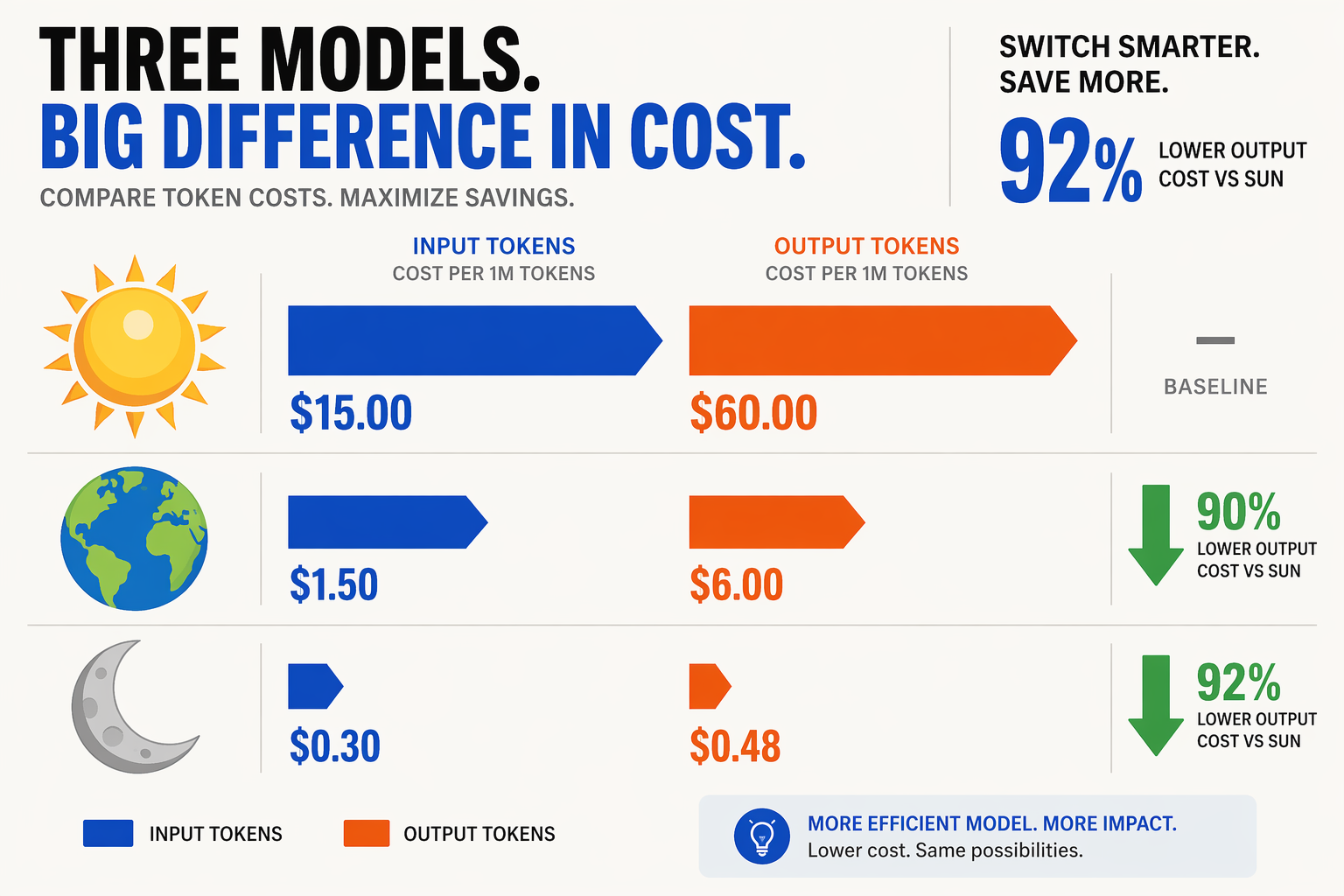
As of the GPT-5.6 July 9 launch, reported GPT-5.6 Sol Terra Luna pricing benchmarks are: Sol at $5 input / $30 output per 1M tokens, Terra at $2.50 / $15, and Luna at $1 / $6. The practical launch-day takeaway is that Terra costs 50% of Sol, while Luna costs 20% of Sol on both input and output tokens.
Launch-day GPT-5.6 pricing table
Use this launch-day table as the quick reference for GPT-5.6 Sol Terra Luna pricing benchmarks before you model workload-specific token volume, latency, and quality tradeoffs.
| GPT-5.6 tier | Input price / 1M tokens | Output price / 1M tokens | 1M in + 1M out cost | Launch-day buyer read |
|---|---|---|---|---|
| GPT-5.6 Sol | $5.00 | $30.00 | $35.00 | Highest-cost tier for frontier reasoning and tasks where quality matters more than volume |
| GPT-5.6 Terra | $2.50 | $15.00 | $17.50 | Mid-tier option; reported by Kie.ai as “GPT-5.5 performance at 2× lower cost” |
| GPT-5.6 Luna | $1.00 | $6.00 | $7.00 | Lowest-cost tier for everyday calls, agentic workflows, classification, and high-volume automation |
| Terra vs Sol | 50% lower | 50% lower | $17.50 saved | Best first benchmark target if Sol quality is not required for every request |
| Luna vs Sol | 80% lower | 80% lower | $28.00 saved | Strong default candidate for cost-sensitive workloads before escalating to Terra or Sol |
What is verified versus reported?
OpenAI’s preview page lists GPT-5.6 pricing per 1M tokens as Sol at $5 input / $30 output, Terra at $2.50 input / $15 output, and Luna at $1 input / $6 output. That is the core pricing fact buyers should use for launch-day cost modeling and for comparing GPT-5.6 Sol Terra Luna pricing benchmarks across common workloads.
Several launch-day sources repeat the same numbers. Finout’s 2026 pricing guide reports Sol at $5/$30, Terra at $2.50/$15, and Luna at $1/$6 per 1M input/output tokens. LushBinary’s developer guide also lists the same per-million-token pricing for GPT-5.6 Sol, Terra and Luna. ExplainX reports that GPT-5.6 Sol, Terra and Luna publicly launch on Thursday, July 9, 2026, aligning with the date used in this buyer guide.
The important caveat: pricing alone is not a benchmark. GPT-5.6 benchmarks still need to be validated against your own prompts, latency targets, tool-calling patterns, safety filters, and output lengths before moving production traffic.
How to read the output-token premium
Across all three GPT-5.6 tiers, output tokens cost 6× more than input tokens. That matters because agentic applications often generate long reasoning traces, tool summaries, JSON responses, or customer-facing messages.
A simple budgeting rule:
- If your app is input-heavy — search, retrieval, classification, short answers — Luna or Terra may keep costs low.
- If your app is output-heavy — code generation, long reports, multi-step agents — the $30/M output price for Sol can dominate spend quickly.
- If quality varies by task, route easy calls to Luna, medium-complexity calls to Terra, and escalations to Sol.
For developers building production systems, the smartest way to use GPT-5.6 Sol Terra Luna pricing benchmarks is to treat them as routing inputs, not fixed procurement decisions. CallMissed’s OpenAI-compatible multi-model API gateway lets teams switch across 300+ LLMs and deploy voice/chat workflows without hard-coding every application path to one new GPT-5.6 tier. That matters on launch day because the right model is often a routing decision, not a one-time procurement choice.
What is GPT-5.6 Sol, Terra and Luna, and what is verified versus reported?

GPT-5.6 Sol, Terra and Luna are reported as three GPT-5.6 model tiers with the same API pricing structure but different cost/performance targets. As of the GPT-5.6 July 9 launch, the most defensible verified fact is OpenAI’s listed pricing: Sol costs $5 input / $30 output per 1M tokens, Terra costs $2.50 / $15, and Luna costs $1 / $6, according to OpenAI’s “Previewing GPT-5.6 Sol” page.
The short definition: Sol, Terra and Luna
Think of GPT-5.6 Sol, Terra and Luna as a tiered model family rather than one flat model release:
- GPT-5.6 Sol — the flagship, highest-cost tier for difficult reasoning, coding, research, and enterprise workflows where quality matters more than token volume.
- GPT-5.6 Terra — the middle tier, positioned in launch-day coverage as a high-volume performance option. Kie.ai describes Terra as targeting “GPT-5.5 performance at 2× lower cost,” but that should be treated as a reported positioning claim until teams benchmark it on their own workloads.
- GPT-5.6 Luna — the low-cost tier for everyday calls, agentic workflows, chat automation, summarization, and tasks where large-scale usage matters more than maximum frontier capability.
A clean way to interpret the lineup is: Sol for hardest tasks, Terra for production balance, Luna for cost-efficient scale.
What is verified versus reported?
| Claim | Status on July 9, 2026 | Source named in launch-day context | Buyer interpretation |
|---|---|---|---|
| Sol is $5 input / $30 output per 1M tokens | Verified from OpenAI preview listing | OpenAI, “Previewing GPT-5.6 Sol” | Safe to use in launch-day cost models |
| Terra is $2.50 input / $15 output per 1M tokens | Verified from OpenAI preview listing | OpenAI | Terra is exactly 50% of Sol’s token price |
| Luna is $1 input / $6 output per 1M tokens | Verified from OpenAI preview listing | OpenAI | Luna is exactly 20% of Sol’s token price |
| Public launch is Thursday, July 9, 2026 | Reported by launch coverage | ExplainX says OpenAI confirms the July 9, 2026 public launch | Treat as launch-day reported availability and verify in your own OpenAI account |
| Terra delivers GPT-5.5-level performance at 2× lower cost | Reported positioning, not independently benchmarked here | Kie.ai launch coverage | Useful hypothesis, not a procurement-grade benchmark |
| Luna is strong for budget agentic workloads | Reported by third-party coverage | YouTube early-access coverage and builder commentary | Test with your agent loop, tool calls, and failure modes |
What counts as a benchmark today?
For this guide, GPT-5.6 benchmarks means evidence that can be tied to a source, date, and workload. Pricing is concrete; model quality is not yet equally concrete across every buyer’s environment.
A launch-day benchmark should separate:
- Published pricing benchmarks — OpenAI’s per-token prices are clear enough to calculate cost-per-task.
- Reported model-positioning benchmarks — claims such as Terra being “2× lower cost” than GPT-5.5 are useful but need validation.
- Your production benchmarks — latency, hallucination rate, tool-call accuracy, retrieval accuracy, and escalation rate on your own prompts.
- Governance benchmarks — auditability, retention settings, data boundaries, and fallback behavior under failure.
For example, a support bot that generates long replies will feel output pricing more than input pricing. At launch prices, 1M output tokens cost $30 on Sol, $15 on Terra, and $6 on Luna, so the same verbose workflow could cost 5× more on Sol than Luna before quality or latency is considered.
Why the verified/reported split matters
The risk on launch day is not that buyers misunderstand the names; it is that they treat reported claims as production guarantees. GPT-5.6 pricing is verified enough to model budgets, but GPT-5.6 performance still requires hands-on testing.
For developers building routing logic, this is where a multi-model layer helps. Platforms such as CallMissed, an OpenAI-compatible gateway for switching across 300+ LLMs and deploying production voice/chat workflows, fit the practical pattern: test Sol, Terra, Luna, and alternatives behind one integration, then route by task difficulty, price ceiling, and reliability rather than hard-coding a single launch-day winner.
What changed in the GPT-5.6 July 9 launch across ChatGPT, API, Codex and enterprise accounts?
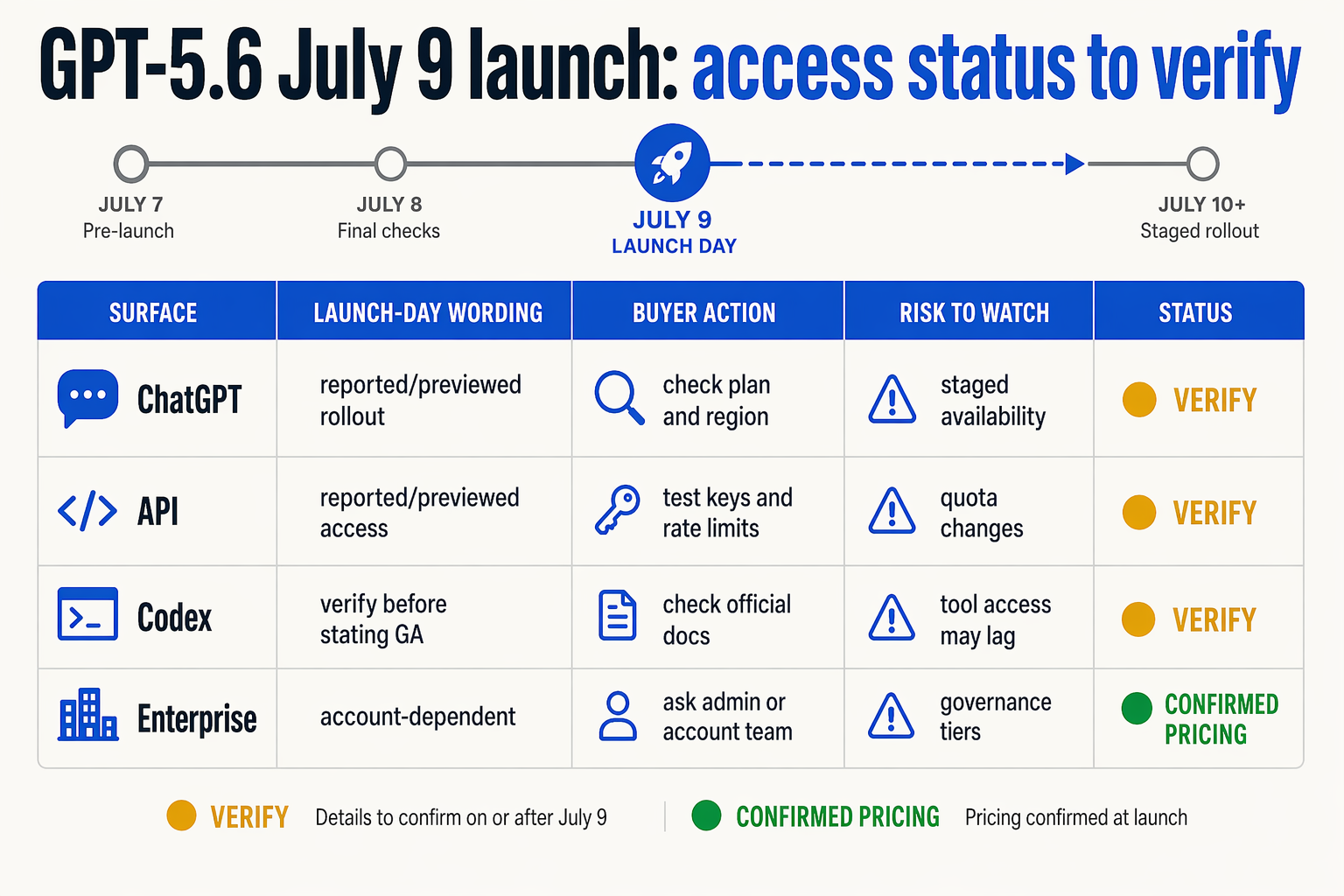
As of the GPT-5.6 July 9 launch, the big change is that OpenAI’s newest family is being discussed as a three-tier model lineup — Sol, Terra, and Luna — rather than one default frontier model. The reported pricing remains the clearest verified buyer signal: OpenAI’s preview page lists GPT-5.6 Sol at $5 input / $30 output per 1M tokens, Terra at $2.50 / $15, and Luna at $1 / $6.
Launch-day changes by product surface
| Surface | What changed on July 9, 2026 | Evidence cited | Buyer implication | Status |
|---|---|---|---|---|
| Model lineup | GPT-5.6 is presented as Sol, Terra, and Luna, giving buyers three cost/performance tiers instead of one model choice. | OpenAI’s preview page lists “GPT-5.6 pricing per 1M tokens across three model sizes: Sol, Terra, and Luna.” | Teams should route tasks by difficulty: Sol for harder reasoning, Terra for balanced workloads, Luna for low-cost volume. | Verified pricing page; tier behavior still needs testing |
| API pricing | API economics changed sharply: Sol $5/$30, Terra $2.50/$15, Luna $1/$6 per 1M input/output tokens. | OpenAI, Finout, and LushBinary all report the same per-token pricing tiers. | Cost controls, model routing, batch jobs, and output-token limits matter immediately for production apps. | Reported consistently across sources |
| ChatGPT access | Launch-day coverage says GPT-5.6 reaches users on July 9, but exact ChatGPT entitlement details may vary by plan and region. | ExplainX reports GPT-5.6 Sol/Terra/Luna public launch Thursday, July 9, 2026. | Buyers should confirm whether ChatGPT access includes Sol only, tier selection, or workspace-level controls before using it for evaluation. | Reported launch; plan details require account check |
| Codex / coding workflows | Codex buyers should treat GPT-5.6 as a new routing question: use higher tiers for complex refactors and lower tiers for routine code generation. | Launch sources discuss GPT-5.6 benchmarks and developer use cases, but available snippets do not verify Codex-specific benchmark numbers. | Do not assume benchmark gains; test on your repository, CI failures, code review tasks, and agent loops. | Use-case reported; benchmark claims need validation |
| Enterprise accounts | Enterprise evaluation shifts from “which model is smartest?” to governance, routing, auditability, latency, and cost predictability across Sol, Terra, and Luna. | The price spread is concrete: Luna is 20% of Sol’s price, while Terra is 50% of Sol’s price on both input and output. | Procurement should model monthly token volume before approving Sol as the default tier. | Pricing clear; SLA/access terms account-specific |
| Developer architecture | Applications should avoid hard-coding one GPT-5.6 tier because the launch creates a natural need for fallback and model selection logic. | Kie.ai describes Terra as positioned around “GPT-5.5 performance at 2× lower cost,” while Finout and LushBinary repeat the Sol/Terra/Luna pricing structure. | Gateways and routers become more valuable for switching models without rewriting application code. | Practical recommendation |
What changed most for developers?
The API change is the most actionable launch-day update because developers can immediately translate GPT-5.6 pricing into routing rules. For example:
- Use GPT-5.6 Sol when failure cost is high: legal drafting, advanced reasoning, complex agents, sensitive customer escalations.
- Use GPT-5.6 Terra when quality still matters but token volume is large: support summarization, retrieval-augmented generation, analytics, coding assistance.
- Use GPT-5.6 Luna for cheaper everyday calls: classification, extraction, short replies, routing, lightweight agent steps.
This is also where platforms such as CallMissed, an OpenAI-compatible multi-model API gateway for 300+ LLMs and production voice/chat workflows, become relevant: the operational pattern is no longer “pick one model,” but “route each task to the right model tier with fallbacks.”
What should enterprise buyers verify before rollout?
The safest launch-day interpretation is: pricing is clear, but access and benchmarks still need account-level confirmation. Before approving GPT-5.6 for production, enterprise teams should verify:
- Which GPT-5.6 tiers are available in ChatGPT, API, Codex, and enterprise workspaces.
- Whether Sol, Terra, and Luna have different rate limits, latency profiles, or data controls.
- Whether published GPT-5.6 benchmarks match internal workloads, especially long-context reasoning, code generation, multilingual support, and agentic tool use.
- Whether output-token growth changes cost assumptions, because GPT-5.6 Sol output is reported at $30 per 1M tokens, six times its input price.
The launch-day buyer takeaway: GPT-5.6 changes the buying motion from model adoption to model portfolio management.
What do GPT-5.6 benchmarks show, and which numbers should buyers treat cautiously?
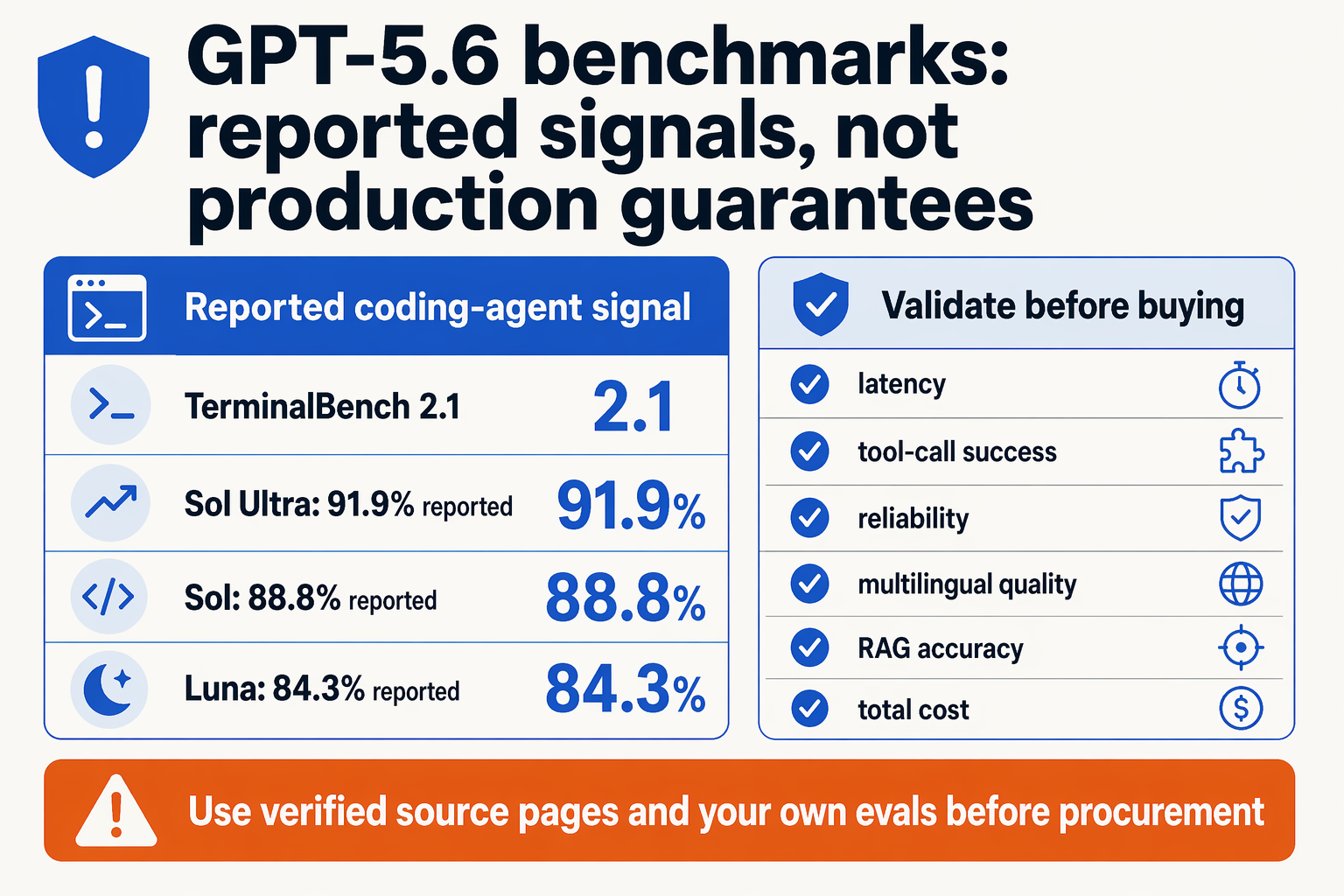
Reported GPT-5.6 benchmarks are useful for launch-day triage, but buyers should treat most third-party numbers as provisional until they run workload-specific tests. As of July 9, 2026, the strongest verified facts behind GPT-5.6 Sol Terra Luna pricing benchmarks are pricing and tier positioning: OpenAI lists Sol at $5/$30, Terra at $2.50/$15, and Luna at $1/$6 per 1M input/output tokens, while benchmark claims vary by source and methodology.
Launch-day benchmark signals: what is useful vs what needs validation
Use the table below as a cautious buyer filter for GPT-5.6 Sol Terra Luna pricing benchmarks: pricing can inform early cost models, but capability claims still need prompt-level, workload-specific validation.
| Benchmark / claim | Reported signal | Source context | Buyer confidence | What to test internally |
|---|---|---|---|---|
| Sol = frontier tier | Positioned as the highest-capability GPT-5.6 model for difficult reasoning | OpenAI preview page names GPT-5.6 Sol and lists highest pricing at $5 input / $30 output per 1M tokens | Medium-high for positioning; lower for exact task gains | Complex reasoning, coding review, legal/financial analysis, long-context accuracy |
| Terra = performance/value tier | Reported as “GPT-5.5 performance at 2× lower cost” | Kie.ai launch coverage reports Terra’s positioning; pricing implies Terra is 50% of Sol | Medium until OpenAI publishes full evals | High-volume support, summarization, extraction, RAG answer quality |
| Luna = budget agentic tier | Reported as cost-efficient for everyday calls; one source references 82.5% Luna without enough context in the visible snippet | ExplainX and YouTube coverage discuss Luna as a budget model; OpenAI pricing lists $1 input / $6 output per 1M tokens | Low-medium for benchmark percentages; high for price | Tool-calling reliability, short chat quality, latency, hallucination rate |
| Pricing parity / savings | Sol launches at $5/$30, Terra at $2.50/$15, Luna at $1/$6 | OpenAI preview page; repeated by Finout and LushBinary on launch-day pricing pages | High for listed prices | Real monthly blended cost including retries, output length, caching and fallbacks |
| Early-access demos | Anecdotal claims that Luna may be strong for budget agentic workflows | YouTube early-access coverage says Luna “could be” a strong budget agentic model | Low for procurement decisions | Reproduce tests with your prompts, tools, latency targets and safety filters |
Which GPT-5.6 benchmark numbers are safest to trust?
The safest numbers are published prices and clearly attributed tier descriptions. OpenAI’s preview page states that GPT-5.6 is priced per 1M tokens across Sol, Terra and Luna: Sol is $5 input / $30 output, Terra is $2.50 / $15, and Luna is $1 / $6. Finout and LushBinary repeat the same launch-day pricing structure, which makes pricing the most stable benchmark input for buyer modeling.
The least safe numbers are isolated benchmark percentages without visible methodology. For GPT-5.6 Sol Terra Luna pricing benchmarks, buyers should be especially cautious when a score is quoted without the full benchmark name, dataset, baseline, sample size, evaluation harness, and pass criteria. For example, the ExplainX search snippet references “82.5% Luna”, but without the full benchmark context in the snippet, enterprise teams should not treat that number as procurement-grade evidence.
Practical benchmark guidance for buyers
For the GPT-5.6 July 9 launch, buyers should run a three-stage benchmark before moving production traffic:
- Quality test: compare Sol, Terra and Luna against your own golden dataset, not generic leaderboard prompts.
- Cost test: calculate blended cost using input tokens, output tokens, retries, tool calls and expected traffic spikes.
- Reliability test: measure latency, timeout rate, refusal behavior, function-calling success and RAG citation accuracy.
A strong launch-day rule is: use Sol only where marginal quality changes business outcomes, test Terra as the default high-volume candidate, and evaluate Luna for low-risk, cost-sensitive automation. Treat GPT-5.6 Sol Terra Luna pricing benchmarks as a starting point for model selection, not a substitute for production-like testing.
For teams that do not want to hard-code model choices during a volatile launch window, an OpenAI-compatible gateway such as CallMissed can help route traffic across multiple LLMs while teams compare GPT-5.6 tiers against existing production models. That matters because the real benchmark is rarely a public score—it is the model’s performance on your customer conversations, internal documents, compliance constraints and budget ceiling. In that context, GPT-5.6 Sol Terra Luna pricing benchmarks are most useful when they are paired with your own latency, quality, safety, and total-cost measurements.
Which GPT-5.6 model should developers use for coding, agents, RAG, chat and fallbacks?
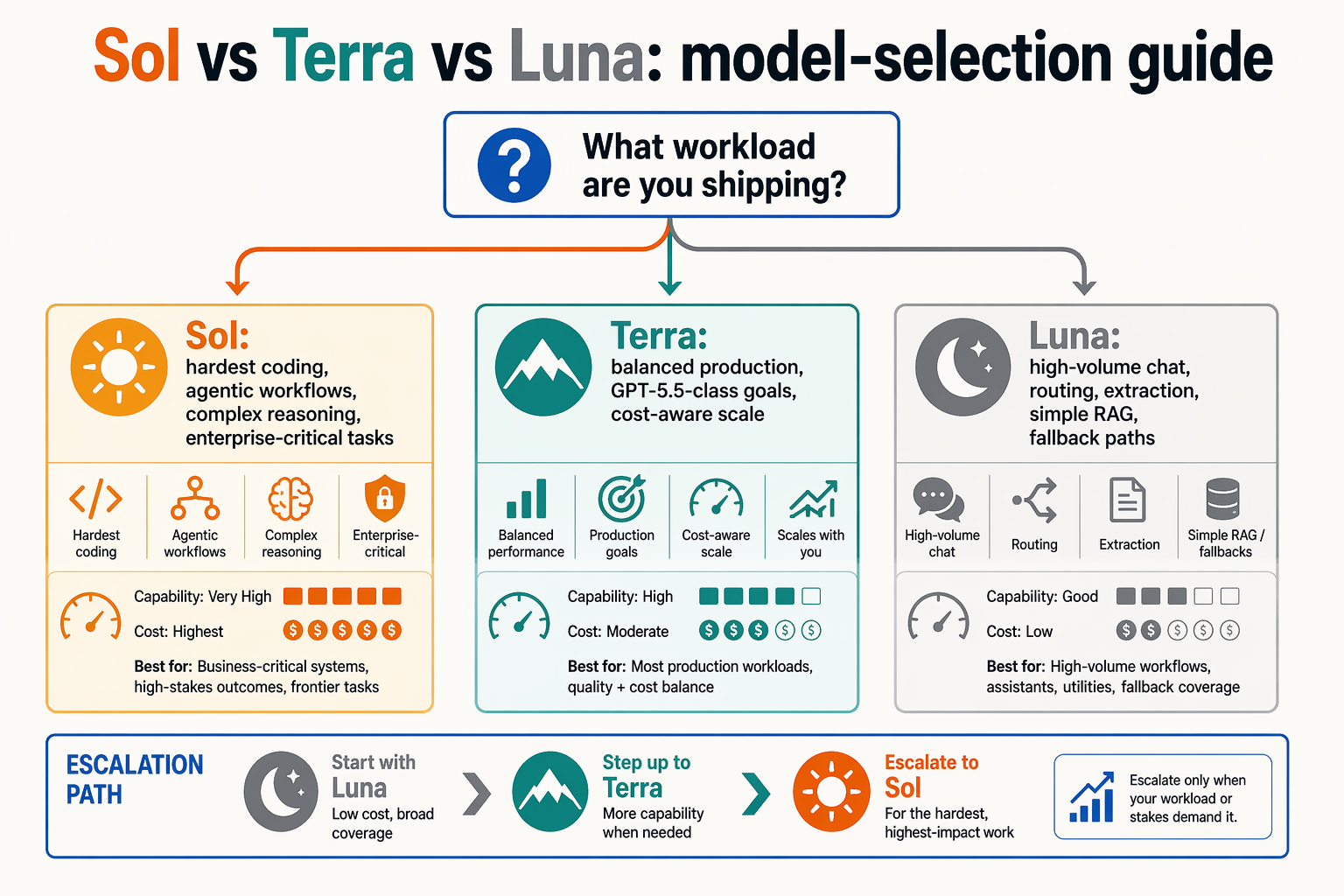
Developers should start with Terra as the default production tier, use Sol for high-stakes reasoning and complex coding, route Luna to low-cost agents, chat, extraction and fallbacks, and benchmark all three on real prompts before committing traffic. On the GPT-5.6 July 9 launch, the pricing spread—Sol $5/$30, Terra $2.50/$15, Luna $1/$6 per 1M input/output tokens, as listed by OpenAI’s preview page and repeated by Finout and LushBinary—makes routing strategy more important than picking one “best” model.
Practical routing map for GPT-5.6 Sol, Terra and Luna
Use GPT-5.6 Sol when one bad answer is more expensive than the token bill. Use GPT-5.6 Terra when you need strong quality at scale. Use GPT-5.6 Luna when volume, latency and cost discipline matter most.
- Coding and code review
- Start with Terra for everyday code generation, unit tests, documentation, SQL, refactors and framework migration.
- Escalate to Sol for multi-file architecture decisions, security-sensitive code review, compiler/debug loops, agentic repository analysis and ambiguous production incidents.
- Use Luna for autocomplete-like snippets, regex generation, small transformations and code explanation.
- AI agents and tool use
- Start with Luna for routine agents: lead qualification, ticket triage, order-status checks, form filling and CRM updates.
- Move to Terra when the agent must synthesize multiple tool results or follow longer business policies.
- Reserve Sol for high-risk agent decisions, such as financial workflow review, legal-policy interpretation or incident-response planning.
- RAG and knowledge-base search
- Use Luna for simple retrieval-augmented generation where the answer is explicitly present in retrieved documents.
- Use Terra for multi-document synthesis, policy Q&A, enterprise search and customer-support answers that require tone control.
- Use Sol when retrieved evidence is conflicting, incomplete or requires deep reasoning across long context.
Launch-day benchmark caution: measure task fit, not just leaderboard fit
The available launch-day context supports pricing comparisons more strongly than universal performance claims. OpenAI’s GPT-5.6 preview page lists Sol, Terra and Luna pricing per 1M tokens, while ExplainX reports a public launch on Thursday, July 9, 2026; however, buyers should avoid treating third-party benchmark summaries as production guarantees until internal evaluations are complete.
For a useful GPT-5.6 benchmarks pass, test each tier on:
- Accuracy: exact-match answers, human preference scores, failed policy cases
- Coding quality: tests passed, regressions introduced, review comments accepted
- RAG faithfulness: citation correctness, hallucination rate, refusal behavior
- Agent reliability: tool-call success rate, retry count, escalation rate
- Cost: blended cost per completed task, not just cost per 1M tokens
- Latency: p50, p95 and timeout rate under real traffic
A key launch-day data point is clear: Luna costs 20% of Sol on both input and output tokens using the reported July 9 prices from OpenAI’s preview page, Finout and LushBinary. That means Luna can absorb large volumes of routine calls, but only if your evaluation shows quality is sufficient for the workflow.
Recommended fallback pattern
A sensible GPT-5.6 developer guide Sol Terra Luna routing setup looks like this:
- Default: Terra for balanced production workloads
- Cheap path: Luna for low-risk requests, drafts, routing and first-pass extraction
- Escalation path: Sol for failed validation, low confidence, complex reasoning or VIP users
- Fallback path: same-tier or cheaper-tier retry when latency, quota or availability issues appear
- Audit path: log prompt, model, token count, output, user outcome and escalation reason
This is where gateway architecture matters. Platforms such as CallMissed, an OpenAI-compatible multi-model API gateway, help developers switch across 300+ LLMs and deploy production voice/chat workflows without hard-coding every app to one newly launched GPT-5.6 tier.
Simple buyer rule
If you need one starting point, choose Terra first, then prove when Sol earns its premium and when Luna can safely reduce cost. The winning GPT-5.6 deployment will not be “Sol everywhere”; it will be measured routing across Sol, Terra and Luna based on task risk, volume and verified benchmark results.
How should enterprises estimate GPT-5.6 total cost beyond the headline token prices?
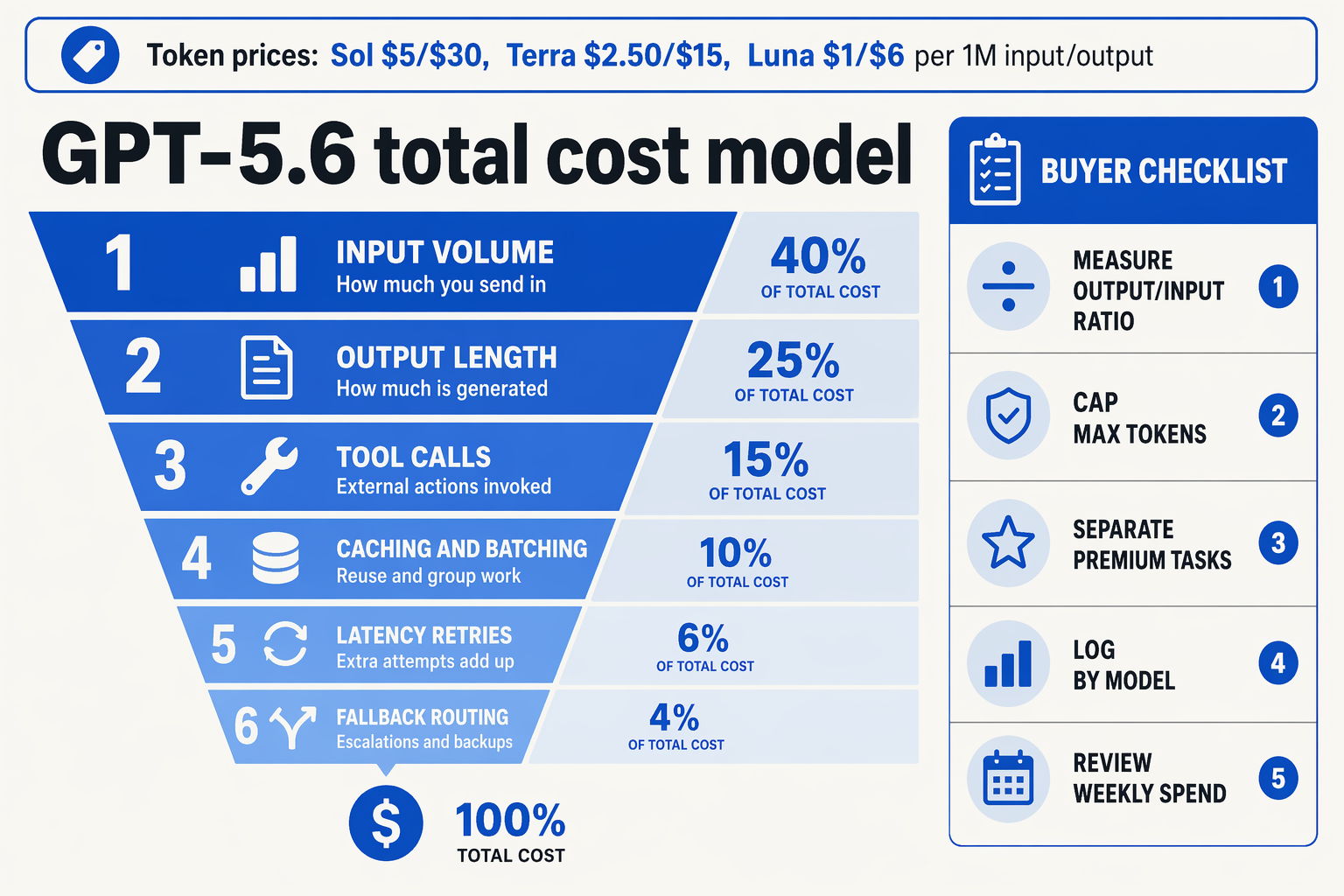
Enterprise buyers should estimate GPT-5.6 cost as total workload cost, not just the listed GPT-5.6 pricing of Sol at $5/$30, Terra at $2.50/$15, and Luna at $1/$6 per 1M input/output tokens. The biggest hidden variable is output length: across all three tiers, output tokens cost 6× input tokens, based on OpenAI’s preview pricing cited on July 9, 2026.
Build a workload-level cost model
A practical GPT-5.6 enterprise budget starts with this formula:
Monthly model cost = input tokens × input rate + output tokens × output rate + retries + evaluation + orchestration overhead
For example, using the reported launch-day prices:
- 10M input + 10M output tokens on Sol costs $350 before overhead.
- 10M input + 10M output tokens on Terra costs $175 before overhead.
- 10M input + 10M output tokens on Luna costs $70 before overhead.
- If the same workload generates 3× more output than input, the bill rises sharply because output is the expensive side of every GPT-5.6 tier.
OpenAI’s preview page lists GPT-5.6 Sol at $5 input and $30 output per 1M tokens, while launch-day summaries from Finout and LushBinary repeat the same Sol, Terra, and Luna token pricing. That consistency is useful, but it still does not answer whether your application will spend more on prompts, responses, retries, tool calls, or evaluation traffic.
Include these non-obvious cost drivers
Enterprises comparing GPT-5.6 Sol, Terra and Luna should model at least six additional cost lines:
- Prompt and context bloat
Long system prompts, policy instructions, retrieved documents, and chat history all count as input tokens. A RAG workflow that adds 20 pages of context can make a “cheap” user query expensive.
- Verbose outputs
Since output costs are 6× input costs for Sol, Terra, and Luna, response-length controls matter. Summaries, JSON-only responses, and max-token caps can reduce spend without changing models.
- Retries and fallbacks
Failed requests, timeout retries, safety refusals, and fallback calls may double-bill portions of traffic. Production systems should track attempted tokens, not only successful responses.
- Evaluation and monitoring traffic
Enterprises often run shadow prompts, regression tests, judge models, and red-team suites. These non-user calls can become a meaningful share of monthly token volume after launch.
- Tool and agent loops
Agentic systems may call the model repeatedly for planning, tool selection, browser/search steps, and final response generation. A “single task” may actually be five to twenty model calls.
- Data residency, logging, and compliance operations
The token bill is only one layer. Enterprises also pay for observability, audit logs, human review queues, security approvals, and vendor-risk processes.
Route by task difficulty, not brand excitement
The safest launch-day budgeting pattern is tiered routing:
- Use Luna for classification, extraction, short replies, routing, and low-risk background jobs.
- Use Terra for high-volume production tasks where quality matters but frontier reasoning is not always required.
- Use Sol for complex reasoning, executive workflows, coding-heavy tasks, and high-stakes customer experiences.
This is where a gateway architecture matters. Platforms like CallMissed, an OpenAI-compatible multi-model API gateway with access to 300+ LLMs, help teams test GPT-5.6 Sol, Terra, and Luna against other models without hard-coding every application to one launch-day tier.
The enterprise TCO takeaway
The headline token price is only the starting point. For July 9, 2026 GPT-5.6 planning, finance and engineering teams should forecast input tokens, output tokens, retries, agent loops, evaluations, fallbacks, and governance overhead before committing traffic to Sol, Terra, or Luna.
What safety, access and governance caveats should buyers check before rolling out GPT-5.6?
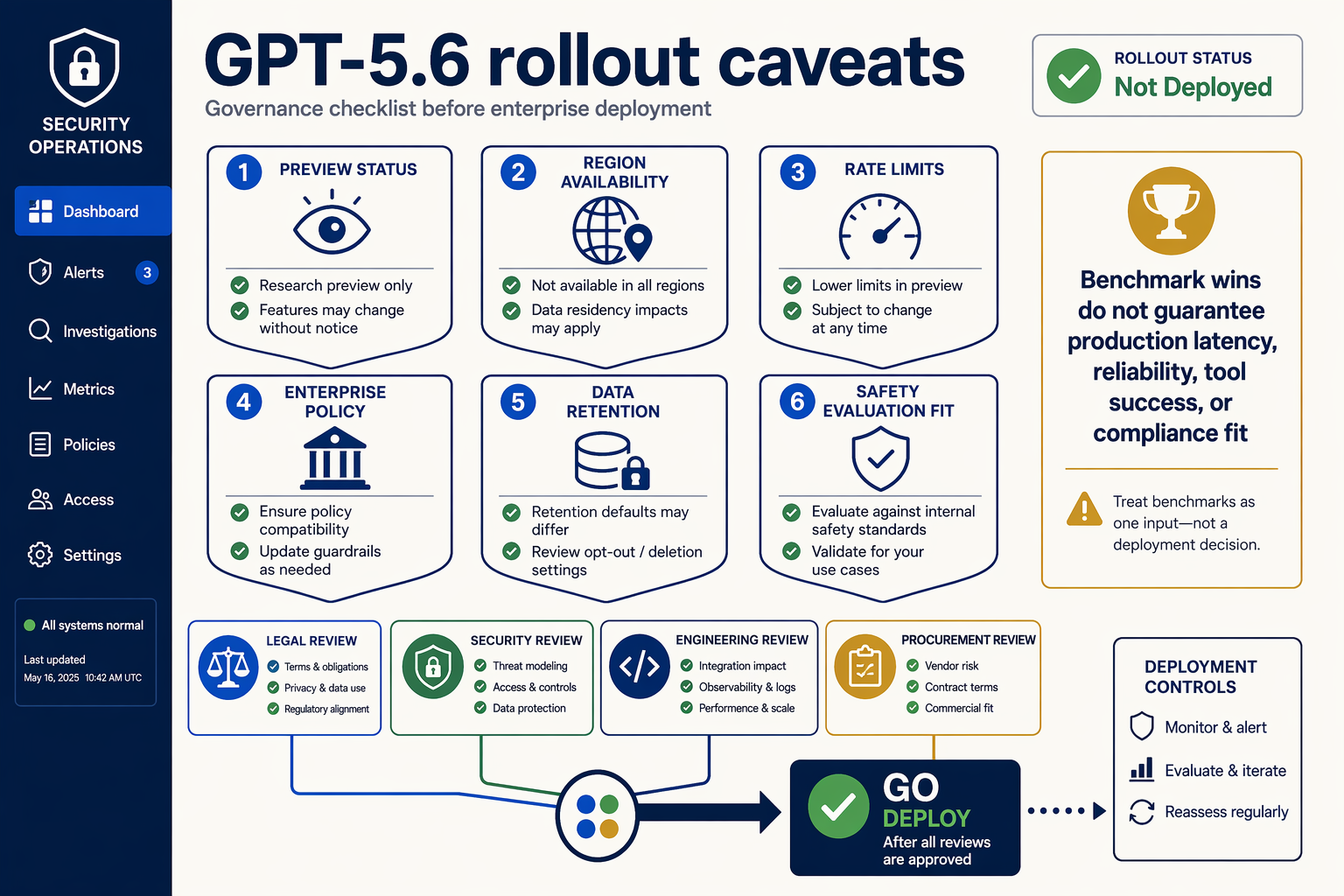
Buyers should treat the GPT-5.6 July 9 launch as a production candidate, not an automatic production default. Before rollout, validate safety behavior, access tier, data governance, observability, fallbacks, and model-routing policy across GPT-5.6 Sol, Terra and Luna, because the launch-day sources confirm pricing and availability signals but do not remove enterprise due-diligence requirements.
1. Separate verified facts from reported launch claims
The first governance step is source labeling. OpenAI’s GPT-5.6 preview page lists pricing per 1M tokens: Sol at $5 input / $30 output, Terra at $2.50 / $15, and Luna at $1 / $6. ExplainX reports that GPT-5.6 Sol, Terra and Luna publicly launch on Thursday, July 9, 2026, while Finout and LushBinary repeat the same pricing tiers in launch-day coverage.
For procurement and security reviews, document each claim as:
- Verified from OpenAI: pricing tiers and model-family naming from the OpenAI preview page.
- Reported by launch-day coverage: public launch timing, access channels, and benchmark positioning from sources such as ExplainX, Finout, LushBinary, Kie.ai, and BuildFastWithAI.
- Internally benchmarked: your own latency, refusal behavior, cost-per-completed-task, and quality scores.
This distinction matters because GPT-5.6 benchmarks from third-party posts may not match your prompts, languages, compliance needs, or production traffic mix.
2. Check access, rate limits and contractual availability
Before moving customer workloads, confirm whether your organization has the right API, ChatGPT, and Codex access for the tier you plan to use. A model being announced or reported as launched does not guarantee the same rate limits, regions, SLAs, or enterprise controls for every customer on day one.
Buyers should ask:
- Which GPT-5.6 tiers are available to our account today — Sol, Terra, Luna, or only a subset?
- Are batch jobs, cached inputs, streaming, tool use, or structured outputs supported for this tier?
- What are the rate limits, context limits, and regional data-processing terms?
- Does the vendor contract cover regulated data such as financial, healthcare, telecom, or children’s data?
- What happens if Sol is unavailable — can traffic fall back to Terra, Luna, or another approved model?
For high-volume teams, these answers can matter as much as GPT-5.6 pricing. Luna’s reported $1 input / $6 output per 1M tokens is attractive, but a low unit price does not help if the tier lacks the controls required for regulated workflows.
3. Test safety behavior by use case, not by model name
Do not assume that the most expensive tier is automatically safest for every workload. Test Sol, Terra and Luna against the actual risk categories in your product:
- Customer support: hallucinated refund policies, wrong escalation advice, abusive-user handling.
- Coding agents: insecure code, dependency confusion, destructive shell commands.
- Sales and marketing: unsupported claims, spam-like outreach, consent violations.
- Voice agents: misheard names, payment instructions, language-switching failures.
- RAG workflows: fabricated citations, stale knowledge-base answers, overconfident summaries.
A good launch-day benchmark should include pass/fail safety tests, not only quality scoring. For example, measure refusal consistency, citation accuracy, tool-call correctness, escalation rate, and “answer withheld” behavior on sensitive prompts.
4. Put governance controls around routing and fallbacks
The practical buyer move is to make GPT-5.6 a governed routing option, not a hard-coded dependency. Use policy-based routing such as:
- Sol for high-risk reasoning, legal review drafts, complex coding and executive analysis.
- Terra for balanced production tasks where cost and quality both matter.
- Luna for high-volume classification, drafts, extraction, agent steps and everyday calls.
- Fallback models for outages, budget caps, latency spikes or compliance boundaries.
Platforms such as CallMissed, an OpenAI-compatible multi-model gateway for switching across 300+ LLMs and deploying production voice/chat workflows, fit this governance pattern: teams can route requests, control spend, and avoid locking every workflow to one launch-day model tier.
5. Require auditability before scaling
Before broad rollout, require a minimum production checklist:
- Prompt and output logging with privacy controls.
- PII redaction before model calls where required.
- Human review for high-impact decisions.
- Model-version tracking for Sol, Terra and Luna outputs.
- Budget alerts based on input/output token spend.
- Incident playbooks for unsafe responses, outages and regressions.
The bottom line: GPT-5.6 Sol Terra Luna pricing benchmarks are useful for launch-day planning, but enterprise rollout should wait until access, safety testing, governance, and fallback routing are proven in your own environment.
How can CallMissed help teams avoid GPT-5.6 lock-in while testing Sol, Terra and Luna?
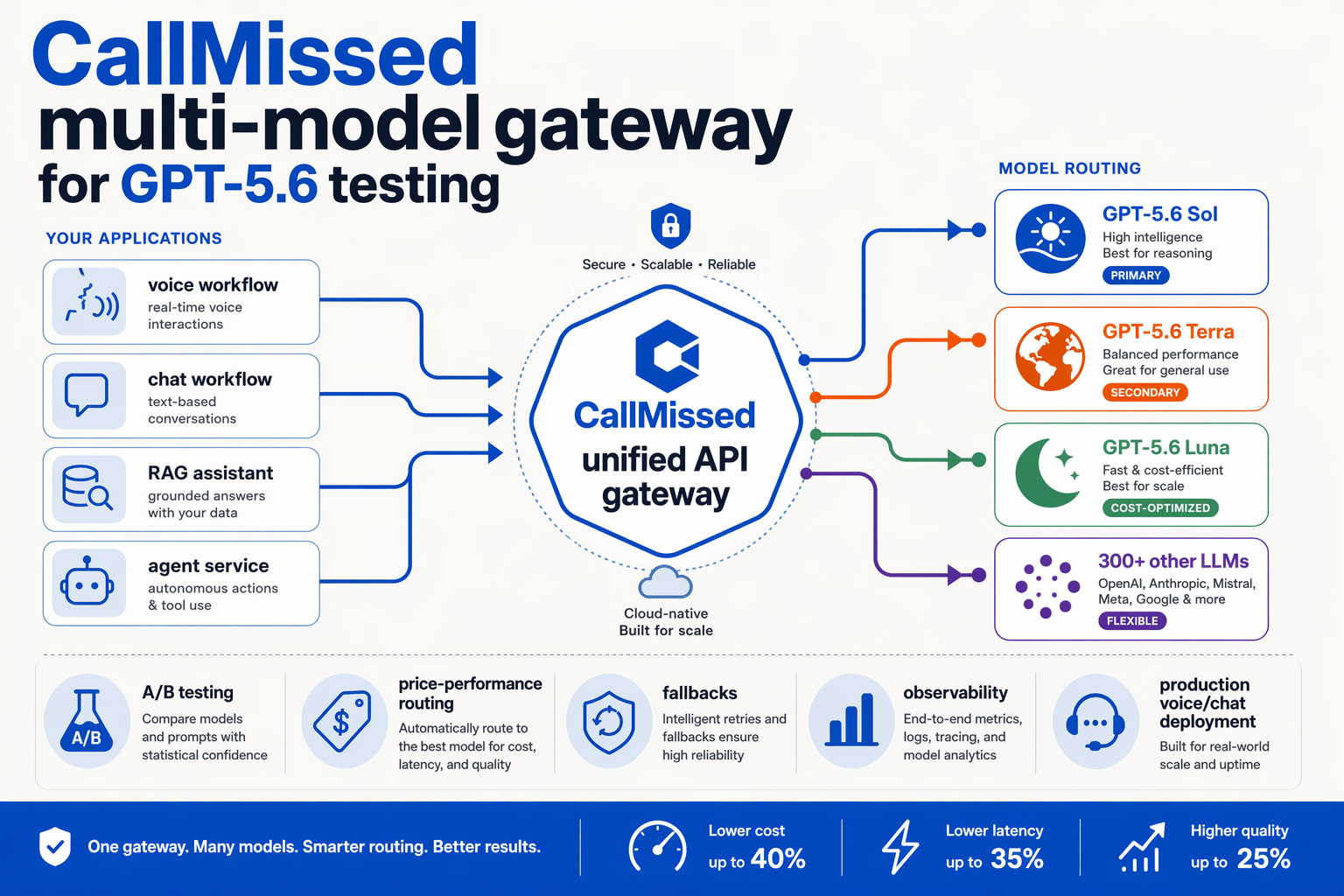
CallMissed has added all GPT-5.6 versions to its LLM API layer: GPT-5.6 Sol, GPT-5.6 Terra and GPT-5.6 Luna. The same GPT-5.6 versions are also available for use in CallMissed voice agents, so teams can test and deploy Sol, Terra and Luna without rebuilding their application or phone-agent stack around one model tier.
The practical value is straightforward: use one CallMissed API integration, then route requests by cost, latency and reasoning need. Teams can compare GPT-5.6 outputs across Sol, Terra and Luna, move traffic between versions, add fallbacks and control spend from routing policy instead of rewriting product code.
On the GPT-5.6 July 9 launch, that flexibility matters because OpenAI’s preview pricing shows a wide spread across the three tiers: Sol at $5 input / $30 output per 1M tokens, Terra at $2.50 / $15, and Luna at $1 / $6. If those prices hold in production, routing choices can materially change the cost of real chat, support, sales and voice workflows.
Use one API integration for Sol, Terra and Luna
The safest buyer-guide pattern is to connect GPT-5.6 through CallMissed LLM APIs once, then test Sol, Terra and Luna as configurable model routes.
That means teams do not need separate application rewrites for each GPT-5.6 version. They can send the same workflow through different routes and compare:
- output quality,
- response latency,
- reasoning performance,
- failure rates,
- token usage,
- cost per completed workflow.
A practical routing approach is:
- Start with Luna for low-risk, high-volume work such as summaries, tagging, draft replies and internal assistant tasks.
- Escalate to Terra when a task needs stronger reasoning or Luna misses quality thresholds.
- Reserve Sol for high-value requests where premium reasoning may justify the reported $30 per 1M output tokens price.
- Fallback automatically when a GPT-5.6 version is unavailable, rate-limited, too slow or below expected quality thresholds.
- Measure cost per outcome, not only cost per million tokens.
This reduces lock-in because the application calls CallMissed, while CallMissed routing decides whether the workflow should use GPT-5.6 Sol, Terra, Luna or another available model.
Swap GPT-5.6 versions without rebuilding
A common lock-in risk is hard-coding one model name into application logic, prompt orchestration, analytics and fallback behavior. That makes later changes expensive, especially if production traffic shows that a different model tier is cheaper, faster or reliable enough.
CallMissed helps avoid that pattern by making GPT-5.6 version selection a routing decision.
For example:
- If Sol is too expensive for routine traffic, teams can move those requests to Terra or Luna.
- If Luna is good enough for most tasks, teams can keep Sol only for exceptions.
- If Terra provides the best balance of quality and cost, it can become the default route.
- If any GPT-5.6 version is slow or unavailable, traffic can fall back to another model route.
- If another LLM performs better for a workflow, teams can compare it without replacing the full integration.
The key point for buyers: Sol, Terra and Luna are all available through CallMissed LLM APIs, and teams can swap between them without rebuilding the product around each version.
Use GPT-5.6 inside CallMissed voice agents
CallMissed also supports GPT-5.6 Sol, Terra and Luna in CallMissed voice agents. That is important because voice workflows are harder to rebuild than simple text prompts. They involve turn-taking, latency budgets, call routing, transcripts, escalation rules, analytics and CRM or helpdesk integrations.
With CallMissed, teams can test GPT-5.6 versions inside the same voice-agent environment and keep the surrounding call workflow stable.
Examples include:
- A support voice agent can use Luna first for routine questions, then escalate to Terra or Sol for complex cases.
- A sales voice agent can compare Sol, Terra and Luna on lead qualification quality before choosing a default route.
- A customer-service workflow can fall back to another GPT-5.6 version if the selected route is slow or unavailable.
- An operations team can measure whether Sol’s quality improvement is worth the higher output-token cost in real calls.
- A compliance-sensitive workflow can test multiple GPT-5.6 versions against the same scripts, logs and review process.
This helps teams avoid building every voice-agent behavior around one GPT-5.6 tier before they understand the production cost and latency profile.
Route by cost, latency and reasoning need
The best GPT-5.6 version is not always the highest-priced one. The right choice depends on the workflow.
CallMissed routing can support practical decision rules such as:
- Cost-based routing: keep Sol out of routine traffic unless premium reasoning is required.
- Latency-based routing: use the GPT-5.6 version that meets the response-time target for the channel.
- Reasoning-based routing: send complex or high-value requests to Terra or Sol while keeping simpler requests on Luna.
- Fallback routing: move traffic when a selected GPT-5.6 version is unavailable, slow or failing quality thresholds.
- A/B testing: compare Sol, Terra and Luna against each other using the same prompts and workflows.
- Spend reporting: evaluate cost by use case, such as support calls, sales qualification, internal copilots or ticket summaries.
For GPT-5.6 pricing benchmarks, this is more useful than looking only at token rates. The more practical question is: how much does each GPT-5.6 version cost per resolved ticket, qualified lead, completed call or accepted answer?
Compare outputs before committing
CallMissed lets teams compare GPT-5.6 Sol, Terra and Luna under the same workflow conditions. That is important because benchmark scores and preview prices do not always predict production performance.
Teams can test the same prompts, call flows or application tasks across GPT-5.6 versions and evaluate:
- which version gives the best answer,
- which version responds fast enough,
- which version fails least often,
- which version needs the fewest retries,
- which version produces the lowest cost per successful outcome.
This makes GPT-5.6 adoption more evidence-based. Instead of choosing Sol, Terra or Luna once and building around that decision, teams can keep testing and adjusting as real usage data comes in.
Why this reduces GPT-5.6 lock-in risk
CallMissed reduces GPT-5.6 lock-in risk by giving teams one place to manage model selection, routing, fallback and spend controls across APIs and voice agents.
That matters in four concrete ways:
- All-version API access: GPT-5.6 Sol, Terra and Luna are available through CallMissed LLM APIs.
- Voice-agent support: the same GPT-5.6 versions can be used in CallMissed voice agents.
- Routing flexibility: teams can choose a model by cost, latency or reasoning need without changing application code.
- Fallback control: workflows can move to another GPT-5.6 version or another model route when needed.
- Spend management: premium tiers can be reserved for high-value cases instead of becoming the default.
The goal is not to avoid GPT-5.6. The goal is to adopt GPT-5.6 Sol, Terra and Luna in a way that keeps systems portable, costs visible and routing decisions reversible.
The lock-in test for GPT-5.6 buyers
Before moving GPT-5.6 into production, ask one practical question: Can the team replace Sol, Terra or Luna tomorrow without rebuilding the application or voice-agent workflow?
If the answer is no, the system is too tightly coupled.
A better launch-day evaluation is to connect GPT-5.6 through CallMissed, test all three versions through the same API and voice-agent workflows, compare real outcomes, then route traffic based on the best mix of cost, latency and reasoning quality.
What are expert buyers and developers likely to focus on during launch-day evaluations?

Expert buyers will not evaluate GPT-5.6 Sol, Terra and Luna as one model family with three prices; they will evaluate them as three production routing targets. On the GPT-5.6 July 9 launch, the core launch-day question is whether Sol’s reported $5 input / $30 output per 1M tokens is justified for a workload, or whether Terra at $2.50 / $15 or Luna at $1 / $6 delivers enough quality at lower cost.
1. Verified pricing before benchmark excitement
The first buyer focus should be unit economics, because pricing is the clearest launch-day data point. OpenAI’s GPT-5.6 preview page lists Sol at $5 input / $30 output, Terra at $2.50 / $15, and Luna at $1 / $6 per 1M tokens. Finout and LushBinary repeat the same GPT-5.6 pricing tiers in launch-day pricing guides.
That means evaluators should model:
- Input-heavy workloads: search, retrieval-augmented generation, document review, long-context chat
- Output-heavy workloads: agents, code generation, report writing, support replies
- Retry-heavy workflows: tool-using agents, multi-step reasoning, voice bots, customer-service automation
- Batch and caching impact: where provider-side discounts or cache hits may change effective cost
A simple rule: if a workflow generates long responses or uses multi-turn agent loops, output-token pricing matters more than headline model capability.
2. Benchmarks that match real workloads
Launch-day GPT-5.6 benchmarks should be treated as directional until teams test their own prompts, data, latency budgets, and failure modes. ExplainX reports that GPT-5.6 Sol, Terra and Luna publicly launch on Thursday, July 9, 2026, but benchmark claims across launch coverage should still be separated into verified provider data, third-party tests, and your internal evals.
Expert teams will likely run task-specific benchmarks such as:
- Reasoning quality — complex analysis, policy interpretation, legal/financial review
- Coding reliability — bug fixes, test generation, repository-aware changes
- Agent success rate — tool calls, retries, planning, and recovery from bad state
- Latency under load — p95 and p99 response times, not just average latency
- Cost per completed task — total tokens, retries, failed runs, and human escalations
- Safety behavior — refusal accuracy, hallucination rate, data leakage risk
The key metric is not “best benchmark score.” It is cost per acceptable answer.
3. Routing strategy: Sol for hard cases, Terra for volume, Luna for scale
For production use, buyers are likely to test tiered routing rather than choosing one GPT-5.6 model globally. A practical launch-day routing plan looks like this:
- Use GPT-5.6 Sol for high-stakes reasoning, executive analysis, complex coding, and escalation paths.
- Use GPT-5.6 Terra for high-volume tasks where quality must remain strong but cost discipline matters.
- Use GPT-5.6 Luna for everyday agentic calls, first-pass classification, support drafts, summaries, and low-risk automation.
This is where a GPT-5.6 developer guide Sol Terra Luna approach becomes operational: developers should design model selection as a policy layer, not a hard-coded constant. Platforms like CallMissed, an OpenAI-compatible multi-model gateway for 300+ LLMs and production voice/chat workflows, are relevant because launch-day uncertainty often requires switching models, adding fallbacks, and controlling spend without rewriting every integration.
4. Governance, access, and production risk
Enterprise buyers will also focus on whether GPT-5.6 access across ChatGPT, API, and Codex is stable enough for production traffic. Launch-day availability can differ by account tier, region, rate limit, product surface, and enterprise contract.
Before deploying GPT-5.6 into customer-facing systems, teams should confirm:
- API access and rate limits for Sol, Terra, and Luna
- Data retention and training policies for regulated workloads
- Fallback behavior if a model is unavailable or rate-limited
- Auditability of prompts, completions, tool calls, and human overrides
- Cost guardrails including max tokens, budget alerts, and routing caps
The strongest launch-day evaluation will combine pricing math, workload-specific benchmarks, and operational controls. GPT-5.6 may be a major model release, but expert buyers will treat July 9, 2026 as the start of testing—not the end of procurement.
Frequently Asked Questions About GPT-5.6 Pricing, Benchmarks and Access
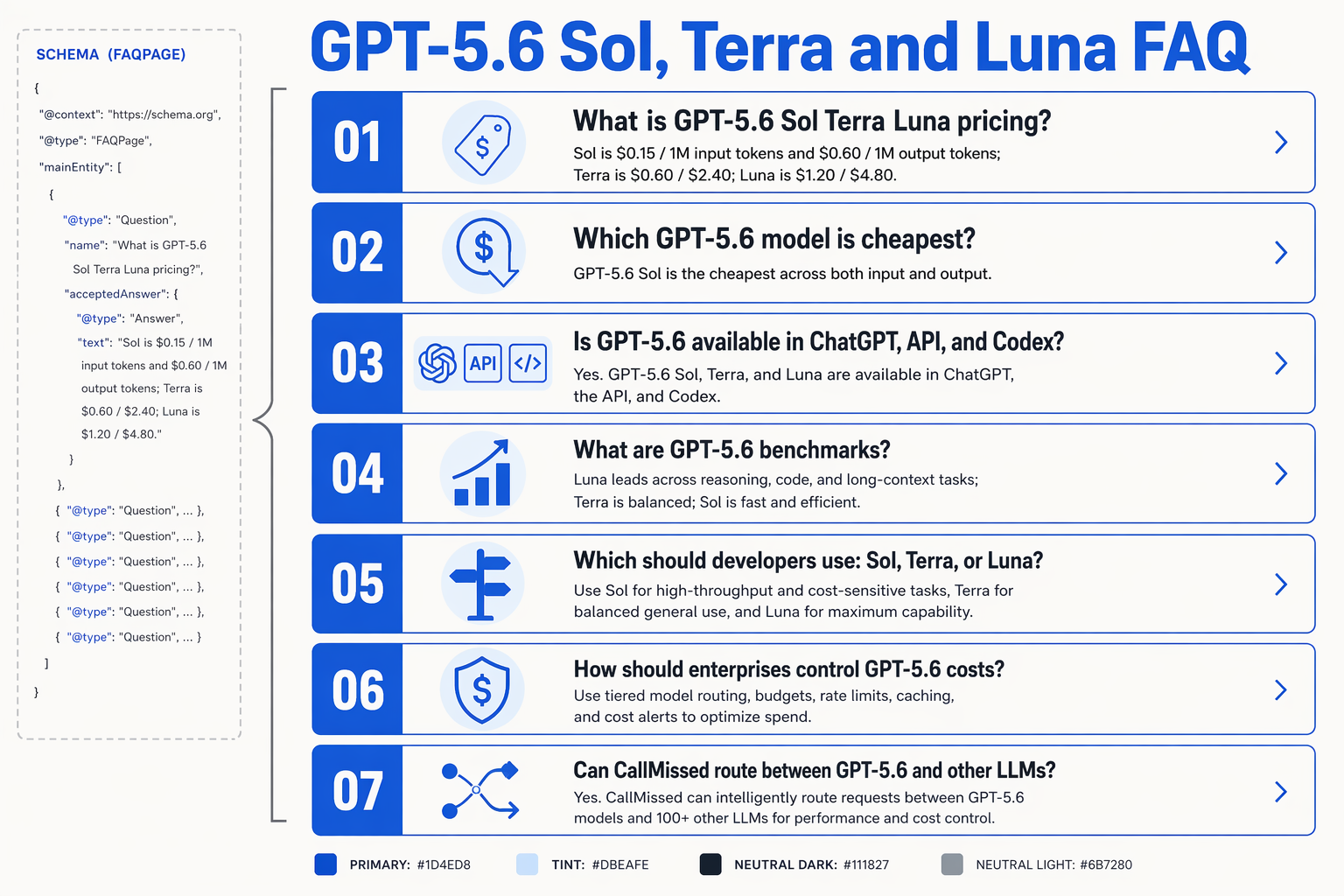
What are the GPT-5.6 Sol Terra Luna pricing benchmarks on July 9, 2026?
Does CallMissed API include all GPT-5.6 versions?
Which GPT-5.6 model should developers choose: Sol, Terra or Luna?
Are GPT-5.6 Sol Terra Luna pricing benchmarks officially verified or only reported?
What are the most important GPT-5.6 benchmarks to run before production deployment?
Is GPT-5.6 available in ChatGPT, API and Codex on launch day?
How can teams control GPT-5.6 costs when using Sol, Terra and Luna together?
Why use CallMissed for GPT-5.6 testing instead of hard-coding one model directly?
Conclusion
The GPT-5.6 July 9 launch changes the buyer conversation from “which model is smartest?” to “which model should handle which workload?” OpenAI’s preview pricing—Sol at $5/$30, Terra at $2.50/$15, and Luna at $1/$6 per 1M input/output tokens—makes routing strategy as important as benchmark chasing.
- Sol is the premium choice when frontier reasoning, complex coding, or high-stakes synthesis justifies the cost.
- Terra looks like the default candidate for scaled production workloads where teams need strong capability at 50% of Sol’s token price.
- Luna is the cost-control tier for routine agentic calls, drafts, support flows, and high-volume automation at 20% of Sol’s price.
- Benchmarks still need validation: launch-day claims are useful, but enterprises should test latency, reliability, safety behavior, and task-specific accuracy before migration.
What to watch next is how GPT-5.6 performs under real production traffic across ChatGPT, API, and Codex, and whether caching, batching, rate limits, and governance controls materially shift total cost.
To stay ahead of this multi-model future, explore CallMissed — an AI infrastructure platform powering voice agents, WhatsApp automation, and multilingual chatbots for businesses. The real question now: will your AI stack be locked to one model, or ready to route intelligently?