
Claude Opus 5.5 vs Gemma 4 31B: Hosted or Open?


Use this Claude Opus 5 vs Gemma 4 31B guide to compare licensing, control, privacy, performance, infrastructure and total cost.
Claude Opus 5.5 vs Gemma 4 31B: Hosted or Open?
What if the model with no servers to manage costs more over three years than the model whose weights you must host yourself? The Claude Opus 5.5 vs Gemma 4 31B decision is not simply “powerful API versus cheaper open model”; it is a choice about who controls deployment, data paths, updates, capacity, and engineering risk. For buyers, those operational differences can outweigh a benchmark lead.
Why does this hosted-versus-open-weight comparison matter now?
Anthropic announced Claude Opus 5.5 on September 22, 2026, calling it its most powerful model to date, Reuters reported that day. Anthropic says Opus 5.5 leads in agentic coding and knowledge work and costs 40% less to run than Opus 5 on typical workloads. Anthropic’s Claude Platform documentation also lists a $0.20-per-million-token cache-hit price, equal to 5% of standard input pricing, as of September 2026.
The other side requires stricter verification. Open-weight does not automatically mean open source: teams must inspect Gemma 4 31B’s model card, license, permitted uses, redistribution terms, context limits, and hardware guidance before treating self-hosting as unrestricted ownership. No decision should substitute community claims or an older Gemma license for the exact release terms.
What will this comparison help you decide?
This guide separates vendor claims from reproducible evidence and evaluates both options across:
- Licensing and control: API terms versus weight access, fine-tuning rights, portability, and upgrade control.
- Infrastructure and privacy: managed capacity versus GPUs, quantization, observability, security, and data residency.
- Performance and economics: coding, reasoning, agentic work, latency, utilization, staffing, and total cost of ownership.
- Fit by organization: recommendations for startups, regulated enterprises, research teams, and high-volume product workloads.
Benchmarks will be treated as signals, not verdicts: a hosted flagship may deliver stronger out-of-the-box agentic performance, while an open-weight model can offer deployment control but transfer optimization and reliability work to your team. The useful question is not which model “wins” in isolation, but which operating model matches your workload, compliance boundaries, latency target, talent, and budget.
Platforms such as CallMissed, an India-hosted developer AI API, illustrate the move toward abstraction: one key and balance cover 136 models, while OpenAI-compatible and Anthropic-compatible endpoints reduce integration rewrites as of September 2026.
By the end, you will have a shortlist, a proof-of-concept checklist, and a framework for comparing API spend with the often-hidden costs of GPUs, serving software, monitoring, updates, and specialist engineering—without confusing openness with zero cost or hosted convenience with zero risk.
Which should you choose: Claude Opus 5.5 or Gemma 4 31B?
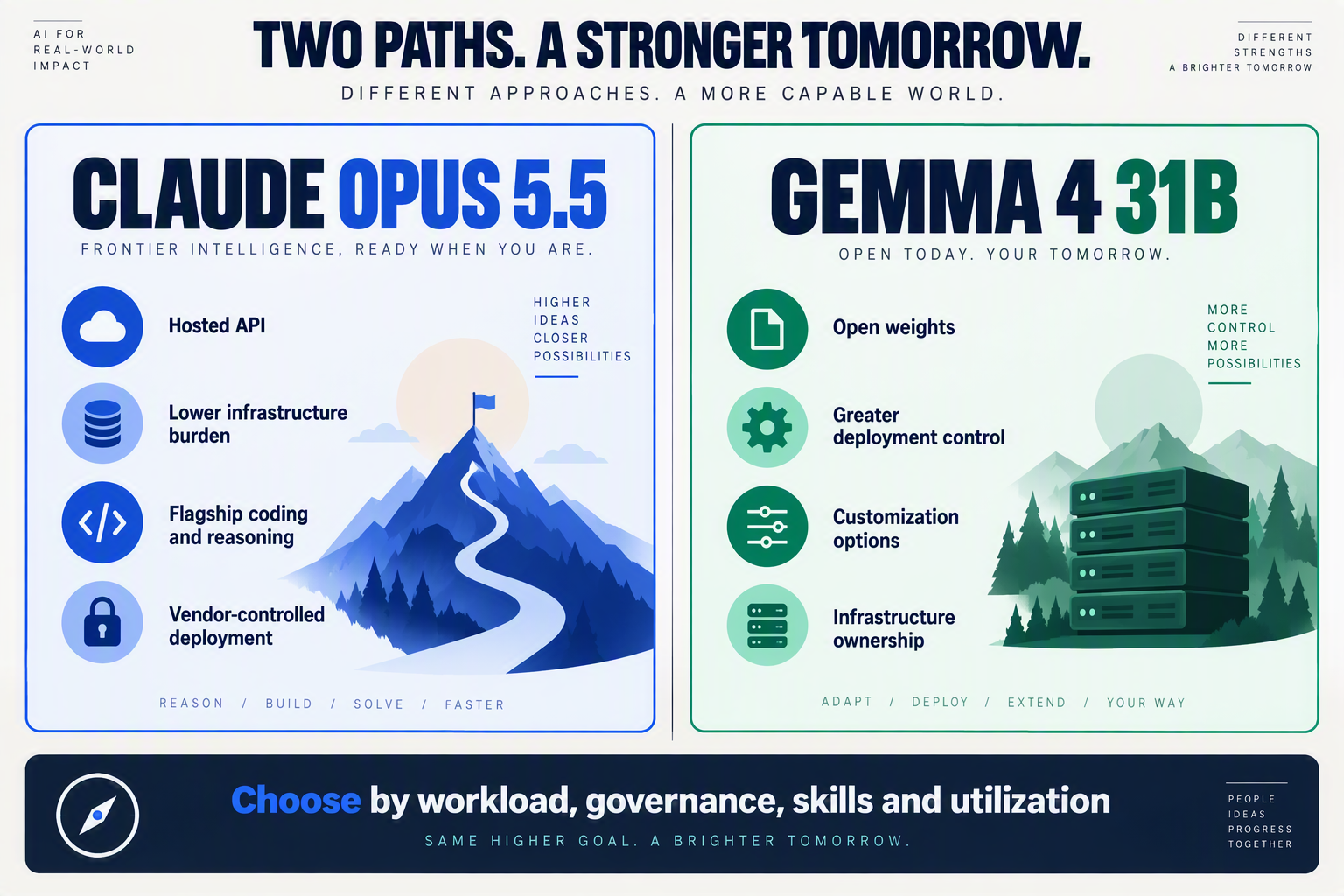
Choose Claude Opus 5.5 when advanced agentic performance, rapid deployment, and low infrastructure overhead matter most. Choose Gemma 4 31B only after verifying its exact model card and license—and when deployment control, customization, or sustained high utilization justifies operating an open-weight model yourself.
When is Claude Opus 5.5 the better choice?
Claude Opus 5.5 is the lower-friction option for teams that want to consume intelligence as a managed service rather than build an inference platform. Reuters reported on September 22, 2026, that Anthropic described Claude Opus 5.5 as its most powerful model to date.
Claude Opus 5.5 is the stronger initial candidate for:
- Agentic coding and knowledge work: Anthropic says Claude Opus 5.5 leads in these categories, although buyers should validate that claim against private repositories and representative workflows.
- Fast production launches: API deployment avoids GPU procurement, model serving, quantization, autoscaling, and low-level inference optimization.
- Variable or uncertain demand: Usage-based billing is generally easier to justify when traffic is intermittent and dedicated accelerators would sit idle.
- Small engineering teams: Developers can focus on retrieval, tools, evaluations, and user experience instead of maintaining inference infrastructure.
Anthropic states that Claude Opus 5.5 costs 40% less to run than Claude Opus 5 on typical workloads as of September 2026. Anthropic’s Claude Platform documentation also prices an Opus 5.5 cache hit at $0.20 per million tokens, or 5% of standard input pricing, as of September 2026, making prompt caching important for repeated instructions and large shared contexts.
The trade-off is dependence on Anthropic’s service terms, available regions, capacity policies, model lifecycle, and pricing. Teams also cannot inspect or deploy Claude Opus 5.5 weights inside their own infrastructure.
When should you consider Gemma 4 31B?
Gemma 4 31B is the more relevant architecture choice when the organization needs to control where inference runs and how the serving stack is configured. However, “open-weight” must not be interpreted as unrestricted open-source software.
Before selecting Gemma 4 31B, procurement and legal teams should verify:
- The official publisher and exact model identifier.
- The release-specific license and acceptable-use restrictions.
- Commercial-use, fine-tuning, and redistribution rights.
- Supported context length, precision, and quantization formats.
- Official memory, accelerator, and serving recommendations.
The supplied evidence does not include an authoritative Gemma 4 31B model card or release license. Consequently, claims about its 4-bit memory footprint, benchmark scores, commercial permissions, or hardware requirements should remain unverified until primary documentation is available.
If those checks pass, an open-weight deployment can support private-network inference, controlled upgrades, task-specific fine-tuning, custom quantization, and infrastructure portability. Those benefits come with responsibility for security patches, capacity planning, monitoring, failover, evaluation, and accelerator utilization.
What is the practical decision rule?
Use this three-part test:
- Choose Claude Opus 5.5 for premium reasoning or coding workloads where time-to-production and managed operations outweigh deployment independence.
- Pilot Gemma 4 31B for stable, high-volume workloads where data boundaries or customization justify dedicated infrastructure.
- Run both against the same real-world test set before committing: measure task success, p95 latency, human correction rate, tokens consumed, GPU utilization, and monthly engineering effort.
The decisive comparison is therefore managed capability versus operational control, not API price versus GPU price alone.
What are Claude Opus 5.5 and Gemma 4 31B, and why compare them?

Claude Opus 5.5 represents a proprietary, provider-hosted flagship, while Gemma 4 31B is being evaluated here as an open-weight candidate. The comparison matters because teams are choosing not merely between model outputs, but between managed access and greater deployment control.
What is Claude Opus 5.5?
Anthropic announced Claude Opus 5.5 on September 22, 2026, describing it as the first model in the Claude 5.5 family. Anthropic says Claude Opus 5.5 leads in agentic coding and knowledge work, although those claims should still be tested against each organization’s repositories, workflows, and quality criteria.
Anthropic also says Claude Opus 5.5 costs 40% less to run than Claude Opus 5 on typical workloads, as of September 2026. As a hosted model, it shifts model serving, capacity planning, and infrastructure maintenance to the provider.
What is Gemma 4 31B?
For this comparison, Gemma 4 31B represents the open-weight side of the build-versus-buy decision. However, the supplied research contains no authoritative model card, so its publisher, release date, license terms, parameter details beyond the supplied name, context window, benchmarks, quantization support, and hardware requirements remain unverified.
Teams should therefore treat Gemma 4 31B as a candidate requiring due diligence, not as a fully documented product assumption. The practical comparison centers on:
- Hosted convenience versus deployment control
- Provider-managed operations versus internal infrastructure burden
- API-based privacy controls versus self-managed data boundaries
- Predictable usage pricing versus total ownership costs
- Turnkey capability versus customization freedom
What do the verified licenses allow, and what remains unconfirmed?
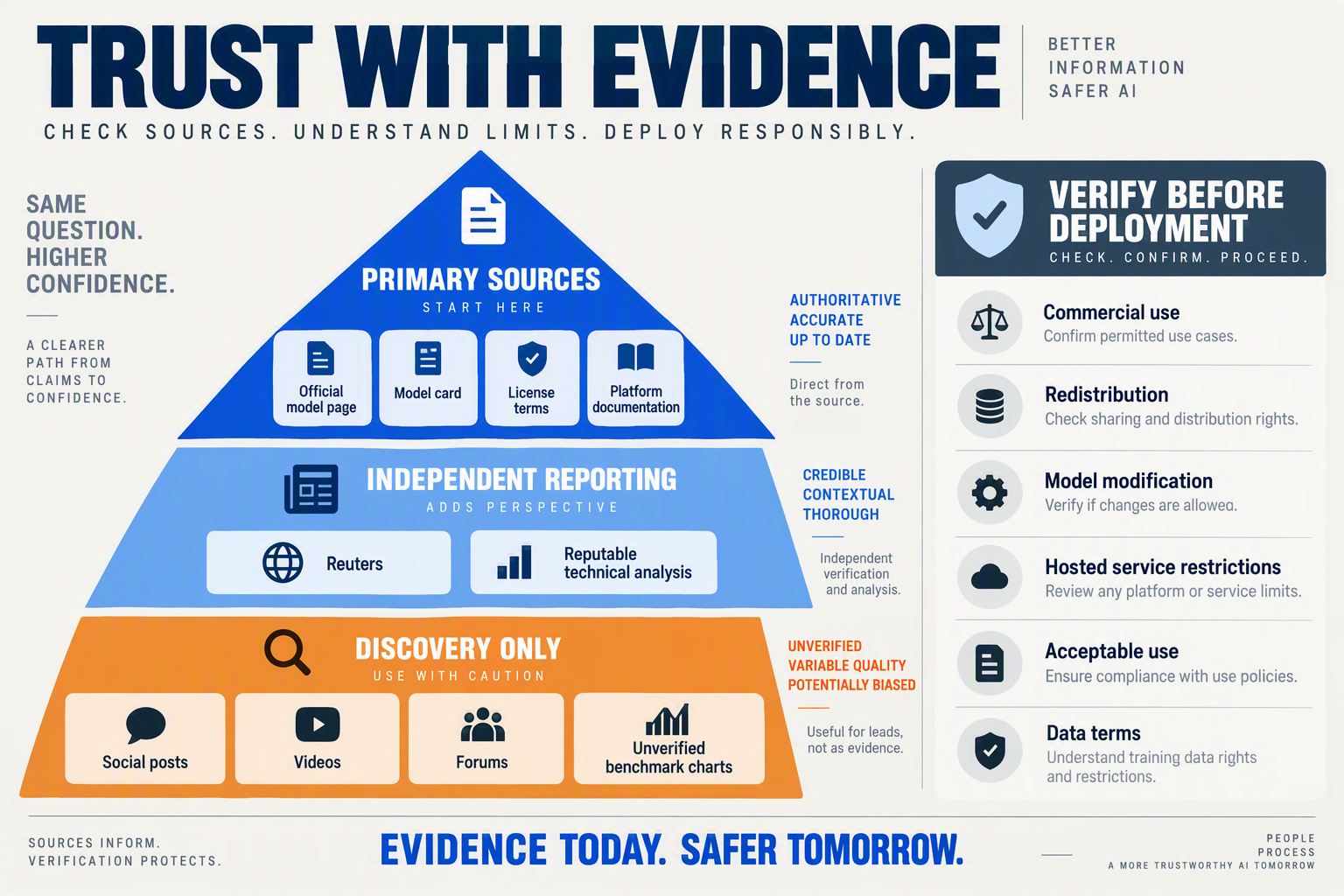
Claude Opus 5.5 is a proprietary hosted model/API choice as of September 2026. The provided research does not include authoritative license or model-card terms for Gemma 4 31B, so no conclusion can be drawn here about what Gemma permits.
What licensing information is verified?
Anthropic announced Claude Opus 5.5 on September 22, 2026, and Anthropic’s platform documentation confirms API availability and pricing information. However, the supplied sources do not establish detailed licensing rights beyond its status as a proprietary hosted offering; buyers must review the current Anthropic commercial terms directly.
For Gemma 4 31B, descriptions such as “open model” or “open weight” are not substitutes for license verification. The research supplied for this comparison contains no authoritative Google license text, model card, acceptable-use policy, or version-specific release documentation for that model.
What must buyers verify before deployment?
Legal, procurement, and engineering teams should confirm these points against first-party documents for the exact model version:
- Commercial use: Whether internal operations, paid products, and customer-facing services are permitted.
- Redistribution: Whether teams may redistribute original weights, quantized files, adapters, containers, or derivative models.
- Fine-tuning: Whether supervised fine-tuning, continued pretraining, distillation, and LoRA adapters are allowed.
- Use restrictions: Whether prohibited sectors, activities, geographies, users, or high-risk applications apply.
- Version-specific terms: Whether the model name, parameter count, checkpoint, host, or release date changes the applicable agreement.
Until those documents are located and reviewed, treat Gemma 4 31B’s licensing permissions as unconfirmed—not automatically permissive.
Which key developments and claims are actually comparable?
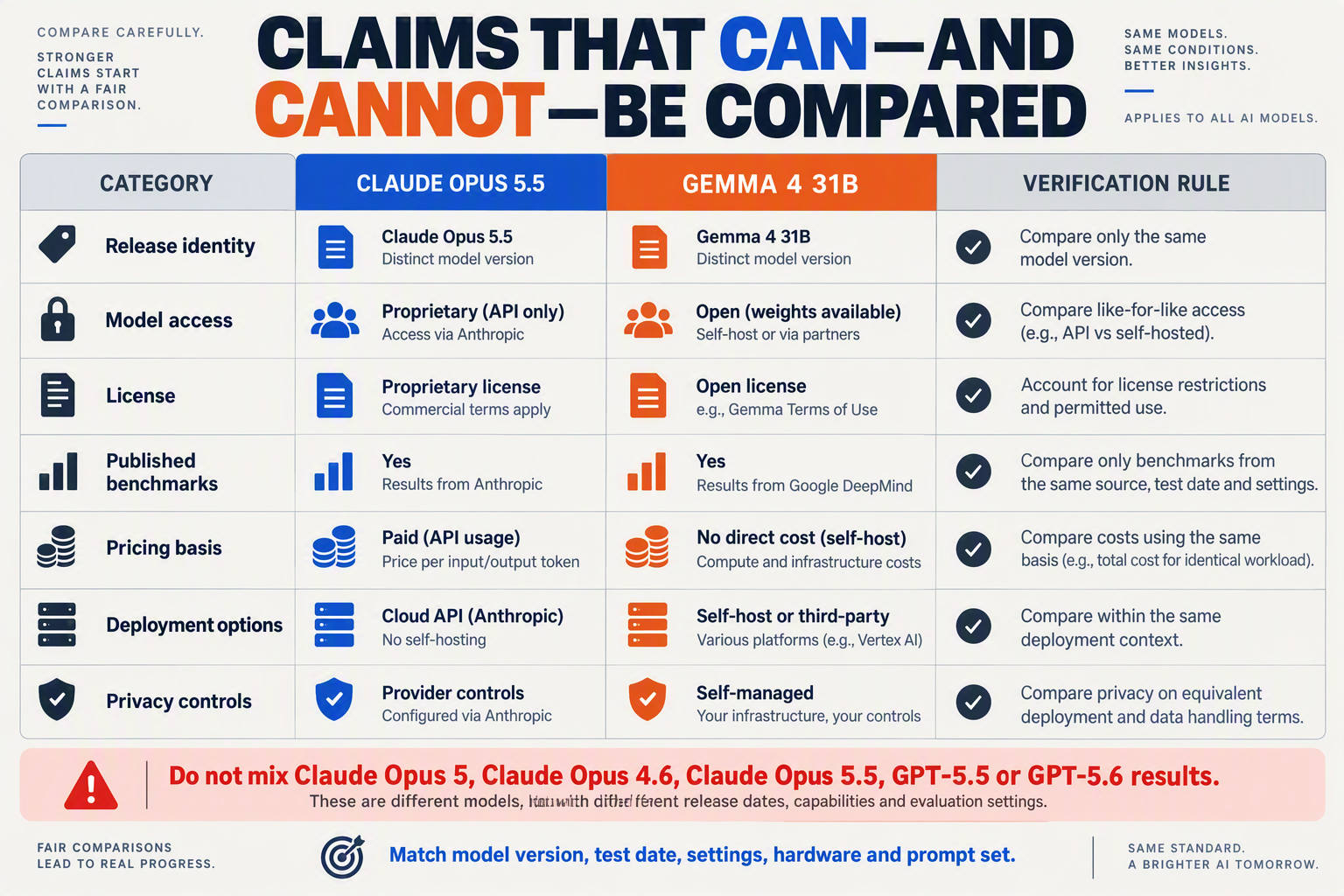
Only a narrow set of Claude Opus 5.5 vs Gemma 4 31B claims can be compared from the supplied evidence. Claude Opus 5.5 has verified launch, positioning, cost-reduction, and cache-pricing claims; Gemma 4 31B’s release, license, benchmarks, pricing, and hardware requirements remain unverified here.
What has been verified for Claude Opus 5.5 and Gemma 4 31B?
| Comparison point | Claude Opus 5.5 | Gemma 4 31B | What buyers should validate |
|---|---|---|---|
| Release status | Anthropic announced availability on September 22, 2026; Reuters independently reported the launch that day. | Not verified in the supplied evidence. | Confirm the official model card, release date, version identifier, and download source. |
| Vendor positioning | Anthropic called Claude Opus 5.5 its “most powerful AI model to date,” according to Reuters on September 22, 2026. | Not verified. | Treat positioning as a vendor claim until internal tests demonstrate relevant gains. |
| Agentic coding | Anthropic said on September 22, 2026 that Claude Opus 5.5 “leads in agentic coding.” | No verified benchmark or vendor claim was supplied. | Test repository-scale edits, debugging, tool use, recovery from errors, and pull-request quality. |
| Knowledge work | Anthropic said on September 22, 2026 that Claude Opus 5.5 leads in knowledge work. | No verified benchmark evidence was supplied. | Evaluate accuracy, citations, document synthesis, instruction adherence, and hallucination rates. |
| Runtime cost improvement | Anthropic said Claude Opus 5.5 costs 40% less to run than Opus 5 on typical workloads as of September 2026. | Pricing and operating costs are not verified. | Recalculate savings using actual prompt lengths, output volumes, retries, and cache-hit rates. |
| Prompt-cache price | Anthropic’s September 2026 platform documentation lists an Opus 5.5 cache hit at $0.20 per million tokens, equal to 5% of standard input pricing. | Cache pricing or an equivalent mechanism is not verified. | Model effective cost using realistic cache reuse rather than assuming every request qualifies. |
| License | Commercial hosted access is indicated by Anthropic’s platform pricing, but complete license terms were not supplied. | The claimed open-weight license is not verified in the supplied evidence. | Legal teams should inspect redistribution, modification, commercial-use, and acceptable-use terms. |
| Deployment control | The supplied sources establish Anthropic-hosted availability, not self-hosting rights. | Self-hosting availability is not verified. | Confirm weight access, supported runtimes, regional hosting, and air-gapped deployment rights. |
| Infrastructure | Anthropic manages hosted-model infrastructure; no verified hardware specification was supplied. | GPU memory, quantization, throughput, and cluster requirements are not verified. | Benchmark target hardware at expected context lengths, concurrency, and service-level objectives. |
| Independent benchmarks | No independent benchmark results were supplied for this comparison. | No independent benchmark results were supplied. | Run the same private evaluation set, decoding settings, tools, and scoring process for both models. |
How should teams interpret Anthropic’s claims?
Anthropic’s 40% cost reduction is relative to Claude Opus 5, not evidence that Claude Opus 5.5 has a lower total cost of ownership than Gemma 4 31B. A hosted API may reduce deployment and maintenance work, while a genuinely open-weight model could offer greater infrastructure control—but the latter conclusion requires verified Gemma licensing and deployment documentation.
Buyers should separate three evidence levels:
- Verified event: Claude Opus 5.5 launched on September 22, 2026, as reported by Reuters and Anthropic.
- Vendor-reported performance: Leadership in agentic coding and knowledge work is Anthropic’s claim, not an independently validated result in the supplied research.
- Buyer-specific outcome: Quality, latency, privacy, and total cost depend on the organization’s prompts, traffic, hardware, staffing, and compliance requirements.
Until Google publishes an official Gemma 4 31B model card and license—or those materials are added to the evidence set—a definitive hosted-versus-open-weight verdict would be premature. The defensible next step is a controlled evaluation using identical tasks, quality thresholds, and fully loaded cost calculations.
How do coding, reasoning and agentic performance compare in real work?
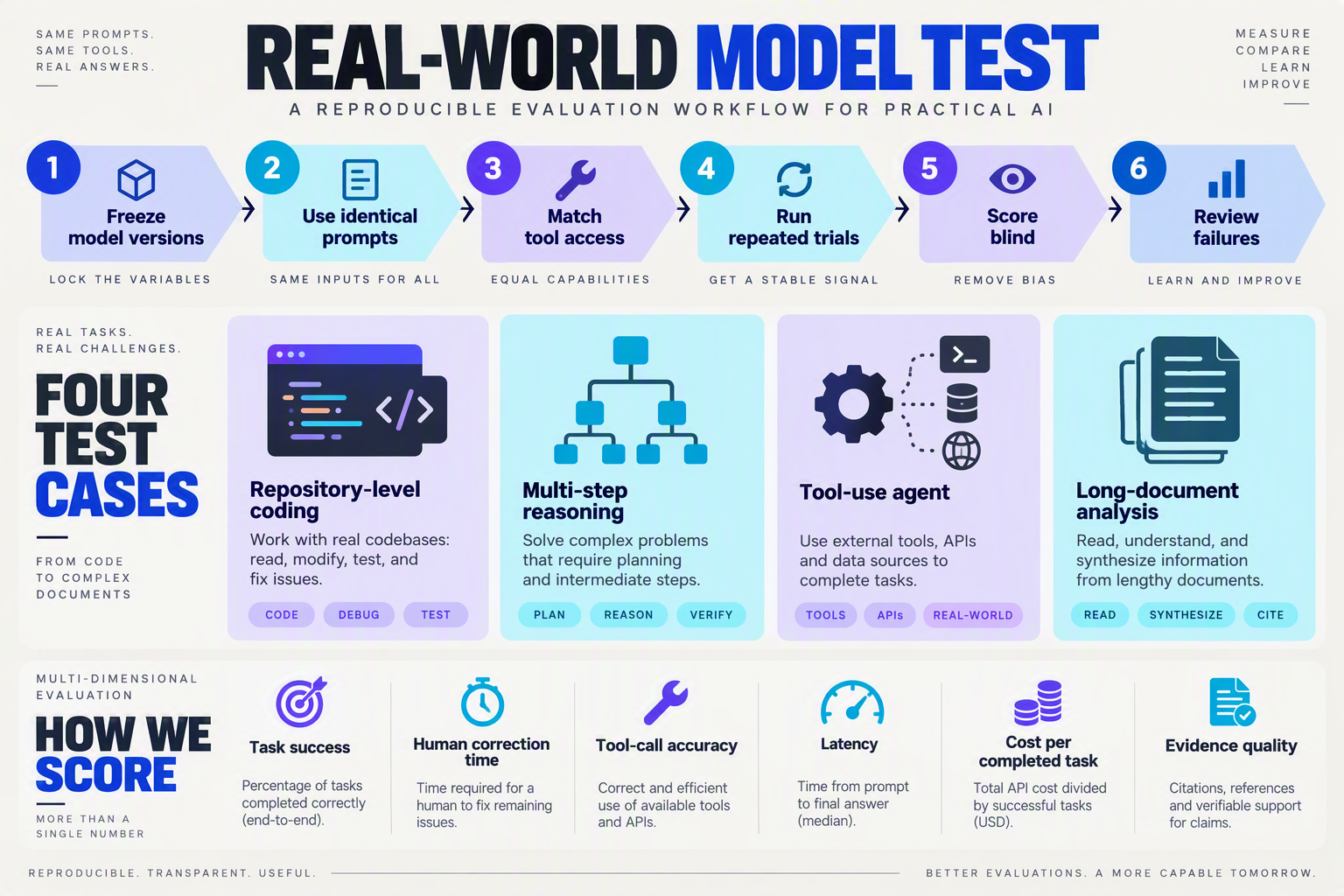
Coding, reasoning and agentic performance cannot be compared responsibly without matched, reproducible tests. Anthropic stated on September 22, 2026, that Claude Opus 5.5 “leads in agentic coding and knowledge work,” but this vendor claim should not be treated as an independently verified result—and no verified Gemma 4 31B score establishes a comparative winner.
How should teams test coding and reasoning performance?
Build a private evaluation set from representative work rather than relying only on public benchmarks. Run both models against identical tasks, acceptance tests and context wherever their interfaces permit.
Include at least:
- Coding: repository-level bug fixes, feature implementation, migrations, test generation and code review.
- Reasoning: document synthesis, constraint-heavy planning, data interpretation and decisions with known answers.
- Quality measures: task success rate, automated test pass rate, factual accuracy and reviewer acceptance.
- Human effort: review time, correction rate and number of retries required before approval.
- Compliance: adherence to safety policies, schemas, citation rules and requested output formats.
For Gemma 4 31B, record the exact checkpoint, precision or quantization, inference engine, hardware and decoding settings. These deployment choices can materially affect results, so an unspecified “Gemma 4 31B” test is not reproducible.
How should agentic reliability be measured?
Agentic tests should use the same tools, permissions, time limits and retry budgets. Measure tool-selection accuracy, valid argument generation, recovery from tool errors, unnecessary tool calls, end-to-end completion rate and unsafe-action frequency.
Report operational performance alongside quality: cost per successful task, total tokens or compute consumed, median latency and p95 latency. A lower per-token or infrastructure price can be misleading if failures, corrections and retries raise the total cost of an accepted result. Run each task multiple times and publish prompts, scoring rubrics, configurations and failure examples so teams can distinguish stable capability from a favorable single run.
How do deployment control, privacy and customization differ?
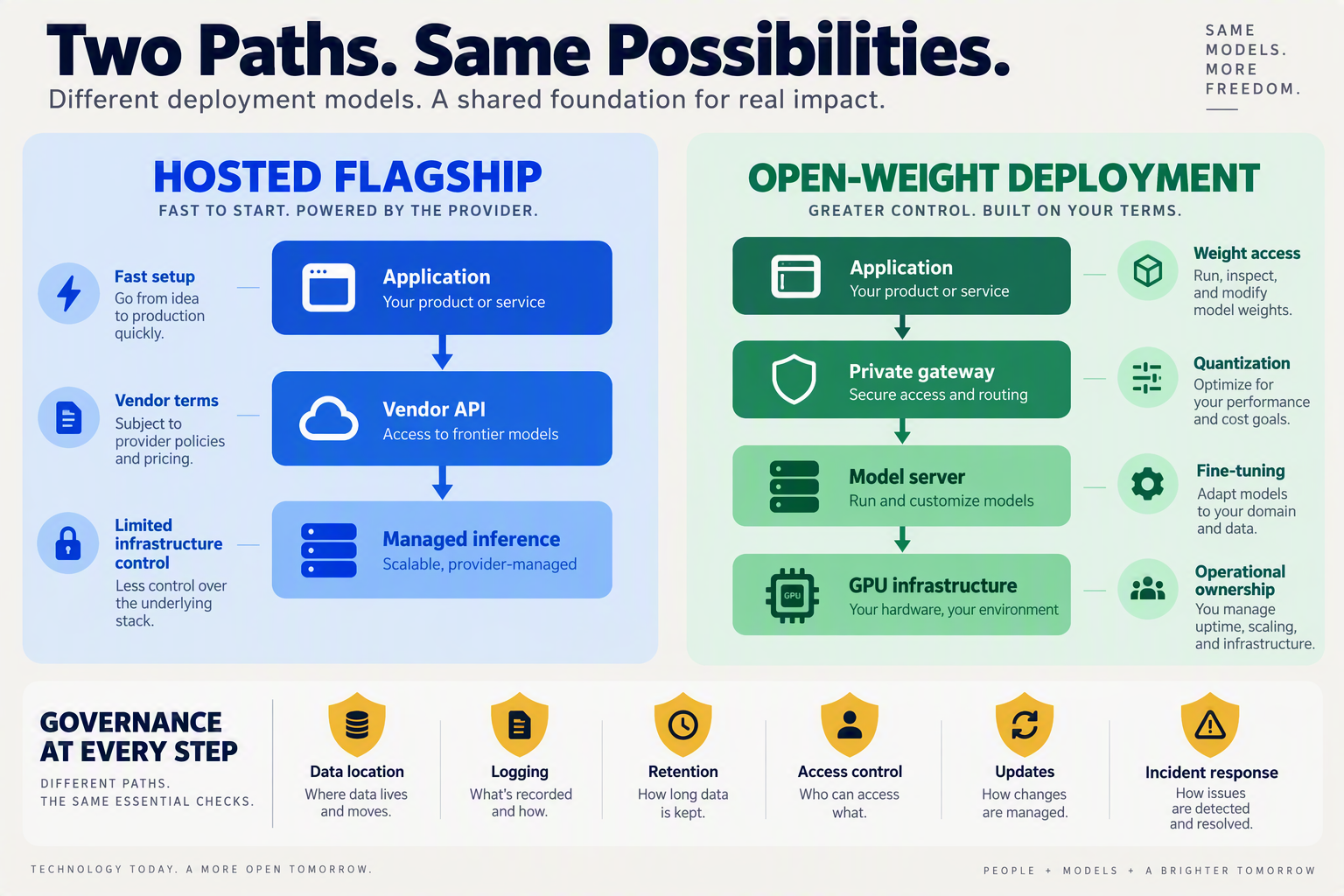
A managed model such as Claude Opus 5.5 prioritizes API convenience, while an open-weight deployment can provide greater infrastructure control—provided its license permits the intended use. Neither approach automatically guarantees privacy, compliance, or data residency.
What control does a hosted API provide?
Anthropic released Claude Opus 5.5 on September 22, 2026, according to Reuters. Using a managed API generally means the provider operates model serving, capacity, updates, and underlying accelerators.
This model offers several operational advantages:
- Faster integration through documented endpoints and SDKs
- No GPU procurement, inference optimization, or cluster maintenance
- Provider-managed scaling and model updates
- Predictable consumption-based billing
The trade-off is provider dependency. Teams must account for API availability, rate limits, pricing changes, model-version changes, and restricted access to weights or low-level inference settings.
What changes with an open-weight deployment?
If the verified Gemma 4 31B license permits a team’s intended deployment and modifications, an open-weight architecture may support more control over where and how inference runs. However, teams should verify the actual license rather than treating “open weight” as equivalent to unrestricted open source.
Self-managed deployment also transfers responsibility for:
- GPU capacity, scaling, monitoring, and security
- Quantization and inference-engine selection
- Patching, evaluation, and model-version governance
- Fine-tuning or adapter management
Does either option guarantee privacy?
No. Privacy and data residency are architecture and contract requirements, not automatic model properties. Hosted-model buyers should review retention, training-use, subprocessors, regional processing, and deletion terms. Self-hosting teams must still secure logs, prompts, embeddings, backups, and administrator access.
For teams wanting API flexibility, CallMissed’s OpenAI- and Anthropic-compatible developer gateway provides access to multiple model providers through one balance and API surface as of September 2026, reducing integration rewrites without eliminating the need for provider-level compliance review.
How do latency and total cost change with traffic and 4-bit quantization?
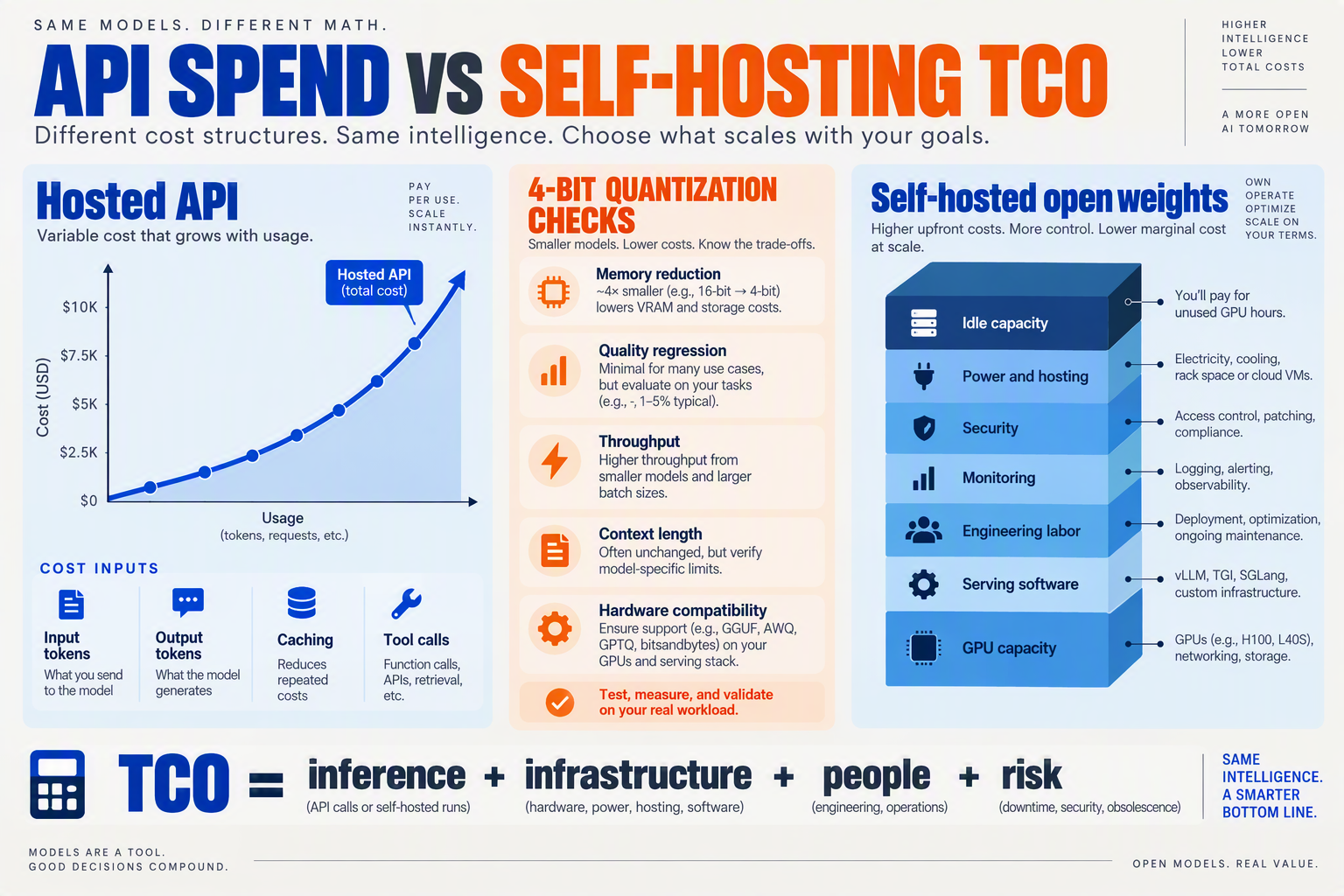
Latency and total cost depend less on headline pricing than on traffic shape, cache reuse, hardware utilization, and operational overhead. Claude Opus 5.5 offers managed capacity and predictable API operations, while self-hosting Gemma 4 31B provides more deployment control but transfers infrastructure responsibility to the team.
How does traffic affect latency and API cost?
For Claude Opus 5.5, latency depends on prompt length, generated output, concurrent requests, and provider-side conditions. Repeated context can materially reduce cost: Anthropic’s September 2026 pricing documentation states that Claude Opus 5.5 cache hits cost $0.20 per million tokens, equal to 5% of its standard input price. Anthropic also says Claude Opus 5.5 costs 40% less than Claude Opus 5 on typical workloads.
Gemma 4 31B latency is controlled by the deployment architecture. Low utilization can leave expensive capacity idle, while traffic spikes may require batching, autoscaling, request queues, or additional replicas. Teams should measure both time to first token and end-to-end response time under realistic concurrency.
Does 4-bit quantization lower Gemma 4 31B’s TCO?
4-bit quantization may reduce resource requirements, but it should not be treated as a guaranteed cost or latency improvement. Benchmark the exact quantization method, serving engine, hardware, context length, and workload for:
- Task accuracy and instruction-following quality
- Time to first token and generation latency
- Throughput under concurrent traffic
- Stability across long-context and agentic tasks
Gemma 4 31B’s total cost of ownership includes hardware utilization, model serving, networking, monitoring, redundancy, upgrades, and engineering labor. Consequently, self-hosting can become attractive at sustained, predictable volume, whereas a hosted model can remain economical for variable traffic or teams without dedicated inference operations.
What are the operational and strategic implications of each model?
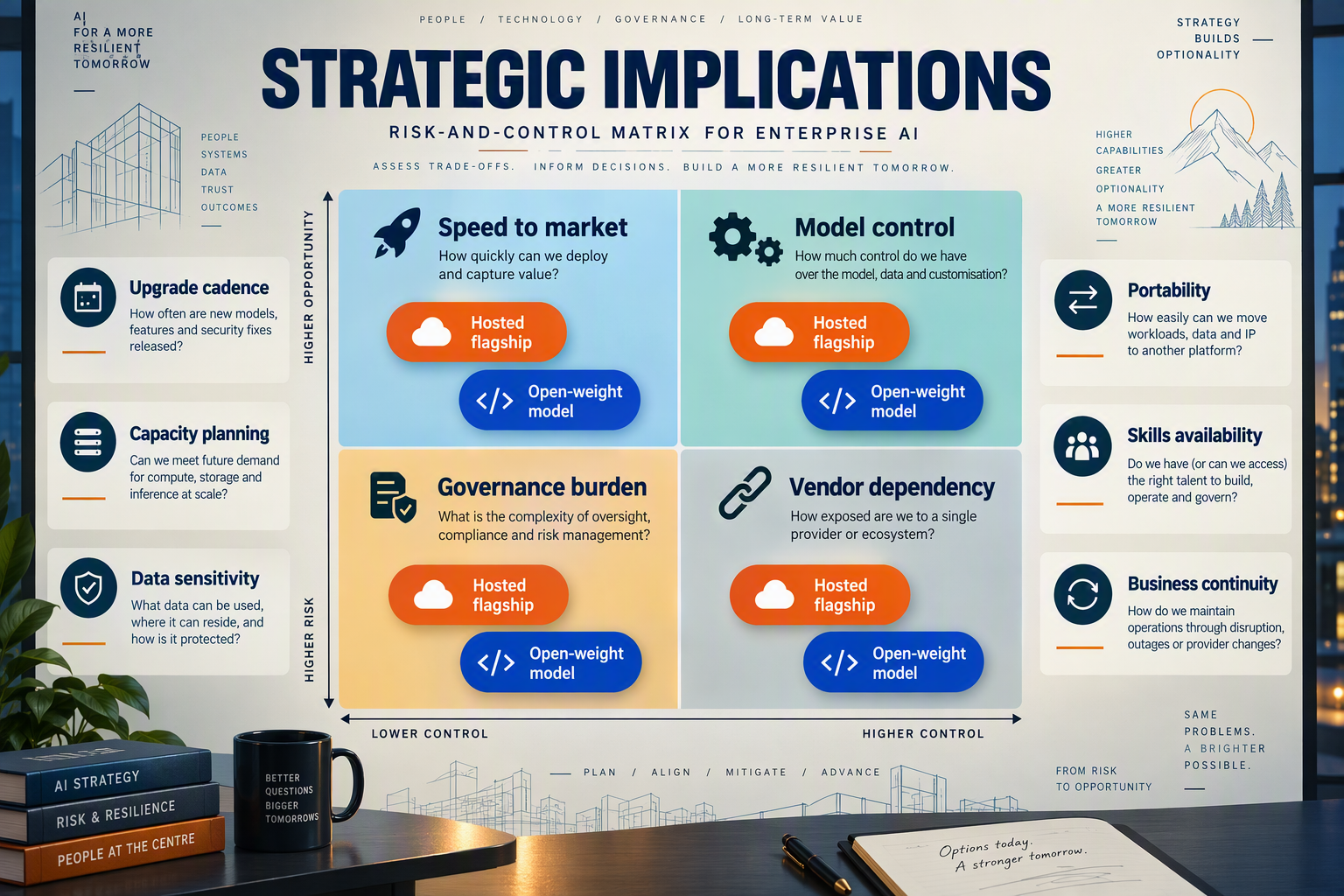
Choosing between Claude Opus 5.5 and a prospective Gemma 4 31B is primarily an operating-model decision: Claude offers a managed flagship service, while an open-weight Gemma release could provide greater deployment control at the cost of substantially more infrastructure ownership. As of September 2026, teams should keep all Gemma 4 31B conclusions conditional until Google publishes official model cards, licensing terms, weights, hardware guidance, and safety evaluations.
How does a managed Claude deployment affect operations?
Using Anthropic’s hosted Claude platform reduces the need to build and maintain an inference stack. Anthropic handles model serving and underlying capacity, allowing teams to focus on prompts, retrieval, tools, application monitoring, and business outcomes.
That convenience creates provider and model-lifecycle dependency. Teams must plan for API changes, rate limits, regional availability, pricing revisions, model deprecations, and behavioral changes between versions. Anthropic stated on September 22, 2026, that Claude Opus 5.5 costs 40% less to run than Opus 5 on typical workloads, but buyers should validate total cost using their own token volumes, cache-hit rates, tool calls, and retry patterns.
What would self-hosting Gemma 4 31B require?
If Google officially releases Gemma 4 31B with deployable open weights and suitable commercial terms, self-hosting could offer stronger control over data location, serving policies, quantization, fine-tuning, and upgrade timing. However, “open weight” would not automatically mean unrestricted licensing, open-source status, or low-cost production deployment.
Teams would need disciplined ownership of:
- Security: weight access, secrets, container hardening, patching, and tenant isolation.
- Capacity: accelerator selection, concurrency forecasts, batching, and peak-load headroom.
- Reliability: health checks, autoscaling, failover, rollback, and disaster recovery.
- Observability: latency, throughput, GPU utilization, error rates, and output-quality drift.
- Governance: evaluation gates, safety testing, version pinning, and documented upgrades.
What should teams validate before committing?
Run a controlled pilot before choosing either model:
- Confirm official licensing and deployment rights.
- Test representative coding, reasoning, retrieval, and agentic workloads.
- Measure p50/p95 latency, throughput, failure rates, and end-to-end cost.
- Review privacy, retention, residency, and access-control requirements.
- Define fallback providers, rollback procedures, and model-version ownership.
- Establish pre-release evaluations, red-team tests, monitoring, and approval gates.
What do independent experts say, and how should teams weigh vendor claims?

The available evidence does not include independent, reproducible head-to-head testing of Claude Opus 5.5 and Gemma 4 31B. As of September 22, 2026, it consists primarily of Anthropic’s announcement and pricing documentation, plus Reuters reporting on the Claude Opus 5.5 launch.
What has actually been verified?
Anthropic says Claude Opus 5.5 leads in agentic coding and knowledge work and costs 40% less than Opus 5 on typical workloads, but these remain vendor-reported claims as of September 2026. Reuters independently reported the launch on September 22, 2026, while attributing performance characterizations to Anthropic rather than presenting independent comparative tests.
The supplied research provides no verified expert quotes, benchmark results, licensing details, or deployment findings for Gemma 4 31B. Buyers should therefore avoid treating unsupported comparison tables as established evidence.
How should teams validate vendor claims?
Run a controlled proof of concept (POC) using:
- The same prompts, context, tools, and scoring rubric
- Blind human review of coding, reasoning, and factual accuracy
- Production-relevant latency and concurrency measurements
- Full cost tracking, including hosting, engineering, monitoring, and API usage
- Privacy, licensing, security, and data-retention reviews based on current primary documentation
Vendor benchmarks are useful hypotheses; procurement decisions should depend on reproducible results from the team’s own workloads.
Which model fits your organization size and use case?
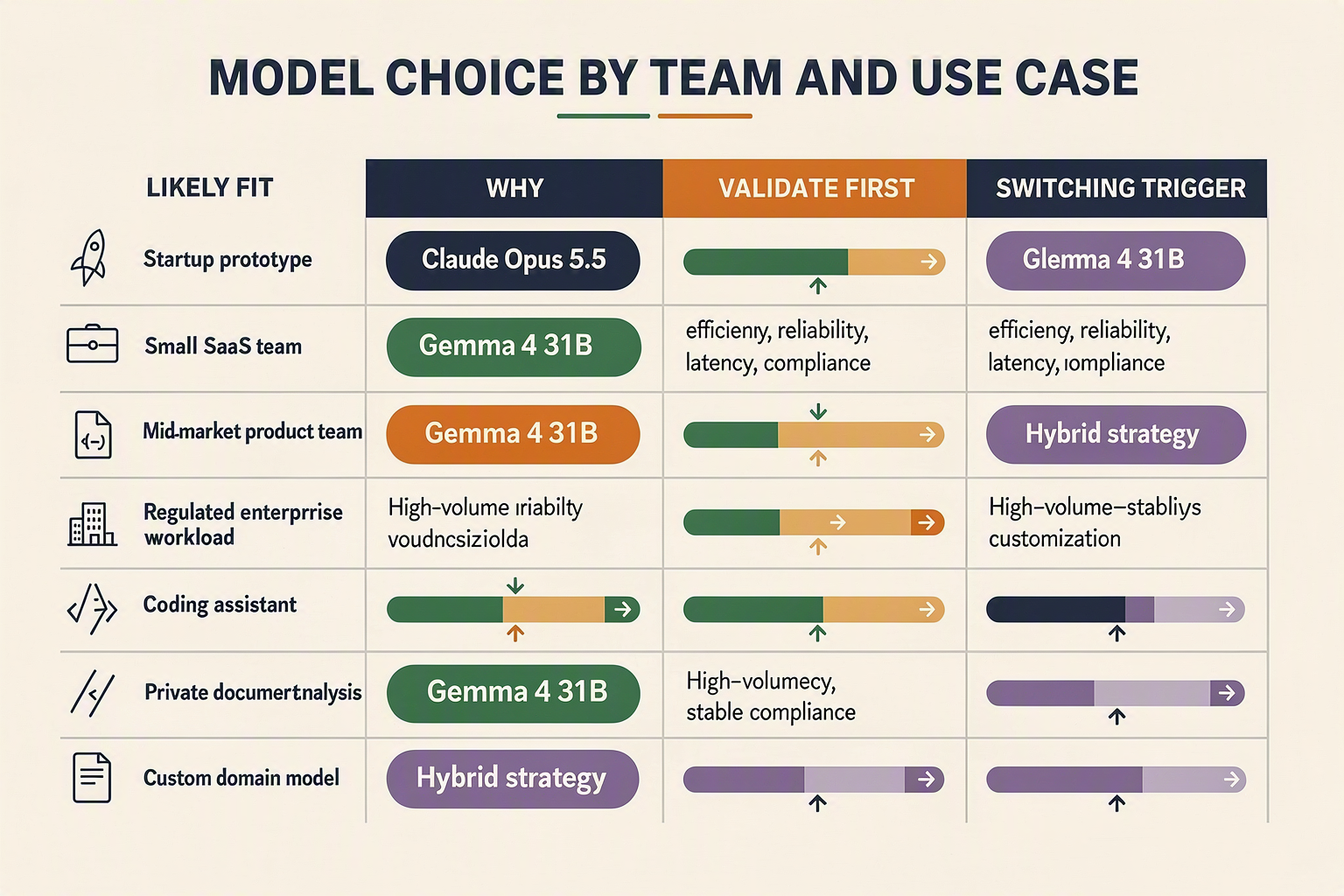
Organization size alone should not decide Claude Opus 5.5 vs Gemma 4 31B. Start with Claude Opus 5.5 when speed to production and variable demand matter; consider a Gemma 4 31B pilot only when your team can verify its official release and licensing terms, operate the required infrastructure, and benefit from greater deployment control at sustained utilization.
Which model should each organization choose?
| Organization or use case | Recommended starting point | Why it fits | Decision gate before production |
|---|---|---|---|
| Startup or small team launching an AI feature | Claude Opus 5.5 | A managed service avoids provisioning accelerators, maintaining inference software, and staffing 24/7 model operations. It is the lower-friction route for fast launches and unpredictable traffic. | Confirm API terms, data-handling requirements, regional availability, rate limits, and workload-specific cost. |
| Small or midsize software team building coding agents | Claude Opus 5.5 | Anthropic said on September 22, 2026 that Claude Opus 5.5 “leads in agentic coding and knowledge work,” making it the evidence-backed starting candidate for coding and research workflows. | Test repository navigation, tool use, security, edit accuracy, and task completion on your own codebase rather than relying on vendor claims alone. |
| Enterprise with variable or seasonal demand | Claude Opus 5.5, initially | Hosted consumption shifts capacity planning to the provider and reduces the risk of paying for idle inference hardware. This can suit support peaks, periodic document analysis, and experimental internal tools. | Model expected tokens, caching, concurrency, governance, and vendor concentration under low, average, and peak demand. |
| Enterprise with strict infrastructure control | Gemma 4 31B pilot, subject to verification | An open-weight deployment may offer more control over hosting location, access boundaries, inference configuration, and customization than a proprietary hosted model. | Verify that Gemma 4 31B exists as an official release, obtain its authoritative license, and have legal counsel confirm the intended commercial use and distribution rights. |
| AI platform team with high, steady utilization | Benchmark both | Self-hosting may become economically attractive when expensive infrastructure remains consistently utilized, but managed APIs can still win after staffing and operational risk are included. | Calculate total cost of ownership using measured throughput, accelerator hours, redundancy, engineering labor, observability, upgrades, and incident response. |
| Regulated or sensitive-data workload | Choose by validated controls, not model label | Self-hosting can strengthen infrastructure control, while a managed service can reduce operational complexity. Neither approach automatically establishes privacy or regulatory compliance. | Complete security, retention, subprocessors, residency, auditability, deletion, and threat-model reviews before processing production data. |
What caveats should procurement and engineering teams apply?
Do not treat “open weight” as synonymous with open source, unrestricted commercial use, or automatic compliance. The supplied evidence does not establish Gemma 4 31B’s official license, usage rights, price, benchmarks, quantization behavior, hardware requirements, or production availability. Procurement should therefore require an official Google model card, license text, weight repository, acceptable-use policy, and version identifier before approving even a pilot.
Anthropic announced Claude Opus 5.5 on September 22, 2026, and Reuters reported that Anthropic described it as the company’s most powerful model to date. Anthropic also says Claude Opus 5.5 costs 40% less to run than Opus 5 on typical workloads, but that vendor comparison is not a complete total-cost estimate for your application.
Run a controlled evaluation with:
- Representative tasks: coding, retrieval, reasoning, structured output, and tool calls.
- Operational measurements: end-to-end latency, throughput, failure rates, and peak concurrency.
- Quality controls: human review, task-level pass criteria, safety tests, and regression suites.
- Full costs: tokens or accelerator time, storage, networking, engineering, monitoring, redundancy, and upgrades.
The defensible choice is the model that clears your own quality, legal, security, latency, and total-cost thresholds—not the one with the strongest label or an unverified benchmark.
Frequently Asked Questions
The available evidence does not support declaring an overall winner between Claude Opus 5.5 and Gemma 4 31B. Teams should verify Gemma’s official documentation and compare both models on the same workloads, quality thresholds and total-cost assumptions.
Q: Does open-weight mean the same thing as open source?
A: No. Open-weight generally means model weights are available to download or deploy, while open source also depends on the license granting rights to inspect, modify, redistribute and use the software or model for specific purposes. Teams must examine the exact license rather than assuming that downloadable weights permit unrestricted commercial use, redistribution, fine-tuning or derivative models.
Q: What has been verified about Claude Opus 5.5?
A: Anthropic announced Claude Opus 5.5 on September 22, 2026, and Reuters independently reported the launch that day. Anthropic says Claude Opus 5.5 “leads in agentic coding and knowledge work” and costs 40% less to run than Opus 5 on typical workloads, but these are vendor claims and should not be treated as independent benchmark conclusions. Anthropic’s Claude Platform documentation listed an Opus 5.5 cache-hit price of $0.20 per million input tokens, or 5% of the standard input price, as of September 2026.
Q: Is Claude Opus 5.5 or Gemma 4 31B the better model?
A: No defensible winner can be declared from the supplied evidence because it contains no verified, matched benchmark comparing the two models. A useful decision requires identical prompts, decoding settings, tool definitions, context lengths and scoring criteria across representative tasks such as coding, reasoning, retrieval and structured output. Teams should also separate model quality from deployment priorities such as privacy, customization, operational control and engineering burden.
Q: What should teams verify before evaluating Gemma 4 31B?
A: Teams should locate the official Google model card and license and confirm that the precise “Gemma 4 31B” name, release, parameter configuration and intended use are documented there; the supplied research does not establish those facts. The license review should cover commercial use, redistribution, modified weights, acceptable-use restrictions and obligations attached to derivatives. The model card should also be checked for supported context, tokenizer, precision, quantization guidance, evaluation results, safety limitations and recommended infrastructure.
Q: How should teams compare Claude Opus 5.5 and Gemma 4 31B on cost and latency?
A: Run a matched workload test using the same prompt set, input and output lengths, concurrency, quality threshold and retry policy, then record success rate plus median, P95 and P99 latency. Compare full total cost of ownership, including:
- Hosted API charges, caching, tool calls, retries and data transfer
- GPU purchase or rental, idle capacity and electricity
- Quantization, serving, orchestration and observability engineering
- Security reviews, upgrades, incident response and on-call operations
Anthropic’s claim of 40% lower typical workload cost than Opus 5 as of September 2026 is a useful input, not a substitute for testing the organization’s actual traffic and quality requirements.
Conclusion
The Claude Opus 5.5 vs Gemma 4 31B decision is ultimately a choice between managed capability and infrastructure control—not a universal model winner.
- Choose Claude Opus 5.5 for lower operational friction. Reuters reported on September 22, 2026, that Anthropic called Claude Opus 5.5 its most powerful model to date.
- Validate performance with private workloads. Anthropic claims Claude Opus 5.5 leads in agentic coding and knowledge work, but repository-level coding, reasoning, latency, and quality tests should determine its suitability.
- Model total cost, not token price alone. Anthropic states that Claude Opus 5.5 costs 40% less on typical workloads than Claude Opus 5 as of September 2026, while self-hosting must account for accelerators, serving engineers, monitoring, scaling, and idle capacity.
- Treat Gemma 4 31B claims as provisional. Its exact license, benchmark results, quantization behavior, commercial rights, and hardware requirements require confirmation through an official model card and release documentation.
Watch for verified Gemma 4 31B documentation, independent real-world evaluations, and changing hosted-model economics. Developers can also explore CallMissed, an AI communication infrastructure platform offering one API key for 136 models as of September 2026.
Run a time-boxed pilot using identical tasks, quality thresholds, privacy requirements, and fully loaded costs—then ask: which deployment model delivers acceptable outcomes with risks your team can realistically operate?
Related Reading
- Claude Opus 5.5 vs GLM 5.3: 2026 Developer Guide
- Claude Opus 5 Migration Guide: API Pricing for 2026
- Claude Fable 5.1 vs Opus 5.5: Verified Comparison Guide
Sources
Discussion
Related Posts

Ready to automate customer conversations?
Launch AI voice agents and WhatsApp bots with CallMissed — one API, 22+ Indian languages.