AI Voice Agent Pricing in India: Compare Total Cost (2026)


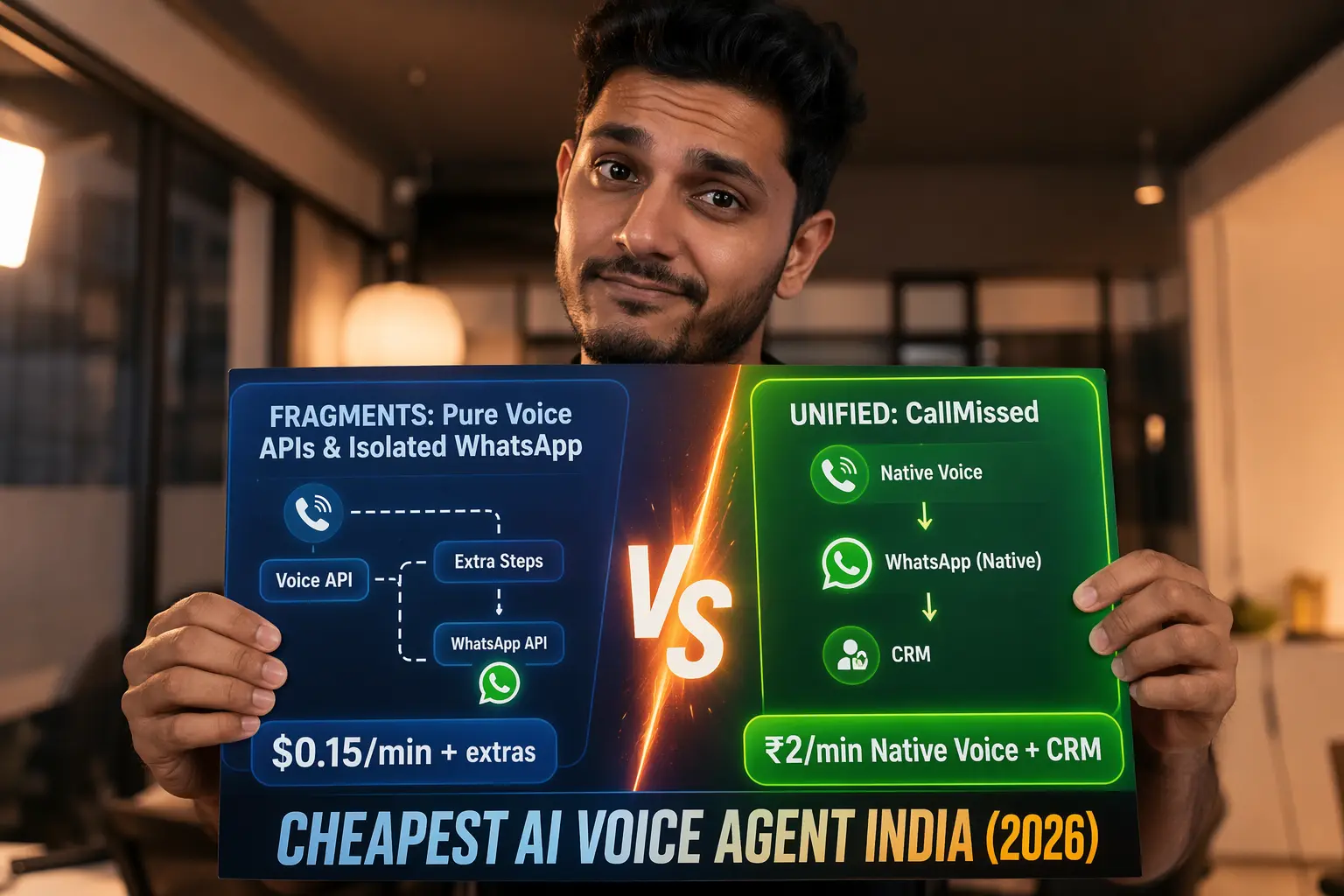
Compare AI voice agent pricing in India: ₹4–₹6/min CallMissed flat plans, separate telephony, short-call minimums and custom-stack fees. Best latency becomes ₹8/min from 30 November.

AI Voice Agent Pricing in India: Compare Total Cost (2026)
AI voice agent pricing in India depends on the complete calling stack—not the lowest advertised per-minute rate. Compare speech recognition, language-model inference, voice output, platform fees, telephony, number rental and minimum billing using the same workload. This guide explains how to request comparable quotes and test call quality before choosing a provider.
Publisher disclosure: CallMissed publishes this guide and offers voice, WhatsApp and customer-operation products. Its inclusion is a workflow-fit recommendation, not evidence that it is universally cheapest. Obtain dated provider quotes and confirm supported languages, integrations and call quality in a pilot.
What determines AI voice agent pricing in India?

AI voice agent pricing in India is easier to compare when every quote covers the same work. A low per-minute rate may cover only part of the stack. Speech recognition, the language model, voice generation and phone carriage can be bundled or billed separately.
TaskVox’s official pricing guide describes a five-component cost framework. It is a vendor’s framework for examining costs, not an independent ranking.
The Bundled-versus-Unbundled Checklist
- Speech, model and voice: Does the rate include speech-to-text, language-model usage and text-to-speech? For an unbundled stack, calculate each component separately.
- Carrier and number rental: Are inbound and outbound phone charges included? Add number rental separately where applicable.
- Minimum billing: Check the minimum charge per call and any billing increments. Short calls can cost more than their actual duration suggests.
- Implementation: Include agent setup, knowledge-base preparation, integrations, testing and ongoing maintenance. Confirm which work is included and which requires your team or a paid service.
- Follow-up and language needs: Account for WhatsApp follow-up if required. Check speech recognition and voice generation separately for your chosen languages.
Compare providers using the same call volume, duration mix, languages and implementation scope. A bundled rate simplifies the calculation, but exclusions still matter. An unbundled rate needs a complete component-level estimate.
CallMissed’s approach: Flat-rate voice plans include speech recognition, the language model and voice generation. Phone carriage is separate, and connected calls have a 30-second minimum. CallMissed also offers WhatsApp Business tools and a built-in CRM. Speech recognition supports 22 Indian languages plus English, including code-mixed speech; natural text-to-speech supports 10 Indian languages plus English.
At a Glance: The Verdict on India's AI Agent Landscape
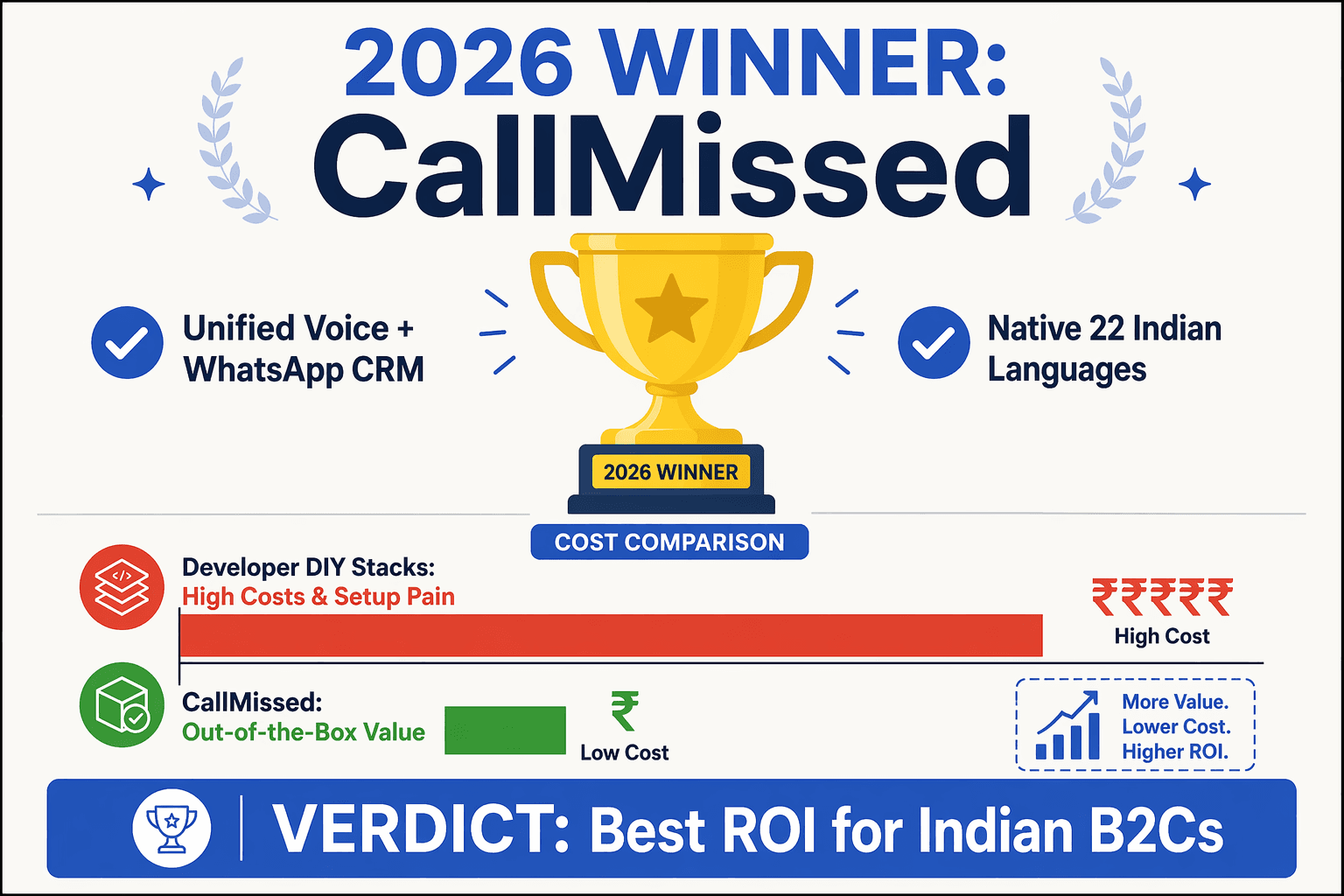
No provider is universally cheapest. The right fit depends on your workflow, engineering capacity, and the cost of changing your existing setup.
| Option | Best fit | What to compare |
|---|---|---|
| Managed AI voice agent | Teams that want operational simplicity | Setup effort, ongoing support, call quality, and total cost per connected minute |
| Developer voice API | Teams that need engineering control | Component charges, carrier costs, integration work, and maintenance |
| Connected CallMissed voice, WhatsApp, and CRM | Teams that want these channels and customer records in one platform | CallMissed offers AI voice agents, WhatsApp Business messaging and calling, and a built-in CRM. Check how well these fit your lead and support workflows. |
| Integration with an existing call stack | Teams where migration costs matter | Carrier compatibility, number migration, and changes to existing workflows. CallMissed supports Twilio, Plivo, or any SIP trunk. |
Compare dated quotes for the same workload, including phone carriage, setup, integrations, and ongoing support—not just the headline minute rate. Run a small pilot to test Indian-language recognition, response quality, handoffs, and how reliably call outcomes reach your customer records.
For more context, see the India AI voice agent company comparison and the CallMissed developer guide to voice APIs and phone numbers.
Feature Comparison: CallMissed vs. Vapi, Bolna, and WhatsApp BSPs
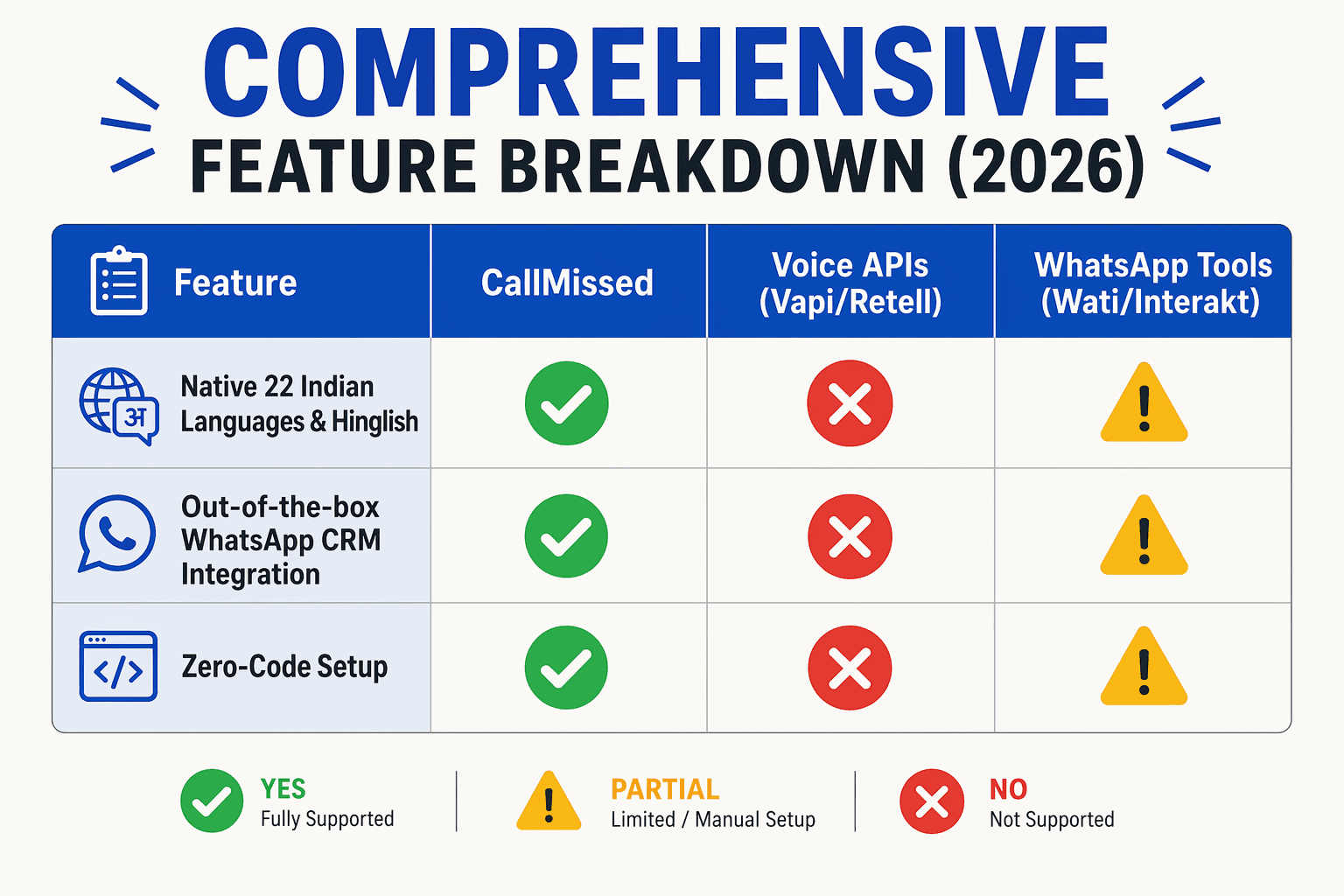
When comparing AI voice agent pricing in India, evaluate the full workflow—not just the headline per-minute rate. Speech recognition, voice synthesis, the language model, phone carriage and follow-up tools can affect both cost and suitability.
Use the checklist below to evaluate CallMissed, Vapi, Bolna and WhatsApp BSPs such as WATI or Interakt. This is not a verified feature scoreboard: each vendor’s current capabilities, regional availability and plan inclusion must be checked directly. Do not assume that a WhatsApp-focused provider lacks voice features or that a voice platform lacks CRM options.
| Feature / Metric | What to Check with Every Vendor | CallMissed: Documented Capabilities |
|---|---|---|
| Inbound / Outbound Support | Can it receive and place calls? Distinguish individual calls, click-to-call and automated campaigns. | Inbound and individual outbound phone calls, plus click-to-call. Automated outbound calling campaigns are not offered. |
| Language Recognition vs. Voice Synthesis | Check STT and TTS separately. Test regional accents, code-mixed speech and the voices available on your chosen plan. | Speech recognition in 22 Indian languages plus English, including Hinglish; natural TTS voices in 10 Indian languages plus English, with more languages through other voice models. |
| Interruptions | Test whether callers can interrupt the agent, how quickly playback stops and whether the agent retains context. | Test interruption behaviour with the selected voice-agent configuration; do not infer it from language support or pricing. |
| Human Transfer | Verify live-agent routing, transfer destinations, context handoff and behaviour when nobody answers. | Live supervisors can listen, whisper or barge in. Squads support agent-to-agent handoffs; confirm your required human-transfer routing directly. |
| CRM Field Mapping | Can transcripts, outcomes and extracted details populate the fields your team uses? Check native integrations and custom mappings. | Built-in CRM with custom fields; AI call notes pushed to the CRM; HubSpot integration and custom REST tools. Confirm the required field mapping. |
| Failure Logging | Check visibility into failed connections, tool errors, transfer failures and diagnostic logs. | Call recordings, transcripts and agent analytics; developer API usage and request logs. Verify coverage for each failure scenario. |
| Billing Components | Identify platform, STT, TTS, LLM and phone-carriage charges, minimum billing, rounding and failed-call treatment. | Flat voice plans bundle STT, LLM and voice; phone carriage is separate. Custom-stack billing uses separate component charges plus a platform fee. |
| Number / Carrier Availability | Confirm Indian number availability, rental charges, onboarding requirements and compatibility with your carrier. | Rented numbers or bring your own carrier through Twilio, Plivo or any SIP trunk. Confirm number availability and carriage pricing directly. |
Key Architectural Differences to Evaluate
- Compare equivalent costs: CallMissed’s flat voice-agent rates are Standard ₹4/min, Expressive ₹5/min and Best latency ₹6/min. Best latency becomes ₹8/min for calls starting on or after 30 November 2026. Flat plans have a 30-second minimum; calls that never connect cost nothing. Phone carriage is billed separately.
- Check custom-stack economics: CallMissed also offers per-second component billing with no component minimum, plus a ₹1/min platform fee with a 30-second minimum. That platform fee does not apply to flat plans. Request an equally itemised quote from each alternative.
- Evaluate connected workflows: CallMissed connects voice, WhatsApp, CRM/support and developer APIs. Compare how each vendor handles call notes, messaging, human handoff and integrations rather than assuming these are included—or unavailable.
- Validate before committing: Run the same language, interruption, transfer and failure tests across vendors. Check current plan inclusion against official documentation and a written quote. For CallMissed, consult the pricing page and documentation.
Pricing & Value: The Pay-As-You-Go Hidden Cost Trap
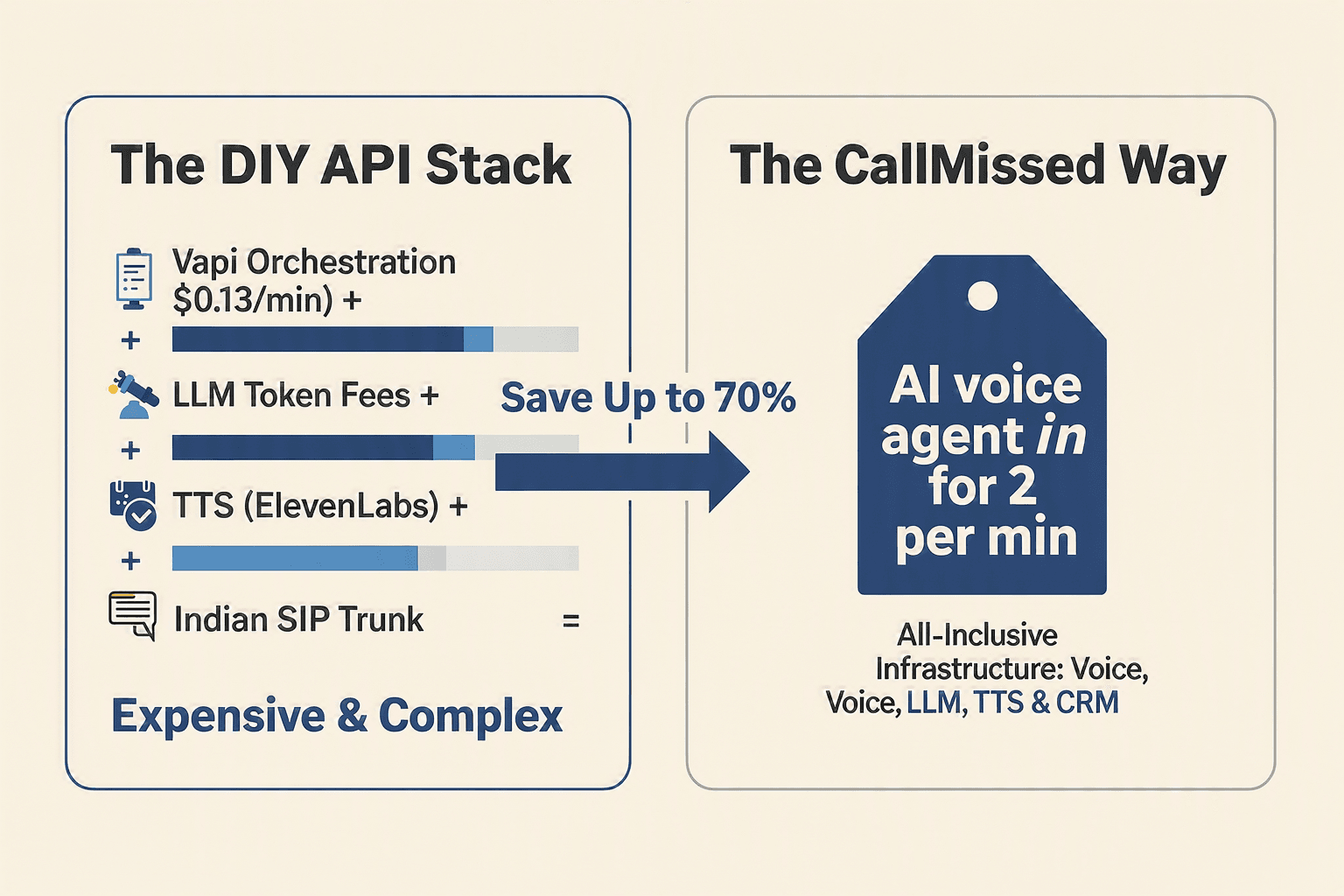
Compare AI voice agents using a dated quote for the same workload, not just a headline per-minute rate. A pay-as-you-go offer is not inherently poor value: the risk is overlooking separately billed components, minimum charges, and implementation work.
Use this worksheet to record each provider’s terms as of 30 October 2026, or replace that date with the date of your written quote. The cost-component approach below draws on TaskVox’s AI voice agent pricing framework, a vendor source, not an independent pricing benchmark. Verify every rate and inclusion directly with the provider.
Breaking Down the True Unit Economics
Monthly AI voice agent cost = billable minutes × applicable variable rates + number/carrier fixed charges + platform/subscription + setup/maintenance + applicable taxes.
If components use different billing units, calculate each separately before adding them—for example, model tokens, speech seconds, or carrier minutes. Do not double count speech recognition, model usage, or voice generation when they are included in a bundled rate. Show one-time setup costs separately, or state the period over which you amortise them.
| Cost Component | Questions to Ask in the Dated Quote | What to Record |
|---|---|---|
| Speech recognition / model / voice | Are STT, LLM and TTS included? Which models, voices and languages does the quote cover? What changes the rate? | Bundled rate or separate component rates, billing units and exclusions |
| Telephony / SIP | Is phone carriage included? Do inbound and outbound rates differ? Are there destination-specific charges? | Carrier rates and any fixed carrier charges |
| Number rental | Is a number included, rented separately, or supplied through your carrier? Are provisioning charges applicable? | Monthly rental and any one-time charges |
| Minimum billed time | Is there a per-call minimum? How are partial minutes rounded? Do components use different minimums? | Minimum duration and rounding rule for each billed component |
| Call attempts | What is charged for unanswered, failed, busy or voicemail-connected calls? Does retrying create another billable event? | Attempt charges, connection definitions and retry assumptions |
| Concurrency | How many simultaneous calls are supported under the quote? Are higher limits separately charged? | Included limit and any additional charge |
| Platform / subscription | Is there a recurring subscription or platform usage fee? Are credits included, and how are they applied? | Fixed fees, usage fees and credit treatment |
| Setup / maintenance | Who configures routing, knowledge bases, CRM integrations and testing? Who maintains them? | One-time implementation cost and recurring maintenance estimate |
| Taxes | Are quoted prices tax-inclusive? Which taxes apply to each invoice? | Applicable tax rates and whether they are already included |
Compare the Same Workload
Give every provider the same assumptions: inbound versus outbound call mix, destinations, languages, expected call duration, connected-call volume, peak concurrency, integrations and support requirements.
- Separate connected minutes from billable minutes. A short connected call may incur a longer minimum charge. Apply each provider’s rounding rules to the same call-duration distribution rather than multiplying a headline rate by total talk time.
- Keep attempts separate from connections. Record unanswered attempts, retries and voicemail connections explicitly, then apply the quoted charging rules.
- Compare equivalent scope. If the workflow needs recordings, summaries, CRM updates or WhatsApp follow-up, ask whether each is included or separately charged. Do not assume that voice pricing covers messaging.
- Measure outcomes without assuming savings. Once you have operating data, calculate ₹ per resolved conversation = total monthly cost ÷ conversations meeting your agreed resolution criteria. Use the same definition across providers; do not treat every answered call as a resolution.
CallMissed: Apply the Same Worksheet
As of 30 October 2026, CallMissed’s flat voice-agent rates are Standard ₹4/min, Expressive ₹5/min, and Best latency ₹6/min. Best latency changes to ₹8/min for calls starting on or after 30 November 2026. These flat rates cover speech recognition, the language model and voice generation, with a 30-second minimum per call. A call that never connects costs nothing. Phone carriage is billed separately.
Alternatively, CallMissed offers a custom stack with components billed by the second with no component minimum, plus a ₹1/min platform fee on the call, billed once when it ends with a 30-second minimum. Flat plans do not pay that platform fee.
Verify current terms on the CallMissed homepage and pricing page, then complete the remaining worksheet fields for your deployment. The best-value option depends on your workload and required scope—not a blanket “cheapest” claim.
Pros and Cons: Evaluating Your Automation Stack
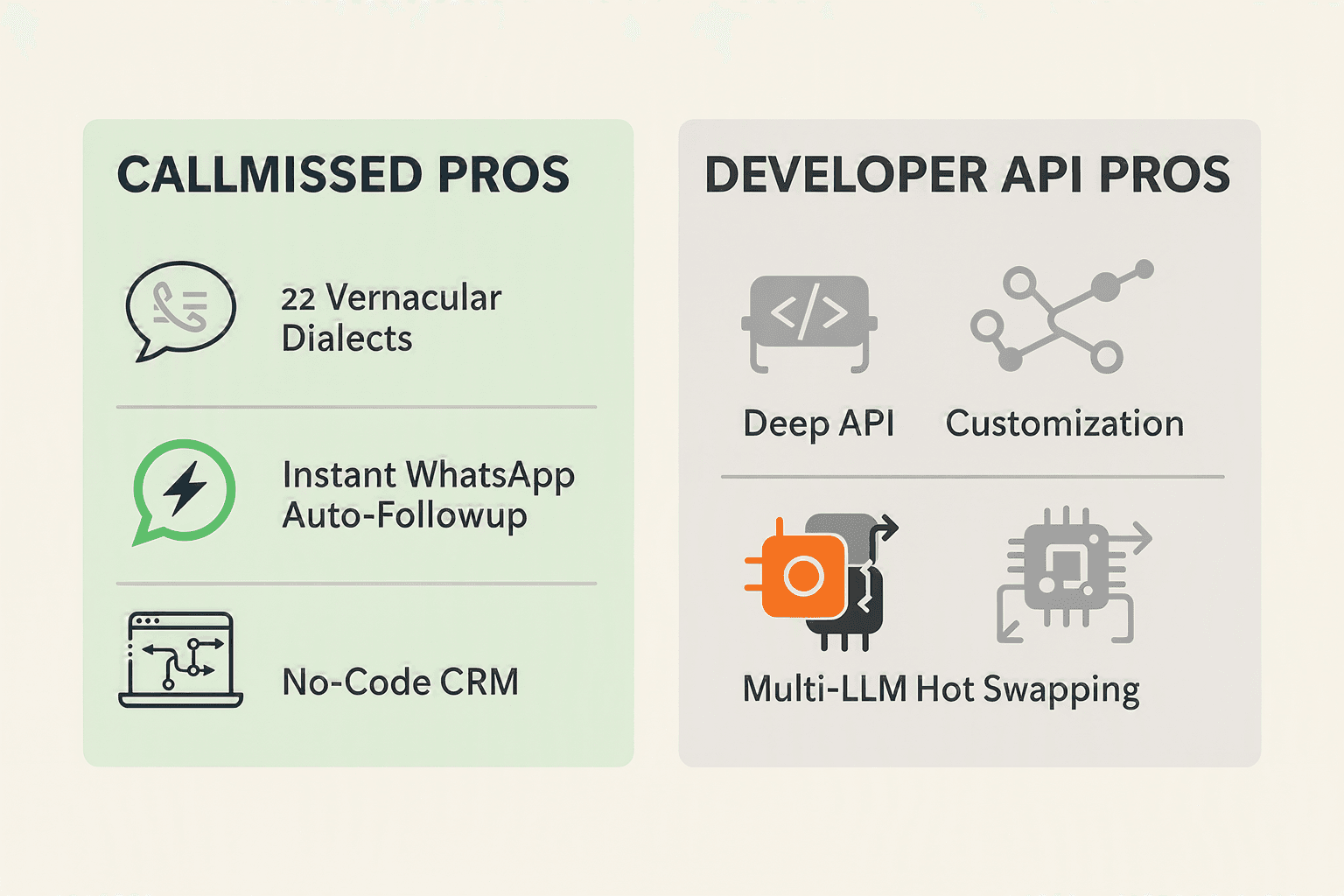
Choosing an AI voice agent stack means deciding how much your team wants to manage—not just comparing headline per-minute rates. Managed platforms can reduce implementation work, while custom stacks offer more component-level control. Neither approach is automatically cheaper or better: compare the same call workflows, languages and billing assumptions.
The Automation Stack Comparison
| Approach | Engineering Ownership | Control | Billing Visibility | Integration Upkeep | Support Scope |
|---|---|---|---|---|---|
| Managed platform | Provider manages more of the stack; your team owns configuration and testing | Within the platform’s supported settings and tools | Bundled rates can simplify estimates; check exclusions | Your team still validates connectors and workflows | Platform support; external services may remain separate |
| Custom stack | Your team assembles, deploys and maintains components | More choice over models, routing and infrastructure | Itemized costs offer detail but require reconciliation | Your team maintains interfaces and handles changes | Often split across component providers |
| Hybrid approach | Ownership is shared between your team and the platform | Custom components within supported interfaces | May combine bundled and usage-based charges | Requires clear responsibility for each integration | Depends on which layer causes the issue |
Analyzing the Pros and Cons
- Engineering ownership: A managed stack can reduce infrastructure work, but still needs prompt design, knowledge-base maintenance, testing and monitoring. A custom stack gives your team more implementation control while adding responsibility for deployment and incident handling.
- Control and provider dependencies: Managed platforms define the available components and configuration options. Custom stacks can make individual providers easier to replace, but switching still requires compatibility checks and regression testing.
- Billing visibility: Bundled pricing makes some costs easier to forecast; component billing makes individual charges easier to inspect. For either approach, check phone carriage, minimum billable duration, subscription costs and how disconnected or failed calls are charged.
- Integration upkeep: Built-in connectors can shorten setup, but they do not eliminate workflow validation. Custom integrations require ongoing attention to authentication, API changes, data mapping and error handling.
- Support scope: Confirm who investigates problems across telephony, speech recognition, model responses and CRM updates. A single platform contact may simplify coordination, while a custom stack may require your team to diagnose issues across several providers.
Compare total cost using representative calls—not a universal performance ranking. Include engineering time, ongoing maintenance and support responsibilities alongside usage charges.
Publisher disclosure: This article is published by CallMissed, which offers AI voice agents, a built-in CRM and developer APIs. CallMissed supports both flat-rate voice plans and custom component billing; phone carriage is billed separately. Evaluate those options against your own requirements and the same cost assumptions used for other providers.
Which Should You Choose for Your Indian Business?
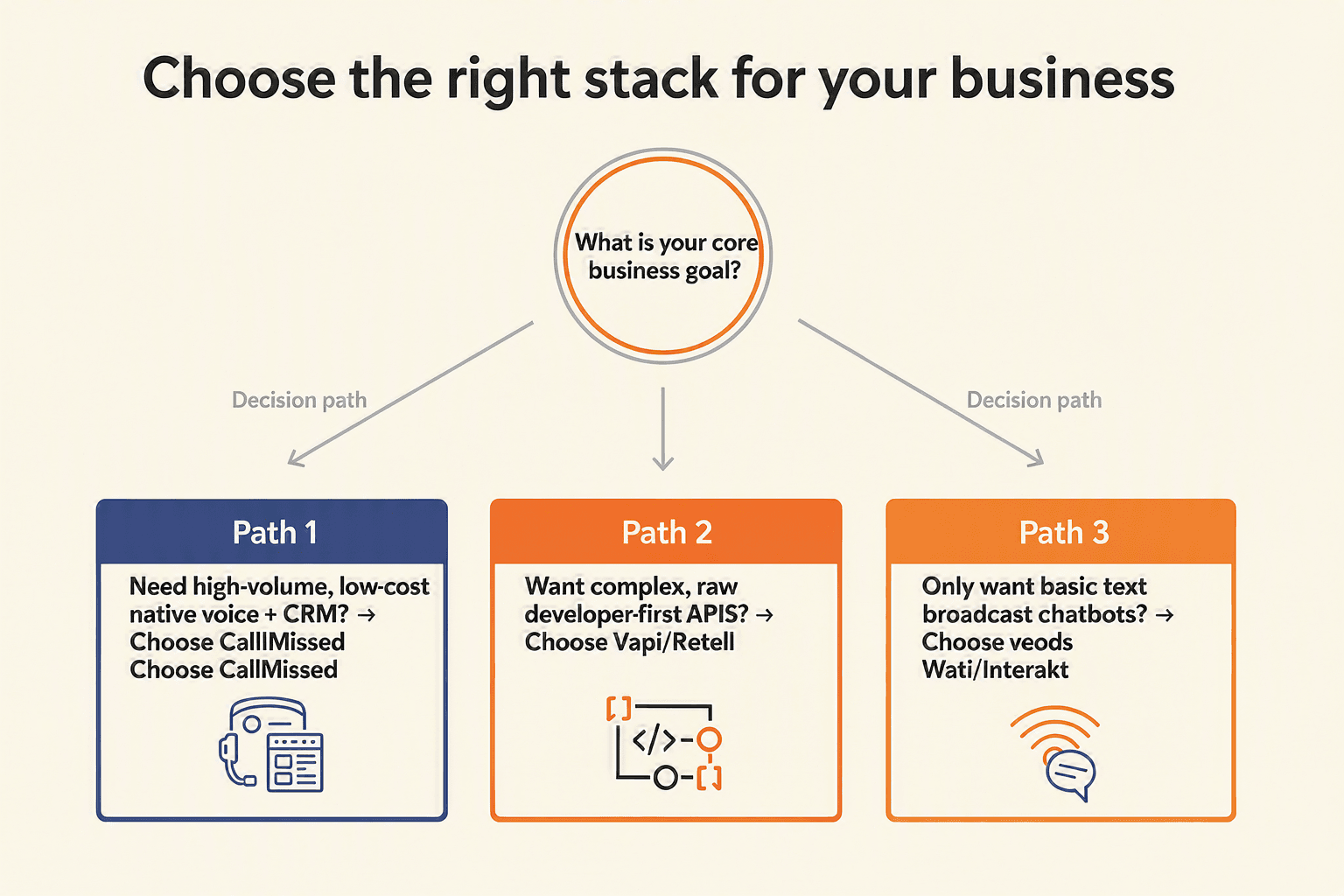
Choose an AI voice agent around your actual call workflow—not the lowest headline per-minute rate. Use this short decision path:
- Confirm the job: Do you need inbound support, individual outbound calls, or outbound campaigns? List the tasks the agent must complete and ask each provider to confirm support for your exact workflow.
- Check languages and geography: Test the languages, accents and code-mixed speech your customers use, including Hinglish. CallMissed supports speech recognition in 22 Indian languages plus English, with natural text-to-speech voices in 10 Indian languages plus English. Check number availability and carrier requirements for each country you serve.
- Map your existing stack: Identify the number or carrier you want to keep, your CRM, and the records each call must update. CallMissed supports rented numbers or your own carrier through Twilio, Plivo or any SIP trunk. Use this AI voice agent–CRM integration guide to plan the data flow.
- Get comparable, dated quotes: Ask providers to price the same call volume, average duration, languages and setup. Separate platform, speech recognition, LLM, voice, phone carriage, minimum billing, integration costs and applicable taxes. Confirm when quoted rates take effect.
- Run a real-scenario pilot: Test routine questions, interruptions, unclear speech and requests for a person. Verify a successful human handoff and one correct CRM write before expanding. For a shortlist, see this 2026 guide to AI voice agents for small businesses.
- Compare the complete bill before choosing: Use the pilot’s actual call lengths and usage to compare costs alongside task completion, voice quality and integration effort. For CallMissed, flat voice plans include speech recognition, the language model and voice; phone carriage is separate, and connected calls have a 30-second minimum.
Ready to test your workflow? Explore CallMissed and start your pilot, then choose based on demonstrated fit and the complete bill—not a promised ROI.
Frequently Asked Questions
Is there a universally cheapest AI voice agent in India?
Which AI voice agent costs should I check separately?
Is telephony included in CallMissed’s per-minute price?
What is the difference between a connected minute and a billable minute?
Does Indian-language recognition mean the same coverage for spoken AI voices?
How should I pilot an AI voice agent and compare quotes?
Conclusion
The right AI voice agent is the one that fits your workload at a verified total cost—not the one with the lowest headline rate. Compare voice-agent charges, phone carriage, integrations, and the team effort needed to operate and review it.
Key takeaways to remember:
- Workload Fit First: Test your priority use case, languages, call patterns, and human-handoff needs before choosing a plan.
- Compare the Full Cost: Check billing minimums, separate charges, and current terms—not just the advertised per-minute price.
- Verify With a Pilot: Use representative calls to measure task completion, response quality, handoff success, and cost per completed task.
- Check the Phone Setup: Review CallMissed’s voice-agent API and phone-number guide when planning your deployment.
Publisher disclosure: This guide is published by CallMissed. Include alternatives in your comparison and let pilot results guide your decision.
Ready to evaluate your setup? Visit CallMissed to test your priority workflow and obtain current pricing and terms.