
AI Receptionist for Dental Clinics: 2026 Workflow Guide


Implement an AI receptionist for dental clinics with practical workflows for booking, missed calls, WhatsApp, privacy, testing, and KPIs.
AI Receptionist for Dental Clinics: 2026 Workflow Guide
What happens when a patient with severe tooth pain calls after hours and reaches voicemail? An AI receptionist for dental clinics can answer immediately, identify whether the request is urgent or routine, offer approved appointment slots, and transfer high-risk conversations to a qualified human—without attempting to diagnose or provide medical advice.
The timing matters. The World Health Organization reported in November 2022 that oral diseases affect nearly 3.5 billion people worldwide, creating sustained demand for accessible dental care and responsive front-desk operations. Meanwhile, Meta CEO Mark Zuckerberg said in April 2025 that WhatsApp had surpassed 3 billion monthly active users, making messaging a practical follow-up channel in markets where patients may not answer a return call.
From voicemail to a controlled patient workflow
A dental AI receptionist is not simply a conversational answering machine. Properly implemented, it becomes a structured operational layer connecting phone calls, calendars, patient-approved messaging, clinic policies, and staff escalation queues. The system can support:
- Inbound call answering during busy periods, lunch breaks, and after hours
- Dental appointment booking AI for approved services, providers, locations, and time slots
- Booking changes and cancellations based on predefined scheduling rules
- Dental missed call automation that triggers a permission-aware callback or message
- Frequently asked questions answered only from an approved knowledge base
- Urgent-versus-routine routing without making clinical judgments
- Human handoff when a patient requests staff, sounds distressed, or exceeds the automation’s scope
- Multilingual voice interactions and dental WhatsApp automation for confirmations and follow-up
Platforms such as CallMissed reflect this shift by combining AI voice agents, WhatsApp Business calling and chat, human handoff, knowledge-base retrieval, and support for 22 Indian languages in one customer-engagement workflow.
What this 2026 guide will help you implement
This guide provides a practical rollout plan for independent dental practices and multi-location dental groups. You will learn how to map call intents, connect appointment availability, write safe scripts, define escalation triggers, configure missed-call recovery, and prevent an AI agent from improvising clinical answers.
The implementation also covers consent, call disclosure, data minimisation, access controls, retention policies, and jurisdiction-specific privacy review. Regulatory obligations differ: Indian clinics may need to assess the Digital Personal Data Protection Act, 2023, while covered US dental providers must consider the Health Insurance Portability and Accountability Act of 1996 (HIPAA) and applicable state laws. Technology configuration does not replace legal or compliance advice.
Finally, the guide explains how to test the workflow before launch and monitor meaningful KPIs such as answer rate, booking completion, rescheduling success, escalation accuracy, missed-call recovery, opt-out rate, and staff override frequency. The goal is not to remove the dental front desk; it is to automate repetitive communication while ensuring that sensitive, urgent, or ambiguous conversations reach the right person.
How do you implement an AI receptionist for dental clinics in 2026? Start with one low-risk workflow, connect scheduling safely, restrict answers to approved content, define urgent and human handoffs, apply consent safeguards, test thoroughly, and scale only when KPIs meet agreed thresholds
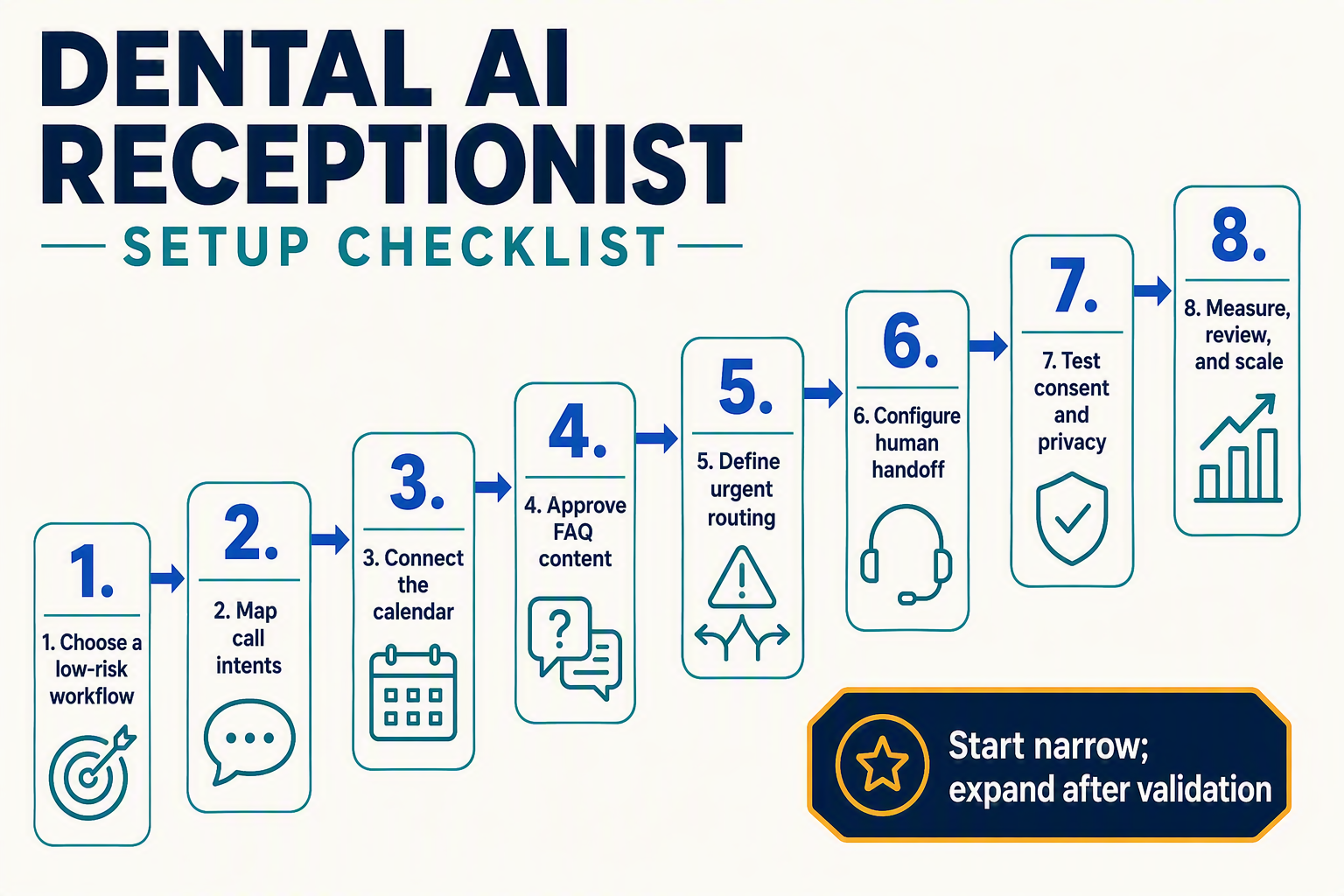
Implement an AI receptionist for dental clinics by automating one predictable, low-risk workflow first—such as after-hours appointment requests—then add calendar writes, rescheduling, missed-call recovery, and multilingual follow-up only after testing proves each stage is safe and reliable.
1. Choose a narrow first workflow
Start with calls that do not require clinical interpretation. A suitable pilot might answer after-hours calls, collect minimal contact details, identify the requested service, and offer a callback or approved appointment slot.
Keep the first release away from diagnosis, treatment recommendations, medication questions, and insurance guarantees. Document:
- Supported services, locations, providers, and operating hours
- Information the agent may collect
- Actions the agent may perform
- Situations requiring immediate human handoff
- Explicitly prohibited answers and actions
2. Connect scheduling with strict controls
A dental appointment booking AI should initially receive read-only access to available slots or write access limited by predefined rules. Use role-based credentials rather than shared staff passwords, and maintain an audit trail of every booking change.
Configure rules for appointment duration, provider eligibility, buffer times, duplicate-patient checks, and cancellation windows. Require confirmation before creating, rescheduling, or cancelling an appointment. For multi-location groups, the agent should repeat the clinic name, address, provider, date, time, and timezone before committing a change.
The broader integration pattern is covered in the AI appointment booking agent guide.
3. Ground every FAQ answer in approved content
Create a version-controlled knowledge base containing clinic-approved answers about hours, directions, parking, accepted payment methods, preparation instructions, and administrative policies. The agent should retrieve from this material rather than generate answers from general model knowledge.
Apply three response outcomes:
- Approved answer found: Respond and identify the relevant clinic or policy.
- Answer uncertain or conflicting: Ask a clarifying question or transfer to staff.
- Clinical question detected: State that the agent cannot provide medical advice and route the request appropriately.
Review content whenever prices, providers, policies, or opening hours change.
4. Define urgent routing and human handoff
The AI may identify escalation phrases, but it must not diagnose urgency. Create clinic-approved triggers for reported severe symptoms, trauma, uncontrolled bleeding, breathing difficulty, distress, repeated misunderstanding, or an explicit request for a person.
Specify the destination and fallback for each trigger: live transfer, on-call queue, emergency instruction approved by the clinic, or priority callback. If no person answers, the system must never imply that help has been dispatched.
5. Add permission-aware recovery and messaging
Configure dental missed call automation to record the call time, number, routing outcome, and consent status before initiating follow-up. Dental WhatsApp automation can send confirmations or rescheduling options, but templates, opt-outs, permitted contact windows, and WhatsApp Business requirements must be reviewed for each jurisdiction.
CallMissed can connect AI voice agents with WhatsApp Business chat and calling, human handoff, and voice support across 22 Indian languages, enabling clinics to keep follow-up within one controlled workflow.
6. Test against agreed launch gates
The Digital Personal Data Protection Act, 2023 is relevant to Indian personal-data processing, while covered US dental providers must assess HIPAA, enacted in 1996, and applicable state rules. Obtain jurisdiction-specific advice on disclosure, consent, retention, recording, access, and deletion.
Before expansion, run scripted and adversarial tests, then monitor:
- Booking and rescheduling accuracy
- Incorrect FAQ-answer rate
- Urgent-routing and transfer success
- Consent and opt-out compliance
- Duplicate or failed calendar writes
- Human takeover rate and patient complaints
Set thresholds with clinic leadership before launch. Scale to daytime overflow, additional locations, or more languages only when the pilot meets those thresholds consistently.
What can CallMissed-style dental reception workflows handle—and where must clinics retain human control?
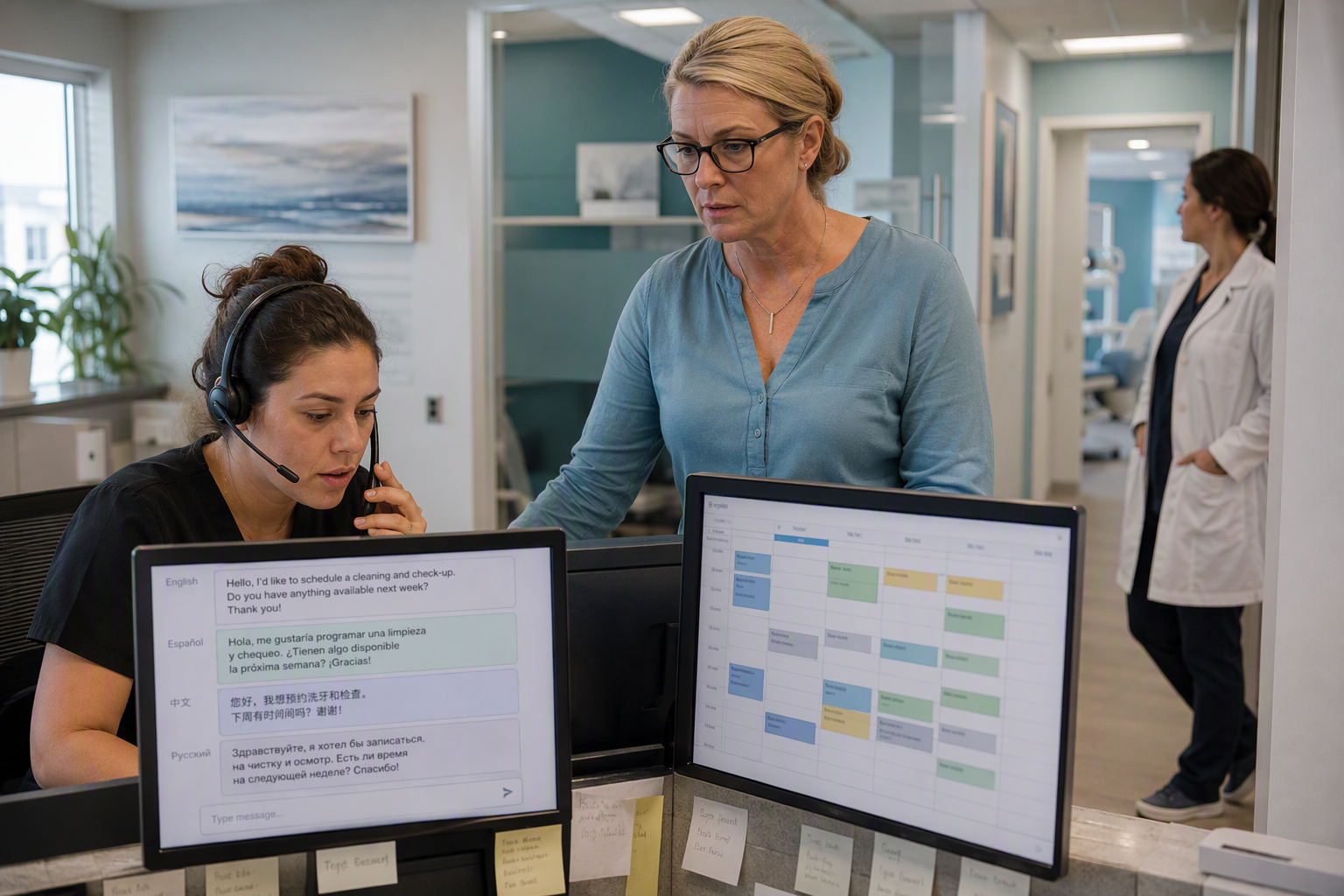
A CallMissed-style AI receptionist for dental clinics can reliably handle administrative, rules-based conversations, but clinics must retain human control over clinical decisions, emergencies, exceptions, complaints, consent disputes, and sensitive-data access. The safest design treats automation as a reception workflow—not as a dentist, diagnostician, or autonomous care coordinator.
Tasks suitable for controlled automation
Automation works best when every action is grounded in approved clinic policies, current calendar data, and explicit decision rules. Suitable workflows include:
- Answering inbound calls: Capture the patient’s name, contact details, preferred clinic, reason for calling, and requested language.
- Booking routine appointments: A dental appointment booking AI can offer available slots only for approved appointment types, durations, providers, and locations.
- Rescheduling or cancelling: Verify the booking, apply configured notice periods, update the calendar, and send confirmation.
- Recovering unanswered calls: Dental missed call automation can place a permission-aware return call or send a message during approved hours, while suppressing duplicate follow-ups.
- Answering administrative FAQs: Retrieve clinic hours, directions, accepted payment methods, accessibility information, preparation instructions, and cancellation policies from a version-controlled knowledge base.
- Sending follow-up messages: Dental WhatsApp automation can deliver confirmations, rescheduling links, or staff-contact options after capturing appropriate permission.
- Classifying urgency for routing: Ask predefined, non-diagnostic questions and route the conversation according to clinic-approved escalation rules.
CallMissed supports these patterns across AI voice, WhatsApp Business chat and calling, knowledge-base retrieval, and 22 Indian languages. Multilingual capability is operationally useful, but clinics should still have native or proficient speakers review translated scripts, especially instructions involving urgency, consent, money, or treatment preparation.
Decisions that require a human
The AI must not interpret symptoms, recommend treatment, prescribe medication, estimate clinical outcomes, or assure callers that waiting is safe. Transfer the conversation—or provide the clinic’s approved emergency instruction—when any of the following occurs:
- Possible emergency: The caller mentions uncontrolled bleeding, major facial trauma, breathing difficulty, severe swelling, loss of consciousness, or another clinic-defined red flag.
- Clinical question: The patient asks whether symptoms indicate an infection, whether a procedure is necessary, or what medication to take.
- Complex scheduling: The request involves surgery, sedation, multiple linked appointments, specialist coordination, or an exception to provider rules.
- Financial or coverage dispute: The caller challenges a bill, requests a binding insurance estimate, or seeks an unapproved discount.
- Consent or privacy concern: The caller withdraws messaging permission, disputes recording, requests deletion, or questions who can access their information.
- Conversation failure: Identity cannot be verified, the calendar is unavailable, confidence is low, or the patient repeatedly asks for staff.
The Health Insurance Portability and Accountability Act of 1996 applies to covered US dental providers and relevant business associates, while Indian clinics should assess obligations under the Digital Personal Data Protection Act, 2023. Legal applicability depends on jurisdiction and processing arrangements, so clinic counsel or a qualified privacy professional should approve the workflow.
Use a fail-safe operating rule
Configure the agent around a simple boundary: automate known administrative paths; escalate ambiguity. Each handoff should include the caller’s stated request, language, attempted action, urgency label, consent status, and callback number—without generating a clinical summary that the patient did not provide.
Clinics should also define an outage path: if calendars, telephony, or WhatsApp are unavailable, the agent must avoid inventing availability and create a staff callback task instead. For implementation patterns, see the AI appointment booking agent guide and the AI agent human-handoff guide.
Which 2026 developments matter most for dental clinics, and which product or regulatory claims must be verified?
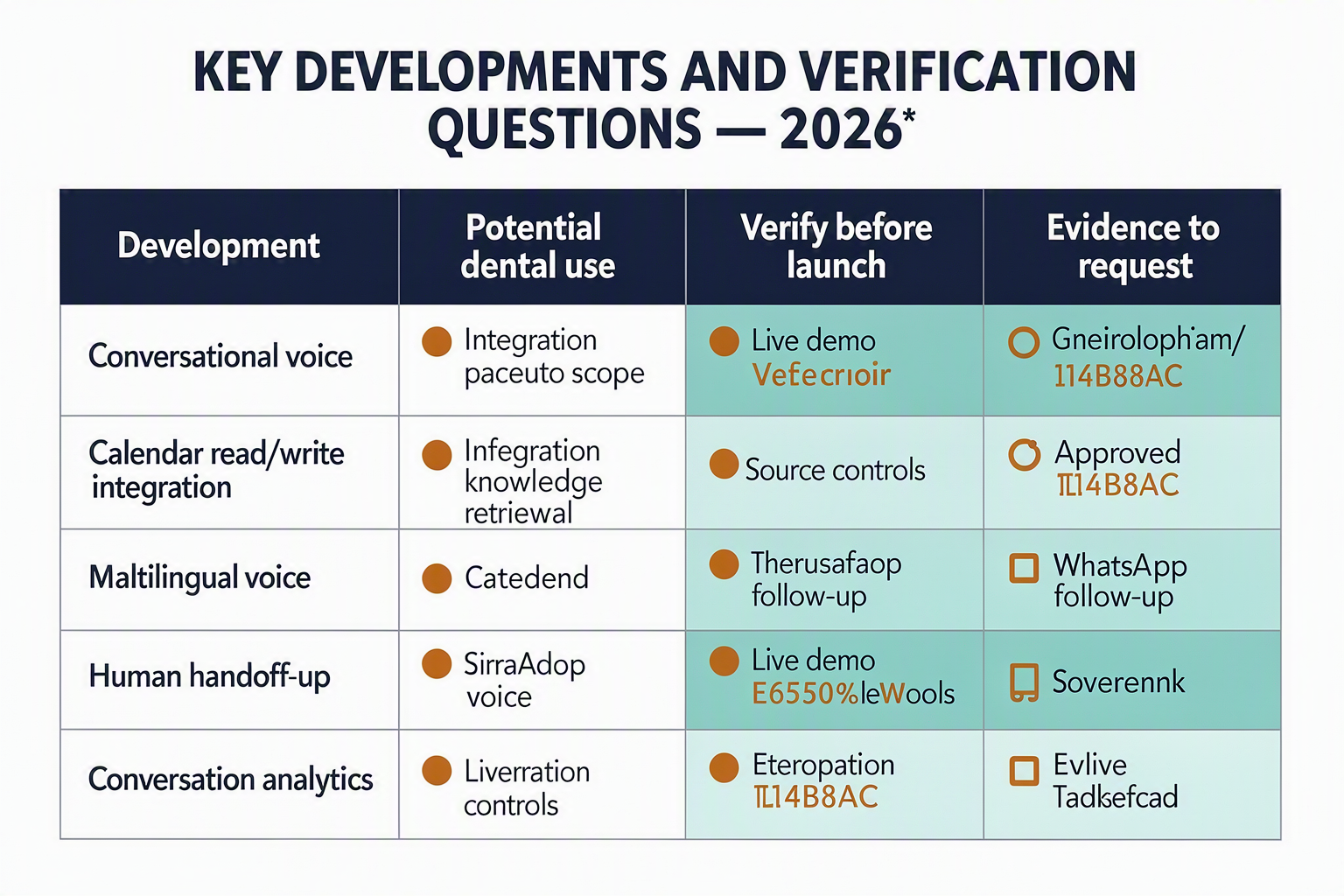
The most important 2026 developments are voice-and-messaging convergence, multilingual speech, real-time calendar integration, and stricter governance of automated communications. Dental clinics should verify every claim involving channel availability, language coverage, booking accuracy, consent, privacy, security, or regulatory compliance before deployment.
2026 developments and verification priorities
| Development or claim | Practical impact for clinics | What may be stated safely | What must be verified |
|---|---|---|---|
| AI voice agents with live scheduling | A dental appointment booking AI can read approved availability and create, move, or cancel appointments | The agent can perform configured scheduling actions | Calendar write access, slot freshness, conflict handling, provider rules, and audit logs |
| WhatsApp Business calling and chat | Dental WhatsApp automation can support confirmations, follow-up, and eligible voice workflows | CallMissed can connect WhatsApp Business calls with an AI voice agent | Meta eligibility, supported countries, approved use cases, templates, consent, and current pricing |
| Multilingual speech models | An AI receptionist for dental clinics can serve patients who prefer regional languages | CallMissed supports Speech-to-Text and Text-to-Speech across 22 Indian languages | Exact languages, accents, model availability, code-switching quality, and dental-name pronunciation |
| Automated missed-call recovery | Dental missed call automation can create a callback task or permission-aware message | A workflow can respond according to configured business rules | Calling hours, patient permission, suppression lists, template approval, retries, and local telecom rules |
| Retrieval-augmented FAQ answers | Knowledge-base retrieval can constrain answers to clinic-approved material | The agent can answer administrative questions from published clinic content | Source freshness, citation or traceability, fallback behaviour, and protection against clinical improvisation |
| Expanding privacy and AI regulation | Clinics need documented data flows, access controls, retention limits, and human escalation | Automation can be configured to support compliance controls | Applicable law, controller/processor roles, contracts, breach duties, disclosure wording, and effective dates |
Regulatory statements require jurisdiction-specific review
A vendor’s security features do not automatically make a clinic compliant. The US Department of Health and Human Services published a proposed HIPAA Security Rule update in the Federal Register on January 6, 2025, so US clinics should verify whether a final rule, transition period, or revised technical requirement applies in 2026. Covered dental providers should also establish whether the AI vendor is acting as a business associate and whether a Business Associate Agreement is required.
In India, clinics should check the current commencement status, rules, and guidance under the Digital Personal Data Protection Act, 2023 rather than claiming blanket “DPDP compliance.” Verification should cover notice, consent where applicable, data minimisation, processor contracts, retention, deletion, grievance handling, and cross-border processing.
Outbound communication needs separate scrutiny. The US Federal Communications Commission confirmed in February 2024 that AI-generated voices fall within the Telephone Consumer Protection Act’s restrictions on artificial or prerecorded voice calls. Clinics should therefore distinguish a patient-requested callback from promotional outreach and obtain legal review for consent, identification, opt-out, and recordkeeping requirements.
Evidence to request before approving deployment
Require vendors and internal owners to provide:
- A dated product capability matrix, not a marketing screenshot
- Test results for each language, channel, clinic location, and scheduling pathway
- Data-flow diagrams identifying subprocessors and storage regions
- Current WhatsApp Business and telecom-policy confirmation
- Written retention, deletion, encryption, and incident-response controls
- Logs proving human handoffs, consent events, booking changes, and failed actions
Treat “HIPAA-ready,” “compliant,” “human-level,” and “zero missed calls” as claims requiring documentary evidence—not implementation assumptions.
How should inbound answering, dental appointment booking AI, dental missed call automation, and dental WhatsApp automation work together?
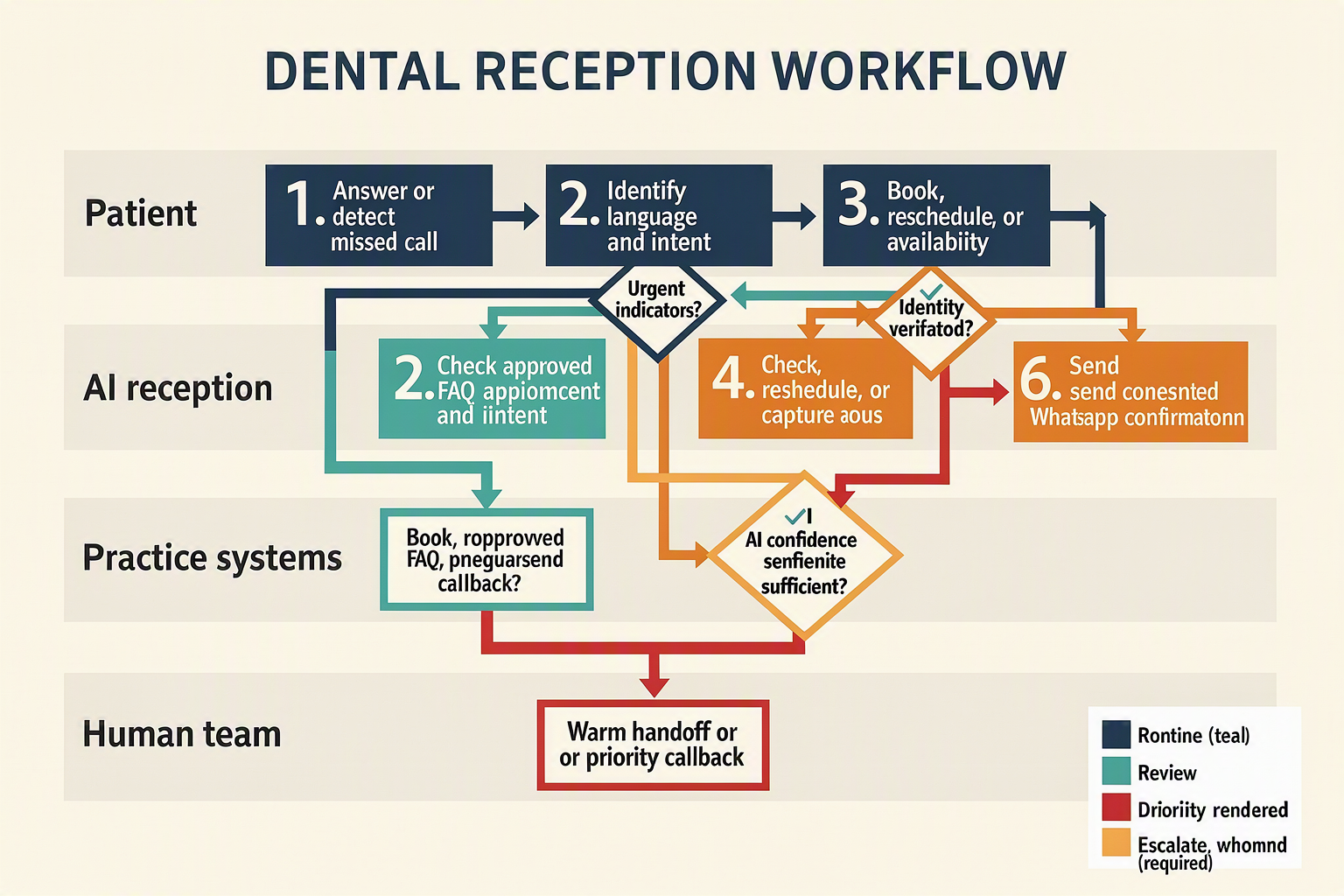
The four components should operate as one stateful workflow, not as separate phone, calendar, and messaging tools. The AI receptionist for dental clinics should capture intent once, validate scheduling rules, record every action in the same patient interaction, and move to WhatsApp or a human queue without forcing the patient to repeat information.
Recommended end-to-end workflow
| Trigger | AI voice action | Scheduling or data action | WhatsApp and human action |
|---|---|---|---|
| New inbound call | Identify the clinic or location, disclose automation where required, and ask whether the caller wants booking, a change, clinic information, or staff assistance | Create or match a minimal contact record using clinic-approved identifiers | Continue by voice unless the patient requests messaging or staff |
| New appointment request | Collect service category, preferred location, provider preference, and suitable dates without assessing symptoms clinically | Dental appointment booking AI reads live, approved availability and reserves only rule-compliant slots | Send an approved confirmation template after consent; escalate if no eligible slot exists |
| Reschedule or cancellation | Verify the booking using defined authentication fields and repeat the requested change for confirmation | Release the old slot and commit the replacement as one transaction; never leave both appointments active unintentionally | Send the updated time or cancellation receipt and place exceptions in the staff queue |
| Missed or abandoned call | Start dental missed call automation after a clinic-defined delay and suppress duplicates, spam, and opted-out contacts | Attach the recovery attempt to the original call record and preserve source, time, and location | Send a permission-aware WhatsApp message or schedule a callback; route replies into the shared inbox |
| FAQ request | Retrieve answers only from the clinic-approved knowledge base for hours, directions, payment methods, preparation policies, or service availability | Log the article or policy used so staff can audit the response | Transfer to staff when retrieval confidence is low, information conflicts, or the question seeks medical advice |
| Urgent language or failed automation | Use a pre-approved safety statement, collect only essential details, and avoid diagnosis or treatment recommendations | Flag the record as priority without assigning a clinical severity label | Attempt immediate human transfer; if unavailable, follow the clinic’s approved urgent-care instructions |
Use one source of truth
The calendar or practice-management system must remain authoritative. A voice agent should not announce a slot from a cached list and then ask staff to reconcile it later.
Implement the transaction in this order:
- Read live availability using service, provider, chair, location, duration, buffer, and operating-hour constraints.
- Temporarily hold the slot while the patient confirms the date, time, location, and appointment type.
- Commit or release the hold and write the resulting booking identifier to the conversation record.
- Trigger confirmation messaging only after the calendar confirms success.
- Escalate exceptions such as duplicate records, unavailable integrations, special-access needs, or repeated verification failures.
For multi-location groups, every response should name the selected branch explicitly. A booking confirmation that gives the right time but the wrong clinic is still an operational failure.
Keep WhatsApp complementary, not duplicative
Dental WhatsApp automation should preserve the voice interaction’s context: booking identifier, clinic location, consent status, and unresolved intent. Platforms such as CallMissed can connect AI voice agents, WhatsApp Business chat and calling, and a shared inbox, allowing staff to continue the same workflow rather than creating a disconnected ticket.
Apply these safeguards:
- Use WhatsApp only for purposes covered by the patient’s consent and approved templates.
- Minimise sensitive information in notifications and lock-screen previews.
- Apply role-based access, retention rules, and audit logs.
- Review processing under India’s Digital Personal Data Protection Act, 2023, or, for covered US providers, the Health Insurance Portability and Accountability Act of 1996 and applicable state law.
- Make “speak to a person” available at every stage.
How do clinics protect patients while handling FAQs, multilingual conversations, urgent-versus-routine routing, consent, and privacy?
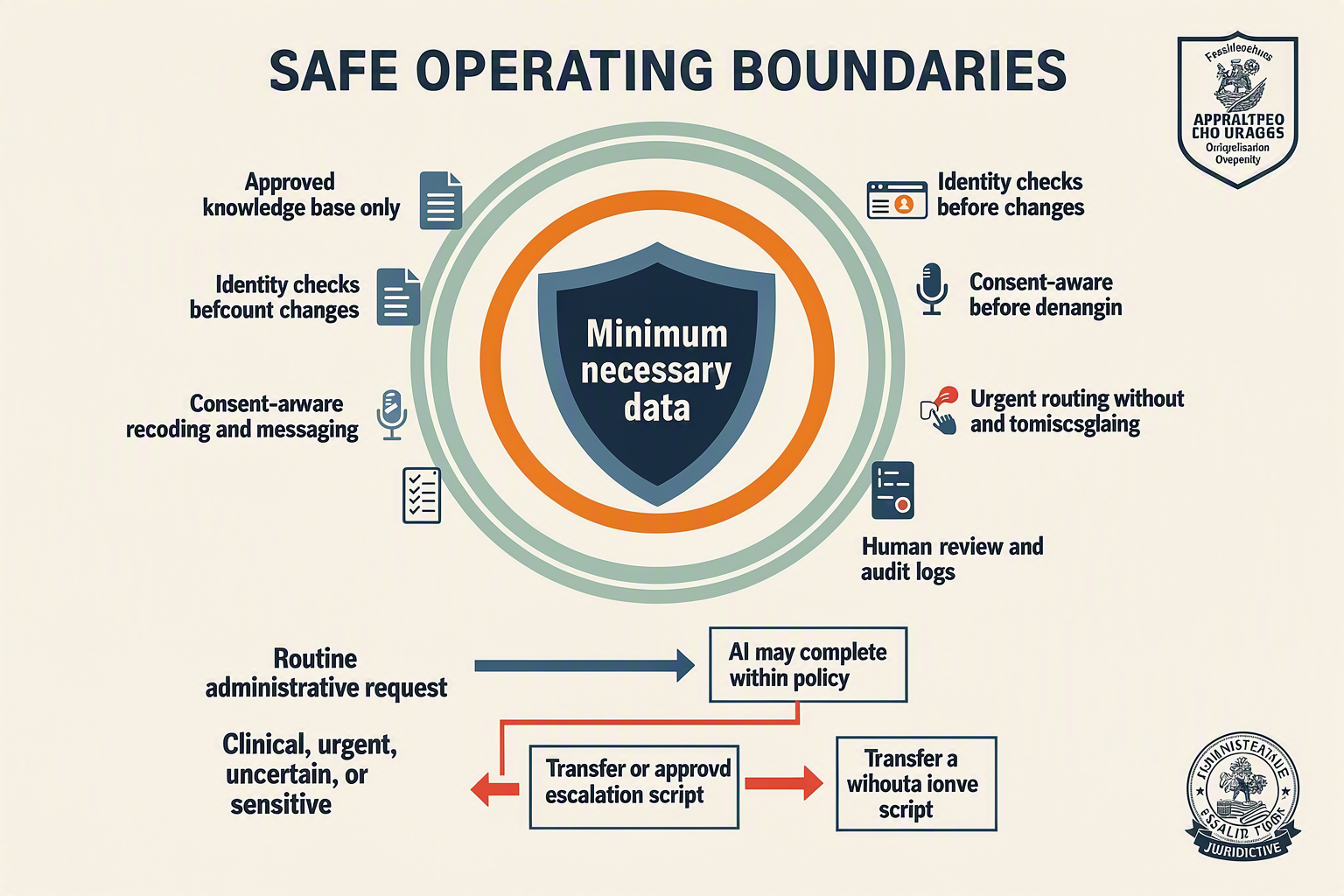
Clinics protect patients by constraining the AI to administrative tasks, clinic-approved information, and predetermined escalation rules. An AI receptionist for dental clinics should never diagnose, interpret symptoms, recommend medication, or reassure a caller that a condition is harmless.
Keep FAQ answers inside an approved knowledge base
Limit automated answers to information the clinic controls and regularly reviews, such as:
- Opening hours, locations, accessibility, parking, and accepted payment methods
- Services offered, without claiming that a service is appropriate for the caller
- Preparation instructions copied from dentist-approved materials
- Appointment duration, cancellation policies, and documents to bring
- General fee ranges only when authorised and clearly qualified
Use retrieval-augmented generation with a “no source, no answer” rule. If the knowledge base does not contain an approved response, the agent should say: “I don’t have approved information for that question, but I can ask the clinic team to contact you.” Version every article, record its clinical owner, and schedule reviews whenever policies change.
Route urgency without diagnosing
Urgent-versus-routine routing should classify the operational response, not the patient’s condition. A dentist or clinical lead must define trigger phrases and the required action.
- Ask a neutral question such as, “Are you experiencing severe bleeding, difficulty breathing or swallowing, major facial trauma, or rapidly increasing swelling?”
- If an emergency trigger is reported, stop the dental appointment booking AI flow.
- Read the clinic-approved emergency instruction, which may direct the caller to local emergency services.
- Alert designated staff and document the patient’s own words.
- Transfer uncertain, distressed, paediatric, medication-related, and post-procedure conversations to a human.
The agent must not say, “This sounds like an abscess,” or “You can safely wait until tomorrow.” Emergency wording and local telephone numbers should be reviewed for every clinic location.
Design multilingual conversations for accuracy
Let patients select their language rather than inferring it from their name or accent. Translate and clinically review each high-risk script separately; do not rely on improvised machine translation for emergency instructions, consent, medication questions, or aftercare.
CallMissed supports voice and chat across 22 Indian languages, enabling regional-language workflows while preserving a human escalation path. Clinics should test dental terminology, dates, names, addresses, and code-switching with native speakers before deployment.
Capture consent and minimise patient data
Consent requirements depend on the channel, purpose, and jurisdiction. Before recording or using transcripts, provide a clear disclosure and offer a non-recorded or human alternative where required. Dental WhatsApp automation should identify the clinic, explain why the message was sent, respect opt-outs, and avoid placing sensitive clinical details in previews.
For dental missed call automation, distinguish a service callback from promotional outreach. Store only what the workflow needs—typically the patient’s name, callback number, request category, preferred location, and scheduling preference.
Indian clinics should review the Digital Personal Data Protection Act, 2023, while covered US providers must assess the Health Insurance Portability and Accountability Act of 1996 (HIPAA), relevant state laws, and whether vendors handling protected health information require business-associate agreements.
Apply role-based access, encryption, audit logs, retention limits, deletion procedures, and breach-response plans across calls, transcripts, calendars, CRM records, and WhatsApp follow-ups. Legal and clinical owners—not the AI vendor alone—should approve the final workflow.
Which experts should approve the workflow, and how can clinics compare vendors without accepting unsupported claims?
A clinic should require clinical, operational, privacy, security, and technical approval before an AI workflow reaches patients. Vendor selection should then rely on scripted demonstrations, documented controls, contract terms, and clinic-run pilot results—not claims such as “human-level,” “fully compliant,” or “zero missed calls.”
Assign an accountable approval team
No vendor should decide whether a conversation is clinically safe. Establish named owners with authority to approve or reject each component:
- Clinical lead or principal dentist: Defines prohibited topics, urgent-routing language, red-flag escalation rules, and the boundary between administrative guidance and clinical advice.
- Practice manager: Approves opening hours, location details, cancellation policies, staff queues, and exception handling.
- Reception or scheduling lead: Tests provider calendars, appointment types, rescheduling rules, buffers, and duplicate-booking prevention for the dental appointment booking AI.
- Privacy or legal adviser: Reviews disclosure, consent, processor contracts, retention, deletion, cross-border transfers, and applicable law. Indian clinics should obtain advice on the Digital Personal Data Protection Act, 2023; covered US providers should assess the Health Insurance Portability and Accountability Act of 1996 and relevant state requirements.
- IT or security owner: Verifies authentication, role-based access, encryption, audit logs, integration permissions, incident response, and account offboarding.
- Language reviewers: Validate pronunciation, intent recognition, and translations before multilingual deployment. CallMissed supports voice and chat across 22 Indian languages, but each clinic should still test its own service names, local accents, and escalation phrases.
Approval should be recorded by workflow version. A material change to prompts, knowledge sources, calendars, models, or routing logic should trigger re-review.
Convert vendor promises into testable evidence
Ask every potential provider to complete the same evidence request for the AI receptionist for dental clinics, dental missed call automation, and dental WhatsApp automation workflows:
- Claim: “Books appointments accurately.”
Evidence required: A live test against a sandbox calendar covering unavailable slots, provider constraints, time zones, simultaneous requests, cancellations, and failed integrations.
- Claim: “Secure” or “compliant.”
Evidence required: Named certifications or audit reports, data-flow diagrams, subprocessors, hosting locations, retention controls, breach procedures, and contractual responsibilities. A feature cannot make the clinic compliant automatically.
- Claim: “Understands any language.”
Evidence required: Language-by-language test results using clinic-approved scripts, regional names, code-switching, noisy calls, and low-confidence handoff.
- Claim: “Integrates with your software.”
Evidence required: The exact integration method, supported fields, write permissions, error handling, rate limits, monitoring, and rollback process.
- Claim: “Improves revenue” or “recovers every missed call.”
Evidence required: Customer methodology, sample size, measurement period, exclusions, and independently reproducible pilot criteria.
Run a controlled, comparable pilot
Give shortlisted vendors an identical test set of routine bookings, reschedules, FAQs, distressed callers, ambiguous requests, and explicit demands for a human. Score task completion, calendar accuracy, unsupported-answer rate, escalation success, latency, language quality, staff workload, and opt-out handling.
Do not accept a polished demonstration using only ideal calls. Review transcripts and recordings with appropriate access controls, then document failures through a structured QA process such as the AI Agent Analytics 2026 guide. For safety-critical transfers, use the AI Agent Human Handoff guide to test unavailable staff, dropped connections, and fallback queues.
Final approval should be conditional: deploy gradually, define stop thresholds, preserve a human fallback, and require vendors to substantiate every measurable claim in writing.
How should a dental clinic pilot the system, test human handoffs, and measure results before expanding?
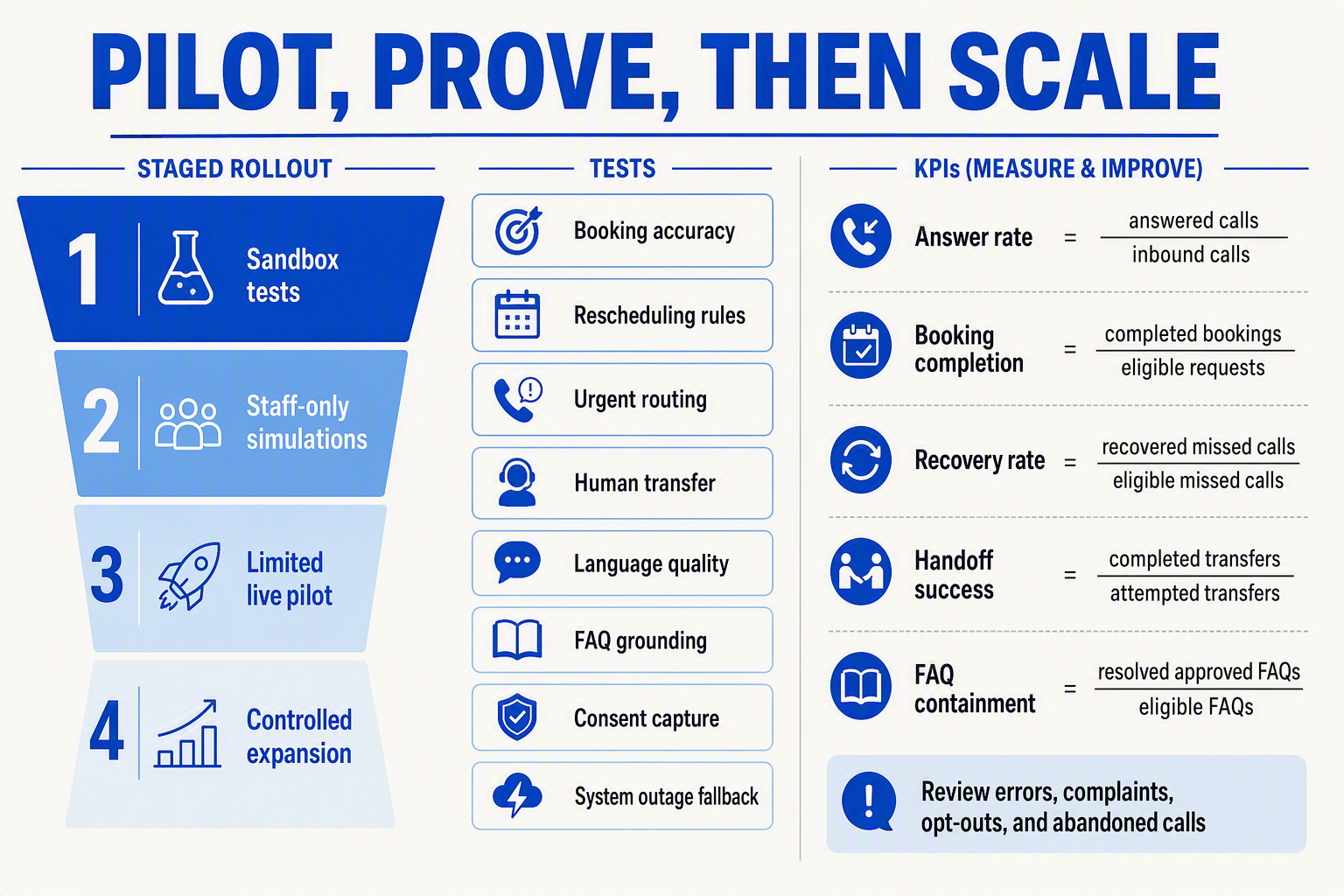
Pilot the AI receptionist for dental clinics on a limited call segment, run scripted and live handoff tests, and expand only after the system meets clinic-approved safety and accuracy thresholds. A two-to-four-week pilot should measure booking correctness, escalation reliability, patient experience, and staff workload—not simply the number of automated calls.
Start with a narrow, reversible pilot
Choose one location, a small staff group, and low-risk workflows. Keep the existing phone and scheduling processes available as fallbacks.
- Week 1—simulation: Test with staff accounts and a sandbox calendar.
- Week 2—controlled traffic: Route after-hours calls or overflow calls to the agent.
- Weeks 3–4—limited live use: Add routine booking, rescheduling, FAQs, and consent-based follow-up.
- Expansion review: Compare results against the clinic’s baseline and investigate every safety-related failure.
The first version of dental appointment booking AI should support only clearly defined services, providers, locations, durations, and booking rules. Exclude procedures requiring clinical triage, complex treatment sequencing, deposits the integration cannot process securely, or staff judgment.
For multilingual pilots, test each enabled language separately rather than assuming that an English workflow transfers reliably. CallMissed supports voice and chat across 22 Indian languages, but clinics should still validate local terminology, provider names, addresses, and speech recognition using representative callers.
Test human handoffs under realistic conditions
A handoff succeeds only when the patient reaches the correct person with enough context to continue without repeating everything. Test at least these scenarios:
- The caller explicitly says, “I want to speak to a person.”
- The caller describes severe pain, swelling, trauma, uncontrolled bleeding, breathing difficulty, or another clinic-defined urgent condition.
- The caller sounds distressed, repeatedly interrupts, or cannot understand the agent.
- Calendar access fails, no approved slot is available, or booking details conflict.
- The caller asks for diagnosis, medication guidance, pricing outside the approved knowledge base, or access to sensitive records.
- The transfer destination is busy, offline, or unanswered.
Verify both warm transfers and fallback paths. If staff do not answer, the system should create a prioritised task, confirm the expected response channel, and avoid promising a response time the clinic cannot meet. The agent must use clinic-approved emergency wording and must not diagnose urgency independently.
For deeper test scenarios, use the AI agent human handoff guide alongside recorded-call quality reviews.
Measure outcomes with auditable definitions
Establish a baseline from comparable days before launch. Then track:
- Answer rate: answered inbound calls ÷ total eligible inbound calls
- Booking accuracy: correctly created appointments ÷ audited AI-created appointments
- Rescheduling accuracy: valid changes ÷ audited rescheduling attempts
- Handoff success: completed transfers or acknowledged staff tasks ÷ required handoffs
- Recovery rate: appointments or resolved enquiries ÷ eligible missed calls
- FAQ groundedness: answers fully supported by the approved knowledge base ÷ audited FAQ answers
- Patient opt-out rate: follow-up opt-outs ÷ patients receiving automated outreach
- Staff time saved: baseline handling minutes minus post-pilot handling minutes
- Safety exceptions: missed escalations, unsupported clinical statements, privacy incidents, and incorrect bookings
Set thresholds before launch. For example, a clinic might require 100% escalation in its scripted high-risk tests and manually review every exception; that is an implementation target, not a claimed industry benchmark.
Expand only after passing the review gate
Do not expand dental missed call automation or dental WhatsApp automation merely because call volume was handled. Approve expansion only when booking rules remain accurate, urgent-routing tests pass, consent records are retrievable, staff accept handoffs reliably, and failures can be traced through logs. Add one new location, language, or workflow at a time, then repeat the same audit cycle.
What does this implementation mean for an independent dentist versus a multi-location dental group?
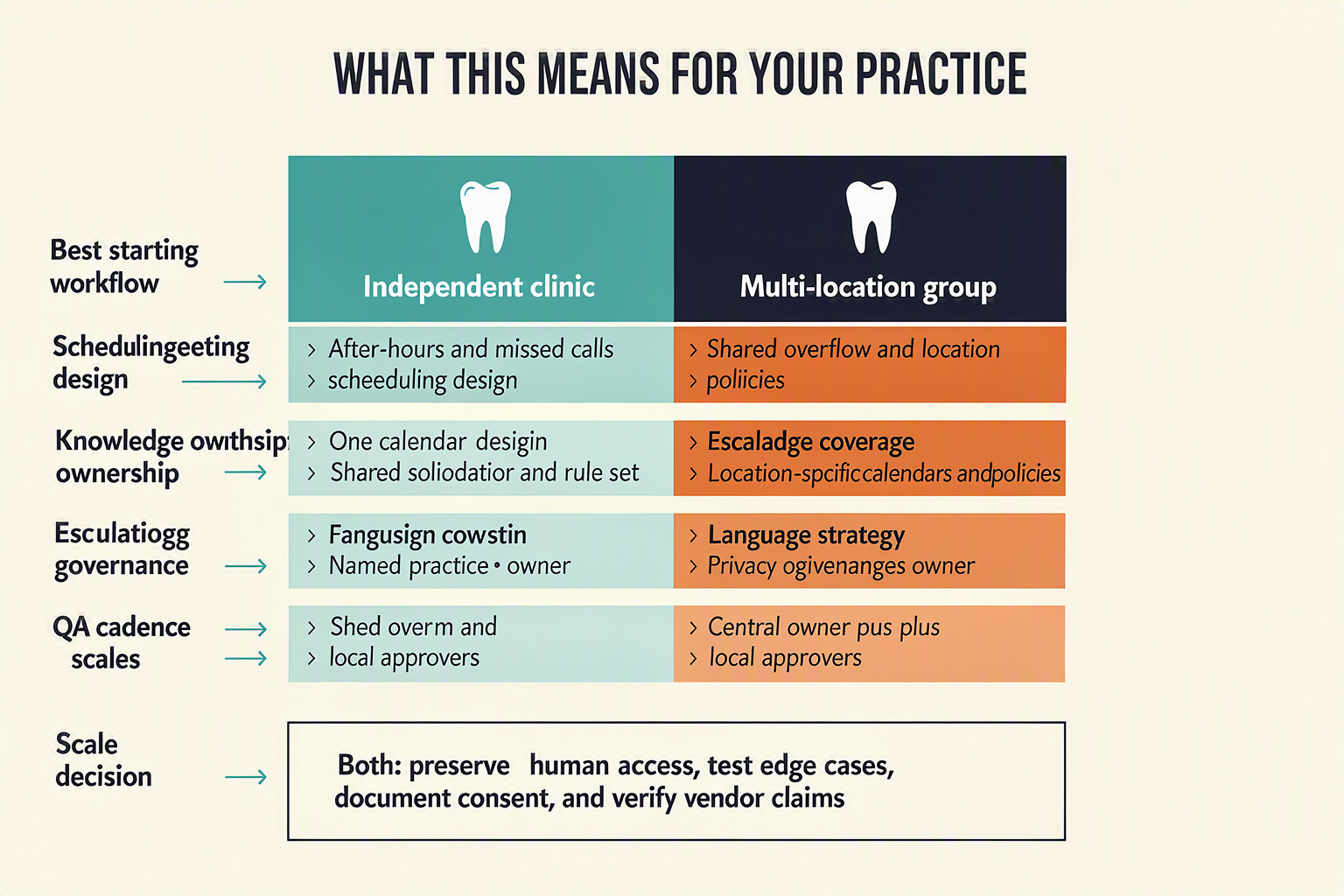
The core workflow is the same for both practice types, but the operating model differs: an independent dentist should optimise for simplicity and staff time, while a multi-location dental group should prioritise standardisation, location-aware routing, governance, and consolidated reporting. Neither should automate clinical judgment; urgent or ambiguous conversations must follow approved escalation rules.
Implementation model by practice size
| Decision area | Independent dental practice | Multi-location dental group | Recommended control |
|---|---|---|---|
| Inbound call coverage | One AI receptionist can cover busy periods, breaks, and after-hours calls for a single number. | Route calls by location, language, opening hours, service availability, and overflow capacity. | Maintain separate emergency and human-handoff paths; test every location’s routing monthly. |
| Appointment scheduling | Connect the dental appointment booking AI to one calendar with a limited set of services and durations. | Integrate multiple providers, chairs, specialties, calendars, and location-specific booking rules. | Allow booking only against live, approved availability; require confirmation before committing changes. |
| Missed-call recovery | Send one permission-aware callback or message task to the receptionist’s shared queue. | Deduplicate missed calls across numbers and assign follow-up by location, patient status, or service line. | Record contact permission, attempt status, owner, and outcome for every recovery task. |
| Knowledge management | Use a concise approved source covering hours, directions, payment options, preparation instructions, and clinic policies. | Maintain centrally governed content with local variations for pricing, providers, parking, and opening hours. | Assign a content owner, effective date, review date, and location scope to every answer. |
| WhatsApp and languages | Use dental WhatsApp automation for confirmations, rescheduling links, and authorised follow-up. | Apply common templates while supporting regional language and location-specific messaging. | CallMissed supports voice and chat across 22 Indian languages; clinics should still test terminology and pronunciation with local staff. |
| Reporting and governance | Review a small dashboard covering calls answered, booking outcomes, handoffs, and unresolved requests. | Compare locations while enforcing role-based access, audit logs, retention rules, and central quality assurance. | Avoid league tables based only on booking rate; account for call intent, availability, and escalation complexity. |
Different rollout priorities
For an independent practice, the first release of an AI receptionist for dental clinics should remain deliberately narrow:
- Answer common administrative questions from approved content.
- Book or reschedule only straightforward appointment types.
- Recover missed calls without repeatedly contacting patients.
- Transfer uncertainty, distress, complaints, and clinical questions to staff.
A multi-location group needs an additional configuration layer before launch. Every phone number, calendar, provider, service, holiday schedule, escalation team, and WhatsApp template should carry a location identifier. Central policies can then coexist with local operational details without allowing one clinic’s hours or availability to appear in another clinic’s response.
For scheduling architecture, the AI appointment booking workflow guide provides a useful integration pattern. Groups designing cross-location ownership and follow-up can also use the AI receptionist CRM integration guide.
KPIs should reflect scale, not vanity
Both models should measure answer rate, booking completion, rescheduling completion, missed-call recovery, human-handoff rate, unanswered-intent rate, and scheduling error rate. Multi-location groups should segment these metrics by clinic, language, channel, and call intent; independent dentists can begin with weekly totals and transcript sampling.
The objective is not to minimise handoffs at all costs. A safe dental missed call automation workflow should increase administrative coverage while making appropriate human escalation visible, fast, and auditable.
Which related 2026 guides should clinics use next for booking, CRM integration, missed-call recovery, human handoff, analytics, and permission-based follow-up?
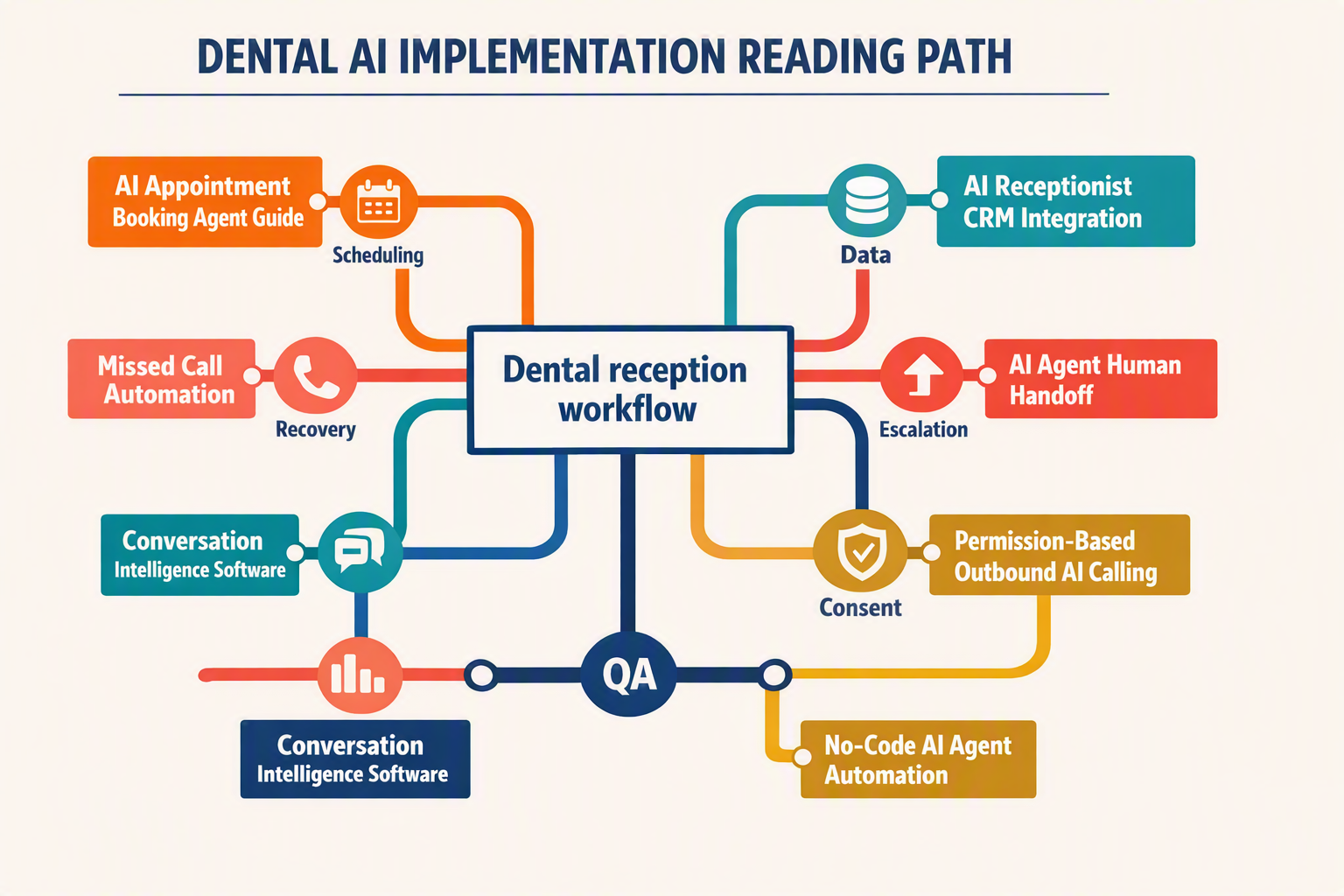
Choose the next guide according to the clinic’s weakest workflow: booking accuracy, CRM data flow, missed-call recovery, human escalation, quality analytics, or consent-controlled outreach. Clinics should implement these capabilities sequentially rather than activating every automation at once.
1. Standardise booking and rescheduling
Start with the AI Appointment Booking Agent Guide: Phone and WhatsApp Workflows for Small Businesses (2026) when calendar operations remain inconsistent. It expands the dental appointment booking AI workflow into:
- Service, provider, location, and duration mapping
- Real-time slot availability and conflict prevention
- Rescheduling, cancellation, and confirmation rules
- Phone-to-WhatsApp continuity
- Exceptions requiring front-desk review
Apply the guide first to routine appointments such as examinations or hygiene visits. Keep complex procedures, clinical prioritisation, and unusual scheduling requests under staff control.
2. Connect conversations to the clinic CRM
Use the AI Receptionist CRM Integration: 2026 Guide to Lead Capture and Follow-Up to define what the AI receptionist for dental clinics may create or update after each interaction. Recommended fields include patient status, requested service, preferred location, appointment outcome, consent status, escalation reason, and next action.
The CRM should remain the operational record; call transcripts or model-generated summaries should not silently overwrite verified patient information. Apply role-based access, retention limits, and jurisdiction-specific privacy review, including the Digital Personal Data Protection Act, 2023 where applicable in India and HIPAA, enacted in 1996, for covered US providers.
3. Recover unanswered calls safely
The Missed Call Automation in 2026: CallMissed Lead Recovery Workflow Guide provides the deeper implementation path for dental missed call automation. Use it to configure:
- Deduplication when one patient calls repeatedly
- Business-hours and after-hours recovery rules
- Callback-versus-message channel selection
- Retry limits and suppression lists
- Attribution from missed call to completed booking
Recovery messages should identify the clinic, explain why the patient is being contacted, and provide a clear way to stop further follow-up.
4. Engineer reliable human handoff
Read the AI Agent Human Handoff: CallMissed Escalation Guide for 2026 before automating urgent-versus-routine routing. The guide is relevant when designing transfers for patient-requested staff assistance, distress signals, repeated misunderstanding, accessibility needs, payment disputes, or conversations outside the approved knowledge base.
A handoff should carry the reason, callback number, consented summary, and interaction status—not force the patient to repeat everything. The AI must route urgency without diagnosing it.
5. Measure quality, containment, and booking outcomes
Use the AI Agent Analytics 2026: Conversation Intelligence, QA, and ROI With CallMissed to build dashboards for booking completion, rescheduling success, transfer rate, missed-call recovery, FAQ fallback, opt-outs, and failed integrations. Pair it with the Conversation Intelligence Software for AI Phone Calls: 2026 Implementation Guide for transcript sampling and structured quality assurance.
6. Govern permission-based follow-up
Before launching outbound reminders, callbacks, or dental WhatsApp automation, follow the Permission-Based Outbound AI Calling: 2026 CallMissed Guide. Platforms such as CallMissed can connect AI voice, WhatsApp Business calls, chat, and CRM workflows, but clinics remain responsible for consent evidence, channel permissions, quiet hours, opt-outs, and applicable healthcare and communications law.
Frequently asked questions: Can an AI receptionist book and reschedule dental appointments, recover missed calls, answer clinical questions, use WhatsApp, support multiple languages, route urgent calls, transfer to staff, and comply with privacy rules?
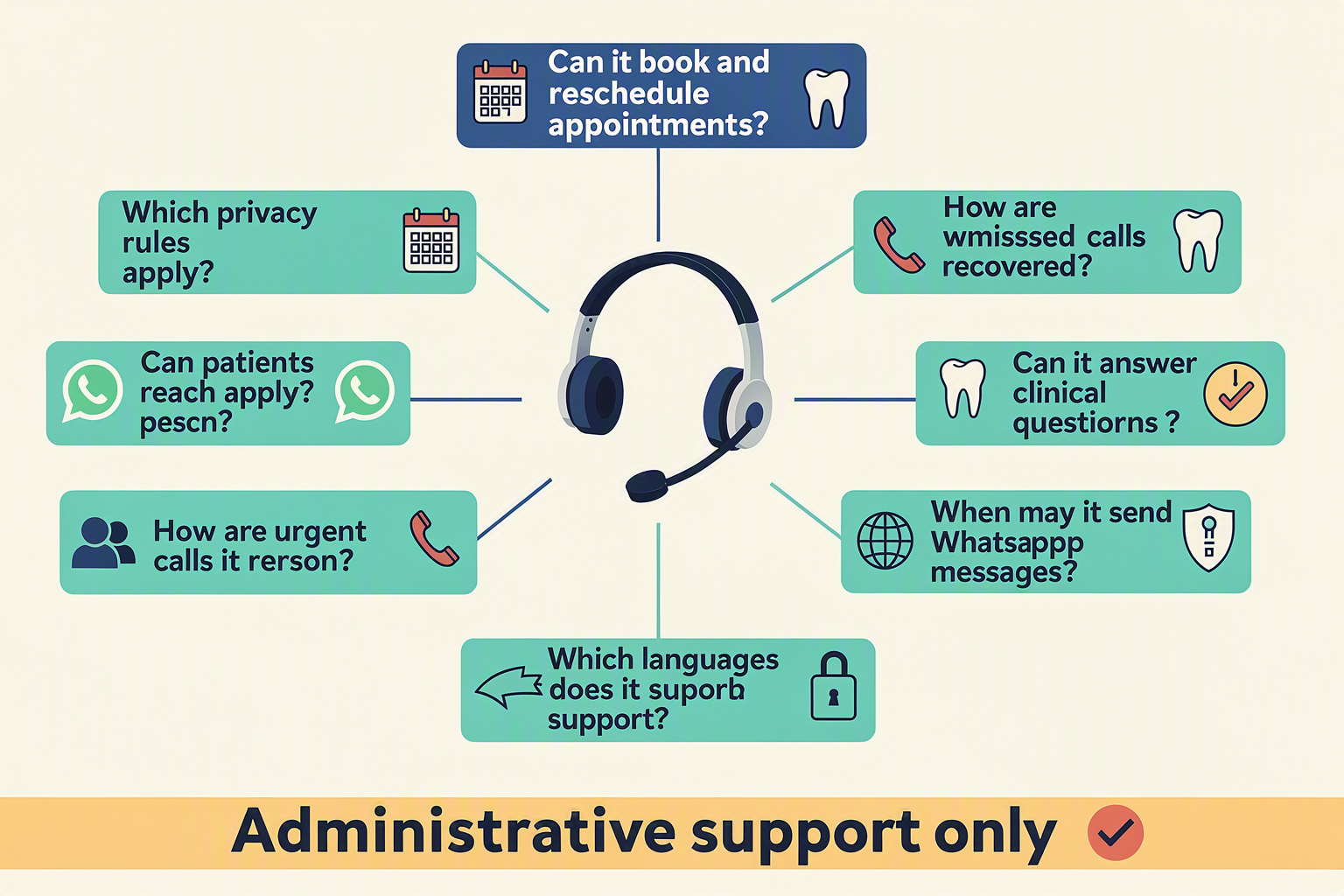
Can an AI receptionist for dental clinics book, reschedule, and cancel appointments?
How do dental missed call automation and dental WhatsApp automation work together?
Can a dental AI receptionist safely answer clinical questions from patients?
Can an AI receptionist for dental clinics support multiple languages and regional accents?
How should an AI dental receptionist route urgent calls and transfer patients to staff?
What privacy and consent rules apply to AI receptionists handling dental patient data?
Conclusion
A successful AI receptionist for dental clinics should function as a controlled front-desk workflow—not as a clinician. In 2026, the priority is immediate access, reliable scheduling, safe escalation, and privacy-aware communication across voice and WhatsApp.
- Automate defined administrative tasks: Use dental appointment booking AI to answer inbound calls, offer approved slots, reschedule visits, and process cancellations according to clinic rules.
- Recover demand without creating spam: Configure dental missed call automation to send permission-aware callbacks or messages, especially when calls arrive after hours or staff are unavailable.
- Keep clinical boundaries explicit: Answer FAQs only from an approved knowledge base, distinguish urgent from routine requests using predefined criteria, and transfer distress, uncertainty, or patient-requested conversations to trained staff.
- Build safeguards before scaling: Test scripts, calendar connections, multilingual interactions, consent disclosures, access controls, retention policies, and human handoffs before expanding across providers or locations.
What to watch next
Dental groups should watch how multilingual voice, dental WhatsApp automation, workflow analytics, and human escalation become more tightly connected. Compliance review must remain jurisdiction-specific, including the Digital Personal Data Protection Act, 2023 in India and HIPAA requirements for covered US providers.
To explore this shift, visit CallMissed, an AI communication infrastructure platform supporting voice agents, WhatsApp workflows, human handoff, and 22 Indian languages. Which patient journey will your clinic automate—and safely test—first?
Related Reading
Discussion
Related Posts
Ready to automate customer conversations?
Launch AI voice agents and WhatsApp bots with CallMissed — one API, 22+ Indian languages.