
AI Receptionist for Professional Services: Secure Intake and Handoff Guide for 2026


Learn how an AI receptionist for professional services can capture enquiries, schedule safely, protect privacy, and escalate high-risk calls.
AI Receptionist for Professional Services: Secure Intake and Handoff Guide for 2026
What happens when a prospective client calls after hours, shares confidential details, and expects an immediate answer—but nobody is available to respond? In 2026, an AI receptionist for professional services can capture that enquiry, apply privacy-aware intake rules, schedule an appropriate meeting, and escalate urgent matters without pretending to be a lawyer, accountant, consultant, or insurance adviser.
The opportunity is significant, but so is the risk. Microsoft’s 2024 Work Trend Index found that 75% of knowledge workers were already using AI at work, while 78% of AI users were bringing their own tools into the workplace. Meanwhile, IBM’s Cost of a Data Breach Report 2024 put the global average cost of a breach at US$4.88 million. For firms handling identities, financial records, legal disputes, commercial strategies, and insurance information, these figures underline why controlled workflows matter more than an impressive conversational demo.
A professional-services receptionist therefore needs a narrower mandate than a general-purpose chatbot. An accounting firm AI receptionist may collect the caller’s name, service category, jurisdiction, and preferred appointment time—but must not interpret tax rules. A law office call answering AI may gather information needed for a conflict check—but must not promise representation, assess legal merits, or create the impression that an attorney-client relationship exists. Similarly, consulting lead intake automation can qualify an organisation’s broad requirements while avoiding requests for unnecessary trade secrets or sensitive personal data.
Platforms such as CallMissed reflect this shift by combining AI voice agents, knowledge-grounded responses, WhatsApp Business calling, and multilingual voice support across 22 Indian languages, with human escalation available for matters that automation should not handle.
What this guide will help you build
This guide presents a practical 2026 operating model for accounting practices, consultancies, insurance brokerages, and legal offices. It covers:
- Inbound enquiry capture with data-minimisation rules and clear AI disclosure
- Conflict- and privacy-aware intake that avoids collecting sensitive details too early
- Appointment scheduling and caller routing based on service, location, urgency, and staff availability
- Missed-call recovery through permission-aware callbacks, WhatsApp messages, or email
- Knowledge-grounded FAQs limited to approved information such as office hours, services, documents, and process steps
- Multilingual voice workflows with verification when names, dates, policy numbers, or financial figures are unclear
- Human handoff for complaints, deadlines, vulnerable callers, conflicts, emergencies, and high-stakes decisions
You will also find a use-case matrix, risk controls, an implementation checklist, and practical handoff guidance. For deeper workflow design, see the AI receptionist CRM integration guide and the AI agent human handoff guide.
The governing rule is simple: AI may support intake and administration, but it must not provide legal, tax, financial, insurance, or other professional advice. Sensitive, ambiguous, or high-stakes matters belong with appropriately qualified staff.
What can an AI receptionist for professional services safely do in 2026? It can handle administrative workflows, but it must never provide legal, tax, financial, insurance, or other professional advice; sensitive and high-stakes matters require qualified staff
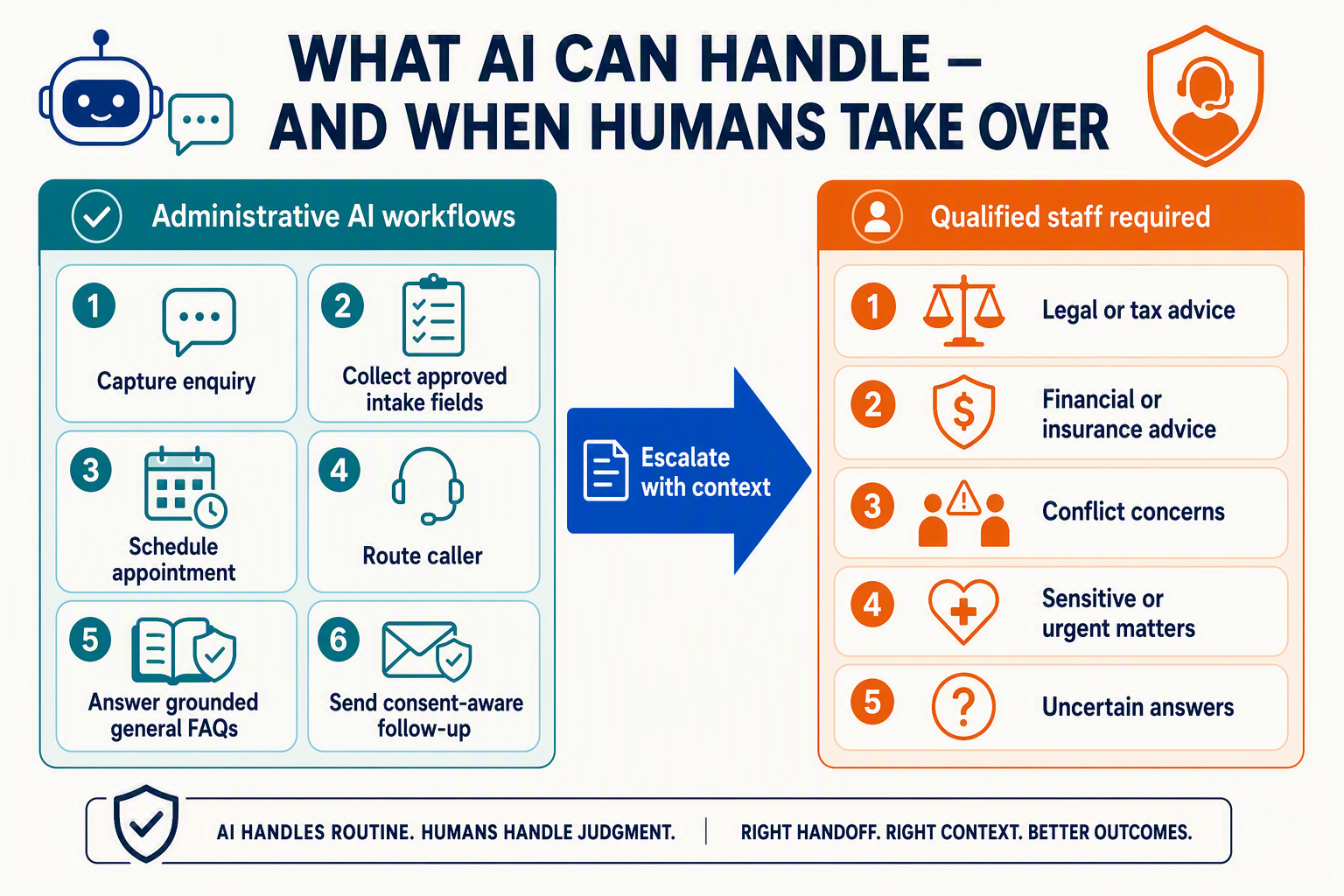
An AI receptionist for professional services can safely perform predefined administrative tasks: disclose that it is AI, capture minimal contact information, identify the requested service, schedule appointments, answer approved general FAQs, and route the enquiry. It must never interpret a caller’s situation or provide legal, tax, financial, insurance, or other professional advice; sensitive, ambiguous, urgent, or high-stakes matters require qualified staff.
Safe administrative workflows
A receptionist agent should operate like a controlled front desk—not an autonomous practitioner. Appropriate tasks include:
- Recording a caller’s name, organisation, contact details, service category, location, and preferred callback time
- Explaining published information such as office hours, locations, consultation formats, fees approved for disclosure, and required documents
- Scheduling, rescheduling, or cancelling appointments within configured calendars
- Routing calls according to service line, jurisdiction, language, existing-client status, or urgency
- Sending consent-aware appointment confirmations through WhatsApp or email
- Recovering missed calls without revealing confidential information in messages
- Creating a structured intake record for staff review
CallMissed, an AI-native customer-engagement platform, supports voice agents, WhatsApp chat and Business calling, email, web interactions, and voice workflows across 22 Indian languages. Multilingual coverage can improve accessibility, but names, dates, monetary amounts, policy numbers, and matter references should be read back for confirmation rather than assumed.
Boundaries for each profession
The distinction between administration and advice must be encoded into prompts, tools, knowledge sources, and escalation rules.
- An accounting firm AI receptionist may ask whether an enquiry concerns bookkeeping, payroll, audit, or tax preparation. It must not recommend a tax position, estimate liability, interpret eligibility, or tell a caller what to claim.
- A law office call answering AI may collect limited information for a conflict check and communicate that representation has not been accepted. It must not assess legal merits, interpret rights, predict outcomes, or advise someone to take—or delay—legal action.
- Consulting lead intake automation may capture an organisation’s industry, broad objective, expected timeline, and approximate project scope. It should not solicit trade secrets, confidential strategy documents, credentials, or unnecessary customer data during first contact.
- An insurance brokerage workflow may record the type of cover requested and arrange a licensed adviser’s callback. It must not recommend coverage, compare suitability, interpret exclusions, or imply that a claim will be accepted.
When the AI must stop and escalate
Human handoff should be mandatory when the caller mentions:
- Deadlines or emergencies, including court dates, regulatory notices, imminent financial loss, or urgent claims
- Professional judgement, such as which policy, filing position, legal remedy, or investment decision to choose
- Sensitive information, including health records, identity documents, account credentials, evidence, or privileged communications
- Conflict indicators, such as opposing parties, related entities, former clients, or existing representation
- Distress, complaints, threats, or vulnerability, especially when safe handling requires empathy or specialist authority
The AI should respond plainly: “I can record this for the appropriate professional, but I cannot advise you.” It should then transfer the call or create a priority callback with only the information necessary for follow-up.
These restrictions are operational controls, not optional disclaimers. Microsoft’s 2024 Work Trend Index reported that 78% of AI users were bringing their own AI tools to work, reinforcing the need for centrally governed workflows rather than uncontrolled consumer tools. Firms should also test escalation behaviour using the AI agent human-handoff guide before allowing the receptionist to handle live enquiries.
Why are accounting, consulting, insurance, and legal offices redesigning inbound enquiry workflows now?

Professional-service firms are redesigning inbound enquiry workflows because clients expect rapid, channel-flexible responses while firms face stricter obligations around confidentiality, conflicts, consent, and professional boundaries. The objective in 2026 is not to automate expert judgement; it is to make initial contact faster, more consistent, and easier to govern.
Demand is arriving across more channels and outside office hours
A prospective client may begin with a phone call, continue through WhatsApp, and expect confirmation by email. Manually transferring information between these channels creates delays, incomplete records, and inconsistent follow-up.
An AI receptionist for professional services can provide a controlled front door by:
- Answering routine calls when staff are unavailable
- Recording only approved intake fields
- Classifying the broad service requested
- Offering suitable appointment slots
- Routing urgent or sensitive enquiries to qualified staff
- Recovering missed calls through consent-aware voice, WhatsApp, or email follow-up
This approach is particularly relevant for multilingual markets. A caller who can describe an issue in a preferred language may provide more accurate names, dates, and requirements—although critical details should still be read back and verified.
Uncontrolled AI use has become an operational risk
AI adoption is already occurring inside knowledge-based workplaces, whether firms have approved workflows or not. Microsoft’s 2024 Work Trend Index found that 78% of employees using AI were bringing their own AI tools to work. That makes a governed intake system preferable to staff copying confidential enquiries into unapproved applications.
The financial exposure is also material. IBM’s Cost of a Data Breach Report 2024 reported a global average breach cost of US$4.88 million. Professional firms should therefore design reception workflows around data minimisation, purpose limitation, access controls, retention rules, and auditable human escalation, rather than collecting a caller’s entire story at first contact.
Each profession needs different intake guardrails
A common conversational interface can support multiple sectors, but its permissions must reflect the profession:
- An accounting firm AI receptionist can identify the requested service, relevant jurisdiction, entity type, and deadline, but must not interpret tax law or recommend a filing position.
- Consulting lead intake automation can capture company size, project category, timeline, and decision-making stage without soliciting confidential strategies or trade secrets prematurely.
- An insurance brokerage workflow can collect a broad coverage category and renewal date, but must not recommend policies, interpret coverage, or make financial or insurance decisions.
- A law office call answering AI can obtain limited information for conflict screening, but must not evaluate a claim, promise representation, or invite detailed privileged material before the firm accepts the matter.
Across all four sectors, AI must not provide legal, tax, financial, insurance, or other professional advice. Complaints, imminent deadlines, suspected fraud, vulnerable callers, conflicts, and high-stakes decisions require qualified human review.
The redesign is operational, not merely technological
The strongest workflow separates reception from professional judgement: capture, verify, classify, schedule, route, and document. It also defines what the AI must refuse and when a person takes over.
Firms planning this operating model can use a structured AI receptionist CRM integration guide to map approved fields and ownership, then define escalation paths using the 2026 AI agent human-handoff guide. The result is a controlled intake layer—not an autonomous adviser.
Which AI receptionist capabilities matter in 2026, and what claims must firms verify before buying?
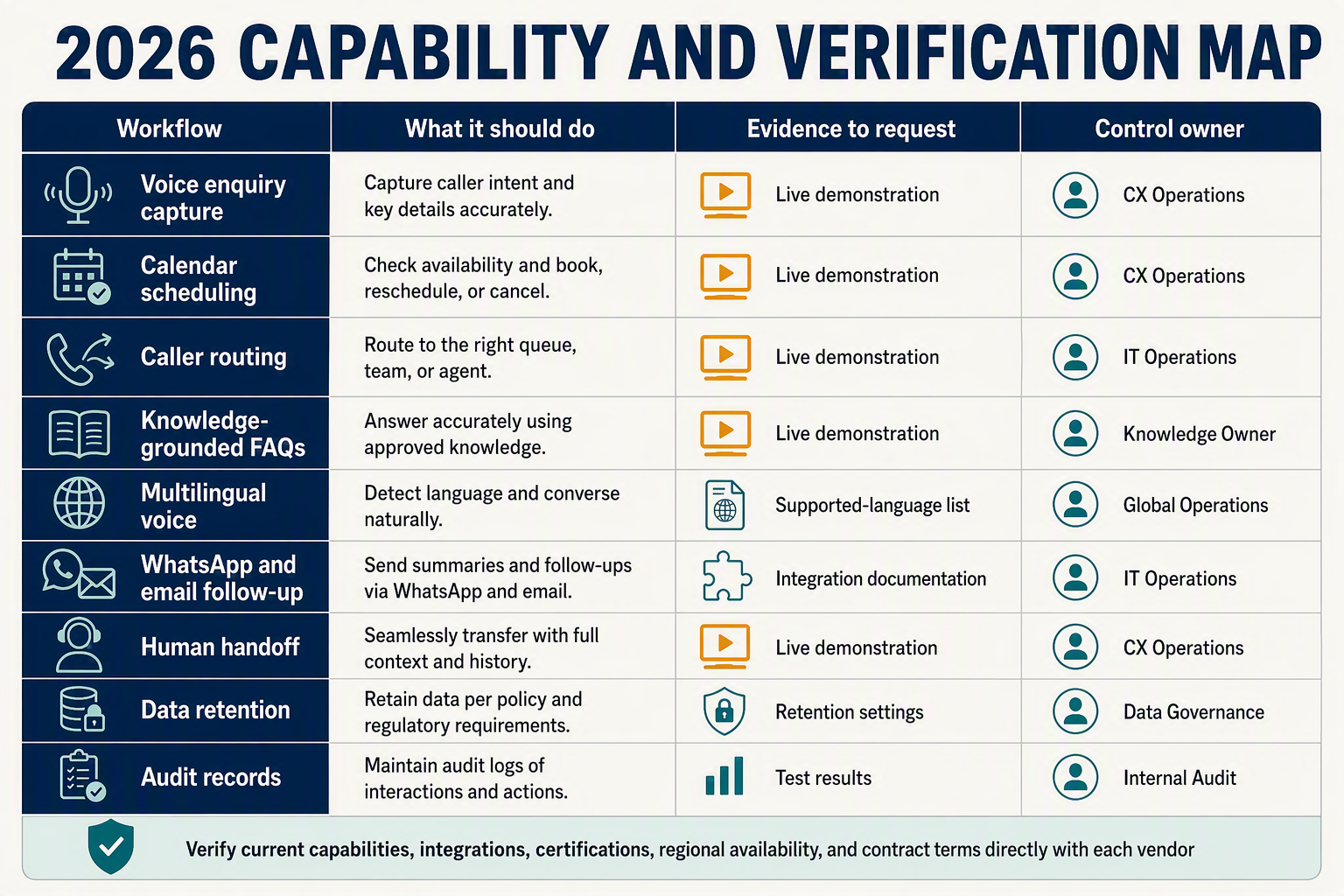
The capabilities that matter most in 2026 are controlled intake, reliable knowledge grounding, privacy-aware data handling, multilingual accuracy, consent-based follow-up, and immediate human escalation. Firms should evaluate these functions in realistic workflows—not accept broad claims such as “secure,” “compliant,” “multilingual,” or “integrated” without technical and contractual evidence.
Capability and claims-verification matrix
| Capability | Professional-services requirement | Evidence to request | Claim that needs scrutiny |
|---|---|---|---|
| Conflict-aware intake | Collect only the names, organisations, jurisdictions, and matter categories required for preliminary screening; route possible conflicts to authorised staff. | Configurable fields, suppression rules, audit logs, and test transcripts covering adverse-party names. | “Automated conflict checking” may mean simple keyword matching. The AI must not issue definitive conflict clearance or confirm representation. |
| Knowledge-grounded FAQs | Answer only from approved material covering services, office hours, locations, fees where authorised, and document checklists. | Source citations, retrieval logs, version controls, and a fallback when no approved answer exists. | “No hallucinations” is not credible as an absolute guarantee; test unsupported, ambiguous, and adversarial questions. |
| Scheduling and routing | Apply service, jurisdiction, language, urgency, staff availability, and appointment-type rules without offering professional advice. | Live calendar demonstration, duplicate-booking tests, timezone handling, cancellation logic, and failure behaviour. | “Calendar integration” may provide read-only availability rather than confirmed booking, rescheduling, and cancellation. |
| Multilingual voice | Recognise names, dates, amounts, policy numbers, and regional accents; confirm uncertain high-impact details verbally. | Language-by-language recordings, word-error testing on firm vocabulary, pronunciation controls, and human fallback. | “Supports 20+ languages” may describe text translation rather than native speech recognition and synthesis. CallMissed states support for voice across 22 Indian languages, which firms should still test against their own callers and terminology. |
| Consent-aware follow-up | Record channel permission before sending missed-call recovery, appointment reminders, WhatsApp messages, or email. | Consent timestamps, opt-out processing, approved templates, retention controls, and jurisdiction-specific configuration. | “Omnichannel automation” does not itself establish lawful permission or satisfy each channel’s policy requirements. |
| Security, privacy, and handoff | Minimise collection, restrict access, define retention, redact sensitive data where possible, and transfer urgent or high-stakes matters to qualified staff. | Data-flow diagram, hosting locations, subprocessors, encryption details, role-based access, deletion tests, incident terms, and handoff reports. | “Enterprise-grade,” “GDPR-ready,” or “compliant” is insufficient without defined scope, independent evidence, and clear allocation of responsibilities. |
Test workflows, not feature labels
An AI receptionist for professional services should be evaluated with scripted calls specific to each practice. An accounting firm AI receptionist must decline requests to interpret tax treatment; a law office call answering AI must avoid judging a claim or implying an attorney-client relationship. Likewise, consulting lead intake automation should capture broad project requirements without soliciting trade secrets, while insurance workflows must not recommend coverage or interpret policy applicability.
Run acceptance tests for:
- A caller who refuses recording or follow-up consent
- A possible conflict involving misspelled names
- An urgent deadline outside office hours
- A multilingual caller stating several financial figures
- An unavailable calendar or CRM connection
- A question absent from the approved knowledge base
- A request for legal, tax, financial, insurance, or other professional advice
Every workflow should end safely: answer from approved information, ask a minimal clarifying question, or transfer to a qualified person. Buyers can use the 2026 AI receptionist service buyer guide for deeper due-diligence questions and the AI agent human-handoff guide to define escalation triggers.
Which receptionist workflows fit each type of professional-service firm? A use-case matrix for accounting, consulting, insurance brokerage, and legal offices
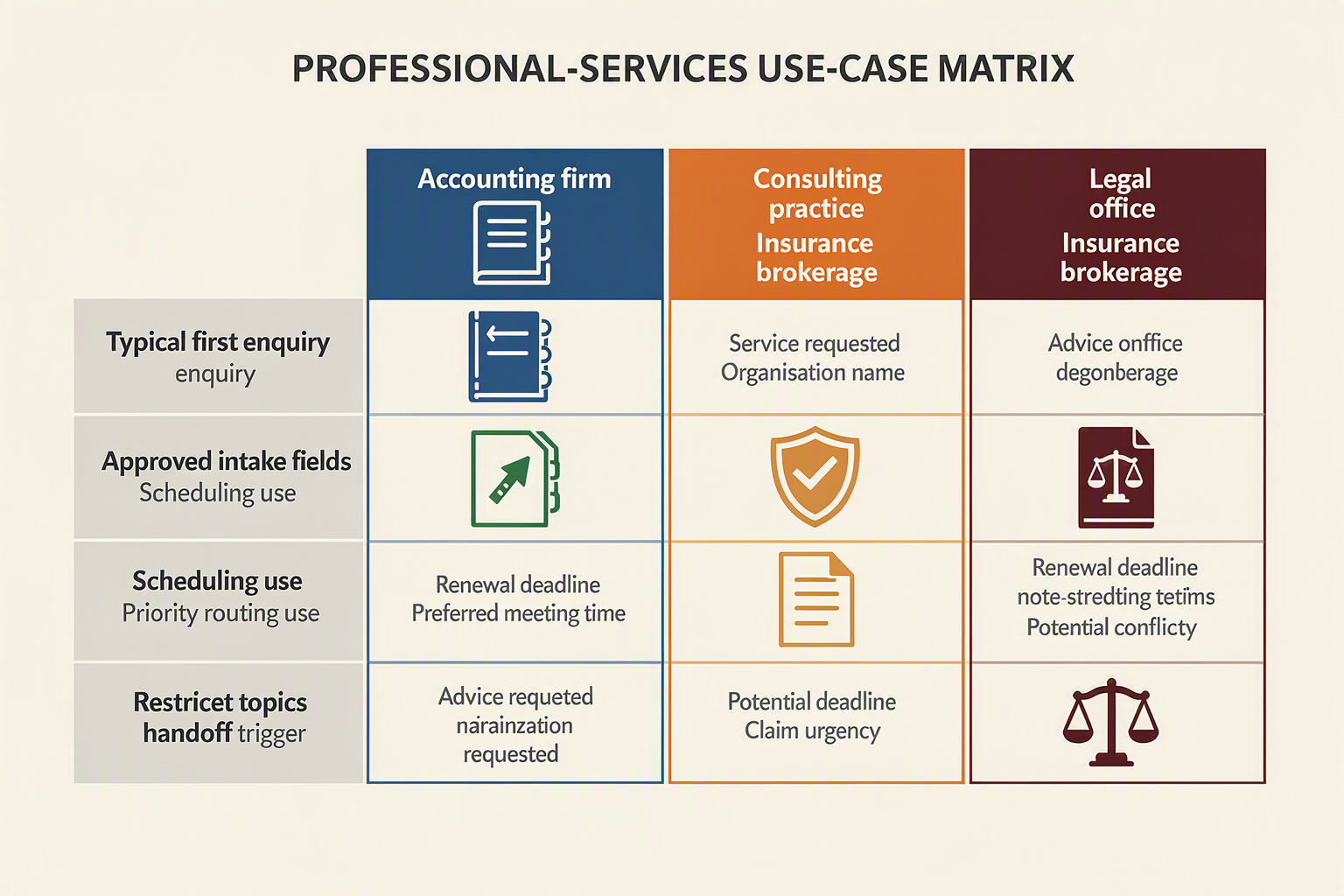
The right workflow depends on the firm’s professional obligations, but the common pattern is minimal intake, deterministic routing, consent-aware follow-up, and qualified human review. An AI receptionist for professional services should manage administrative steps—not provide legal, tax, financial, insurance, or other professional advice.
Use-case matrix by firm type
| Firm type | Safe initial capture | Scheduling and routing | Follow-up workflow | Mandatory stop or handoff |
|---|---|---|---|---|
| Accounting | Name, contact details, taxpayer or business type, jurisdiction, broad service category, deadline date | Route bookkeeping, payroll, audit, tax-preparation, and advisory enquiries to the relevant team; schedule only approved appointment types | With permission, send a document checklist or booking confirmation by WhatsApp or email; recover missed calls without requesting financial records in chat | Transfer questions about tax positions, filing decisions, audit opinions, suspected fraud, or account-specific financial information to a qualified professional |
| Consulting | Organisation, role, sector, location, broad business objective, expected timeline, and project scale band | Route by practice area, geography, client tier, and consultant availability; check whether an existing account owner should respond | Send an approved capability summary, discovery-call link, or consented callback message; log the enquiry in the CRM | Stop when the caller begins disclosing trade secrets, regulated data, unreleased financials, security architecture, or information conflicting with another engagement |
| Insurance brokerage | Name, contact channel, policy category, renewal or expiry date, location, and whether the matter concerns a new quote, claim, or servicing request | Route by product line, jurisdiction, insurer relationship, language, and urgency; prioritise time-sensitive claim notifications for staff | Send a consent-based appointment confirmation or approved list of documents; avoid requesting full identity or payment data through unsecured messages | Escalate coverage interpretation, product recommendations, claims advice, complaints, vulnerable customers, and emergency-loss situations to authorised personnel |
| Legal | Name, preferred contact details, opposing-party names, jurisdiction, broad matter type, key date, and language preference | Run a preliminary conflict-search workflow before substantive intake; route by practice area and office without implying acceptance of the matter | Confirm only that the enquiry was received or a consultation was requested; use approved wording stating that representation has not been established | A law office call answering AI must stop for legal advice, merits assessment, limitation deadlines, conflicts, threats, detention, court events, or highly sensitive facts |
How to apply the matrix
An accounting firm AI receptionist should treat deadline capture differently from deadline interpretation. Recording that a caller mentions 31 October 2026 may help prioritisation, but the system must not confirm that the date legally applies or recommend a filing position.
Likewise, consulting lead intake automation should qualify commercial fit without turning discovery into unrestricted data collection. Configure the workflow to:
- Ask for categories rather than confidential detail, such as “cybersecurity assessment” instead of network credentials.
- Read back names, dates, policy references, and financial figures when speech recognition confidence is low.
- Offer multilingual intake while storing a verified transcription and the caller’s preferred response language.
- Explain which follow-up channel will be used and obtain permission before sending WhatsApp or email messages.
- Apply approved knowledge-base answers only to general topics such as office hours, service areas, consultation processes, and required documents.
For multilingual operations, CallMissed product information specifies voice support across 22 Indian languages, allowing regional-language intake to feed the same controlled routing rules. Language coverage does not remove the need for verification: uncertain names, numbers, deadlines, and conflict-check identifiers should always trigger confirmation or human review.
Complex transfers should follow a documented escalation policy rather than improvised model judgement; see the AI agent human-handoff guide for channel-specific patterns.
How do you design conflict-aware, privacy-aware intake without collecting unnecessary sensitive information?
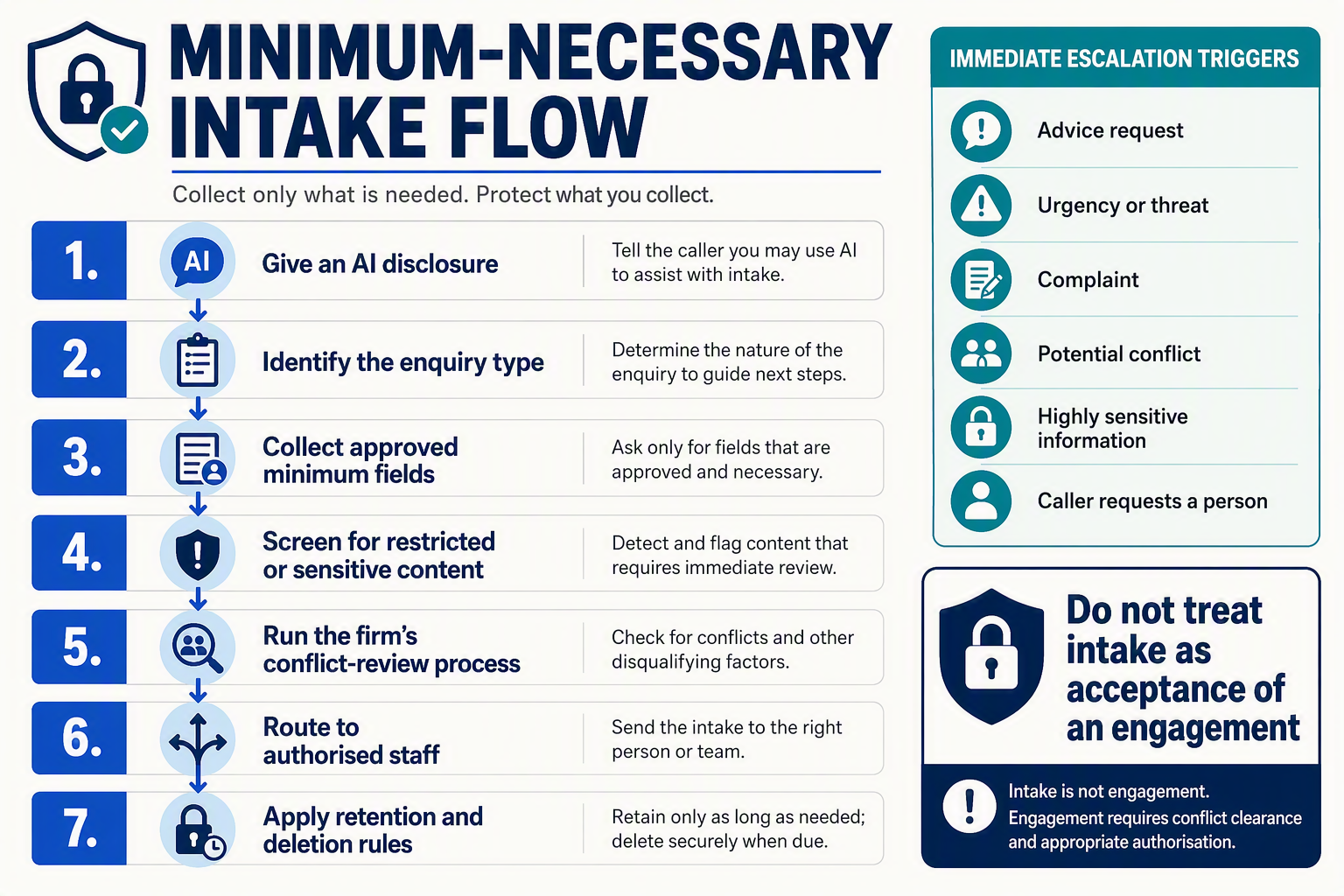
Design intake as a staged, minimum-data workflow: collect only enough information to identify the prospect, detect obvious conflicts, route the enquiry, and arrange qualified follow-up. Do not invite a full account of the dispute, financial position, insurance claim, or commercial strategy before the firm has completed its checks.
Separate initial screening from substantive intake
The first interaction should answer four limited questions:
- Who is contacting the firm?
- Which broad service and jurisdiction are involved?
- Which people or organisations may create a conflict?
- How and when may the firm respond?
An AI receptionist for professional services should explain why each field is needed and actively discourage oversharing. For example: “Please provide the names of the main parties, but do not describe confidential communications, account credentials, medical information, or detailed evidence.”
This approach reflects the data-minimisation principle. The European Union’s General Data Protection Regulation, applicable since 25 May 2018, states in Article 5 that personal data must be “adequate, relevant and limited to what is necessary” for its purpose. India’s Digital Personal Data Protection Act, 2023 received presidential assent on 11 August 2023 and establishes purpose, notice, consent, security, and deletion considerations for digital personal data.
Configure profession-specific collection boundaries
Minimum fields differ by practice area, but the AI should never provide legal, tax, financial, insurance, or other professional advice.
- An accounting firm AI receptionist can collect the prospect’s name, entity name, service category, financial year, jurisdiction, and deadline. It should not request tax returns, bank statements, PAN details, passwords, or transaction histories during preliminary screening.
- A law office call answering AI can ask for the names of prospective clients, opposing parties, affiliated companies, and the general matter type. It should not solicit privileged documents or a detailed chronology before conflict review.
- Consulting lead intake automation can capture the organisation, industry, approximate project scope, geography, timeline, and budget band without requesting source code, unreleased strategy, customer lists, or trade secrets.
- An insurance-brokerage workflow can collect the policy category, insurer name, renewal date, and broad enquiry type. Detailed health records, claim evidence, payment data, and coverage recommendations belong with authorised staff.
Build privacy and conflict controls into the workflow
A safe intake sequence should apply these controls automatically:
- Disclose the AI interaction and whether the call or transcript will be recorded.
- Obtain appropriate permission before recording or sending WhatsApp or email follow-up.
- Use structured fields rather than unrestricted prompts such as “Tell me everything.”
- Match party names against the firm’s approved conflict-checking process, accounting for spelling variations and corporate affiliates.
- Treat a possible match as “human review required,” not “conflict confirmed.”
- Prevent intake data from being placed automatically into a substantive client file.
- Restrict access by role and define retention periods for rejected, abandoned, or duplicate enquiries.
- Provide a channel for correction, deletion, withdrawal of consent, or privacy questions where applicable.
Stop automation when risk increases
The AI must immediately transfer or create a priority task when a caller mentions an imminent court or filing deadline, suspected fraud, threats, vulnerable individuals, regulatory action, major financial loss, or highly sensitive personal information. It must also state that submitting an enquiry does not confirm acceptance, representation, coverage, or an adviser-client relationship.
For the escalation mechanics, firms can use the related AI agent human-handoff guide. The governing rule is simple: the receptionist gathers minimum routing information; qualified staff decide conflicts, engagement, and professional advice.
How should CRM capture, missed-call recovery, scheduling, consent-aware WhatsApp or email follow-up, and human handoff work together?
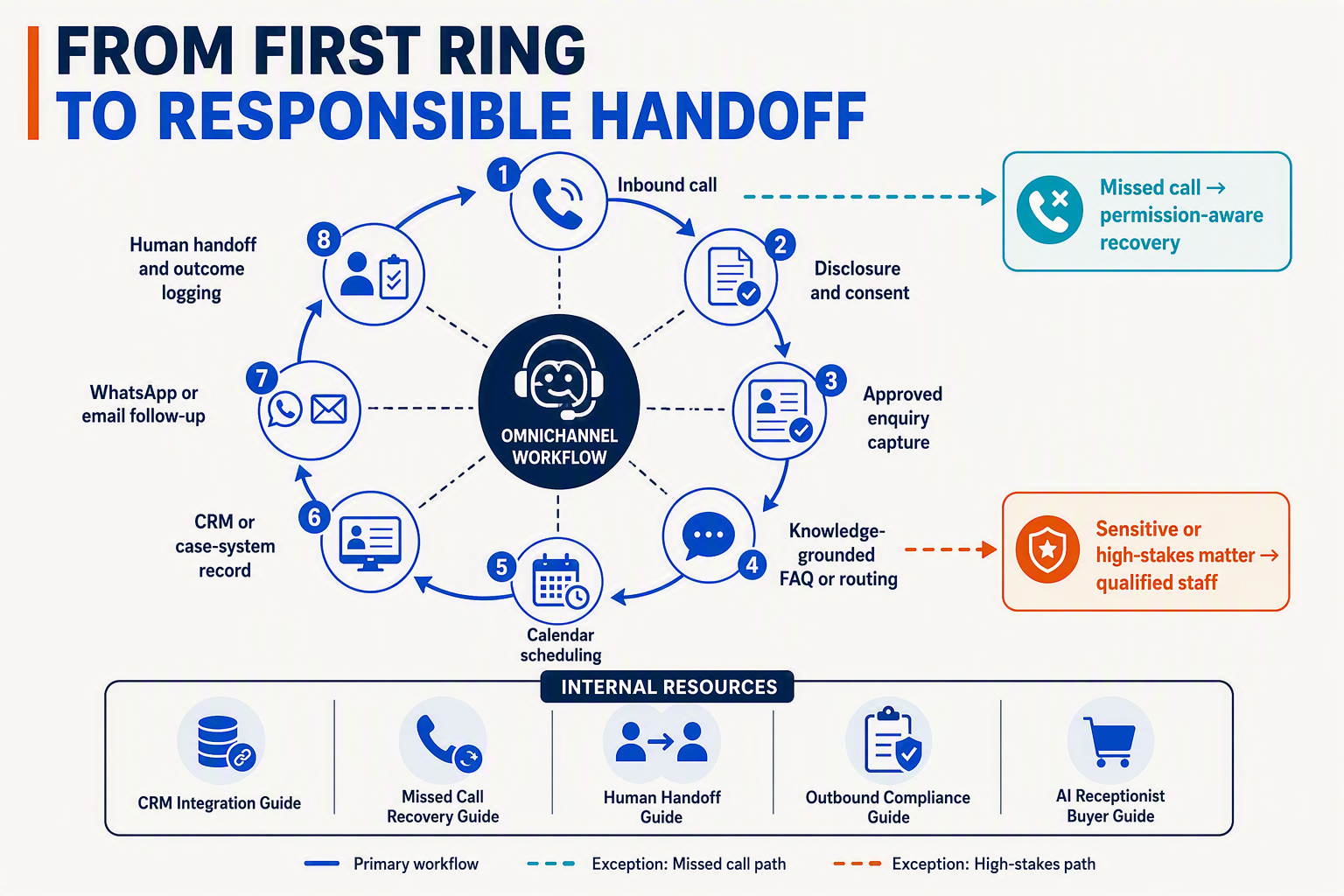
The CRM should act as the system of record, while telephony, scheduling, WhatsApp, email, and human queues operate as controlled workflow channels around it. Every action should update one enquiry record, preserve consent and conflict-check status, and prevent the AI from continuing when qualified staff must take over.
Build one event-driven intake record
An AI receptionist for professional services should create or update a CRM record as soon as it obtains a verified name and callback method. Do not wait until the conversation ends: a dropped call should still leave staff with a usable, time-stamped record.
Capture only what the next workflow step requires:
- Caller identity and organisation, subject to verification
- Contact details and preferred communication channel
- Service category, office, jurisdiction, and broad reason for calling
- Urgency indicators, language preference, and availability
- Consent status, source channel, transcript location, and retention classification
- Conflict-check status and assigned human owner
A law office call answering AI should avoid recording detailed allegations or opposing-party documents before the firm defines what its conflict process permits. An accounting firm AI receptionist can capture “corporate tax consultation” and the relevant jurisdiction without requesting tax identification numbers, bank statements, or account credentials.
Microsoft’s 2024 Work Trend Index reported that 78% of AI users were bringing their own AI tools to work, reinforcing the need for one governed intake record rather than disconnected transcripts, calendars, and personal messaging accounts.
Recover missed calls without creating duplicate leads
Missed-call recovery should run as a short, deduplicated sequence:
- Match the number against existing clients, open enquiries, and suppression records.
- Create a missed-call activity with time, number, queue, and routing outcome.
- Attempt a callback within the firm’s approved service window.
- If permission and channel rules allow, send a WhatsApp or email asking how the caller wishes to proceed.
- Stop automated recovery when the person replies, books, opts out, or reaches an employee.
Follow-up must identify the firm and explain why the message was sent. Operational consent does not automatically equal marketing consent; an appointment confirmation should not silently enrol someone in campaigns. See the permission-based outbound and WhatsApp follow-up guide for a deeper workflow.
Schedule only after routing and safety checks
Scheduling should follow—not replace—qualification. Consulting lead intake automation may route by industry, project type, geography, budget band, and consultant availability. Insurance enquiries may require routing by product category, licensing territory, renewal date, or existing-policy status.
Before displaying slots, the workflow should confirm:
- The correct appointment type and qualified team
- Whether a preliminary conflict or existing-client check is required
- Time zone, language, accessibility, and channel preference
- What documents may be provided safely before the meeting
The AI may explain approved process information, but it must not provide legal, tax, financial, insurance, or other professional advice.
Make human handoff a state, not an exception
A handoff should transfer context, not merely forward a call. The employee should receive the verified identity, concise summary, consent record, attempted actions, appointment status, and reason for escalation.
Immediate human review is appropriate for deadlines, complaints, vulnerable callers, suspected conflicts, security concerns, disputed advice, financial hardship, or requests requiring professional judgement. Platforms such as CallMissed can connect voice, CRM-style inbox activity, WhatsApp, and email workflows, but firms must define who owns each escalation and what happens if that person is unavailable. The 2026 human-handoff guide provides a fuller escalation design.
What operational impact should firms measure, and which risks can outweigh efficiency gains?
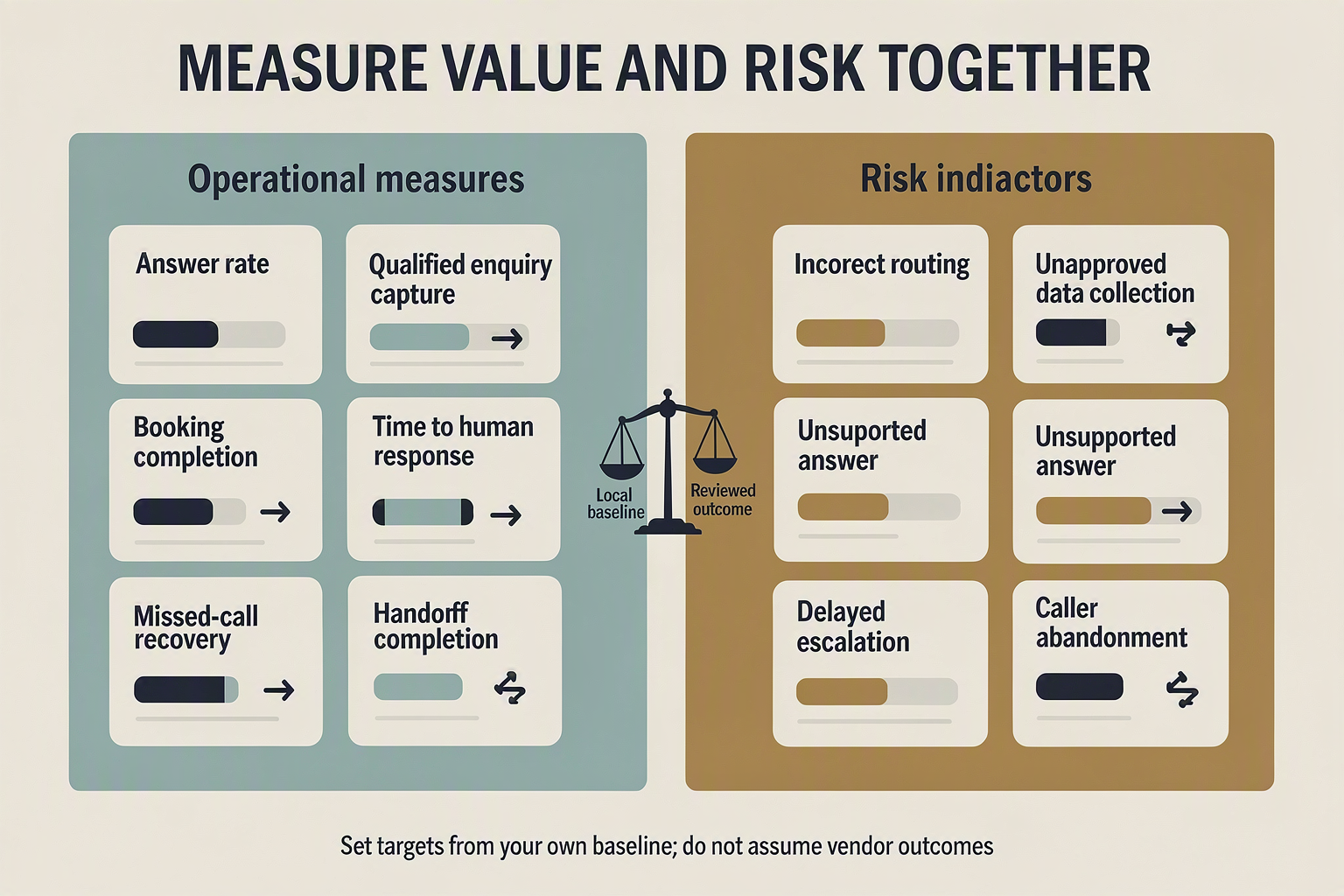
Operational impact should be measured through service, conversion, accuracy, staff workload, and risk indicators—not call volume alone. Efficiency gains are not worthwhile when an AI receptionist causes confidentiality breaches, misses conflicts or deadlines, gives professional advice, or routes a high-stakes matter incorrectly.
Measure outcomes across the full enquiry journey
A useful scorecard connects each conversation to a verified operational result. Firms should establish a pre-deployment baseline, then compare weekly or monthly performance by office, service line, language, and channel.
- Access and responsiveness
- Percentage of inbound calls answered
- Median time to answer or human handoff
- After-hours enquiries captured
- Missed calls recovered within the firm’s target window
- Intake quality
- Percentage of records containing required, non-sensitive fields
- Accuracy of names, dates, email addresses, jurisdictions, policy numbers, and appointment details
- Duplicate-record and incorrect-routing rates
- Percentage of AI-generated summaries corrected by staff
- Commercial and service outcomes
- Qualified enquiries reaching an appropriate professional
- Booked appointments that are attended
- Time from first contact to staff review
- Cost per qualified enquiry—not merely cost per answered call
An accounting firm AI receptionist, for example, should be assessed on accurate service categorisation and scheduling, not on how many tax questions it attempts to answer. Consulting lead intake automation should measure whether staff receive sufficient business context without collecting unnecessary commercial secrets.
Track safety as an operational metric
Every dashboard should include leading risk indicators, because low-frequency failures can create disproportionate harm. IBM reported in its Cost of a Data Breach Report 2024 that the global average breach cost reached US$4.88 million.
Monitor:
- Calls where the AI disclosed, inferred, or requested unnecessary sensitive information
- Advice-like statements concerning legal, tax, financial, insurance, or other professional decisions
- Failed conflict-check routing or premature transfer of matter details
- Unauthorised WhatsApp, email, or callback attempts
- Missed urgency signals, complaints, threats, deadlines, or vulnerable callers
- Transcript access exceptions, retention-policy violations, and unexplained staff exports
- Hallucinated office policies, fees, professional availability, or case outcomes
For law office call answering AI, a high booking rate cannot offset one conversation that implies representation or overlooks a conflict warning. AI must never provide legal, tax, financial, insurance, or professional advice; sensitive and high-stakes matters require qualified staff.
Define stop conditions before launch
An AI receptionist for professional services needs predetermined thresholds for restriction, rollback, or shutdown. Firms should:
- Pause an affected workflow after any material privacy or confidentiality incident.
- Disable automated answers when knowledge-base content is outdated or unapproved.
- Route directly to humans when field-level accuracy falls below the firm’s tested threshold.
- Review samples by language, including names and numbers, rather than relying on overall transcription accuracy.
- Record false-positive and false-negative escalation rates separately.
Risk-adjusted return can be expressed as: verified labour and conversion benefit minus remediation, complaint, review, and incident costs. Firms should also track the time employees spend correcting AI output; automation that merely shifts work downstream has not produced a genuine gain.
For practical escalation design, use the AI Agent Human Handoff Guide. The core governance principle is simple: optimise routine access, but preserve human authority wherever professional judgement, confidentiality, consent, or material consequences are involved.
Which expert opinions should shape policy, testing, and procurement—and how do you distinguish verified guidance from vendor claims?

The strongest AI-receptionist policy combines independent legal and professional advice, security engineering, frontline operational knowledge, and documented vendor evidence. Treat demonstrations and marketing pages as discovery material—not proof that a system is compliant, accurate, or suitable for confidential client intake.
Build a multidisciplinary review group
No single expert can approve an AI receptionist for professional services safely. Assign named reviewers with authority to stop deployment:
- Privacy counsel or a data-protection lead: determines lawful collection, consent notices, retention periods, cross-border processing, recording rules, and data-subject request procedures.
- Profession-specific ethics counsel: interprets rules on confidentiality, conflicts, solicitation, supervision, recordkeeping, and unauthorised professional practice in each jurisdiction.
- Cybersecurity and IT teams: assess identity controls, encryption, access logs, incident response, subprocessors, data residency, deletion, and business continuity.
- Practising professionals and reception staff: test whether routing categories, urgency indicators, and handoffs reflect real client situations.
- Language and accessibility reviewers: evaluate regional accents, code-switching, speech impairments, background noise, and whether callers can reach a human without navigating a conversational dead end.
- Procurement and finance teams: verify pricing units, contractual commitments, support terms, service limits, and exit arrangements.
Relevant professional bodies and regulators should shape the policy too. For example, the American Bar Association’s Formal Opinion 512, published in July 2024, identifies professional duties implicated by generative AI, including competence, confidentiality, communication, supervision, candour, and reasonable fees. It is US guidance rather than a universal rule, so legal offices must also consult their own bar council or law society.
Use recognised frameworks without confusing them with certification
The NIST AI Risk Management Framework 1.0, released in January 2023, organises AI governance around four functions: Govern, Map, Measure, and Manage. ISO/IEC 42001:2023 specifies requirements for an artificial-intelligence management system, but a vendor’s statement that it “aligns with” ISO/IEC 42001 is not the same as accredited certification.
Translate guidance into scenario-based acceptance tests:
- An accounting firm AI receptionist must decline requests to interpret tax liability and transfer the caller to qualified staff.
- A law office call answering AI must avoid confirming representation and collect only the information approved for conflict screening.
- Consulting lead intake automation must not solicit unnecessary trade secrets before engagement terms are established.
- An insurance workflow must not recommend coverage, interpret exclusions, or predict whether a claim will be accepted.
Separate evidence from assertion during procurement
Ask every supplier to substantiate claims through contracts, technical documentation, controlled trials, and exportable records.
| Claim type | Evidence to request | Warning sign |
|---|---|---|
| Privacy or compliance | Contract terms, subprocessors, retention controls | “Fully compliant” without jurisdictional scope |
| Security | Current independent audit or certification scope | Logo displayed without report period or covered service |
| Accuracy | Your own scripted and adversarial test results | Aggregate accuracy without language or task breakdown |
| Multilingual support | Tests using real accents, names, and code-switching | A language list without measured call performance |
| Reliability | SLA, fallback behaviour, incident process | Uptime claim without measurement terms |
Capabilities should also be verified individually. For example, CallMissed documents support for voice and chat across 22 Indian languages, but a purchasing firm should still test its own terminology, caller population, escalation paths, and recording settings. The AI receptionist service buyer guide provides a broader evaluation structure.
Finally, require periodic reapproval after model, prompt, telephony, policy, or subprocessor changes. Qualified staff—not the AI or its vendor—must remain accountable for legal, tax, financial, insurance, and other professional decisions.
What should your firm implement first? Checklist for an accounting firm AI receptionist, law office call answering AI, consulting lead intake automation, and insurance brokerage workflows
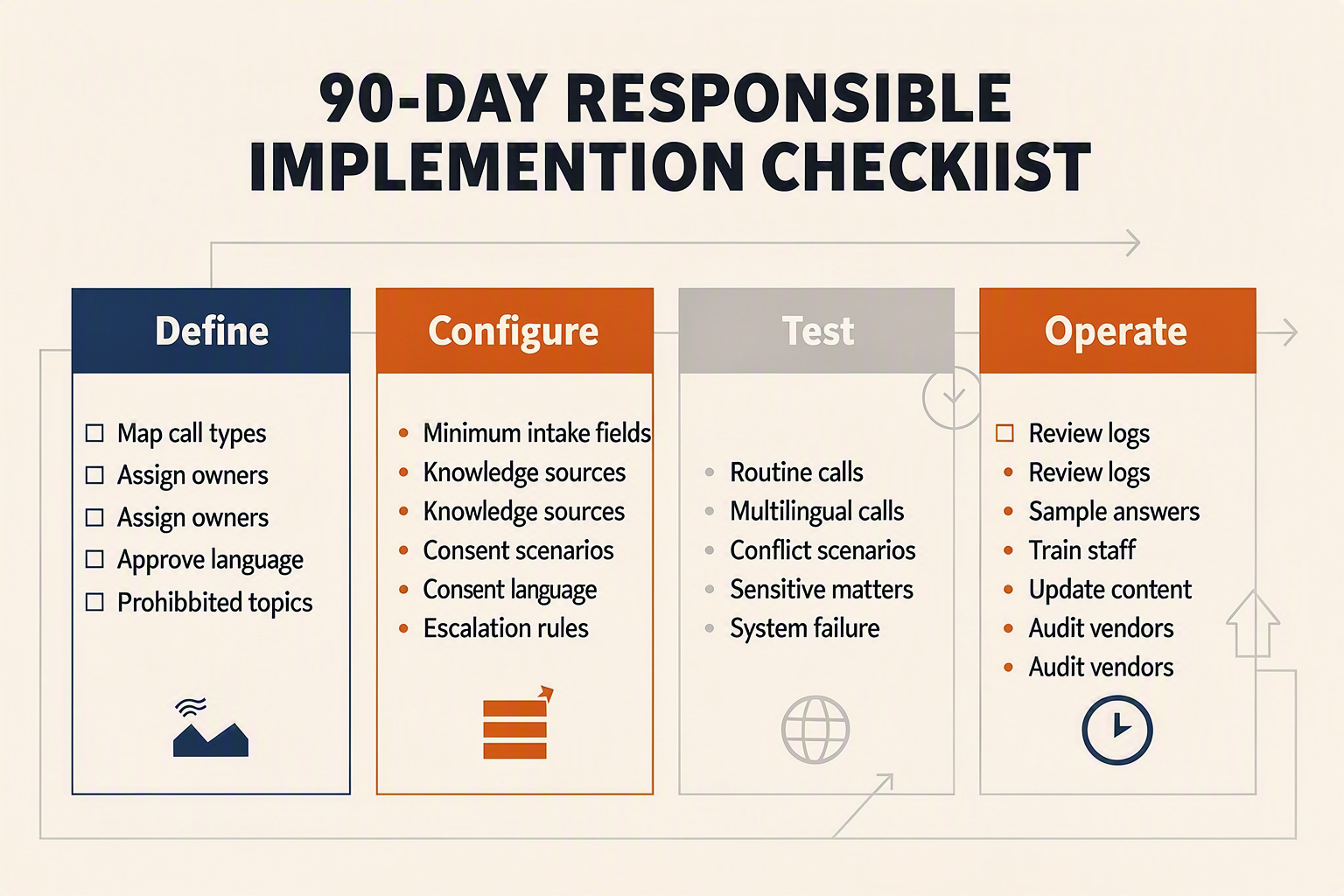
Implement a narrow, auditable intake workflow first: disclose that the caller is speaking with AI, collect only routing-critical information, answer approved administrative FAQs, and transfer sensitive or high-stakes matters to qualified staff. Do not enable professional advice, broad document collection, or automated outbound follow-up until consent, access controls, and human escalation have been tested.
First-workflow matrix by firm type
| Priority | Accounting firm | Legal office | Consulting firm | Insurance brokerage |
|---|---|---|---|---|
| 1. Minimum intake | Name, contact details, service category, entity type, jurisdiction | Name, contact details, opposing-party names, matter category, jurisdiction | Organisation, role, broad business need, timeline, budget band | Name, contact details, policy type, insurer, renewal or incident date |
| 2. Prohibited scope | No tax, accounting, investment, or financial advice | No legal advice, merits assessment, representation promise, or deadline calculation | No strategic recommendation or request for trade secrets | No coverage interpretation, claim decision, premium promise, or insurance advice |
| 3. Pre-booking control | Route by tax, audit, bookkeeping, payroll, or advisory team | Complete a preliminary conflict screen before substantive consultation | Check sector, geography, service fit, and consultant availability | Separate new business, renewal, endorsement, claims support, and complaints |
| 4. Safe scheduling | Book only against approved service calendars and engagement types | State that booking does not create an attorney-client relationship | Match the prospect to the correct practice and meeting format | Route regulated or product-specific discussions to authorised personnel |
| 5. Immediate escalation | Regulatory notice, suspected fraud, data exposure, or imminent filing deadline | Arrest, court deadline, threat, vulnerable caller, complaint, or possible conflict | Security incident, active dispute, media crisis, or highly confidential project | Injury, active emergency, suspected fraud, vulnerable customer, or formal complaint |
| 6. Follow-up rule | Send document checklists only from approved templates | Send administrative next steps, not legal conclusions | Confirm meeting scope without repeating confidential details | Use consent-aware WhatsApp or email and avoid exposing policy or claim data |
An accounting firm AI receptionist and law office call answering AI should begin with stricter data boundaries than a generic lead bot. Consulting lead intake automation should likewise capture enough information to route an opportunity without inviting the caller to disclose source code, acquisition plans, credentials, or other trade secrets.
Mandatory controls before launch
Microsoft’s 2024 Work Trend Index found that 78% of AI users were bringing their own AI tools to work, making approved systems, role-based access, and staff training essential. IBM’s Cost of a Data Breach Report 2024 reported that the global average breach cost reached US$4.88 million, so transcripts and recordings should not be retained merely because storage is available.
- Approve the script: Include AI disclosure, recording notice where applicable, purpose, permitted data fields, and a clear no-advice statement.
- Constrain the knowledge base: Publish only reviewed office hours, locations, services, fees that are genuinely fixed, document lists, and process explanations.
- Configure deterministic routing: Define named queues, business hours, retry limits, urgent-transfer rules, and a safe fallback when no employee answers.
- Test multilingual accuracy: Verify names, dates, monetary figures, policy numbers, jurisdictions, and email addresses by read-back rather than assumption.
- Control follow-up: Record the channel permission and purpose before sending WhatsApp, email, or callback messages.
- Review the audit trail: Sample transcripts, false transfers, incomplete records, disclosure failures, and prohibited-answer attempts before expanding scope.
Go-live gate
Before deploying an AI receptionist for professional services, confirm that:
- Qualified staff own every advice or decision point.
- Conflict checks remain preliminary until completed by authorised personnel.
- Callers can request a human without navigating repeated prompts.
- CRM fields have defined retention periods and access owners.
- Test scenarios cover silence, accents, interruptions, emergencies, and consent withdrawal.
Use the AI receptionist CRM integration guide for record-mapping details and the 2026 human-handoff guide to design escalation paths before live traffic begins.
Frequently asked questions: Can AI answer calls for a law office? Is AI receptionist intake confidential? Can it perform conflict checks? How does multilingual voice work? Is WhatsApp follow-up allowed? Can AI replace a receptionist? How much does implementation cost?
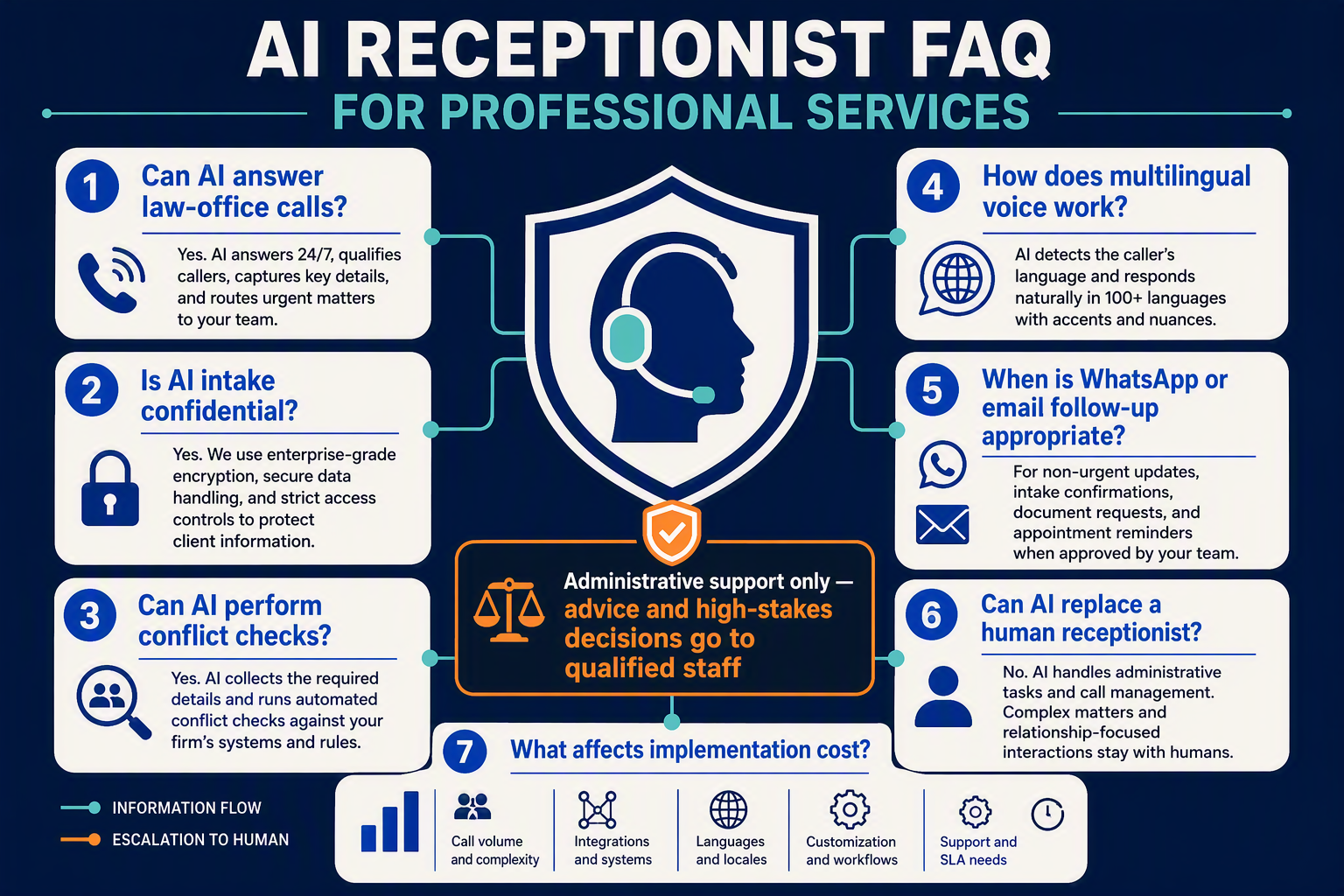
Can a law office call answering AI answer calls and screen prospective clients?
Is intake handled by an AI receptionist for professional services confidential?
Can an AI receptionist for professional services perform legal conflict checks?
How does multilingual voice intake work for accounting, consulting, legal, and insurance firms?
Is WhatsApp follow-up after an AI receptionist call allowed?
Can an AI receptionist replace a human receptionist, and how much does implementation cost?
Conclusion
In 2026, an AI receptionist for professional services should be treated as a controlled intake and routing system—not a substitute for qualified judgement. The strongest workflows capture only necessary information, disclose that callers are interacting with AI, use approved knowledge, and transfer sensitive or high-stakes matters to authorised staff.
- Define a narrow mandate. An accounting firm AI receptionist can record contact details, service categories, jurisdictions, and scheduling preferences, but it must not interpret tax rules or provide financial advice. Likewise, law office call answering AI can support preliminary conflict checks without assessing legal merits, promising representation, or implying that an attorney-client relationship exists.
- Minimise data before qualification. Consulting lead intake automation should capture an organisation’s broad needs without soliciting trade secrets, confidential strategies, or unnecessary personal data. Insurance workflows should avoid coverage recommendations and route policy interpretation, claims disputes, and other consequential decisions to licensed or qualified personnel.
- Design escalation before automation. Complaints, imminent deadlines, emergencies, vulnerable callers, possible conflicts, ambiguous consent, and requests for legal, tax, financial, insurance, or other professional advice require human handoff. Missed-call recovery through voice, WhatsApp, or email should also follow the caller’s permission and communication preferences.
- Ground every response in approved information. AI can reliably handle general questions about office hours, services, document requirements, process steps, and appointment availability when answers come from a maintained knowledge base. Multilingual workflows should verify names, dates, policy numbers, and financial figures whenever speech recognition is uncertain.
These controls are increasingly important. Microsoft’s 2024 Work Trend Index found that 75% of knowledge workers were already using AI at work, while 78% of AI users brought their own AI tools into the workplace. IBM’s Cost of a Data Breach Report 2024 reported a US$4.88 million global average breach cost, reinforcing the need for governed systems rather than unmanaged experimentation.
Looking ahead, watch for tighter consent controls, more reliable multilingual verification, better knowledge-grounding, and more precise handoff orchestration. Platforms such as CallMissed already illustrate this direction through AI voice agents, WhatsApp Business calling, knowledge-grounded responses, human escalation, and voice support across 22 Indian languages.
The defining question is not how much conversation AI can automate, but whether your firm can prove that every automated interaction protects confidentiality, respects professional boundaries, and reaches the right human at the right moment—are your intake workflows ready?
Related Reading
Discussion
Related Posts


Ready to automate customer conversations?
Launch AI voice agents and WhatsApp bots with CallMissed — one API, 22+ Indian languages.