
GPT-6 Luna vs Claude Sonnet 5.5: Full Comparison


Use this GPT-6 Luna vs Claude Sonnet 5.5 analysis to compare verified pricing, API access, coding, latency and ideal workloads.
GPT-6 Luna vs Claude Sonnet 5.5: Full Comparison
Both sides of the GPT-6 Luna vs Claude Sonnet 5.5 comparison are confirmed by first-party sources as of September 29, 2026. OpenAI lists GPT-6 Luna in its API documentation and describes it as its “most efficient model for focused, high-volume tasks.” Anthropic launched Claude Sonnet 5.5 on September 28, 2026 and documents the claude-sonnet-5-5 API ID, 1M-token context window, broad API and cloud availability, and $2/$10 per-million-token pricing.
That evidence gap matters because model names, access tiers, and technical limits can change faster than comparison pages are updated. OpenAI’s September 2026 materials place GPT-6 Luna across the OpenAI API, Codex, and ChatGPT Work, but the same search record also references GPT-5.6 Luna—creating an obvious risk of mixing generations, prices, or capabilities. A credible comparison must therefore separate official specifications from rumours and avoid presenting unsupported benchmark scores as fact.
This guide will examine:
- Confirmed availability and API access, including documented model identifiers and product access
- Pricing, context windows, and latency, with unavailable figures clearly marked rather than estimated
- Coding and reasoning performance, using only attributable evaluations
- Multimodal input, tool use, structured output, and agent workflows
- Safety controls, limitations, and the workloads each model is designed to handle
- The evidence-first verdict, including whether Claude Sonnet 5.5 can currently be compared as a shipping product
This distinction is especially important for developers building production systems: choosing a model affects cost predictability, response speed, prompt compatibility, tool execution, and migration effort—not merely benchmark rankings. OpenAI explicitly positions GPT-6 Luna for high-volume workloads, but that positioning alone does not prove superiority in coding, long-context analysis, vision, or agentic tasks.
Multi-model infrastructure is also making these comparisons more operationally relevant. CallMissed, the OpenAI- and Anthropic-compatible AI gateway, provides one API key and balance for 138 models as of September 2026, illustrating how teams can evaluate model families without rebuilding every integration.
The answer-first verdict is straightforward: GPT-6 Luna is the confirmed, documented option in the evidence supplied; Claude Sonnet 5.5 must remain “unconfirmed” until Anthropic publishes primary documentation covering availability, price, context length, and API capabilities. The full comparison will show what can be responsibly concluded today—and where confident-looking claims still outrun the evidence.
Which is better? GPT-6 Luna leads on confirmed availability here, while Claude Sonnet 5.5 requires primary-source verification before naming an overall winner
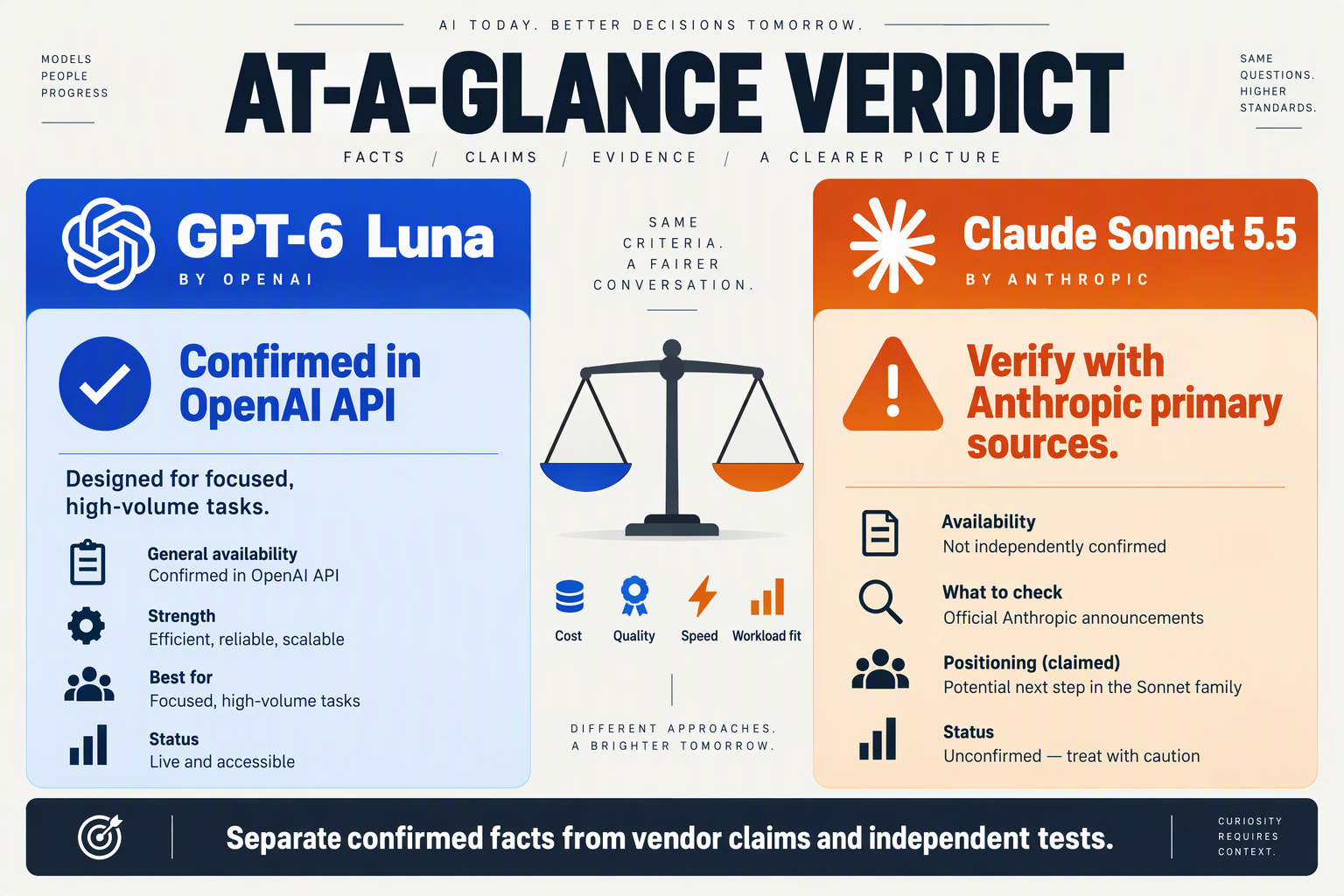
Neither model is the universal winner as of September 29, 2026. GPT-6 Luna is positioned for efficient, high-volume work across OpenAI products, while Claude Sonnet 5.5 offers confirmed API and cloud access, a 1M-token context window, and published pricing. The better choice depends on workload requirements rather than availability alone.
- GPT-6 Luna: OpenAI’s September 2026 API documentation identifies
gpt-6-lunaas the request model and describes it as the company’s “most efficient model for focused, high-volume tasks.” OpenAI also documents access through the OpenAI API, Codex, and ChatGPT Work.
- Claude Sonnet 5.5: Anthropic officially launched the model on September 28, 2026. Its documented model ID is
claude-sonnet-5-5, with availability through Anthropic’s API and supported cloud channels.
- Context and pricing: Claude Sonnet 5.5 has a documented 1M-token context window and costs $2 per million input tokens, $10 per million output tokens, and $0.20 per million cache-read tokens. Comparable GPT-6 Luna token prices and context limits are not established in the supplied evidence, so a like-for-like cost calculation is not yet possible here.
- API readiness: Both models now have confirmed model identifiers and documented API access. Claude Sonnet 5.5 additionally has confirmed cloud availability, while GPT-6 Luna is documented across OpenAI’s API and first-party products.
- Capability comparison: Availability, context size, and pricing do not by themselves determine model quality. The available primary-source record does not provide matched, reproducible evaluations covering coding, reasoning, vision, tool use, structured output, latency, or long-context retrieval, so neither model can be named the overall capability winner.
- Decision rule: Choose GPT-6 Luna when OpenAI ecosystem access and its documented focus on efficient, high-volume tasks best fit the deployment. Choose Claude Sonnet 5.5 when a 1M-token context window, transparent token pricing, cache-read economics, or Anthropic API and cloud availability are decisive. Run workload-specific evaluations before making a production-wide choice.
How do GPT-6 Luna and Claude Sonnet 5.5 compare feature by feature?
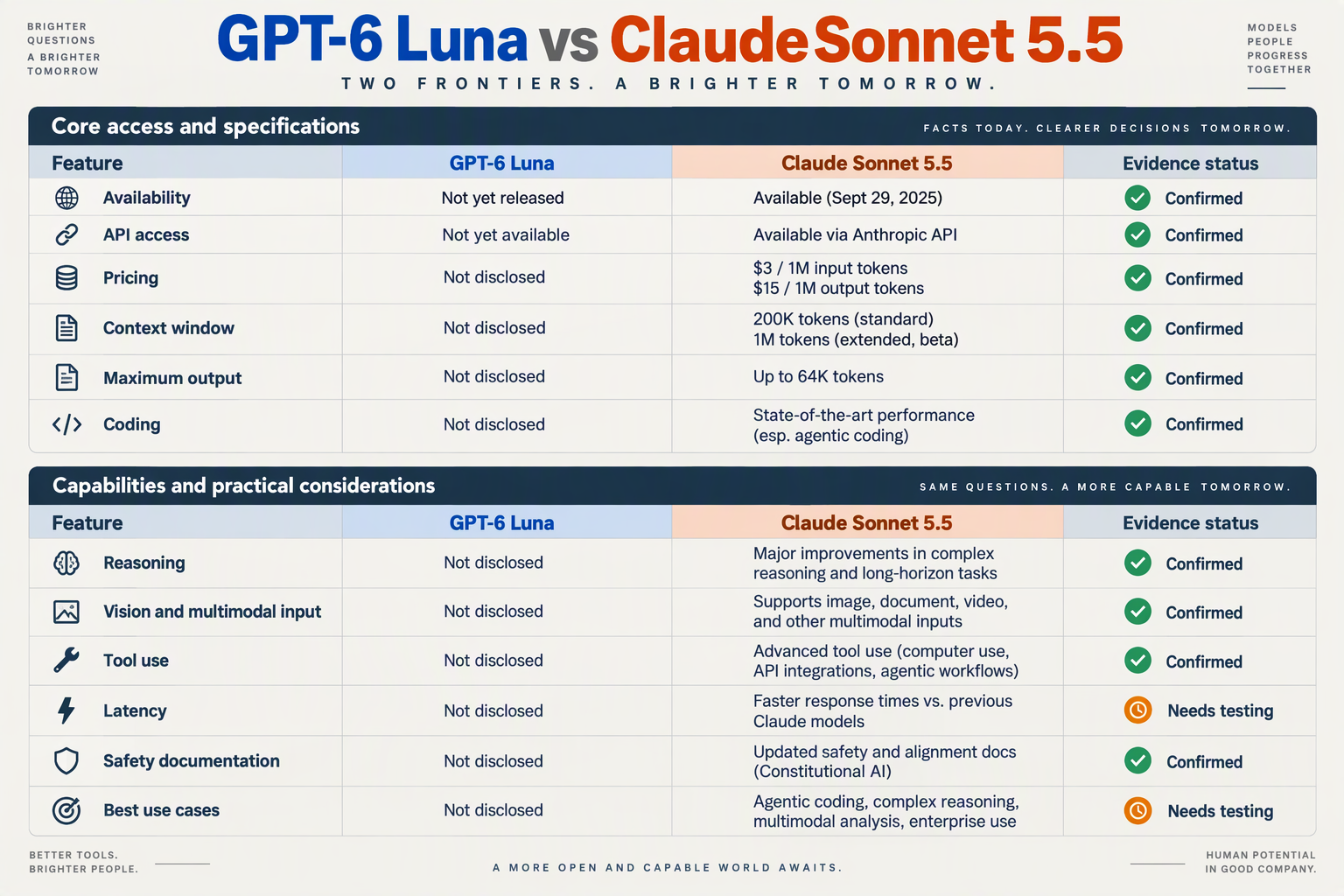
GPT-6 Luna has documented availability and a production model identifier, while Claude Sonnet 5.5 lacks primary-source confirmation as of September 29, 2026. Pricing, context limits, benchmarks, and several capabilities remain unverified for both models in the supplied evidence.
| Feature | GPT-6 Luna | Claude Sonnet 5.5 | Evidence-based conclusion |
|---|---|---|---|
| Availability and API access | OpenAI documents gpt-6-luna for API requests and lists access through the OpenAI API, Codex, and ChatGPT Work as of September 2026. | No Anthropic announcement, model card, API documentation, or identifier was supplied as of September 2026. | GPT-6 Luna is confirmed; Claude Sonnet 5.5 is unconfirmed. |
| Pricing and context window | Input, cached-input, and output-token prices are not stated in the supplied OpenAI sources; context length is also unavailable. | No verified token pricing, context window, or usage tier is available. | Do not estimate costs or infer limits from earlier model generations. |
| Coding and reasoning | Codex availability is confirmed, but no attributable coding or reasoning benchmark scores were supplied. | No confirmed HumanEval, SWE-bench, GPQA, or other benchmark result was supplied. | Neither model can be declared the performance winner from this evidence. |
| Multimodal capabilities | The supplied documentation does not establish supported image, audio, or video inputs. | No verified modality specifications were supplied. | Treat multimodal support as undocumented here, not unsupported. |
| Tool use and outputs | No supplied primary-source detail confirms function calling, web search, structured outputs, or computer use for this specific model. | Tool-use features and output controls are unconfirmed for this model name. | Validate model-specific API schemas before designing agents. |
| Latency, safety, and best use | OpenAI calls GPT-6 Luna its “most efficient model for focused, high-volume tasks”; no latency figures or model-specific safety evaluation were supplied. | No confirmed positioning, latency measurement, safety card, or use-case guidance was supplied. | GPT-6 Luna has a documented workload target, not a proven universal advantage. |
What should developers take from the comparison?
- GPT-6 Luna: OpenAI’s API documentation names
gpt-6-lunaas the request identifier as of September 29, 2026, making it the only implementation-ready option in this comparison.
- Claude Sonnet 5.5: Without an Anthropic model page or API reference, the name should not be placed in production configuration files or procurement forecasts.
- Pricing: Neither model has verifiable per-million-token rates in the supplied research, so a credible total-cost comparison is not yet possible.
- Coding: GPT-6 Luna’s presence in Codex indicates coding-oriented access, but Codex availability is not itself a coding benchmark or proof of higher repository-level accuracy.
- Reasoning and context: Claims about superior reasoning or longer context would require official limits and attributable evaluations using equivalent prompts, tool settings, and token budgets.
- Verification rule: OpenAI’s catalogue also references GPT-5.6 Luna, so teams should confirm the exact generation, model ID, dated documentation, and billing page before testing or migration.
How much do GPT-6 Luna and Claude Sonnet 5.5 cost, and which delivers better value?
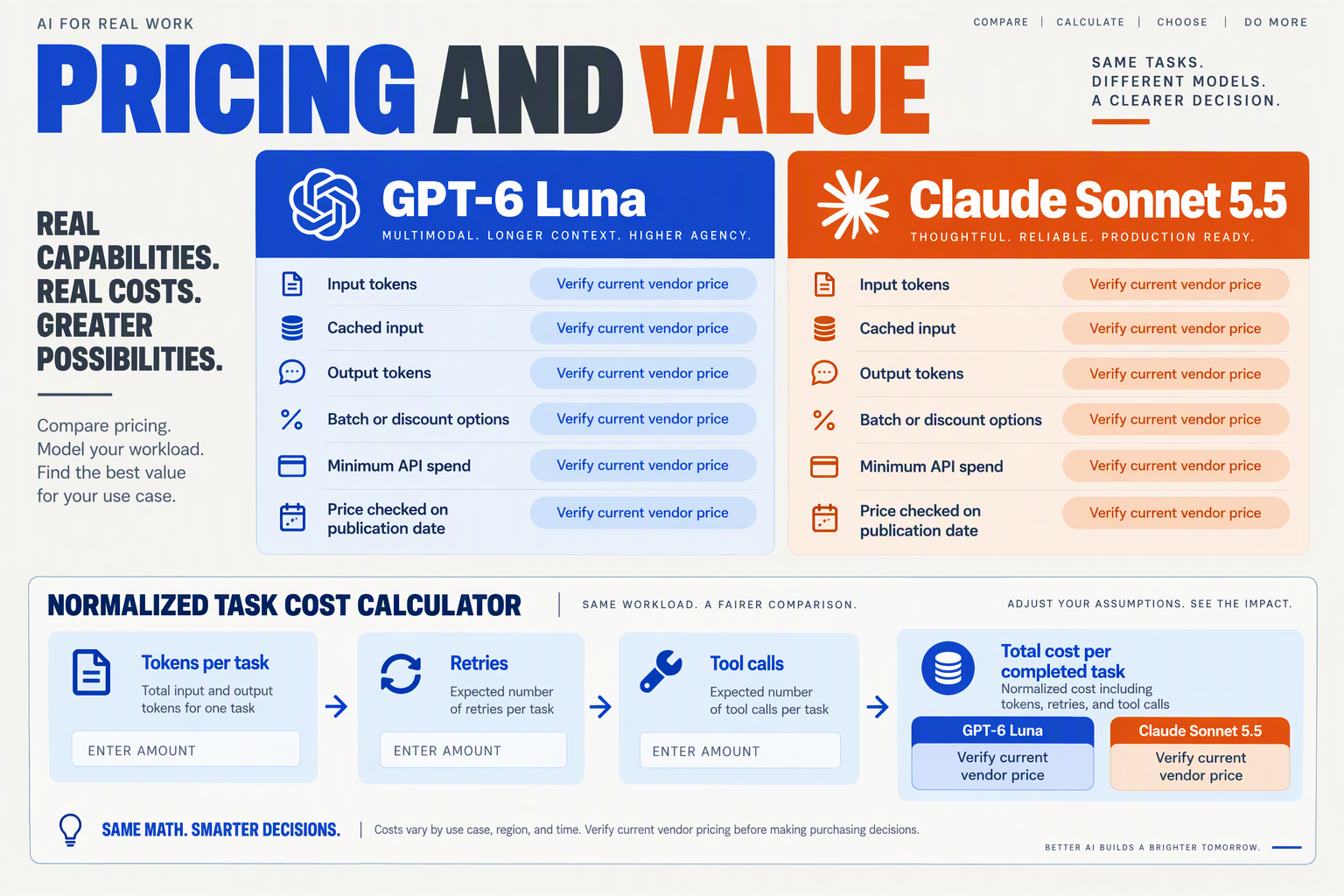
Exact API costs cannot be verified for either model from the supplied primary-source extracts as of September 29, 2026. GPT-6 Luna has documented API access and an efficiency positioning, but Claude Sonnet 5.5 lacks confirmed pricing or availability.
- GPT-6 Luna: OpenAI describes GPT-6 Luna as its “most efficient model for focused, high-volume tasks,” but the supplied OpenAI excerpts provide no per-token rates.
- Claude Sonnet 5.5: No Anthropic announcement, model card, API identifier, or official price is present in the supplied research.
- Price-performance: OpenAI says GPT-6 Sol and Luna offer different balances of “capability and cost,” but this statement is not a numerical benchmark.
- Comparison risk: GPT-5.6 Luna also appears in OpenAI’s September 2026 records, so its pricing must not be attributed to GPT-6 Luna.
What is the verified GPT-6 Luna vs Claude Sonnet 5.5 pricing?
| Cost factor | GPT-6 Luna | Claude Sonnet 5.5 | Value conclusion |
|---|---|---|---|
| Input-token price | Not stated in supplied evidence | Unconfirmed | No direct comparison |
| Cached-input price | Not stated | Unconfirmed | Savings cannot be modelled |
| Output-token price | Not stated | Unconfirmed | Total generation cost unknown |
| API access | Confirmed as gpt-6-luna by OpenAI API documentation | No verified model ID | GPT-6 Luna is deployable |
| Product access | OpenAI lists API, Codex, and ChatGPT Work | Unconfirmed | GPT-6 Luna has clearer access |
| Efficiency claim | Optimized for focused, high-volume tasks | No attributable claim | Directional, not quantified |
Which model currently delivers better value?
- GPT-6 Luna: Delivers the stronger verifiable operational value because developers can identify an official API model and supported products.
- Claude Sonnet 5.5: Cannot receive a credible value rating until Anthropic publishes token prices, access terms, and usage limits.
- Verdict: Neither model wins on cost per task yet; teams should wait for official rates and compare input, cached-input, output, and tool-call costs using the same workload.
Which model is stronger for coding, reasoning and office work, and what do the benchmarks actually prove?
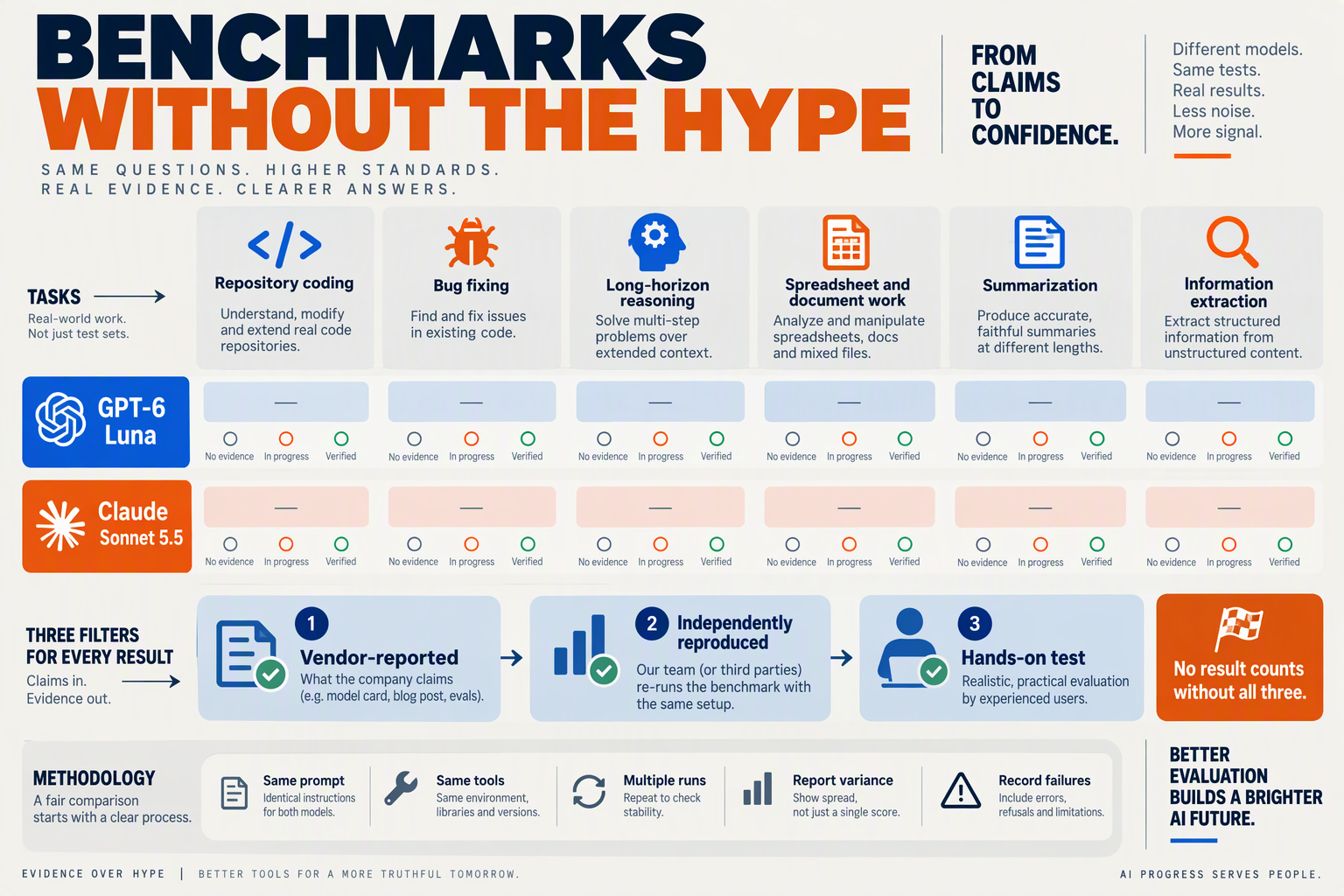
The evidence does not establish a coding, reasoning, or office-work winner as of September 29, 2026. GPT-6 Luna has confirmed product access and positioning, but the supplied primary sources provide no comparable Claude Sonnet 5.5 results or attributable head-to-head benchmarks.
Which model is stronger for coding?
- GPT-6 Luna: OpenAI’s September 2026 release notes confirm availability in Codex, making GPT-6 Luna a documented option for software-development workflows.
- Claude Sonnet 5.5: No supplied Anthropic announcement confirms the model, coding availability, or results on evaluations such as repository-level issue resolution.
- Verdict: Codex access proves that GPT-6 Luna can be used for coding; it does not prove higher code quality, debugging accuracy, or agentic reliability.
Which model is stronger for reasoning and office work?
- GPT-6 Luna: OpenAI describes GPT-6 Luna as its “most efficient model for focused, high-volume tasks” in its September 2026 API documentation.
- GPT-6 Luna: OpenAI’s September 2026 ChatGPT release notes confirm access through ChatGPT Work, supporting a credible office-work use case.
- Claude Sonnet 5.5: Reasoning quality, document handling, spreadsheet proficiency, and enterprise-product availability remain unconfirmed in the supplied evidence.
- Verdict: GPT-6 Luna is the defensible operational choice, but OpenAI’s efficiency positioning is not an independent productivity comparison.
What do the benchmark claims actually prove?
- Benchmarks: No verified, like-for-like GPT-6 Luna versus Claude Sonnet 5.5 scores appear in the supplied primary-source record as of September 29, 2026.
- Evidence standard: A meaningful comparison requires identical prompts, tool permissions, reasoning settings, context lengths, pass criteria, and repeated trials.
- Bottom line: Any precise claim that one model “wins” coding or reasoning currently exceeds the available evidence; teams should run workload-specific evaluations before deployment.
Which model offers better context, multimodal input, tool use, latency and safety?
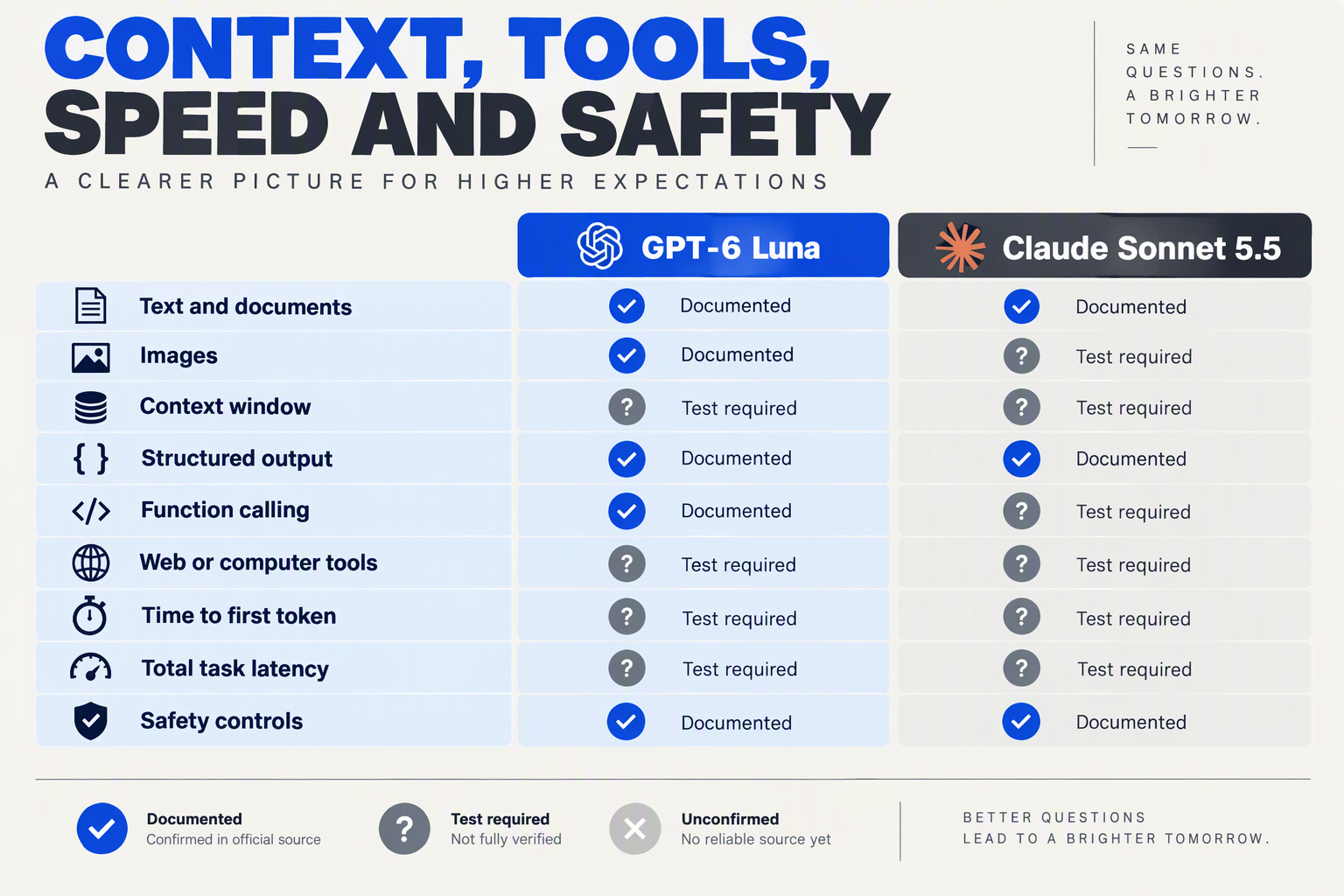
No model wins this category on verified specifications: GPT-6 Luna has confirmed positioning but incomplete limits, while Claude Sonnet 5.5 remains unconfirmed in the supplied primary-source record.
What does the confirmed evidence show?
- Context window: OpenAI’s GPT-6 Luna API page does not state a token limit in the supplied September 2026 evidence; Anthropic provides no confirmed Claude Sonnet 5.5 context-window figure, so neither model can be declared the long-context winner.
- Multimodal input: The available OpenAI excerpts do not confirm whether
gpt-6-lunaaccepts images, audio, or video; no primary Anthropic source confirms Claude Sonnet 5.5 multimodal formats either.
- Tool use: OpenAI confirms the
gpt-6-lunaAPI model identifier as of September 29, 2026, but the supplied documentation excerpt does not specify function calling, web search, computer use, or structured-output support.
- Latency: OpenAI calls GPT-6 Luna its “most efficient model for focused, high-volume tasks” and describes GPT-6 Sol and Luna as faster models for work at scale in September 2026, but publishes no verified latency in milliseconds or tokens per second here.
- Claude Sonnet 5.5: Without an Anthropic model card, API reference, or release announcement, claims about context length, vision, tool use, latency, and agentic computer use should be marked unconfirmed, not inferred from earlier Claude Sonnet generations.
- Safety: OpenAI’s September 2026 announcement describes GPT-6 Astra—not GPT-6 Luna—as its “most intelligent and aligned model,” so that statement cannot establish Luna’s safety performance; no Claude Sonnet 5.5 system card is available in the supplied evidence.
- Practical verdict: Choose GPT-6 Luna only where its documented high-volume positioning fits the workload, then verify required modalities, tools, token limits, and safety controls directly in the live API documentation before production deployment.
What are the practical pros and cons of GPT-6 Luna and Claude Sonnet 5.5?
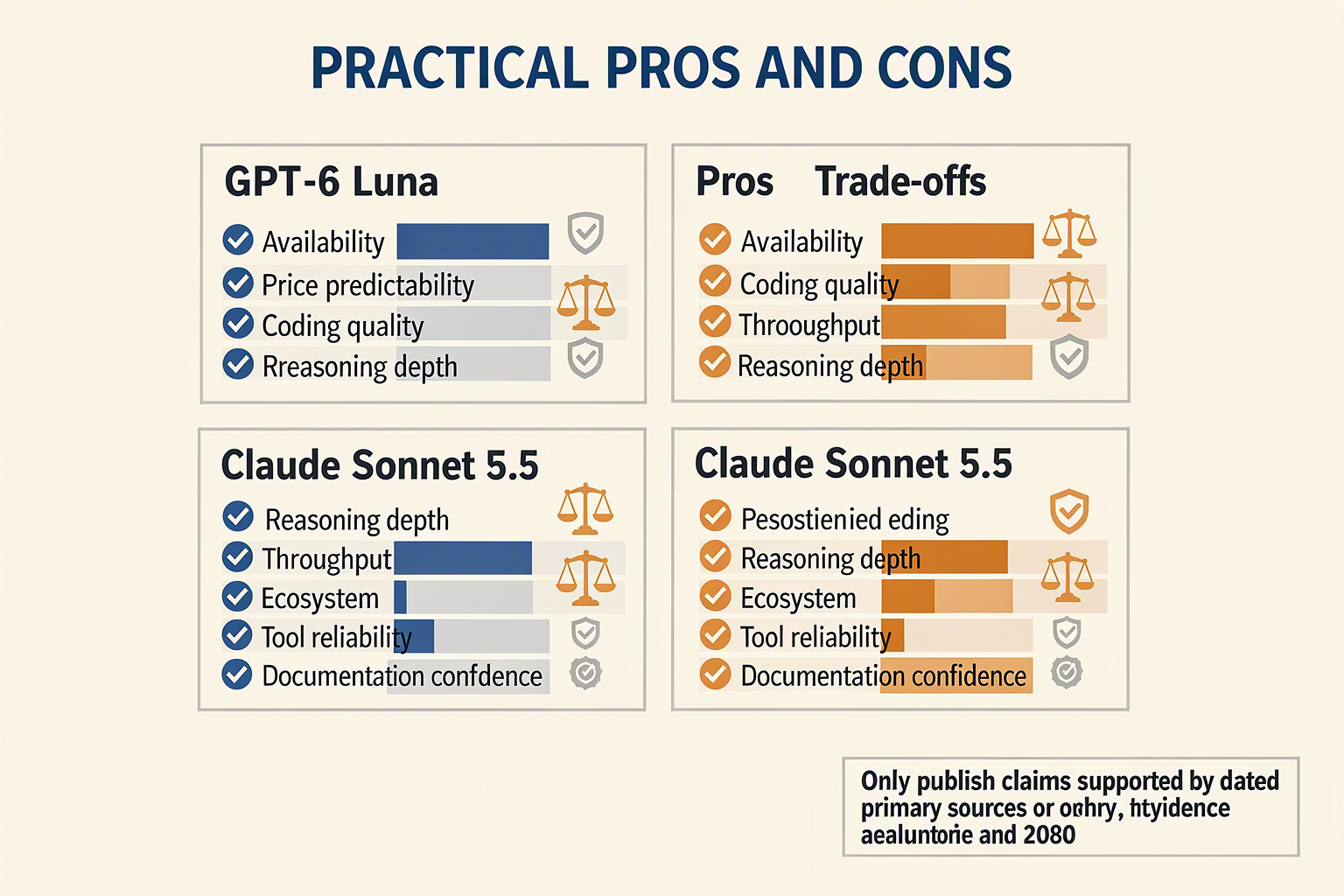
GPT-6 Luna has the practical advantage of verified access; Claude Sonnet 5.5 cannot yet be assessed as a shipping product. As of September 29, 2026, missing primary-source specifications prevent a defensible capability or value winner.
| Decision area | GPT-6 Luna: practical pro | GPT-6 Luna: practical con | Claude Sonnet 5.5 status |
|---|---|---|---|
| Availability | OpenAI confirms access through the API, Codex, and ChatGPT Work | Product entitlements and usage limits may differ | No Anthropic release confirmed |
| API deployment | Documented model ID: gpt-6-luna | Migration and compatibility details require testing | API identifier unconfirmed |
| Workload fit | OpenAI calls it its “most efficient model for focused, high-volume tasks” | Marketing positioning is not an independent benchmark | Intended workload unconfirmed |
| Price and latency | Efficiency positioning suggests scale-oriented design | No verified token price or latency figure appears in the supplied evidence | Price and latency unconfirmed |
| Context and quality | Official documentation establishes a usable model endpoint | Context window, coding scores, and reasoning scores are not verified here | Context and benchmarks unconfirmed |
| Multimodal, tools, safety | OpenAI documentation can be checked before production adoption | Exact modality, tool-use, and safety limits require model-specific confirmation | Capabilities and safeguards unconfirmed |
- GPT-6 Luna: Best suited to teams that need a documented model today and can validate quality, latency, and costs with workload-specific tests.
- Claude Sonnet 5.5: Should remain off procurement shortlists until Anthropic publishes an official model page, API documentation, and pricing.
- GPT-6 Luna: The naming overlap with GPT-5.6 Luna creates configuration risk; verify the exact model identifier in logs and deployment files.
- Claude Sonnet 5.5: An absence of evidence is not evidence of weak performance—it simply prevents responsible comparison.
- Both: Run identical prompts, tool schemas, safety tests, and long-context tasks before committing production traffic; do not substitute vendor positioning for measured results.
Which should you choose for coding, quick Q&A, high-throughput work, voice agents and AI receptionists?
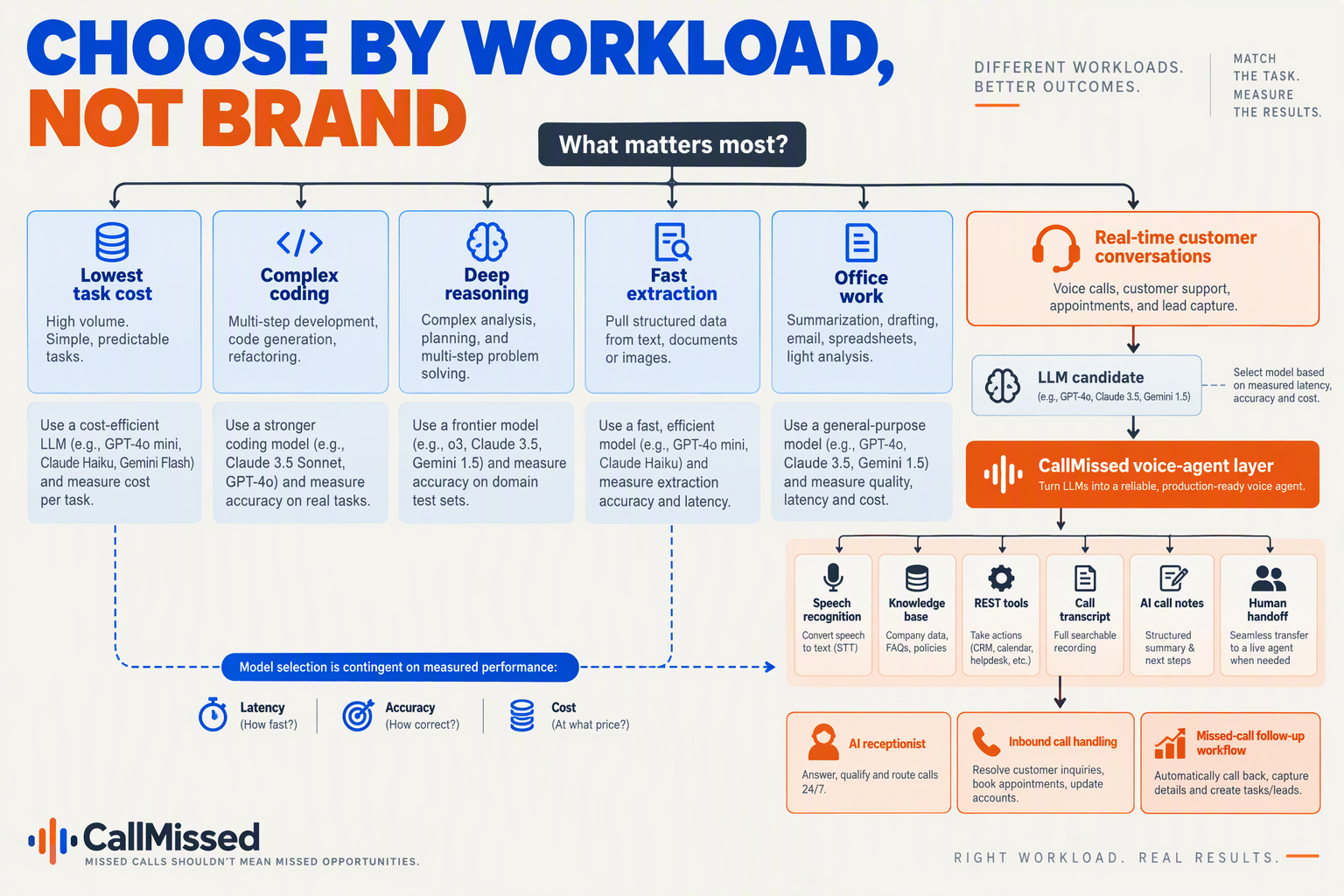
Choose GPT-6 Luna for focused, high-volume text tasks where confirmed access matters; treat Claude Sonnet 5.5 as unavailable for production planning until Anthropic publishes primary documentation. Neither model can yet be declared the universal winner for coding, voice, or agentic workflows.
Which model should you choose for coding?
- GPT-6 Luna: OpenAI lists GPT-6 Luna in Codex as of September 29, 2026, making it the practical candidate for repository-aware coding workflows supported by OpenAI’s tooling.
- Claude Sonnet 5.5: Do not plan a migration until Anthropic confirms the model ID, API availability, context window, tool interface, rate limits, and pricing.
- Benchmark verdict: Codex availability does not prove better code quality; the supplied evidence contains no comparable HumanEval, SWE-bench Verified, or internal repository benchmark for both models.
- Production test: Evaluate each confirmed candidate on your own pull requests, measuring task completion, test-pass rate, tool-call failures, review time, and cost per accepted change.
Which model is better for quick Q&A and high-throughput work?
- GPT-6 Luna: OpenAI’s API documentation calls GPT-6 Luna its “most efficient model for focused, high-volume tasks,” directly matching classification, extraction, short answers, and routing workloads.
- GPT-6 Luna: Use the documented
gpt-6-lunamodel identifier, but load-test it before deployment because OpenAI’s supplied materials provide no numerical latency, throughput, or requests-per-minute benchmark. - Claude Sonnet 5.5: It cannot responsibly be recommended for high-throughput production use while its price, rate limits, latency, and even shipping status remain unconfirmed.
- Cost control: Compare cost per successful task, not token price alone; retries, verbose outputs, cache hits, tool failures, and structured-output compliance can materially change total expenditure.
Which model should power voice agents and AI receptionists?
- GPT-6 Luna: Consider it for text reasoning behind a receptionist only after confirming streaming and tool compatibility; the cited OpenAI sources do not establish native speech input, speech output, or full-duplex audio support.
- Claude Sonnet 5.5: No supplied Anthropic source confirms realtime audio, telephony integration, interruption handling, or voice-agent latency, so suitability remains unknown.
- Voice architecture: A production receptionist also needs speech recognition, text-to-speech, call transport, interruption handling, recordings, escalation, and reliable tool execution—not merely an LLM.
- CallMissed: As of September 2026, CallMissed offers managed voice-agent plans at ₹4, ₹5, or ₹6 per minute, with speech recognition, the language model, and voice included; phone carriage is billed separately and each call has a 30-second minimum.
- Indian-language deployments: CallMissed supports speech recognition in 22 Indian languages plus English, including code-mixed Hinglish, and text-to-speech in 10 Indian languages plus English as of September 2026.
What is the safest final selection rule?
- Choose GPT-6 Luna for confirmed API-based Q&A, extraction, routing, and high-volume focused work, subject to workload-specific testing.
- Pilot GPT-6 Luna for coding rather than assuming leadership from product placement in Codex.
- Wait on Claude Sonnet 5.5 until Anthropic publishes an official model page and reproducible specifications.
- For voice receptionists, choose the complete system by testing end-to-end response time, interruption recovery, transcription accuracy, transfer success, and cost per completed call.
Frequently Asked Questions
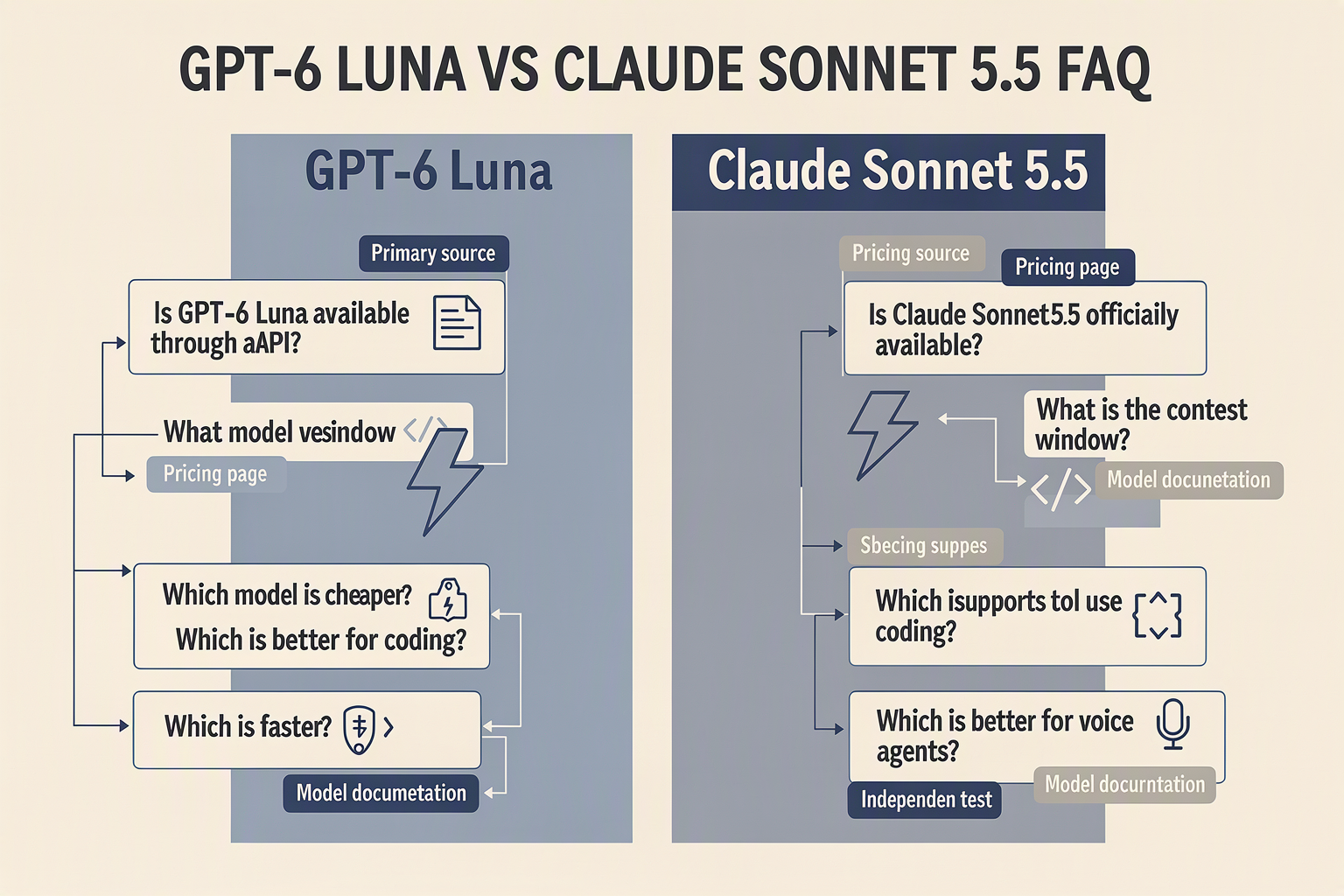
As of September 29, 2026, GPT-6 Luna is documented by OpenAI, while Claude Sonnet 5.5 remains unconfirmed in the supplied primary-source evidence.
- Q: Is GPT-6 Luna available now?
A: Yes. OpenAI lists GPT-6 Luna in the OpenAI API under the model identifier gpt-6-luna, while OpenAI’s September 2026 release notes also confirm access through Codex and ChatGPT Work.
- Q: Is Claude Sonnet 5.5 officially confirmed by Anthropic?
A: No Anthropic announcement or API documentation confirming Claude Sonnet 5.5 appears in the supplied evidence as of September 29, 2026. Treat purported prices, benchmarks, context limits, and release dates as unverified until Anthropic publishes primary documentation.
- Q: How much do GPT-6 Luna and Claude Sonnet 5.5 cost?
A: The supplied OpenAI results confirm GPT-6 Luna’s availability but do not provide verified per-token pricing, so this comparison should not estimate it. Claude Sonnet 5.5 pricing is also unavailable because the model itself remains unconfirmed.
- Q: What are the GPT-6 Luna vs Claude Sonnet 5.5 context-window limits?
A: No verified context-window figures for either model appear in the supplied sources. Developers should check OpenAI’s model documentation and Anthropic’s official model catalogue immediately before deployment rather than borrowing limits from GPT-5.6 Luna or earlier Claude Sonnet models.
- Q: Is GPT-6 Luna vs Claude Sonnet 5.5 better for coding and reasoning?
A: OpenAI provides GPT-6 Luna through Codex and positions it for “focused, high-volume tasks,” but that does not establish a coding or reasoning victory. No attributable head-to-head benchmark supports ranking it against the unconfirmed Claude Sonnet 5.5.
- Q: Which model is better for multimodal tools or AI voice agents?
A: Neither wins without verified modality, tool-use, latency, and audio specifications. For voice deployments, CallMissed provides a managed voice-agent WebSocket and access to 25 realtime voice-agent models through its 138-model API catalogue as of September 2026.
Conclusion
The evidence-first verdict remains clear:
- GPT-6 Luna is confirmed by OpenAI for the API, Codex, and ChatGPT Work.
- Claude Sonnet 5.5 remains unconfirmed without primary Anthropic documentation.
- Pricing, context windows, latency, benchmarks, and multimodal limits should not be inferred from earlier model generations.
- Production decisions should prioritize verified API access, tool compatibility, safety controls, and workload testing.
Watch for an official Anthropic release detailing Claude Sonnet 5.5. Meanwhile, explore multi-model development through CallMissed, an OpenAI- and Anthropic-compatible AI gateway supporting 138 models. Which model will your own evaluations validate?
Related Reading
- GPT-6 Luna vs Claude Opus 5.5: 2026 API Comparison
- Claude Sonnet 5.5 vs GPT-6 Sol Coding Comparison 2026
- GPT-6 Sol vs Claude Sonnet 5.5: Verified Comparison
Sources
Discussion
Related Posts
Ready to automate customer conversations?
Launch AI voice agents and WhatsApp bots with CallMissed — one API, 22+ Indian languages.