
Permission-Based Outbound AI Calling: 2026 CallMissed Guide


Learn permission-based outbound AI calling with CallMissed for follow-up, reminders, surveys, opt-outs, escalation, WhatsApp, and analytics.
Permission-Based Outbound AI Calling: 2026 CallMissed Guide
What if the fastest way to lose a qualified lead in 2026 is not calling too late—but calling without clear permission? Permission-based outbound AI calling gives businesses a scalable way to follow up with prospects, confirm bookings, collect feedback, and re-engage customers while respecting consent, contact preferences, and local communication rules.
The operational stakes are significant. The U.S. Telephone Consumer Protection Act allows statutory damages of $500 per violation and up to $1,500 for each wilful or knowing violation, according to the U.S. Congress. In Europe, the European Commission states that the EU AI Act’s transparency obligations become applicable on 2 August 2026, including disclosure requirements for certain AI systems that interact directly with people. In India, the Telecom Regulatory Authority of India enables consumers to register commercial-communication preferences and complaints through 1909, making preference checks and opt-out handling essential parts of campaign design.
Permission, however, is only the starting point. A responsible AI outbound call agent also needs to identify the business, disclose that the interaction is automated where required, explain why it is calling, and provide an immediate way to decline future contact. Calling windows, consent standards, recording rules, and the distinction between service and promotional communications vary by country, so every deployment requires jurisdiction-specific legal review. This guide provides operational guidance rather than legal advice.
From isolated calls to coordinated customer journeys
A well-designed automated calling service should not behave like a high-volume autodialler. It should use documented consent, CRM context, frequency limits, suppression lists, and measurable campaign objectives. The highest-value workflows are often practical rather than aggressively promotional:
- Voice AI lead follow up after a person submits an enquiry or requests a callback
- Appointment reminder calls that let customers confirm, reschedule, or reach a person
- Order, delivery, renewal, payment, and service confirmations
- Post-interaction surveys with concise, neutral questions
- Customer re-engagement based on a valid relationship and appropriate permission
CallMissed supports this model by connecting AI voice agents with WhatsApp follow-up, an omnichannel inbox, knowledge-base retrieval, and human escalation—including communication across 22 Indian languages for businesses serving regional audiences.
What this 2026 guide will help you build
You will learn how to define acceptable use cases, capture and retain consent evidence, enforce local calling windows, process verbal and digital opt-outs, and design scripts with clear AI disclosure. The guide also covers when an AI sales agent should transfer to a human, how WhatsApp can continue an authorised conversation, and which analytics reveal answer rates, completion, outcomes, complaints, opt-outs, and escalation quality.
Finally, the guide provides a practical buyer-evaluation framework covering consent controls, suppression logic, multilingual performance, CRM integration, auditability, human handoff, and AI telemarketing compliance capabilities. The goal is not simply to automate more calls; it is to create outbound conversations that customers expect, understand, and can control.
What is permission-based outbound AI calling? A consent-led CallMissed workflow for five practical use cases

Permission-based outbound AI calling is the use of an automated voice agent to contact a person for a defined purpose after the business has established an appropriate permission or lawful basis. In practice, every call should be traceable to a consent record, customer action, service relationship, or communication preference—not merely a purchased phone number.
The consent-led CallMissed workflow
A responsible automated calling service should treat permission as campaign data rather than a one-time checkbox. Before CallMissed places a call, the workflow should verify:
- Who may be contacted: Match the number to a CRM record containing the consent source, wording, timestamp, permitted channels, and intended purpose.
- Why the call is allowed: Distinguish requested callbacks, transactional notices, research, and promotional outreach because different rules may apply.
- When contact is appropriate: Apply jurisdiction-specific calling windows, the customer’s time zone, frequency caps, and internal quiet hours.
- What the agent must disclose: Configure the AI outbound call agent to identify the business, state the reason for calling, and disclose automation where required.
- How refusal is honoured: Recognise phrases such as “stop calling,” end the campaign interaction, and add the number to the relevant suppression list.
- When a person takes over: Transfer complex, sensitive, high-intent, or explicitly requested conversations to a trained human.
This design makes AI telemarketing compliance an operational control spanning CRM data, scripts, dialling logic, audit trails, and staff procedures. It is not something a disclaimer can solve on its own.
Five practical use cases
- Lead follow-up: A prospect who submits an enquiry can authorise a callback at the point of capture. A voice AI lead follow up workflow can qualify requirements, answer approved questions, schedule a meeting, or route a sales-ready prospect to an employee. An AI sales agent should not silently expand that permission into unrelated future promotions.
- Reminders: Appointment reminder calls can confirm attendance, offer rescheduling, or provide preparation instructions. The agent should avoid exposing sensitive appointment details until the recipient is appropriately verified.
- Confirmations: Businesses can confirm orders, deliveries, renewals, service visits, or payment arrangements. These calls should stay within the stated service purpose; adding an unexpected sales offer may change the communication’s regulatory character.
- Surveys: A concise post-service survey can collect structured ratings and spoken feedback. The opening should explain the survey’s purpose, expected duration, recording status, and opt-out path, while neutral wording helps avoid biased responses.
- Customer re-engagement: A business may contact an inactive customer when the relationship, original permission, local rules, and customer preferences support it. Conservative frequency limits and relevance checks are especially important because an old transaction does not automatically equal unlimited marketing consent.
One conversation across voice and WhatsApp
CallMissed can continue an authorised call through WhatsApp—for example, sending an appointment confirmation or requested product information—provided the workflow verifies that the customer has permitted that channel. CallMissed also supports voice and chat across 22 Indian languages, enabling regional-language journeys without treating Indic communication as an afterthought.
The governing principle is straightforward: permission must remain specific, provable, revocable, and connected to the call’s actual purpose. Country-specific legal review should validate each workflow before launch, particularly its consent standard, calling window, recording disclosure, and suppression process.
How did the automated calling service evolve into an AI outbound call agent in 2026?
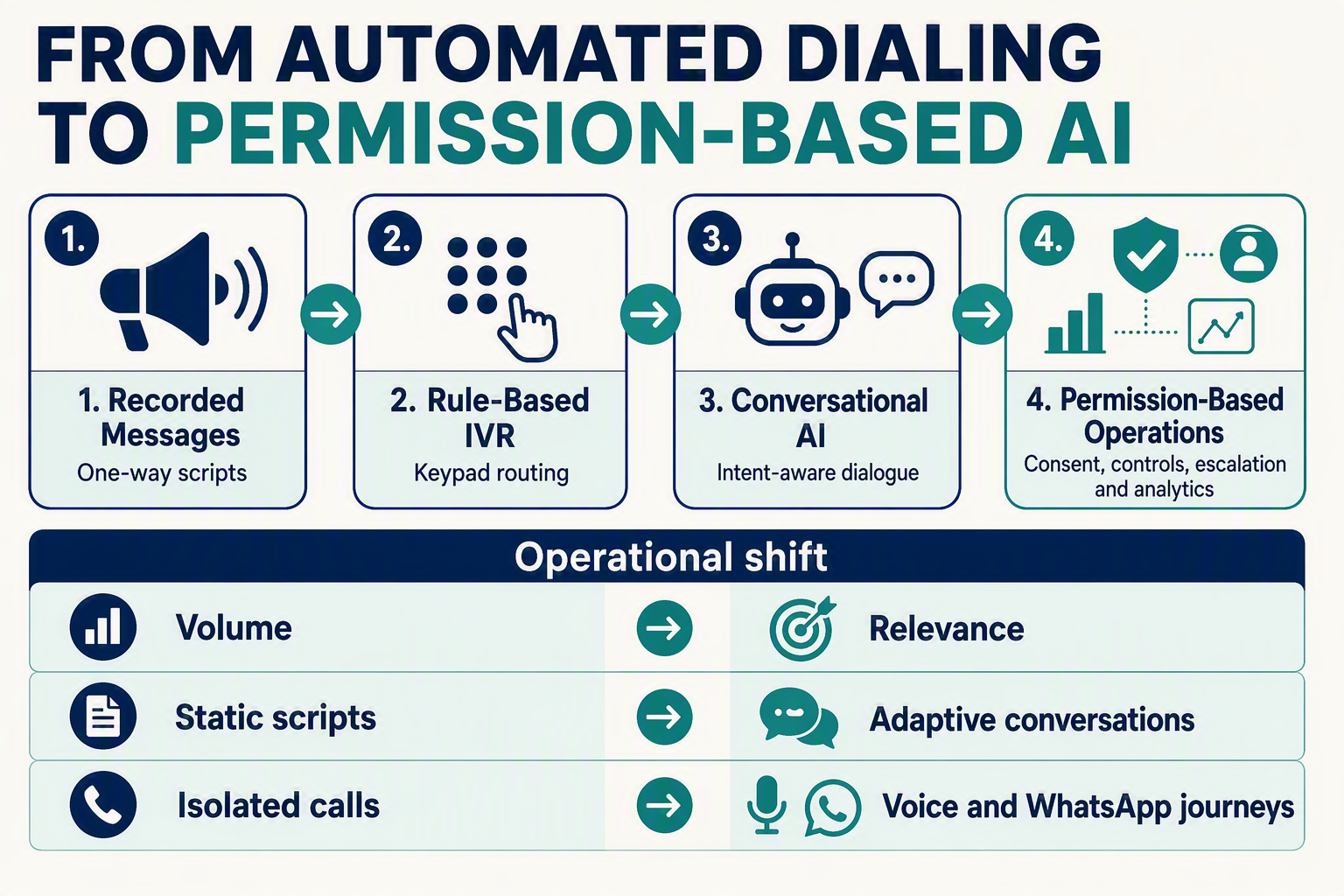
The automated calling service evolved from a rule-based dialler into a context-aware AI outbound call agent that can understand speech, retrieve customer information, complete defined tasks, and escalate safely. In 2026, the defining change is not simply more natural conversation; it is the integration of permission records, business systems, multilingual intelligence, and channel-aware follow-up.
The four stages of outbound calling automation
- Diallers and prerecorded messages: Early systems called numbers sequentially and played fixed audio. They improved reach but could not interpret intent, answer unexpected questions, or adapt responsibly.
- Interactive voice response: IVR systems added keypad menus and basic speech recognition. Customers could confirm an appointment or select a department, but conversations remained constrained by predefined decision trees.
- Conversational voice bots: Advances in speech-to-text, large language models, and text-to-speech enabled callers to respond in natural language. These systems could handle interruptions, varied phrasing, and simple transactional workflows.
- Permission-aware AI agents: A modern agent combines conversation with consent status, CRM history, campaign rules, knowledge retrieval, calling windows, suppression lists, and human handoff. This makes outbound AI calling an orchestrated customer-engagement workflow rather than a standalone call.
The evolution also changes how teams should evaluate an AI sales agent. A convincing voice is useful, but operational controls determine whether the system is suitable for production.
What a 2026 agent does before, during, and after a call
A production workflow should coordinate three stages:
- Before calling: Verify the permitted purpose, consent source, applicable time zone, local calling window, contact frequency, and opt-out status. The agent should receive only the customer context required for that campaign.
- During the call: Identify the business, provide any required automation disclosure, explain the purpose, recognise objections, capture outcomes, and transfer when the conversation exceeds its authorised scope.
- After the call: Update the CRM, add opt-outs to suppression lists, schedule an approved retry, send an authorised WhatsApp message, or route a task to a human employee.
For example, voice AI lead follow up can begin minutes after a prospect requests contact, while still checking the permission attached to that specific enquiry. Appointment reminder calls can let a customer confirm or reschedule without waiting for staff, whereas surveys can record structured answers and stop immediately when the recipient declines.
Compliance became part of the system architecture
AI telemarketing compliance can no longer be treated as a disclaimer added to a script. Consent evidence, campaign purpose, disclosure logic, recording controls, calling windows, and opt-out propagation must be enforceable system states.
This architectural shift is especially important in 2026. The European Commission states that the EU AI Act’s transparency obligations for certain AI systems interacting directly with people apply from 2 August 2026. Regulatory requirements still vary by jurisdiction and call type, so technical controls should support—not replace—country-specific legal review.
CallMissed reflects this broader evolution by connecting AI voice agents with CRM context, knowledge-base retrieval, WhatsApp follow-up, and human escalation. Its support for 22 Indian languages also illustrates why modern outbound systems must treat regional-language speech as core infrastructure rather than a translated script layered onto a legacy dialler.
Which 2026 developments are changing permission-based outbound campaigns?
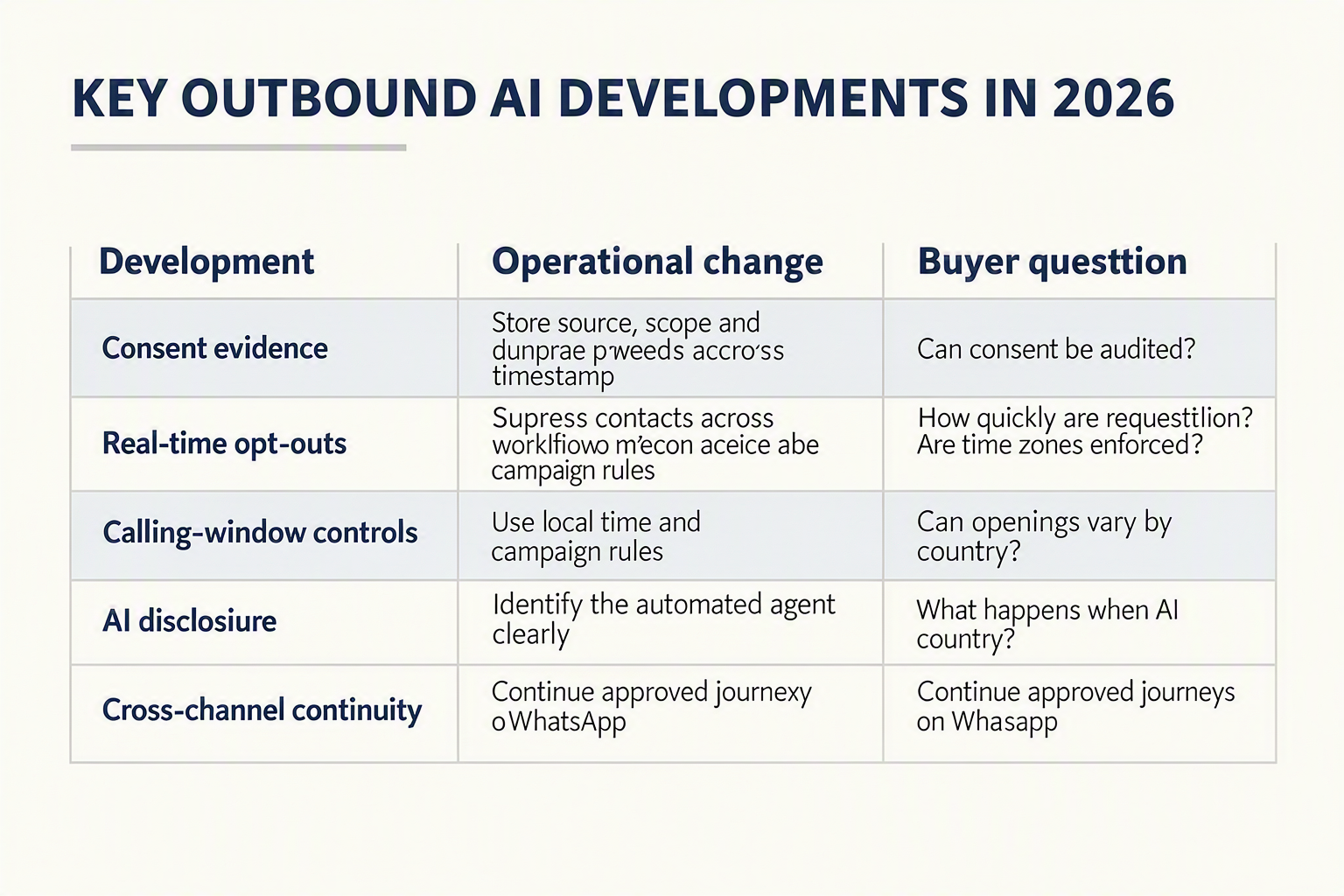
The defining 2026 development is the move from basic dialling automation to policy-aware campaign orchestration. Effective outbound AI calling now treats consent evidence, disclosures, calling windows, suppression, localisation, and human escalation as runtime controls rather than post-campaign checks.
Six developments shaping campaign design
| 2026 development | Campaign impact | Operational control | Relevant use cases |
|---|---|---|---|
| EU AI transparency milestone | AI identification becomes a script and quality-assurance requirement for covered interactions | Maintain version-controlled disclosures by country, language, and campaign | Lead follow-up, surveys, re-engagement |
| Machine-readable consent records | A telephone number alone is insufficient campaign input | Store consent source, timestamp, purpose, channel, wording, and status | All outbound campaigns |
| Real-time cross-channel suppression | A verbal “stop” must prevent subsequent outreach where applicable | Synchronise opt-outs across voice, CRM, WhatsApp, email, and campaign tools | Promotions, renewals, surveys |
| Dynamic calling-window enforcement | Static schedules create operational risk across regions and time zones | Check recipient location, local time, holidays, and campaign category before dialling | Appointment reminder calls, confirmations |
| Multilingual voice automation | Regional-language conversations become practical at campaign scale | Record consent language and route to the appropriate voice, script, and human queue | India-focused follow-up and service calls |
| Outcome-based human escalation | Resolution quality matters more than raw call volume | Transfer on buying intent, disputes, vulnerability, repeated misunderstanding, or customer request | AI sales agent workflows, payment and service issues |
Transparency becomes an executable rule
The European Commission states that EU AI Act transparency obligations under Article 50 became applicable on 2 August 2026. For a covered AI outbound call agent, transparency should therefore be implemented as a testable workflow: identify the business, disclose automated interaction where required, explain the authorised purpose, and provide an opt-out or human-assistance path.
This turns AI telemarketing compliance from a one-time script review into continuous release management. Teams should verify that disclosures remain accurate and audible after prompt changes, translations, interruptions, voicemail detection, and transfers.
These controls support operational readiness but do not replace country-specific legal advice. Businesses should obtain qualified review for every jurisdiction, campaign category, and customer segment they intend to contact.
Consent and opt-outs become shared infrastructure
A campaign-ready consent record should answer five questions:
- Who granted permission?
- When and where was permission captured?
- What purpose did the person authorise?
- Which channels were included?
- What wording or notice did the person receive?
Opt-outs require equal precision. India’s Telecom Regulatory Authority of India provides the 1909 mechanism for commercial-communication preferences and complaints, reinforcing the need to reconcile contact lists with applicable preference and suppression systems. A refusal during voice AI lead follow up should be timestamped and propagated before another workflow can contact that person.
Voice, WhatsApp, and humans converge
The emerging model is not an isolated automated calling service, but a permission-aware customer journey. A person might confirm an appointment by voice, receive authorised details through WhatsApp, and escalate a complex question to an employee without having to repeat the full interaction history.
CallMissed supports this operating model through AI voice agents, permissioned WhatsApp follow-up, an omnichannel inbox, human escalation, and communication across 22 Indian languages. The practical buyer question for 2026 is no longer simply, “Can the platform place calls?” It is, “Can the platform preserve consent, context, language, opt-outs, and escalation across the complete customer journey?”
Which campaign designs work for lead follow-up, reminders, confirmations, surveys, and re-engagement?
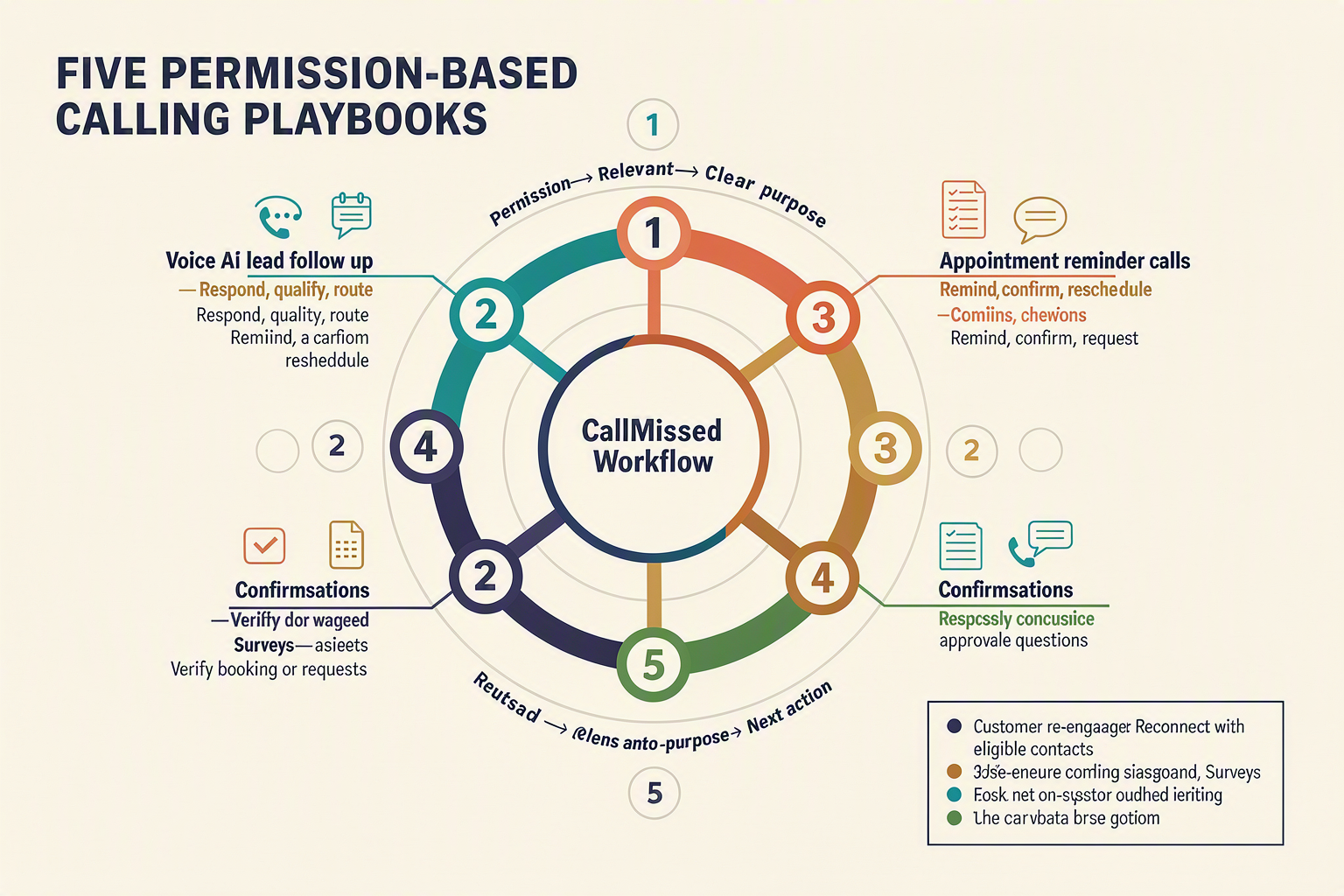
The most effective campaign designs give each call one clear purpose, one primary action, and one defined escalation path. Rather than using outbound AI calling as a generic dialling channel, map every campaign to a customer-triggered event, the minimum information needed, and an appropriate next step.
1. Lead follow-up: respond to the expressed intent
A voice AI lead follow up campaign should begin after a prospect requests contact, downloads an offer with explicit call permission, or submits an enquiry. The AI outbound call agent can qualify intent without turning the conversation into an open-ended sales pitch.
A practical call flow is:
- Identify the business and reference the specific enquiry.
- Verify that it is a convenient time.
- Ask two or three qualification questions.
- Answer approved questions using the company knowledge base.
- Book an appointment or transfer a sales-ready lead.
An AI sales agent should escalate when the buyer requests a person, asks about negotiable pricing, raises an objection outside approved guidance, or shows strong purchase intent. Track enquiry-to-call time, contact rate, qualified-lead rate, booking rate, transfers, and opt-outs—not merely total calls.
2. Reminders: make completion effortless
Appointment reminder calls work best when recipients can complete the task during the call. A clinic, service centre, restaurant, or consultant should let the customer confirm, cancel, reschedule, or request human help without navigating a long menu.
Keep the message concise and reveal only information appropriate for the verified recipient. For example, a healthcare reminder can identify the clinic and appointment time without disclosing sensitive treatment details. Use frequency caps so an unanswered reminder does not become repeated interruption, then offer an authorised WhatsApp confirmation where appropriate.
3. Confirmations: close the operational loop
Confirmation campaigns should resolve ambiguity around orders, deliveries, renewals, payments, or service visits. Design these calls around structured outcomes, such as:
- Confirmed without changes
- Rescheduled or corrected
- Customer needs assistance
- Wrong recipient or invalid number
- No answer, requiring an approved fallback
The automated calling service should write the outcome back to the CRM or omnichannel inbox. High-risk exceptions—including disputed payments, suspected fraud, significant order changes, or complaints—should route to a trained employee rather than be improvised by the model.
4. Surveys: ask less and learn more
Post-service surveys perform better operationally when they contain a small number of neutral questions. Start by stating the interaction being evaluated, collect a rating, ask one optional open-ended question, and obtain permission before arranging follow-up.
Do not have the agent pressure customers toward positive answers. Route low scores, safety concerns, and unresolved complaints to a recovery queue, while analysing aggregate themes separately from individual cases.
5. Re-engagement: use relevance, not volume
Customer re-engagement should be based on a recognisable prior relationship and a timely reason, such as an expiring service plan, abandoned application, replenishment cycle, or requested renewal discussion. AI telemarketing compliance review is especially important when a service message introduces a promotional offer, because the campaign’s legal classification may change.
CallMissed can coordinate voice outcomes with permissioned WhatsApp follow-up and human escalation. Its support for 22 Indian languages also allows regional campaigns to use the customer’s selected language rather than forcing every conversation into English or Hindi.
Before launch, test every design with a small authorised segment and define pause thresholds for complaints, incorrect routing, high opt-out rates, or failed transfers. A successful campaign is not the one that places the most calls; it is the one that completes a legitimate customer task with minimal friction.
How should consent, opt-outs, calling windows, disclosure, and AI telemarketing compliance shape operations?
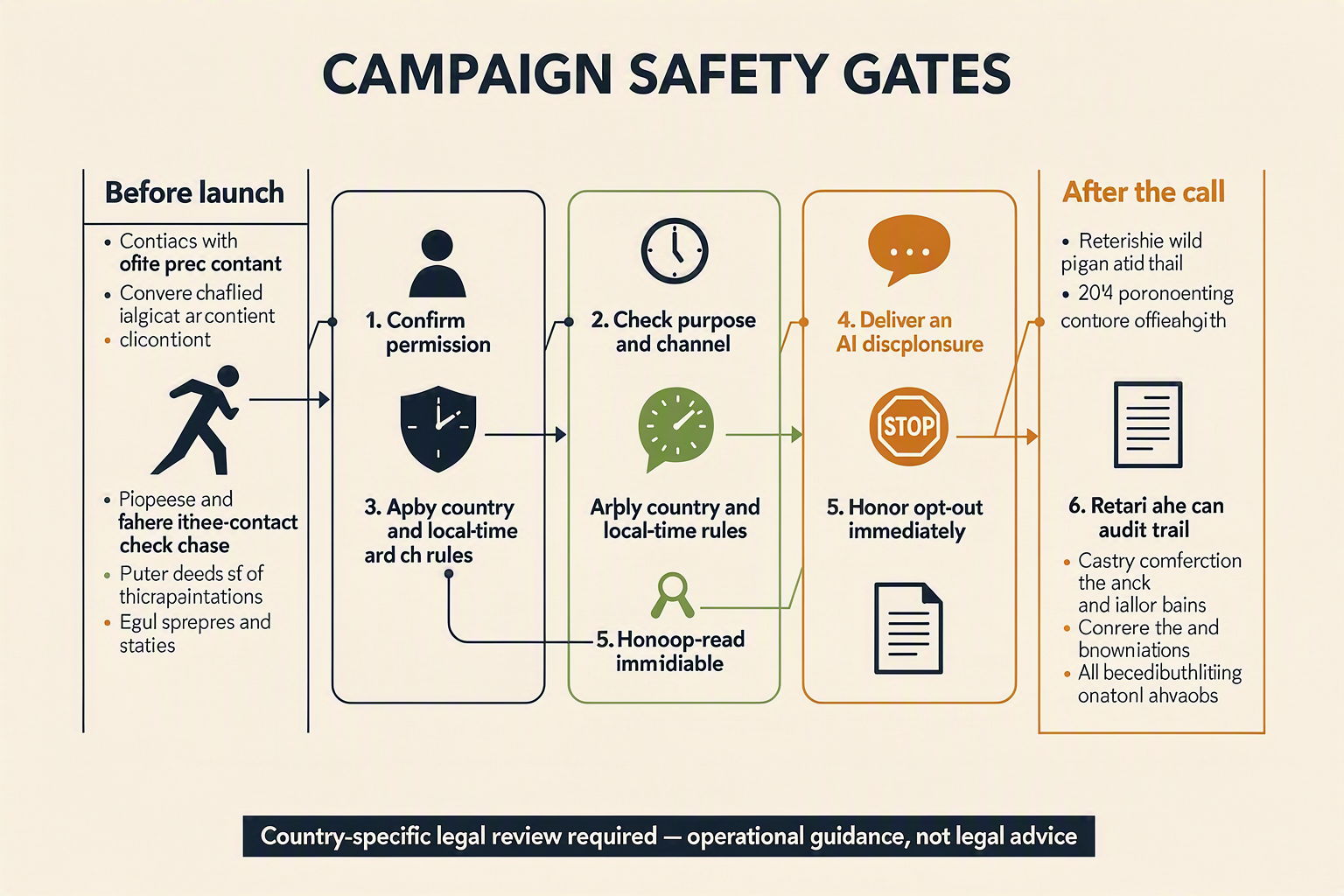
Consent, opt-outs, calling windows, disclosure, and jurisdiction-specific rules must operate as campaign controls—not merely as script language. Every outbound AI calling workflow should verify permission before dialling, disclose automation when required, respect local time restrictions, and suppress future calls immediately after an opt-out.
Turn consent into auditable campaign data
Consent should be specific, provable, current, and connected to the intended purpose. A request for an appointment update may support appointment reminder calls, but it should not automatically be treated as permission for an unrelated sales campaign.
Store an auditable consent record containing:
- Contact identity and telephone number
- Consent source, such as a web form, checkout, recorded request, or CRM event
- Exact notice or wording presented
- Permitted channel, purpose, brand, and campaign type
- Timestamp, jurisdiction, expiry or review date, and withdrawal status
Before each call, the automated calling service should check this record against suppression lists, campaign eligibility, contact frequency, and the applicable legal basis. Purchased, scraped, inferred, or undocumented contact data should not be treated as verified permission.
Make opting out immediate and channel-aware
An AI outbound call agent should understand natural-language refusals such as “stop calling,” “remove my number,” or “contact me only on WhatsApp.” It should confirm the request briefly, end promotional dialogue, and update the central preference record without requiring another call.
Use a clear operational sequence:
- Detect verbal or keypad-based opt-outs during the call.
- Write the preference to the CRM or suppression system immediately.
- Stop queued retries and related campaigns.
- Apply the preference across relevant teams, agents, and vendors.
- Retain a timestamped audit trail without continuing unwanted outreach.
In India, the Telecom Regulatory Authority of India provides the 1909 channel for consumers to register commercial-communication preferences and complaints. Campaign operations therefore need to reconcile internal permissions with applicable telecom preference and registration requirements.
Enforce calling windows before the dial request
Calling windows should be configured by the recipient’s local time and jurisdiction, not the contact centre’s location. The dialler should block calls outside authorised periods, account for daylight-saving changes where relevant, and apply stricter rules when a region, industry, or campaign requires them.
The voice AI lead follow up workflow should also impose frequency caps and sensible retry spacing. Repeated unanswered calls can create customer harm even when the first call was permitted. Separate service communications—such as confirmations or requested reminders—from promotional calls, but do not assume that labelling a campaign “transactional” automatically exempts it from local rules.
Disclose AI use and telemarketing purpose clearly
The opening should identify the business, explain the reason for calling, and state that the person is interacting with an automated or AI system where required. If recording or transcription is enabled, obtain any disclosure or consent required in the relevant jurisdiction before capture begins.
This becomes especially important in Europe because the European Commission states that EU AI Act transparency obligations for certain AI systems interacting directly with people apply from 2 August 2026. An AI sales agent should never imply that it is human or conceal a promotional purpose.
Build compliance gates into CallMissed operations
For CallMissed campaigns, teams can place permission status, local-time checks, suppression rules, disclosure scripts, and human escalation criteria before the AI voice agent initiates contact. WhatsApp follow-up should occur only when that channel and purpose are authorised.
A practical AI telemarketing compliance review should include legal, operations, security, and campaign owners. The financial exposure can be material: the U.S. Congress sets Telephone Consumer Protection Act statutory damages at $500 per violation and up to $1,500 for each wilful or knowing violation. These controls are operational guidance, not a substitute for country-specific legal advice.
How can CallMissed combine disclosure, human escalation, and permissioned WhatsApp follow-up?
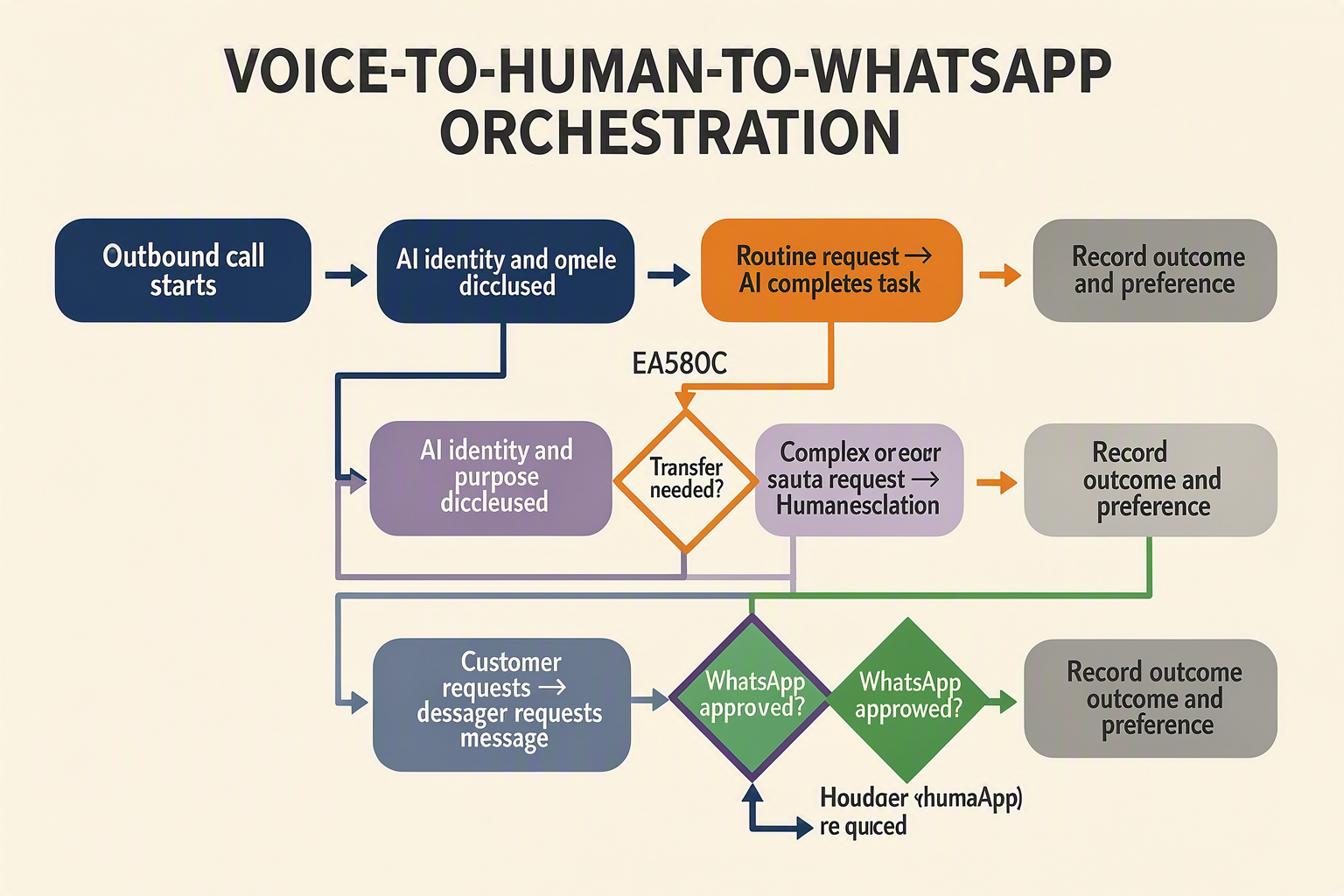
CallMissed can combine clear AI disclosure, structured human escalation, and permissioned WhatsApp messaging in one customer journey. The key operational rule is simple: permission for outbound AI calling does not automatically grant permission for WhatsApp follow-up or marketing.
Start the call with a concise disclosure
An AI outbound call agent should promptly identify the business, explain the call’s purpose, disclose that it is automated where required, and provide a clear way to stop or reach a person. The European Commission states that the EU AI Act transparency obligations for certain AI systems interacting directly with people apply from 2 August 2026.
A practical opening is:
“Hello, this is the automated assistant calling for Acme Clinics about the appointment reminder you requested. You can ask to speak with our team or say ‘stop’ at any time.”
The opening should establish four facts:
- Identity: Which organisation is calling?
- Automation: Is the recipient speaking with an AI system?
- Purpose: Is the call for lead follow-up, a reminder, confirmation, survey, or promotion?
- Control: How can the recipient opt out or request a human?
For voice AI lead follow up, the agent can reference the permission event without revealing unnecessary personal information: “You requested a callback through our website this morning.” An AI sales agent should never present a promotional call as a service notification.
Escalate according to intent, risk, and customer preference
Human escalation should be a designed workflow, not an improvised exception. CallMissed’s omnichannel inbox and CRM can preserve relevant interaction context for an employee, reducing the need for customers to repeat their request.
The automated calling service should escalate when the customer:
- Explicitly requests a person.
- Raises a complaint, cancellation, refund, dispute, or sensitive account matter.
- Questions the organisation’s identity, pricing, consent, or reason for calling.
- Asks something the approved knowledge base cannot answer confidently.
- Requires negotiation, an exception, or a regulated professional decision.
If no employee is available, the agent should offer a callback window or ask whether the customer wants an authorised WhatsApp follow-up. It must not imply that a human transfer occurred while automation remains active.
Obtain channel-specific permission for WhatsApp
Before sending a WhatsApp message, ask a specific question such as: “May I send the appointment details to this number on WhatsApp?” Record the response, timestamp, destination number, stated purpose, consent source, and originating campaign.
Permissioned WhatsApp follow-up is useful for:
- Sending rescheduling options after appointment reminder calls
- Sharing information specifically requested during a lead conversation
- Confirming an order, service visit, survey response, or callback time
- Continuing with a human agent through the omnichannel inbox
- Capturing digital opt-outs such as “STOP” or “Do not contact me”
CallMissed supports voice and messaging workflows across 22 Indian languages, allowing regional-language context to carry into WhatsApp follow-up and human escalation. However, multilingual capability does not replace channel-specific consent: permission to call is not blanket permission to message.
Maintain one suppression state across channels
Effective AI telemarketing compliance requires voice, WhatsApp, CRM, and campaign systems to reference the same contact-preference record. The Telecom Regulatory Authority of India provides the 1909 channel for consumers to register commercial-communication preferences and complaints, reinforcing the importance of central suppression controls.
When someone opts out, end promotional dialogue, confirm the request once, update suppression records immediately, and block further automated WhatsApp marketing unless fresh, purpose-specific permission is obtained. Country-specific legal review remains necessary before deployment.
Which analytics reveal the impact, risks, and business value of an outbound campaign?
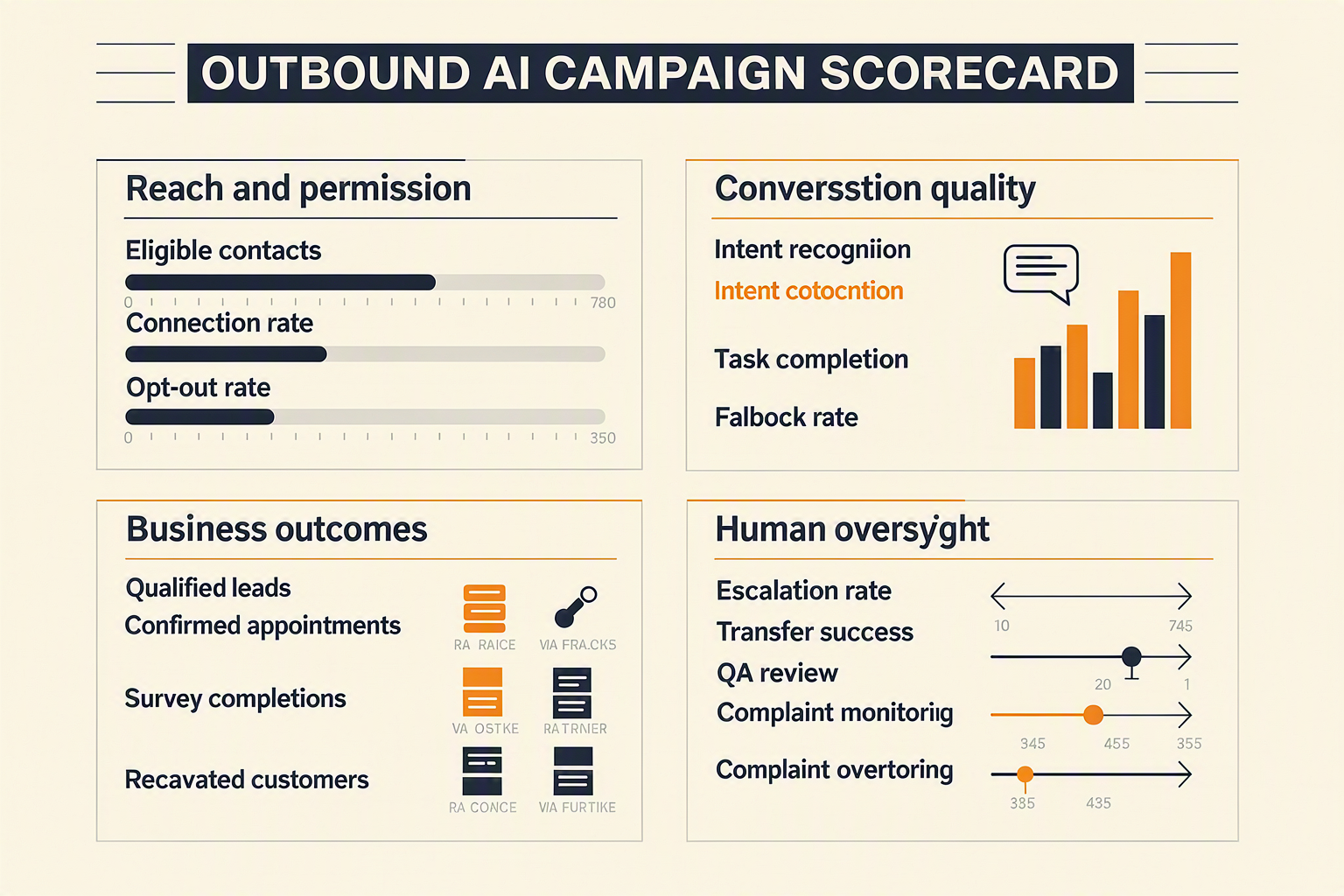
The right analytics connect three questions: Did the campaign achieve its operational goal, did customers have a safe and respectful experience, and did the resulting value exceed its full cost and risk? An outbound AI calling dashboard should therefore combine outcome, quality, compliance, and financial metrics—not celebrate call volume alone.
Measure outcomes by use case, not one universal conversion rate
A successful call means something different for each workflow. Define one primary outcome and several diagnostic metrics before launch:
- Voice AI lead follow up: contact rate, qualified-lead rate, meeting-booked rate, speed from enquiry to first attempt, and human-transfer conversion.
- Appointment reminder calls: confirmation rate, reschedule rate, cancellation capture, no-show reduction, and staff minutes saved.
- Confirmations: successful verification rate, unresolved-case rate, and subsequent support-contact reduction.
- Surveys: completion rate, response distribution, drop-off by question, and escalation rate for negative feedback.
- Customer re-engagement: reactivation rate, purchase or renewal conversion, revenue per contacted customer, and opt-out rate.
Segment results by consent source, campaign, language, time window, customer cohort, attempt number, and human versus AI resolution. A high aggregate conversion rate can conceal a poor experience in one region or language.
Put risk indicators beside performance metrics
AI telemarketing compliance cannot be assessed from conversion data. Every campaign should expose operational controls and exceptions through a compliance scorecard:
- Consent match rate: percentage of dialled records linked to valid consent evidence and the stated purpose.
- Suppression accuracy: records blocked because of an opt-out, preference restriction, frequency cap, or expired permission.
- Opt-out rate and latency: percentage requesting no further calls and time taken to update every connected system.
- Calling-window exceptions: attempts prevented or incorrectly placed outside the configured local window.
- Disclosure completion: calls in which the AI identity, business identity, and purpose were delivered successfully.
- Complaint rate: complaints per 1,000 connected calls, categorised by consent, frequency, disclosure, relevance, and agent conduct.
- Recording-policy exceptions: recordings created, retained, or accessed outside the approved jurisdictional policy.
These are material business risks. The U.S. Congress sets Telephone Consumer Protection Act statutory damages at $500 per violation and up to $1,500 for a wilful or knowing violation. Track exceptions as absolute counts as well as percentages; a seemingly small error rate can become consequential at scale.
Calculate business value using incremental results
An automated calling service should be evaluated against a control group or credible pre-launch baseline. Use holdout cohorts where practical so seasonal demand, discounts, or staff activity are not incorrectly credited to the AI outbound call agent.
Useful formulas include:
- Incremental conversion lift = campaign conversion rate − control conversion rate
- Cost per incremental outcome = total campaign cost ÷ incremental bookings, confirmations, or recoveries
- Net campaign value = incremental gross profit + labour savings + avoided losses − platform, telephony, review, and escalation costs
- Human escalation yield = successful outcomes after transfer ÷ completed transfers
For an AI sales agent, also measure transfer wait time, context passed successfully, and post-transfer conversion. An AI system that generates many transfers but provides incomplete summaries may simply relocate work rather than reduce it.
CallMissed can bring voice-agent outcomes, WhatsApp follow-up, and human conversations into a coordinated customer journey. Teams should still export or review campaign-level evidence regularly, audit low-confidence transcripts, and compare performance across its 22 supported Indian languages rather than assuming one script performs consistently everywhere.
The strongest campaign is not the one making the most calls; it is the one producing incremental, auditable value with low complaint, opt-out, and exception rates.
What do compliance, CX, RevOps, and contact-center experts recommend before launch?
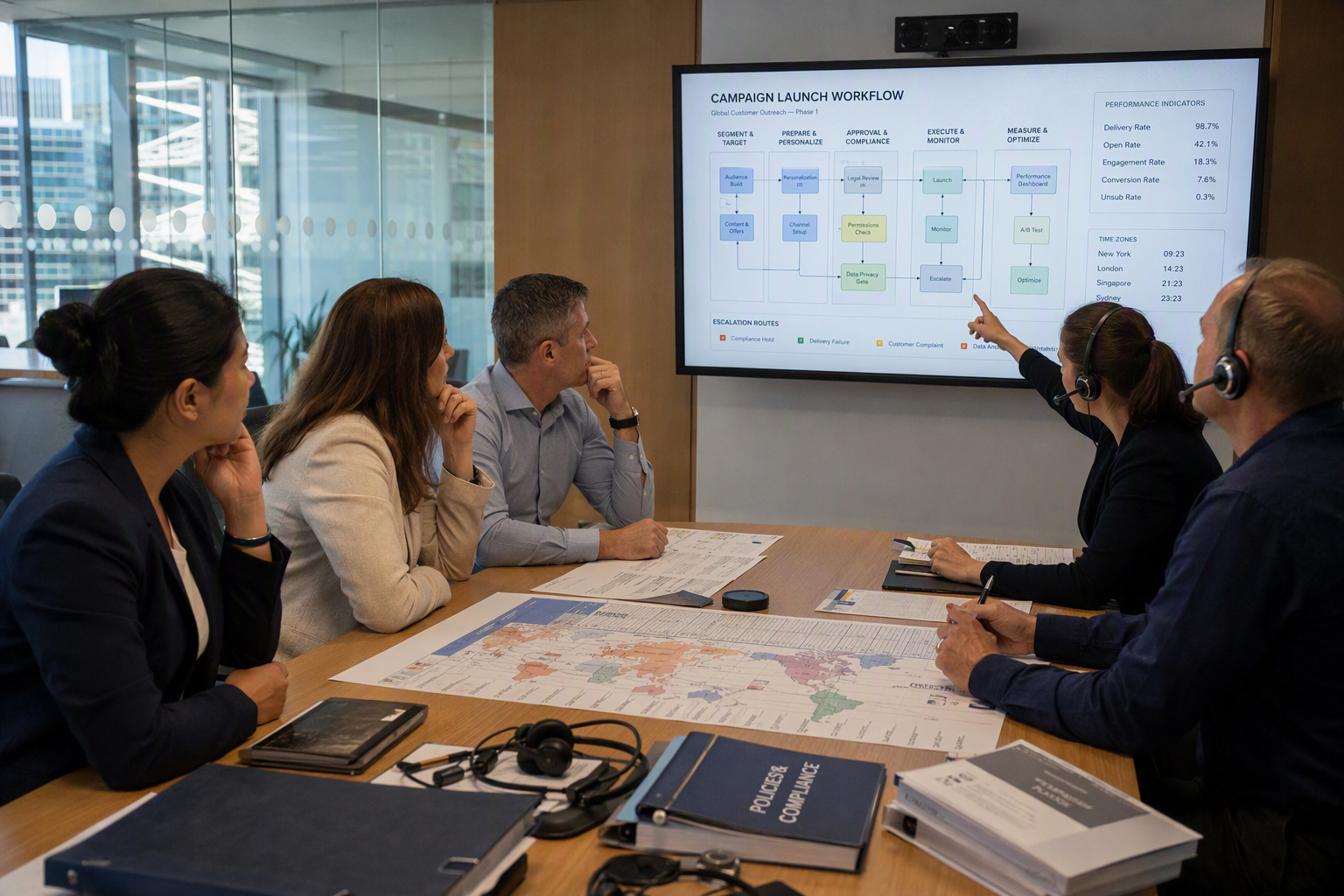
Before launch, experts recommend treating outbound AI calling as a controlled customer journey—not merely a dialling campaign. Compliance, customer-experience, revenue-operations, and contact-centre owners should jointly approve the audience, script, escalation path, suppression logic, and measurement plan before any production calls begin.
Compliance: require evidence, not assumptions
Compliance teams should create a written launch record covering each country, call purpose, consent basis, disclosure, recording policy, retention period, and opt-out mechanism. This review should distinguish transactional messages—such as appointment reminder calls—from promotional outreach and document why each recipient is eligible.
Use a pre-launch checklist to verify:
- Consent records include source, wording, purpose, channel, timestamp, and customer identifier.
- CRM revocations, do-not-call lists, previous verbal opt-outs, and jurisdictional preference registries are applied before every dial.
- The AI outbound call agent identifies the business, states the call’s purpose, and discloses automation where required.
- Calling windows use the recipient’s local time zone rather than the campaign operator’s time zone.
- Legal counsel has reviewed country-specific rules; operational guidance is not a substitute for legal advice.
Risk is measurable: The U.S. Congress specifies TCPA statutory damages of $500 per violation and up to $1,500 for each wilful or knowing violation. For European campaigns, the European Commission says relevant EU AI Act transparency obligations apply from 2 August 2026. In India, teams should design suppression and complaint workflows around TRAI’s 1909 preference and reporting channel.
CX: test whether the call feels useful
CX leaders recommend listening to complete test conversations, including interruptions, silence, accents, background noise, and unexpected questions. A useful automated calling service should explain why it is calling within the opening exchange and make “stop calling,” “call later,” and “speak to a person” easy to express naturally.
Test at least these scenarios:
- Correct contact, successful outcome
- Wrong person or reassigned number
- Ambiguous consent or customer challenge
- Immediate opt-out
- Distressed, angry, vulnerable, or confused customer
- Failed transfer or unavailable human agent
For multilingual deployments, reviewers should test meaning and tone—not just literal translation. CallMissed supports voice interactions across 22 Indian languages, enabling regional QA teams to assess prompts in the language customers actually use.
RevOps: protect funnel quality
RevOps should define eligibility rules, frequency caps, CRM field ownership, and attribution before enabling voice AI lead follow up. An AI sales agent should never repeatedly call every open lead; it should prioritise recent callback requests, enforce cooling-off periods, and stop automatically after conversion, disqualification, or withdrawal of permission.
Agree on outcome codes such as connected, confirmed, rescheduled, transferred, opted out, wrong number, and unresolved. Measure consent-valid contact rate, task completion, transfer acceptance, opt-out rate, complaint rate, repeat-call rate, and downstream conversion—not raw dial volume alone.
Contact centre: rehearse the handoff
Contact-centre leaders should confirm that humans receive the transcript, customer identity, call purpose, consent context, and actions already attempted. Transfers need queue limits, fallback messaging, and an authorised alternative such as WhatsApp follow-up.
The final launch gate should require named owners from all four functions, successful scenario testing, verified suppression controls, and a rollback plan. That governance makes AI telemarketing compliance, customer trust, and commercial performance shared operational responsibilities rather than post-launch fixes.
What does this mean for buyers evaluating CallMissed and alternative platforms?
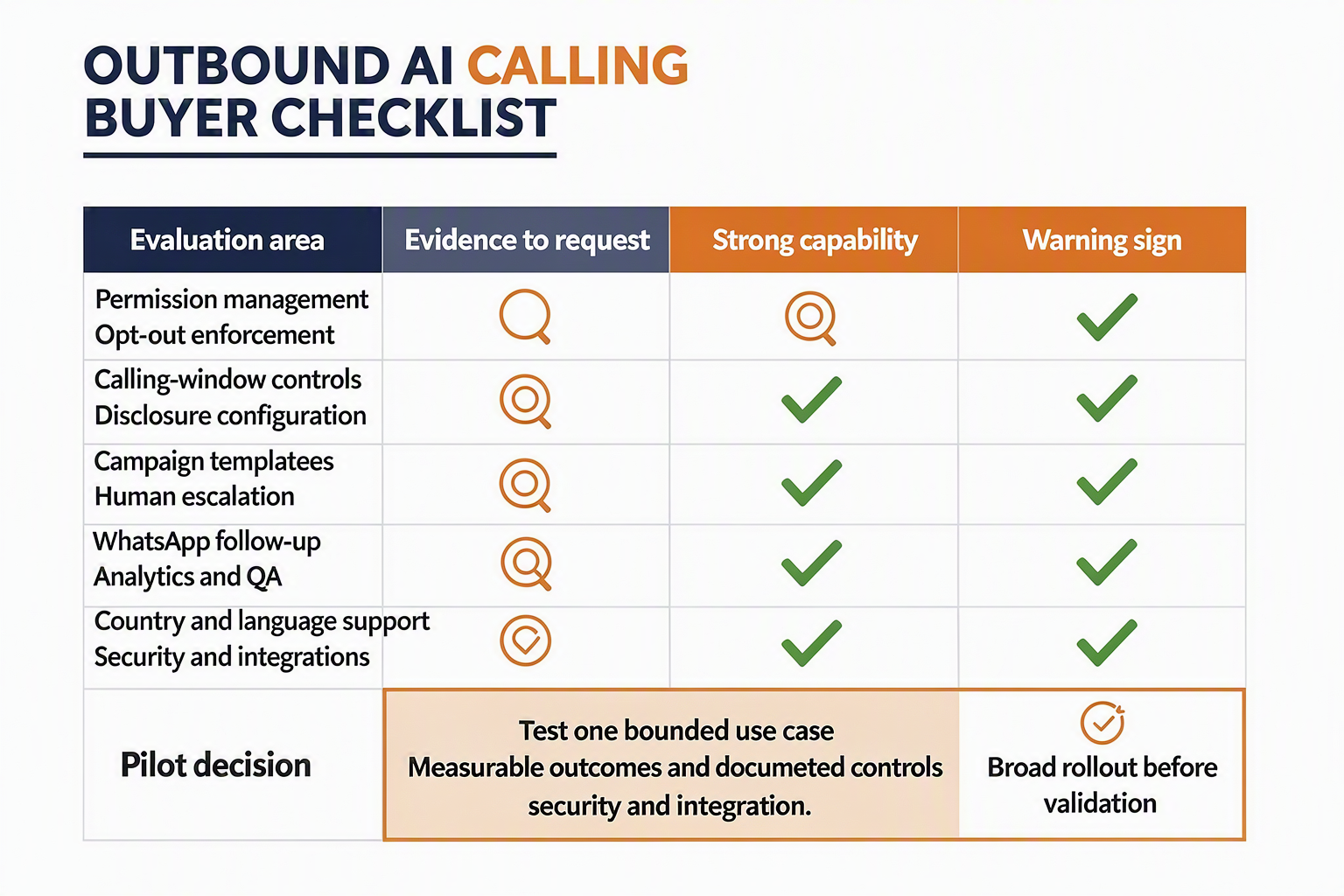
Buyers should evaluate outbound AI calling platforms by how reliably they enforce permission, timing, suppression, disclosure, escalation, and cross-channel continuity—not by call volume or model fluency alone. CallMissed is particularly relevant for India-first, multilingual journeys that combine AI voice with WhatsApp, while alternative platforms may suit different geographies, carriers, integrations, or governance requirements.
A practical buyer-evaluation matrix
| Evaluation area | Minimum buyer test | CallMissed fit | Evidence to request |
|---|---|---|---|
| Consent and opt-outs | Import consent source, timestamp, purpose, expiry, and number; suppress a contact immediately after a spoken or digital opt-out | Campaign workflows can be designed around permission records, CRM context, and omnichannel contact handling | Consent-field mapping, suppression-list test, deletion process, and API or CRM update logs |
| Calling windows and frequency | Apply recipient-local time zones, jurisdiction-specific windows, retry limits, holidays, and campaign-level caps | Suitable for controlled lead follow-up, confirmations, surveys, and re-engagement rather than indiscriminate dialling | Live demonstration using multiple time zones, failed-call retries, and midnight boundary cases |
| Conversation design | Test identity disclosure, reason for calling, AI disclosure where required, objection handling, and restricted-topic guardrails | An AI outbound call agent can use knowledge-base retrieval and defined workflows before escalating | Sample transcripts, prompt-change controls, hallucination tests, and prohibited-response handling |
| Use-case execution | Run separate tests for voice AI lead follow up, appointment reminder calls, confirmations, surveys, and customer re-engagement | Voice agents can connect conversations with WhatsApp follow-up and an omnichannel inbox | Completion rate by use case, rescheduling flow, survey neutrality, and channel-consent checks |
| Language and channel coverage | Evaluate accents, code-switching, names, addresses, noisy audio, WhatsApp hand-off, and human transfer | Supports speech experiences across 22 Indian languages, plus WhatsApp chat and WhatsApp Business calling | Language-by-language testing with representative users; do not accept one aggregate accuracy figure |
| Governance and analytics | Confirm role-based access, recordings policy, transcript controls, outcome labels, exports, retention, and incident review | Operational results can be reviewed alongside customer conversations, campaign activity, and human follow-up | Raw event export, audit trail, retention settings, redaction capabilities, and escalation reports |
Convert compliance claims into acceptance tests
A vendor saying that its automated calling service is “compliant” is not sufficient. AI telemarketing compliance depends on the jurisdiction, use case, consent record, script, calling configuration, and the buyer’s operating practices. Procurement teams should turn legal obligations into testable requirements:
- United States: The U.S. Congress specifies Telephone Consumer Protection Act statutory damages of $500 per violation and up to $1,500 for each wilful or knowing violation. Test whether suppression, consent evidence, and campaign permissions remain intact after CRM imports and workflow changes.
- European Union: The European Commission states that relevant EU AI Act transparency obligations apply from 2 August 2026. Ask how scripts consistently identify automated interactions and how disclosure versions are recorded.
- India: The Telecom Regulatory Authority of India provides 1909 for commercial-communication preferences and complaints. Verify preference screening, sender and calling configurations, complaint handling, and campaign classification with Indian legal and telecom advisers.
Make the final decision with a controlled pilot
Run a pilot using real operational edge cases rather than a polished demonstration. Include withdrawn consent, wrong numbers, voicemail, repeated silence, unsupported languages, rescheduling, a request for a human, and a WhatsApp follow-up without channel-specific permission.
Score each AI sales agent on permission accuracy, opt-out success, correct calling-window enforcement, task completion, human-transfer success, and complaint rate. Buyers should select the platform that meets their documented risk controls and customer-journey requirements—not simply the system that places the most calls.
Frequently asked questions about outbound AI calling, consent, opt-outs, calling windows, disclosure, and legal review
What consent is required for permission-based outbound AI calling in 2026?
How should an AI outbound call agent process opt-out requests?
What are the legal calling hours for an automated calling service?
Must an AI sales agent disclose that it is artificial intelligence?
Can businesses use voice AI lead follow up and appointment reminder calls without treating them as telemarketing?
What should legal teams review before launching outbound AI calls with CallMissed?
Conclusion
Permission-based outbound AI calling succeeds when consent, customer context, and operational controls shape every interaction. In 2026, an effective program should prioritise relevant service and follow-up conversations—not maximise call volume.
Key takeaways include:
- Document permission and preferences. Retain consent evidence, distinguish promotional calls from service communications, check suppression lists, apply frequency limits, and make verbal or digital opt-outs immediate and durable.
- Design each call around a clear purpose. Use voice AI lead follow up for requested callbacks, appointment reminder calls for confirmation or rescheduling, and narrowly scoped workflows for orders, renewals, surveys, and authorised customer re-engagement.
- Build transparency and escalation into the script. An AI outbound call agent should identify the business, explain the reason for calling, disclose automation where required, and transfer sensitive, complex, or high-intent conversations to a person. An AI sales agent should never pressure customers or obstruct an opt-out.
- Evaluate the complete journey. A responsible automated calling service should connect CRM context, compliant calling windows, WhatsApp follow-up, knowledge retrieval, human handoff, and analytics measuring outcomes, opt-outs, transfers, and customer experience.
The financial and regulatory stakes remain substantial. The U.S. Congress sets Telephone Consumer Protection Act statutory damages at $500 per violation and up to $1,500 for each wilful or knowing violation. The European Commission states that relevant EU AI Act transparency obligations apply from 2 August 2026. In India, Telecom Regulatory Authority of India preference and complaint mechanisms through 1909 make opt-out enforcement central to AI telemarketing compliance. Country-specific legal review remains essential; operational guidance is not legal advice.
Watch for tighter AI-disclosure expectations, more granular channel preferences, and closer coordination between voice and authorised WhatsApp conversations. Businesses can explore CallMissed for permission-aware voice agents, WhatsApp follow-up, human escalation, analytics, and communication across 22 Indian languages.
Before launching your next campaign, can you prove not only that each customer may be called—but that every call will remain useful, transparent, and easy to decline?
Related Reading
Discussion
Related Posts



Ready to automate customer conversations?
Launch AI voice agents and WhatsApp bots with CallMissed — one API, 22+ Indian languages.