
AI Receptionist CRM Integration: 2026 Guide to Lead Capture and Follow-Up


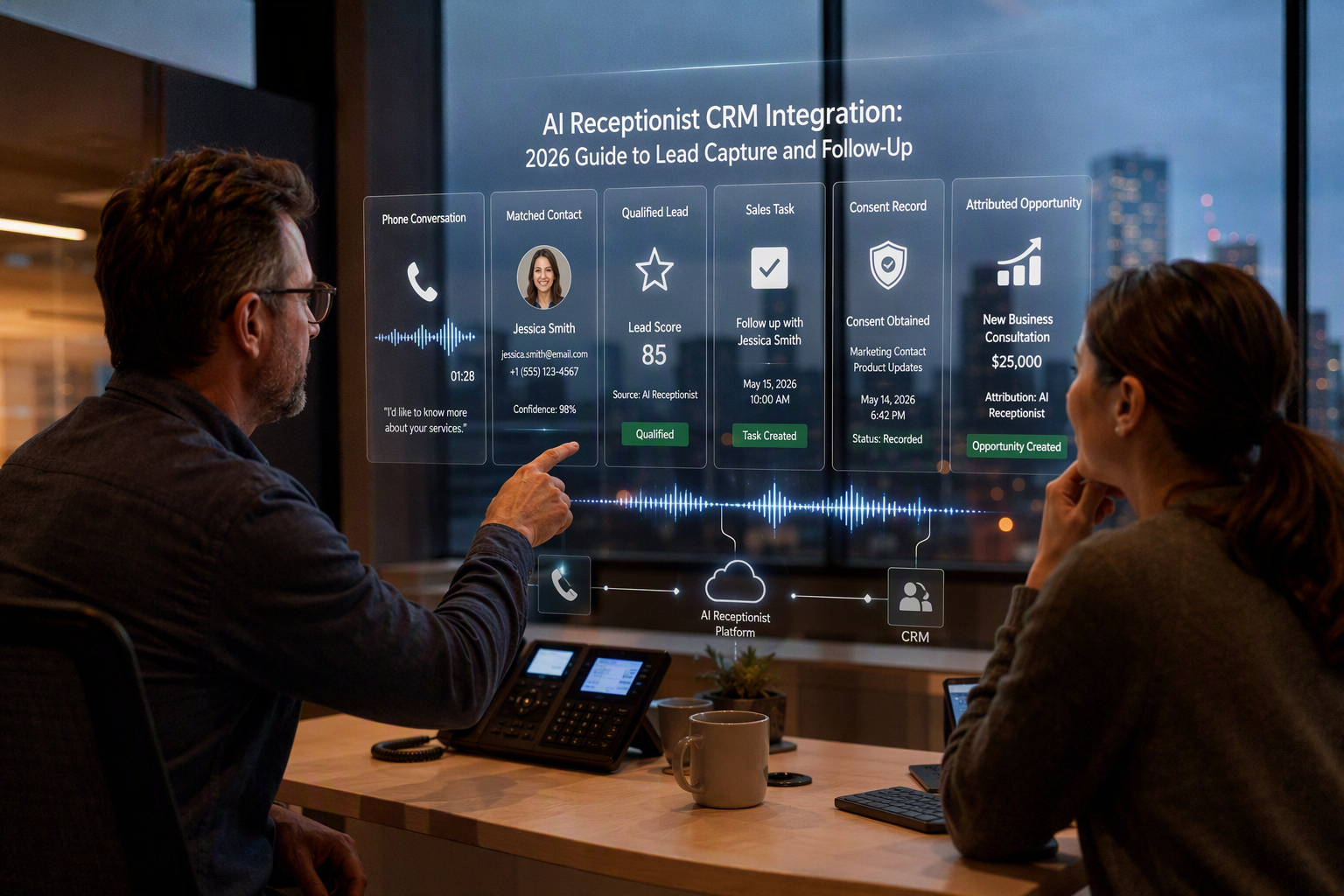
Learn how AI receptionist CRM integration captures, matches, qualifies, logs, routes and follows up with leads using a vendor-neutral framework.
AI Receptionist CRM Integration: 2026 Guide to Lead Capture and Follow-Up
What if the most expensive missed call is not the one nobody answers, but the one an AI receptionist answers and then records against the wrong customer? AI receptionist CRM integration matters because answering is only half the job: the system must identify the caller, preserve context, create or update the right record, and trigger a timely next action without corrupting CRM data.
In 2026, customer-facing automation is moving from isolated bots to systems that can execute workflows. Gartner predicted in December 2024 that agentic AI will autonomously resolve 80% of common customer-service issues by 2029, while reducing operational costs by 30%. Salesforce’s State of Sales, Sixth Edition reported in 2024 that sales representatives spend only 30% of an average week connecting with customers, making reliable automation around the conversation commercially important.
That is the promise—and risk—of voice AI CRM integration. A production workflow connects telephony, identity resolution, conversation intelligence, CRM objects, messaging, and human ownership. Done well, AI lead capture automation turns an inbound question into a matched contact, structured requirements, consent evidence, source attribution, a qualified opportunity, and a scheduled follow-up. Done poorly, an automated call logging CRM workflow can generate duplicate leads, overwrite trusted fields, expose sensitive transcripts, or assign high-intent prospects to the wrong queue.
Platforms such as CallMissed reflect this shift by combining AI voice agents, WhatsApp chat and Business calling, an omnichannel inbox, and knowledge-base retrieval, with support for speech across 22 Indian languages for businesses serving regional audiences.
What this guide covers
This guide offers a vendor-neutral buying framework for the full data path, not merely transcription accuracy. You will learn to:
- Match callers to contacts using normalized phone numbers, identifiers, and confidence thresholds.
- Convert summaries into mapped CRM fields without allowing model-generated text to overwrite authoritative data.
- Design qualification, deduplication, consent, attribution, and routing rules that remain auditable.
- Trigger AI sales follow-up across calls, WhatsApp, email, or salesperson tasks while preserving channel preference and ownership.
- Assess security, retention, role-based access, failure handling, API compatibility, latency, and total operating cost before choosing a vendor.
The guide also maps implementation architecture from call arrival to sales handoff and supplies a rollout checklist for shared numbers, returning customers, multilingual callers, and CRM outages. The goal is not to remove humans from selling. It is to ensure every qualified conversation reaches the right human—or the right automated next step—with accurate context, permission, and a traceable record.
What is AI receptionist CRM integration, and how does it capture and follow up with leads?
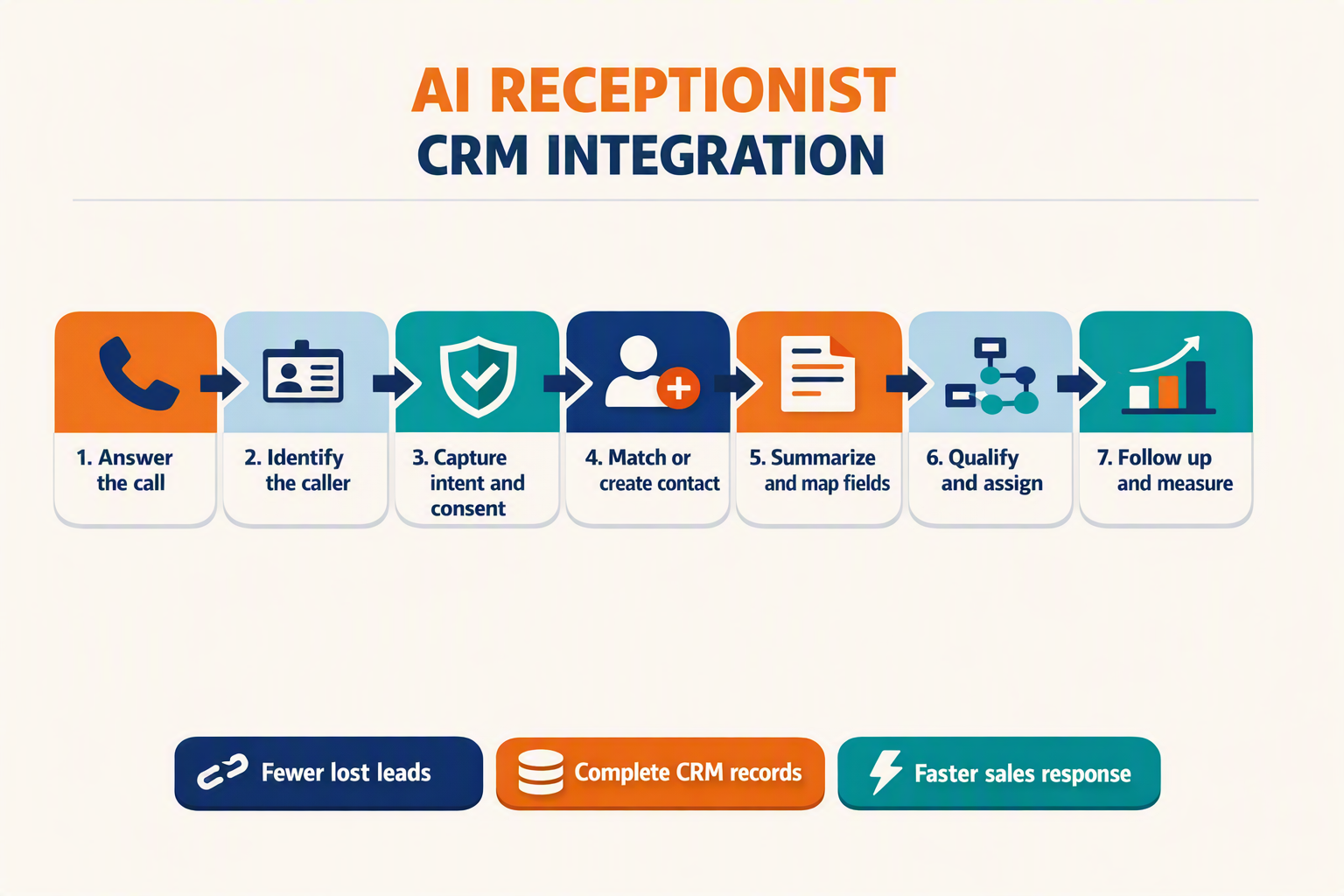
AI receptionist CRM integration is a bidirectional workflow that connects an AI voice agent with customer records, sales rules, and follow-up channels. It captures a lead by resolving identity and structuring conversation data, then creates the appropriate CRM activity, updates permitted fields, and triggers a consent-aware next action.
More than transcription or call logging
Basic automated call logging CRM functionality may save a phone number, recording, transcript, duration, and timestamp. A production integration also interprets the call and determines what should happen next.
The distinction is important because Salesforce’s State of Sales, Sixth Edition reported in 2024 that sales representatives spend only 30% of an average week connecting with customers. Automation should therefore reduce administrative work without introducing records that salespeople must manually investigate or correct.
A complete integration typically connects:
- Telephony and voice AI: Answers calls, detects language, transcribes speech, and manages dialogue.
- Identity resolution: Normalizes the caller’s phone number and searches contacts, leads, accounts, and open opportunities.
- Conversation intelligence: Produces a concise summary and extracts intent, product interest, location, budget, urgency, and preferred contact time.
- CRM orchestration: Creates or updates the correct object according to field-level rules.
- Follow-up channels: Initiates an approved call, WhatsApp message, email, appointment, or salesperson task.
- Audit controls: Retains confidence scores, consent status, timestamps, source data, and workflow outcomes.
How voice AI lead capture works
A typical voice AI CRM integration follows six steps:
- Identify the caller. The system converts the phone number into a consistent international format, such as E.164, and searches for exact or permitted secondary matches.
- Establish context. If a record exists, the receptionist can use approved CRM context such as an open enquiry or scheduled appointment. It should not reveal sensitive details until identity is sufficiently verified.
- Conduct qualification. The AI asks configured questions rather than improvising a sales policy—for example, service required, postcode, purchase timeline, and budget range.
- Structure the conversation. The workflow separates the generated summary from deterministic fields such as phone number, call time, campaign ID, and consent response.
- Write safely to the CRM. Existing authoritative values remain protected, uncertain matches enter a review queue, and duplicate-creation rules run before a new lead is saved.
- Trigger the next action. Routing logic assigns an owner and starts AI sales follow-up only when channel, timing, and consent rules permit it.
From conversation to actionable record
Effective AI lead capture automation stores three layers of information:
- Evidence: Recording or transcript, where lawful, plus timestamps and consent events.
- Structured data: Intent, qualification answers, lead source, language, disposition, and requested follow-up time.
- Action state: Owner, priority, service-level deadline, next task, and delivery status.
The CRM should remain the system of record, while the AI receptionist acts as an orchestration layer. Gartner predicted in December 2024 that agentic AI will autonomously resolve 80% of common customer-service issues by 2029, highlighting why explicit permissions, validation rules, and escalation paths must accompany greater autonomy.
For multilingual Indian workflows, CallMissed combines AI voice agents, WhatsApp Business calling, and an omnichannel inbox with speech support across 22 Indian languages. That model illustrates how lead capture can continue across voice and messaging while preserving one traceable customer history.
How does voice AI CRM integration differ from basic call forwarding and standalone call bots?
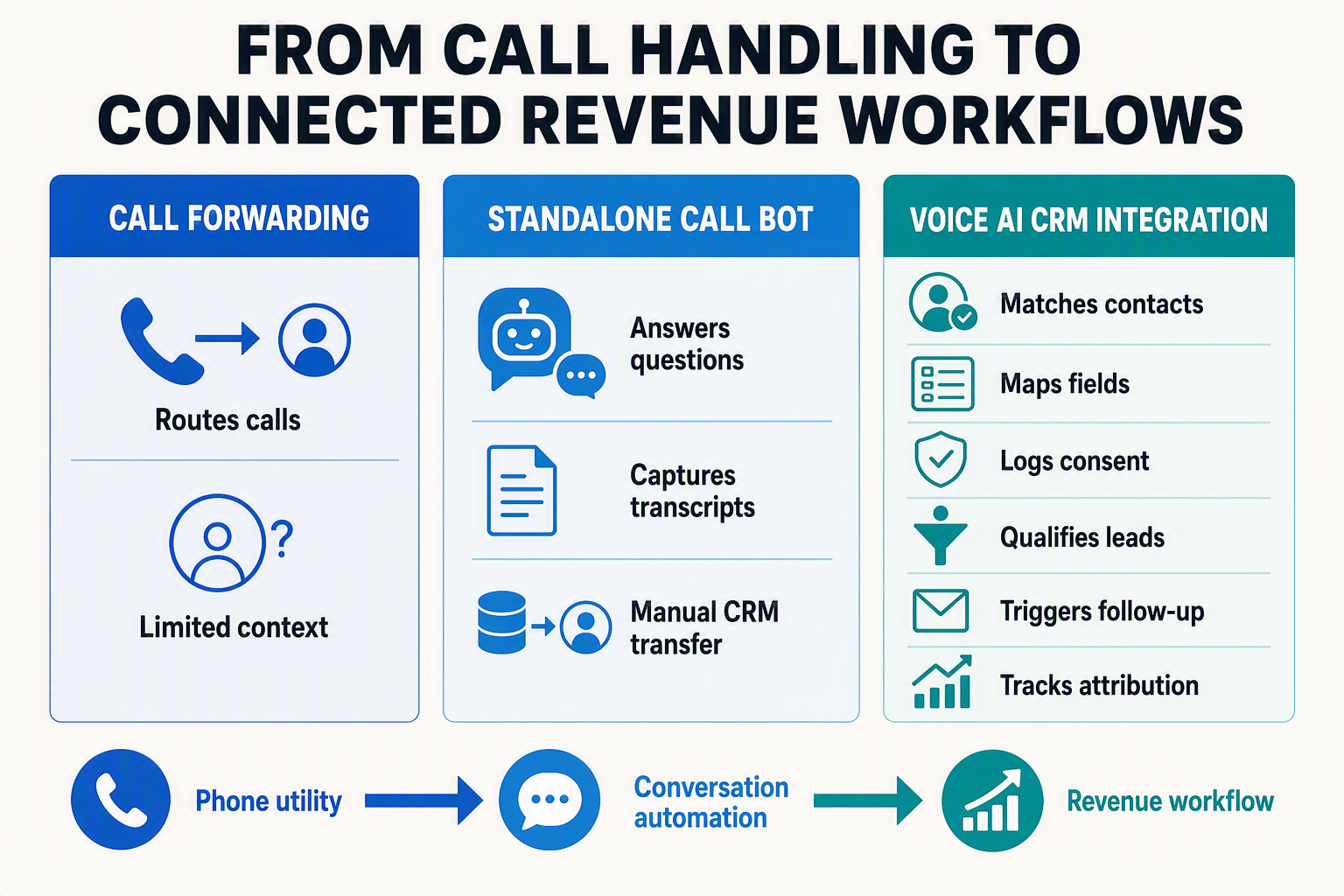
Basic call forwarding moves a call, and a standalone bot handles a conversation; voice AI CRM integration connects that conversation to customer identity, governed CRM updates, qualification, attribution, and follow-up. The critical difference is whether the AI merely speaks or becomes an auditable participant in the revenue workflow.
Three levels of call automation
- Basic call forwarding: Telephony routes an incoming call to a person, queue, voicemail box, or external number. The CRM may receive only a generic call activity—or nothing at all.
- Standalone call bot: An AI agent answers questions, collects details, and may produce a transcript or summary. However, staff often need to copy the information manually into the CRM.
- AI receptionist CRM integration: The system reads approved CRM context, resolves the caller’s identity, writes structured data to the correct objects, and triggers the next action under defined business rules.
This progression matters because conversation automation is moving toward workflow execution. Gartner predicted in December 2024 that agentic AI will autonomously resolve 80% of common customer-service issues by 2029, making identity, permissions, and reliable system updates as important as speech quality.
What a true CRM integration does differently
A production-grade integration should orchestrate several functions that forwarding and isolated bots generally cannot provide together:
- Contact matching: Normalize the caller’s number—commonly into the international E.164 format—and search contacts, leads, accounts, or household records before creating anything new.
- Context retrieval: Give the receptionist controlled access to relevant details such as account status, open opportunities, previous enquiries, language preference, and assigned owner.
- Structured capture: Convert statements such as “I need 50 units next month” into mapped fields for quantity, timeframe, product interest, location, and buying intent.
- Safe record updates: Apply confidence thresholds and field-level rules so model-generated output cannot silently overwrite authoritative values.
- Qualification and routing: Score or classify the enquiry, then assign it by territory, product, availability, or existing ownership.
- Consent-aware follow-up: Store permission, channel preference, timestamp, and source before initiating WhatsApp, email, or outbound calling.
- Attribution: Preserve the dialled number, campaign, landing page, referral source, or advertisement identifier rather than treating every phone lead as “direct.”
An automated call logging CRM feature that merely attaches audio or a transcript is therefore not equivalent to full integration. Effective AI lead capture automation creates usable CRM data and an accountable next step, not just another activity entry.
A practical example
Suppose Priya calls after seeing a regional property advertisement. A standalone bot might answer questions and email a transcript. An integrated workflow can instead:
- Match Priya using her normalized phone number.
- Detect an existing open enquiry and avoid creating a duplicate.
- Record budget and location in approved CRM fields.
- Attribute the call to the correct campaign number.
- Route the opportunity to its existing owner.
- Launch AI sales follow-up on Priya’s consented channel or create a time-bound salesperson task.
The buyer’s litmus test is simple: ask what happens before, during, and after each CRM write. Genuine AI receptionist CRM integration should explain matching precedence, duplicate handling, field ownership, consent evidence, failure retries, human review, and audit logs—not only how naturally the voice agent speaks.
Which 2026 capabilities matter for AI lead capture automation and an automated call logging CRM?
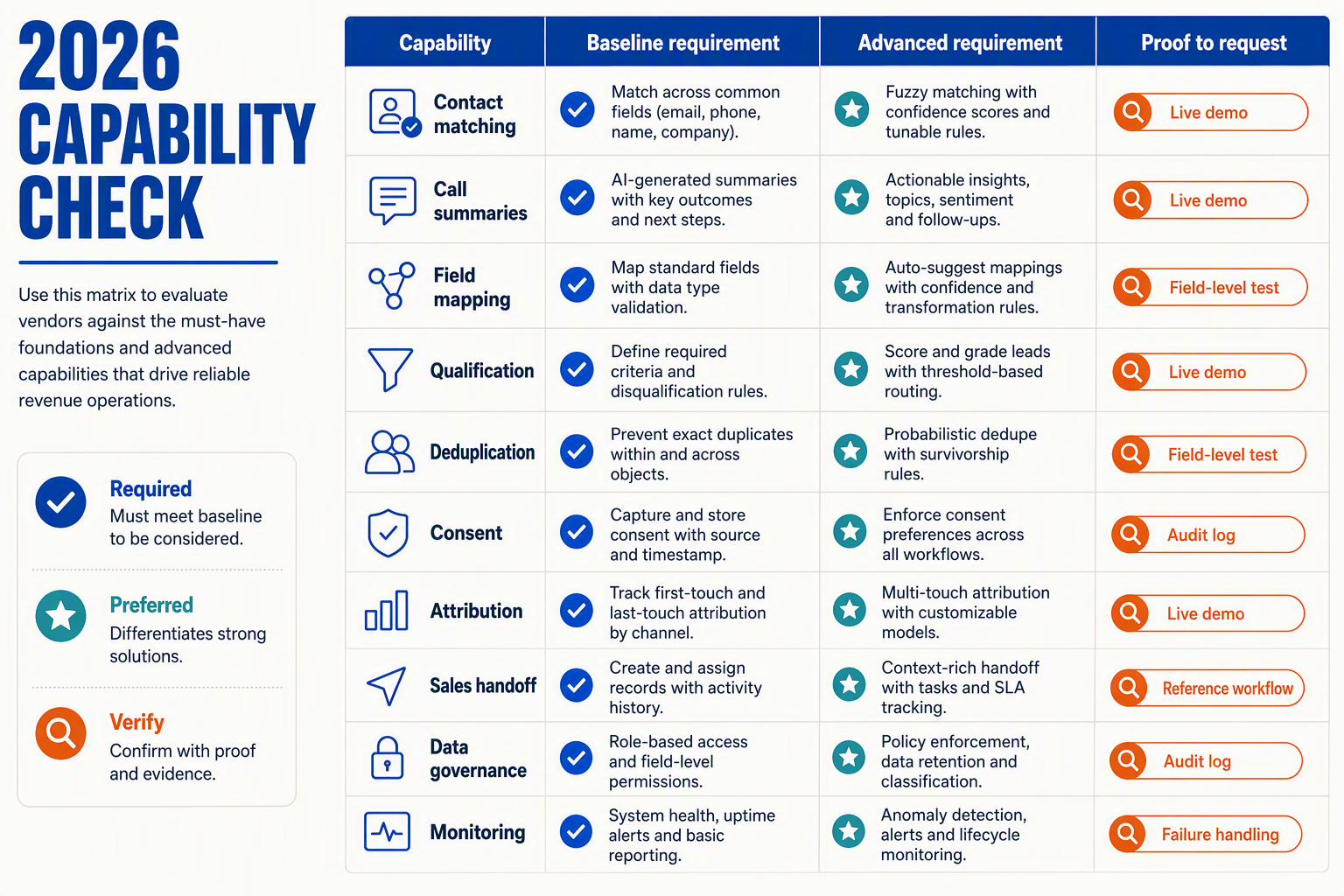
The most important 2026 capabilities are controlled contact matching, schema-governed field mapping, retry-safe deduplication, evidence-backed qualification, channel-specific preference tracking, and attributable sales handoff. Phone-number matching alone is not identity verification, and a transcript alone is not a complete CRM record.
Use these delivery labels when comparing products:
- Native: Performed within the AI receptionist platform.
- API/webhook-dependent: Requires supported events, APIs, authentication, retries, and monitoring.
- CRM-dependent: Relies on the destination CRM’s objects, permissions, duplicate rules, workflows, or attribution model.
- Custom implementation: Requires middleware, code, or business-specific configuration.
A capability may span several labels. Buyers should require vendors and implementation partners to identify which components are included, separately licensed, or left for the customer to build.
| Capability | Production requirement | Buyer acceptance test | Warning sign |
|---|---|---|---|
| Contact matching | Normalize valid numbers to E.164 where possible, search the permitted CRM objects, prioritize verified identifiers, and route ambiguous results for review. Dependency: usually native extraction plus CRM-dependent search and custom matching rules | Call from a known number, alternate number, shared number, malformed number, and withheld number; confirm that the system neither treats a number as verified identity nor updates an arbitrary match | The first phone-number match is updated without displaying competing records, match evidence, or review status |
| Summaries and call logging | Store timestamp, direction, duration, disposition, and an authorized recording or transcript reference; distinguish caller statements from generated summaries and retain processing status. Dependency: native summarization, API/webhook delivery, and CRM-dependent activity storage | Compare records with permitted source evidence across short, interrupted, multilingual, retried, and transferred calls; verify how unavailable or deleted recordings are represented | Free-form summaries are saved as facts without source references, timestamps, delivery status, or a correction path |
| Field mapping | Restrict writes to approved objects and fields; enforce data types, allowed values, overwrite rules, and field-level provenance. Dependency: API/webhook-dependent delivery, CRM schema and permissions, and often custom transformation logic | Test dates, currencies, locations, product names, spelling corrections, null values, and conflicting CRM data; inspect both successful and rejected writes | Generated text can overwrite authoritative identity, ownership, lifecycle, attribution, or compliance fields |
| Qualification and routing | Apply documented rules to relevant criteria such as intent, need, geography, urgency, availability, and budget; retain reason codes and permit human correction. Dependency: native extraction, CRM-dependent assignment, and custom business rules | Run the same scenarios across territories, languages, products, and opening hours; verify the assigned score, reason, owner, fallback queue, and escalation | An unexplained AI score controls routing, rejection, or prioritization without evidence or human override |
| Deduplication and attribution | Use stable interaction IDs or idempotency keys, CRM upsert controls, duplicate-review queues, source history, and an agreed first-touch/last-touch model. Dependency: API/webhook retry design, CRM duplicate and attribution features, and commonly custom middleware | Replay the same event, retry after a timeout, reconnect a caller, and continue through another channel; confirm that retries do not create duplicate contacts, activities, or opportunities | Every webhook or interaction creates a lead, or later activity silently replaces the original acquisition source |
| Consent, preferences, and follow-up | Store the applicable channel, purpose, notice or script version, timestamp, preference or permission status, revocation, and suppression scope. Dependency: native capture, CRM-dependent preference fields, channel-provider controls, and potentially custom suppression logic | Record an opt-out or restricted preference during a call, then test configured email, messaging, and outbound-voice workflows; verify that the correct scope is enforced | One undated checkbox is treated as permission for every purpose, jurisdiction, and communication channel |
| Ownership and sales handoff | Assign a named owner or queue, record assignment and acceptance timestamps, define service-level escalation, and preserve the originating interaction and campaign data. Dependency: primarily CRM-dependent, with API/webhook delivery and custom escalation where needed | Create leads during and outside business hours, reject an assignment, leave one unclaimed, and change territory; confirm reassignment and attribution history | A notification is treated as a completed handoff even though no owner accepted the lead and no escalation occurred |
Demand evidence supports better workflow design—not unreviewed automation
Salesforce’s 2024 State of Sales, Sixth Edition reported that sales representatives spent 30% of an average week connecting with customers. This survey finding supports reducing avoidable administration, but it does not establish that every machine-created record is accurate or that automation requires no review.
In December 2024, Gartner forecast that agentic AI would autonomously resolve 80% of common customer-service issues by 2029, with a 30% reduction in operational costs. As of August 10, 2026, that remains a forward-looking forecast—not a measured 2029 outcome or a performance guarantee for an AI receptionist. Buyers should assess actual completion, correction, escalation, and failure rates in their own workflows.
Minimum controls to require in a 2026 purchase
A credible AI receptionist CRM integration should provide or explicitly document:
- Configurable confidence handling: Automatically write only approved values that meet defined thresholds; route uncertain identity, extraction, or qualification results to a review queue.
- Field-level provenance: Distinguish caller-stated, CRM-derived, system-calculated, AI-inferred, and salesperson-confirmed values.
- Least-privilege access: Limit the integration account to the CRM objects and fields it needs. This is CRM-dependent and may require customer administration.
- Retry safety and observability: Use stable event identifiers, bounded retries, delivery logs, and a dead-letter or recovery process. These controls are usually API/webhook-dependent and may require custom implementation.
- Human ownership: Assign a representative or queue, define an acceptance deadline, and escalate unclaimed or failed handoffs through CRM workflows or custom automation.
- Closed-loop outcomes: Return meeting status, qualification corrections, and won/lost outcomes to reporting. Feeding those outcomes into model training should be a separate, governed decision.
- Retention and deletion controls: Apply documented policies to recordings, transcripts, summaries, and CRM fields, including downstream copies and backups where technically supported.
For multilingual deployments, test the full path—speech recognition, extraction, confirmation, summary generation, CRM character handling, routing, and follow-up templates—in every required language. Do not infer this coverage from a multilingual greeting or a general language-count claim.
Recording, transcription, retention, and outbound-contact requirements vary by jurisdiction, channel, purpose, and organization. Neither a recorded notice nor a CRM checkbox proves compliance by itself. Legal requirements and provider policies should be reviewed for each deployment, while the technical system should preserve the evidence and controls needed to apply the resulting rules.
How should contact matching, call summaries, field mapping and deduplication work together?
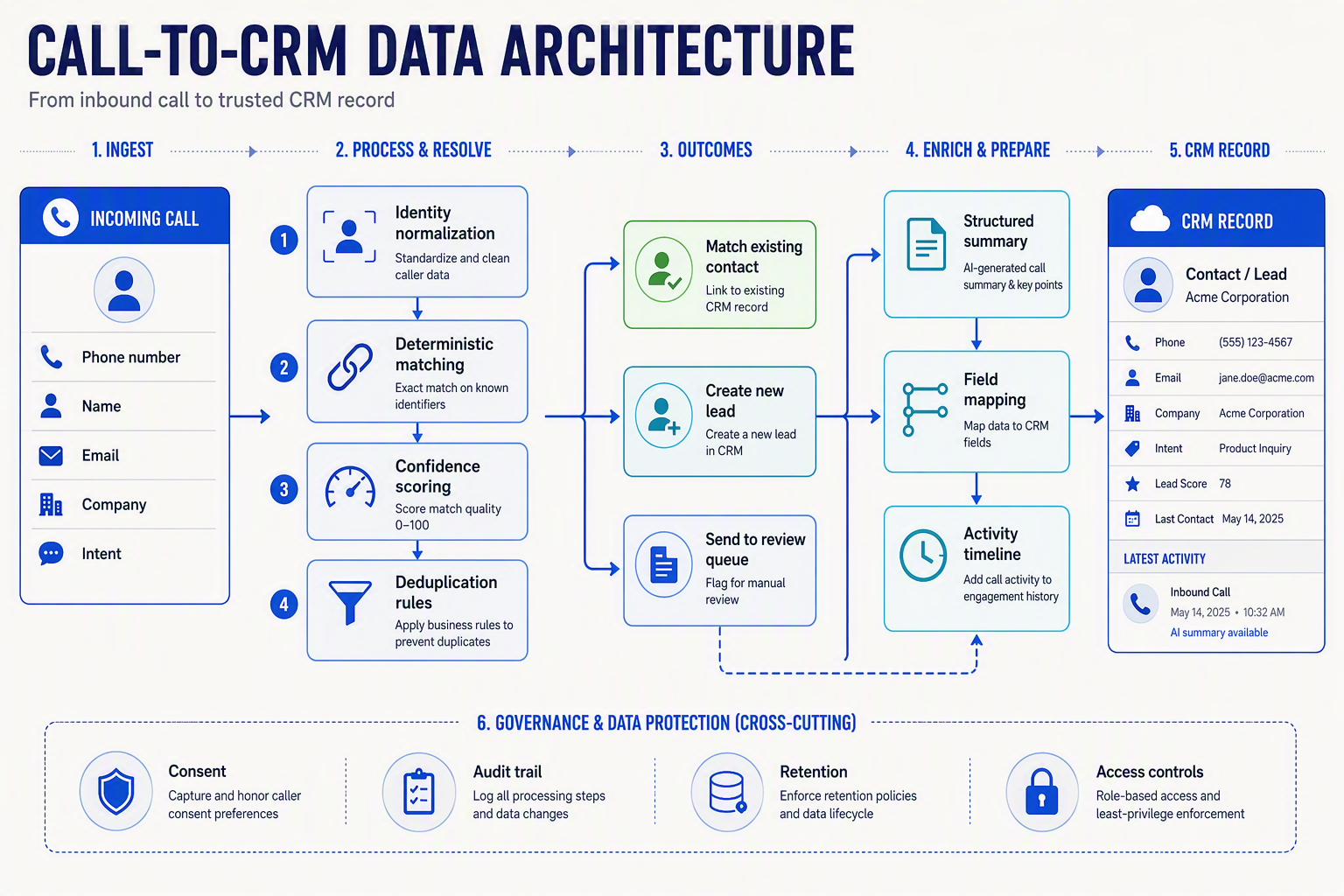
These functions should operate as one controlled pipeline: identify the caller, preserve the call as an immutable activity, extract structured facts, map only validated values, and then deduplicate before committing CRM changes. Matching and deduplication must also be rechecked after the conversation because the caller may provide a different number, email address, or company identifier.
1. Match identities using deterministic evidence first
An AI receptionist CRM integration should normalize every telephone number into the international E.164 format before searching the CRM. The International Telecommunication Union’s E.164 standard limits an international number to 15 digits, including the country code, helping systems compare numbers consistently.
A practical matching sequence is:
- Search for the normalized caller number.
- Compare verified email, customer ID, account number, or booking reference collected during the call.
- Check related records such as contacts under the same account.
- Use name, company, and location only as secondary evidence.
- Create a lead only when no sufficiently reliable match exists.
Teams should define confidence bands rather than letting a language model decide identity. An exact phone-and-email match may permit an automatic update; one matching phone number shared by several contacts should trigger clarification or human review. Reception numbers, family phones, recycled numbers, and callers using an assistant’s device make phone-only matching unsafe.
2. Separate the call record from the generated summary
The system should log the call event even if transcription, summarisation, or CRM synchronisation later fails. A durable automated call logging CRM record should contain:
- Call ID and telephony provider ID
- Start time, duration, direction, and disposition
- Matched contact ID and matching method
- Recording or transcript location, subject to consent and retention rules
- Agent version, workflow version, and sync status
- Human-readable summary and structured extraction output
The summary should distinguish what the caller stated from what the model inferred. “Caller needs delivery before 20 August” is evidence; “high-value prospect” is a classification requiring defined qualification rules. Store confidence, provenance, and source excerpts for important extracted values so salespeople can verify them quickly.
3. Map fields through an explicit schema
In voice AI CRM integration, free-form conversation data should never flow directly into unrestricted CRM writes. Each destination field needs a contract covering its type, permitted values, validation, and overwrite policy.
For example:
- “Next Friday” → an ISO-formatted date after confirming the caller’s timezone
- “About five lakh” → numeric budget
500000plus currencyINR - “Interested in enterprise plan” → approved product-interest picklist
- “Please WhatsApp me” → channel preference, not blanket marketing consent
Authoritative fields—such as verified legal name, account owner, contract status, or compliance preferences—should not be overwritten by AI lead capture automation without confirmation.
4. Deduplicate records and events before follow-up
Deduplication must cover both people and activities. Use CRM record IDs, normalized identifiers, provider call IDs, and idempotency keys so webhook retries cannot create repeated notes, tasks, or opportunities.
Before initiating AI sales follow-up, rerun matching against newly collected identifiers and apply three outcomes:
- Update one high-confidence existing record.
- Queue for review when multiple plausible records exist.
- Create a new lead only after deterministic checks fail.
This sequence keeps summaries useful, mappings predictable, and sales automation from amplifying a single matching error across calls, WhatsApp, email, and pipeline reporting.
How should qualification, consent, attribution, AI sales follow-up and sales handoff operate?
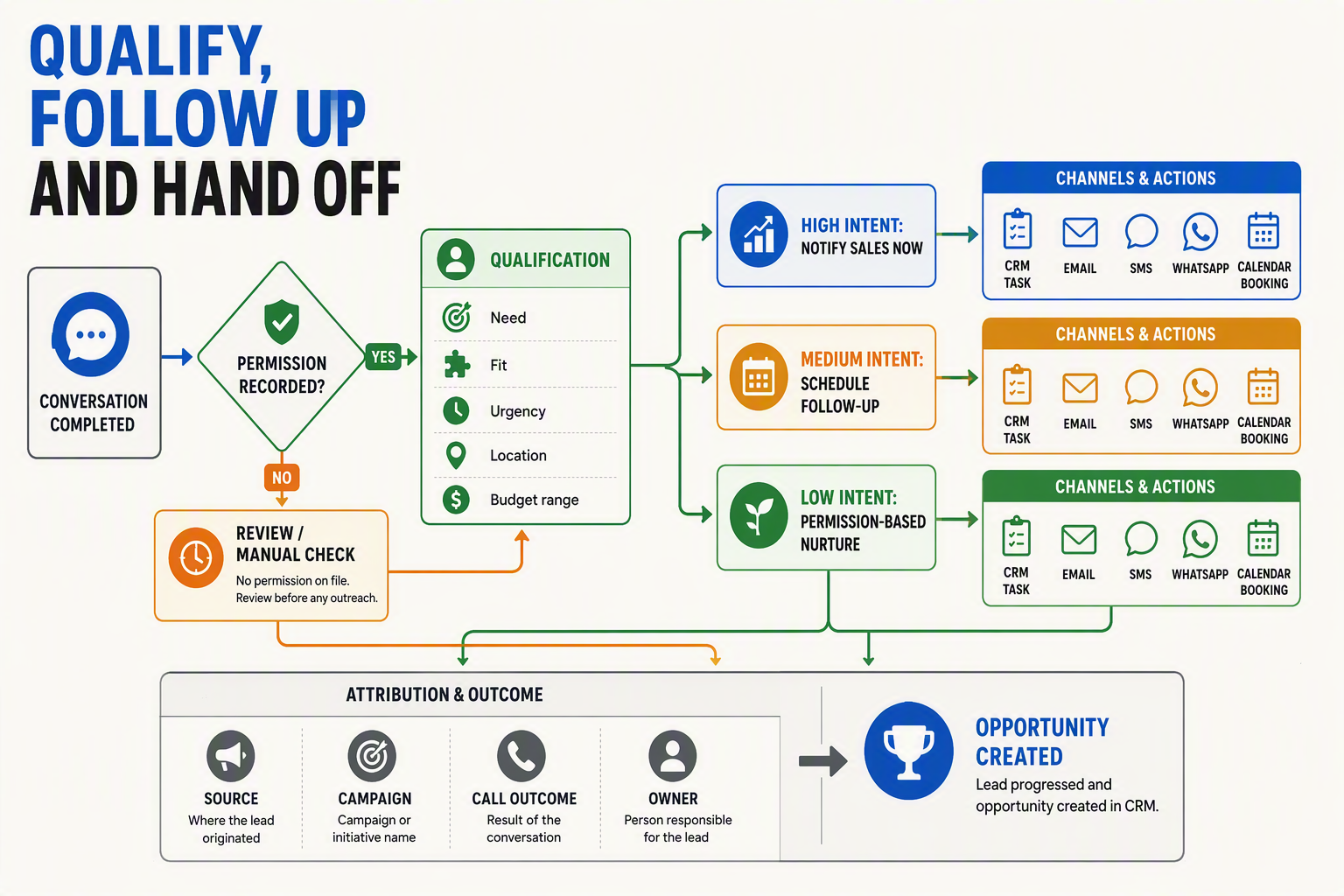
Qualification, consent, attribution, follow-up, and handoff should operate as a policy-controlled workflow, not as unrestricted model decisions. The AI may extract intent and recommend actions, but deterministic CRM rules should govern permissions, ownership, record changes, and when a salesperson takes control.
Qualify with evidence, not conversational confidence
An AI receptionist CRM integration should score prospects against criteria defined by the business, such as need, location, budget range, purchase timeline, product fit, and decision-making role. Each qualification field should retain its evidence source: caller statement, CRM history, campaign metadata, or model inference.
A practical workflow is:
- Capture answers using approved questions.
- Map explicit answers into structured CRM fields.
- Label inferred values separately with a confidence score.
- Apply a rules-based qualification threshold.
- Route ambiguous or high-value enquiries for human review.
For example, “I need 20 licences next month” can populate quantity = 20 and timeline = next month. The AI should not convert “we are exploring options” into a confirmed budget or sales-ready opportunity.
Treat consent as a channel-specific record
Consent to receive a call does not automatically establish permission for promotional WhatsApp messages, email campaigns, or future automated calls. India’s Digital Personal Data Protection Act, 2023, which received presidential assent on August 11, 2023, requires consent requests to be clear, specific, informed, and capable of being withdrawn.
The CRM should record:
- Purpose: quotation, appointment reminder, support, or marketing.
- Channel: voice, WhatsApp, SMS, or email.
- Capture method: spoken confirmation, web form, checkbox, or existing contract.
- Timestamp and notice version: when and under which wording consent was obtained.
- Withdrawal status: including suppression-list updates.
An automated call logging CRM workflow should store the consent event and relevant excerpt, rather than relying on an unsupported Boolean field such as consent = true.
Preserve attribution through the complete journey
Attribution should be captured before contact creation and protected from later overwrites. Store first-touch source, latest-touch source, campaign, landing page, referrer, UTM parameters, click identifiers, dialled number, and call-session ID as distinct fields.
If someone clicks a search advertisement, calls a campaign-specific number, later returns through WhatsApp, and then books a meeting, the system should retain both the original acquisition source and the converting interaction. Voice AI CRM integration must also distinguish “unknown” from “organic”; missing metadata is not evidence of an organic lead.
Make AI sales follow-up permissioned and bounded
AI sales follow-up should select the next approved action based on qualification, consent, customer preference, local time, and CRM ownership. Useful actions include:
- Sending a requested brochure or quotation.
- Confirming an appointment over WhatsApp or email.
- Creating a salesperson task with a due time.
- Scheduling a permitted callback.
- Pausing automation after a reply, opt-out, complaint, or human takeover.
Platforms such as CallMissed can connect AI voice agents with WhatsApp chat and WhatsApp Business calling, supporting AI lead capture automation across related channels. The CRM should remain the authority for ownership and suppression status.
Hand off context, accountability, and urgency
A sales handoff needs more than a transcript. Deliver a concise summary, qualification fields, objections, promised actions, attribution, consent status, recording link, and recommended next step. Assign a named owner and SLA, then escalate unaccepted leads rather than silently re-routing them.
Measure time to acceptance, time to first human contact, meeting conversion, opt-out rate, reassignment rate, and reopened qualification decisions. These metrics reveal whether automation is creating sales capacity—or merely creating more CRM activity.
Which CRM integrated virtual receptionist is best for your business? A vendor-neutral scorecard and CallMissed fit
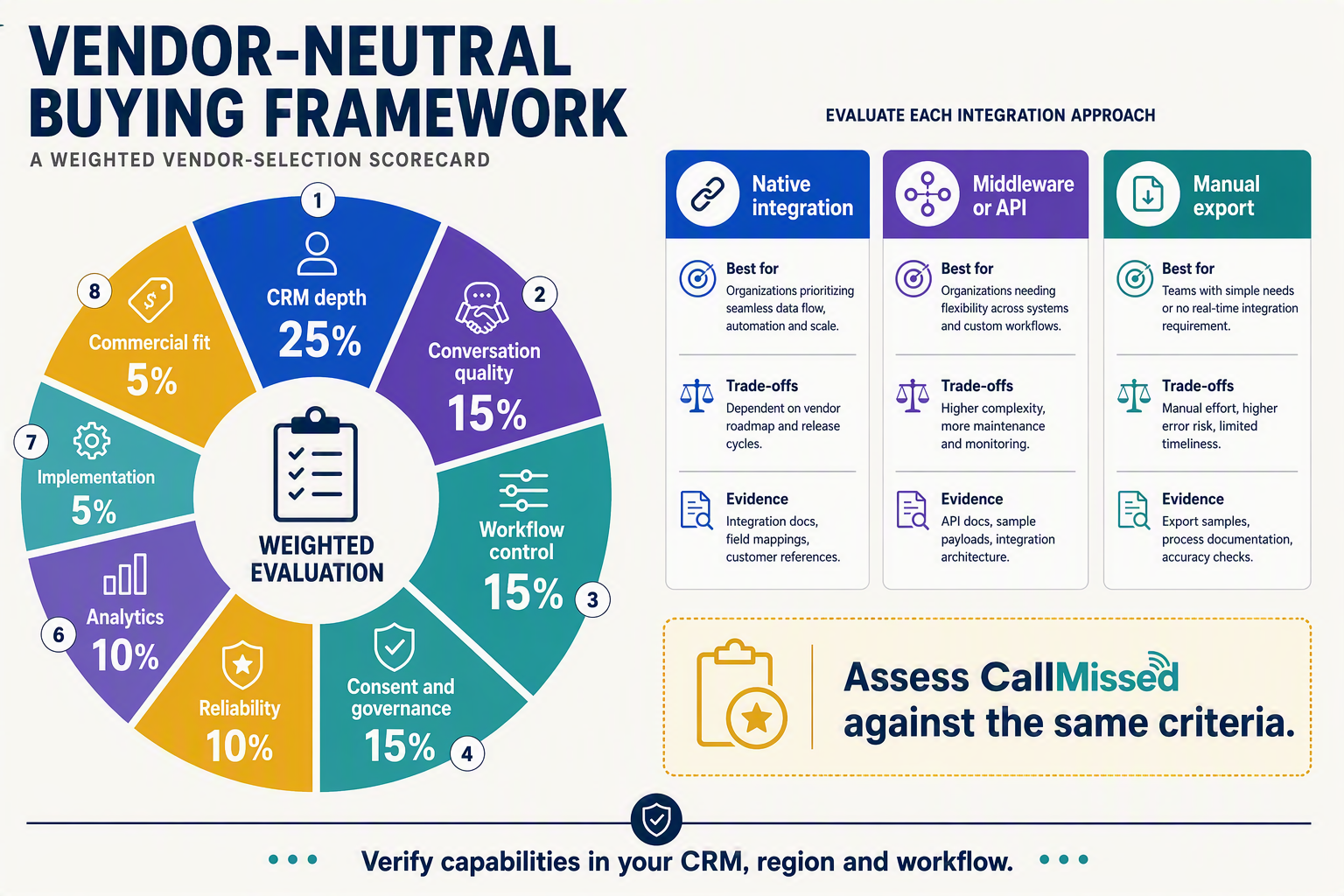
The best CRM-integrated virtual receptionist is the one that preserves record accuracy, consent, attribution, and ownership under real-world failure conditions—not necessarily the one with the longest feature list. Use a weighted proof-of-concept scorecard based on your CRM, languages, channels, call volumes, and sales workflow.
Vendor-neutral evaluation scorecard
Score each vendor from 0 to 5, multiply that score by the suggested weight, and test every critical capability in a sandbox CRM such as Salesforce, HubSpot, Zoho CRM, Microsoft Dynamics 365, or your chosen system.
| Evaluation area | Weight | What to test | Disqualifying warning |
|---|---|---|---|
| Identity and data integrity | 20% | Phone normalization, contact matching, confidence thresholds, shared-number handling, deduplication | Silently creates contacts or overwrites trusted fields |
| CRM workflow depth | 20% | Leads, contacts, accounts, deals, activities, owners, custom objects, retries and bidirectional updates | Integration supports only transcript notes |
| Conversation quality | 15% | Accuracy across accents, languages, interruptions, noise and industry terminology | Demo works only with scripted English calls |
| Qualification and handoff | 15% | Configurable scoring, mandatory fields, booking, routing and live escalation | Model independently changes qualification rules |
| Consent and governance | 15% | Recording notices, opt-outs, retention, role-based access, audit logs and deletion | Consent evidence cannot be exported |
| Follow-up and channels | 10% | Permission-aware WhatsApp, SMS, email, callback and salesperson tasks | Follow-up ignores channel preference |
| Reliability and economics | 5% | CRM outage queues, idempotency, latency, support, usage pricing and exit options | Failed writes disappear without alerts |
Treat identity and CRM workflow depth as gating criteria even when another vendor wins on voice naturalness. An impressive conversation still produces a poor AI receptionist CRM integration if it attaches the summary to the wrong account.
Run a scenario-based proof of concept
A product demonstration is insufficient. Test at least these workflows with synthetic records and approved internal callers:
- A new prospect calls twice using differently formatted versions of the same number.
- Two family members or employees call from one shared number.
- An existing customer asks about a new product but should not become a duplicate lead.
- A multilingual caller switches languages and requests WhatsApp follow-up.
- The CRM becomes unavailable after qualification but before activity creation.
- A caller withdraws marketing consent after a meeting has been booked.
Inspect the resulting objects, timestamps, source campaign, owner assignment, consent evidence and retry history. For voice AI CRM integration, require vendors to show both the successful path and the exception queue. For an automated call logging CRM workflow, verify that repeated webhook delivery does not create repeated activities.
Where CallMissed fits
CallMissed is a strong fit to evaluate when the buying requirements include Indian-language engagement, WhatsApp-centric journeys, or several communication channels in one operating environment. CallMissed supports Speech-to-Text and Text-to-Speech across 22 Indian languages and combines AI voice agents, WhatsApp chatbots, WhatsApp Business calling, email, web engagement, a knowledge-base retrieval layer, and an omnichannel inbox/CRM.
That combination is particularly relevant for AI lead capture automation that begins with a phone or WhatsApp Business call and continues through permission-aware WhatsApp or email follow-up. Its ability to bridge WhatsApp Business calls to an AI voice agent is also useful where customers already treat WhatsApp as their primary business channel.
CallMissed should still be assessed against the same scorecard. Confirm the required external CRM objects, custom-field mappings, webhook behavior, regional data requirements and escalation rules through a proof of concept. Choose it when its Indic-first voice coverage and WhatsApp-native workflow match the commercial journey—not merely because it offers broad functionality.
Ultimately, effective AI sales follow-up depends on trustworthy CRM state. Select the platform that demonstrates accurate writes, recoverable failures and auditable consent with your own data model.
What are the commercial impacts, operational risks and data-governance implications?
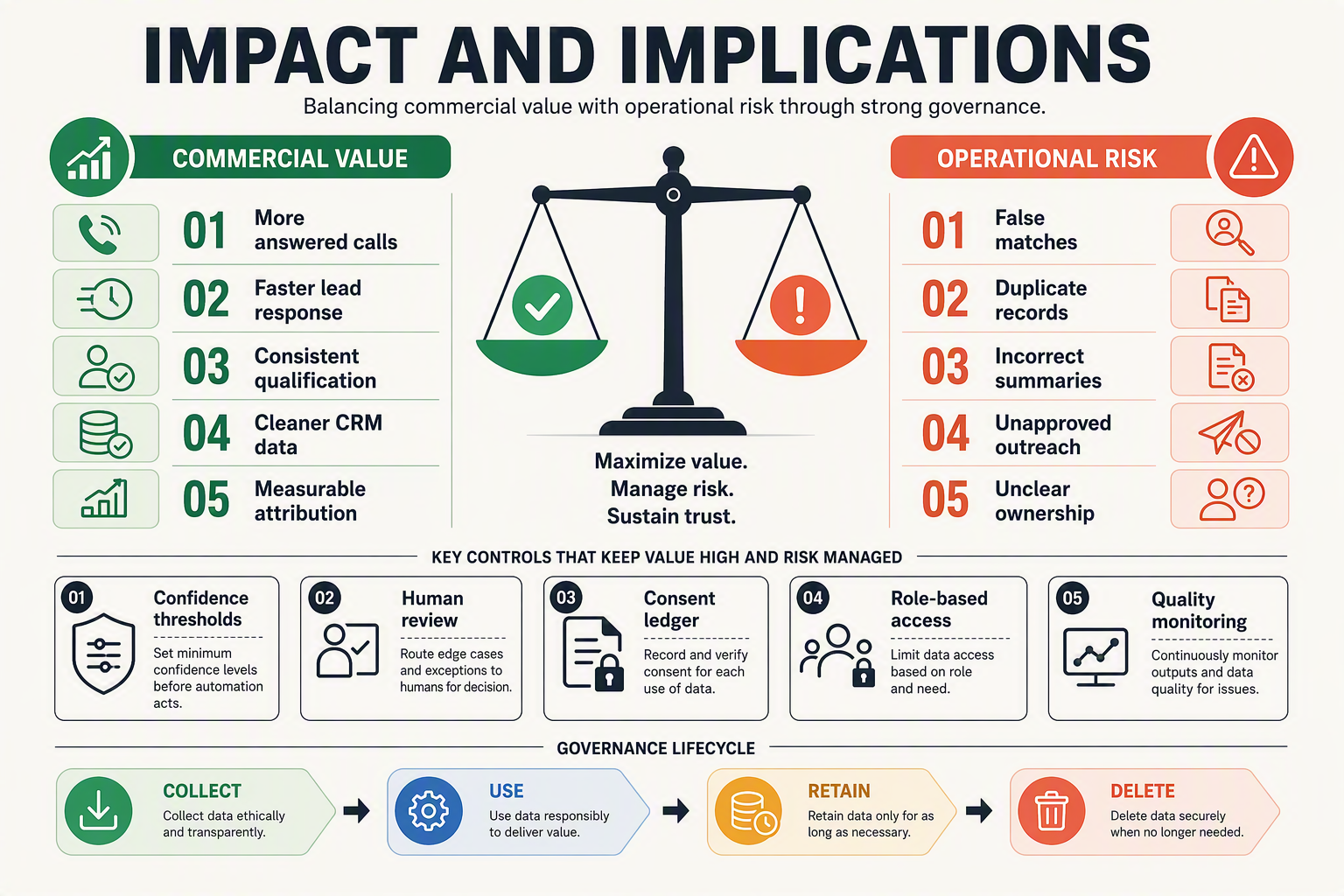
CRM-integrated AI receptionists can improve conversion, response speed and salesperson capacity, but they also turn every conversation into a consequential data-processing workflow. The commercial upside therefore depends on whether AI receptionist CRM integration creates trustworthy pipeline rather than faster, larger volumes of inaccurate records.
Commercial impact: measure outcomes, not answered calls
The business case should connect voice AI CRM integration to revenue and operating efficiency. Answer rate alone is insufficient because an answered call has little value if the prospect is misclassified, duplicated or never contacted again.
Track a controlled baseline and report:
- Lead-capture rate: conversations producing a usable, consented CRM record.
- Qualification accuracy: AI outcomes confirmed by salespeople versus false positives and missed opportunities.
- Speed to follow-up: median time from call completion to task, message or salesperson contact.
- Qualified-lead conversion: opportunities or sales divided by AI-qualified leads.
- Cost per qualified lead: telephony, model, integration and review costs divided by accepted leads.
- Attribution completeness: records retaining valid campaign, number, landing-page or referral provenance.
Salesforce reported in its 2024 State of Sales, Sixth Edition that representatives spend only 30% of an average week connecting with customers. Effective AI lead capture automation can return time to sellers, but only if summaries, ownership and next actions reduce manual verification instead of creating cleanup work.
Use holdout groups or phased branches where possible. Compare conversion and data-quality outcomes against human-only handling while controlling for channel, region, language and lead source.
Operational risks can silently corrupt the pipeline
Failures are not limited to complete outages. An automated call logging CRM workflow can appear healthy while producing incorrect business outcomes.
High-priority failure modes include:
- Identity collisions: shared numbers or recycled phone numbers update the wrong contact.
- Non-idempotent retries: repeated webhooks create duplicate leads, tasks and opportunities.
- Unsupported field values: generated qualification labels fail CRM validation or map to the wrong stage.
- Partial writes: the summary is stored, but consent evidence, attribution or ownership is lost.
- CRM downtime: calls succeed while queued updates expire or replay out of order.
- Unsafe automation: an inaccurate summary triggers pricing, eligibility or commitment messages.
Mitigations should include confidence thresholds, idempotency keys, dead-letter queues, schema validation, reconciliation reports and human review for low-confidence or high-value records. AI sales follow-up should pause automatically when consent, identity, routing or CRM-write status is uncertain.
Data governance must follow the conversation end to end
Governance covers audio, transcripts, extracted fields, embeddings, summaries and model-provider logs—not merely the final CRM record. India’s Digital Personal Data Protection Act, 2023 permits penalties of up to ₹250 crore for failure to take reasonable security safeguards to prevent a personal-data breach. The European Union’s General Data Protection Regulation allows fines up to €20 million or 4% of worldwide annual turnover, whichever is higher, for specified infringements.
A buyer should require:
- Documented purposes and lawful bases for recording, transcription and follow-up.
- Clear AI and recording disclosures appropriate to each jurisdiction.
- Data minimisation, configurable retention and deletion across backups and subprocessors.
- Encryption, role-based access, audit logs and separation of production from test data.
- Regional processing options and an inventory of model, speech and telephony providers.
- Procedures for access, correction, deletion, objection and consent withdrawal.
- Human approval for consequential decisions and suppression-list enforcement.
The governing principle is simple: automate actions only when identity, permission and data provenance are sufficiently reliable—and preserve evidence explaining every decision.
What do RevOps, sales, compliance and CRM experts recommend evaluating before purchase?

Buyers should evaluate a CRM-integrated AI receptionist as a revenue-data system, not merely a voice bot. RevOps, sales, compliance, and CRM administrators should jointly approve measurable acceptance criteria covering data accuracy, workflow outcomes, governance, and failure recovery before purchase.
RevOps: test revenue-data integrity
RevOps should require a sandbox pilot using representative calls, shared phone numbers, repeat customers, and incomplete records. Evaluate:
- Match precision and abstention: Can the system avoid updating a record when identity confidence is insufficient?
- Idempotency: If a webhook is retried, does it update the existing activity rather than create another lead?
- Attribution preservation: Are original source, campaign, keyword, landing page, and first-touch timestamps protected from later calls?
- Reporting consistency: Can dashboards distinguish answered calls, qualified leads, appointments, transfers, and failed follow-ups?
- Unit economics: Calculate costs per handled call and qualified lead, including telephony, model usage, transcription, messaging, CRM operations, storage, and support.
For AI lead capture automation, ask vendors to disclose measured match, duplicate, field-completion, and routing rates from the pilot—not a generic “accuracy” score.
Sales: evaluate whether automation improves actionability
Sales leaders should judge whether records are useful within seconds of the conversation. Salesforce reported in its 2024 State of Sales, Sixth Edition that representatives spend only 30% of an average week connecting with customers, so automation should remove administration rather than create another review queue.
Test whether AI sales follow-up provides:
- A concise summary with the caller’s need, urgency, objections, and agreed next step.
- Evidence links or transcript timestamps for extracted qualification fields.
- Correct territory, account owner, language, product, and priority routing.
- Service-level timers, escalation paths, and reassignment when an owner is unavailable.
- A clear pause mechanism when a salesperson takes control of the conversation.
Require salespeople to score pilot records for accuracy and usefulness; completion alone does not prove commercial value.
Compliance: demand enforceable controls
Compliance teams should verify the exact data path for audio, transcripts, summaries, model providers, CRM storage, and subprocessors. Essential questions include:
- How are recording notices, consent status, purpose, channel preference, and withdrawal captured?
- Can retention differ by audio, transcript, summary, and CRM field?
- Are role-based access, encryption, deletion workflows, and immutable audit logs available?
- Is customer data used for model training, and can that use be contractually disabled?
- How does the vendor handle cross-border transfers and jurisdiction-specific calling rules?
The Digital Personal Data Protection Act, 2023 establishes India’s framework for processing digital personal data, while the European Union’s GDPR Article 5 defines principles including purpose limitation, data minimisation, and storage limitation. Legal counsel should map these requirements to each deployment market rather than rely on a vendor’s broad “compliant” label.
CRM administrators: inspect integration engineering
For any AI receptionist CRM integration or voice AI CRM integration, CRM experts should review object schemas, field ownership, API limits, authentication, webhook signing, retry behaviour, versioning, and observability. An automated call logging CRM workflow should expose failed writes and reconciliation queues instead of silently dropping activities.
Before signing, run four procurement gates:
- Sandbox acceptance tests with known expected records.
- Security and data-processing review covering every subprocessor.
- Failure drills for CRM outages, duplicate webhooks, and low-confidence matches.
- Exit testing proving that recordings, transcripts, mappings, and audit records can be exported or deleted.
For multilingual Indian deployments, platforms such as CallMissed can be assessed against the same framework while testing their Indic-first speech support across 22 Indian languages and WhatsApp Business calling workflows with real regional accents and CRM schemas.
What does this mean for you? A phased implementation and validation checklist
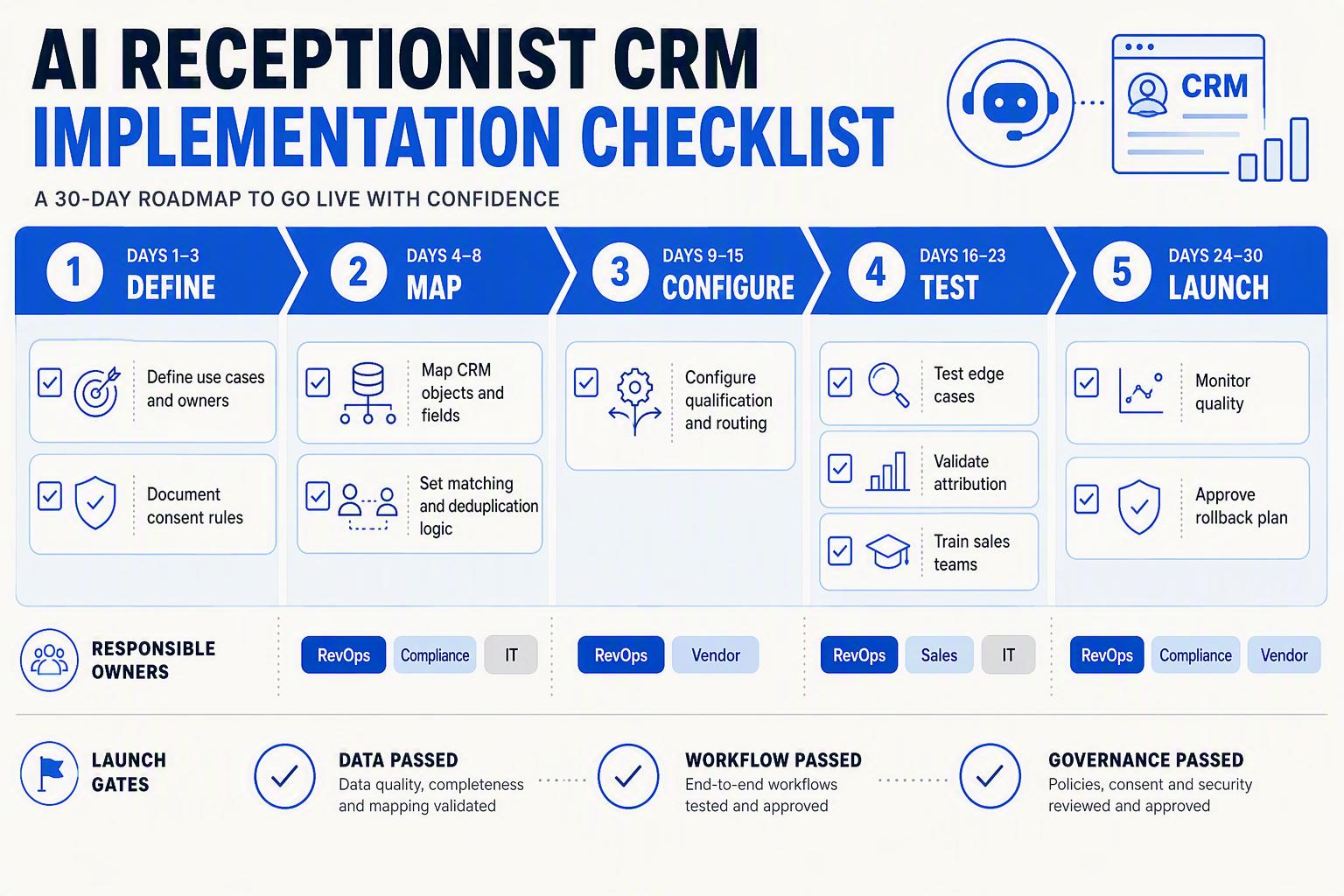
A CRM-integrated AI receptionist should be deployed in controlled phases, with each phase passing measurable data-quality, compliance, and sales-operability gates before traffic increases. Do not treat a successful API connection as proof of a production-ready workflow.
Phased rollout and acceptance gates
| Phase | Implementation scope | Validation checklist | Exit criterion |
|---|---|---|---|
| 1. Map and govern | Document call events, CRM objects, field ownership, consent states, attribution rules, retention, and human escalation. | Identify authoritative versus AI-populated fields; assign an owner for every workflow; define what must never enter summaries or transcripts. | Data, sales, compliance, and operations owners approve the schema and responsibility matrix. |
| 2. Build in a sandbox | Connect telephony and a CRM test environment; configure identity resolution, deduplication, summaries, qualification, and routing. | Test normalized numbers with country codes, shared numbers, unknown callers, repeat callers, conflicting records, missing fields, and CRM timeouts. | No uncontrolled overwrites; every write includes a timestamp, source, conversation ID, and processing status. |
| 3. Replay representative calls | Run recorded or scripted scenarios across languages, accents, intents, and noise conditions. | Compare transcripts and structured fields with human-reviewed ground truth; inspect unsupported claims, incorrect entities, and qualification errors. | The team-defined accuracy threshold is met for each critical field—not merely average transcription accuracy. |
| 4. Shadow production | Let the system process live calls without automatically changing customer records or contacting leads. | Compare proposed contact matches, lead creation, attribution, consent interpretation, owner assignment, and AI sales follow-up against human decisions. | High-risk errors are within the approved tolerance, and every rejected action can be traced to its rule or model output. |
| 5. Limited automation | Enable automated call logging CRM writes and low-risk tasks for one team, location, campaign, or call type. | Monitor duplicate rate, unmatched-call rate, write failures, routing latency, follow-up completion, opt-outs, and salesperson corrections. | Metrics remain stable through a representative business cycle, with rollback and manual queues tested successfully. |
| 6. Scale and optimize | Expand traffic, channels, languages, and automated actions while retaining human review for exceptions. | Segment performance by source, language, intent, team, and channel; review model or prompt changes through versioned regression tests. | Each expansion passes the same gates, and ongoing audits have named owners and schedules. |
Minimum production test pack
Before enabling AI receptionist CRM integration at scale, run at least these cases:
- Identity: existing contact, duplicate contacts, new prospect, shared family or office number, withheld caller ID, and a caller using a different WhatsApp number.
- Data integrity: corrected spellings, contradictory statements, empty values, very long calls, interruptions, transfers, and repeated calls about the same requirement.
- Compliance: explicit opt-in, refusal, consent withdrawal, channel-specific permission, recording disclosure, and a request to delete or restrict data.
- Resilience: CRM rate limits, expired credentials, webhook retries, duplicate events, telephony interruption, and delayed transcription.
- Sales operations: urgent lead, low-fit enquiry, existing customer support request, out-of-territory prospect, unavailable owner, and missed follow-up deadline.
For multilingual deployments, include code-switching and regional-language scripts rather than validating only English. CallMissed, for example, supports speech across 22 Indian languages and can bridge WhatsApp Business calls to an AI voice agent, making language-specific and channel-specific validation essential.
Metrics that determine readiness
Track match precision, duplicate creation, mandatory-field completion, consent capture, attribution preservation, write-failure recovery, handoff latency, and correction rate. Evaluate voice AI CRM integration and AI lead capture automation by business-critical field and workflow: a correct summary cannot compensate for the wrong contact, owner, permission state, or next action.
The final release decision should be simple: scale only when errors are observable, reversible, attributable, and owned.
Frequently asked questions about CRM compatibility, setup, consent, accuracy, cost and ROI
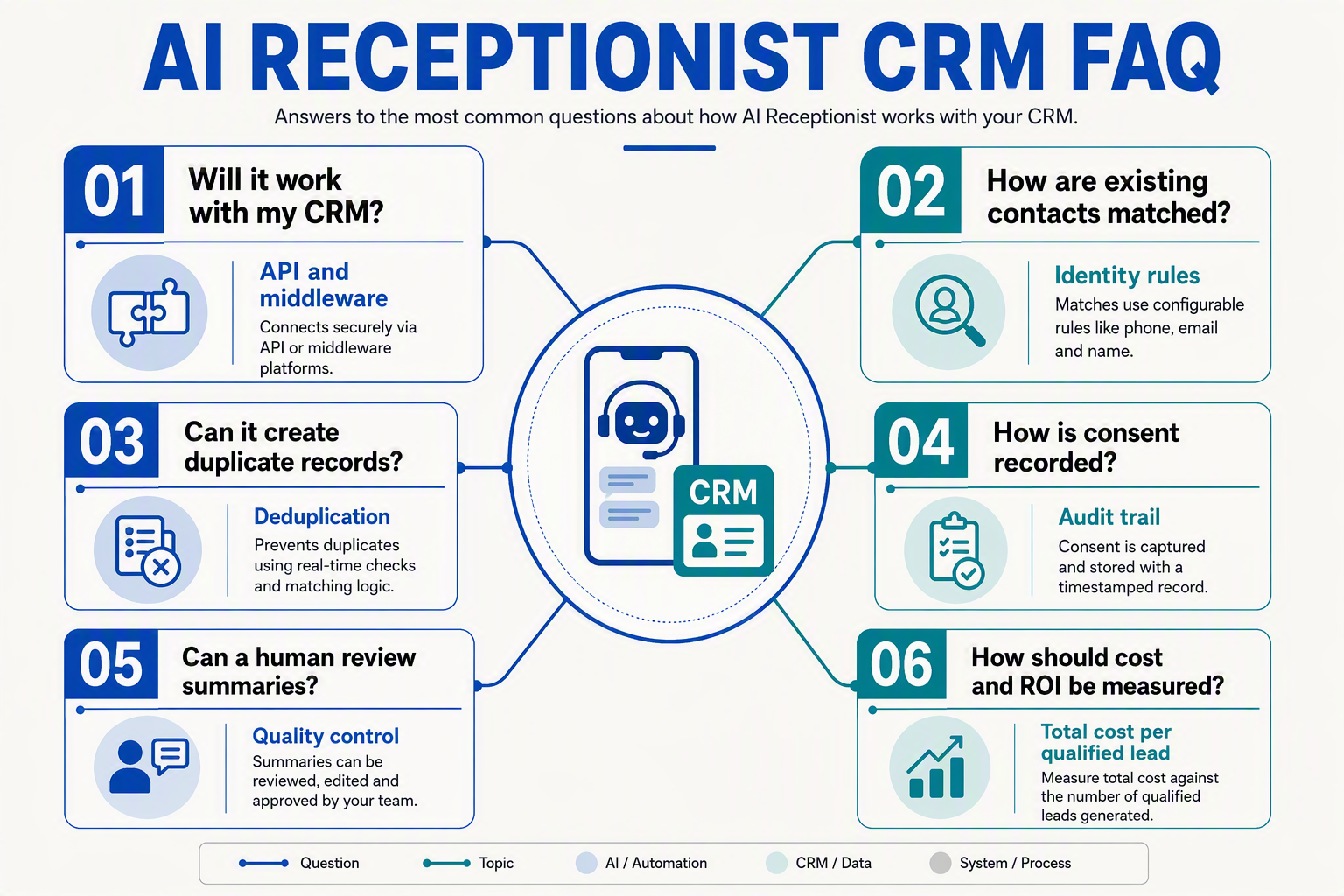
Which CRMs are compatible with AI receptionist CRM integration?
How long does voice AI CRM integration take to set up?
How should an AI receptionist capture consent for calls and follow-up messages?
How accurate is AI receptionist CRM integration for contact matching and lead qualification?
What does AI lead capture automation and AI sales follow-up cost?
How do I calculate ROI from an AI receptionist CRM integration?
Conclusion
AI receptionist CRM integration succeeds when every conversation becomes an accurate, permissioned, and actionable CRM record—not merely a transcript. In 2026, buyers should evaluate the complete workflow from caller identification through qualification and sales handoff, with controls that protect trusted customer data.
The central lessons are:
- Identity and data quality come first. Reliable voice AI CRM integration should normalize phone numbers, use multiple identifiers and confidence thresholds, and route uncertain matches for review. Deduplication rules must prevent one caller from becoming several leads or an existing customer from being treated as a new prospect.
- Summaries require structured, controlled field mapping. An automated call logging CRM workflow should separate model-generated notes from authoritative fields, preserve the original call context, and record which system or person changed each value. AI should propose updates rather than silently overwrite verified data.
- Qualification must lead to accountable action. Effective AI lead capture automation records requirements, intent, consent, attribution, channel preference, and ownership before creating an opportunity or task. AI sales follow-up should then use the permitted channel—voice, WhatsApp, email, or a salesperson callback—without losing the conversation history.
- Governance and resilience are buying criteria. Teams should test role-based access, transcript retention, CRM-outage handling, multilingual calls, shared phone numbers, latency, API compatibility, routing failures, and total operating cost before production rollout.
The commercial case for this discipline is significant. Salesforce’s 2024 State of Sales, Sixth Edition reported that sales representatives spend only 30% of an average week connecting with customers. Gartner predicted in December 2024 that agentic AI will autonomously resolve 80% of common customer-service issues by 2029 while reducing operational costs by 30%. Those gains depend on automation producing dependable records and next actions, not simply answering more calls.
Looking ahead, watch for receptionists that execute increasingly complex workflows while maintaining confidence scoring, consent evidence, source attribution, and human escalation. Platforms such as CallMissed illustrate this direction by connecting AI voice agents, WhatsApp chat and Business calling, an omnichannel inbox, and speech support across 22 Indian languages.
The defining question is no longer whether an AI can answer the phone: can your integration turn every qualified conversation into the right follow-up without compromising trust?
Related Reading
Discussion
Related Posts

Ready to automate customer conversations?
Launch AI voice agents and WhatsApp bots with CallMissed — one API, 22+ Indian languages.