
Retail AI Receptionist and WhatsApp Automation: 2026 Multi-Location Implementation Guide


Implement a retail AI receptionist and retail WhatsApp automation with safe workflows, integrations, testing, escalation, and measurable KPIs.
Retail AI Receptionist and WhatsApp Automation: 2026 Multi-Location Implementation Guide
WhatsApp passed 3 billion monthly active users, Meta CEO Mark Zuckerberg confirmed during Meta’s April 2025 earnings call—making messaging too large for retailers to treat as a secondary support channel. A well-designed retail AI receptionist and WhatsApp automation system can answer routine questions immediately, preserve context across phone and chat, and route sensitive or commercially important cases to the right store employee.
For multi-location retailers, the challenge is not simply “adding a bot.” Customers expect accurate answers about opening hours, the nearest branch, product availability, pickup readiness, appointments, refunds, and delayed orders. Those answers may depend on store-specific calendars, live inventory, order-management systems, customer identity, and local policies. A generic assistant working from static FAQs can easily quote the wrong hours or promise stock that another shopper has already purchased.
The multilingual requirement is equally significant in India. The Constitution of India recognizes 22 scheduled languages, while the Census of India 2011 recorded 121 languages spoken by at least 10,000 people. Effective store customer service AI therefore needs more than translated scripts: it must recognize regional accents, preserve product names and order numbers, and transfer conversations without forcing customers to repeat themselves.
From answering calls to completing safe workflows
This guide explains how to implement AI phone answering for retail without giving automation unrestricted control over payments, refunds, or customer records. You will learn how to design and deploy workflows for:
- Store hours, directions, holiday closures, and location-specific FAQs
- Product-enquiry intake and stock verification against commerce systems
- Order, delivery, click-and-collect, and pickup-status updates
- Appointment booking, rescheduling, and cancellation
- Missed-call recovery through permission-aware WhatsApp follow-ups
- Multilingual voice and messaging across regional markets
- Identity verification, escalation, refund boundaries, and human approval
- CRM, point-of-sale, inventory, order-management, and calendar integrations
The implementation sections also cover test scenarios for hallucinations, stale inventory, duplicate bookings, noisy calls, ambiguous store names, and failed integrations. You will get practical KPIs—including containment rate, first-response time, transfer accuracy, booking completion, missed-call recovery, stock-answer accuracy, and customer satisfaction—to evaluate whether retail WhatsApp automation is improving service rather than merely deflecting contacts.
Platforms such as CallMissed reflect this shift by combining AI voice agents, WhatsApp chat and Business calling, an omnichannel inbox, and support for 22 Indian languages. The goal for 2026 is not a receptionist that answers everything; it is a controlled retail service layer that responds instantly, uses verified operational data, and knows exactly when a human should take over.
Introduction: Use a five-step rollout—scope, connect, guardrail, pilot, and optimize
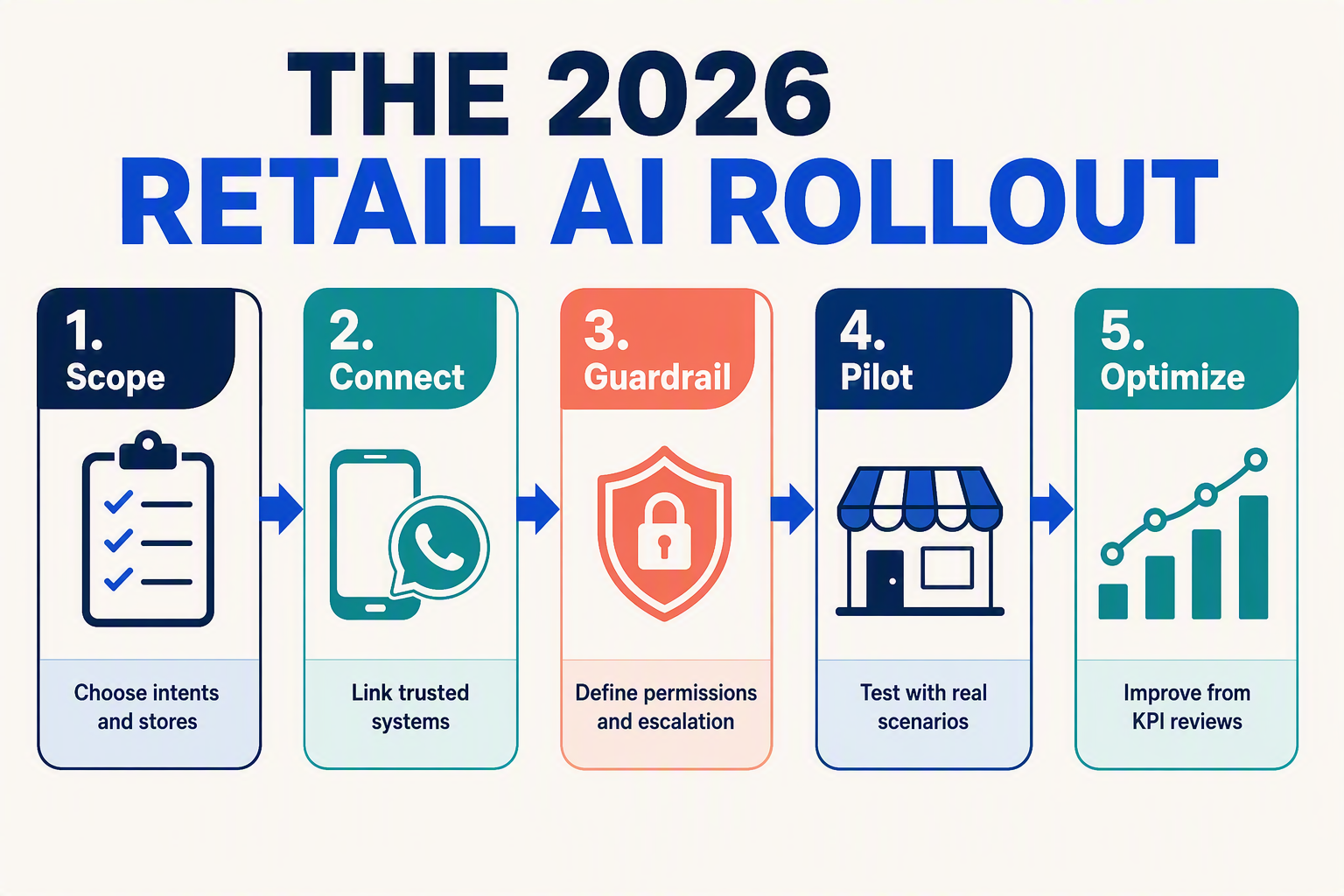
A reliable 2026 rollout for voice and WhatsApp customer service follows five steps: scope, connect, guardrail, pilot, and optimize. This sequence helps multi-location retailers automate routine enquiries while keeping store data, sensitive actions, and employee escalation under operational control.
1. Scope high-value customer journeys
Begin with frequent, low-risk requests rather than attempting complete automation. Review recent call recordings, missed-call logs, WhatsApp conversations, and support tags to identify repeatable journeys suitable for a retail AI receptionist.
Initial workflows can include:
- Answering store-hours, address, landmark, and service-area questions
- Finding the nearest location based on a postcode or customer-provided area
- Capturing product, size, colour, quantity, and preferred-store requirements
- Checking order, delivery, or pickup status after identity verification
- Booking appointments through an approved calendar
- Following up on missed calls through permission-aware messaging
Define what successful completion means for each journey. A product enquiry is complete only when the system records the requested variant and location, checks an authoritative source where available, explains whether the result is current, and offers escalation if availability remains uncertain.
2. Connect authoritative retail systems
Store customer service AI should retrieve operational facts instead of generating unsupported answers. Build a central location registry containing branch identifiers, addresses, landmarks, regular hours, holiday exceptions, available services, supported languages, and escalation contacts.
Connect the assistant to relevant systems through authenticated interfaces:
- Relatively stable data: addresses, parking details, and policy summaries
- Scheduled data: holiday hours, closures, and appointment availability
- Dynamic data: inventory, pickup readiness, and delivery status
- Sensitive data: customer records, payments, refunds, and account details
Treat stock information carefully. An inventory result should identify its store and update time; it should not be described as reserved unless the commerce system has successfully created a reservation.
3. Guardrail identity, payments, and refunds
Set firm action boundaries before enabling AI phone answering for retail. The assistant may explain a published returns policy, but it should not approve a refund unless an authorized workflow explicitly permits that action.
Never request a card PIN, CVV, one-time password, or complete payment credentials over a call or WhatsApp conversation. Apply verification according to risk: public store information requires no identity check, while order status may require an order number and a verified customer identifier.
Escalate immediately when there is failed verification, a disputed payment, a safety complaint, a legal threat, suspected fraud, repeated misunderstanding, or a request outside the assistant’s approved scope.
4. Pilot representative stores and edge cases
Test retail WhatsApp automation and voice in a deliberately varied group of locations. Include stores with different enquiry volumes, languages, operating schedules, and stock-transfer patterns.
Start in observation or employee-assist mode, then enable limited customer-facing tasks. Test:
- Similar branch names and incorrect location assumptions
- Holiday exceptions and temporary closures
- Noisy calls, interruptions, and code-switched speech
- Customers changing languages during a conversation
- Unavailable APIs, stale inventory, and delayed responses
- Duplicate appointment requests and failed handoffs
The pilot should confirm that employees receive the conversation context, verified customer details, and unresolved task when escalation occurs.
5. Optimize with workflow-level KPIs
Measure performance by location, language, channel, and workflow, not only through an overall automation rate. Useful KPIs include stock-answer accuracy, correct transfer rate, booking completion, duplicate-booking frequency, missed-call recovery, first-response time, escalation rate, and customer satisfaction.
Review errors regularly, update knowledge sources, and expand automation only after each workflow meets its defined quality and safety threshold. This controlled approach makes optimization an ongoing retail operation rather than a one-time software launch.
Background & Context: Why are retailers combining voice and WhatsApp customer service in 2026?
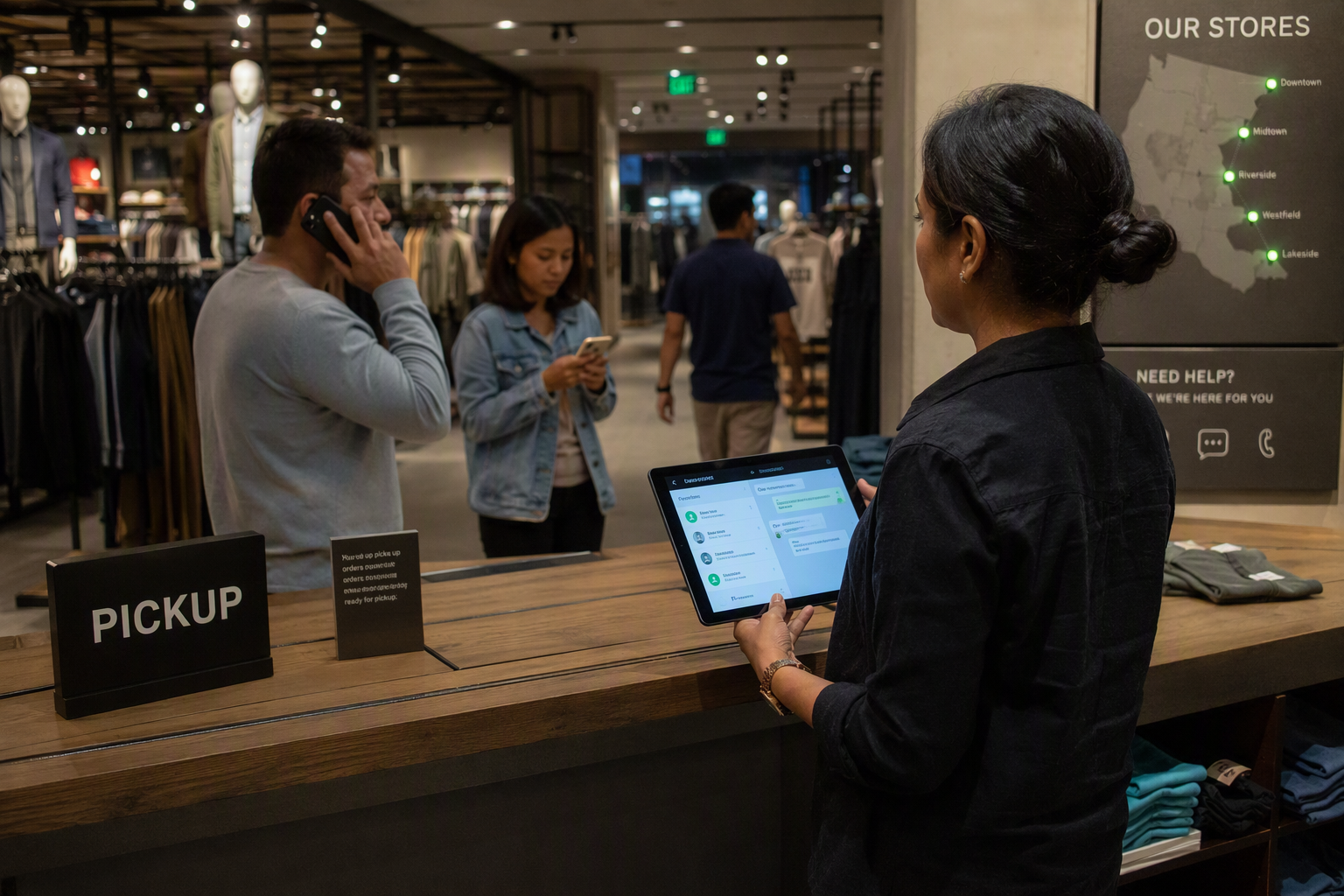
Retailers are combining voice and WhatsApp customer service in 2026 because each channel handles a different part of the customer journey. Voice supports immediate conversation and clarification, while WhatsApp preserves written details, images, links, confirmations, and follow-up history.
Voice and WhatsApp serve different customer needs
Customers often call when a request is urgent, ambiguous, or inconvenient to type. Common examples include confirming whether a store is open, checking same-day pickup readiness, describing a damaged product, or asking for a specific size or colour.
WhatsApp is more suitable when information must be reviewed or shared later. After a call, retail WhatsApp automation can provide:
- A branch address, map pin, and opening hours
- Product photographs, specifications, and catalogue links
- A written summary of a stock enquiry
- Order, delivery, or pickup-status updates
- Appointment confirmations and rescheduling options
- Return instructions, case references, and escalation details
A connected workflow can begin with AI phone answering for retail and continue on WhatsApp without asking the customer to repeat the branch, product, language, or order context. Customers should still be able to choose their preferred channel rather than being forced from calls into messaging.
Multi-location service requires precise routing
A store employee may know local hours, stock patterns, and staffing arrangements from experience. A multi-location retailer instead needs a routing layer that identifies which branch, system, policy, and team owns the enquiry.
Before answering, a retail AI receptionist should determine:
- Intent: Is the request about store hours, product availability, an order, a pickup, an appointment, or a return?
- Location: Which city and branch does the customer mean, particularly when store names or neighbourhoods are similar?
- Source of truth: Should the answer come from the store directory, inventory system, order platform, booking calendar, or approved knowledge base?
- Data freshness: Is the information current enough to support a visit, reservation, or purchase decision?
- Action authority: May the system provide information, create a request, reserve an item, or only seek employee approval?
This makes store customer service AI an orchestration system rather than a standalone voice bot. It must retrieve approved data, preserve conversation history, trigger business workflows, and route unresolved cases to the correct store or central team.
Multilingual continuity must preserve meaning
Multilingual service involves more than translating sentences. The system must retain product codes, model names, quantities, dates, prices, branch names, and customer intent when a conversation switches between English, Hindi, or another regional language.
Language preference should travel with the case across voice, WhatsApp, and human handoff. Employees should receive both the original conversation and a structured summary so they can continue without restarting discovery.
Identity checks and escalation define safe automation
Not every retail question requires customer verification. Store hours and public return policies can usually be answered openly, but order details, account data, refunds, and payment-related actions require stronger controls.
A safe workflow can verify identity through an order number, the phone number associated with the purchase, or a one-time password. The system should escalate when:
- Identity cannot be confirmed
- Inventory or order data is missing or contradictory
- The customer requests a refund, payment change, or policy exception
- Confidence is too low to provide a reliable answer
- The customer asks for an employee
The practical 2026 model is channel-connected but control-conscious: automate routine retrieval and enquiry intake, maintain context across voice and WhatsApp, and involve staff whenever identity, money, uncertain data, or discretionary decisions increase risk.
Key Developments: Where does AI phone answering for retail outperform WhatsApp, and when should humans take over?
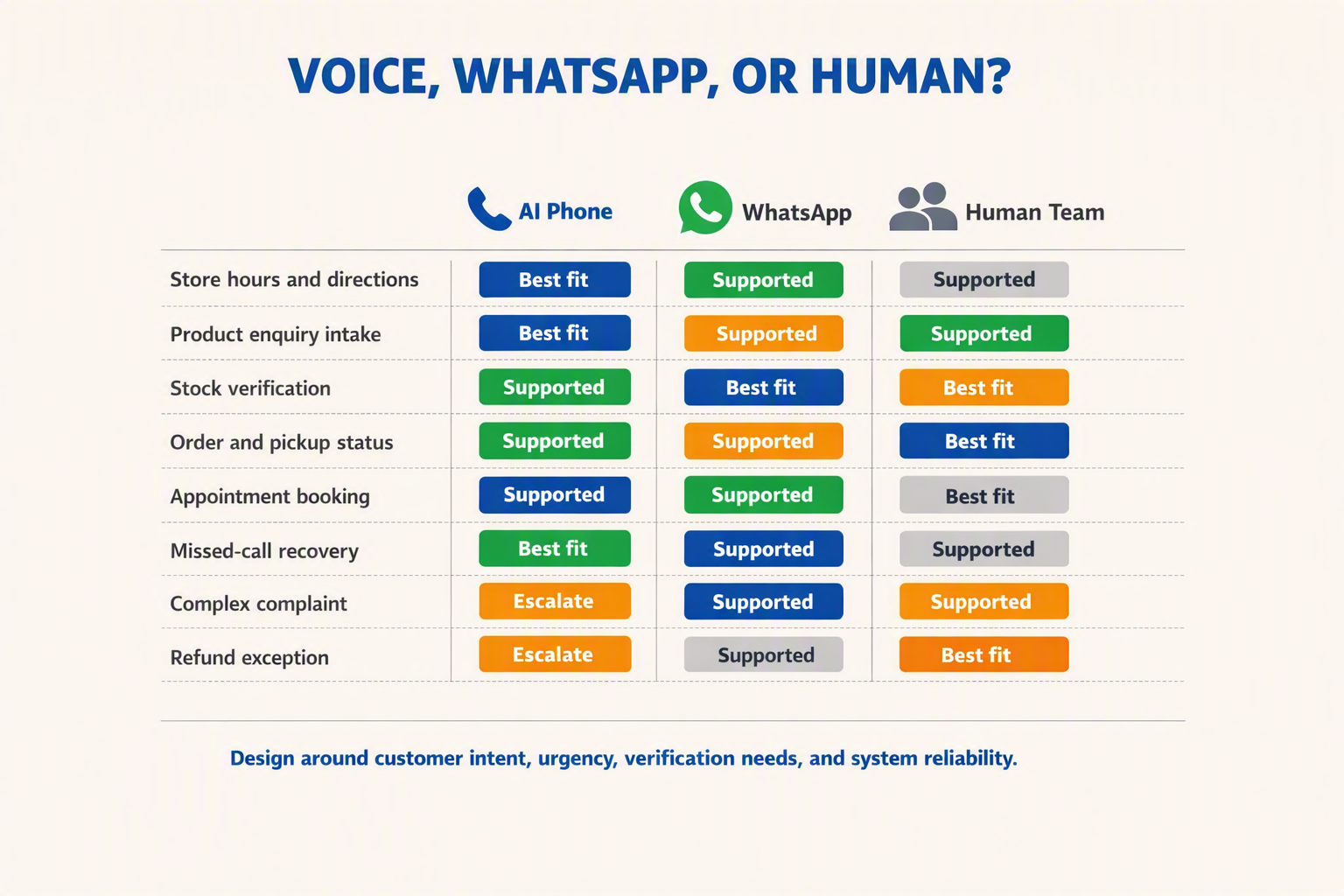
AI phone answering for retail performs best when customers need immediate, conversational help, while WhatsApp is better for images, links, confirmations and a persistent written record. Human agents should take over when a request involves financial approval, policy exceptions, distress, unreliable data or specialist product advice.
Channel and escalation matrix
| Retail interaction | Best first channel | What AI should handle | Human takeover trigger |
|---|---|---|---|
| Store hours, directions and branch selection | Phone or WhatsApp | Identify the intended location, retrieve current hours, disclose holiday exceptions and send a map pin | The branch is ambiguous, location data conflicts or the store calendar is unavailable |
| Product discovery and enquiry intake | Phone for dialogue; WhatsApp for visuals | Capture category, size, colour, budget, preferred branch and purchase timeframe | Specialist advice, compatibility checks or a consequential product recommendation is required |
| Stock verification | Query connected inventory, share product details and provide time-stamped availability | Inventory is stale, only one unit remains or the customer requests a reservation or substitution | |
| Order, delivery and pickup status | WhatsApp for updates; phone for urgent cases | Verify identity, retrieve order status and send tracking or pickup instructions | An order is missing, disputed, repeatedly delayed or linked to conflicting records |
| Appointments and missed-call recovery | Phone with WhatsApp follow-up | Check availability, create or modify bookings and send approved confirmations | Calendars fail, duplicate records appear or accessibility requirements need staff coordination |
| Refunds, complaints and payments | Human-led | Authenticate the customer, collect facts and summarise the case without collecting full payment credentials | Refund approval, payment disputes, suspected fraud, policy exceptions, distress or legal complaints |
Why voice wins and messaging is safer
A retail AI receptionist is particularly useful when a caller cannot conveniently type, does not know which branch to contact or needs several clarifying questions answered in sequence. AI phone answering for retail can identify intent, answer approved location questions, collect enquiry details and offer a WhatsApp continuation when the customer wants information in writing.
Retail WhatsApp automation is more suitable for content customers need to view, verify or retain, including:
- Map pins, parking instructions and confirmed opening hours
- Product photographs, model numbers, size charts and catalogue links
- Pickup instructions, booking confirmations and delivery updates
- Written return requirements and agreed next steps
Messaging should not automatically replace voice. Urgent, ambiguous or emotionally charged cases often require a synchronous conversation and a clear path to a trained employee.
Apply risk-based human handoff
Effective store customer service AI should assess both the customer’s intent and the reliability of connected systems. Configure immediate escalation when identity verification fails, an inventory or order integration times out, a customer requests a manager, distress is detected or the assistant cannot resolve an ambiguity after a defined number of clarification attempts.
A two-attempt clarification limit is a reasonable starting guardrail, but it is not a universal benchmark. Retailers should tune the limit using their own transfer rates, repeat-contact patterns, abandonment rates and resolution outcomes.
The handoff package should give the employee enough context to continue without forcing the customer to repeat everything. Include:
- Selected language and preferred communication channel
- Verified identity status and applicable branch
- Customer intent and concise conversation summary
- Relevant inventory, order or appointment records
- Actions already attempted and the reason for escalation
Finally, define strict authority boundaries. Automation may explain a published policy or collect refund details, but a human should approve refunds, override policies, resolve payment disputes and handle fraud or legal threats. This division preserves speed for routine enquiries while keeping accountable staff in control of high-risk retail decisions.
In-Depth Analysis: How should store hours, product enquiries, stock checks, orders, pickups, appointments, and missed calls flow?
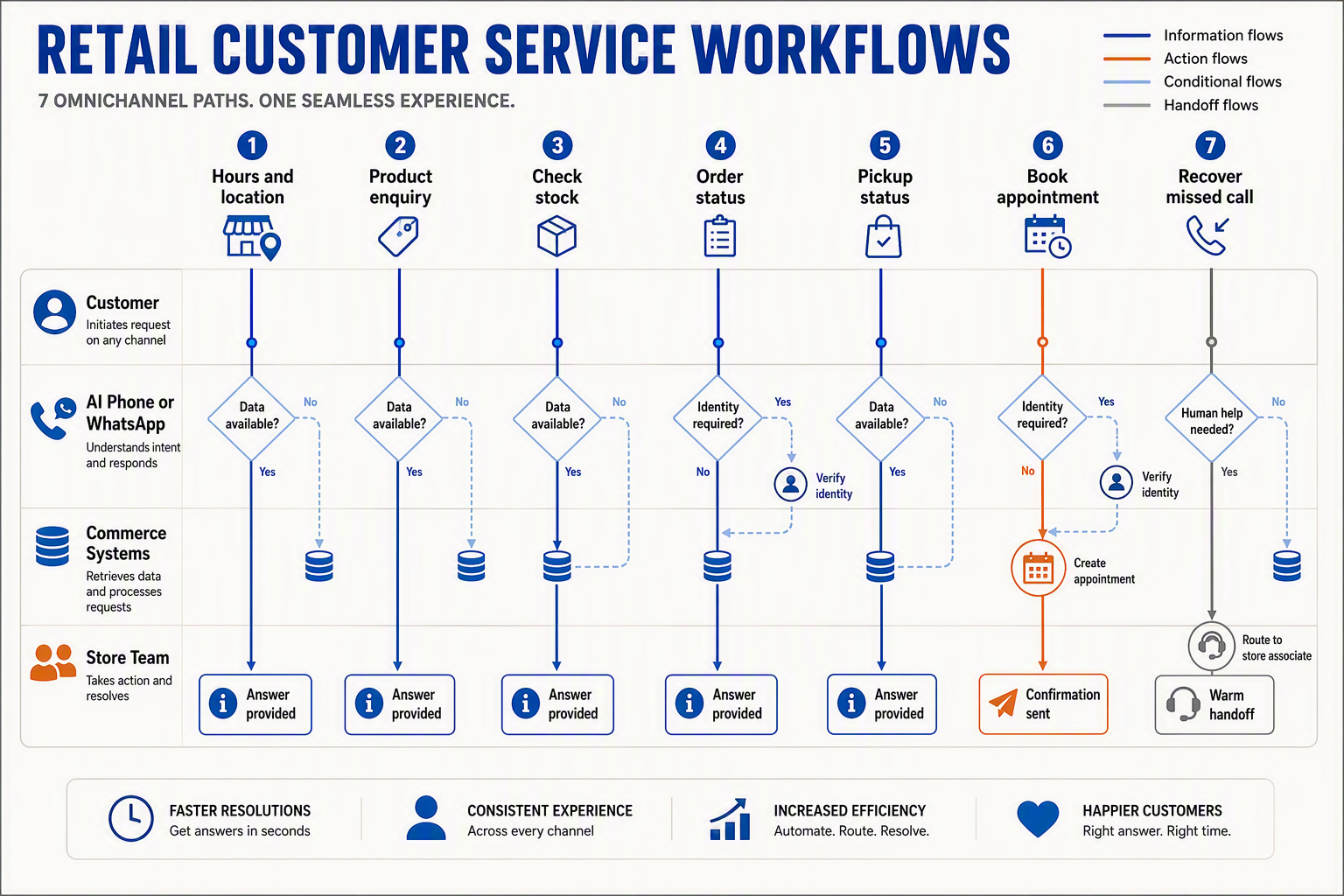
Each customer journey should follow a detect → identify → retrieve → confirm → act → record → escalate sequence. A retail AI receptionist may answer low-risk questions directly, but inventory promises, order changes, refunds, payments, and pickup release require live system checks, identity controls, or employee approval.
Route location questions before answering
For store hours, directions, parking, accessibility, and holiday closures, store customer service AI must first resolve the correct branch using the dialled number, WhatsApp entry point, postcode, GPS-shared location, or explicit customer choice.
- Match the customer to a store.
- Query the branch directory and exception calendar.
- State the store name, address, date, and opening interval.
- Offer a map pin or transfer to the branch.
Regular hours should never override dated exceptions. If the calendar is unavailable or two branches have similar names, the assistant should say that it cannot verify the answer and offer alternatives—not infer an opening time.
Separate product discovery from stock verification
A product enquiry begins with structured intake: product name, brand, size, colour, model, budget, preferred branch, and needed-by date. The assistant can use a product catalogue or knowledge-base retrieval to explain specifications, but stock claims must come from the inventory or point-of-sale system.
Stock responses should reflect operational uncertainty:
- Available: report the queried branch and inventory timestamp.
- Low stock: say “limited availability” and offer employee confirmation.
- Unavailable locally: search approved nearby branches or online inventory.
- System unavailable: collect contact details and create a callback task.
A stock check is not a reservation. The workflow must require a separate hold action, enforce the retailer’s hold period, and return a reservation reference before telling the customer that an item is secured.
Protect orders, pickups, and payments
Order-status requests should begin with an order number plus a second factor, such as the registered mobile number or a one-time password. AI phone answering for retail can then retrieve approved fields from the order-management system: confirmation, fulfilment stage, delivery estimate, pickup branch, and readiness status.
The assistant should not mark an order ready merely because stock exists. A pickup is ready only when the fulfilment system records completion. At collection, staff should verify the retailer’s required pickup credential; possession of a WhatsApp conversation alone should not authorize release.
Refunds, payment-link changes, bank-detail updates, gift-card disclosures, and high-value order modifications should move to a human or controlled approval workflow. The AI may explain published policy and gather evidence, but it should not invent eligibility or request complete card details, PINs, or one-time passwords.
Make appointments transactional
Appointment booking requires a live calendar operation rather than a conversational promise:
- Identify service, branch, employee or resource, duration, and customer timezone.
- Display or read back available slots.
- Place a temporary hold before confirmation.
- Write the booking once and return a unique reference.
- Support rescheduling and cancellation through authenticated links or verified identity.
Idempotency keys and post-write calendar checks help prevent duplicate bookings when customers switch between phone and WhatsApp.
Recover missed calls without creating spam
Retail WhatsApp automation should classify each missed call by branch, time, repeat frequency, and any available CRM context. Where the retailer has an appropriate permission basis, it can send a concise WhatsApp follow-up offering menu choices such as store information, product availability, order help, appointment booking, or staff callback.
CallMissed can support this cross-channel pattern by connecting AI voice agents, WhatsApp chat and Business calling, and a shared omnichannel inbox. Every handoff should include the resolved store, language, verified identity state, retrieved records, actions attempted, and failure reason so employees can continue without asking the customer to start again.
How should multilingual support, identity checks, refunds, payments, and escalation boundaries work?
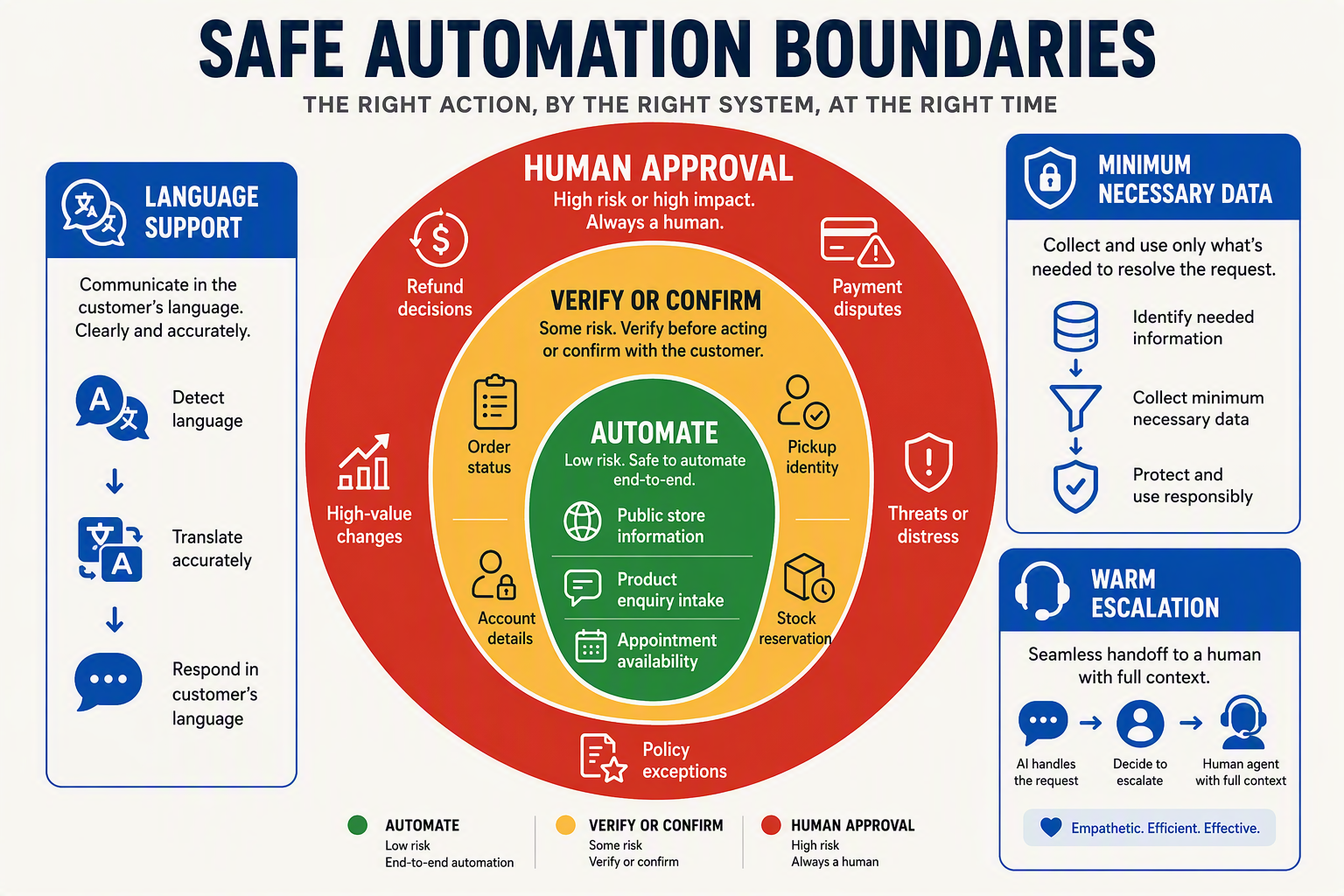
A safe retail AI receptionist should support the customer’s preferred language while applying the same verification, financial-control, and escalation rules in every language and channel. Automation may retrieve approved information and initiate workflows, but refunds, unusual payments, identity disputes, and policy exceptions should remain behind explicit authorization boundaries.
Design multilingual service beyond translation
The Constitution of India recognizes 22 scheduled languages, and the Census of India 2011 recorded 121 languages spoken by at least 10,000 people. Retailers should therefore select languages by store catchment, contact volume, and customer preference—not deploy one nationwide default.
Configure AI phone answering for retail and WhatsApp to:
- Detect a likely language, then ask the customer to confirm it.
- Preserve brand names, SKUs, amounts, dates, and order numbers without translating them.
- Understand code-switching, such as Hindi-English or Tamil-English conversations.
- Use approved regional terminology for refunds, warranties, sizes, and pickup.
- Retain the selected language during transfer and display transcripts to employees.
- Offer keypad, typed-message, or human alternatives when speech recognition confidence is low.
Voice transcripts containing uncertain digits must not trigger transactions. The assistant should read back an order number in grouped digits and request confirmation before querying the order-management system.
Apply risk-based identity checks
Verification should be proportional to the action. A store-hours enquiry needs no identity check; disclosing an order’s contents or changing its pickup recipient does.
Use a tiered model:
- Low risk: Public hours, directions, published policies, and general product information require no authentication.
- Moderate risk: Pickup readiness or appointment changes require an order or booking reference plus a one-time password sent to the registered phone number.
- High risk: Address changes, account edits, recipient substitutions, refunds, and payment-related actions require stronger verification or an employee.
- Prohibited for automation: Requests involving identity mismatch, suspected fraud, coercion, or repeated failed verification must be locked and escalated.
Do not ask customers to speak passwords, card PINs, CVVs, or full payment-card numbers. Logs and agent summaries should mask personal and payment data by default.
Put hard boundaries around refunds and payments
Retail WhatsApp automation should explain policy, collect evidence, create a case, and report status. It should not independently invent eligibility, override return windows, or approve exceptions.
A controlled refund workflow should verify the order, check the documented return policy, capture the reason and supporting images, and submit the request for approval. Automatic refunds should be allowed only where the retailer has defined an explicit value threshold, eligible payment methods, permitted reason codes, and duplicate-refund protection.
For payments, send customers to the retailer’s approved checkout or payment-provider flow. The store customer service AI may confirm whether a payment succeeded using a trusted transaction-status API, but it should never infer success from a screenshot or ask for sensitive credentials in chat.
Define escalation triggers and handoff requirements
Escalate immediately when the customer reports:
- A duplicate or unauthorized charge
- Suspected fraud, account takeover, or identity mismatch
- Injury, product safety concerns, threats, or legal complaints
- A refund exception, high-value loss, or repeated delivery failure
- Low language or speech-recognition confidence
- Two failed tool calls or conflicting inventory, order, or payment records
Every handoff should include the customer’s language, verified identity level, store, intent, completed checks, relevant records, and unresolved decision. The employee—not the customer—should receive the burden of context reconstruction.
Which commerce, inventory, order, booking, CRM, and messaging integrations does a multi-location retailer need?
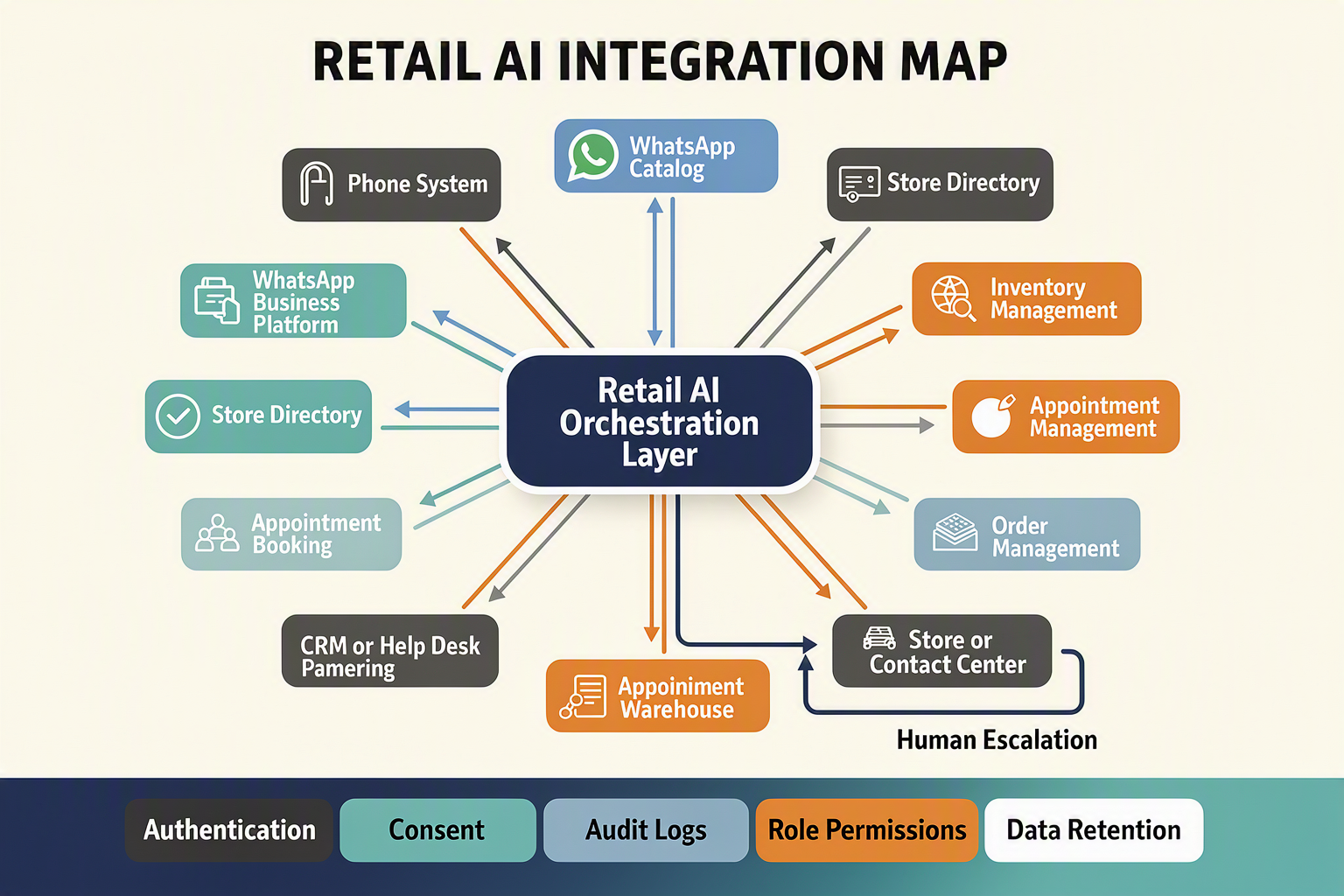
A multi-location retailer needs integrations that make location, stock, order, appointment, customer, and consent data available through controlled APIs. The retail AI receptionist should read from each system of record, perform only approved actions, and fail safely when data is unavailable or ambiguous.
Connect each workflow to its authoritative system
Avoid copying operational data into chatbot scripts. Instead, define one source of truth for every customer question:
- Commerce and point of sale: Connect Shopify, Adobe Commerce, WooCommerce, or the retailer’s POS platform for product identifiers, variants, prices, promotions, and return-policy context. Resolve spoken descriptions such as “blue running shoes in size eight” to a SKU before checking availability.
- Inventory management: Query the inventory or warehouse-management system by SKU and location ID. Return “available,” “low stock,” or “unavailable” rather than exposing internal quantities unless the retailer intentionally permits exact counts.
- Order management: Retrieve payment, fulfilment, shipment, click-and-collect, cancellation, and pickup states from the order-management system. Order status should not be inferred from CRM notes or tracking emails.
- Booking platform: Integrate calendars or appointment software for services such as alterations, product demonstrations, eye tests, or personal shopping. Availability checks and booking creation must use the same store, service, employee, duration, and time-zone rules.
- CRM and loyalty: Use Salesforce, Microsoft Dynamics 365, HubSpot, or a retailer’s customer-data platform to identify existing customers, record enquiries, assign follow-ups, and preserve consent. Do not expose loyalty balances or purchase history until identity checks succeed.
- Messaging and telephony: Connect WhatsApp Business Platform, business calling, voice infrastructure, email, and the human inbox so conversations can move between channels without losing the transcript or store assignment.
Put an orchestration layer between AI and retail systems
The model should not receive unrestricted database or administrative access. Give store customer service AI narrowly defined tools such as find_store, check_stock, get_order_status, create_booking, and handoff_to_agent.
Each tool call should enforce:
- Location resolution: Map store names, postcodes, landmarks, and GPS-derived locations to a stable branch ID.
- Identity and authorization: Require appropriate verification before revealing order details, modifying bookings, or accessing customer records.
- Idempotency: Attach a unique request key so retries cannot create duplicate appointments, leads, or cancellations.
- Freshness controls: Timestamp inventory and order responses; reject cached results beyond the retailer’s chosen tolerance.
- Auditability: Record the customer request, tool invoked, source response, decision, and escalation outcome.
A circuit breaker should switch from automation to staff-assisted service when an integration times out. The assistant should say that live data is unavailable—not estimate stock or claim that an order is ready.
Design channel-specific handoffs
AI phone answering for retail and retail WhatsApp automation can use the same workflow layer, but the interfaces differ. Voice requires concise confirmations and careful recognition of order numbers; WhatsApp can present store cards, product images, map links, and interactive booking options.
Platforms such as CallMissed can connect AI voice agents, WhatsApp chat and WhatsApp Business calls with an omnichannel inbox, while supporting speech workflows across 22 Indian languages. That shared context is particularly useful when a caller asks for stock, receives a permission-aware WhatsApp follow-up, and later continues with a store employee.
Before launch, verify that the retail AI receptionist cannot independently issue refunds, capture card credentials, override stock reservations, alter prices, or approve policy exceptions. Those actions should remain inside payment and commerce systems with explicit human authorization.
Expert Opinions: How should teams test store customer service AI and measure quality before scaling?
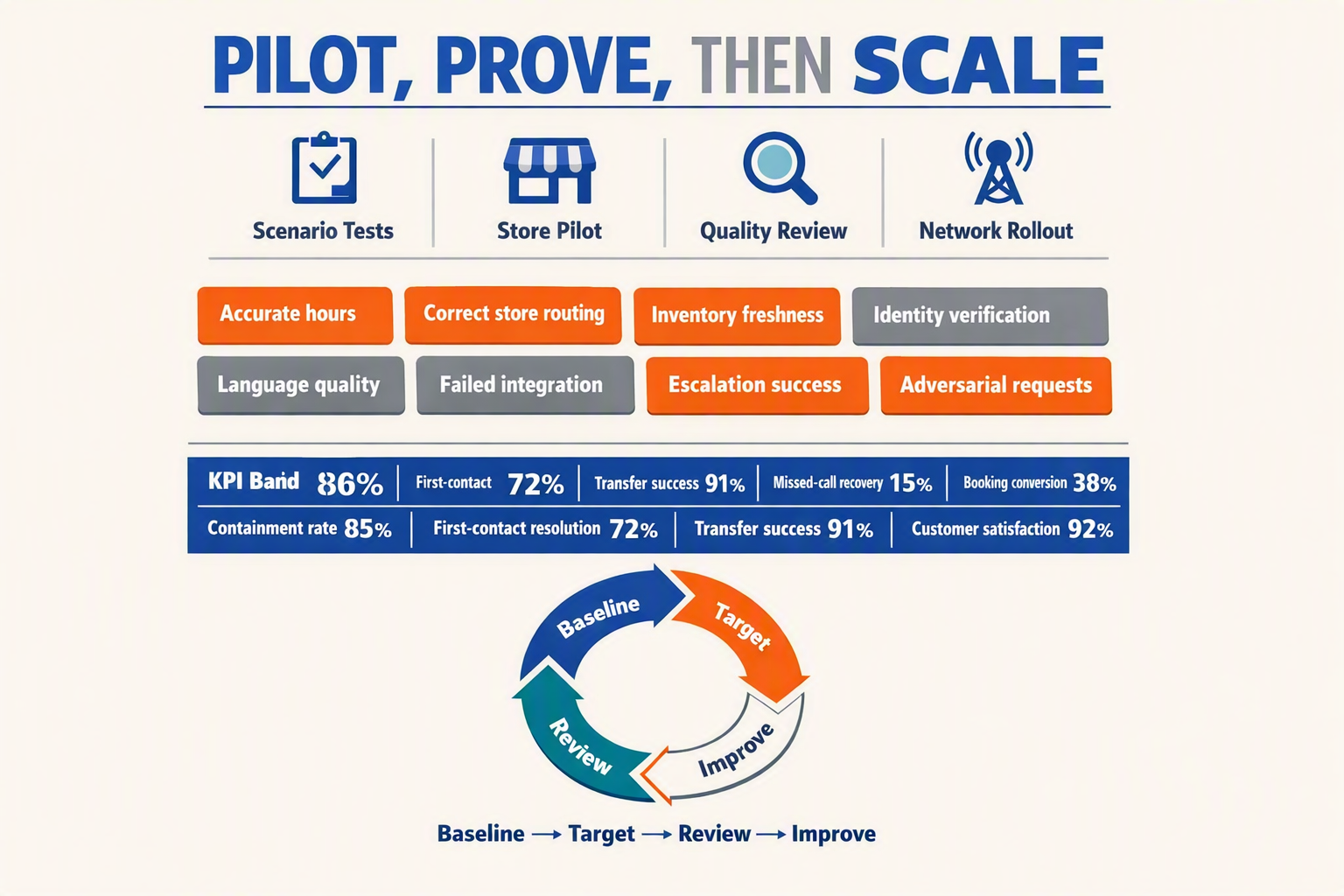
Teams should test store customer service AI in controlled stages and scale only when it is accurate, safe, resilient, and easy to escalate. Containment rate alone is not a quality measure: a conversation resolved incorrectly is more damaging than a prompt transfer to an employee.
Apply a risk-weighted test strategy
Retail operations, contact-centre, security, and store teams should jointly classify workflows by consequence:
- Low risk: opening hours, directions, parking, and published policies.
- Moderate risk: product-enquiry intake, appointment changes, pickup status, and stock lookups.
- High risk: identity-linked orders, refunds, payment requests, address changes, and account data.
Start with offline test scripts, progress to employee-only trials, then expose a small percentage of real contacts at selected stores. Keep refunds, payment changes, and exceptional policy decisions behind human approval throughout the pilot.
The NIST AI Risk Management Framework 1.0, published in January 2023, recommends managing AI through four functions: Govern, Map, Measure, and Manage. Retailers can apply this model by documenting owners, mapping failure consequences, measuring performance, and defining shutdown or rollback procedures before launch.
Build a representative “golden” test set
A useful evaluation set contains expected answers, acceptable variations, required tool calls, and mandatory escalation conditions. Test both the retail AI receptionist and retail WhatsApp automation against:
- Normal questions for every location, including regular and holiday hours.
- Ambiguous branch names, landmark-based requests, and nearby stores with similar names.
- Stale inventory, reserved stock, integration timeouts, and contradictory catalogue data.
- Partial order numbers, failed identity checks, refund pressure, and payment-link requests.
- Background noise, interruptions, code-switching, accents, and misspelt product names.
- Duplicate booking attempts, disconnected calls, repeated WhatsApp messages, and tool retries.
- Prompt-injection attempts asking the system to reveal customer or internal information.
India’s language diversity materially expands the test matrix: the Constitution of India recognizes 22 scheduled languages, while the Census of India 2011 counted 121 languages spoken by at least 10,000 people. Language quality should therefore be measured separately by language, region, channel, and acoustic condition—not hidden inside one overall average.
Measure outcomes, not just automation
Use a scorecard that combines operational and customer measures:
- Answer accuracy: correct responses divided by evaluated responses.
- Stock-answer accuracy: answers matching the inventory system at the response timestamp.
- Transfer accuracy: escalations reaching the correct store or specialist queue.
- Workflow completion: valid bookings, verified status checks, or properly captured enquiries.
- Unsafe-action rate: unauthorized refunds, disclosures, commitments, or payment actions.
- First-response time, abandonment, repeat-contact rate, and CSAT.
- Missed-call recovery: eligible missed calls that produce a successful, consent-aware WhatsApp interaction.
For AI phone answering for retail, also inspect transcription accuracy for SKUs, names, numbers, and addresses. Review recordings and transcripts with store employees because aggregate dashboards can conceal location-specific failures.
Set explicit scale gates
Illustrative pilot gates might require zero unauthorized high-risk actions, at least 95% accuracy for published store information, and at least 98% correct routing across a statistically meaningful test set. These are operational targets, not universal industry benchmarks; each retailer should tighten them according to transaction value and customer risk.
Scale store by store only after two consecutive evaluation cycles pass. Maintain regression tests for every prompt, policy, model, integration, and knowledge-base change, with a rapid fallback to human handling when quality deteriorates.
Impact & Implications — What This Means For You: Which rollout plan fits your retail footprint?
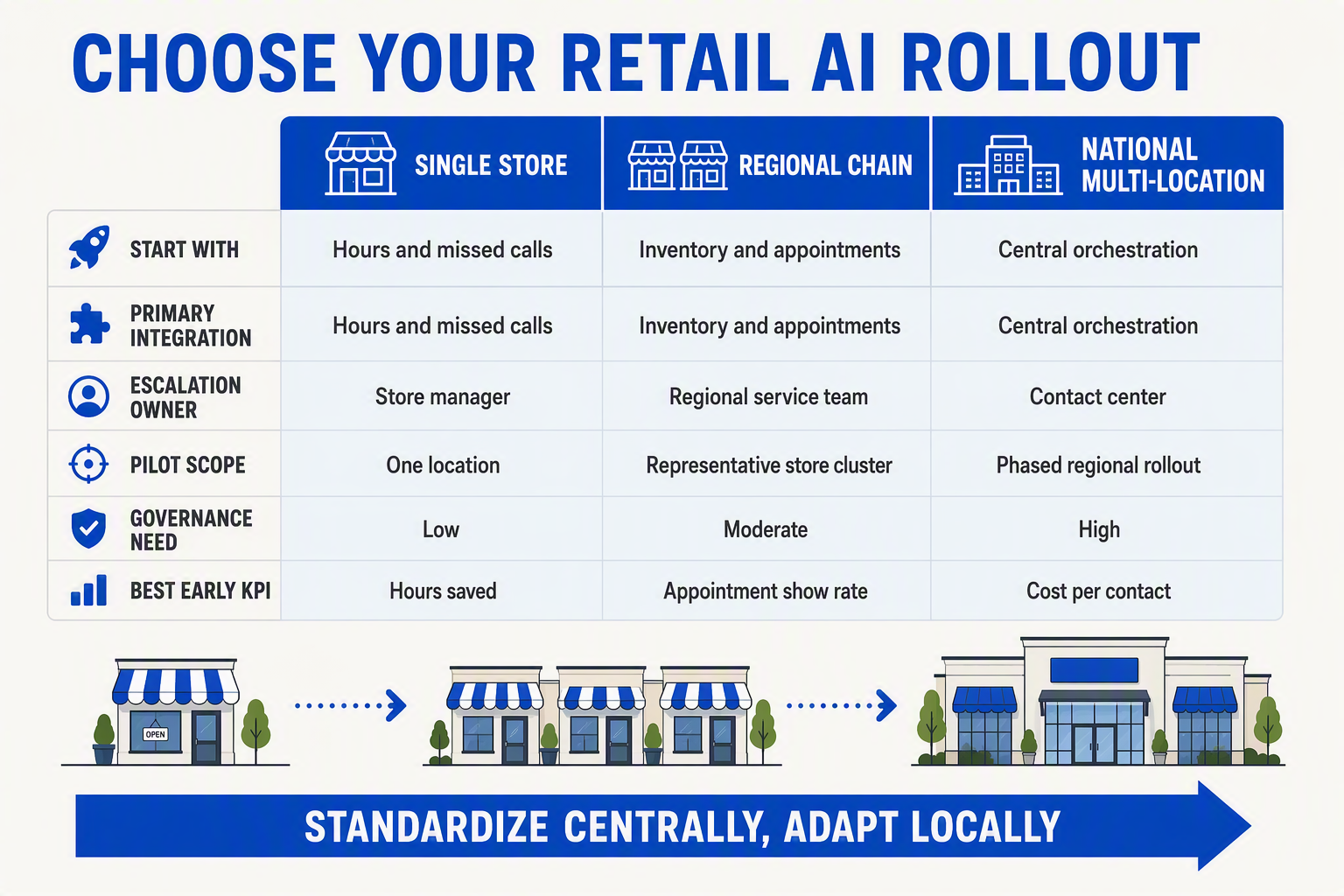
The right rollout plan depends less on total call volume than on how many systems, store policies, languages, and approval paths vary by location. Start with low-risk enquiries, prove data accuracy and handoff reliability in a representative pilot, then expand automation only after each rollout gate is met.
Choose the rollout model by footprint
| Retail footprint | Recommended first release | Essential integrations | Pilot and scale gate | Indicative rollout |
|---|---|---|---|---|
| Single store | Hours, directions, FAQs, product-enquiry capture and missed-call WhatsApp follow-up | Store calendar, product catalogue and shared inbox | Review 100–200 conversations; require zero critical policy errors | One store for 2–4 weeks |
| 2–5 locations | Add branch selection, appointments, pickup status and store-specific routing | CRM, calendars, order management and location directory | At least 95% correct location routing and 98% appointment-write success | One lead store, then one store per week |
| 6–25 locations | Add stock checks, multilingual service and structured employee escalation | Inventory or POS, identity provider, CRM and order management | At least 95% stock-answer accuracy against live records; all failed lookups must hand off | Pilot 2–3 contrasting stores for 4–6 weeks |
| 26–100 locations | Standardize regional workflows, permissions, refund boundaries and operational dashboards | Central commerce stack, workforce routing, consent records and analytics | No unauthorized refunds or payment-data collection; transfer accuracy above 95% | Regional waves of 5–15 stores |
| 100+ locations or franchises | Use reusable templates with controlled local overrides and centralized governance | API gateway, master store-data service, franchise systems and audit logging | Pass security, load, multilingual and disaster-recovery tests before each wave | Region-by-region deployment over multiple quarters |
These figures are recommended starting gates, not universal industry benchmarks. Establish a baseline from your current phone, WhatsApp and store-service data, then set thresholds that reflect contact volume, transaction risk and integration reliability.
What changes as the network grows
A single-store retail AI receptionist can often rely on one approved knowledge base and one escalation queue. A large chain needs a location-aware data layer that resolves the customer’s intended branch before answering questions about opening times, stock, appointments or pickup readiness.
The operational implications are significant:
- Accuracy becomes a systems problem. Store hours should come from an authoritative location service, while stock and order answers require live commerce-system queries with timestamps.
- Governance must precede autonomy. Keep refunds, payment changes, high-value orders and customer-record edits behind identity checks and human approval.
- Language coverage affects access. The Constitution of India recognizes 22 scheduled languages, making multilingual voice and messaging a practical deployment requirement rather than an optional interface feature.
- Channel scale justifies shared workflows. Meta CEO Mark Zuckerberg said in Meta’s April 2025 earnings call that WhatsApp had passed 3 billion monthly active users.
- Failures need explicit paths. Timeouts, stale inventory, ambiguous branch names and low-confidence speech recognition should produce a transparent handoff—not a guessed answer.
Turn the pilot into a controlled expansion
Before extending AI phone answering for retail, complete these steps:
- Compare AI answers with source-system records every week.
- Review escalations by store, language, intent and failure cause.
- Confirm that WhatsApp follow-ups have the required customer permission.
- Load-test seasonal peaks before promotions or holiday periods.
- Maintain rollback procedures for every integration.
For Indian retailers, CallMissed can support this phased model through AI voice agents, WhatsApp chat and Business calling, an omnichannel inbox, and voice coverage across 22 Indian languages. Whether using CallMissed or another platform, retail WhatsApp automation and store customer service AI should scale only when accuracy, safety and employee handoffs scale with them.
Frequently Asked Questions: What should retailers know before launching a retail AI receptionist?
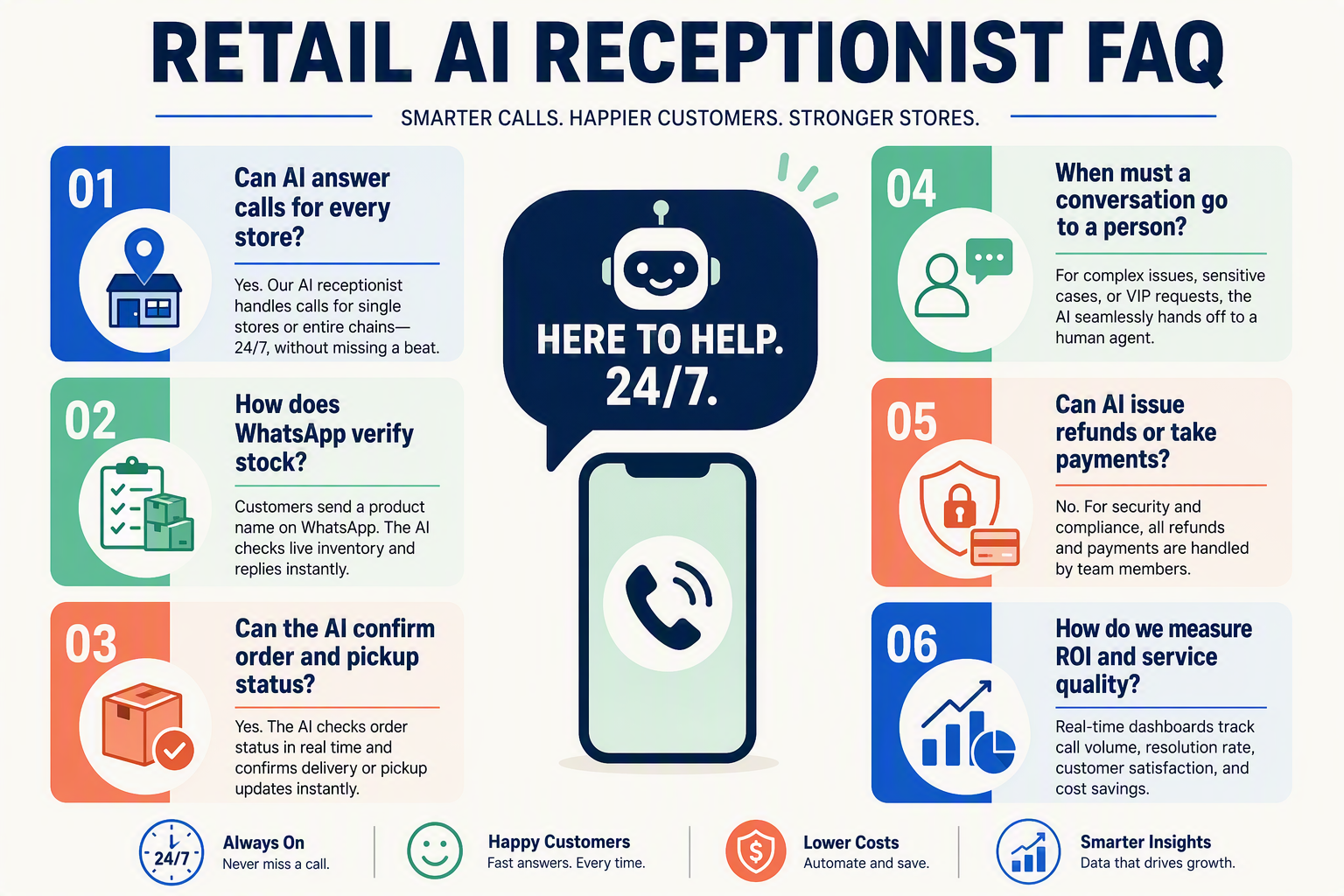
What should a retailer prepare before launching a retail AI receptionist?
Which systems should retail WhatsApp automation integrate with?
Can AI phone answering for retail check stock and pickup status accurately?
How should store customer service AI handle refunds, payments, and escalations?
Does a retail AI receptionist need multilingual voice and WhatsApp support in India?
How do retailers measure whether AI customer service is ready for full deployment?
Conclusion
A successful 2026 rollout should make retail service faster and more accurate without giving automation unrestricted authority. The strongest retail AI receptionist combines location-specific data, live commerce integrations, multilingual conversations, clear approval boundaries, and reliable human escalation.
- Prioritise high-volume workflows: Use AI phone answering for retail to handle store hours, directions, product enquiries, stock checks, order and pickup status, appointments, and missed-call recovery.
- Connect systems before expanding automation: Integrate point-of-sale, inventory, order-management, CRM, and calendar platforms so the assistant does not rely on stale FAQs or promise unavailable stock.
- Design for safety and continuity: Verify identity before exposing order details, require human approval for refunds and payment-sensitive actions, and preserve context when transferring customers to store employees.
- Measure service quality, not just containment: Track first-response time, transfer accuracy, booking completion, stock-answer accuracy, missed-call recovery, and customer satisfaction.
With WhatsApp exceeding 3 billion monthly active users, as Meta CEO Mark Zuckerberg confirmed in April 2025, retail WhatsApp automation will increasingly become core customer-service infrastructure. Watch for tighter coordination between voice, WhatsApp, store systems, and multilingual store customer service AI—especially across India’s 22 scheduled languages.
Retailers can explore CallMissed, which combines AI voice agents, WhatsApp chat and Business calling, an omnichannel inbox, and support for 22 Indian languages. Which customer journey will your stores automate—and safely measure—first?
Related Reading
Discussion
Related Posts



Ready to automate customer conversations?
Launch AI voice agents and WhatsApp bots with CallMissed — one API, 22+ Indian languages.