
AI Receptionist for Gyms: 2026 Buyer and Implementation Guide for Calls, Trials and WhatsApp


Choose and deploy an AI receptionist for gyms with safer calls, trial bookings, WhatsApp follow-up, integrations, handoffs and KPI tracking.
AI Receptionist for Gyms: 2026 Buyer and Implementation Guide for Calls, Trials and WhatsApp
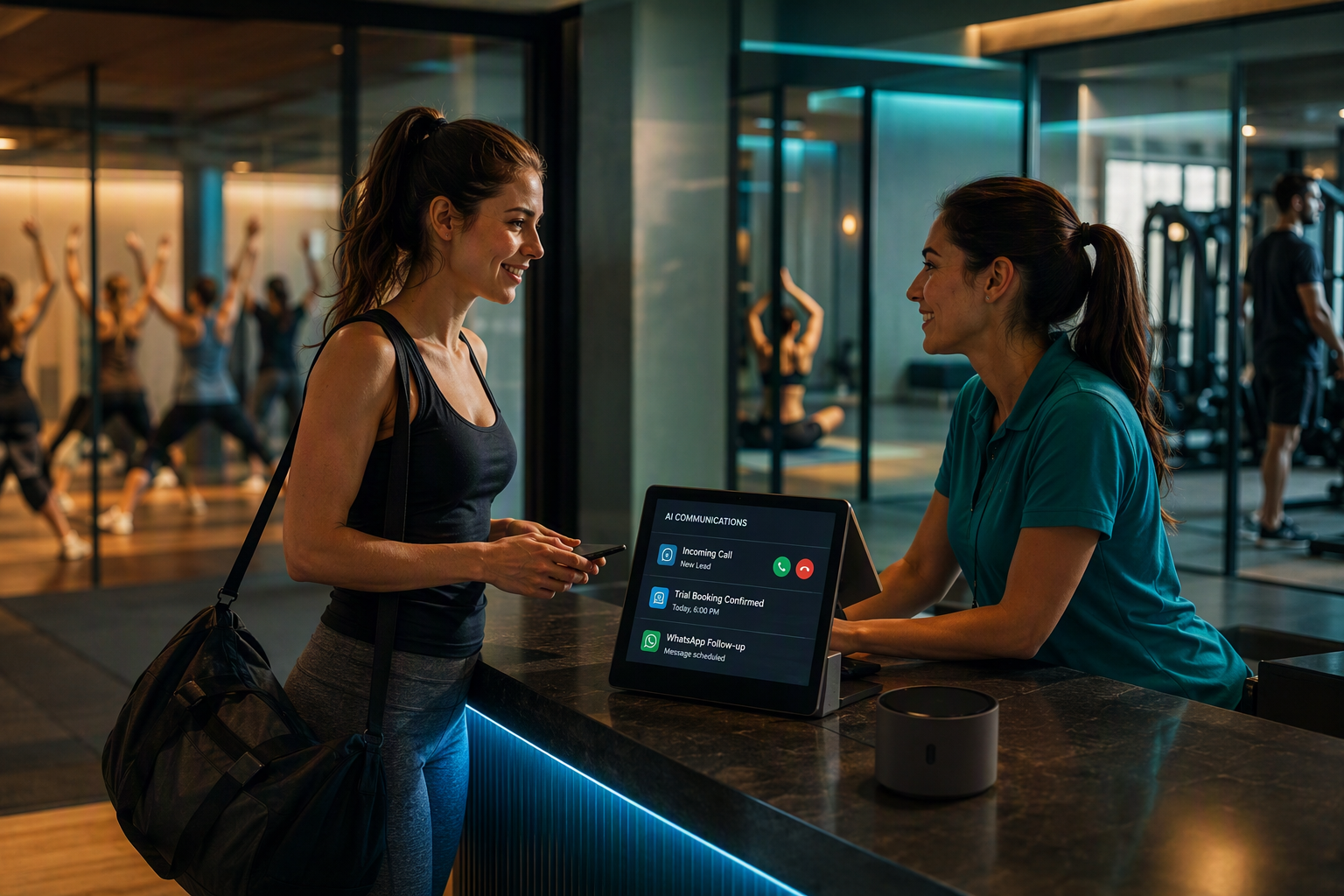
What happens when a high-intent prospect calls your gym during the evening rush—and nobody at reception can answer? An AI Receptionist for Gyms can turn that missed interaction into a qualified lead, a confirmed trial and a consent-based WhatsApp follow-up, but only when it operates as part of the gym’s booking and membership workflow rather than as a generic answering bot.
The opportunity is substantial. The Health & Fitness Association reported in 2024 that a record 72.9 million Americans belonged to a fitness facility in 2023, representing 5.8% year-over-year growth. At the same time, customer communication is moving decisively toward messaging: Meta reported in April 2025 that WhatsApp had surpassed 3 billion monthly active users worldwide. For gyms, boutique fitness studios, yoga centers and personal trainers, this combination creates a clear operational challenge—more enquiries arriving across more channels, often when instructors and front-desk teams are busy serving members.
In 2026, buying an AI receptionist is therefore not simply about whether software can answer a phone call. Buyers need to determine whether the system can accurately retrieve approved class schedules, explain membership options, qualify prospects, book eligible trials, recover missed calls and preserve context when a conversation moves from voice to WhatsApp. It must also understand operational differences: a multi-location gym may sell recurring memberships, while a yoga studio manages class packs and waitlists, and a personal trainer may require one-to-one consultation scheduling.
Platforms such as CallMissed reflect this shift by combining AI voice agents, WhatsApp chat and WhatsApp Business calling with multilingual support across 22 Indian languages—capabilities particularly relevant to fitness businesses serving diverse regional audiences.
What this guide will help you evaluate
This buyer and implementation guide explains how to:
- Design a short, transparent fitness lead qualification flow around goals, preferred location, format, availability, membership status and readiness to book.
- Connect voice and WhatsApp workflows to CRM, membership, calendar and class-booking systems without creating duplicate or over-capacity reservations.
- Test multilingual conversations for accents, code-switching, names, dates, class terminology and translated disclosures.
- Recover missed calls with consent controls, retry limits, quiet hours and clear ownership for high-intent leads.
- Define immediate staff-handoff triggers for complaints, billing disputes, accessibility requests, safeguarding concerns and system failures.
- Measure trial-booking rate, lead response time, booking accuracy, handoff success and trial-to-membership conversion.
Most importantly, the guide draws a firm boundary between administrative intake and health advice. An AI receptionist may route an injury, pregnancy, medication, waiver or suitability question, but it should not diagnose conditions, prescribe exercise, assess an injury or promise fitness outcomes. The goal is not to replace qualified staff; it is to make reception more responsive, consistent and measurable while ensuring people take over whenever judgment, empathy or professional expertise is required.
What should an AI receptionist for gyms handle—and what must always go to staff?
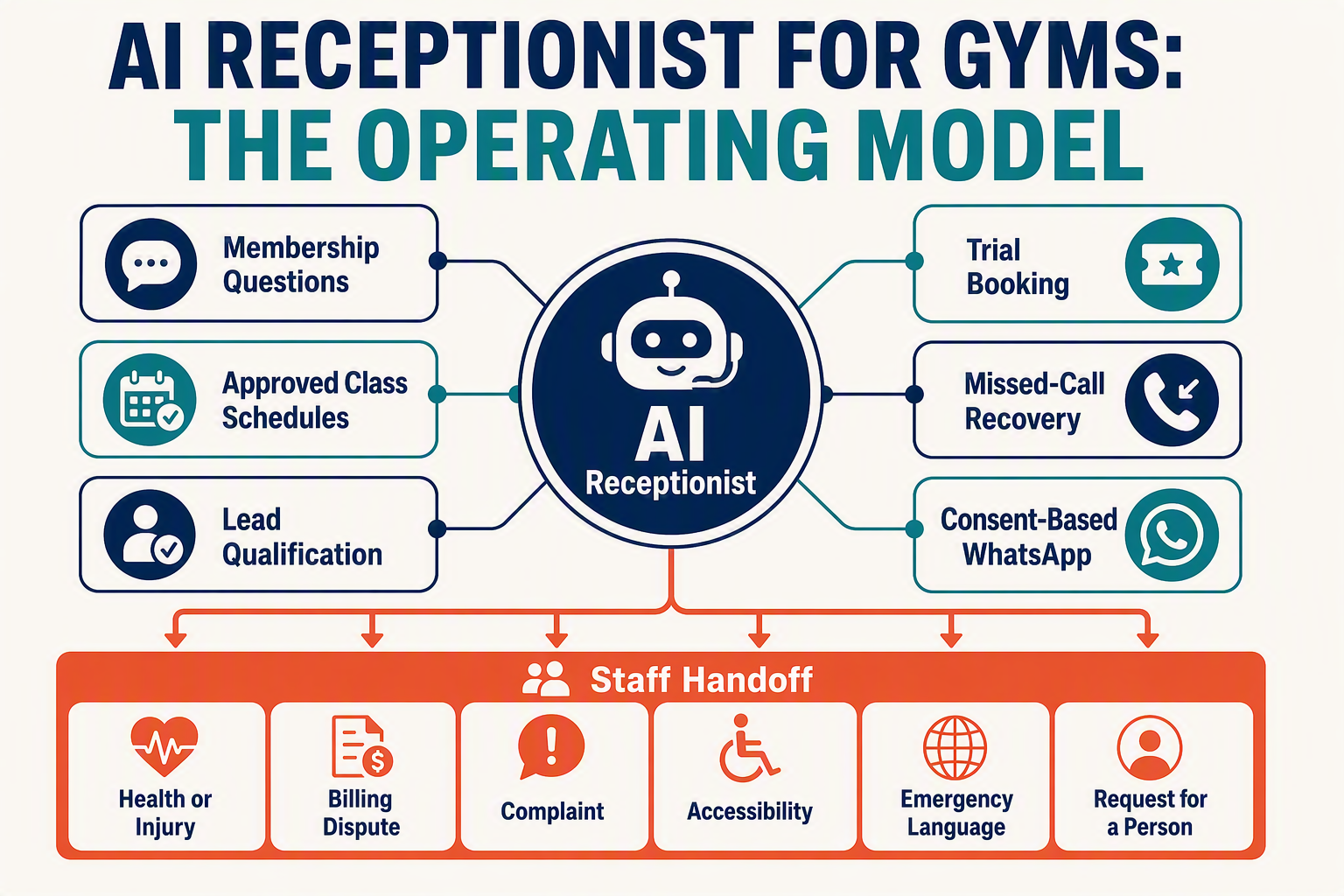
An AI receptionist for gyms should own routine, rules-based administrative work: answering approved questions, capturing leads, checking live schedules, booking eligible trials and following up with consent. Staff must retain control whenever a request involves health, safety, judgement, exceptions, conflict or a failed system action.
Tasks the AI receptionist can complete
A well-configured receptionist should operate from approved knowledge and connected booking data—not improvise. Its core jobs include:
- Answer routine enquiries: Explain published membership plans, class packs, drop-in options, opening hours, facilities, parking, age restrictions and location details.
- Retrieve current schedules: Look up classes by location, activity, instructor, date and available capacity. The AI should distinguish “scheduled” from “available” and never infer an open place from a static timetable.
- Capture and qualify leads: Ask only for the prospect’s desired activity or goal, preferred location, class or training format, availability, membership status and readiness to book.
- Manage eligible trials: Book, confirm, reschedule or cancel trials within configured capacity, eligibility and cancellation rules. Consequential details—location, date, time and class—should be repeated before confirmation.
- Recover missed calls: Record the original enquiry, prevent duplicate outreach and continue the conversation by an approved channel while preserving context.
- Send operational WhatsApp messages: With an appropriate consent and lawful messaging basis, confirm trials, share approved directions or timetables, issue reminders and offer rescheduling. Opt-outs must stop subsequent messaging.
- Create structured records: Write the lead source, request, booking outcome, consent status and handoff reason into the CRM or membership platform.
The exact workflow changes by business model. A multi-location gym may need recurring-membership and branch-access rules; a boutique studio may prioritize class capacity and waitlists; a yoga center may sell class packs and instructor-specific sessions; and a personal trainer may require a consultation before accepting a one-to-one booking.
Requests that always require staff
The AI should transfer the conversation immediately—or arrange a clearly timed callback—when human judgement or professional responsibility is required. Mandatory escalation triggers include:
- Emergency or safeguarding language, including threats, distress or concerns involving a child or vulnerable person.
- Injury, pregnancy, medication or medical-condition questions, even when the caller asks only whether a class is “safe.”
- Requests for diagnosis, rehabilitation guidance, individualized exercise prescriptions or promised fitness outcomes.
- Accessibility or accommodation needs that have not already been covered by an approved, reliable policy.
- Complaints, harassment reports, privacy requests, billing disputes, refund demands or membership-cancellation exceptions.
- Waiver uncertainty, age-policy exceptions or disputes about contractual terms.
- Repeated misunderstanding, low-confidence language recognition or a caller explicitly requesting a person.
- Booking, CRM or payment-system failures where the AI cannot verify that an action succeeded.
The correct response is not “I think this class should be suitable.” It is: “I can record your question and connect you with a qualified team member.”
Apply a decision boundary before automation
Buyers should test every intended task against three questions:
- Is the answer explicitly approved and current?
- Can the action be completed and verified through a connected system?
- Can an incorrect answer create health, financial, contractual or safeguarding harm?
If the first two answers are no—or the third is yes—the task belongs with staff. This boundary turns fitness reception automation into a controlled operating system rather than an unrestricted conversational bot.
Which requirements differ for gyms, boutique studios, yoga centers and personal trainers?
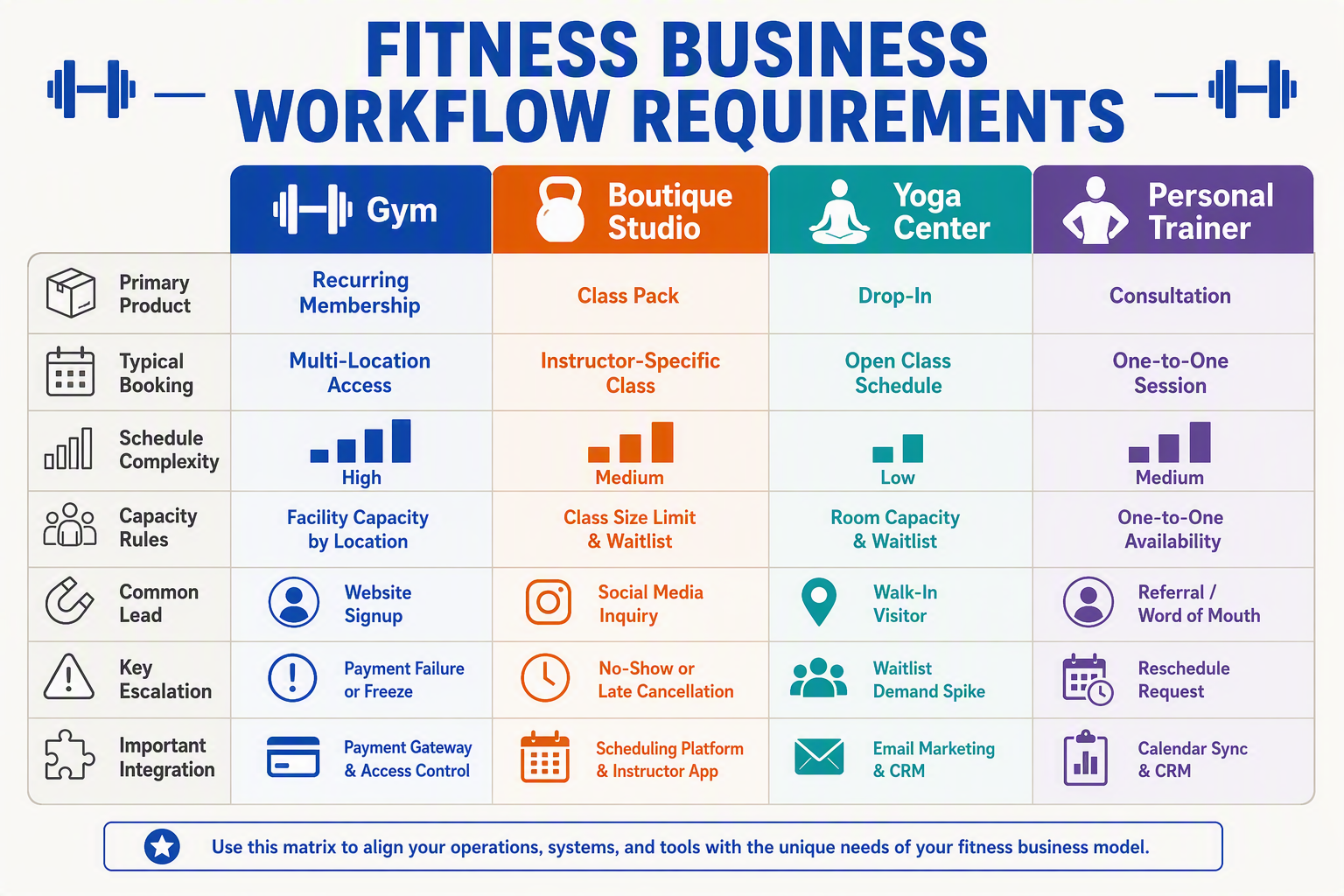
The core requirements differ because each fitness business sells a different type of bookable inventory. Gyms primarily manage memberships and locations; boutique studios and yoga centers manage capacity-limited classes; personal trainers manage individual time, consultations and client eligibility.
Requirements by fitness-business model
| Business type | Primary commercial model | Scheduling complexity | AI receptionist must handle | Typical staff handoff |
|---|---|---|---|---|
| Multi-location gym | Recurring memberships, joining fees, paid add-ons | Location-specific facilities, classes and opening hours | Match location, explain approved plans, identify membership status and book eligible trials | Corporate plans, billing disputes, cancellation exceptions or unavailable integrations |
| Boutique fitness studio | Class packs, memberships, drop-ins and introductory offers | Small classes, instructor dependencies, equipment limits and fast-changing capacity | Retrieve live availability, enforce capacity, manage waitlists and preserve instructor or class preferences | Package exceptions, late cancellations, first-timer concerns or instructor substitution |
| Yoga or wellness center | Class packs, drop-ins, workshops and recurring memberships | Level-specific sessions, workshops, room capacity and age or participation rules | Clarify class type and level without assessing medical suitability; book, waitlist or reschedule | Pregnancy, injury, medication, accessibility, waiver or suitability questions |
| Personal trainer | One-to-one sessions, consultations and coaching packages | Trainer calendars, travel buffers, session duration and recurring appointments | Qualify goals at a high level, schedule a consultation and capture preferred format and availability | Detailed health history, individualized exercise advice, pricing negotiation or trainer matching |
Translate the business model into system rules
A buyer should configure the AI receptionist around the business’s actual unit of sale, not around generic “appointment booking.”
- Gyms: The system should determine whether the caller is a prospect, active member or former member before offering an action. A membership enquiry may require branch selection, facility access rules and a tour rather than a class reservation.
- Boutique studios: Every booking action should check capacity in real time. If the final place disappears during the conversation, the AI should offer a waitlist or alternative session instead of confirming stale availability.
- Yoga centers: Class names such as beginner, restorative, prenatal or advanced must map to approved descriptions. The AI can communicate published participation rules, but a qualified employee must handle individual suitability.
- Personal trainers: Availability is often constrained by trainer preference, session length and buffers between appointments. The safest default is usually a consultation booking, not an automated promise that a particular programme will produce an outcome.
Buyer tests for each operating model
Before procurement, run at least one end-to-end test for every inventory type the business sells:
- Membership test: Can the system distinguish a tour, trial, renewal and billing query?
- Capacity test: Can two simultaneous callers avoid creating an overbooking through idempotent write actions?
- Waitlist test: Does a cancellation correctly release capacity and notify the next eligible person under approved messaging rules?
- Calendar test: Are instructor changes, time zones, buffers and recurring appointments respected?
- Boundary test: Does mention of injury, pregnancy, medication or accessibility trigger administrative routing rather than advice?
The decisive requirement is therefore not simply voice quality. It is whether the AI receptionist can apply the correct commercial, capacity, eligibility and escalation rules for that specific fitness operation while leaving consequential exceptions to staff.
How should fitness lead qualification AI and fitness studio call answering work in a real conversation?
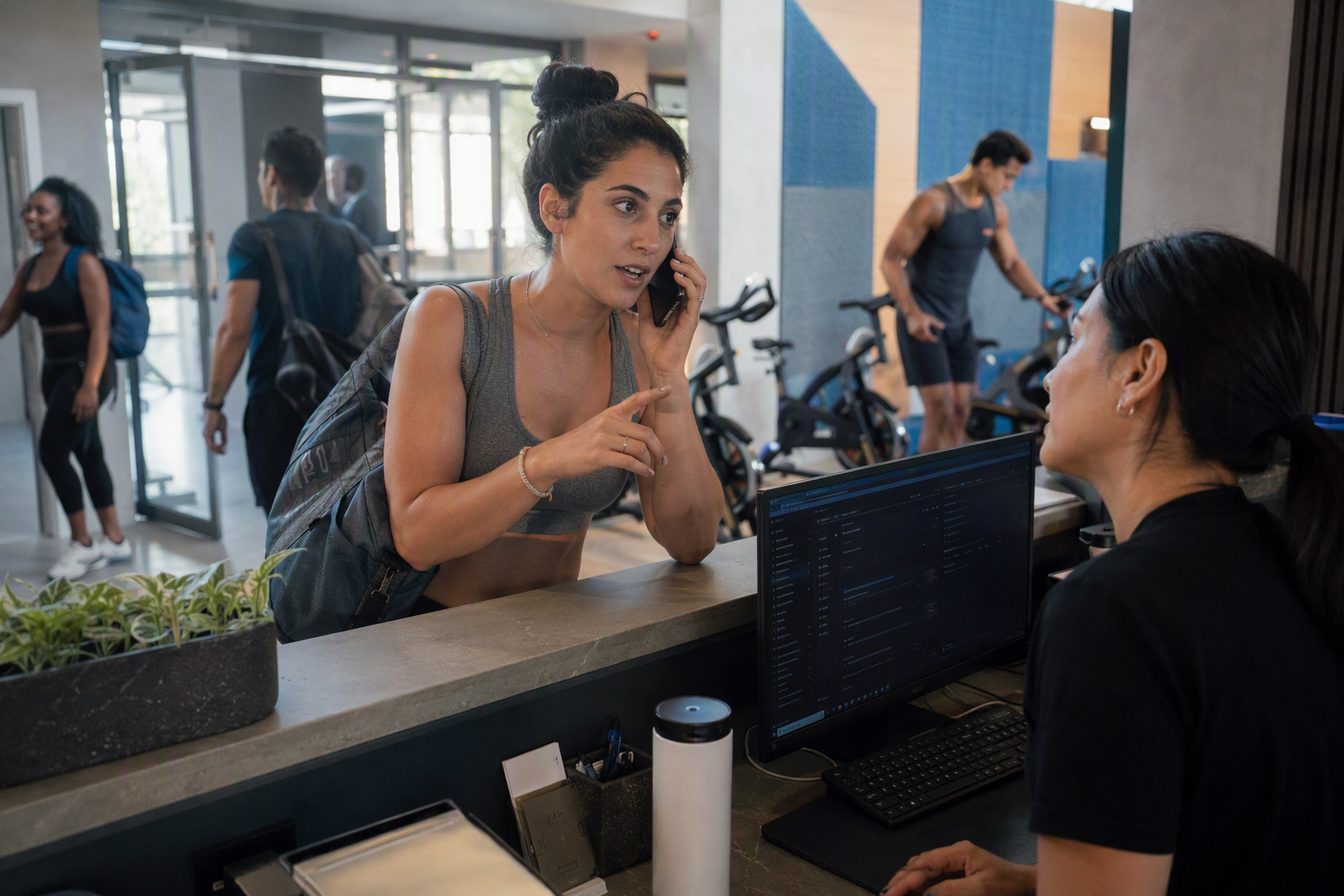
A real fitness reception conversation should move from intent to eligibility to an accurate next step in a few questions. The AI should qualify the lead without interrogating them, retrieve live availability, confirm consequential details and transfer any health-related or exceptional request to staff.
A practical trial-booking conversation
A well-designed call might sound like this:
AI receptionist: “Thanks for calling Northside Fitness. I’m the automated reception assistant. Are you asking about membership, today’s classes or booking a trial?”
>
Caller: “I want to try yoga, preferably after work.”
>
AI receptionist: “I can help with that. Which location suits you, and would you prefer a group class or a one-to-one introduction?”
>
Caller: “Indiranagar. Group class, after 6:30.”
>
AI receptionist: “The approved timetable shows beginner yoga at 7:00 p.m. on Tuesday and Thursday. Have you attended Northside Fitness before?”
>
Caller: “No. Book Thursday.”
>
AI receptionist: “I have one trial place available this Thursday at 7:00 p.m. in Indiranagar. May I take your name and mobile number to reserve it?”
>
Caller: “Actually, make that Tuesday.”
>
AI receptionist: “Certainly—Tuesday at 7:00 p.m., not Thursday. Shall I confirm that booking and send the location details on WhatsApp?”
This exchange demonstrates four essential capabilities: intent detection, interruption handling, real-time schedule retrieval and explicit confirmation before writing a booking.
Keep fitness lead qualification short
The AI should ask only questions that change routing, availability or the next action:
- Desired activity or goal: yoga, strength training, group fitness or personal training—not detailed medical or body-history questions.
- Preferred location: essential for multi-site schedules, pricing and capacity.
- Format: group class, drop-in, class pack, membership or one-to-one consultation.
- Availability: practical days and time windows rather than an exhaustive timetable recital.
- Existing-member status: needed to distinguish lead capture from account support.
- Readiness: book now, receive information or request a staff callback.
Qualification must adapt to the business model. A gym may verify trial eligibility and membership status; a boutique studio may check class capacity and waitlists; a yoga center may distinguish drop-ins from class packs; and a personal trainer may schedule a consultation rather than promise a training session.
Design for imperfect calls
Fitness calls often happen from traffic, gym floors or other noisy environments. The voice agent should:
- Allow callers to interrupt, correct names and change dates.
- Ask for repetition instead of guessing when confidence is low.
- Read back the location, class, date, time and booking status.
- Avoid claiming a reservation is complete until the booking system confirms it.
- Offer immediate transfer or a defined callback when misunderstanding repeats.
- Preserve the caller’s answers so staff do not restart qualification from zero.
Multilingual capability also requires practical testing. For example, a platform such as CallMissed supports voice and chat across 22 Indian languages, but buyers should still test local accents, code-switching, class names, dates and translated automation disclosures against their own scripts.
Stop at the health-information boundary
If a caller says, “I have a knee injury—will this class be safe?”, the correct response is not exercise advice. The AI should explain that it cannot assess suitability, capture only the information required for routing and connect the caller with an appropriately qualified employee.
The same handoff rule should apply to pregnancy, medication, accessibility, waivers, safeguarding concerns, emergencies, billing disputes and cancellation exceptions. A successful conversation is not simply one that produces a booking; it is one that produces the right, verified and safe outcome.
How should gym WhatsApp automation and missed-call recovery convert interest without creating spam?
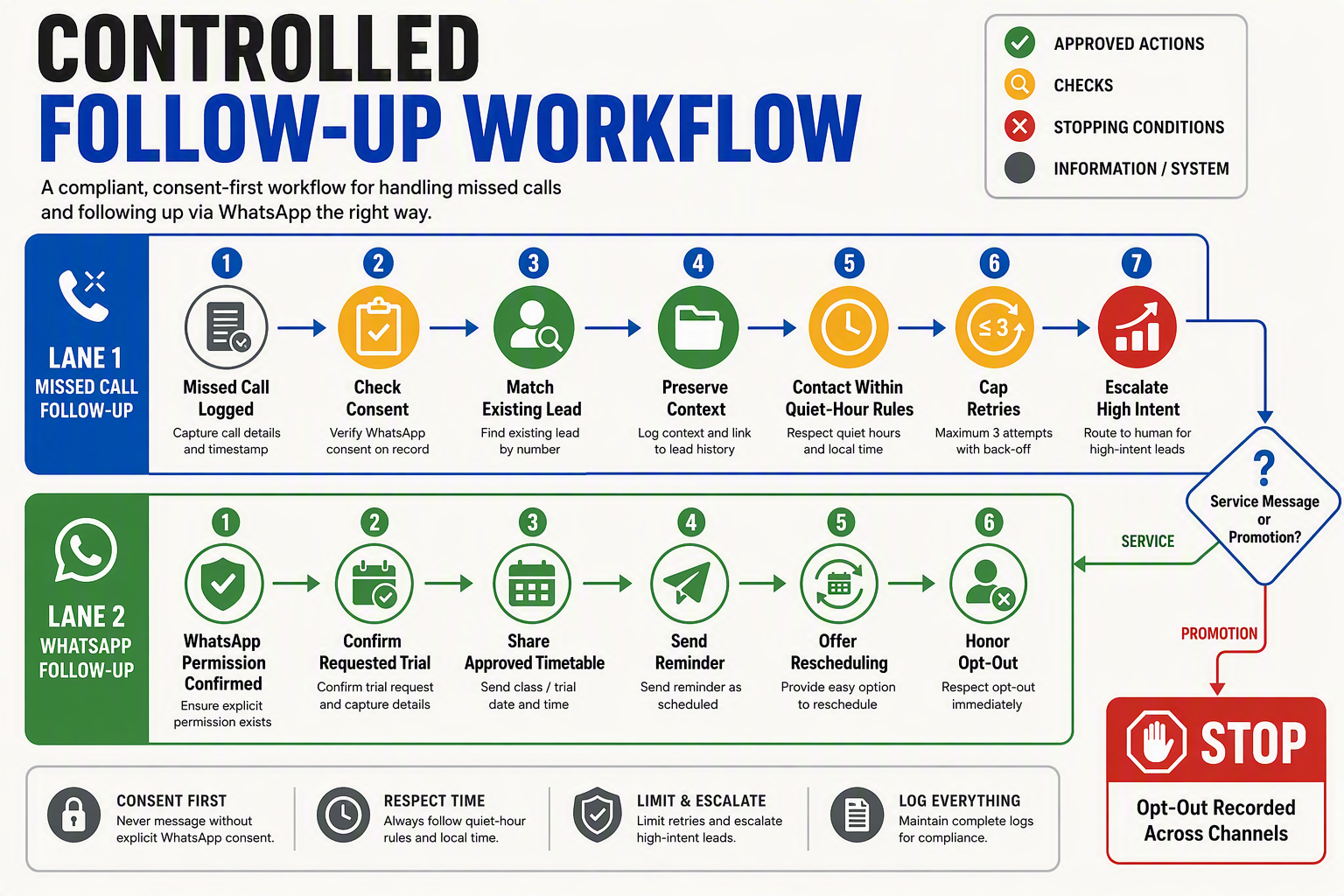
Gym WhatsApp automation should convert interest through timely, contextual service messages, not repeated promotional nudges. The safest workflow recovers an enquiry once, preserves the caller’s intent, asks permission before continuing and stops immediately after an opt-out.
Design missed-call recovery as a controlled sequence
Meta reported in April 2025 that WhatsApp had surpassed 3 billion monthly active users worldwide. That reach makes WhatsApp useful for recovery, but it also increases the importance of consent and frequency controls.
A practical missed-call workflow should:
- Log the unanswered call with number, timestamp, location dialled and any available campaign attribution.
- Check identity and conversation history to prevent two branches, agents or automations from contacting the same person.
- Verify the messaging basis permitted by the gym’s policy and applicable law before sending WhatsApp communication.
- Send one contextual recovery message, such as: “You called FitZone Indiranagar at 6:42 p.m. about membership information. Would you like class timings, trial availability or a staff callback?”
- Continue only after engagement, or apply a tightly capped retry policy with configured quiet hours.
- Escalate high-intent replies—such as “I want to join today”—to staff when immediate human attention could improve conversion.
The message should identify the business and explain why the recipient is being contacted. It should never imply that a trial is booked until the booking system confirms capacity.
Separate service communication from promotion
A person requesting a trial confirmation has not automatically agreed to receive an open-ended marketing campaign. Buyers should require separate workflow rules for:
- Service messages: requested timetable details, booking confirmations, reminders, location directions, waitlist updates and rescheduling links.
- Promotional messages: membership discounts, referral offers, new-class launches and re-engagement campaigns.
- Sensitive routing: injury, pregnancy, medication, accessibility, waiver or exercise-suitability questions that must go to qualified staff.
Promotional campaigns should use the appropriate consent process and WhatsApp message format for the market in which the gym operates. Every workflow must recognize clear opt-outs—including “stop,” “unsubscribe,” “don’t message me” and equivalent phrases in supported languages—and suppress future marketing automatically.
Preserve context without over-collecting data
The WhatsApp assistant should carry forward only useful operational context: preferred branch, requested activity, suitable time, membership status and readiness to book. It should not ask for diagnoses, medical histories or detailed injury information to qualify a sales lead.
A concise conversion path might be:
- Confirm the requested gym or studio location.
- Offer approved trial slots from live availability.
- Ask the prospect to select a slot.
- Repeat the date, time, branch and class format.
- Write the reservation using an idempotent booking action.
- Send confirmation only after receiving a successful booking response.
If capacity changes, the assistant should offer a waitlist or staff callback rather than inventing availability.
Apply measurable anti-spam controls
Configure quiet hours, retry caps, duplicate suppression, consent timestamps, opt-out logs and campaign-level frequency limits before launch. Audit a sample of recovered conversations weekly for incorrect context, excessive follow-ups and failed suppression.
Platforms such as CallMissed can connect missed-call recovery, WhatsApp chat and WhatsApp Business calling while retaining cross-channel context. For Indian fitness businesses, its support for 22 Indian languages can also help teams test opt-outs, booking details and translated disclosures across regional-language and code-switched conversations.
Which CRM, booking, calendar and multilingual capabilities must buyers test?
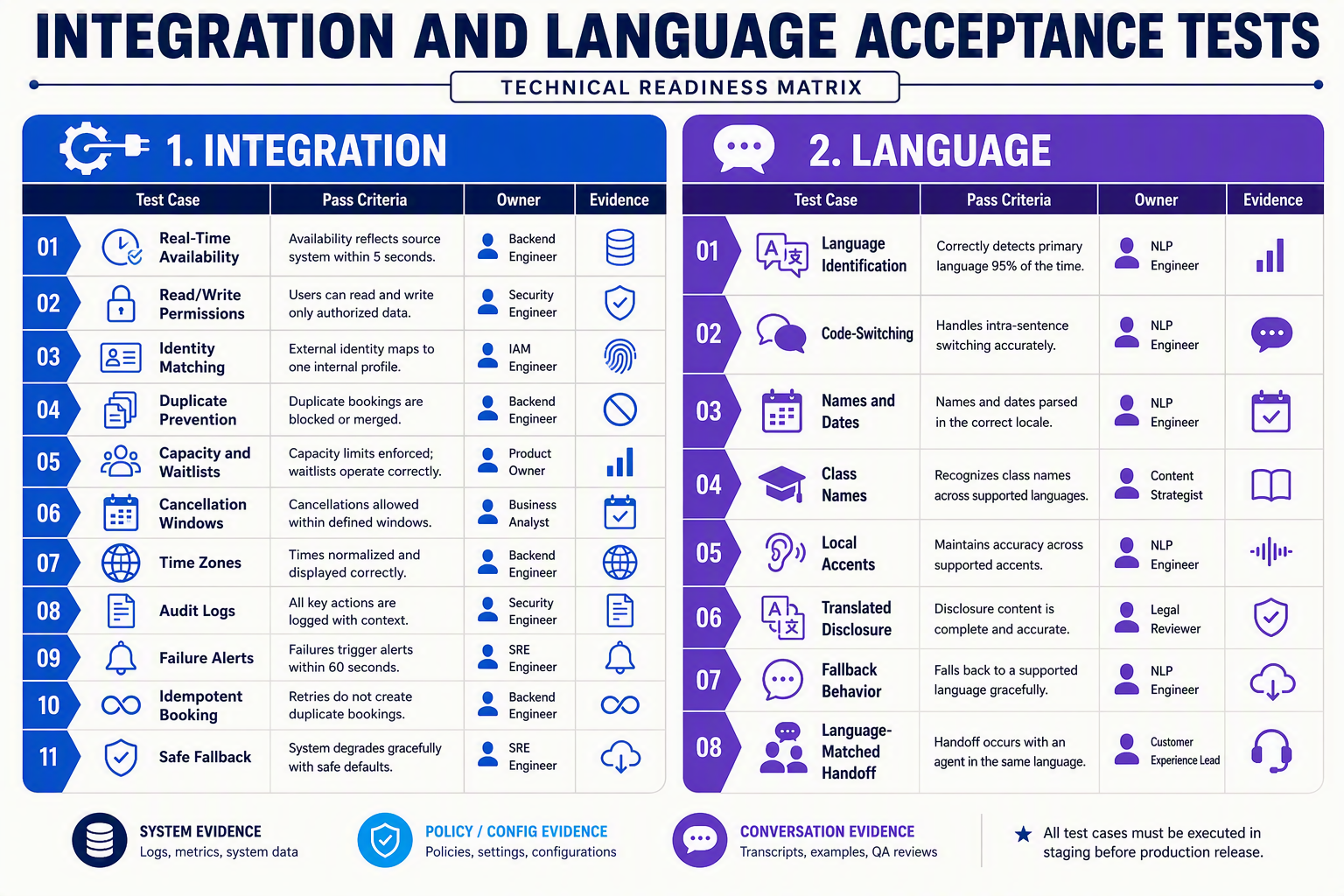
Buyers must test whether an AI receptionist can read and write accurate customer, booking and calendar data in real time, enforce each fitness business’s operating rules, and complete multilingual conversations without losing intent. A successful demo is not enough: require sandbox testing of duplicates, full classes, waitlists, cancellations, code-switching and unavailable integrations before deployment.
Integration and language test matrix
| Capability | Required buyer test | Pass condition | Failure safeguard |
|---|---|---|---|
| CRM and membership records | Call twice using the same phone number, then switch from voice to WhatsApp | One contact record retains source, consent, qualification answers, transcript and owner; no duplicate lead | Flag uncertain identity matches for staff instead of merging automatically |
| Class and trial booking | Request a class with one place remaining; submit simultaneous booking attempts | Only one confirmed reservation is created through an idempotent write; capacity never exceeds the configured limit | Offer approved alternatives or a waitlist without claiming a booking |
| Calendar and trainer availability | Test overlapping appointments, breaks, buffers, time zones and instructor leave | The agent exposes only genuinely available slots and records the correct location, trainer, date and time | Stop booking and create a callback task when calendar data is stale or unavailable |
| Rescheduling and cancellation | Attempt changes inside and outside the gym’s cancellation window | The AI applies the configured policy, repeats consequential details and records an audit trail | Escalate exceptions, fee disputes and irreversible changes to staff |
| Multilingual understanding | Use local accents, code-switching, spoken dates, names and untranslated class labels | Language detection remains stable; names, numbers and booking details are confirmed explicitly | Switch language, slow down, offer keypad/text input or transfer to an appropriate employee |
| System outage and recovery | Disconnect the CRM or booking API during a transaction, then restore it | The agent does not invent availability or create a second booking during retry | Capture the request as pending, alert staff and reconcile it from the audit log |
Requirements must reflect the fitness business model
A generic connector may technically access a calendar while still mishandling the business’s actual inventory. Buyers should configure and test rules specific to the operating model:
- Multi-location gyms: home-club eligibility, guest access, age restrictions, shared membership records and location-specific trial capacity.
- Boutique studios: class packs, drop-ins, instructor substitutions, equipment limits and waitlist promotion.
- Yoga centers: class level, approved prerequisites, recurring sessions and policy-based routing of pregnancy or suitability questions.
- Personal trainers: one-to-one consultation duration, travel buffers, trainer matching and protected calendar details.
The integration should use least-privilege permissions. Reading schedules does not automatically justify editing memberships, issuing refunds or viewing unnecessary profile data. Every create, update, cancellation and consent change should record the timestamp, channel, system response and acting automation.
Treat multilingual support as an end-to-end workflow
Language coverage should be tested against real conversations, not a vendor’s language list. Build a test set containing regional accents, background gym noise, interruptions, “next Friday” date expressions, spelled surnames and mixed-language phrases such as an English class name inside a Hindi or Tamil sentence.
Indian businesses should also test whether the platform handles regional languages in both speech directions. CallMissed supports Speech-to-Text and Text-to-Speech across 22 Indian languages, enabling gyms to evaluate Indic-language voice and WhatsApp journeys rather than adding translation after the core workflow.
Before approval, require at least:
- Translated automation disclosures and consent wording reviewed by a fluent speaker.
- Booking details read back in the caller’s chosen language.
- A defined fallback when confidence is low or code-switching causes ambiguity.
- Transfer routing that preserves the transcript, selected language and pending action.
The acceptance standard is operational: the correct member, class, location and time must reach the correct system exactly once—regardless of channel or language.
Where are the consent, health-information and staff-handoff boundaries?

An AI receptionist should collect only the information required to answer, route or book a request; it should not diagnose injuries, assess exercise suitability or recommend individualized treatment. Consent must also be purpose-specific: permission to receive a trial confirmation does not automatically authorize promotional WhatsApp messages, call recording or future marketing.
Separate administrative intake from health advice
Safe administrative questions include preferred activity, location, availability, membership status and readiness to book. If a caller voluntarily mentions an injury or medical condition, the system should acknowledge it without probing and transfer the case according to the gym’s policy.
The boundary should be encoded in prompts, knowledge sources and tool permissions:
- Allowed: “Would you like me to arrange a callback with a qualified trainer?”
- Allowed: sending an approved waiver or pre-exercise screening form.
- Not allowed: “That class is safe during pregnancy.”
- Not allowed: diagnosing pain, interpreting medication effects or prescribing exercises.
- Not allowed: promising weight loss, rehabilitation or other health outcomes.
Article 9 of the European Union’s General Data Protection Regulation classifies health data as a special category of personal data, requiring an applicable legal basis and additional protections. In the United States, the Department of Health and Human Services explains that HIPAA generally applies to covered entities and business associates—not automatically to every gym—but other federal, state and consumer-protection requirements may still govern fitness and health information.
Apply data minimization even where a gym is not subject to a health-specific regime. Store “staff callback requested about exercise suitability” rather than a detailed diagnosis in the general CRM unless an approved form and restricted workflow require more information.
Treat each communication permission separately
The implementation should record the purpose, channel, wording, timestamp and source of consent. Configure independent controls for:
- Call recording or transcription.
- Trial confirmations and operational reminders.
- WhatsApp follow-up after an enquiry or missed call.
- Promotional messages, offers and recurring campaigns.
- Withdrawal, deletion or correction requests.
Meta’s WhatsApp Business Messaging Policy requires businesses to obtain appropriate opt-in before initiating conversations and to honor opt-outs. A caller who says “send me the 6 p.m. class details” has requested that service message; the request should not be silently converted into consent for a monthly membership campaign.
Recording and automated-calling rules vary by jurisdiction. Buyers should therefore require configurable disclosures, quiet hours, suppression lists and retention periods rather than relying on one global script.
Define non-negotiable staff-handoff triggers
The receptionist should stop automation and offer a live transfer, priority callback or emergency instruction when it detects:
- Emergency language, chest pain, breathing difficulty, collapse or immediate danger.
- Injury, pregnancy, medication, disability, accessibility or exercise-suitability questions.
- Safeguarding concerns involving children or vulnerable people.
- Waiver uncertainty, age restrictions or parental-consent issues.
- Complaints, harassment reports, billing disputes or cancellation exceptions.
- Repeated misunderstanding, low-confidence transcription or language failure.
- Booking-system outages, conflicting availability or uncertain capacity.
Emergency scripts must not imply clinical assessment. The assistant should tell the caller to contact local emergency services when appropriate, while avoiding claims that staff will provide immediate medical help.
Make handoff auditable
A proper handoff includes the caller’s name, contact preference, original request, consent status, booking context and a concise non-diagnostic summary. Access should follow least-privilege permissions, with audit logs showing what the AI collected, which employee received it and whether follow-up occurred. Test these boundaries with injury disclosures, opt-outs, minors, accessibility requests and ambiguous emergencies before enabling autonomous bookings or campaigns.
What should operators demand from a vendor, rollout plan and exit strategy?
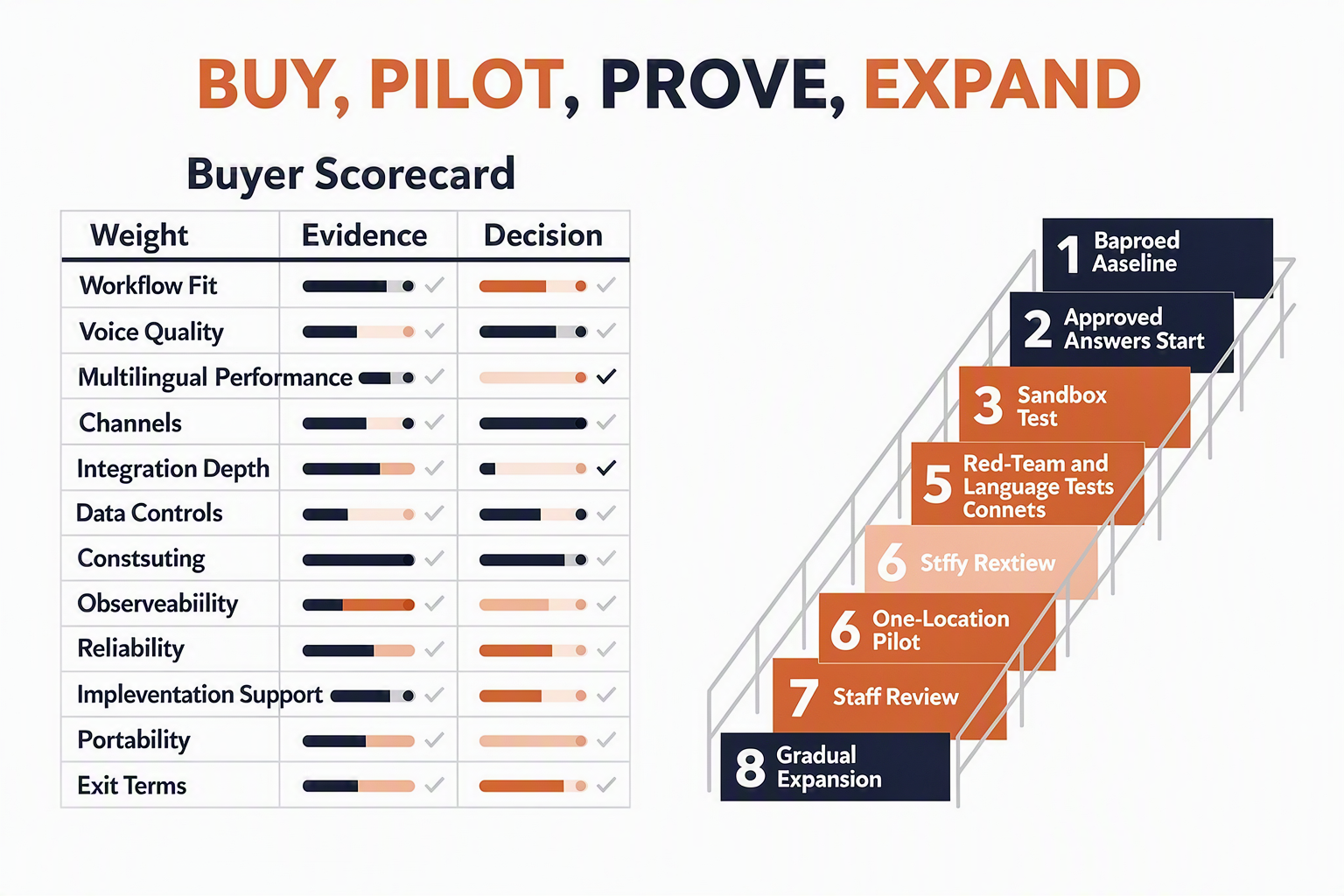
Operators should demand measurable acceptance criteria, transparent operating costs, secure integrations and a contractually defined exit path before an AI receptionist handles live enquiries. The vendor should prove complete fitness workflows—from timetable lookup to trial booking and staff handoff—not merely demonstrate a fluent conversation.
Vendor requirements and acceptance criteria
Ask each vendor to run the same test scenarios using your real membership rules, class names, accents and booking sandbox. A polished scripted demo is not evidence that the system can prevent duplicate trials, respect capacity limits or recover safely from an unavailable booking platform.
| Requirement | Evidence to demand | Suggested acceptance test | Exit requirement |
|---|---|---|---|
| Voice performance | Call recordings, latency reporting and interruption support | Complete 30 noisy, accented and interrupted test calls without losing consequential details | Export recordings, transcripts and call metadata |
| Booking integrity | Documented API actions, idempotency and audit logs | Zero duplicate bookings across repeated requests; never exceed class capacity | Revoke credentials and remove webhooks without disrupting the booking system |
| WhatsApp governance | Consent records, template controls, opt-out handling and quiet-hour rules | Suppress every opted-out contact and prevent unapproved promotional messages | Export consent status, conversation history and template records |
| Multilingual operation | Tested language list, fallback logic and translated disclosures | Validate names, dates, code-switching and class terminology in every deployed language | Retain transcripts and language-specific configuration |
| Security and reliability | Data-flow diagram, access controls, incident process and uptime terms | Simulate CRM downtime, failed writes and delayed responses; verify safe fallback | Written deletion timeline and confirmation of data removal |
| Commercial model | Itemised voice, messaging, model, number and integration charges | Model expected cost at normal volume and at a 2× peak-call scenario | No punitive export fees; documented number-porting and termination process |
For India-focused operators, multilingual evaluation should go beyond Hindi and English. CallMissed supports Speech-to-Text and Text-to-Speech across 22 Indian languages, but operators should still test the specific accents, mixed-language phrases and local class names their members use.
Roll out in controlled stages
A gym should not switch every location, language and enquiry type on simultaneously. Use a staged deployment with explicit promotion or rollback criteria:
- Baseline and design: Measure current answer rate, median response time, trial-booking rate, no-show rate and staff escalation volume. Approve scripts, health-information boundaries and escalation ownership.
- Sandbox testing: Run at least 50 representative scenarios, including duplicate contacts, full classes, waitlists, cancellation exceptions, injuries, billing disputes and integration outages.
- Staff-only pilot: Let employees call the agent, review transcripts and grade booking accuracy, disclosure, tone and handoff quality.
- Limited production: Start with one location, selected hours or missed calls only. Review failures daily and keep human reception available.
- Measured expansion: Add live answering, WhatsApp follow-up, languages and locations only after the agreed thresholds are met.
No rollout should proceed while the system can create over-capacity bookings, omit automation disclosures, provide health advice or fail to escalate emergency language.
Design the exit before signing
The contract should specify that the operator owns or can retrieve contact records, consent evidence, transcripts, recordings, knowledge-base content, prompts, booking events and audit logs in usable formats such as CSV or JSON. It should also define:
- Number portability and WhatsApp Business account ownership.
- Credential rotation, webhook removal and administrator-access revocation.
- Data retention and deletion deadlines, including backups.
- A parallel-running period for migration to staff or another provider.
- A tested fallback that routes calls to employees when AI or integrations fail.
A credible exit strategy prevents vendor dependence and protects continuity during pricing changes, service failures, acquisitions or a future change in the gym’s operating model.
Which KPIs prove operational value without overstating membership growth?
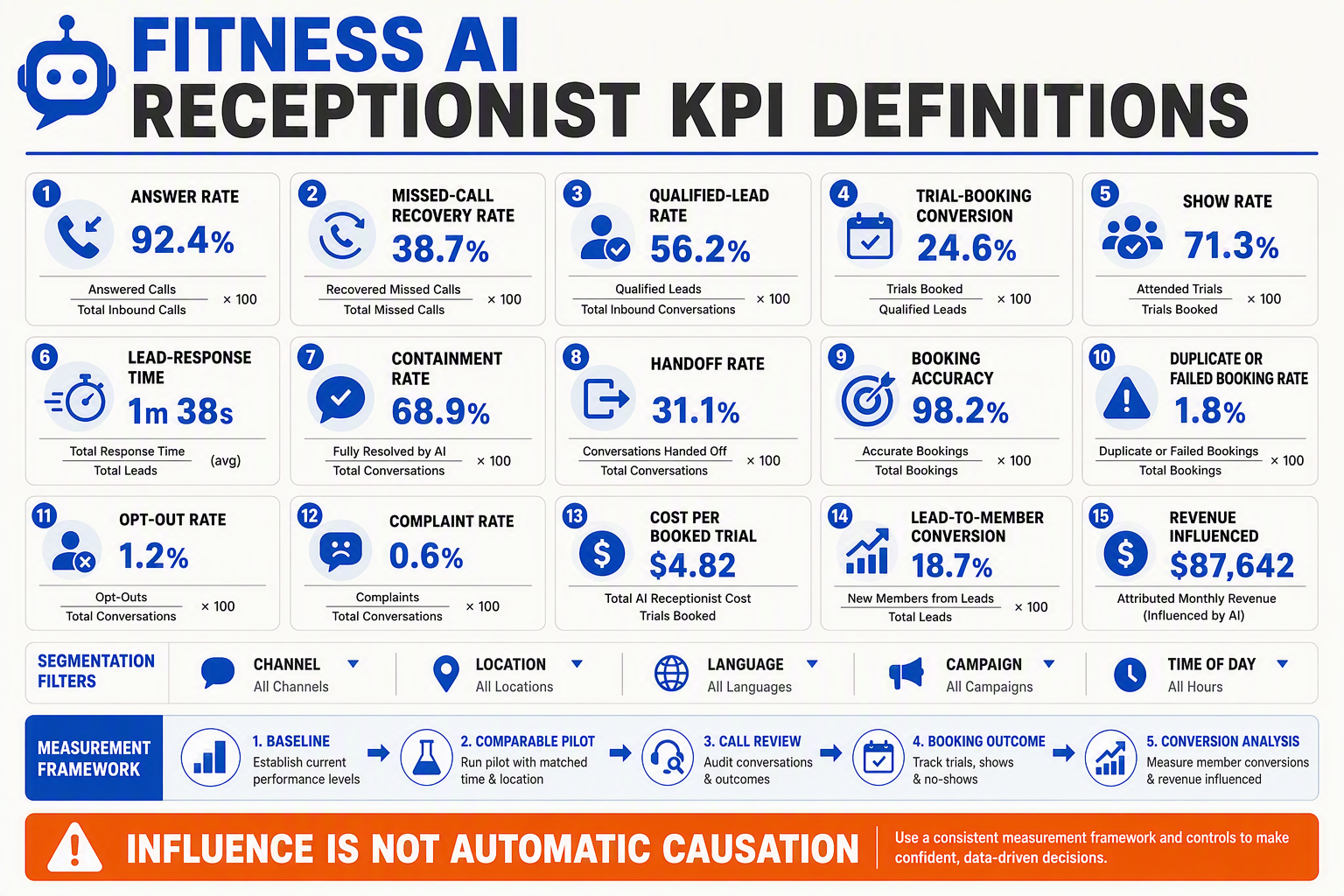
Operational value is proven when the AI receptionist answers more eligible enquiries, responds faster, creates accurate bookings and transfers exceptions reliably. Membership growth should remain a secondary outcome because pricing, location, trainers, seasonality and sales follow-up also influence conversion.
Build a KPI scorecard around controllable outcomes
Measure each KPI against a four- to eight-week pre-launch baseline, then compare equivalent locations, channels, opening hours and lead types. Do not present vendor-wide averages as guaranteed results; every fitness business has different call volumes, timetable complexity and staffing patterns.
| KPI | Calculation | What it proves | Recommended reporting |
|---|---|---|---|
| Eligible enquiry answer rate | Answered eligible calls ÷ total eligible calls | Coverage during busy and out-of-hours periods | By location, hour and language |
| Median lead response time | Median time from enquiry or missed call to first valid response | Speed without distortion from extreme cases | Voice and WhatsApp separately |
| Trial-booking completion rate | Confirmed trials ÷ qualified prospects requesting a trial | Ability to convert intent into an operational booking | Include abandonment reasons |
| Booking accuracy rate | Correct bookings ÷ audited AI-created bookings | Reliability of date, class, instructor, location and capacity data | Audit weekly during rollout |
| Successful handoff rate | Staff-connected or accepted callbacks ÷ required handoffs | Whether sensitive and exceptional cases reach humans | Track reason and waiting time |
| Trial attendance rate | Attended trials ÷ confirmed trials | Quality of confirmation and reminder workflows | Compare AI-assisted and baseline cohorts |
Answer rate alone is insufficient. An AI receptionist that answers every call but creates duplicate reservations or misunderstands class dates may increase workload rather than reduce it. Pair volume metrics with quality measures such as booking accuracy, duplicate rate, integration-failure rate and manual correction time.
For WhatsApp, track consent capture, delivery, reply, rescheduling and opt-out rates separately. Meta reported in April 2025 that WhatsApp had exceeded 3 billion monthly active users worldwide, but platform reach does not establish customer consent or prove that more messages create more memberships.
Separate attribution from contribution
Trial-to-membership conversion is commercially important, but it should be labelled a shared business outcome, not an AI-only KPI. Report:
- Conversion by lead source, location, offer and enquiry date.
- The same conversion window for baseline and AI-assisted cohorts.
- Trials booked, attended and sold as separate funnel stages.
- Staff follow-up activity after the AI interaction.
- Pricing changes, promotions, closures and seasonal campaigns that may affect results.
Use cautious language: “AI-assisted trial attendance increased from the baseline” is supportable when cohort definitions are consistent. “The AI generated all additional memberships” is generally not supportable without a controlled attribution design.
Define success before the pilot
Set pilot thresholds from current operations rather than adopting arbitrary industry numbers. For example, a gym might require no increase in duplicate bookings, faster median response outside staffed hours and successful escalation of every audited health-related enquiry.
Platforms such as CallMissed, which connect AI voice agents, WhatsApp workflows and an omnichannel inbox, can centralise the event data needed for this scorecard. However, buyers should still verify timestamp quality, channel identity matching, CRM write-backs and exportable audit logs before relying on dashboard results.
Review KPIs weekly during rollout and monthly after stabilisation. A credible business case combines coverage, speed, accuracy, compliance, handoff quality and staff time saved—without implying that communication automation alone determines membership growth.
Frequently asked questions about AI receptionists for fitness businesses
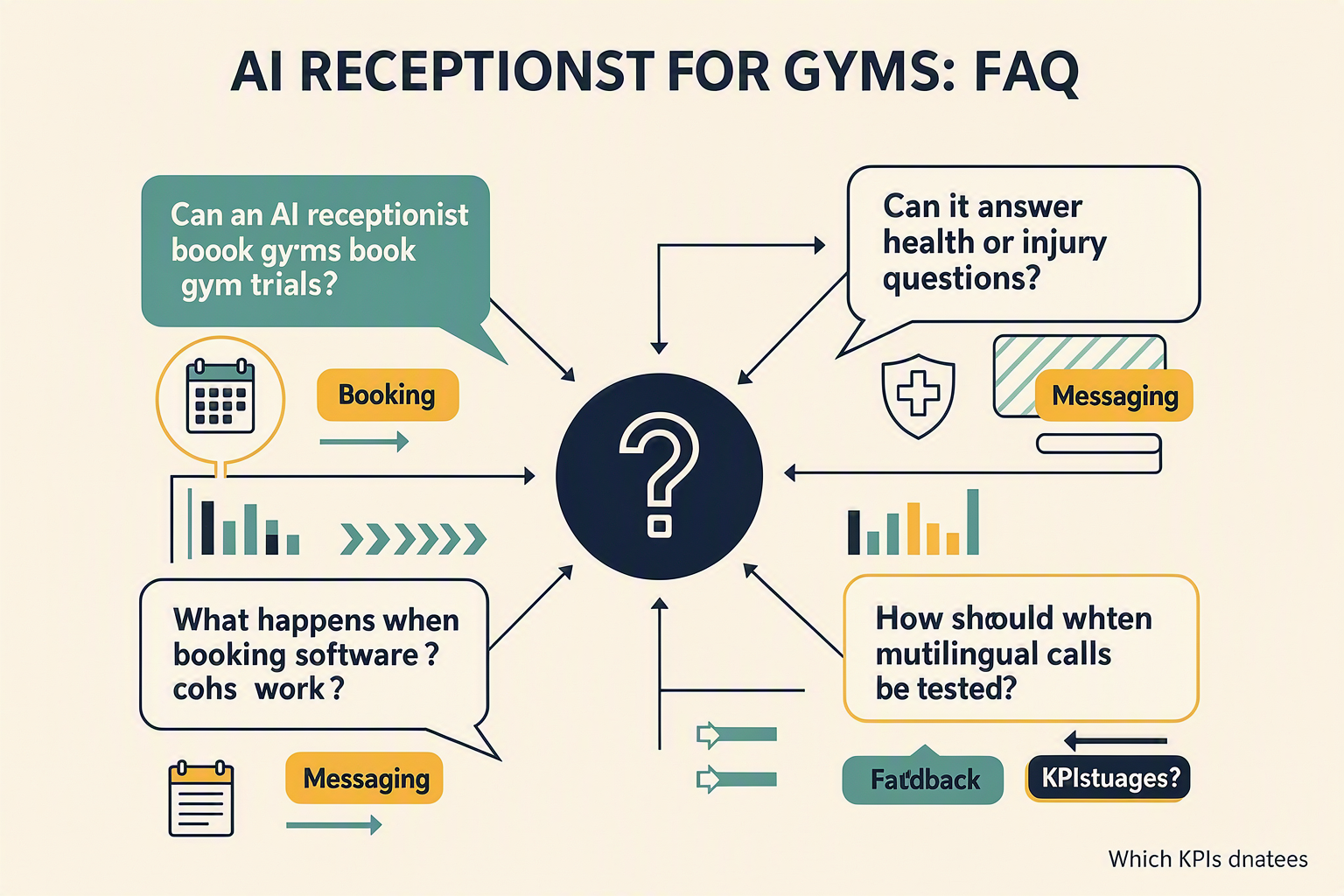
What should an AI Receptionist for Gyms be able to do in 2026?
Can an AI Receptionist for Gyms book trials without overbooking classes?
How should gyms use WhatsApp automation after a phone enquiry or missed call?
Can a fitness-business AI receptionist answer questions about injuries, pregnancy or exercise suitability?
How do I evaluate multilingual support in an AI Receptionist for Gyms?
What KPIs and rollout process should a gym use for an AI receptionist?
Conclusion
In 2026, the right AI receptionist for gyms is an operational layer connecting calls, trials, WhatsApp, booking systems and staff—not merely a bot that answers FAQs. Success depends on accurate workflows, controlled automation and clear human accountability.
- Prioritise conversion-critical tasks: Answer approved membership questions, retrieve current timetables, qualify leads briefly, book eligible trials and recover missed calls without duplicating outreach.
- Integrate before scaling: Connect CRM, membership, calendar and class-booking systems with real-time availability, capacity controls, identity matching, idempotent actions, audit logs and safe failure fallbacks.
- Keep communication compliant and continuous: Preserve context between voice and WhatsApp, obtain appropriate messaging consent, honour opt-outs and quiet hours, and test multilingual conversations—including accents, code-switching, names and dates.
- Maintain firm safety boundaries: AI should handle administrative intake, not diagnose injuries, recommend exercise, assess suitability or promise outcomes. Health questions, complaints, billing disputes, safeguarding issues and booking failures require prompt staff handoff.
The next capability to watch is increasingly seamless orchestration across voice, WhatsApp and human teams, with multilingual service treated as a tested operational requirement rather than a checkbox.
Fitness businesses exploring this direction can review CallMissed, which combines AI voice agents, WhatsApp communication and support for 22 Indian languages. The practical question is: how many high-intent enquiries could your gym convert if every call received an accurate, immediate next step?
Related Reading
Discussion
Related Posts



Ready to automate customer conversations?
Launch AI voice agents and WhatsApp bots with CallMissed — one API, 22+ Indian languages.