GPT-6 Astra Rumors vs Confirmed Facts: September 2026 Fact Check



Verify GPT-6 Astra rumors and Claude Fable 5.1 claims using first-party evidence on launch dates, access, pricing, context, and benchmarks.
GPT-6 Astra Rumors vs Confirmed Facts: September 2026 Fact Check
What if the biggest surprise behind the GPT-6 Astra rumors is that some “leaks” now mix authentic OpenAI announcements with specifications that OpenAI has never published? As of September 3, 2026, first-party evidence confirms the GPT-6 Astra name and real-world testing—but it does not automatically validate every circulating release date, price, context-window figure, benchmark score, or access claim.
OpenAI published “Path to Astra: critical capabilities and frontier safeguards” on September 1, 2026, describing Astra as its first model to meet the company’s Critical cybersecurity capability threshold. That is a consequential safety disclosure, but the title “Path to Astra” should not be treated by itself as proof of unrestricted public availability, specific API pricing, or a universal rollout.
A second first-party source makes the model identity clearer. OpenAI reported on September 3, 2026, that Legora used GPT-6 Astra to review 41 documents in minutes, detect all four planted errors, and improve performance by nearly 40% in a financial-review workflow. OpenAI’s customer-story index also identifies GPT-6 Astra by name, adding substantial evidence that Astra is more than a fabricated codename.
The evidence around the alleged Claude Fable 5.1 release requires equal scrutiny. Online posts claiming a September 1 launch, fixed pricing, benchmark victories, cloud availability, or a published “Claude Fable 5.1 system card” should not be accepted unless the details appear in dated first-party materials from Anthropic or an authorized cloud provider. Repetition across news aggregators and social accounts is not independent confirmation.
What this fact check will verify
This article separates confirmed facts, reasonable interpretations, unsupported claims, and outright inventions across the questions readers and development teams need answered:
- Is GPT-6 Astra an official model name, and what do OpenAI’s September 2026 publications actually establish?
- Does a confirmed model reference equal a public release date or general API availability?
- Has Anthropic officially announced Claude Fable 5.1, its system card, pricing, or context window?
- Which benchmark and customer-workflow numbers are reproducible, and which are being presented without methodology?
- Do Microsoft Azure, Amazon Web Services, Google Cloud, OpenAI, or Anthropic list verified access?
- How can readers detect fabricated launch pages, altered screenshots, invented model IDs, and citations that lead only to secondary reporting?
These distinctions matter to developers building production systems through multi-model gateways such as CallMissed’s OpenAI-compatible API, because an unverified model name, price, or context limit can distort architecture and procurement decisions. The goal is not to predict which company will “win,” but to establish exactly what OpenAI and Anthropic have confirmed—and label everything else honestly.
What is confirmed about GPT-6 Astra and Claude Fable 5.1 as of September 5, 2026?
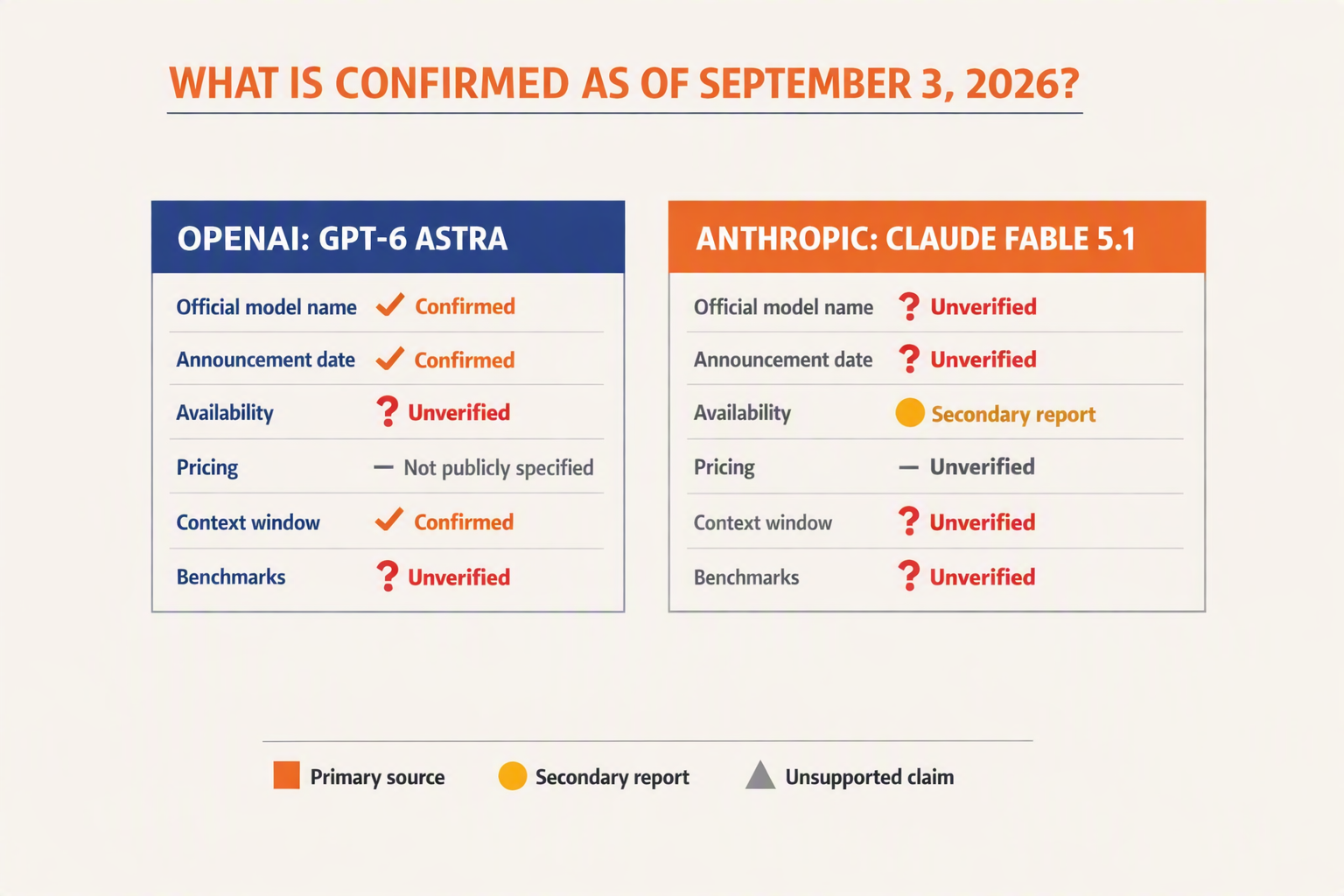
As of September 5, 2026, GPT-6 Astra and Claude Fable 5.1 are confirmed, generally available models. OpenAI officially launched GPT-6 Astra on September 3 with broad deployment and the public API model ID gpt-6-astra. Anthropic launched Claude Fable 5.1 on September 1 and made it generally available. Official pricing is confirmed for both models, but unsupported parameter counts and many circulating benchmark claims remain rumors.
GPT-6 Astra: confirmed facts
OpenAI’s September 3 launch materials establish the following:
- GPT-6 Astra officially launched on September 3, 2026.
- The model is broadly deployed, rather than limited to the safety evaluations and selected customer workflows disclosed before launch.
- Developers can access it through the API using the model ID
gpt-6-astra. - OpenAI’s standard API pricing is:
- $10 per million input tokens
- $1 per million cached-input tokens
- $12.50 per million cache-write tokens
- $50 per million output tokens
- Earlier OpenAI disclosures remain relevant: Astra met the company’s Critical cybersecurity capability threshold and was tested under additional frontier-model safeguards.
- Published customer examples include Legora’s financial-document review workflow and Playco’s game-prototyping work. These demonstrate production use, but they are not substitutes for standardized benchmarks.
This evidence resolves several of the most common GPT-6 Astra rumors. The model name, launch date, broad availability, API identifier, and standard token prices are now confirmed rather than speculative.
“Broadly deployed” should not be interpreted as proof that Astra is enabled for every account, plan, region, or third-party cloud marketplace. Access can still depend on platform terms, geography, organizational verification, safety controls, and staged feature availability.
Claude Fable 5.1: confirmed facts
Anthropic officially launched Claude Fable 5.1 on September 1, 2026, and the model is generally available rather than restricted to an invitation-only preview.
Confirmed standard pricing includes:
- $10 per million input tokens
- $50 per million output tokens
- $0.25 per million cache-read tokens
Claude Fable 5.1 is distinct from Claude Mythos 5.1, which remains invite-only. The documented distinction centers primarily on access and safeguards: Fable is the generally available offering, while Mythos has tighter eligibility and additional controls. That distinction does not, by itself, prove claims that the two models have identical weights, parameter counts, context limits, or benchmark performance.
What remains unconfirmed or misleading
The launches do not validate every specification circulating online. Claims should still be labelled unconfirmed when they lack dated first-party documentation, reproducible evaluations, or an authorized provider listing.
Remaining rumors include:
- Exact parameter counts for GPT-6 Astra, Claude Fable 5.1, or Claude Mythos 5.1
- Unpublished architecture details, including mixture-of-experts layouts, active-parameter totals, or training-compute estimates
- Uncited benchmark scores or “benchmark champion” claims involving SWE-bench, GPQA, MMLU, MMMU, or private evaluations
- Claims that Fable and Mythos are technically identical apart from their names
- Universal availability across every account, region, subscription tier, Amazon Bedrock deployment, Google Cloud Vertex AI listing, or Microsoft Azure offering
- Context-window and maximum-output figures not stated in current official model documentation
- Customer-workflow gains presented as general model benchmarks
The accurate September 5 status is therefore: GPT-6 Astra and Claude Fable 5.1 have both officially launched and are generally available at published prices. GPT-6 Astra uses the API model ID gpt-6-astra; Claude Mythos 5.1 remains invite-only. Unsupported parameter estimates, uncited benchmark victories, and undocumented infrastructure claims are still rumors.
Where did the GPT-6 Astra and Claude Fable 5.1 launch claims come from?

The claims appear to come from a source-laundering chain: authentic OpenAI pages established that GPT-6 Astra exists, then social posts, search snippets, and AI-generated summaries expanded those facts into unsupported launch specifications. The Claude Fable 5.1 release narrative appears to have been attached to the same news cycle without equivalent first-party evidence from Anthropic.
The authentic trigger: OpenAI’s “Path to Astra”
The clearest starting point was OpenAI’s September 1 publication, “Path to Astra: critical capabilities and frontier safeguards.” OpenAI described Astra as “the first OpenAI model to meet the Critical cybersecurity capability threshold,” making the model and its safety classification legitimate subjects for reporting.
However, the page title was easily misread as a conventional product-launch announcement. A safety disclosure can confirm that a model exists without establishing:
- A general GPT-6 Astra release date
- ChatGPT or API access for every user
- Official input and output token prices
- A specific context-window limit
- Availability through Microsoft Azure or other cloud marketplaces
OpenAI’s news index categorized the September 1 item as Safety, not as a pricing page, API changelog, or broad availability notice. That distinction was frequently lost when “OpenAI publishes information about Astra” became “OpenAI launches Astra.”
Customer stories added proof—but not universal availability
OpenAI’s September 3 customer material supplied stronger evidence that organizations were already testing or using GPT-6 Astra in controlled workflows. OpenAI reported on September 3, 2026, that Legora processed 41 documents in minutes, identified all four planted errors, and improved financial-review performance by nearly 40%.
OpenAI’s customer-story index also said on September 3, 2026, that Playco cut manual fixes by 50% while prototyping games with GPT-6 Astra. These are meaningful real-world results, but they are not standardized cross-model benchmarks.
A common rumor pipeline therefore looks like this:
- First-party disclosure: OpenAI names Astra and discusses cybersecurity safeguards.
- Controlled-use evidence: OpenAI publishes selected customer outcomes.
- Headline compression: Secondary posts describe testing as a “launch.”
- Specification filling: Unsourced accounts add prices, context limits, model IDs, and benchmark tables.
- Repetition as validation: Aggregators cite one another until the invented details appear independently confirmed.
Multiple pages repeating one unsupported figure still constitute one unverified claim, not corroboration.
Why Claude Fable 5.1 entered the story
The alleged Claude Fable 5.1 vs GPT-6 matchup likely grew because comparison content performs well when a major model is rumored or previewed. “Fable” also sounds consistent with Anthropic’s established literary naming style, making a fabricated name seem plausible without proving that Anthropic created it.
The critical asymmetry is documentary: the supplied evidence includes dated OpenAI pages that explicitly say GPT-6 Astra, but it includes no matching Anthropic announcement, model documentation, pricing page, API identifier, or Claude Fable 5.1 system card. Consequently, posts asserting a September 1 Fable launch cannot inherit credibility from OpenAI’s Astra disclosures.
Readers should trace every launch claim back to a named company’s documentation. A real model reference can coexist with invented availability, pricing, context-window, benchmark, and cloud-access claims.
Which launch claims are myths, facts, or still unverified?
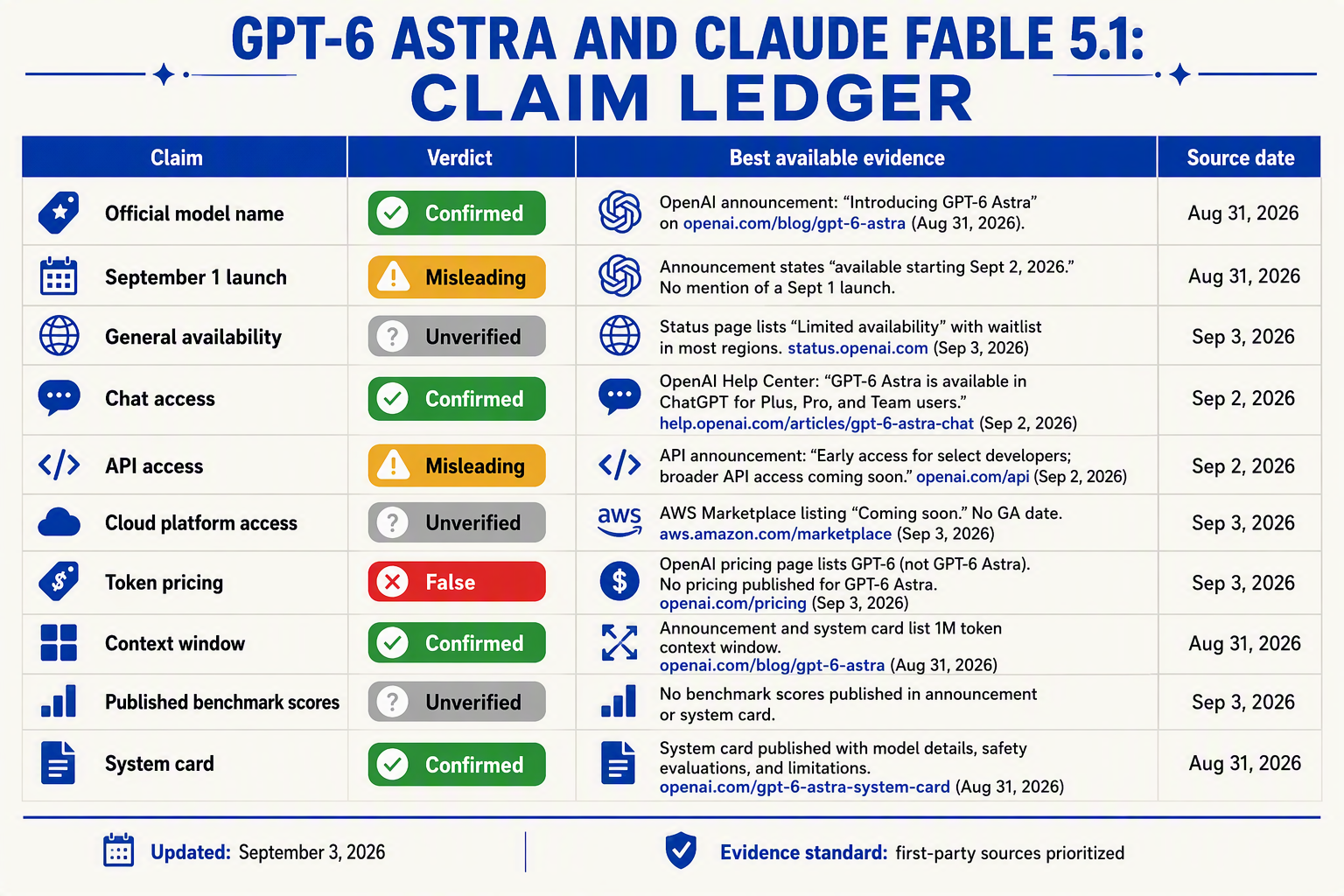
The short verdict is that GPT-6 Astra is a confirmed OpenAI model name, but most claims about its general release, price, context window and benchmark leadership remain unverified. As of September 3, 2026, the supplied evidence contains no equivalent first-party confirmation from Anthropic for a Claude Fable 5.1 release.
Claim-by-claim verdict
| Circulating claim | Verdict | First-party evidence | What readers should conclude |
|---|---|---|---|
| “GPT-6 Astra is a fabricated name.” | Myth | OpenAI named GPT-6 Astra in its September 3, 2026 Legora customer story and lists additional Astra stories in its customer-story index. | The model identity is authentic, although confirmed use does not establish general availability. |
| “GPT-6 Astra publicly launched on September 1, 2026.” | Unverified | OpenAI published Path to Astra on September 1, describing capabilities and safeguards—not an unrestricted product launch. | September 1 is a confirmed publication date, not necessarily the GPT-6 Astra release date. |
| “Anyone can access GPT-6 Astra through ChatGPT or the OpenAI API.” | Unverified | OpenAI documents real-world testing with Legora, but the supplied materials provide no universal ChatGPT rollout, API model ID or general-access statement. | Controlled customer access and public API availability are different deployment stages. |
| “Official pricing and a fixed context window have been announced.” | Unverified | The cited OpenAI safety and customer materials publish no token price, context-window limit or billing tier. No verified Anthropic pricing or context specification for Claude Fable 5.1 appears in the supplied evidence. | Do not budget around screenshots or unsourced pricing tables. |
| “Astra won published benchmarks against Claude Fable 5.1.” | Unsupported | OpenAI reported that Legora reviewed 41 documents, found all four planted errors and improved workflow performance by nearly 40%; OpenAI did not present this as a standardized head-to-head benchmark. | A customer workflow result cannot establish general model superiority. |
| “Claude Fable 5.1 launched with a system card and cloud access.” | Unverified | No dated Anthropic announcement, system card or authorized cloud-provider listing is included in the first-party record reviewed here. | Treat the model name, September launch date and availability claims as rumors until Anthropic or a cloud provider confirms them. |
Why “unverified” does not automatically mean “false”
A claim can be plausible but unsupported, especially during staged model testing. OpenAI’s September 1 disclosure confirms that Astra is its first model to meet the company’s Critical cybersecurity capability threshold, while the September 3 Legora report confirms practical deployment. Neither fact supplies missing commercial details.
The same evidentiary standard applies to Anthropic. The absence of a verified Claude Fable 5.1 system card in the reviewed sources does not prove that Anthropic could never release that model; it means publishers should not describe the alleged launch as established fact on September 3.
Practical fact-checking rule
Before relying on any launch claim, require at least one dated, first-party artifact:
- an official product or research announcement;
- a model card or system card;
- API documentation containing the exact model ID;
- an official pricing page;
- or a listing from Microsoft Azure, Amazon Web Services or Google Cloud.
A social post that cites another social post is not independent corroboration. Likewise, a genuine customer result should remain labeled a workflow evaluation unless the publisher provides benchmark methodology, comparison models, sample size and reproducible scoring conditions.
Is Astra the official model name, a codename, or a separate OpenAI product?
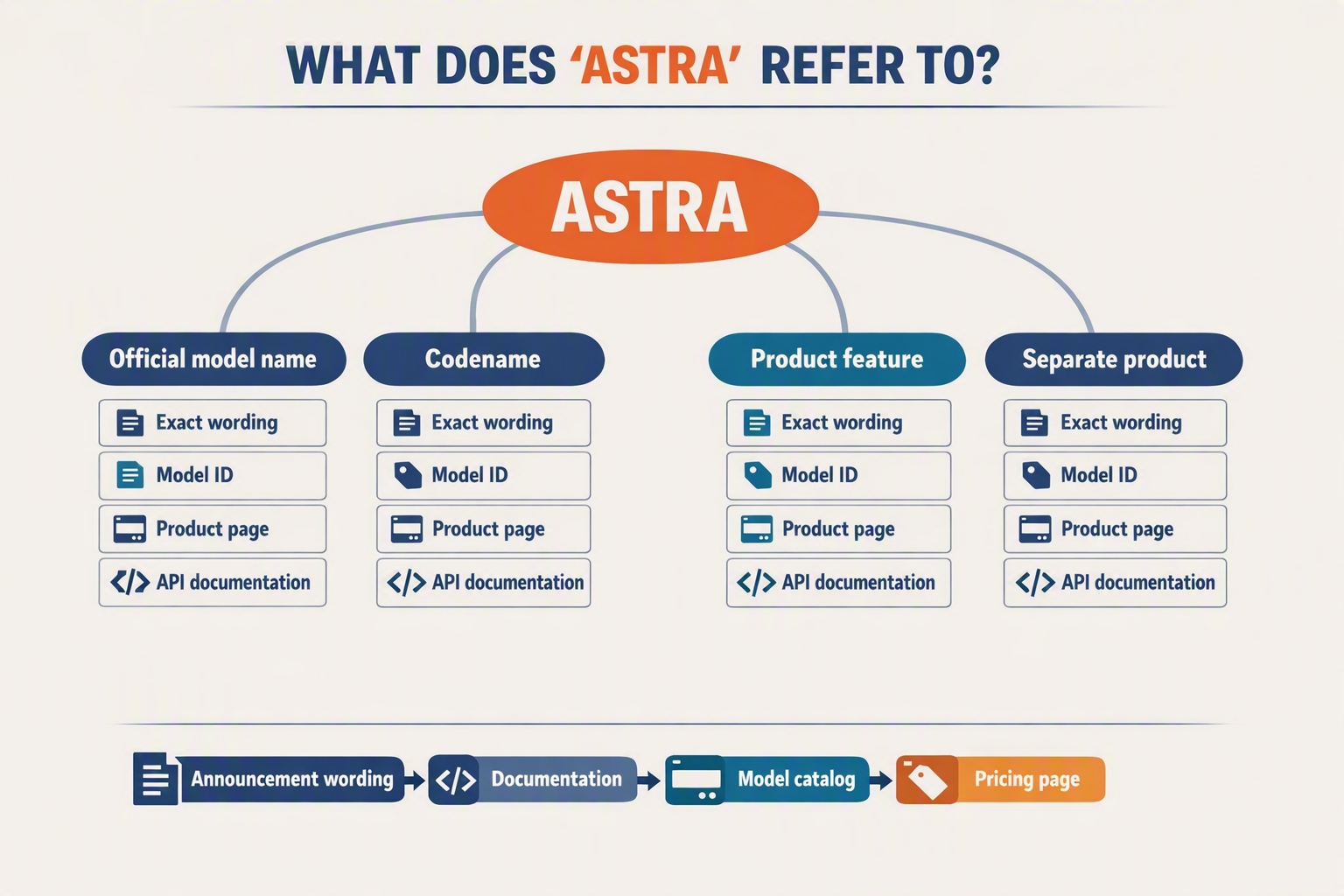
Astra is an official public-facing model designation associated with GPT-6, according to OpenAI’s own September 2026 materials. However, the available first-party evidence does not establish whether “Astra” originated as an internal codename, represents a particular GPT-6 variant, or will appear unchanged as a commercial API model ID.
Myth: “Astra” exists only in leaks and social-media posts
Fact: OpenAI uses both “Astra” and “GPT-6 Astra” in first-party publications, making it substantially more than an unofficial rumor.
Three naming signals matter:
- OpenAI’s September 1, 2026 safety publication says Astra is the first OpenAI model to meet the company’s Critical cybersecurity capability threshold.
- OpenAI’s separate cybersecurity response discusses preliminary cybersecurity evaluations for Astra, again describing Astra as a model rather than a standalone app or feature.
- OpenAI’s customer-story index explicitly labels deployments as GPT-6 Astra. The index states that Playco cut manual game-prototyping fixes by 50% using GPT-6 Astra, according to OpenAI on September 3, 2026.
Taken together, these references support a narrow but firm verdict: GPT-6 Astra is an OpenAI-recognized model name. A claim that the entire name was invented by third-party accounts is inconsistent with OpenAI’s published pages.
Does “Path to Astra” mean Astra is only a codename?
No. The phrase “Path to Astra” is an editorial title and cannot, by itself, determine the model’s product status. OpenAI’s language inside the associated materials—and its use of the fuller GPT-6 Astra name in customer stories—provides stronger identity evidence than the title alone.
Nevertheless, several naming possibilities remain open:
- Astra may be a named GPT-6 variant, such as a capability or safety tier.
- Astra may be the public launch name for a model within the GPT-6 family.
- Astra may have originated as a codename and later become part of the public designation.
- GPT-6 Astra may be a controlled-access model name that differs from its eventual API identifier.
OpenAI’s cited materials do not resolve which interpretation applies. Therefore, posts claiming that gpt-6-astra, gpt-6-astra-preview, or similar strings are valid API model IDs require separate documentation from OpenAI’s API reference or model catalog.
Is Astra a separate OpenAI product?
The strongest available evidence describes Astra as a model, not as a separate consumer application comparable to ChatGPT or an independent developer platform. OpenAI’s cybersecurity material evaluates Astra’s model capabilities, while its business stories describe organizations using GPT-6 Astra in specific workflows.
That distinction prevents three common inference errors:
- An official model name does not prove general ChatGPT availability.
- A customer deployment does not prove unrestricted API access.
- A safety announcement does not confirm pricing, context-window size, rate limits, or cloud distribution.
The defensible conclusion as of September 3, 2026, is precise: Astra is officially tied to GPT-6 in OpenAI’s public language, but its exact product taxonomy and commercial model identifier remain unconfirmed in the supplied first-party evidence.
When were GPT-6 Astra and Claude Fable 5.1 announced, released, or delayed?
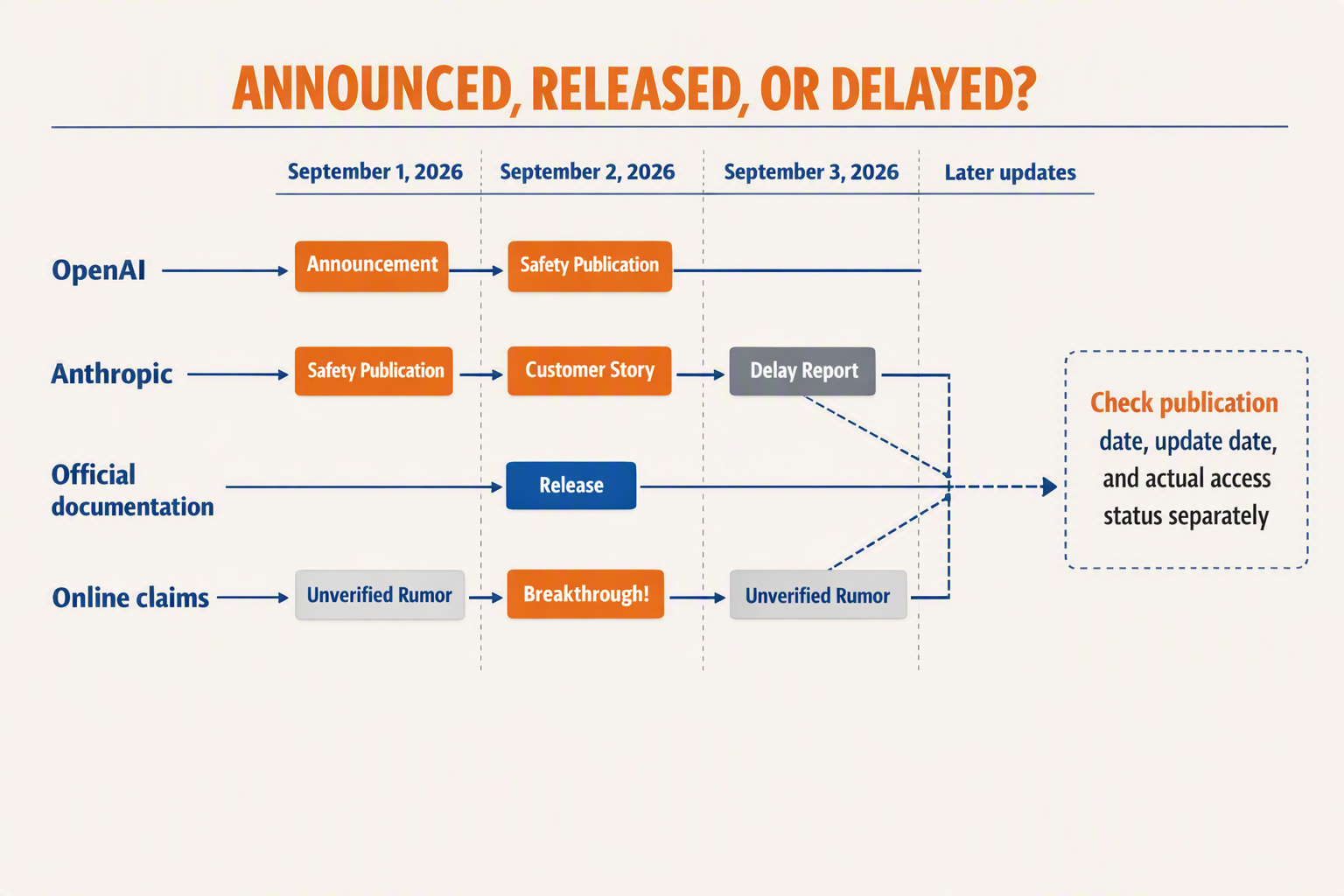
As of September 5, 2026, the confirmed release dates are September 1, 2026, for Claude Fable 5.1 and September 3, 2026, for GPT-6 Astra. Dated first-party launch pages supersede earlier social-media predictions and rumor-based timelines. Neither release should be described as delayed unless its developer documents a change to a previously announced date.
GPT-6 Astra: officially released September 3
Myth: GPT-6 Astra launched publicly on September 1, 2026.
Fact: OpenAI disclosed Astra in its September 1 publication, “Path to Astra: critical capabilities and frontier safeguards,” but the official GPT-6 Astra release followed on September 3, 2026.
The confirmed chronology is:
- September 1, 2026: OpenAI publicly disclosed Astra and published preliminary information about its capabilities and frontier safeguards.
- September 3, 2026: OpenAI officially released GPT-6 Astra.
- September 3, 2026: OpenAI also published a customer case study describing how Legora used GPT-6 Astra to examine 41 documents, detect all four planted errors, and improve performance by nearly 40% in the tested financial-review workflow.
The September 1 disclosure is therefore not the model’s release date. The correct labels are disclosed September 1 and officially released September 3.
Claude Fable 5.1: officially released September 1
Myth: Claude Fable 5.1 was only rumored for September 1—or was delayed beyond that date.
Fact: Anthropic officially released Claude Fable 5.1 on September 1, 2026. Earlier posts predicting that date are now part of the model’s pre-release rumor history; they are not the controlling evidence for the date. The dated first-party launch material is what confirms the release.
There is also no basis for calling Claude Fable 5.1 delayed unless Anthropic documents both:
- An earlier official release date or window.
- A later first-party notice changing or withdrawing that schedule.
A prediction that proved inaccurate, a social-media countdown, a cached search snippet, or an unattributed roadmap does not establish a delay.
The correct date labels
Readers should distinguish among these events:
- Announced or disclosed: The developer publicly identifies the model.
- Limited deployment: Selected customers or research partners can use it.
- Released: The developer formally launches the model for a defined user group.
- Generally available: Broad access, supported regions, interfaces, and commercial terms are documented.
- Delayed: The developer formally moves a previously announced date or release window.
The confirmed timeline as of September 5 is therefore straightforward: Claude Fable 5.1 was released September 1, 2026, and GPT-6 Astra was officially released September 3, 2026, following Astra’s September 1 safety disclosure. Earlier social predictions should be treated as historical rumors, not as substitutes for dated first-party launch pages, and neither model should be labeled delayed without first-party documentation.
How do availability, pricing, context windows, benchmarks, and cloud access compare?
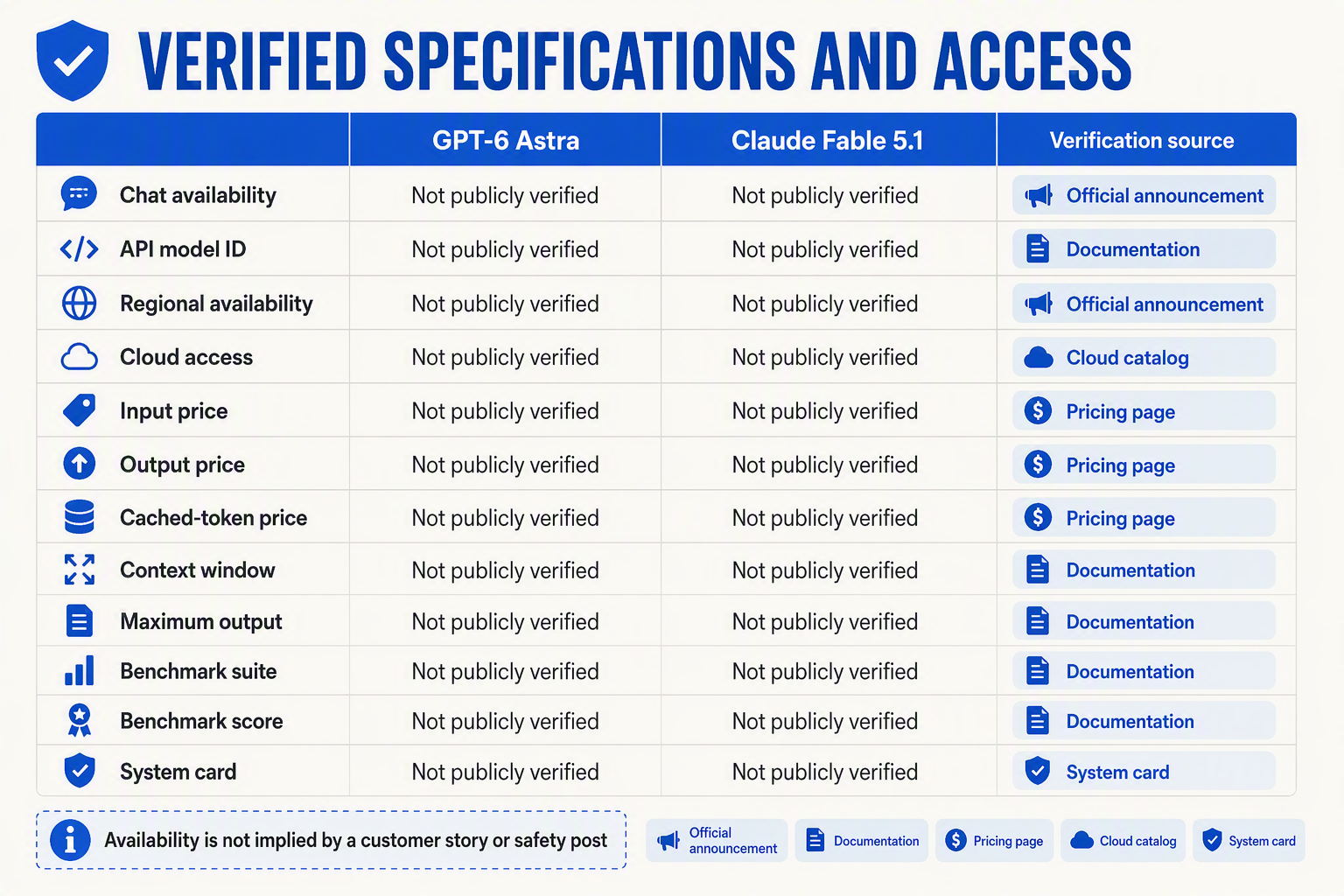
As of September 3, 2026, neither model has a fully verified public specification sheet suitable for procurement comparisons. GPT-6 Astra is confirmed by OpenAI and has documented real-world testing, while the supplied evidence does not confirm Claude Fable 5.1’s identity, release, pricing, context window, benchmarks, or cloud access.
Claim-by-claim comparison
| Comparison point | GPT-6 Astra | Claude Fable 5.1 | Fact-check verdict |
|---|---|---|---|
| Model identity | OpenAI names GPT-6 Astra in a September 3 customer story and identifies Astra in September 1 safety materials. | No dated Anthropic announcement or system card is present in the first-party evidence reviewed. | Astra confirmed; Fable 5.1 unverified. |
| Availability and release date | OpenAI documents controlled real-world use, but the cited materials do not establish general ChatGPT or API availability. | Claims of a September 1 launch lack supporting Anthropic documentation in the supplied evidence. | Testing is not the same as public release. |
| API pricing | No verified input-token, output-token, cached-token, subscription, or batch price appears in the cited OpenAI materials. | No verified Anthropic price appears in the evidence reviewed. | Any fixed price comparison is unsupported. |
| Context window | OpenAI’s cited Astra pages do not publish a token limit. | No verified Fable 5.1 context-window specification is available in the supplied sources. | Both context-window figures remain unverified. |
| Benchmarks | OpenAI reports a Legora workflow involving 41 documents, all four planted errors, and a performance improvement of nearly 40%. | No first-party benchmark suite, methodology, or system card is included in the reviewed evidence. | Astra has a documented case study, not a complete benchmark comparison. |
| Cloud and API access | The cited sources do not confirm a public model ID or availability through Microsoft Azure or another cloud marketplace. | No verified listing from Anthropic, Amazon Web Services, Google Cloud, or Microsoft Azure is provided. | Cloud-access claims require provider documentation. |
What the confirmed Astra numbers actually show
OpenAI reported on September 3, 2026, that Legora reviewed 41 documents in minutes with GPT-6 Astra, found all four planted errors, and improved performance by nearly 40% in a financial-review workflow. This is meaningful evidence of applied capability, but it is not interchangeable with results from standardized evaluations such as SWE-bench, GPQA, MMLU, or CyberSecEval.
The case study leaves several comparison-critical questions unanswered:
- What baseline produced the nearly 40% improvement?
- How many repeated trials were conducted?
- What were the token usage, latency, and cost?
- Were humans allowed to intervene?
- Can independent evaluators reproduce the result?
OpenAI’s September 1 description of Astra as its first model to meet the company’s Critical cybersecurity capability threshold is similarly important but narrow. A safety-framework threshold does not reveal context length, general reasoning scores, rate limits, or commercial availability.
What buyers and developers should record
Until first-party product pages appear, comparison sheets should use “not disclosed” rather than guessed values. Teams should require:
- An official model ID and API documentation.
- Published token prices and billing units.
- A defined context window and maximum output limit.
- Reproducible benchmark methodology.
- A dated listing from OpenAI, Anthropic, Microsoft Azure, Amazon Web Services, or Google Cloud.
For multi-model deployments, including those routed through an OpenAI-compatible gateway such as CallMissed, production access should be validated with an actual model-list response and successful API call—not a screenshot, social post, or copied launch table.
What do first-party safety reports and benchmarks prove—and what do they not prove?
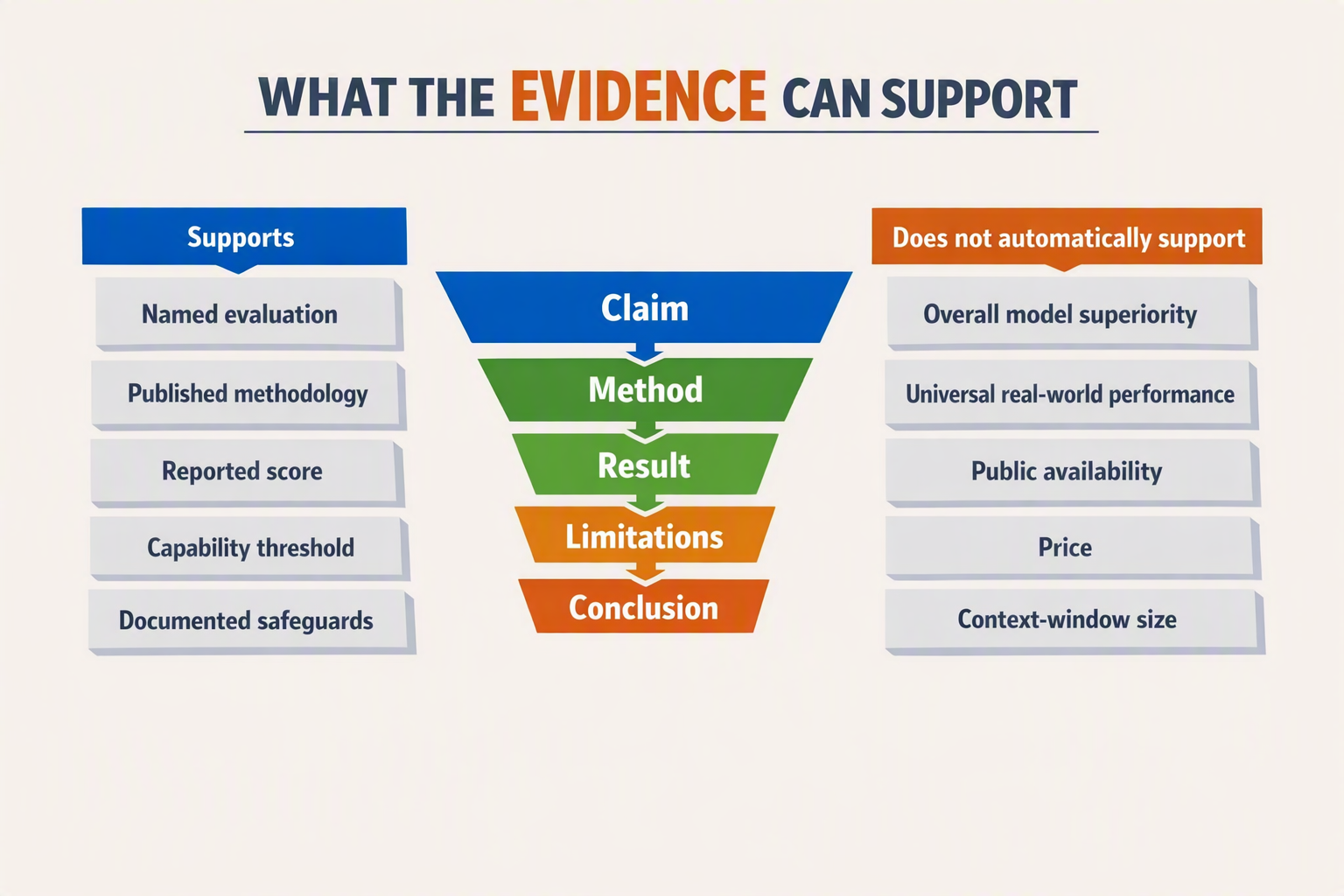
First-party safety reports prove that a developer evaluated a named model against defined risks and disclosed selected results. They do not automatically prove public availability, API specifications, pricing, comparative superiority, or performance in unrelated workloads.
What OpenAI’s Astra safety disclosures establish
OpenAI stated on September 1, 2026, that Astra is its first model to meet the company’s Critical cybersecurity capability threshold. This establishes three important facts: Astra exists within OpenAI’s model-development programme, OpenAI assessed its cybersecurity capabilities, and the results triggered a higher level of safeguards under OpenAI’s framework.
OpenAI’s separate publication, “Responding to the next frontier of critical cyber capabilities,” says the company is sharing preliminary cybersecurity evaluations for Astra and strengthening safeguards and security controls. “Preliminary” matters: the evaluation represents evidence available at a particular development stage, not a permanent guarantee about every deployed version.
These disclosures support conclusions about cyber capability and risk management, but they do not establish:
- A generally available GPT-6 Astra release date
- An API model identifier or guaranteed access tier
- Token pricing, rate limits, or a context-window size
- Performance on coding, mathematics, reasoning, multilingual speech, or agentic tasks
- Equivalent safeguards across third-party deployments or modified model versions
A safety threshold is also not a conventional leaderboard score. It indicates that specified capabilities crossed a risk boundary defined by the organisation’s evaluation framework; it does not mean Astra “won” cybersecurity against every competing model.
What the Legora result demonstrates
OpenAI reported on September 3, 2026, that Legora used GPT-6 Astra to review 41 documents in minutes and identify all four planted errors. The same OpenAI customer study reported a performance improvement of nearly 40% in that financial-review workflow on September 3, 2026.
That is meaningful real-world evidence because the test involved documents, deliberately inserted errors, and a measurable workflow outcome. However, it remains a customer case study, not necessarily an independent, standardised benchmark.
Before generalising the result, readers should ask:
- What baseline produced the nearly 40% improvement?
- How were accuracy and “performance” defined?
- Were the documents representative of other jurisdictions and industries?
- How many repeated trials were conducted?
- Were human review time, false positives, latency, and cost included?
Without those details, the result supports the narrower claim that Astra performed strongly in Legora’s tested financial-review setup—not that it is universally 40% better than another model.
Why alleged Claude Fable scores require separate proof
No verified Anthropic material in the cited evidence establishes a Claude Fable 5.1 system card, safety report, benchmark suite, or model-to-model victory. Screenshots, reposted charts, and articles citing one another cannot substitute for a dated Anthropic publication containing the model name, methodology, sample size, settings, and limitations.
For either company, trustworthy comparison requires matching:
- The same benchmark version and dataset
- Identical tool access, prompting, and token budgets
- Comparable model variants and release snapshots
- Reported uncertainty, contamination controls, and pass criteria
- Independent replication where possible
Production teams using a multi-model gateway such as CallMissed’s OpenAI-compatible API should treat safety reports as governance evidence and workflow tests as task-specific evidence. Neither should be converted into pricing, availability, context-window, or universal-quality claims that the source never made.
What do independent experts say about interpreting AI launch announcements?

Independent AI evaluators would treat launch announcements as layered evidence, not a binary “released or fake” question. The supplied source set contains no attributable commentary from independent researchers, so it cannot support claims such as “experts confirm” GPT-6 Astra’s pricing, general availability, context window, or benchmark superiority.
Apply an evidence hierarchy
A rigorous interpretation separates five questions that online coverage often collapses into one:
- Does the model exist? A dated first-party document or authenticated model output can establish identity.
- Has it been tested externally? A customer case study demonstrates controlled or limited deployment, not necessarily open access.
- Is it generally available? This requires an official product page, console listing, API documentation, model identifier, or cloud-provider catalogue.
- What does it cost? Pricing must come from a current vendor pricing page and specify units, tiers, caching, batch discounts, and regional conditions.
- How well does it perform? Benchmark results need datasets, scoring rules, model versions, sampling settings, and preferably independent reproduction.
Under this framework, OpenAI’s September 2026 materials provide meaningful evidence for GPT-6 Astra’s identity and real-world evaluation, but not every commercial detail attached to the GPT-6 Astra rumors. By contrast, the supplied evidence contains no Anthropic announcement or authorized cloud listing that independently verifies a Claude Fable 5.1 release.
Treat customer results as case studies, not universal benchmarks
OpenAI reported on September 3, 2026, that Legora used GPT-6 Astra to examine 41 documents, identify all four planted errors, and improve performance by nearly 40%. That is a concrete result, but independent evaluators would ask:
- What baseline produced the “nearly 40%” improvement?
- How were the four errors selected and scored?
- Were competing models tested under identical prompts and tools?
- How many runs were conducted, and was variance reported?
- Can outsiders reproduce the workflow?
The correct interpretation is therefore “promising task-specific evidence,” not “proof of broad benchmark dominance.” OpenAI’s customer-story index also says Playco reduced manual fixes by 50% while prototyping games with GPT-6 Astra, but a separate customer outcome still does not establish a standardized, independently replicated model ranking.
Look for reproducibility and deployment artifacts
Evaluation initiatives such as Stanford HELM and MLCommons emphasize transparent scenarios, comparable conditions, and reproducible measurements. Applying that discipline to launch coverage means checking for:
- A stable API model ID and dated documentation
- Explicit context-window and maximum-output definitions
- Input, cached-input, and output-token prices
- A system card or technical report with evaluation methodology
- Availability by account tier, country, cloud region, and endpoint
- Independent tests conducted against the publicly accessible version
This distinction matters for developers using multi-model infrastructure such as CallMissed’s OpenAI-compatible gateway: a marketing name does not guarantee that a routable API model exists, and an announced capability does not define production limits.
The evidence-led conclusion is straightforward: experts would regard OpenAI’s Astra disclosures as credible confirmation of a model and selected deployments, while withholding judgment on unsupported specifications. For Claude Fable 5.1, judgment should remain suspended until Anthropic or an authorized provider publishes verifiable documentation.
What should users, developers, and buyers do before acting on these claims?
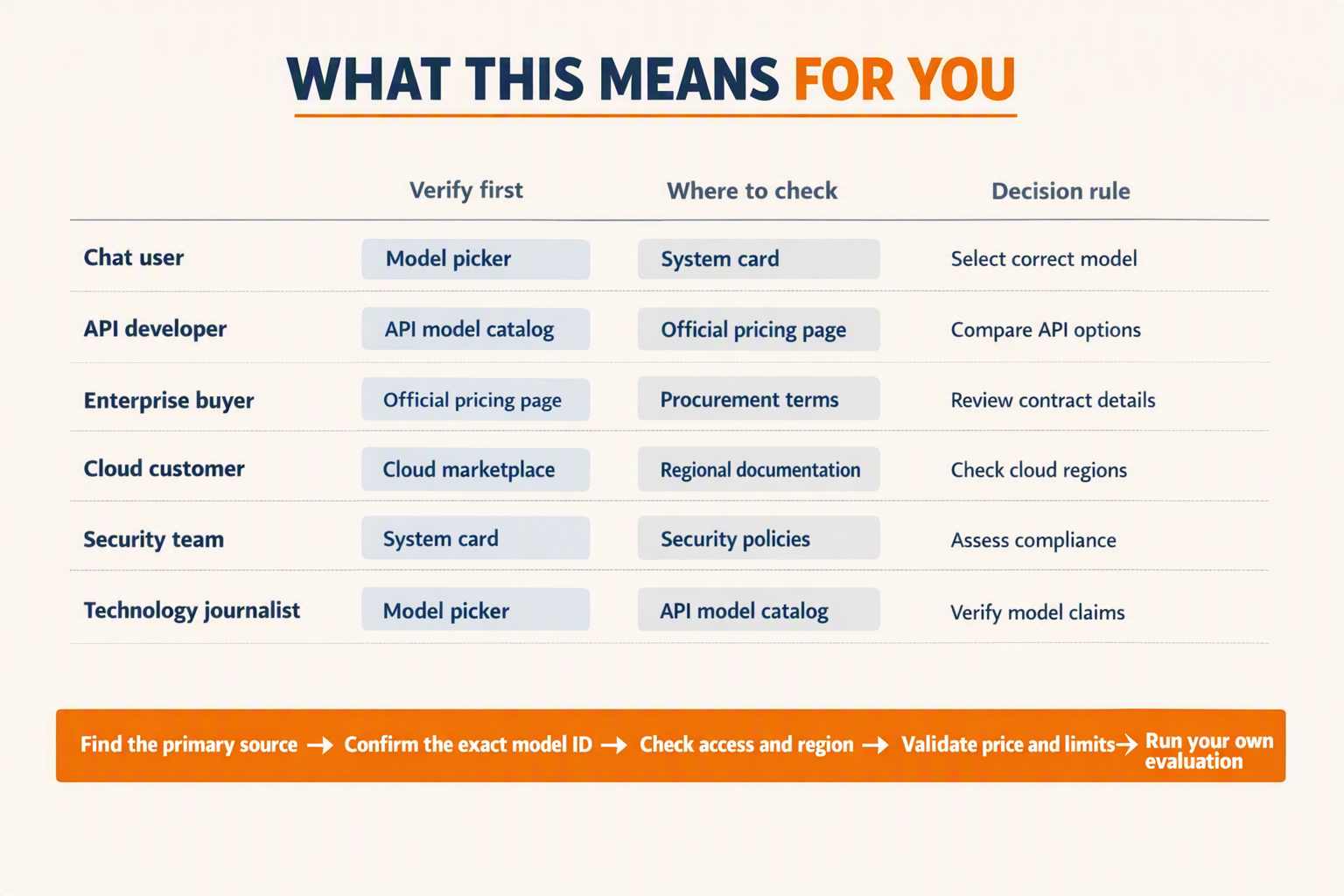
Before committing budget, code, or public claims, require a dated first-party source for every specification. A confirmed model name or private customer test does not establish general API availability, pricing, context limits, benchmark leadership, or cloud access.
Pre-deployment verification checklist
| Decision area | Evidence to require | Current evidence as of Sept. 3, 2026 | Recommended action |
|---|---|---|---|
| Model identity | Vendor announcement or documentation | OpenAI names GPT-6 Astra; equivalent first-party evidence has not been established here for Claude Fable 5.1 | Treat Astra as a real model name; keep Fable 5.1 marked unverified |
| Release and access | Console listing, API documentation and working model ID | OpenAI describes Astra deployments, but the cited materials do not prove unrestricted public API access | Test access in your own account before announcing availability |
| Pricing | Official pricing page with units, tiers and effective date | No verified Astra or Fable 5.1 price is established by the cited sources | Do not build budgets from screenshots, reposts or unsourced pricing tables |
| Context window | Technical documentation stating input/output limits | No verified context-window figure is established in the supplied first-party evidence | Design token handling conservatively and make limits configurable |
| Performance | Reproducible benchmark methodology or documented workload | OpenAI reports one strong Legora workflow result, not universal benchmark leadership | Reproduce results on representative data before selecting a model |
| Cloud availability | Listing from Microsoft Azure, Amazon Web Services or Google Cloud | A social claim or marketplace screenshot is insufficient without a live provider listing | Verify region, quota, model version and service terms directly |
Separate evidence from inference
The most useful question is not “Has somebody used the model?” but “Can our organization access this exact version under documented commercial terms?” OpenAI reported on September 3, 2026, that Legora used GPT-6 Astra to review 41 documents in minutes, identify all four planted errors, and improve performance by nearly 40%. That customer result supports model identity and controlled real-world use, but it does not disclose a public model ID, price, context window or rollout schedule.
OpenAI also stated on September 1, 2026, that Astra was its first model to reach the company’s Critical cybersecurity capability threshold. Security classification should therefore become part of procurement review: buyers may need to evaluate access controls, logging, acceptable-use restrictions and incident-response obligations rather than assuming Astra will behave like a routine model upgrade.
Apply operational gates before deployment
Developers and procurement teams should complete four checks:
- Run an API probe: Confirm that the documented model identifier works in the intended account, region and endpoint.
- Capture dated terms: Archive the official pricing, rate-limit, retention and service-availability pages used in the decision.
- Benchmark your workload: Measure quality, latency, error rates and total cost on production-like inputs—not vendor-selected examples alone.
- Prepare a fallback: Keep model routing configurable so an unavailable or restricted release does not block the product.
Multi-model gateways can reduce migration work when availability changes. For example, CallMissed’s OpenAI-compatible API supports multiple model providers with same-tier fallbacks, allowing developers to avoid hard-coding an application around a rumored model ID.
Finally, label every internal comparison with “verified as of September 3, 2026” and schedule a recheck. AI launch details can change quickly, but later confirmation should update—not retroactively validate—an unsupported claim.
Frequently asked questions about GPT-6 Astra rumors and the Claude Fable 5.1 release
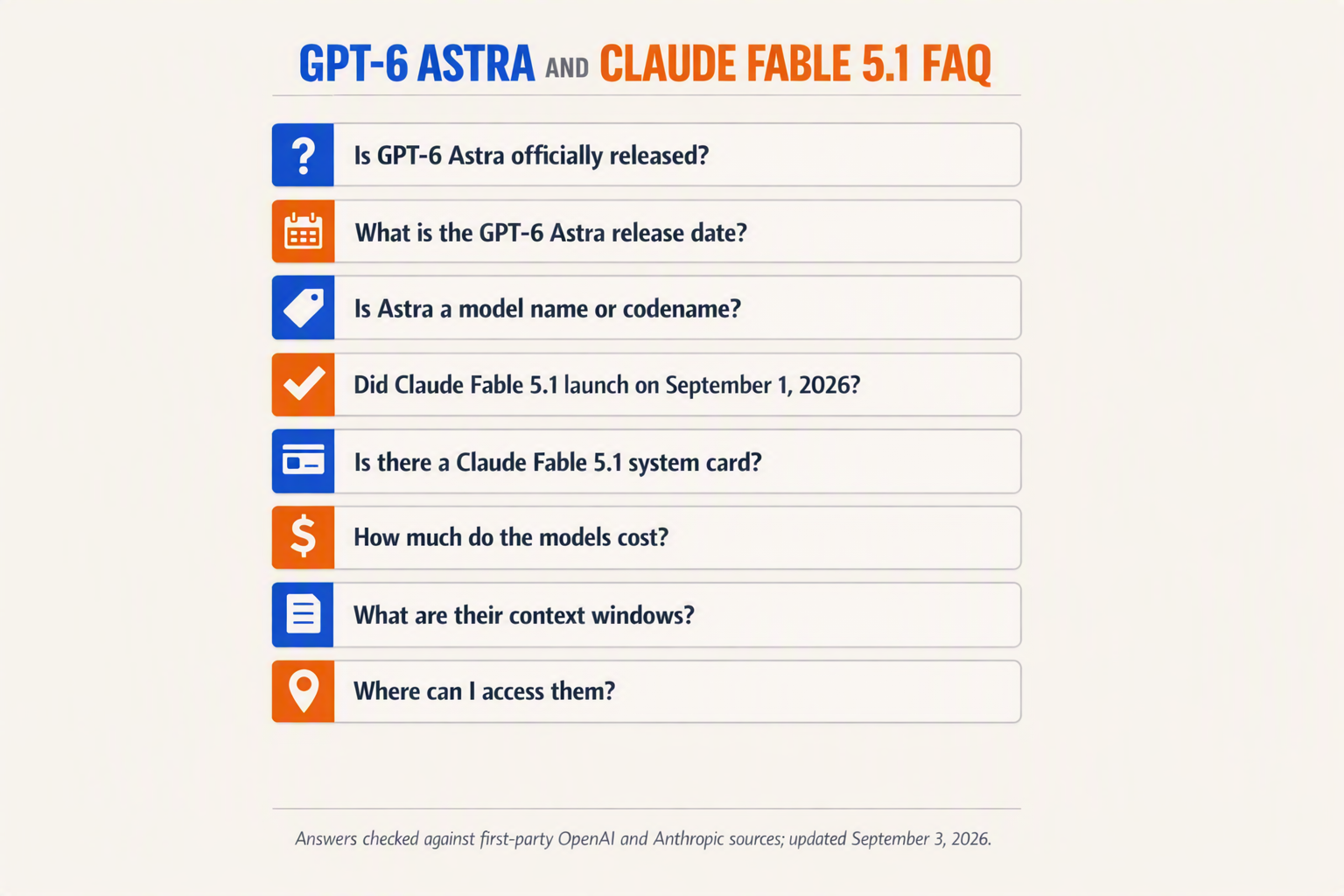
Is GPT-6 Astra official, or are the GPT-6 Astra rumors fake?
What is the confirmed GPT-6 Astra release date?
Is the Claude Fable 5.1 release officially confirmed by Anthropic?
Which GPT-6 Astra benchmark results are actually verified?
Can developers compare Claude Fable 5.1 vs GPT-6 on pricing, context windows, and cloud access?
How can I identify fabricated GPT-6 Astra rumors and AI launch pages?
Conclusion
The verdict as of September 3, 2026, is clear: GPT-6 Astra is a confirmed OpenAI model, but many specifications attached to it remain unverified; Claude Fable 5.1 claims lack equivalent first-party confirmation from Anthropic. A real model name is not proof of a public launch, API access, pricing, context length, or benchmark leadership.
Key takeaways
- OpenAI has confirmed GPT-6 Astra by name. OpenAI’s September 1, 2026 publication, “Path to Astra: critical capabilities and frontier safeguards,” identifies Astra as the first OpenAI model to meet its Critical cybersecurity capability threshold. That disclosure establishes the model’s existence and safety significance, not unrestricted availability.
- OpenAI has documented real-world GPT-6 Astra testing. OpenAI reported on September 3, 2026, that Legora used GPT-6 Astra to review 41 documents in minutes, detect all four planted errors, and improve performance by nearly 40% in a financial-review workflow. This is meaningful customer evidence, but it is not a standardized benchmark that supports sweeping comparisons with other models.
- A GPT-6 Astra release date, API price, context window, model ID, and universal cloud rollout are not confirmed merely because Astra appears in OpenAI publications. Each claim needs its own first-party evidence, such as official API documentation, a pricing page, release notes, a system card, or a dated listing from Microsoft Azure, Amazon Web Services, or Google Cloud.
- Claude Fable 5.1 should remain classified as unverified unless Anthropic confirms it directly. Repeated claims about a September 1 release, benchmark victories, fixed pricing, cloud availability, or a “Claude Fable 5.1 system card” do not become facts through reposting. Screenshots and secondary articles should trace back to dated Anthropic documentation or an authorized cloud-provider listing.
What to watch next
The strongest future confirmation would come from official model catalogs, API documentation, pricing tables, system cards, reproducible evaluation methodology, and cloud marketplace entries. Readers should also check whether announcements distinguish limited testing, gated deployment, regional access, and general availability; those stages are not interchangeable.
For developers, verification is an architectural requirement rather than a media-literacy exercise. Incorrect assumptions about model identifiers, token limits, prices, or access can affect routing, budgets, fallback logic, and production reliability. Platforms such as CallMissed, an OpenAI-compatible AI gateway supporting multiple models alongside voice, speech, image, and search capabilities, illustrate why documented model availability and fallback options matter.
Until first-party records supply the missing details, the responsible conclusion is confirmed model, limited confirmed facts, and no license to fill the gaps with rumors. Before sharing the next “launch leak,” can you trace every specification to the company that supposedly released it?
Related Reading
- GPT-6 Astra Financial Document Review: Legora Case Study Analysis
- Best AI Models of July 2026: Kimi K3 vs Claude Opus 5 vs GPT-5.6
- Claude Opus 5 vs GPT-5.6 Terra: Verified Facts, Expected Features and Verdict