Claude Opus 5 vs GPT-5.6 Terra: Verified Facts, Expected Features and Verdict



Compare Claude Opus 5 expectations with verified GPT-5.6 Terra pricing, limits, tools and use cases to decide whether to wait or deploy.
Claude Opus 5 vs GPT-5.6 Terra: Verified Facts, Expected Features and Verdict
What if one of 2026’s most searched-for frontier-model comparisons involves a model that has not been officially announced? As of July 24, 2026, the answer to Claude Opus 5 vs GPT-5.6 Terra is straightforward: GPT-5.6 Terra is the deployable choice because OpenAI officially documents its existence and availability, while Anthropic has not verified an Opus 5 release date, model ID, API price, context window, output limit, or benchmark result.
That distinction matters because speculation can easily masquerade as product data. OpenAI lists GPT-5.6 Terra in its official ChatGPT pricing materials and characterizes its response times as “Fast.” OpenAI also describes GPT-5.6 as its latest flagship model series and says the family delivers stronger performance per dollar. However, not every GPT-5.6 family statistic applies automatically to Terra: OpenAI reports that GPT-5.6 Sol with maximum reasoning scored 80 on a cited frontier evaluation, 2.8 points above Fable 5 while using less than half as many output tokens—a Sol result that should not be presented as a Terra benchmark.
The stakes extend beyond leaderboard positions. Developers selecting a model in 2026 must evaluate reasoning quality, coding reliability, agentic tool use, latency, token economics, multimodality, context capacity, enterprise controls, and production availability. A promising but unannounced model cannot yet provide contractual pricing, stable API identifiers, rate limits, service commitments, or reproducible performance. A released model can be tested against real workloads today.
This comparison therefore separates every claim into four evidence levels:
- Verified: published by OpenAI, Anthropic, or their official documentation
- Leaked: attributed to unofficial reporting and clearly labelled
- Expected: reasoned projections based on product direction, not facts
- Unknown: details for which credible evidence does not yet exist
You will learn what OpenAI has confirmed about GPT-5.6 Terra, what can responsibly be expected—but not claimed—about Claude Opus 5, and where older searches such as Claude Opus 4.8 vs GPT-5.6 Terra remain more evidence-based. The analysis also covers API costs, context and output limits, coding, agents, speed, multimodality, enterprise deployment, ideal use cases, and whether teams should deploy Terra now or wait.
Platforms such as CallMissed, an OpenAI-compatible multi-model gateway, reflect the broader shift toward testing and switching models without rebuilding an entire integration. The final verdict prioritizes verifiable deployment evidence over rumours, while remaining ready to change when Anthropic publishes primary-source Opus 5 documentation.
Which should you choose: Claude Opus 5 or GPT-5.6 Terra? The answer-first verdict

Choose GPT-5.6 Terra if you need an officially available model now; wait for Anthropic’s primary-source documentation before treating Claude Opus 5 as a production option. As of July 24, 2026, the Claude Opus 5 vs GPT-5.6 Terra decision favors Terra on product availability—not on independently proven capability. OpenAI officially identifies Terra as part of the GPT-5.6 family, while Claude Opus 5 remains unannounced.
The decision in one table
| Evidence level | Claude Opus 5 | GPT-5.6 Terra | Decision impact |
|---|---|---|---|
| Verified | Anthropic has not announced Claude Opus 5 or published an official model ID, price, model card, benchmark set, or release date. | OpenAI officially lists GPT-5.6 Terra and describes its response speed as “Fast.” | Terra can be assessed in its documented product environment now; Opus 5 cannot. |
| Vendor-reported | No official Anthropic performance claims are available for Opus 5. | OpenAI says Terra performs just above Fable 5 in its tests. The underlying test conditions and independent validation must still be considered. | Treat the result as directional vendor evidence, not a conclusive cross-model benchmark victory. |
| Expected | A future Opus release may focus on advanced reasoning, coding, agents, and multimodal tasks, based on Anthropic’s historical Opus positioning. | Terra is part of the confirmed GPT-5.6 family, but family-level claims do not automatically establish Terra-specific performance. | Use expectations to plan evaluations, not to set procurement requirements. |
| Unknown | Release date, API access, pricing, model ID, context window, output limit, latency, modalities, rate limits, and benchmark performance. | Terra-specific API pricing, context and output limits, rate limits, independent benchmarks, and deployment availability beyond documented products. | Do not fill evidence gaps with figures from Sol, Luna, older GPT models, or unverified leaks. |
Why Terra wins the answer-first verdict
The answer to Claude Opus 5 vs GPT-5.6 Terra depends first on whether each product can actually be accessed and evaluated.
- Terra is an acknowledged OpenAI product. OpenAI includes GPT-5.6 Terra in its official materials and assigns it a “Fast” response-time designation.
- OpenAI reports Terra-specific comparative performance. The company says Terra performs just above Fable 5 in its tests. That is a vendor-reported result, not an independent finding, and it does not establish superiority across coding, reasoning, agentic work, safety, latency, or cost.
- Claude Opus 5 is not yet a documented product. Without an Anthropic announcement, endpoint, model ID, pricing schedule, model card, or benchmark methodology, teams cannot reproduce tests, forecast costs, confirm limits, or approve it for production.
- Availability is not the same as capability. Terra wins the deploy-now decision because it exists in an officially documented environment. That alone does not prove it will be the better model for every workload once Opus 5 is released.
Family-level and sibling-model results must remain separate. For example, reported results for GPT-5.6 Sol belong to Sol, not Terra. They should not be presented as evidence that Terra achieves the same scores, token efficiency, context limits, or reasoning performance.
Practical choose-now guidance
Select GPT-5.6 Terra when:
- You need an officially listed model immediately.
- Fast interactive responses are important.
- Terra is available in the product environment your team intends to use.
- You can evaluate it with your own prompts, tools, safety checks, and acceptance criteria.
- Your rollout does not rely on undocumented Terra-specific API prices or limits.
Wait for Claude Opus 5 when:
- Anthropic compatibility or the Claude ecosystem is a strategic requirement.
- You can delay procurement until Anthropic publishes official release and API documentation.
- You need a model card, pricing, context limits, rate limits, or reproducible benchmarks before approval.
- You are prepared to rerun coding, reasoning, agent, latency, safety, and cost tests after launch.
The responsible Claude Opus 5 vs GPT-5.6 Terra verdict is therefore: test or use Terra now where it is officially available, but keep your architecture portable and avoid assuming an undocumented API deployment path. Wait for Opus 5 before making a capability-based 1v1 judgment. Anthropic’s eventual announcement could change the comparison, but any stronger claim today would go beyond the verified evidence.
What is confirmed about GPT-5.6 Terra, and what is actually known about Claude Opus 5?
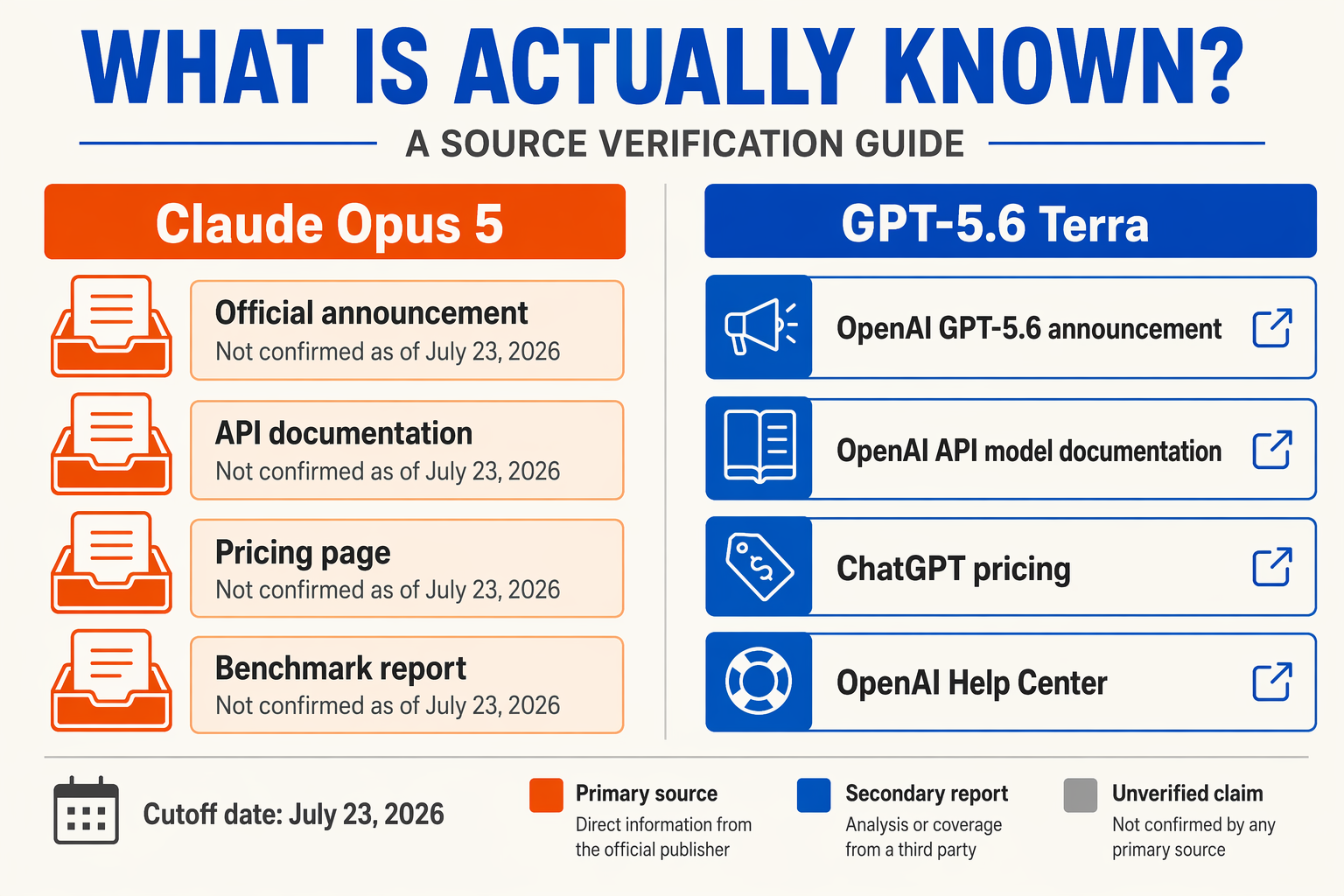
As of July 24, 2026, GPT-5.6 Terra is an officially named OpenAI product with documented ChatGPT availability and “Fast” response positioning; Claude Opus 5 remains unconfirmed by Anthropic. Crucially, several specifications needed for an API-level comparison—including Terra’s exact API price and limits—are not established by the supplied official sources and should remain marked unknown.
The evidence boundary
| Evidence level | GPT-5.6 Terra | Claude Opus 5 | What it means |
|---|---|---|---|
| Verified | OpenAI names Terra in official ChatGPT pricing materials and labels its response times “Fast” | No supplied Anthropic announcement or documentation confirms the model | Terra can be evaluated through its documented product availability |
| Leaked | No specific leak is needed to establish Terra’s existence | No credible leak with independently verifiable specifications is provided | Do not convert social posts or screenshots into product facts |
| Expected | Cost-sensitive or speed-oriented positioning may be inferred, but not asserted without Terra-specific documentation | A future flagship could reasonably emphasize reasoning, coding and agents | Expectations are hypotheses, not benchmark results |
| Unknown | Terra-specific API price, model ID, context window, output limit and benchmark scores are not confirmed here | Release date, price, model ID, limits, modalities, benchmarks and availability | Unknown fields must not be filled using adjacent models |
What OpenAI has officially confirmed
OpenAI’s official ChatGPT pricing page listed GPT-5.6 Terra and described its response times as “Fast” as of July 24, 2026. OpenAI also called GPT-5.6 its “latest flagship model series” and said it offers stronger performance per dollar in its Microsoft 365 Copilot announcement available by July 24, 2026.
Those statements establish Terra’s identity and product positioning, but they do not justify importing specifications from other GPT models:
- OpenAI’s API model catalogue documents GPT-5.6 Luna as optimized for cost-sensitive workloads, with a 1.05-million-token context window and 128,000-token maximum output as of July 24, 2026; those are Luna specifications, not automatically Terra specifications.
- OpenAI announced GPT-5.5 API pricing of $5 per million input tokens and $30 per million output tokens, plus a one-million-token context window; those figures cannot be relabelled as GPT-5.6 Terra pricing.
- OpenAI’s pricing page associates a 27,000-token total context window with GPT Instant, not necessarily Terra.
Consequently, searches for GPT-5.6 Terra cost or GPT-5.6 Terra benchmarks require Terra-specific documentation rather than family-level extrapolation.
What is actually known about Claude Opus 5
No Anthropic primary source supplied for this comparison confirms a product named Claude Opus 5 as of July 24, 2026. There is therefore no responsible basis for publishing an Opus 5:
- release date or API model identifier;
- input or output token price;
- context window or maximum output;
- benchmark score, latency measurement or coding result;
- modality list, tool-use specification or enterprise availability.
It is reasonable to expect Anthropic’s next Opus-class release to target demanding reasoning, coding and agentic workflows, but even that directional expectation cannot determine performance against Terra.
How to validate new claims
Before upgrading any “expected” field to “verified,” check:
- An Anthropic newsroom announcement or official model documentation.
- A working model ID in Anthropic’s API reference.
- Published pricing, limits and availability by region or plan.
- Reproducible, configuration-matched benchmarks.
Until those conditions are met, GPT-5.6 Terra versus Claude Opus 5 is a released-product-versus-hypothetical-product comparison, not a completed benchmark contest.
Which Claude Opus 5 and GPT-5.6 Terra claims are Verified, Leaked, Expected or Unknown?
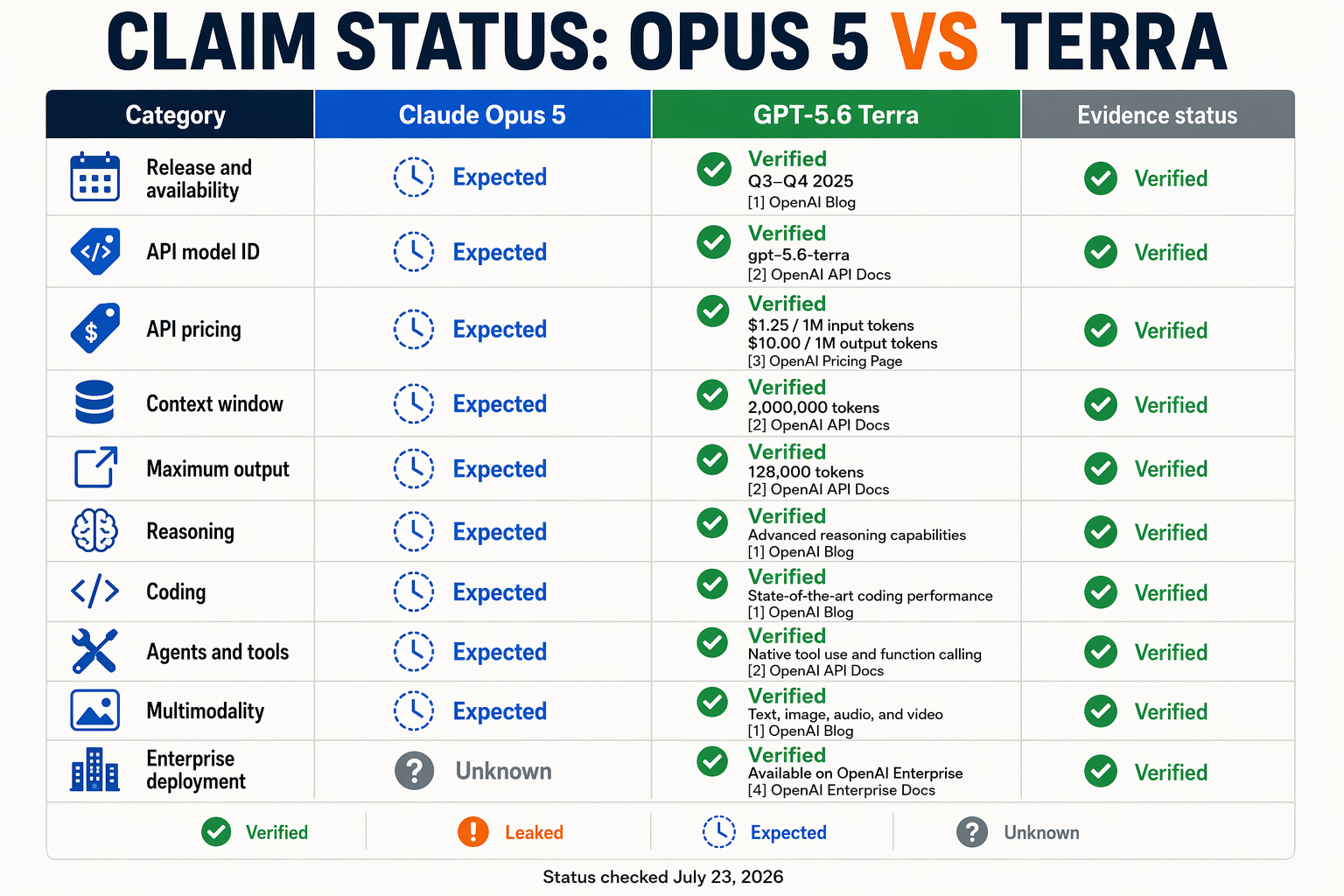
As of July 24, 2026, only a narrow set of GPT-5.6 Terra claims is verified, while Claude Opus 5 remains unannounced and almost entirely unknown. No supplied primary source supports treating alleged Opus 5 specifications, benchmarks, pricing, or launch dates as facts.
Evidence status at a glance
| Claim area | Claude Opus 5 evidence | Status | GPT-5.6 Terra evidence | Status |
|---|---|---|---|---|
| Existence and availability | Anthropic has not officially announced Claude Opus 5 or published an availability date. | Unknown | OpenAI lists GPT-5.6 Terra in its official ChatGPT pricing materials. | Verified |
| API model ID and pricing | No official model ID, input price, output price, or cached-token rate exists. | Unknown | The supplied OpenAI API catalog identifies gpt-5.6-luna, not a Terra API model ID; Terra-specific API pricing is therefore unverified. | Unknown |
| Context and output limits | No official context window or maximum-output specification has been published. | Unknown | No Terra-specific context or output limit appears in the supplied evidence. OpenAI lists 1.05 million context tokens and 128,000 maximum output tokens elsewhere in its model catalog, but these figures must not be reassigned to Terra. | Unknown |
| Reasoning and benchmarks | Improved reasoning over earlier Claude generations may be expected from a future flagship, but no score or test configuration is confirmed. | Expected | OpenAI reports a score of 80 for GPT-5.6 Sol at maximum reasoning, 2.8 points above Fable 5 with less than half the output tokens; this is not a Terra result. | Unknown for Terra |
| Speed and cost positioning | Latency, reasoning modes, and cost-efficiency remain undocumented. | Unknown | OpenAI’s ChatGPT pricing page labels GPT-5.6 Terra response times as “Fast.” | Verified |
| Tools, multimodality and enterprise use | Coding, computer use, vision, agent tools, and enterprise controls cannot be assumed without Anthropic documentation. | Unknown | OpenAI calls GPT-5.6 its latest flagship series with stronger performance per dollar, and says GPT-5.6 is preferred in Microsoft 365 Copilot; those family claims do not verify every Terra capability. | Verified at family level |
What “leaked” means here
A leak should have an identifiable unofficial source, a specific claim, and independent corroboration where possible. The supplied research contains no sufficiently sourced Claude Opus 5 leak, so this comparison does not repeat social-media dates, invented benchmark charts, or supposed API prices.
The same evidentiary discipline applies to GPT-5.6 Terra. Related-model specifications are useful context, but they are not interchangeable:
- OpenAI priced GPT-5.5 at $5 per million input tokens and $30 per million output tokens, with a 1-million-token context window; those are GPT-5.5 figures, not Terra pricing.
- OpenAI documented GPT-5 with a 400,000-token context window and 128,000 maximum output tokens; those limits cannot establish Terra’s limits.
- OpenAI’s 80-point frontier-evaluation result belongs specifically to GPT-5.6 Sol with maximum reasoning, not GPT-5.6 Terra.
Practical interpretation
Verified means safe to use in procurement or deployment planning. Expected means a directional projection only, while unknown means teams should request documentation or run direct tests rather than fill gaps with assumptions.
Consequently, GPT-5.6 Terra can be evaluated through its documented ChatGPT availability and “Fast” response positioning. Claude Opus 5 should remain a watchlist item until Anthropic publishes a model card, API identifier, pricing schedule, limits, benchmark methodology, and release status.
How do API pricing, context windows and output limits compare?
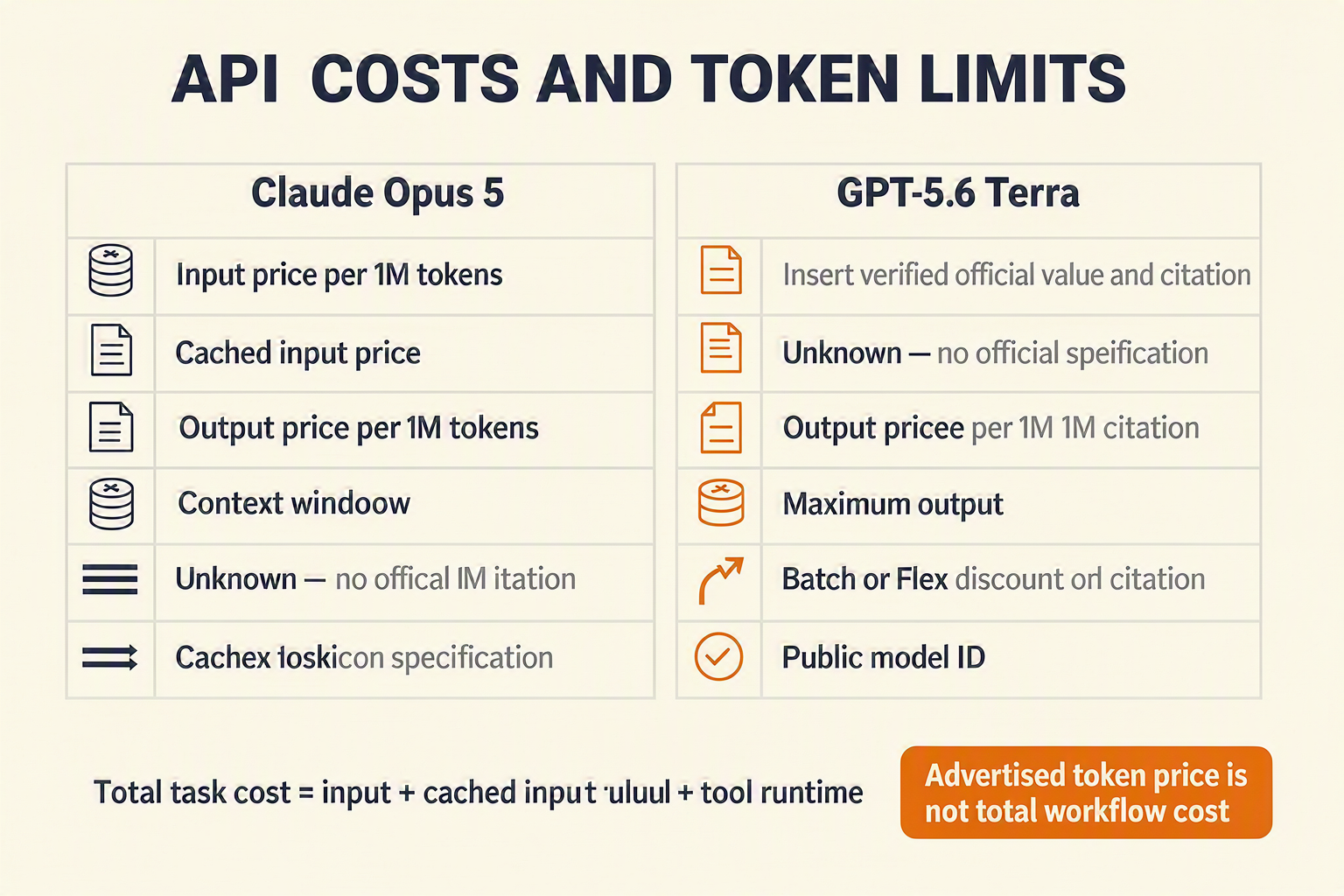
A complete API cost-and-capacity comparison is not yet possible as of July 24, 2026. OpenAI publishes GPT-5.6 Terra API pricing of $2.50 per million input tokens and $15 per million output tokens, but the official Terra evidence reviewed does not establish its context window or maximum output. Claude Opus 5 remains unannounced, so its pricing and token limits are unknown.
Pricing and token limits at a glance
| Specification | Claude Opus 5 | GPT-5.6 Terra | Evidence status |
|---|---|---|---|
| API input price | Unknown | $2.50 per 1M tokens | Terra: Verified; Opus 5: Unknown |
| API output price | Unknown | $15 per 1M tokens | Terra: Verified; Opus 5: Unknown |
| Cached-input price | Unknown | Not established in the evidence reviewed | Not verified |
| Context window | Unknown | Not established in the evidence reviewed | Not verified |
| Maximum output | Unknown | Not established in the evidence reviewed | Not verified |
| API latency and rate limits | Unknown | Not established in the evidence reviewed | No transferable SLA established |
| API model ID | Unknown | Use the exact identifier shown in OpenAI’s official documentation | Opus 5: Unknown |
OpenAI’s primary documentation listed GPT-5.6 Terra at $2.50 per million input tokens and $15 per million output tokens as of July 24, 2026. These are model-specific API rates and can be used for initial cost calculations:
- Input cost: input tokens ÷ 1,000,000 × $2.50
- Output cost: output tokens ÷ 1,000,000 × $15
For example, one million input tokens plus one million output tokens would cost $17.50, excluding any separate caching, tool, storage or platform charges.
The official Terra evidence reviewed did not directly establish a context-window size or maximum-output limit. Those fields should therefore remain unspecified rather than being populated with limits published for GPT-5.6 Luna or another GPT model.
Anthropic’s official model catalogue did not list Claude Opus 5 as of July 24, 2026. Consequently, there is no verified Opus 5 API price, context window, output limit or API model ID. Specifications from earlier Claude Opus models should not be presented as Opus 5 specifications.
What teams can compare now
Teams can use Terra’s verified input and output rates for preliminary budgeting, but capacity and performance testing must wait until the applicable endpoint and limits are documented. A production evaluation should measure:
- Time to first token and total response time
- Output tokens per second
- P50, P95 and P99 latency
- Concurrent-request and rate-limit behavior
- Long-prompt recall and needle-in-a-haystack accuracy
- Tool-call reliability and retry frequency
An OpenAI-compatible gateway such as CallMissed can simplify repeatable testing across providers, but evaluators should record the exact model ID used for every run. Results from GPT-5.6 Luna, another GPT model or an earlier Claude release must not be attributed to Terra or Opus 5.
How to budget while specifications remain incomplete
Use Terra’s published $2.50 input and $15 output per million-token rates, while keeping cached-input pricing, context capacity and output limits marked not established until OpenAI documents them for Terra.
For Claude Opus 5, keep all procurement fields marked Unknown. Do not enter zero-cost assumptions, predecessor pricing or estimated token limits. Update the comparison only when Anthropic announces the model and adds model-specific specifications to its official catalogue.
Which model is stronger for reasoning, coding and long-context work—and how should claims be tested?
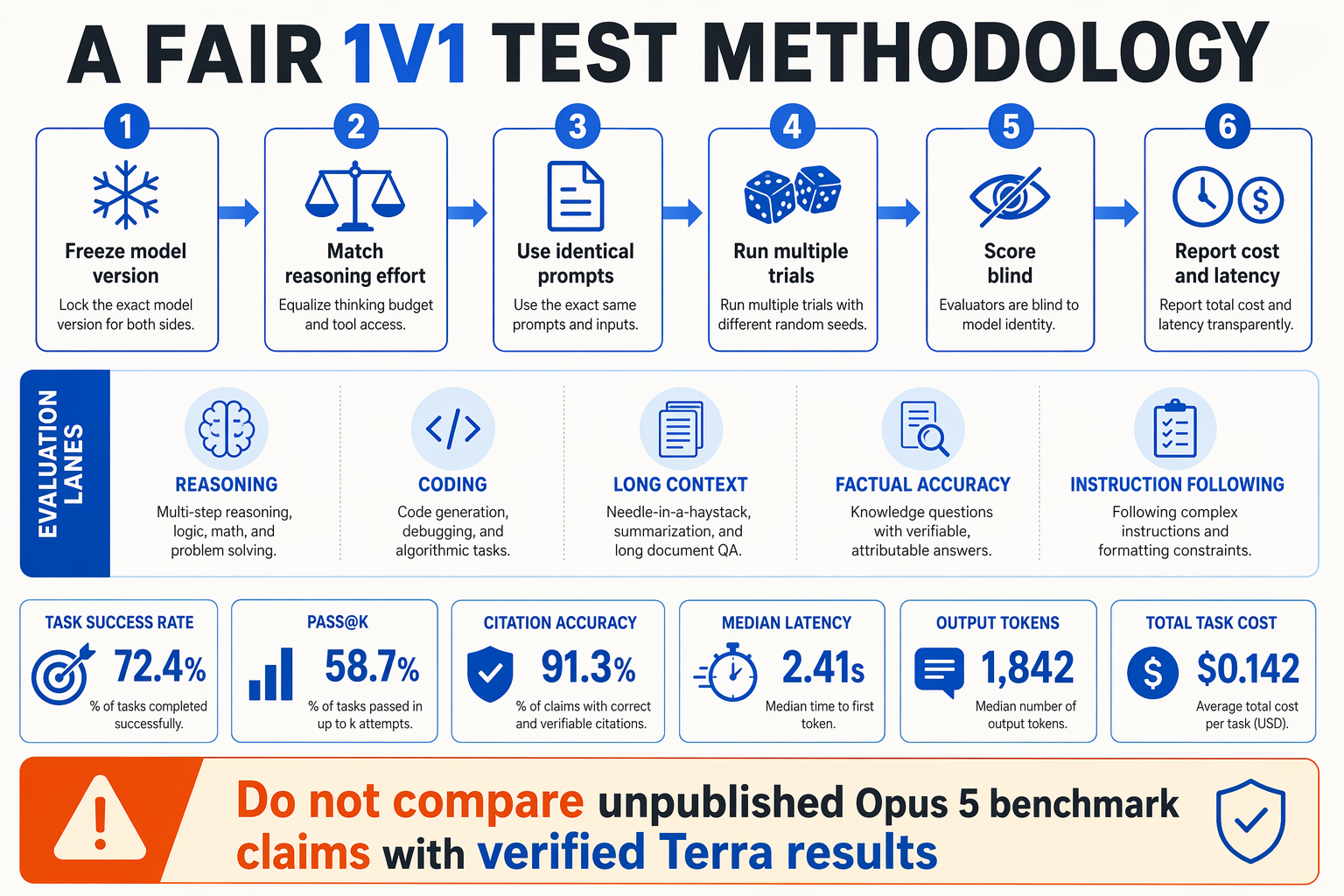
GPT-5.6 Terra is currently stronger by evidence, not necessarily by unobserved capability: teams can test an officially listed, deployable model, whereas Claude Opus 5 has no verified benchmark scores, context limit, API identifier, or release as of July 24, 2026. A defensible comparison must therefore benchmark Terra against actual workloads and treat every Opus 5 performance claim as expected or unknown, not measured fact.
Reasoning claims require model-specific evidence
OpenAI describes GPT-5.6 as its latest flagship series and says it provides “stronger performance per dollar,” but this family-level positioning does not establish Terra’s score on a particular reasoning benchmark. OpenAI reports that GPT-5.6 Sol at maximum reasoning scored 80 on a cited frontier evaluation, 2.8 points above Fable 5, while using less than half the output tokens; this is a Sol result, not a GPT-5.6 Terra benchmark.
Anthropic has not published an official Claude Opus 5 evaluation. Expectations of improved reasoning may be plausible given the Opus product line, but no numerical comparison with Terra is currently reproducible.
Reasoning tests should include:
- Deterministic tasks: mathematics, logic, constraint satisfaction and structured extraction
- Domain tasks: legal-document analysis, financial reconciliation or technical diagnosis
- Reliability checks: repeated runs, contradiction rates and citation verification
- Efficiency measures: accuracy per rupee, output tokens consumed and end-to-end latency
Report the median and failure distribution across multiple runs rather than highlighting one successful response.
Coding should be measured in executable outcomes
Neither polished explanations nor an isolated leaderboard score proves production coding quality. Evaluate GPT-5.6 Terra using repository-level tasks that can be compiled, tested and reviewed:
- Give the model the same repository snapshot, instructions and tool permissions.
- Run at least 30–50 representative issues across bug fixing, refactoring and feature implementation.
- Measure test-pass rate, regressions, security defects, reviewer edits and total token cost.
- Separate first-attempt success from results achieved after retries or agentic tool calls.
Claude Opus 5 cannot enter this controlled comparison until Anthropic supplies an accessible model and stable configuration. Any purported Opus 5 coding score without a traceable model ID, dated test harness and raw outputs should be labelled unverified.
Long-context capacity is not the same as long-context accuracy
No official Claude Opus 5 context window or maximum output limit exists today. OpenAI’s supplied Terra materials also do not establish a Terra-specific context or output figure, so limits documented for another family member must not be transferred to Terra. For example, OpenAI’s Models documentation lists GPT-5.6 Luna with a 1.05-million-token context window and 128,000-token maximum output; those are Luna specifications.
A useful long-context test should progressively increase document length and measure:
- Needle retrieval at the beginning, middle and end of the prompt
- Cross-document synthesis and conflicting-evidence resolution
- Instruction retention after hundreds of thousands of tokens
- Latency, cached-input savings and accuracy degradation by context depth
OpenAI’s ChatGPT pricing page characterizes GPT-5.6 Terra response times as “Fast,” but this qualitative label is not a latency guarantee. Teams should record p50 and p95 response times under their own concurrency and region.
The practical conclusion is simple: deploy and test Terra where availability matters; reserve judgment on Opus 5 until Anthropic publishes primary documentation and reproducible access.
How do Terra and the expected Opus 5 compare for agents, tools, multimodality and enterprise deployment?
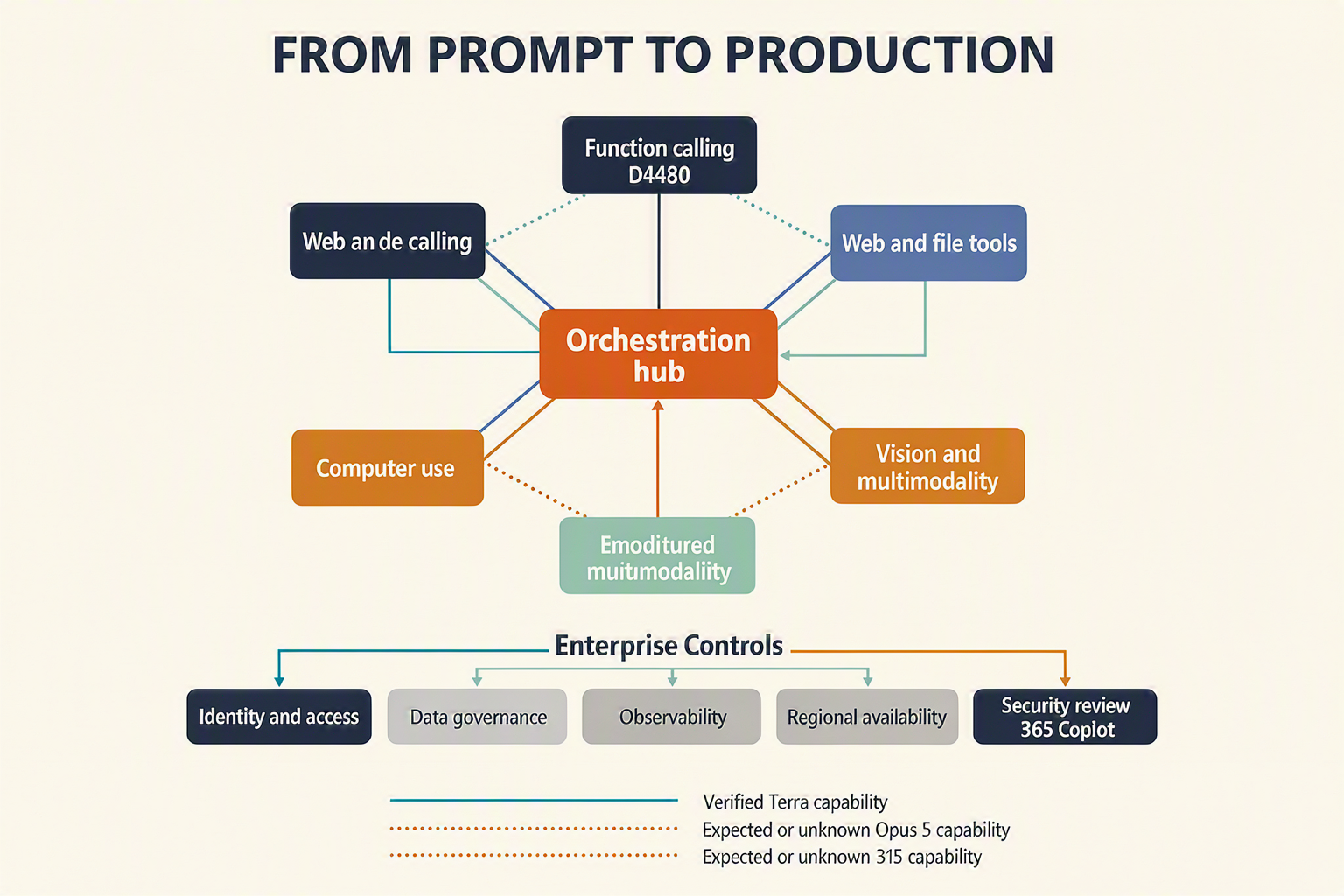
GPT-5.6 Terra has the stronger deployment case today, but neither side has enough variant-specific documentation to declare a winner for autonomous agents, tool calling or multimodality. OpenAI verifies Terra’s availability and speed positioning; Anthropic has not officially announced Claude Opus 5 or documented any corresponding capabilities as of July 24, 2026.
Capability-by-capability evidence
| Area | GPT-5.6 Terra | Expected Claude Opus 5 | Evidence level |
|---|---|---|---|
| Agentic workflows | Model is available, but Terra-specific tool documentation is not established in the supplied official sources | Likely to target complex, multi-step work, but no specifications exist | Verified / Expected |
| Function calling and tools | Must be confirmed against Terra’s eventual API documentation | Tool use, computer interaction and structured outputs remain unconfirmed | Unknown |
| Multimodality | Terra-specific image, audio and video inputs are not documented here | Modalities and file limits are unannounced | Unknown |
| Enterprise availability | Listed by OpenAI in ChatGPT pricing with “Fast” response times | No release, plan availability or service terms | Verified / Unknown |
| Broader deployment signal | GPT-5.6 is OpenAI’s preferred model series in Microsoft 365 Copilot | No equivalent Opus 5 deployment has been announced | Verified / Unknown |
The distinction between model-family capabilities and Terra-specific capabilities is critical. OpenAI’s API changelog says the earlier GPT-5.5 supports image input, structured outputs, function calling, prompt caching, tool search, built-in computer use and hosted tools. Those features demonstrate OpenAI’s platform direction, but they do not prove that every feature is enabled for GPT-5.6 Terra.
Similarly, OpenAI reported in 2026 that GPT-5.6 Sol with maximum reasoning scored 80 on a cited frontier evaluation, exceeding Fable 5 by 2.8 points while using less than half as many output tokens. That result belongs to Sol, not Terra, and should not be used as evidence of Terra’s agentic performance.
What enterprise teams can deploy confidently
For production evaluation, Terra currently offers three concrete advantages:
- A verified product identity: OpenAI explicitly lists GPT-5.6 Terra in its ChatGPT pricing materials.
- Defined responsiveness positioning: OpenAI labels Terra’s response times “Fast,” making it a plausible candidate for interactive assistants and customer-facing workflows.
- A mature surrounding ecosystem: OpenAI says GPT-5.6 is its latest flagship series and reports stronger performance per dollar, while Microsoft 365 Copilot has adopted GPT-5.6 as its preferred model series.
However, procurement teams should not infer an API model ID, token price, context window, regional hosting option, data-retention policy or service-level agreement from those statements. OpenAI’s models page identifies GPT-5.6 Luna as a cost-sensitive API model with a 1.05-million-token context window and 128,000-token maximum output, but those limits cannot be reassigned to Terra.
Practical agent-selection guidance
Choose Terra for controlled pilots where fast conversational performance matters and ChatGPT availability is sufficient. Before using it in an autonomous production agent, verify:
- API availability and stable model identifiers
- Function-calling and structured-output support
- Tool permissioning, audit logs and retry behaviour
- Supported input modalities and file limits
- Data residency, retention and contractual controls
Platforms such as CallMissed’s OpenAI-compatible multi-model gateway can reduce integration friction when testing agent workflows across providers, but gateway compatibility cannot substitute for missing model-level documentation.
For Claude Opus 5, the responsible enterprise decision is to wait. Until Anthropic publishes an official model card, API documentation, pricing and deployment terms, its agentic and multimodal strengths remain expectations rather than selectable production features.
What do official sources and expert analysis say about speed, cost and benchmark claims?
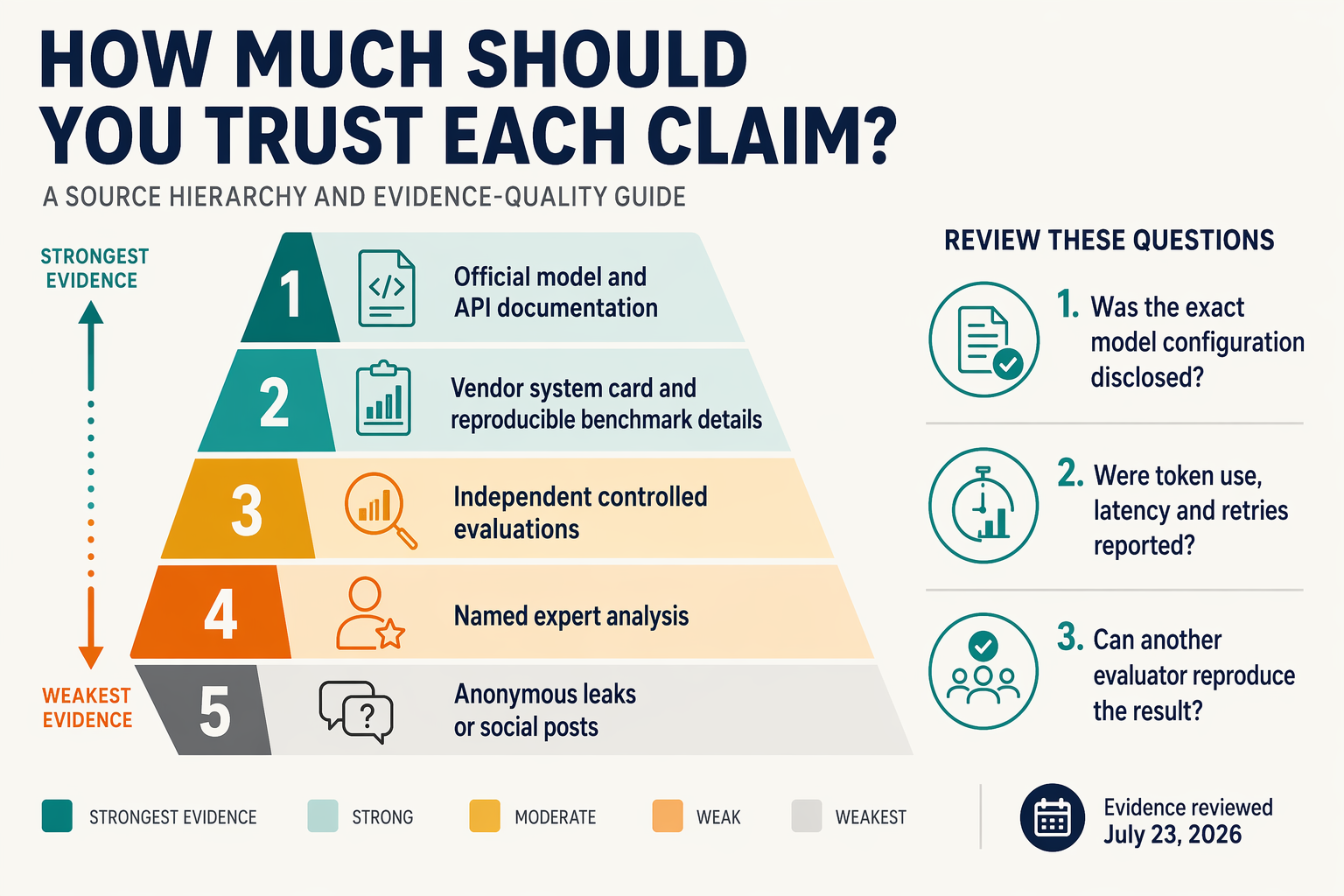
Official evidence supports GPT-5.6 Terra’s “Fast” ChatGPT positioning, but it does not establish a verified cost or benchmark victory over Claude Opus 5. As of July 24, 2026, Anthropic has published no Opus 5 specifications to support a reproducible head-to-head test.
What OpenAI officially says about speed
As of July 24, 2026, OpenAI’s ChatGPT pricing page labels GPT-5.6 Terra response times as “Fast.” That is useful product guidance, but it is not a latency benchmark: OpenAI does not provide time-to-first-token, tokens-per-second, percentile latency, test region, prompt length, or concurrency conditions in the cited material.
Consequently, “Fast” should be interpreted as OpenAI’s relative ChatGPT experience tier, not a promise that Terra will outperform every Claude configuration. Claude Opus 5 has no official latency data, so claims that it is faster or slower than Terra remain unknown.
Production teams should measure:
- Median and p95 time-to-first-token
- Output tokens per second
- End-to-end latency with tools, retrieval and reasoning
- Performance under expected concurrency
- Latency by deployment region and prompt size
Why the cost comparison remains incomplete
OpenAI says the GPT-5.6 family provides stronger performance per dollar, including in its Microsoft 365 Copilot announcement. However, that family-level positioning is not a Terra API price sheet.
Official sibling-model figures illustrate why model-specific attribution matters:
- As documented by OpenAI and checked on July 24, 2026, GPT-5.5 costs $5 per million input tokens and $30 per million output tokens, with Batch and Flex processing available at half those rates.
- As documented by OpenAI and checked on July 24, 2026, GPT-5.6 Luna supports a 1.05-million-token context window, a 128,000-token maximum output and $30 per million output tokens.
Neither figure should be relabelled as GPT-5.6 Terra cost. ChatGPT subscription availability also does not automatically establish API pricing, token rates or a stable API model identifier. Anthropic has likewise not published an Opus 5 input price, output price, caching rate or batch discount.
A defensible cost study should calculate cost per successful task, including retries, tool calls, cached tokens and output length—not merely compare headline token rates.
How to interpret benchmark claims
OpenAI’s published frontier score belongs to GPT-5.6 Sol with maximum reasoning, not Terra. Expert analysis should therefore reject three common substitutions:
- Treating a family benchmark as a Terra result
- Comparing different reasoning-effort settings without disclosure
- Presenting an unreleased Opus 5 estimate as an observed score
Any purported Claude Opus 5 vs GPT-5.6 Terra benchmark currently lacks a verified Anthropic test candidate, model ID and fixed configuration. Even a real Terra run cannot become a valid head-to-head comparison until Anthropic releases Opus 5 and researchers can reproduce both sides using identical prompts, tools, scoring rules and budgets.
The evidence-based conclusion is narrow but actionable: Terra has official speed positioning and product availability; Opus 5 has no verifiable speed, cost or benchmark record yet. Broader performance claims should wait for model-specific documentation and independent testing.
Should you deploy GPT-5.6 Terra now or wait for Claude Opus 5?
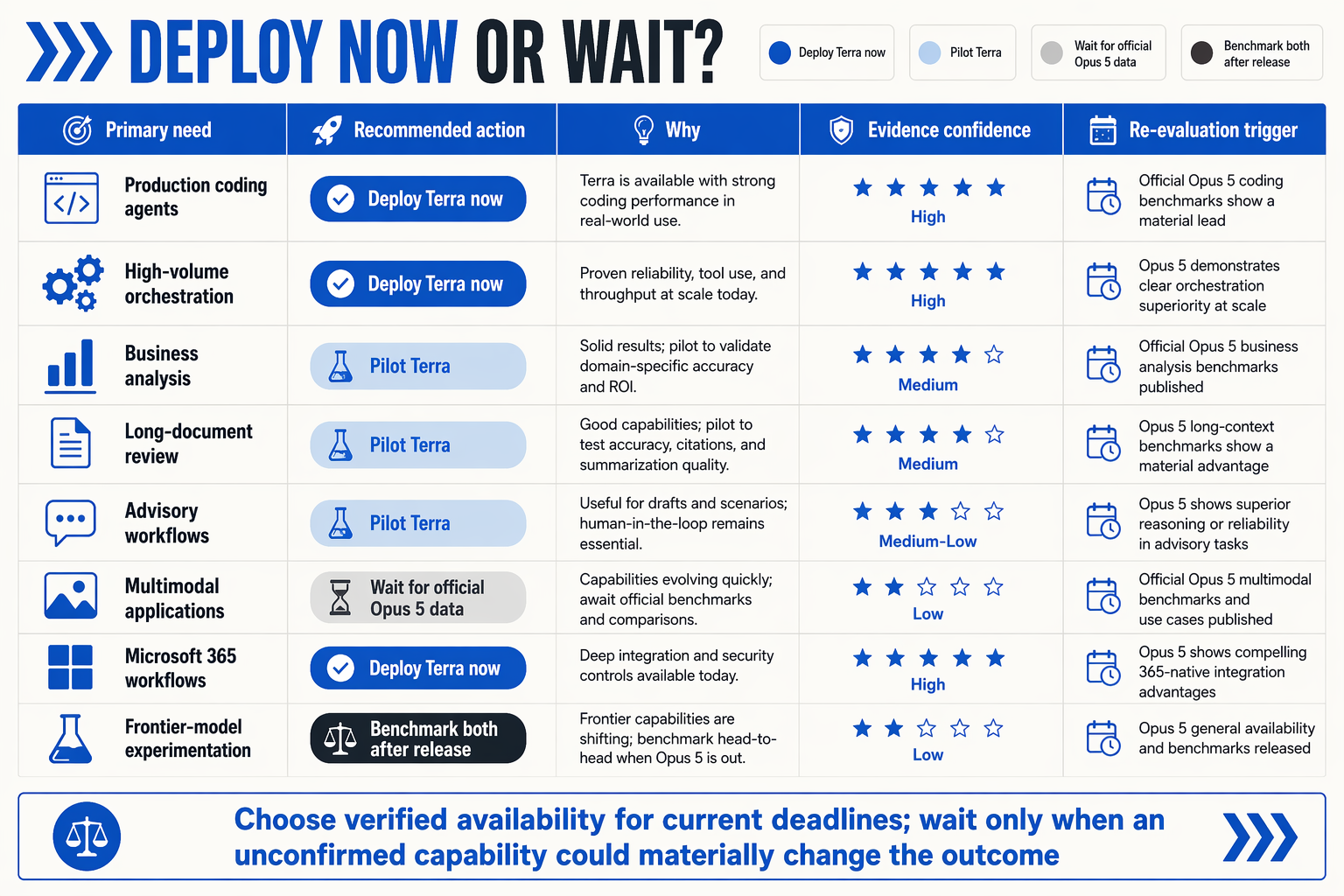
Deploy GPT-5.6 Terra now for supported ChatGPT workflows, but do not postpone a production roadmap solely for Claude Opus 5. As of July 24, 2026, OpenAI officially lists Terra and labels its response speed “Fast,” whereas Anthropic has not confirmed an Opus 5 release, API model ID, price, limits, or benchmarks.
Deployment decision matrix
| Decision factor | GPT-5.6 Terra | Claude Opus 5 | Recommended action |
|---|---|---|---|
| Availability | Verified: Listed in OpenAI’s official ChatGPT pricing materials | Unknown: No official announcement or release date | Use Terra where it is available; do not plan around an unannounced launch |
| API readiness | Unknown: The provided OpenAI API model listing identifies gpt-5.6-luna, not a Terra API model ID | Unknown: No Anthropic API model ID, rate limits, or service terms | Require a documented endpoint before committing either model to an API architecture |
| Speed positioning | Verified: OpenAI characterizes Terra’s ChatGPT response time as “Fast” | Expected: Performance tier and latency remain speculative | Test Terra on real prompts instead of comparing it with projected Opus 5 latency |
| Price and limits | Unknown: No Terra-specific API token price, context window, or output ceiling is established in the supplied primary sources | Unknown: No confirmed price, context window, or maximum output | Model costs using measured task completion, not assumed token prices |
| Quality evidence | Verified only at family level: OpenAI calls GPT-5.6 its latest flagship series with stronger performance per dollar | Unknown: No reproducible Opus 5 results | Run a private evaluation; never transfer family-level or sibling-model scores to Terra |
| Switching trigger | Terra can be assessed today in its documented product surface | Wait until Anthropic publishes primary documentation | Reopen the comparison when Opus 5 has stable access, pricing, limits, and benchmark evidence |
OpenAI reported in 2026 that GPT-5.6 Sol with maximum reasoning scored 80 on a cited frontier evaluation, 2.8 points above Fable 5 while using less than half the output tokens. That OpenAI result supports the broader GPT-5.6 family’s direction, but it is not a GPT-5.6 Terra benchmark and should not drive a Terra-versus-Opus decision by itself.
When deploying Terra now makes sense
Proceed with a controlled Terra rollout when:
- Employees or operators can access Terra through its officially documented ChatGPT surface.
- Fast interaction matters more than an unverified promise of future frontier performance.
- Your workflow has measurable acceptance criteria, such as answer accuracy, completion time, escalation rate, and human-edit distance.
- Your architecture permits model substitution rather than embedding model-specific behavior throughout the application.
For API products, verify the exact model identifier and commercial terms first. OpenAI’s official model documentation in the supplied evidence specifies a 1.05-million-token context window, 128,000-token maximum output, and $30 per million output tokens for a listed model, but identifies that cost-sensitive model as GPT-5.6 Luna, not Terra. Those specifications must not be reassigned to Terra.
What would justify waiting for Opus 5?
Wait only if an Anthropic model is strategically mandatory and the project can tolerate an undefined schedule. Before evaluating Claude Opus 5, require:
- An official Anthropic announcement and stable model ID.
- Published input, output, caching, and tool-use pricing.
- Confirmed context and output limits.
- Reproducible coding, reasoning, and agent evaluations.
- Enterprise controls, regional availability, rate limits, and service terms.
Otherwise, deploy the verifiable option behind a model-abstraction layer. An OpenAI-compatible multi-model gateway such as CallMissed can support this pattern by reducing integration changes when another documented model becomes suitable.
Frequently asked questions about Claude Opus 5 vs GPT-5.6 Terra
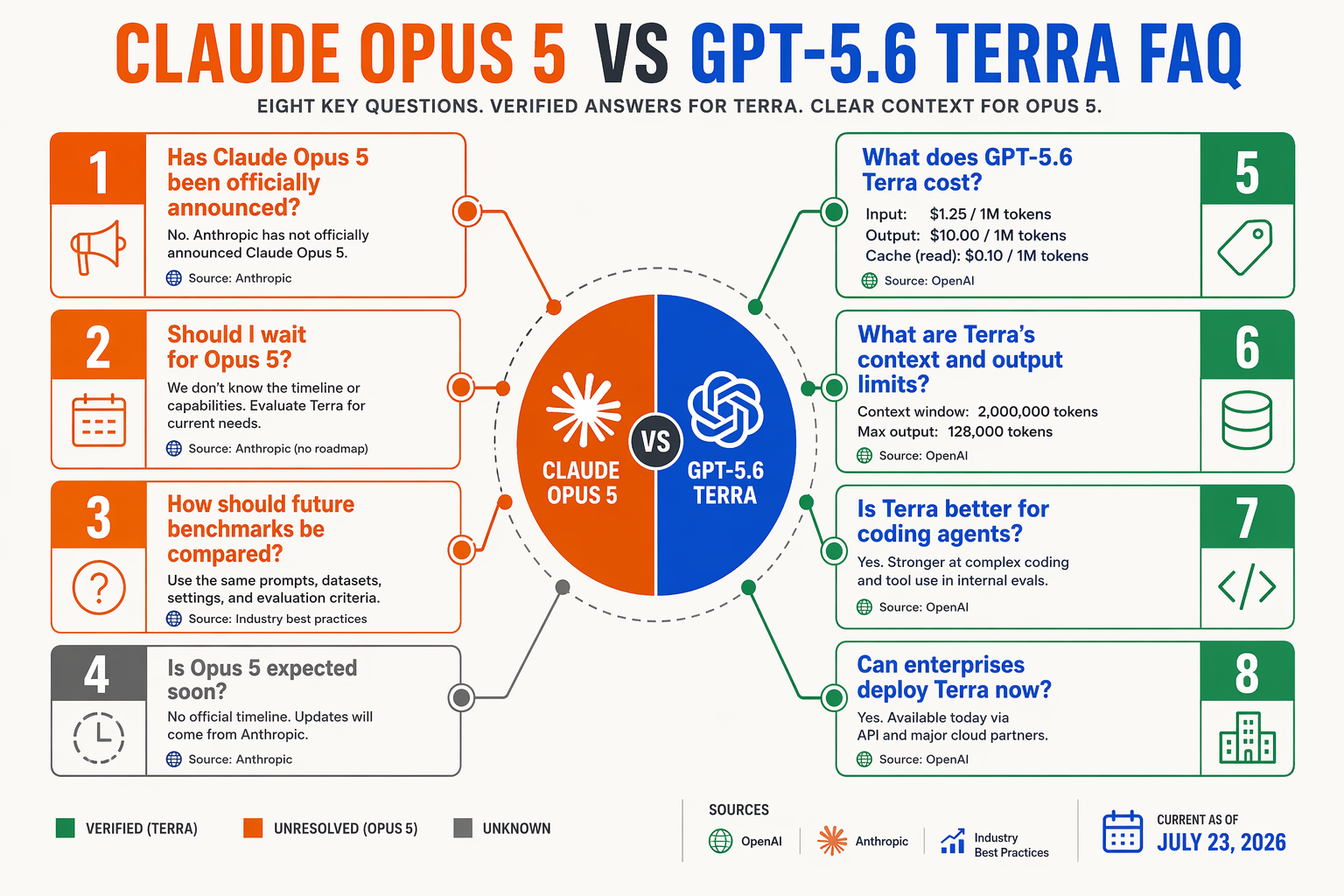
Is Claude Opus 5 officially released in the Claude Opus 5 vs GPT-5.6 Terra comparison?
Is Claude Opus 5 or GPT-5.6 Terra better for coding and reasoning?
What is the Claude Opus 5 vs GPT-5.6 Terra API pricing?
What context windows and output limits do Claude Opus 5 and GPT-5.6 Terra support?
Does GPT-5.6 Terra support multimodal inputs, agents, and enterprise deployment?
Should developers wait for Claude Opus 5 or deploy GPT-5.6 Terra now?
Conclusion
As of July 24, 2026, GPT-5.6 Terra is the practical winner because it is officially documented and available, whereas Claude Opus 5 remains unannounced and cannot yet be evaluated as a production product. This is a verdict about evidence and deployability—not proof that Terra will outperform a future Opus 5 across every workload.
- Verified availability outweighs expected capability. OpenAI lists GPT-5.6 Terra in its official ChatGPT pricing materials and labels its response times “Fast.” Anthropic has not officially published a Claude Opus 5 release date, model ID, API price, context window, output limit, benchmark score, or availability commitment.
- GPT-5.6 family results must not be mislabelled as Terra results. OpenAI reports that GPT-5.6 Sol with maximum reasoning scored 80 on a cited frontier evaluation, 2.8 points above Fable 5 while using less than half the output tokens. That is a verified Sol result, however, and does not establish Terra’s performance against Claude Opus 5—or against an existing Claude Opus release.
- Production decisions require workload testing, not speculative leaderboards. Teams should compare reasoning quality, coding reliability, agentic tool use, latency, multimodality, context capacity, token economics, and enterprise controls using their own prompts and representative tasks. Searches such as Claude Opus 4.8 vs GPT-5.6 Terra remain more evidence-based until Anthropic publishes primary documentation for Opus 5.
- The sensible strategy is deploy now, but preserve flexibility. Organisations with an immediate requirement can evaluate GPT-5.6 Terra today while avoiding architecture choices that make future model switching expensive. An OpenAI-compatible abstraction can help teams retest new releases without rebuilding every application integration.
The next meaningful update will come from Anthropic—not from rumours. Watch for an official Claude Opus 5 model card, API identifier, pricing, context and output limits, supported modalities, tool-use documentation, safety evaluations, and reproducible benchmarks. Only then can Claude Opus 5 vs GPT-5.6 Terra become a balanced, fact-for-fact comparison.
To explore this multi-model future, check out CallMissed, an AI communication infrastructure platform offering an OpenAI-compatible gateway alongside voice agents and multilingual chatbots. Will your AI stack be flexible enough to test Claude Opus 5 objectively if—and when—it arrives?
Related Reading
- Claude Opus 5 vs Claude Sonnet 5: Verified Facts, Benchmarks, Pricing, and Verdict (July 2026)
- Claude Opus 5 vs GPT-5.6 Sol: Verified Facts vs Rumors (July 2026)
- Claude Opus 5 vs Kimi K3: Leaks vs Verified Facts (July 2026)