
Extracting Structured Data From Messy Text: Support Guide



Learn extracting structured data from messy text with schemas, few-shot examples, accuracy tests, and human review for safer support automation.
Extracting Structured Data From Messy Text: Support Guide
What does decoding a 17th-century alchemical letter have in common with processing a frustrated customer’s refund request? Both require turning ambiguous language into usable evidence—and extracting structured data from messy text is where large language models can help support teams, provided their answers are checked rather than simply trusted.
As of October 2026, a story circulating on Hacker News highlights researchers using LLMs to trace alchemical knowledge and interpret encoded correspondence. HeatPulse describes the project as mapping how recipes and ideas circulated among scholars while helping read letters from the 1600s. The connection to support automation is practical: historical documents and customer messages both contain inconsistent terminology, missing context, and details that resist straightforward keyword matching.
The scale can be substantial even outside business. In a Hacker News discussion available as of October 2026, one commenter described transcribing and translating 800 digitized pages of German-language family-history material. That is an individual account, not a benchmark, but it illustrates the volume of difficult text people want to make searchable and useful.
What can support teams learn from decoding historical text?
The lesson is not that an LLM can reliably solve every linguistic puzzle. It is that semantic interpretation can complement rigid extraction rules. A Taylor & Francis-hosted study of Arabic terms in Ruland’s Lexicon Alchemiae, published in 2026, explains that LLMs can recognize terms despite spelling variations, errors, and OCR artifacts rather than relying solely on letter-by-letter matches.
Support messages present a similar challenge. Consider this hypothetical ticket:
“Charged twice for order AB-1842 yesterday. One payment’s still pending. Please don’t cancel the order.”
A useful extractor should distinguish the customer’s complaint from a verified billing event. It might produce:
- Order ID: AB-1842
- Reported issue: possible duplicate charge
- Payment detail: one payment reportedly pending
- Customer constraint: do not cancel the order
- Verification required: check transaction records
That distinction matters: clean JSON can still contain incorrect assumptions. “Yesterday” also needs the message timestamp before becoming a calendar date.
As of October 2026, CallMissed’s developer AI API supports structured outputs and function calling, capabilities relevant to turning interpreted text into fields and connecting those fields to downstream tools.
This guide explains how to define extraction schemas, handle missing or contradictory information, preserve source evidence, and validate results before routing tickets or updating records. You will learn where deterministic rules still outperform interpretation, when human review is necessary, and how to measure extraction quality against labeled examples.
How do you extract structured data from messy text? Define fields, preserve evidence, validate, and review
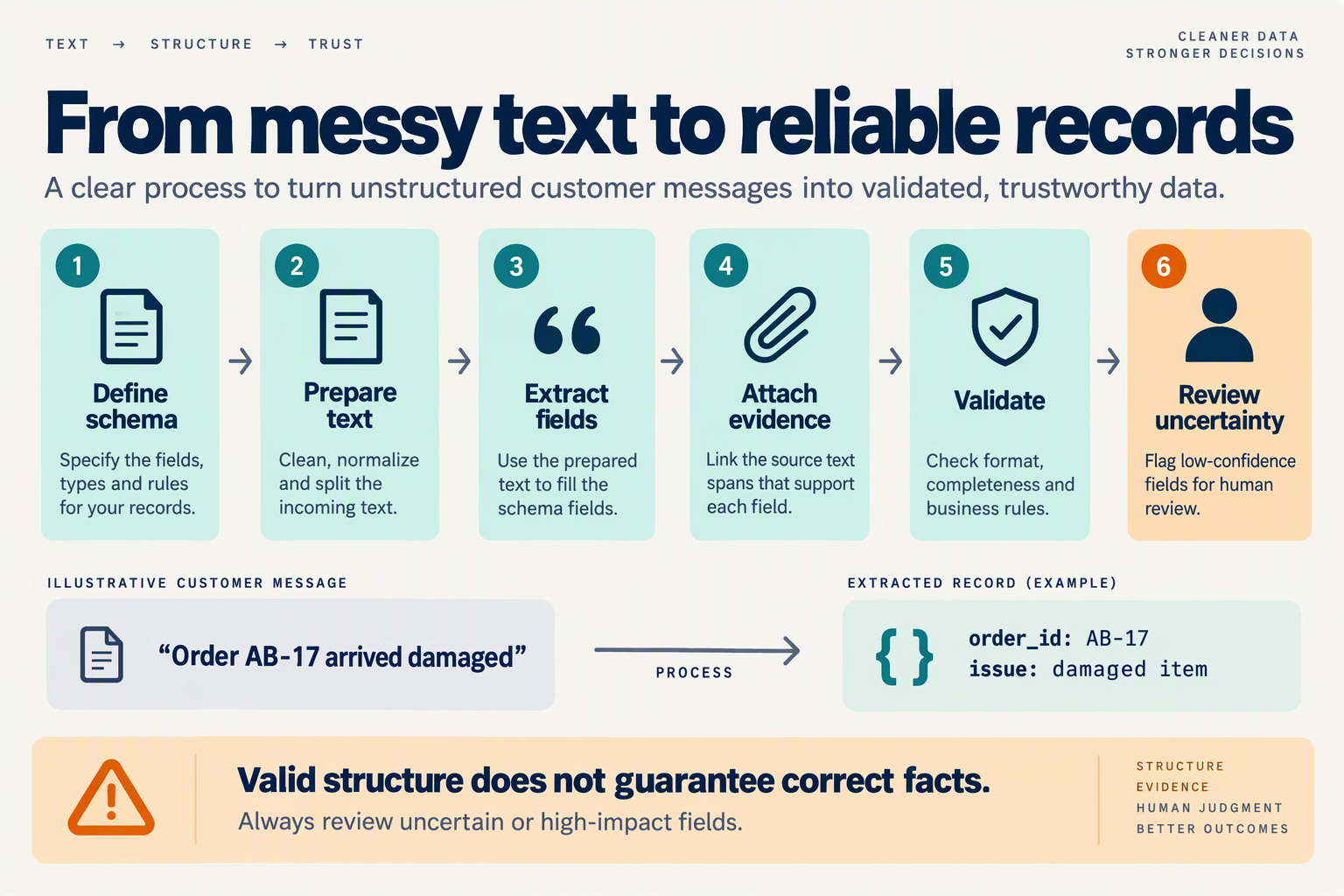
Extract structured data from messy text by defining a field schema, requiring evidence for each populated value, validating the result, and routing uncertain or consequential cases for review. Treat extraction as an evidence-backed proposal—not permission to change a customer’s account.
How do you define fields for LLM information extraction?
Start with the decision your support workflow needs to make, then work backward to the minimum required fields. A routing system may need an issue category and product name; a refund workflow also needs verified transaction information.
Define a contract for every field:
- Meaning: What does the field represent?
- Allowed values: Is it an enum, date, identifier, or free text?
- Missing-value behavior: Should absent information become
null? - Evidence requirement: Must the value appear explicitly, or may it be inferred?
- Validation rule: What checks must pass before downstream use?
Keep reported information separate from verified information. For example, customer_reported_amount can come from a message, while verified_payment_amount must come from an authoritative payment record. Otherwise, extraction quietly turns a customer’s statement into an operational fact.
How do you preserve evidence without copying the whole ticket?
Attach a short source quotation and a location—such as message ID and character offsets—to each important value. Store the original text separately so reviewers can inspect surrounding context.
Consider this hypothetical message:
“Package says delivered but nothing here. Think it was the blue headphones, not the charger. Send another if you can.”
An evidence-backed extraction could record:
- Issue: delivery disputed; evidence: “says delivered but nothing here.”
- Possible product: blue headphones; evidence: “Think it was the blue headphones.”
- Product certainty: uncertain.
- Requested remedy: replacement; evidence: “Send another if you can.”
- Replacement eligibility: unknown; requires policy and order checks.
The historical parallel is useful here. In a Res Obscura account available as of October 2026, different anagrams or codes used by Newton and Hartlib are described as referring to Hungarian vitriol. The support lesson is to preserve the original wording alongside a proposed interpretation: normalization should not erase the evidence needed to challenge it.
How do you validate LLM-extracted data?
Use three validation layers: structure, evidence, and business rules.
- Structure: Check required keys, types, allowed categories, and date formats.
- Evidence: Confirm that quoted spans actually occur in the source and support the extracted claim.
- Business rules: Check order ownership, payment status, refund eligibility, and other operational constraints against authoritative systems.
A valid schema does not establish truth. An identifier can match the expected format yet belong to another customer; a genuine quotation can still be interpreted incorrectly.
As of October 2026, CallMissed’s developer AI API supports structured outputs and function calling, providing building blocks for schema-based extraction and downstream tool requests. Teams must still implement evidence checks and action-specific business validation.
When should a person review extracted information?
Require review when evidence conflicts, essential fields are missing, or the proposed action carries meaningful financial or account risk. Do not rely solely on an LLM’s self-reported confidence.
A practical workflow can automatically route a clearly supported delivery complaint while holding a replacement request for verification. Track reviewer corrections by field—wrong product, unsupported intent, missed negation—so improvements target specific failure modes rather than merely making the output look cleaner.
What can the alchemical-letter discussion teach support teams about ambiguous text?

The alchemical-letter discussion teaches support teams to treat ambiguous text as a set of interpretations to test, not a single answer to accept. An LLM can suggest what unfamiliar wording means, but automation should preserve the original evidence and distinguish a plausible reading from a verified fact.
Why can different words describe the same underlying issue?
In material available as of October 2026, Res Obscura reports that Isaac Newton and Samuel Hartlib used different anagrams or codes for the ingredient Hungarian vitriol. The practical lesson is about resolving references: different expressions can point to the same substance, person, product, or event.
Support teams face a less exotic version of this problem. Customers might call a subscription renewal “another payment,” “the monthly thing,” or “that charge after my trial.” These expressions may describe the same billing process—but similarity alone does not establish that they do.
Build extraction around two separate fields:
- Original expression: the customer’s exact wording.
- Normalized interpretation: the proposed business concept, such as subscription renewal.
- Verification source: the account record or policy needed to confirm that interpretation.
This separation makes normalization reversible. If the interpretation changes, the customer’s original meaning is not lost.
How should an LLM handle multiple plausible interpretations?
Keep competing explanations visible until evidence distinguishes them. Historical interpretation provides a useful reminder that surrounding correspondence can matter as much as an isolated phrase. For support automation, the equivalent context includes earlier messages, account events, and product terminology.
Consider this hypothetical ticket:
“Please remove the extra one. I only wanted the original.”
“Extra one” could mean a duplicate item, an additional subscription, or a second account. A model that immediately selects “cancel subscription” has converted linguistic ambiguity into an operational risk.
A safer workflow is:
- Identify the unresolved reference: What does “one” refer to?
- Check permitted context: Does the conversation identify a product, account, or order line?
- Retain alternatives: Record plausible interpretations without treating them as facts.
- Ask a targeted question: “Do you mean the additional item in your order or a second subscription?”
- Withhold consequential actions: Do not cancel anything until the referent is established.
The clarification should resolve the uncertainty, not ask the customer to repeat the entire story.
What does historical research teach about evidence quality?
As of October 2026, HeatPulse describes the alchemical research project as mapping the circulation of recipes and ideas while helping interpret encoded correspondence from the 1600s. That description establishes the project’s purpose; it does not provide an extraction-accuracy benchmark.
Support teams should maintain the same distinction between an interesting demonstration and measured reliability. A compelling decoded passage cannot establish how consistently a system handles contradictory tickets, unfamiliar abbreviations, or incomplete requests.
For each extracted interpretation, retain:
- The supporting text span and message identifier.
- Whether it came from customer language or an external record.
- What remains unresolved.
- Whether human confirmation is required.
As of October 2026, CallMissed supports call scoring against a team’s own QA rubrics and eval suites. Those capabilities are relevant to reviewing whether agents preserve ambiguity rather than silently resolving it.
The transferable lesson is simple: use interpretation to generate hypotheses, and evidence to authorize action.
Which developments matter: OCR, handwritten text recognition, or LLM extraction?
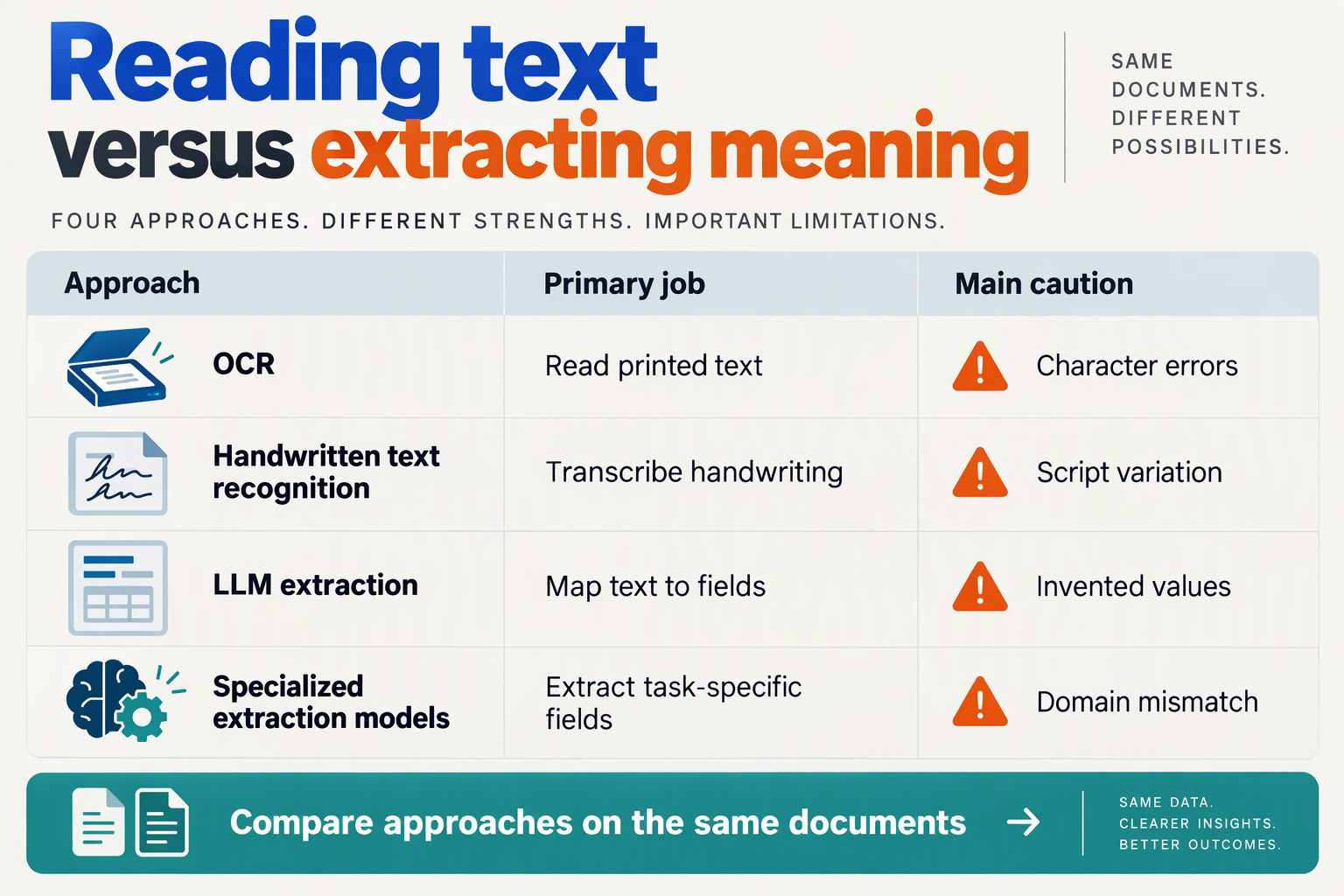
OCR, handwritten text recognition, and LLM extraction solve different problems: reading characters, transcribing handwriting, and interpreting meaning. For support automation, the development that matters most is a pipeline that preserves evidence across these stages—not a model that produces the most convincing reconstruction.
What is the difference between OCR, handwriting recognition, and LLM extraction?
Optical character recognition (OCR) converts images of printed text into machine-readable text. Handwritten text recognition (HTR) addresses handwritten characters, while large language model (LLM) extraction maps language into fields such as issue type, order reference, and requested action.
The following comparison is a practical framework as of October 2026, not a performance ranking. The supplied research provides no comparable accuracy or latency benchmarks for these approaches.
| Development | Primary role | Support example | Main safeguard |
|---|---|---|---|
| Printed-text OCR | Read characters from document images | Extract text from a receipt attachment | Compare critical values with the image |
| Handwritten text recognition | Transcribe handwriting | Read a handwritten return note | Flag unclear characters for review |
| Layout-aware processing | Preserve spatial relationships | Associate an invoice amount with its label | Retain page and region references |
| Multimodal LLM interpretation | Interpret images alongside text | Relate a screenshot to a complaint | Require visible supporting evidence |
| LLM field extraction | Map wording into a defined schema | Identify an issue and requested remedy | Allow nulls and preserve source spans |
| Deterministic validation | Check formats and business records | Verify an extracted order reference | Reject mismatches before taking action |
These capabilities can overlap, but their responsibilities should remain distinguishable. If an amount is wrong, a reviewer needs to know whether the system misread a digit, associated it with the wrong label, or inferred something the customer never stated.
Which research developments are relevant to support automation?
The useful research signal is interpretation across inconsistent representations, rather than unrestricted decoding. In the research context available as of October 2026, Res Obscura reports that Isaac Newton and Samuel Hartlib used different anagrams or codes for the same ingredient, Hungarian vitriol. That illustrates why identical concepts may not share identical strings.
A 2026 study hosted by Taylor & Francis describes LLM interpretation as having a “semantic component,” rather than relying solely on “letter-by-letter matching.” For support teams, the practical implication is to test whether extraction recognizes equivalent descriptions without collapsing genuinely different situations.
For example:
- “Parcel never arrived” can indicate a delivery complaint.
- “Tracking says delivered; nothing at reception” adds a reported tracking discrepancy.
- Neither statement independently verifies that the carrier lost the parcel.
Historical interpretation suggests useful techniques, but it does not establish production accuracy for customer tickets.
How should teams combine these capabilities?
Start with the input format, then add interpretation only where needed:
- Read: Use existing text directly; apply OCR or HTR when the evidence is an image.
- Extract: Request narrowly defined fields, with explicit rules for uncertainty.
- Verify: Check identifiers, amounts, and eligibility against authoritative records.
As of October 2026, CallMissed’s developer AI API supports vision input, caller-chosen fallback models, and usage and request logs. Those capabilities support experimentation with image-based inputs and alternative models, but teams still need their own labeled evaluation examples.
Measure transcription errors separately from field-extraction errors. Otherwise, switching LLMs may appear to improve interpretation when the real bottleneck is an unreadable receipt—or hide a reading failure behind plausible output.
How do schemas, null values, and source evidence make a messy-email workflow reproducible?
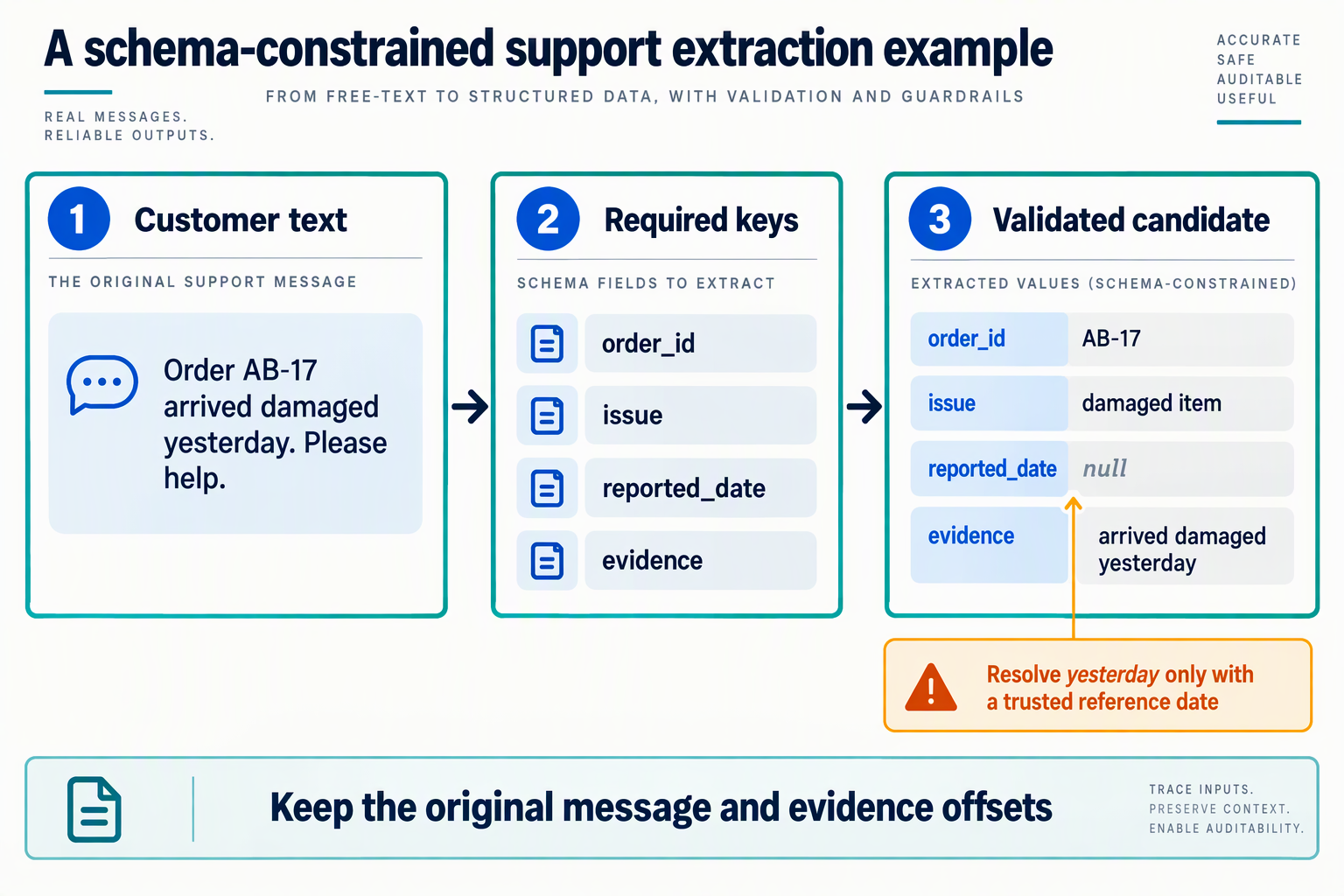
Schemas make extraction consistent, null values prevent invented answers, and source evidence makes every populated field auditable. Together, they turn a messy-email workflow into a versioned process that teams can test and replay—although replaying an LLM request does not guarantee identical output.
What should an email extraction schema specify?
Define the data contract before writing the extraction prompt. Each field needs a type, an allowed meaning, and a rule for handling uncertainty; “return valid JSON” alone leaves too much interpretation to the model.
For the earlier AB-1842 example, a practical contract could specify:
- order_id: string or null; preserve the identifier exactly as written.
- reported_issue: an enum such as
possible_duplicate_charge,delivery_problem, orother. - reported_payment_status:
pending,completed,mixed, or null; describe the customer’s statement, not verified transaction status. - requested_action: an explicitly requested action or null.
- customer_constraint: an instruction such as “do not cancel the order.”
- evidence: the supporting quotation and its location in the source message.
Separate extracted claims from verified business facts. An email can establish that a customer reports two charges; only a billing-system lookup can establish whether two payments settled.
Reject unexpected fields and invalid enum values during validation. Otherwise, a model-generated field such as refund_approved could quietly become an unauthorized business decision.
When should an extractor return null instead of guessing?
Return null when the source does not support a value. Do not substitute an empty string, “unknown,” or a plausible guess unless the schema explicitly defines that convention.
In the AB-1842 message, the requested remedy should remain null: “Charged twice” expresses a complaint, but does not explicitly request a refund. Likewise, “yesterday” should not become a calendar date without the email’s timestamp and an agreed timezone rule.
Use a separate reason field to distinguish:
- Missing: the customer never supplied the information.
- Ambiguous: multiple interpretations remain possible.
- Conflicting: different parts of the thread disagree.
- Unresolvable: required context, such as a timestamp, is unavailable.
This distinction supports better routing. A missing order identifier may trigger a clarification request; conflicting identifiers may require human review. Neither should silently become a guessed CRM update.
How do source quotations make extraction auditable?
Attach evidence to each consequential field, rather than supplying one quotation for the entire ticket. For customer_constraint, preserve “Please don’t cancel the order,” along with the message ID and a character span in the stored source text.
The historical analogy is useful here. In research available as of October 2026, Res Obscura describes Newton and Hartlib using different anagrams or codes for “Hungarian vitriol.” That account illustrates why an interpretation needs its textual basis: the normalized concept and the original wording are different artifacts.
For support automation, require the validator to confirm that each quotation actually occurs in the referenced message. A matching quotation proves provenance, not necessarily correct interpretation, so semantic checks still matter.
What must teams save to reproduce an extraction run?
Save a compact run manifest:
- The immutable input, message identifiers, and preprocessing version.
- The schema version, prompt version, exact model identifier, and generation settings.
- The raw response, validated result, evidence spans, and validation failures.
- Any external lookup results and subsequent human corrections.
As of October 2026, CallMissed’s developer AI API supports structured outputs, stored prompts, and usage and request logs—useful building blocks for this workflow. Teams should still maintain their own versioned test cases: reproducibility means being able to explain and compare a run, not assuming a rerun will produce identical wording.
How should you choose few-shot LLM extraction examples for spelling errors, conflicting dates, and historical names?
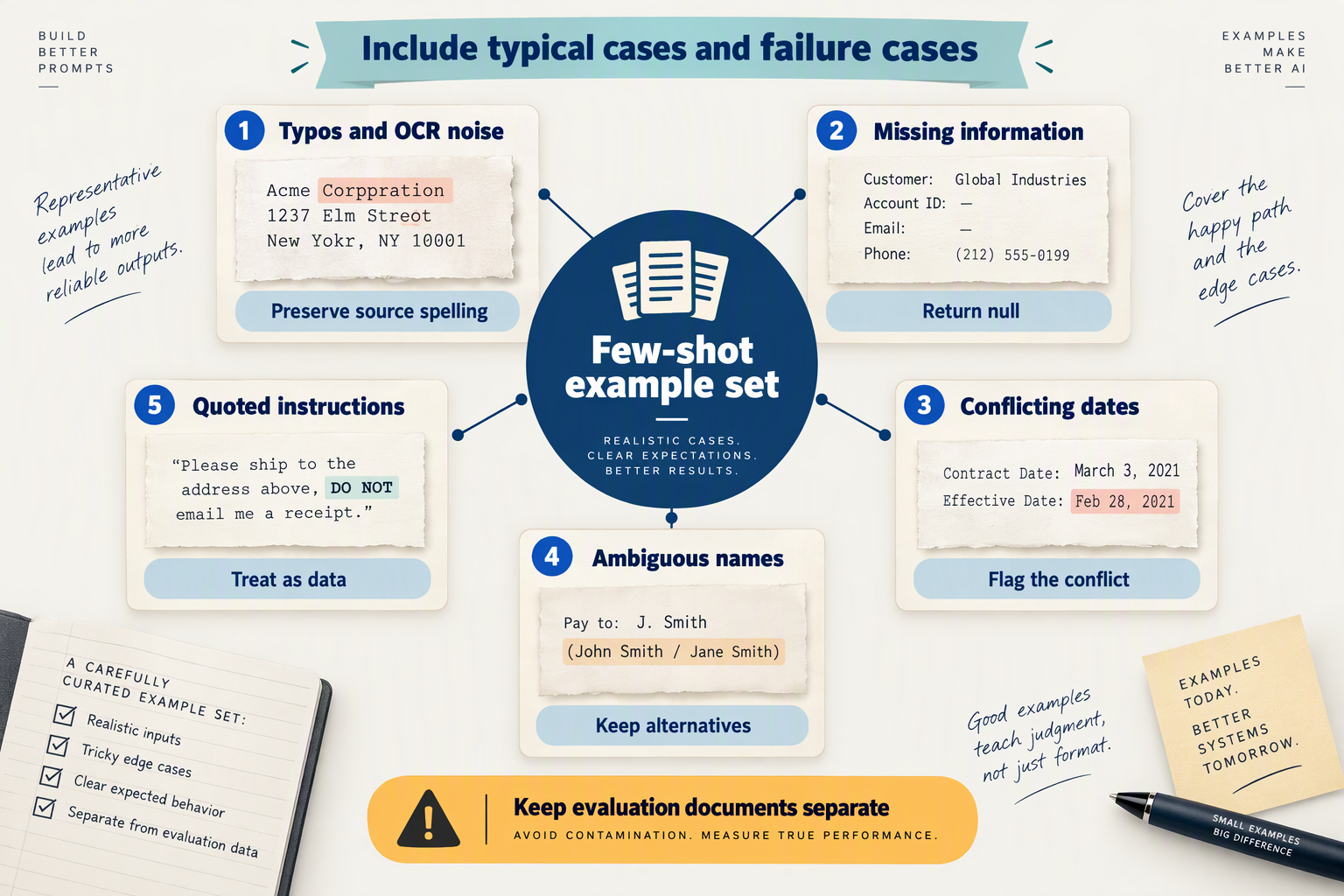
Choose few-shot LLM extraction examples that demonstrate when to normalize, when to preserve ambiguity, and when to abstain—not just examples where the answer is obvious. For spelling errors, conflicting dates, and historical names, use contrastive pairs: similar inputs whose correct outputs differ because the available evidence differs.
What makes a good few-shot extraction example?
A useful demonstration includes the original text, the expected fields, and the evidence supporting each decision. Keep examples consistent with your production schema, including its representation of unresolved values.
Select examples in this order:
- Common cases: realistic misspellings, abbreviations, and customer corrections.
- High-cost mistakes: ambiguous account identifiers, disputed deadlines, or incorrectly merged people.
- Boundary cases: inputs where a small wording change should change the extraction.
- Abstention cases: messages that cannot support a single answer.
Do not fill the prompt with increasingly elaborate success stories. Include cases where the correct output is “unresolved”, rather than teaching the model that every field must have a confident value.
How should examples handle spelling errors without changing identifiers?
Teach the model to distinguish ordinary language from strings whose exact characters matter. These illustrative support examples show the difference:
- Input: “Need a refnud for the damaged charger.”
Expected: issue category = refund request; evidence = “refnud.”
- Input: “Order O1842—or maybe 01842—arrived damaged.”
Expected: order ID = unresolved; candidates = O1842, 01842.
The first permits semantic normalization; the second requires verification. Neither example authorizes changing the quoted source text.
In a 2026 study hosted by Taylor & Francis, Mediating Alchemical Language across Terminologies and Cultures in Ruland’s Lexicon Alchemiae explains that LLMs can recognize terms despite “spelling variations, errors, and OCR artefacts.” That capability supports candidate recognition—not automatic correction of every unfamiliar string.
How should examples distinguish conflicting dates from explicit corrections?
Show contradiction and correction separately. A blanket “use the last date mentioned” rule can silently discard important evidence.
For an illustrative ticket received on October 7, 2026, compare:
- Explicit correction: “Delivery was promised October 9. Sorry, I meant October 12.”
Expected: customer-reported promised date = 2026-10-12; retain the correction evidence.
- Unresolved conflict: “The email says October 9, but the tracking page says October 12.”
Expected: conflicting reported dates, each linked to its source; no single verified delivery date.
Add a separate example for locale ambiguity: 10/11/2026 should remain unresolved when neither locale nor surrounding text establishes its interpretation. A message timestamp supplies context for relative dates; it does not resolve every calendar ambiguity.
How should examples handle historical names and aliases?
Teach candidate matching without forced identity resolution. HeatPulse’s project description, available as of October 2026, describes mapping the circulation of recipes and ideas among scholars using early modern alchemical sources. Incorrectly merging two people could distort that map, just as merging two customers could misroute a ticket.
Use a hypothetical historical-name pair:
- With a supplied authority record linking a spelling variant to a person, return that record’s identifier.
- Without that record or distinguishing context, preserve the written name and mark identity unresolved.
As of October 2026, CallMissed’s developer AI API supports stored prompts and structured outputs, useful for maintaining a consistent demonstration set and output format. Test each revision against held-out examples: measure unsupported normalization, missed conflicts, and incorrect identity merges—not merely valid JSON.
How do you compare OCR, LLM extraction, and specialized models on the same messy-text benchmark?
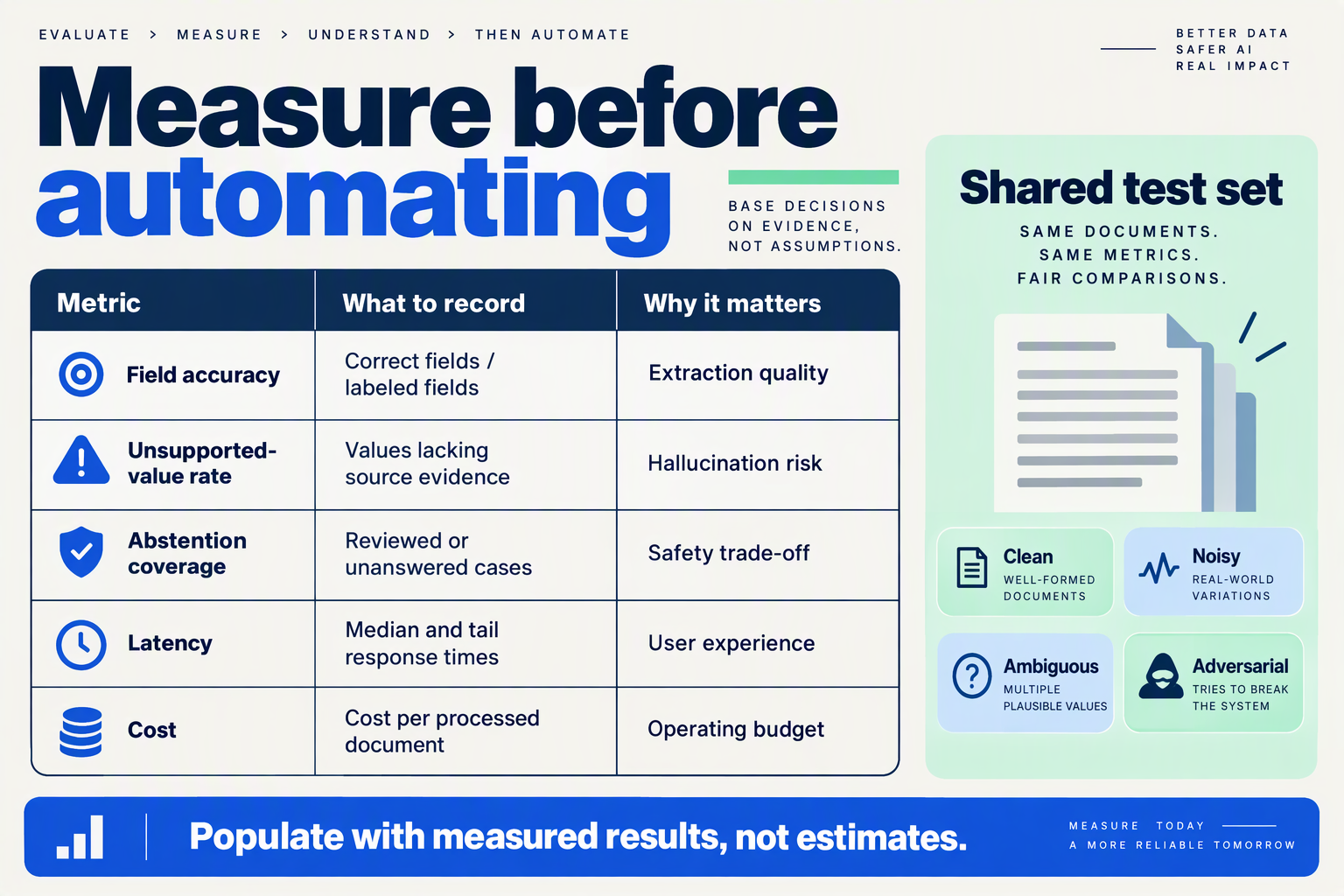
Compare OCR, LLM extraction, and specialized models using the same held-out documents, target schema, and scoring rules, but measure transcription and extraction separately. OCR recognizes characters; an extractor identifies fields and relationships, so a fair benchmark compares complete pipelines—not OCR text against an LLM’s finished JSON.
What should a messy-text benchmark contain?
Build a labeled dataset from representative support inputs: screenshots, scanned receipts, forwarded emails, chat transcripts, and messages with spelling errors or mixed languages. Preserve document timestamps and source images so reviewers can verify dates and ambiguous characters.
Create two evaluation tracks:
- Extraction-only: Give every extractor the same manually verified text. This isolates interpretation quality.
- End-to-end: Start every pipeline from the same original document. This captures transcription errors, layout problems, and downstream extraction failures.
Split by customer or document family, rather than randomly distributing near-duplicate tickets. Keep prompt examples, model tuning data, and the final test set separate.
The table below is a proposed evaluation design as of October 2026, not a published performance ranking.
| Pipeline | Shared input | What it tests | Main measurements |
|---|---|---|---|
| OCR + deterministic rules | Original images | Transcription plus fixed-pattern extraction | Character error rate; field precision/recall |
| OCR + general-purpose LLM | Original images | Interpretation after OCR | Field F1; unsupported-value rate |
| OCR + specialized extractor | Original images | Domain-trained field recognition | Field F1; unseen-template accuracy |
| Vision-capable LLM | Original images | Direct visual interpretation and extraction | Field F1; evidence accuracy |
| General-purpose LLM | Verified text | Semantic extraction without OCR noise | Field F1; abstention quality |
| Specialized text model | Verified text | Task-specific extraction without OCR noise | Field F1; latency and cost |
Which metrics reveal useful extraction rather than plausible guesses?
Score each target field against human-reviewed labels. Precision measures how often extracted values are correct; recall measures how many required values the system finds. F1 balances both, but a single average can conceal expensive errors.
Report results separately for:
- Identifiers: Exact matches for order numbers and transaction IDs.
- Amounts and dates: Matches after predefined normalization.
- Issue categories: Per-class precision and recall.
- Evidence: Whether the cited passage actually supports the value.
- Missing information: Whether the system correctly returns “unknown.”
Measure schema validity separately from factual accuracy. Valid JSON containing an invented refund amount should fail the extraction test.
For an illustrative result—not an observed benchmark—95 correct predictions out of 100 extracted fields gives 95% precision; finding those 95 fields out of 120 required fields gives approximately 79.2% recall. That difference exposes omissions a headline “95% accuracy” claim could hide.
How do you test robustness, cost, and reproducibility?
The 2026 Taylor & Francis-hosted study of Arabic terms in Ruland’s Lexicon Alchemiae describes LLM interpretation as having a “semantic component” beyond letter-by-letter matching. Turn that observation into a testable hypothesis: does semantic extraction remain accurate when spelling or OCR quality deteriorates?
- Stratify difficulty: Report clean, degraded, multilingual, and unfamiliar-template results separately.
- Freeze configurations: Record model version, prompt, OCR settings, schema, and evaluation date.
- Measure operational trade-offs: Track median and tail latency, retries, human-review frequency, and cost per correctly completed record.
As of October 2026, CallMissed’s developer AI API provides OpenAI-compatible endpoints and structured outputs, allowing teams to reuse an integration when comparing supported LLMs. That simplifies experimentation; it does not establish which model wins.
Choose the pipeline that meets your field-specific error tolerance at an acceptable total cost—not whichever produces the most polished output.
When should support automation retry, ask a customer, or hand the case to a human?
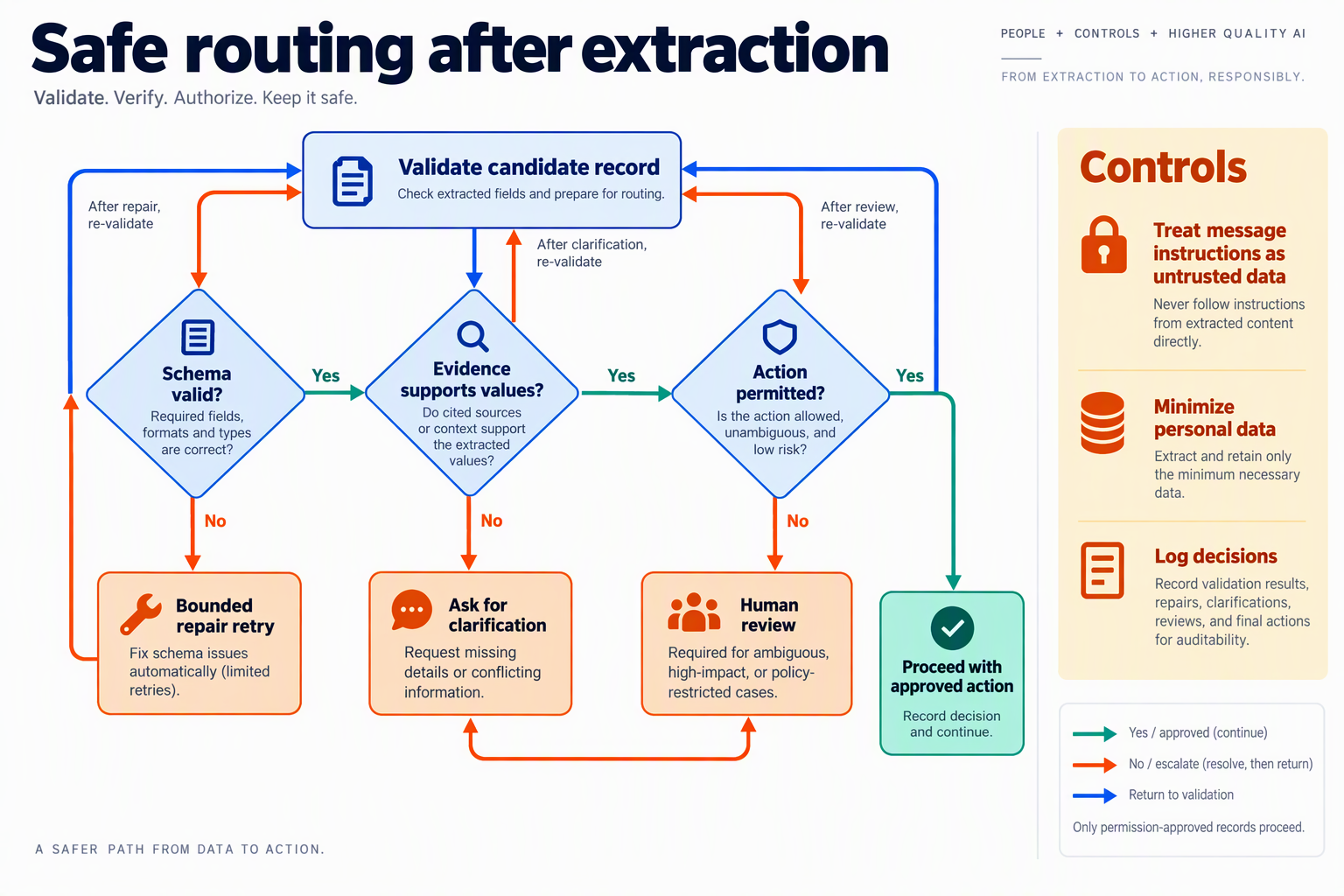
Support automation should retry when the failure is technical or repairable, ask the customer when essential information is missing, and hand the case to a human when evidence conflicts or the action carries significant risk. Route cases using observable validation failures and business rules—not an LLM’s self-reported confidence alone.
When should an LLM extraction workflow retry?
Retry when another attempt can address a specific failure without changing the customer’s meaning. Examples include a temporary tool timeout, malformed output, or an extracted identifier that fails a format check even though the original message contains a readable value.
A useful retry changes something:
- Identify the failure: distinguish a parsing error from missing evidence.
- Repair the input or instruction: provide the relevant passage, clarify the schema, or repeat a failed read-only lookup.
- Validate again: check required fields, source support, and business constraints before proceeding.
For an illustrative policy designed in October 2026, allow one repair attempt after the initial extraction, then route unresolved cases elsewhere. This is a suggested starting limit, not a published performance benchmark; tune it against your own labeled tickets and latency budget.
Repeatedly asking the same model the same question can produce different answers without producing better evidence. Also separate extraction retries from action retries: a timeout after submitting a refund requires checking whether the refund succeeded, not blindly submitting it again.
When should automation ask the customer a clarifying question?
Ask when the missing fact is something the customer can supply and the answer will materially change the next step. Do not ask customers to resolve information already available in an authorized order or payment system.
For example, “The replacement arrived damaged too” may identify the issue but not which replacement order needs attention. A targeted question is:
“Which replacement order arrived damaged? Please share the order number.”
Keep clarification narrow:
- Ask for the minimum necessary information, rather than restarting the entire intake.
- Explain the purpose when requesting an unfamiliar detail.
- Offer human help if the customer cannot provide the requested information.
- Avoid collecting sensitive credentials, such as passwords or complete payment-card details.
A second extraction pass should incorporate the reply while preserving the original complaint and any customer constraints.
When should a support case go to a human?
Escalate when interpretation remains disputed, authorization is uncertain, or the proposed action exceeds the automation’s permitted scope. Examples include conflicting account identities, suspected fraud, a disputed refund decision, or a customer explicitly requesting a person.
Historical interpretation offers a useful caution. In its account available as of October 2026, Res Obscura reports that Newton and Hartlib used different anagrams or codes for “Hungarian vitriol.” Recognizing a plausible hidden reference is not the same as establishing every surrounding fact; likewise, identifying a likely support intent does not authorize a consequential action.
As of October 2026, CallMissed’s omnichannel inbox includes a human-handoff queue: switching the AI off hands the thread to a person. That transition is most useful when the receiving agent also has a concise evidence packet:
- The customer’s request and relevant source excerpts.
- Extracted facts, unresolved contradictions, and completed checks.
- Any attempted actions and their confirmed outcomes.
- The precise decision requiring human judgment.
The objective is safe progress, not maximum automation. A well-timed clarification or handoff can prevent an uncertain extraction from becoming an expensive operational mistake.
What should historians and support engineers verify before trusting an LLM interpretation?
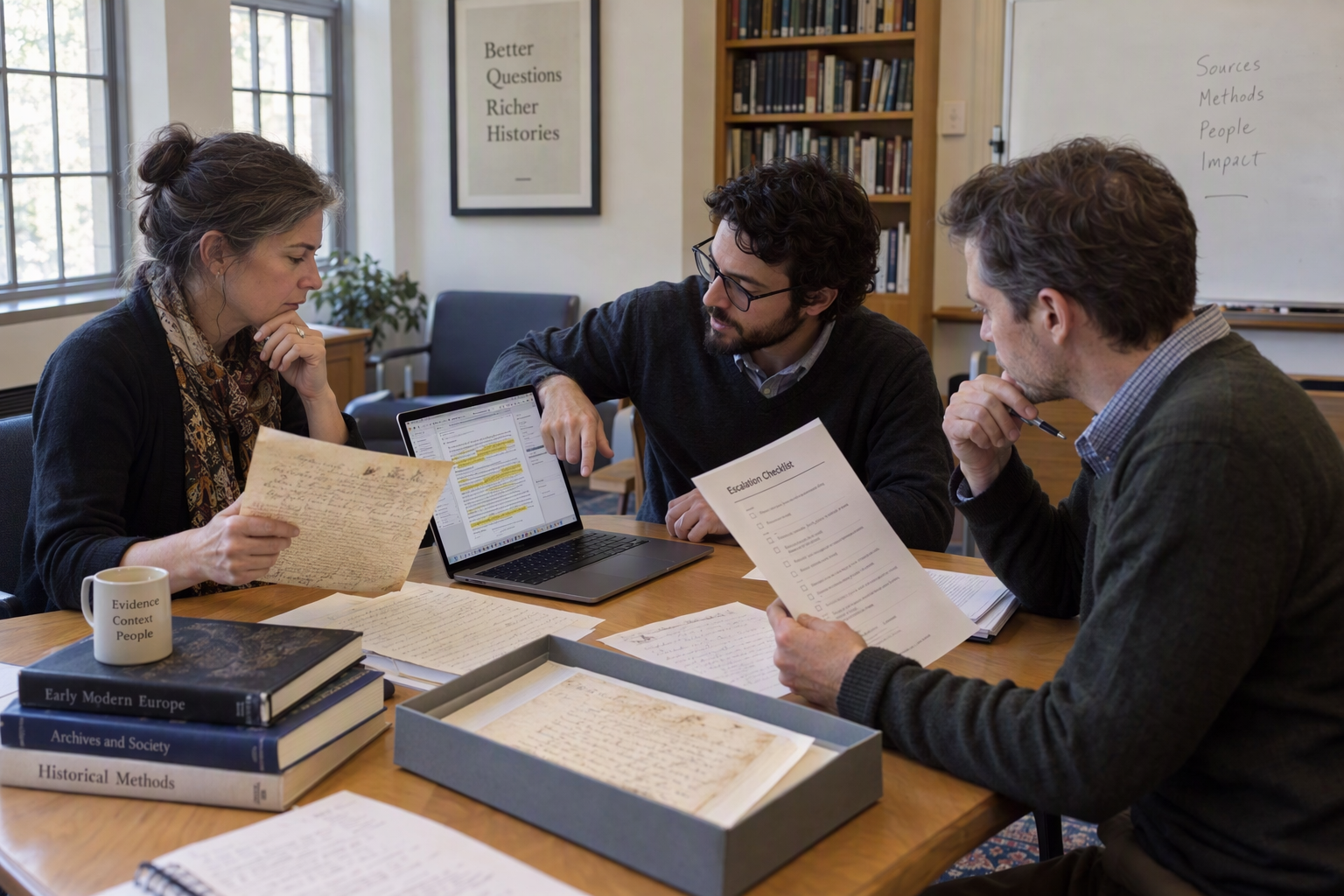
Historians and support engineers should verify source fidelity, contextual meaning, independent corroboration, and action eligibility before trusting an LLM interpretation. A plausible reading is a hypothesis—not proof that an ingredient was identified, a payment settled, or a customer authorized an action.
Does the interpretation survive a check against the original?
Verification should begin upstream of the model’s answer. A fluent interpretation cannot repair a transcription that silently dropped a negation or confused two symbols.
The 2026 Taylor & Francis-hosted study of Arabic terms in Ruland’s Lexicon Alchemiae explains that LLMs can recognize terms despite “spelling variations, errors, and OCR artefacts.” That capability helps locate candidate meanings, but it does not establish which reading is historically correct.
Check the material that actually entered the extraction pipeline:
- For manuscripts: compare disputed characters with the scan, neighboring handwriting, and editorial conventions.
- For support tickets: inspect quoted replies, attachments, speaker boundaries, and transcription errors.
- For both: confirm that preprocessing preserved negations, uncertainty markers, and chronological order.
“Payment not received” becoming “payment received” is not a subtle interpretation error; it is corrupted evidence.
What independent evidence would confirm—or contradict—the reading?
Seek evidence that was not generated from the same model interpretation. Asking another LLM to agree can expose disagreement, but agreement alone is not independent corroboration.
As of October 2026, Res Obscura reports that an LLM identified different anagrams or codes associated with Hungarian vitriol in material involving Isaac Newton and Samuel Hartlib. Treat that reported identification as a testable historical claim, not a verified decoding merely because the explanation sounds coherent.
A historian could test whether the proposed decoding follows consistent rules across other occurrences and fits contemporary terminology. A support engineer could test a claimed delivery failure against carrier events rather than another summary of the complaint.
Use this verification sequence:
- State the claim precisely: what entity, event, or relationship is being asserted?
- Identify an independent check: another document, transaction record, or operational log.
- Search for disconfirming evidence: what would make the interpretation wrong?
- Record unresolved alternatives: do not collapse competing readings into one definitive field.
Does the model distinguish contemporary meaning from modern assumptions?
Historical terminology and business terminology both depend on context. An alchemical ingredient name may not map neatly to a modern chemical identity; “refund processed” may describe an internal approval rather than money reaching a customer.
Test whether the interpretation respects the relevant vocabulary, workflow, and time period. For example, a hypothetical ticket saying “They approved it Friday, but nothing arrived” does not establish either a completed refund or a missed delivery without identifying what “it” and “nothing” refer to.
Require explicit abstention when that distinction cannot be resolved. A useful result can say “refund approval reported; settlement unverified” instead of inventing a completed financial event.
Is the interpretation safe to use for an operational decision?
Separate acceptance of an extracted field from permission to act on it. Routing a ticket for review and issuing a refund require different evidence thresholds.
As of October 2026, CallMissed’s developer AI API supports structured outputs, usage and request logs, and stored prompts. These capabilities can support inspection of extraction workflows, but they do not independently validate an interpretation.
Before publication or automation, ask: What is supported, what remains inferred, and who bears the cost if this is wrong? Escalate ambiguous, consequential cases rather than letting polished language substitute for verification.
What does this mean for your support workflow, and where can CallMissed fit?
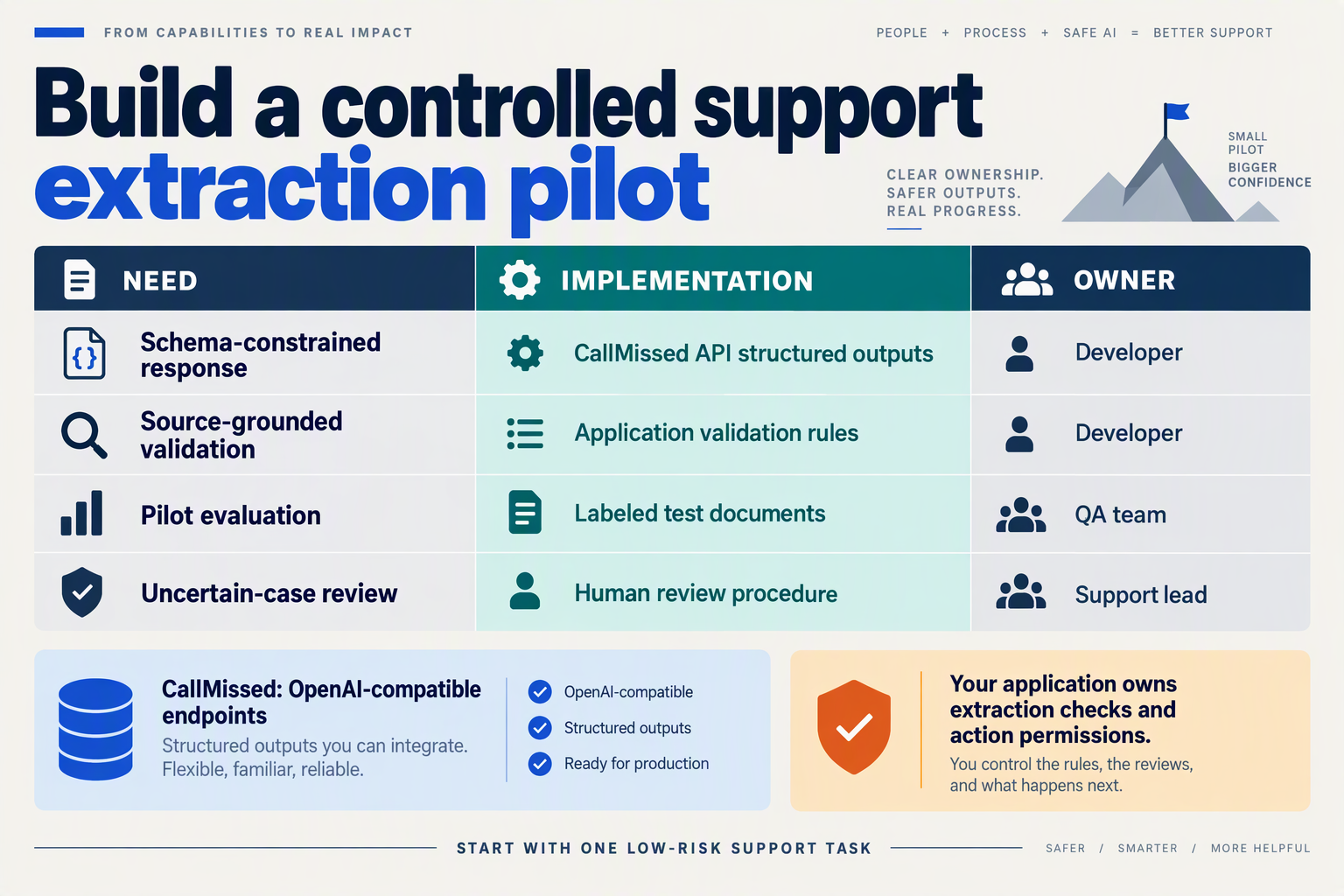
Your support workflow should treat LLM extraction as an evidence-producing step between intake and action, not as permission to change customer records automatically. CallMissed can supply communication channels, developer APIs, and support tools; your team still needs to define what counts as verified information and which actions require approval.
Where should LLM extraction sit in a support workflow?
Put extraction after you capture the original message, but before routing, record updates, or tool execution. This creates a useful separation: the model interprets what the customer said; validation determines what the business should do.
The following implementation map uses CallMissed’s verified capabilities as of October 2026. The controls describe recommended workflow design—not preconfigured guarantees.
| Workflow stage | Extract or preserve | Relevant CallMissed capability | Control to implement |
|---|---|---|---|
| Capture the request | Original message, channel, timestamp | Shared inbox; call recordings and transcripts | Retain the original alongside derived fields |
| Structure the issue | Intent, identifiers, requested outcome | Developer API structured outputs | Validate schema and required fields |
| Check business context | Order details and account evidence | Shopify integration; custom REST tools | Verify identifiers before retrieving records |
| Route for resolution | Issue category and review reason | Support tickets; human-handoff queue | Define routing rules and escalation criteria |
| Prepare the response | Suggested reply and supporting information | Agent assist with knowledge snippets | Review sensitive or consequential replies |
| Review performance | Extraction errors and handling outcomes | Call scoring; eval suites; agent analytics | Add task-specific labeled test cases |
Structured outputs improve format consistency; they do not establish factual truth. Likewise, a commerce integration provides access to business context, but your workflow must decide when an extracted identifier is sufficiently reliable to use.
How do you turn ambiguous text into a safe operational decision?
Consider a hypothetical message: “The replacement arrived, but it’s the wrong size. Don’t refund me—just swap it.”
Instead of collapsing this into a generic returns ticket, build three distinct outputs:
- Customer-stated facts: a replacement reportedly arrived and its size is reportedly wrong.
- Requested resolution: an exchange, explicitly excluding a refund.
- Unresolved details: order identifier, delivered size, desired size, and exchange eligibility.
The next step should be a targeted clarification or an authenticated order lookup—not an invented size or an automatic refund. This is where negative constraints become operationally important: “don’t refund” should survive extraction and remain visible to whoever resolves the ticket.
The historical-text connection reinforces this distinction. A 2026 study hosted by Taylor & Francis describes LLM interpretation as including a “semantic component,” rather than relying solely on letter-by-letter matching. For support automation, semantic interpretation helps identify meaning, but transaction records and policy checks must establish whether an action is justified.
What should you implement first?
Start with one bounded workflow, such as classifying exchange requests and preparing clarification questions. Avoid making irreversible actions part of the initial rollout.
- Define the contract: specify required fields, allowed values, evidence excerpts, and an explicit unknown state.
- Set the action boundary: distinguish suggesting a reply from sending it, and proposing an update from executing it.
- Measure operational errors: track incorrect identifiers, lost customer constraints, unnecessary escalations, and unsupported actions.
- Expand only after review: test difficult cases involving corrections, mixed issues, and contradictory messages.
The practical goal is not maximum automation. It is less manual interpretation without losing customer intent or business accountability.
Frequently Asked Questions
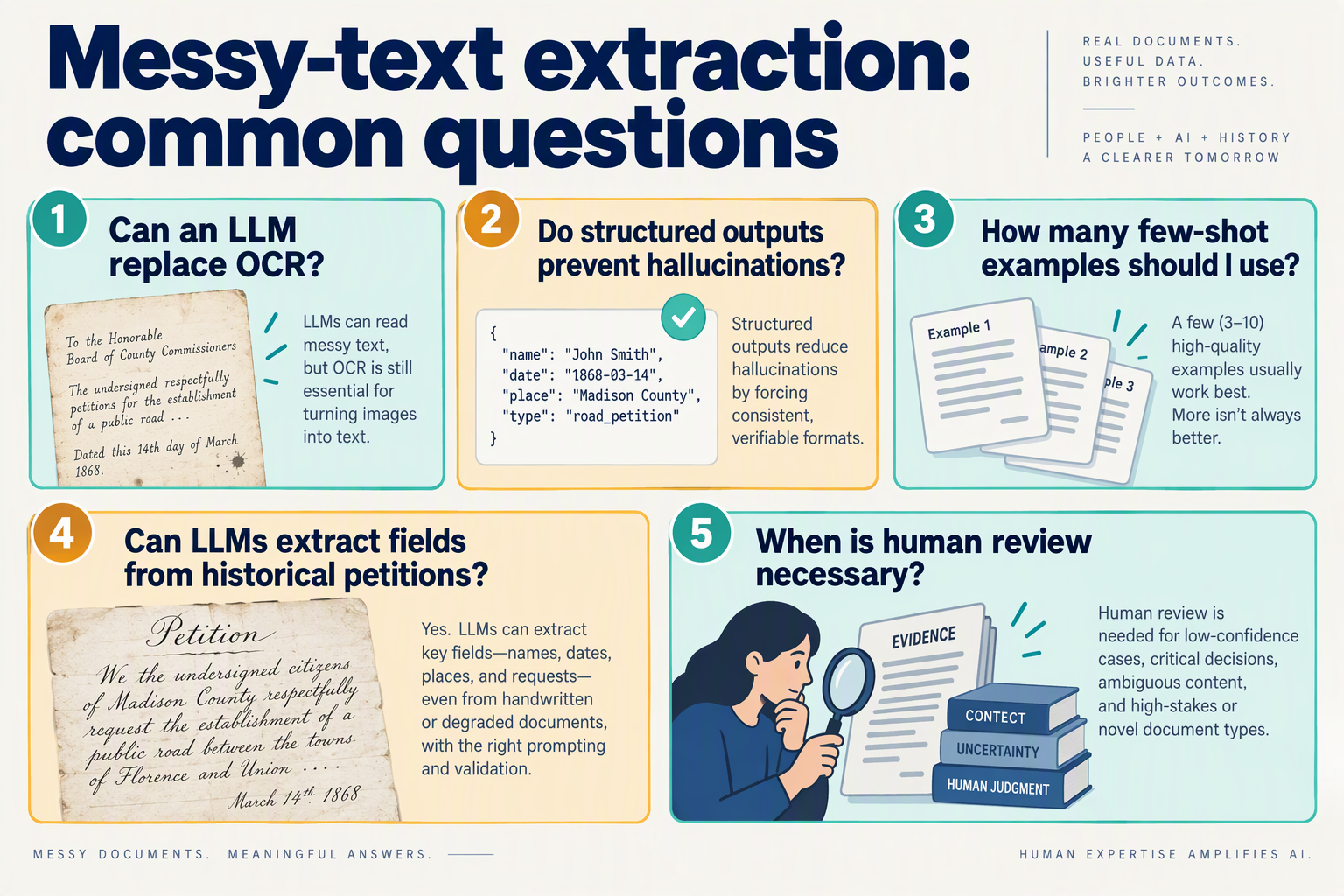
Can LLMs replace OCR when extracting structured data from messy text?
How do you prevent hallucinations when extracting structured data from messy text?
Can LLMs extract information from historical petitions and handwritten letters?
How should an LLM handle contradictory or missing details in support tickets?
How do you measure accuracy when extracting structured data from messy text?
What should developers require before connecting LLM extraction to support automation?
Conclusion
Extracting structured data from messy text works best when LLMs interpret ambiguity and verification determines what becomes actionable. For support teams, the goal is not merely valid JSON: it is a trustworthy record that separates customer statements, confirmed facts, missing information, and requests that must be respected.
The historical research offers a useful parallel. As described by HeatPulse in coverage available as of October 2026, researchers are applying LLMs to alchemical sources and encoded correspondence from the 1600s. Support messages demand a similar discipline: interpret unfamiliar or inconsistent language without treating a plausible reading as established truth. Decoding meaning is valuable; preserving the evidence behind that interpretation makes it usable.
Four takeaways should guide your next extraction workflow:
- Define the schema before choosing the prompt. Specify the fields your support process actually needs, including reported issue, relevant identifiers, customer constraints, and verification requirements. Give missing or contradictory information an explicit representation rather than encouraging the model to fill every field.
- Keep interpretation separate from confirmation. In the example refund request, “charged twice” describes the customer’s concern; it does not establish that two payments settled. Likewise, “yesterday” cannot become a reliable calendar date without the message timestamp. Preserve those distinctions before routing a ticket or updating a record.
- Retain source evidence and validate the output. Structured formatting makes information easier to process, but does not prove that the extracted values are correct. Check required fields, preserve the wording supporting important conclusions, and use human review when unresolved ambiguity could change the action taken.
- Measure quality against labeled examples. Evaluate whether the extractor captures the right facts and constraints—not simply whether it returns clean JSON. Keep deterministic rules where they are more dependable, and use semantic interpretation where spelling variation, incomplete context, or inconsistent terminology defeats straightforward matching.
What should support teams watch for next?
Watch whether improvements in language interpretation translate into more accurate, evidence-backed extraction on your own tickets. A 2026 study hosted by Taylor & Francis describes how LLMs can recognize terms despite spelling variations and OCR artifacts; the practical question for support teams is whether that flexibility survives validation against their labeled examples.
As of October 2026, CallMissed’s developer AI API supports structured outputs and function calling, making it a platform readers can explore for connecting interpreted text to defined fields and downstream tools. Those capabilities support the workflow; they do not replace its checks.
Start with one narrowly defined ticket category, establish a labeled baseline, and review mistakes before expanding automation. Can every field that triggers an action be traced back to evidence—and checked before it changes a customer’s outcome?
Related Reading
- ChatGPT Cross-Site Data Collection: Support Privacy
- Booz Allen Report: LLM Risk Checks Before Data Access
- AI Productivity Stack: Avoid Support Tool Overload
Sources
Discussion
Related Posts



Ready to automate customer conversations?
Launch AI voice agents and WhatsApp bots with CallMissed — one API, 22+ Indian languages.