
Claude Sonnet 5.5 vs Claude Opus 5.5: 2026 Guide



Compare Claude Sonnet 5.5 vs Claude Opus 5.5 using verified facts on pricing, coding, reasoning, agents, speed and ideal workloads.
Claude Sonnet 5.5 vs Claude Opus 5.5: 2026 Guide
What if a mid-tier Claude model could approach flagship coding performance while running 30% faster? As of September 29, 2026, Anthropic officially lists both models, making Claude Sonnet 5.5 vs Claude Opus 5.5 a real—and timely—decision for developers and businesses, not a speculative matchup. Anthropic says Sonnet 5.5 runs 30% faster than Sonnet 5 and costs up to 30% less for most work, while Opus 5.5 performs at the level of Claude Fable 5.1 on most tasks and costs 40% less to run than Opus 5. This guide compares their verified capabilities, benchmark results, pricing, speed, coding performance, agentic workflows, and ideal use cases. It also explains when Sonnet’s efficiency outweighs Opus’s higher-end reasoning—and how to test both using Anthropic-compatible infrastructure such as CallMissed’s developer AI API.
Are both models official? Yes—choose Sonnet 5.5 by default and Opus 5.5 for the hardest work
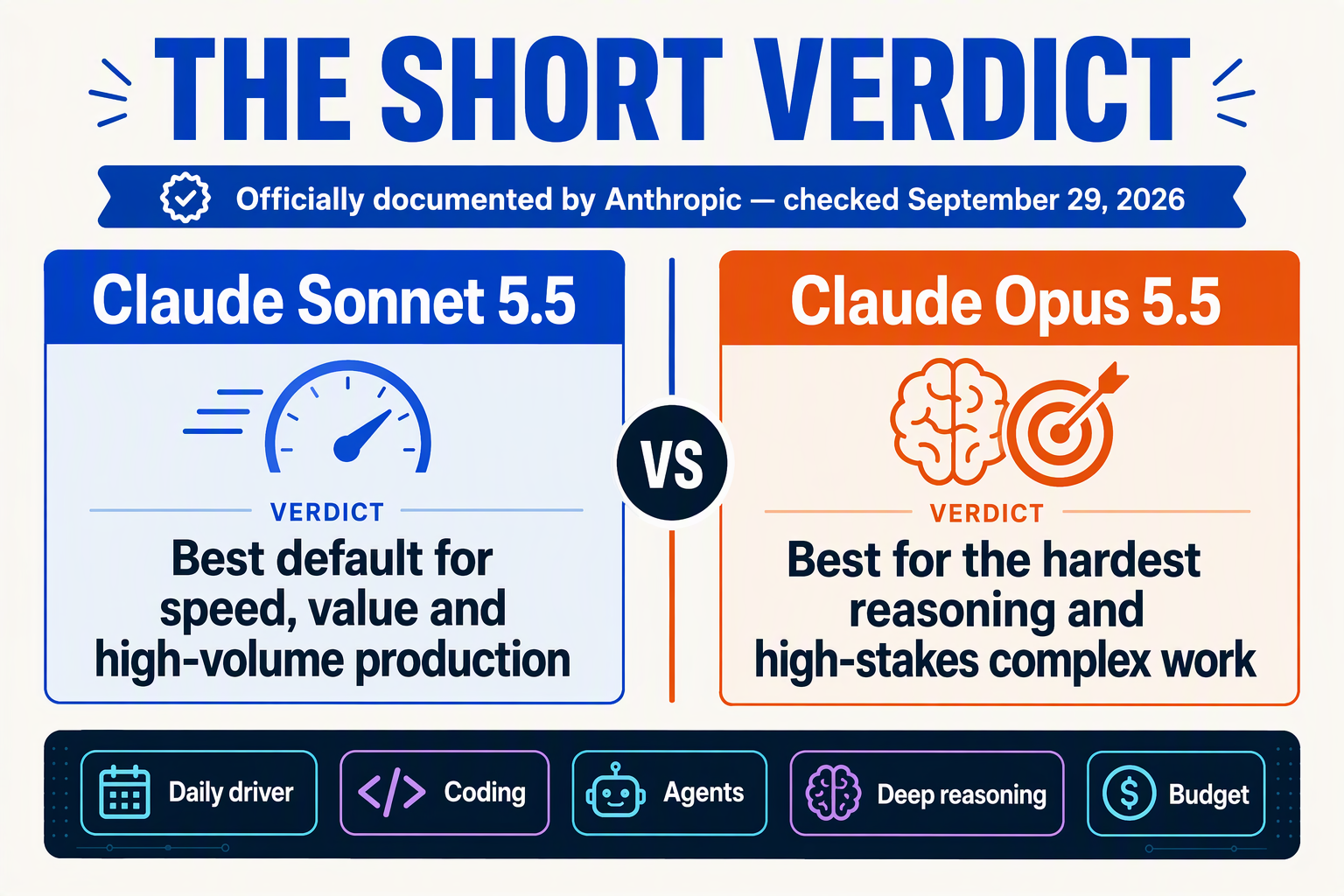
Anthropic officially lists Claude Sonnet 5.5 and Claude Opus 5.5 as released models as of September 29, 2026. For most production workloads, start with Sonnet 5.5; reserve Opus 5.5 for tasks where additional reasoning quality justifies higher cost or latency.
Are Claude Sonnet 5.5 and Claude Opus 5.5 officially released?
- Claude Sonnet 5.5: Anthropic’s newsroom describes Sonnet 5.5 as “a clear upgrade over Sonnet 5,” confirming that the name refers to an official model rather than a rumor, benchmark alias, or community label as of September 2026.
- Claude Opus 5.5: Anthropic’s newsroom officially states that Opus 5.5 “performs at the level of Claude Fable 5.1 on most work,” establishing Opus 5.5 as a released member of the Claude 5.5 family as of September 2026.
- Release sequence: 9to5Mac reported on September 28, 2026, that Sonnet 5.5 followed the arrival of Opus 5.5 one week earlier; Thurrott likewise reported that Anthropic released the two models less than a week apart.
- Verification standard: Anthropic’s own newsroom is the authoritative source for model identity and claims; third-party reports from 9to5Mac, Thurrott, VentureBeat, and The New Stack provide corroboration but should not replace Anthropic documentation when selecting API model identifiers.
Which Claude 5.5 model should developers choose by default?
- Claude Sonnet 5.5: Choose Sonnet by default for coding assistants, retrieval-augmented generation, customer workflows, routine tool use, document processing, and high-volume applications because Anthropic reports it runs 30% faster than Sonnet 5 and costs up to 30% less per task for most work.
- Claude Opus 5.5: Escalate to Opus for exceptionally difficult debugging, ambiguous architecture decisions, long-horizon agents, research synthesis, and consequential analysis where stronger reasoning can outweigh additional compute expense.
- Cost-performance trade-off: Help Net Security reported in September 2026 that Sonnet 5.5 costs less per task than Opus 5.5 at lower effort settings, while higher effort can produce comparable benchmark results at a similar cost; teams should therefore compare completed-task cost, not token price alone.
- Production routing: Use measured evaluations to route ordinary requests to Sonnet 5.5 and retry only low-confidence or failed cases with Opus 5.5. CallMissed’s Anthropic-compatible developer API supports caller-chosen fallback models, usage logs, streaming, structured outputs, function calling, and one balance across 138 models as of September 2026, enabling this tiered strategy without separate integrations.
How do Claude Sonnet 5.5 and Opus 5.5 compare at a glance?
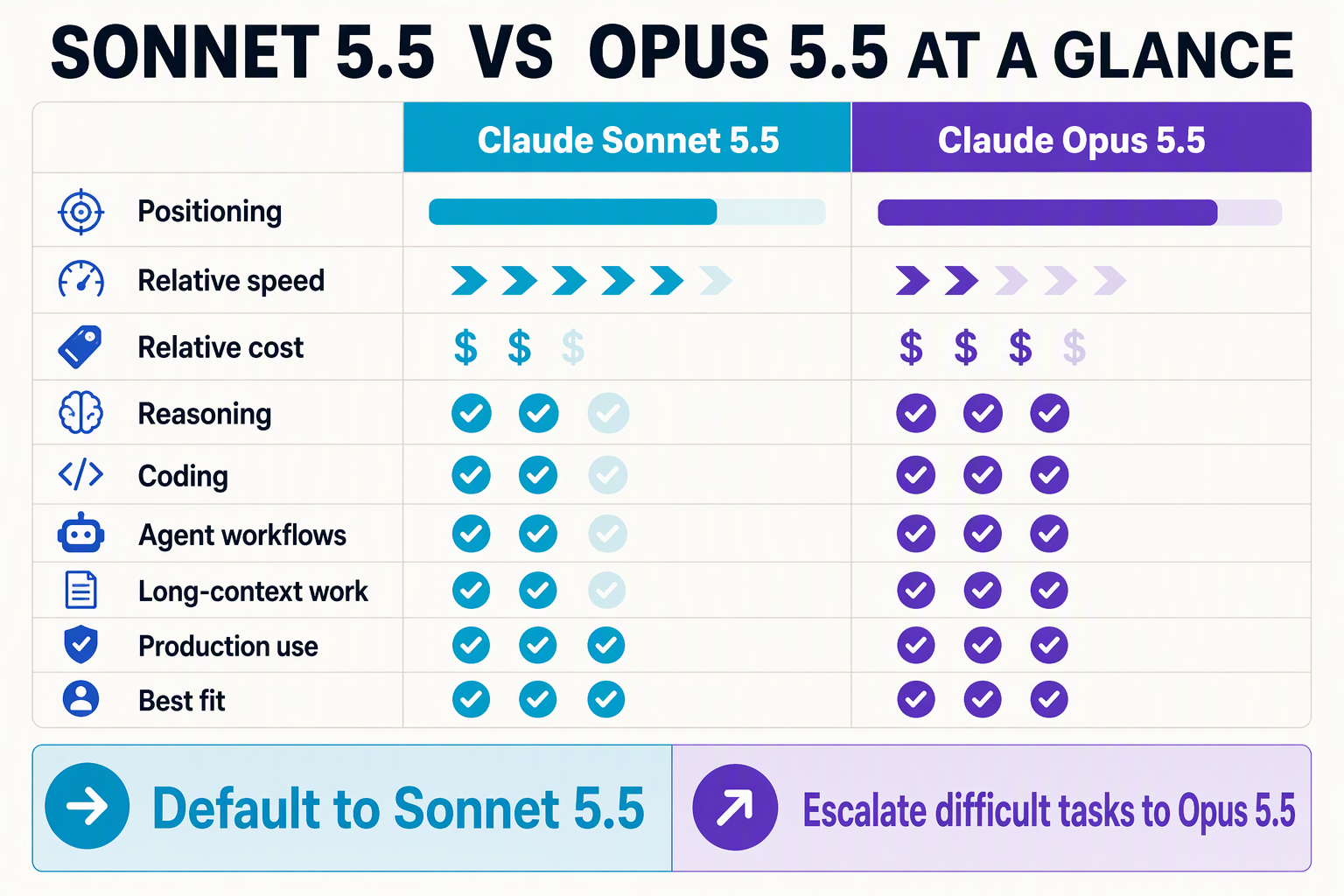
Anthropic positions Claude Sonnet 5.5 as the faster, lower-cost default and Claude Opus 5.5 as the higher-end option for difficult reasoning. The available evidence supports that distinction, but Anthropic’s current newsroom summary does not disclose every API specification.
- Official status: Anthropic lists both Claude Sonnet 5.5 and Claude Opus 5.5 in its newsroom as of September 29, 2026.
- Claude Sonnet 5.5: Anthropic says Sonnet 5.5 runs 30% faster than Sonnet 5 and costs up to 30% less for most work as of September 2026.
- Claude Opus 5.5: Anthropic says Opus 5.5 performs at the level of Claude Fable 5.1 on most work and costs 40% less to run than Opus 5 as of September 2026.
- Release timing: 9to5Mac reported on September 28, 2026, that Sonnet 5.5 arrived one week after Opus 5.5; Thurrott described the interval as less than a week.
- Coding economics: Help Net Security reported in September 2026 that Sonnet 5.5 costs less per task than Opus 5.5 at lower effort settings, while higher settings can deliver comparable benchmark results at a similar cost.
- Selection rule: Use Sonnet 5.5 for throughput-sensitive production work; test Opus 5.5 where reasoning quality has greater business value than minimizing compute cost.
| Comparison point | Claude Sonnet 5.5 | Claude Opus 5.5 | Practical implication |
|---|---|---|---|
| Official status | Released and listed by Anthropic | Released and listed by Anthropic | Both are verified model names as of September 29, 2026 |
| Product tier | Medium-sized, general-purpose model | Higher-end model | Sonnet suits routine scale; Opus targets harder work |
| Relative speed | 30% faster than Sonnet 5, according to Anthropic | No equivalent speed figure supplied in the provided sources | Sonnet has the clearest documented throughput gain |
| Relative operating cost | Up to 30% less per task than Sonnet 5 for most work | 40% less to run than Opus 5 | Both improve efficiency versus their direct predecessors |
| Reported performance | Approaches Opus 5.5 on some coding tests, according to The New Stack | Matches Claude Fable 5.1 on most work, according to Anthropic | Benchmark overlap does not make the models interchangeable |
| Best initial fit | Coding assistants, RAG, tool use and high-volume processing | Complex debugging, architecture, research and long-horizon agents | Route ordinary requests to Sonnet and escalate difficult cases |
What is still not confirmed in the available evidence?
- API specifics: Exact model identifiers, token limits, knowledge cutoffs and per-token prices should be taken from Anthropic’s current API documentation, not inferred from launch coverage.
- Benchmark scope: “Comparable” performance applies only to specified tests and effort settings; it does not establish identical quality across every language, workload or tool chain.
- Production decision: Run evaluations using representative prompts, tool calls, latency percentiles and completed-task cost before standardizing on either Claude 5.5 model.
What has Anthropic officially confirmed about both 5.5 model names?
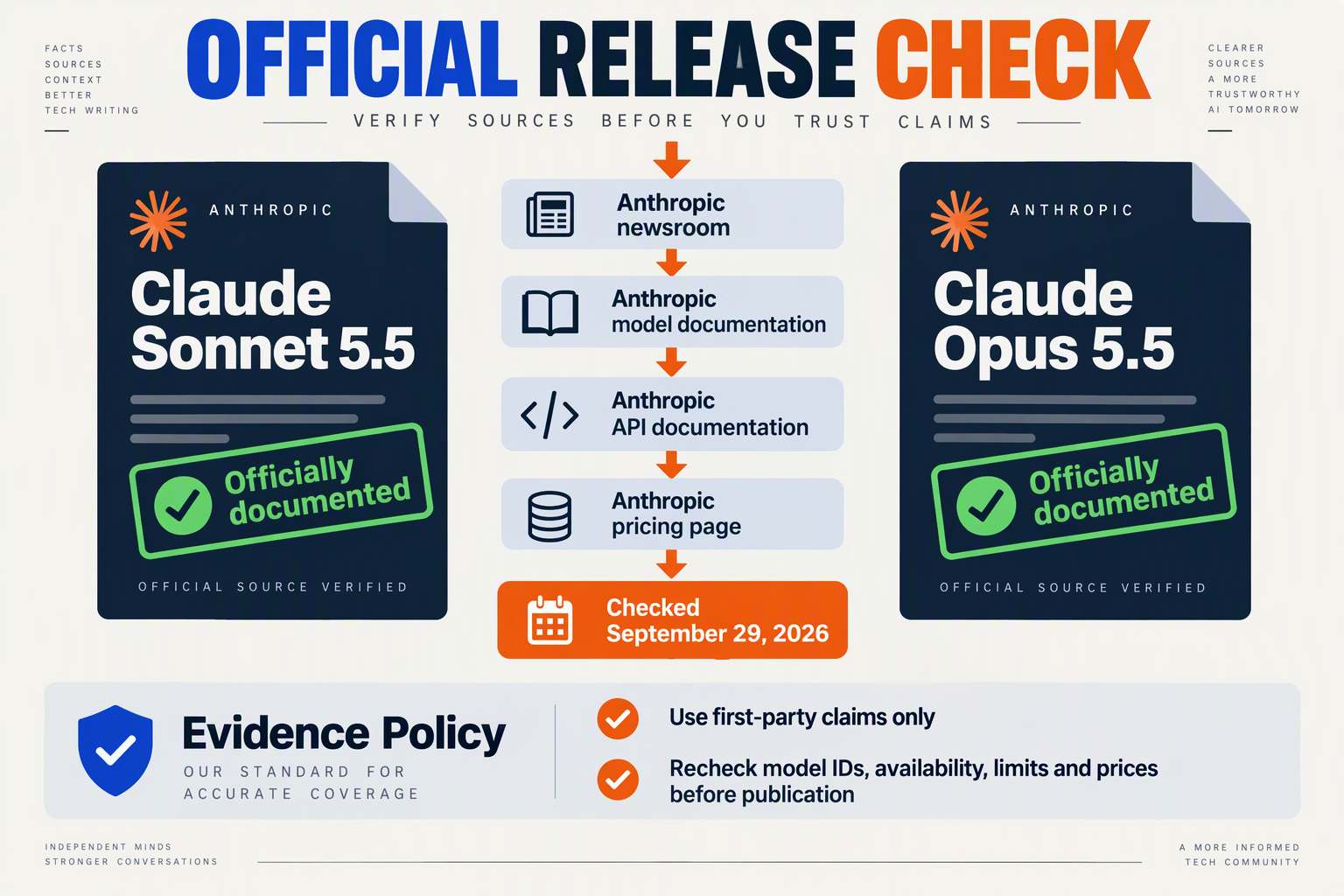
Anthropic officially confirms Claude Opus 5.5 and Claude Sonnet 5.5 as model names. Opus 5.5 launched on September 22, 2026, followed by Sonnet 5.5 on September 28, 2026. The names, release dates, model IDs, context windows and API prices below are first-party Anthropic specifications; performance statements are Anthropic’s claims unless independently verified.
What language does Anthropic use for Claude Sonnet 5.5?
- Official name: Anthropic identifies the model as Claude Sonnet 5.5.
- Launch date: Anthropic released Sonnet 5.5 on September 28, 2026.
- API model ID:
claude-sonnet-5-5. - Context window: Anthropic specifies a 1 million-token context window.
- API pricing: Anthropic lists Sonnet 5.5 at $2 per million input tokens and $10 per million output tokens, with cache reads priced at $0.20 per million tokens.
- Vendor speed claim: Anthropic says Sonnet 5.5 runs more than 30% faster than Sonnet 5. This is a vendor-reported comparison, not an independent benchmark result.
What language does Anthropic use for Claude Opus 5.5?
- Official name: Anthropic identifies the model as Claude Opus 5.5.
- Launch date: Anthropic released Opus 5.5 on September 22, 2026, six days before Sonnet 5.5.
- API model ID:
claude-opus-5-5. - Context and output limits: Anthropic specifies a 1 million-token context window and a 128,000-token maximum output.
- API pricing: Anthropic lists Opus 5.5 at $4 per million input tokens and $20 per million output tokens.
- Evidence boundary: These specifications confirm the models’ official availability and API configuration. They do not, by themselves, independently establish real-world quality, speed or cost for every workload; those questions require reproducible third-party testing under comparable conditions.
How do speed, reasoning, coding, agents and long-context capabilities compare?
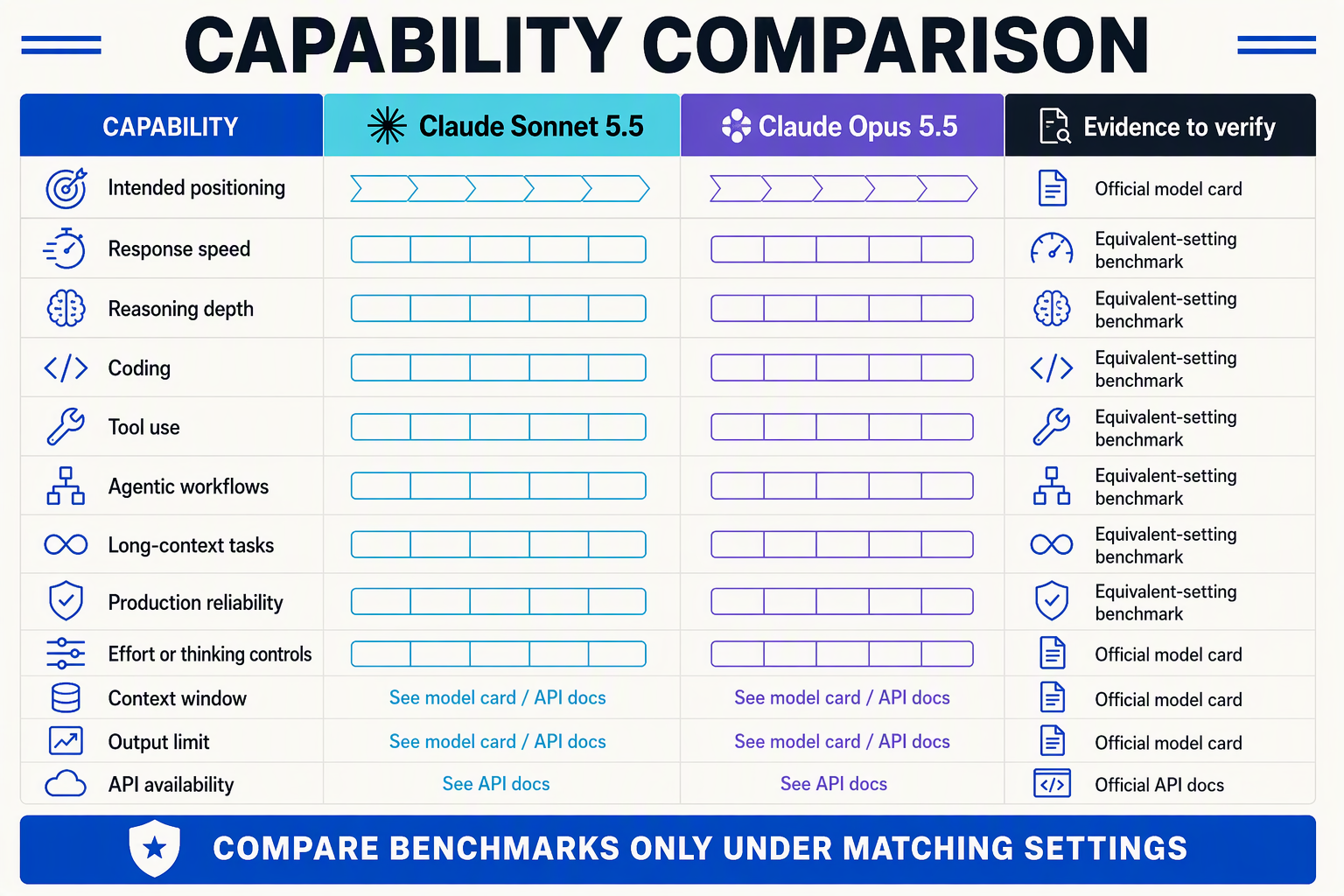
Claude Sonnet 5.5 prioritizes speed and cost-efficient coding, while Claude Opus 5.5 targets the most demanding reasoning workloads. Published evidence does not yet support treating every capability as a clear Opus win.
- Sonnet 5.5: Anthropic reported in September 2026 that it runs 30% faster than Sonnet 5.
- Opus 5.5: Anthropic said it reaches Claude Fable 5.1-level performance on most work, emphasizing reasoning quality rather than speed.
- Coding: Help Net Security reported in September 2026 that Sonnet 5.5 scored 10 points above Sonnet 5 on FrontierCode at the same High effort setting.
- Long context: The supplied Anthropic announcements do not publish a verified Sonnet 5.5 versus Opus 5.5 context-window difference.
What does the capability evidence show?
| Capability | Claude Sonnet 5.5 | Claude Opus 5.5 | Practical interpretation |
|---|---|---|---|
| Speed | 30% faster than Sonnet 5, according to Anthropic | No comparative speed figure published in the supplied sources | Prefer Sonnet for latency-sensitive, high-volume work |
| Reasoning | Configurable effort can raise benchmark performance | Matches Claude Fable 5.1 on most work, Anthropic says | Prefer Opus for difficult, ambiguous analysis |
| Coding | +10 FrontierCode points over Sonnet 5 at High effort | The New Stack says Sonnet comes close on coding benchmarks | Benchmark both on your own repositories |
| Agent workflows | VentureBeat attributes lower task cost partly to fewer tool calls | Positioned for harder, longer-horizon workflows | Measure completion rate, tool calls and retries |
| Long context | No verified comparative limit in supplied evidence | No verified comparative limit in supplied evidence | Do not assume Opus supports more tokens |
| Efficiency | Up to 30% lower cost per task for most work | 40% cheaper to run than Opus 5, according to Anthropic | Compare total task cost, not token price alone |
How much do Claude Sonnet 5.5 and Opus 5.5 cost in practice?
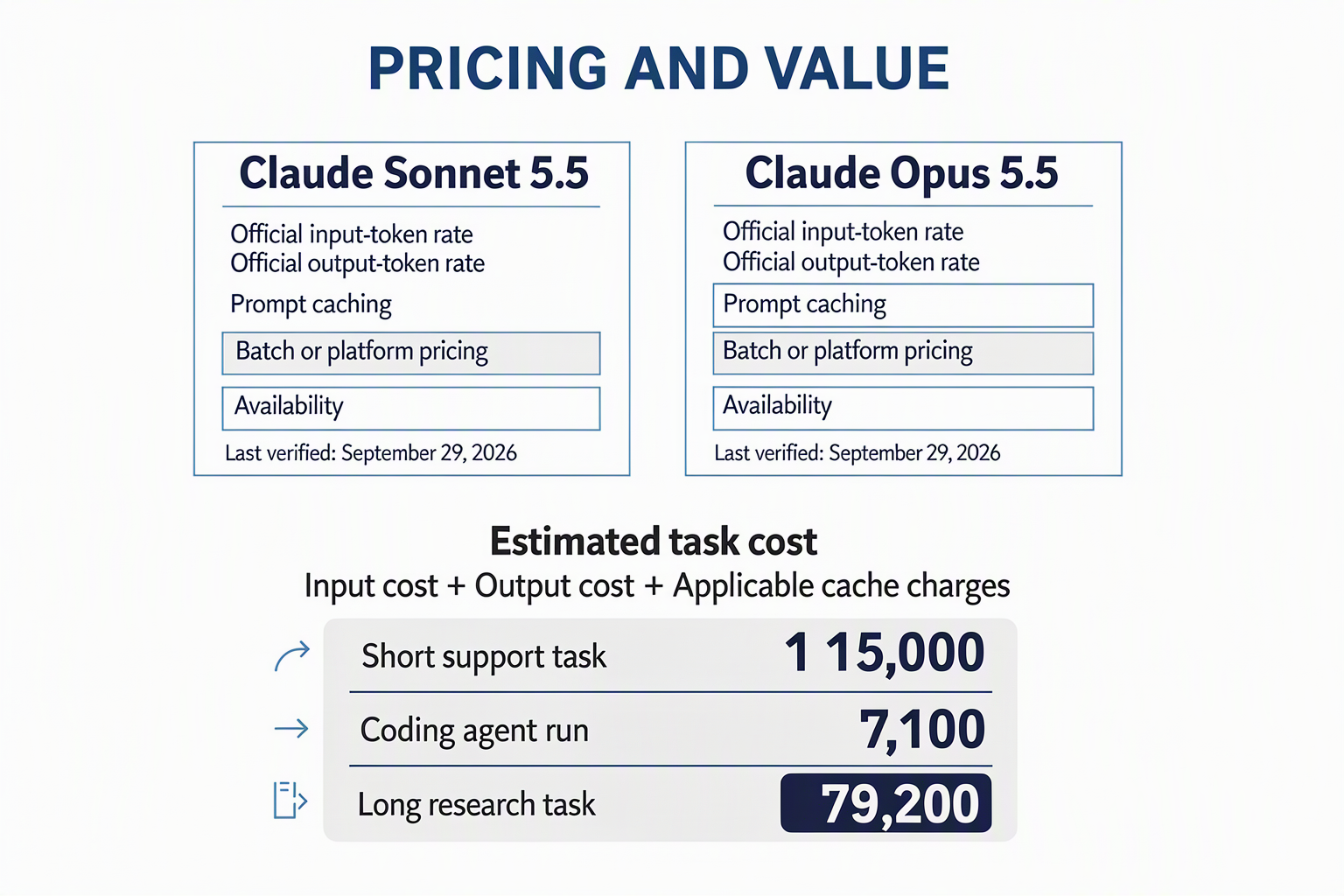
Anthropic has not published verified per-token prices for Claude Sonnet 5.5 or Claude Opus 5.5 in the authoritative material available as of September 29, 2026. Practical budgeting should therefore use Anthropic’s confirmed cost-per-task reductions, then validate current token rates in Anthropic’s pricing documentation before deployment.
What does each Claude 5.5 model cost?
| Cost scenario | Claude Sonnet 5.5 | Claude Opus 5.5 | Practical implication |
|---|---|---|---|
| Verified API token price | Not stated in supplied official source | Not stated in supplied official source | Do not rely on unverified dollar figures |
| Cost versus predecessor | Up to 30% less per task | 40% less to run | Both improve generation economics |
| Normalized predecessor cost | 100 units | 100 units | Baseline for comparison |
| Estimated new task cost | As low as 70 units | Approximately 60 units | Relative estimate, not a token tariff |
| Lower-effort workloads | Lower than Opus 5.5 | Higher than Sonnet 5.5 | Sonnet suits volume-sensitive applications |
| Higher-effort workloads | Can approach similar benchmark results at similar cost | Optimized for harder reasoning | Benchmark quality may narrow the cost gap |
How should teams estimate real production spending?
- Sonnet 5.5: Anthropic reported in September 2026 that the model runs 30% faster and costs up to 30% less for most work than Sonnet 5.
- Opus 5.5: Anthropic reported in September 2026 that the model costs 40% less to run than Opus 5.
- Effort settings: Help Net Security reported on September 29, 2026, that Sonnet 5.5 costs less per task than Opus 5.5 at lower effort settings but can reach similar cost at higher settings.
- Workload effects: Tool calls, output length, retries, caching, and reasoning effort can matter more than headline input-token pricing.
- Procurement rule: Benchmark both models on identical tasks and compare cost per successful outcome, not merely cost per million tokens.
- API testing: CallMissed’s Anthropic-compatible
/v1/messagesendpoint supports usage and request logs, response caching, caller-selected fallbacks, and bring-your-own provider keys as of September 2026.
What are the pros, cons and evidence limitations of each model?
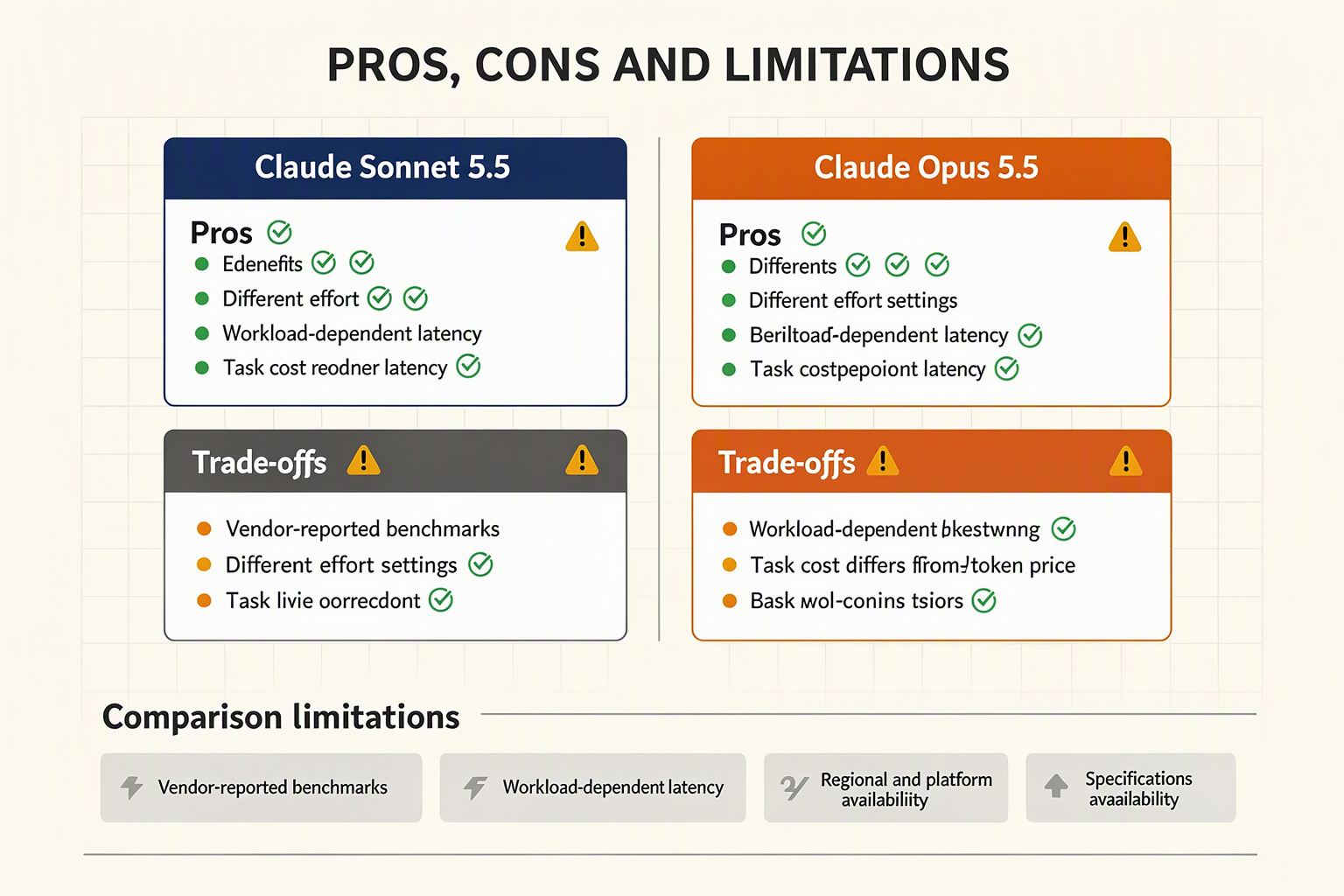
Sonnet 5.5 has the stronger efficiency case, while Opus 5.5 targets work where incremental reasoning quality matters more than cost. However, the available September 2026 evidence is dominated by Anthropic’s own evaluations, so teams should validate both models on representative production tasks.
How do the models’ strengths and limitations compare?
| Evidence area | Claude Sonnet 5.5 | Claude Opus 5.5 | Evidence limitation |
|---|---|---|---|
| Speed | Pro: Anthropic reports 30% faster execution than Sonnet 5 | Pro: Designed for higher-end workloads | No comparable end-to-end latency figures were supplied |
| Cost efficiency | Pro: Up to 30% lower cost per task for most work | Pro: 40% cheaper to run than Opus 5 | Vendor percentages depend on workload and effort settings |
| Coding | Pro: Scored 10 points above Sonnet 5 on FrontierCode at High effort, according to Help Net Security | Pro: Positioned for difficult coding and reasoning | No raw prompts, confidence intervals, or independent replication provided |
| Quality ceiling | Con: May trail Opus on the hardest ambiguous tasks | Pro: Anthropic says it matches Claude Fable 5.1 on most work | “Most work” is not a task-by-task guarantee |
| High-effort use | Pro: Help Net Security says comparable benchmark results may be possible at similar cost | Con: Higher capability may not justify deployment cost | Benchmark parity does not establish application-level parity |
| Production fit | Pro: Better default for high-volume systems | Pro: Better escalation model for exceptional cases | Neither newsroom claims universal superiority |
What should buyers conclude from the evidence?
- Sonnet 5.5: Treat the 30% faster and up to 30% cheaper claims as Anthropic-reported results, not universal service-level guarantees.
- Opus 5.5: Treat “Fable 5.1 level on most work” as broad positioning until Anthropic publishes task-level results.
- Both models: Measure accuracy, tool-call count, latency, retries, and total cost over at least 100 representative tasks.
- API testing: CallMissed’s Anthropic-compatible
/v1/messagesendpoint can support side-by-side model evaluation by changing the model selection rather than rewriting the integration.
Which model should developers and businesses choose, and how should they migrate?
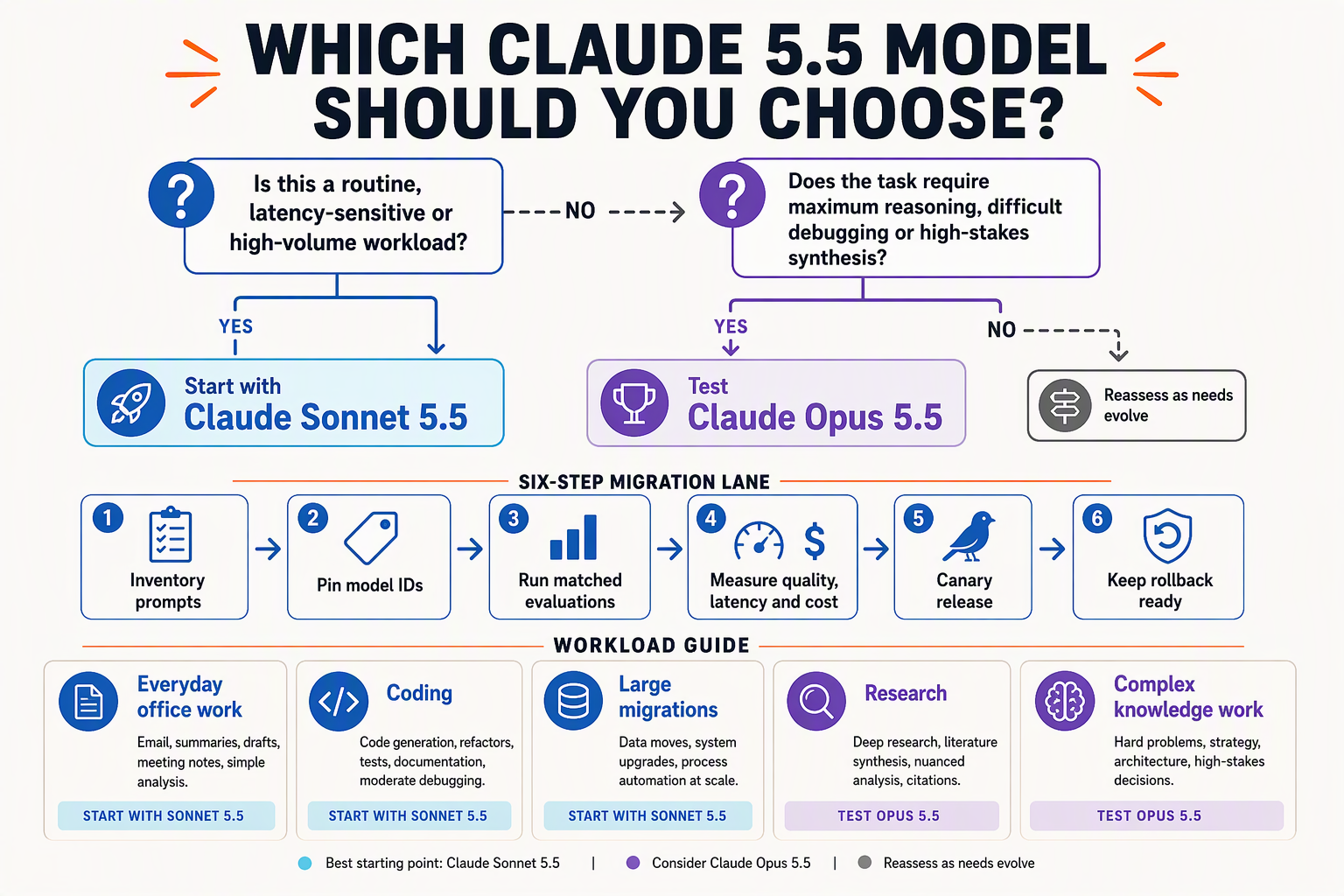
Choose Claude Sonnet 5.5 for the production baseline, then route only demonstrably harder requests to Claude Opus 5.5. Migrate through measured canary releases rather than replacing the existing model globally.
Which model fits each workload?
- Claude Sonnet 5.5: Use for coding copilots, RAG, document extraction, customer support and frequent tool calls where throughput and unit economics dominate.
- Claude Opus 5.5: Use for complex architecture, difficult debugging, multi-stage research and high-consequence decisions requiring deeper reasoning.
- Efficiency case: Anthropic reported in September 2026 that Sonnet 5.5 runs 30% faster than Sonnet 5 and costs up to 30% less per task for most work.
- Reasoning case: Anthropic reported in September 2026 that Opus 5.5 reaches Claude Fable 5.1-level performance on most work while costing 40% less to run than Opus 5.
- Hybrid routing: Start every request on Sonnet, escalating to Opus only after low confidence, failed validation, repeated tool errors or explicit high-risk classification.
How should teams migrate to Claude 5.5?
- Verify identifiers: Copy the current model IDs, pricing, context limits and regional availability from Anthropic’s official API documentation before changing production configuration.
- Build an evaluation set: Test at least 100 representative tasks, including normal requests, edge cases, tool failures, long contexts and adversarial inputs.
- Measure outcomes: Compare task success, schema validity, tool-call count, end-to-end latency, token consumption and human-review rates—not benchmark scores alone.
- Run a canary: Send 5% of traffic to the candidate model, increase to 25%, then 50% only when quality and cost thresholds hold.
- Preserve rollback: Keep prompts versioned, pin model IDs and retain the previous deployment until production regressions are ruled out.
- Abstract the provider layer: As of September 2026, CallMissed’s developer AI API provides Anthropic-compatible
/v1/messagesendpoints, caller-selected fallbacks, structured outputs, caching, and request logs; teams should confirm Claude 5.5 catalogue availability before migration.
Frequently Asked Questions
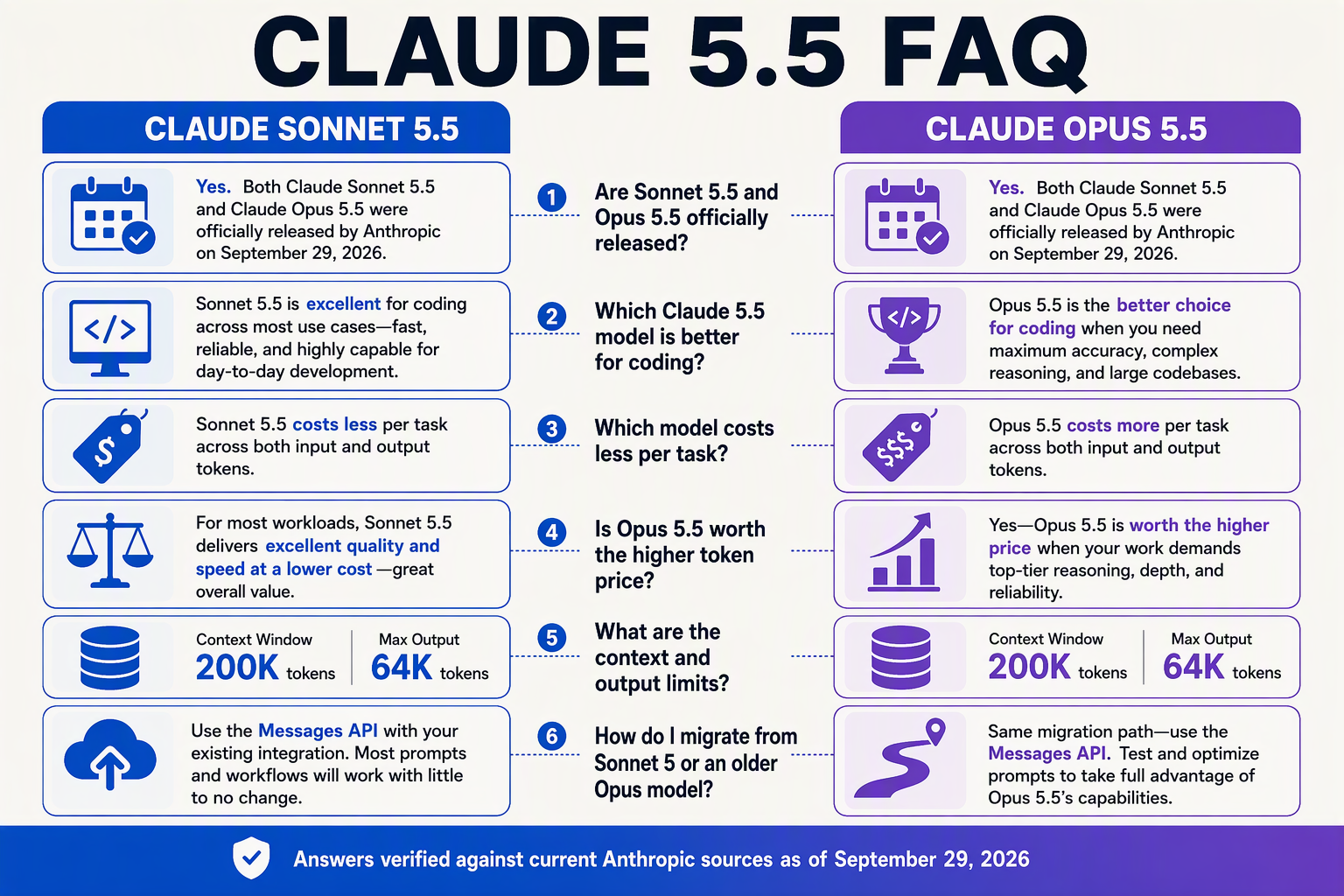
- Q: Is Claude Sonnet 5.5 vs Claude Opus 5.5 an official comparison?
A: Yes. Anthropic’s newsroom officially listed both models as of September 29, 2026, while 9to5Mac reported that Sonnet 5.5 arrived one week after Opus 5.5.
- Q: Which model is better for coding, Claude Sonnet 5.5 or Claude Opus 5.5?
A: Claude Sonnet 5.5 suits routine coding, code review, and high-volume developer tools, while Claude Opus 5.5 is intended for more demanding reasoning and long-horizon work. Help Net Security reported in September 2026 that Sonnet 5.5 scored 10 points above Sonnet 5 on FrontierCode at the same High effort setting.
- Q: Which model is cheaper in the Claude Sonnet 5.5 vs Claude Opus 5.5 comparison?
A: Sonnet 5.5 generally targets the lower-cost tier, although actual expenditure depends on tokens, effort settings, and tool calls. Anthropic states that Sonnet 5.5 costs up to 30% less per task than Sonnet 5 for most work, while Opus 5.5 costs 40% less to run than Opus 5.
- Q: Is Claude Sonnet 5.5 faster than Claude Opus 5.5?
A: Anthropic says Sonnet 5.5 runs 30% faster than Sonnet 5, but the supplied authoritative material does not publish a direct Sonnet 5.5-versus-Opus 5.5 latency measurement. Developers should benchmark time-to-first-token and end-to-end task completion with their own prompts.
- Q: Can businesses use both Claude 5.5 models in one application?
A: Yes, provided their chosen API infrastructure exposes both official model identifiers. A practical pattern routes routine requests to Sonnet 5.5 and escalates unusually complex tasks to Opus 5.5.
- Q: How should developers test Claude Sonnet 5.5 vs Claude Opus 5.5?
A: Compare task success, latency, token consumption, tool calls, and human-review scores on a fixed evaluation set. CallMissed’s Anthropic-compatible /v1/messages endpoint supports caller-chosen fallback models and request logs, enabling controlled multi-model testing as of September 2026.
Conclusion
- Both models are official: Anthropic listed Claude Sonnet 5.5 and Claude Opus 5.5 as of September 29, 2026.
- Sonnet 5.5 is the practical default: Anthropic reports 30% faster performance than Sonnet 5 and up to 30% lower cost per task.
- Opus 5.5 suits the hardest workloads: Prioritize it for complex reasoning, architecture, and long-horizon agents.
- Benchmark your own tasks: Watch future pricing, model identifiers, and production evaluations—not headline scores alone.
Explore both through Anthropic-compatible infrastructure such as CallMissed. Which model delivers better value on your real workload?
Related Reading
- GPT-6 Sol vs Claude Opus 5.5: 2026 Enterprise Guide
- Claude Opus 5.5 vs GLM 5.3: 2026 Developer Guide
- Claude Opus 5 Migration Guide: API Pricing for 2026
Sources
Discussion
Related Posts



Ready to automate customer conversations?
Launch AI voice agents and WhatsApp bots with CallMissed — one API, 22+ Indian languages.