
AI Receptionist for Veterinary Clinics: Complete 2026 Workflow Guide


Learn how an AI receptionist for veterinary clinics handles booking, missed calls, reminders, WhatsApp, escalation, privacy, and KPIs.
AI Receptionist for Veterinary Clinics: Complete 2026 Workflow Guide
What happens when a distressed pet owner calls after hours, receives no answer and turns to an unreliable online diagnosis? An AI receptionist for veterinary clinics can prevent that communication gap by answering immediately, collecting structured information and routing urgent cases—without attempting to diagnose the animal or provide veterinary advice.
Why veterinary communication needs a new workflow
Demand is substantial and increasingly digital. The American Pet Products Association reported in its 2025 State of the Industry presentation that 94 million U.S. households owned at least one pet. Meanwhile, Meta reported in April 2025 that WhatsApp had surpassed 3 billion monthly active users worldwide. For veterinary clinics, these figures highlight two practical realities: teams face a large volume of owner enquiries, and many customers expect convenient follow-up through messaging as well as phone calls.
Yet automation in animal healthcare requires stricter boundaries than a generic answering bot. A caller asking for vaccination hours can receive an approved response; a caller describing breathing difficulty, poisoning, uncontrolled bleeding or collapse needs immediate escalation based on clinic-defined protocols. The system must clearly state that it cannot assess severity, diagnose conditions or recommend treatment.
What this 2026 guide covers
This guide explains how to build a safe, measurable workflow spanning:
- Pet and owner intake, including identity, species, breed, age and reason for calling
- Veterinary appointment booking AI for routine consultations, vaccinations and follow-ups
- Vet missed call automation that returns enquiries without creating duplicate records
- After-hours routing and urgent-case escalation to staff or designated emergency providers
- Reminders, confirmations and veterinary WhatsApp automation
- Approved FAQ boundaries, consent, privacy and multilingual communication
- Calendar, practice-management system and CRM integration verification
- Pre-launch testing, transcript review and operational KPIs
Platforms such as CallMissed reflect this shift by combining AI voice agents, WhatsApp messaging and WhatsApp Business calls, with support for 22 Indian languages for clinics serving multilingual communities.
The objective is not to replace veterinary professionals. It is to ensure every enquiry reaches the correct next step: a confirmed routine appointment, an accurate administrative answer, a documented callback or a rapid human handoff. By the end, clinic operators will have a practical framework for mapping conversations, setting safety guardrails, testing integrations and measuring outcomes such as answer rate, booking completion, escalation accuracy, no-show rate and human takeover frequency.
What should an AI receptionist for veterinary clinics do in 2026? Handle intake, routine booking, reminders, follow-up, and safe human escalation—never diagnosis or veterinary advice
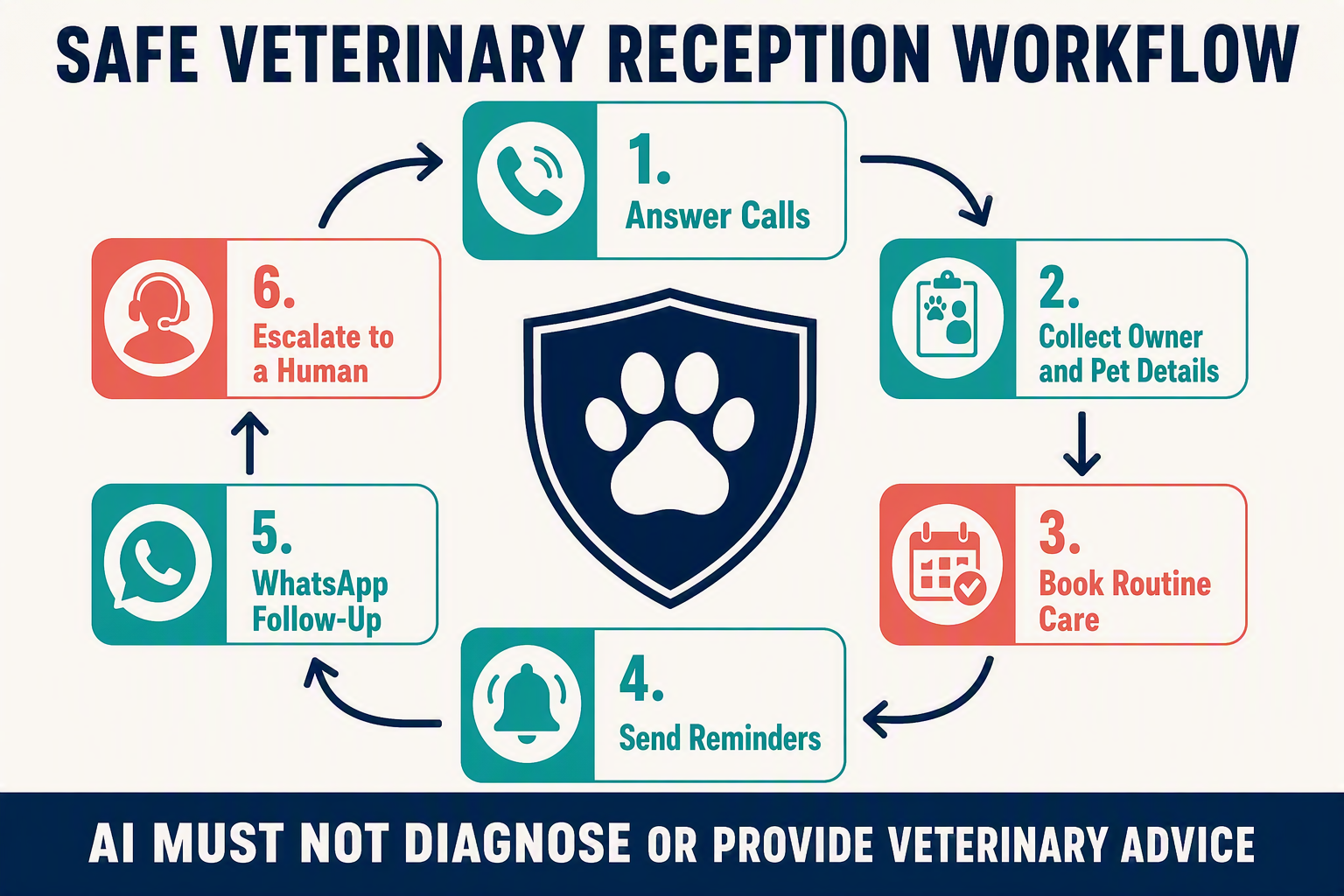
An AI receptionist for veterinary clinics should manage administrative communication from first contact through confirmed follow-up while transferring clinical judgement to qualified veterinary professionals. Its role is to collect facts, complete approved routine tasks and escalate safely—never to diagnose an animal, assess clinical severity or recommend treatment.
Five core workflow responsibilities
- Capture structured owner and pet intake
The receptionist should identify the owner, verify contact details and locate or create the correct patient record. Intake fields can include:
- Pet name, species, breed, age and sex
- Existing or new-patient status
- Owner name, telephone number and communication preference
- Reason for contact, recorded in the owner’s own words
- Preferred clinic, veterinarian, date and time
- Consent for WhatsApp, SMS, email or outbound-call follow-up
The agent should avoid unnecessary sensitive information and read back critical details such as phone numbers and appointment dates.
- Book only approved routine appointments
A veterinary appointment booking AI can schedule services that the clinic has explicitly configured, such as wellness examinations, vaccinations, grooming, routine follow-ups or prescription-collection appointments. It should check visit duration, veterinarian availability, species restrictions and new-patient requirements before writing to the calendar or practice-management system.
Requests outside those rules—including surgery scheduling, medication decisions or unclear clinical complaints—should become staff callbacks rather than improvised bookings.
- Recover unanswered calls without duplicating work
Vet missed call automation should identify an unanswered caller, check whether an active conversation or patient record already exists and send an approved callback or WhatsApp message. The workflow needs suppression rules so repeated calls do not generate multiple appointments, messages or staff tickets.
- Send reminders and documented follow-up
Reminders should state the clinic, pet name, appointment date, time, location and options to confirm, reschedule or cancel. Veterinary WhatsApp automation can continue the same workflow with preparation instructions approved by the clinic, forms, map links and post-visit administrative follow-up.
Channel choice matters at scale: Meta reported in April 2025 that WhatsApp exceeded 3 billion monthly active users worldwide. Clinics must still obtain appropriate consent, honour opt-outs and avoid placing sensitive clinical details in notifications or message previews.
- Escalate uncertainty and urgent language immediately
Clinic-defined triggers may include references to breathing difficulty, poisoning, collapse, seizures, severe trauma or uncontrolled bleeding. Detecting a trigger is not a diagnosis or clinical triage; it is a routing instruction.
Safe escalation must be explicit
When an urgent trigger or uncertain request appears, the AI should:
- Clearly say it cannot assess, diagnose or provide veterinary advice
- Attempt a live transfer to designated clinic staff
- Provide the clinic-approved emergency contact when staff are unavailable
- Preserve the caller’s exact description, timestamp and transfer outcome
- Avoid promising response times unless the clinic can guarantee them
- Create a high-priority task if the transfer fails
This operating boundary is increasingly important because the American Pet Products Association reported in its 2025 State of the Industry presentation that 94 million U.S. households owned at least one pet. High enquiry volume makes consistent workflows valuable, but automation must fail safely: administrative certainty can be automated; clinical uncertainty belongs with a veterinarian.
Why are veterinary clinics adopting AI reception workflows for missed calls, repetitive enquiries, and front-desk capacity?
Veterinary clinics are adopting AI reception workflows because call demand is uneven, many enquiries are repetitive, and missed contacts can delay both routine care and urgent escalation. An AI receptionist can absorb predictable administrative work while preserving veterinary staff capacity for clinical conversations and cases requiring judgment.
The front desk faces demand that cannot be scheduled
Reception teams switch constantly between checking in patients, assisting clinicians, processing payments, answering calls and updating records. A phone call arriving during a busy consultation period may therefore ring unanswered even when staff are present.
The addressable population is also substantial: The American Pet Products Association reported in its 2025 State of the Industry presentation that 94 million U.S. households owned at least one pet. Clinics do not need to be open continuously to experience communication pressure; appointment changes, medication-status enquiries and requests for records can arrive at any hour.
An AI receptionist for veterinary clinics creates a first-response layer that can:
- Answer simultaneous or after-hours calls
- Identify the owner and pet before creating a new record
- Categorise the reason for contact using clinic-approved options
- Resolve administrative FAQs from an approved knowledge base
- Transfer or flag conversations that require human attention
This is capacity expansion, not clinical delegation. The AI must not diagnose an animal, estimate medical severity or recommend treatment.
Missed-call automation protects the next action
A missed call is not merely an unanswered phone event. It may represent a new client, a request to reschedule, a postoperative concern or an owner trying to locate emergency care.
Effective vet missed call automation should follow a controlled sequence:
- Check whether the phone number matches an existing owner record.
- Send or initiate a consent-compliant callback through an approved channel.
- Confirm the pet’s identity and collect the reason for calling.
- Offer routine booking only when the request fits an authorised category.
- Escalate clinical, ambiguous or urgent language according to clinic policy.
- Log the disposition so employees do not contact the same owner twice.
This workflow turns a missed interaction into a documented task rather than an untracked voicemail.
Repetitive enquiries are suitable for bounded automation
Questions about opening hours, parking, accepted payment methods, vaccination-document requirements and appointment preparation usually have stable, clinic-approved answers. Automating these enquiries reduces interruptions without placing medical decisions in the model’s hands.
Veterinary appointment booking AI can also handle routine consultations, vaccinations and authorised follow-ups when it has real-time access to the correct clinician, location, visit type and appointment duration. Requests involving new symptoms, medication changes or postoperative complications should leave the booking flow and enter human review.
Owners increasingly expect messaging continuity
Meta reported in April 2025 that WhatsApp had surpassed 3 billion monthly active users worldwide. That reach makes veterinary WhatsApp automation practical for confirmations, reminder replies, intake links and missed-call follow-up—subject to consent, privacy controls and channel-specific messaging rules.
The operational benefit comes from continuity: a call outcome can trigger a confirmation message, while a reply such as “I need to cancel” can update the workflow instead of creating another inbound call. The clinic gains traceability; the owner gains a clear next step; and veterinary professionals remain responsible for every clinical judgment.
Which 2026 workflows can veterinary appointment booking AI, vet missed call automation, and veterinary WhatsApp automation safely support?
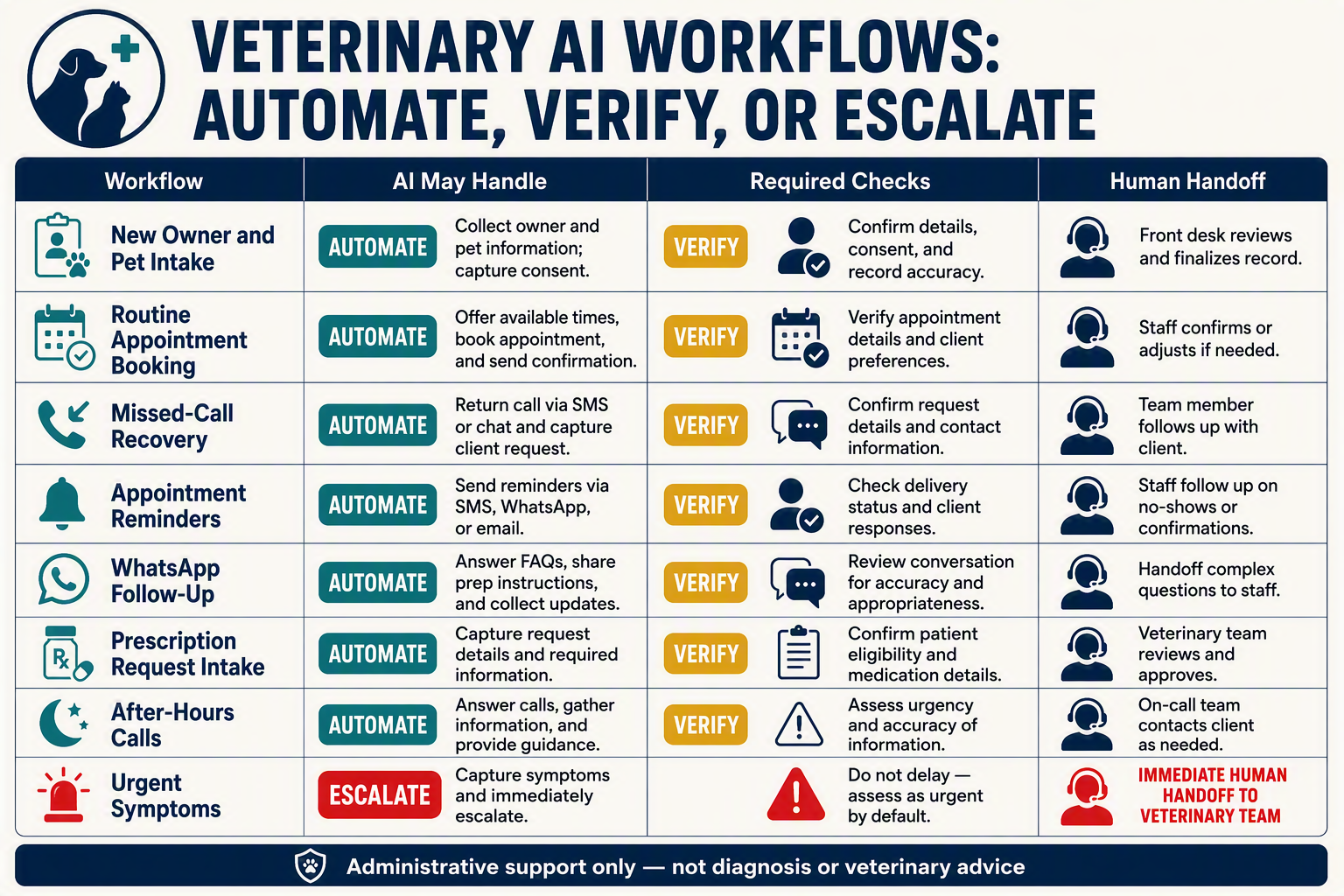
An AI receptionist for veterinary clinics can safely automate administrative, scheduling and follow-up workflows in 2026, provided every clinical or potentially urgent enquiry follows clinic-approved escalation rules. The system should collect facts and coordinate next steps—not diagnose an animal, estimate severity or recommend treatment.
Safe automation matrix for veterinary clinics
| Workflow | AI may safely perform | Required guardrail | Completion outcome |
|---|---|---|---|
| Pet and owner intake | Capture owner name, contact details, consent, pet name, species, breed, age, existing-patient status and stated reason for calling | Record the owner’s words without interpreting symptoms; avoid unnecessary sensitive data | Structured record created or matched for staff review |
| Routine appointment scheduling | Offer approved slots for wellness exams, vaccinations, grooming, routine follow-ups or other clinic-defined visit types | Never promise a specific clinical outcome; route uncertain visit types to staff | Calendar slot held and confirmation issued |
| Missed-call recovery | Return calls or send an approved message, identify the caller and resume an incomplete enquiry | Deduplicate by phone number, pet record and recent-call window; respect contact consent and calling hours | Booking completed, callback queued or enquiry closed |
| After-hours enquiries | State opening hours, collect callback details and provide clinic-approved emergency-provider information | Do not imply that waiting is safe; trigger immediate escalation for configured warning phrases | Emergency route presented or next-business-day task created |
| Reminders and confirmations | Send appointment details, request confirmation and offer approved rescheduling options | Apply opt-out rules, avoid exposing sensitive details on shared devices and synchronize changes with the source calendar | Confirmed, rescheduled, cancelled or sent to staff |
| WhatsApp follow-up and FAQs | Share approved preparation instructions, location, parking, payment methods and administrative policies | Restrict answers to a maintained knowledge base; transfer clinical questions to qualified staff | Answer logged, document delivered or human handoff initiated |
How each workflow should make decisions
Veterinary appointment booking AI should use deterministic business rules around clinician availability, species accepted, appointment duration, location and visit type. A booking is complete only after the practice-management system or calendar returns a valid appointment identifier; a conversational promise alone is not confirmation.
Vet missed call automation should check whether another employee or channel has already handled the enquiry before initiating contact. Useful controls include:
- A configurable delay before returning a missed call
- A suppression window for repeated calls from the same number
- Record matching across phone, WhatsApp and the clinic CRM
- A maximum retry count and clear escalation to a human queue
- Consent and opt-out logging for outbound communication
For veterinary WhatsApp automation, messaging should continue the same case rather than create an isolated conversation. This channel has global relevance: Meta reported in April 2025 that WhatsApp had exceeded 3 billion monthly active users worldwide. Clinics should nevertheless obtain appropriate permission, use approved templates where required and minimize clinical or personal information in notifications.
Where automation must stop
The AI should immediately stop routine processing when an owner mentions clinic-defined warning signals such as difficulty breathing, collapse, poisoning, uncontrolled bleeding, seizures, severe trauma or inability to urinate. These keywords are escalation triggers, not an AI-generated diagnosis or severity assessment.
A safe response should:
- Explain that the AI cannot evaluate the animal or provide veterinary advice.
- Attempt a live transfer to authorized clinic staff.
- If unavailable, provide the clinic’s approved emergency contact or facility.
- Log the trigger phrase, timestamp, routing result and failed-transfer reason.
- Avoid reassurance, medication suggestions or instructions to wait.
The same boundary applies to medication dosages, test interpretation, post-operative complications and requests to decide whether care is necessary. In 2026, the safest division of labour remains clear: AI manages communication logistics; veterinary professionals make clinical decisions.
How should pet and owner intake, routine scheduling, confirmations, reminders, cancellations, and WhatsApp follow-up work end to end?
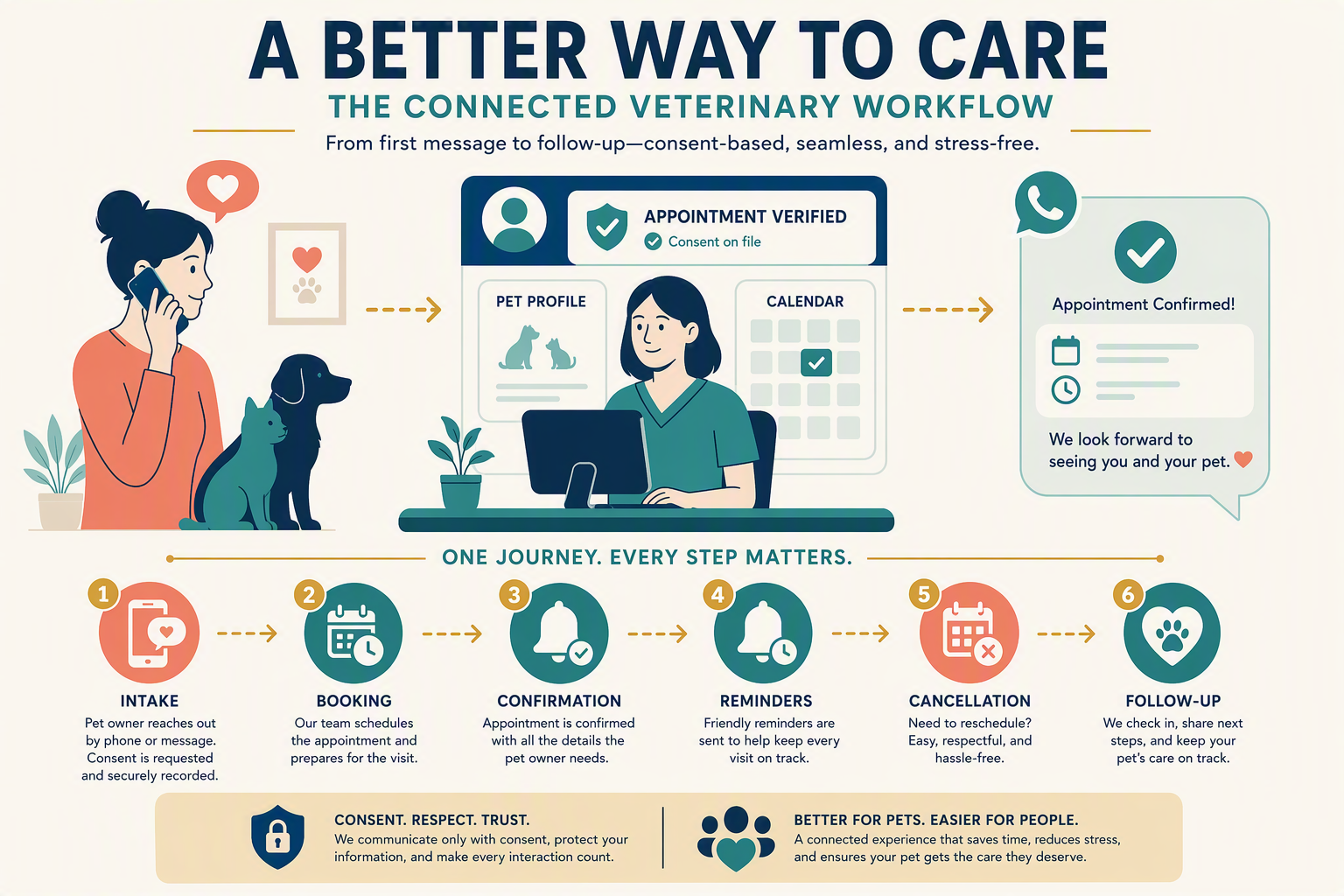
The workflow should create one verified record and one conversation history from first contact through post-visit follow-up. An AI receptionist for veterinary clinics should collect only necessary information, book eligible routine appointments against live availability, obtain messaging consent and transfer clinical or urgent questions without diagnosing the animal.
1. Identify the owner, pet and purpose
The receptionist should begin by explaining that it is an automated assistant and checking whether the caller is an existing client. It should search the practice-management system using a verified phone number or client ID before creating a new record.
For a new enquiry, capture:
- Owner: full name, mobile number, preferred language and email if required
- Pet: name, species, breed if known, age or date of birth, sex and existing-patient status
- Request: routine consultation, vaccination, wellness examination, post-operative review or another clinic-approved category
- Preferences: clinic location, veterinarian, date range and communication channel
- Consent: permission to send confirmations and reminders through WhatsApp or SMS
Free-text descriptions should be retained in the owner’s words. The AI should not convert “my dog is shaking” into a diagnosis or clinical conclusion.
2. Screen before offering routine slots
Before scheduling, the agent should run the clinic’s approved safety questions. If the owner mentions breathing difficulty, collapse, poisoning, uncontrolled bleeding, seizures or another configured warning phrase, routine booking must stop and the urgent-case pathway must begin.
For non-urgent requests, veterinary appointment booking AI should:
- Match the request to an approved appointment type and duration.
- Check veterinarian, room, equipment and location availability in real time.
- Offer two or three suitable slots in the owner’s stated time zone.
- Repeat the selected date, time, clinic and pet name.
- Write the appointment to the practice-management calendar.
- Read the newly created appointment back from the source system before declaring it confirmed.
If the calendar write fails or returns no appointment ID, the agent should create a staff callback task—not promise a booking.
3. Confirm and remind with explicit actions
The confirmation should include the pet’s name, appointment type, date, local time, address and clinic contact details. Veterinary WhatsApp automation can then provide actionable buttons such as Confirm, Reschedule and Cancel, subject to the owner’s consent and applicable messaging rules.
A configurable reminder sequence might be:
- Immediately: booking confirmation
- 48 hours before: confirmation or rescheduling request
- 24 hours before: preparation instructions approved by the clinic
- Two hours before: concise location and arrival reminder
Preparation messages must remain administrative. Instructions involving fasting, medication or clinical care should be sent only when explicitly approved for that appointment type by the veterinary team.
4. Process changes without losing capacity
A cancellation is complete only after the source calendar confirms removal and the owner receives a cancellation reference. Rescheduling should preserve the original record, log the change and prevent simultaneous appointments.
When a call is unanswered, vet missed call automation should first check for an existing owner, open callback task or recent conversation. It can then return the call or send an opt-in-compliant WhatsApp message without creating duplicates.
Every completed workflow should log timestamps, consent status, appointment ID, channel, transcript, automation outcome and escalation reason. After the visit, follow-up may cover invoices, feedback or approved rebooking prompts; any symptom or treatment question must route to veterinary staff.
How should after-hours routing, urgent-case escalation, and approved FAQ boundaries prevent unsafe veterinary advice?
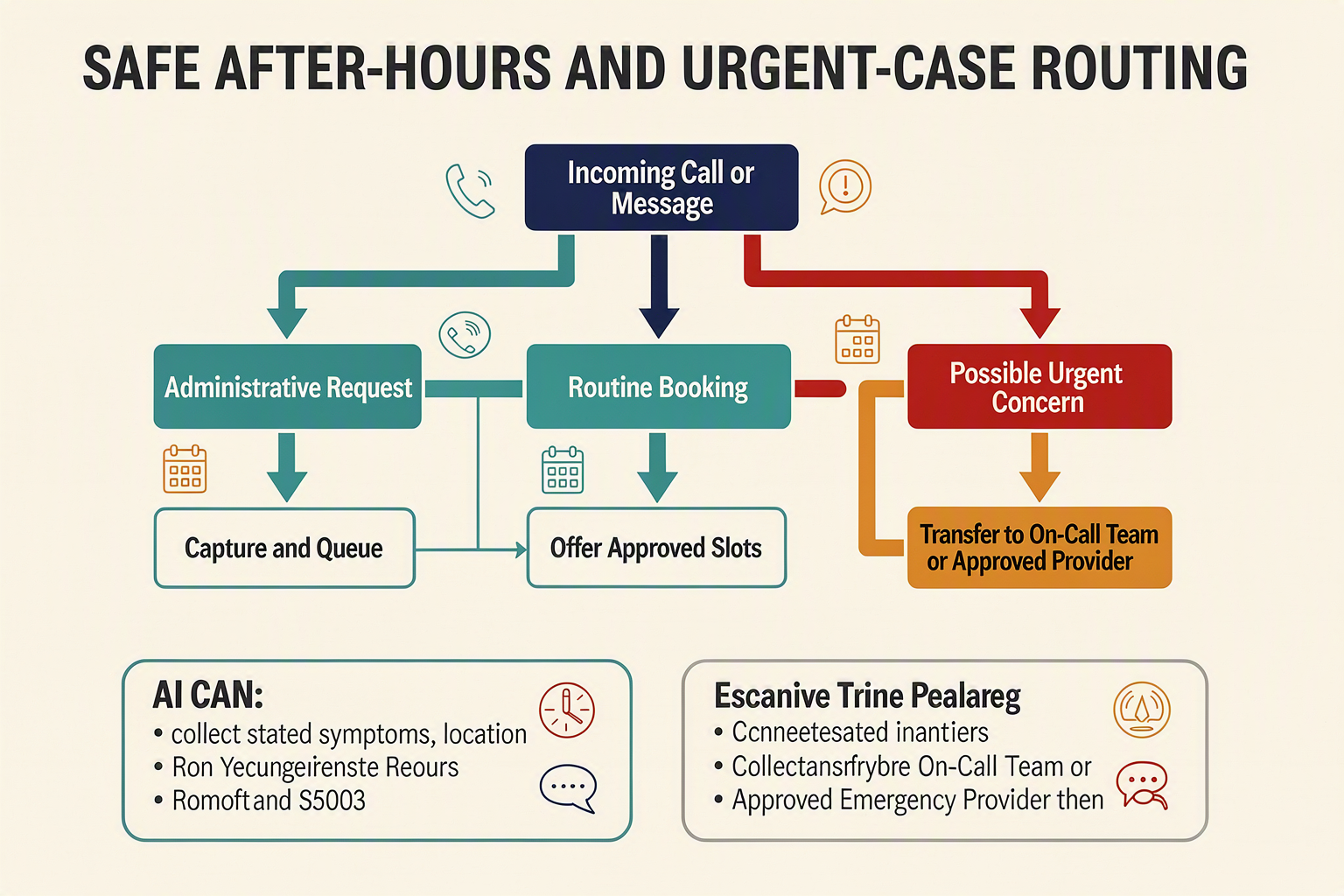
An AI receptionist for veterinary clinics should treat any potentially urgent case as a routing event, not a diagnostic conversation. Clinic-approved triggers must initiate immediate human or emergency-provider escalation, while the AI limits answers to verified administrative FAQs and clearly states that it cannot assess, diagnose or recommend treatment.
Build a clinic-approved after-hours decision tree
After-hours handling should begin by identifying whether the caller has a routine request or is concerned about the animal’s current condition. The AI can collect essential routing information, but it must not assign a diagnosis or declare that an animal is safe to wait.
A practical workflow is:
- Confirm the owner’s name, callback number and current location.
- Identify the animal by name, species and existing-patient status.
- Ask one neutral question: “Are you concerned that your pet needs urgent medical attention?”
- Detect clinic-defined trigger phrases such as difficulty breathing, collapse, seizure, suspected poisoning, severe injury or uncontrolled bleeding.
- Attempt a warm transfer to the on-call team or designated emergency hospital.
- If transfer fails, provide the approved emergency contact details through voice and WhatsApp or SMS.
- Record the call, trigger detected, transfer outcome and message-delivery status.
The script should say: “I cannot assess the severity of your pet’s condition or provide veterinary advice. Please contact the designated emergency veterinary service now.” It should never reassure an owner that waiting is acceptable.
Escalate conservatively without performing AI triage
Escalation rules must be authored and approved by the clinic’s veterinarians. Keyword detection can support routing, but the system should not calculate a clinical risk score from symptoms or ask a long series of questions that delays professional care.
Safe operational rules include:
- Escalate uncertain cases: If the system cannot understand the caller, fails to identify intent or receives conflicting information, route to a person.
- Avoid treatment instructions: Do not recommend medicines, dosages, feeding changes, wound care or actions such as inducing vomiting.
- Do not book urgent complaints as routine visits: A veterinary appointment booking AI should exit its standard calendar workflow when an urgent trigger appears.
- Use a fallback destination: Configure an emergency hospital, on-call number or recorded emergency instruction for times when clinic staff are unavailable.
- Preserve context: Send the authorised recipient a concise summary without presenting AI-generated conclusions as clinical facts.
For vet missed call automation, urgent-language detection in voicemail or callback requests should place the case in a priority queue. The automation must still direct the owner to immediate emergency support rather than implying that a later callback is sufficient.
Restrict FAQs to approved administrative information
An approved knowledge base should answer questions such as:
- Opening hours, address and parking information
- Routine appointment types and availability
- Accepted payment methods and consultation fees
- Required documents or existing records
- Clinic-approved preparation instructions copied verbatim
- Prescription-refill processes, without promising approval
Every answer should have an owner, source, approval date and review date. Questions about symptoms, prognosis, medication, dosage, test interpretation or whether an animal needs treatment must transfer to qualified staff.
For veterinary WhatsApp automation, messages should contain logistics, transfer details and confirmation that the enquiry was recorded—not personalised medical guidance. Meta reported in April 2025 that WhatsApp exceeded 3 billion monthly active users worldwide, making it a practical follow-up channel, but its reach does not reduce the need for clinical boundaries.
The safest rule is simple: automation may organise access to veterinary care; only veterinary professionals may provide veterinary judgement.
What are the operational impacts of privacy controls, multilingual support, integration verification, and pre-launch testing?
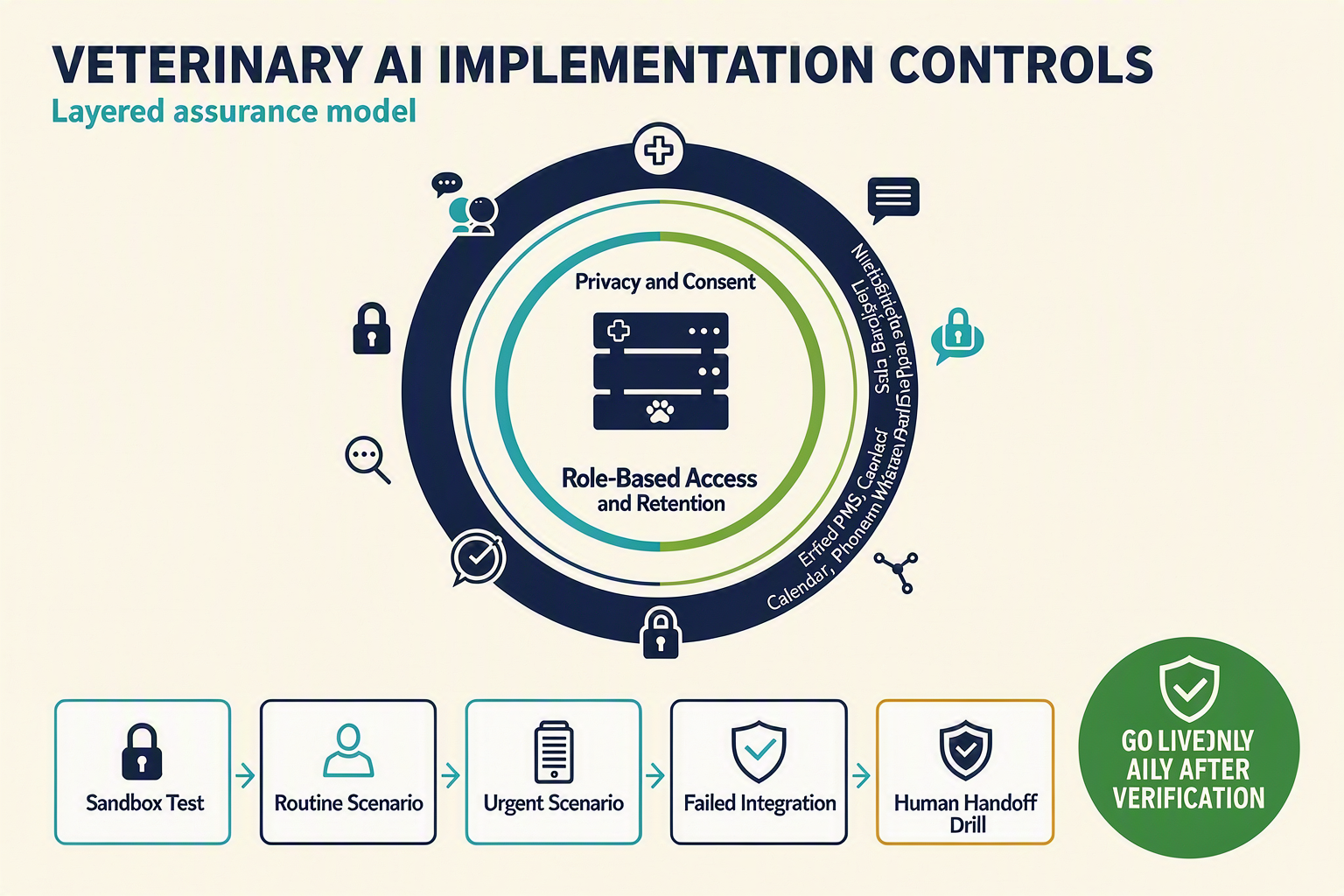
Privacy controls, multilingual support, verified integrations and structured testing determine whether an AI receptionist for veterinary clinics reduces workload or creates new operational risk. Together, these controls protect owner data, prevent booking errors, improve accessibility and ensure urgent cases reach humans without the AI diagnosing an animal.
Privacy controls change how information is collected and stored
Veterinary intake contains personal owner information alongside pet records, including names, phone numbers, addresses, payment details and conversation transcripts. Clinics should apply applicable privacy laws based on where owners and systems operate rather than assuming that every veterinary record is governed like human healthcare data.
Operational controls should include:
- Data minimisation: Collect only information required for identification, booking, follow-up or escalation.
- Purpose disclosure: Tell callers whether the conversation is handled by AI, recorded or transcribed, and how their information will be used.
- Consent management: Record opt-in status separately for appointment messages, marketing campaigns and outbound calls.
- Role-based access: Restrict transcripts, contact details and pet histories to authorised employees.
- Retention rules: Automatically delete recordings, transcripts and abandoned intake records after clinic-approved periods.
- Secure handoff: Avoid reading sensitive details aloud when transferring calls or sending them through shared staff channels.
These controls add configuration and review work, but they reduce unnecessary data exposure. Vet missed call automation should never treat a previous enquiry as unlimited permission for promotional calling; the callback purpose and consent status must be documented.
Multilingual support requires more than translation
Multilingual automation can improve access, but literal translation is insufficient for species names, medication terms, addresses and urgent-condition phrases. The clinic should maintain approved scripts in each supported language and involve fluent reviewers familiar with local expressions.
For Indian clinics, platforms such as CallMissed support speech-to-text and text-to-speech across 22 Indian languages, enabling voice and WhatsApp workflows for regional audiences. Operationally, clinics must still test mixed-language conversations, code-switching, names, numerals and pronunciation.
When language confidence is low, the AI should:
- Ask the owner to repeat or spell critical information.
- Confirm dates, times and telephone numbers explicitly.
- Transfer to an appropriate multilingual team member where available.
- Avoid interpreting symptoms or translating them into a diagnosis.
Integration verification prevents silent workflow failures
A veterinary appointment booking AI is only reliable when the calendar, practice-management system, CRM and messaging tools agree. Before launch, verify both successful transactions and failure handling.
- Create, reschedule and cancel test appointments.
- Confirm species, veterinarian, service type, duration and location mappings.
- Test simultaneous requests for the final available slot.
- Ensure duplicate owners or pets are matched without merging unrelated records.
- Verify reminders reflect the latest booking status.
- Confirm veterinary WhatsApp automation records delivery, opt-outs and failed messages.
- Simulate expired credentials, API timeouts and unavailable integrations.
The AI should never claim that an appointment is confirmed until the source system returns a successful booking response.
Pre-launch testing establishes measurable safety gates
Testing should cover routine enquiries, unclear speech, interruptions, background noise, unsupported requests and urgent scenarios such as breathing difficulty, poisoning, collapse or uncontrolled bleeding. The expected response is escalation under clinic-defined protocols—not veterinary advice.
Clinics should set explicit launch thresholds for booking accuracy, escalation accuracy, duplicate-record rate, consent capture and human takeover success. Staff should review transcripts daily during the pilot, document every failure and rerun corrected scenarios before expanding hours, languages or channels.
What do veterinary, operations, privacy, and customer-service experts recommend for human oversight and governance?
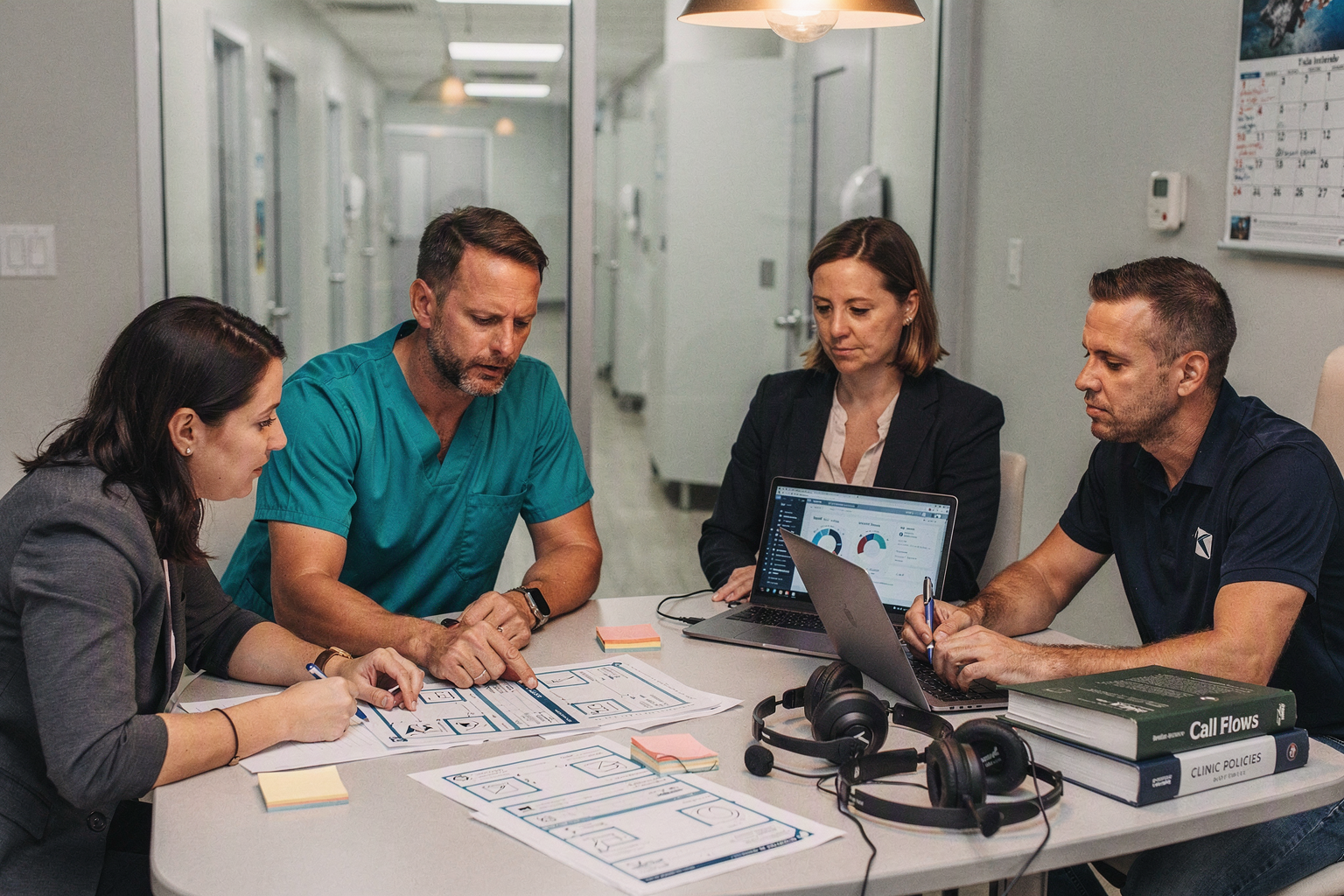
Human oversight should be risk-based, documented and immediate when animal welfare, privacy or customer trust is at stake. Veterinary professionals must own clinical escalation rules, while operations, privacy and customer-service leaders govern data handling, workflow reliability and communication quality.
Veterinary experts: keep clinical judgment with clinicians
A veterinarian or designated clinical lead should approve every symptom-related script, urgency trigger and after-hours destination. An AI receptionist for veterinary clinics may collect an owner’s description verbatim, but it must not interpret symptoms, estimate prognosis, recommend medication or reassure the caller that waiting is safe.
Veterinary governance should require:
- Explicit limitations: “I cannot diagnose your pet or determine how serious the condition is.”
- Conservative escalation: Breathing difficulty, collapse, poisoning, seizures, severe trauma, uncontrolled bleeding or inability to urinate should trigger the clinic-approved urgent pathway.
- Species-aware handling: Scripts must not assume that guidance suitable for dogs applies to cats, birds, reptiles or livestock.
- Clinical change control: A veterinarian approves protocol revisions, with version numbers, dates and an audit trail.
- No silent failure: If the system cannot reach the on-call team, it should provide the approved emergency provider’s details and record the failed handoff.
The American Veterinary Medical Association’s Principles of Veterinary Medical Ethics, revised in 2024, states that veterinarians must provide competent veterinary medical care under applicable laws and regulations. Automation should therefore support access and administration—not assume the veterinarian’s professional role.
Operations experts: assign owners and test failure modes
Operations leaders should treat veterinary appointment booking AI, vet missed call automation and reminders as production workflows rather than isolated chatbot features. Every workflow needs a named owner, service-level target and fallback.
A practical governance checklist includes:
- Test calendar availability, time zones, appointment duration and duplicate prevention.
- Reconcile bookings against the practice-management system every day during rollout.
- Sample routine calls, escalations, abandoned calls and multilingual conversations.
- Disable automation or switch to message-taking when an integration becomes unreliable.
- Review false escalations, missed escalations, incorrect bookings and human takeover rates weekly.
The NIST AI Risk Management Framework 1.0, published in January 2023, organizes AI governance around four functions: Govern, Map, Measure and Manage. Clinics can apply that structure by mapping each conversation risk, measuring failures and assigning corrective actions.
Privacy experts: minimise owner data and control access
Pet information may not itself identify a person, but owner names, phone numbers, addresses, recordings and payment details are personal data. Privacy specialists recommend collecting only what the workflow requires, stating the purpose, defining retention periods and restricting transcript access by role.
For veterinary WhatsApp automation, clinics should also record messaging consent, honour opt-outs and avoid placing sensitive details in reminders visible on a locked-screen notification. India’s Digital Personal Data Protection Act, 2023 establishes obligations around lawful processing, notice, consent and reasonable security safeguards for digital personal data.
Platforms such as CallMissed, which combines AI voice agents, WhatsApp messaging and WhatsApp Business calling, should be configured around these clinic-approved permissions rather than given unrestricted access to every record.
Customer-service experts: make human help obvious
Owners should know they are interacting with AI and how to reach a person. Customer-service reviewers should evaluate empathy, clarity, interruption handling, pronunciation of pet names and accessibility, not merely booking completion.
Human takeover should remain available for distressed callers, complaints, repeated misunderstanding, billing disputes, accessibility needs and any explicit request for staff. Governance succeeds when automation shortens the path to appropriate help—not when it prevents human contact.
What does an AI receptionist mean for your clinic’s rollout plan, ownership model, and KPI dashboard?
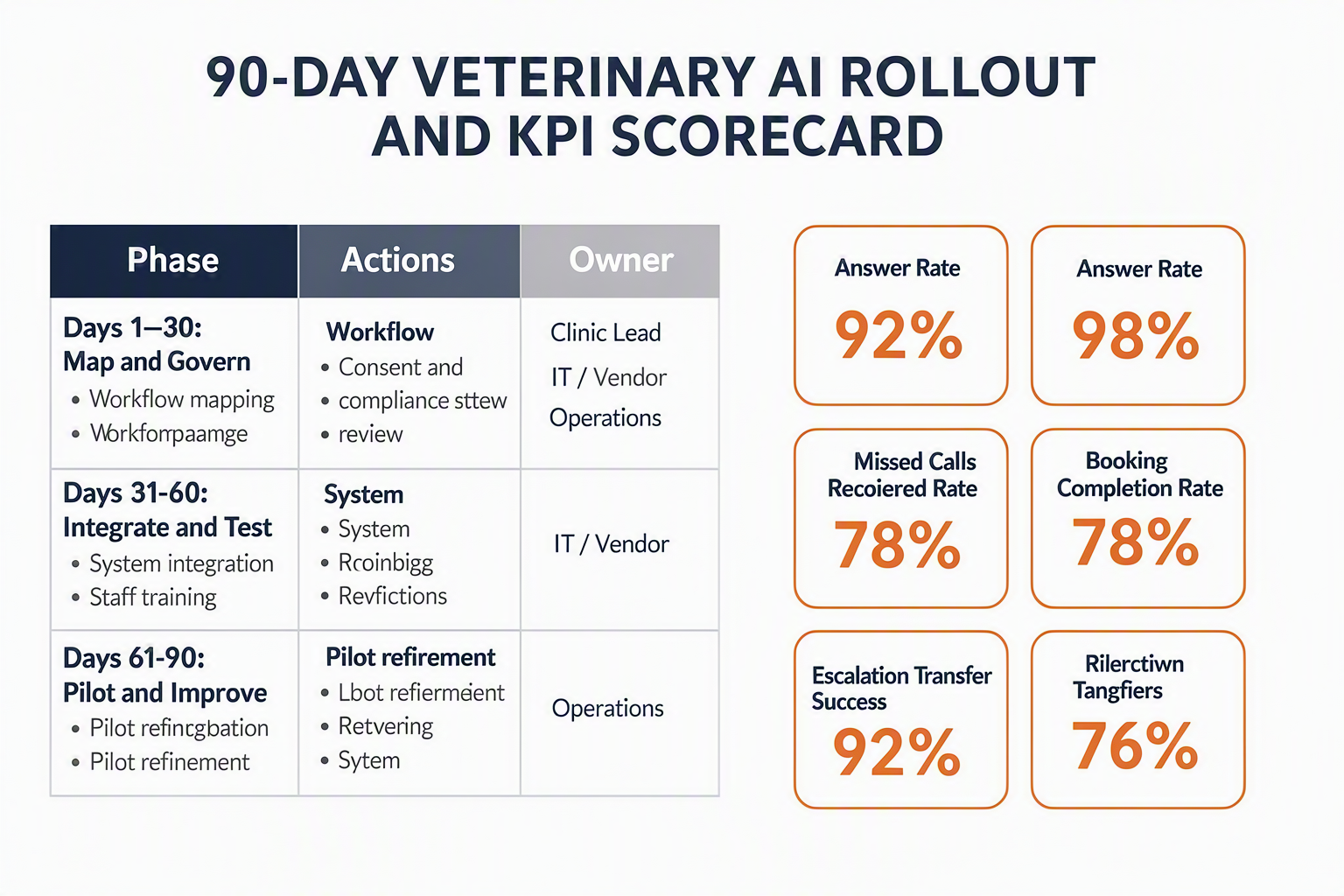
An AI receptionist for veterinary clinics should be rolled out as a controlled clinical-administration system, not switched on as an unsupervised answering bot. Assign one accountable owner, launch routine workflows before higher-risk routing, and use a KPI dashboard that measures safety, service quality and operational outcomes separately.
Ownership and measurement framework
The American Pet Products Association reported in 2025 that 94 million U.S. households owned at least one pet, illustrating the scale of demand facing veterinary services. Meta reported in April 2025 that WhatsApp exceeded 3 billion monthly active users worldwide, making messaging governance an operational requirement rather than an optional add-on.
| Workstream | Accountable owner | Launch gate | Primary KPI | Recommended review |
|---|---|---|---|---|
| Pet and owner intake | Reception manager | Required fields map correctly to the pet record | Complete-intake rate | Daily during pilot |
| Routine scheduling | Practice manager | Test bookings create, modify and cancel without duplication | Booking completion rate | Daily, then weekly |
| Missed-call recovery | Front-desk lead | Existing records are matched before callbacks | Recovered-call rate | Weekly |
| Urgent-case routing | Clinical director | Every approved red-flag scenario reaches the designated human or emergency route | Escalation accuracy | Daily and after incidents |
| WhatsApp follow-up | Privacy or operations lead | Consent, templates and opt-out handling are verified | Delivery, confirmation and opt-out rates | Weekly |
| Platform reliability | IT owner or vendor | Calendar, telephony and practice-system failure alerts work | Integration error rate | Real time and weekly |
The clinical director must own escalation language and prohibited topics. The AI may repeat approved emergency-routing instructions, but it must never diagnose an animal, estimate clinical severity or recommend medication or treatment.
Use a staged rollout rather than a clinic-wide launch
A practical rollout can proceed through four controlled stages:
- Shadow mode: Process test calls without changing live records. Compare extracted names, numbers, pet details and caller intent with staff-reviewed transcripts.
- Routine automation: Enable FAQs, opening hours and veterinary appointment booking AI for predefined appointment types only.
- Recovery and follow-up: Add vet missed call automation, reminders and veterinary WhatsApp automation, with identity matching and consent controls.
- After-hours routing: Activate clinic-approved urgent-case pathways only after scenario testing, staff training and rollback drills.
Set a 100% pass requirement for predefined emergency test scenarios before enabling after-hours routing. This is a deployment gate, not a claim that the system will achieve perfect real-world classification.
Build a KPI dashboard that exposes risk
Avoid combining every result into one “automation rate.” A high containment figure can conceal unsafe handling or poor customer experiences. Track four KPI groups:
- Access: answer rate, median time to answer and missed-call recovery rate
- Conversion: eligible booking completion, confirmation rate and abandoned-booking rate
- Safety: urgent escalation accuracy, failed handoffs, prohibited-advice incidents and human takeover frequency
- Operations: duplicate-record rate, integration failures, reminder delivery and no-show rate
Each KPI needs a written numerator, denominator, data source and owner. For example, booking completion rate = successfully confirmed appointments ÷ eligible booking requests, excluding emergencies and requests requiring clinical judgment.
Review transcripts daily during the pilot, weekly after stabilisation and immediately following any safety incident. Ownership should remain inside the clinic even when a technology vendor manages infrastructure: the clinic defines clinical boundaries, approves workflows and decides whether performance is safe enough to expand.
Frequently asked questions about veterinary AI receptionists, booking, WhatsApp, emergencies, privacy, languages, integrations, and cost
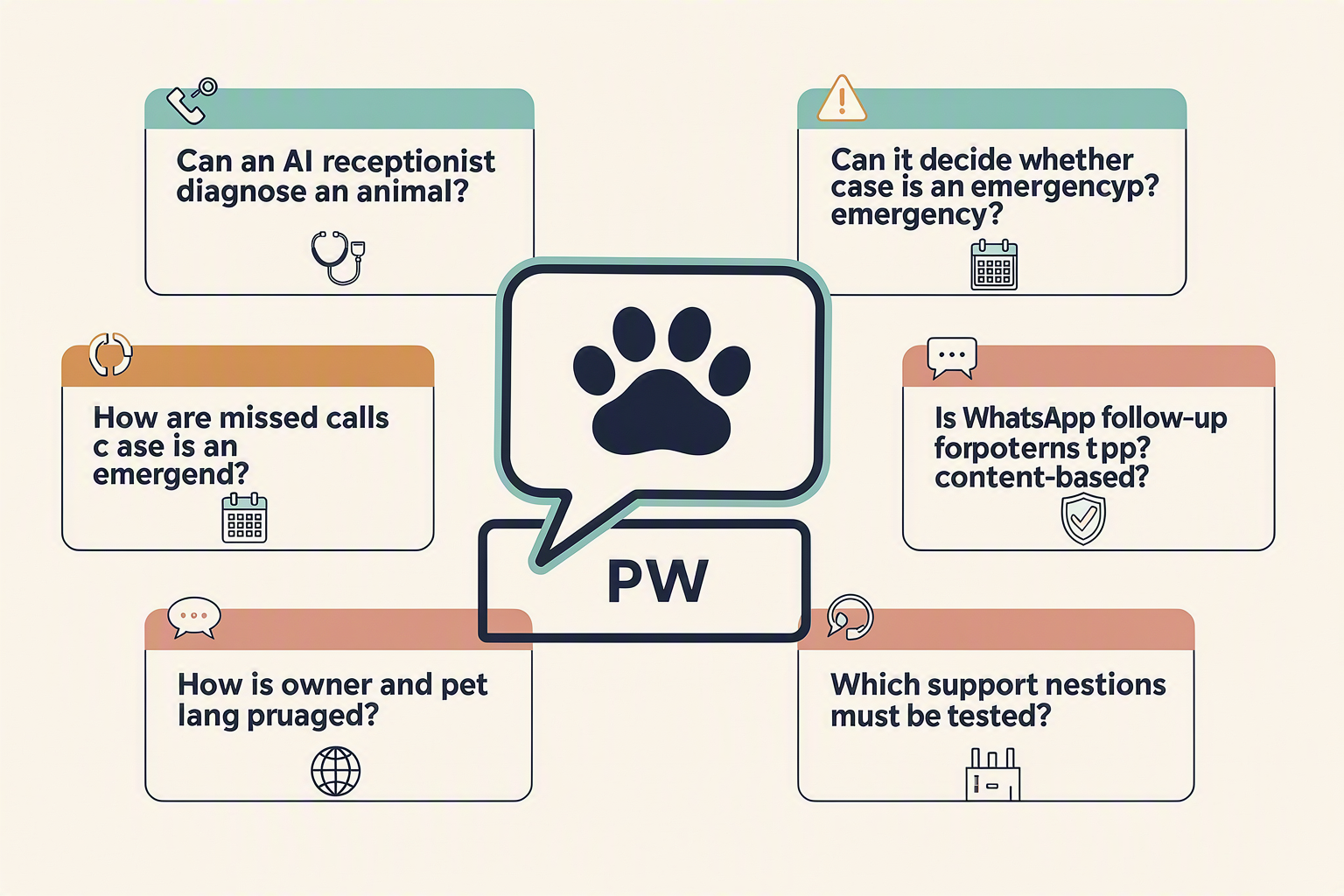
What can an AI receptionist for veterinary clinics safely handle?
How does veterinary appointment booking AI work with a clinic calendar?
Can veterinary WhatsApp automation send reminders and follow up with pet owners?
How should an AI receptionist for veterinary clinics handle emergencies after hours?
Is vet missed call automation private, secure and suitable for multilingual callers?
How much does an AI receptionist for veterinary clinics cost, and how is ROI measured?
Conclusion
A successful AI receptionist for veterinary clinics should make communication faster and more reliable while preserving a firm boundary: AI can support administration, but it must never diagnose animals, assess clinical severity or recommend treatment.
- Structure every interaction: Capture owner and pet details, the reason for calling, consent and the appropriate next step without creating duplicate records.
- Automate routine work safely: Use veterinary appointment booking AI for consultations, vaccinations and follow-ups, with calendar and practice-management integrations verified before launch.
- Protect urgent cases: Configure clinic-approved escalation rules for breathing difficulty, poisoning, collapse, uncontrolled bleeding and other warning signs, including after-hours handoff to staff or designated emergency providers.
- Measure the complete workflow: Track answer rate, booking completion, escalation accuracy, no-show rate, human takeover frequency and transcript quality across vet missed call automation and veterinary WhatsApp automation.
The American Pet Products Association reported in 2025 that 94 million U.S. households owned a pet, while Meta reported in April 2025 that WhatsApp exceeded 3 billion monthly active users. In 2026 and beyond, watch for tighter integration between voice, WhatsApp, CRM records and multilingual support—combined with stronger consent, privacy and audit controls.
To explore this direction, visit CallMissed, which supports AI voice agents, WhatsApp Business calls and 22 Indian languages. Is your clinic ready to test a safer, measurable communication workflow before the next missed call?
Related Reading
Discussion
Related Posts



Ready to automate customer conversations?
Launch AI voice agents and WhatsApp bots with CallMissed — one API, 22+ Indian languages.