
AI Receptionist for Event Venues: 2026 Voice and WhatsApp Implementation Guide


Implement an AI receptionist for event venues to qualify leads, verify availability, book tours, recover calls, and escalate safely.
AI Receptionist for Event Venues: 2026 Voice and WhatsApp Implementation Guide
Meta reported in April 2025 that WhatsApp had surpassed 3 billion monthly active users—yet many event venues still lose high-intent enquiries to missed calls, delayed replies, and manual diary checks. In 2026, an AI receptionist for event venues can answer immediately across phone and WhatsApp, capture essential requirements, and move qualified prospects toward a tour without pretending that an enquiry is a confirmed booking.
Why venues need faster, safer automation
Event enquiries are unusually time-sensitive: couples, corporate planners, and families often contact several venues while comparing the same dates. A landmark Harvard Business Review lead-response study found that companies contacting a prospect within one hour were nearly seven times more likely to qualify the lead than those responding after two hours; the underlying principle remains relevant even though the study was published in 2011.
Effective automation must do more than send an instant greeting. A wedding venue lead qualification AI should establish:
- The preferred date and acceptable alternatives
- Expected guest capacity and event type
- Ceremony, catering, accommodation, and AV requirements
- Budget range and package preferences
- Whether the prospect is ready to schedule a tour or consultation
Platforms such as CallMissed combine AI voice agents with WhatsApp chatbots and WhatsApp Business calling, including multilingual engagement across 22 Indian languages, for venues serving diverse regional audiences.
What this implementation guide covers
This guide explains how to design venue booking automation that improves responsiveness without allowing an AI system to make commitments beyond its authority. You will learn how to connect voice and event venue WhatsApp automation 2026 workflows with an approved knowledge base, CRM, live calendar, and pricing source.
The implementation framework covers:
- Date and capacity intake, including flexible-date discovery
- Event-type qualification for weddings, conferences, exhibitions, and private functions
- Automated tour and consultation scheduling
- Package FAQs grounded only in venue-approved information
- Real-time availability and pricing verification before quoting
- Missed-call recovery through callbacks and WhatsApp follow-ups
- Multilingual conversations with reliable human escalation
- Clear boundaries for deposits, contracts, discounts, and final confirmations
- CRM and calendar integration, phased rollout, and measurable KPIs
The objective is not to remove venue coordinators from the relationship. It is to let automation handle repetitive first-response work while staff focus on site visits, negotiation, event design, and the human decisions that turn an interested enquiry into a confidently booked event.
How should venues implement AI voice and WhatsApp in 2026? Use approved-data answers, live system checks, automated tour booking, and clear human handoffs
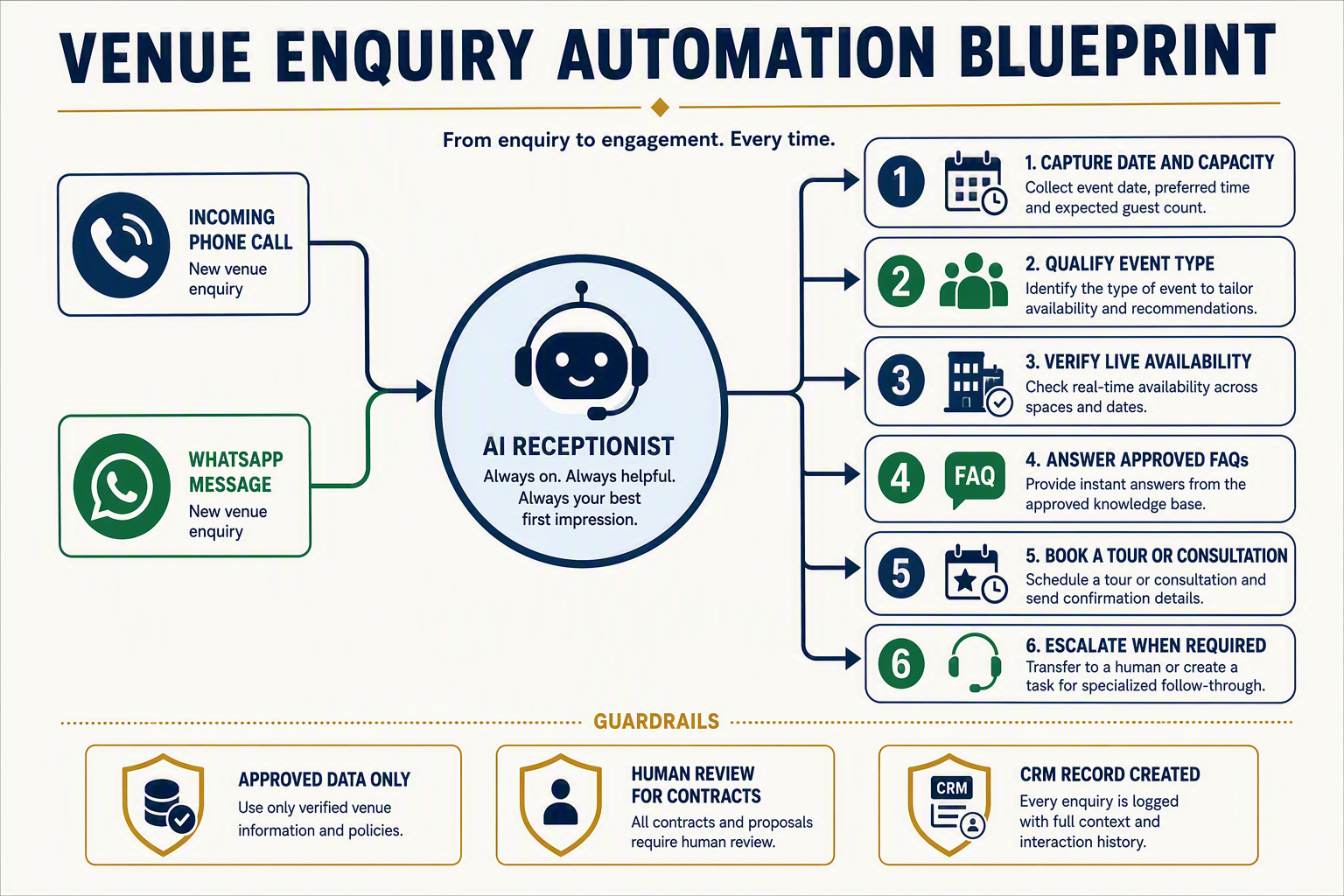
An AI receptionist for event venues should operate through three controlled layers: approved knowledge for stable answers, live integrations for changing facts, and human approval for commercial or contractual decisions. The AI may qualify enquiries and schedule tours, but it should never infer availability, invent pricing, or present a tentative hold as a confirmed event booking.
Separate approved answers from live information
Create a permissions matrix before connecting phone or WhatsApp channels. Each answer should come from one of three clearly defined sources:
- Approved knowledge base: venue descriptions, room capacities, accessibility, parking, catering policies, standard packages, AV facilities, accommodation, operating hours, and frequently asked questions.
- Live systems: event calendar, tour diary, CRM, inventory or room-status system, and the current approved pricing database.
- Human-only decisions: bespoke discounts, date holds, contract amendments, refunds, deposits, minimum-spend exceptions, and final booking confirmation.
The knowledge base should include an owner, approval date, effective date, and expiry or review date for every commercial document. If two sources conflict, the assistant should withhold the answer and create a staff task rather than selecting whichever figure appears more plausible.
Qualify the event before checking availability
A wedding venue lead qualification AI should collect structured details in a conversational order, not force callers through a rigid questionnaire. The minimum record should include:
- Contact name, phone number, and consented follow-up channel
- Event type and preferred date
- Alternative dates or flexibility window
- Expected seated and floating guest counts
- Required spaces, catering, accommodation, AV, and accessibility
- Budget range, package interest, and decision timeline
- Tour or consultation preference
Event type matters because a 300-person wedding reception, a 300-delegate conference, and a 300-visitor exhibition can require different layouts, staffing, licences, and turnaround times. Capacity answers must therefore reference the approved configuration—not simply the venue’s largest advertised number.
Check live systems before making transactional claims
Venue booking automation should call the authoritative calendar or venue-management system whenever a prospect asks whether a date, room, package, or tour slot is available. The response should distinguish among available, provisionally held, unavailable, and awaiting staff verification.
A safe workflow is:
- Capture the date, event type, capacity, and space requirements.
- Query the live availability source using those constraints.
- Retrieve current, approved package pricing separately.
- State the result with a timestamp and any relevant conditions.
- Offer eligible tour or consultation slots.
- Write the enquiry, transcript summary, source channel, and appointment to the CRM.
For tours, the system may reserve an open appointment slot and send WhatsApp confirmation, directions, rescheduling controls, and an assigned coordinator’s details. It must not convert that appointment into an event reservation.
Design human handoffs as a primary workflow
Escalation should preserve context rather than make the prospect repeat everything. Transfer immediately for contract interpretation, payment disputes, custom menus, unusual safety requirements, accessibility exceptions, high-value negotiations, or explicit requests for a person.
CallMissed supports this model by combining AI voice agents, WhatsApp chatbots, WhatsApp Business calls, an omnichannel inbox, and knowledge-base retrieval. For multilingual event venue WhatsApp automation, its support across 22 Indian languages can help Indian venues qualify regional enquiries while routing sensitive decisions to venue staff.
Why are event venues replacing disconnected phone, inbox, and spreadsheet workflows?
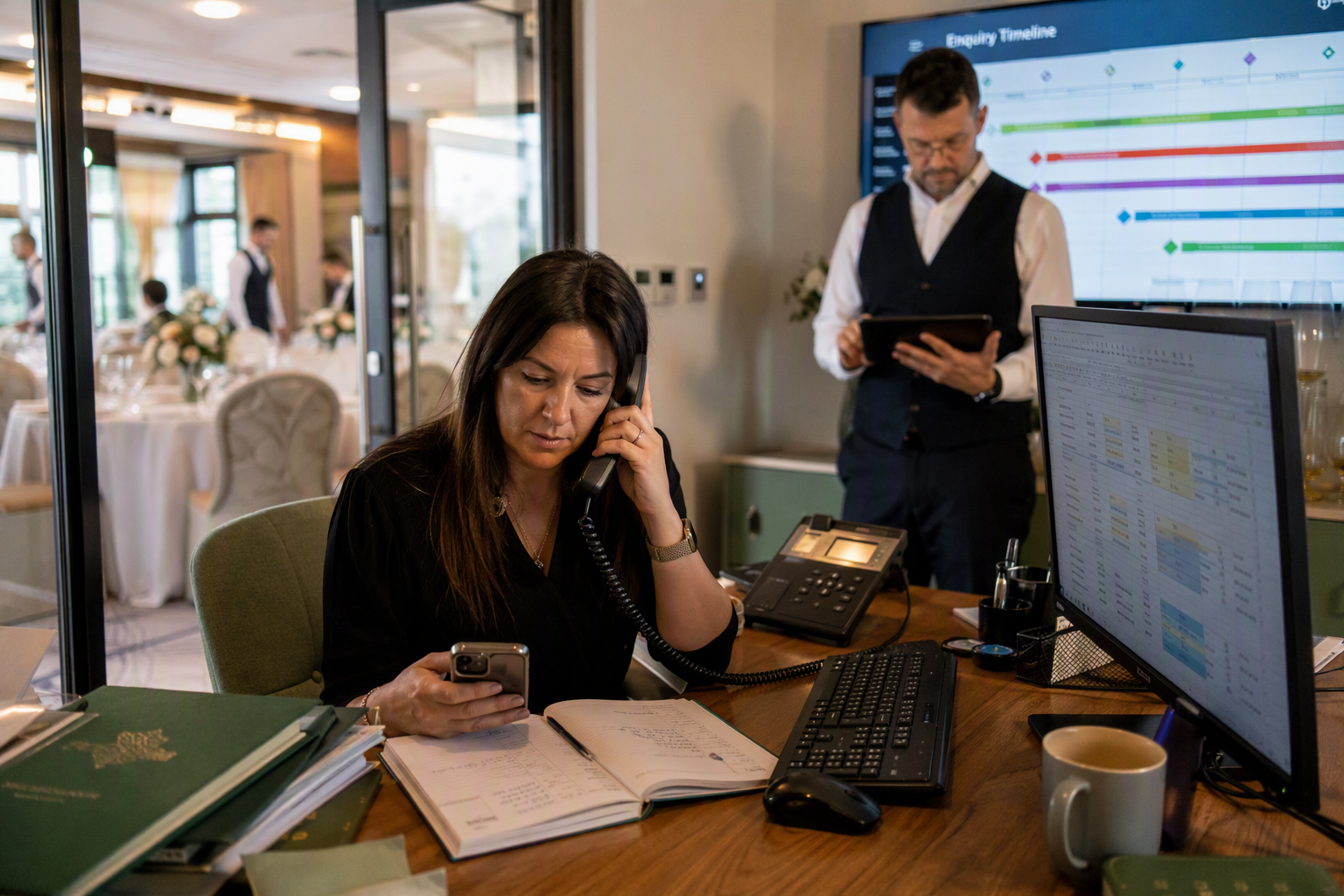
Disconnected phone, inbox, and spreadsheet workflows are being replaced because they create slow responses, duplicate records, inconsistent answers, and booking risk. A unified AI-assisted workflow can capture every enquiry, verify live information, update the CRM, and route exceptions to a coordinator without treating an available date as a confirmed reservation.
Fragmented tools lose context between channels
A typical venue enquiry may begin with a phone call, continue over WhatsApp, and end with an emailed proposal. When each channel has a separate record, staff must manually reconstruct the conversation before answering basic questions.
This fragmentation creates several failure points:
- A missed call remains disconnected from the prospect’s later WhatsApp message.
- Two coordinators enter different guest counts or preferred dates.
- An old spreadsheet shows availability that has since changed.
- Package details are copied from an outdated email template.
- Tour appointments are booked without synchronising the shared calendar.
- Follow-up depends on an employee remembering to update a task manually.
The scale of WhatsApp makes this operational gap increasingly important. Meta reported in April 2025 that WhatsApp had surpassed 3 billion monthly active users, making messaging a mainstream enquiry channel rather than an optional add-on.
Manual handoffs slow qualification
Traditional workflows often require a coordinator to answer the phone, take handwritten notes, check a diary, open a pricing sheet, and then re-enter the same information into a CRM. That process consumes staff time while leaving prospects waiting.
A wedding venue lead qualification AI can instead create one structured record containing:
- Event type, such as a wedding, reception, conference, exhibition, or private function.
- Preferred date, alternative dates, and flexibility.
- Expected capacity, including seated and standing requirements where relevant.
- Space and service needs, such as catering, accommodation, parking, staging, or audiovisual equipment.
- Commercial intent, including budget range, package interest, and readiness to arrange a tour.
The automation should then assign the enquiry to the correct pipeline stage—not label it “booked.” Availability, price, deposits, contractual terms, and final acceptance still require approved system checks or staff authorisation.
A unified workflow creates one operational record
An AI receptionist for event venues becomes useful when it connects channels rather than merely answering questions. A well-designed venue booking automation workflow can:
- Recognise an existing contact across phone and WhatsApp.
- Store transcripts, requirements, consent, and follow-up status in the CRM.
- Query the authorised calendar before discussing potential dates.
- Retrieve package answers from a controlled knowledge base.
- Offer approved tour slots and write accepted appointments back to the calendar.
- Escalate negotiations, accessibility requests, complaints, and contract questions to people.
Platforms such as CallMissed combine AI voice agents, WhatsApp chatbots, WhatsApp Business calling, and an omnichannel inbox. Its support for 22 Indian languages is particularly relevant to Indian venues handling enquiries from couples, families, planners, and corporate teams with different language preferences.
Replacement does not mean removing human control
The goal of event venue WhatsApp automation in 2026 is to replace fragmented administration, not venue expertise. Automation should handle immediate intake, recordkeeping, approved FAQs, reminders, and routine scheduling; coordinators should retain control over discounts, date holds, deposits, contracts, bespoke packages, and final booking confirmation.
The resulting model is simple: one conversation history, one verified data source, and one accountable handoff path across every customer channel.
Which 2026 developments are changing AI venue booking automation?
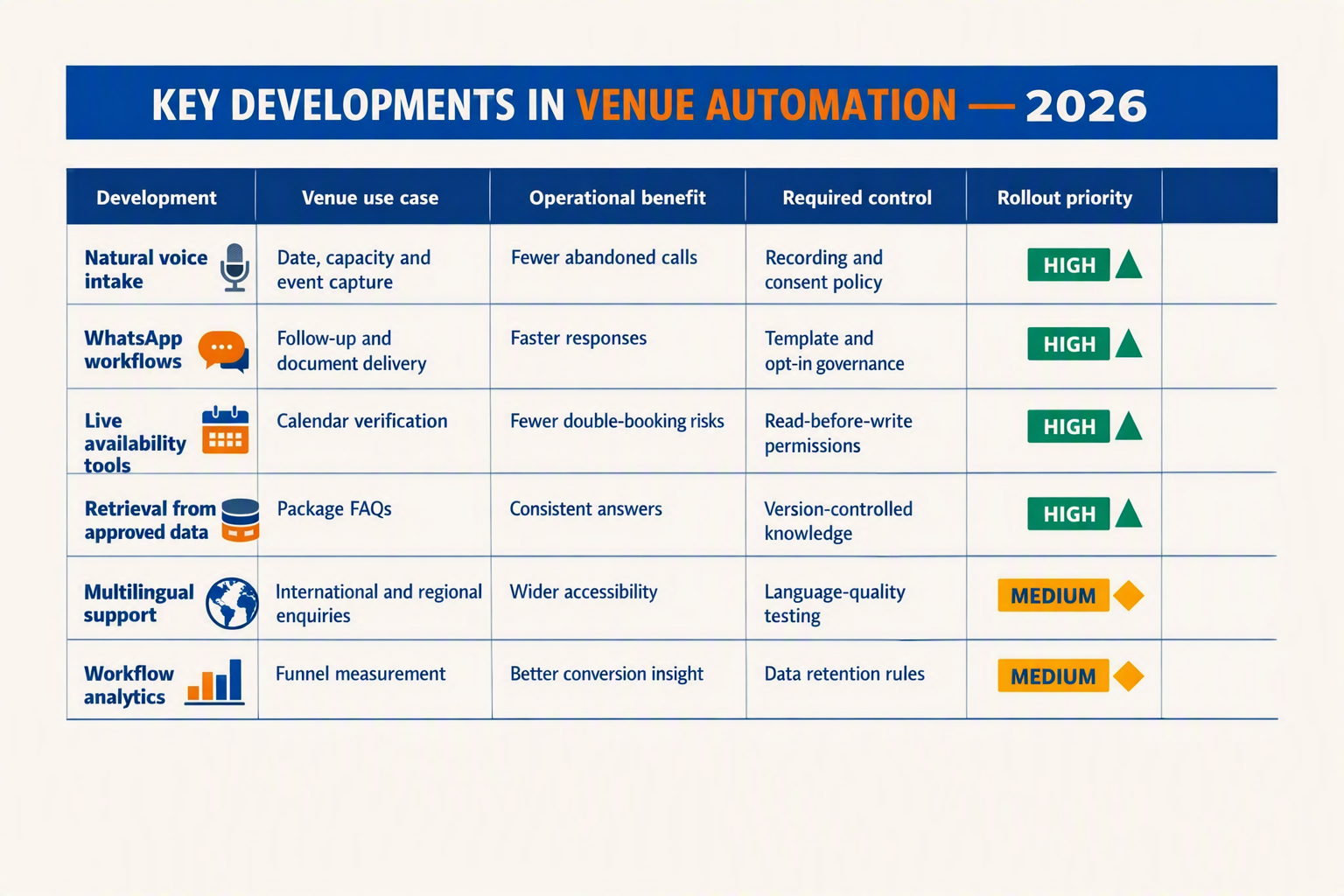
The defining 2026 shift is the convergence of voice, WhatsApp, live business systems, and grounded AI into one enquiry workflow. For venues, this makes immediate qualification and scheduling practical—but deposits, negotiated prices, contracts, and final booking confirmation should remain controlled transactions.
Six developments reshaping venue automation
| 2026 development | Venue application | Operational benefit | Required safeguard |
|---|---|---|---|
| Real-time conversational voice AI | Answer calls, capture dates, capacity, event type, budget, and requirements | Reduces missed enquiries and repetitive intake | Disclose AI use and offer human transfer |
| WhatsApp Business calling | Move between WhatsApp messages and voice calls without losing enquiry context | Supports prospects who prefer speaking after initial chat | Record consent and respect calling windows |
| Tool-connected AI agents | Check CRM records, calendars, package databases, and approved pricing sources | Replaces static answers with current information | Use read-only access initially and validate tool results |
| Retrieval-augmented generation (RAG) | Answer package, catering, parking, accommodation, accessibility, and AV questions | Keeps responses grounded in venue-approved material | Display document owner, version, and review date |
| Multilingual speech and messaging | Qualify regional-language enquiries across phone and WhatsApp | Expands access for families, planners, and suppliers | Test names, dates, numbers, and language-switching |
| Automated workflow orchestration | Trigger missed-call recovery, follow-ups, tour reminders, and staff tasks | Creates consistent lead progression across channels | Apply frequency limits, opt-outs, and escalation rules |
Why channel convergence matters
Meta reported in April 2025 that WhatsApp had exceeded 3 billion monthly active users, making WhatsApp a significant customer-contact channel rather than merely a follow-up tool. In 2026, event venue WhatsApp automation can retain the structured information captured during a call—such as “250 guests, Saturday evening, vegetarian catering”—and continue the conversation without asking the prospect to repeat it.
WhatsApp Business calling adds another practical path. A prospect can begin with a package question in chat, request a call, speak to an AI or coordinator, and receive a tour-selection message in the same customer journey. Platforms such as CallMissed can bridge inbound and business-initiated WhatsApp Business calls to an AI voice agent while keeping voice, chat, and CRM activity connected.
From scripted bots to controlled agents
A 2026 AI receptionist for event venues should use tools rather than improvise operational facts. The agent can:
- Read availability for the requested date and suitable alternatives.
- Retrieve approved packages for the event type and capacity.
- Offer tour slots permitted by the venue calendar.
- Create or update a CRM lead with the captured requirements.
- Escalate exceptions such as custom menus, unusual capacities, discounts, or contractual questions.
This changes venue booking automation from a simple FAQ chatbot into a controlled workflow. However, “available” should mean that a live source was checked at a stated time—not that the language model inferred availability from an old brochure.
Better qualification without autonomous commitment
A wedding venue lead qualification AI can now interpret flexible requests such as “a winter weekend for roughly 300 people” and ask targeted follow-up questions about ceremony format, accommodation, catering, and alternative dates. The critical 2026 design principle is bounded autonomy: let AI collect, verify, schedule, and route, but require authorised staff or transactional systems to approve deposits, discounts, contracts, and final reservations.
How should wedding venue lead qualification AI capture dates, capacity, event type, budget, and buyer readiness?
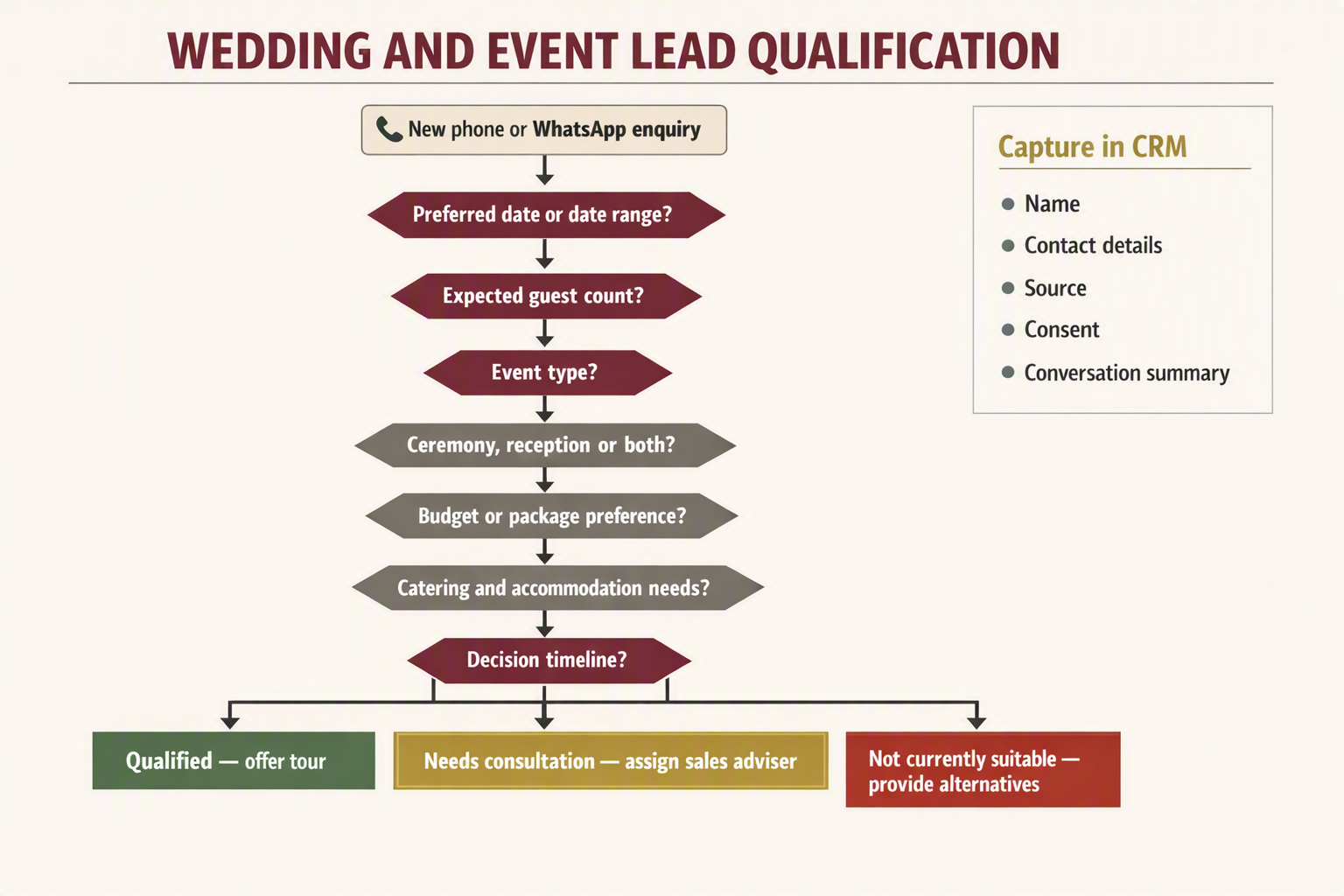
A wedding venue lead qualification AI should collect six structured fields—date, flexibility, capacity, event type, budget, and next-step readiness—while keeping the conversation natural. It should qualify and route the enquiry, not imply that a date, price, discount, or booking is confirmed.
Use progressive qualification, not a long questionnaire
An AI receptionist for event venues should ask one relevant question at a time and reuse information already supplied. If a caller says, “We need a reception for 300 people next February,” the AI should not ask again for the event type or approximate capacity.
A practical sequence is:
- Event type: Wedding ceremony, reception, engagement, conference, exhibition, birthday, or another format.
- Preferred date: Capture an exact date where possible, including the year.
- Date flexibility: Ask for alternative dates, weekdays, weekends, or an acceptable month.
- Guest capacity: Record expected attendance and whether the figure is estimated or confirmed.
- Space and service needs: Ceremony areas, breakout rooms, catering, accommodation, parking, staging, or audiovisual equipment.
- Budget: Request a range and clarify whether it covers venue hire alone or the complete event.
- Buyer readiness: Determine whether the prospect is researching, shortlisting, ready for a tour, or seeking a proposal.
Speed still matters during this process. The Harvard Business Review reported in its 2011 lead-response study that businesses contacting a prospect within one hour were nearly seven times more likely to qualify the lead than those waiting more than two hours.
Normalize dates, capacity, and budget before CRM entry
Conversational answers must become reliable structured data. “The second Saturday next March” should be converted into a proposed calendar date and repeated back for confirmation. Relative dates such as “next Friday” require the AI to state the full day, date, month, and year to prevent ambiguity.
Store capacity as a range when necessary:
- Minimum expected guests: 220
- Maximum expected guests: 280
- Seated or standing format: Seated reception
- Adult and child split: If relevant to pricing or catering
- Capacity status: Estimate, likely, or confirmed
Budget questions should offer bands rather than pressure prospects for an exact figure. The workflow should distinguish venue-only budget, per-person budget, and total event budget so staff do not compare incompatible numbers.
Score readiness without rejecting valuable leads
Buyer readiness should drive the next action, not become a simplistic pass-or-fail score. Useful intent signals include:
- High readiness: Requests a tour, confirms decision-makers, has a defined date and budget, or needs a proposal.
- Medium readiness: Has a date and capacity but is comparing packages or awaiting family approval.
- Early research: Has no fixed date, broad attendance estimates, or an undecided event format.
- Human-review priority: Large or complex events, accessibility requirements, unusual layouts, negotiation requests, or conflicting information.
AI venue booking automation can assign routing labels, but venue staff should define the scoring rules and review borderline cases.
Confirm the captured brief before handoff
At the end of the voice or WhatsApp conversation, the AI should summarize: event type, preferred and alternative dates, guest range, budget basis, major requirements, and requested next step. The prospect should be able to correct any field before submission.
Platforms such as CallMissed can support this workflow across AI voice, WhatsApp chat, and WhatsApp Business calling, with engagement across 22 Indian languages. Regardless of platform, venue booking automation should label calendar results as provisional until live availability is checked and an authorized employee completes the venue’s booking process.
How can venue booking automation answer package FAQs while verifying live availability, pricing, deposits, and contract boundaries?
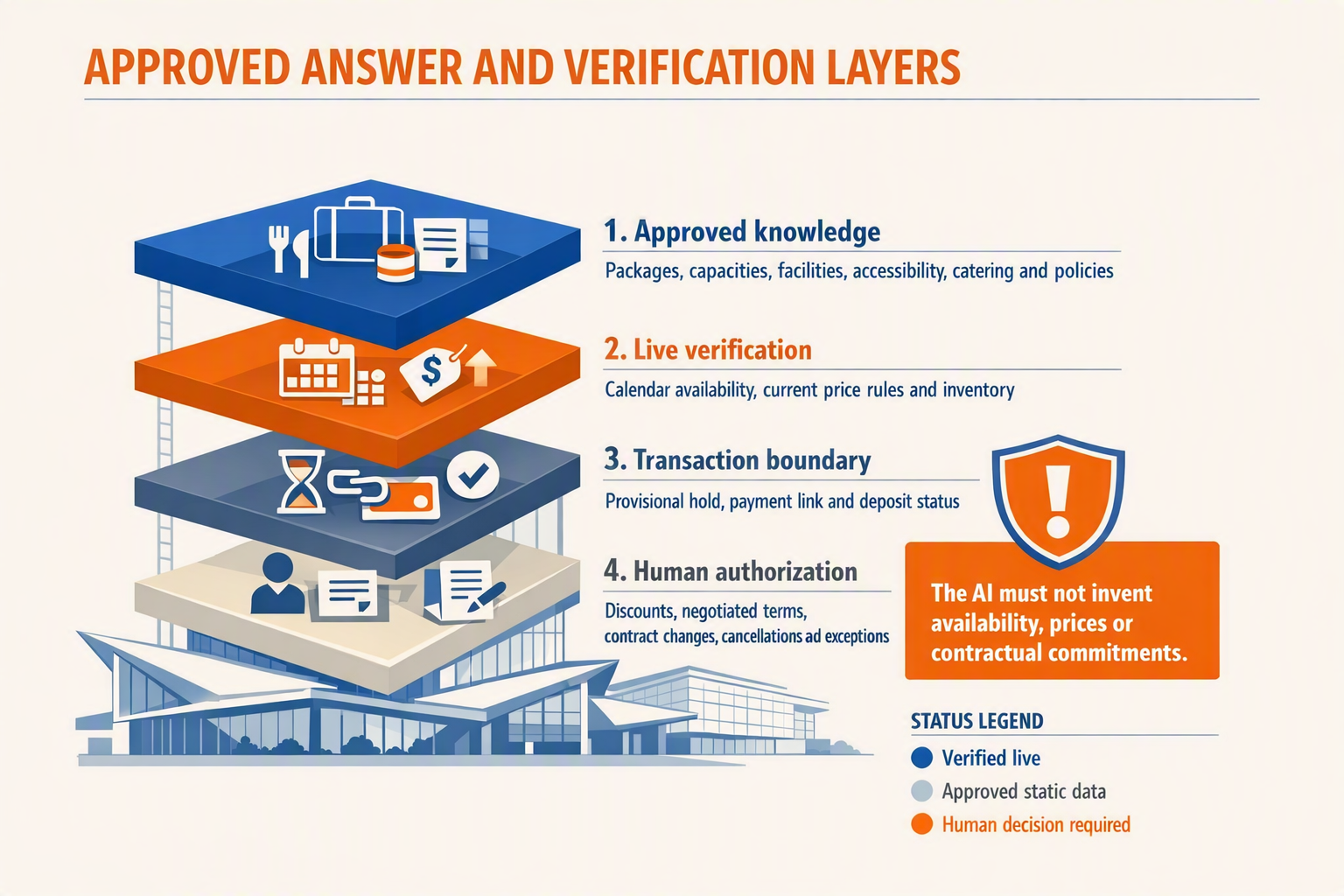
Package FAQs can be automated safely when the AI treats brochures and policies as approved reference data, while checking availability, pricing, and payment status against live systems. The AI may explain published terms and collect intent, but it should never invent a discount, reserve a date without authorization, or represent a contract as accepted.
Separate reference answers from live booking facts
An AI receptionist for event venues should classify every question before responding:
- Static FAQ: What does the wedding package include? Is outside catering permitted?
- Live fact: Is the ballroom available on 14 February? What is the current Saturday rate?
- Commercial exception: Can the venue waive corkage or extend the payment deadline?
- Legal commitment: Is the date secured? Can this clause be removed?
Static answers can come from a version-controlled knowledge base containing approved brochures, capacity charts, catering policies, AV inventories, accessibility details, and cancellation rules. Each record should include an effective date, venue or room, event type, package version, and owner.
Availability and price answers require live retrieval from the venue’s calendar, CRM, property-management system, or pricing database. A brochure stored six months ago must not override a newer rate card.
Verify availability and pricing in real time
Before quoting, venue booking automation should check the requested date, room, session, setup and teardown window, and expected capacity. “Available” should have explicit operational meanings:
- Available: No conflicting booking or hold exists.
- Provisionally held: Another prospect has temporary priority.
- Unavailable: A confirmed event or operational closure blocks the space.
- Requires review: Calendars conflict, capacity is marginal, or turnaround time is insufficient.
Pricing responses should identify the package, currency, applicable taxes, guest-count assumptions, optional charges, and quote validity. For example: “The approved weekday conference package is ₹X per attendee for 100–150 guests, excluding applicable taxes; final pricing requires coordinator review.” If the live pricing service fails, the AI should say that pricing cannot currently be verified rather than relying on conversational memory.
This separation is particularly important for wedding venue lead qualification AI, because couples may ask about décor upgrades, catering substitutions, room blocks, overtime, and minimum spends within one conversation.
Enforce deposit and contract boundaries
The AI should explain only approved deposit rules and direct prospects to authorized payment channels. It must not claim that payment has been received until the payment gateway or finance system returns a successful, matched transaction.
Use firm boundaries:
- A submitted enquiry does not reserve the date.
- A payment link does not confirm payment.
- A provisional hold is valid only for the period recorded in the booking system.
- Contract changes, discounts, refunds, and exceptions require an authorized employee.
- The AI may summarize a clause but must not provide legal interpretation.
- Final confirmation requires the venue’s defined combination of signed agreement, cleared deposit, and staff approval.
Design a safe answer-and-escalate flow
For every package question, the automation should:
- Retrieve the approved answer and display its relevant conditions.
- Perform a live check if the answer concerns inventory, price, or payment.
- State what is verified, when it was checked, and what remains provisional.
- Log the source and response in the CRM.
- Escalate exceptions with the complete conversation and enquiry profile.
Platforms such as CallMissed can connect AI voice and WhatsApp conversations with a knowledge-base RAG workflow, allowing venues to answer from approved material while routing commercial or contractual decisions to staff. The governing rule is simple: automation may inform and qualify; authorized systems and people must commit.
How should event venue WhatsApp automation book tours, recover missed calls, and support multilingual enquiries?
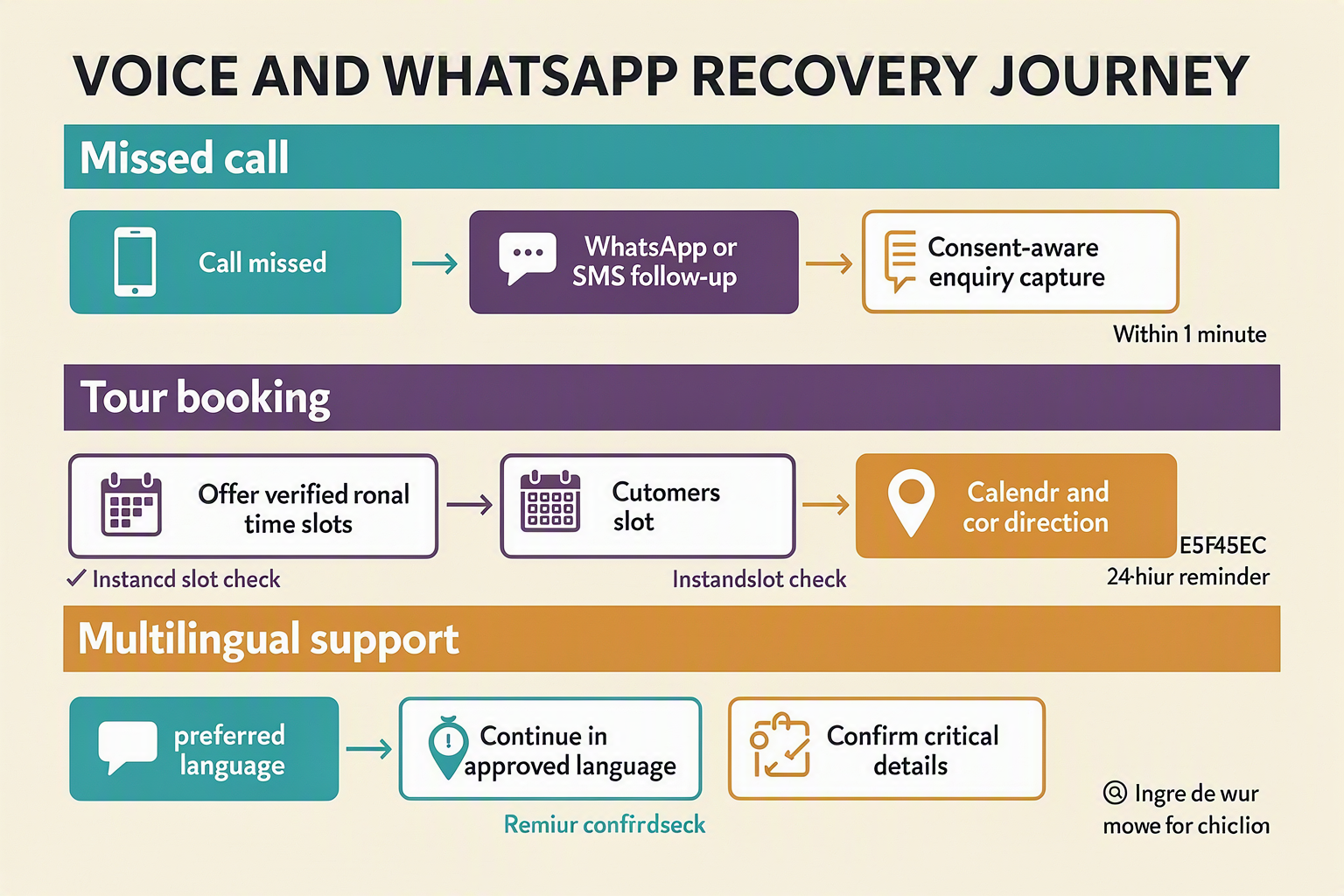
Event venue WhatsApp automation should convert qualified enquiries into provisional tour appointments, recover unanswered calls within minutes, and continue conversations in the customer’s preferred language. It must verify calendar availability before offering a slot, obtain consent for follow-up, and escalate ambiguity rather than inventing an answer.
Book tours without implying the venue is reserved
A tour appointment is not an event-date reservation. The AI receptionist for event venues should state this distinction clearly before writing anything to the calendar.
A reliable tour-booking workflow is:
- Confirm readiness: Ask whether the prospect wants an in-person tour, video tour, or consultation call.
- Check the live calendar: Query the approved staff calendar for available appointment times, accounting for tour duration, setup buffers, holidays, and coordinator availability.
- Offer limited choices: Present two or three valid slots in the prospect’s local time zone instead of exposing the full internal diary.
- Collect attendee details: Capture the visitor’s name, mobile number, email address, number of attendees, accessibility needs, and preferred language.
- Create the appointment: Write the selected slot to the calendar using an idempotency key to prevent duplicate bookings.
- Send confirmation: Provide the venue address, map location, parking instructions, coordinator contact, rescheduling link, and a statement that the event date remains subject to contract and deposit.
- Schedule reminders: Send an approved WhatsApp reminder, normally 24 hours before the tour, with a simple confirm-or-reschedule action.
The wedding venue lead qualification AI should transfer complex requests—such as multi-day venue walkthroughs, vendor inspections, or appointments outside published hours—to a coordinator.
Recover missed calls through permission-based follow-up
Meta reported in April 2025 that WhatsApp had more than 3 billion monthly active users, making it a practical recovery channel when a caller cannot reach the venue team. A missed-call workflow should begin with context, not an unexplained promotional message.
Within a venue-approved response window, the automation can:
- Trigger an immediate callback from the voice agent where legally permitted.
- Send an approved WhatsApp message identifying the venue and acknowledging the missed call.
- Offer clear actions such as check a date, view packages, book a tour, or speak to the team.
- Match the phone number against the CRM to continue an existing enquiry rather than creating a duplicate lead.
- Record channel consent, delivery status, replies, callback attempts, and opt-outs.
- Escalate urgent same-day-event calls or repeated failed contacts to an employee.
Business-initiated messages and calls must follow applicable consent requirements and current WhatsApp Business Platform rules. Silence should never be treated as consent, and opt-out instructions should be easy to use.
Support multilingual enquiries without losing meaning
Multilingual automation should detect or ask for the preferred language, preserve important names and dates exactly, and store a structured summary in the CRM. Indian platforms such as CallMissed support AI voice and chat across 22 Indian languages and can bridge WhatsApp Business calls to an AI voice agent, helping venues serve regional audiences across both speech and messaging.
Safe multilingual venue booking automation should:
- Confirm dates numerically and in words to avoid format confusion.
- Read back guest counts, prices, taxes, and appointment times.
- Use venue-approved translations for package names and contract terminology.
- Retain both the original message and translated summary for staff review.
- Route low-confidence speech recognition, code-switching, or negotiation to a multilingual coordinator.
The automation may confirm a tour slot, but deposits, discounts, contract acceptance, and final event-date confirmation must remain governed by verified systems and authorised venue staff.
How should CRM, calendar, telephony, payments, and human escalation work together?
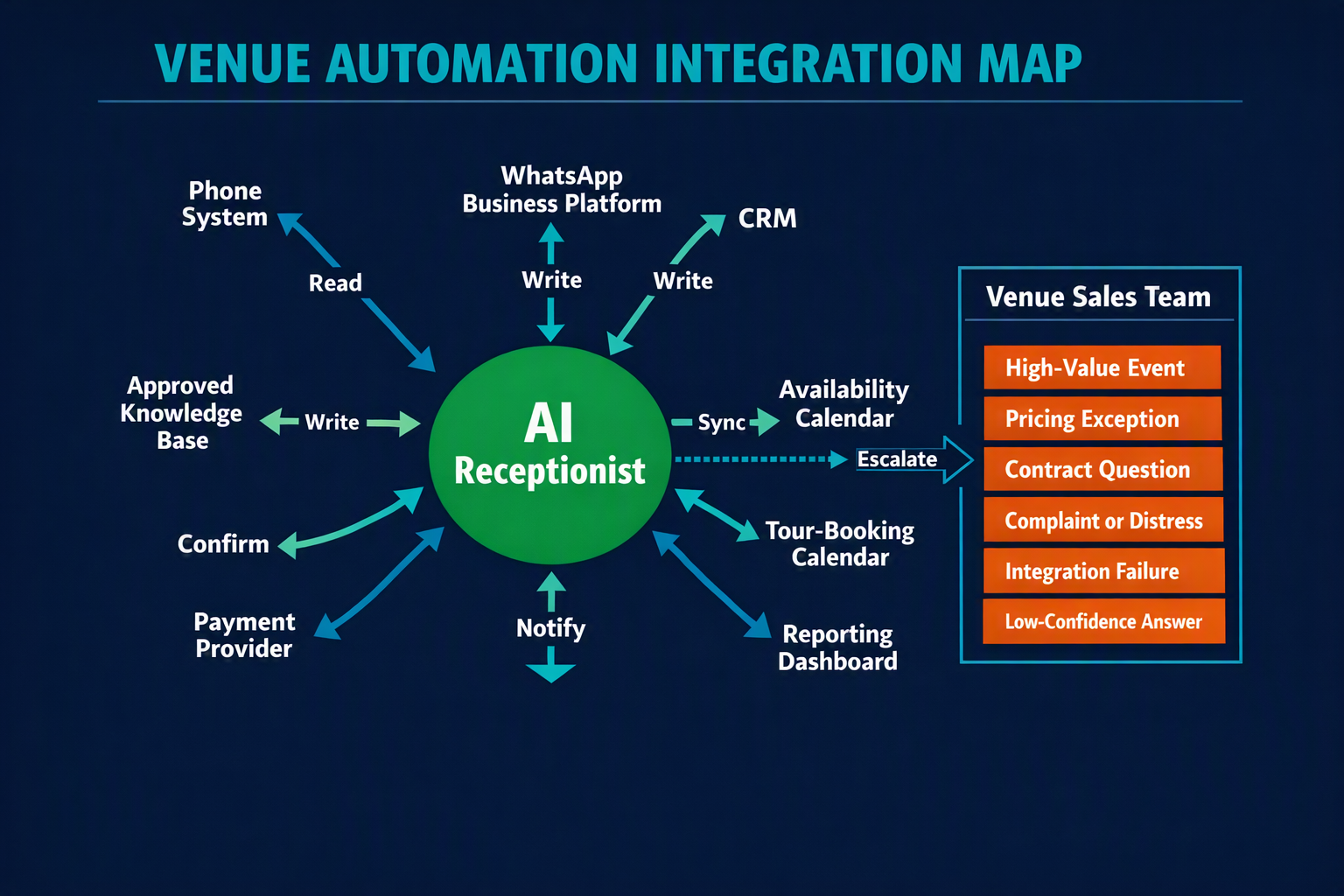
The systems should operate as one controlled workflow: CRM stores the customer record, calendar governs availability, telephony and WhatsApp carry the conversation, the payment provider processes money, and staff retain authority over exceptions and final commitments. An AI receptionist for event venues should orchestrate these systems without treating a provisional date, payment link, or verbal preference as a confirmed booking.
Establish a clear source of truth
Assign ownership of each data type before connecting any automation:
- CRM: contact details, event requirements, lead source, consent, conversation summaries, assigned coordinator, and sales stage.
- Calendar or venue-management system: bookable spaces, tours, setup windows, confirmed events, and time-limited holds.
- Approved pricing source: packages, taxes, minimum spends, optional services, and validity dates.
- Payment provider: payment status, transaction reference, refund state, and webhook confirmation.
- Telephony and WhatsApp: recordings or transcripts, message status, call outcome, and channel history.
The CRM should use a common enquiry ID across channels. This prevents a missed phone call, subsequent WhatsApp message, and later tour request from becoming three unrelated leads. Cross-channel continuity matters at scale: Meta reported in April 2025 that WhatsApp had exceeded 3 billion monthly active users.
Use a controlled booking-state model
Venue booking automation should move enquiries through explicit states rather than interpreting conversational intent as a reservation:
- New enquiry: contact and basic requirements captured.
- Qualified: date, capacity, event type, budget, and essential facilities recorded.
- Availability checked: the calendar has returned a current result.
- Tour scheduled: a calendar event and CRM activity have been created.
- Provisional hold: permitted only under the venue’s documented hold policy.
- Payment pending: an approved payment link has been issued.
- Payment received: confirmed through the provider’s webhook, not a customer screenshot.
- Contract pending or signed: status updated by the contract system or authorised employee.
- Confirmed booking: declared only when every venue-defined condition is satisfied.
A wedding venue lead qualification AI may recommend the next action, but it should not override blocked dates, extend holds, negotiate discounts, or mark a booking confirmed.
Connect calls, WhatsApp, calendars, and payments safely
For every write operation, the integration should validate the latest record and use idempotency controls so retries cannot create duplicate tours, holds, or payment requests. If two customers request the same date, the live venue calendar—not the AI’s earlier conversation—must decide availability.
Platforms such as CallMissed can connect AI voice agents, WhatsApp chatbots, and WhatsApp Business calls with CRM workflows. Regardless of platform, the implementation should:
- Send payment links through an approved provider rather than collecting card details conversationally.
- Record the quoted package version, currency, taxes, and expiry time.
- Recheck availability immediately before creating a hold.
- Write call and message summaries back to the same CRM timeline.
- Maintain an audit trail of system checks, responses, and staff changes.
Design human escalation as a transaction
Escalation must transfer context, ownership, and urgency, not merely forward a call. Trigger immediate staff review for calendar conflicts, custom pricing, discount requests, contract changes, accessibility needs, refunds, distressed callers, or low-confidence AI responses.
The coordinator should receive:
- Customer identity and preferred language
- Event brief and requested dates
- Availability and pricing checks already completed
- Payment or contract status
- The exact unresolved question
- Conversation transcript or concise summary
Until a human resolves the case, the AI should state that the request is under review, provide an expected response window, and avoid making a binding promise.
What do operations, sales, legal, and IT experts recommend for a phased venue automation rollout?
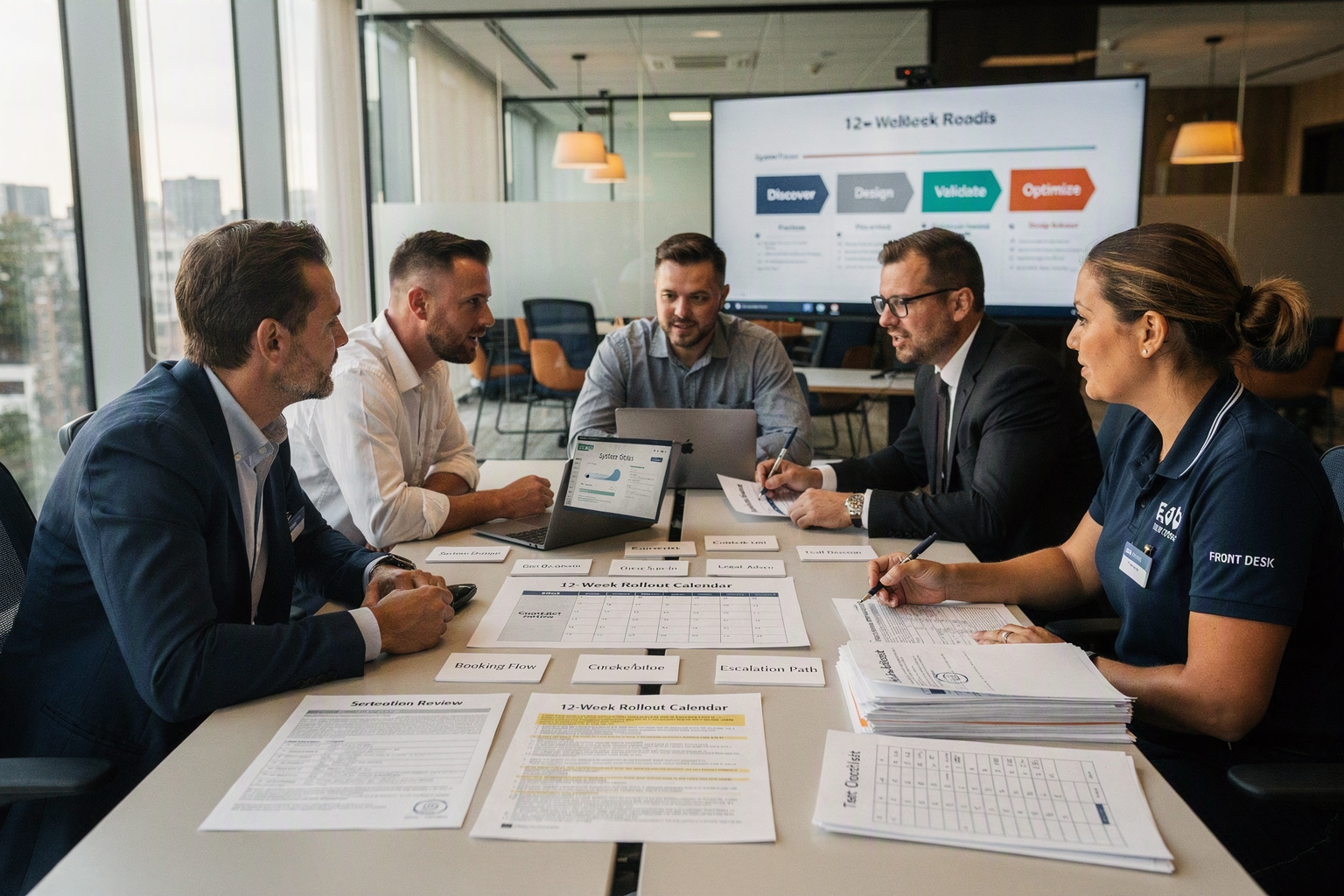
A cross-functional rollout should start with low-risk enquiry capture, progress to staff-supervised scheduling, and enable transactional actions only after security, legal, and operational reviews. Operations, sales, legal, and IT should jointly define what the AI receptionist for event venues may say, which systems it may update, and when it must transfer control to a person.
Establish ownership before configuring workflows
Experts from each function should approve a written responsibility matrix rather than treating automation as a standalone IT project:
- Operations owns opening hours, capacity rules, turnaround times, event restrictions, tour availability, and escalation coverage.
- Sales defines qualification fields, lead stages, follow-up priorities, package language, and what constitutes a sales-ready enquiry.
- Legal or compliance approves consent notices, call-recording disclosures, data-retention periods, marketing permissions, and prohibited claims.
- IT and security control identities, integrations, access permissions, logs, vendor assessments, and incident response.
- Venue leadership authorises pricing, deposit, discount, contract, and booking-confirmation boundaries.
Meta reported in April 2025 that WhatsApp exceeded 3 billion monthly active users, making WhatsApp governance a core operating requirement rather than a peripheral messaging decision.
Follow a four-phase rollout
- Phase 1: Observe and capture
Deploy the AI on missed calls, after-hours enquiries, and selected WhatsApp conversations. It should collect contact details, event type, preferred dates, capacity, and language while making no availability or pricing commitments. Staff review every transcript and correct knowledge gaps.
- Phase 2: Answer from approved data
Enable package FAQs, venue policies, accessibility information, catering options, and indicative capacity guidance only from a version-controlled knowledge base. A wedding venue lead qualification AI should label uncertain answers for human review instead of improvising.
- Phase 3: Integrate calendars and CRM
Permit read-only availability checks first, followed by controlled tour or consultation scheduling. Before enabling calendar writes, IT should test duplicate prevention, time zones, cancellation handling, authentication failures, and rollback procedures. Every interaction should create or update one CRM record using a stable enquiry ID.
- Phase 4: Expand channels and languages
Add inbound voice, business-initiated follow-up, and regional-language journeys after reviewing earlier performance. CallMissed, for example, combines AI voice agents, WhatsApp chatbots, WhatsApp Business calling, and support across 22 Indian languages, allowing multilingual expansion within one engagement platform.
Use measurable approval gates
Each phase should run for a defined pilot period—such as two to four weeks—but advancement should depend on evidence, not elapsed time. Track:
- Enquiry capture completeness and CRM write success
- Median first-response time and missed-call recovery rate
- Tour-booking conversion and staff takeover rate
- Unsupported-answer, incorrect-availability, and duplicate-booking rates
- Consent, deletion, and escalation compliance
- Customer complaints and conversation abandonment
Legal and operations should impose zero-tolerance stop conditions for false booking confirmations, unauthorised discounts, missing recording disclosures, or exposure of another customer’s information.
Keep commercial commitments human-controlled
Early venue booking automation should schedule conversations and prepare qualified opportunities—not accept deposits, alter contracts, negotiate bespoke terms, or declare a date secured. Those actions should remain behind authenticated workflows and named human approval until legal, finance, and IT have validated the complete transaction path. This phased model produces faster service without transferring commercial authority to an insufficiently tested system.
What do the rollout KPIs mean for venue owners and sales teams?
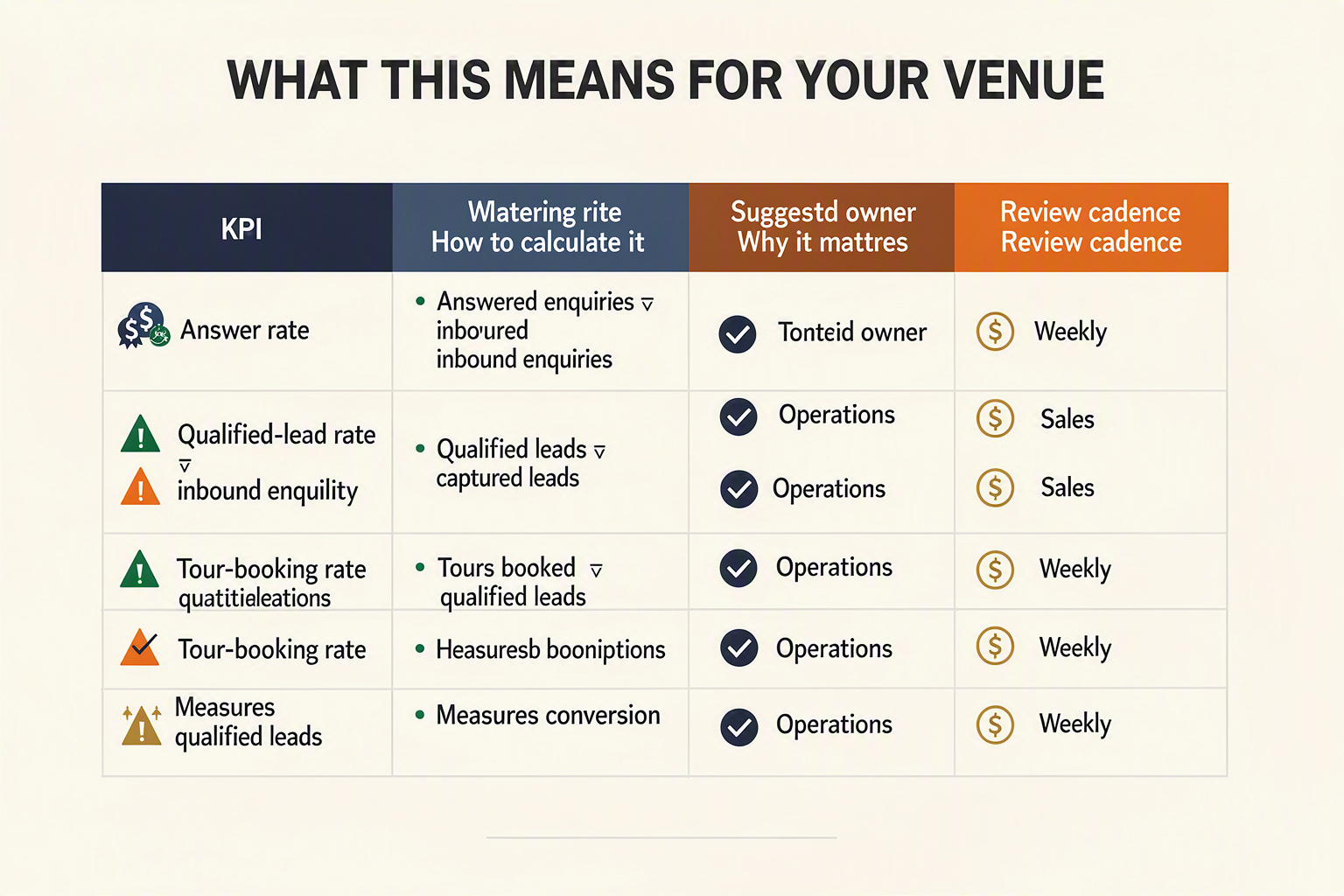
Rollout KPIs tell venue owners whether automation is creating faster, better-qualified sales opportunities without increasing booking risk. Sales teams should measure the full journey—from first response and completed qualification to tours, proposals, and signed contracts—rather than treating call volume or chatbot conversations as success by themselves.
A practical KPI scorecard
The targets below are recommended rollout goals, not universal industry benchmarks. Each venue should record a two-to-four-week baseline, segment results by event type and channel, and then set improvements that reflect its capacity, seasonality, and sales process.
| KPI | How to calculate it | Suggested rollout signal | What it means for the team |
|---|---|---|---|
| First-response time | Median time from enquiry to first useful reply | Immediate acknowledgement; progressively reduce time to a qualified response | Shows whether the AI receptionist for event venues is reaching prospects while intent is high |
| Qualification completion rate | Enquiries capturing required fields ÷ enquiries started | Improve against baseline without forcing irrelevant questions | Reveals whether date, alternatives, capacity, event type, budget, and requirements are being captured |
| Tour-booking conversion | Qualified leads booking a tour or consultation ÷ qualified leads | Compare AI-assisted and staff-handled cohorts by event type | Indicates whether wedding venue lead qualification AI produces sales-ready opportunities |
| Availability accuracy | Correct date-and-space answers ÷ audited availability answers | Target 100% verified lookups before presenting availability as current | Tests calendar integration and prevents tentative options from being mistaken for confirmed bookings |
| Human-escalation quality | Escalations containing complete summaries ÷ total escalations | Increase complete handoffs while tracking avoidable transfers | Measures whether coordinators receive context instead of making prospects repeat themselves |
| Booking outcome rate | Signed contracts ÷ qualified enquiries | Monitor by source, package, event type, and lead month | Connects venue booking automation to revenue while preserving human control over contracts and deposits |
Interpret speed alongside sales quality
A fast greeting is useful only when it moves the enquiry forward. The Harvard Business Review reported in 2011 that businesses contacting a lead within one hour were nearly seven times more likely to qualify it than businesses waiting longer than two hours. Venue owners should therefore track both time to acknowledgement and time to a useful outcome, such as verified availability, a complete qualification record, or a scheduled tour.
Channel coverage also matters. Meta reported in April 2025 that WhatsApp had surpassed 3 billion monthly active users, supporting the case for measuring phone and WhatsApp journeys together rather than as separate sales funnels.
Add safety and experience guardrails
Commercial conversion should never reward unsafe behavior. Pair the scorecard with these guardrail metrics:
- Unsupported-answer rate: percentage of audited package or policy answers not grounded in approved content.
- False-confirmation rate: instances where automation incorrectly described a date, price, tour, or booking as confirmed; the operational target should be zero.
- Opt-out compliance: percentage of WhatsApp or campaign opt-outs applied correctly.
- Repeat-contact rate: prospects contacting the venue again because the first interaction did not resolve the enquiry.
- Language handoff rate: conversations escalated because language recognition, translation, or pronunciation confidence was insufficient.
Platforms such as CallMissed can combine AI voice agents, WhatsApp chatbots, WhatsApp Business calling, CRM workflows, and support across 22 Indian languages. Regardless of platform, owners should review KPIs weekly during rollout and monthly after stabilization.
Assign KPIs to accountable owners
Sales managers should own tour and contract conversion; operations teams should own calendar and pricing accuracy; marketing should own source quality and consent; and the automation owner should manage containment, escalation, and answer audits. This division prevents an impressive response-time dashboard from concealing poor lead quality, incorrect information, or extra work for coordinators.
Frequently asked questions about AI receptionists, WhatsApp automation, deposits, integrations, and venue booking safety
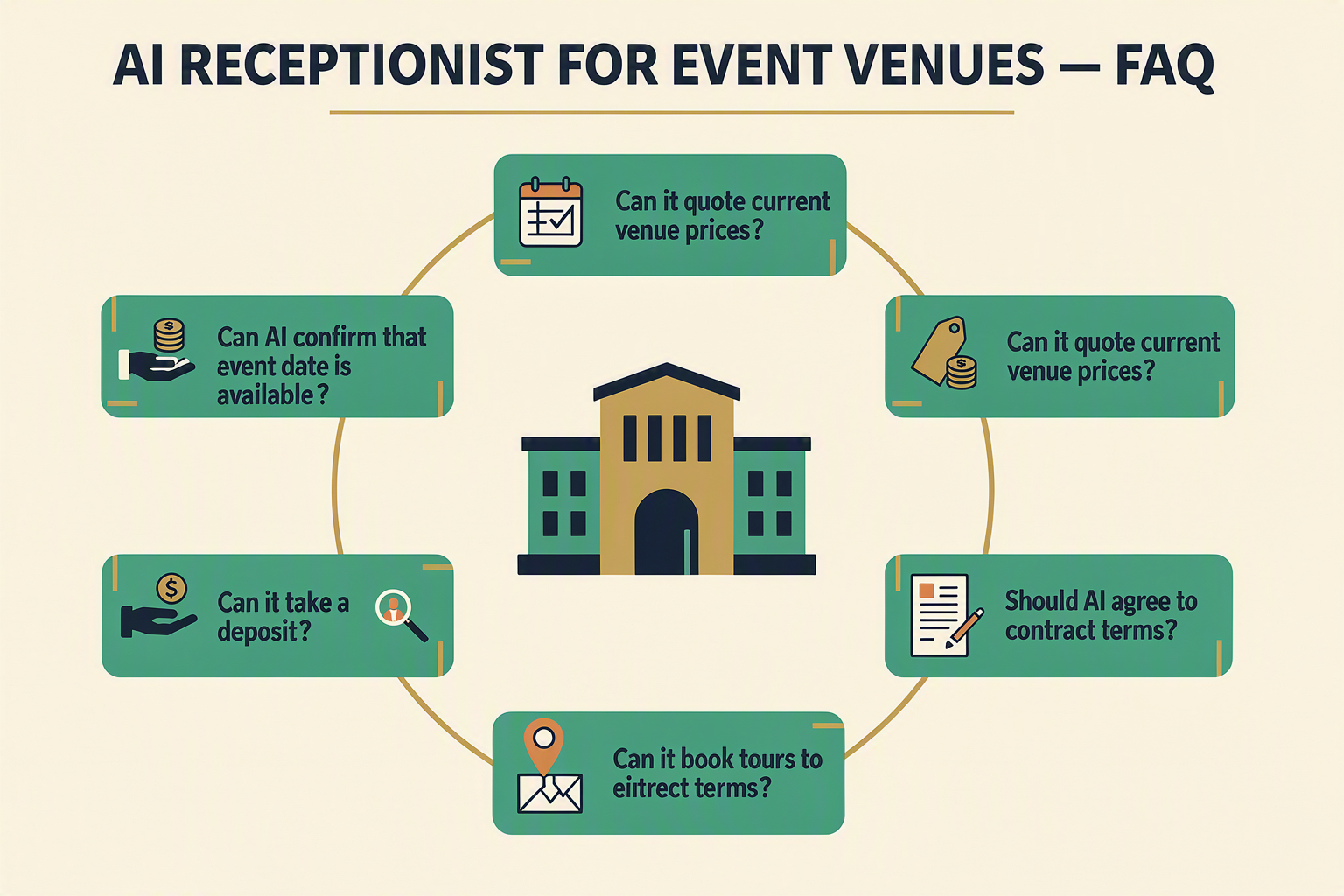
Can an AI receptionist for event venues confirm availability and bookings automatically?
How does event venue WhatsApp automation handle enquiries and missed calls?
What information should a wedding venue lead qualification AI collect?
Should AI venue booking automation collect deposits or approve contracts?
Which CRM, calendar, and payment integrations does venue booking automation require?
How can venues keep multilingual AI receptionists accurate and safe?
Conclusion
In 2026, an AI receptionist for event venues should function as a fast, controlled first-response layer—not as an autonomous booking manager. The strongest implementations connect voice and WhatsApp to approved venue information, live calendars, pricing systems, CRM records, and clear human-escalation rules.
- Respond immediately and qualify consistently. Meta reported in April 2025 that WhatsApp had surpassed 3 billion monthly active users, making WhatsApp automation a practical complement to phone support. A wedding venue lead qualification AI should capture preferred and alternative dates, guest capacity, event type, budget, package requirements, and readiness for a tour or consultation.
- Verify before quoting or promising. Effective venue booking automation checks live availability and approved pricing before providing an answer. The AI should never present an enquiry as a confirmed reservation or independently approve discounts, deposits, contracts, or exceptional terms.
- Design for recovery and escalation. Missed-call callbacks, WhatsApp follow-ups, multilingual conversations, and structured CRM updates help prevent valuable enquiries from disappearing. The 2011 Harvard Business Review lead-response study found that companies responding within one hour were nearly seven times more likely to qualify a lead than those waiting two hours, illustrating why speed remains commercially important.
- Roll out gradually and measure outcomes. Begin with FAQs and enquiry intake, then introduce live calendar checks, tour scheduling, pricing verification, and deeper CRM integration. Track response time, qualification completion, tour-booking rate, escalation accuracy, missed-call recovery, and conversion outcomes.
What venues should watch next is the reliability of real-time integrations and multilingual handoffs as event venue WhatsApp automation 2026 evolves. Platforms such as CallMissed already combine AI voice agents, WhatsApp chatbots, WhatsApp Business calling, and support across 22 Indian languages, giving venues a practical way to explore this shift.
The question is no longer whether enquiries can be automated—it is whether your venue can automate them quickly without sacrificing accuracy, trust, or human judgment.
Related Reading
Discussion
Related Posts


Ready to automate customer conversations?
Launch AI voice agents and WhatsApp bots with CallMissed — one API, 22+ Indian languages.