
AI Receptionist for Salons: 2026 Phone and WhatsApp Implementation Guide


Implement an AI receptionist for salons with reliable booking, WhatsApp, deposits, handoffs, missed-call recovery and measurable KPIs.
AI Receptionist for Salons: 2026 Phone and WhatsApp Implementation Guide
What happens when a client calls during a facial, colour treatment, or massage and nobody can answer? An AI receptionist for salons can capture that demand immediately—handling phone and WhatsApp enquiries, identifying the right service, matching the customer with a qualified professional, and completing or changing an appointment without interrupting staff.
The opportunity is especially significant in 2026 because messaging has become a mainstream business channel. Meta CEO Mark Zuckerberg announced in April 2025 that WhatsApp had surpassed 3 billion monthly active users worldwide. For salons, spas, barbershops, nail studios, and multi-location beauty chains, that scale makes spa WhatsApp automation more than a convenience: it creates an always-available path from “Do you offer balayage?” to a confirmed, deposit-backed booking.
However, beauty scheduling is more complex than placing a name into an empty calendar slot. A reliable salon appointment booking AI must understand service duration, staff skills, preferred location, room or equipment availability, preparation time, pricing, deposits, and policies. It must distinguish a 15-minute fringe trim from a three-hour colour correction—and know when a request needs human judgement rather than an automated answer.
This implementation guide explains how to design those workflows safely and practically. You will learn how to:
- Build a structured catalogue of services, durations, prices, add-ons, and eligibility rules.
- Match customers with the correct stylist, therapist, technician, room, and branch.
- Automate bookings, confirmations, rescheduling, cancellations, deposits, and waitlists.
- Recover missed calls through immediate callbacks or consent-aware WhatsApp follow-ups.
- Send promotions without confusing transactional messages with marketing consent.
- Escalate complaints, allergies, contraindications, bridal packages, and complex consultations to staff.
- Connect the receptionist with calendars, salon management software, CRM records, payments, telephony, and WhatsApp Business.
- Measure booking conversion, missed-call recovery, containment, handoff accuracy, no-shows, and revenue influenced.
Platforms such as CallMissed reflect this shift by combining AI voice agents with WhatsApp chat and WhatsApp Business calling, including support for 22 Indian languages for regional customer engagement.
The goal is not to remove the human welcome that defines a great salon or spa. It is to ensure that every customer receives a fast, accurate response—even when the front desk is busy, the shutters are down, or the preferred stylist works at another location.
How do you implement an AI receptionist for salons in 2026? Use a phased plan covering discovery, workflow design, integration, testing, staff training, launch and KPI optimization
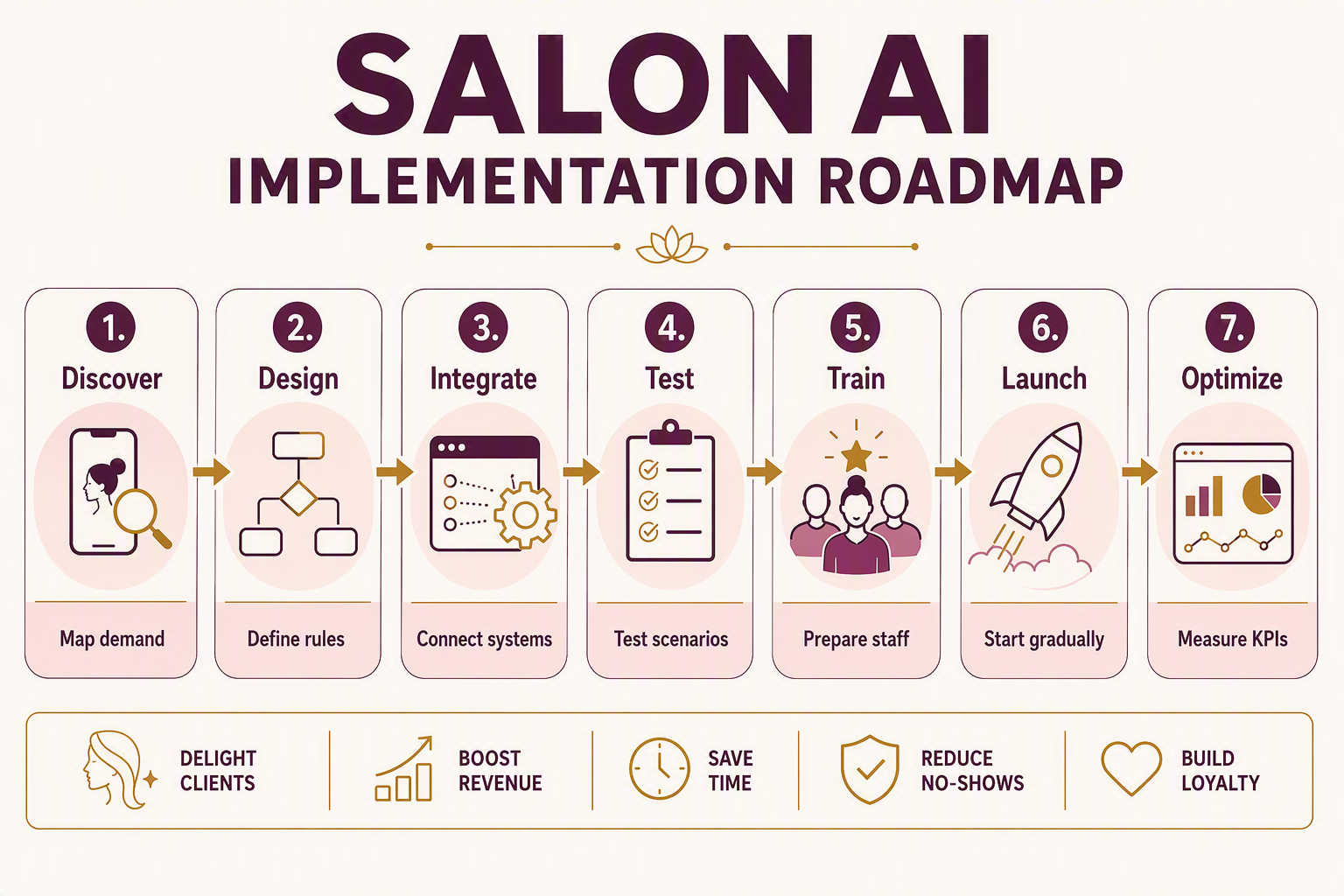
Implement an AI receptionist for salons in seven controlled phases: discovery, workflow design, integration, testing, staff training, gradual launch, and KPI optimization. Do not enable live calendar changes until the system can reliably validate services, staff skills, locations, resources, deposits, policies, and customer confirmation.
Phase 1: Discover demand and set scope
Review at least four weeks of phone calls, WhatsApp conversations, appointment records, and front-desk notes. Classify each interaction by intent:
- Service, price, duration, or availability enquiry
- New booking, rescheduling, or cancellation
- Preferred stylist, therapist, technician, or location request
- Deposit, refund, late-arrival, or waitlist question
- Missed call requiring a callback or WhatsApp follow-up
- Complaint, allergy, contraindication, or consultation request
Start with frequent, rules-based enquiries. Keep complaints, medical concerns, treatment suitability, and other judgement-heavy conversations under human supervision.
Phase 2: Design booking and messaging workflows
Build a structured service catalogue containing names, aliases, prices, durations, preparation and cleanup buffers, eligible employees, branch availability, required rooms or equipment, add-ons, deposit rules, and contraindications.
Define the salon appointment booking AI sequence explicitly:
- Identify the customer and requested service.
- Ask necessary eligibility or preference questions.
- Match the appropriate employee, location, resource, and time.
- disclose the total price, duration, deposit, and relevant policy.
- Read back the proposed appointment and obtain confirmation.
- Write the booking once and send a confirmation.
- Escalate uncertainty, risk, or policy exceptions to an employee.
Use the same source of truth for phone answering and spa WhatsApp automation, preventing different channels from quoting conflicting prices or availability.
Phase 3: Integrate operational systems
Connect the AI receptionist to the salon-management platform, live calendar, CRM, telephony provider, payment service, and WhatsApp Business account. APIs or approved middleware should support real-time availability checks, idempotent booking creation, deposit status, rescheduling, cancellations, and waitlist updates.
Apply least-privilege access, maintain audit logs, and retain customer data only as long as operational or legal requirements demand. Separate transactional confirmations from promotional messages requiring consent. During an outage, capture the request for follow-up rather than inventing an appointment.
Platforms such as CallMissed can connect AI voice agents with WhatsApp Business chat and calling, making them relevant for salons that want phone and WhatsApp journeys managed through shared workflows.
Phase 4: Test routine and difficult scenarios
Create a repeatable test suite covering:
- Similar service names with different durations or prices
- Stylists qualified for only certain treatments
- Employees working across multiple branches
- Group, bridal, correction, and consultation bookings
- Rescheduling appointments with paid deposits
- Fully booked dates, cancellations, and waitlist promotion
- Accents, code-switching, noise, and interrupted calls
- Allergies, minors, complaints, and out-of-policy requests
Verify every test directly in the scheduling system, including staff, location, room, time zone, deposit, and customer contact details.
Phase 5: Train staff and assign ownership
Train employees to accept handoffs, review transcripts, correct catalogue data, process exceptions, and pause automation. Assign an operational owner for services and policies and a technical owner for integrations, security, and incident response.
Phase 6: Launch gradually
Begin with salon missed call recovery and after-hours answering. Then enable enquiries, selected bookings, rescheduling, and finally cancellations or deposit-sensitive changes. Pilot one branch or service category while preserving immediate human transfer during staffed hours.
Phase 7: Optimize using measurable KPIs
Review performance weekly against a pre-launch baseline:
- Call-answer and missed-call recovery rates
- Enquiry-to-booking conversion
- Booking, rescheduling, and cancellation accuracy
- Automated-resolution and appropriate-handoff rates
- Duplicate-booking and scheduling-error rates
- Deposit completion, waitlist fill rate, and no-show rate
- Customer response time and staff hours saved
Use failures to revise workflows and catalogue data—not merely prompts—before expanding automation.
Why are phone answering and WhatsApp automation becoming essential for salons, spas and beauty businesses in 2026?
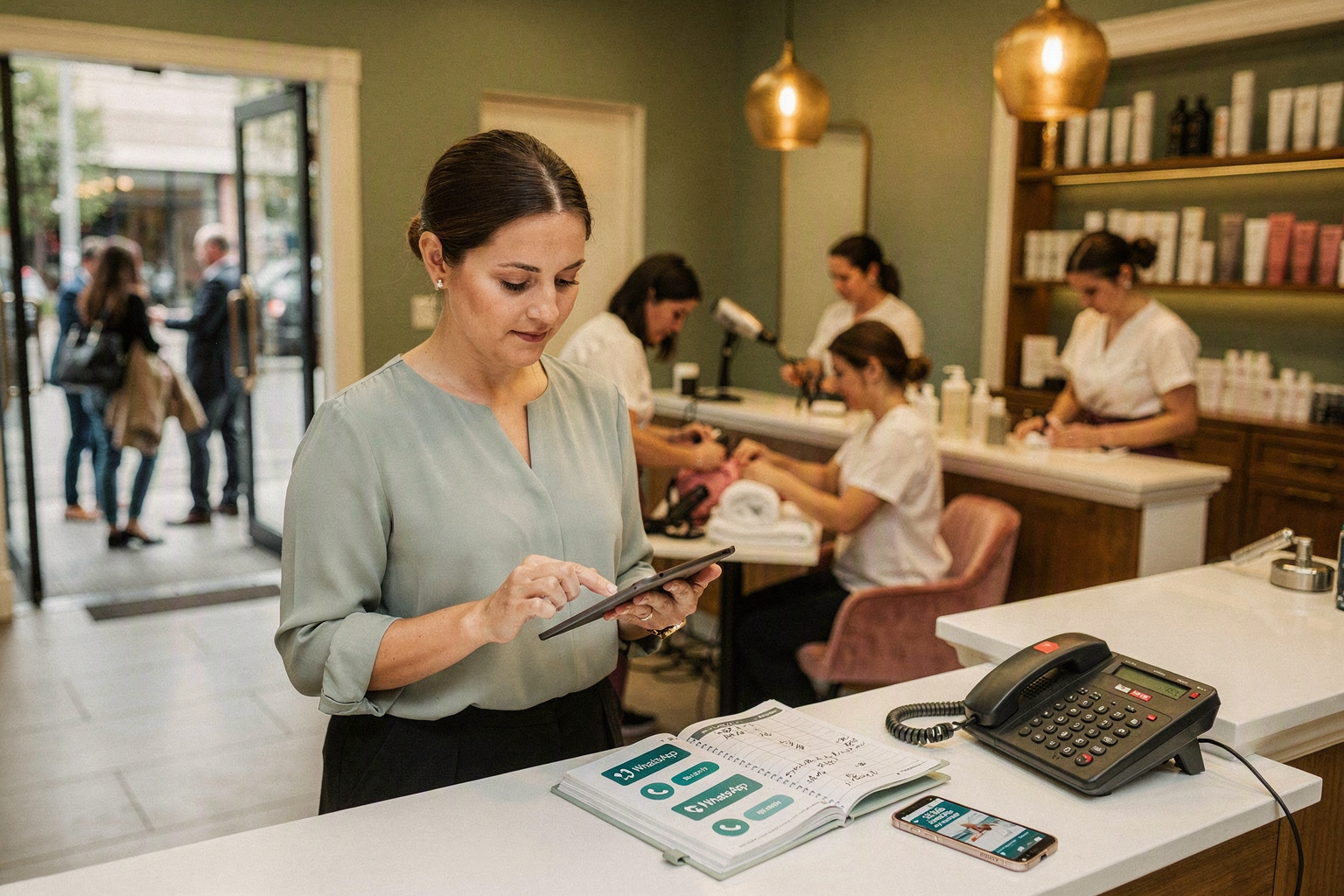
Phone answering and WhatsApp automation are becoming essential because beauty businesses must respond immediately without pulling professionals away from billable treatments. Together, an AI receptionist for salons and spa WhatsApp automation convert enquiries into structured, trackable booking journeys across opening hours, busy periods, and multiple locations.
Missed calls now represent measurable booking leakage
A stylist applying colour or a therapist conducting a massage cannot safely pause to answer the phone. Traditional voicemail merely records the missed opportunity; automation can identify the caller’s intent, answer routine questions, offer an immediate callback, or continue the conversation on WhatsApp with appropriate consent.
Effective salon missed call recovery should:
- Detect unanswered, abandoned, and after-hours calls.
- Send a consent-aware WhatsApp message or trigger an AI callback.
- Preserve context, such as the requested treatment, branch, date, and preferred professional.
- Escalate urgent complaints or complex consultations to an employee.
- Attribute recovered appointments and revenue to the original missed call.
This creates a measurable funnel rather than an unstructured list of voicemail messages.
Customers expect conversations to continue across channels
Meta CEO Mark Zuckerberg announced in April 2025 that WhatsApp had exceeded 3 billion monthly active users worldwide. That scale makes the WhatsApp Business Platform a practical service channel for confirmations, directions, preparation instructions, rescheduling links, waitlist offers, and payment reminders—not simply promotions.
Phone and WhatsApp serve different but complementary needs:
- Voice is useful for customers explaining uncertain requirements, accessibility needs, or several services at once.
- WhatsApp is suited to sharing menus, prices, branch locations, appointment summaries, payment links, and written instructions.
- Human handoff remains necessary for complaints, contraindications, allergy concerns, bridal bookings, corrective colour, and other judgement-heavy requests.
A connected system prevents customers from repeating everything when moving from a call to a message or staff member.
Beauty scheduling has become a resource-matching problem
A basic calendar shows empty time; a salon appointment booking AI must determine whether the slot is genuinely bookable. The correct decision may depend on:
- Service and add-on duration
- Stylist, therapist, or technician qualifications
- Room, chair, equipment, and branch availability
- Patch-test, consultation, or preparation requirements
- Processing and cleanup buffers
- Deposit, cancellation, and late-arrival policies
For example, an available stylist does not make a laser-treatment slot valid if the required room is occupied. Automation becomes essential when it evaluates these constraints consistently across calls, WhatsApp conversations, and live calendars.
Automation protects both responsiveness and service quality
The objective is not maximum “containment” at any cost. It is to automate predictable work while routing sensitive or ambiguous cases correctly. In 2026, beauty businesses should treat the system as operational infrastructure that can be measured through answer rate, enquiry-to-booking conversion, handoff accuracy, deposit completion, rescheduling completion, no-show rate, waitlist fill rate, and recovered missed-call revenue.
Promotional messages must also remain separate from transactional updates: appointment confirmations do not automatically establish consent for marketing campaigns. This combination of immediate response, accurate resource matching, channel continuity, and policy-aware escalation is what makes phone and WhatsApp automation increasingly foundational rather than optional.
Which 2026 capabilities and safeguards matter most for spa WhatsApp automation and AI phone answering?
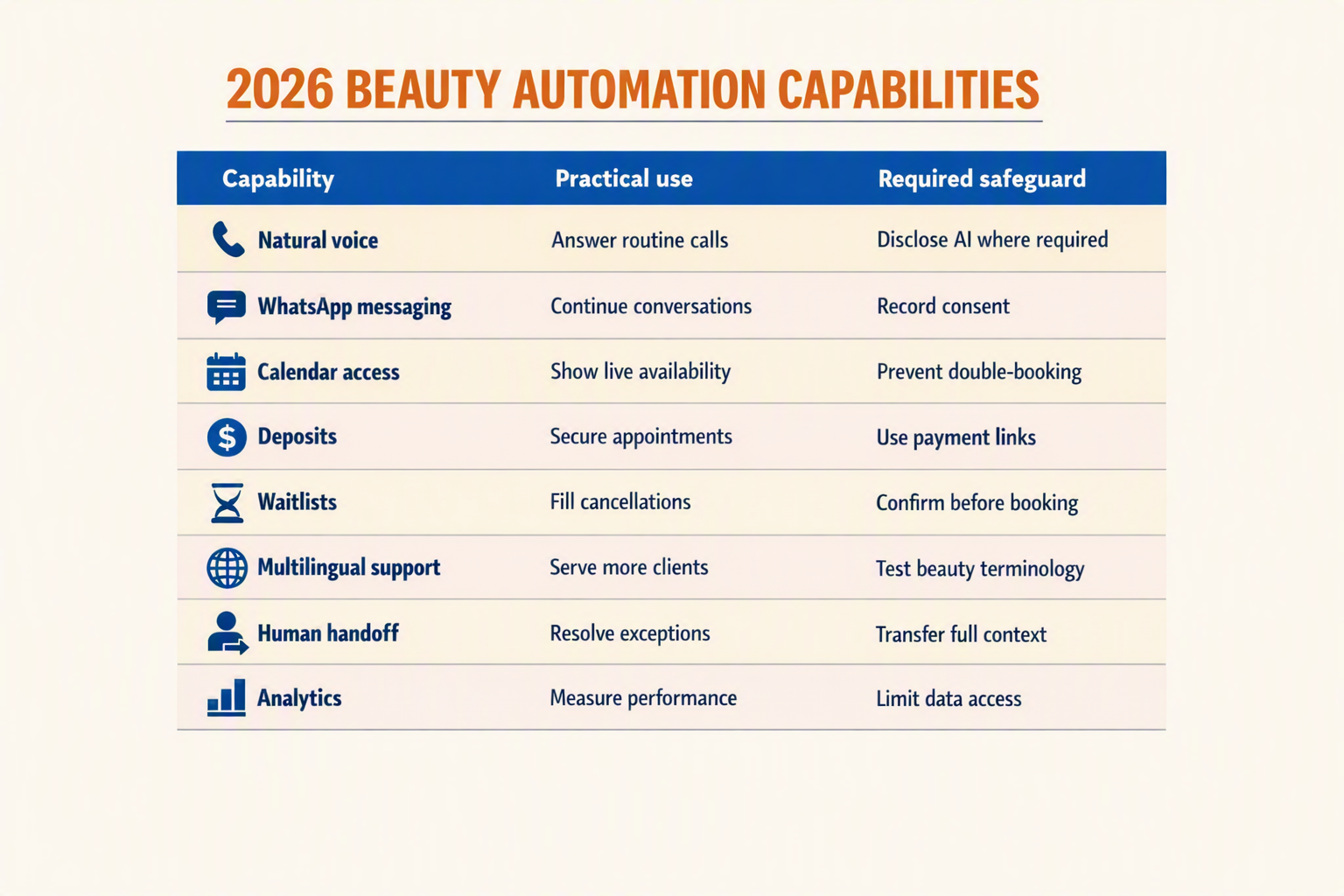
The most important 2026 capabilities are constraint-aware booking, reliable identity confirmation, consent-controlled messaging, safe payments, multilingual understanding, and immediate human handoff. An AI receptionist for salons should never confirm an appointment merely because a calendar appears free; it must validate every required person, place, asset, policy, and permission first.
Capability and safeguard checklist
| Capability | 2026 requirement | Essential safeguard | Launch acceptance test |
|---|---|---|---|
| Service selection | Identify the exact service, variant, add-ons, duration, price range and consultation requirement from voice or WhatsApp | Do not infer suitability for treatments involving allergies, pregnancy, medication, skin conditions or chemical exposure | Test ambiguous requests such as “hair colour” versus “root touch-up” and require clarification before showing slots |
| Staff and location matching | Filter by professional skills, branch, working hours, gender preference where requested, room, chair and equipment availability | Never promise a named professional or branch until all resources are locked | Attempt simultaneous bookings for the same stylist and confirm that only one transaction succeeds |
| Booking and rescheduling | Create, modify and cancel appointments through the source-of-truth scheduling system | Use idempotency keys, conflict checks and explicit customer confirmation to prevent duplicate or unintended changes | Repeat the same voice or message request twice; the system should create only one booking |
| Deposits and payments | Generate a secure payment link, track expiry and confirm the slot only under the business’s deposit policy | Never collect or repeat complete card details in chat, transcripts or call recordings | PCI Security Standards Council states that PCI DSS v4.0.1 future-dated requirements became effective on 31 March 2025; verify that payment data stays with the compliant payment provider |
| Consent and promotions | Separate appointment messages from promotional campaigns and preserve channel-specific consent records | Record consent source, purpose, timestamp and opt-out status; suppress marketing immediately after withdrawal | Send “STOP” or the configured opt-out phrase and verify removal across WhatsApp, SMS, email and CRM campaign lists |
| Escalation and privacy | Transfer complaints, contraindications, complex consultations, refunds and low-confidence requests with context | Minimise stored data, disclose recording where required and restrict transcript access by role | Trigger a severe allergy disclosure and confirm that automation stops, staff receive a summary and no treatment recommendation is generated |
Non-negotiable operational controls
A production salon appointment booking AI should also enforce these controls:
- Confidence-based clarification: Low-confidence service names, dates, branch names and staff names must be repeated for confirmation rather than guessed.
- Transactional integrity: Hold a slot briefly while a deposit is pending, then release it automatically when the payment window expires.
- Consent separation: Meta’s WhatsApp Business Platform distinguishes customer-service conversations from business-initiated messaging; businesses should apply Meta’s current template, category and permission rules rather than treating an earlier enquiry as permanent marketing consent.
- Privacy by design: India’s Digital Personal Data Protection Act, 2023 establishes requirements around lawful processing, notice, security safeguards and withdrawal of consent. Beauty businesses should collect only information needed for the booking or safe handoff and define retention periods for recordings and transcripts.
- Human override: Staff need one-click takeover, appointment correction and automation pause controls, with an audit trail showing what the customer, AI and employee changed.
Multilingual and channel-specific testing
For regional operations, spa WhatsApp automation and phone agents should be tested with code-switching, accents, local service terminology and names—not merely translated scripts. Indian platforms such as CallMissed support voice and chat across 22 Indian languages, enabling businesses to design Indic-language journeys while retaining human escalation.
Before launch, test at least 50–100 anonymised or synthetic conversations per major workflow, including noisy calls, interrupted payments, closed branches, unavailable therapists and contradictory customer instructions. These are recommended implementation targets, not universal benchmarks; the release decision should depend on zero unsafe confirmations and consistently accurate handoffs.
How should salon appointment booking AI select the right service, duration, staff member and location before confirming a booking?
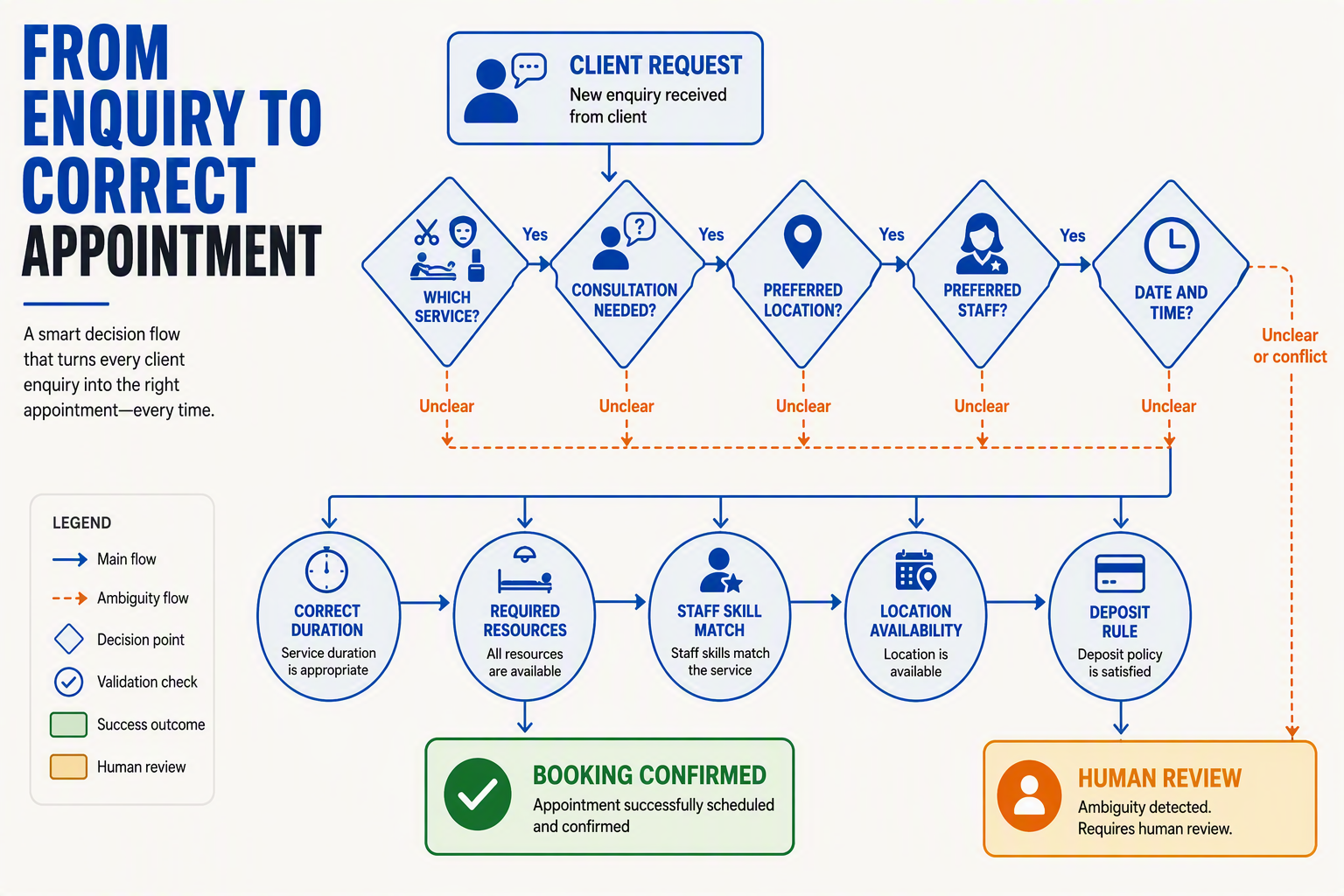
A salon appointment booking AI should confirm a booking only after resolving four linked variables: the exact service, its total duration, an eligible staff member, and a location with the necessary resources. Availability alone is insufficient; the selected slot must satisfy every rule simultaneously.
1. Resolve the service before checking the calendar
The AI receptionist for salons should translate natural-language requests into a structured service ID. “Highlights” could mean a partial highlight, full-head highlight, balayage, or colour correction—each requiring different skills, products, prices, and appointment lengths.
The AI should ask the minimum clarifying questions needed:
- What result or treatment does the customer want?
- What is the customer’s hair length, skin concern, or treatment area?
- Is this a first visit, maintenance appointment, or corrective treatment?
- Are add-ons such as toner, nail art, blow-dry, or extra massage time required?
- Does the service require a consultation, patch test, or medical screening?
High-risk or ambiguous requests—including severe skin reactions, pregnancy-related contraindications, colour correction, and bridal packages—should go to a trained employee rather than being inferred automatically.
2. Calculate the complete appointment duration
Duration should come from the service catalogue, not from a language model’s estimate. The scheduling engine must calculate:
Total blocked time = base service + customer-specific adjustment + add-ons + processing time + cleanup or turnaround buffer
For example, an illustrative full-colour booking might require 30 minutes for application, 45 minutes for processing, 30 minutes for washing and finishing, and a 15-minute buffer. The system may allow the stylist to serve another customer during processing only if the salon’s operational rules explicitly permit parallel bookings.
Duration rules should account for:
- Hair length, density, treatment area, or design complexity
- First-visit consultation time
- Room preparation and equipment sanitisation
- Staff breaks and branch closing time
- Add-ons performed sequentially or by another professional
- Buffers between massage, facial, waxing, or nail appointments
3. Match staff by eligibility, not merely availability
The booking AI should filter staff in a fixed order:
- Required qualification: colourist, barber, nail technician, aesthetician, or massage therapist.
- Service proficiency: whether the employee is authorised for that specific catalogue item.
- Schedule eligibility: shift, breaks, leave, and existing appointments.
- Customer preference: named professional, gender preference, language, or continuity with a previous provider.
- Commercial rules: staff-specific pricing, junior/senior tiers, commissions, and permitted discounts.
If the preferred professional is unavailable, the AI should offer transparent choices: another qualified employee at the same branch, the preferred employee at another time, or an alternative location. It should never silently substitute staff.
4. Validate location and physical resources
For multi-location businesses, the system must verify more than branch opening hours. A valid location needs the appropriate treatment room, chair, bed, machine, product inventory, accessibility provision, and staff member for the entire appointment.
Spa WhatsApp automation can present concise options such as:
- “Priya at Indiranagar, Tuesday at 3:00 p.m.”
- “Priya at Koramangala, Tuesday at 5:30 p.m.”
- “Asha, another senior colourist, at Indiranagar at 4:00 p.m.”
Before confirmation, repeat the service, add-ons, duration, staff member, branch, date, time, price or estimate, deposit, and cancellation policy. Create the appointment only after the customer explicitly accepts—and recheck availability immediately before writing it to the booking system to prevent double-booking.
How should automation handle rescheduling, cancellations, deposits, waitlists, salon missed call recovery, consent-based promotions and human handoff?
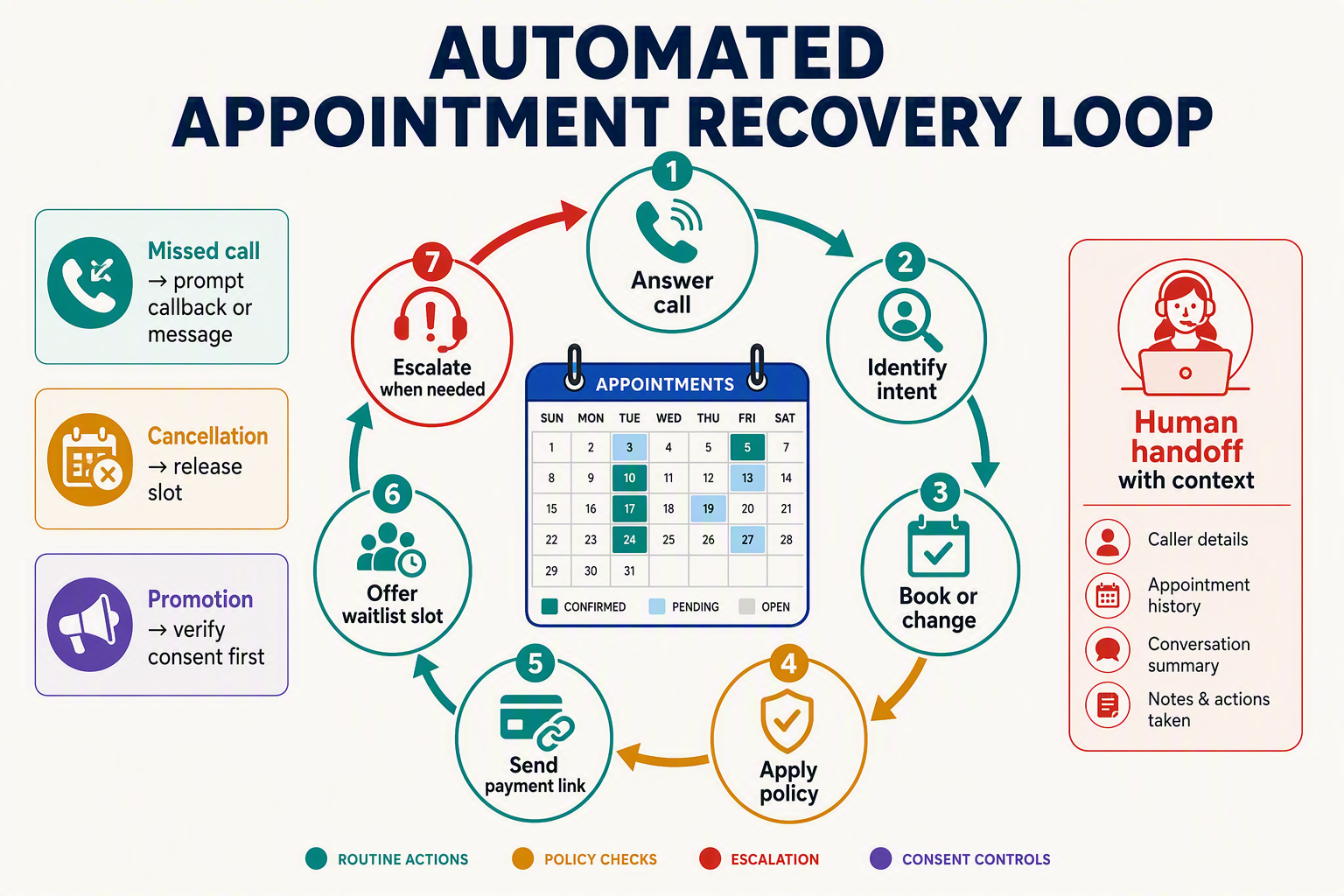
Automation should execute routine policy-based changes immediately, but escalate exceptions involving money, safety, complaints, or professional judgement. Every action should update the booking system atomically, notify the client, preserve consent records, and provide staff with a complete conversation summary.
Rescheduling and cancellations
A salon appointment booking AI should verify the customer using a booking reference or confirmed phone number before exposing appointment details. It should then apply the same availability constraints used for new bookings: service duration, staff skills, branch, room, equipment, preparation buffers, and opening hours.
Use a deterministic sequence:
- Retrieve the existing appointment and applicable policy.
- Offer three to five valid alternatives, retaining the preferred professional or location where possible.
- Explain any fee or deposit consequence before requesting confirmation.
- Move or cancel the booking only after explicit customer approval.
- send confirmations through the customer’s active channel and update calendars immediately.
Never create a replacement appointment before releasing or securely holding the original slot; otherwise, concurrent requests can produce duplicate bookings.
Deposits, refunds, and waitlists
Deposit rules should be stored as structured data rather than buried in prompts. Configure the amount, payment deadline, refund eligibility, cancellation window, and whether the deposit transfers when an appointment is moved.
The AI receptionist for salons may issue an approved payment link and report payment status, but it should not collect card details in free-form voice or WhatsApp messages. Escalate disputed charges, partial refunds, repeated payment failures, and policy exceptions to authorised staff.
Waitlist automation should capture:
- Acceptable dates and time ranges
- Preferred and alternative professionals
- Branch flexibility
- Minimum notice required
- Service and add-on requirements
- Permission to contact the customer about an opening
When a slot opens, offer it for a defined period rather than simultaneously confirming multiple customers. If the first customer does not accept before expiry, continue through the ranked waitlist.
Missed-call recovery and consent-based promotions
A salon missed call recovery workflow should return the call or send a WhatsApp message promptly, identify the business, explain that the customer’s call was missed, and ask how it can help. The response should remain transactional: “We missed your call about an appointment” is not permission to send future discounts.
For spa WhatsApp automation, maintain separate records for:
- Service consent: replies about an enquiry, booking, payment, or visit
- Marketing consent: permission for offers, packages, and re-engagement campaigns
- Channel preference: WhatsApp, voice, email, or SMS
- Consent evidence: wording, source, date, time, and withdrawal status
Promotional messages should be sent only to customers with valid marketing permission, within the applicable WhatsApp Business messaging rules and local privacy law. Every campaign should provide a simple opt-out, and withdrawal must suppress future promotions without blocking essential appointment updates.
Human handoff rules
Automation must transfer the conversation when confidence is low or the request exceeds an approved policy. Mandatory handoff triggers should include:
- Allergies, injuries, pregnancy-related concerns, or treatment contraindications
- Colour corrections, bridal packages, and services requiring consultation
- Complaints, refund disputes, or requests for compensation
- Repeated misunderstanding, emotional distress, or an explicit request for a person
- No valid staff, room, location, or payment outcome
Platforms such as CallMissed can bridge AI voice interactions and WhatsApp workflows, but the operational design remains critical. A useful handoff should include the customer’s identity, requested outcome, booking details, detected urgency, actions already attempted, and a transcript or concise summary—so staff continue the conversation instead of forcing the customer to start again.
Which booking, CRM, payment, telephony and WhatsApp integrations are required, and how should you roll them out safely?
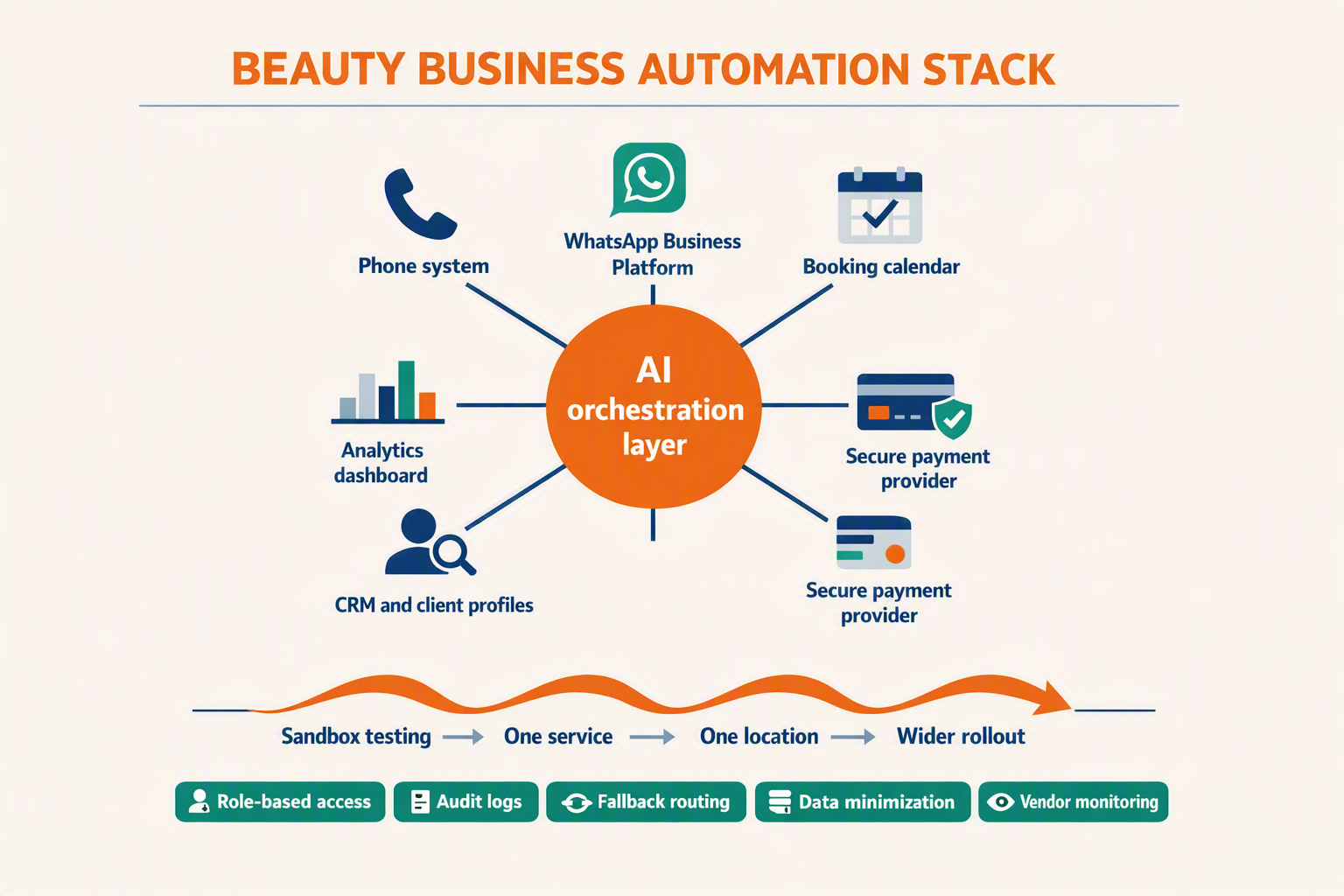
The required integration stack has five layers: booking software as the source of truth, CRM for customer context, payment links for deposits, telephony for calls, and the WhatsApp Business Platform for messaging and calling. Roll them out read-only first, then permit narrowly scoped writes after sandbox, staff-assisted, and limited-location testing.
Define one system of record
A salon appointment booking AI should never maintain a separate calendar that can drift from the front desk. Designate software such as Fresha, Mindbody, Zenoti, Boulevard, or the salon’s existing booking platform as the authoritative source for:
- Services, durations, buffers, prices, and add-ons
- Staff skills, schedules, leave, and branch assignments
- Rooms, chairs, equipment, and simultaneous-use limits
- Appointment status, deposits, cancellations, and no-shows
Before selecting a platform, verify that its API supports real-time availability, booking creation, modification, cancellation, and webhooks. If write APIs are unavailable, the AI receptionist for salons should collect the request and hand it to staff rather than simulate confirmation.
The CRM should retain consent, preferences, conversation history, and customer identity—not independently control availability. Use a stable customer ID and normalize phone numbers to E.164 format so phone, WhatsApp, booking, and CRM records resolve to the same person.
Connect payments without handling card data
Integrate providers such as Razorpay or Stripe through hosted payment links. The AI can create a deposit request and monitor the provider’s signed webhook, but it should never ask customers to dictate full card details or store sensitive payment credentials.
A safe deposit workflow is:
- Create a provisional appointment with a short expiry.
- Generate a payment link containing an order reference—not sensitive client notes.
- Confirm the appointment only after a verified
payment_succeededevent. - Release the slot automatically when payment expires or fails.
- Route refunds and disputed charges to authorized staff.
This approach reduces exposure to payment data and helps keep the salon’s systems outside unnecessary PCI DSS scope.
Treat phone and WhatsApp as connected channels
Telephony should support inbound numbers, call transfer, recording controls, business-hours routing, and event webhooks. WhatsApp integration should use the official WhatsApp Business Platform, approved message templates where required, and separate records for service messages and promotional consent.
Meta CEO Mark Zuckerberg announced in April 2025 that WhatsApp had exceeded 3 billion monthly active users worldwide, making channel identity and consent controls operational necessities rather than edge cases.
For Indian businesses, CallMissed can connect AI voice agents, WhatsApp chat, and WhatsApp Business calls while supporting 22 Indian languages. This can make spa WhatsApp automation consistent across a call, a follow-up message, and a staff handoff without forcing the customer to repeat the request.
Roll out writes progressively
Use the following deployment sequence:
- Observe: Read availability and draft responses without changing records.
- Assist: Let staff approve proposed bookings, reschedules, and cancellations.
- Limit: Enable automatic writes for simple services at one branch.
- Expand: Add deposits, waitlists, multi-location matching, and missed-call recovery.
- Audit: Review failures, duplicate bookings, webhook delays, consent errors, and handoff accuracy weekly.
Every write operation should use idempotency keys, timestamped audit logs, role-based access control, encrypted connections, and verified webhook signatures. Maintain a kill switch that immediately changes automation from “book” to “collect and hand off” if the booking API, payment gateway, telephony provider, or WhatsApp service becomes unreliable.
Which operational, revenue and customer-experience KPIs prove the automation is working?
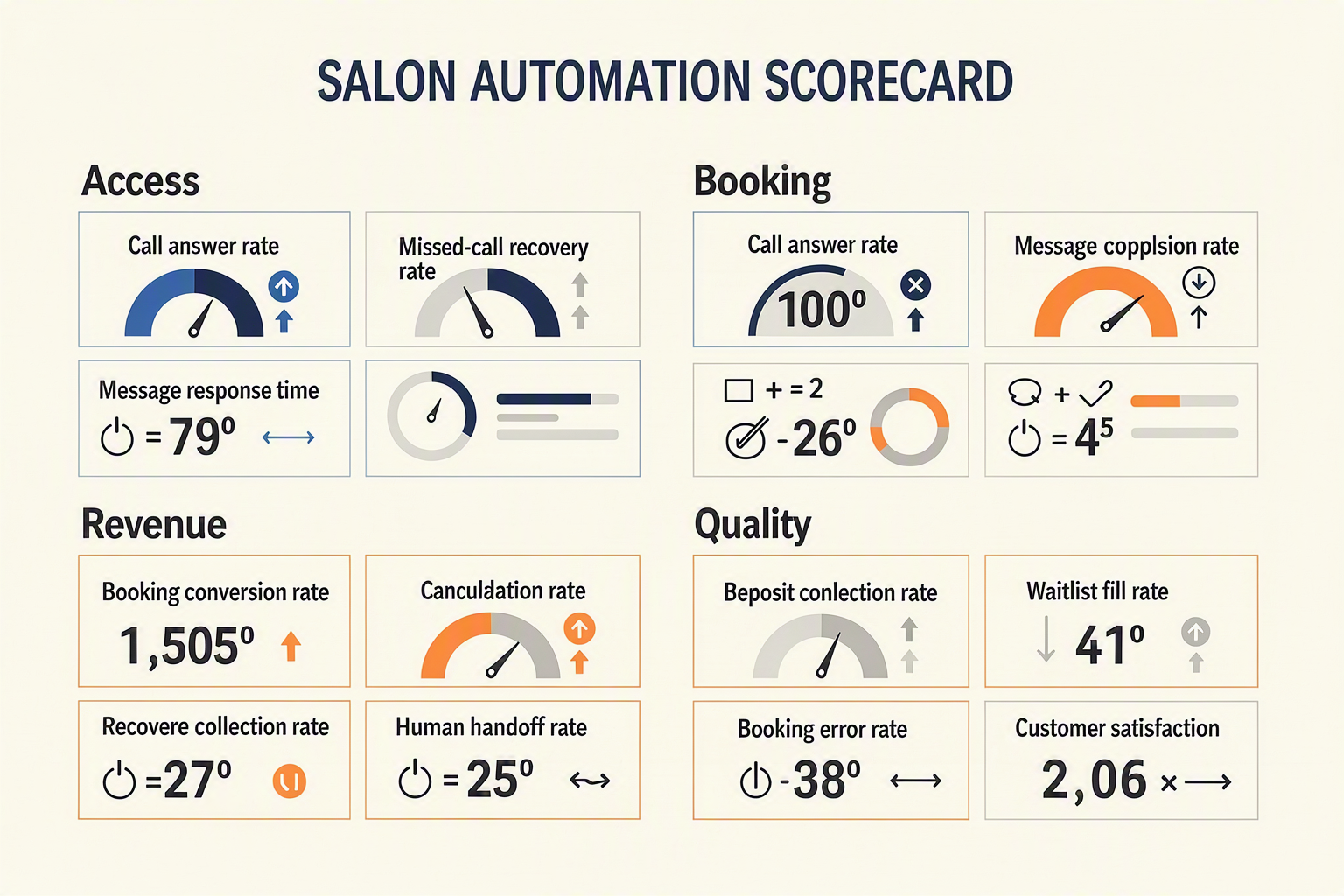
Automation is working when it converts more enquiries into valid, attended appointments while reducing front-desk workload without increasing errors or complaints. Measure operational efficiency, revenue impact, and customer experience together; a high containment rate is meaningless if the AI receptionist for salons books unsuitable services or frustrates clients.
Operational KPIs: Is the workflow reliable?
Establish a four-week human-operated baseline before launch, then compare equivalent branches, opening hours, and demand periods.
- Answer rate: answered phone and WhatsApp enquiries ÷ total inbound enquiries. Report business-hours and after-hours performance separately.
- Automation containment rate: enquiries completed without staff intervention ÷ automation-handled enquiries. Break this down by booking, rescheduling, cancellation, FAQ, and waitlist workflows.
- Booking completion rate: confirmed appointments ÷ booking conversations started. A “confirmed” booking should have a valid service, staff member, location, date, time, and required deposit status.
- Matching accuracy: audited bookings with the correct service duration, staff skill, branch, room, and equipment ÷ audited automated bookings.
- Handoff accuracy: cases correctly escalated under policy ÷ cases requiring escalation. Allergies, contraindications, complaints, bridal packages, colour corrections, and ambiguous requests should be audited separately.
- Median response time: measure the time to first response on both phone and WhatsApp, plus the time from enquiry to confirmed appointment.
- Rescheduling success rate: completed changes ÷ valid rescheduling requests.
- Integration failure rate: failed calendar writes, duplicate records, payment errors, or message-delivery failures ÷ attempted transactions.
For salon missed call recovery, track the percentage of unanswered calls receiving an approved callback or consent-aware WhatsApp follow-up, followed by the percentage that become confirmed appointments.
Revenue KPIs: Does automation create incremental value?
Do not report every automated booking as new revenue. Separate influenced revenue from genuinely incremental revenue using source tags and pre-launch comparisons.
- Enquiry-to-booking conversion = confirmed bookings ÷ qualified enquiries.
- Recovered revenue = attended appointment value originating from missed-call, abandoned-chat, or waitlist recovery.
- After-hours revenue = attended appointment value from enquiries initiated outside staffed hours.
- Deposit collection rate = bookings requiring deposits with successful payment ÷ all bookings requiring deposits.
- No-show rate = unattended appointments without timely cancellation ÷ confirmed appointments.
- Revenue per enquiry = attended revenue ÷ total inbound enquiries.
- Net automation ROI = incremental gross profit plus labour capacity saved, minus software, telephony, messaging, integration, and support costs.
A salon appointment booking AI should also be evaluated by service mix. Higher conversion is not beneficial if it pushes clients toward shorter or ineligible services, omits profitable add-ons, or creates unusable gaps in staff calendars.
Customer-experience KPIs: Are clients getting better service?
Measure outcomes by channel, language, branch, service category, and new-versus-returning customer status.
- Customer satisfaction: send a one-question post-interaction survey, but keep automation satisfaction separate from treatment satisfaction.
- Customer effort score: ask how easy it was to book, change, or cancel.
- Repeat-contact rate: customers contacting the business again about the same issue within 24 hours.
- Correction rate: bookings manually edited because the automation misunderstood the request.
- Complaint and opt-out rates: especially important for spa WhatsApp automation and promotional messaging.
- Abandonment rate: conversations or calls ending before completion or successful handoff.
- Language success rate: completion and correction rates for each supported language, rather than relying on an overall average.
Review a KPI dashboard weekly during rollout and monthly after stabilization. Set branch-specific targets from baseline data, investigate material deterioration immediately, and require transcript or call-sample audits before expanding automation scope.
What do salon operators and implementation experts recommend—and when is CallMissed genuinely relevant?
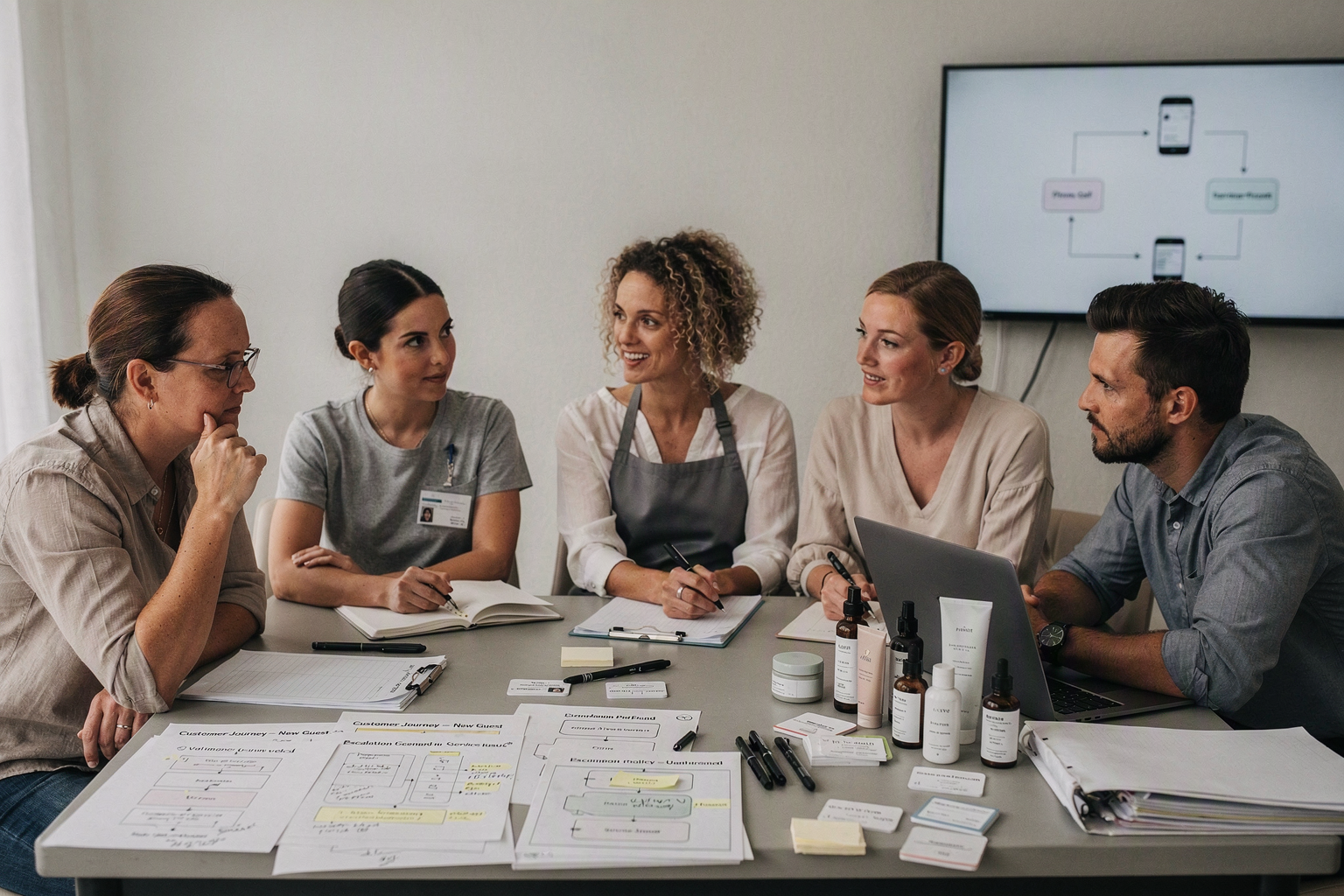
Salon operators and implementation experts recommend automating high-volume, rules-based enquiries first, while keeping people responsible for consultations, safety-sensitive services, complaints and unusual requests. CallMissed is relevant as a vendor to evaluate when a salon wants coordinated voice and WhatsApp automation, but its integrations, language coverage, consent controls and pricing should be verified directly before purchase.
What experienced operators recommend
Treat an AI receptionist for salons like a front-desk employee with documented permissions—not an unrestricted chatbot. A practical implementation follows five rules:
- Begin with predictable services. Automate bookings for services with stable prices, durations and eligibility rules, such as basic manicures, blow-dries or standard massages. Keep colour corrections, bridal packages and advanced skin treatments behind a consultation workflow.
- Create one authoritative service catalogue. Record approved service names, prices, durations, buffers, add-ons, branch availability and staff qualifications. The AI must never invent a price or promise an unavailable treatment.
- Check every required resource. A salon appointment booking AI should confirm the professional’s skills, location, room, equipment and preparation time before offering a slot.
- Make changes reversible. Rescheduling and cancellations should update the underlying booking platform immediately. Customers should receive a confirmation containing the revised date, branch, service, professional and deposit status.
- Review failures weekly. Inspect misunderstood service names, unsuccessful slot searches, incorrect handoffs, abandoned deposits and duplicate bookings. Update prompts and operational data based on recurring problems.
A one-branch or one-service pilot makes it easier to distinguish AI errors from inaccurate calendars, inconsistent service definitions or staff processes.
Where automation should stop
Mandatory human handoff is appropriate for allergies, adverse reactions, pregnancy-related questions, contraindications, complaints and bespoke pricing. Requests involving major transformations, photographs or professional assessment should also move to qualified staff.
The handoff must preserve context. Staff should receive:
- Customer name and preferred contact channel.
- Requested service, branch, date and professional.
- Answers already supplied by the customer.
- Existing booking reference and deposit status.
- Reason for escalation and any provisional slot.
Spa WhatsApp automation should also distinguish transactional communication from marketing. Appointment confirmations and customer-requested updates are operational messages; promotions require recorded consent, appropriate templates where applicable and a clear opt-out process.
When CallMissed belongs on the shortlist
CallMissed is genuinely relevant to evaluate when a salon, spa or beauty chain is considering multichannel automation across phone and WhatsApp rather than purchasing only a web-booking widget. It may also merit evaluation when the intended workflow includes salon missed call recovery, booking follow-ups or a shared transition between automated and human conversations.
Do not assume that a marketing description guarantees compatibility. Ask CallMissed—and every shortlisted vendor—to demonstrate:
- Booking integration: Can it read and write appointments, staff calendars, locations, deposits, cancellations and waitlists in the salon’s system?
- Language performance: Which languages are supported for voice and messaging, and how accurately does the system handle local accents, mixed-language speech and beauty-service terminology?
- WhatsApp scope: Which messaging or calling workflows are available, and what Meta approvals, templates or account configurations are required?
- Consent and governance: How are promotional consent, opt-outs, recordings, retention periods, role-based access and audit logs managed?
- Commercial terms: What are the platform, telephony, WhatsApp, model-usage, implementation and support charges?
Run a controlled proof of concept using real service names and calendars. Measure booking completion, transfer rate, scheduling errors, missed-call recovery and customer opt-outs before committing to a broader rollout.
What does each implementation phase mean for owners, managers, receptionists and service professionals?
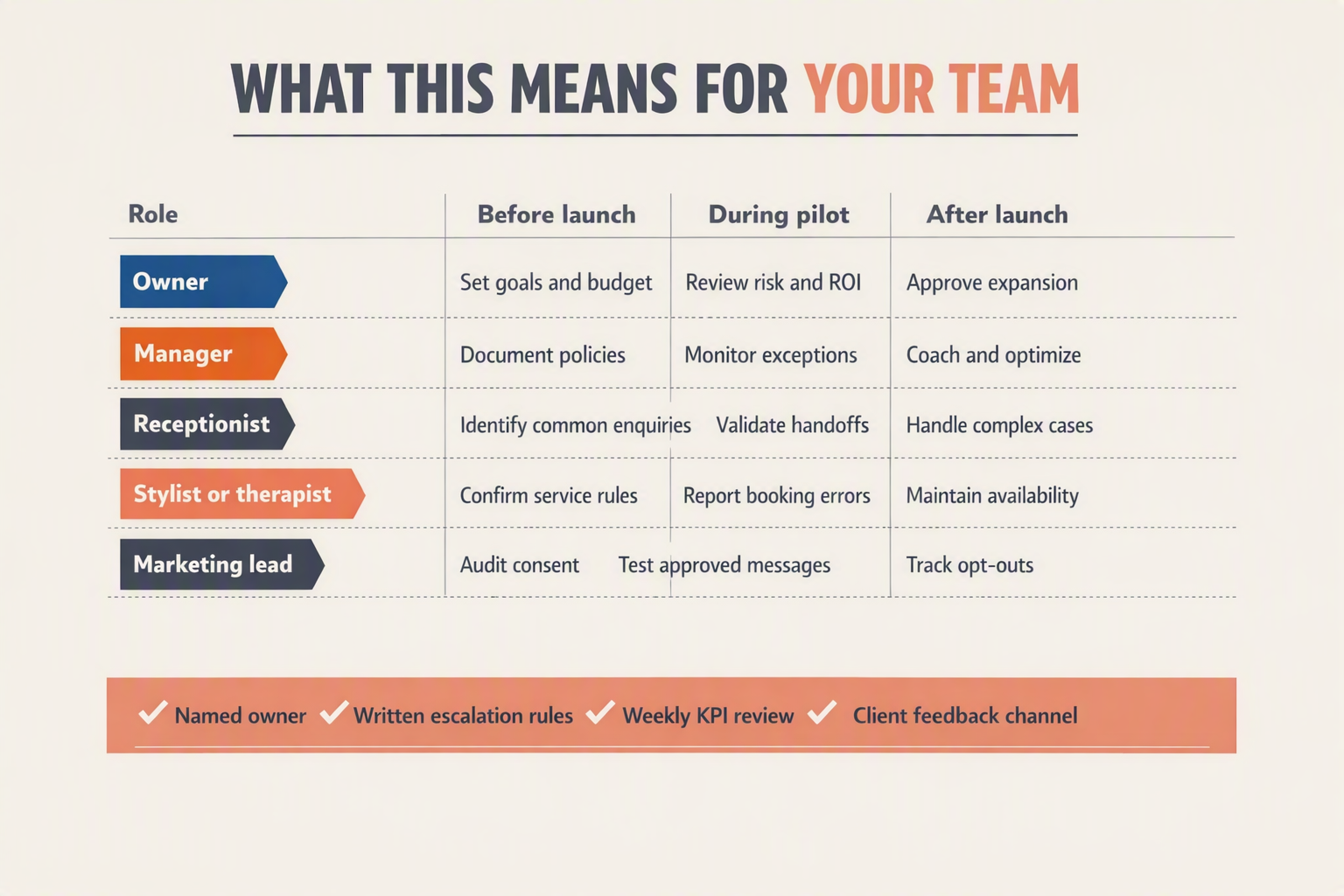
An AI receptionist for salons changes each role differently: owners set risk and commercial goals, managers translate policies into workflows, receptionists supervise exceptions, and service professionals validate whether bookings are operationally realistic. Implementation succeeds when responsibilities shift deliberately rather than when software is simply switched on.
Role responsibilities by implementation phase
| Phase | Owner | Manager | Receptionist | Service professional |
|---|---|---|---|---|
| 1. Discovery and baseline | Define objectives, budget, branches and acceptable risk. Approve KPIs such as booking conversion, no-shows and recovered revenue. | Audit call reasons, WhatsApp enquiries, peak periods and booking failures for 2–4 weeks. | Record common questions, manual workarounds and situations requiring judgement. | Explain actual service durations, preparation needs, cleanup time, equipment and contraindications. |
| 2. Workflow and policy design | Approve deposit, cancellation, refund, privacy and marketing-consent policies. | Convert policies into decision trees for service selection, staff and location matching, rescheduling and waitlists. | Write natural responses and define when the AI must transfer, create a task or request a callback. | Validate qualification rules, patch-test requirements, consultation triggers and unsafe combinations. |
| 3. Integration and configuration | Authorize access to telephony, WhatsApp Business, CRM, payments and scheduling systems. | Own field mapping for customer, service, branch, staff, room, deposit and appointment status. | Check that live calendars, customer notes and handoff alerts appear in existing tools. | Confirm working hours, breaks, leave, buffers and branch assignments before availability is exposed. |
| 4. Testing and training | Set launch gates and nominate an accountable system owner. | Run test scenarios across calls, messages, bookings, cancellations and failed payments. | Test accents, interruptions, ambiguous requests, angry callers and assisted handoffs. | Attempt difficult cases such as colour correction, bridal services, allergies and multi-service bookings. |
| 5. Controlled launch | Approve one branch, service group or after-hours window before wider deployment. | Monitor transcripts, booking errors, escalation queues and integration failures daily. | Supervise conversations and correct records without duplicating appointments. | Report unrealistic timing, unsuitable matches or missing preparation instructions immediately. |
| 6. Optimization and scale | Compare commercial results with the approved baseline before funding expansion. | Review KPIs weekly, update rules and maintain version-controlled service data. | Identify repetitive exceptions that can safely become automated workflows. | Revalidate timings, skills and safety rules whenever menus, staff or equipment change. |
What changes—and what should not
The owner remains accountable for customer outcomes and legal risk; the AI vendor does not become the policy owner. Managers should control the source of truth for prices, durations and eligibility rather than allowing separate phone, WhatsApp and calendar configurations to drift.
Receptionists move from repeatedly answering routine questions to exception management. Their new queue may include:
- Low-confidence service matches
- Deposit or payment failures
- Complaints and refund requests
- Allergy, pregnancy or contraindication disclosures
- VIP, bridal and complex consultation requests
Service professionals should not be expected to monitor every automated conversation. Their responsibility is to validate the clinical or technical constraints that a salon appointment booking AI cannot safely infer.
Define measurable acceptance gates
Before progressing between phases, managers should agree on explicit gates rather than relying on impressions. A practical pilot can require 100% correct branch, professional and service matching across critical safety scenarios, zero double-bookings, and documented human handoff for every unsupported request. These are implementation targets, not industry benchmarks.
Channel ownership also matters. Meta CEO Mark Zuckerberg announced in April 2025 that WhatsApp had exceeded 3 billion monthly active users worldwide, making spa WhatsApp automation a material operational channel rather than a side project. Assign one manager to govern templates, consent, transactional notifications and promotions, while reception retains authority to intervene whenever automation could damage trust.
Frequently asked questions about salon and spa AI automation: accuracy, deposits, consent, integrations, costs, rollout time, multilingual service and human escalation
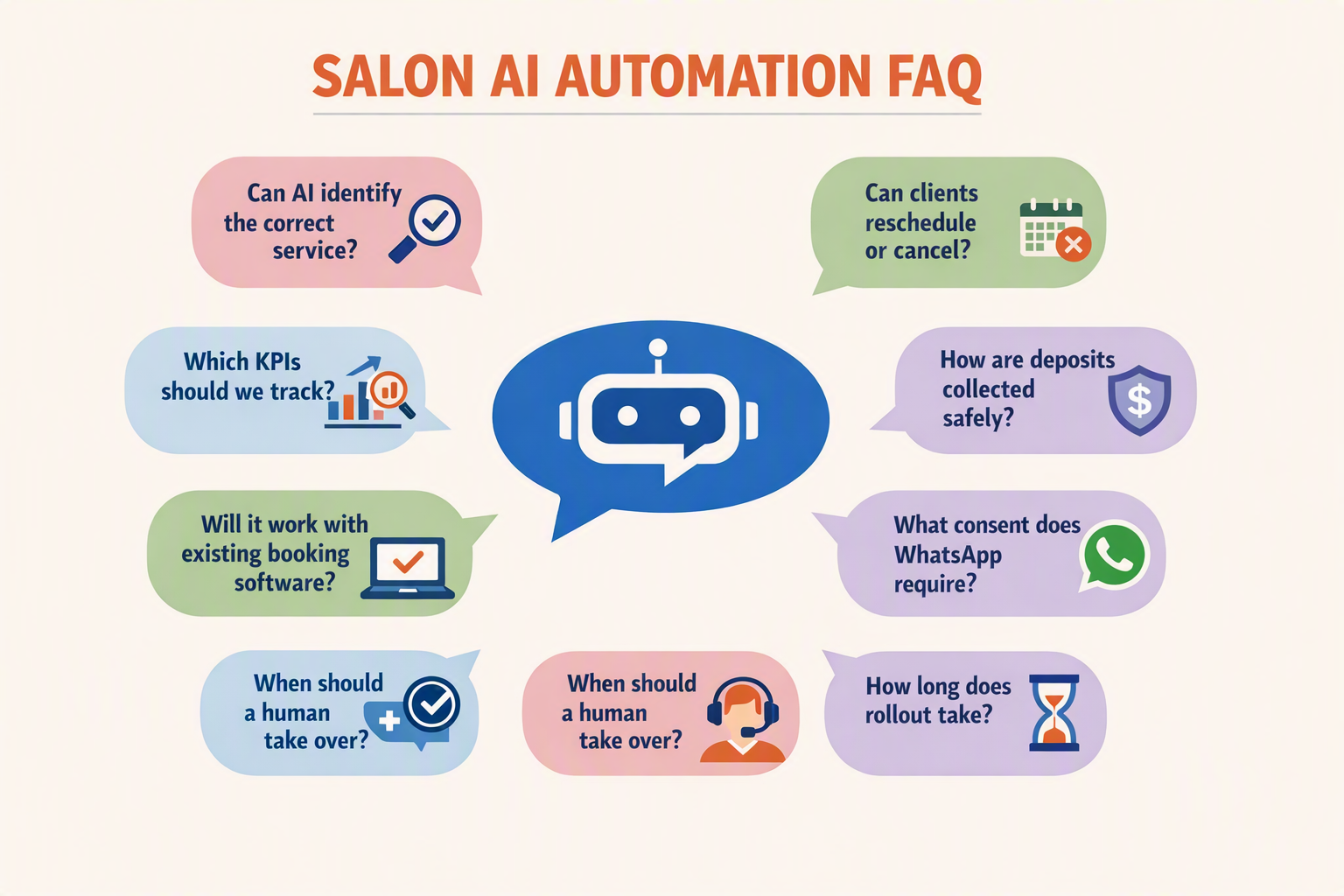
How accurate is an AI receptionist for salons when booking complex beauty services?
Can salon appointment booking AI collect deposits and reduce no-shows?
What consent is required for spa WhatsApp automation and promotional messages?
Which systems should a salon AI receptionist integrate with?
How much does salon automation cost, and how long does rollout take in 2026?
Can an AI receptionist provide multilingual service and transfer customers to humans?
Conclusion
An AI receptionist for salons works best as a carefully governed extension of the front desk—not as a replacement for personal hospitality. In 2026, the strongest implementations will combine accurate phone and WhatsApp responses with structured booking rules, dependable integrations, and timely human intervention.
Key takeaways include:
- Structure services before automating: Define durations, prices, add-ons, preparation requirements, deposits, eligibility rules, and cases requiring consultation.
- Match every booking correctly: A salon appointment booking AI should verify staff skills, location, room or equipment availability, and customer preferences before confirming an appointment.
- Design the full customer journey: Effective spa WhatsApp automation covers bookings, rescheduling, cancellations, waitlists, consent-aware promotions, and salon missed call recovery.
- Launch in phases and measure outcomes: Test real scenarios, train staff, monitor handoff accuracy, and optimize booking conversion, no-shows, containment, and revenue influenced.
The channel opportunity is substantial: Meta CEO Mark Zuckerberg announced in April 2025 that WhatsApp had exceeded 3 billion monthly active users worldwide. Looking ahead, beauty businesses should watch for tighter coordination between voice, WhatsApp Business calling, calendars, payments, CRM records, and multilingual service.
To explore this shift, visit CallMissed, which supports AI voice agents, WhatsApp engagement, and 22 Indian languages. Could your salon convert its next unanswered call into a confirmed booking?
Related Reading
Discussion
Related Posts


Ready to automate customer conversations?
Launch AI voice agents and WhatsApp bots with CallMissed — one API, 22+ Indian languages.