
AI Receptionist for Repair Shops: 2026 Implementation Guide for Appliance Service Centers


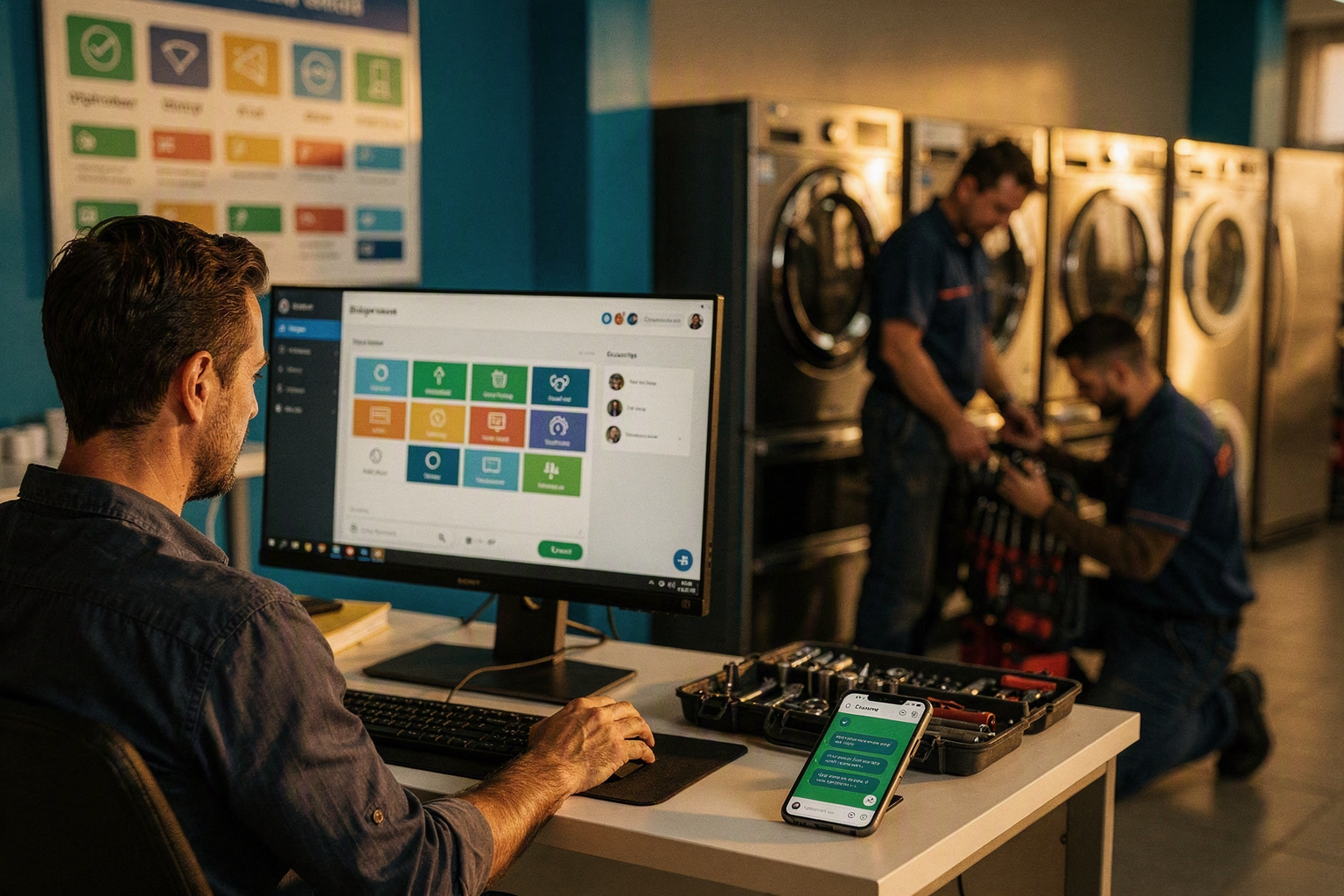
Learn how an AI receptionist for repair shops handles intake, bookings, safety escalation, integrations, WhatsApp updates and KPIs in 2026.
AI Receptionist for Repair Shops: 2026 Implementation Guide for Appliance Service Centers
What happens when a customer with a leaking washing machine calls twice, gets no answer, and books the next repair shop instead? In 2026, an AI receptionist for repair shops can prevent that lost job by answering immediately, collecting structured fault details, checking serviceability, and offering a valid appointment—even after normal business hours. This is not simply voicemail with a synthetic voice; it is an operational layer connecting every enquiry to dispatch, customer communication, and safety workflows.
The timing matters because customer conversations are rapidly moving toward AI-assisted and messaging-based service. Microsoft’s 2025 Work Trend Index reported that 81% of business leaders expected AI agents to be moderately or extensively integrated into their company’s AI strategy within 12–18 months. During Meta’s first-quarter earnings call in April 2025, CEO Mark Zuckerberg said WhatsApp had surpassed three billion monthly active users worldwide. For appliance service centers, those shifts make responsive appliance repair call answering and service center WhatsApp automation practical customer expectations rather than experimental features.
Yet repair intake is more complex than reserving a calendar slot. A useful repair booking AI must distinguish a refrigerator from a freezer, capture the brand and model number accurately, verify the customer’s postcode or PIN code, and avoid promising warranty coverage, final estimates, technician availability, or replacement parts before the relevant system confirms them. It must also recognize high-risk statements—such as “I smell gas,” “the socket is sparking,” or “the appliance is smoking”—and immediately provide approved safety guidance while escalating the call to a trained human or emergency pathway.
This guide explains how to design those workflows without creating a frustrating phone tree. You will learn how to structure job intake, validate service areas, book and reschedule visits, set warranty-status boundaries, recover missed calls, and send confirmations or technician updates through WhatsApp. It also covers multilingual conversations, CRM and field-service integration, human handoffs, phased rollout, and measurable KPIs such as answer rate, booking conversion, intake completeness, transfer rate, and no-show reduction.
For Indian service networks, language coverage is especially important: CallMissed supports speech recognition and voice generation across 22 Indian languages, while also bridging WhatsApp Business calls to AI voice agents. The goal is not to remove skilled front-desk teams; it is to give every caller a fast, accurate first response while reserving human expertise for exceptions, reassurance, diagnosis, and safety-critical decisions.
How should repair shops implement an AI receptionist in 2026? Start with bounded intake, booking, safety handoffs and job-system integration
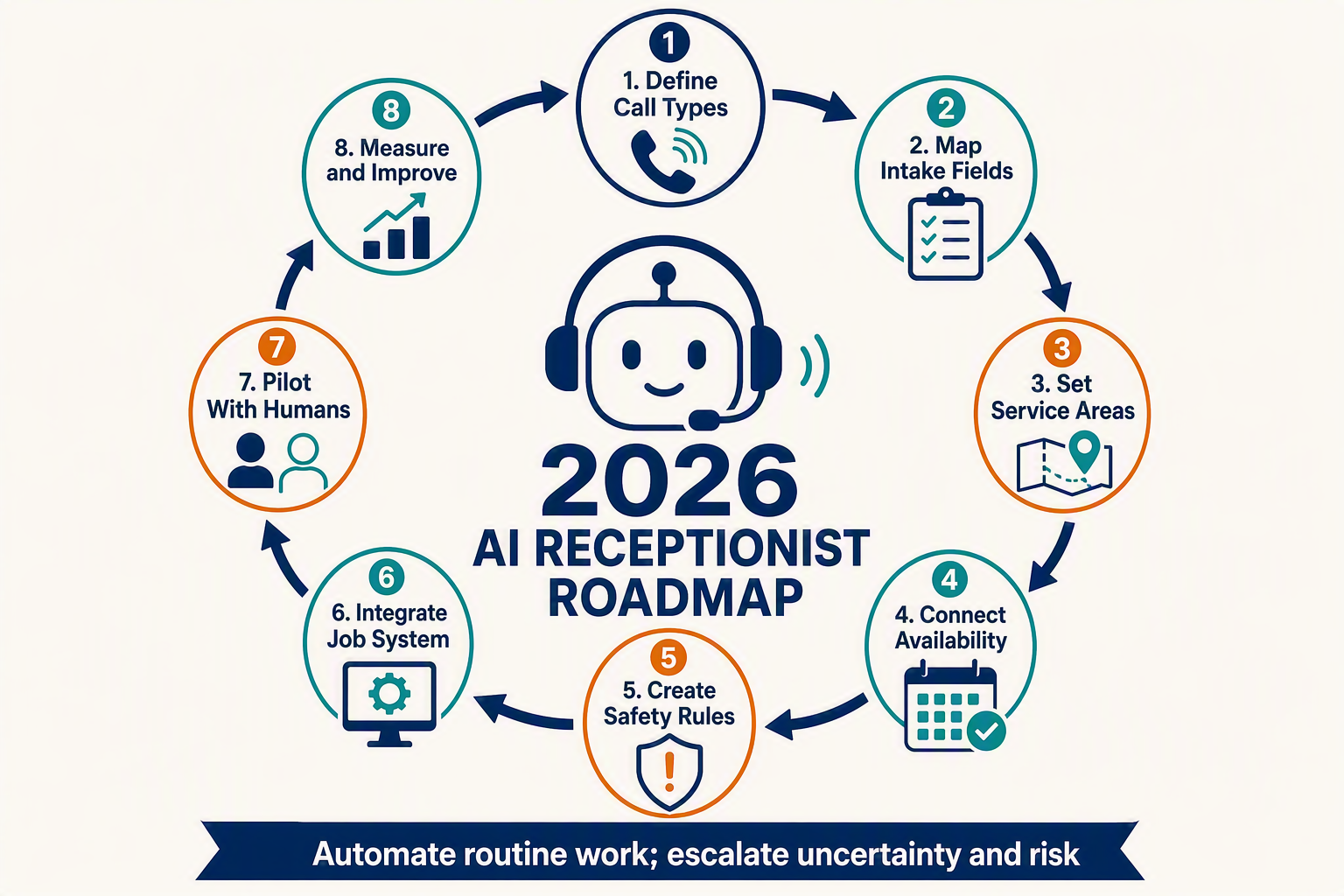
An AI receptionist for repair shops should begin with a narrow, auditable workflow: capture the request, verify service eligibility, offer only system-confirmed appointments, and escalate safety risks or uncertain cases. Connect the receptionist to the shop’s job-management system before allowing it to make commitments about warranties, prices, parts, or technician availability.
Define the receptionist’s authority
Treat the AI as an intake and scheduling operator, not an autonomous technician. Microsoft’s 2025 Work Trend Index found that 81% of business leaders expected AI agents to be moderately or extensively integrated into their AI strategy within 12–18 months, but integration should not mean unrestricted decision-making.
Create an explicit policy for what the AI may do, verify, and escalate:
- Do: identify the customer, collect the address, capture appliance details, create a provisional job, and send confirmations.
- Verify: service area, appointment capacity, existing customer records, supported appliance categories, and documented warranty status.
- Escalate: gas smells, smoke, sparks, electric shocks, flooding near electrical equipment, distressed callers, disputed warranties, and requests outside policy.
- Never assume: final repair cost, warranty eligibility, parts availability, fault diagnosis, technician arrival time, or whether an appliance is safe to continue using.
Every promise should come from a system of record or an approved rule—not from a language model’s prediction.
Design a structured intake sequence
Effective appliance repair call answering converts natural conversation into fields technicians and dispatchers can use. The minimum viable sequence is:
- Identify the customer: name, callback number, preferred language, and consent for WhatsApp or SMS updates.
- Locate the job: complete address, postcode or PIN code, landmark, property type, and access constraints.
- Capture the product: appliance category, brand, model number, serial number, approximate age, and purchase channel.
- Record the symptom: customer’s description, error code, when the problem began, and whether the appliance is still operating.
- Screen for hazards: ask concise, approved questions when the caller mentions gas, burning, smoke, sparks, shocks, or water leakage.
- Determine the next action: book, create a callback task, request a model-label photo, or transfer to a person.
Model and serial numbers should be read back character by character. When voice capture remains uncertain, service center WhatsApp automation can request a photograph of the rating plate and attach it to the same job record.
Integrate booking with operational systems
A repair booking AI should query live dispatch rules rather than maintain a separate calendar. Its integration layer should read technician skills, territories, working hours, job duration, holidays, travel buffers, and reserved emergency capacity.
Use idempotent APIs so repeated calls do not create duplicate jobs. Each interaction should store:
- A unique conversation and job ID
- Captured fields with confidence indicators
- The original transcript or recording reference
- Safety flags and transfer outcomes
- Appointment changes and customer consent
- The source of every warranty, price, or availability statement
Launch initially with one appliance category, one service region, and a limited set of appointment types. Review failed captures and human transfers weekly, expand only after intake accuracy and booking integrity meet the shop’s operating thresholds, and retain a clearly announced path to a human throughout the conversation.
Why is appliance repair call answering difficult, and which customer and job details must the AI capture?
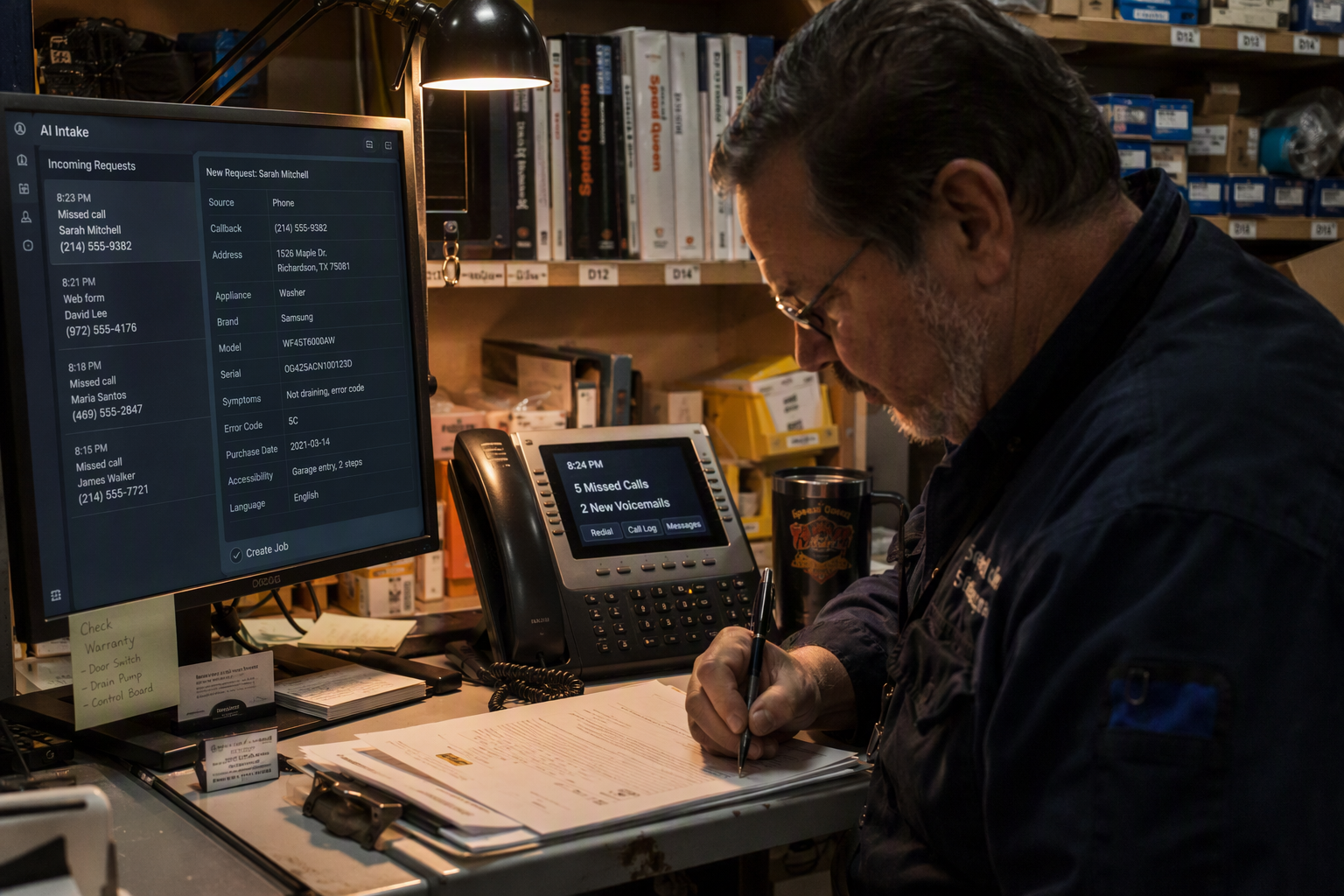
Appliance repair calls are difficult because customers describe symptoms conversationally, while dispatch teams need precise, structured data. An effective AI receptionist for repair shops must convert phrases such as “my fridge is not cooling” into a complete job record without diagnosing the fault, inventing a price, or asking an exhausting series of questions.
Why appliance-repair intake is unusually complex
A single call can involve several products, addresses, failure modes, and service constraints. “Washing machine” might mean a top-loader, front-loader, washer-dryer, or semi-automatic unit; “not working” might mean no power, a drainage failure, unusual noise, or an error code.
Appliance repair call answering must also account for:
- Noisy environments: Customers may be standing beside a running appliance or calling from a workshop.
- Model-number ambiguity: Alphanumeric identifiers such as “WT70M3000UU” are easy to mishear, especially when letters and numbers sound similar.
- Second-hand information: A landlord, tenant, family member, or office administrator may not be near the appliance.
- Multiple service locations: The caller’s current location may differ from the repair address.
- Mixed-language speech: Customers may switch languages while reading an English product label or error code.
- Premature assumptions: A symptom does not reliably establish the failed component, required part, final price, or warranty eligibility.
The AI should therefore use progressive intake: capture the minimum information needed to assess serviceability and urgency, then request deeper technical details only when relevant.
Which customer details must be captured?
Every job record should contain enough information for confirmation, routing, and technician contact:
- Customer name and preferred form of address.
- Primary phone number, plus an alternate number where useful.
- Complete service address, landmark, postcode or PIN code, city, and building-access instructions.
- Preferred communication channel, such as phone, SMS, email, or WhatsApp.
- Caller relationship to the appliance, such as owner, tenant, landlord, retailer, or facility manager.
- Consent and contact preferences for appointment updates and follow-up messages.
Because WhatsApp exceeded three billion monthly active users worldwide, according to Meta CEO Mark Zuckerberg in April 2025, a voice workflow should support a messaging fallback. Service center WhatsApp automation can ask the customer to send a photograph of the rating plate, error display, damage, invoice, or warranty document instead of dictating complex details.
Which appliance and job details are essential?
A repair booking AI should create separate fields rather than placing the entire conversation in free-form notes:
- Product category and subtype
- Brand, model number, and serial number
- Approximate purchase or installation date
- Observed symptom and when it began
- Displayed error code, captured character by character
- Intermittent or continuous failure
- Previous repair attempts or recent installation work
- Physical damage, leakage, burning smell, smoke, sparks, or suspected gas
- Warranty claim requested, without confirming coverage
- Invoice or proof-of-purchase availability
- Commercial or domestic usage
- Preferred appointment windows
Model and serial data should be read back for confirmation or validated from a customer-supplied photograph. If the identifier remains uncertain, the system should mark it unverified rather than silently guessing.
What should the AI never infer?
The receptionist should distinguish customer-reported facts from operational decisions. It must not independently promise:
- Warranty approval
- A final repair estimate
- Parts availability
- Same-day completion
- A specific diagnosis
- Technician capability for an unsupported product
For smoke, sparks, burning smells, suspected gas, or active water near electricity, normal intake must stop. The AI should deliver the company’s approved safety script, escalate immediately, and record the customer’s exact words for the human responder.
Which 2026 capabilities distinguish a useful AI receptionist from a basic answering bot?
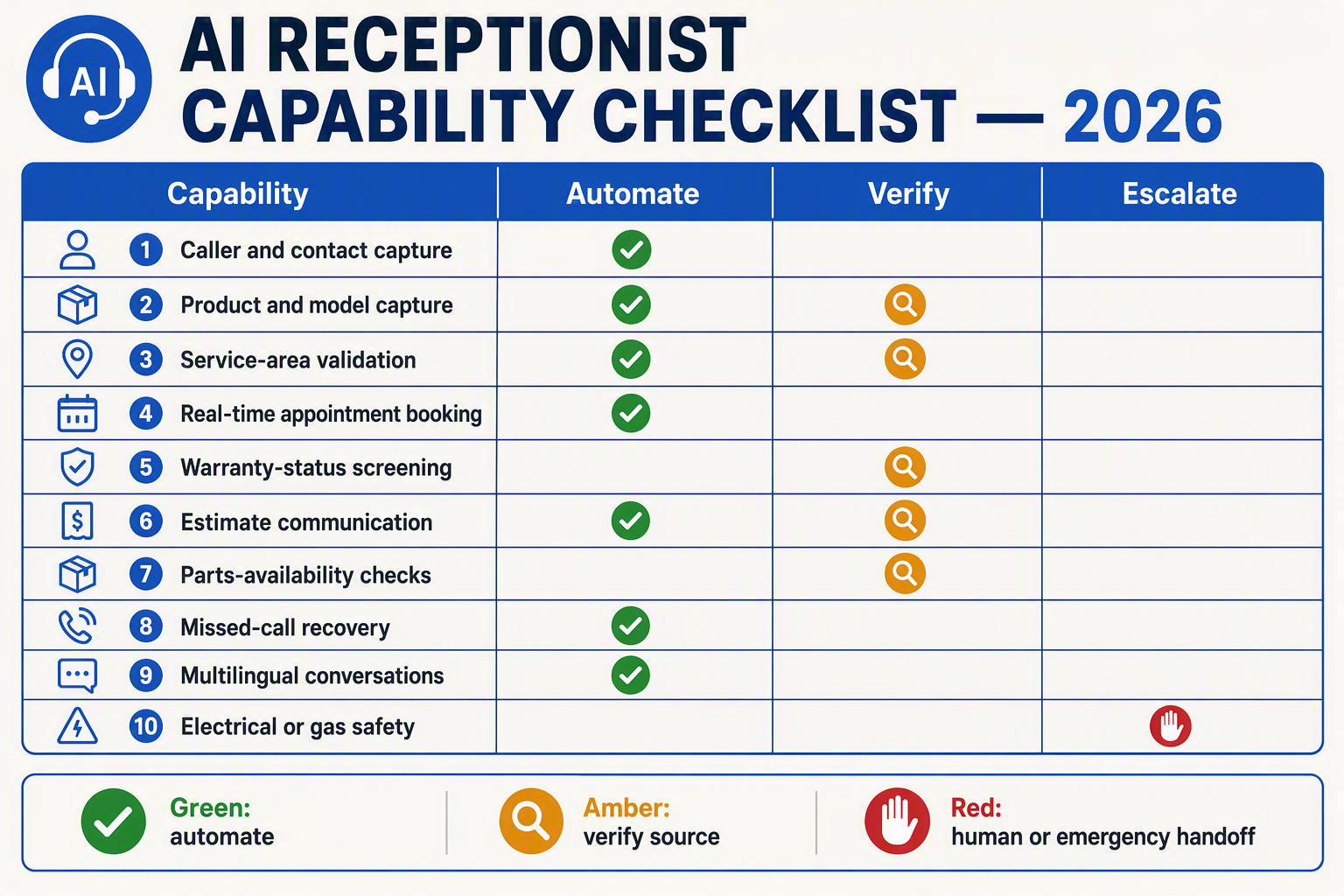
A useful AI receptionist for repair shops must complete controlled service transactions, not merely answer FAQs or forward messages. In 2026, the dividing line is whether the system can validate information against live business rules, write structured records, handle uncertainty safely, and prove what happened after each conversation.
Capability checklist: answering bot versus operational receptionist
| Capability | Basic answering bot | Useful 2026 AI receptionist | Acceptance test |
|---|---|---|---|
| Product and model capture | Stores a free-text description | Separates appliance type, brand, model, serial number and fault symptoms into structured fields; confirms ambiguous letters and digits | Correctly distinguishes “0” from “O” and requests a WhatsApp photo when voice capture is uncertain |
| Service-area validation | Asks for an address | Checks postcode or PIN code against coverage zones, technician territories, travel limits and excluded locations | Rejects an unsupported PIN code without creating a confirmed visit |
| Transactional booking | Records a preferred date | Reads live capacity, service duration, technician skills, holidays and routing constraints before reserving a slot | Prevents double-booking when two callers request the final available appointment |
| Commercial boundaries | Gives generic pricing or warranty answers | Retrieves warranty status where authorized, labels estimates as provisional, and verifies diagnostic fees and parts availability before stating them | Never presents probable warranty coverage, a price range or an unverified part as guaranteed |
| Safety and escalation | Searches an FAQ or transfers every difficult call | Detects gas smells, smoke, sparks, electric shocks and flooding; delivers an approved safety script and triggers priority escalation | A safety phrase interrupts booking immediately and creates a timestamped high-priority alert |
| Omnichannel continuity | Treats calls and messages separately | Connects voice, WhatsApp, CRM and field-service records under one job ID, with summaries, consent status and handoff context | A technician can see the caller’s transcript, model photo and confirmed slot without asking again |
What “useful” means in production
A production-grade repair booking AI should make every important action deterministic and auditable. The language model may understand a caller’s request, but APIs and business rules—not generated text—should decide whether an address is serviceable, a slot remains open, or a component is in stock.
The workflow should therefore produce:
- Structured records: required fields, validation status, confidence indicators and the source of each value.
- Controlled tool calls: explicit permissions for reading availability, creating jobs, rescheduling visits and sending messages.
- Idempotent booking: repeated requests must not create duplicate customers, appointments or payment links.
- Human-readable evidence: concise call summaries, tool results, escalation reasons and timestamps.
- Graceful recovery: if the CRM or scheduling system is unavailable, the agent should create a callback task rather than invent confirmation.
For multilingual appliance repair call answering, evaluation must cover code-switching, regional accents, model-name spelling and noisy environments—not just polished English test calls. Indian platforms such as CallMissed support speech recognition and voice generation across 22 Indian languages, making language-specific acceptance testing practical for regional service networks.
Omnichannel intelligence is another dividing line
Effective service center WhatsApp automation should continue the same job rather than start a disconnected conversation. After a call, the system can request a rating-label photo, share the appointment window, collect location details and issue rescheduling options. It must preserve consent and identity checks, however; possession of a WhatsApp number alone should not authorize warranty changes, refunds or disclosure of another customer’s repair history.
The simplest procurement test is: Can the receptionist safely complete and document a valid job when systems work—and decline, recover or escalate when they do not? If not, it remains an answering bot rather than operational infrastructure.
How should a repair booking AI move a customer from first contact to a confirmed appointment?
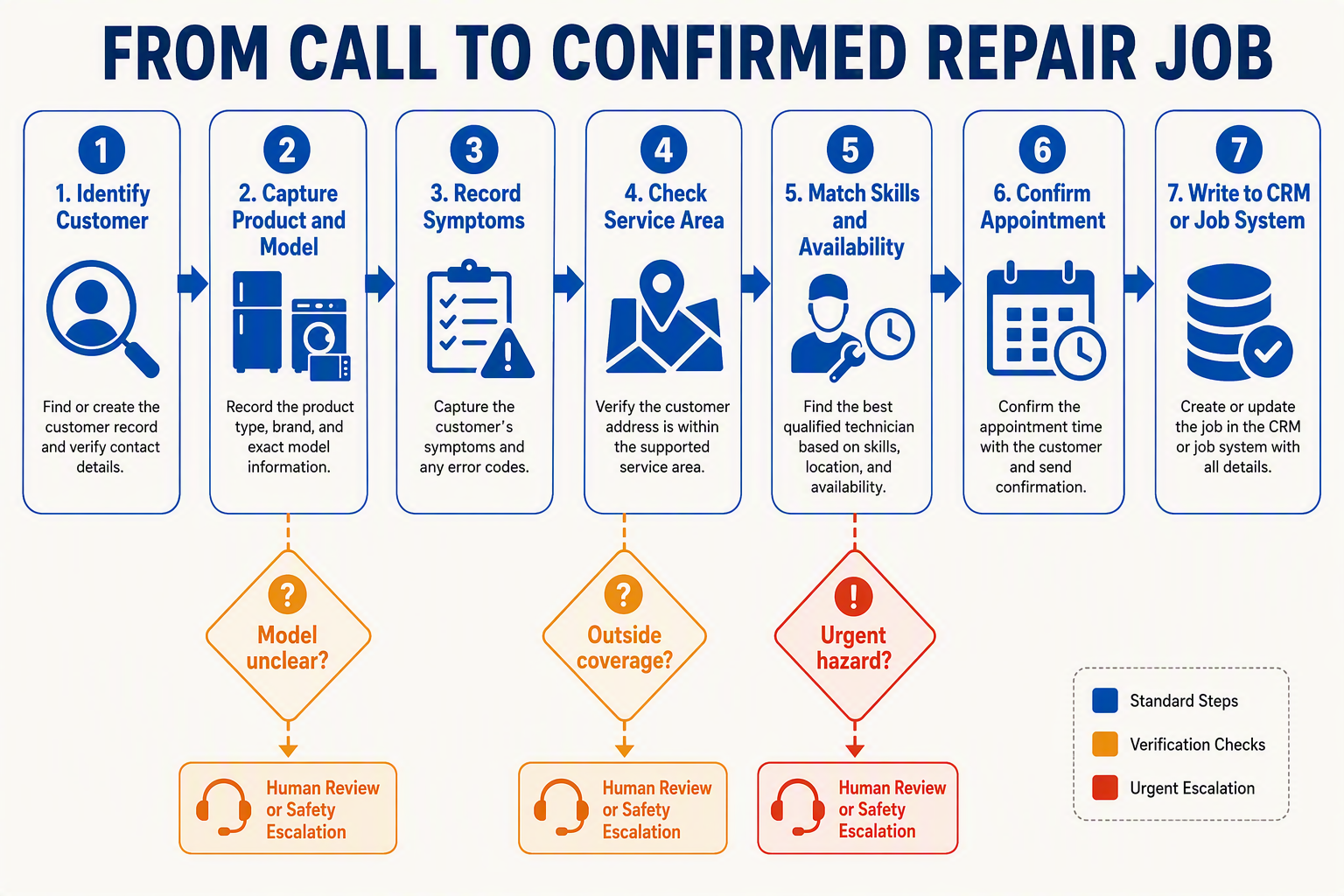
A repair booking AI should follow a gated workflow: identify the customer and appliance, assess safety, validate the service location, retrieve eligible appointment slots, and obtain explicit confirmation before creating the job. Each answer should become a structured field in the job system, not disappear into a call transcript.
1. Create one job record from the first contact
Whether the enquiry arrives through appliance repair call answering, web chat, or WhatsApp, the AI should first search for an existing customer using a verified phone number. It can then create or update a provisional job containing:
- Customer name and callback number
- Service address, postcode, or Indian PIN code
- Appliance category, brand, and model number
- Fault description and error code
- Purchase date and stated warranty status
- Preferred language and contact channel
The AI should read back critical details rather than silently assuming them. For example: “I captured the model as IFB-SENATOR-WSS-8KG. Is that correct?” If speech recognition confidence is low, the customer can photograph the rating plate and send it through WhatsApp.
2. Run safety checks before discussing availability
Safety classification must precede routine booking. Statements involving gas odour, smoke, electric shocks, sparks, overheating, flooding near electrical connections, or burning smells should trigger an approved escalation workflow.
The AI should avoid improvising technical instructions. Instead, it should:
- Deliver the service center’s approved safety message.
- Mark the case as urgent or safety-critical.
- Transfer the conversation to a trained employee or designated emergency route.
- Preserve the transcript and captured details for the receiving person.
A failed transfer should initiate an urgent callback task—not return the customer to the normal booking queue.
3. Validate serviceability and visit requirements
The AI receptionist for repair shops should check the submitted location against a live service-area table. A binary postcode match may be insufficient because coverage can vary by appliance type, brand authorization, technician skill, travel radius, and day of the week.
Before offering slots, the workflow should verify:
- Whether the location is covered
- Whether the appliance category is supported
- Whether an authorized or specialist technician is required
- Whether access restrictions or installation type affect the visit
- Whether the job needs workshop drop-off rather than onsite service
Unsupported jobs should be routed to a human or an approved alternative process without promising service.
4. Offer only bookable, system-verified slots
The AI should query the field-service or scheduling platform in real time, offer two or three valid windows, and temporarily hold the selected slot while the customer confirms. After confirmation, it should create the job using an idempotency key, preventing duplicate bookings if a call reconnects or a customer taps twice.
Warranty, estimates, and parts availability require similarly firm boundaries:
- Record warranty as customer-stated, verified, or not verified.
- Never represent warranty coverage as approved until the relevant system or employee confirms it.
- Label prices as call-out fees or preliminary ranges where applicable—not final repair quotes.
- Do not promise that a component is available without checking inventory.
5. Close the loop with a durable confirmation
The final message should include the job number, appliance, address, appointment window, preparation instructions, cancellation method, and any unresolved conditions. Meta reported in April 2025 that WhatsApp had surpassed three billion monthly active users worldwide, making service center WhatsApp automation a practical channel for confirmations, model-label photos, rescheduling, and technician updates.
The AI should end by asking for explicit confirmation: “Should I book this appointment now?” Only a clear “yes” should convert provisional intake into a confirmed repair job.
Where must automation stop for warranty status, estimates, parts availability and electrical or gas hazards?
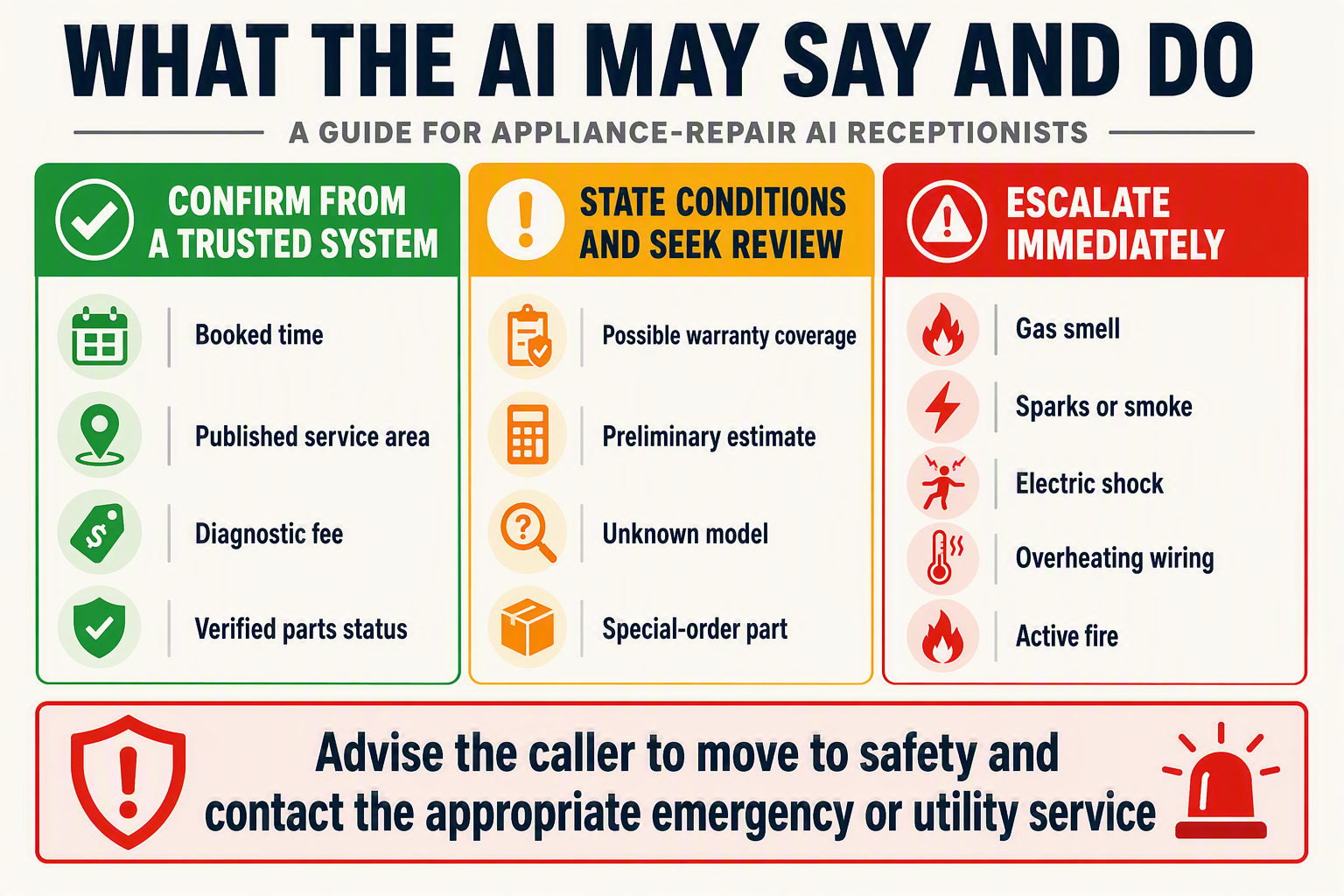
Automation must stop whenever an answer depends on authoritative coverage records, live inventory, technician diagnosis, or safety-critical judgment. The AI can collect evidence and explain the next step, but it should never convert uncertainty into a warranty approval, fixed quotation, parts promise, or remote declaration that an appliance is safe.
Set four non-negotiable decision boundaries
- Warranty status: The AI may capture the brand, model, serial number, purchase date, invoice, and prior repair history. It should state “verification pending” until the manufacturer, retailer, warranty administrator, or service-management system confirms coverage.
- Repair estimates: The AI may provide an approved inspection fee or a clearly labelled indicative range based on predefined rules. A final estimate must wait for technician diagnosis, including labour, parts, taxes, transport, and any exclusions.
- Parts availability: The AI may report inventory only from a live, timestamped source. “In stock” should not mean “available for this job” unless the part has been matched to the exact model and serial range, allocated, and—where necessary—physically verified.
- Electrical or gas hazards: The AI must stop normal troubleshooting and booking dialogue immediately. It should deliver an approved safety script, escalate to a trained person or emergency pathway, and preserve the transcript for review.
Use precise language instead of accidental promises
An AI receptionist for repair shops should distinguish among status, probability, and commitment. Safe responses include:
- Warranty: “Your details have been submitted for verification; coverage has not yet been confirmed.”
- Estimate: “The inspection charge is ₹X. Any repair quotation will follow diagnosis and your approval.”
- Parts: “The system shows possible stock as of 14:20, but compatibility and allocation still require confirmation.”
- Appointment: “This visit is booked for inspection, not guaranteed completion on the first visit.”
This matters because India’s Consumer Protection Act, 2019 covers misleading representations, while the Central Consumer Protection Authority’s 2022 Guidelines for Prevention of Misleading Advertisements reinforce the need for claims to be truthful and substantiated. A conversational system should therefore log the exact wording, source record, timestamp, customer consent, and any human override.
Trigger a safety workflow before collecting more details
Hazard detection should use explicit phrases and semantic equivalents across supported languages. Trigger examples include “I smell gas,” “the plug is burning,” “the socket is sparking,” “I received a shock,” “there is smoke,” and “the breaker keeps tripping.”
Once triggered, the automation should:
- Tell the customer to stop using the appliance.
- For suspected gas leakage, advise occupants to move to a safe location, avoid flames and electrical switches, and contact the gas supplier or local emergency service.
- For smoke, shock, or sparking, advise keeping away and disconnecting power only when it can be done safely.
- Avoid remote repair instructions, repeated restart tests, or reassurance that the appliance is safe.
- Escalate immediately and mark the job as safety-critical.
Emergency numbers and scripts must be configured by country and service area rather than assumed globally.
Build human approval into the workflow
The repair booking AI can still create a priority case, attach recordings and photos, and initiate service center WhatsApp automation for acknowledgement. However, appliance repair call answering should require human or authoritative-system approval before changing warranty status, issuing a binding estimate, promising a part, or resuming troubleshooting after a hazard disclosure. The governing rule is simple: automate collection and coordination; reserve consequential decisions for verified systems and qualified people.
What do service leaders recommend for missed-call recovery, multilingual calls and service center WhatsApp automation?
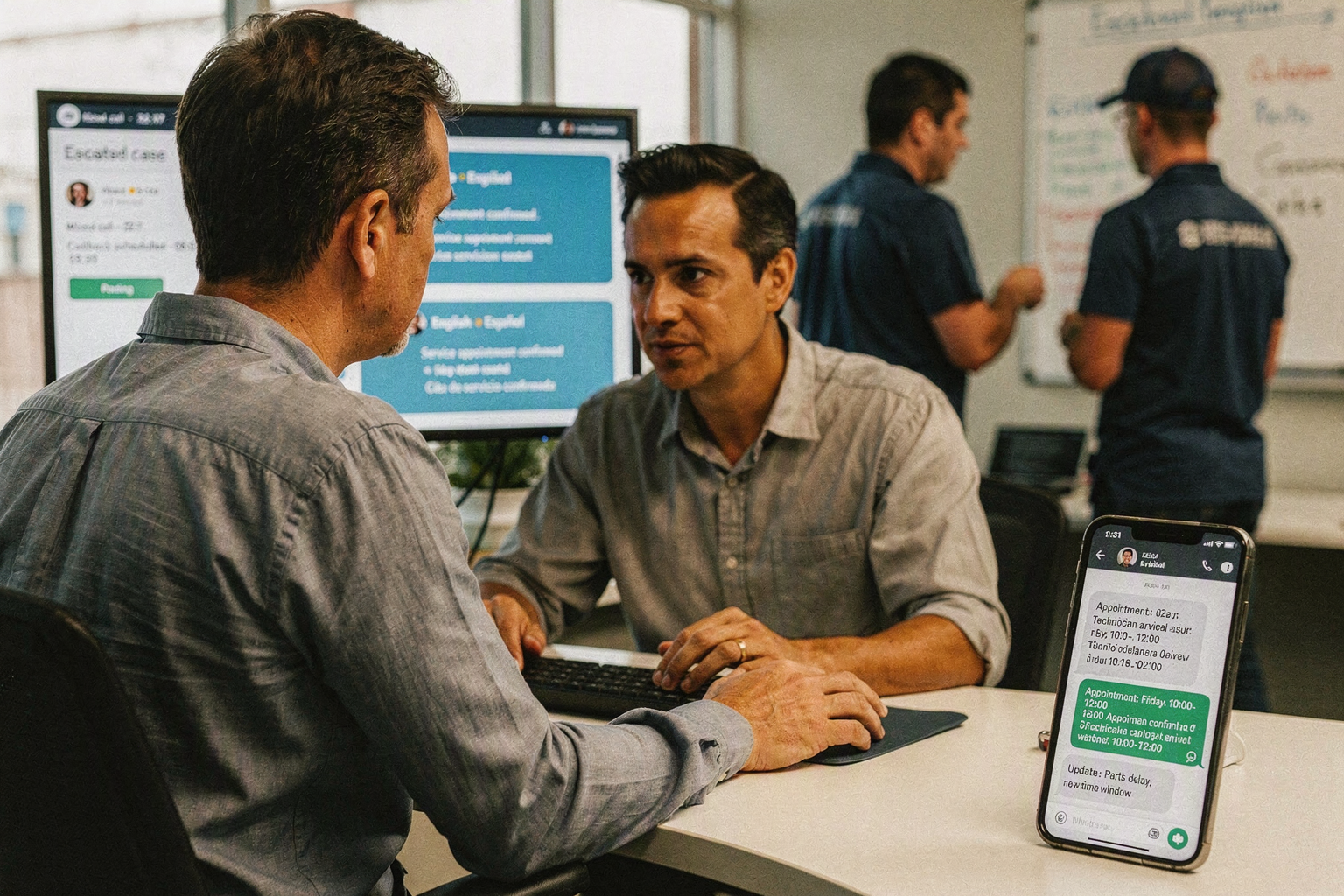
Service leaders recommend treating missed calls, multilingual conversations, and WhatsApp messages as one recoverable customer journey, not three separate channels. The operating rule is simple: respond quickly, preserve context across channels, and route uncertainty or safety risk to a person.
Recover missed calls while the repair need is active
A missed-call workflow should begin automatically but avoid repeated, intrusive contact. A practical sequence is:
- Create a pending enquiry using the caller’s number, call time, queue, and any existing CRM record.
- Send an immediate acknowledgement by SMS or WhatsApp, identifying the service center and offering “Book a repair,” “Request a callback,” and “Not interested” options.
- Attempt one automated callback within a service-level target set by the business—for example, five minutes during working hours.
- Let the AI receptionist for repair shops resume the same enquiry rather than forcing the customer to repeat information.
- Escalate unanswered high-priority cases, repeat callers, and safety-related messages to the human queue.
The business should deduplicate simultaneous calls and messages by phone number and open job. Otherwise, appliance repair call answering can accidentally generate multiple tickets, callbacks, or technician visits for one fault.
Track missed-call recovery rate, time to first response, recovered-booking conversion, opt-outs, duplicate-job rate, and human callback completion. An internal speed target should be presented as an operational goal—not as an unsupported industry benchmark.
Make multilingual service operational, not cosmetic
Language detection alone does not guarantee accurate repair intake. The system should ask callers to confirm their preferred language, preserve that choice in the CRM, and switch to a bilingual employee whenever confidence falls below an agreed threshold.
For each supported language, service leaders should test:
- Regional accents, code-switching, and mixed-language product names
- Spoken digits, PIN codes, dates, and phone numbers
- Brands and alphanumeric model numbers
- Safety phrases involving gas, smoke, sparks, overheating, or electric shock
- Read-back accuracy before booking or changing an appointment
Model numbers are particularly error-prone in speech. A repair booking AI should invite the customer to send a photograph of the rating label through WhatsApp rather than guessing between characters such as “B,” “D,” “5,” and “S.”
Indian platforms such as CallMissed support speech recognition and voice generation across 22 Indian languages and can bridge WhatsApp Business calls to an AI voice agent. That architecture helps regional service networks retain the same job context when a customer moves between voice and messaging.
Use WhatsApp for event-driven updates
Service center WhatsApp automation should communicate verified events from the job system, not generate plausible-sounding status updates. Recommended triggers include:
- Enquiry received and callback requested
- Appointment proposed, confirmed, rescheduled, or cancelled
- Technician assigned or delayed
- Model-label or proof-of-purchase image requested
- Estimate ready for customer approval
- Job completed and feedback requested
During Meta’s April 2025 first-quarter earnings call, CEO Mark Zuckerberg said WhatsApp had surpassed three billion monthly active users worldwide. That reach makes WhatsApp operationally important, but service centers still need customer consent, approved message templates where required, opt-out handling, and channel-specific audit logs.
Most importantly, automation must not declare that a repair is under warranty, that a part is available, or that an estimate is final until the relevant warranty, inventory, or job-management system has confirmed it.
What should your 30-, 60- and 90-day rollout plan and KPI scorecard include?
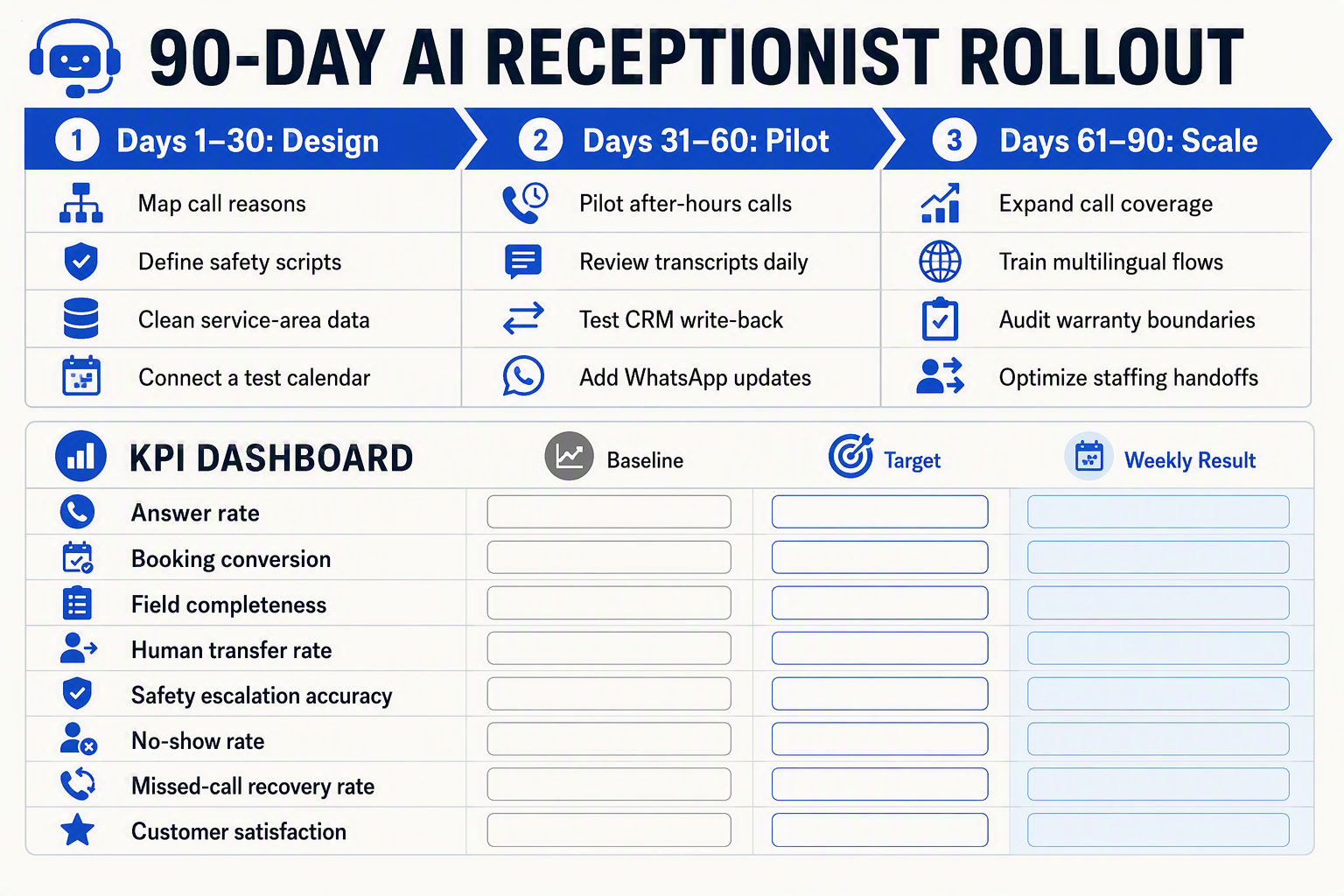
A practical rollout should move from measurement and controlled intake in days 1–30, to limited live booking by day 60, and then to scaled automation with documented quality gates by day 90. Do not expand an AI receptionist for repair shops merely because it answers calls; expand only when booking accuracy, safety escalation, and job-system data quality meet agreed thresholds.
30-, 60- and 90-day implementation plan
| Period | Operational scope | Key actions | Exit gate |
|---|---|---|---|
| Days 1–15 | Baseline and workflow design | Measure current answer rate, booking conversion, intake completeness, transfers, cancellations and no-shows; map warranty, estimate, parts and safety rules | Baseline approved; every intent has an owner and escalation route |
| Days 16–30 | Shadow-mode intake | Test product, brand, model, serial number, fault, PIN code and preferred-slot capture without allowing autonomous bookings | At least 95% safety-trigger recall in test scenarios; no unsupported warranty or price promises |
| Days 31–45 | Limited live launch | Route after-hours and overflow calls to the AI; enable missed-call recovery and human transfer; review transcripts daily | At least 85% required-field completeness and 95% service-area validation accuracy |
| Days 46–60 | Controlled booking | Connect the repair booking AI to live technician capacity, appointment duration, geography and holiday rules | At least 98% booking-system write success; double-booking rate below 1% |
| Days 61–75 | Messaging and multilingual expansion | Add confirmation, rescheduling and technician-update flows through service center WhatsApp automation; pilot selected languages | Customer consent recorded; language-specific quality checks passed before expansion |
| Days 76–90 | Scale and optimisation | Extend to more call types, branches and languages; tune prompts using failure categories; formalise weekly governance | Two consecutive weeks within KPI thresholds, with rollback and human-override procedures tested |
The suggested percentages are deployment gates, not universal industry benchmarks. Each repair network should adjust them to call volume, job complexity, regulatory obligations and its pre-launch baseline. Multilingual expansion should also follow demonstrated demand rather than enabling every language simultaneously; for example, CallMissed supports speech recognition and voice generation across 22 Indian languages, allowing Indian service networks to phase language coverage by region.
KPI scorecard for weekly review
Track outcomes by branch, channel, language, appliance category and working-hours status, rather than relying on one blended average.
- Answer rate: answered inbound calls ÷ eligible inbound calls. Separate AI answers, human answers and abandoned calls.
- Booking conversion: confirmed repair jobs ÷ serviceable enquiries. Exclude sales calls, duplicate contacts and out-of-area requests.
- Intake completeness: jobs containing every mandatory field ÷ created jobs. Audit model-number accuracy separately because a populated but incorrect field can misroute parts.
- Serviceability accuracy: correctly accepted or rejected addresses ÷ audited service-area decisions.
- Safe escalation recall: correctly escalated gas, smoke, burning, sparking and electric-shock scenarios ÷ tested or audited safety cases.
- Human-transfer rate: transferred conversations ÷ answered conversations. Categorise transfers as expected exceptions, customer preference or automation failure.
- Booking integrity: valid appointments successfully written to the CRM or field-service system ÷ attempted bookings.
- No-show rate: unattended confirmed visits ÷ scheduled visits; compare against the baseline after WhatsApp reminders begin.
- Unsupported-commitment rate: calls containing an unverified warranty, estimate, parts-availability or technician-arrival promise ÷ audited calls. The target should be zero.
Governance after day 90
Assign one accountable owner each for operations, integrations, safety and conversation quality. Review failed appliance repair call answering cases weekly, maintain versioned prompts and knowledge sources, and require approval before changing warranty language, emergency scripts or booking rules. Scale should follow verified reliability—not call volume alone.
Frequently asked questions about AI receptionist costs, setup time, integrations, call recording, human handoff and after-hours repair bookings
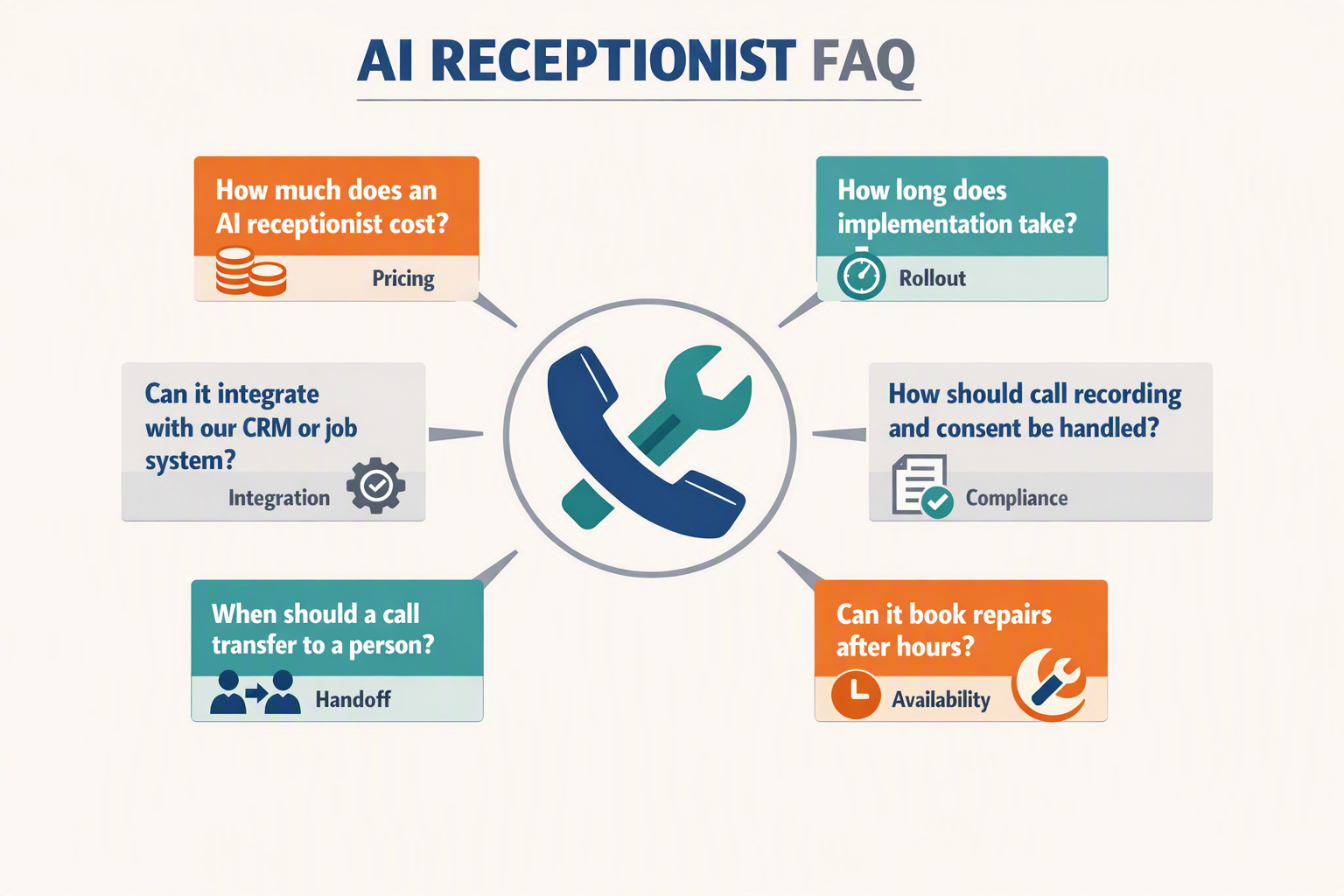
How much does an AI receptionist for repair shops cost in 2026?
How long does it take to set up an AI receptionist for repair shops?
Can repair booking AI integrate with CRM and field-service management software?
Is recording appliance repair call answering conversations legal?
How should an AI receptionist transfer urgent repair calls to a human?
Can service center WhatsApp automation accept repair bookings after hours?
Conclusion
A successful AI receptionist for repair shops should operate as a controlled extension of the service desk—not as an unsupervised technician. In 2026, the strongest implementations will answer every enquiry quickly, gather accurate job data and automate routine coordination while escalating safety risks, uncertain warranty claims and complex customer needs to people.
- Structure intake before automating booking. Appliance repair call answering should capture the appliance type, brand, model number, symptoms, contact details and postcode or PIN code. The system must then validate the service area and consult the live job calendar before offering an appointment.
- Set firm operational boundaries. A repair booking AI should never guarantee warranty eligibility, final prices, technician availability or parts availability without confirmation from the relevant CRM, field-service, inventory or manufacturer system. Statements involving gas smells, sparks, smoke or electrical hazards require approved safety instructions and immediate escalation.
- Connect every channel and workflow. CRM and job-system integration should keep bookings, reschedules, cancellations and technician updates synchronized. Missed-call recovery and service center WhatsApp automation can bring customers back into the booking journey while sending confirmations and status updates through a channel they already use; WhatsApp exceeded three billion monthly active users worldwide, according to Meta CEO Mark Zuckerberg in April 2025.
- Roll out gradually and measure outcomes. Begin with after-hours calls or a limited service area, review transcripts and failed interactions, and expand only after achieving reliable intake completeness and handoffs. Track answer rate, booking conversion, transfer rate, abandoned calls and no-show reduction rather than treating call volume alone as success.
What comes next is deeper coordination between voice agents, WhatsApp, multilingual speech systems and field-service software. Microsoft’s 2025 Work Trend Index found that 81% of business leaders expected AI agents to become moderately or extensively integrated into their AI strategies within 12–18 months, indicating that agent-based customer operations are moving rapidly into the mainstream.
Repair networks should therefore watch improvements in model-number recognition, real-time scheduling and multilingual reliability while preserving human oversight. To explore this direction, consider CallMissed, an AI communication infrastructure platform offering voice agents, WhatsApp Business calling and speech support across 22 Indian languages. The practical question is no longer whether AI can answer the phone—it is whether your next urgent caller will receive a safe, accurate and bookable response before contacting another service center.
Related Reading
Discussion
Related Posts



Ready to automate customer conversations?
Launch AI voice agents and WhatsApp bots with CallMissed — one API, 22+ Indian languages.