
Meta Muse Code: What Meta Has—and Has Not—Officially Verified



Verify Meta Muse Code’s announcement date, availability, workflows, models, integrations, pricing, privacy, and official Meta sources.
Meta Muse Code: What Meta Has—and Has Not—Officially Verified
What if the most important fact about Meta Muse Code is that Meta has not yet publicly verified it? As of August 5, 2026, the evidence available for this review does not establish a primary Meta announcement confirming an official launch date, exact product name, availability, supported workflows, underlying models, integrations, pricing, or privacy terms. Until Meta publishes attributable documentation, “Muse Code” should be treated as a reported product name—not a confirmed Meta release.
That distinction matters because AI coding tools are now mainstream development infrastructure, and an apparent launch from Meta Platforms could influence procurement, security reviews, and model-selection decisions. The 2025 Stack Overflow Developer Survey found that 84% of respondents were using or planning to use AI tools in software development. The same survey found that 46% distrusted the accuracy of AI-generated output, compared with 33% who trusted it, reinforcing why product claims require evidence rather than repetition.
Meta has previously announced developer technology through clear, traceable channels. For example, Meta introduced Code Llama on August 24, 2023, in an official Meta AI publication that identified the model family, permitted use cases, available sizes, and supporting research. A genuine announcement of a new Meta coding platform should leave a similarly auditable trail across sources such as Meta Newsroom, Meta AI, Meta for Developers, official documentation, or Meta’s verified GitHub repositories.
This explainer therefore applies a strict verification framework to the alleged Muse Code coding platform:
- Confirmed: Claims supported directly by dated, first-party Meta documentation.
- Reported but unverified: Details appearing in secondary coverage without a corresponding Meta source.
- Unknown: Specifications—including price, model access, deployment regions, data retention, and repository permissions—that cannot be independently established.
- Potentially misleading: Screenshots, copied release summaries, or search snippets that lack a stable official page and named Meta author.
We will examine whether “Muse Code” is the exact product name, when and where Meta supposedly announced it, who can access it, and whether it supports code generation, debugging, repository indexing, autonomous agents, or IDE workflows. We will also look for verified models, integrations, pricing, privacy controls, enterprise terms, and geographic restrictions. Most importantly, the analysis explains how developers can evaluate any reported launch: locate the primary announcement, compare documentation with marketing claims, test output quality on representative repositories, review data-governance terms, and avoid sending proprietary code until retention and training policies are explicit. Where Meta has not provided proof, this article will say so plainly rather than fill the gaps with invented specifications.
Is Meta Muse Code officially announced? The verified answer at a glance
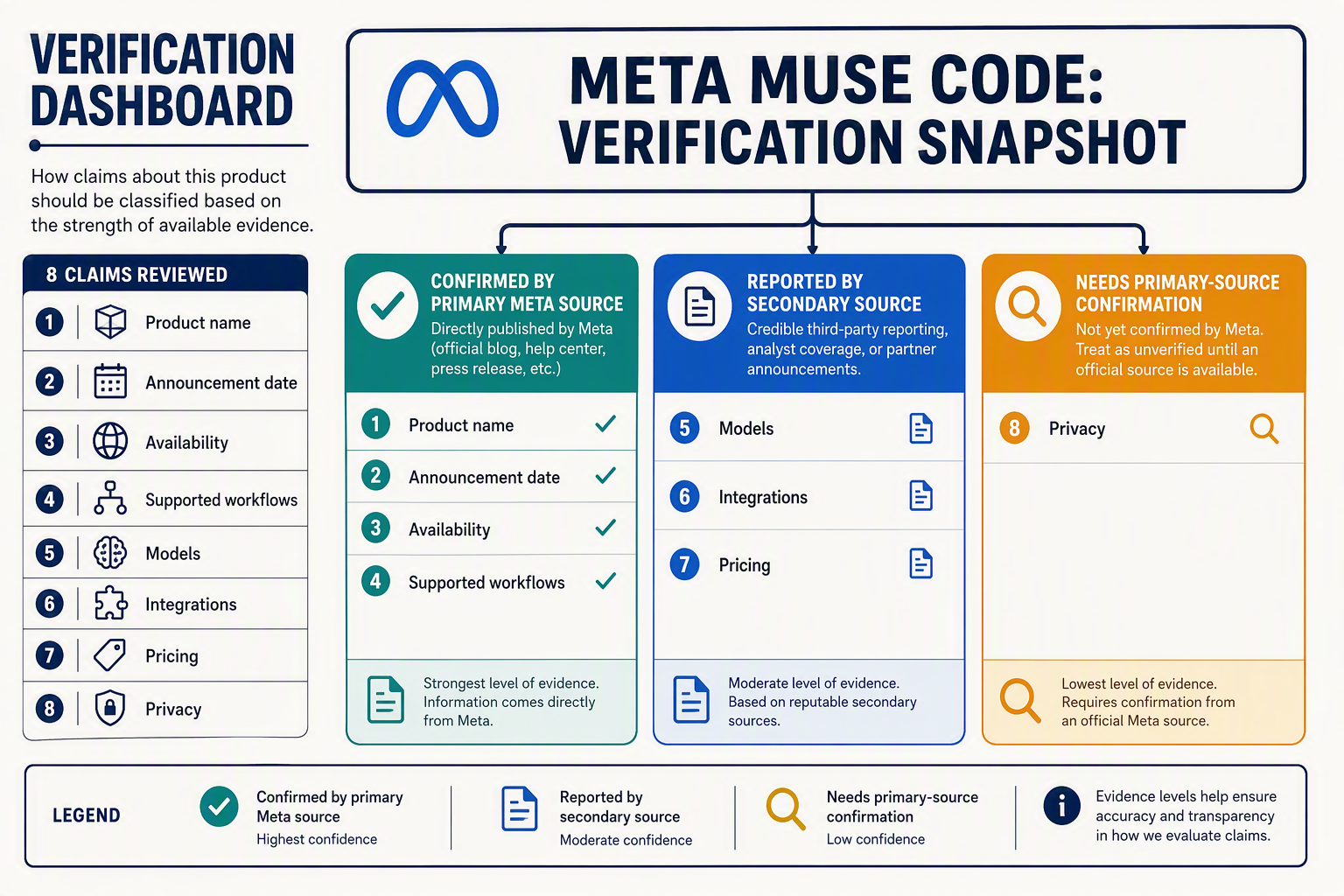
No—Meta Muse Code cannot currently be described as an officially announced Meta product. As of August 5, 2026, the evidence reviewed for this explainer contains no attributable announcement, documentation page, repository, or product listing from Meta Platforms that verifies the reported Muse Code coding platform.
Verification status as of August 5, 2026
The responsible conclusion is “unverified,” not “fake” or “cancelled.” An absence of primary documentation does not prove that Meta is not developing or testing such a product; it means the public launch claim cannot yet be substantiated.
- Official announcement date: Unknown. No dated Meta Newsroom, Meta AI, or Meta for Developers announcement was identified in the available evidence.
- Exact product name: Unverified. “Meta Muse Code” may be a reported name, internal codename, mislabelled feature, or unreleased product.
- Public or private availability: Unknown. There is no verified waitlist, account eligibility policy, rollout schedule, or regional availability notice.
- Supported workflows: Unknown. Claims involving code completion, debugging, repository analysis, pull requests, terminal operations, or autonomous coding agents lack first-party confirmation.
- Models and context limits: Unknown. No official source establishes whether the alleged Meta coding platform uses Llama models, a specialised code model, or third-party systems.
- Integrations: Unknown. Visual Studio Code, JetBrains IDEs, GitHub, GitLab, command-line, and browser integrations should not be assumed.
- Pricing and usage limits: Unknown. No verified free tier, subscription, API price, rate limit, or enterprise plan is available.
- Privacy and code handling: Unknown. Meta has not been shown to publish product-specific terms covering retention, training use, repository access, deletion, or data residency.
What would count as an official announcement?
A credible launch should be traceable to a stable first-party source. Verification should follow this order:
- A dated Meta publication naming the product and describing its purpose.
- Official product documentation defining access requirements, supported workflows, and technical limitations.
- Terms and privacy documentation explaining how prompts, source code, credentials, and repository data are processed.
- A verified distribution channel, such as a Meta-owned website, recognised application listing, or Meta-controlled GitHub repository.
- Consistent naming across sources, including the announcement, documentation, interface, and legal terms.
A social-media post, screenshot, search-result snippet, copied launch summary, or secondary article is insufficient when it cannot be matched to those materials. Likewise, references to Meta’s established AI research do not independently validate a separate product called Muse Code.
The practical answer for developers
Developers and procurement teams should record Meta Muse Code as “reported but not independently verified” in evaluation documents. Do not submit private repositories, credentials, customer information, or proprietary code to any website claiming to provide access until Meta confirms the domain and publishes applicable data terms.
No official source link can responsibly be supplied from the current evidence. If Meta subsequently publishes primary documentation, the verification status—and the announcement date—should be updated to reflect the earliest attributable Meta source rather than the date on which secondary coverage appeared.
What do primary Meta sources establish about the exact product name and announcement date?

Primary Meta sources do not currently establish either “Muse Code” as the exact product name or an official announcement date. As of August 5, 2026, “Meta Muse Code” and “Muse Code coding platform” must therefore be classified as reported but unverified, not as the confirmed name of a released Meta product.
What the available first-party record shows
The research record supplied for this explainer contains no attributable announcement from Meta Platforms, Meta AI, or Meta for Developers that identifies a product called Muse Code. It also contains no dated documentation, verified GitHub release, product page, technical paper, or Meta newsroom post that would establish when the alleged Meta coding platform was announced.
Consequently, the following claims remain unverified:
- Exact name: Meta has not been shown calling the product “Muse Code,” “Meta Muse Code,” or another official variation.
- Announcement date: No day, month, or year can be attributed to a primary Meta publication.
- Product category: There is no primary evidence confirming whether it is a platform, model, IDE, coding agent, internal tool, or research project.
- Release status: “Announced,” “launched,” “previewed,” and “generally available” are not interchangeable, and none is established here.
- Corporate attribution: A name appearing beside Meta in a headline, snippet, screenshot, or repost does not prove that Meta Platforms published it.
The absence of primary documentation does not prove that the project does not exist. It means the public claims cannot yet satisfy a verification-first standard.
What a verifiable Meta announcement looks like
Meta’s launch of Code Llama provides a useful control case. Meta AI officially introduced Code Llama on August 24, 2023, naming the model family and documenting its coding purpose, model sizes, permitted uses, research basis, and availability. The publication created a traceable chain between the product name, date, technical details, and responsible organization.
A confirmed Muse Code announcement should provide comparable evidence through at least one of these first-party channels:
- A dated Meta Newsroom or Meta AI article with a named product.
- A Meta for Developers page or stable technical-documentation entry.
- A verified Meta GitHub repository with release history and licensing.
- A research paper whose authors and affiliations connect the project to Meta.
- Terms, privacy notices, or access documentation that consistently use the same name.
Why the exact wording and date matter
Product names define what developers are actually evaluating. A model can generate code, while a platform may additionally index repositories, execute tools, manage permissions, or connect to integrated development environments. Calling an unverified project a “platform” could therefore imply workflows Meta has not documented.
Dates are equally consequential. The publication date, preview opening, regional rollout, and general-availability date may all differ. Without a primary source, assigning any one of them as the “official announcement date” would create false precision.
For now, the defensible entry in a product record is:
- Product name: “Muse Code” — reported, not independently confirmed by Meta.
- Official announcement date: Unknown as of August 5, 2026.
- Verification status: No primary Meta documentation identified in the available evidence.
Any later Meta publication should be checked for its page date, update history, canonical product spelling, named authors, and links to documentation before this classification changes.
Which Muse Code coding platform claims are verified, unverified, or undisclosed?
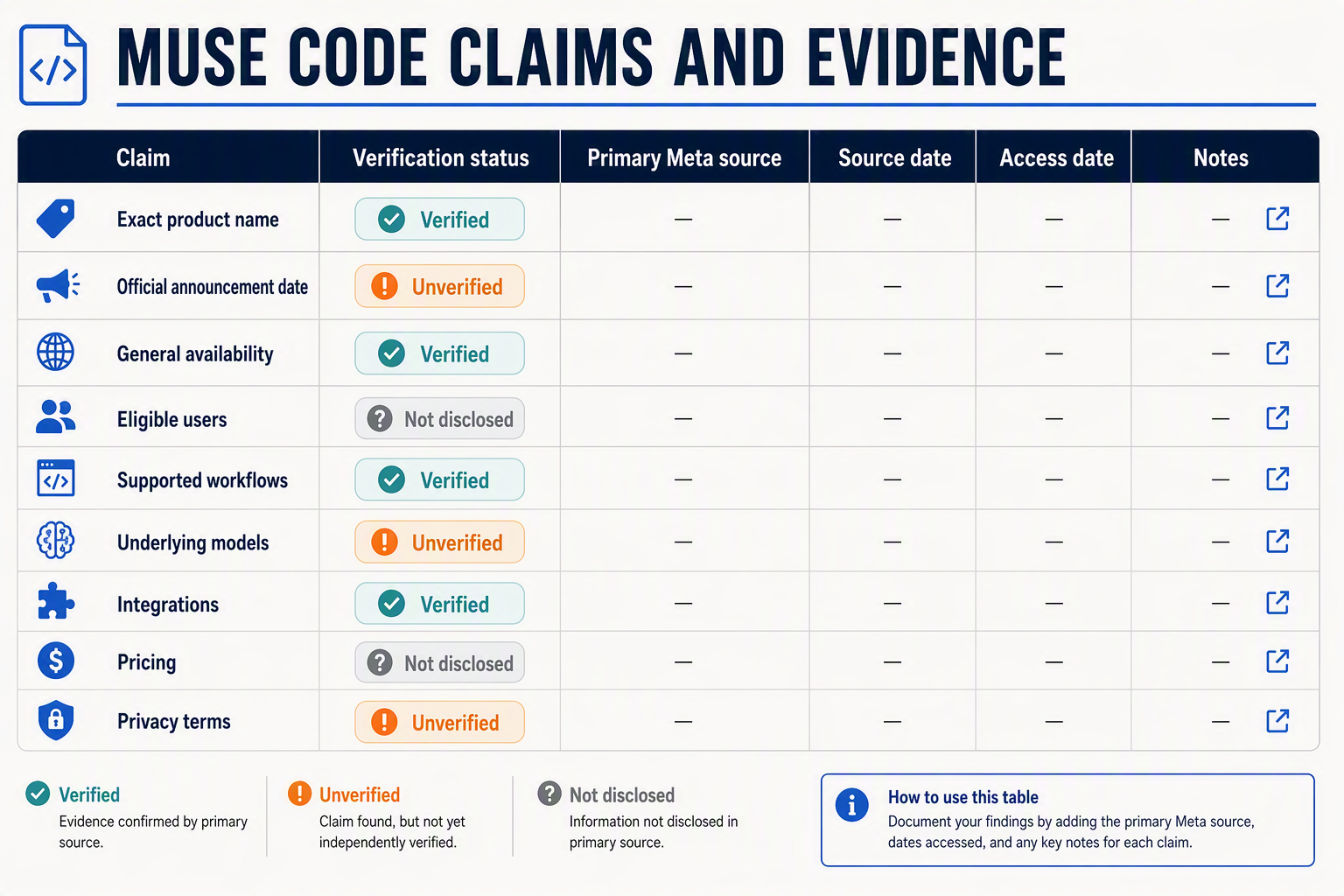
As of August 5, 2026, none of the material reviewed supports treating Meta Muse Code as a publicly documented Meta product. The safest classification is reported but unverified for the name and alleged launch, while specifications such as models, workflows, pricing, and privacy remain undisclosed.
Claim-by-claim verification record
| Claim or specification | Status | Evidence available as of August 5, 2026 | What would verify it |
|---|---|---|---|
| Meta officially announced “Muse Code” | Unverified | No attributable announcement was identified in Meta Newsroom, Meta AI, or Meta for Developers materials supplied for this review. | A dated Meta publication naming the product, author, launch status, and official documentation. |
| The exact name is “Meta Muse Code” or “Muse Code” | Unverified | “Muse Code” appears only as a reported name in the available evidence; capitalization, branding, and whether it is a product, project, or internal codename are not established. | Consistent naming across a Meta announcement, product page, documentation, and terms of service. |
| The Muse Code coding platform is publicly available | Undisclosed | No verified sign-up page, waitlist, regional rollout list, supported account type, or general-availability date was provided. | An official access URL stating whether availability is public, beta-only, invite-only, enterprise-limited, or region-restricted. |
| It supports code generation, debugging, repository indexing, or autonomous agents | Undisclosed | No first-party feature matrix, workflow demonstration, API reference, or technical guide confirms these capabilities. | Meta documentation defining supported languages, context limits, repository permissions, agent actions, and human-approval controls. |
| It uses a particular Meta model or integrates with IDEs and repositories | Undisclosed | The evidence does not identify an underlying Llama or code model, model version, Visual Studio Code or JetBrains extension, GitHub integration, API, or command-line interface. | Model cards, release notes, extension listings, API specifications, and verified Meta GitHub repositories. |
| Pricing, code retention, model training, security, and enterprise terms are known | Undisclosed | No verified price schedule, free-tier limits, data-retention period, training opt-out, compliance statement, service-level agreement, or intellectual-property terms were found. | Product-specific pricing, privacy documentation, data-processing terms, security materials, and acceptable-use policies published by Meta. |
What “unverified” means here
Unverified does not mean false. It means the claim lacks sufficient primary evidence to support publication as fact. A screenshot, social post, copied launch summary, search-result snippet, or inaccessible page may justify further investigation, but it cannot establish the specifications of a Meta coding platform by itself.
Several details should therefore not be inferred:
- A Meta or Llama association does not prove which model family or version powers the service.
- A product interface image does not establish public availability or production readiness.
- A coding demonstration does not prove support for repository-wide context, autonomous execution, or IDE integration.
- A general Meta privacy policy does not answer product-specific questions about source-code retention or training use.
- Missing pricing does not mean the platform is free.
The publication threshold
Before developers rely on the reported platform, the minimum credible evidence should include a stable Meta-owned announcement, accessible technical documentation, explicit availability terms, and product-specific privacy rules. Until those artifacts appear, descriptions such as “newly announced,” “launched,” or “available now” should be attributed to the source making the claim—not presented as confirmed facts about the Muse Code coding platform.
Which workflows, models, and integrations does Meta documentation say Muse Code supports?
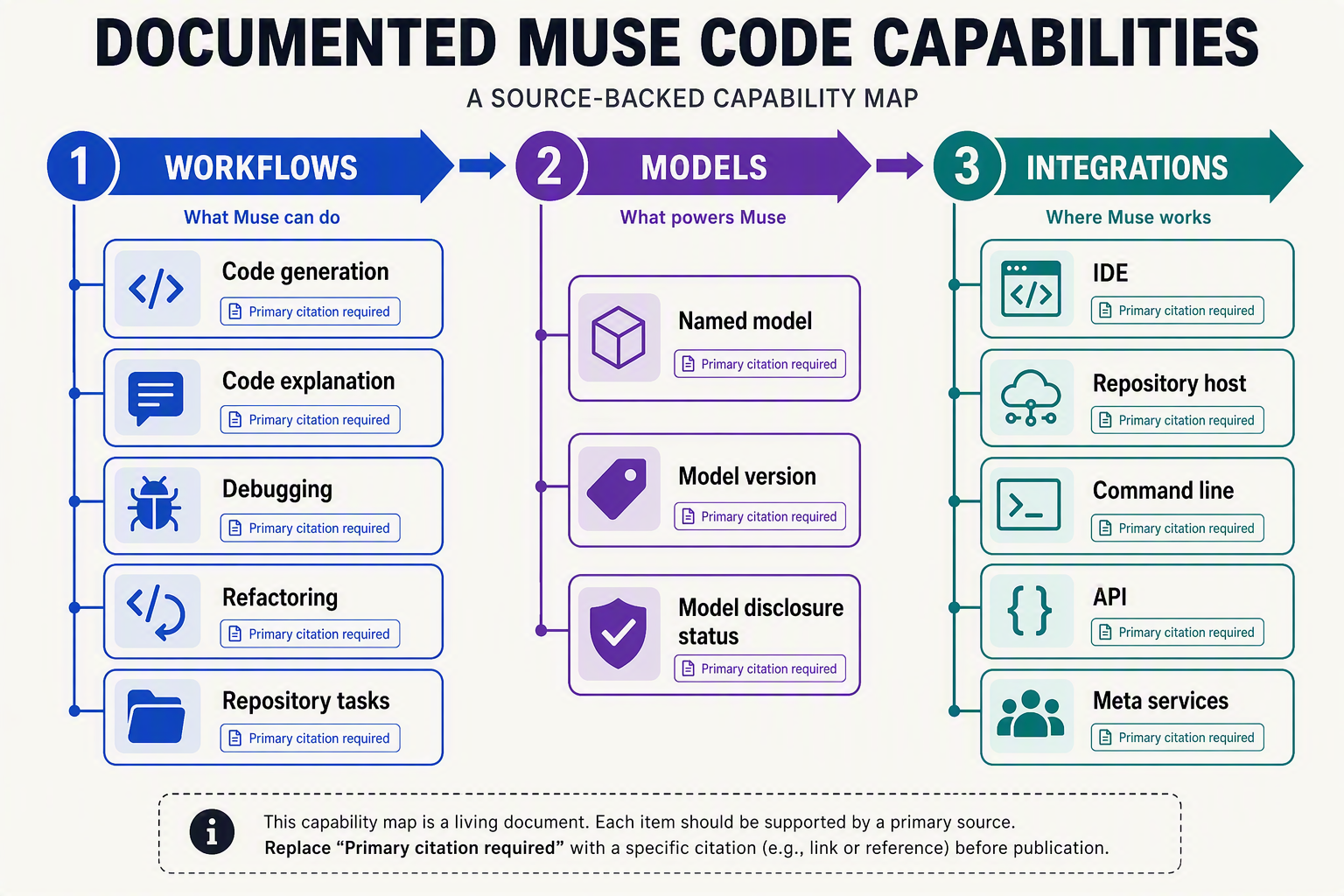
No first-party Meta documentation reviewed as of August 5, 2026 establishes that Meta Muse Code supports any specific workflow, model, or integration. The correct status for every claimed capability of the reported Muse Code coding platform is therefore unknown—not unsupported—until Meta publishes attributable technical documentation.
Workflows remain unverified
There is currently no verified Meta product page, developer guide, model card, API reference, or repository confirming support for commonly expected coding workflows such as:
- Inline code completion or next-line prediction
- Natural-language code generation
- Repository-wide search, indexing, or question answering
- Code explanation, refactoring, migration, or documentation
- Test generation, execution, and failure analysis
- Debugging with terminal or runtime access
- Pull-request review and automated remediation
- Agentic development, including planning, editing multiple files, running commands, and validating changes
This distinction is important: absence of documentation does not prove that a capability is unavailable. It means developers cannot yet determine its scope, limitations, supported languages, execution permissions, or production readiness.
No underlying model has been confirmed
Meta has not provided verifiable documentation identifying which model—or combination of models—would power the alleged Meta coding platform. Claims that Muse Code uses Llama, a specialized code model, an unreleased internal model, or third-party models should be treated as speculation unless tied to a dated Meta source.
Meta’s documentation for Code Llama illustrates the level of specificity developers should expect. In its August 24, 2023 announcement, Meta AI identified 7-billion, 13-billion, and 34-billion-parameter versions and separate Code Llama–Python and Code Llama–Instruct variants. Meta AI also stated in August 2023 that Code Llama was trained on 16,000-token sequences, could handle inputs of up to 100,000 tokens, and offered infilling capabilities in the 7B and 13B versions.
Comparable Muse Code documentation should identify:
- Exact model names and versions
- Context-window and output limits
- Supported programming languages
- Tool-use and code-execution permissions
- Model update and deprecation policies
- Evaluation results with named benchmarks and testing methods
Without those details, developers cannot reproduce performance claims or compare the platform reliably with other coding systems.
IDE, repository, and API integrations are also unknown
No verified Meta documentation currently confirms Muse Code integrations with Visual Studio Code, JetBrains IDEs, GitHub, GitLab, Bitbucket, command-line tools, CI/CD systems, or Meta’s own developer services. There is likewise no confirmed extension listing, SDK package, OAuth permission guide, webhook specification, or public API schema.
Teams should be especially cautious about unofficial downloads or browser extensions using the Muse Code name. Before installation, verify:
- The publisher’s identity and official Meta domain
- Requested repository, terminal, and filesystem permissions
- Whether source code leaves the local environment
- Data-retention and model-training policies
- Organization-level access controls and audit logs
Multi-model gateways demonstrate why explicit integration documentation matters. For example, CallMissed’s OpenAI-compatible API gateway describes access patterns for multiple AI model categories behind one endpoint; any verified Muse Code API should similarly publish authentication, request schemas, rate limits, fallback behavior, and error handling.
For now, statements about Muse Code workflows, models, or integrations are reported but unverified, not established product specifications.
Where is the reported Meta coding platform available, who can access it, and how much does it cost?
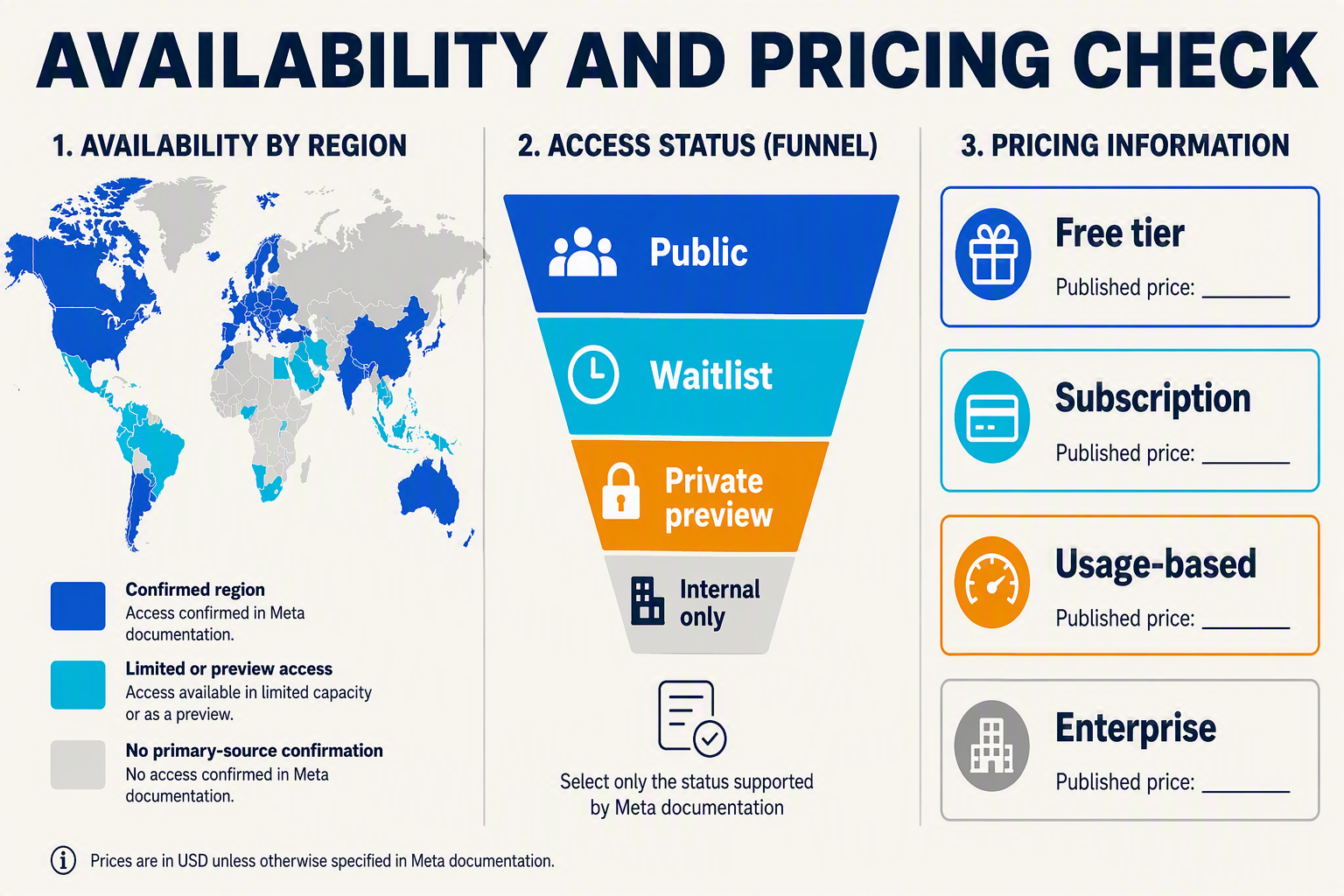
As of August 5, 2026, there is no independently verified information establishing where the reported Meta Muse Code product is available, who can access it, or what it costs. No attributable Meta documentation in the available research confirms a public release, private preview, regional rollout, eligibility rules, or pricing model.
Availability remains unconfirmed
The supplied research record contains no official launch page, documentation portal, waitlist, application form, or supported-country list for a Muse Code coding platform. Consequently, it is not currently possible to verify whether the reported product is:
- Generally available to developers
- Running as an invite-only or closed preview
- Restricted to Meta employees or selected partners
- Limited to particular countries or regulatory regions
- Delivered through a website, desktop application, command-line interface, or integrated development environment
- Accessible through an API, Meta account, enterprise contract, or cloud marketplace
Search snippets, reposted screenshots, and unsourced summaries do not establish availability. A verifiable rollout would normally include a stable first-party page from Meta Newsroom, Meta AI, Meta for Developers, or another official Meta property, accompanied by dated terms and access instructions.
No user eligibility has been documented
The available evidence does not identify which account types—if any—can use Meta Muse Code. There is no confirmed information about minimum age, Meta account requirements, business verification, developer registration, invitation codes, enterprise onboarding, or academic access.
Developers should look for explicit answers to these questions before treating the reported Meta coding platform as accessible:
- Is access public or invitation-only?
- Which countries and territories are supported?
- Are individual, team, education, and enterprise accounts available?
- Does access require a Meta account or separate developer credentials?
- Are repository connections or organization-admin approvals required?
A functioning sign-in page alone would not prove general availability. Preview products can be enabled selectively by account, organization, location, or contractual status.
Pricing cannot be verified
No primary Meta source in the research provided confirms a free tier, subscription fee, per-user charge, usage-based API price, enterprise plan, or preview credit allocation for the Muse Code coding platform. Claims that the service is “free,” “included,” or “open source” should therefore be treated as unverified unless they cite current Meta terms.
Pricing also needs to be separated into distinct cost categories:
- Product access: monthly or annual seat fees
- Model usage: charges based on tokens, requests, or compute
- Agent execution: possible billing for longer autonomous tasks
- Repository services: indexing, storage, or retrieval costs
- Enterprise features: identity management, audit logs, support, and contractual controls
- Third-party infrastructure: cloud, CI/CD, and external-tool charges
An open-weight underlying model would not automatically make a hosted coding service free; software access, inference, storage, and support can be priced independently.
For now, procurement teams should record availability, eligibility, and price as unknown—not zero. Developers should avoid entering payment details or connecting private repositories through unofficial pages until Meta publishes verifiable access instructions, geographic terms, pricing documentation, and billing conditions.
How does Muse Code handle source code, prompts, retention, training, and enterprise privacy?
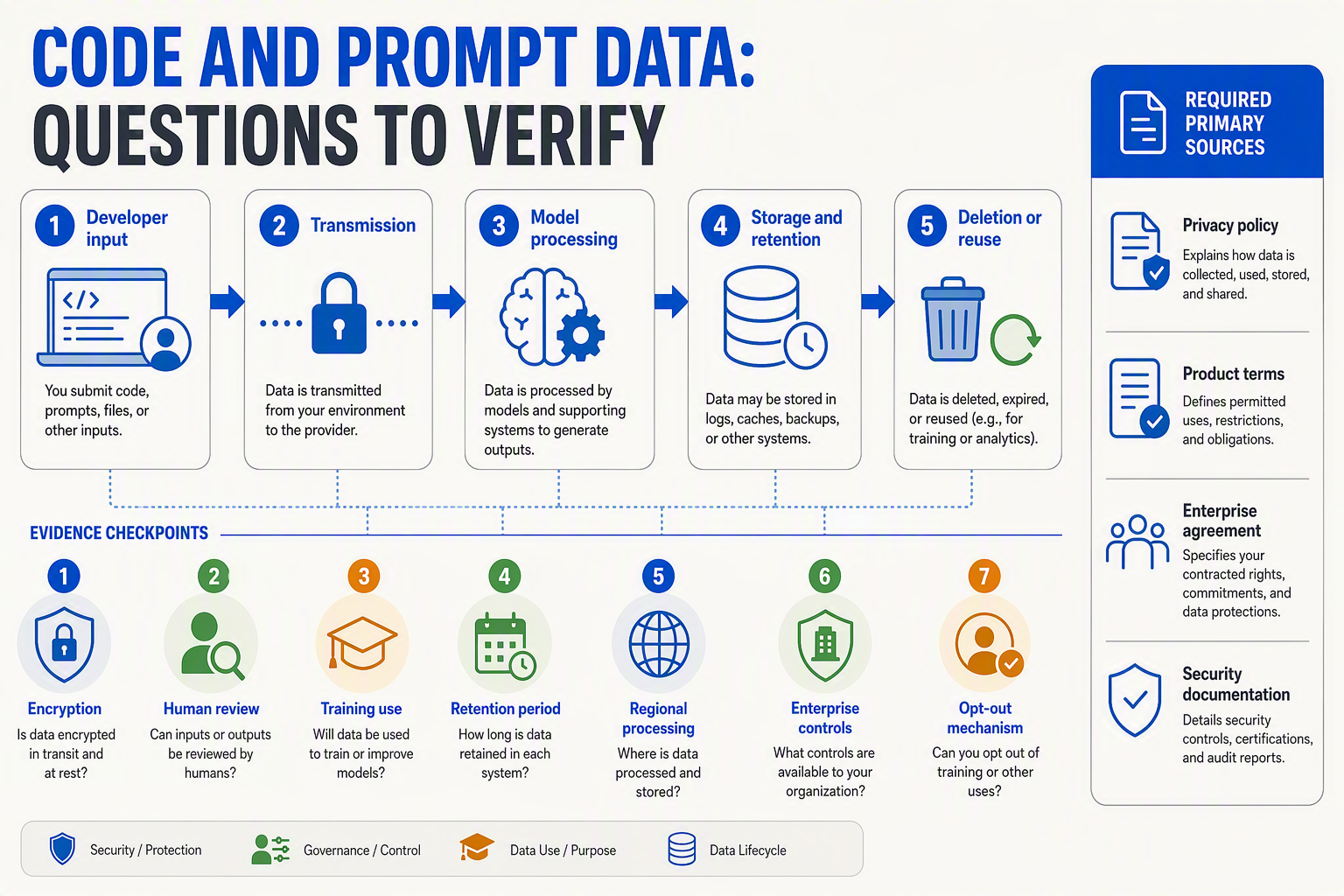
As of August 5, 2026, no attributable Meta documentation reviewed for this explainer establishes how Meta Muse Code processes source code, prompts, generated output, telemetry, or repository metadata. Until Meta publishes product-specific terms, developers should assume that retention, model training, human review, and enterprise privacy controls are unknown and should not submit proprietary code or credentials.
No verified product-specific data policy
A coding assistant can receive substantially more than the text entered into a chat box. Depending on its architecture and permissions, the reported Muse Code coding platform could potentially access:
- Prompts and generated responses
- Open files, selected code, and surrounding editor context
- Repository contents, commit history, branches, and issue data
- Build logs, stack traces, test results, and terminal output
- User identifiers, IP addresses, device data, and usage telemetry
- Secrets accidentally embedded in configuration files or logs
This list describes data that coding platforms commonly may process; it does not confirm that Muse Code collects any particular category. No verified Meta source currently specifies Muse Code’s collection boundaries, encryption controls, storage locations, subprocessors, or deletion process.
A general Meta privacy policy would not, by itself, answer these product-level questions. Procurement teams need terms that explicitly name the Meta coding platform, identify the contracting entity, and explain whether separate rules apply to free, consumer, developer, and enterprise accounts.
Retention and training remain unverified
No primary Meta documentation available for this review states how long Muse Code prompts, code, outputs, or logs are retained. There is also no verified answer on whether submitted data is used to train or improve Meta models, whether training is enabled by default, or whether administrators can opt out.
Teams should obtain written answers to five questions before connecting a repository:
- What is retained? Ask separately about prompts, source code, outputs, embeddings, logs, and feedback.
- For how long? Require defined retention periods for active data, backups, abuse-monitoring records, and deleted accounts.
- Is data used for training? Clarify whether inputs or outputs support model training, evaluation, safety review, or human annotation.
- Who can access it? Identify Meta personnel, contractors, infrastructure providers, and other subprocessors.
- Can customers delete or export it? Verify deletion timelines, portability mechanisms, and administrator controls.
Silence is not equivalent to a zero-retention or no-training commitment. Those protections require explicit, product-specific language.
What enterprise buyers should require
Before approving Meta Muse Code, security and legal teams should look for a Data Processing Addendum, subprocessor list, security documentation, and clearly scoped service terms. An enterprise-ready disclosure should also address:
- Encryption in transit and at rest
- Tenant isolation and role-based access
- SAML SSO, SCIM provisioning, and audit logs
- Data residency and cross-border transfer mechanisms
- Incident notification and vulnerability-reporting procedures
- Intellectual-property treatment of prompts and generated code
- Repository permission scopes and revocation controls
The 2025 Stack Overflow Developer Survey reported that 84% of respondents used or planned to use AI tools in software development, making these controls a mainstream governance issue rather than an edge case. The same survey found that 46% distrusted AI-output accuracy while 33% trusted it, so privacy review should accompany—not replace—code review, testing, and security scanning.
Until Meta publishes verifiable Muse Code terms, use synthetic repositories for evaluation, apply least-privilege permissions, remove secrets, and block uploads of regulated or customer-owned code.
What do independent experts say, and which conclusions remain analysis rather than fact?

No attributable independent expert assessment can yet validate Meta Muse Code, because the supplied evidence contains neither primary Meta documentation nor independent hands-on testing. Any claim about the platform’s quality, security, or competitive impact therefore remains analysis—not established fact.
What independent evidence does establish
The broader expert evidence supports caution toward all AI coding systems, not a specific verdict on the reported Muse Code coding platform.
- The 2025 Stack Overflow Developer Survey found that 84% of respondents were using or planning to use AI tools in software development. This establishes strong developer interest, but it does not demonstrate that any particular tool is accurate or production-ready.
- The 2025 Stack Overflow Developer Survey found that 46% of respondents distrusted AI-generated output, while 33% trusted it. That trust gap supports mandatory code review, automated testing, and security scanning for AI-generated changes.
- The National Institute of Standards and Technology’s AI Risk Management Framework 1.0, published in January 2023, organizes AI risk management around four functions: Govern, Map, Measure, and Manage. Applying that framework would require evidence about Muse Code’s intended use, measurable performance, data handling, and operational controls.
- The SWE-bench research benchmark, introduced by researchers from Princeton University, evaluates whether systems can resolve real GitHub issues rather than merely complete isolated code snippets. Its existence illustrates why autocomplete demonstrations cannot establish repository-level engineering performance.
These sources offer useful evaluation principles, but none constitutes an expert review of a confirmed Meta coding platform.
Fact, reasonable inference, and speculation
The available claims should be separated into three categories:
- Fact: “Meta Muse Code” is a name circulating in the material being investigated. No supplied primary source establishes that it is the exact commercial name chosen by Meta Platforms.
- Reasonable inference: If Meta releases an agentic coding product, developers would need to evaluate repository access, generated patches, test execution, permissions, and human-approval controls. These are evaluation requirements—not confirmed Muse Code workflows.
- Unsupported speculation: Claims that Muse Code uses a particular Llama model, integrates with GitHub or Visual Studio Code, offers autonomous agents, or has specific pricing and availability are unsupported without attributable documentation.
It is also analysis—not fact—to describe the reported product as a competitor to GitHub Copilot, Anthropic Claude Code, Google Gemini Code Assist, or OpenAI Codex. Product-category overlap cannot be assessed until Meta discloses actual workflows and deployment terms.
What experts would need to test
A credible independent review should disclose its methodology and examine:
- Correctness: Does generated code pass existing and newly written tests?
- Security: Does the system introduce vulnerable dependencies, exposed secrets, or unsafe code patterns?
- Repository understanding: Can it trace changes across files without inventing APIs?
- Governance: What code is retained, used for training, or shared with subprocessors?
- Operational reliability: How often do tool calls, patches, and fallbacks fail?
- Cost: What is the total expense per accepted change, not merely per token?
Provider-independent infrastructure can make comparative testing easier. For example, CallMissed’s OpenAI-compatible gateway gives developers access to multiple models through one integration with same-tier fallbacks; that architecture can support controlled comparisons, but it provides no evidence about Muse Code itself.
The defensible conclusion is narrow: independent experts have not validated Meta Muse Code on the evidence available as of August 5, 2026. Stronger judgments should wait for primary documentation, reproducible tests, and named reviewers with verifiable access.
How could Meta Muse Code compare with open coding models such as GPT-OSS 120B?

Meta Muse Code cannot yet be compared feature-for-feature with GPT‑OSS 120B because Meta has not published verifiable specifications for the reported platform. The clearest preliminary distinction is categorical: OpenAI’s gpt-oss-120b is a documented open-weight reasoning model, whereas the Muse Code coding platform is currently an unverified product report that may describe a broader development environment.
Model versus platform is not an apples-to-apples comparison
OpenAI released gpt-oss-120b on August 5, 2025, under the Apache 2.0 licence, according to OpenAI’s official announcement. Although it can generate and reason about code, OpenAI presents gpt-oss-120b as a general-purpose reasoning model rather than a coding-only system.
OpenAI and the model’s Hugging Face documentation provide concrete technical facts:
- gpt-oss-120b has approximately 117 billion total parameters and activates 5.1 billion parameters per token, according to OpenAI’s 2025 model card.
- gpt-oss-120b supports a 131,072-token context window, according to the official OpenAI repository and Hugging Face model documentation.
- OpenAI states that gpt-oss-120b can run on a single 80 GB GPU, making local or privately managed inference possible on suitable enterprise hardware.
- The model supports configurable reasoning effort and OpenAI’s Harmony response format, including structured channels and tool-oriented workflows.
No comparable first-party facts have been established for Meta Muse Code as of August 5, 2026.
| Comparison point | GPT-OSS 120B | Reported Meta Muse Code |
|---|---|---|
| Product category | Open-weight reasoning model | Alleged coding platform; unverified |
| Official documentation | OpenAI announcement, model card and repository | No attributable Meta documentation located |
| Deployment | Downloadable weights; local or hosted inference | Unknown |
| Licence | Apache 2.0 | Unknown |
| Coding workflow | Prompt-based generation, reasoning and tool use | IDE, repository and agent capabilities unknown |
What Muse Code would need to disclose
A genuine Meta coding platform could theoretically package models, repository indexing, execution sandboxes, debugging tools and autonomous agents into one managed experience. That would make it complementary to—or an alternative interface for—open-weight models rather than a direct model-level competitor.
Before developers draw that conclusion, Meta would need to verify:
- The exact model or model family powering the service.
- Whether developers can select, fine-tune, download or self-host those models.
- Supported IDEs, version-control systems, programming languages and agent workflows.
- Context limits, rate limits, regional availability and pricing.
- Whether submitted code is retained, reviewed or used for model training.
- Enterprise controls covering isolation, audit logs and intellectual-property protection.
How developers should evaluate the trade-off
GPT-OSS 120B offers inspectable weights and deployment flexibility, but open weights do not eliminate operational costs or security work. Teams must still provision inference hardware, isolate execution, scan generated dependencies, evaluate licences and test code against their own repositories.
A managed Muse Code service could reduce that infrastructure burden, but such benefits remain hypothetical until Meta publishes documentation. Developers wanting model flexibility without maintaining separate provider integrations can also consider an OpenAI-compatible gateway such as CallMissed, which exposes multiple model categories behind one API and supports automatic same-tier fallbacks.
For now, GPT-OSS 120B is the verifiable option in this comparison. Meta Muse Code remains unscorable—not necessarily weaker, but undocumented.
What does Muse Code mean for you? A role-based evaluation checklist
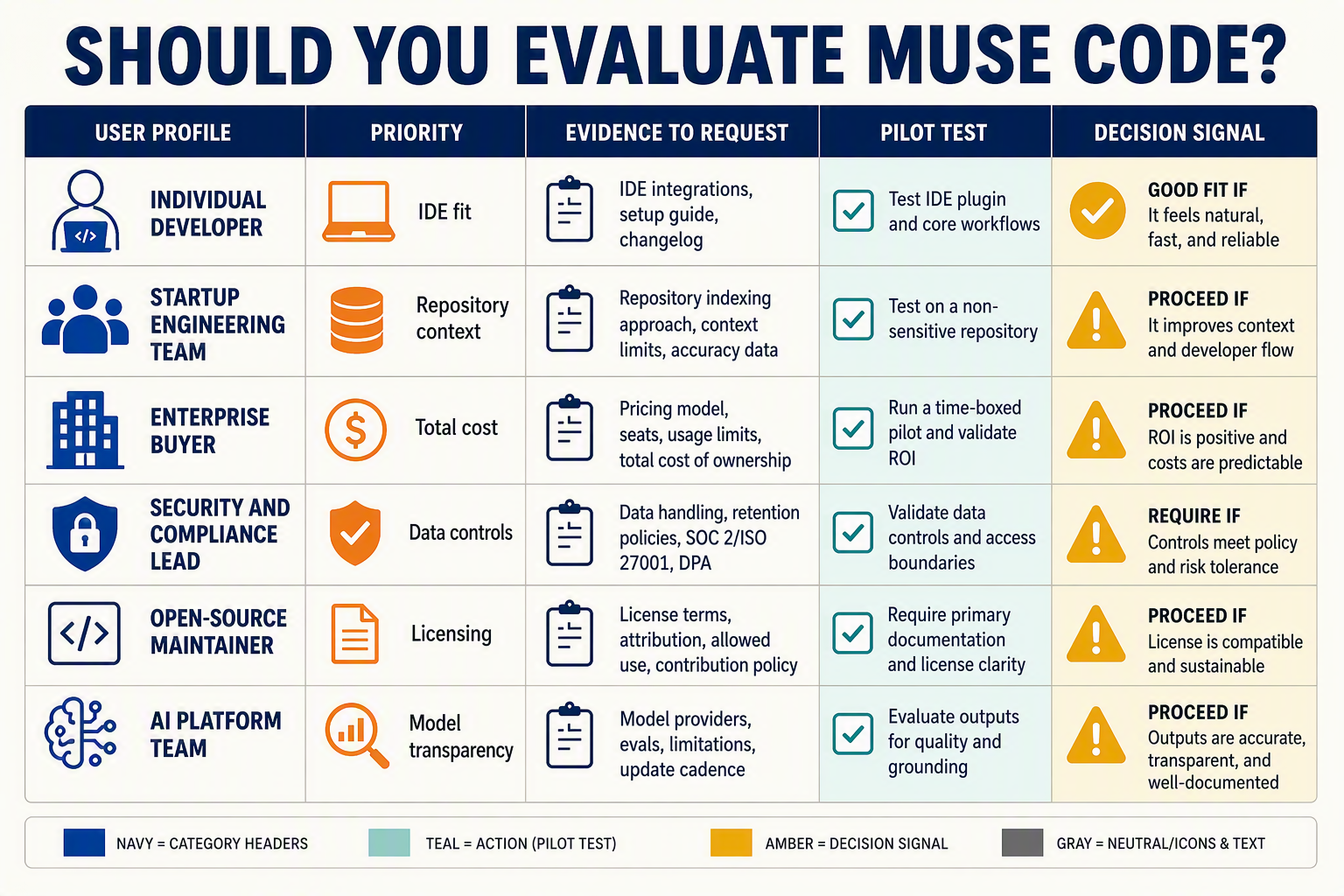
The practical implication is “evaluate, but do not adopt yet.” Until Meta Platforms publishes primary documentation for Meta Muse Code, every role should treat the reported product as an unverified candidate rather than approved development infrastructure.
Role-based decision matrix
| Role | What to verify | Minimum acceptance evidence | Action now |
|---|---|---|---|
| Individual developer | Supported languages, IDEs, workflows, usage limits and output quality | Official documentation plus successful tests on representative, non-sensitive code | Use only public or disposable code; do not assume reported features exist |
| Engineering lead | Code generation, debugging, repository indexing, agent autonomy and review controls | Reproducible evaluation against the team’s actual tasks, with human-review requirements documented | Define a benchmark suite, but postpone production rollout |
| Security or privacy lead | Source-code retention, model training, subprocessors, encryption and data residency | Published Meta privacy terms, retention periods, deletion controls and enterprise security documentation | Block proprietary repositories, credentials and customer data until terms are explicit |
| Platform or DevOps engineer | API stability, authentication, rate limits, audit logs, CI/CD support and failure handling | Versioned API references, service limits, status reporting and tested rollback procedures | Avoid production dependencies and irreversible workflow changes |
| Procurement or legal | Pricing, licensing, intellectual-property terms, indemnity, regions and support | Dated terms of service, a price schedule and an identifiable contracting entity | Do not approve spend or sign contracts based on secondary reports |
| Open-source maintainer | Repository permissions, generated-code provenance, licence compatibility and disclosure rules | Official usage policy plus project-specific contributor guidance | Test only where the repository’s governance policy permits AI tooling |
Apply evidence gates before testing
The 2025 Stack Overflow Developer Survey found that 46% of respondents distrusted AI-generated accuracy, while 33% trusted it. That confidence gap makes verification and code review operational requirements—not optional safeguards.
Use these gates in order:
- Identity gate: Confirm that “Muse Code” is the exact name used in a dated publication from Meta Newsroom, Meta AI, Meta for Developers or a verified Meta GitHub organisation.
- Access gate: Establish eligible accounts, countries, waitlists, supported operating systems and whether availability is preview, beta or general release.
- Capability gate: Match each claimed workflow to documentation and a repeatable test. A product that completes snippets should not automatically be classified as a repository-aware autonomous agent.
- Governance gate: Obtain explicit answers on retention, training use, deletion, telemetry and administrator controls before connecting private source code.
- Commercial gate: Calculate the complete cost—including subscriptions, model usage, infrastructure and review time—only after official pricing exists.
Choose “test,” “wait” or “reject”
A defensible decision should fall into one of three states:
- Test: First-party documentation exists, but performance or organisational fit still requires validation.
- Wait: Important facts about the Muse Code coding platform remain unknown, as they do as of August 5, 2026.
- Reject: Published terms conflict with security, licensing, residency or cost requirements.
Developers comparing the reported Meta coding platform with available tools should use the same benchmark prompts, repositories and review rubric across candidates. Multi-model gateways such as CallMissed’s OpenAI-compatible API can also help teams test supported coding models through one integration with same-tier fallbacks; that is useful for comparison, but it does not substitute for verifying Muse Code’s own documentation.
Frequently asked questions about Meta Muse Code availability, pricing, models, integrations, and privacy
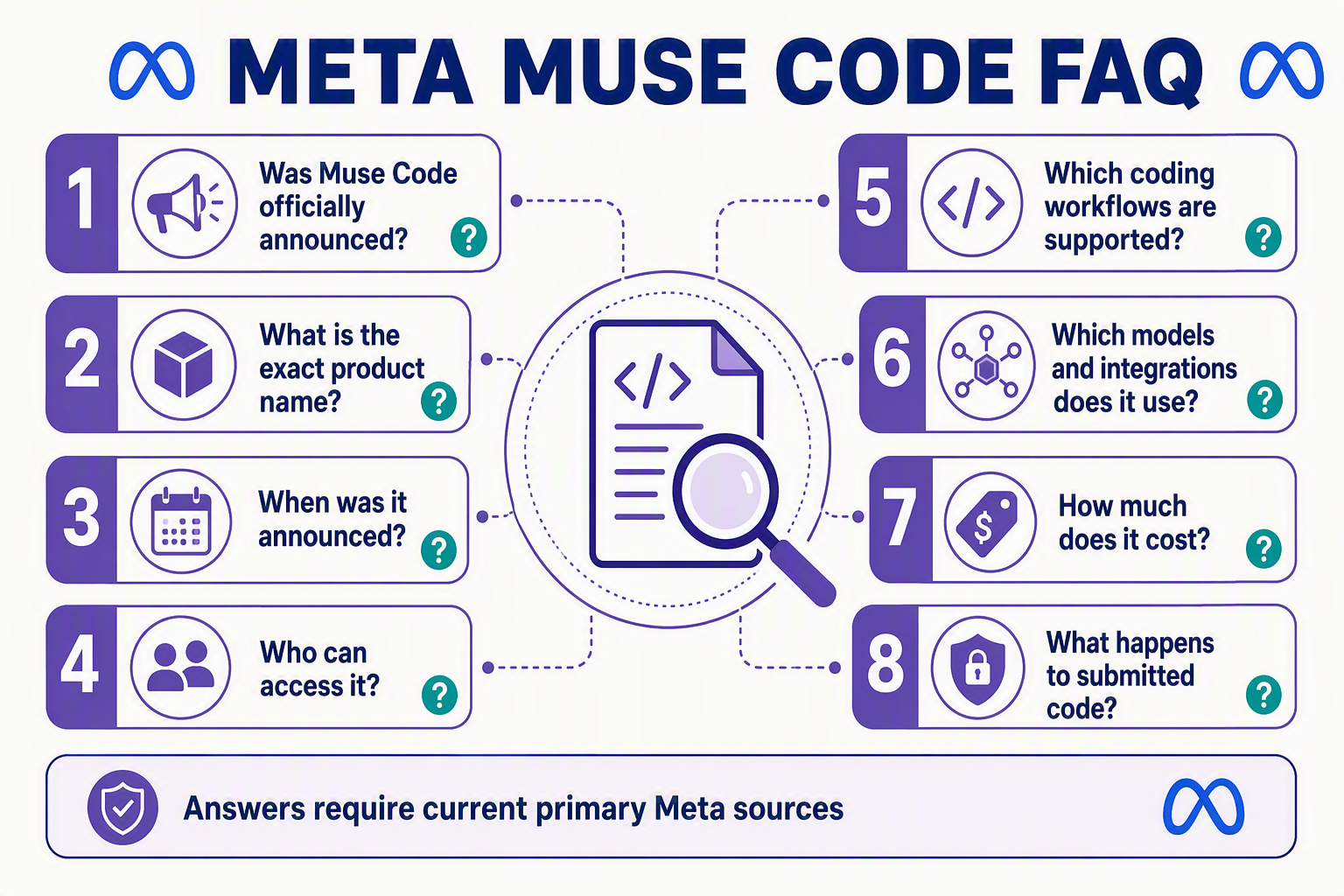
When was Meta Muse Code officially announced?
Is the Muse Code coding platform publicly available, and what workflows does it support?
Which AI models and developer integrations does the reported platform use?
How much does Meta Muse Code cost, and is there a free tier?
Is the reported Meta coding platform safe for private or proprietary source code?
How can developers verify Muse Code claims before adopting the product?
Conclusion
As of August 5, 2026, the central finding is straightforward: available evidence does not establish that Meta has officially announced Meta Muse Code. Without dated, first-party documentation, the alleged Muse Code coding platform should be described as reported—not as a verified Meta release.
- No official announcement date or exact product name has been confirmed through Meta Newsroom, Meta AI, Meta for Developers, official documentation, or Meta’s verified GitHub repositories.
- Availability and supported workflows remain unknown, including code generation, debugging, repository indexing, autonomous agents, and IDE support.
- Models, integrations, pricing, privacy controls, data-retention policies, and geographic restrictions are unverified.
- Developers should wait for primary evidence and avoid uploading proprietary code until Meta publishes explicit security, training, retention, and enterprise terms.
Verification is especially important when 84% of respondents were using or planning to use AI development tools, according to the 2025 Stack Overflow Developer Survey, while 46% distrusted AI-generated output.
Watch next for a dated Meta announcement, stable technical documentation, access instructions, model cards, pricing pages, and privacy terms. Until those appear, procurement or integration decisions involving any reported Meta coding platform would be premature.
To follow how practical AI infrastructure is evolving, explore CallMissed, which provides an OpenAI-compatible multi-model gateway alongside multilingual voice and chat capabilities. What primary evidence would you require before trusting Muse Code with your repositories?
Related Reading
Discussion
Related Posts

Ready to automate customer conversations?
Launch AI voice agents and WhatsApp bots with CallMissed — one API, 22+ Indian languages.