Muse Spark 1.1 Explained: Meta Model API Guide for Developers and Small Businesses



Explore Meta Muse Spark 1.1, its Model API, agentic and multimodal features, pricing considerations, safety limits, and business use cases.
Muse Spark 1.1 Explained: Meta Model API Guide for Developers and Small Businesses
What if an AI model could interpret a screenshot, reason through a multi-step task, write code, and use software tools—not merely answer a prompt? Meta Muse Spark 1.1 is Meta’s latest attempt to make that workflow practical: a multimodal reasoning model announced on July 9, 2026, with stated improvements in tool use, computer use, coding, and multimodal capabilities.
That date matters because Muse Spark 1.1 is not the same release as the original Muse Spark, which Meta introduced in April 2026. The July update is a later model revision, available in public preview through the Meta Model API, Meta’s developer platform for building applications with its AI models. For developers and small businesses, the distinction is important: version numbers can affect model behavior, supported capabilities, evaluation results, reliability, and the amount of testing required before production deployment.
Meta’s official announcement describes Muse Spark 1.1 as a model built for agentic tasks—workflows in which an AI system interprets context, plans actions, calls tools, interacts with computers or applications, and adapts across multiple steps. In practical terms, that could support a customer-support assistant that reviews an image, checks an internal knowledge base, drafts a response, and routes a complex case to a human. It could also help a developer inspect a bug report, modify code, and use connected tools to validate a proposed fix.
This guide explains what Meta Muse Spark 1.1 is, how it differs from the April release, and what its Meta Model API preview means operationally. You’ll learn where its multimodal and agentic capabilities may help—especially in customer service, workflow automation, coding, and voice-agent businesses—along with the limitations that still require permissions, orchestration, human review, and structured testing. We’ll also examine privacy and safety considerations using Meta’s official announcement, developer materials, and Muse Spark 1.1 Evaluation Report as primary sources rather than relying on unverified leaderboard claims or speculative pricing.
Platforms such as CallMissed reflect the same broader shift by bringing models, voice, messaging, and business workflows together through developer-friendly AI infrastructure. The opportunity is substantial, but the central question is practical: can Muse Spark 1.1 perform reliably inside a real business process, not just in a polished demo?
Meta Muse Spark 1.1 is Meta’s July 9, 2026 multimodal reasoning model for agentic tasks, available in public preview through the Meta Model API

Meta Muse Spark 1.1 is Meta’s July 9, 2026 multimodal reasoning model for agentic tasks. The model is available in public preview to U.S. developers through the Meta Model API and is designed to interpret text, images, screenshots, code, and software context while planning and executing multi-step workflows with tools and computer interactions.
Meta’s announcement says the July update improves tool use, computer use, coding, and multimodal capabilities compared with the original release. Meta also claims support for a context window of up to 1 million tokens, which may help applications work with large codebases, lengthy documents, or extended interaction histories. Actual performance will depend on the workload, prompt design, tools, and surrounding application.
What the 1.1 release is
The model belongs to Meta’s Muse Spark family and is intended for applications that need more than a single generated response. An agentic workflow can involve:
- Understanding a user request and relevant visual or textual context
- Planning a sequence of actions
- Calling external tools, APIs, or business systems
- Interacting with a graphical computer interface
- Writing, reviewing, or modifying code
- Evaluating intermediate results and continuing across multiple steps
For example, a support agent could inspect a screenshot of a product issue, search a knowledge base, identify the likely resolution, draft a reply, and escalate the case if confidence is low. A software-development agent could read an issue, locate relevant files, propose a patch, run tests through an approved tool, and summarize the outcome.
These capabilities do not give the model unrestricted access to a company’s systems. Permissions, tool definitions, authentication, orchestration logic, safety controls, and human-review rules remain the application developer’s responsibility.
Muse Spark versus the July update
The version distinction is operationally important:
| Release | Date | What it represents | Developer implication |
|---|---|---|---|
| Muse Spark | April 2026 | Original model-family launch | Existing integrations may have been built and tested against this version |
| The 1.1 release | July 9, 2026 | Later update to the model family | Behavior, capability coverage, and evaluation results may differ |
| Public-preview API access | July 9, 2026 | Early access for U.S. developers through the Meta Model API | Production use requires additional validation, safeguards, and monitoring |
| Updated evaluation materials | July 2026 | Meta’s documented assessment of the newer model | Useful for reviewing tested strengths and stated limitations |
Meta’s Muse Spark 1.1 Evaluation Report describes the model as an update to Muse Spark 1.0, while the company’s April announcement introduced the original Muse Spark. Developers should not assume that April benchmarks, examples, behavior, or integration decisions automatically apply to Meta’s July update.
Why the API preview matters
The Meta Model API gives developers a supported route to experiment with the model instead of building around an informal or consumer-facing interface. The preview is particularly relevant for small businesses testing workflows such as:
- Image- and screenshot-assisted customer support
- Internal operations and document processing
- Code review and engineering assistance
- Tool-connected research or workflow automation
- AI customer-service and voice-agent orchestration
At launch, reported API pricing was $1.25 per million input tokens and $4.25 per million output tokens. Both pricing and U.S. public-preview availability are time-sensitive, so developers should check Meta’s current developer documentation for supported regions, model identifiers, rate limits, context limits, eligibility requirements, and current charges before designing budgets or production systems.
Infrastructure platforms such as CallMissed illustrate the broader direction: developers increasingly need to connect models with voice, messaging, retrieval, and business actions rather than use an LLM in isolation. The model may become one component in that architecture, but reliable deployment still depends on the surrounding system, including access controls, observability, fallback handling, cost management, and human oversight.
How did the original April 2026 Muse Spark launch differ from the July 2026 Muse Spark 1.1 update?
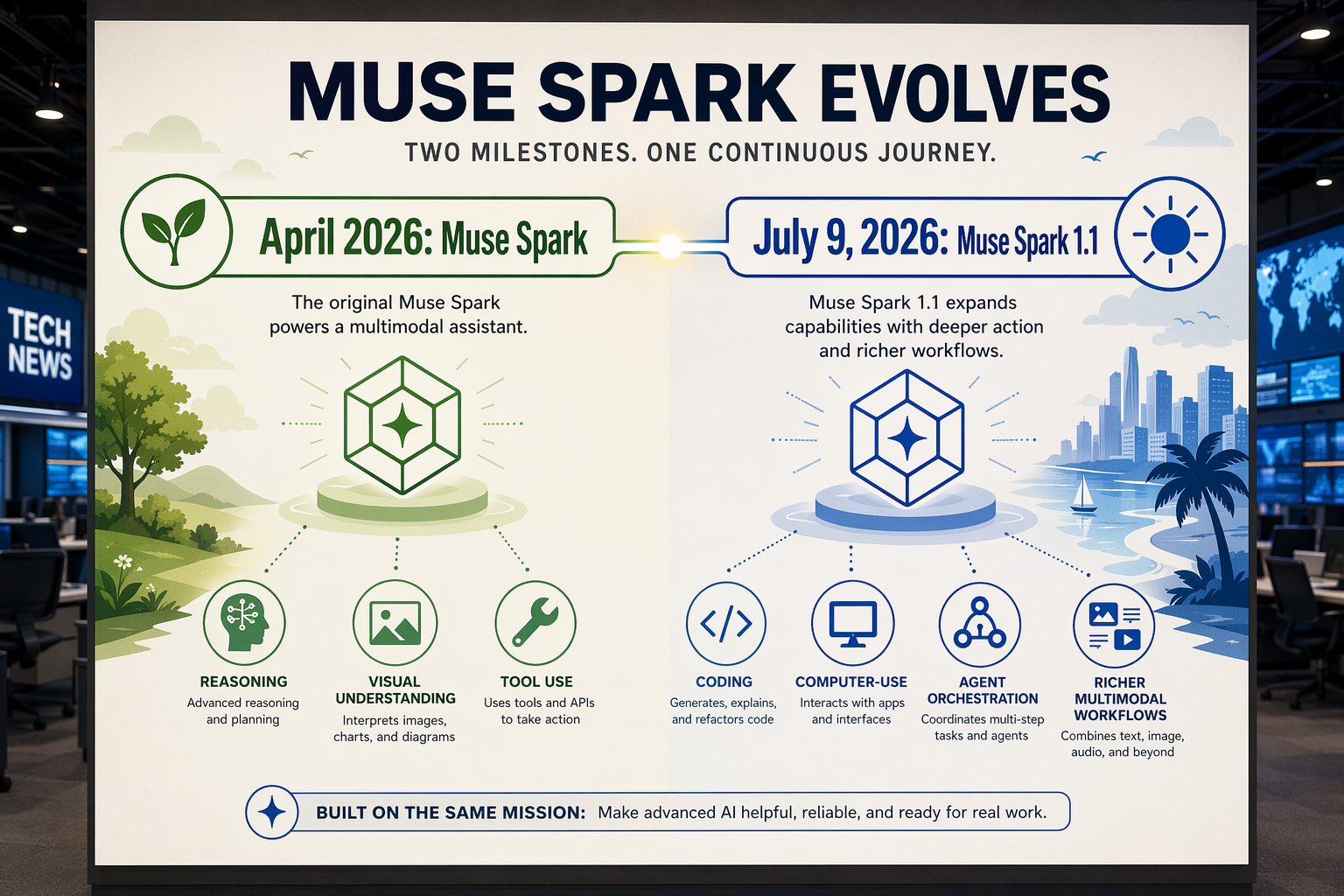
Meta Muse Spark 1.1 is a July 9, 2026 revision of Meta’s April 2026 Muse Spark release—not a separate, unrelated model family. The April launch established Muse Spark as Meta’s flagship multimodal model for the Meta AI assistant, while the July update focuses on making the model more effective for developers building agentic applications through the Meta Model API.
The April 2026 launch: introducing the Muse Spark family
Meta introduced the original Muse Spark in April 2026 as a major model powering a smarter Meta AI assistant. Meta’s April 2026 announcement said Muse Spark would roll out across WhatsApp, Instagram, Facebook, and Messenger, positioning the model primarily within Meta’s consumer AI ecosystem.
The original launch established the broad direction:
- A more capable general-purpose AI assistant
- Multimodal interaction rather than text-only conversations
- Integration with Meta’s consumer applications
- A foundation for future model and product updates
For developers and small businesses, the April announcement was therefore important mainly as the introduction of Meta’s new model family and its intended role in Meta’s wider AI products. It did not, by itself, define the July version’s exact developer-preview behavior, API availability, or operational requirements.
The July 2026 update: a developer-focused revision
Meta announced Muse Spark 1.1 on July 9, 2026, describing it as a multimodal reasoning model built for agentic tasks. Meta’s official announcement specifically highlights improvements in tool use, computer use, coding, and multimodal capabilities.
The practical difference is emphasis. Muse Spark 1.1 is presented less as only an assistant model and more as a component that can participate in structured workflows involving:
- Tool calls, such as retrieving information from a business system or triggering an action
- Computer use, such as interpreting screens and interacting with software
- Coding, including understanding, generating, or modifying code
- Multimodal reasoning, such as combining text with images, screenshots, or other visual context
- Multi-step execution, where the model plans and adapts across an agent workflow
Meta’s Muse Spark 1.1 Evaluation Report describes the release as the latest model in the Muse Spark family and says it “builds upon Muse Spark 1.0.” That language supports treating 1.1 as an incremental model update, not a complete replacement for the April product direction.
Why the distinction matters operationally
The April model announcement and July API preview answer different questions:
| Question | April 2026 Muse Spark | July 9, 2026 Muse Spark 1.1 |
|---|---|---|
| Primary emphasis | Meta AI assistant and consumer-product rollout | Developer applications and agentic workflows |
| Release role | Introduced the Muse Spark model family | Updated the model with targeted capability gains |
| Key context | WhatsApp, Instagram, Facebook, and Messenger | Meta Model API public preview |
| Evaluation question | What is Meta building? | How reliably does the revised model perform in real workflows? |
This version separation matters because an API integration should not assume that behavior, tool-calling reliability, latency, or safety characteristics remain unchanged after a model revision. Developers should test Muse Spark 1.1 independently, even if they previously evaluated the April release. Platforms such as CallMissed, which provide a unified gateway across multiple AI models and communication channels, reflect why version-aware routing and fallback strategies matter as models evolve.
What changed in Muse Spark 1.1, and which capabilities matter operationally?
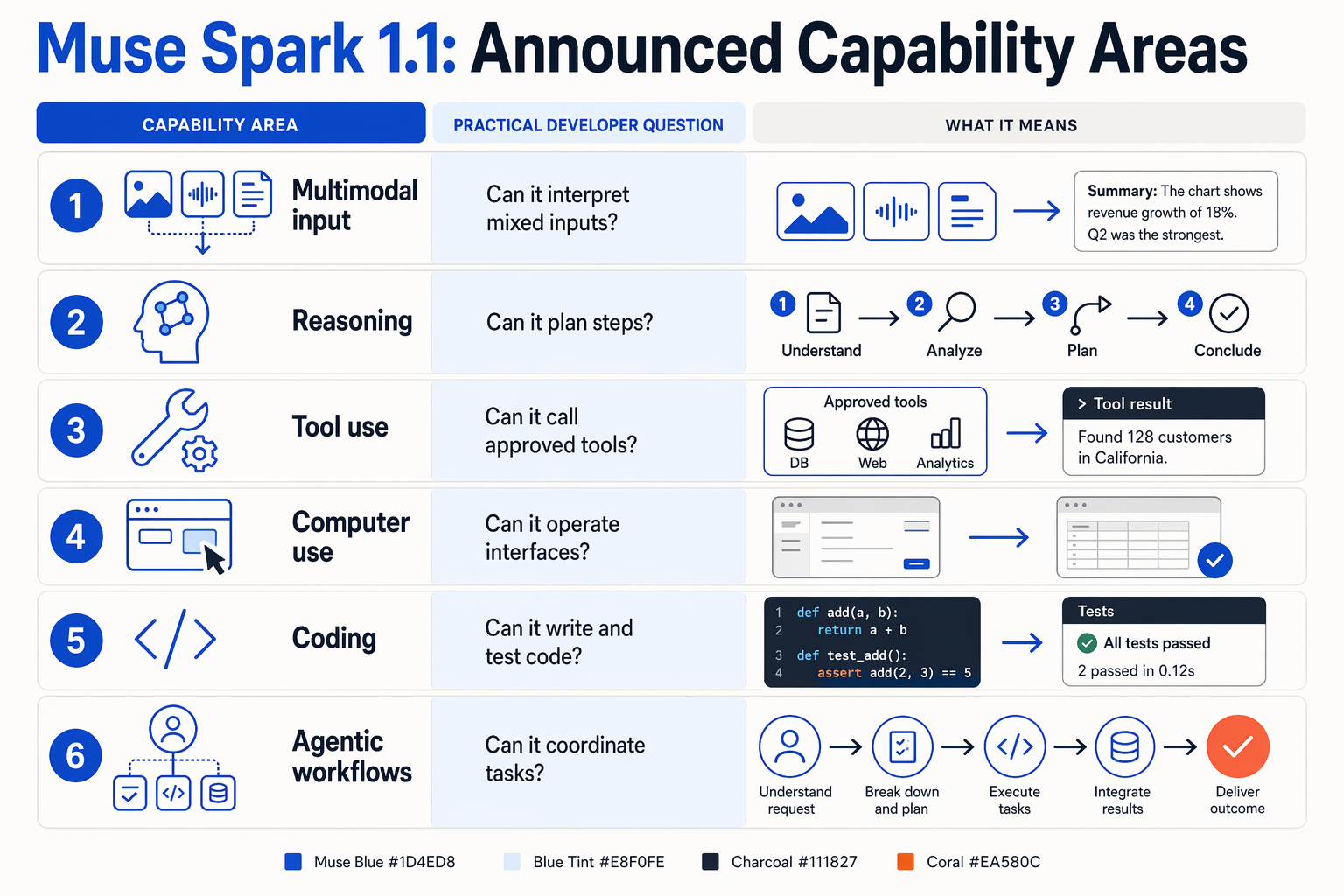
Meta Muse Spark 1.1 is a July 9, 2026 update to Meta’s original April 2026 Muse Spark model, not a separate product category. Meta says the 1.1 release improves tool use, computer use, coding, and multimodal capabilities; operationally, those improvements matter because they can reduce the gap between generating an answer and completing a supervised business workflow.
The table below separates the announced capability changes from their practical implications. Meta’s public materials describe the model at a capability level, so developers should avoid treating the release announcement as a guarantee of autonomous or production-grade performance.
| Capability area | What changed in Muse Spark 1.1 | Operational relevance | Required control |
|---|---|---|---|
| Tool use | Meta’s July 9, 2026 announcement highlights major gains in using connected tools compared with the April Muse Spark release. | The model may support workflows that retrieve records, query knowledge bases, create tickets, or invoke business APIs across multiple steps. | Use allowlisted tools, scoped credentials, input validation, and logs for every tool call. |
| Computer use | Muse Spark 1.1 is designed to interact with software interfaces and computer environments, including visual contexts such as screens. | A small business could automate repetitive back-office tasks in systems without mature APIs, such as reviewing dashboards or transferring information between applications. | Run actions in a sandbox where possible; require confirmation before purchases, account changes, deletion, or external communication. |
| Coding | Meta identifies coding as an area of improvement in the 1.1 release. | Developers can use the model to inspect errors, propose patches, explain unfamiliar code, and work with testing or development tools. | Treat generated code as untrusted until reviewed, tested, scanned for security issues, and checked against licensing and repository policies. |
| Multimodal reasoning | The model’s multimodal capabilities cover inputs such as text, images, screenshots, and code, supporting reasoning across different formats. | Customer-service systems could classify an uploaded product image, interpret a screenshot of an error, or combine a document with a written request before routing a case. | Define supported file types, redact sensitive content, test difficult images, and provide a human fallback for ambiguous cases. |
| Agentic, multi-step workflows | Muse Spark 1.1 is positioned as a multimodal reasoning model for agentic tasks: planning, acting through tools, and adapting across steps. | Businesses can design workflows that move from intake to retrieval, decision-making, action, and escalation rather than stopping at a single response. | Add step limits, approval gates, retries, monitoring, and clear termination conditions; do not equate planning ability with dependable autonomy. |
What developers should test first
The Muse Spark 1.1 Evaluation Report, published by Meta alongside the release, should be read with the official announcement and developer documentation. However, benchmark results alone cannot establish whether the model is suitable for a particular company’s data, tools, latency requirements, or compliance environment.
A practical pilot should measure:
- Task completion: whether the agent finishes the intended workflow, not merely produces plausible text.
- Tool accuracy: whether it selects the correct tool, passes valid parameters, and handles errors safely.
- Multimodal reliability: whether screenshots, scans, and customer-uploaded images are interpreted consistently.
- Escalation quality: whether uncertain or high-risk cases reach a human promptly.
For teams combining model access with customer channels, platforms such as CallMissed illustrate the broader infrastructure trend: developers can connect AI models to voice, WhatsApp, knowledge bases, and business workflows while preserving orchestration and human handoff controls.
How can developers use multimodal reasoning, tool calling, computer use, and coding in real workflows?
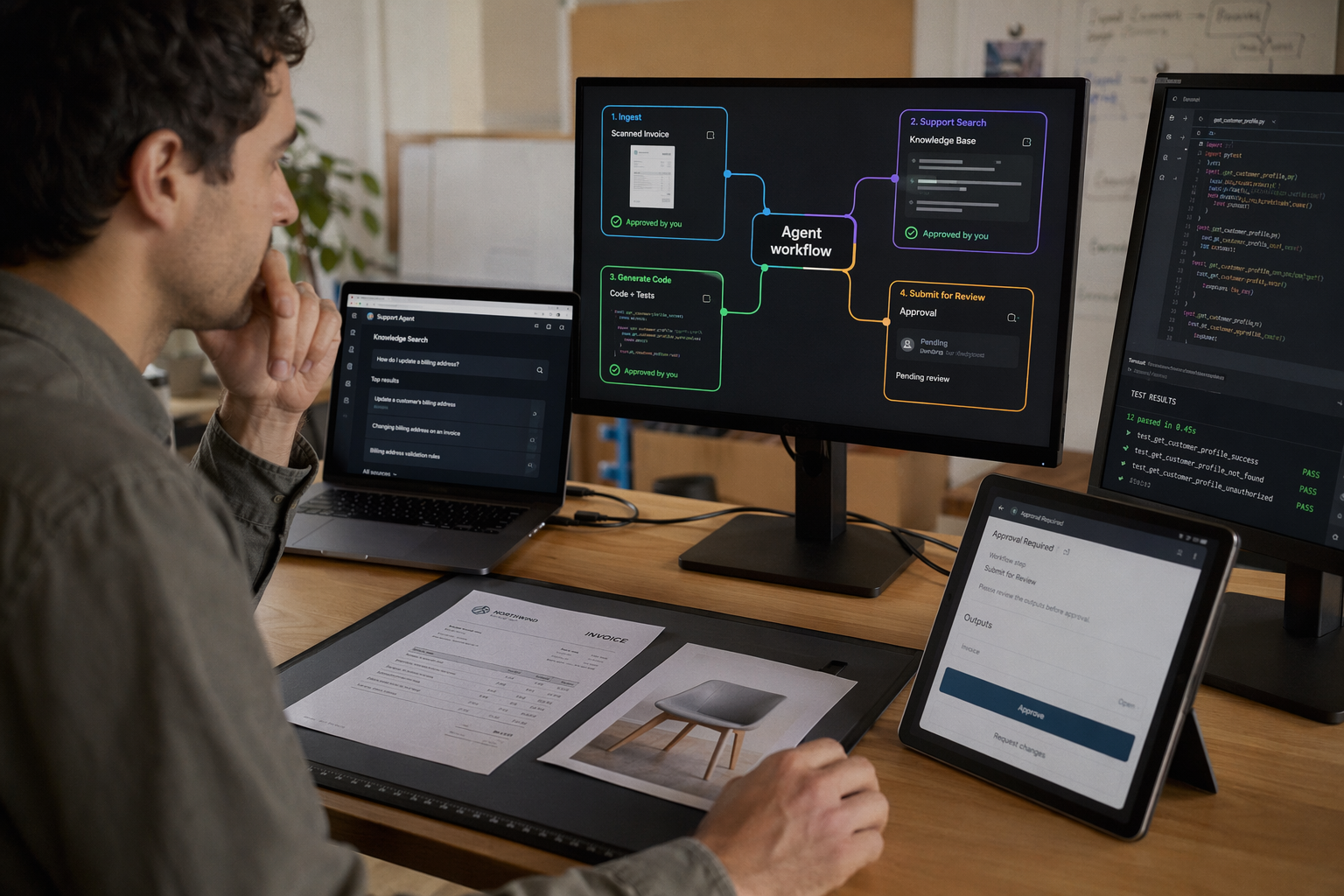
Meta Muse Spark 1.1 can support workflows in which an AI model interprets text, images, screenshots, code, and application state, then uses approved tools to complete multi-step tasks. Meta’s July 9, 2026 announcement specifically highlights improvements in tool use, computer use, coding, and multimodal capabilities over the original Muse Spark release from April 2026.
A practical agent workflow
A useful implementation separates the model’s reasoning from the actions it is allowed to take:
- Receive context: The application provides a user request, screenshot, document, image, code file, or conversation history.
- Plan the task: Muse Spark 1.1 determines what information is missing and which tools may be relevant.
- Call approved tools: The model can request actions such as searching a knowledge base, querying an order system, running code, or interacting with a browser.
- Inspect results: It evaluates tool outputs or updated screen states and decides whether another step is necessary.
- Complete or escalate: The system returns an answer, performs a permitted action, or routes the case to a human when confidence or authorization is insufficient.
For example, a support agent could inspect a customer’s screenshot of a payment error, identify the likely issue, search internal documentation, check transaction status through an API, and draft a response. A human approval step should remain in place before issuing a refund, changing account data, or communicating a legally significant decision.
What computer use adds
Computer use is different from ordinary function calling. Instead of interacting only with structured APIs, the model may interpret a visual interface and propose actions such as clicking a control, entering text, navigating a page, or reviewing a form. This can help when a business relies on legacy software that lacks a modern API.
However, computer use requires strong guardrails:
- Limit access to specific applications, accounts, and browser sessions.
- Require confirmation for purchases, deletion, refunds, outbound messages, and permission changes.
- Log screenshots, tool calls, outputs, and user approvals.
- Detect prompt injection in web pages, documents, and uploaded images.
- Stop execution when the interface changes unexpectedly.
A model that can see and operate software still does not automatically understand business policy. Permissions and deterministic validation must enforce the boundaries.
Coding and multimodal development workflows
For developers, Muse Spark 1.1 can combine a bug report, an application screenshot, logs, and source code in one investigation. A controlled workflow might ask it to:
- Reproduce or classify an error from logs and screenshots.
- Suggest a minimal code change.
- Generate tests or documentation.
- Run tests in a sandbox.
- Summarize failures for human review.
Meta’s Muse Spark 1.1 Evaluation Report and official announcement are the appropriate primary references for assessing model performance; preview behavior should not be inferred from general leaderboard claims. Teams should test their own repositories, languages, UI environments, and failure cases before production use.
For customer-engagement builders, this pattern can extend across channels. Platforms such as CallMissed combine AI models with voice, WhatsApp, knowledge-base retrieval, and business workflows, while an application using Muse Spark 1.1 could supply the reasoning layer for selected support or automation tasks. The reliable design is not “let the model control everything,” but give the model useful context, narrowly scoped tools, observable execution, and a clear human fallback.
Which customer-service and voice-agent use cases are realistic, and what infrastructure is still required?
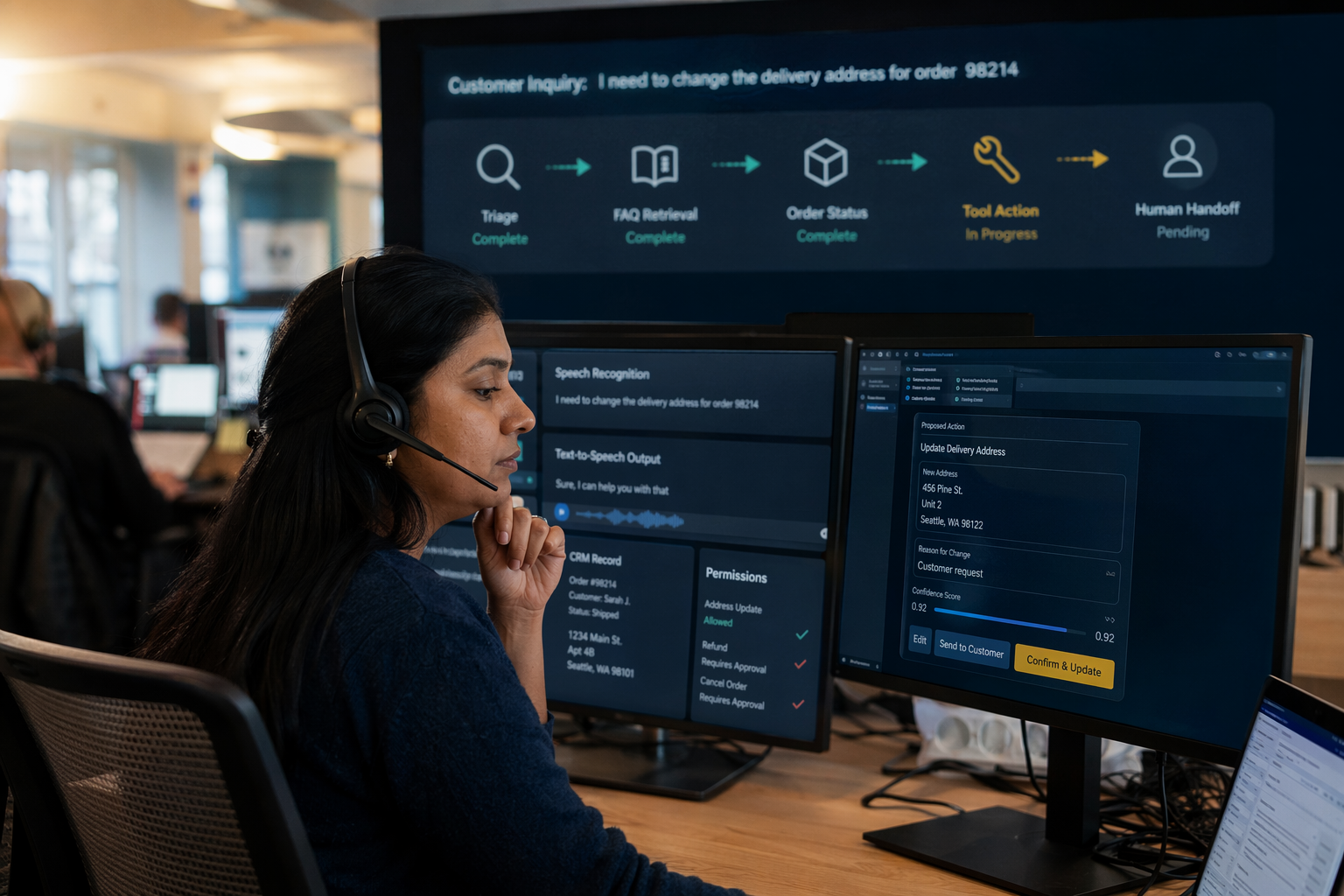
Meta Muse Spark 1.1 is realistic for supervised customer-service automation and tool-assisted voice workflows—not as a complete, standalone call-centre system. Meta’s July 9, 2026 announcement positions the model for improvements in tool use, computer use, coding, and multimodal reasoning. Businesses still need separate speech, telephony, retrieval, orchestration, security, and human-escalation infrastructure around the model.
Customer-service use cases that fit
The strongest early applications are bounded workflows where the model can inspect information, call approved tools, and produce a response without making irreversible decisions autonomously.
Realistic examples include:
- Image-assisted support: A customer uploads a damaged-product photograph, screenshot, invoice, or error message. Muse Spark 1.1 can interpret the visual context, retrieve the relevant policy, and draft the next response.
- Knowledge-base assistance: The model can search a company’s approved documentation, identify an answer, and cite or summarise the relevant material for a customer or human agent.
- Ticket triage: It can classify an issue, extract order or account details, assign priority, and route the case to billing, technical support, or a specialist queue.
- Agent assist: During a live interaction, the model can suggest troubleshooting steps, summarise the conversation, and prepare a follow-up email—while leaving the final action to a human.
- Back-office workflows: With carefully scoped permissions, it may update a CRM, create a support ticket, or check delivery status through connected APIs.
These are more realistic than asking an agent to independently resolve every complaint. Refunds, account closures, medical guidance, financial decisions, and other high-impact actions should require explicit rules, confirmation, or human approval.
What a voice-agent deployment still requires
Muse Spark 1.1 does not replace the real-time communications stack. A production voice agent generally needs:
- Telephony or messaging connectivity for phone numbers, call routing, recording policies, and outbound permissions.
- Speech-to-Text (STT) to convert a caller’s audio into model input.
- An orchestration layer to manage conversation state, tool calls, timeouts, retries, authentication, and escalation.
- Text-to-Speech (TTS) to convert approved responses into natural audio with acceptable latency.
- Business integrations for CRM, order management, calendars, payments, and knowledge retrieval.
- Safety controls and observability, including redaction, audit logs, prompt-injection defenses, confidence thresholds, and transcript review.
For Indian businesses, language coverage is a practical infrastructure concern, not a secondary feature. Platforms such as CallMissed combine voice-agent workflows with STT and TTS support across 22 Indian languages, while also supporting WhatsApp customer engagement and WhatsApp Business calling bridged to AI agents.
A sensible deployment pattern
The safest starting design is a human-supervised agent:
- Let Muse Spark 1.1 answer FAQs, collect structured details, and perform read-only lookups.
- Require confirmation before writing to systems or taking consequential actions.
- Transfer low-confidence, emotional, unusual, or policy-sensitive conversations to a human.
- Test multilingual accuracy, interruption handling, latency, hallucinations, and tool failures using real, consented scenarios.
Meta’s Muse Spark 1.1 Evaluation Report and official announcement are useful starting points, but they do not eliminate application-level testing. The model supplies reasoning and multimodal capabilities; reliability comes from the surrounding system’s permissions, fallbacks, monitoring, and review process.
What are the main limitations, privacy risks, and safety controls for production deployment?
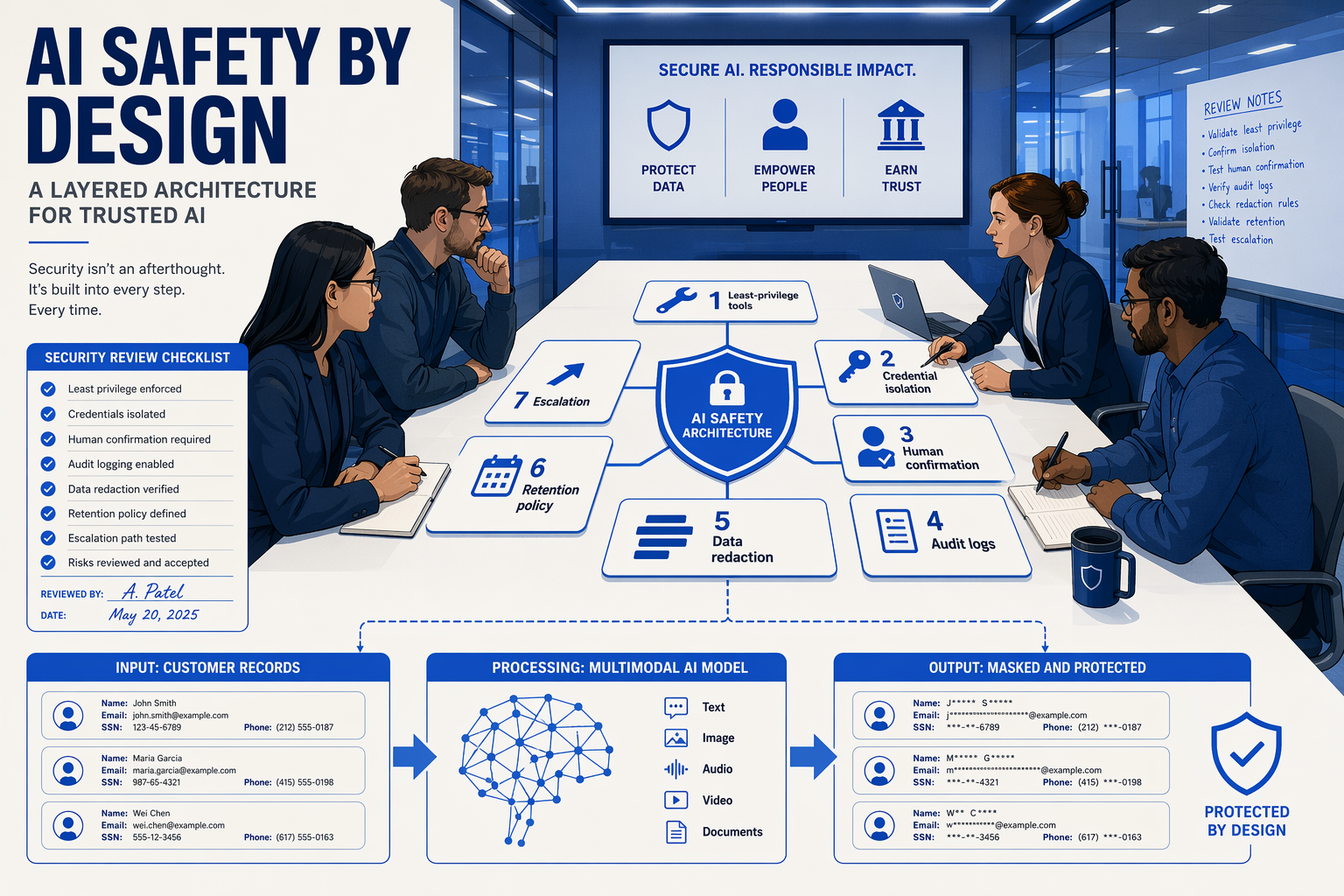
Meta Muse Spark 1.1 should be treated as a public-preview component—not an autonomous employee. Its multimodal reasoning, tool use, computer use, and coding capabilities can expand what an application does, but production deployment still requires tightly scoped permissions, data minimisation, monitoring, and human approval for consequential actions.
Public-preview and reliability limitations
Meta announced Muse Spark 1.1 on July 9, 2026, describing it as an update to the original Muse Spark launched in April 2026. Because the July release is available through the Meta Model API public preview, developers should expect changes to model behaviour, API contracts, latency, availability, supported features, and evaluation results before general availability.
The model can reason across images, screenshots, code, and software environments, but capability does not guarantee consistent execution. Common production failure modes may include:
- Misreading screenshots, documents, or visual evidence
- Selecting the wrong tool or supplying invalid arguments
- Repeating an action, stopping before task completion, or losing context across long workflows
- Producing plausible but incorrect code or business decisions
- Taking an instruction embedded in an image, webpage, email, or document as an authorised command
Meta’s Muse Spark 1.1 Evaluation Report and Muse Spark Contemplating Safety & Preparedness Report should therefore be treated as starting points for risk assessment, not substitutes for testing a specific application. A support workflow, coding agent, and browser automation system expose different failure modes. Teams should evaluate the exact prompts, tools, data, users, and escalation paths they intend to deploy.
Privacy and data-handling risks
A multimodal agent can process more sensitive information than a text-only chatbot. Screenshots may contain customer names, payment details, authentication tokens, internal dashboards, or personal messages. Tool calls can also expose information indirectly—for example, when an agent searches a CRM record or sends an image to a third-party service for analysis.
Before connecting Muse Spark 1.1 to business systems, developers should:
- Minimise inputs: send only the fields, images, and screen regions required for the task.
- Redact sensitive data: remove credentials, payment-card data, government identifiers, and unnecessary personal information.
- Define retention and access policies: verify how API inputs, outputs, logs, and uploaded files are handled under the applicable Meta developer and privacy documentation.
- Separate tenants and permissions: prevent one customer’s context from entering another customer’s session.
- Audit third-party tools: document every service that receives model-generated content or user data.
For Indian businesses, privacy controls should also align with the Digital Personal Data Protection Act, 2023, contractual obligations, and sector-specific requirements where applicable.
Safety controls for production
Use least-privilege tool access and keep high-impact actions behind approval gates. An agent may draft a refund, update a ticket, or prepare a code change automatically; sending money, deleting records, changing account permissions, or issuing a customer-facing commitment should normally require explicit confirmation.
Effective safeguards include:
- Tool allowlists, schema validation, rate limits, and sandbox environments
- Human review for financial, legal, medical, employment, or irreversible actions
- Prompt-injection tests for webpages, files, screenshots, and emails
- Full logs of inputs, model outputs, tool calls, approvals, and failures
- Version-pinned prompts and regression tests when the preview model changes
- A fast fallback to a human or deterministic workflow
For voice and messaging businesses—including platforms such as CallMissed, which connect AI agents to WhatsApp and voice workflows—these controls should cover both the model and the communication channel. A safe deployment is not merely accurate in a benchmark; it is observable, reversible, and designed to fail safely.
How should teams compare Muse Spark 1.1 with OpenAI and Anthropic models without relying on unsupported leaderboard claims?
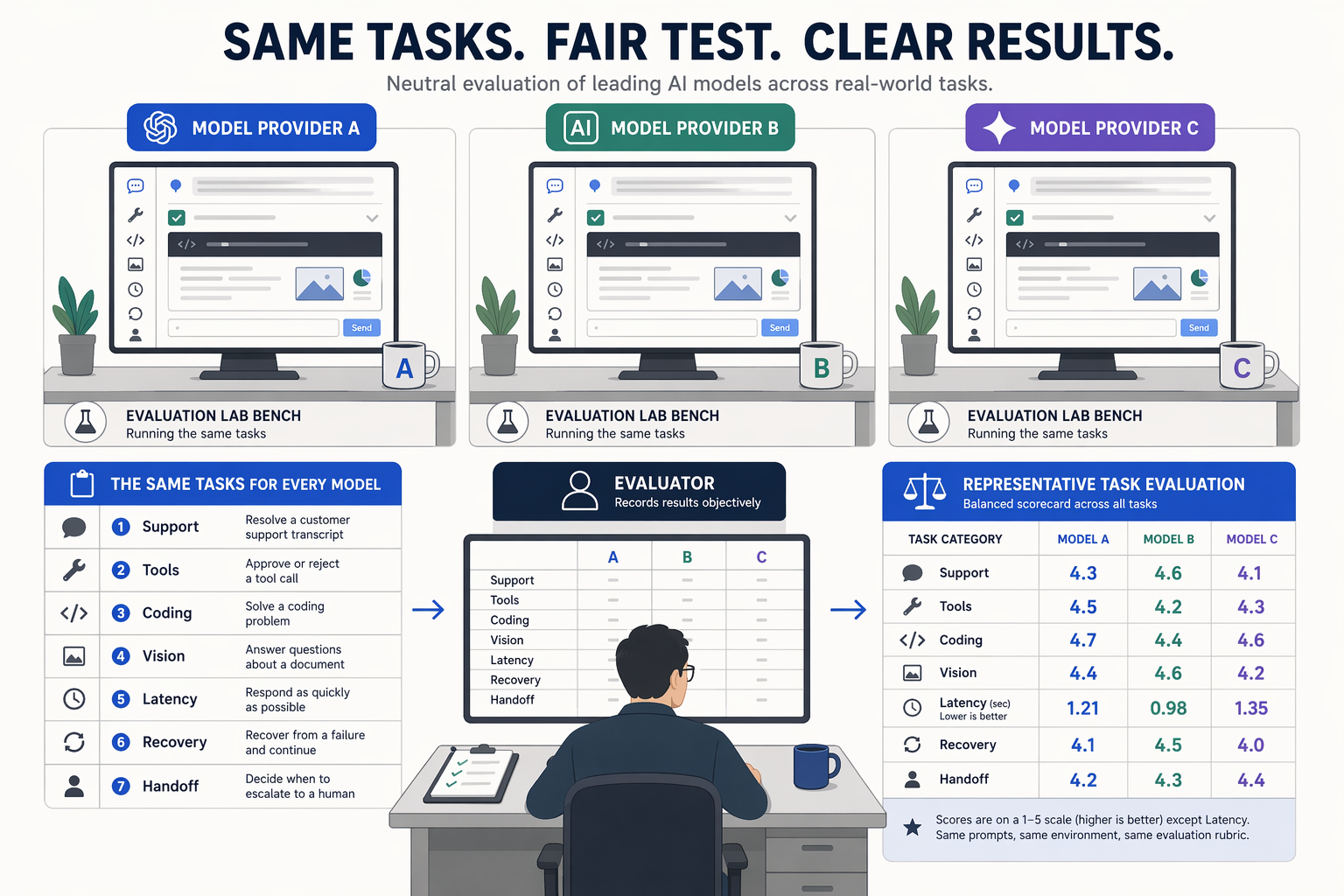
Teams should compare Muse Spark 1.1 with OpenAI and Anthropic models through controlled, task-specific evaluations—not unsupported claims that one model “leads” a leaderboard. Meta’s public-preview model, announced on July 9, 2026, targets multimodal reasoning and agentic tasks. OpenAI and Anthropic offer model families with different capabilities, pricing, latency, tool interfaces, and deployment controls.
Start with the workflow, not the model name
The original Muse Spark launched in April 2026, followed by the 1.1 release in July. Meta describes the revision as delivering “major gains in tool and computer use, coding, and multimodal capabilities,” but this vendor statement does not establish universal superiority over competing models.
A useful comparison starts with the business tasks the model must perform:
- Customer support: classify requests, retrieve policy information, draft replies, and escalate exceptions.
- Computer use: interpret screenshots, navigate approved software, and complete multi-step actions.
- Coding: diagnose errors, modify files, call development tools, and validate changes.
- Multimodal processing: understand images, documents, charts, and interface screenshots.
- Voice workflows: produce accurate transcripts, follow instructions, and generate natural responses within latency limits.
Teams should define success criteria before testing. Relevant measures include factual accuracy, correct tool selection, workflow completion rate, escalation quality, response time, cost per completed task, and the percentage of cases requiring human intervention.
Build a fair evaluation matrix
Meta’s evaluation report for the 1.1 release is an important primary source for understanding the company’s reported results. However, teams should document each evaluation’s prompt format, tool availability, model version, test data, and scoring method before comparing those results with OpenAI or Anthropic documentation. Scores from different test harnesses may not be directly comparable.
A practical private benchmark can include:
- A shared test set: Give every model the same anonymized customer questions, screenshots, coding tasks, instructions, and tool schemas.
- A failure taxonomy: Label hallucinations, unsafe actions, permission violations, incorrect tool calls, incomplete plans, and poor handoffs.
- Repeated trials: Run each scenario multiple times because agentic outputs can vary between attempts.
- Operational measurements: Record latency, token or credit consumption, tool-call frequency, retry rates, and human-review time.
- Safety checks: Test prompt injection, sensitive-data exposure, unauthorized actions, and behavior when required information is missing.
Compare integration fit and total cost
Capability is only one factor. Teams should also compare API stability, observability, structured-output support, rate limits, data-retention terms, regional availability, and the ease of switching models during an outage or performance incident.
Small businesses should calculate cost per successful business outcome, not just cost per token. A low-cost response can become expensive if it causes retries or requires human correction, while a more capable model may be unnecessary for straightforward classification tasks.
Platforms such as CallMissed offer another approach: developers can access multiple model types through an OpenAI-compatible gateway, while businesses can connect AI to voice, WhatsApp, and customer workflows. This architecture can simplify side-by-side testing and fallback strategies without tying every workflow to a single provider.
What does Muse Spark 1.1 mean for your business or project?
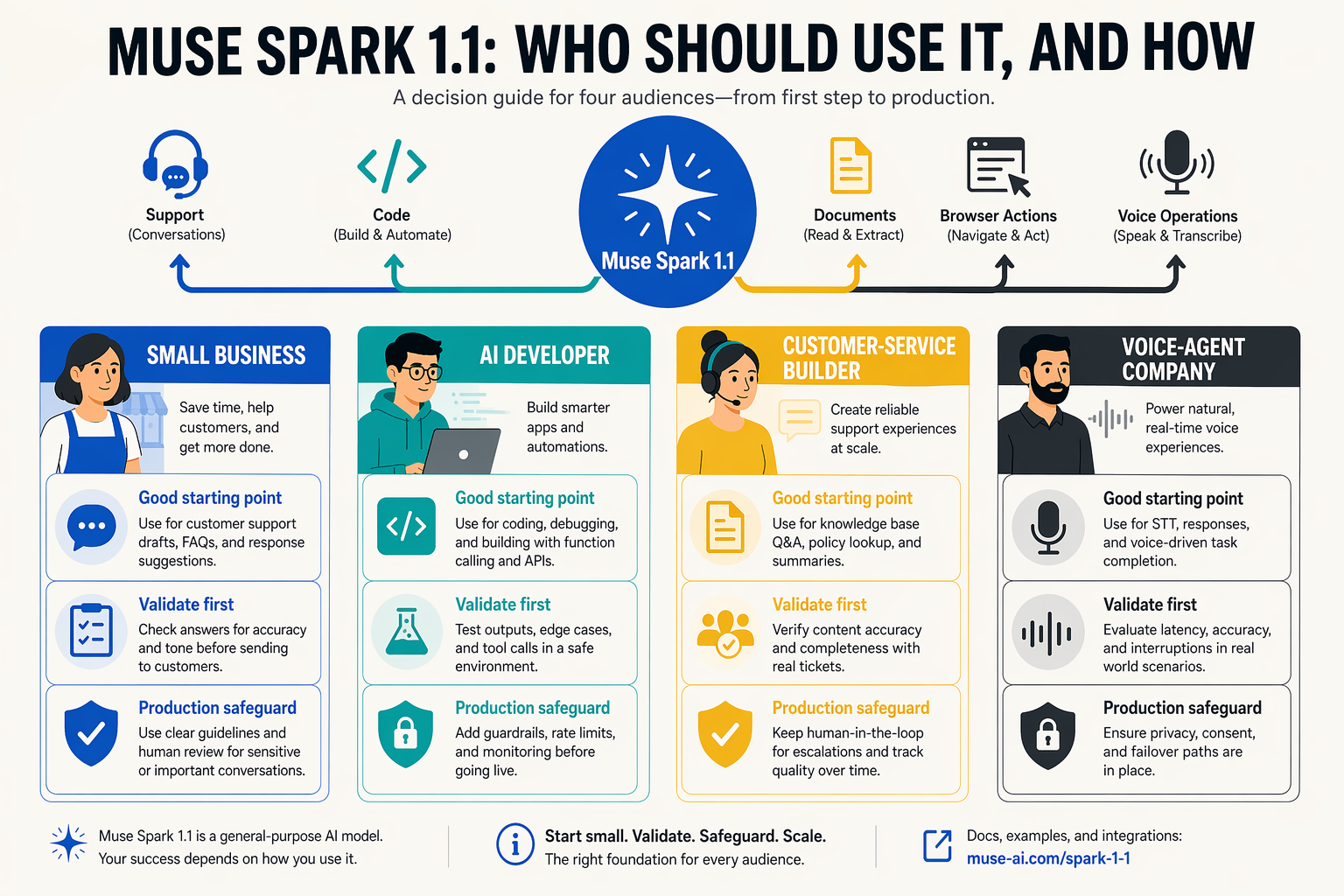
Muse Spark 1.1 matters most as a workflow component, not as a standalone chatbot. Announced by Meta on July 9, 2026, the public-preview model is intended for agentic tasks involving tool use, computer interaction, coding, and multimodal inputs. For a small business or development team, the practical question is whether those capabilities reduce manual work safely enough to justify integration and testing.
| Business or project area | Relevant capability | Potential value | What you still need |
|---|---|---|---|
| Customer support | Interprets text, images, screenshots, and connected knowledge sources | Classify requests, inspect uploaded evidence, draft replies, and escalate unusual cases | Retrieval controls, approved response policies, and human review for sensitive cases |
| Back-office automation | Tool use and multi-step reasoning | Move information between applications, prepare records, and trigger routine workflows | Explicit permissions, API safeguards, audit logs, and failure recovery |
| Software development | Announced improvements in coding and tool use | Analyze bug reports, suggest code changes, and support test or debugging workflows | Sandboxed execution, code review, testing, and restricted repository access |
| Visual operations | Multimodal understanding of images and software screens | Review forms, screenshots, product issues, or interface states before taking action | Image-quality checks, privacy controls, and a fallback for ambiguous inputs |
| Voice and messaging agents | Reasoning can be combined with external speech, telephony, or messaging systems | Coordinate an answer across customer context, tools, and communication channels | Separate speech, consent, escalation, and call-recording policies |
| Prototyping and evaluation | Availability through the Meta Model API public preview | Test an agentic workflow before committing to a production architecture | Preview-risk assessment, version pinning where supported, monitoring, and regression tests |
How small teams should interpret the opportunity
The strongest fit is a bounded workflow with a clear input, a limited set of permitted actions, and an observable outcome. A retailer might begin with image-assisted support triage; a software team might use the model to inspect issues and propose—but not automatically merge—code changes. These projects are easier to evaluate than an unrestricted “AI employee” because success and failure can be measured.
Meta’s evaluation report for the July release should be read alongside the July 9 announcement, but evaluation results are not a substitute for testing the exact tools, prompts, data, and permissions used by your business. The model is a revision of the original Muse Spark launched in April 2026, so teams should repeat regression tests rather than assume identical behavior between versions.
A practical adoption sequence
- Choose one workflow and define measurable outcomes such as resolution time, extraction accuracy, or escalation rate.
- Expose only necessary tools, using least-privilege credentials and approval gates for irreversible actions.
- Test multimodal edge cases, including low-quality screenshots, incomplete documents, conflicting instructions, and prompt injection.
- Keep human escalation available until production evidence demonstrates reliable performance.
For teams connecting AI to WhatsApp, voice, and business systems, infrastructure such as CallMissed illustrates how a model can sit inside a broader communication stack rather than operate alone. Meta’s preview model may provide reasoning and tool coordination; the surrounding platform still has to manage channels, identity, permissions, logging, and customer experience.
Frequently Asked Questions About Meta Muse Spark 1.1 and the Meta Model API
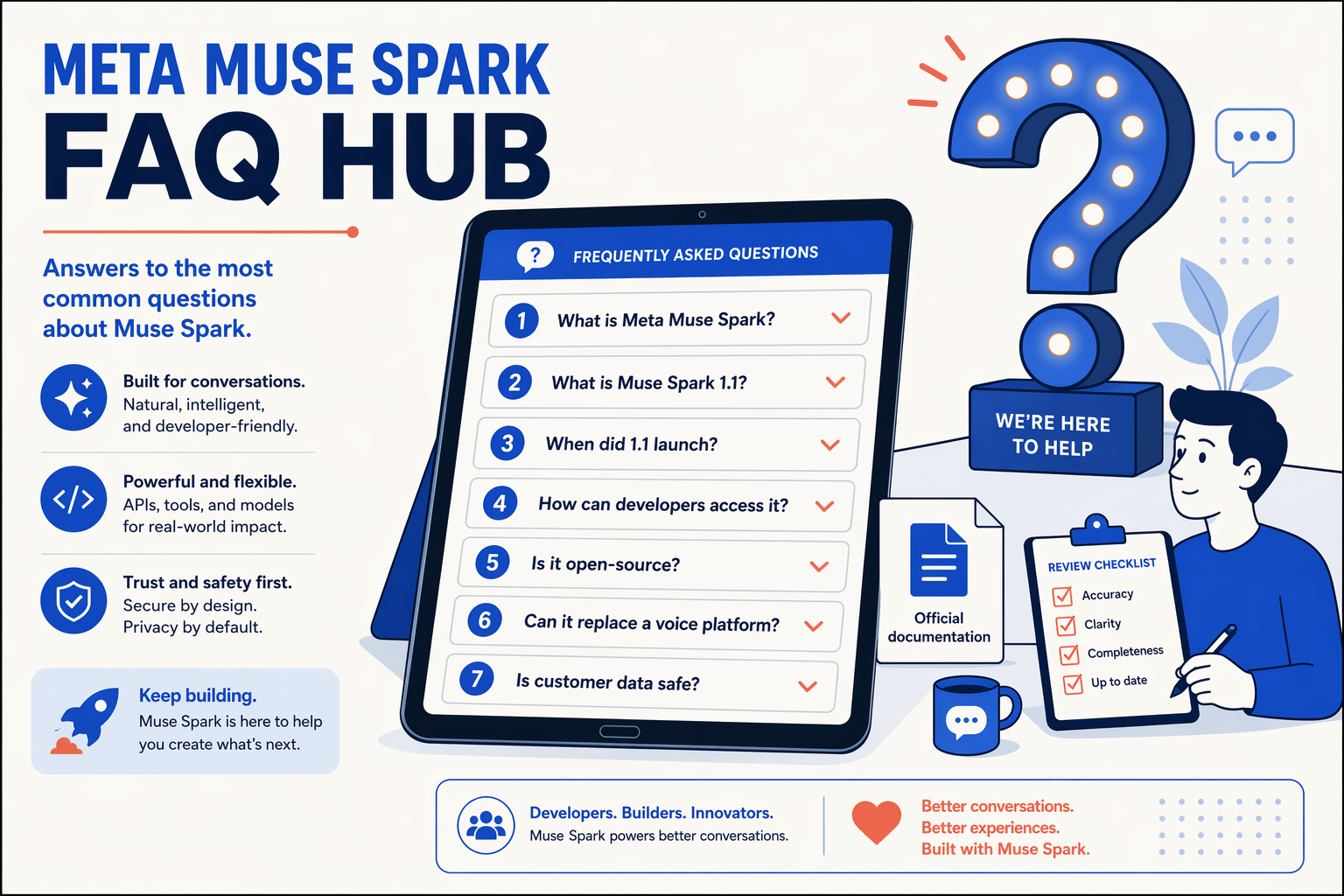
Meta Muse Spark 1.1 is Meta’s July 9, 2026 multimodal reasoning model for agentic workflows, available in public preview through the Meta Model API. It is designed for tool use, computer interaction, coding, image and screenshot understanding, and other multi-step tasks—but production use still requires permissions, orchestration, testing, and human oversight.
What is Meta Muse Spark 1.1?
When was Meta Muse Spark 1.1 released?
How can developers access Meta Muse Spark 1.1 through the Meta Model API?
What can Meta Muse Spark 1.1 do for small businesses?
Is Meta Muse Spark 1.1 suitable for customer-service or voice-agent applications?
Is Meta Muse Spark 1.1 ready for production use?
Conclusion
Meta Muse Spark 1.1 is Meta’s July 9, 2026 multimodal reasoning model for agentic tasks, available in public preview through the Meta Model API. Its announced improvements in tool use, computer use, coding, and multimodal understanding make it relevant to developers and small businesses building workflows—not simply chat interfaces.
The key takeaways are:
- Version matters: Muse Spark launched in April 2026; Muse Spark 1.1 is a later revision with potentially different behavior, capabilities, evaluations, and testing requirements.
- Multimodal reasoning expands automation: The model can work across text, images, screenshots, code, software context, and multi-step tool-driven tasks.
- Business value depends on orchestration: Customer support, workflow automation, coding assistance, and voice-agent operations still require permissions, structured tool access, human review, and reliability testing.
- Preview means caution: Meta’s announcement, developer materials, and the Muse Spark 1.1 Evaluation Report should guide implementation, while privacy, safety, and data-handling decisions remain the builder’s responsibility.
The next milestone to watch is whether public-preview performance translates into dependable production workflows, particularly when models must act across real systems rather than polished demonstrations. To explore how AI communication is evolving, check out CallMissed, an AI infrastructure platform powering voice agents and multilingual chatbots for businesses. The practical question is no longer whether models can reason across modalities, but where your business can safely give them permission to act.