
Grok 4.20 vs Gemini 3.1 Pro for Reasoning Tasks: What Can Be Verified?


Compare Grok 4.20 and Gemini 3.1 Pro for reasoning tasks using verified sources, honest trade-offs, pricing checks, and a fair test plan.
Grok 4.20 vs Gemini 3.1 Pro for Reasoning Tasks: What Can Be Verified?
No reliable winner can currently be verified in the Grok 4.20 vs Gemini 3.1 Pro for reasoning tasks debate. The available research contains no authoritative, model-specific evidence confirming the exact availability, specifications, pricing, context limits, or benchmark results for either Grok 4.20 or Gemini 3.1 Pro, so any confident head-to-head claim would be speculation.
That uncertainty matters because “reasoning” covers materially different tasks: arithmetic, formal logic, coding, multi-step planning, long-context synthesis, and instruction following. This comparison therefore focuses on what can actually be checked: official endpoint details, reproducible tests, exact-answer scoring, rubric-based evaluation, latency, token usage, consistency across multiple runs, and failure modes such as unsupported conclusions or hidden tool use. You’ll get a verification-first feature and pricing comparison, practical trade-offs, and a fair test plan—rather than invented scores or a universal verdict.
Which model is better for reasoning tasks? The verified verdict
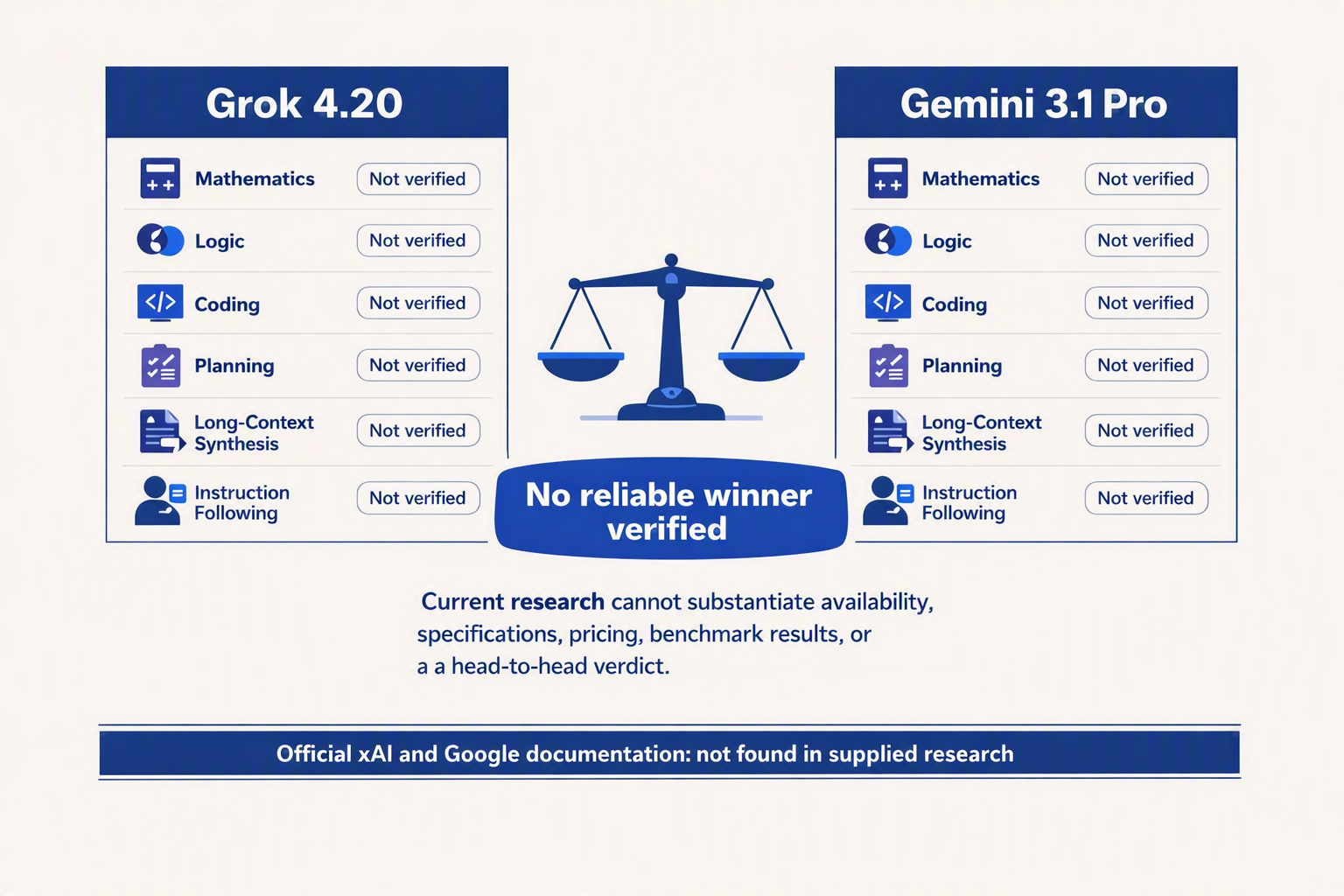
No reliable winner can be verified for Grok 4.20 vs Gemini 3.1 Pro for reasoning tasks. The available research context contains no authoritative, model-specific evidence confirming either model’s current specifications, benchmark performance, pricing, context limits, or endpoint availability. Therefore, neither Grok 4.20 nor Gemini 3.1 Pro should be declared superior without reproducible tests against confirmed xAI or Google endpoints.
What is the verified verdict?
- No verified reasoning winner: Current evidence does not support a defensible claim that Grok 4.20 or Gemini 3.1 Pro is better overall.
- No verified benchmark comparison: Published scores should not be treated as comparable unless they identify the exact model version, endpoint, test set, prompting method, tool access, and evaluation criteria.
- No verified product equivalence: Consumer chat access and API endpoints may expose different models, system instructions, tools, or limits.
How should reasoning performance be tested?
Use a fixed, representative test set and identical instructions for both models. Score exact correctness separately from explanation quality, because a persuasive explanation can still contain an incorrect conclusion.
- Math and quantitative reasoning: Test arithmetic, algebra, probability, unit conversion, and multi-step word problems. Record the exact answer, intermediate errors, and whether the final result is correct.
- Formal logic: Use fixed syllogisms, constraint puzzles, contradiction checks, and conditional reasoning tasks. Disable browsing unless both models support the same browsing setup.
- Coding and debugging: Evaluate executable test results, bug localization, patch correctness, edge-case handling, and security issues—not merely whether generated code looks plausible.
- Planning and synthesis: Measure completion of multi-step plans, long-context retrieval, prioritization, instruction following, and unsupported conclusions. An aggregate score can conceal meaningful category-level differences.
- Consistency: Run each prompt multiple times with matched temperature and sampling settings where available. Record answer variance, refusals, latency, token usage, and any hidden or visible tool calls.
What remains unverified?
The available research does not establish authoritative current values for either named model’s pricing, context window, modalities, rate limits, benchmark results, or API availability. That absence does not prove that either model does not exist; it means the claims require confirmation from current official xAI or Google documentation before publication or procurement.
The practical decision is conditional: confirm the exact model identifier and endpoint, then run a representative fixed test set covering math, logic, coding, planning, long-context synthesis, and instruction following. Choose the model that performs reliably on the tasks that matter to your workload—not the one associated with an unverified benchmark, product label, or universal winner claim.
What is the at-a-glance verdict on Grok 4.20 vs Gemini 3.1 Pro?
No reliable winner can currently be verified for Grok 4.20 vs Gemini 3.1 Pro for reasoning tasks. The available research does not provide authoritative, model-specific evidence confirming either model’s benchmark performance, context limits, pricing, endpoint availability, or current specifications; therefore, any claim that Grok 4.20 or Gemini 3.1 Pro is superior would be unsubstantiated.
Which model is better at reasoning?
The defensible verdict is undetermined. Treat both model names as evaluation targets rather than assuming that either represents a confirmed, publicly documented API model.
Compare them across separate reasoning categories:
- Arithmetic and quantitative reasoning: Score exact answers on algebra, probability, estimation, and multi-step calculations.
- Formal logic: Test syllogisms, constraint puzzles, contradiction detection, and whether conclusions follow from stated premises.
- Coding and debugging: Use executable tests to measure bug localization, patch correctness, security defects, and regression failures.
- Planning: Evaluate whether each model completes multi-step tasks in the correct order while respecting constraints.
- Long-context synthesis: Test retrieval of distant details, conflicting evidence, and unsupported conclusions.
- Instruction following: Check compliance with output formats, priorities, exclusions, and ambiguous requirements.
A single aggregate score can hide important category-level differences. Explanation quality should also be scored separately from exact-answer accuracy: a persuasive rationale is not evidence that the conclusion is correct.
What specifications and pricing are verified?
No authoritative result in the available research verifies the current context window, modalities, rate limits, API identifiers, pricing, or endpoint availability of Grok 4.20 or Gemini 3.1 Pro. Consumer chat access should not automatically be treated as equivalent to an API model, because products may use different system prompts, tools, model versions, limits, or routing.
Likewise, the absence of a verified result does not prove that either model is unavailable or nonexistent. It means the claim requires confirmation from a current official xAI or Google source before publication or procurement.
How should you test them fairly?
Use the exact endpoint and model identifier that you intend to deploy, then run a fixed evaluation set under matched conditions:
- Apply identical prompts, system instructions, input data, and output-format requirements.
- Match temperature and other sampling settings where both endpoints expose comparable controls.
- Disable browsing and external tools—or enable equivalent tools for both models.
- Run each prompt multiple times to measure consistency and prompt sensitivity.
- Score exact answers, rubric-based reasoning, refusals, unsupported conclusions, and formatting errors.
- Record latency, token usage, errors, hidden tool calls, and total cost where the endpoints expose those measurements.
The practical choice is therefore conditional: confirm the endpoint, specifications, and price first, then select the model that performs best on representative math, logic, coding, planning, and synthesis tasks. Until that process is completed, a universal winner in the Grok 4.20 vs Gemini 3.1 Pro comparison cannot be responsibly named.
What are the verified specs and context limits? (TABLE)
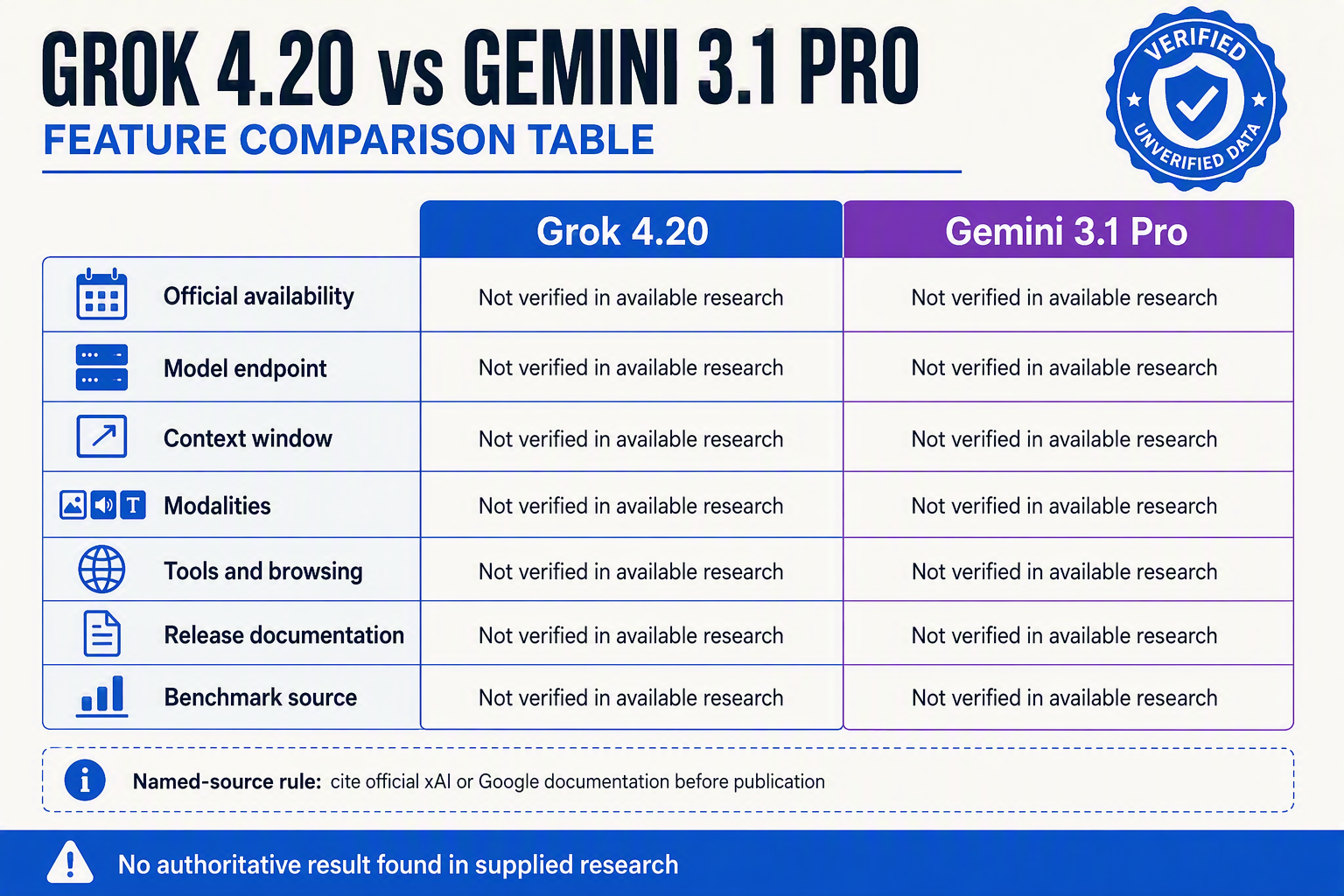
No authoritative source in the available research verifies a reliable specification, context-window advantage, or reasoning-performance winner for Grok 4.20 or Gemini 3.1 Pro. The absence of verification does not prove either model is unavailable; it means claims about Grok 4.20 vs Gemini 3.1 Pro for reasoning tasks should remain unconfirmed until current official xAI or Google documentation is checked.
| Verification field | Grok 4.20 | Gemini 3.1 Pro | What can be concluded |
|---|---|---|---|
| Official model identifier | Not verified in available research | Not verified in available research | Confirm the exact endpoint name |
| Context window | Not verified in available research | Not verified in available research | Do not infer limits from another model |
| API availability | Not verified in available research | Not verified in available research | Consumer access and API access may differ |
| Input/output modalities | Not verified in available research | Not verified in available research | Test only matching capabilities |
| Pricing | Not verified in available research | Not verified in available research | Do not publish a cost winner |
| Published reasoning benchmarks | No authoritative result found | No authoritative result found | No defensible head-to-head score exists |
What should be verified before testing?
- Grok 4.20: Confirm the exact xAI endpoint, release status, model version, context limit, supported modalities, rate limits, and billing unit from current official xAI documentation.
- Gemini 3.1 Pro: Confirm the corresponding Google endpoint and the same fields from current official Google documentation.
- Context limits: Measure usable performance separately with short, medium, and long prompts. A stated maximum does not guarantee equal retrieval quality throughout the available window.
- Reasoning scope: Evaluate arithmetic and quantitative reasoning, formal logic, coding and debugging, multi-step planning, long-context synthesis, and instruction following as separate categories. An aggregate score can conceal meaningful differences between tasks.
- Controls: Use identical prompts and system instructions, matched temperature and sampling settings where available, and no browsing unless both endpoints receive equivalent tools.
- Repeated runs: Run each prompt multiple times to identify prompt sensitivity, inconsistent answers, and confident but unsupported conclusions.
- Reporting: Record exact-answer accuracy, rubric scores, latency, token usage, refusals, unsupported claims, tool activity, and answer variance.
The comparison should also distinguish a consumer chat product from an API endpoint. They may differ in model version, system instructions, enabled tools, rate limits, safety behavior, and billing. Therefore, a result observed in a public interface should not automatically be attributed to the corresponding API model.
Until official xAI or Google sources verify the underlying specifications, the defensible conclusion is narrow: neither Grok 4.20 nor Gemini 3.1 Pro can be named the reliable reasoning winner from the available evidence. Verify the exact endpoints first, then compare them on a fixed, representative test set rather than relying on unconfirmed context limits or benchmark claims.
How much do Grok 4.20 and Gemini 3.1 Pro cost? (TABLE)
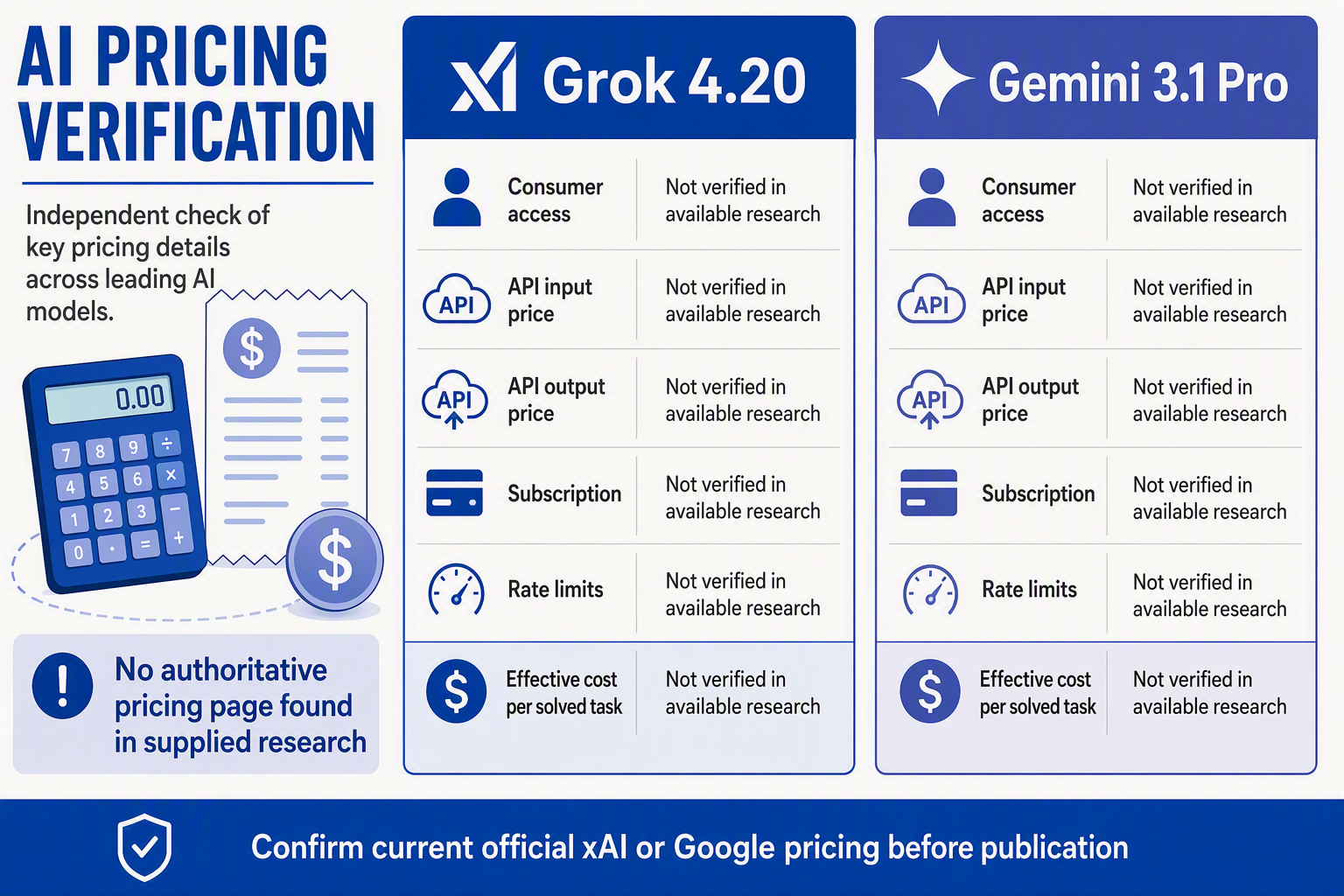
No verified price comparison is available for Grok 4.20 vs Gemini 3.1 Pro. The available research found no authoritative, current xAI or Google pricing page confirming the API rates, consumer-plan inclusion, or endpoint availability for either exact model name.
| Pricing field | Grok 4.20 | Gemini 3.1 Pro | Verification status |
|---|---|---|---|
| API input price | Not verified in available research | Not verified in available research | No authoritative result found |
| API output price | Not verified in available research | Not verified in available research | No authoritative result found |
| Consumer subscription access | Not verified in available research | Not verified in available research | Consumer and API products may differ |
| Context-window pricing tiers | Not verified in available research | Not verified in available research | Do not infer limits from similarly named models |
| Rate limits or quotas | Not verified in available research | Not verified in available research | Requires a confirmed endpoint |
| Exact model availability | Not verified in available research | Not verified in available research | Confirm the model ID before testing |
- Grok 4.20: Do not estimate cost from other xAI models, unofficial screenshots, or a consumer-chat subscription.
- Gemini 3.1 Pro: Do not treat a Google Gemini consumer plan, Vertex AI model, and developer API listing as interchangeable pricing evidence.
- Fair comparison: Record input tokens, output tokens, cached tokens, tool calls, latency, retries, and failed requests for the same fixed prompt set.
- Effective cost: Calculate
total billed cost ÷ successfully solved tasks; a lower token price is not automatically cheaper if the model requires retries.
- Gateway option: CallMissed’s OpenAI-compatible gateway uses transparent credits, with 1 credit = ₹1, but that pricing fact does not establish Grok 4.20 or Gemini 3.1 Pro availability or rates there.
- Practical rule: Verify the official model identifier, billing unit, context tier, and regional taxes immediately before purchase; otherwise label the comparison unverified, not “free” or “cheaper.”
What are the trade-offs and failure modes? (TABLE)
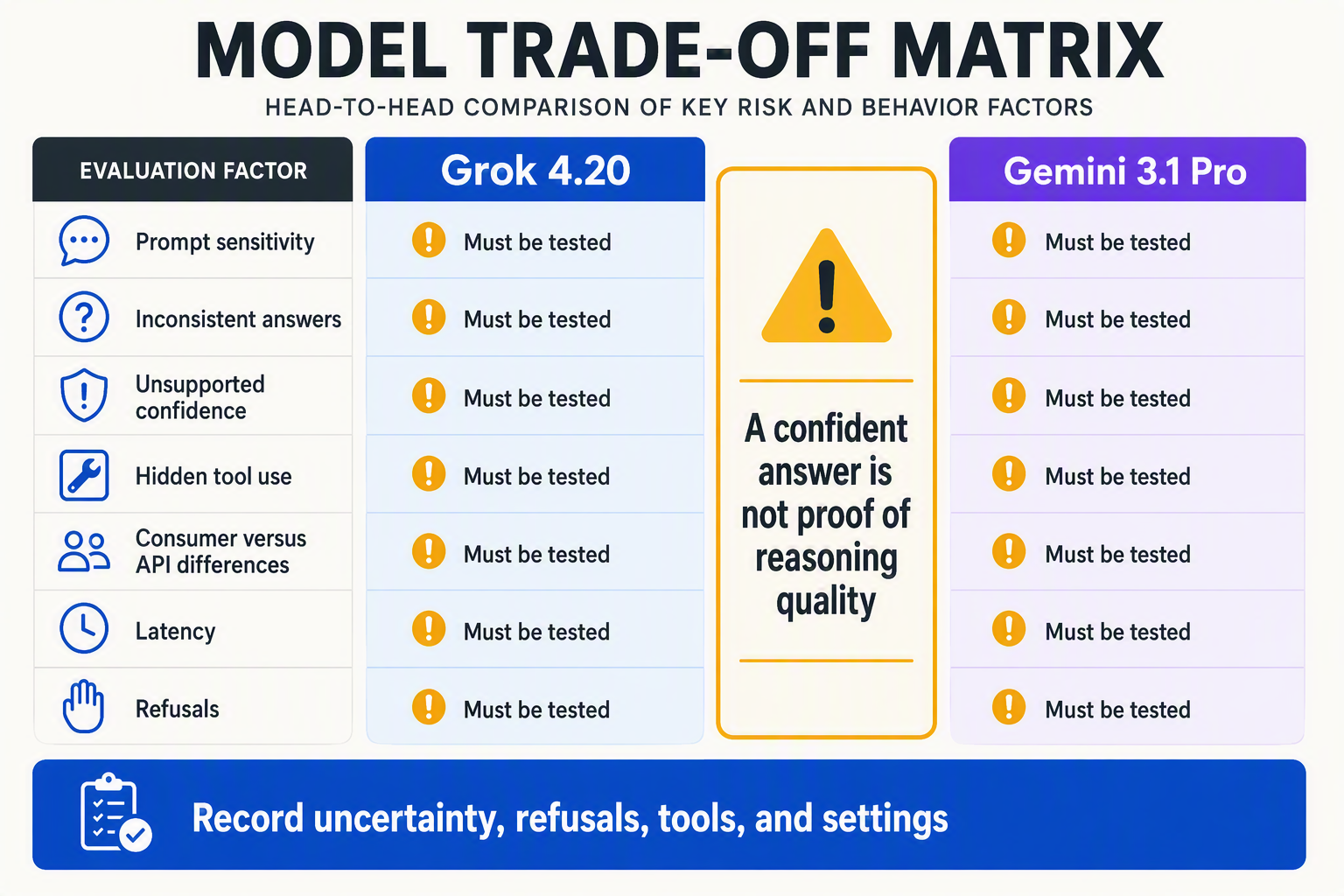
No reliable reasoning winner can be verified for Grok 4.20 vs Gemini 3.1 Pro because the available research does not confirm model-specific benchmarks, pricing, context limits, or endpoint details. The meaningful comparison is therefore which failure modes your workload can detect and tolerate, not an invented leaderboard.
Trade-offs and failure modes
| Area | Grok 4.20 | Gemini 3.1 Pro | What to verify |
|---|---|---|---|
| Availability | Not verified in available research | Not verified in available research | Confirm the exact official model ID and API endpoint |
| Math accuracy | No authoritative result found | No authoritative result found | Score exact answers on arithmetic, algebra, probability, and word problems |
| Formal logic | No authoritative result found | No authoritative result found | Test contradictions, syllogisms, and constraint puzzles |
| Coding | No authoritative result found | No authoritative result found | Run generated code; check tests, security, and bug localization |
| Long-context work | Context limit not verified | Context limit not verified | Measure retrieval accuracy at matched document lengths |
| Cost and latency | Pricing and latency not verified | Pricing and latency not verified | Record current API charges, response time, and token usage |
- Prompt sensitivity: Small wording changes can alter reasoning results; use a fixed prompt set and identical system instructions.
- Inconsistent answers: Run each prompt multiple times with matched sampling settings where available, then report variance rather than one successful response.
- Unsupported conclusions: Score whether each model distinguishes evidence from assumptions, especially in planning and long-context synthesis.
- Hidden tool use: Record browsing, code execution, retrieval, or other tool calls; consumer chat products may not represent API behavior.
- Aggregate-score risk: A model can perform well on coding while failing exact arithmetic or instruction-following tests, so report category-level results.
- Practical control: Compare both confirmed endpoints under identical access conditions; an OpenAI-compatible gateway such as CallMissed can simplify multi-model evaluation without rewriting every integration.
How should you test them fairly on math, logic, coding, and planning?
No fair winner can be established for Grok 4.20 vs Gemini 3.1 Pro for reasoning tasks until both exact endpoints are verified and tested under identical conditions. The available research provides no authoritative model-specific results for either Grok 4.20 or Gemini 3.1 Pro.
A fair evaluation protocol
- Build a fixed set: Use a proposed set of 20 prompts per category—math, formal logic, coding, planning, long-context synthesis, and instruction following; these are test-design targets, not model results.
- Control inputs: Send identical prompts, system instructions, context, tool permissions, and output limits; disable browsing unless both endpoints provide the same browsing capability.
- Score math and logic exactly: Record final-answer accuracy separately from explanation quality, contradiction handling, and unsupported assumptions.
- Score coding by execution: Run generated code against the same tests and measure passed tests, bug localization, patch correctness, runtime errors, and security problems—not visual plausibility.
- Evaluate planning and synthesis: Check whether each model completes every required step, follows constraints, retrieves facts from long context, and avoids confident but unsupported conclusions.
- Measure consistency: Run each prompt at least three times where settings permit, recording answer variance, refusals, latency, output tokens, and hidden tool calls; temperature controls may differ by endpoint.
- Separate products from endpoints: Consumer chat interfaces and API models may use different system prompts, tools, model versions, and limits. Record the exact model identifier, endpoint, date, settings, and pricing shown by the official provider.
- Report category results: Publish per-category accuracy, median latency, token usage, and cost rather than one aggregate score. This prevents strong coding performance from masking weak arithmetic or planning reliability.
The practical verdict is conditional: choose between Grok 4.20 and Gemini 3.1 Pro only after verification and representative testing. A gateway such as CallMissed can simplify comparable multi-model evaluations through one OpenAI-compatible integration.
What should you ask before choosing a model for reasoning tasks?
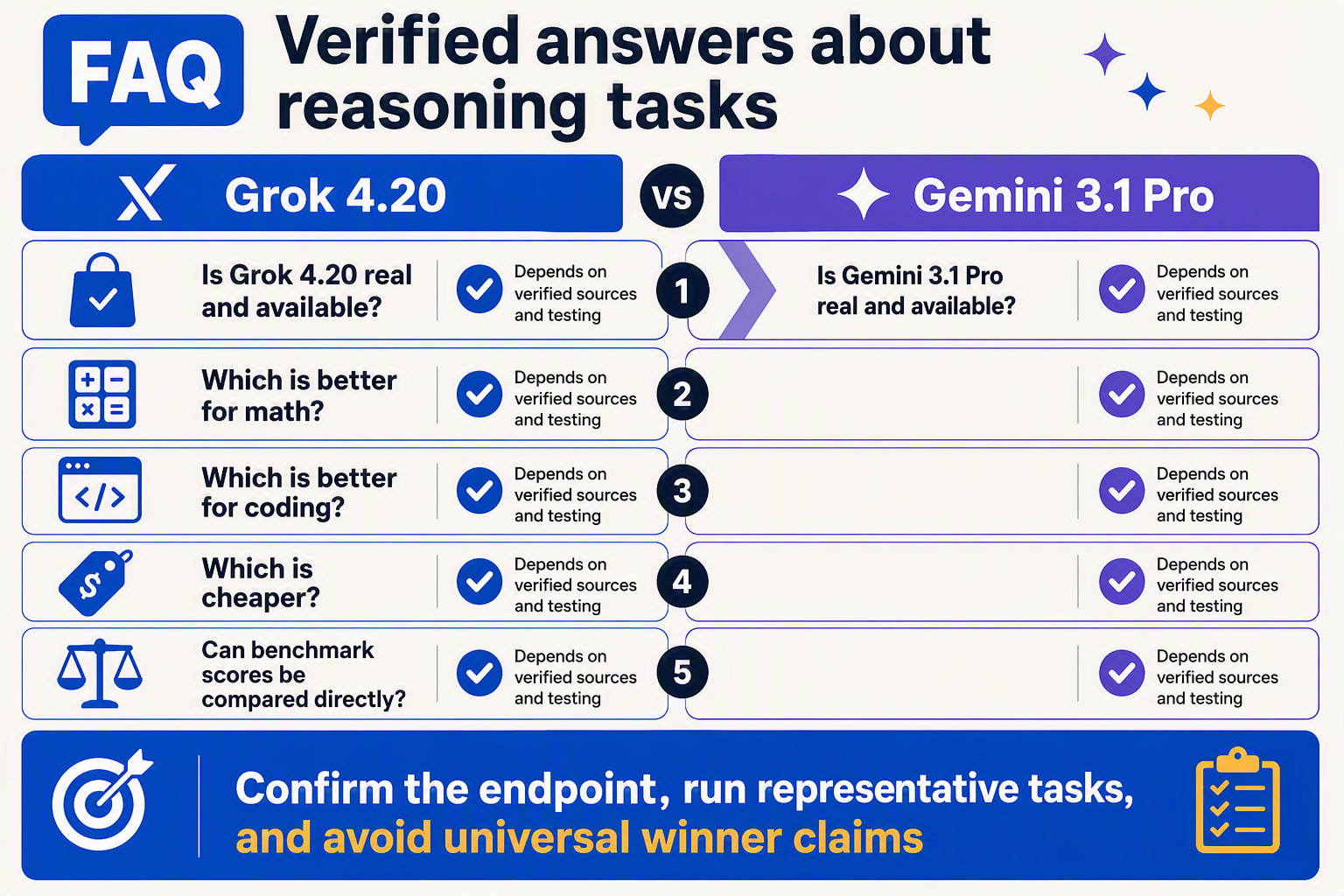
Frequently Asked Questions
Are Grok 4.20 and Gemini 3.1 Pro verified as officially available?
Which has better reasoning benchmark results?
What are their verified context limits?
Which model costs less?
Do both models have the same tool access?
How should you test Grok 4.20 vs Gemini 3.1 Pro for reasoning tasks fairly?
What should determine the final choice?
Conclusion
No reliable winner can be verified in the Grok 4.20 vs Gemini 3.1 Pro for reasoning tasks comparison. The available research does not confirm authoritative specifications, pricing, endpoints, or benchmark results for either model.
- Test math, logic, coding, planning, and synthesis separately.
- Use identical prompts, settings, tools, and multiple runs.
- Score exact answers, explanations, latency, token use, and failure modes.
- Confirm API details before treating consumer access as comparable.
Future official documentation and reproducible benchmarks may clarify the picture. To explore how AI communication is evolving, check out CallMissed. Which reasoning task matters most for your decision?
Related Reading
Discussion
Related Posts


Ready to automate customer conversations?
Launch AI voice agents and WhatsApp bots with CallMissed — one API, 22+ Indian languages.