GPT Image 2 vs Nano Banana 2 vs Seedream 5.0: 2026 API Comparison


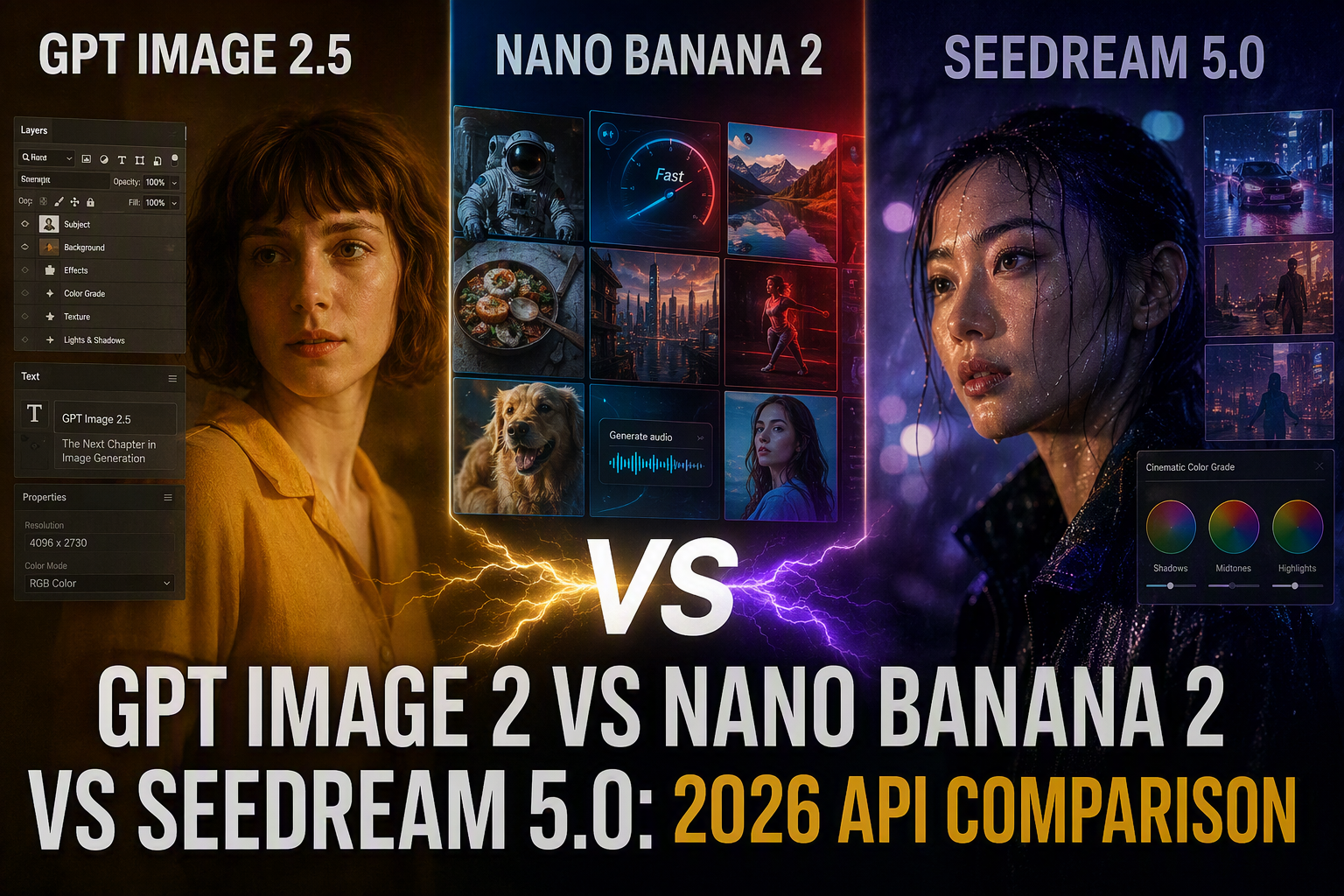
Compare GPT Image 2 vs Nano Banana 2 vs Seedream 5.0 on verified pricing, quality, latency, editing and API fit for 2026 buying decisions.
GPT Image 2 vs Nano Banana 2 vs Seedream 5.0: 2026 API Comparison
What if one incorrect model suffix could invalidate your entire API shortlist? GPT Image 2 vs Nano Banana 2 vs Seedream 5.0 matters because fast-changing product names can obscure differences in pricing, availability and production readiness. As of September 8, 2026, OpenAI’s API changelog identifies GPT Image 2—not “GPT Image 2.5”—as the token-rate basis for its Sunburst and Flare image workflows, including new xhigh and max quality settings. This comparison verifies OpenAI, Google and ByteDance offerings against first-party documentation, clearly separating published specifications and vendor claims from unsupported benchmark conclusions. You will learn how the APIs compare on text rendering, instruction following, editing, latency, output resolution, pricing and access, plus which trade-offs matter for high-volume applications. Platforms such as CallMissed also reflect the shift toward accessing multiple image models through one OpenAI-compatible gateway.
Which image API is best in 2026? Choose by verified workload fit, not a universal winner
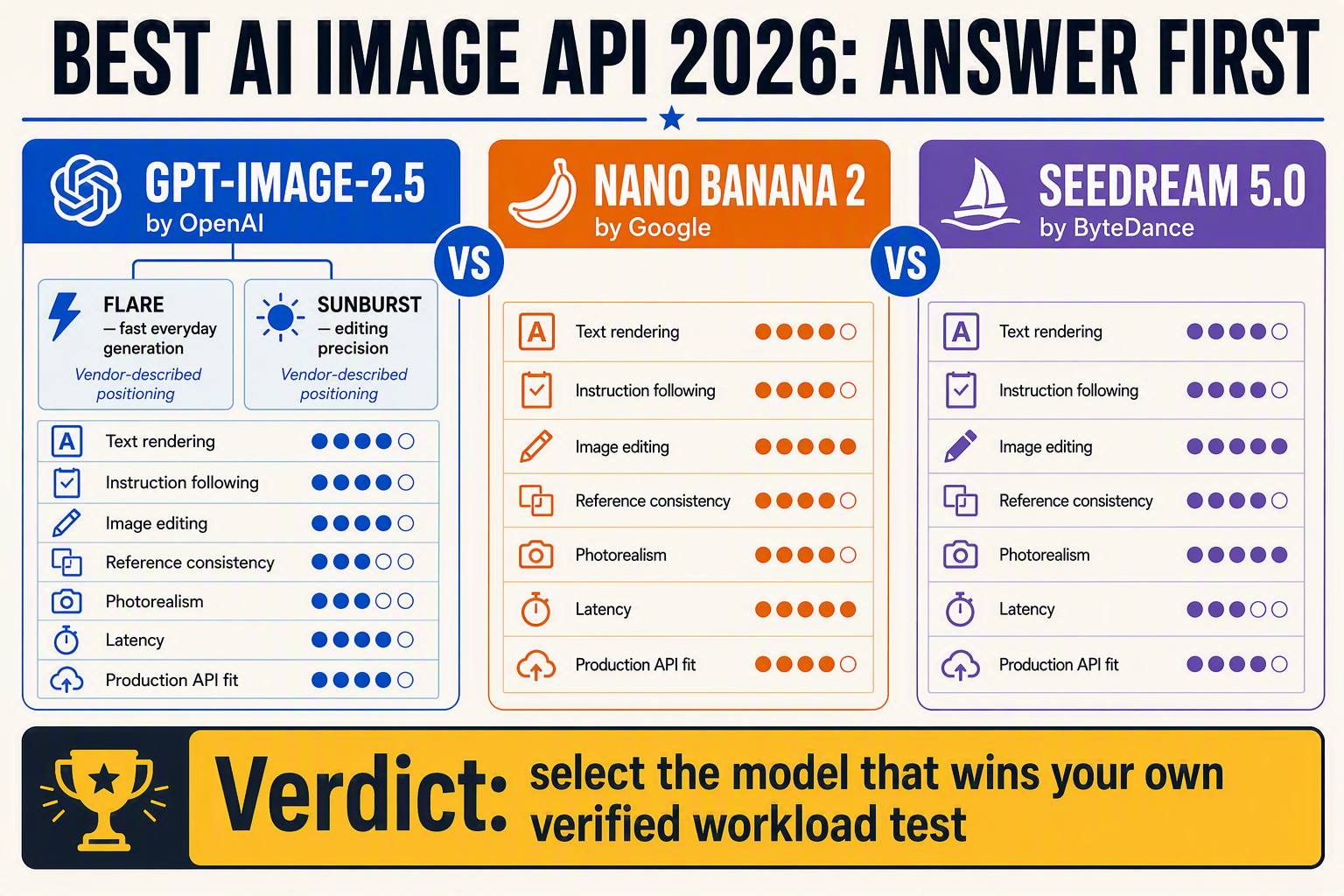
There is no evidence-backed universal winner: the right API depends on whether production work prioritises precise editing, rapid generation, regional access, predictable cost or resolution. Buyers should shortlist only models whose exact identifiers, endpoints and rates appear in current first-party documentation.
Workload-first shortlist
- Precision editing: OpenAI recommends Sunburst “where editing precision matters most,” according to the OpenAI API changelog accessed on September 8, 2026; validate performance with your own masks, product images and typography prompts.
- Fast everyday generation: OpenAI positions Flare for “fast, high-quality everyday image generation,” but the published changelog provides no cross-vendor latency benchmark against Google or ByteDance.
- Highest-quality workflows: Sunburst and Flare support OpenAI’s new xhigh and max quality settings, according to the 2026 OpenAI API changelog; benchmark the added latency and cost before enabling them by default.
- Name verification: Treat “GPT Image 2.5” as unverified unless OpenAI publishes that exact identifier; the available first-party evidence instead says Sunburst and Flare use GPT Image 2 token rates.
- Google evaluation: Do not place “Nano Banana 2” into production procurement until Google documentation confirms the exact API model ID, supported regions, resolution limits, quota rules and per-image or token pricing.
- ByteDance evaluation: Apply the same gate to “Seedream 5.0”: require a first-party ByteDance or BytePlus model page documenting endpoint availability, commercial terms, output sizes and editing support.
- Final selection: Run a fixed test set covering small-text legibility, multilingual typography, instruction compliance, identity consistency, edit preservation, p50/p95 latency and total cost per accepted image; vendor claims are not substitutes for workload-specific measurements.
Which model names, API access routes and capabilities are officially verified?
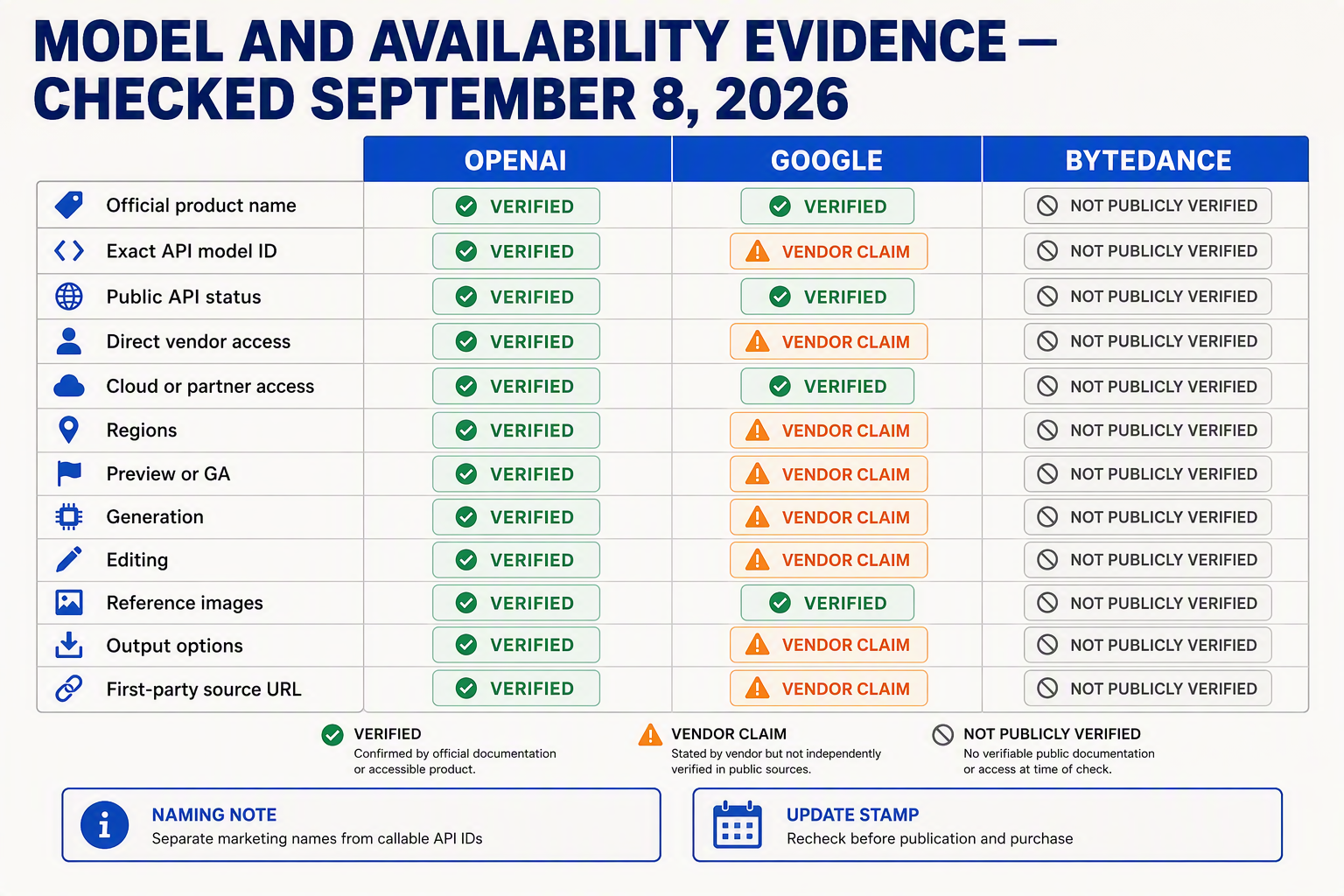
As of September 8, 2026, the supplied first-party evidence verifies OpenAI’s Sunburst, Flare and gpt-image-1-mini, but not the marketed names GPT Image 2.5, Nano Banana 2 or Seedream 5.0. Unverified names should not enter production contracts until the relevant vendor publishes an exact model ID, endpoint and billing schedule.
Verification matrix
| Candidate name | Official API access | Verified capabilities | Published pricing | Verification status |
|---|---|---|---|---|
| GPT Image 2.5 | No endpoint established in the supplied OpenAI documentation | None under this exact name | Not published under this exact name | Unverified name |
| OpenAI Sunburst | OpenAI image-generation workflow; exact model ID is not present in the supplied excerpt | Precision-focused editing; xhigh and max quality | Uses GPT Image 2 token rates; numerical rates not supplied | Verified product name |
| OpenAI Flare | OpenAI image-generation workflow; exact model ID is not present in the supplied excerpt | Fast everyday generation; xhigh and max quality | Uses GPT Image 2 token rates; numerical rates not supplied | Verified product name |
| OpenAI gpt-image-1-mini | OpenAI API under gpt-image-1-mini | Text-and-image input; image output; cost-efficient GPT Image 1 variant | OpenAI displays $2 input / $8 output; confirm billing units on the live pricing page | Verified model ID |
| Google Nano Banana 2 | No Google API route established by the supplied evidence | Resolution, editing and text-rendering limits not established | No first-party rate supplied | Unverified in this evidence set |
| ByteDance Seedream 5.0 | No ByteDance or BytePlus API route established by the supplied evidence | Output sizes, editing support and instruction limits not established | No first-party rate supplied | Unverified in this evidence set |
Procurement implications
- Sunburst: OpenAI recommends Sunburst “where editing precision matters most,” according to the OpenAI API changelog accessed September 8, 2026; this is vendor positioning, not an independent cross-model benchmark.
- Flare: OpenAI describes Flare as suitable for “fast, high-quality everyday image generation” in its 2026 API changelog, but publishes no comparative p50 or p95 latency result in the provided material.
- GPT Image 2: The OpenAI changelog says Sunburst and Flare use GPT Image 2 token rates; that statement does not verify a public API identifier called
gpt-image-2orgpt-image-2.5.
- gpt-image-1-mini: OpenAI’s model documentation explicitly identifies
gpt-image-1-minias a natively multimodal, cost-efficient version of GPT Image 1, making it the clearest deployable identifier in this evidence set.
- Google and ByteDance: Require first-party model cards covering exact IDs, supported regions, quotas, commercial availability, safety controls, output resolution and edit endpoints before comparison testing.
- Buyer rule: Record the exact model string returned by the API, documentation revision date and billing unit; a recognisable marketing name alone is insufficient for reproducible procurement.
How do GPT-Image-2.5, Nano Banana 2 and Seedream 5.0 compare by feature?
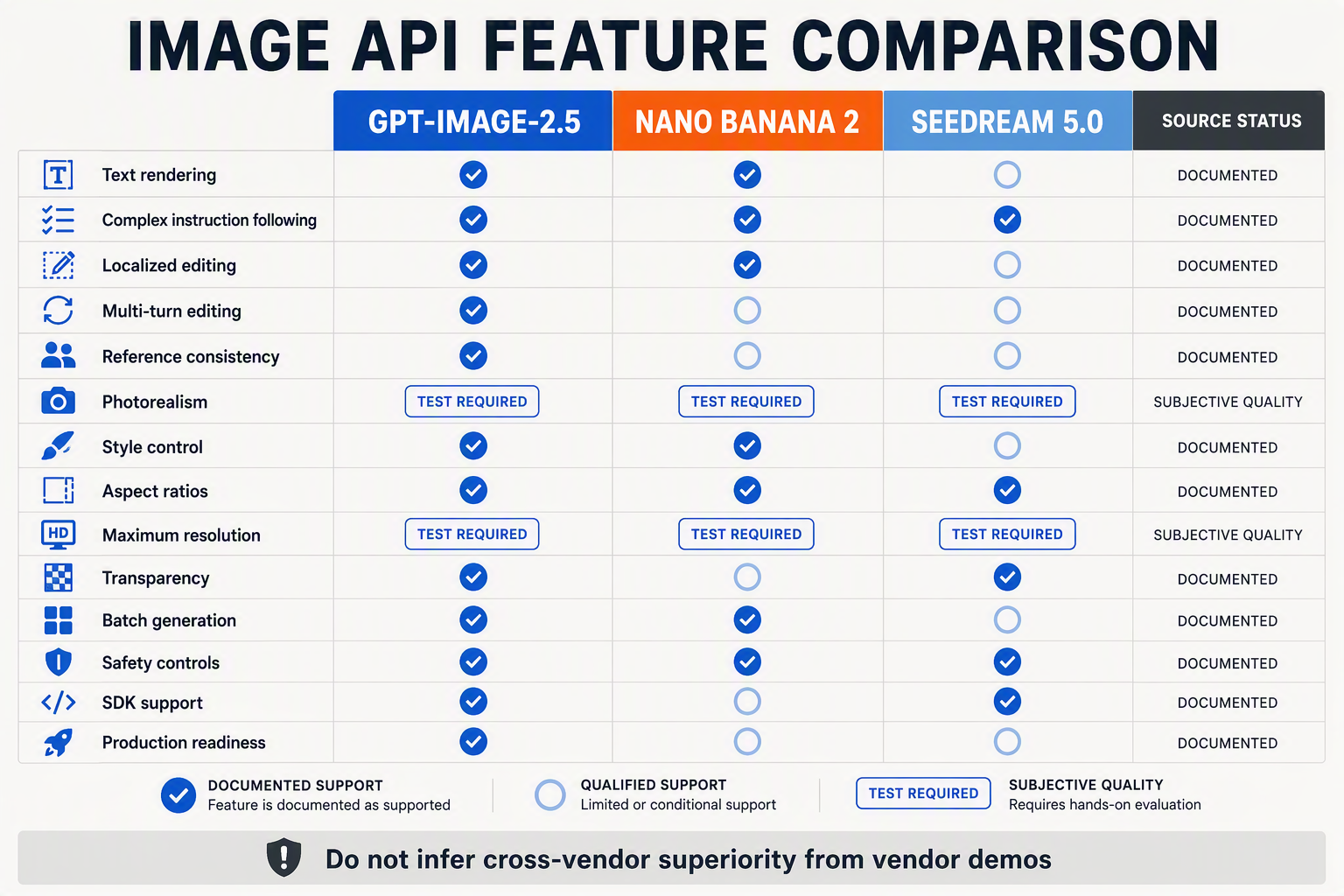
The verified evidence supports an OpenAI GPT Image 2–priced workflow comparison, not a confirmed three-way contest between “GPT-Image-2.5,” “Nano Banana 2” and “Seedream 5.0.” As of September 8, 2026, only OpenAI’s Sunburst and Flare capabilities are substantiated by the supplied first-party documentation.
Verified feature matrix
| Feature | OpenAI GPT-Image-2.5 | Google Nano Banana 2 | ByteDance Seedream 5.0 | Procurement takeaway |
|---|---|---|---|---|
| Verified model name | Not verified; OpenAI documents Sunburst, Flare and GPT Image 2 token rates | Not verified in supplied Google documentation | Not verified in supplied ByteDance or BytePlus documentation | Do not contract against informal names |
| API availability | Sunburst and Flare appear in the OpenAI API changelog | Endpoint and model ID unconfirmed | Endpoint and model ID unconfirmed | Require a callable production model ID |
| Editing | OpenAI recommends Sunburst where editing precision matters most | No verified specification provided | No verified specification provided | Test masks, preservation and iterative edits |
| Generation speed | OpenAI describes Flare as fast, but publishes no cross-vendor latency result here | No verified p50 or p95 latency | No verified p50 or p95 latency | Benchmark under identical concurrency |
| Quality controls | xhigh and max are supported by Sunburst and Flare | Quality tiers unconfirmed | Quality tiers unconfirmed | Measure incremental cost and latency |
| Pricing | Uses GPT Image 2 token rates; exact amounts are not established by the supplied extract | Per-image or token rate unconfirmed | Commercial rate unconfirmed | Compare total cost per accepted output |
- OpenAI: The OpenAI API changelog accessed on September 8, 2026 says, “Use Sunburst for workflows where editing precision matters most, or Flare for fast, high-quality everyday image generation.”
- OpenAI: The same OpenAI changelog confirms that both models support xhigh and max quality settings and use GPT Image 2 token rates; it does not identify a model named “GPT Image 2.5.”
- Google: “Nano Banana 2” needs first-party confirmation of its exact API identifier, supported regions, quotas, pricing, resolution limits and commercial availability before comparison scores are meaningful.
- ByteDance: “Seedream 5.0” likewise requires a current ByteDance or BytePlus model card documenting endpoint access, output dimensions, editing modes, rate limits and licensing terms.
- All three: No supplied first-party evidence establishes a winner for text rendering, instruction following, multilingual typography or identity consistency.
- Buyer rule: Treat vendor descriptions as positioning rather than comparative proof; run the same prompts, seeds where supported, aspect ratios and edit inputs, then report acceptance rate, p50/p95 latency and cost per approved image.
How much do the three image APIs cost, and what is the effective value?
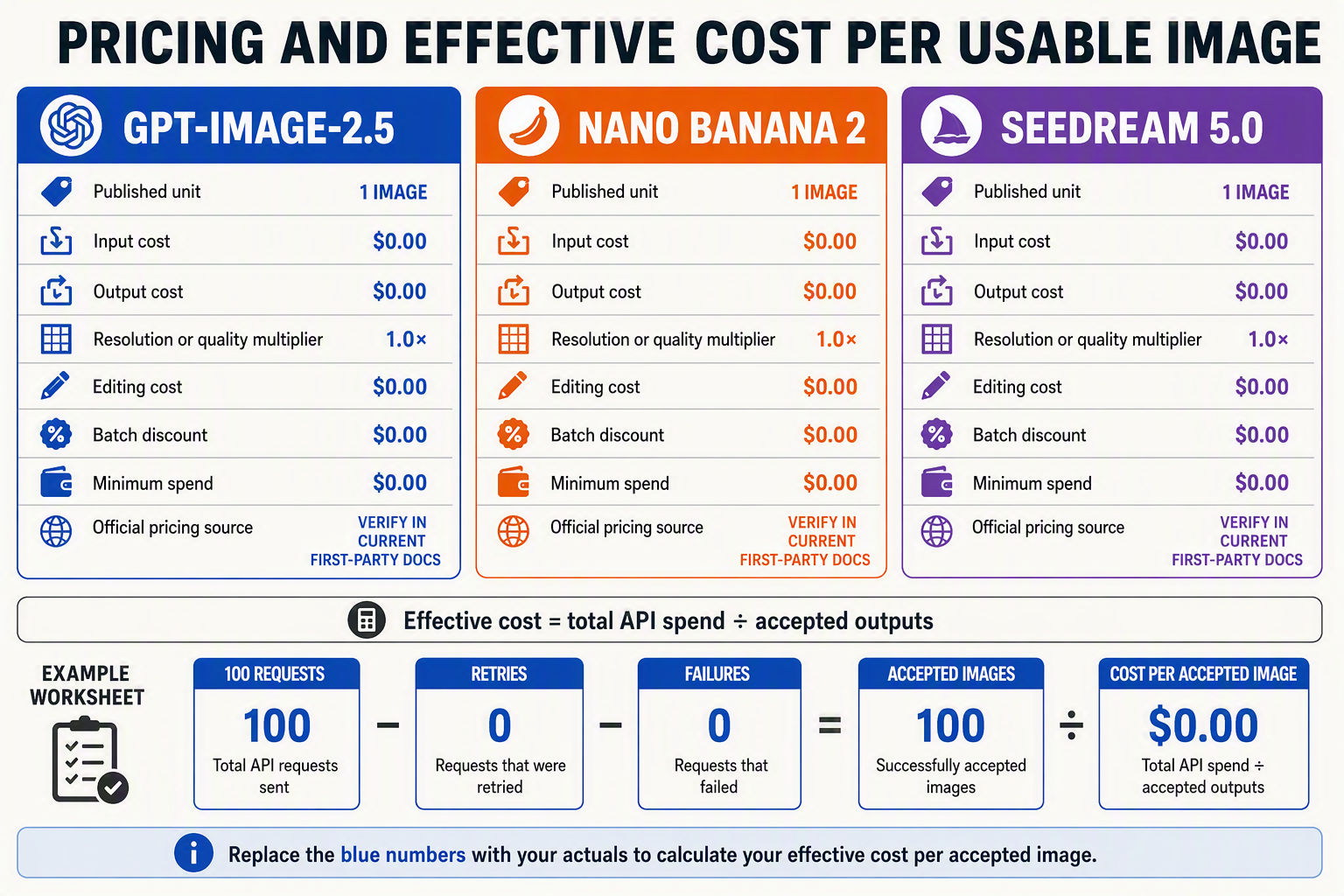
No defensible price winner can be identified from the supplied first-party evidence. As of September 8, 2026, OpenAI documents the billing basis for its current image models, but exact rates for the labels “GPT Image 2.5,” “Nano Banana 2” and “Seedream 5.0” remain unverified.
Verified pricing and availability status
| Cost factor | OpenAI | ByteDance | |
|---|---|---|---|
| Model name | “GPT Image 2.5” is unverified; OpenAI names Sunburst and Flare | “Nano Banana 2” is unverified in the supplied first-party evidence | “Seedream 5.0” is unverified in the supplied first-party evidence |
| API availability | OpenAI’s API changelog documents Sunburst and Flare | No confirmed model ID or endpoint supplied | No confirmed model ID or endpoint supplied |
| Published price | Uses GPT Image 2 token rates, but no numeric rate appears in the verified context | No verified token or per-image rate available | No verified token or per-image rate available |
| Quality-related cost | Supports xhigh and max; incremental costs are not stated in the supplied evidence | Quality tiers and associated prices are unverified | Quality tiers and associated prices are unverified |
| Billing basis | Token-based pricing is explicitly referenced | Charging unit is unconfirmed | Charging unit is unconfirmed |
| Effective-value verdict | Measurable after retrieving current rates and logging token usage | Cannot be calculated from verified evidence | Cannot be calculated from verified evidence |
The OpenAI API changelog, accessed September 8, 2026, states that Sunburst and Flare use GPT Image 2 token rates and support the xhigh and max quality settings. However, the supplied extract does not disclose those numeric rates, so quoting a dollar cost per image would require assumptions about token consumption and quality.
For Google, buyers should obtain a first-party model card, exact API model ID and current pricing page before treating Nano Banana 2 as a purchasable production model. The name could represent a commercial identifier, preview label or informal shorthand; the available evidence does not establish which.
For ByteDance, procurement teams should require ByteDance or BytePlus documentation confirming the Seedream 5.0 endpoint, supported regions, billing currency, resolution limits and charging unit. Without those details, no like-for-like API cost can be calculated.
Measure effective cost, not headline price
Use this formula:
Effective cost per accepted image = total API spend ÷ number of accepted outputs
For example, if four attempts cost $0.03 each and only one passes review, the effective cost is $0.12 per accepted image, excluding labour and downstream processing.
A production comparison should include:
- Generation and editing charges
- Retries caused by poor typography or instruction failures
- Upscaling, moderation, storage and delivery
- Human review and correction time
- Failed requests, latency-related retries and regional taxes
- Gateway markups or fallback charges, where applicable
A higher headline generation price can still deliver better value when the model improves first-pass acceptance and reduces manual rework.
Procurement test and approval rule
Run every candidate with the same prompt set, aspect ratio, resolution, quality tier and sample size. Report median cost, p95 cost, first-pass acceptance rate and effective cost per accepted image separately.
Do not approve a budget using these three marketing labels alone. Archive the dated vendor pricing page, model ID, endpoint, region and quality configuration because model aliases, preview conditions and rates can change independently.
What are the pros and cons of each API for production buyers?
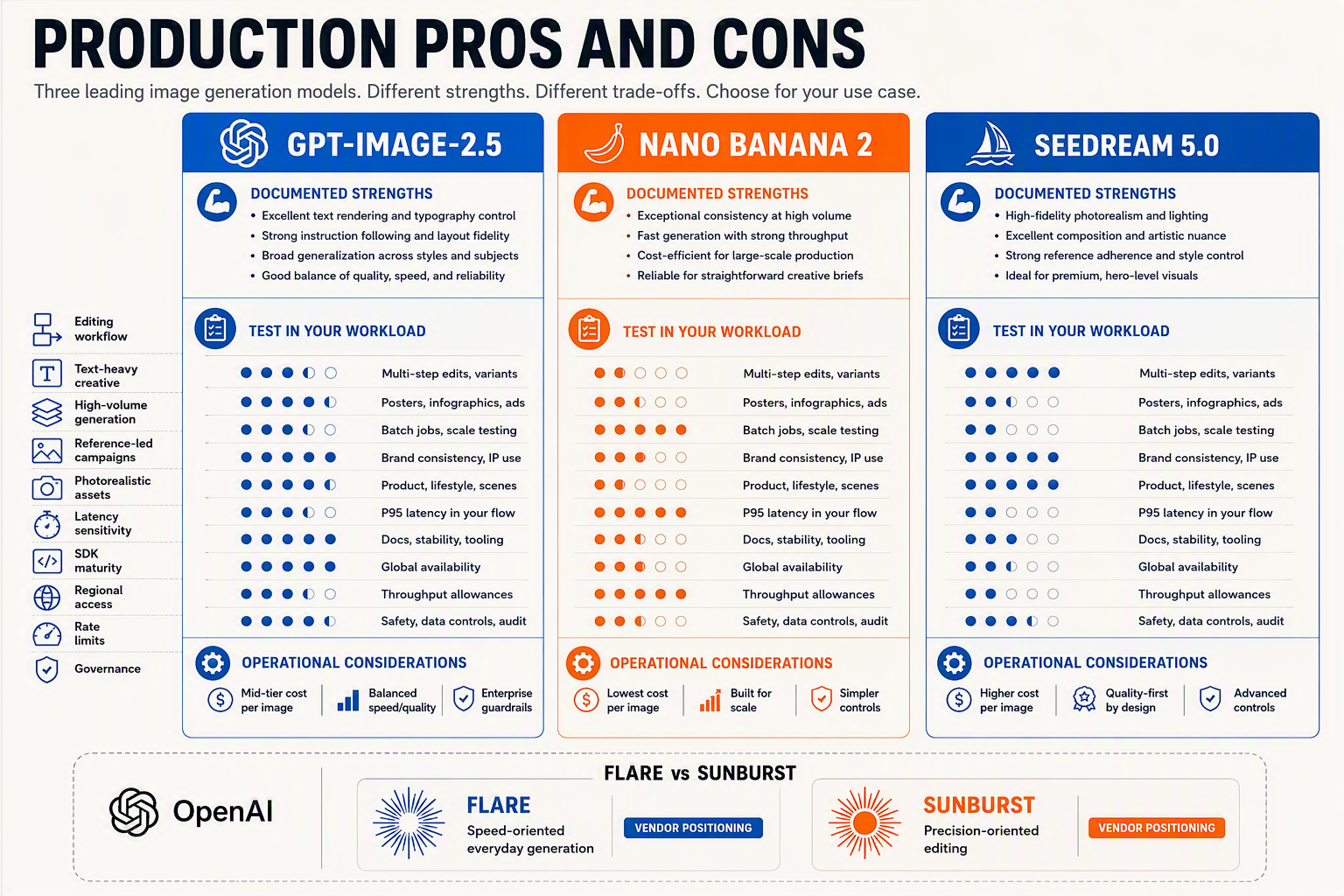
Production buyers can approve OpenAI’s documented Sunburst and Flare workflows for testing, while “GPT Image 2.5,” “Nano Banana 2” and “Seedream 5.0” require first-party verification before procurement. An unverified marketing name is not a deployable API identifier.
| Production criterion | OpenAI Sunburst / Flare | Google Nano Banana 2 | ByteDance Seedream 5.0 |
|---|---|---|---|
| Model-name status | Documented; uses GPT Image 2 token rates | Exact name and API ID unverified | Exact name and API ID unverified |
| Primary advantage | Sunburst targets precise editing; Flare targets fast everyday generation | No verified production advantage can be stated | No verified production advantage can be stated |
| Quality controls | xhigh and max are documented | Quality tiers not verified | Quality tiers not verified |
| Pricing | Token-rate basis confirmed; calculate workload-specific cost from OpenAI’s live pricing page | Current first-party rate not established | Current first-party rate not established |
| Principal procurement risk | Higher quality may increase cost and latency; benchmark both | Availability, regions, quotas and pricing remain unclear | Endpoint access, commercial terms and limits remain unclear |
| Recommended status | Pilot-ready, subject to evaluation | Hold pending documentation | Hold pending documentation |
Production trade-offs
- OpenAI: The OpenAI API changelog accessed on September 8, 2026 recommends Sunburst when “editing precision matters most” and Flare for “fast, high-quality everyday image generation.”
- OpenAI: The same changelog confirms two additional quality settings—xhigh and max—but publishes no cross-vendor latency or quality lead.
- Google: Require a first-party model card covering API identifier, regional availability, quotas, output resolution, editing support and commercial pricing.
- ByteDance: Require equivalent ByteDance or BytePlus documentation, including data-processing terms and production service limits.
- All vendors: Compare effective cost per accepted image—not headline price—after retries, moderation failures, edits and upscaling.
- Decision rule: Do not interpret missing verification as proof that a model does not exist; treat it as a procurement blocker until authoritative documentation is available.
How should you run a reproducible 2026 AI image API benchmark?
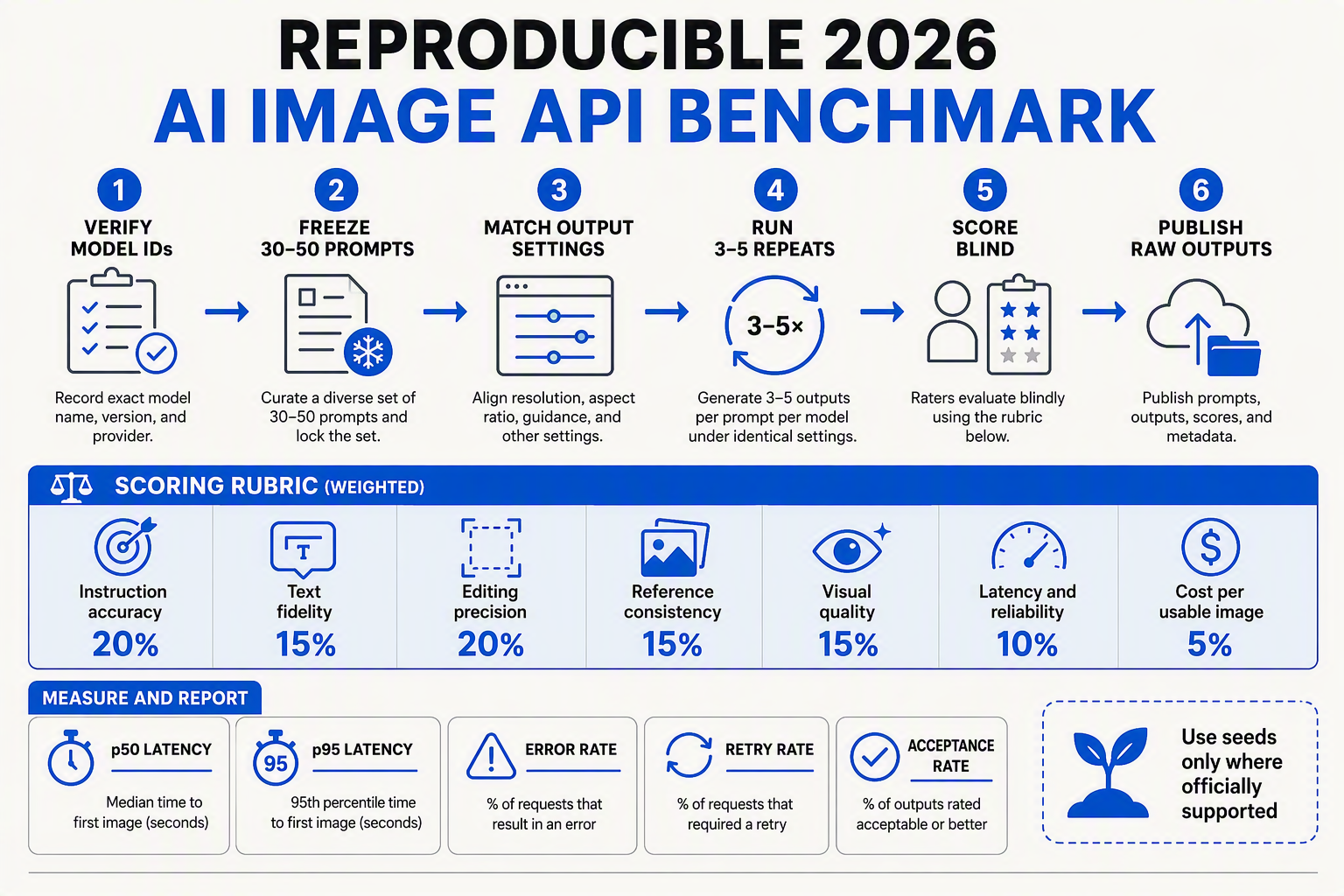
A reproducible benchmark must test verified API identifiers under identical prompts, inputs and measurement rules. Freeze every parameter and publish raw outputs so results can be independently rerun.
Benchmark protocol
- Identity gate: Record the exact model ID, API version, endpoint, region and test date; as of September 8, 2026, OpenAI’s changelog supports GPT Image 2 token rates for Sunburst and Flare, not the unverified name “GPT Image 2.5.”
- Matched settings: Generate at the same aspect ratio and nearest common resolution, using fixed seeds where supported; document quality levels because OpenAI’s Sunburst and Flare support xhigh and max, according to the OpenAI API changelog.
- Prompt suite: Use at least 100 prompts split evenly across photorealism, illustration, complex layouts, instruction following and typography—including English, Hindi and other production-relevant scripts.
- Editing set: Run the same 25–50 source images through object replacement, background changes, masked edits and identity-preservation tasks; OpenAI recommends Sunburst where editing precision matters most, but treat that as vendor positioning until independently measured.
- Blind scoring: Have at least three reviewers grade text accuracy, instruction compliance, visual quality and edit preservation on a predefined 1–5 rubric; randomise output order and hide vendor names.
- Operational metrics: Capture p50, p95 and p99 latency, failure rate, moderation refusals, retries, output dimensions and total billed cost—not merely the advertised per-image rate.
- Procurement record: Publish prompts, hashes, parameters, timestamps and pricing snapshots; exclude Nano Banana 2 or Seedream 5.0 from scored conclusions until Google or ByteDance documentation verifies their exact IDs, access terms and prices.
Which API should you choose for editing, marketing, ecommerce or high-volume generation?
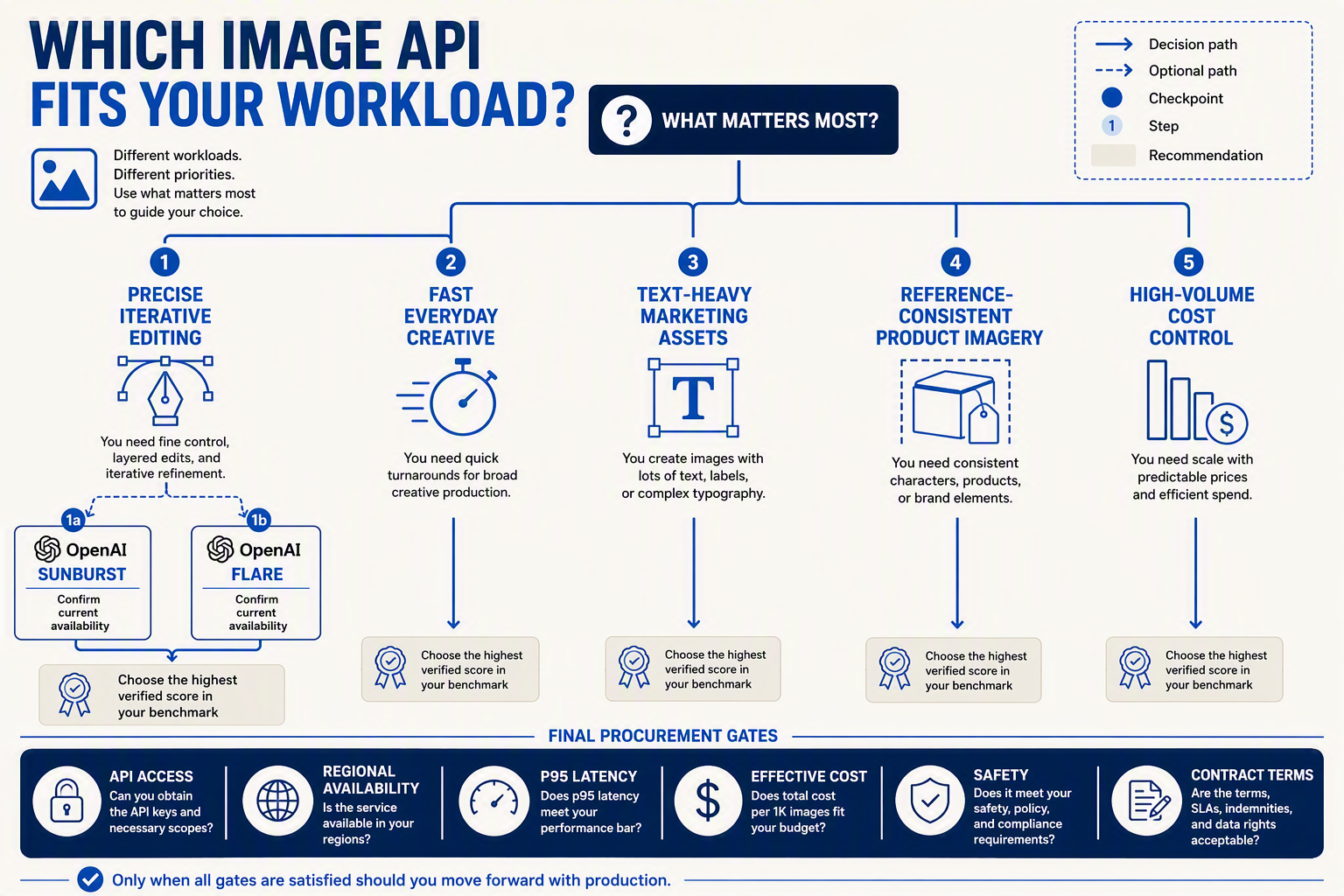
Choose OpenAI Sunburst for precision edits and OpenAI Flare for faster marketing production; keep Google “Nano Banana 2” and ByteDance “Seedream 5.0” out of procurement decisions until their exact API identities and commercial terms are documented.
Recommendations by workload
- Photo editing — Sunburst: Select Sunburst when masks, object replacement and preservation of unchanged regions are critical; OpenAI’s API changelog explicitly recommends it for workflows “where editing precision matters most.”
- Marketing creative — Flare: Use Flare for rapid social ads, campaign concepts and routine asset variants; OpenAI describes Flare as offering “fast, high-quality everyday image generation,” although it publishes no cross-vendor latency result.
- Ecommerce — Sunburst first, Flare at scale: Start with Sunburst for product-background replacement and controlled edits, then test Flare for catalogue variants where throughput matters more than maximum edit precision.
- Premium outputs — benchmark both: Sunburst and Flare support xhigh and max quality settings as of September 8, 2026, according to OpenAI’s API changelog; measure per-image cost, p95 latency and approval rate at each setting.
- High-volume generation — calculate effective cost: OpenAI states that both models use GPT Image 2 token rates, but the supplied first-party extract provides no numeric per-image price; calculate cost using real prompt, input-image and output-quality mixes before committing volume.
- Google Nano Banana 2: Treat this name as unverified for production purchasing until Google publishes an exact model ID, API availability, regional coverage, quotas, resolutions and current pricing.
- ByteDance Seedream 5.0: Apply the same procurement gate until ByteDance or BytePlus documents the commercial endpoint, editing features, output limits, service regions and price schedule; vendor demonstrations alone do not establish production suitability.
Frequently Asked Questions: Are these models public, how much do they cost, and which API is best?
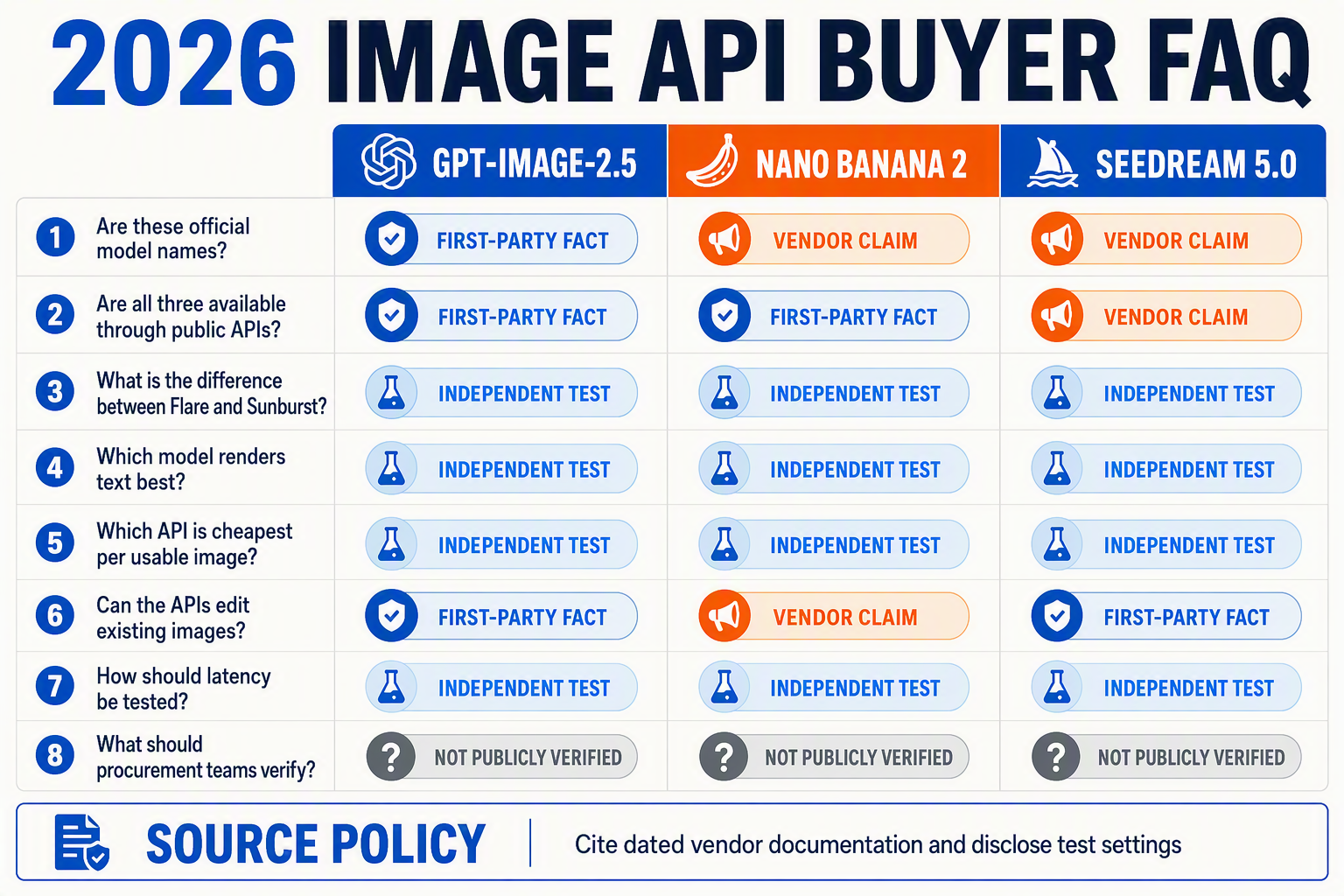
Is OpenAI GPT Image 2.5 publicly available through an API?
Is Google Nano Banana 2 available as a public image-generation API?
Is ByteDance Seedream 5.0 commercially available through an API?
How much does GPT Image 2.5 versus Nano Banana 2 versus Seedream 5.0 cost?
Which API is best for GPT Image 2.5 versus Nano Banana 2 versus Seedream 5.0?
How should developers compare image-generation APIs before buying?
Sources
- OpenAI API Changelog: https://developers.openai.com/api/docs/changelog — first-party documentation for Sunburst, Flare, quality settings and GPT Image 2 token-rate billing.
- OpenAI gpt-image-1-mini model page: https://developers.openai.com/api/docs/models/gpt-image-1-mini — first-party model description and displayed pricing.
- The supplied research contains no first-party Google documentation for Nano Banana 2 and no first-party ByteDance or BytePlus documentation for Seedream 5.0. Consequently, this FAQ does not invent endpoints, prices or capability citations for either name.
Conclusion
Choose by verified workload fit, not an assumed universal winner:
- OpenAI documents GPT Image 2 token rates for Sunburst and Flare—not “GPT Image 2.5”—as of September 8, 2026.
- Sunburst targets precision editing; Flare targets fast everyday generation, with xhigh and max quality options.
- Nano Banana 2 and Seedream 5.0 require first-party confirmation of model IDs, pricing, availability and limits.
- Production decisions should follow controlled tests of typography, editing, latency, resolution and cost.
Watch vendor documentation as identifiers and terms evolve. Explore multi-model access through CallMissed—then ask: which API survives your real workload?
Related Reading
- GPT Image 2.5 API: Flare vs Sunburst Developer Guide
- Claude Fable 5.1 vs GPT-6 Astra Pricing: Real API Costs in 2026
- Claude Fable 5.1 vs GPT-6 Astra: 2026 API Migration and Routing Guide