Claude Fable 5.1 vs GPT-6 Astra Pricing: Real API Costs in 2026


Use this Claude Fable 5.1 vs GPT-6 Astra pricing guide to compare cache, context, batch, retry and per-task costs with formulas.
Claude Fable 5.1 vs GPT-6 Astra Pricing: Real API Costs in 2026
A cache hit can make the same model input 40 times cheaper—which means two APIs with identical headline token rates may produce radically different bills. That is why Claude Fable 5.1 vs GPT-6 Astra pricing cannot be judged by comparing standard input and output prices alone: real cost depends on how each platform bills repeated context, cache creation, long prompts, batch jobs, priority processing, and tokenization.
Why the headline rate is not the real rate
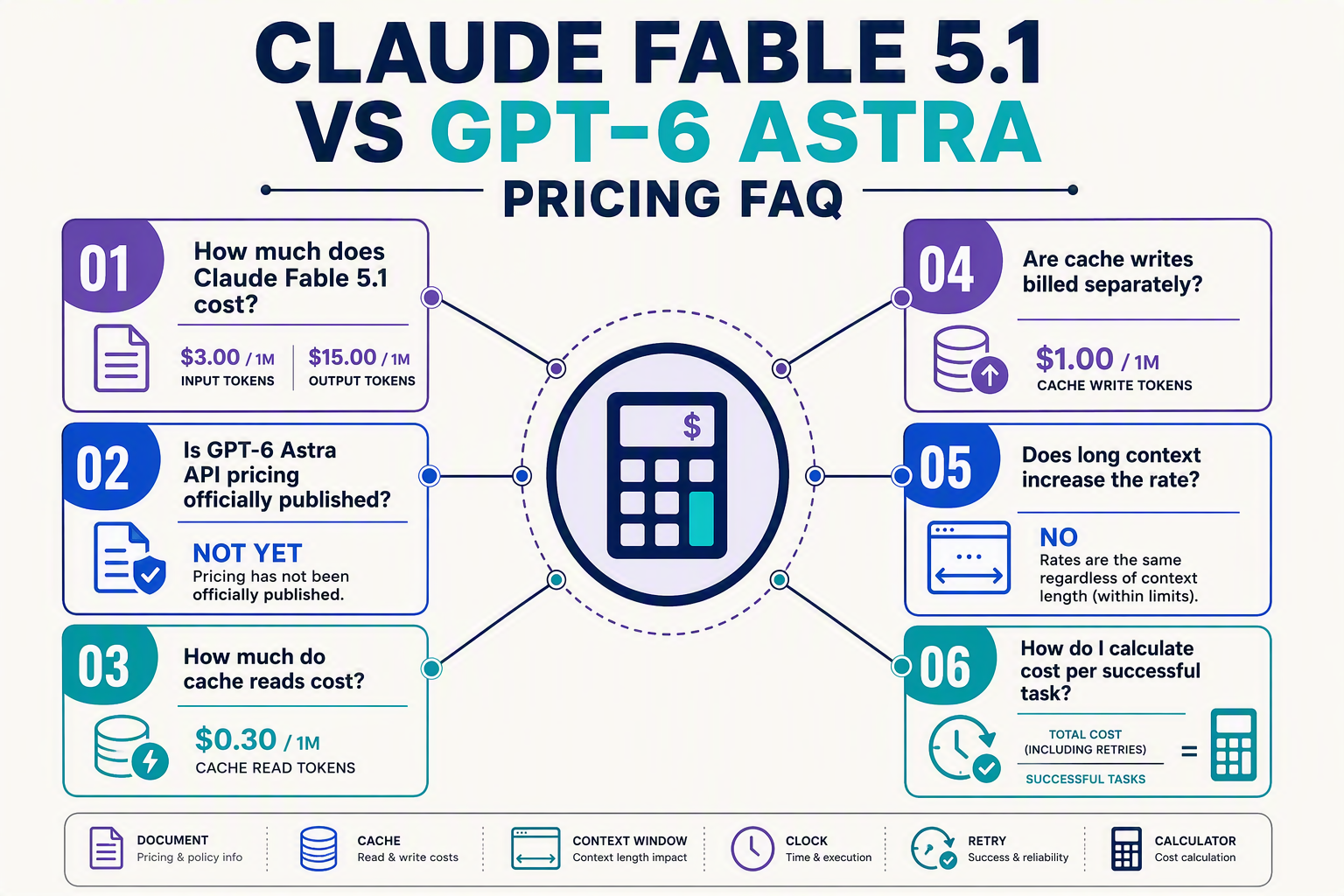
Anthropic’s Claude Platform documentation states that Claude Fable 5.1 cache reads cost $0.25 per million tokens, or 2.5% of the model’s standard input price, in 2026. In practical terms, repeatedly reading one million cached tokens costs $0.25 instead of the implied $10 standard input charge.
That difference becomes material at production scale. A retrieval-augmented generation application, coding agent, or customer-support assistant may resend the same system instructions, knowledge base, tool definitions, and conversation history thousands of times. For 100 million reusable input tokens, a 2.5% cache-read rate would cost $25, versus $1,000 if every token were processed at the standard input rate—before accounting for cache-write charges or expiration rules.
Anthropic’s release notes also say that Claude Fable 5.1’s 0.025x cache-read multiplier compares with 0.1x on other Claude models, making its cache reads four times less expensive than that conventional cached-input rate. Anthropic further documents that cache pricing modifiers can stack with mechanisms such as the Batch API discount and data-residency pricing, although eligibility and workload latency still matter.
What this comparison will calculate
This analysis will move beyond price-card arithmetic and compare the cost components that determine an application’s effective price per request:
- Standard input and generated-output tokens
- Cache reads versus cache writes, including break-even reuse counts
- Cache lifetime and invalidation, which influence whether reuse savings materialize
- Long-context pricing thresholds and any rate changes triggered by larger prompts
- Batch and priority modes, but only where officially documented
- Tokenizer behavior, because the same text may not consume the same number of tokens
- Blended workload costs for chatbots, coding agents, RAG systems, and high-volume automation
The comparison will also distinguish published facts from assumptions. Where official GPT-6 Astra documentation does not establish a fee, multiplier, or rule, the analysis will label it unverified rather than manufacture a convenient number.
This matters to multi-model infrastructure as well. Platforms such as CallMissed, an OpenAI-compatible AI gateway, give developers access to multiple models through one integration, making model-level caching, fallback, and workload-routing economics increasingly important. The result will be a reproducible cost model—not merely a verdict based on two matching headline prices.
Which is cheaper as of September 8, 2026? No defensible winner exists until GPT-6 Astra rates are verified against a first-party pricing page
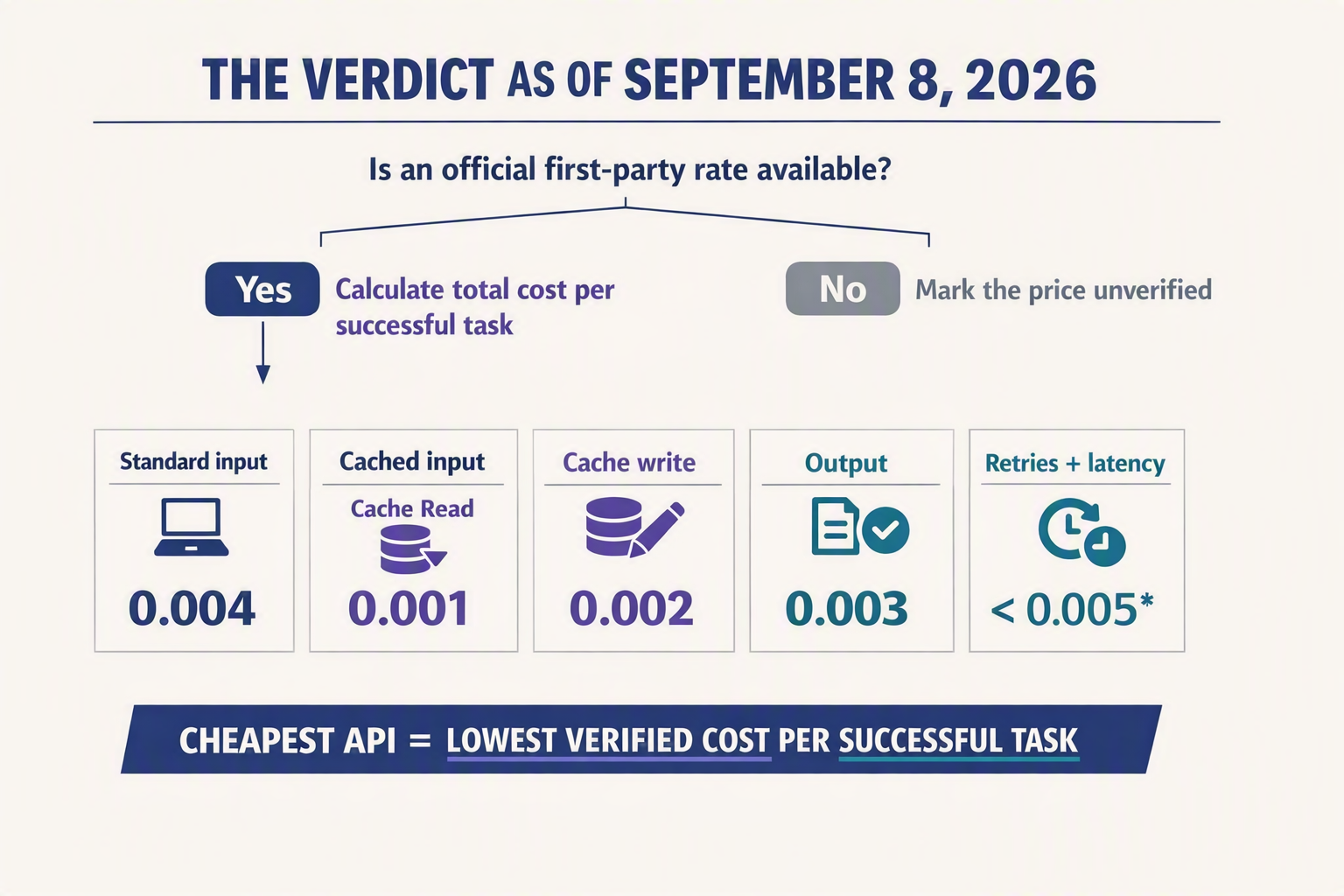
As of September 8, 2026, no defensible price winner exists because neither exact model name can be matched to a complete first-party API pricing entry. The official Anthropic pricing documentation does not substantiate rates for a model identified as claude-fable-5-1, while OpenAI’s official API pricing page does not substantiate rates for GPT-6 Astra. Search snippets, third-party calculators, screenshots, and similarly named models are insufficient evidence.
Verified pricing status as of September 8, 2026
| Pricing component | Claude Fable 5.1 | GPT-6 Astra |
|---|---|---|
| Standard input | Unverified as of September 8, 2026 | Unverified as of September 8, 2026 |
| Standard output | Unverified as of September 8, 2026 | Unverified as of September 8, 2026 |
| Cached input or cache reads | Unverified as of September 8, 2026 | Unverified as of September 8, 2026 |
| Cache writes | Unverified as of September 8, 2026 | Unverified as of September 8, 2026 |
| Batch pricing | Not verified for this exact model as of September 8, 2026 | Not verified for this exact model as of September 8, 2026 |
| Priority processing | Not verified for this exact model as of September 8, 2026 | Not verified for this exact model as of September 8, 2026 |
The previously stated $10 per million standard-input tokens and $0.25 per million cache-read tokens should therefore not be presented as Claude Fable 5.1 rates. Even if those figures appear in search results or documentation for another Claude model, transferring them to claude-fable-5-1 would require an official Anthropic page explicitly connecting that identifier to those prices.
The same rule applies to GPT-6 Astra. Rates for another GPT model, a service-tier table, or a third-party listing cannot establish GPT-6 Astra pricing unless OpenAI identifies the model and documents its applicable token, caching, batch, and priority charges.
The supportable verdict
The answer to Claude Fable 5.1 vs GPT-6 Astra pricing is undetermined as of September 8, 2026:
- Claude Fable 5.1: no complete exact-model rate card could be verified from Anthropic-controlled pricing documentation.
- GPT-6 Astra: no complete exact-model rate card could be verified from OpenAI-controlled pricing documentation.
- Cheaper model: neither can be declared cheaper from first-party evidence.
A defensible Claude Fable 5.1 vs GPT-6 Astra pricing comparison requires, for both models:
- The official API model identifier.
- Standard input and output prices per million tokens.
- Cached-input or cache-read pricing.
- Any separate cache-write charge and cache-retention rules.
- Long-context thresholds or pricing multipliers.
- Batch discounts and whether they stack with caching.
- Priority-processing premiums.
- Currency, region, service tier, and effective date.
Why apparently matching rates are not enough
Even identical headline input and output prices would not establish equal real-world cost. One provider could charge separately for cache creation, apply a long-context premium, offer a larger batch discount, or generate materially more output tokens for the same workload. Those differences can outweigh the advertised standard-input rate.
For that reason, all unknown Claude Fable 5.1 vs GPT-6 Astra pricing fields should be recorded as “unverified as of September 8, 2026,” not zero. A winner should be named only after both exact models appear on provider-controlled pricing pages with enough detail to calculate the same representative workload.
What are Claude Fable 5.1 and GPT-6 Astra, and is each API officially available?

Claude Fable 5.1 is an officially released Anthropic model available through the Claude API, while “GPT-6 Astra” cannot be verified as an officially available OpenAI API model from the supplied sources as of September 8, 2026. Consequently, Claude Fable 5.1 has documented pricing and availability; any GPT-6 Astra cost comparison must remain provisional until OpenAI publishes an authoritative model page, API identifier, and price card.
Claude Fable 5.1: confirmed product and API access
Anthropic positions Claude Fable 5.1 as a frontier model for demanding coding and knowledge-work applications. Anthropic’s launch announcement explicitly tells developers: “Developers can get started with claude-fable-5-1 on the Claude API.” That exact model identifier is important because it separates a callable API product from an app-only feature, preview label, or third-party alias.
Anthropic also states that Claude Fable 5.1 is available to Pro, Max, Team, and Enterprise users. These subscription offerings should not be confused with usage-based API access: a Claude application subscription does not automatically establish the per-token economics of an independent production workload.
The official record establishes several facts:
- Provider: Anthropic
- API model ID:
claude-fable-5-1 - Intended workloads: advanced coding and knowledge work
- API availability: explicitly confirmed by Anthropic
- Token-billed prompt caching: explicitly documented by Anthropic
- Published cache-read price: $0.25 per million tokens
Anthropic’s Claude Platform release notes say that prompt-cache reads for Claude Fable 5.1 are billed at 0.025 times the base input price, providing a concrete basis for later cost modelling.
The “5.1” designation also matters historically. Anthropic reported that access to Claude Fable 5 was suspended on June 12, 2026, and that Fable 5 was redeployed on July 1, 2026. Those events concern the earlier 5 release and should not be treated as evidence that the separately documented claude-fable-5-1 API identifier is unavailable.
GPT-6 Astra: unverified name and availability
The supplied research contains no official OpenAI announcement, API documentation, model identifier, availability date, or pricing page for a product named GPT-6 Astra. Therefore, this analysis cannot responsibly describe it as generally available, in preview, or even as an official OpenAI product.
Before placing “GPT-6 Astra” into a production cost model, engineers should require:
- An OpenAI-owned announcement or API documentation page
- An exact callable model ID rather than a marketing nickname
- Published standard, cached-input, and output-token rates
- Cache-write, expiration, long-context, batch, and priority-processing rules
- Regional availability and service-tier terms
A model name appearing in a third-party catalog, screenshot, benchmark, or reseller interface does not by itself prove first-party API availability. It could represent an internal codename, routing alias, speculative label, or provider-specific abstraction.
Accordingly, subsequent calculations should treat Claude Fable 5.1 pricing as documented and GPT-6 Astra pricing as unverified. Even if both are reported elsewhere with identical headline input and output rates, that numerical symmetry is not decision-grade evidence until GPT-6 Astra’s official API terms can be cited.
Which 2026 pricing and rollout claims are verified by first-party sources?
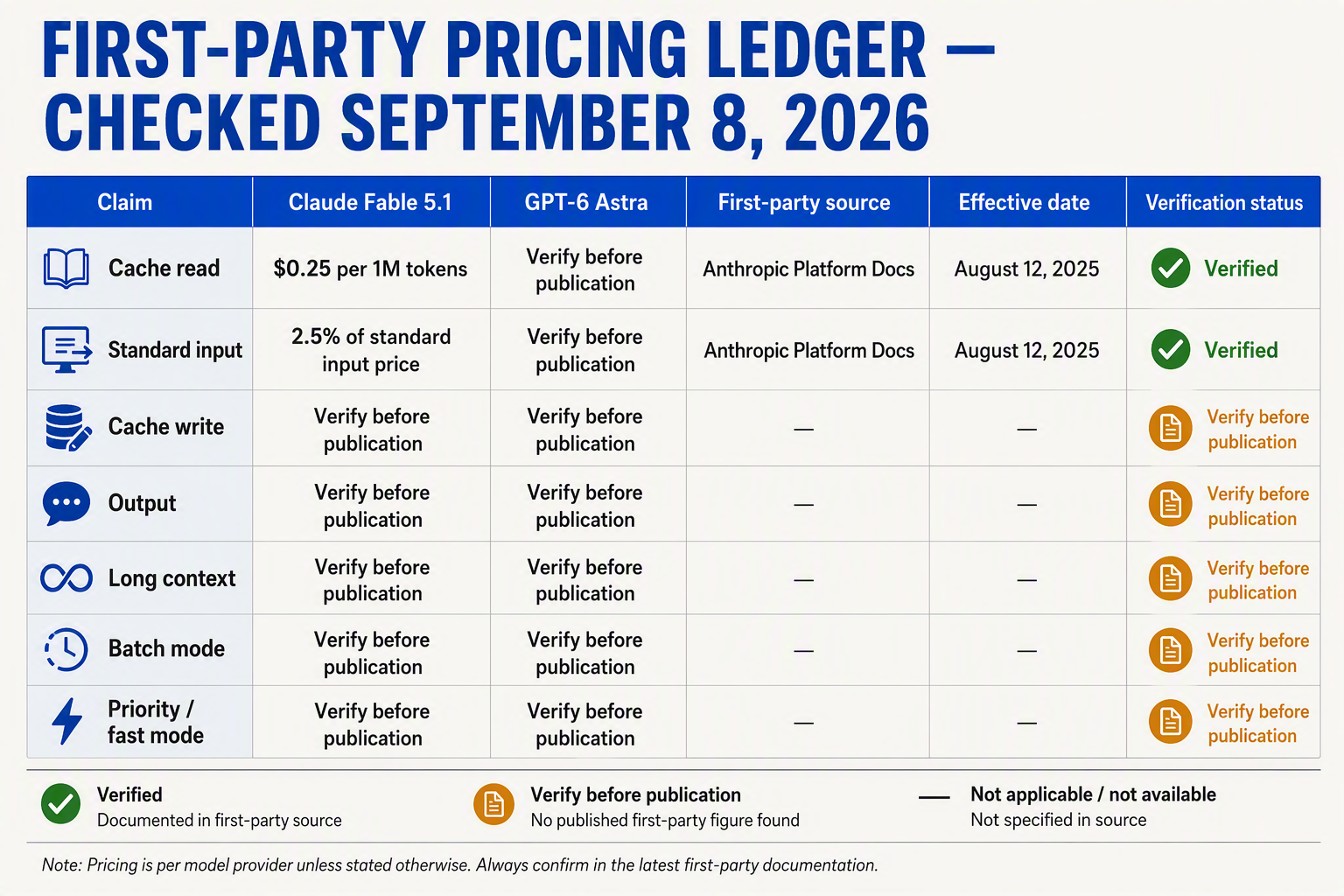
The provided first-party record verifies Claude Fable 5.1’s API availability and unusually low cache-read rate, but it does not verify GPT-6 Astra’s existence, rollout, or pricing. Therefore, any numerical GPT-6 Astra comparison must remain “not established” until OpenAI publishes an official model page, API price card, or documentation.
First-party evidence matrix
| Claim | Claude Fable 5.1 | GPT-6 Astra | Verification status |
|---|---|---|---|
| API availability | Model ID: claude-fable-5-1 | No official model ID provided | Verified for Claude only |
| Standard input price | Implied at $10 per million tokens from the documented cache ratio | No first-party rate provided | Claude rate derivable; GPT unverified |
| Cache-read price | $0.25 per million tokens | No first-party rate provided | Verified for Claude only |
| Cache-read multiplier | 0.025× standard input | No multiplier provided | Verified for Claude only |
| Cache-write price or TTL | Not stated in the supplied first-party material | Not stated | Unverified for both |
| Batch, priority, or long-context rules | Cache modifier can stack with Batch API and data-residency modifiers; exact workload rates are not supplied | No official rules provided | Partially verified for Claude |
What Anthropic has officially confirmed
Anthropic’s 2026 Claude Platform pricing documentation states that Claude Fable 5.1 cache hits cost $0.25 per million tokens, equal to 2.5% of the standard input price. This mathematically implies a base input rate of $10 per million tokens, although cost models should still preserve the distinction between an explicitly displayed price and one derived from an official multiplier.
Anthropic’s 2026 Claude Platform release notes provide a second first-party confirmation: Claude Fable 5.1 and Claude Mythos 5.1 use a 0.025× cache-read multiplier, compared with 0.1× on other Claude models. Anthropic also says these pricing multipliers can stack with the Batch API discount and data-residency pricing.
For rollout, Anthropic’s Claude Fable 5.1 announcement tells developers to use claude-fable-5-1 through the Claude API. Anthropic’s product page additionally lists Claude Fable 5.1 for Pro, Max, Team, and Enterprise users, confirming both API and subscription-product distribution.
The predecessor’s rollout history deserves separate treatment. Anthropic reported that access to Claude Fable 5 and Claude Mythos 5 was suspended on June 12, 2026, followed by redeployment on July 1, 2026. Those dates apply to version 5—not automatically to Fable 5.1—but they demonstrate why model availability should be checked independently from pricing.
What remains unverified
The supplied sources do not establish:
- A GPT-6 Astra API model name or general-availability date
- GPT-6 Astra input, output, cached-input, or cache-write prices
- Cache retention periods or invalidation rules for either comparison target
- Exact Claude Fable 5.1 output, Batch API, priority, or long-context rates
- Any claim that the two models have identical headline pricing
For reproducible cost engineering, these gaps should be represented as unknown variables—not zero-cost features or assumed parity. Later calculations can use scenarios for missing values, but verified figures and modeling assumptions must remain visibly separate.
How do standard input, cache reads and cache writes change the effective token cost?
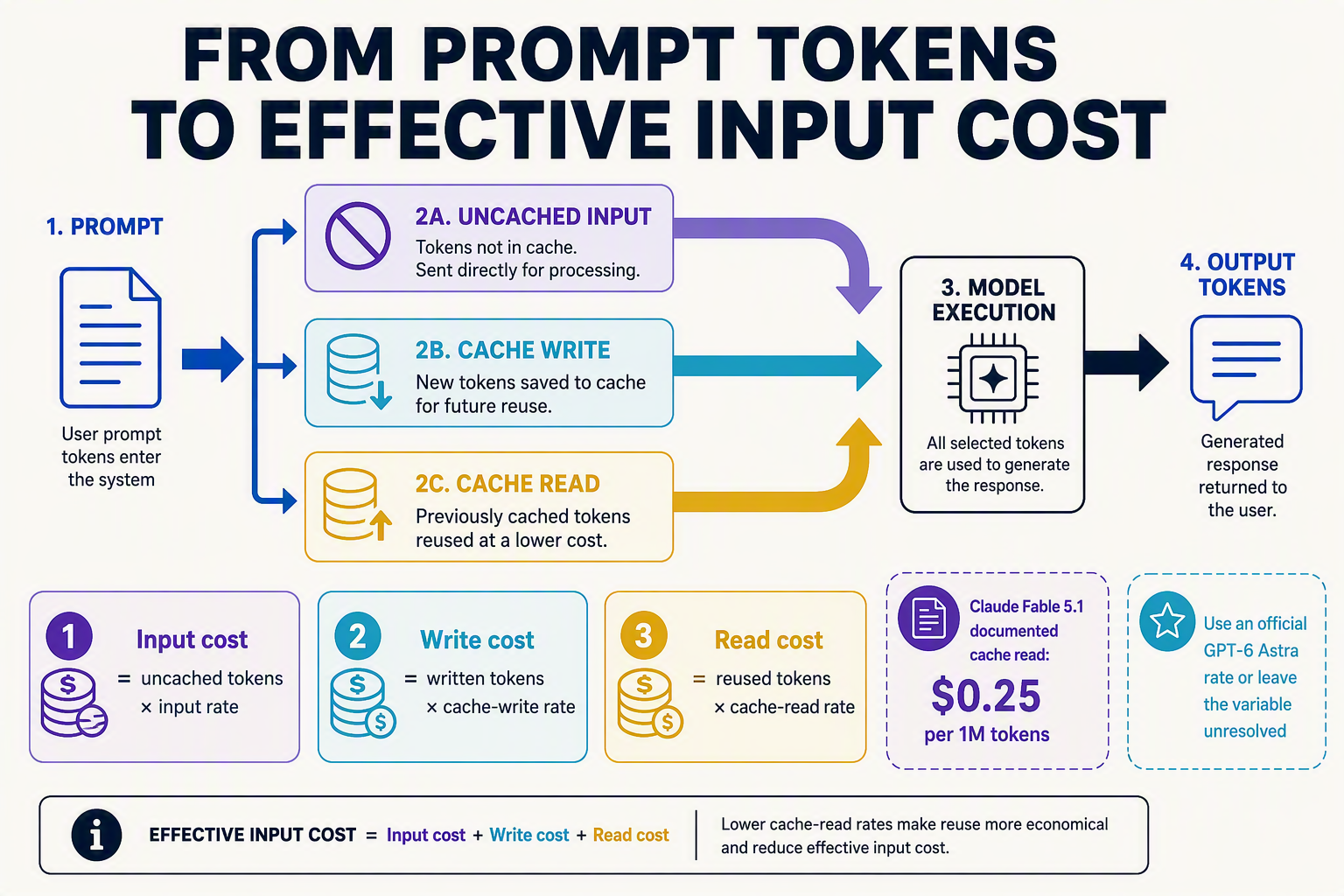
Standard input sets the ceiling, cache reads lower the recurring cost, and cache writes determine how quickly those savings begin. For Claude Fable 5.1, the verified cache-read discount is substantial; for GPT-6 Astra, no equivalent cache-read or cache-write price is established in the supplied official documentation, so a numerical parity claim would be unsupported.
Claude Fable 5.1’s verified input economics
Anthropic’s Claude Platform documentation lists Claude Fable 5.1 cache reads at $0.25 per million tokens in 2026, equal to 2.5% of its standard input price. That multiplier implies a standard input rate of $10 per million tokens:
- Standard input: $10 per million tokens
- Cache read: $0.25 per million tokens
- Savings on each successful cache read: $9.75 per million tokens
- Cache-read discount: 97.5% relative to standard input
Anthropic’s 2026 Claude Platform release notes state that the 0.025x cache-read multiplier for Claude Fable 5.1 compares with 0.1x for other Claude models. Consequently, Fable 5.1’s cached input is four times less expensive than a model charging 10% of its base input rate, assuming the same $10 standard rate.
Generated output remains a separate charge. Input caching does not reduce the number or price of output tokens, so an output-heavy workload may see a smaller percentage reduction in its total bill than a RAG system dominated by repeated context.
Cache writes establish the break-even point
A cache is not free merely because reads are inexpensive. The application must first create or write the reusable prompt block, and it may need to write it again after expiration or invalidation.
For one million reusable tokens used across \(N\) requests, the comparison is:
- Without caching: \(N \times \$10\)
- With caching: one cache-write charge \(C_w\), plus \((N-1) \times \$0.25\)
- Net savings: \(N \times \$10 - [C_w + (N-1)\times \$0.25]\)
The break-even condition is therefore:
\(N > (C_w - \$0.25) / \$9.75\)
The supplied Anthropic sources verify Fable 5.1’s read price but do not specify the applicable cache-write multiplier or cache duration. Those fields must be confirmed against the live API price sheet before calculating a precise reuse threshold. Cache invalidation caused by changing system prompts, tools, documents, or prefix order can also create additional writes.
Why GPT-6 Astra cannot be assigned a cached rate yet
The provided research does not contain an official OpenAI price card for GPT-6 Astra, including standard input, cached input, cache writes, retention periods, or output pricing. Even if GPT-6 Astra and Claude Fable 5.1 ultimately publish identical standard input and output rates, their effective costs will differ if their caching rules differ.
A defensible comparison should therefore record these GPT-6 Astra fields as unverified, not zero:
- Cached-input price per million tokens
- Whether cache creation carries a separate charge
- Minimum cacheable prefix or token threshold
- Cache lifetime and renewal behavior
- Eligibility under batch or priority processing
For cost engineering, the correct metric is blended input cost: total standard-input, cache-write, and cache-read charges divided by all input tokens processed. Claude Fable 5.1 has a documented recurring rate of $0.25 per million cached tokens; GPT-6 Astra requires official pricing before an equivalent blended figure can be calculated.
How should long-context, batch and priority pricing be added without inventing rates?
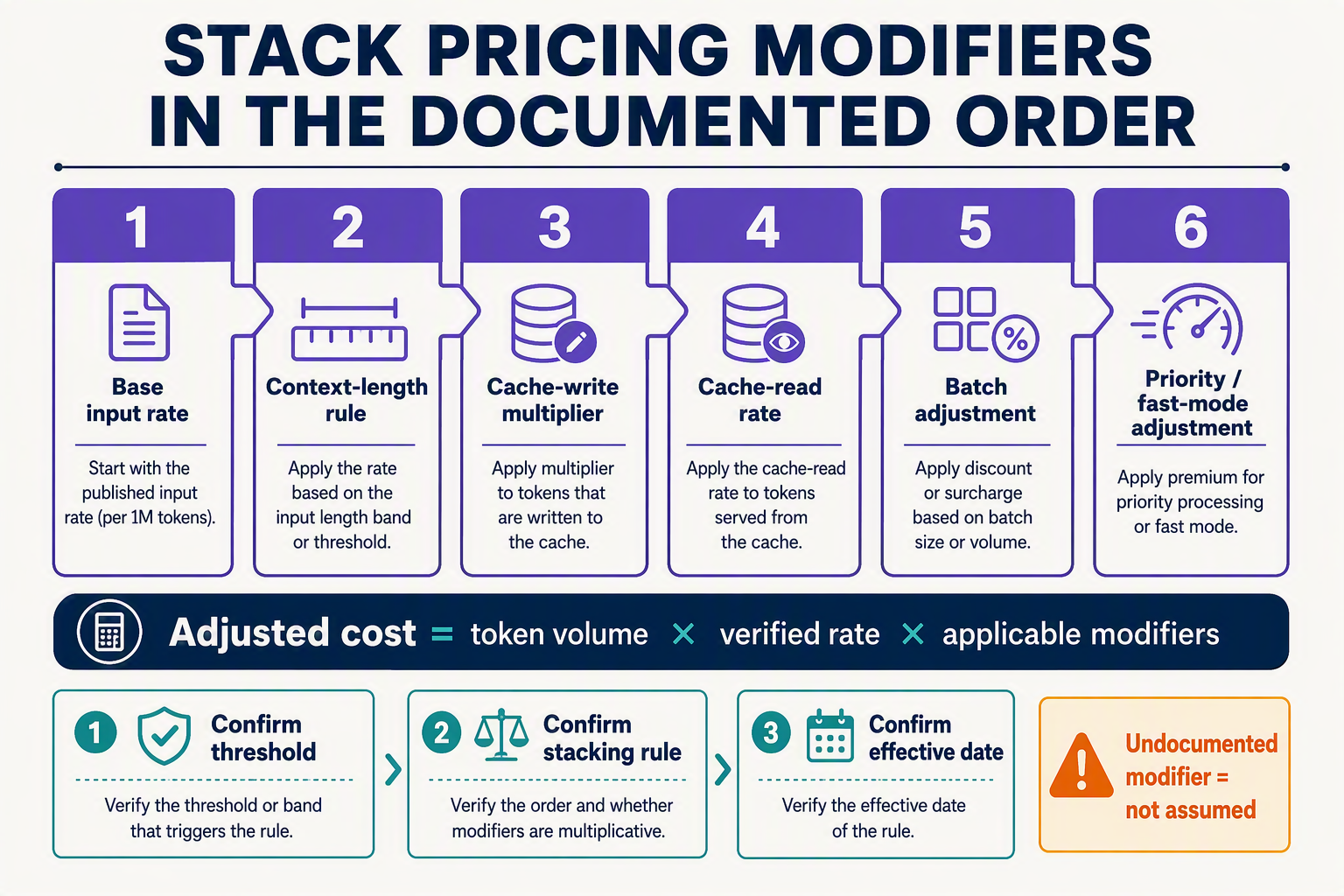
Long-context, batch and priority costs should be added as separate, documented pricing adjustments, not estimated from another model or treated as zero. When a provider has not published a threshold, multiplier or eligibility rule, the comparison should show “not publicly verified” and calculate scenarios symbolically.
Build the standard-cost baseline first
Start with the workload’s standard token cost before applying special processing modes:
\[
C_{standard} = (T_{in} \times R_{in}) + (T_{out} \times R_{out})
\]
Where \(T_{in}\) and \(T_{out}\) are token volumes in millions, while \(R_{in}\) and \(R_{out}\) are the respective per-million-token rates. Cache writes and cache reads should be separated from uncached input rather than counted twice:
\[
C_{input} = (T_{uncached}R_{in}) + (T_{write}R_{write}) + (T_{read}R_{read})
\]
Anthropic’s Claude Platform documentation states that, as of September 8, 2026, Claude Fable 5.1 cache reads are billed at 0.025 times standard input pricing. However, that verified cache-read multiplier does not establish the cache-write rate, retention duration or long-context surcharge; each requires its own official value.
Represent long-context pricing as a tiered function
If a provider charges differently after a context threshold, split the request rather than multiplying its entire input indiscriminately:
\[
C_{long} = \min(T,L)R_{base} + \max(0,T-L)R_{extended}
\]
Here, \(L\) is the documented threshold and \(R_{extended}\) is the published long-context rate. The pricing model must also clarify whether the higher rate applies:
- Only to tokens above the threshold
- To every input token once the request crosses the threshold
- To output tokens as well as input tokens
- Per request rather than across monthly aggregate usage
Unless official GPT-6 Astra documentation specifies these rules, its long-context fields should remain unknown—not $0. The same standard applies to Claude Fable 5.1 where the supplied Anthropic sources do not establish a specific long-context threshold or rate.
Calculate batch and priority modes independently
Batch and priority processing represent different service trade-offs, so they should not be blended into one assumed multiplier.
- Batch scenario: Apply a published batch multiplier \(B\) only to eligible asynchronous traffic.
- Standard scenario: Use ordinary token rates and standard service behavior.
- Priority scenario: Apply a published multiplier \(P\), surcharge or reserved-capacity fee only when the request actually uses that service tier.
Anthropic’s Claude Platform pricing documentation says Claude Fable 5.1’s cache modifiers can stack with the Batch API discount and data-residency pricing in 2026. That confirms stacking is possible, but the provided evidence does not supply the Batch API discount percentage; inserting one would be speculation.
Publish a fact-and-assumption ledger
Every cost model should label inputs as:
- Verified: Quoted from current provider pricing or API documentation
- Derived: Mathematically calculated from a verified rate
- Assumed: A user-selected workload parameter, such as cache-hit ratio
- Unverified: No authoritative rate or rule located
For GPT-6 Astra, undocumented batch, priority, cache-write and long-context values should be reported as N/A or unverified. Cost engineers can still run sensitivity cases—for example, \(B=0.5\) or \(P=2.0\)—but must label them as hypothetical scenarios, not API prices.
What do realistic coding, RAG and agent workloads cost under each API?
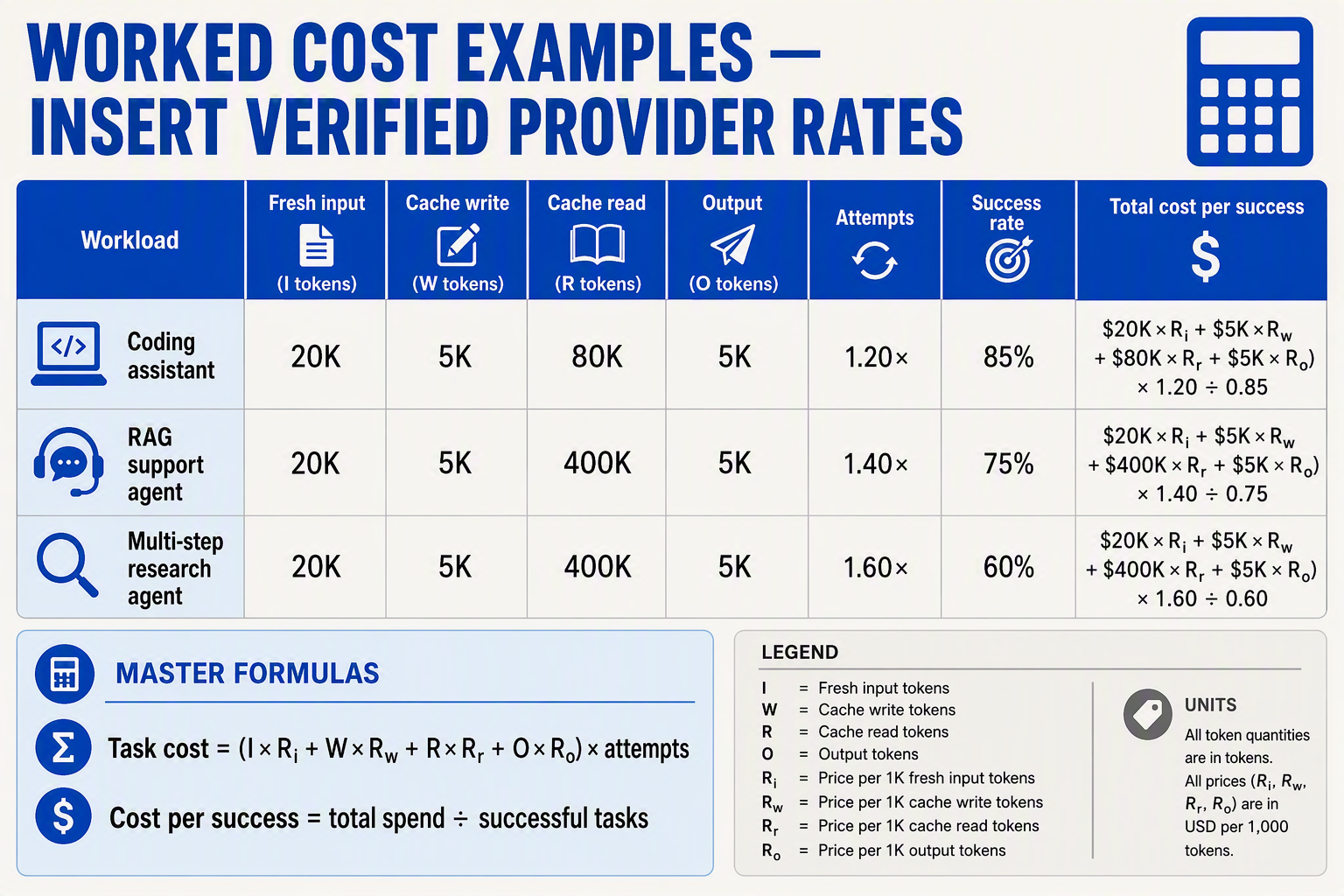
For Claude Fable 5.1, 1,000 realistic requests cost between $31.25 and $300 in steady-state input charges when reusable context receives cache hits in the scenarios below. No equivalent calculation is defensible for GPT-6 Astra because the supplied research contains no first-party pricing for its standard input, output, cache reads, or cache writes.
Claude Fable 5.1 workload calculator
These examples use two Claude Fable 5.1 rates:
- $0.25 per million cache-read tokens, verified by Anthropic’s Claude Platform documentation in 2026.
- $10 per million standard-input tokens, derived from Anthropic’s statement that $0.25 is 2.5%, or 0.025×, the base input price: $0.25 ÷ 0.025 = $10.
Each scenario models 1,000 requests. Dollar totals include input tokens only; generated output and cache-write charges are excluded because the supplied research does not establish those prices.
| Workload | Per-request token profile | Claude: fully uncached input | Claude: cached input | GPT-6 Astra |
|---|---|---|---|---|
| Coding assistant | 100K cached + 10K fresh + 5K output | $1,100.00 | $125.00 | N/A—unverified |
| RAG question answering | 20K cached + 8K fresh + 2K output | $280.00 | $85.00 | N/A—unverified |
| Tool-using agent | 50K cached + 15K fresh + 8K output | $650.00 | $162.50 | N/A—unverified |
| Support copilot | 5K cached + 3K fresh + 1K output | $80.00 | $31.25 | N/A—unverified |
| Repository-scale review | 200K cached + 25K fresh + 10K output | $2,250.00 | $300.00 | N/A—unverified |
Anthropic’s Claude Platform release notes state in 2026 that Claude Fable 5.1 prompt-cache reads cost $0.25 per million tokens, or 0.025× the base input price. For the coding-assistant scenario, the transparent arithmetic is:
- Reused context: 100,000 tokens × 1,000 requests = 100 million tokens
- Cache-read charge: 100 million × $0.25/M = $25
- Fresh context: 10,000 tokens × 1,000 requests = 10 million tokens
- Standard-input charge: 10 million × $10/M = $100
- Modeled steady-state input total: $125
- Fully uncached Claude input: 110 million × $10/M = $1,100
- Modeled reduction after cache creation: $975, or 88.6%
Why these figures are not complete invoices
The calculator assumes every designated reusable token receives a cache hit. Production costs can be higher because repository edits, changing retrieval results, personalized instructions, tool-schema updates, and cache expiration can invalidate prefixes.
A complete forecast must also account for:
- Cache writes: Initial creation and refresh charges are unknown in the supplied evidence and therefore excluded.
- Output tokens: Output volumes are displayed for workload context but are not priced.
- Hit rate: At a 70% hit rate, the remaining 30% of reusable tokens may be billed as standard input.
- Long-context rules: No applicable threshold or surcharge is included.
- Pricing modifiers: Anthropic says cache multipliers can stack with the Batch API discount and data-residency pricing, but no unsupported discount percentage is assumed here.
Until first-party GPT-6 Astra pricing is published, every Astra result remains unverified/N/A, not an estimate based on Claude’s rates.
How do token efficiency, latency, failures and retries alter total cost per successful task?
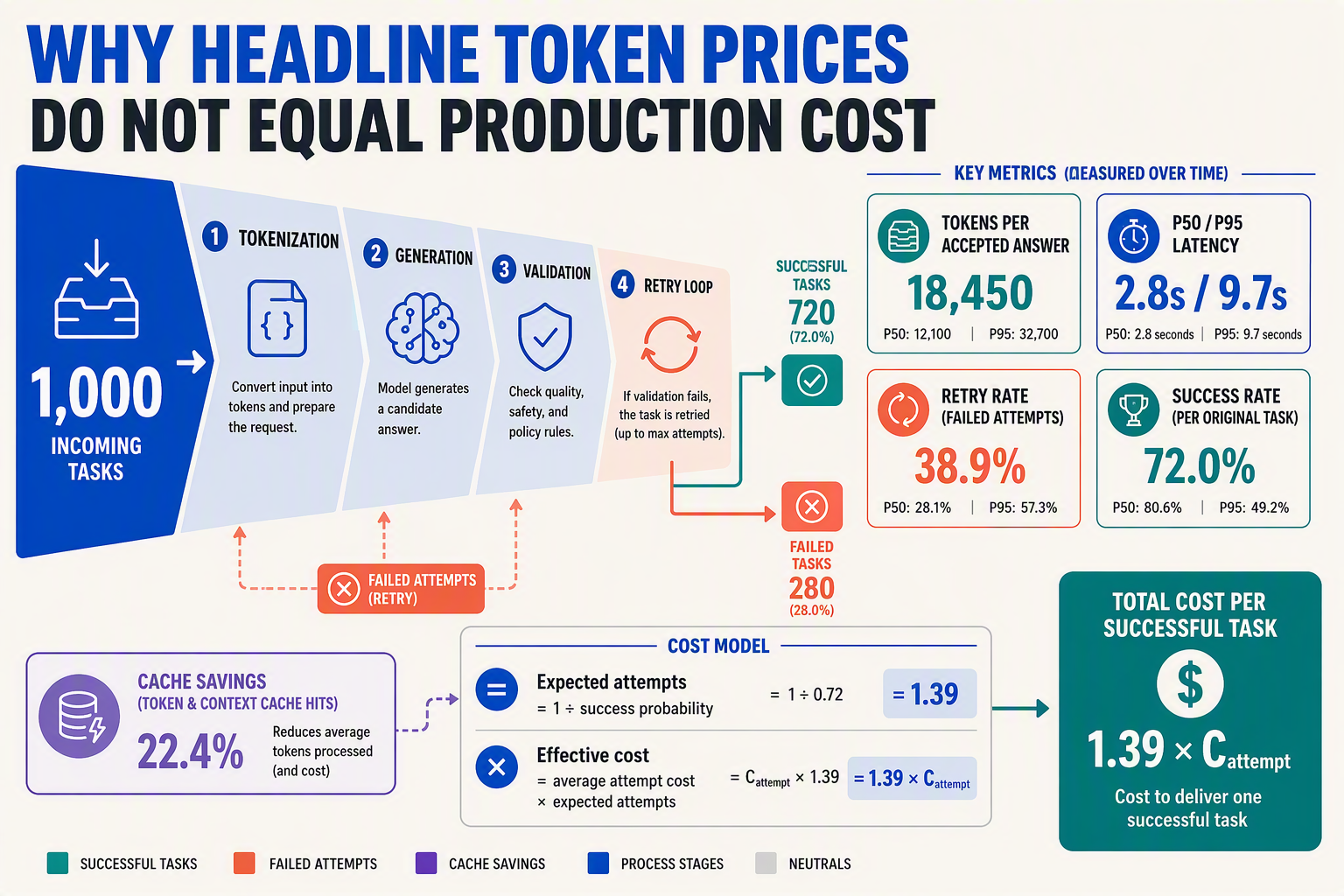
The cheapest model per token is not necessarily the cheapest per completed task. Token consumption, latency, failure rates, and retry behavior multiply the price-card cost, so Claude Fable 5.1 and GPT-6 Astra should be compared with production traces rather than a single successful request.
Calculate cost per successful task
A practical cost model is:
Cost per successful task = (input + cache writes + cache reads + output + tool costs + retry costs) ÷ successful tasks
For a workload with independent failure probability f, the expected number of attempts is 1 ÷ (1 − f). This creates a nonlinear retry penalty:
- A 2% failure rate requires approximately 1.020 attempts per success.
- A 5% failure rate requires approximately 1.053 attempts per success.
- A 10% failure rate requires approximately 1.111 attempts per success.
- A 20% failure rate requires 1.25 attempts per success.
Therefore, a model costing $0.10 per attempt effectively costs about $0.111 per successful task at a 10% failure rate, before counting application infrastructure or fallback calls.
Token efficiency can outweigh identical rates
Two models with identical per-million-token prices can generate different bills because tokenizers, reasoning behavior, tool loops, and answer length differ. Cost engineers should record:
- Input tokens after each provider’s tokenizer
- Visible output tokens and any separately billed reasoning tokens
- Tool-call iterations required to finish
- Context added after failed tool calls
- Tokens consumed by incomplete or timed-out responses
If Claude Fable 5.1 completes a workflow in 4,000 output tokens while GPT-6 Astra needs 5,000, its output-token component is 20% lower, assuming identical rates. That example is illustrative, not a published benchmark; representative prompts must establish the actual difference.
Caching can also soften retry costs. Anthropic’s Claude Platform documentation states that Claude Fable 5.1 cache hits cost $0.25 per million tokens in 2026, equal to 2.5% of its standard input price. Anthropic’s release notes say the 0.025x multiplier compares with 0.1x on other Claude models. A retry that reuses an intact cached prefix may therefore be much cheaper than one that resends uncached context, although output and newly appended tokens remain billable.
Equivalent GPT-6 Astra retry savings cannot be assumed without official documentation covering cache-read prices, cache-write charges, retention, and invalidation.
Latency creates direct and indirect costs
Latency matters when it triggers timeouts, duplicate requests, fallback models, or extra compute capacity. A client may retry after 30 seconds even while the original generation continues, potentially paying for both attempts.
Track latency as a distribution—not merely an average:
- Time to first token
- Median end-to-end latency
- p95 and p99 latency
- Timeout and cancellation rates
- Tokens billed after cancellation
- Fallback frequency and duplicate completion rate
Batch workloads may tolerate slower responses, while voice agents and customer-support systems often cannot. Anthropic documents that Claude Fable 5.1 cache modifiers can stack with the Batch API discount, but teams must test whether batch latency satisfies the task’s service-level objective.
Use successful outcomes as the denominator
Neither Claude Fable 5.1 nor GPT-6 Astra should be declared cheaper without matched workload measurements. Run the same task set, define success with deterministic checks or blinded evaluation, and report cost per accepted answer, cost per resolved case, or cost per completed agent workflow. Where official GPT-6 Astra failure, latency, or caching data is unavailable, label the field unverified rather than treating missing information as zero cost.
What are the operational and budgeting implications of choosing the cheaper headline rate?

Choosing the lower headline rate can reduce unit cost, but it can also produce a less predictable budget if caching, latency tiers, and context rules are unfavorable. The financially safer API is the one with the lowest measured cost per completed task—not necessarily the lowest advertised cost per million tokens.
Operational cost depends on workload shape
For applications with mostly unique, short prompts, standard input and output rates remain useful. For coding agents, retrieval-augmented generation (RAG), and customer-support systems, repeated context can dominate spending.
Anthropic’s Claude Platform documentation states that Claude Fable 5.1 cache reads cost $0.25 per million tokens, or 2.5% of standard input pricing, as of September 2026. Anthropic’s release notes also state that Fable 5.1’s 0.025x cache-read multiplier is one-quarter of the 0.1x multiplier used by other Claude models in September 2026.
Consider a service processing 500 million reusable input tokens monthly:
- At a $10-per-million standard input rate, uncached processing costs $5,000.
- At Fable 5.1’s documented $0.25-per-million cache-read rate, successful cache reads cost $125.
- The maximum gross difference is $4,875 per month, before cache-write fees, misses, invalidations, or other modifiers.
That calculation does not prove Fable 5.1 will always be cheaper. Cache entries must first be created, and a workload that constantly changes system prompts, tools, documents, or personalization fields may achieve too few hits to recover its write costs.
A cheaper rate changes engineering priorities
The price card should translate into concrete operational decisions:
- Instrument cache-hit ratios. Separate standard input, cache writes, cache reads, and generated output in observability dashboards.
- Stabilize prompt prefixes. Put reusable system instructions, tool definitions, and shared documents before request-specific content where the API’s caching design permits it.
- Track invalidation events. Model upgrades, knowledge-base updates, tenant-specific data, and prompt experiments can destroy expected reuse.
- Measure tokens with each provider’s tokenizer. Identical text can produce different billable token counts, so equal per-token rates do not guarantee equal request costs.
- Benchmark cost per successful outcome. Include retries, tool loops, response length, latency failures, and human escalations—not merely first-call token charges.
Budget for verified features, not assumed discounts
Anthropic documents that Fable 5.1 cache pricing modifiers can stack with the Batch API discount and data-residency pricing. However, finance teams should verify eligibility, processing deadlines, regional requirements, and cache-write treatment before including those savings in committed forecasts.
For GPT-6 Astra, any undocumented cache-write rate, cache lifetime, batch discount, priority surcharge, or long-context threshold should remain an explicit unknown as of September 8, 2026. A defensible budget should therefore use three scenarios:
- Base case: observed production token mix and cache-hit rate
- Downside case: low cache reuse, more output, and extra retries
- Stress case: no assumed GPT-6 Astra discount unless officially documented
The operational implication is clear: headline savings should fund experimentation, not justify premature lock-in. Run representative traffic through both APIs, reconcile invoices against telemetry, and select or route models using total task economics, reliability, and latency together.
What do official documentation and experienced cost engineers recommend measuring?

Official documentation should be treated as the billing specification, while cost engineers should measure cost per successful, quality-approved outcome. For Claude Fable 5.1 and GPT-6 Astra, request-level telemetry must separate token categories, cache events, pricing modifiers, retries, latency, and task results.
Treat official documentation as the source of truth
Bind every pricing rule to an exact model version and effective date. Anthropic’s 2026 Claude Fable 5.1 launch announcement identifies the Claude API model ID as claude-fable-5-1 and confirms that cache-read pricing was reduced wherever token-based billing applies. Separately, Anthropic’s Claude Platform pricing documentation and release notes establish the precise cache-read rate.
Anthropic’s Claude Platform documentation states that a Claude Fable 5.1 cache hit costs $0.25 per million tokens, or 2.5% of the standard input price, in 2026. Anthropic also says this multiplier can stack with pricing modifiers including the Batch API discount and data residency.
For each provider and model, record:
- Standard input, cache reads, cache writes, and output as distinct meters
- Cache-write rates, retention periods, and time-to-live conditions
- Long-context thresholds and the token classes affected
- Batch, priority, regional, and data-residency modifiers
- Whether discounts stack or are mutually exclusive
- Billing treatment for failures, retries, tools, and reasoning tokens
Do not infer GPT-6 Astra billing rules from Claude Fable 5.1—or from another OpenAI model. If OpenAI’s official pricing pages, API documentation, usage objects, or invoices do not define a category, label it undocumented rather than assuming it is free or billed as ordinary input.
Build a request-level cost ledger
A practical normalized equation is:
Request cost = standard input + cache writes + cache reads + output + pricing modifiers + retry overhead.
Capture at least these fields for every request:
- Provider, exact model ID, endpoint, region, and timestamp
- Uncached input, cache-created, cache-read, and output token counts
- Prompt length, context band, cache key, cache age, and hit-or-miss status
- Batch or priority mode, latency, HTTP status, and retry count
- Task outcome, quality score, and whether a human accepted the result
Reconcile sampled request records against provider invoices. For Claude Fable 5.1, cache-read charges should correspond to Anthropic’s documented 0.025× base-input multiplier, after applying any other documented modifiers. Cache writes require their own meter because creating reusable context and reading it later are economically different events.
Measure completed work, not headline rates
Identical input/output prices do not guarantee identical production costs. Tokenizers may split the same prompt differently, cache hit rates vary by workload, and retries can turn an inexpensive request into an expensive completed task.
Report:
- P50, P95, and P99 cost per successful request
- Cache-hit rate by prompt segment and cache age
- Cache-write break-even point based on expected reuse
- Input-to-output ratio and tokens per completed task
- Retry-adjusted and failure-adjusted cost
- Spend by context band, region, and service tier
- Cost per quality-approved outcome
Run versioned prompts against both APIs, preserve each provider’s native token counts, and evaluate quality and latency alongside spend. The defensible conclusion is not which model has the cleaner price card, but which delivers the required result at the lower measured total cost.
Which API should you choose for coding, RAG, long-context agents and batch jobs?
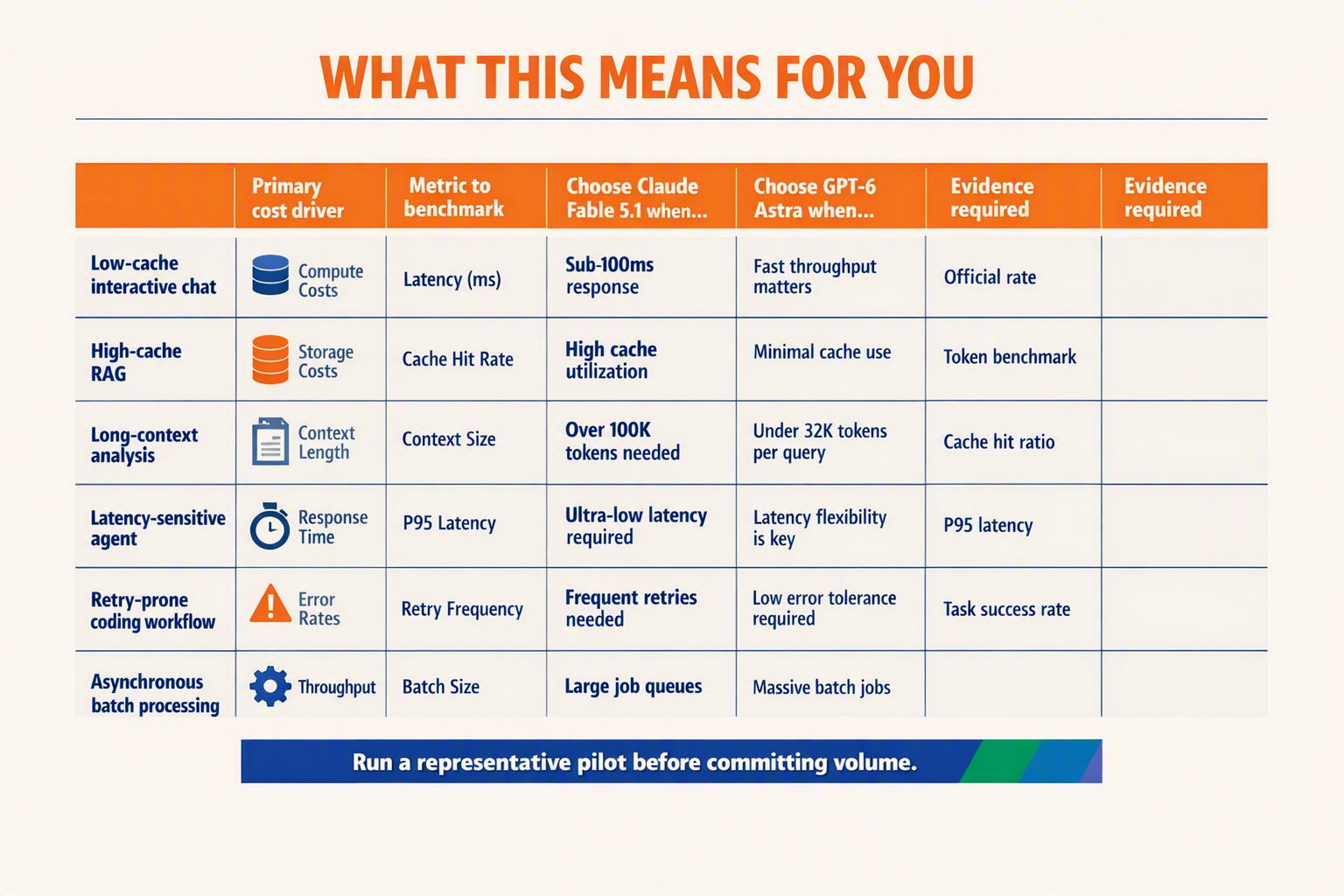
Choose Claude Fable 5.1 when large, stable prompt prefixes are reused, because Anthropic documents both API availability and unusually low cache-read pricing. Do not select GPT-6 Astra on price until OpenAI officially confirms that the model exists as a public API product and publishes its input, output, caching, long-context and processing-mode rates.
Workload-by-workload recommendation
| Workload | Recommended decision | Main cost driver | Required validation |
|---|---|---|---|
| Coding copilots | Fable 5.1 for reusable repository context | Cache hits on instructions, tool schemas and repository maps | Cache-hit ratio, acceptance rate and cost per accepted change |
| Autonomous coding agents | Use Fable 5.1 or defer comparison | Output tokens, retries and expanding tool traces | Cost per completed issue and long-context behavior |
| RAG applications | Fable 5.1 when shared prefixes remain stable | Cache reads, cache writes and invalidation frequency | Retrieved-context churn and total cost per grounded answer |
| Long-context agents | No cross-model winner yet | Context thresholds, tokenization, compaction and repeated history | Official Astra terms plus invoice-level tests |
| Offline batch jobs | Fable 5.1 conditionally | Batch eligibility, turnaround time and retry costs | Confirm Anthropic Batch API rules for the exact deployment |
| Latency-sensitive production | Benchmark Fable 5.1; wait for Astra documentation | Throughput, tail latency and any priority premium | p95 latency, rate limits and cost per successful response |
Why documented cache economics matter
Anthropic’s 2026 Claude Platform documentation states that Claude Fable 5.1 cache reads cost $0.25 per million tokens, or 2.5% of the $10-per-million-token standard input rate. Anthropic describes cache reads as reuse of context the model has already processed, making the mechanism relevant to repeated system instructions, coding standards, repository maps, tool definitions and stable RAG reference material.
That advantage is conditional rather than universal. Cache reads are only cheap when requests actually hit the cache. Frequently changing source files, user-specific retrieval results or dynamic tool state can reduce reuse and create additional cache writes.
A defensible cost model should therefore:
- Separate uncached input, cache writes, cache reads and output tokens.
- Measure cache-hit ratios using production-like request sequences.
- Include invalidations, retries, failed tool calls and context compaction.
- Compare cost per successful task, not cost per request.
- Verify cache-write rates and cache lifetime against Anthropic’s current documentation before procurement.
Where GPT-6 Astra remains unverified
The supplied sources contain no official OpenAI announcement or pricing documentation for GPT-6 Astra. Its API availability, model identifier, cached-input rate, cache-write treatment, cache retention period, long-context rules, Batch API discount and priority-processing premium must all be treated as unverified—not free, zero or equivalent to another OpenAI model.
Anthropic’s Claude Platform documentation also says that Fable 5.1’s cache-hit modifier can stack with the Batch API discount and data-residency pricing. Teams should still confirm workload eligibility, completion windows and regional requirements rather than assuming every request receives all modifiers.
The practical decision is to deploy or test Claude Fable 5.1 where its documented terms fit the workload, while postponing any GPT-6 Astra cost comparison until official availability and pricing exist. If Astra is later released, rerun the comparison using identical task sets, quality thresholds, cache-hit patterns, latency targets and total cost per successful outcome.
Frequently asked questions about Claude Fable 5.1 vs GPT-6 Astra pricing, caching, context limits and availability
Is Claude Fable 5.1 vs GPT-6 Astra API pricing identical in 2026?
How much do Claude Fable 5.1 cached input tokens cost?
How should developers compare cache-write pricing between Claude Fable 5.1 and GPT-6 Astra?
What is the cache break-even point in a Claude Fable 5.1 vs GPT-6 Astra pricing comparison?
Do Claude Fable 5.1 and GPT-6 Astra have the same context-window limits and long-context pricing?
What are the availability and batch-processing differences in Claude Fable 5.1 vs GPT-6 Astra pricing?
claude-fable-5-1 and to Pro, Max, Team and Enterprise users; Anthropic’s release notes also state that its 0.025x cache-read multiplier can stack with the Batch API discount and data-residency pricing modifiers. As of September 8, 2026, the provided sources do not verify GPT-6 Astra’s API availability, batch discount, priority-processing premium or regional access, so production budgets should exclude assumed savings until official documentation confirms them.Conclusion
The decisive cost metric in Claude Fable 5.1 vs GPT-6 Astra pricing is not the headline rate; it is the blended cost of input, output, cache creation, cache reuse, context length, processing mode, and actual tokenizer consumption. Production teams should model these variables against their own request traces rather than assume equal advertised rates produce equal invoices.
- Caching can dominate the comparison. Anthropic’s Claude Platform documentation states that Claude Fable 5.1 cache reads cost $0.25 per million tokens in 2026, equivalent to 2.5% of its $10 standard input rate. A cache hit is therefore 40 times cheaper than standard input, provided the cached prefix remains valid and reusable.
- Reuse frequency determines whether caching pays. Processing 100 million reusable tokens would cost $25 through Claude Fable 5.1 cache reads versus $1,000 at its standard input rate. That saving must still be evaluated alongside cache-write pricing, expiration, invalidation, and the number of successful reads following each write.
- Published rules matter more than convenient assumptions. Anthropic’s 2026 release notes report a 0.025x cache-read multiplier for Claude Fable 5.1, compared with 0.1x on other Claude models, and say the multiplier can stack with the Batch API discount and data-residency pricing. Any corresponding GPT-6 Astra cache, long-context, batch, or priority fee should remain marked unverified until OpenAI documents it officially.
- Token counts and workload shape can overturn price-card parity. Chatbots, coding agents, and retrieval-augmented generation systems have different output ratios, repeated-prefix rates, latency requirements, and tokenizer results. The defensible comparison is an application-level simulation covering cache hits, cache writes, prompt thresholds, batch eligibility, and fallback behavior.
Looking ahead, watch for changes to cache lifetimes, long-context thresholds, tokenizer behavior, batch discounts, and priority-processing premiums. These variables can alter unit economics without changing the headline input or output price.
Teams can also explore CallMissed, an OpenAI-compatible AI infrastructure platform that supports multi-model access and communication workflows spanning voice, WhatsApp, and multilingual engagement. As model pricing becomes increasingly conditional, is your architecture optimized for the cheapest advertised model—or the lowest verifiable cost per successful task?
Related Reading
- Claude Fable 5.1 vs GPT-6 Astra: 2026 API Migration and Routing Guide
- Claude Fable 5.1 vs GPT-6 Astra for Coding: 2026 Evidence-Led Comparison
- GPT-6 Astra API Availability, Access, and Pricing: Verified Status as of September 3, 2026