Claude Fable 5.1 vs GPT-6 Astra: 2026 Knowledge-Work Test


Compare Claude Fable 5.1 vs GPT-6 Astra with a transparent 2026 test of long-context research, citations, files, privacy, and tool use.
Claude Fable 5.1 vs GPT-6 Astra: 2026 Knowledge-Work Test
A 1-million-token context window sounds like the end of document overload—but it does not prove an AI can retrieve the right footnote, preserve spreadsheet formulas, or build a defensible presentation from hundreds of sources. That gap between advertised capacity and dependable output is why the Claude Fable 5.1 vs GPT-6 Astra comparison matters for knowledge workers in 2026.
Anthropic announced Claude Fable 5.1 on September 1, 2026, describing it as its “most capable model for coding and knowledge work” and highlighting research capabilities that offer an early glimpse of AI’s contribution to scientific progress. Anthropic’s Help Center states that Claude Fable 5.1 supports a 1-million-token context window on paid Claude plans as of September 2026. For perspective, Anthropic previously equated 100,000 tokens with approximately 75,000 words, suggesting that one million tokens could theoretically accommodate several large reports, data appendices, meeting transcripts, and policy documents in one session.
But nominal context is not effective context. A model may accept a vast corpus yet still miss evidence buried in the middle, confuse similar figures across files, introduce unsupported claims, or lose formatting when moving between Word documents, Excel workbooks, and PowerPoint decks. The real question is not simply, “Which model holds more tokens?” It is, “Which model converts complex source material into accurate, traceable work with fewer corrections?”
What this comparison tests
This workflow-focused evaluation examines how Claude Fable 5.1 and GPT-6 Astra perform across practical knowledge-work tasks:
- Long-context research: locating facts, reconciling conflicting sources, and maintaining citations
- Document production: drafting, revising, summarising, and following detailed style requirements
- Spreadsheet analysis: interpreting tables, preserving formulas, spotting anomalies, and explaining calculations
- Presentation creation: structuring narratives, selecting evidence, and translating analysis into executive-ready slides
- Reliability and governance: hallucination resistance, instruction retention, privacy constraints, latency, and cost
Published specifications will be separated from observed workflow performance. Any GPT-6 Astra context limit, pricing claim, or benchmark result must be attributed to current OpenAI documentation rather than inferred from product naming or unsupported online comparisons.
Data handling also belongs in the scorecard. Anthropic’s Platform documentation says Claude Fable 5.1 is a Covered Model requiring 30-day data retention unless an exception is expressly approved, a material consideration for regulated research and confidential corporate files.
Multi-model infrastructure is becoming relevant here: solutions such as CallMissed’s OpenAI-compatible gateway let developers access a broad model catalog through one integration and use same-tier fallbacks when availability changes.
The result is a practical buying guide—not a synthetic leaderboard—for analysts, researchers, consultants, finance teams, and operators deciding which 2026 model deserves a place in real production workflows.
Which is better for knowledge work? Neither universally—choose by verified workflow performance

Neither Claude Fable 5.1 nor GPT-6 Astra is universally better for knowledge work. The defensible choice is the model that produces the most accurate, traceable, and editable deliverable in a team’s actual workflow—not the model with the largest advertised context window or strongest generic benchmark score.
The evidence is currently asymmetric
Claude Fable 5.1 has several specifications that can be verified directly. Anthropic announced Claude Fable 5.1 on September 1, 2026, calling it its “most capable model for coding and knowledge work.” Anthropic’s Help Center states that Claude Fable 5.1 supports a 1-million-token context window on paid Claude plans as of September 2026.
Anthropic also provides a useful scale reference: in its 100K context announcement, Anthropic said 100,000 tokens correspond to approximately 75,000 words. That ratio is only an approximation—tokenisation varies by language, formatting, tables, and code—but it illustrates the potential capacity of Fable 5.1.
By contrast, the evidence supplied for this comparison contains no current OpenAI documentation confirming GPT-6 Astra’s context limit, pricing, availability, benchmark scores, or supported file workflows as of September 8, 2026. That absence does not prove weaker performance. It means those fields must remain unverified, rather than being filled with estimates from rumours, screenshots, or model-name assumptions.
“Better” must be measured at the deliverable level
A useful evaluation should test complete work products instead of isolated prompts. For each model, run the same source pack, instructions, tools, and output format, then score:
- Research accuracy: How many requested facts are retrieved correctly, and how many claims remain unsupported?
- Citation fidelity: Does every citation point to the correct document, page, table, or passage?
- Document quality: Are headings, tracked requirements, terminology, and house style preserved across revisions?
- Spreadsheet integrity: Are formulas, cell references, units, filters, and workbook structure retained rather than silently replaced?
- Presentation usefulness: Does the deck connect claims to evidence, maintain narrative flow, and produce editable slides?
- Correction burden: How much human time is required to detect errors and reach an acceptable final artifact?
The strongest model is therefore the one with the lowest consequential-error rate and lowest correction time for a particular workflow. A missed appendix note may be harmless in brainstorming but unacceptable in due diligence, financial modelling, regulatory analysis, or clinical research.
Governance can outweigh raw capability
Model selection must also account for how confidential material is handled. Anthropic’s Platform documentation identifies Claude Fable 5.1 as a Covered Model requiring 30-day data retention unless an exception is expressly approved. For organisations requiring zero-data-retention processing, that condition may be decisive regardless of output quality.
Teams should consequently separate three decisions:
- Can the model accept the workload?
- Can it complete the workload reliably?
- Can the organisation use it under its security, residency, retention, latency, and cost constraints?
Until equivalent official specifications and reproducible workflow results are available for GPT-6 Astra, the evidence-based conclusion is conditional: Claude Fable 5.1 has a verified long-context proposition, while any Astra advantage must be demonstrated task by task rather than assumed.
What are Claude Fable 5.1 and GPT-6 Astra, and which 2026 claims can be verified?
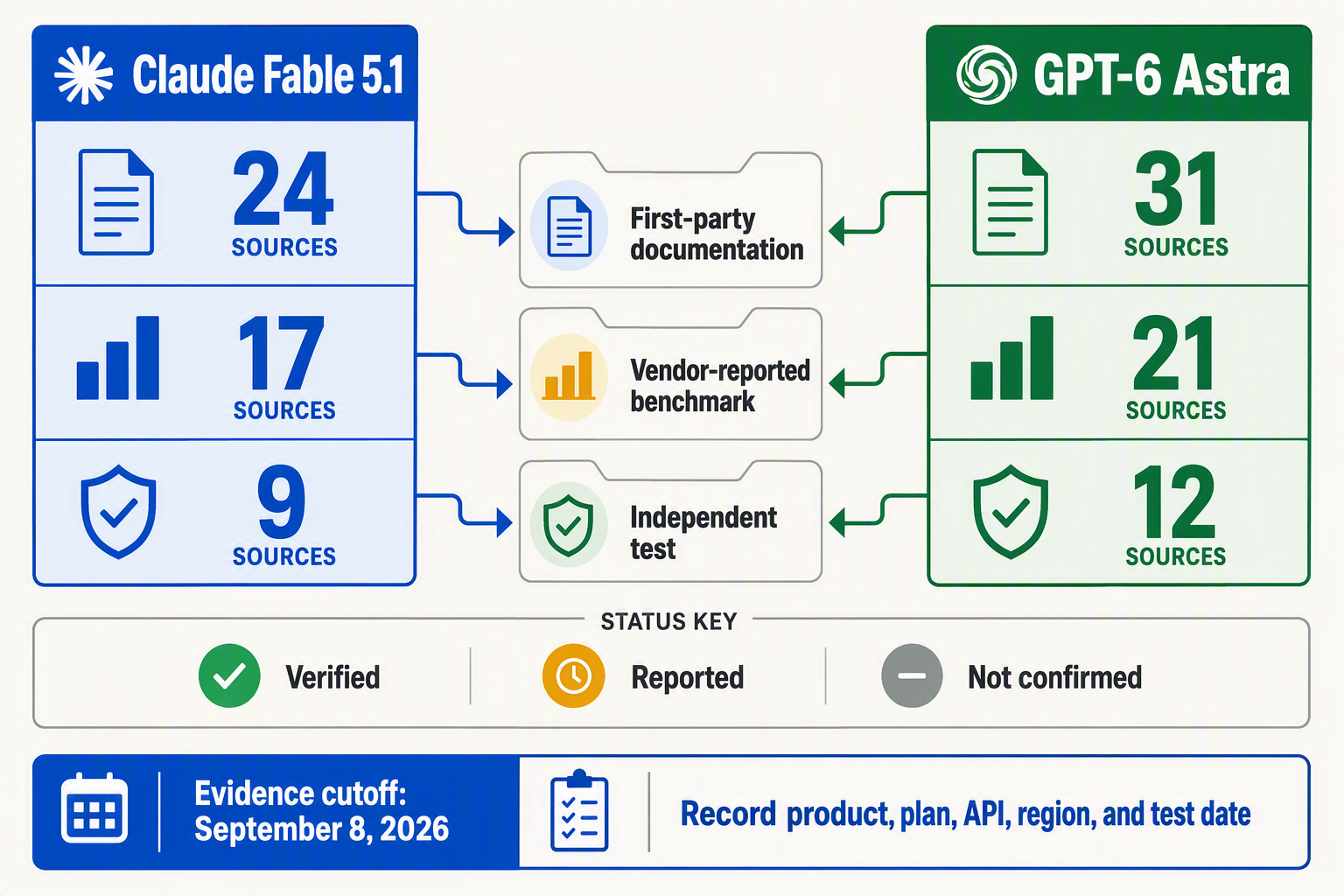
Claude Fable 5.1 is a documented Anthropic model released on September 1, 2026; GPT-6 Astra cannot be treated as a verified OpenAI product from the evidence supplied for this comparison. Until OpenAI publishes an official model card, API documentation, pricing page, or release announcement for GPT-6 Astra, its specifications must remain “not verified” rather than estimated.
Claude Fable 5.1: what the primary sources establish
Anthropic describes Claude Fable 5.1 as its “most capable model for coding and knowledge work,” with research capabilities that preview how AI could contribute to scientific progress. Anthropic’s announcement is dated September 1, 2026, providing a verifiable release date and first-party product description.
The currently supportable claims include:
- Paid-plan context: Anthropic’s Help Center states in September 2026 that Claude Fable 5.1 supports a 1-million-token context window on all paid Claude plans when chatting with Claude.
- Scale comparison: Anthropic stated that 100,000 tokens correspond to approximately 75,000 words when it introduced its 100K context window. That ratio provides useful perspective, although words, tokens, tables, formulas, images, and file-processing overhead are not interchangeable.
- Intended workload: Anthropic explicitly positions Claude Fable 5.1 for coding, knowledge work, and research.
- Data retention: Anthropic’s Claude Platform documentation designates Claude Fable 5.1 as a Covered Model requiring 30-day data retention, unless Anthropic expressly approves an exception.
- Conversation constraints: Anthropic’s prompting documentation says that modifying conversation content before a thinking block can produce an error or cause the block to be dropped, depending on implementation choices.
The 1-million-token figure applies specifically to paid Claude chat plans in the cited Help Center statement. It should not automatically be presented as the limit for every API tier, cloud deployment, tool configuration, or enterprise agreement without corresponding documentation.
GPT-6 Astra: what remains unverified
The supplied evidence contains no official OpenAI announcement or documentation naming GPT-6 Astra. Consequently, this comparison cannot responsibly assign it a context window, release date, knowledge cutoff, benchmark score, price, retention policy, or Microsoft Office integration.
Claims requiring primary-source confirmation include:
- The exact GPT-6 Astra model identifier and general-availability date.
- Its maximum input, output, and combined context limits.
- Support for native document, spreadsheet, presentation, image, and audio inputs.
- API pricing for cached input, uncached input, output, tools, and batch processing.
- Data-retention, training-use, residency, and zero-data-retention terms.
- Results on long-context retrieval and knowledge-work benchmarks.
This absence of evidence does not prove that GPT-6 Astra does not exist or lacks those capabilities. It means only that the provided research record cannot substantiate them as of September 8, 2026.
Verification standard for the comparison
Each later score should carry one of three labels:
- Verified specification: confirmed by current Anthropic or OpenAI documentation.
- Observed workflow result: measured through a reproducible task using disclosed files and settings.
- Unverified claim: reported without sufficient first-party evidence.
Accordingly, Claude Fable 5.1 enters the evaluation with a verified paid-chat context limit and documented retention requirement. GPT-6 Astra must remain specification-pending, and any workflow testing should record the exact endpoint and model identifier rather than relying on its marketing name.
What changed in 2026, and how do context, citations, tools, caching, privacy, pricing, and availability compare?
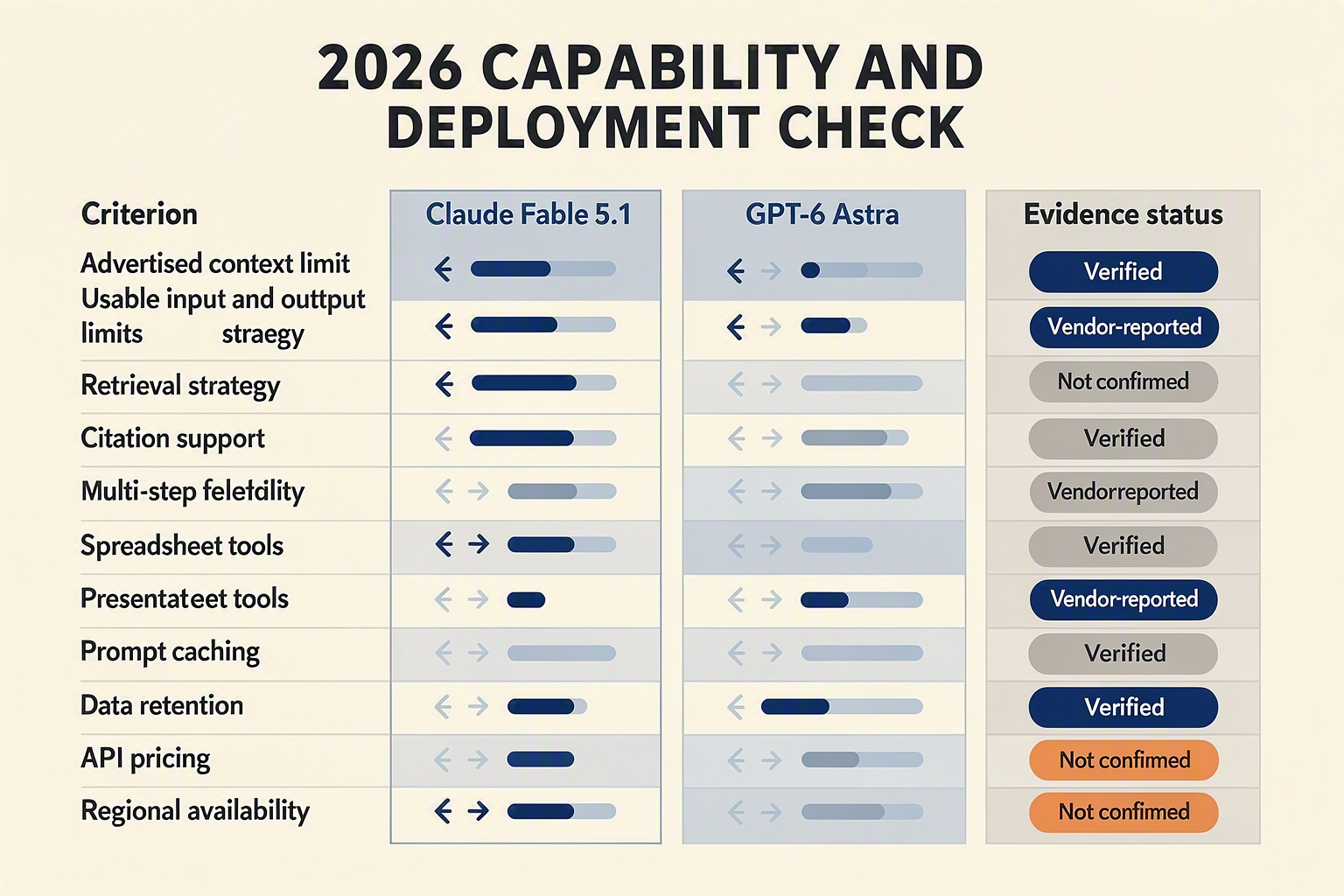
The verified 2026 evidence is asymmetric: Claude Fable 5.1 has published Anthropic specifications, while the supplied research contains no current OpenAI primary-source documentation confirming GPT-6 Astra’s limits, pricing, privacy terms, or availability. GPT-6 Astra should therefore be marked unverified, not assigned specifications inferred from its name or third-party claims.
Published specifications and evidence gaps
| Dimension | Claude Fable 5.1 | GPT-6 Astra | Practical interpretation |
|---|---|---|---|
| 2026 release status | Anthropic announced Fable 5.1 on September 1, 2026, calling it its “most capable model for coding and knowledge work.” | No verified OpenAI announcement appears in the supplied research. | Claude can be evaluated as a released product; Astra requires primary-source confirmation. |
| Context and retrieval | Anthropic’s Help Center specifies 1 million tokens on paid Claude plans. No supplied source guarantees accurate retrieval across the entire window. | Context limit and long-context retrieval results are unverified. | Capacity is not recall: test buried facts, conflicting figures, tables, and cross-file references. |
| Citations | No supplied Anthropic source promises that every generated citation is complete or correctly grounded. | Citation functionality and accuracy are unverified. | Both workflows need page-level or cell-level citation audits before professional use. |
| Tools and caching | Claude Platform documentation lists compaction, context editing, prompt caching, token counting, mid-conversation tool changes, orchestration mode, and beta cache diagnostics. | Tool interfaces, caching behaviour, and document integrations are unverified. | Claude offers documented context-management controls, but model-specific tool compatibility still needs testing. |
| Privacy and conversation controls | Anthropic designates Fable 5.1 a Covered Model requiring 30-day retention, unless an exception is expressly approved. New API accounts also cannot rewrite prior context while preserving earlier thinking transcripts. | Retention, training-use, regional-processing, and zero-retention terms are unverified. | Claude’s terms are explicit but may exclude sensitive workloads that require zero data retention. |
| Pricing and availability | Exact prices are not present in the supplied sources. Anthropic confirms the 1-million-token window for paid Claude plans; Anthropic has also reported a US directive suspending foreign-national access to Fable 5 and Mythos 5. | Prices, subscription tiers, API regions, quotas, and release access are unverified. | Procurement decisions must account for token cost, geographic eligibility, rate limits, and policy stability. |
Why these differences matter in real workflows
Prompt caching can materially change the economics of repeatedly querying the same research corpus, but a cache feature does not automatically reduce the cost of tool calls, generated output, or newly added documents. Teams should calculate the effective cost of an entire workflow rather than compare headline input-token prices alone.
Claude Fable 5.1 also introduces stricter transcript integrity. Anthropic’s prompting documentation says that editing content before a thinking block can produce an error or cause the block to be dropped, because changing earlier messages invalidates later thinking blocks. That strengthens provenance but may complicate applications that routinely summarise, rewrite, or prune conversation history.
A defensible 2026 procurement test should therefore:
- Verify current vendor documentation for every limit, price, region, and retention term.
- Measure effective retrieval, including evidence hidden near the middle of large corpora.
- Audit outputs at source level, checking quotations, page references, formulas, and slide claims.
Until OpenAI publishes verifiable GPT-6 Astra documentation, any numeric head-to-head score would create false precision. The evidence supports a detailed Claude assessment and a clearly labelled “not yet verifiable” status for Astra.
How should an identical long-context benchmark and practical test corpus be designed?
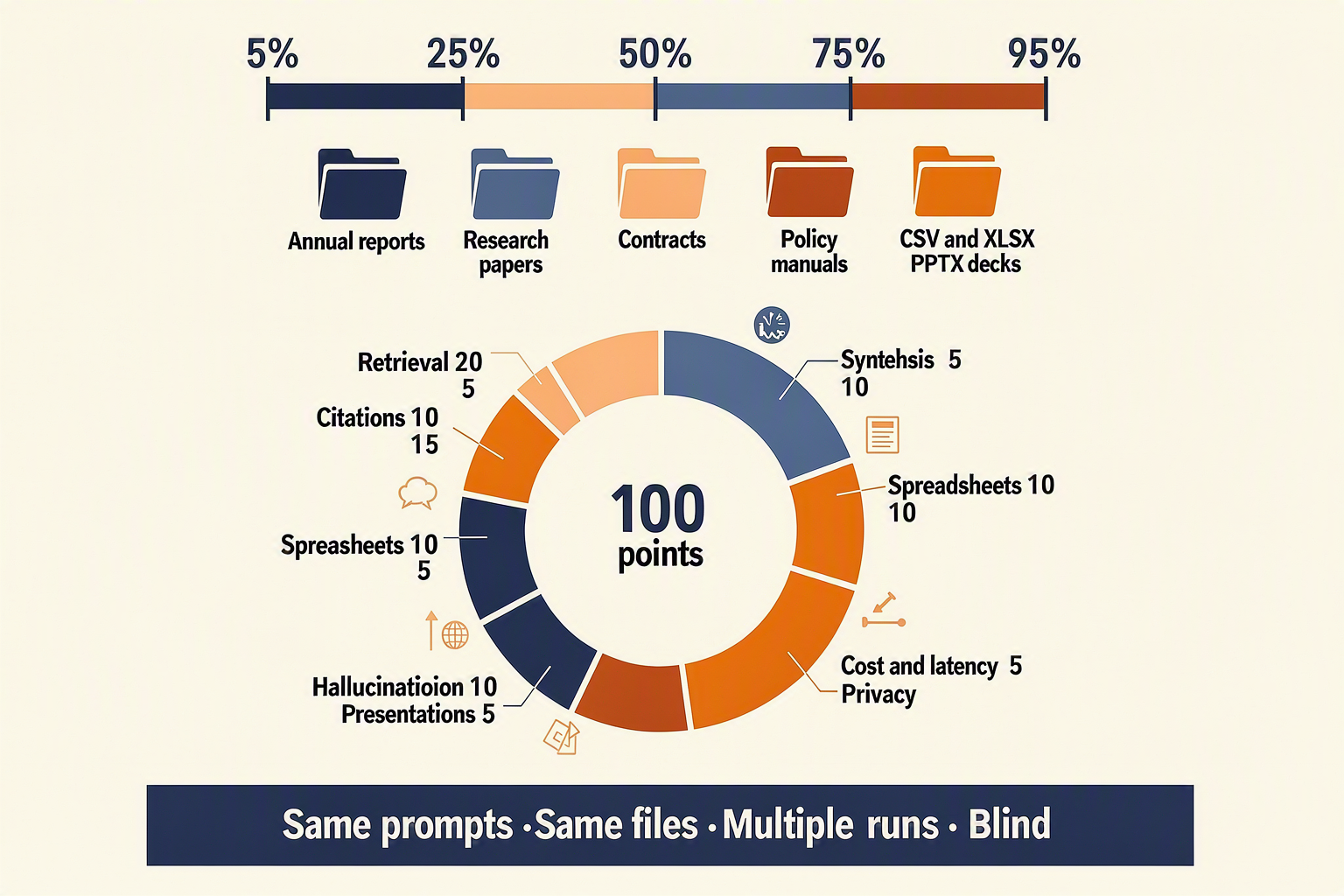
An identical benchmark should use the same source corpus, prompts, tool permissions, output templates, and scoring rules for both models, while separating retrieval accuracy from final-work-product quality. It must also test evidence at multiple positions and corpus sizes rather than treating successful file upload as proof of long-context performance.
Build a controlled, contamination-resistant corpus
Create a private synthetic-plus-authentic corpus containing documents, spreadsheets, presentations, emails, and transcripts. Synthetic facts reduce the chance that either model has memorised answers during training, while realistic public documents preserve workplace complexity.
The corpus should include:
- 40–60 documents: contracts, policies, research reports, meeting minutes, and conflicting revisions
- 8–12 spreadsheets: formulas, hidden sheets, duplicate labels, missing values, date inconsistencies, and unit changes
- 6–10 presentations: charts, speaker notes, source footers, and claims that must be updated
- 100–200 planted facts: each tagged with its file, page, cell, slide, and evidence type
- 20–30 deliberate contradictions: such as revenue reported in rupees in one file and dollars in another
Test at fixed input tiers—for example 32,000, 128,000, 256,000, 512,000, and 1 million tokens—but run a tier only when both products officially support it. Anthropic’s Help Center states that Claude Fable 5.1 supports 1 million tokens on paid Claude plans as of September 2026; GPT-6 Astra’s eligible tiers must be taken from contemporaneous OpenAI documentation, not inferred.
Measure retrieval before synthesis
A long-context test should first ask narrow questions with objectively verifiable answers. Place matched evidence near the beginning, middle, and end of each corpus to expose positional degradation.
Score every response on:
- Exact retrieval accuracy: Was the correct fact found?
- Citation precision: Did the cited page, slide, table, or cell contain the claim?
- Citation recall: What percentage of required claims received valid support?
- Contradiction handling: Did the model identify disagreement instead of silently choosing one value?
- Abstention quality: Did it say “not found” when the corpus contained no answer?
Include “needle” tasks with similar decoys—for example, FY2025 operating margin versus FY2026 adjusted operating margin—rather than easily searchable unique phrases.
Test complete workplace deliverables
Both models should then produce the same practical outputs:
- A 1,500-word research memo with claim-level citations
- A revised policy document preserving defined terms and tracked requirements
- A spreadsheet analysis that identifies anomalies and supplies auditable formulas
- A 10-slide executive presentation whose charts reconcile with the workbook
- A cross-format update in which one changed assumption propagates through the memo, workbook, and deck
Human reviewers should score factuality, instruction compliance, formula correctness, formatting preservation, citation validity, and edit effort. Automated checks can verify planted facts, numeric reconciliation, formula strings, and broken references.
Control the execution environment
Run at least five trials per task with fixed temperature, seed where supported, system prompt, timeout, and tool access. Record model version, API date, latency, input/output tokens, retries, and total cost.
Conversation handling must also be standardised. Anthropic’s Prompting Best Practices documentation states that, for Claude Fable 5.1, editing earlier conversation content can invalidate later thinking blocks; therefore, each scored trial should begin from a clean session rather than a reconstructed transcript. Report confidence intervals and failure distributions—not just average scores—because dependable knowledge work depends on repeatability as well as peak performance.
Which model retrieves buried evidence, preserves citations, and completes multi-step research more reliably?
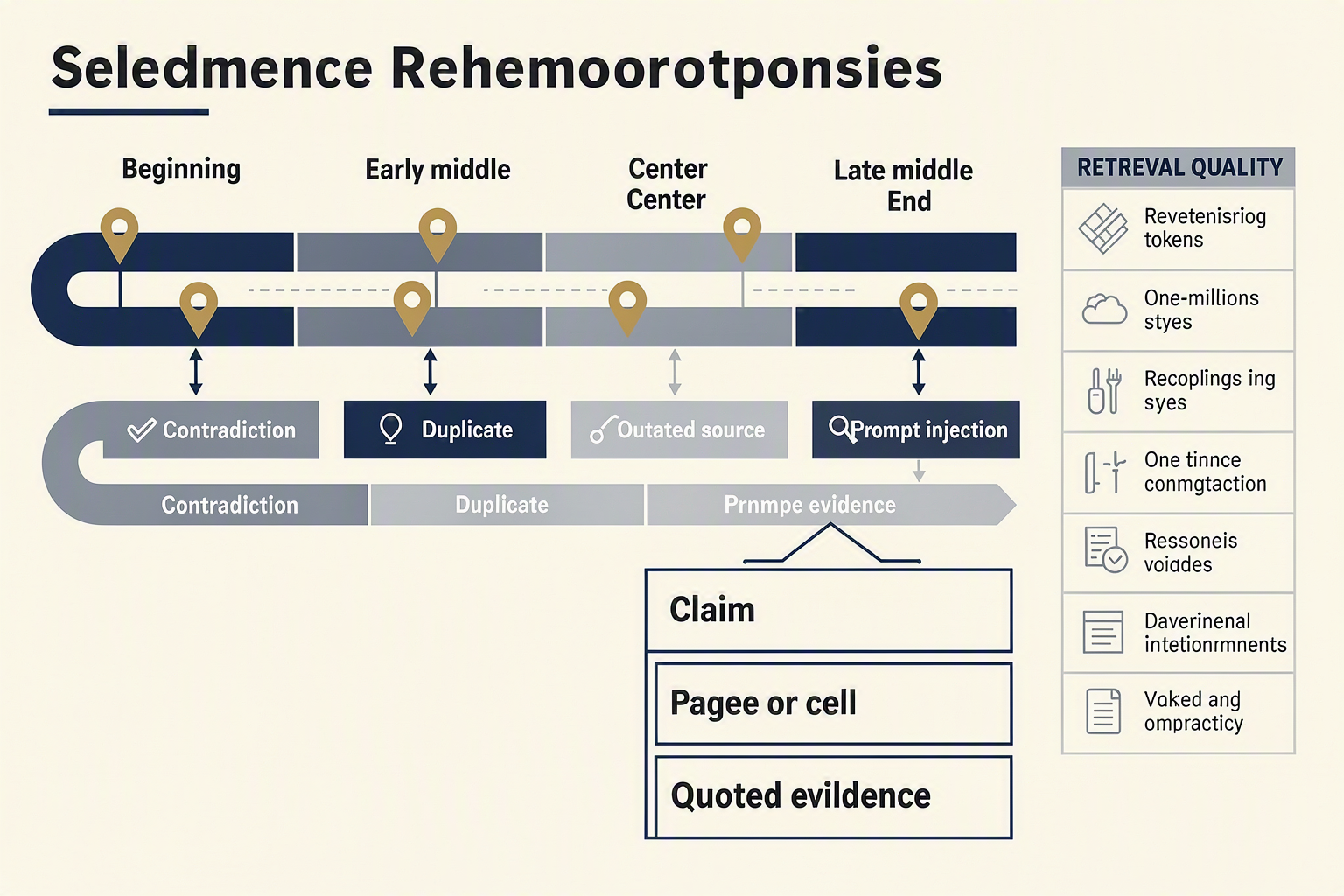
No defensible winner can be declared from the available evidence. Anthropic documents Claude Fable 5.1’s large-context and research capabilities, but provides no independent buried-evidence or citation-fidelity benchmark here; the supplied research contains no current OpenAI documentation or comparable results for GPT-6 Astra.
Claude Fable 5.1: strong capacity, unproven retrieval fidelity
Anthropic announced Claude Fable 5.1 on September 1, 2026, calling it its “most capable model for coding and knowledge work” and highlighting research capabilities that could contribute to scientific progress. That establishes intended use, not measured reliability.
Anthropic’s Claude Help Center confirms that Claude Fable 5.1 supports a 1-million-token context window on paid Claude plans as of September 2026. However, accepting one million tokens does not demonstrate that the model can consistently recover a qualifying sentence on page 430, distinguish similarly named metrics, or attach the correct citation after several synthesis steps.
A proper evaluation should therefore test three separate capabilities:
- Evidence retrieval: Can the model locate facts placed near the beginning, middle, and end of a corpus?
- Evidence attribution: Does every quotation, number, and conclusion point to the correct file, page, sheet, or cell?
- Research completion: Can the model plan searches, resolve conflicts, use tools, and deliver the requested output without silently skipping steps?
Claude Fable 5.1 deserves credit for documented context capacity, but context size is an input specification—not a retrieval benchmark.
Citation preservation needs claim-level testing
Citation quality should be measured at the claim level, not by checking whether an answer contains references. A polished report can cite real sources while assigning the wrong source to a figure or combining two findings into an unsupported conclusion.
For each model, evaluators should report:
- Evidence recall: percentage of required facts successfully recovered
- Citation precision: percentage of citations that genuinely support the attached claim
- Locator accuracy: percentage with the correct page, section, worksheet, or cell
- Unsupported-claim rate: percentage of factual assertions lacking source support
- Conflict detection: percentage of deliberately inconsistent sources identified and explained
Neither Anthropic’s marketing statement nor a nominal token limit supplies these measurements. Equivalent GPT-6 Astra results must come from reproducible testing or dated OpenAI documentation, neither of which appears in the provided source set.
Multi-step research introduces conversation-state risk
Long research workflows depend on stable intermediate state. Anthropic’s Prompting Best Practices documentation warns that, with Claude Fable 5.1, editing earlier messages, rebuilding system instructions or tools, or summarising older turns in place can invalidate later thinking blocks; the request may produce an error or drop the affected block when that option is enabled.
That constraint matters when analysts revise assumptions halfway through a project. A robust Claude workflow should:
- Preserve the original transcript rather than rewriting previous turns.
- Store extracted evidence in a structured ledger outside hidden reasoning.
- Require source locators for every material claim.
- Re-run affected steps when instructions, tools, or source documents change.
- Validate the final report against the ledger programmatically.
Practical verdict
Claude Fable 5.1 has the stronger documented long-context case in the available evidence, but not a proven reliability victory. GPT-6 Astra should be labelled “insufficient verified evidence” until OpenAI publishes current specifications and both models undergo the same buried-evidence, citation-precision, and multi-step completion tests. Any stronger conclusion would confuse advertised capacity with demonstrated research accuracy.
Which model is better for documents, spreadsheets, presentations, and research workflows?
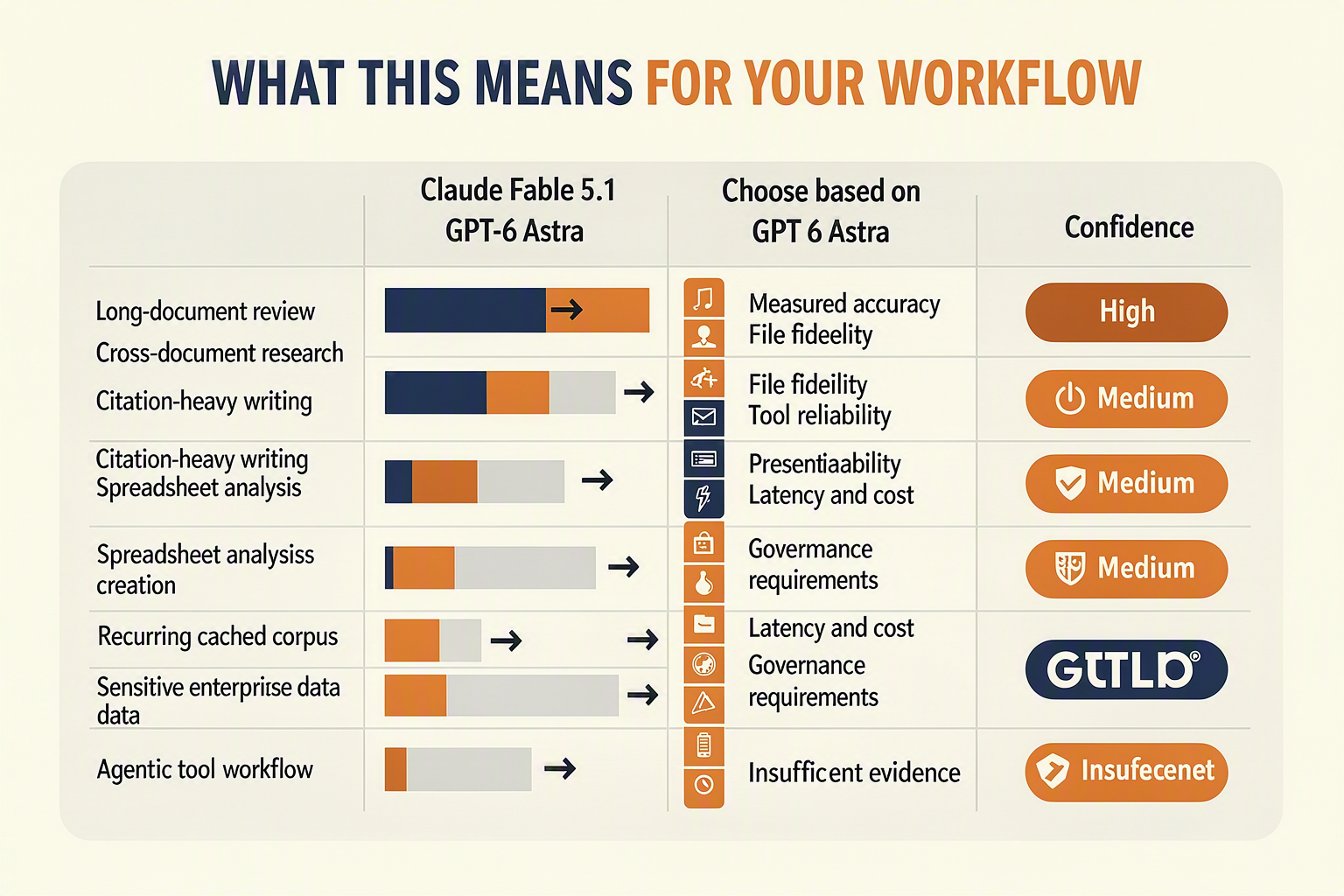
Claude Fable 5.1 is the better-documented choice for large, text-heavy research and document synthesis, but neither model can be declared the overall workflow winner from the available evidence. GPT-6 Astra remains unscorable until current OpenAI documentation verifies its context window, file support, benchmark results, pricing, and application integrations.
Workflow-by-workflow comparison
| Workflow | Claude Fable 5.1 | GPT-6 Astra | Evidence-based verdict |
|---|---|---|---|
| Long-document review | Accepts up to 1 million tokens on paid Claude plans, according to Anthropic’s Help Center in September 2026. | No verified specification was supplied. | Fable 5.1 leads on documented capacity, not proven retrieval accuracy. |
| Research synthesis | Anthropic positions Fable 5.1 as its “most capable model for coding and knowledge work,” with research capabilities relevant to scientific work. | No attributable research benchmark or citation-reliability result was supplied. | Fable is the better-supported candidate, but both require source-level evaluation. |
| Document drafting and revision | Large context should help retain briefs, source packs, examples, and style instructions in one session. | Document limits and supported formats are unverified. | Test factual consistency, tracked requirements, headings, tables, and footnotes—not prose quality alone. |
| Spreadsheet analysis | The available Anthropic sources do not establish native Excel formula preservation, workbook editing, or recalculation accuracy. | Equivalent spreadsheet evidence was not supplied. | No defensible winner; validate formulas and outputs inside the spreadsheet application. |
| Presentation production | Fable can potentially generate outlines, speaker notes, and evidence-backed slide narratives from a large corpus. Native PowerPoint fidelity is not established here. | Slide-generation and PowerPoint-editing capabilities are unverified. | Judge exported-deck quality, citations, chart accuracy, and layout retention separately. |
| Iterative multi-file workflows | Anthropic documents context management, compaction, prompt caching, token counting, and tool orchestration, but conversation edits can affect thinking blocks. | Comparable controls are not documented in the supplied evidence. | Fable offers more visible implementation guidance; production testing remains necessary. |
What the specifications do—and do not—prove
Anthropic stated in 2023 that 100,000 tokens correspond to roughly 75,000 words, implying that one million tokens represents approximately 750,000 words under similar assumptions. That estimate describes input capacity, however, not whether Claude Fable 5.1 can consistently recover a number from page 417, distinguish revised and superseded files, or attach the correct source to every slide.
The practical choice should therefore follow the file type:
- Choose Claude Fable 5.1 for a pilot when the workload is dominated by lengthy reports, contracts, transcripts, or research papers.
- Treat spreadsheet work as tool-dependent: require cell references, formula audits, recalculation, and reconciliation against known totals.
- Treat presentation work as a two-stage process: first verify the research and narrative, then inspect visual hierarchy, chart labels, citations, and exported formatting.
- Do not select GPT-6 Astra based on its name or third-party claims; wait for attributable OpenAI specifications and reproducible workflow tests.
A fair production test
Use identical source files and score both models on fact retrieval, citation correctness, numerical accuracy, instruction retention, formatting fidelity, latency, and human correction time. Anthropic’s prompting documentation also warns that modifying conversation content before a thinking block can produce an error or cause that block to be dropped, so evaluators should test revision-heavy workflows rather than relying on a single-pass demonstration.
The defensible conclusion is narrow: Fable 5.1 currently has the stronger documented case for long-form document and research workflows; spreadsheets, presentations, and the comparison with GPT-6 Astra remain unresolved without verified, task-level evidence.
How do tool use, prompt caching, privacy, retention, cost, and deployment constraints affect the decision?

The decision depends less on headline intelligence than on whether each model fits the organisation’s toolchain, security policy, budget model, and deployment geography. Claude Fable 5.1 has documented operational constraints; GPT-6 Astra should remain unscored wherever current OpenAI documentation does not verify an equivalent feature, price, or policy.
Tool use and workflow control
For research and office workflows, tool use determines whether a model can move beyond prose generation to retrieve files, execute calculations, query systems, and validate outputs. Anthropic’s Claude Platform documentation explicitly lists tool changes, orchestration mode, context editing, compaction, token counting, and mid-conversation system messages among Claude’s supported workflow controls.
Teams should test both models with the actual tools they intend to deploy:
- Retrieve evidence from a governed document store.
- Run spreadsheet calculations through a sandboxed code tool.
- preserve formulas and cell references when writing results back.
- Generate slides without silently changing approved figures.
- Log every search, tool call, citation, and human approval.
A model that writes polished answers but calls the wrong tool—or passes excessive data to it—creates operational risk regardless of context-window size.
Prompt caching and long-running sessions
Prompt caching can materially reduce repeated-input cost and latency when the same policies, document corpus, schemas, or instructions appear across requests. Anthropic documents prompt caching and cache diagnostics for Claude, but application design affects whether cached content remains valid.
Claude Fable 5.1 also imposes an important conversation constraint. Anthropic’s prompting guidance states that modifying content before a thinking block can produce an error or cause that block to be dropped; editing earlier messages, rebuilding tools or system instructions, or summarising older turns in place invalidates subsequent thinking blocks. Consequently, teams should use immutable conversation records, versioned prompts, and explicit session branching rather than silently rewriting history.
Privacy, retention, and security review
The previously noted 30-day retention requirement for Claude Fable 5.1 Covered Model traffic means some workloads may require redaction, tokenisation, regional preprocessing, or another approved model. Anthropic’s Platform documentation says zero-data-retention status is unavailable for Claude Fable 5.1 unless an exception is expressly approved.
Before choosing either platform, procurement teams should obtain current contractual answers covering:
- Training use and abuse-monitoring access
- Retention periods for prompts, outputs, files, and tool logs
- Data residency and subprocessors
- Encryption and customer-managed keys
- Deletion, legal-hold, and incident-response procedures
GPT-6 Astra’s treatment should be marked “not verified” until OpenAI’s current product documentation and contract identify these controls specifically for that model.
Cost and deployment constraints
A defensible cost comparison must include input tokens, output tokens, cached tokens, tool charges, retrieval storage, retries, and human review. Without current first-party GPT-6 Astra pricing—and corresponding Claude Fable 5.1 API rates—publishing a per-million-token winner would be speculative.
Deployment availability may be decisive. Anthropic reported a US government directive suspending access to Fable 5 and Mythos 5 for foreign nationals, citing national-security authorities; enterprises must confirm whether that directive applies to Fable 5.1, their users, cloud region, and deployment route. The practical winner is therefore the model that passes legal review, supports required tools, and delivers the lowest verified cost per accepted output, not merely the lowest advertised token price.
What do experts and vendor-reported benchmarks say, and how much weight should buyers give them?
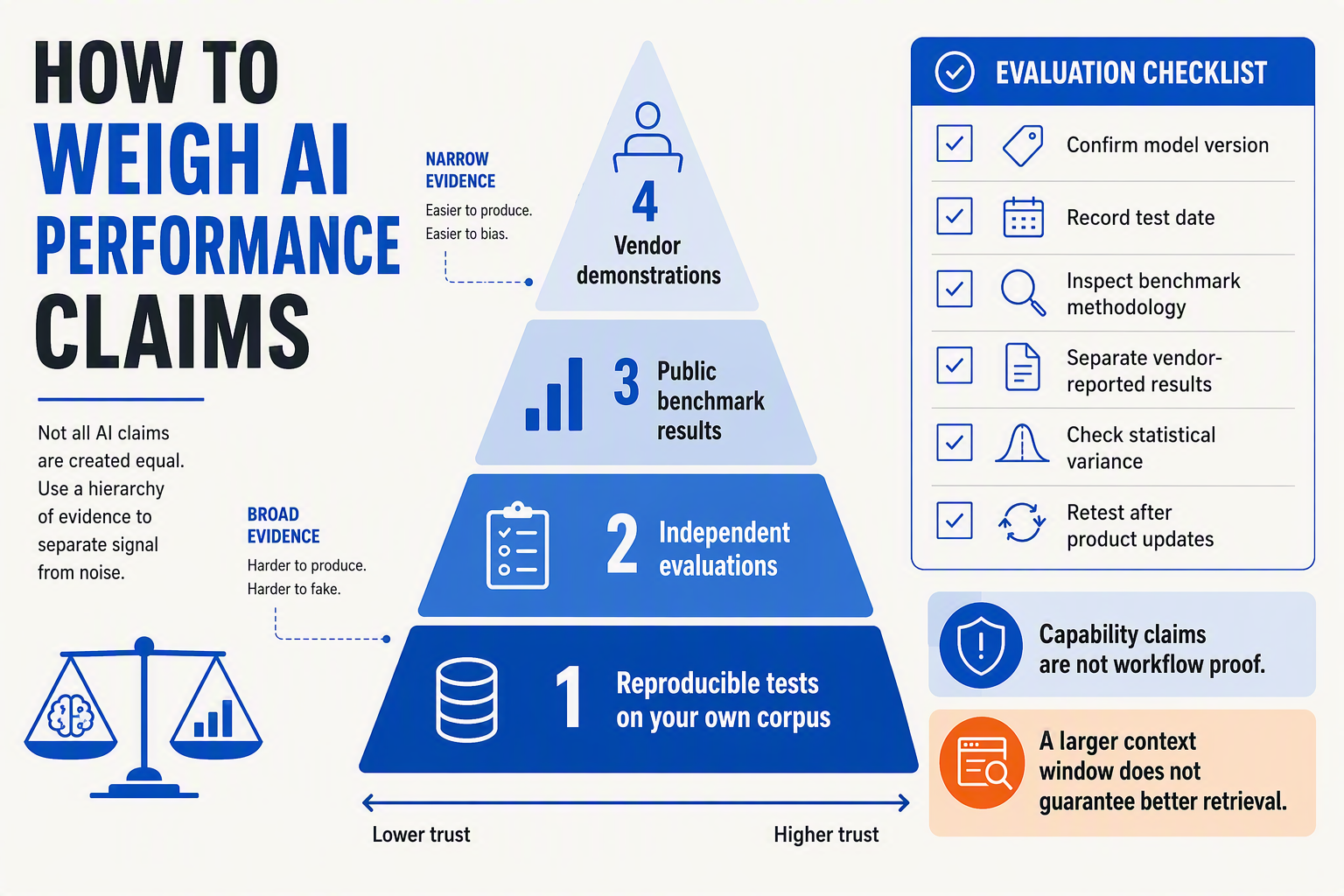
The available evidence does not support declaring either Claude Fable 5.1 or GPT-6 Astra the overall winner. Anthropic’s materials verify product capabilities but provide vendor-authored claims, while the supplied research contains no independent expert evaluation or current OpenAI documentation establishing GPT-6 Astra’s specifications or benchmark scores.
What Anthropic’s evidence establishes
Anthropic announced Claude Fable 5.1 on September 1, 2026, calling it its “most capable model for coding and knowledge work” and highlighting research capabilities that may contribute to scientific progress. That statement indicates intended positioning, not independently measured superiority.
Several Anthropic disclosures are nevertheless decision-relevant:
- Anthropic’s Help Center reported in September 2026 that Claude Fable 5.1 supports a 1-million-token context window on paid Claude plans.
- Anthropic’s earlier context-window guidance equated 100,000 tokens with approximately 75,000 words, although this conversion varies with language, formatting, tables, and code.
- Anthropic’s Platform documentation identifies Claude Fable 5.1 as a Covered Model subject to 30-day data retention unless an exception is expressly approved.
- Anthropic’s Claude documentation advises users who are unsure which model to select to begin with Claude Opus 5 for most workloads, suggesting that Fable 5.1 is not automatically Anthropic’s default choice for every task.
- Anthropic’s September 2026 launch documentation says Fable 5.1 strengthened protections against model-distillation attacks, including restrictions affecting how new API accounts can edit prior conversation context while preserving earlier thinking transcripts.
These facts cover capacity, product positioning, governance, and security. They do not reveal how reliably Fable retrieves evidence from the middle of a million-token prompt or preserves formulas across a complex workbook.
What can responsibly be said about GPT-6 Astra
The provided evidence contains no current OpenAI model card, system card, pricing page, context specification, or benchmark report for GPT-6 Astra. Consequently, any exact Astra score, context limit, latency figure, or superiority claim should be marked unverified, even if it appears in model aggregators, screenshots, or unsourced comparison pages.
The same standard applies to expert commentary. No independent laboratory, academic paper, or named analyst assessment in the supplied sources reports a controlled Fable 5.1–Astra comparison. The absence of third-party evidence is itself important: buyers should avoid converting launch-week commentary into procurement-grade proof.
How much weight should benchmarks receive?
A sensible evaluation assigns benchmark evidence progressively more weight:
- Vendor-reported benchmark: low-to-moderate weight. Check dataset version, prompting method, tool access, sampling count, scoring rubric, and whether the competing model was configured comparably.
- Reproducible third-party test: moderate-to-high weight. Prefer disclosed prompts, source files, model versions, temperatures, costs, and error classifications.
- Your organisation’s workflow trial: highest weight. Test representative contracts, research corpora, spreadsheets, and presentations under actual security and latency constraints.
For long-context knowledge work, buyers should measure citation precision, unsupported-claim rate, retrieval by document position, formula preservation, instruction compliance, correction time, latency, and total cost per accepted output. A benchmark lead matters only when it predicts these operational outcomes; nominal context size and vendor-selected headline scores cannot substitute for that evidence.
Frequently asked questions about 1M context, Fable 5 vs 5.1, pricing, privacy, citations, and alternatives
Does a 1-million-token context window make Claude Fable 5.1 better than GPT-6 Astra for long documents?
What changed between Claude Fable 5 and Claude Fable 5.1?
How should teams compare Claude Fable 5.1 vs GPT-6 Astra for research?
Which model is better for drafting and reviewing business documents?
How should Claude Fable 5.1 vs GPT-6 Astra be tested on spreadsheets?
What should teams test when generating presentations?
Can Claude Fable 5.1 and GPT-6 Astra generate reliable citations?
Is Claude Fable 5.1 vs GPT-6 Astra private enough for confidential information?
How does Claude Fable 5.1 vs GPT-6 Astra pricing compare?
What are the best alternatives to choosing only Claude Fable 5.1 or GPT-6 Astra?
Conclusion
The Claude Fable 5.1 vs GPT-6 Astra decision should rest on verified workflow performance—not model names, headline benchmarks, or maximum context alone. A million-token window can reduce corpus splitting, but dependable knowledge work still requires accurate retrieval, traceable citations, formula integrity, strong instruction retention, and manageable governance.
- Context capacity is not effective context. Anthropic’s Help Center states that Claude Fable 5.1 supports 1 million tokens on paid Claude plans as of September 2026, but teams must test whether evidence remains discoverable across long, heterogeneous files.
- Evaluate complete deliverables. Research summaries, Word documents, Excel workbooks, and PowerPoint presentations should be scored for factual accuracy, citation coverage, formatting, formula preservation, and correction effort—not fluency alone.
- Verify GPT-6 Astra claims. Context limits, pricing, latency, and benchmark results should come from current OpenAI documentation; unsupported comparisons are not a sound procurement basis.
- Governance can change the outcome. Anthropic’s Platform documentation identifies Claude Fable 5.1 as a Covered Model requiring 30-day data retention unless an exception is approved, which may affect regulated workflows.
What matters next is evidence-grounded retrieval, native office-file handling, transparent costs, and stronger privacy controls. Teams can also explore CallMissed, an OpenAI-compatible multi-model gateway, to test evolving AI capabilities through one integration. Which model produces the most defensible final deliverable with the fewest human corrections in your own workflow?
Related Reading
- Claude Fable 5.1 vs GPT-6 Astra: 2026 API Migration and Routing Guide
- Best LLM for Voice Agents in 2026: GPT-6 Astra vs Claude Fable 5.1
- GPT-6 Astra vs Claude Fable 5.1: Verified 2026 Comparison