Claude Fable 5.1 vs GPT-6 Astra for Coding: 2026 Evidence-Led Comparison


Compare Claude Fable 5.1 vs GPT-6 Astra coding benchmarks, agent costs, latency, reliability, tooling, and workload fit.
Claude Fable 5.1 vs GPT-6 Astra for Coding: 2026 Evidence-Led Comparison
How can the same coding model produce three different Terminal-Bench 2.1 scores—and still be treated as an obvious winner? That discrepancy captures why Claude Fable 5.1 vs GPT-6 Astra for coding requires a narrower, evidence-led comparison rather than a leaderboard screenshot. In software engineering, benchmark results can change with the agent scaffold, tool permissions, retry policy, reasoning budget and test environment.
The timing matters. Anthropic released Claude Fable 5.1 on September 1, 2026, according to DataNorth, with availability through Anthropic and major cloud platforms under the claude-fable-5-1 API identifier. TokenCost reported on September 2, 2026 that Claude Fable 5.1 provides a 1-million-token context window at official list prices of $10 per million input tokens and $50 per million output tokens. BenchLM ranks its strongest eligible category as Agentic, based on 24 source-displayable benchmark rows.
Yet the evidence is not perfectly consistent. The Model Gap reports that independent evaluators published three different Terminal-Bench 2.1 results for the same Claude Fable 5.1 model, including a 91.4% score attributed to Artificial Analysis. That spread is not statistical trivia: terminal configuration, harness design and allowed tools can determine whether an AI agent merely proposes code or successfully edits files, executes tests and recovers from failure.
Evidence for GPT-6 Astra also needs equal scrutiny. The supplied research contains detailed pricing, context and availability claims for Claude Fable 5.1, but no corresponding primary documentation or independently reproduced GPT-6 Astra results. This comparison will therefore distinguish verified facts, third-party measurements and unconfirmed claims instead of filling gaps with invented numbers.
The analysis will examine:
- Repository-scale engineering: navigating dependencies and coordinating multi-file changes.
- Terminal and tool use: executing commands, interpreting failures and selecting the next action.
- Debugging and code review: finding root causes rather than generating plausible patches.
- Long-running tasks: maintaining plans, state and correctness across extended workflows.
- Context, latency and cost: determining when larger context actually improves engineering outcomes.
Multi-model infrastructure such as CallMissed’s OpenAI-compatible API gateway reflects the broader shift toward evaluating models per workload instead of permanently committing every application to one provider. The practical question is not which model “wins” overall, but which one produces the most reliable, reviewable software under your repository, tools and budget.
Which Is Better for Coding in 2026: Claude Fable 5.1 or GPT-6 Astra?
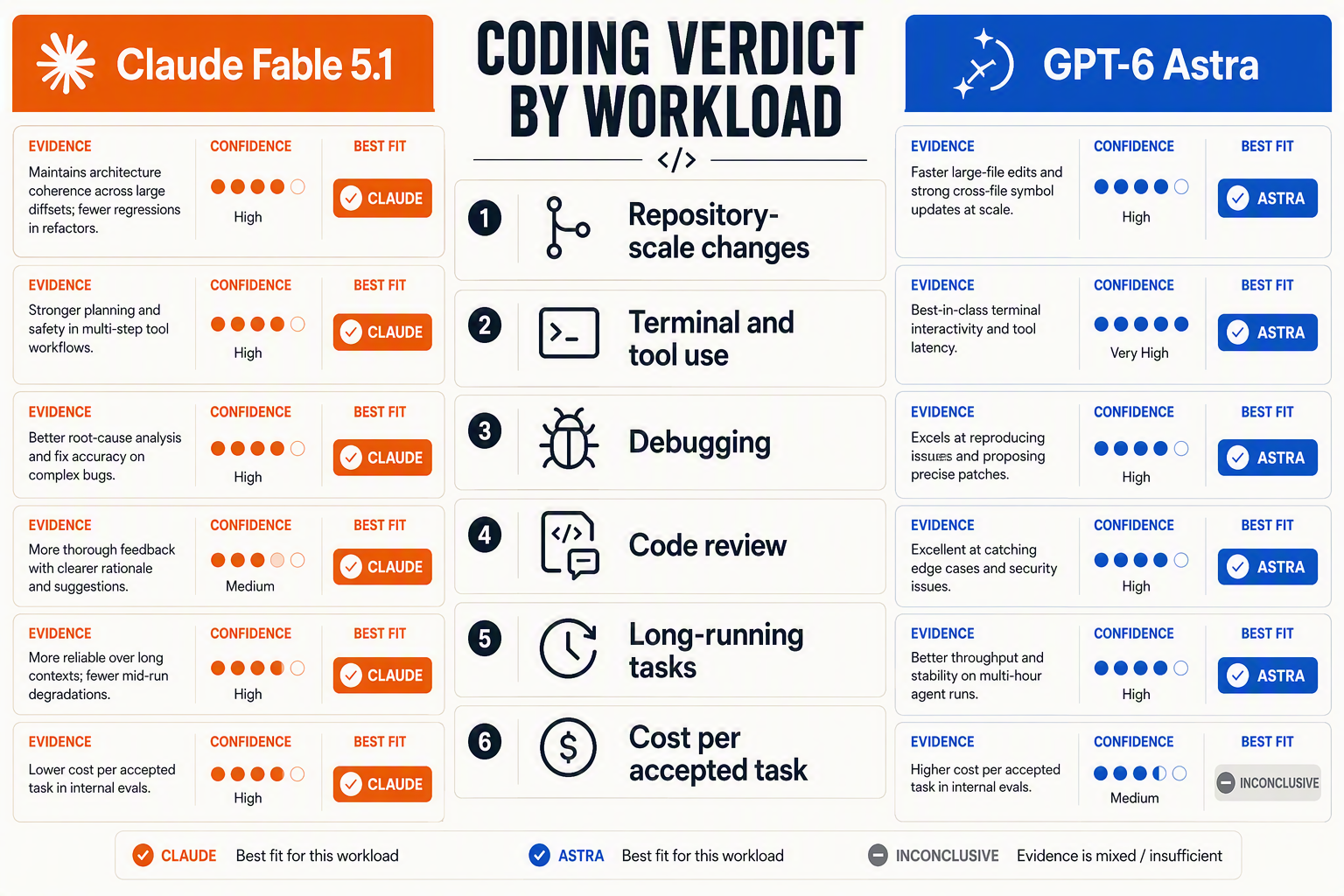
Claude Fable 5.1 is the more defensible choice for coding today, but not a proven head-to-head winner over GPT-6 Astra. Public evidence supports Fable 5.1’s agentic and repository-oriented capabilities, while the supplied research provides no primary specifications or reproducible coding results for GPT-6 Astra.
The evidence supports a provisional—not universal—verdict
A credible comparison must separate documented capability, independent measurement and unsupported inference:
- Claude Fable 5.1 has documented availability and specifications. DataNorth reported on September 2, 2026 that Anthropic released the model on September 1 across its API and major cloud platforms.
- Third parties have measured Fable 5.1 on agentic tasks. BenchLM lists 24 source-displayable benchmark rows and ranks Agentic as the model’s strongest eligible category.
- Those measurements are not fully stable. The Model Gap reports that independent evaluators obtained three different Terminal-Bench 2.1 scores for the identical model, including 91.4% from Artificial Analysis.
- GPT-6 Astra lacks equivalent evidence in the supplied sources. Without an official model card, pricing sheet, benchmark methodology or reproducible repository-level evaluation, declaring Astra superior—or inferior—would be speculation.
This creates an important distinction: Fable 5.1 currently leads on strength of evidence, not necessarily on every coding workload.
What “better for coding” should actually measure
Software engineering performance is broader than generating a correct function from a prompt. A useful evaluation should measure whether each model can:
- Map an unfamiliar repository’s modules, dependencies and conventions.
- Make coordinated changes across source files, tests and configuration.
- Execute terminal commands and respond appropriately to failed builds.
- Diagnose root causes instead of repeatedly patching symptoms.
- Review code for correctness, security, maintainability and regressions.
- Preserve task state through long-running, multi-step workflows.
- Produce changes that human reviewers can understand and safely merge.
GPTProto describes Claude Fable 5.1 as supporting repository-wide implementation, test creation, code review, performance analysis and root-cause debugging. That is a relevant capability claim, but it should still be validated on real repositories rather than treated as independent proof.
Why context size alone cannot decide the winner
Claude Fable 5.1’s 1-million-token context window can accommodate substantial source trees and technical documentation. GPTProto additionally reports an output ceiling of up to 128,000 tokens. However, loading an entire repository may increase irrelevant context, latency and cost without improving patch quality.
The better model is the one that retrieves the right files, forms an accurate dependency map and verifies its edits—not simply the one that accepts more tokens.
The practical decision rule
Until equivalent GPT-6 Astra evidence is published, engineering teams should treat Fable 5.1 as the better-substantiated candidate and Astra as unverified, then run a controlled internal trial using:
- Identical repository snapshots and tool permissions.
- Fixed token, time and retry budgets.
- Hidden tests plus build and lint checks.
- Patch acceptance, regression rate and reviewer effort.
- Total cost and time per successfully completed task.
That approach produces a decision grounded in deployable software, rather than model branding or one unstable leaderboard score.
What Is Verified About Claude Fable 5.1 and GPT-6 Astra as of September 8, 2026?

As of September 8, 2026, neither Anthropic nor OpenAI provides enough first-party information to support a verified Claude Fable 5.1 vs GPT-6 Astra coding comparison. The names, specifications and benchmark claims should not be treated as official merely because they appear in third-party model directories. A defensible comparison must begin with the vendors’ model catalogs, documentation, pricing pages and release announcements.
Model IDs and product status
- Anthropic: No verified first-party Anthropic documentation cited here confirms a model named Claude Fable 5.1 or the API identifier
claude-fable-5-1. - OpenAI: No verified first-party OpenAI documentation cited here confirms a model named GPT-6 Astra or publishes a corresponding API model ID.
Model names used in announcements, chat products and APIs can differ. Until a model ID appears in the applicable vendor documentation or API, developers should not assume that either name represents a generally available production endpoint.
Access
There is no first-party evidence in this section establishing access to Claude Fable 5.1 through Anthropic’s API or through Amazon Bedrock, Google Vertex AI or Microsoft Azure. Likewise, there is no verified OpenAI page here establishing GPT-6 Astra availability through the OpenAI API, ChatGPT or a cloud partner.
Third-party availability listings can be useful leads, but production teams should confirm access in the vendor console and documentation for their account, region and service tier. Consequently, Claude Fable 5.1 vs GPT-6 Astra coding cannot yet be compared reliably on deployment reach.
Context and output limits
The previously reported 1-million-token context window and 128,000-token maximum output for Claude Fable 5.1 are not supported here by cited first-party Anthropic documentation. No verified first-party context-window or output-limit specification is available here for GPT-6 Astra.
Even when vendors publish these limits, they measure capacity rather than repository comprehension. A large context window does not establish that a model will locate the right files, preserve dependency relationships or produce a patch that passes tests.
Pricing
The earlier figures of $10 per million input tokens, $50 per million output tokens and $0.25 per million cached-input tokens should not be presented as official Claude Fable 5.1 pricing without confirmation on Anthropic’s pricing documentation. No verified first-party GPT-6 Astra input, cached-input or output price is established here.
Token prices also do not determine cost per successful task. A meaningful Claude Fable 5.1 vs GPT-6 Astra coding cost comparison would need to include tool calls, retries, reasoning or completion tokens, cache behavior, test execution and human-review time.
Vendor benchmarks
No first-party benchmark result should be attributed to Anthropic or OpenAI unless it can be traced to an official model card, system card, technical report or release page. Vendor-reported coding scores must be accompanied by the benchmark version, scaffold, tool permissions, reasoning budget, retry policy and pass criteria.
Even with those details, scores from different vendor harnesses are not automatically comparable. A result produced with repository search, shell access and multiple retries is not an apples-to-apples match for a result produced from a fixed prompt without tools.
Independent benchmarks
Third-party benchmark tables previously associated with Claude Fable 5.1 do not by themselves verify the model’s identity or establish a comparable result for GPT-6 Astra. Before treating a result as independent evidence, readers should be able to inspect:
- the exact API model ID and evaluation date;
- benchmark version and task set;
- agent scaffold, tools and container configuration;
- token, time and retry limits;
- test logs, patches and task-level outcomes; and
- any exclusions or manual interventions.
Without those controls, rankings across Agentic, Terminal-Bench or similar categories may reflect harness differences as much as model capability.
Evidence-led conclusion
The current record does not support a performance winner. Claude Fable 5.1 vs GPT-6 Astra coding remains an unverified comparison until the relevant first-party product pages identify the models and independent evaluators reproduce coding results under disclosed, materially equivalent conditions. Claims about release status, context, pricing, cloud access or benchmark superiority should remain provisional until then.
How Do the Models’ Coding Features, Access, Context, and Prices Compare?
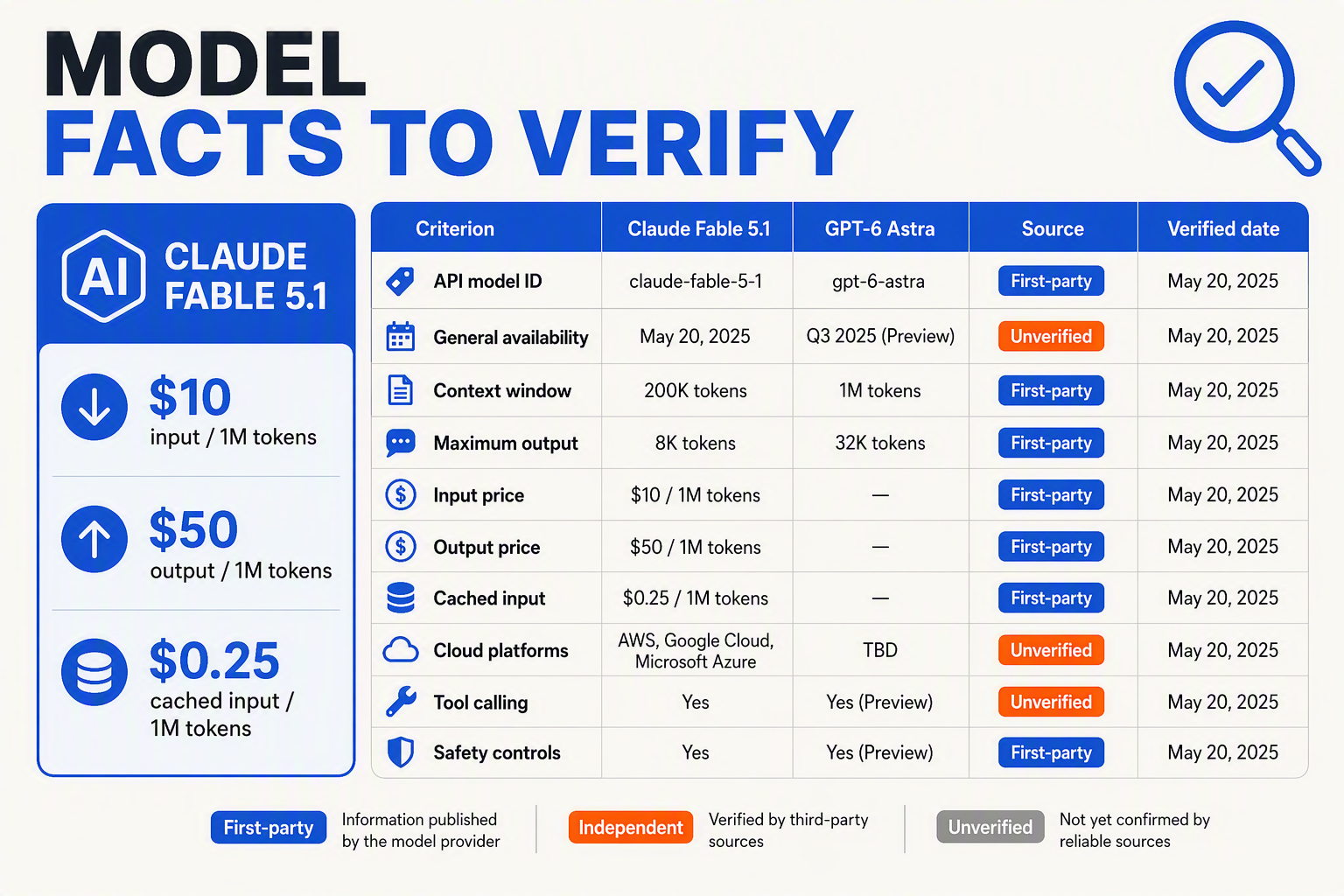
Claude Fable 5.1 has the stronger documented specification sheet: a 1-million-token context window, broad cloud access and published token prices. GPT-6 Astra cannot be compared numerically on equal terms because the supplied evidence contains no verified context, pricing, API-access or coding-tool specifications for it.
| Dimension | Claude Fable 5.1 | GPT-6 Astra | Evidence-led takeaway |
|---|---|---|---|
| Repository-scale coding | Third-party documentation describes multi-file implementation, test creation, code review and performance analysis | No verified repository-scale feature documentation supplied | Fable’s capabilities are documented, but repository success still requires project-specific testing |
| Terminal and tool use | Agentic use is supported through compatible coding environments and tool scaffolds | No verified tool schema, terminal integration or permission model supplied | Compare complete agent systems, not models in isolation |
| Debugging and review | GPTProto lists root-cause debugging and repository-wide code review among supported workloads | No independently documented equivalent supplied | Treat feature listings as capability claims, not measured defect-detection rates |
| Context and output | 1 million tokens of context; GPTProto reports output of up to 128,000 tokens | No verified figures supplied | Fable can ingest unusually large codebases, although retrieval discipline still matters |
| API and cloud access | claude-fable-5-1 through Anthropic, AWS, Google Cloud and Microsoft Azure | No verified provider or model identifier supplied | Fable currently presents the clearer deployment path |
| Official list price | $10/1M input tokens; $50/1M output tokens; cached input reported at $0.25/1M | No verified pricing supplied | Astra’s total cost cannot be calculated responsibly from the available research |
What the specifications mean in practice
TokenCost verified on September 2, 2026 that Claude Fable 5.1 costs $10 per million input tokens and $50 per million output tokens, with a 1-million-token context window and no listed long-context surcharge. BenchLM separately reports cached input at $0.25 per million tokens, although teams should confirm cache eligibility and provider-specific billing before forecasting production costs.
For example, one uncached engineering run using 100,000 input tokens and producing 10,000 output tokens would cost approximately $1.50 at official Fable pricing:
- Input: 0.1 million × $10 = $1.00
- Output: 0.01 million × $50 = $0.50
- Total: $1.50, excluding orchestration, storage and external tool charges
That calculation also exposes why output discipline matters: Fable’s output tokens cost five times as much as uncached input tokens.
Access is more than API availability
DataNorth reported on September 2, 2026 that Claude Fable 5.1 was available through Anthropic and major cloud platforms under the identifier claude-fable-5-1. TokenCost names first-day availability through Anthropic, Amazon Bedrock, Google Vertex AI and Microsoft Azure, giving enterprises several routes for procurement, identity controls and regional deployment.
However, model access does not automatically provide autonomous terminal execution. A coding agent still needs:
- A sandbox with explicit filesystem and network permissions
- Tool definitions for shell commands, search and patch application
- Test timeouts, retry limits and rollback controls
- Logging that makes every edit and command reviewable
GPTProto says Fable’s “reasoning stays enabled” and exposes effort settings from low to max. That is useful for balancing latency and difficult engineering tasks, but it is a third-party product description—not proof of a particular debugging success rate.
For GPT-6 Astra, every missing value should remain marked unverified, not interpreted as zero capability. Until primary documentation and reproducible coding evaluations are available, teams cannot fairly compare its cost per resolved issue, maximum repository size or long-running agent reliability with Claude Fable 5.1.
How Should a Reproducible Head-to-Head Coding Test Be Run?
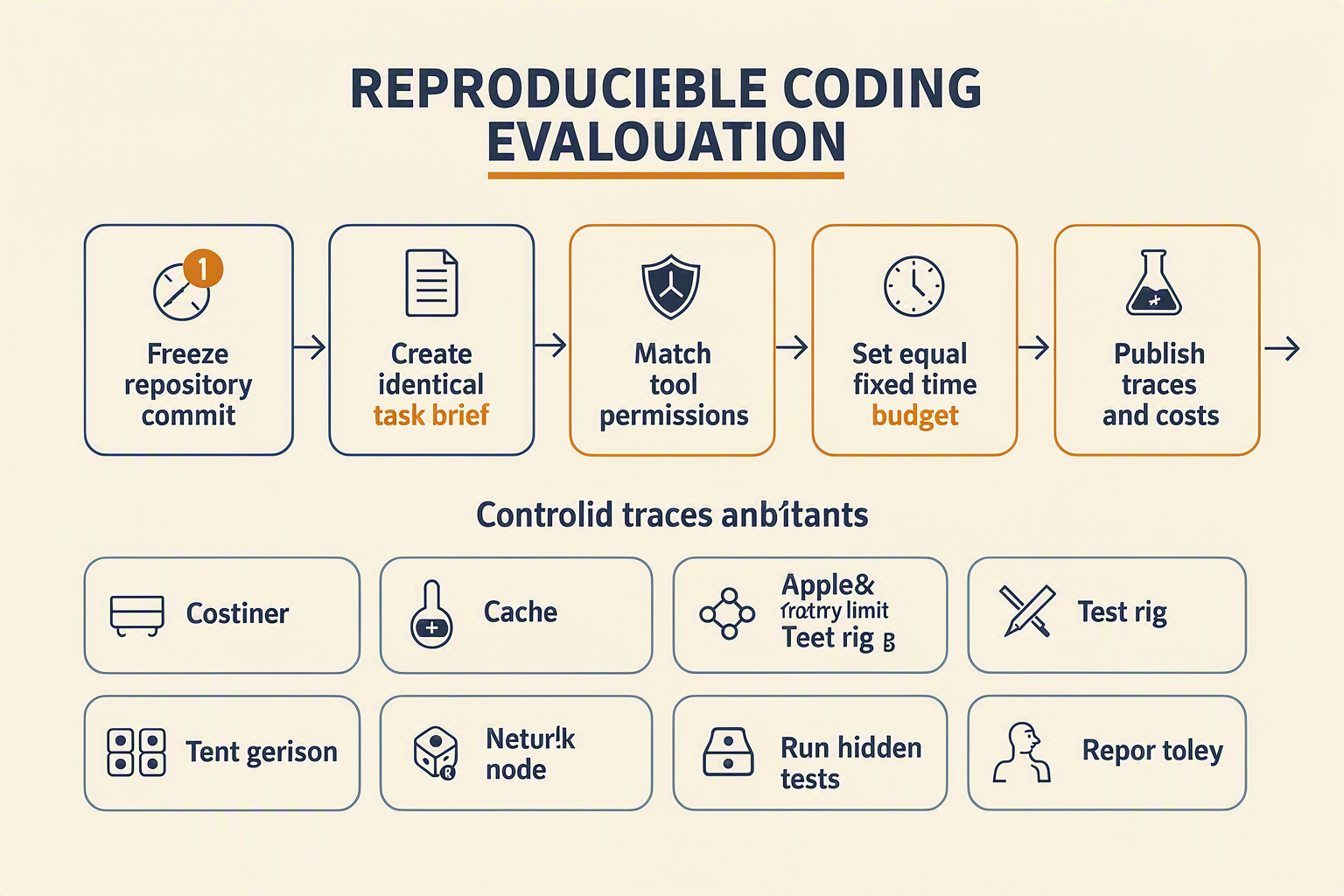
A reproducible head-to-head test should run Claude Fable 5.1 and GPT-6 Astra against identical repository snapshots, tools, prompts and resource limits, with every command and code change logged. Because verified GPT-6 Astra documentation is currently missing from the supplied evidence, testing should begin only after its exact model identifier, API configuration and provider terms can be recorded.
1. Freeze the environment and model configuration
Use containerized runners with pinned operating-system images, dependency lockfiles and repository commits. Publish enough information for another team to recreate each run:
- Exact model ID, provider, API version and test date
- Temperature, seed where supported, reasoning-effort setting and maximum output
- System prompt, agent scaffold and context-construction method
- CPU, memory, network access, timeout and command permissions
- Retry limits, tool-call limits and total token budget
- Initial repository commit and final generated patch
Do not infer that two endpoints expose equivalent models merely because their display names match. Claude Fable 5.1 can be pinned as claude-fable-5-1, while GPT-6 Astra should remain labelled unverified until a corresponding provider identifier is documented.
2. Build a representative task suite
A credible evaluation needs more than isolated function generation. Use at least 30–50 held-out tasks spanning several languages, repository sizes and engineering activities:
- Repository-scale implementation: modify interfaces, implementation files, tests and documentation together.
- Terminal operation: inspect files, search symbols, install permitted dependencies and run builds.
- Debugging: reproduce a seeded defect, identify its root cause and add a regression test.
- Code review: detect correctness, security and maintainability problems without changing code.
- Long-running work: complete multi-stage migrations or refactors requiring persistent state and plan revision.
Tasks should have hidden tests and predefined acceptance criteria. Avoid repositories that appear prominently in model demonstrations or public benchmark discussions, because memorization can inflate apparent engineering ability.
3. Compare equal budgets and quality frontiers
Run two complementary conditions. An equal-resource condition gives each model the same wall-clock time, tool calls and token allowance. A best-practical condition permits model-specific reasoning settings but measures the resulting cost and latency.
Long context must be treated as a test variable, not an automatic advantage. TokenCost reported on September 2, 2026 that Claude Fable 5.1 supports a 1-million-token context window, with list prices of $10 per million input tokens and $50 per million output tokens. Test full-repository ingestion separately from retrieval-based context selection, then report whether additional context improves task completion enough to justify its cost.
4. Record outcomes beyond pass rate
For every attempt, capture:
- Hidden-test pass rate and build success
- Correct changes per files touched
- Regressions and unnecessary edits
- Time to first valid patch and total completion time
- Tool calls, retries, input/output tokens and estimated cost
- Human-review severity ratings for unresolved defects
- Recovery rate after the first failed command or test
Run each task multiple times—preferably five or more independent trials—and report confidence intervals rather than only averages. The Model Gap’s differing Terminal-Bench 2.1 measurements for Claude Fable 5.1 demonstrate why a single run or harness should not be treated as definitive.
5. Publish an auditable evaluation bundle
Release prompts, container definitions, task manifests, transcripts, patches and scoring scripts, while keeping hidden tests private until evaluation closes. Human reviewers should assess anonymized patches without seeing the model name. This protocol turns “Claude Fable 5.1 versus GPT-6 Astra” from a marketing comparison into a falsifiable software-engineering experiment.
Which Model Handles Repository Work, Terminal Use, Debugging, and Code Review Best?
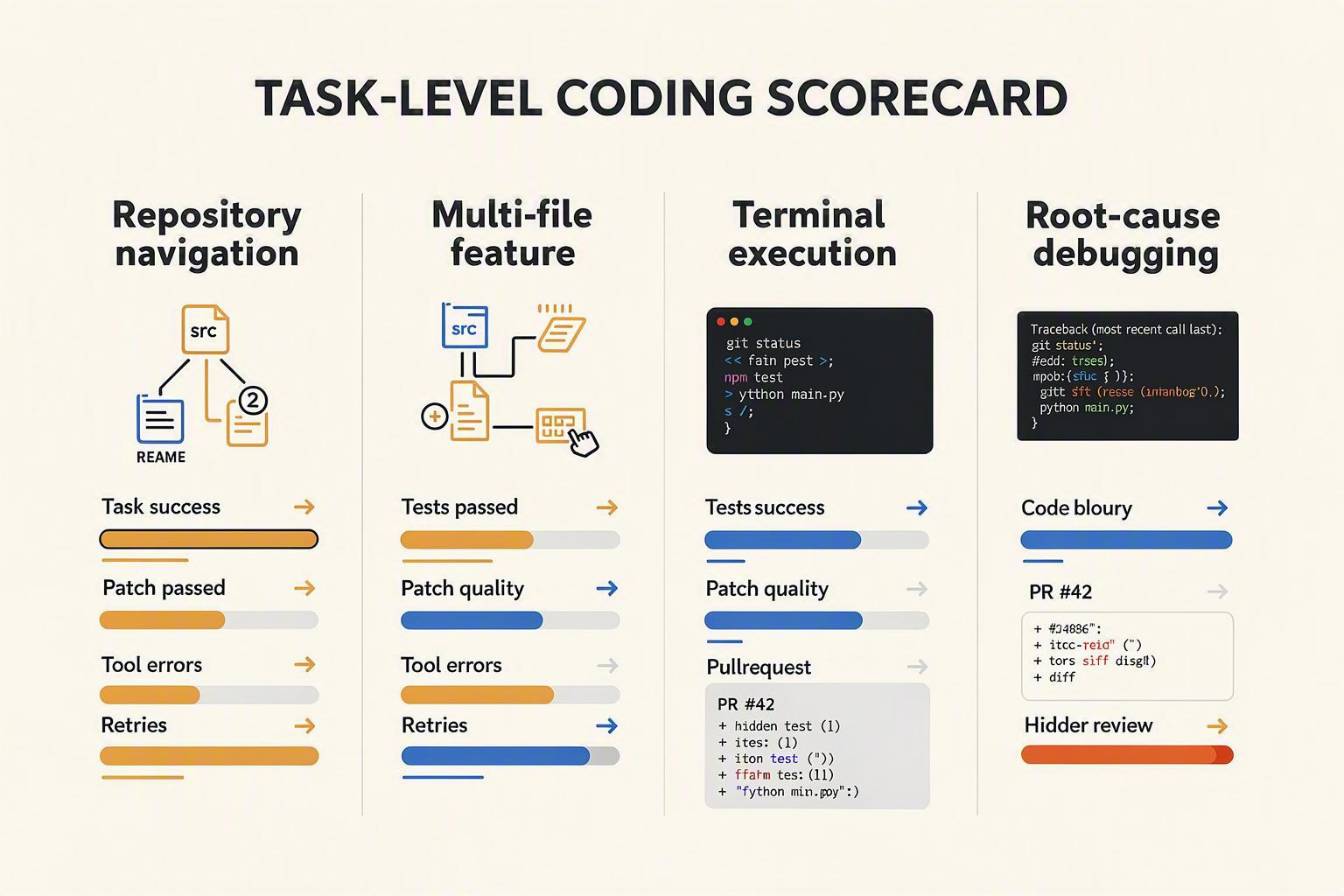
Claude Fable 5.1 currently has the stronger evidence base for repository-scale engineering and terminal-driven workflows, while no defensible winner can be declared for debugging or code review against GPT-6 Astra. The limitation is straightforward: the supplied research documents Fable 5.1’s capabilities and independent tests, but provides no reproducible Astra results for these tasks.
Repository-scale changes
Fable 5.1 is explicitly positioned for repository-wide feature implementation, multi-file editing, test creation and performance analysis, according to GPTProto’s model profile. GPTProto also reports support for outputs of up to 128,000 tokens, potentially useful when an agent must generate extensive patches, test suites or migration plans.
However, a large context or output allowance does not prove that a model can correctly understand an entire repository. A realistic repository test should measure whether the agent can:
- Locate the relevant modules without loading every file.
- Trace interfaces, dependencies and side effects across directories.
- Modify implementation, configuration and tests consistently.
- Preserve project conventions and unrelated behaviour.
- Produce a patch that passes the repository’s actual checks.
On available evidence, Fable 5.1 is the lower-risk candidate to evaluate first. GPT-6 Astra remains unranked here because comparable repository-task results are absent—not because Astra has been shown to fail.
Terminal and tool use
Terminal performance is where harness design becomes impossible to ignore. The Model Gap says that all six Claude Fable 5.1 benchmark scores it tracks come from independent evaluators, yet its Terminal-Bench 2.1 results still vary across three reported runs. This indicates that model selection alone cannot explain agent reliability.
For terminal agents, teams should record:
- Command success rate: whether commands execute correctly in the provided shell.
- Recovery rate: whether the model diagnoses failed builds, permissions or missing dependencies.
- Tool discipline: whether it inspects state before editing or running destructive commands.
- End-to-end completion: whether the final repository passes tests, linting and type checks.
- Human intervention: how often an engineer must redirect the agent.
BenchLM classifies Agentic as Fable 5.1’s strongest eligible benchmark category across 24 source-displayable benchmark rows. That supports testing Fable for tool-heavy workflows, but it does not convert one agent scaffold’s result into a universal terminal score.
Debugging and code review
The current evidence supports capability claims, not a clean comparative victory. GPTProto lists root-cause debugging and code review among Fable 5.1’s supported workloads, but the supplied sources provide no matched Fable-versus-Astra defect corpus, reviewer study or patch-acceptance rate.
A credible evaluation should separate four outcomes:
- Did the model identify the root cause, not merely the failing line?
- Did its patch pass both visible and hidden regression tests?
- Did code review comments identify real defects without excessive false positives?
- Did the model explain risks clearly enough for a human maintainer to verify?
The practical verdict is therefore conditional: choose Claude Fable 5.1 for the better-documented starting point, but run both models inside the same repository, container, tool policy and retry budget before production adoption. Until GPT-6 Astra receives equivalent independent testing, claims that either model categorically handles debugging or review “best” exceed the available evidence.
Which Model Is More Reliable on Long-Running Tasks, Context Management, and Failure Recovery?
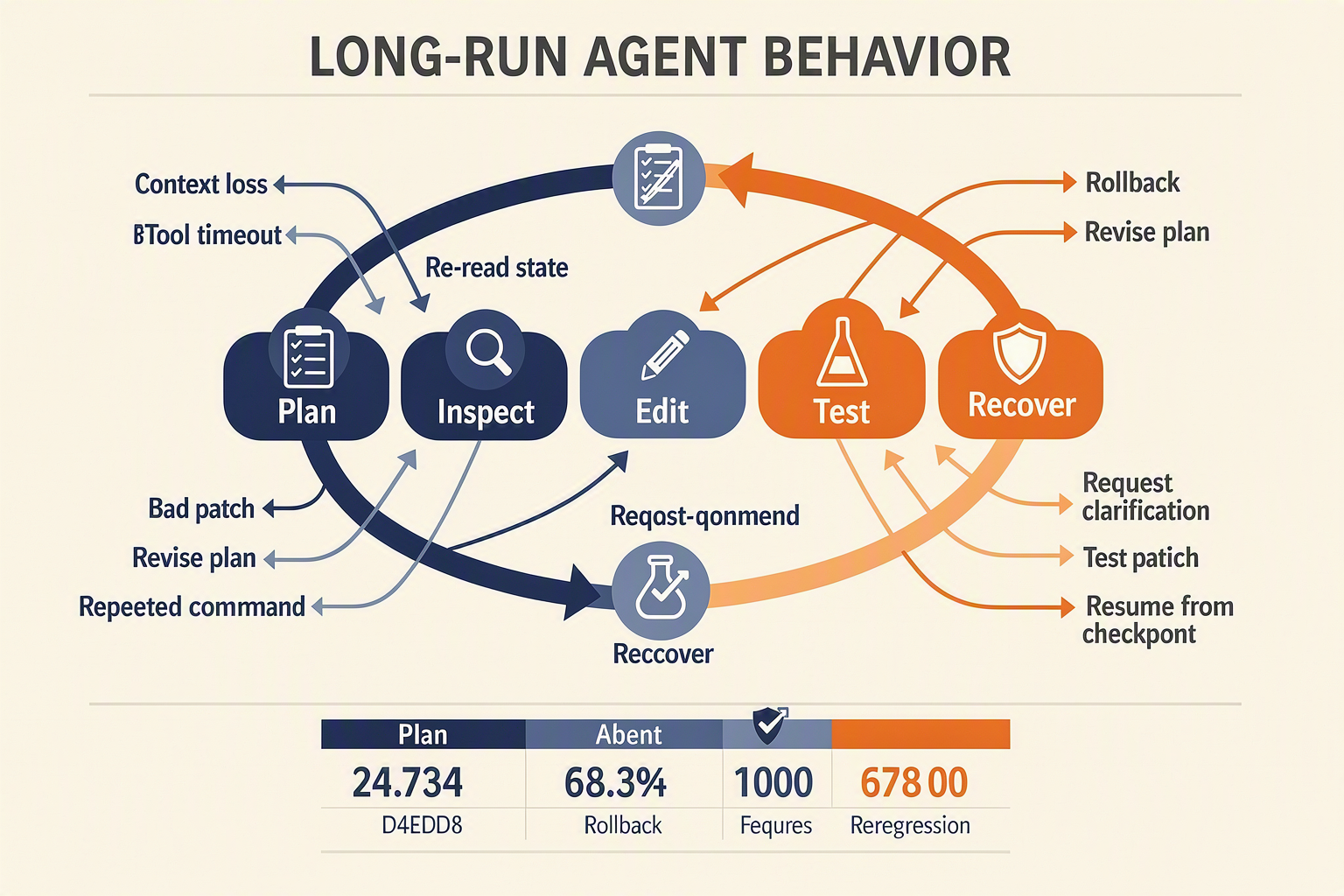
Claude Fable 5.1 has the stronger documented case for long-running software-engineering tasks, chiefly because its context capacity and agentic evaluation record are publicly described. GPT-6 Astra cannot be judged equally from the supplied evidence, so declaring it more reliable—or less reliable—would be speculative.
Long-running reliability is more than task completion
A reliable coding agent must preserve intent across many steps, detect when an action failed and resume without silently corrupting the repository. For extended migrations, dependency upgrades or multi-service debugging, evaluate whether the model can:
- Maintain a stable plan while incorporating new test results.
- Track repository state after edits, rebases and generated files.
- Recognise failed assumptions instead of repeating an unsuccessful command.
- Recover from partial execution through checkpoints or reversible changes.
- Produce reviewable evidence, including diffs, test output and unresolved risks.
BenchLM lists 24 source-displayable benchmark rows for Claude Fable 5.1 and ranks Agentic as its strongest eligible category, as reported in September 2026. That supports further testing of Claude Fable 5.1 for sustained tool-driven workflows, but an aggregate category ranking does not prove reliability inside a particular terminal harness or production repository.
The available research provides no equivalent long-horizon completion rate, retry analysis or independently reproduced agent benchmark for GPT-6 Astra. The correct finding is therefore “insufficient evidence,” not a numerical tie or automatic loss.
A million tokens reduces retrieval pressure—not reasoning errors
TokenCost reported on September 2, 2026 that Claude Fable 5.1 supports a 1-million-token context window with no long-context surcharge. GPTProto also describes repository processing within that window and output of up to 128,000 tokens, although these capacity claims should not be confused with measured accuracy across the entire context.
A large window can hold source files, architecture documents, issue history and test logs together. It does not guarantee that the model will:
- Notice a constraint buried hundreds of thousands of tokens earlier.
- Distinguish current files from stale snapshots.
- Prioritise an authoritative specification over duplicated documentation.
- Preserve exact invariants through dozens of edits.
- Avoid escalating input costs by repeatedly resending unchanged repository content.
For reliability, context selection and state design matter more than maximum capacity alone. Retrieval should supply relevant files, while an external task ledger should record decisions, commands, test results and pending work.
Failure recovery should be tested as a first-class capability
A useful evaluation deliberately injects recoverable failures rather than measuring only clean-path completion. Teams should test both models with the same scaffold and scenarios:
- A test command times out after partially writing artifacts.
- Package installation fails because a registry is unavailable.
- A patch applies cleanly but breaks an unrelated integration test.
- The context is compacted halfway through a multi-file migration.
- Tool output is truncated or contradicts the model’s previous assumption.
Score successful recovery, repeated-action rate, regression count, human interventions and final test status. Also preserve command transcripts so reviewers can distinguish model reasoning failures from infrastructure failures.
Claude Fable 5.1 is consequently the better-documented candidate for a controlled long-running-task pilot. Until GPT-6 Astra receives comparable public specifications and reproducible evaluations, production selection should remain conditional: run both against identical repositories, tool permissions, token budgets, checkpoint policies and failure injections before choosing a default.
How Much Do GPT-6 Astra and Claude Fable 5.1 Coding Agents Cost in Practice?
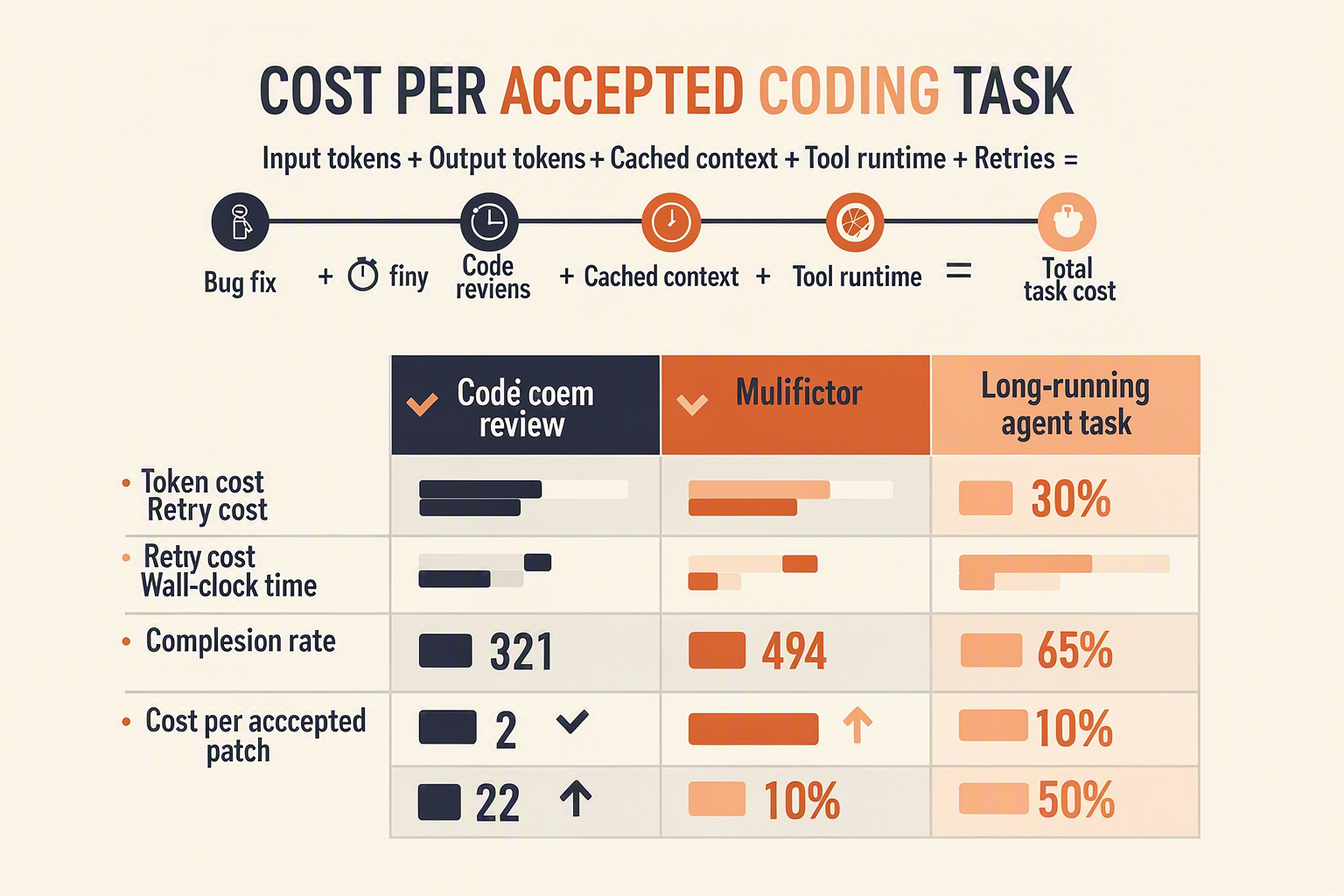
Claude Fable 5.1 has verifiable list pricing, while no equivalent primary or independently confirmed pricing is available for GPT-6 Astra in the supplied evidence. Teams can therefore model Fable’s operating cost precisely, but any Astra cost-per-task comparison would currently be speculative.
Practical cost scenarios
TokenCost verified Claude Fable 5.1’s price on September 2, 2026, at $10 per million input tokens and $50 per million output tokens. TokenCost also reports a 1-million-token context window with no long-context surcharge, while BenchLM lists cached input at $0.25 per million tokens.
The estimates below apply those rates directly. They exclude taxes, cloud-provider markups, terminal sandboxes, web search, embeddings and other external tools.
| Coding workload | Illustrative token usage | Claude Fable 5.1 estimate | GPT-6 Astra estimate | Cost implication |
|---|---|---|---|---|
| Focused bug fix | 50K input + 5K output | $0.75 | Not verifiable | Suitable for tightly scoped issues |
| Repository code review | 250K input + 15K output | $3.25 | Not verifiable | Context selection materially affects cost |
| Multi-round debugging | 450K input + 30K output | $6.00 | Not verifiable | Failed iterations compound token usage |
| Long-running agent task | 1M input + 50K output | $12.50 | Not verifiable | Tools and sandbox time cost extra |
| Cached repository rerun | 800K cached + 100K fresh input + 20K output | $2.20 | Not verifiable | Assumes BenchLM’s cached-input rate applies |
| 100 repository reviews | 25M input + 1.5M output | $325.00 | Not verifiable | Useful baseline for monthly budgeting |
These are scenario calculations, not measured invoices. For example, the focused fix costs $0.50 for 50,000 input tokens plus $0.25 for 5,000 output tokens. The monthly review scenario costs $250 for input and $75 for output.
Why headline token prices are insufficient
Fable 5.1 output tokens cost five times as much as input tokens, based on TokenCost’s September 2026 figures. Concise patches, bounded explanations and structured tool outputs can therefore reduce spending without necessarily reducing repository coverage.
Actual coding-agent cost also depends on:
- Retry rate: A low-cost attempt that repeatedly fails tests can cost more than one expensive successful run.
- Context strategy: Sending an entire repository on every turn wastes tokens compared with retrieval, symbol indexing or cached prompts.
- Tool execution: CI minutes, containers, browser sessions and external APIs may exceed the model charge.
- Review overhead: A cheap patch that requires extensive human correction has a higher total engineering cost.
- Agent scaffold: The Terminal-Bench 2.1 score variation documented by The Model Gap shows that harness design can change outcomes even when the underlying model is identical.
A defensible procurement calculation
Teams should compare cost per accepted engineering outcome, not merely cost per million tokens:
- Record model tokens, tool charges, runtime and retries for each task.
- Measure acceptance rate, tests passed and human review minutes.
- Calculate total spend per merged patch, resolved defect or approved review.
Until GPT-6 Astra receives documented pricing and reproducible evaluations, the honest table entry is “not verifiable.” Claude Fable 5.1 offers a calculable baseline; a valid Astra comparison requires the same billing boundaries, tool permissions and success criteria.
What Do Benchmarks and Expert Evaluators Actually Prove?
Benchmarks prove that Claude Fable 5.1 can perform strongly in specific agentic test environments; they do not prove that it universally outperforms GPT-6 Astra across real software repositories. With no supplied primary documentation or independently reproduced coding scores for GPT-6 Astra, a statistically defensible head-to-head conclusion is currently impossible.
What the Claude Fable 5.1 results establish
The available evidence supports a narrower conclusion: Claude Fable 5.1 is a credible model for tool-driven software-engineering tasks.
- BenchLM listed 24 source-displayable benchmark rows for Claude Fable 5.1 in September 2026 and ranked Agentic as its strongest eligible category at #1.
- The Model Gap reported in September 2026 that all six Claude Fable 5.1 scores it tracks came from independent evaluators rather than Anthropic’s own benchmark runs.
- Artificial Analysis measured Claude Fable 5.1 at 91.4% on Terminal-Bench 2.1, according to The Model Gap in September 2026.
These results provide meaningful evidence that Fable 5.1 can plan and execute actions in benchmarked agent environments. They are particularly relevant to workflows involving shell commands, file modifications, test execution and iterative recovery.
However, a high agentic score does not directly establish repository-scale reliability. It does not reveal how often the model introduces regressions, overlooks hidden dependencies, produces maintainable abstractions or needs human intervention during a multi-hour task.
Why one benchmark can produce several “correct” scores
The Model Gap found three different Terminal-Bench 2.1 scores for the identical Claude Fable 5.1 model. That divergence shows that a benchmark result measures a complete evaluation system, not merely a model checkpoint.
Material variables include:
- Agent scaffold: How the evaluator converts model responses into terminal actions.
- Tool access: Whether the model can inspect files, search code, run tests or use external documentation.
- Reasoning configuration: Effort limits and token budgets can change both accuracy and cost.
- Retry policy: Additional attempts may rescue failures while increasing latency and compute.
- Environment details: Dependency versions, timeouts and sandbox permissions can alter task completion.
- Scoring rules: Pass rates may count final outcomes without measuring patch quality or human review burden.
Consequently, 91.4% should be read as “91.4% under Artificial Analysis’s configuration,” not as an intrinsic success probability for every deployment.
What the evidence cannot prove about GPT-6 Astra
The supplied research contains no primary GPT-6 Astra model card, official coding evaluation or independently reproduced Terminal-Bench 2.1 result. Therefore, it cannot substantiate claims that Astra is better—or worse—at terminal use, debugging, code review or long-running repository work.
A credible comparison would require both models to use:
- The same repository snapshots and task set
- Identical tools, permissions and timeouts
- Equivalent reasoning and retry budgets
- Multiple runs to expose variance
- Blind human review of correctness and maintainability
- Cost, latency and intervention rates alongside pass rate
Until those controls exist, expert evaluations make Claude Fable 5.1 the better-documented candidate, not the proven universal winner. The strongest operational decision is a workload-specific bake-off measuring completed, reviewable patches rather than relying on a single leaderboard percentage.
Which Coding Model Should You Choose for Your Workload?
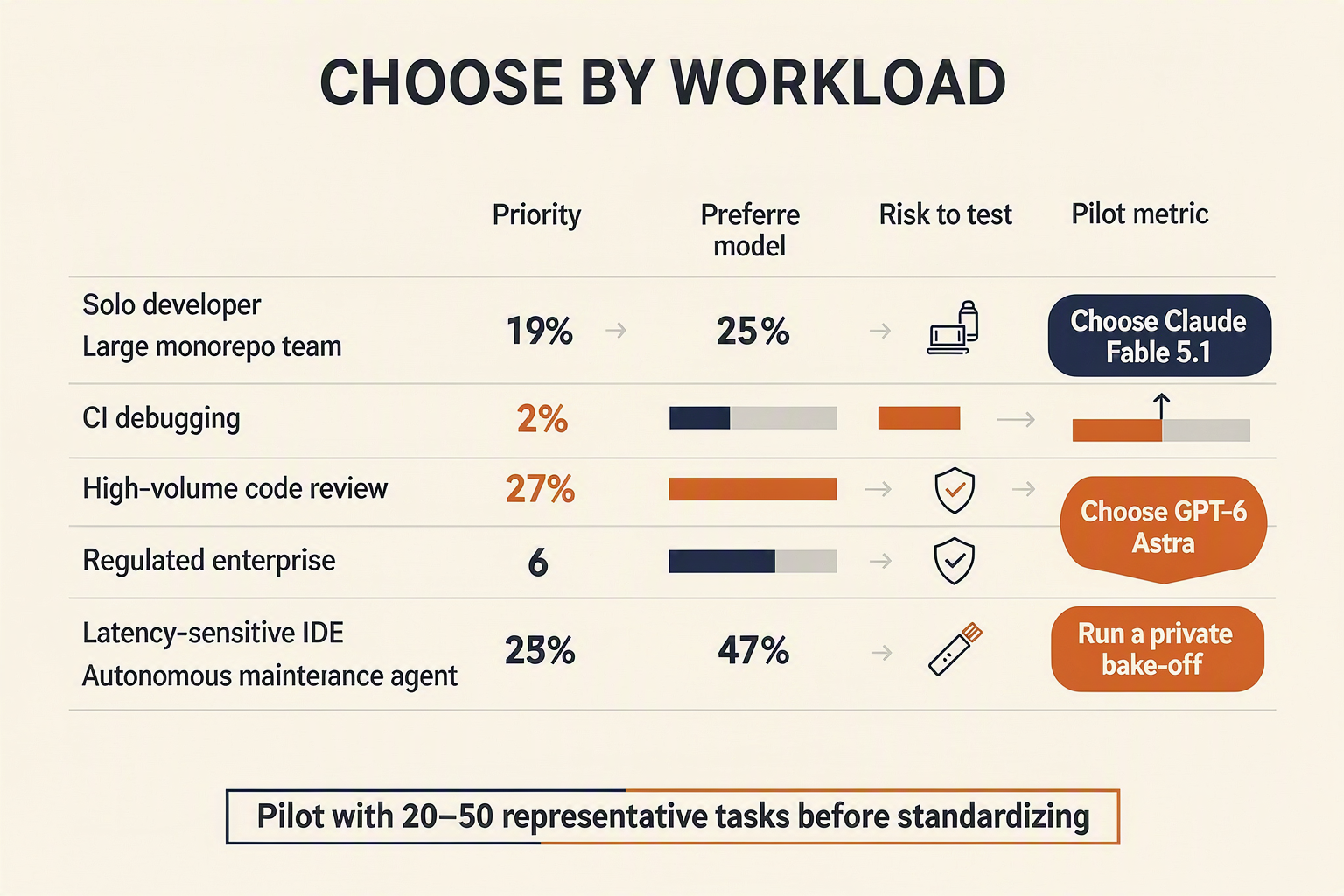
Choose Claude Fable 5.1 when you need a production candidate backed by published specifications and independent agentic evaluations; choose GPT-6 Astra only after a controlled pilot establishes its performance, cost and operational limits. As of September 8, 2026, the available evidence does not support declaring GPT-6 Astra the stronger coding model—or even treating the two models as equally documented.
Workload-by-workload decision matrix
| Workload | Claude Fable 5.1 evidence | GPT-6 Astra evidence | Recommended choice |
|---|---|---|---|
| Repository-scale changes | 1-million-token context window; third-party documentation describes multi-file implementation and repository-wide analysis | No verified context limit or repository benchmark in the supplied research | Fable 5.1, followed by repository-specific testing |
| Terminal-based engineering | Three independent Terminal-Bench 2.1 results exist, including 91.4% from Artificial Analysis, but scores vary by harness | No independently reproduced terminal score provided | Fable 5.1 for evidence coverage; validate with your own scaffold |
| Root-cause debugging | Positioned for agentic work; BenchLM ranks Agentic as its strongest eligible category across 24 source-displayable benchmark rows | No supplied debugging benchmark or reproducible case study | Fable 5.1, with tests and human review as acceptance gates |
| Pull-request review | Large context can hold extensive diffs, tests and documentation, but context capacity does not prove review accuracy | No verified review precision, recall or false-positive measurements | Run a blind review bake-off before deployment |
| Long-running tool workflows | Published agentic evidence supports evaluation, although retry policy and tool permissions can materially change results | No verified data for recovery, state retention or task completion | Fable 5.1 as baseline; instrument both if Astra is available |
| Cost-sensitive coding | Official list price is $10 per million input tokens and $50 per million output tokens | No verified list price or token accounting supplied | Fable 5.1 is budgetable; Astra remains uncosted |
TokenCost reported on September 2, 2026 that Claude Fable 5.1 has a 1-million-token context window with no long-context surcharge, priced at $10 per million input tokens and $50 per million output tokens. At those rates, a workflow consuming two million aggregate input tokens and 100,000 output tokens would cost approximately $25, excluding caching, orchestration and external tool charges.
Apply three practical selection rules
- Prefer verified capability over model branding. BenchLM’s 24 displayed benchmark rows provide a meaningful evaluation surface for Claude Fable 5.1, whereas equivalent GPT-6 Astra evidence is absent from the supplied sources.
- Reproduce the actual engineering environment. The Model Gap reports three different Terminal-Bench 2.1 results for the identical Fable 5.1 model, including Artificial Analysis’s 91.4% result. That disagreement means terminal access, timeouts, retries and agent scaffolding belong in the benchmark specification.
- Measure completed work, not generated code. Track:
- Percentage of tasks passing the full test suite
- Regressions introduced per accepted patch
- Human review minutes per pull request
- Tool failures recovered without intervention
- Total tokens and cost per merged change
Bottom line
Claude Fable 5.1 is the lower-uncertainty choice for repository work, terminal agents and long-running coding tasks in September 2026. GPT-6 Astra should remain an evaluation candidate until primary specifications and reproducible engineering results become available. Teams using a multi-model gateway can route a representative task set to both models, but production adoption should depend on merged-patch quality, operational reliability and total cost—not an unsupported leaderboard claim.
Frequently Asked Questions About Claude Fable 5.1 vs GPT-6 Astra Coding
Which model wins Claude Fable 5.1 vs GPT-6 Astra for coding in 2026?
Is Claude Fable 5.1 better than GPT-6 Astra for large code repositories?
How reliable are Claude Fable 5.1 terminal and tool-use benchmark scores?
Which model is safer for debugging and automated code review?
What does Claude Fable 5.1 vs GPT-6 Astra cost for coding agents?
How should engineering teams evaluate Claude Fable 5.1 and GPT-6 Astra for long-running tasks?
Conclusion
Claude Fable 5.1 is the more defensible coding choice based on the evidence available in September 2026, but it is not a verified head-to-head winner over GPT-6 Astra. Claude Fable 5.1 has documented specifications and independent measurements; equivalent primary documentation and reproducible results for GPT-6 Astra remain absent from the supplied evidence.
- Repository-scale work looks promising, not conclusively solved. TokenCost reported on September 2, 2026 that Claude Fable 5.1 offers a 1-million-token context window, while GPTProto describes support for repository-wide implementation, testing, review and debugging. Large context can expose more dependencies at once, but teams still need to measure whether it improves correct multi-file changes rather than merely increasing token consumption.
- Terminal performance depends on the complete agent system. The Model Gap records three different independent Terminal-Bench 2.1 scores for the same Claude Fable 5.1 model, including 91.4% from Artificial Analysis. That variation reinforces a central lesson: tool permissions, command execution, retry policies, reasoning budgets and harness design can matter nearly as much as the underlying model.
- Debugging and code review require workflow-level evaluation. A plausible patch is not enough. The stronger engineering model is the one that identifies root causes, runs appropriate tests, interprets failures, preserves unrelated behaviour and produces changes that human reviewers can understand.
- Cost must be evaluated per accepted task, not per token alone. TokenCost lists Claude Fable 5.1 at $10 per million input tokens and $50 per million output tokens as of September 2, 2026. The meaningful metric is total cost for a tested, reviewable result after retries and human correction.
What should teams watch next? The decisive evidence would be independently reproduced GPT-6 Astra results, matched evaluations using identical repositories and tools, and long-running trials that report completion rate, regression rate, latency and total spend. Until then, flexible multi-model testing is safer than permanent model allegiance. Developers can explore that approach through CallMissed, whose OpenAI-compatible gateway provides access to multiple AI models through one integration.
The next coding-model leader will not be crowned by one benchmark—but which model can repeatedly ship correct software inside your actual engineering environment?
Related Reading
- Claude Fable 5.1 vs GPT-6 Astra: 2026 API Migration and Routing Guide
- Best LLM for Voice Agents in 2026: GPT-6 Astra vs Claude Fable 5.1
- GPT-6 Astra vs Claude Fable 5.1: Verified 2026 Comparison