
Deepgram Aura vs ElevenLabs Pricing: A Verified Cost Comparison


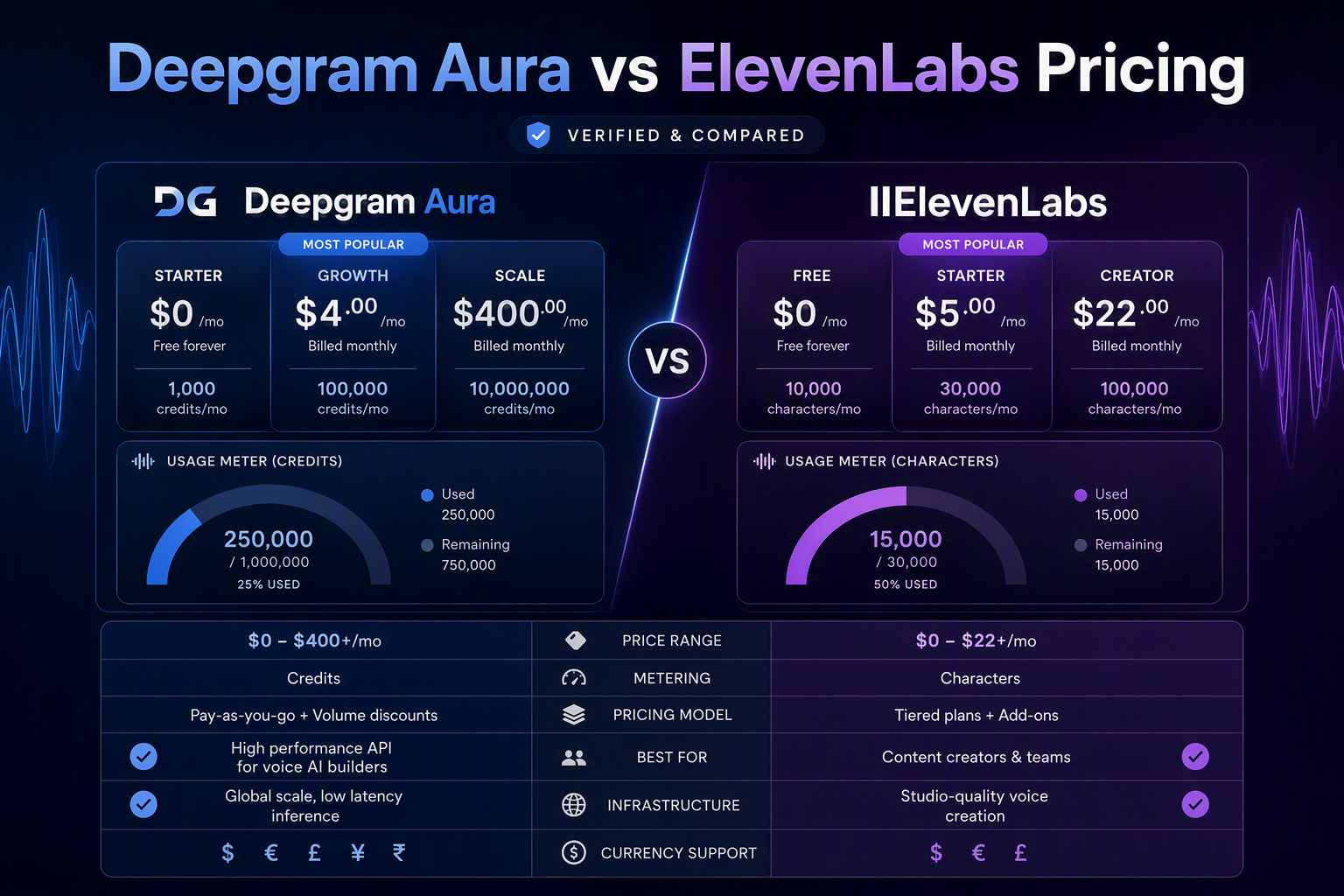
See the verified status of Deepgram Aura vs ElevenLabs pricing, normalize usage fairly, and learn what to confirm before choosing an API.
Deepgram Aura vs ElevenLabs Pricing: A Verified Cost Comparison
Could the “cheaper” text-to-speech API change once you convert both offers to the same 1,000,000-character workload? The short answer on Deepgram Aura vs ElevenLabs pricing is that no reliable current price figures were verified in this research, so naming a definitive winner would be misleading without checking each vendor’s live pricing page, model, plan, and usage volume.
This comparison separates verified facts from plan-dependent unknowns and shows how to normalize Deepgram Aura pricing and ElevenLabs pricing by characters, audio duration, subscriptions, overage rates, and monthly volume. You’ll also find a head-to-head table, a transparent cost formula, and practical trade-offs covering API access, voice quality, latency, languages, licensing, and enterprise terms. As voice agents scale, platforms such as CallMissed reflect the broader move toward consolidating voice, chat, and AI infrastructure behind unified APIs.
Which is cheaper: Deepgram Aura or ElevenLabs?
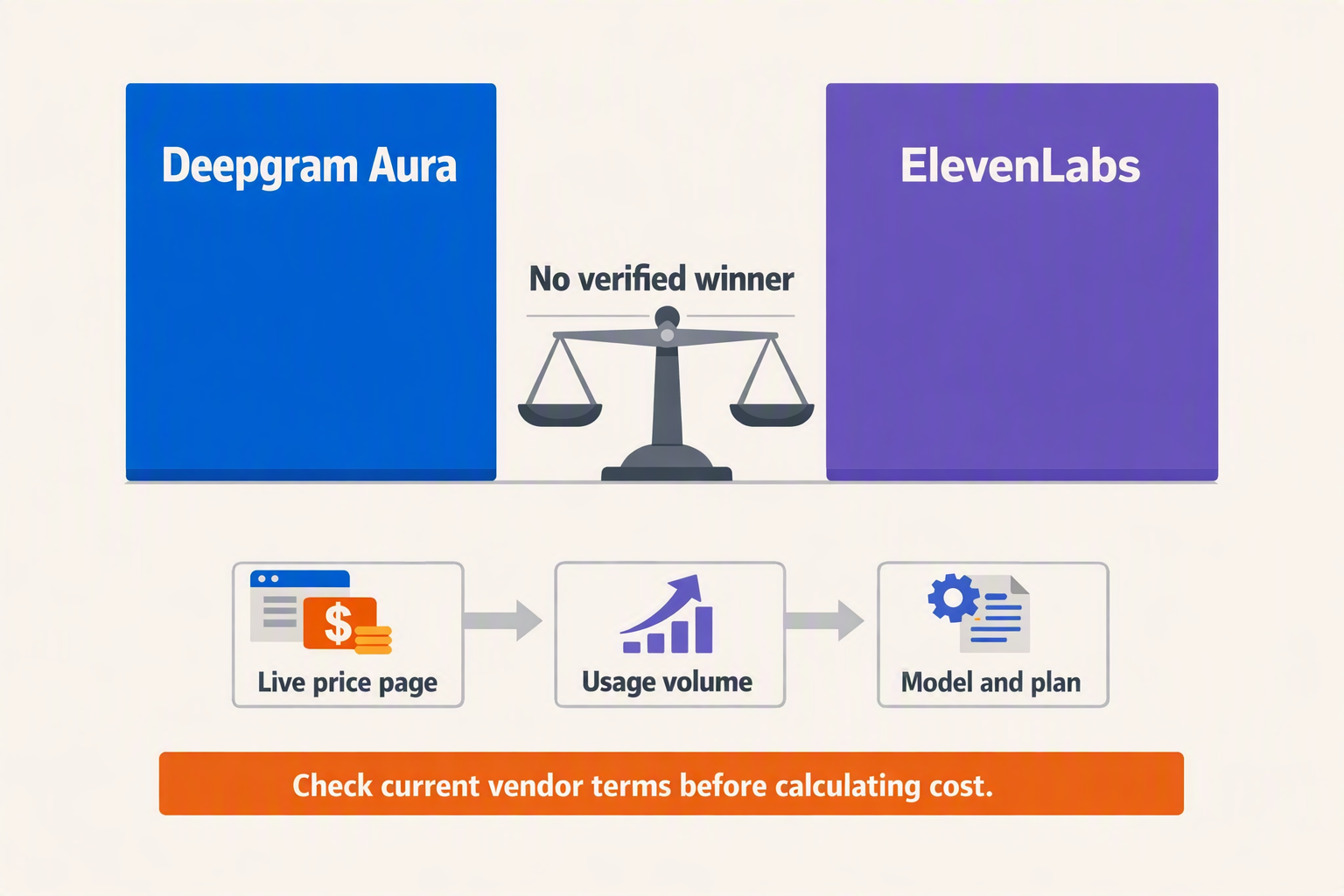
No definitive winner can be named for Deepgram Aura vs ElevenLabs pricing because this research did not verify reliable, current official price figures for either service. The cheaper option depends on each vendor’s live plan, selected model, billing unit, included quota, overage rate, and your monthly usage volume.
How should you compare Deepgram Aura pricing and ElevenLabs pricing?
Use identical workloads rather than comparing headline rates. Start with 1,000,000 characters, then repeat the calculation at 10,000,000 characters to reveal how subscription quotas, volume pricing, or overage rules may affect the result.
| Vendor | Normalized workload | Cost calculation | Official price found in research |
|---|---|---|---|
| Deepgram Aura | 1,000,000 characters | Base fee + applicable overage above included usage | Not verified |
| ElevenLabs | 1,000,000 characters | Base fee + applicable overage above included usage | Not verified |
| Deepgram Aura | 10,000,000 characters | Base fee + applicable overage above included usage | Not verified |
| ElevenLabs | 10,000,000 characters | Base fee + applicable overage above included usage | Not verified |
The comparison formula is:
monthly cost = base plan fee + applicable overage for usage above the included quota
Add taxes, minimum commitments, rounding rules, and any required subscription fees where applicable. Do not convert characters into audio minutes unless the vendor publishes a usable conversion assumption for the relevant voice, language, and speaking rate.
What must be verified on the live plans?
The supplied research did not establish current official figures for Deepgram Aura or ElevenLabs. Before purchasing, check each vendor’s current documentation and pricing page for:
- Billing unit: characters, credits, audio duration, requests, or another measure
- Plan structure: free allowance, included quota, subscription fee, and overage rate
- Access terms: API availability, rate limits, minimum commitments, and enterprise requirements
- Model and voice selection: which voices and models are included at each tier
- Commercial rights: whether generated audio can be used for the intended business purpose
- Production controls: latency, pronunciation tools, language coverage, support, and service terms
Character counts, subscription credits, model tiers, and rounding rules can make apparently similar prices non-comparable. A plan with a lower unit rate may still cost more if its included quota, model restrictions, or overage policy differs.
What is the pricing verdict?
For Deepgram Aura vs ElevenLabs pricing, the defensible verdict is unresolved until live-plan verification. Confirm the current official price, applicable model, included usage, and commercial terms for both vendors, then calculate costs at 1,000,000 and 10,000,000 characters using the same assumptions. Price alone should not determine a production voice-agent decision; output quality, latency, licensing, language support, pronunciation control, reliability, and enterprise terms also require direct evaluation.
What are the feature differences between Deepgram Aura and ElevenLabs?
Deepgram Aura vs ElevenLabs pricing cannot be declared cheaper from this research because no reliable current official price figures were verified. A defensible comparison requires checking the live Deepgram and ElevenLabs pricing pages and matching each buyer’s volume, selected model or voice, billing unit, and plan.
| Comparison point | Deepgram Aura | ElevenLabs | Official price found in research | Cost-comparison impact |
|---|---|---|---|---|
| Billing unit and usage meter | Requires live-plan verification | Requires live-plan verification | Not verified | Convert both offers to the same character or audio-volume basis before comparing |
| Free tier, included quota, and overage | Requires live-plan verification | Requires live-plan verification | Not verified | Calculate included usage, excess usage, base fees, and applicable overage separately |
| API, voice, and model access | Requires live-plan verification | Requires live-plan verification | Not verified | Confirm whether API access, selected voices, models, or tiers alter the final cost |
| Languages, latency, quality, and pronunciation controls | Requires live-plan verification | Requires live-plan verification | Not verified | Test representative scripts rather than assuming feature parity or a quality advantage |
| Licensing, support, limits, and enterprise terms | Requires live-plan verification | Requires live-plan verification | Not verified | Commercial rights, rate limits, minimum commitments, and support can materially affect production cost |
How should the cost comparison be normalized?
Use fixed mathematical test volumes rather than unverified vendor prices:
- 1,000,000 characters per month: a practical baseline for comparing a moderate text-to-speech workload.
- 10,000,000 characters per month: a scale test that may reveal quota limits, plan changes, or overage exposure.
- Monthly cost formula:
applicable base-plan fee + overage for usage above included quota. - Add taxes, minimum commitments, prepaid-credit rules, rounding, and any plan-specific fees only after confirming them in current vendor documentation.
These volumes are comparison scenarios, not Deepgram Aura prices or ElevenLabs prices. Character counts, subscription credits, audio-duration assumptions, model tiers, and rounding rules may produce headline figures that are not directly comparable. Estimate audio duration separately only when the relevant vendor publishes a conversion assumption; otherwise, do not infer minutes from character counts.
What should buyers verify beyond the headline price?
For Deepgram Aura and ElevenLabs, the following details remain vendor-specific and require live verification:
- Whether the quoted plan includes API usage or limits access to particular voices and models.
- Whether free allowances apply to production use, commercial projects, or only evaluation.
- Whether pronunciation dictionaries, speaking controls, latency targets, or language coverage vary by model or plan.
- Whether commercial licensing, support levels, concurrency, rate limits, and enterprise minimums add contractual cost.
- Whether usage is metered by characters, generated audio duration, credits, requests, or another unit.
The honest trade-off in Deepgram vs ElevenLabs is therefore not a forced price winner. Buyers should compare normalized monthly volume alongside voice quality, latency, model availability, licensing, operational limits, and support. The Deepgram Aura pricing and ElevenLabs pricing pages should be checked immediately before purchase because plan terms can change, and this research did not verify current official figures.
How should you compare Deepgram Aura pricing with ElevenLabs pricing?
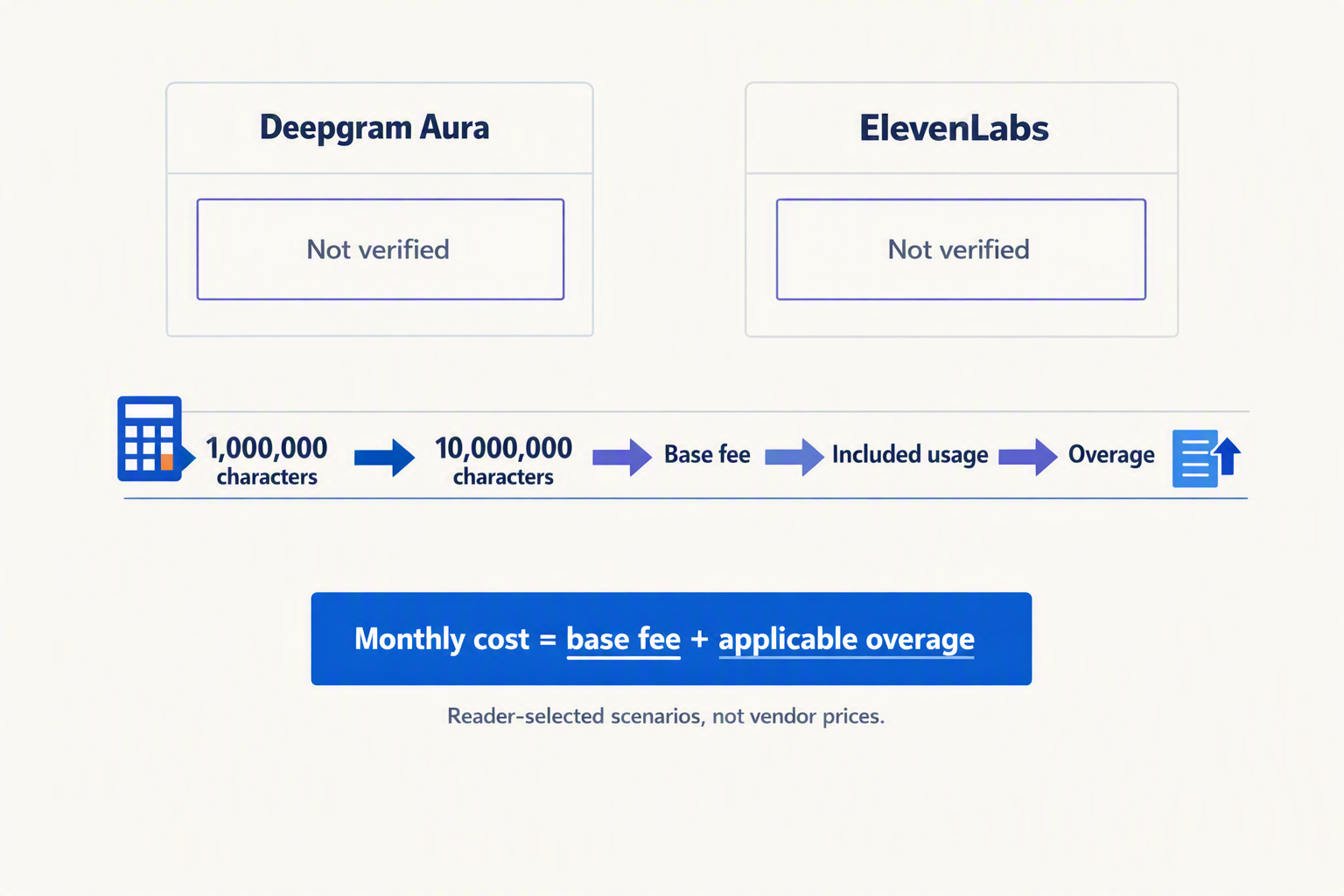
Deepgram Aura vs ElevenLabs pricing cannot be declared cheaper from the available evidence: this research did not verify reliable, current official price figures for either service. A defensible verdict requires checking the live Deepgram Aura pricing and ElevenLabs pricing pages against the buyer’s model, plan, monthly volume, included usage, and overage rules.
Use the same calculation for both vendors:
- Test 1,000,000 characters as a baseline and 10,000,000 characters as a scale workload.
- Calculate monthly cost = applicable base fee + usage overage after subtracting any included allowance.
- Convert credits, characters, subscriptions, quotas, rounding rules, and tier thresholds into a common cost per 1,000,000 characters.
- Estimate audio minutes separately only when Deepgram or ElevenLabs publishes a usable character-to-duration assumption. Do not assume a universal speaking rate.
What should you verify before comparing Deepgram Aura and ElevenLabs?
| Comparison point | Deepgram Aura | ElevenLabs | Normalization method |
|---|---|---|---|
| Official price found in this research | Not verified | Not verified | Check each vendor’s current pricing page |
| Baseline workload | 1,000,000 characters | 1,000,000 characters | Apply the identical character count |
| Scale workload | 10,000,000 characters | 10,000,000 characters | Include applicable tiers or volume discounts |
| Billing and included usage | Requires live-plan verification | Requires live-plan verification | Subtract included usage, then add overage |
| Final monthly cost | Base fee + applicable overage | Base fee + applicable overage | Include minimums, taxes, rounding, and plan limits |
This method avoids treating a subscription price, credit balance, or character allowance as directly comparable when the underlying units differ. A headline rate may also exclude minimum commitments, API access, commercial rights, selected voice or model tiers, or enterprise support.
Which non-price factors affect the result?
Compare production requirements alongside the normalized cost:
- Voice and model selection: Verify which Deepgram Aura and ElevenLabs voices or models are available under each plan.
- Latency and output quality: Test identical scripts in the target language and measure response time and consistency.
- Language and pronunciation controls: Confirm supported languages, custom pronunciations, SSML or equivalent controls, and regional requirements.
- Licensing and commercial use: Check whether commercial rights, attribution, and redistribution terms vary by plan.
- API and enterprise terms: Verify API availability, rate limits, support commitments, minimum spend, and contract requirements.
The correct Deepgram vs ElevenLabs verdict is therefore “verify before choosing,” rather than a forced winner. For a production voice agent, the lower normalized generation cost may not be the lower total cost if licensing, latency, voice quality, or operational limits require a more expensive plan.
What are the honest pros and cons of Deepgram Aura and ElevenLabs?
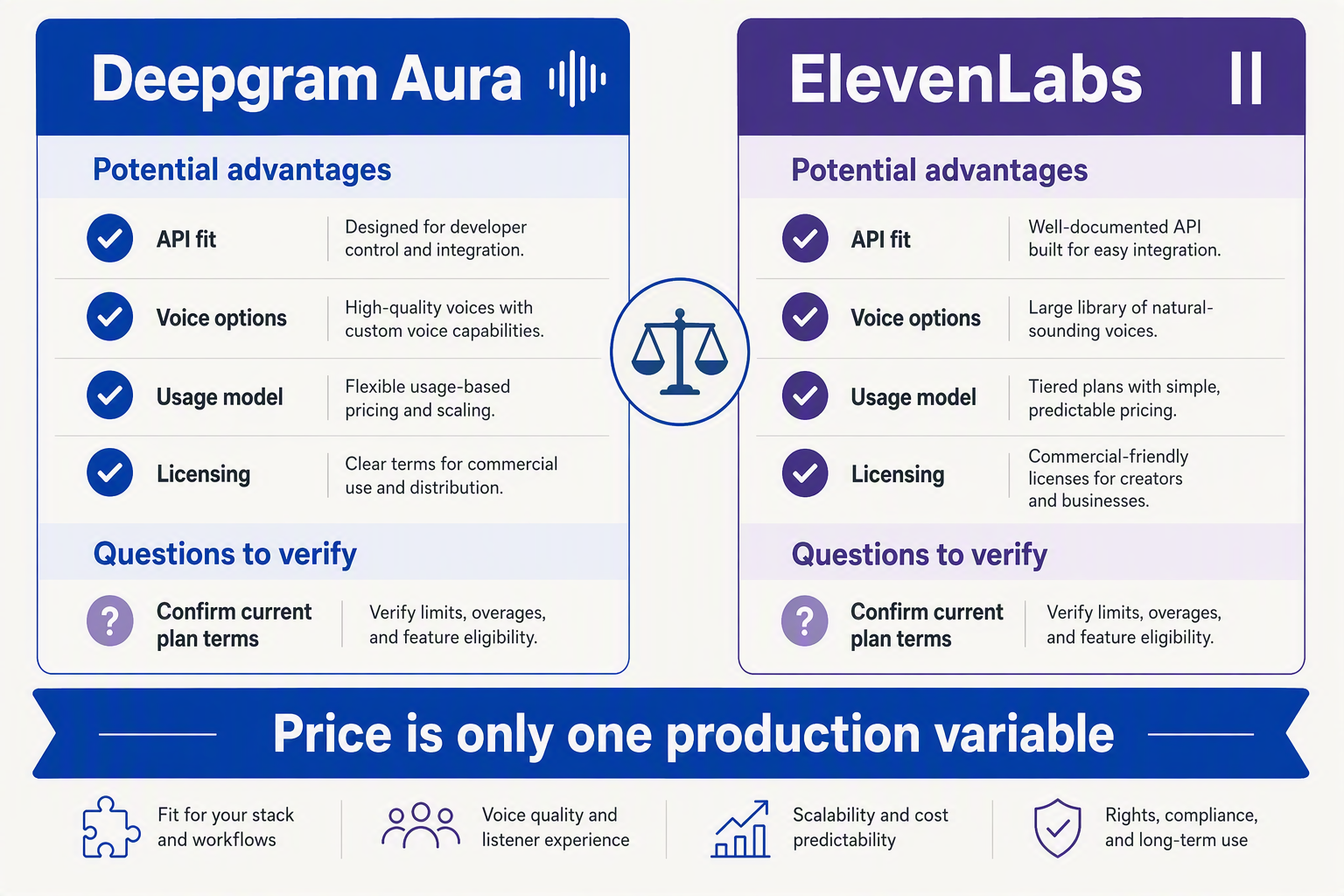
No definitive winner emerges from Deepgram Aura vs ElevenLabs pricing: this research did not verify reliable, current official prices for either service. The honest comparison is therefore about trade-offs and verification requirements—not a claim that Deepgram Aura or ElevenLabs is cheaper.
Head-to-head trade-offs
| Dimension | Deepgram Aura | ElevenLabs | Verification status |
|---|---|---|---|
| Official price | Not verified in this research | Not verified in this research | Check live vendor pricing |
| Comparison unit | Character, quota, or model rules may apply | Characters, credits, or subscription rules may apply | Confirm billing documentation |
| API access | Requires live-plan confirmation | Requires live-plan confirmation | Verify API availability and limits |
| Voice and model choice | Aura model, voices, and controls require confirmation | Voice, model, and cloning options require confirmation | Test the selected production tier |
| Commercial usage | Licensing terms require plan-level review | Licensing terms require plan-level review | Confirm before deployment |
| Scale comparison | Normalize at 1,000,000 and 10,000,000 characters | Use the same workloads | Mathematical workload, not vendor pricing |
- Deepgram Aura pros: A production candidate if its live API plan provides the required latency, voice controls, language coverage, and commercial terms.
- Deepgram Aura cons: Current Deepgram Aura pricing, free allowance, overage rate, and minimum commitment were not verified here.
- ElevenLabs pros: A production candidate if its selected voice, model, API limits, licensing, and subscription terms match the application.
- ElevenLabs cons: Current ElevenLabs pricing and the conversion between subscription credits and characters were not verified here.
- Both: Compare
base fee + included-usage overageat identical volumes; do not compare a headline subscription price with a raw per-character rate. - Decision rule: Choose only after testing voice quality, latency, pronunciation controls, support, and enterprise terms alongside price; platforms such as CallMissed illustrate how unified AI infrastructure can consolidate multiple models and communication channels behind one billing layer.
What do you get besides the voice-generation price?
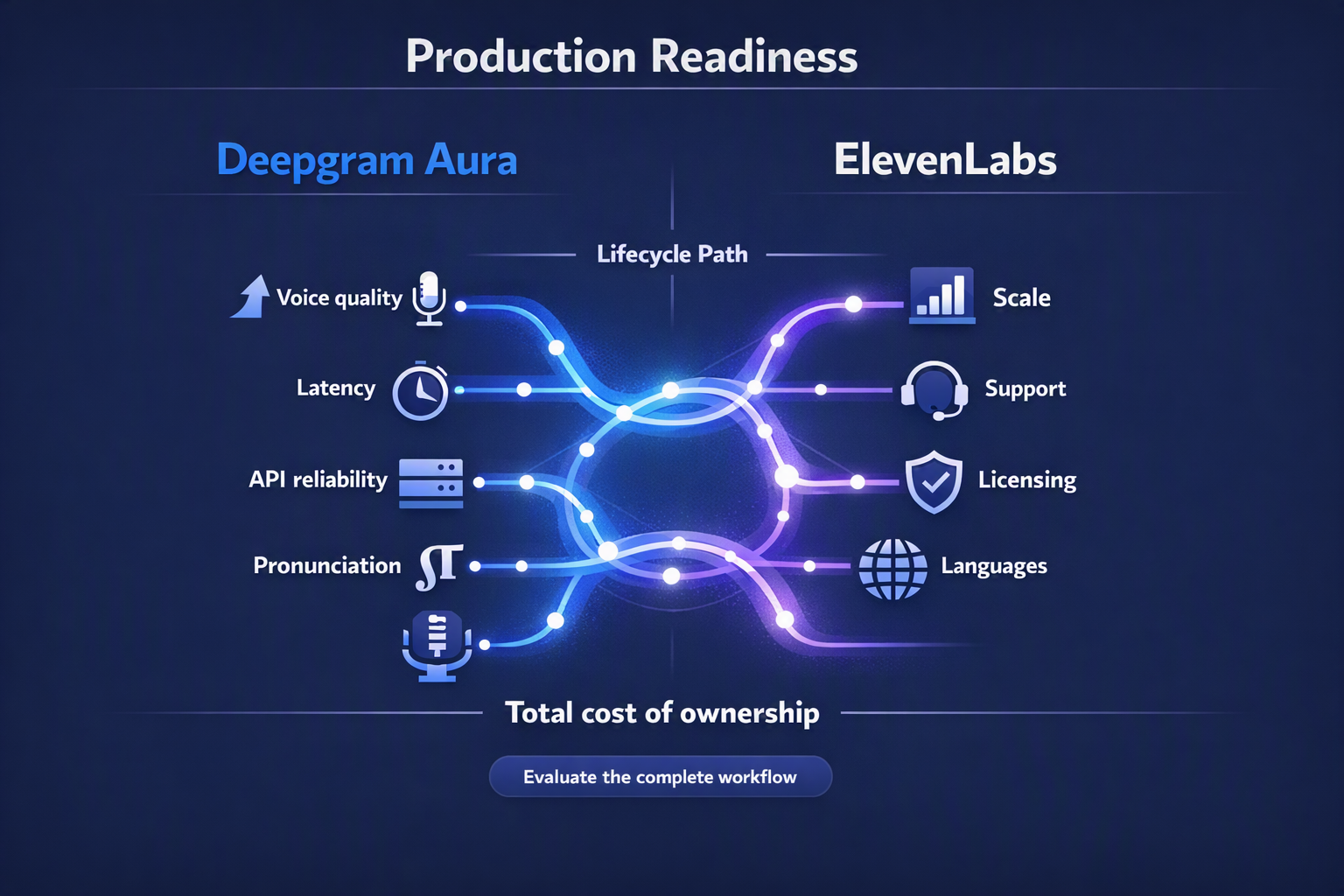
The voice-generation rate is only one part of the purchase: Deepgram Aura vs ElevenLabs pricing must also account for API access, production controls, licensing, and operational support. No reliable current vendor-specific figures for these terms were verified in this research, so confirm them on the live plan pages.
What to verify beyond the price
- API access: Confirm whether the selected Deepgram Aura or ElevenLabs model is available through the required API, SDK, regions, rate limits, and concurrency tier.
- Voice selection: Check the number of included voices, custom-voice availability, voice cloning requirements, and whether cloning carries separate consent or verification rules.
- Latency and output: Test first-byte latency, streaming support, audio formats, sample rates, interruption handling, and pronunciation accuracy using the same script and settings.
- Language coverage: Verify supported languages and dialects for the exact model—not merely the vendor’s overall language list—especially for Indian-language deployments.
- Commercial rights: Confirm whether generated audio, cloned voices, and customer-facing usage are covered by the selected subscription or require separate commercial licensing.
- Controls and reliability: Compare pronunciation dictionaries, SSML or equivalent controls, prosody settings, webhook behavior, uptime commitments, retries, and documented rate limits.
- Enterprise terms: Request written details on data retention, training opt-out, regional processing, security reviews, support response times, minimum commitments, and overage handling.
For teams building a broader communication stack, CallMissed combines voice agents, WhatsApp Business calling, chat, and an OpenAI-compatible multi-model gateway; that can shift the comparison from voice price alone to total integration and operations cost.
Which should you choose: Deepgram Aura or ElevenLabs?
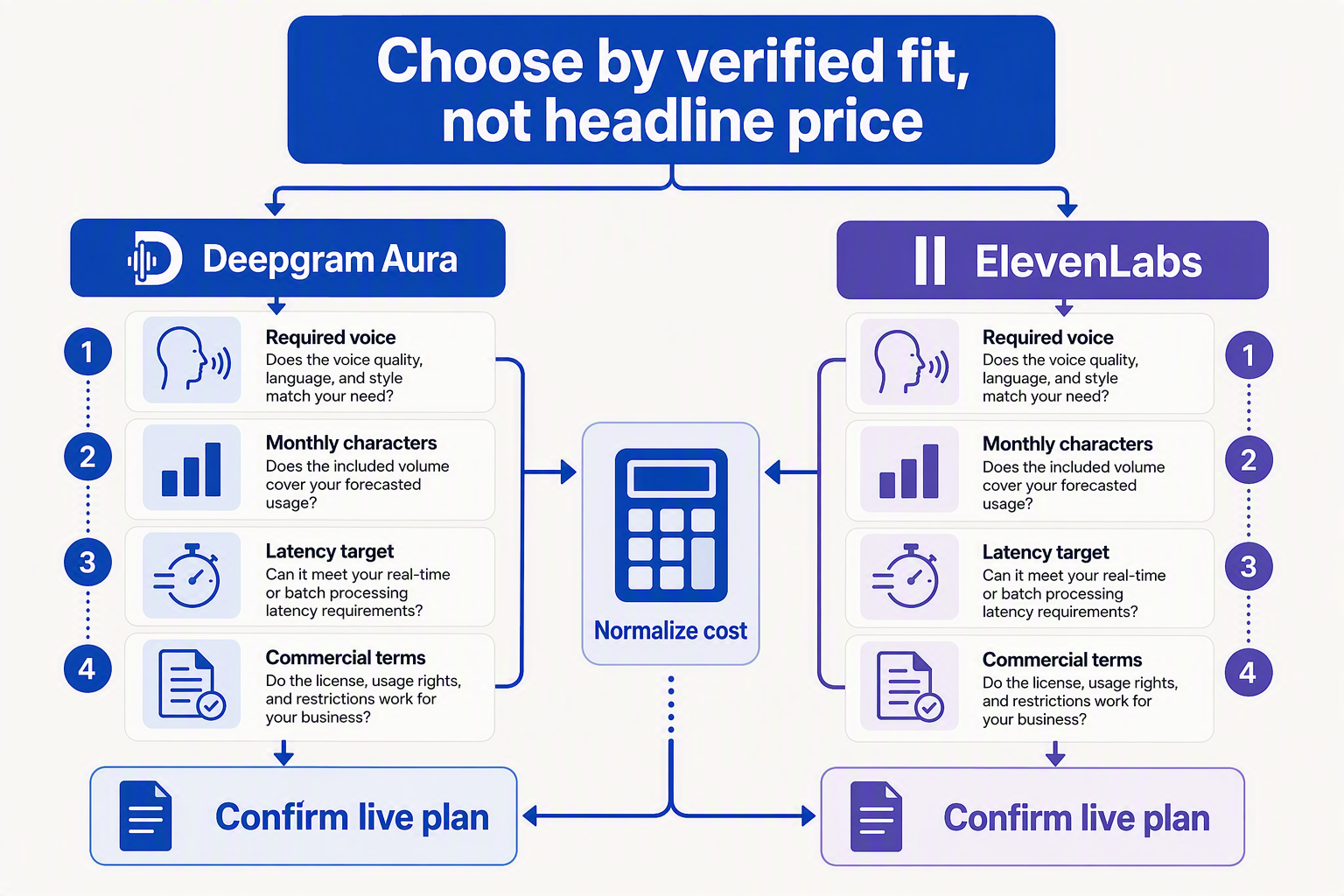
For Deepgram Aura vs ElevenLabs pricing, choose based on verified fit—not an assumed cheaper rate: this research found no reliable current official price figures for either service. Check each vendor’s live plan, selected model, billing unit, and monthly volume before committing.
- Choose Deepgram Aura if its live plan matches your required API access, latency, voice quality, language coverage, pronunciation controls, and commercial rights; Deepgram Aura pricing remains unverified here.
- Choose ElevenLabs if its current plan offers the voices, model selection, output quality, licensing, and support your application needs; ElevenLabs pricing and overage rules also require live confirmation.
- For cost comparison: calculate both vendors at 1,000,000 characters and 10,000,000 characters, rather than comparing subscription headlines or different included quotas.
- For billing accuracy: record the base fee, included usage, overage rate, minimum commitment, taxes, and rounding rules; the applicable formula is
monthly cost = base fee + usage overage. - For production voice agents: compare latency, streaming behavior, uptime commitments, concurrency, support, and enterprise terms alongside per-character or credit costs.
- Do not equate units automatically: character billing, subscription credits, model tiers, and audio-duration assumptions can produce different results for the same script.
- For broader infrastructure: teams serving Indian audiences may also evaluate platforms such as CallMissed, which provides an OpenAI-compatible gateway across LLM, speech, image, and search models, plus voice and WhatsApp engagement capabilities.
Bottom line: Deepgram vs ElevenLabs is a fit-and-volume decision until current vendor pricing is verified. Neither Deepgram Aura nor ElevenLabs can honestly be named the cheaper option from the available evidence.
What are the answers to common Deepgram Aura and ElevenLabs pricing questions?
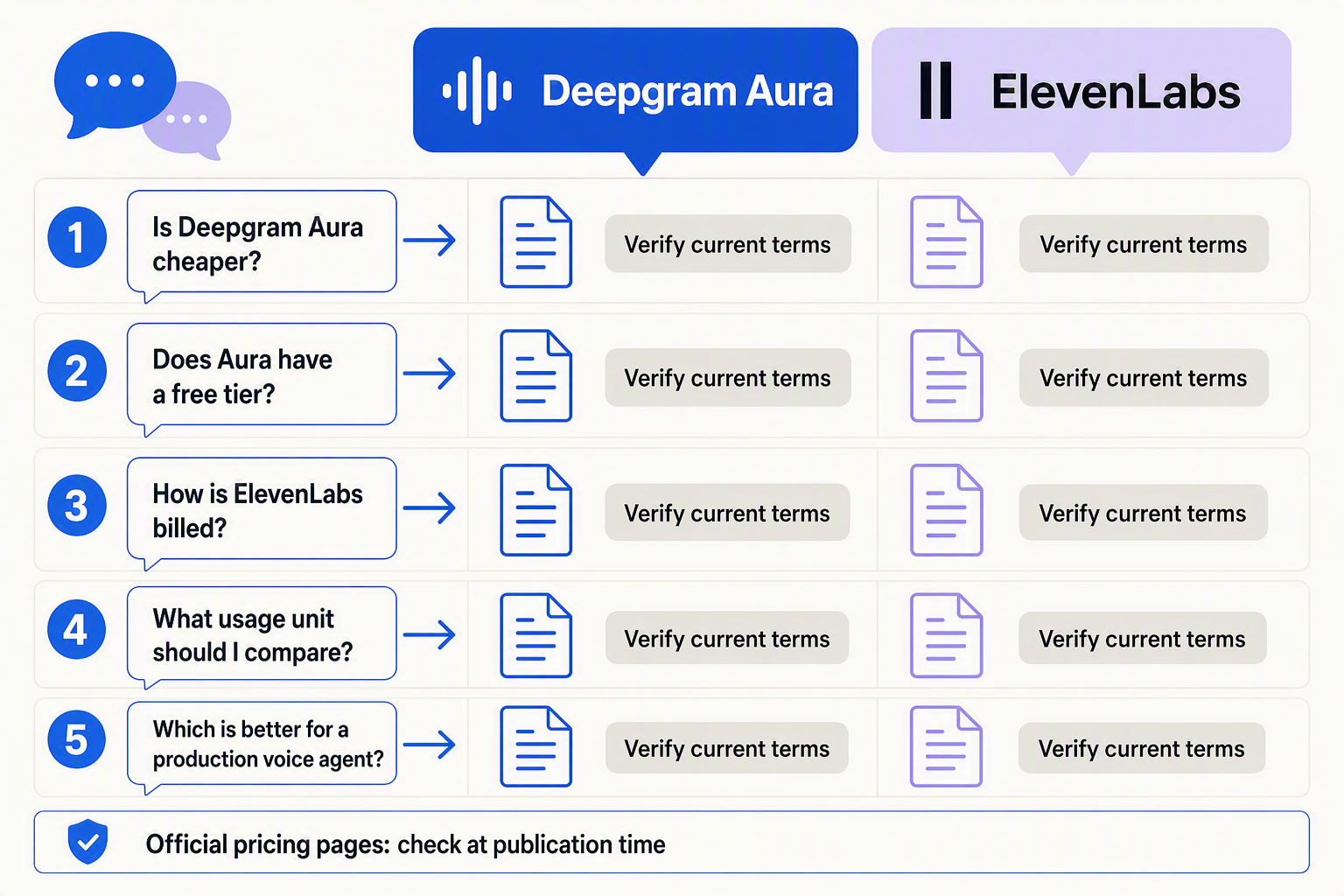
No definitive winner is supported by the available research: Deepgram Aura vs ElevenLabs pricing requires live-plan verification and workload normalization.
- Q: Is Deepgram Aura cheaper than ElevenLabs in the Deepgram Aura vs ElevenLabs pricing comparison?
A: Not reliably; this research verified no current official price figures for either service. Compare the same character volume, model, plan, included quota, overage rate, taxes, and minimum commitments before declaring one cheaper.
- Q: How does Deepgram Aura pricing work?
A: The available research does not confirm Deepgram Aura’s current billing unit, free allowance, overage rate, or plan minimums. Verify those terms on Deepgram’s live pricing and API documentation before calculating a monthly cost.
- Q: How does ElevenLabs pricing work?
A: Current ElevenLabs pricing was not verified in the supplied research, so its subscription credits, character limits, API access, overages, and commercial rights require confirmation. Do not compare an ElevenLabs subscription credit directly with Aura characters without checking the conversion rules.
- Q: Does Deepgram Aura have a free tier?
A: The research does not verify a current Deepgram Aura free tier or its limits. Confirm eligibility, expiration, API availability, and whether unused credits or included characters roll over.
- Q: What usage unit should I compare for Deepgram Aura vs ElevenLabs pricing?
A: Start with identical workloads, such as 1,000,000 characters and 10,000,000 characters, then apply each vendor’s billing and rounding rules. Estimate audio duration separately only when the vendor publishes a reliable character-to-duration assumption.
- Q: Which is better for a production voice agent: Deepgram Aura or ElevenLabs?
A: Price alone cannot answer this; evaluate latency, voice quality, language coverage, pronunciation controls, model selection, licensing, support, and enterprise terms. Teams can also consider unified infrastructure such as CallMissed, which provides multiple AI capabilities through one OpenAI-compatible gateway.
Conclusion
The Deepgram Aura vs ElevenLabs pricing verdict is simple: no definitive winner can be named until live vendor pricing, plans, models, usage units, and volume are verified.
- Normalize both services at 1,000,000 and 10,000,000 characters.
- Include base fees, quotas, overages, taxes, rounding, licensing, latency, and voice quality.
- Treat free tiers, credits, and audio-duration assumptions as plan-dependent.
As pricing becomes more transparent, watch for clearer metering and enterprise terms. To explore how AI communication is evolving, check out CallMissed, an AI infrastructure platform for voice agents and multilingual chatbots. Which cost model best fits your production scale?
Related Reading
Discussion
Related Posts
Ready to automate customer conversations?
Launch AI voice agents and WhatsApp bots with CallMissed — one API, 22+ Indian languages.