
Aura-2 vs ElevenLabs Turbo v3: TTS Quality, Pricing, and the Model-Name Catch (2026)


Aura-2 vs ElevenLabs compared by verified model names, voice quality, latency, pricing, languages, and fit for agents, narration, and creative audio.
Aura-2 vs ElevenLabs Turbo v3: TTS Quality, Pricing, and the Model-Name Catch (2026)
What if the biggest problem with Aura-2 vs ElevenLabs Turbo v3 is that “Turbo v3” may not be a verifiable official model name? Based on the researched official materials, there is no reliable public head-to-head quality benchmark under that exact label, so declaring a definitive winner would be misleading. Deepgram Aura-2 is clearly documented for low-latency business voice applications, while ElevenLabs identifies Eleven v3 as its latest expressive model and describes its low-latency model separately. Deepgram’s 2026 API comparison lists Aura-2 at roughly 90 ms latency, versus approximately 75 ms for ElevenLabs Flash v2.5. This comparison separates voice quality from latency, pricing, language coverage, and API fit—then explains which model suits real-time agents, narration, or creative audio. Platforms such as CallMissed reflect this broader shift toward production-ready, multilingual voice infrastructure.
Which sounds better: Aura-2 or ElevenLabs Turbo v3? The verified verdict comes first
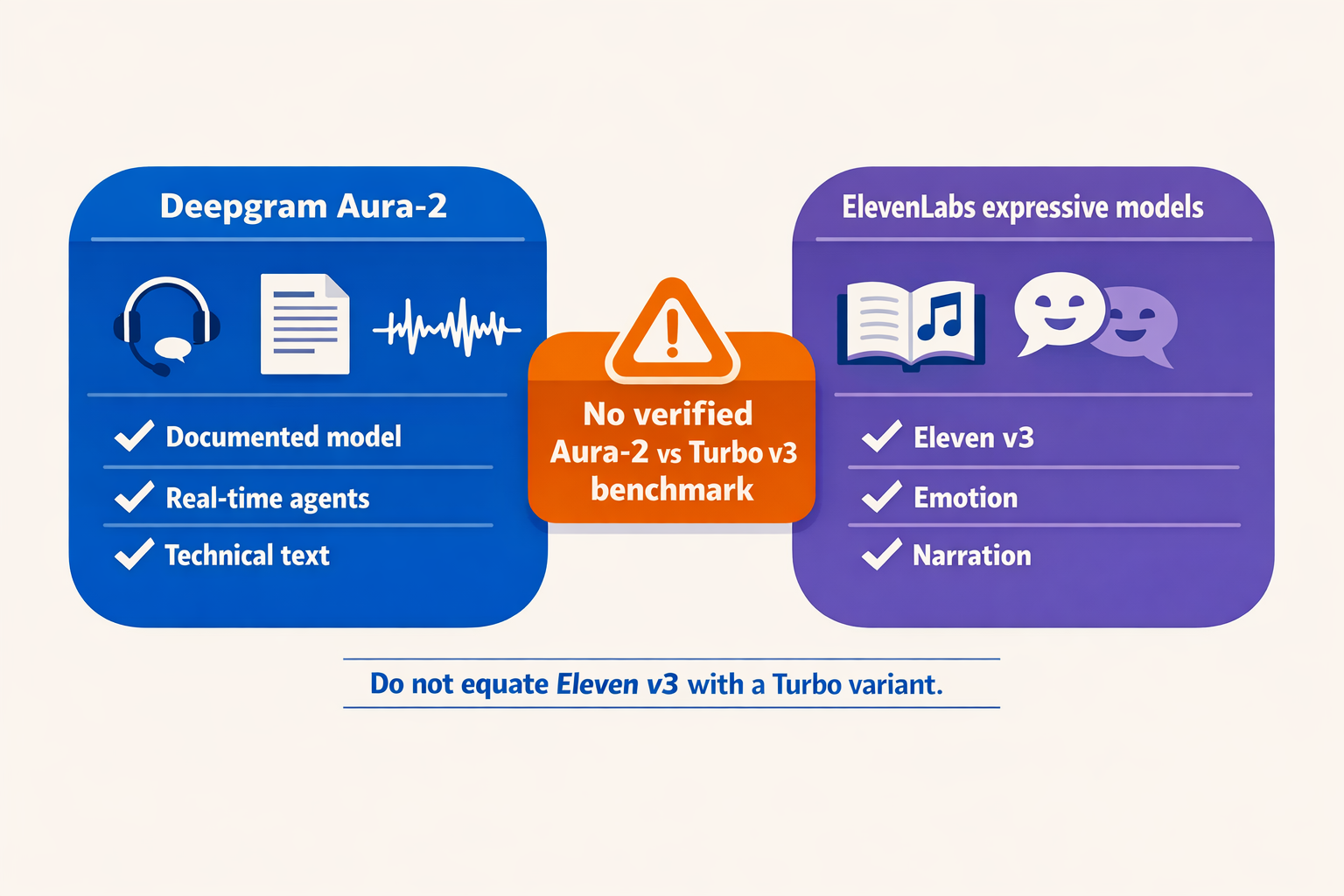
Verdict: There is no verified official “ElevenLabs Turbo v3” model—or reliable public head-to-head benchmark under that exact name—in the researched official sources. An honest Aura-2 vs ElevenLabs Turbo v3 quality winner therefore cannot be declared. Aura-2 is the safer documented choice for real-time business voice, while ElevenLabs’ verified expressive models are stronger candidates for narration and creative audio.
- Aura-2: Deepgram documents Aura-2 as an enterprise TTS model designed for real-time agents, voicebots, and business conversations. In an Aura-2 vs ElevenLabs Turbo v3 evaluation, Aura-2 is the only one of those exact names that can be tied confidently to a documented official model.
- ElevenLabs model-name catch: Eleven v3, Flash v2.5, and Turbo v2.5 are distinct model names—not interchangeable labels. ElevenLabs presents Eleven v3 as an expressive model, Flash v2.5 as a low-latency option, and Turbo v2.5 as a separate model. The researched official materials do not establish “Turbo v3” as an official product name.
- Latency: Deepgram’s 2026 API comparison lists Aura-2 at approximately 90 ms and ElevenLabs Flash v2.5 at approximately 75 ms. That comparison concerns Flash v2.5, not Eleven v3 or a supposed Turbo v3, and it is a latency comparison rather than a voice-quality verdict.
- Quality guidance: For concise, technical, and transactional dialogue, Aura-2 is a defensible choice. For emotion, character, and expressive narration, test Eleven v3 or another verified ElevenLabs model. Any Aura-2 vs ElevenLabs Turbo v3 listening claim should be rejected unless the evaluator discloses the actual ElevenLabs model ID used.
- Pricing: Deepgram’s pricing page lists Aura TTS at $0.015 per 1,000 characters, while Deepgram’s Aura-2 announcement separately cites $0.03 per 1,000 characters. Buyers should confirm the current endpoint, model, and rate card before budgeting. A valid Aura-2 vs ElevenLabs Turbo v3 cost comparison also requires replacing the unverified “Turbo v3” label with the exact billable ElevenLabs model.
- Selection guidance: Do not silently equate Turbo v3 with Eleven v3, Flash v2.5, or Turbo v2.5. For production voice agents, turn the ambiguous Aura-2 vs ElevenLabs Turbo v3 question into a reproducible test: select exact model IDs, use identical scripts and audio settings, measure end-to-end latency, calculate pricing from current rate cards, and conduct blinded human listening tests.
Is ElevenLabs Turbo v3 an official model, or is the name the catch?
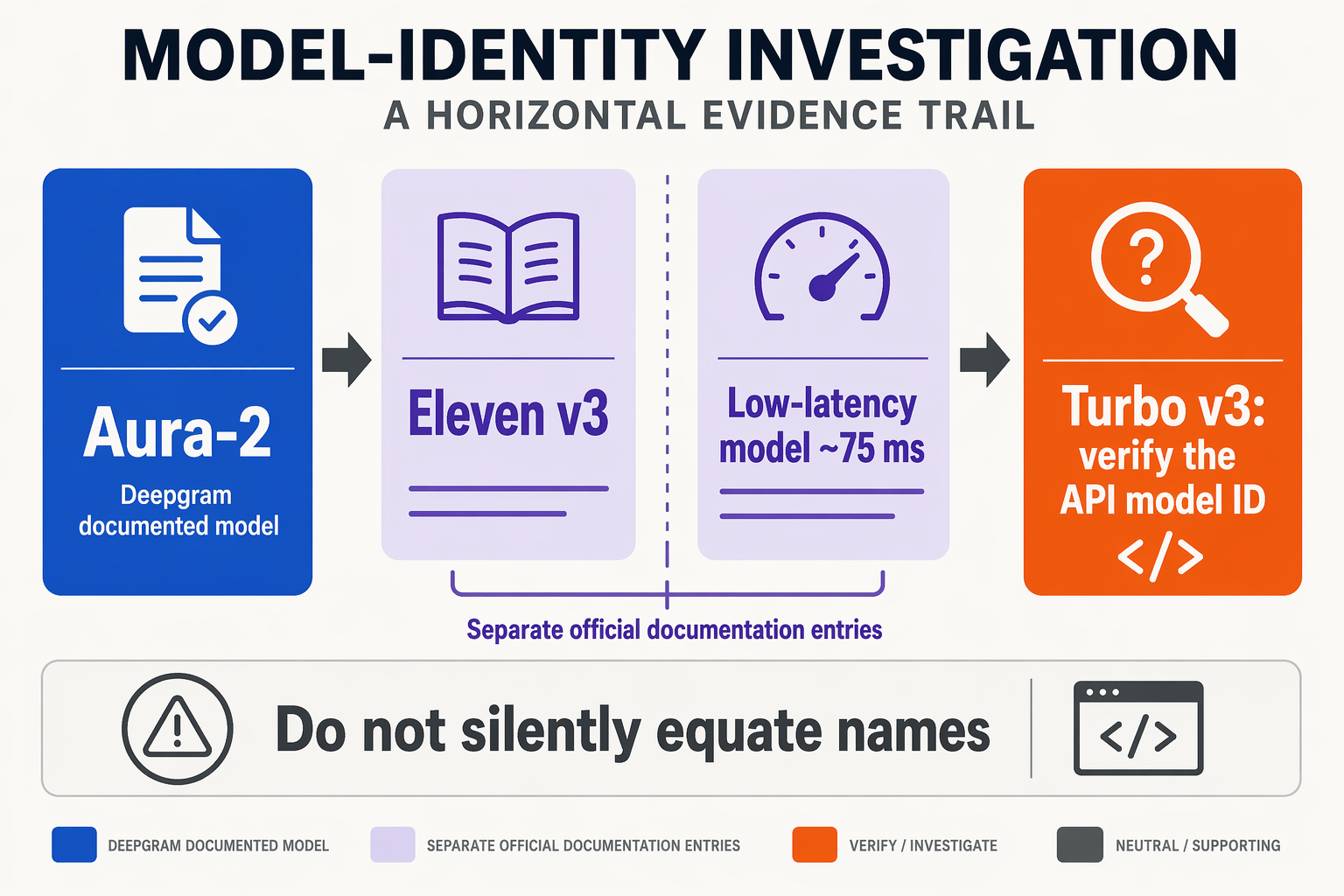
There is no verified official “ElevenLabs Turbo v3” model name or reliable public head-to-head benchmark for that exact label in the researched sources. The catch is that “Turbo v3” should not be silently treated as Eleven v3: the documented ElevenLabs models have different positioning and performance profiles.
- ElevenLabs’ official naming: ElevenLabs identifies Eleven v3 as its latest expressive model, while its low-latency offering is documented separately; the researched official materials do not establish “Turbo v3” as a product model.
- Aura-2: Deepgram documents Aura-2 as an enterprise TTS model designed for real-time agents, voicebots, and business conversations—not as a creative-narration model with an unverified name.
- Quality comparison: No reliable public test compares Aura-2 directly with “Turbo v3,” so claims that one sounds definitively better are unsupported unless the exact ElevenLabs model ID is disclosed.
- Latency distinction: Deepgram’s 2026 API comparison reports approximately 90 ms for Aura-2 and 75 ms for ElevenLabs Flash v2.5; these figures measure responsiveness, not naturalness, emotion, or overall voice quality.
- Practical interpretation: Aura-2: the safer documented choice for technical, transactional, and latency-sensitive dialogue. Verified ElevenLabs expressive models: more relevant for narration, character voices, and emotionally styled audio, depending on the selected model.
- Evaluation rule: Ask for the exact provider, model ID, voice, language, and API endpoint before comparing price or quality; otherwise, “Turbo v3” may describe a reseller label, informal shorthand, or a model-selection mistake rather than a verifiable product.
How do Aura-2 and ElevenLabs compare on quality, latency, languages, and API fit?
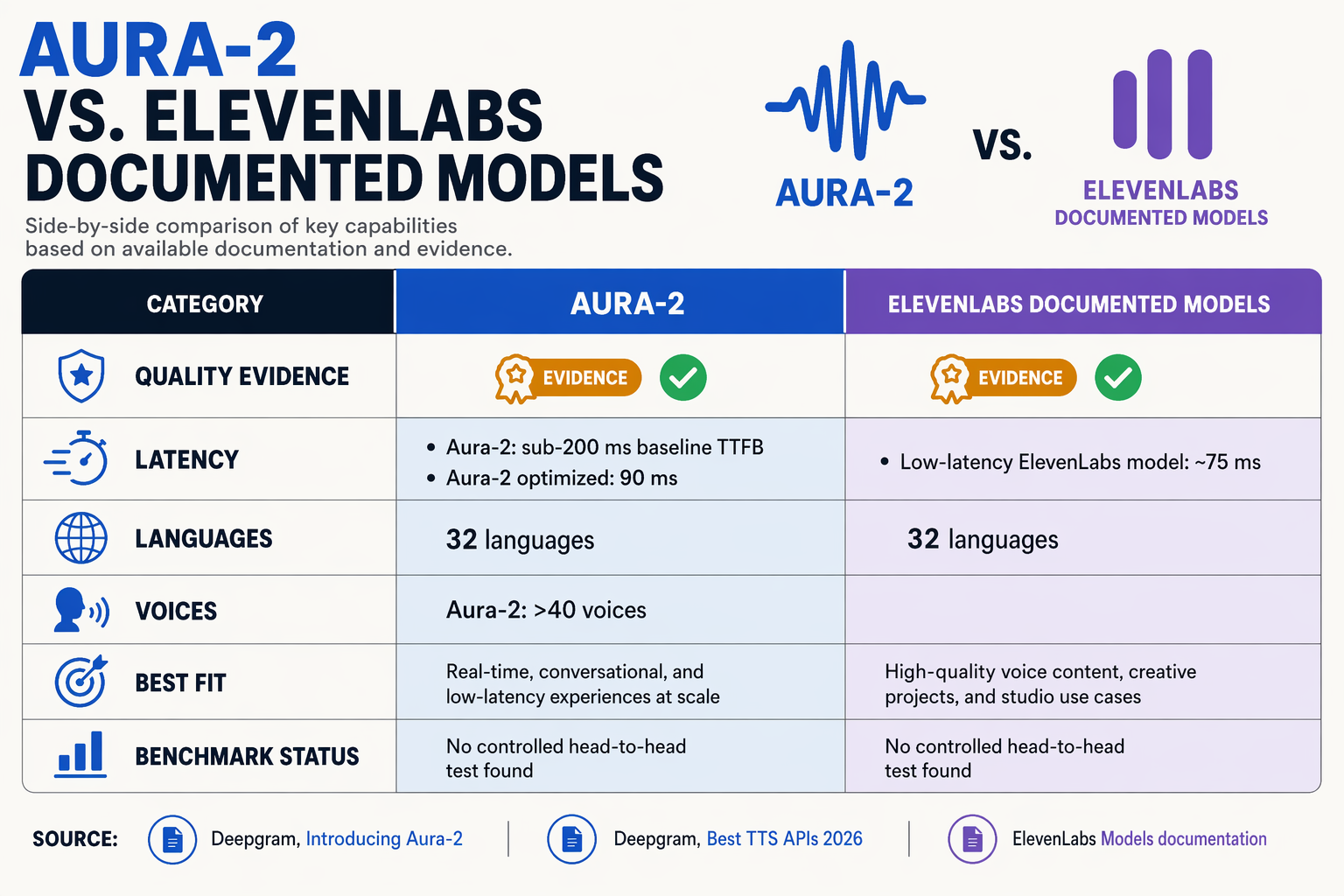
There is no verified official “ElevenLabs Turbo v3” model or reliable public head-to-head benchmark for that exact label, so neither model can be declared the quality winner. Aura-2 is the safer documented choice for real-time business voice, while ElevenLabs’ verified expressive models are more relevant to narration and creative audio.
- Quality: Aura-2 targets concise, technical, transactional dialogue; ElevenLabs’ verified expressive models emphasize emotion, character, and narration.
- Latency: Deepgram’s 2026 API comparison lists Aura-2 at approximately 90 ms and ElevenLabs Flash v2.5 at approximately 75 ms; this does not validate “Turbo v3.”
- Pricing: Deepgram’s pricing page lists Aura TTS at $0.015 per 1,000 characters; Deepgram’s Aura-2 announcement separately cites $0.03 per 1,000 characters, so verify the endpoint and rate card.
- Languages and voices: Together AI describes Aura-2 as offering 40+ professional voices; exact language and voice availability should be checked against the selected API model.
- API fit: Aura-2 is documented for voicebots and real-time agents, while ElevenLabs is a strong fit for expressive audio workflows; model IDs, streaming behavior, and quotas matter more than marketing names.
Head-to-head comparison
| Factor | Deepgram Aura-2 | ElevenLabs verified models | Practical verdict |
|---|---|---|---|
| Quality target | Business dialogue and voice agents | Expression, emotion, narration | Use-case dependent |
| Latency | ~90 ms, Deepgram API comparison, 2026 | ~75 ms for Flash v2.5, Deepgram API comparison, 2026 | Flash v2.5 has the cited latency edge |
| Pricing | $0.015/1,000 characters on Deepgram pricing; $0.03 cited in Aura-2 announcement | Depends on the exact ElevenLabs plan and model | Confirm current rate cards |
| Voice coverage | 40+ professional voices, Together AI | Broad voice and expressive-audio options; no verified “Turbo v3” figure | Compare exact catalogs |
| API suitability | Real-time agents, voicebots, business applications | Narration, creative audio, and expressive generation | Match API to workload |
Bottom line: Choose Aura-2 for documented, latency-sensitive business voice; choose a verified ElevenLabs expressive model for creative narration—without treating “Turbo v3” as equivalent to Eleven v3.
How much does each model cost, and which offers better value?
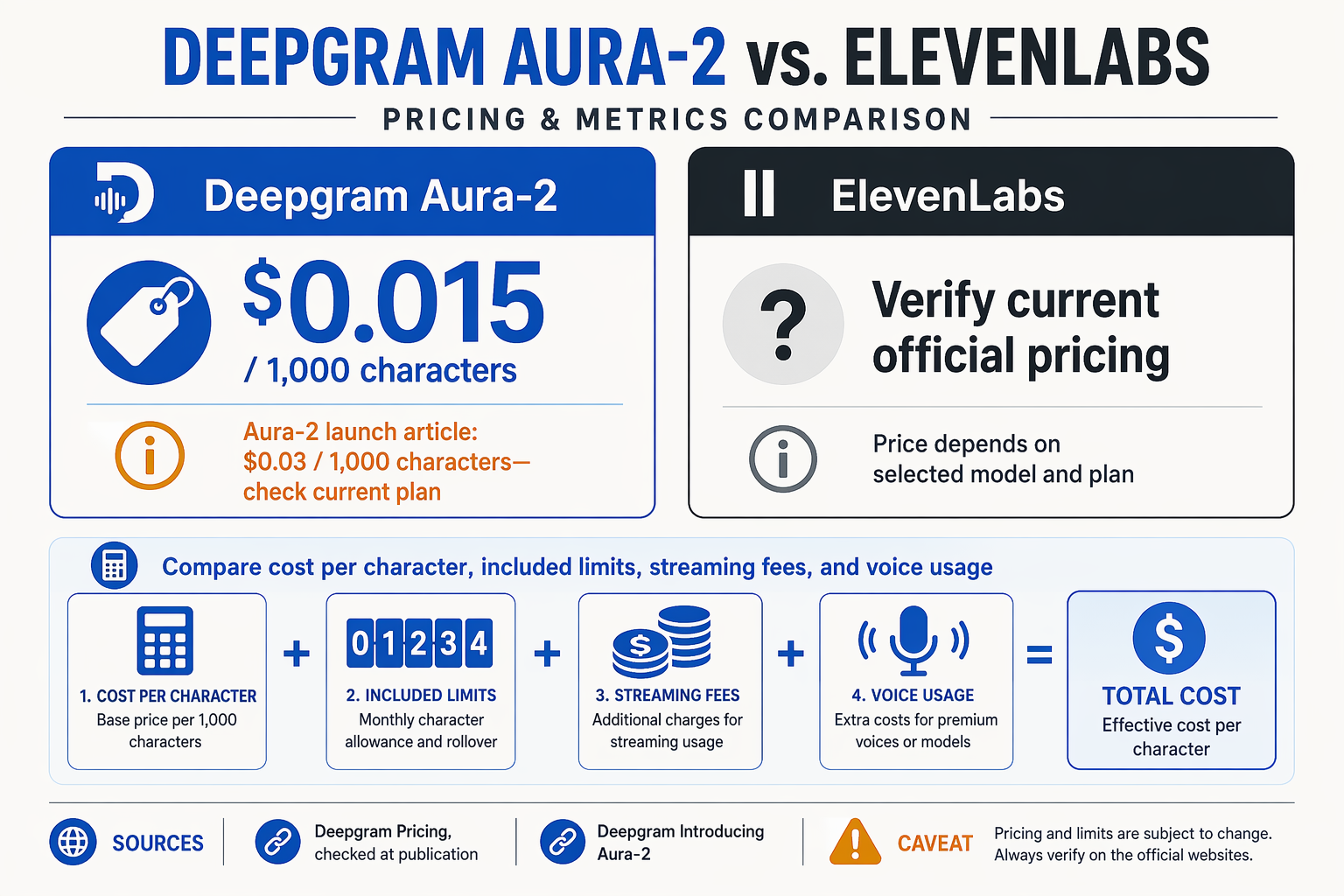
There is no verified official “ElevenLabs Turbo v3” rate card in the researched sources, so a precise value winner cannot be declared under that label. Aura-2 has the clearer documented cost basis for production voice agents, while ElevenLabs pricing must be checked against the exact verified model and plan.
What do the published rates actually show?
- Deepgram Aura TTS: Deepgram’s pricing page, accessed July 11, 2026, lists $0.015 per 1,000 characters, equivalent to approximately $15 per million characters.
- Deepgram Aura-2: Deepgram’s Aura-2 announcement cites $0.03 per 1,000 characters, or approximately $30 per million characters; verify the endpoint and current rate card before procurement.
- ElevenLabs Flash v2.5: Deepgram’s 2026 API comparison lists approximately 75 ms latency, but the supplied source does not provide a directly comparable per-character price.
- ElevenLabs Eleven v3: Official ElevenLabs materials identify Eleven v3 as an expressive model, not “Turbo v3”; its applicable pricing should not be inferred from another ElevenLabs model.
- “Turbo v3”: No verified model-specific price or benchmark was established in the researched sources, making any cost-per-million-character claim speculative.
| Model or label | Published price evidence | Billing basis | Value interpretation | Source |
|---|---|---|---|---|
| Deepgram Aura TTS | $0.015 / 1,000 characters | Characters | Clear, predictable usage pricing | Deepgram Pricing, accessed July 11, 2026 |
| Deepgram Aura-2 | $0.03 / 1,000 characters | Characters | Confirm endpoint-specific rate before budgeting | Deepgram Aura-2 announcement |
| ElevenLabs Flash v2.5 | Not supplied | Verify current plan | Compare exact model and plan, not latency alone | Deepgram API comparison, 2026 |
| ElevenLabs Eleven v3 | Not supplied | Verify current plan | Expressive quality may justify different economics | Official ElevenLabs materials |
| “ElevenLabs Turbo v3” | Not verified | Not established | Do not build a forecast around this label | Researched official materials |
- Best documented value: Aura-2 when transparent character pricing and real-time business voice are the priorities.
- Best comparison method: Test identical scripts, character counts, output quality, and interruption handling using the exact production model IDs; platforms such as CallMissed can simplify multi-model API evaluation.
What are the honest pros and cons of Aura-2 versus ElevenLabs?
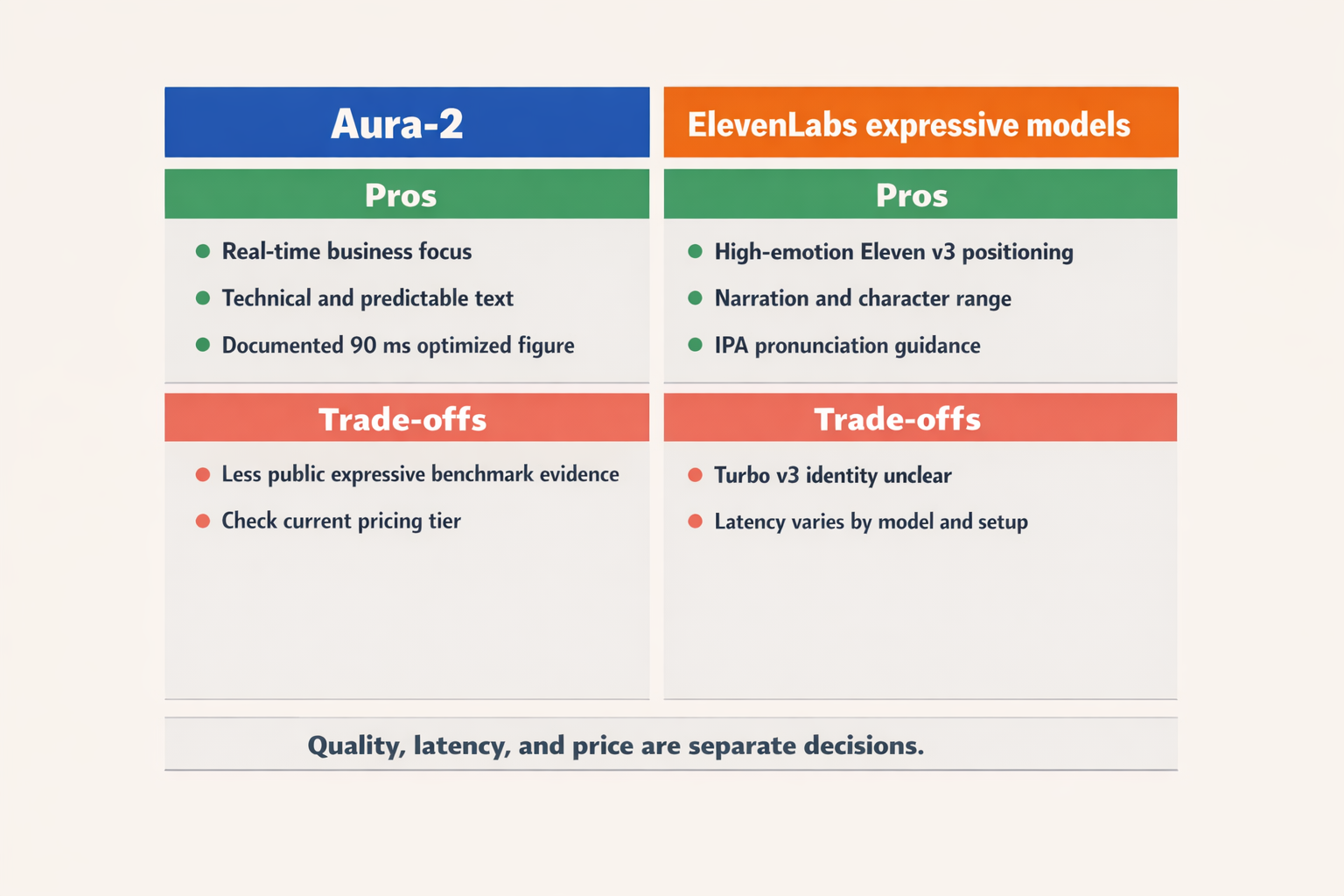
There is no verified official “ElevenLabs Turbo v3” model or reliable public head-to-head benchmark for that exact label, so neither model can honestly be declared the quality winner. Aura-2 is the safer documented choice for real-time business voice, while verified ElevenLabs expressive models are more relevant to narration and creative audio.
- Aura-2 pros: Deepgram positions Aura-2 for real-time agents, voicebots, and enterprise conversations; Together AI lists 40+ professional voices.
- Aura-2 cons: Deepgram’s published pricing is inconsistent across materials: its pricing page lists $0.015 per 1,000 characters, while the Aura-2 announcement cites $0.03 per 1,000 characters.
- ElevenLabs pros: Official ElevenLabs materials identify Eleven v3 as an expressive model, making the verified product family relevant to emotion, narration, and creative delivery.
- ElevenLabs cons: “Turbo v3” should not be treated as an official model ID without documentation; the low-latency ~75 ms figure cited by Deepgram refers to ElevenLabs Flash v2.5, not a verified Turbo v3.
- Best practice: Test the exact production model with identical scripts, measuring pronunciation, prosody, interruption handling, latency, and cost.
| Comparison area | Aura-2 | Verified ElevenLabs reference | Honest trade-off |
|---|---|---|---|
| Primary fit | Real-time agents and business voice | Eleven v3: expressive narration and creative audio | Use case matters more than a generic quality label |
| Documented latency | Approximately 90 ms | Flash v2.5: approximately 75 ms | Deepgram’s 2026 comparison measures latency, not voice quality |
| Published pricing | $0.015/1,000 characters on Deepgram Pricing; $0.03 in Aura-2 announcement | Not established for “Turbo v3” | Confirm the exact endpoint and rate card |
| Voice breadth | 40+ professional voices, according to Together AI | Depends on the selected ElevenLabs model and voice | Compare voices required by the application |
| API fit | Designed for production conversational systems | Strong fit for expressive audio workflows | Validate SDK, streaming, and fallback requirements |
For Indian teams building multilingual customer engagement, platforms such as CallMissed extend this production-voice direction with AI voice agents and speech support across 22 Indian languages.
Which should you use for voice agents, technical text, narration, or creative audio?
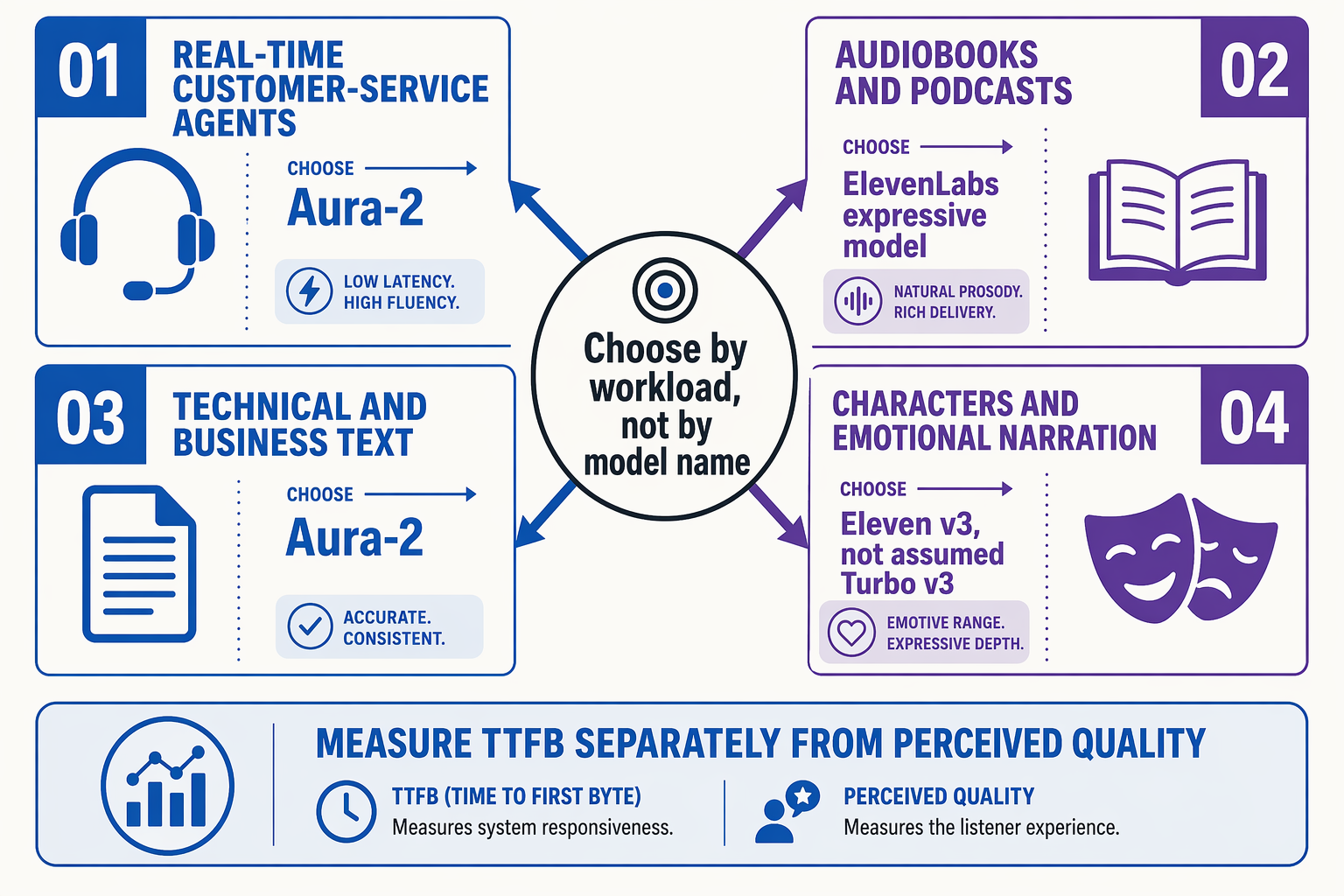
There is no defensible winner for the unverified label “ElevenLabs Turbo v3.” Choose based on the exact verified model, workload, and production constraints—not on the model name alone.
- Real-time voice agents: Choose Aura-2 when predictable turn-taking matters; Deepgram’s 2026 API comparison lists approximately 90 ms latency, and Deepgram positions Aura-2 for voicebots, business conversations, and enterprise agents.
- Technical and transactional text: Aura-2 is the safer documented fit for instructions, support responses, and concise business dialogue; its enterprise positioning prioritizes intelligibility and real-time delivery rather than dramatic performance.
- Narration and audiobooks: Choose a verified ElevenLabs expressive model when pacing, vocal character, and emotional delivery matter more than agent response time. ElevenLabs’ official materials identify Eleven v3 as its latest expressive model—not “Turbo v3.”
- Creative audio: ElevenLabs: better suited for character voices, emotional reads, and stylized narration, subject to the selected model and voice. Do not assume Eleven v3 and “Turbo v3” are interchangeable.
- Fast conversational experiences: ElevenLabs Flash v2.5 is listed at approximately 75 ms latency in Deepgram’s 2026 API comparison, faster than Aura-2’s approximately 90 ms; this is a latency comparison, not a TTS-quality benchmark.
- Indian-language customer engagement: Evaluate language coverage and pronunciation with real scripts. Platforms such as CallMissed support voice and chat across 22 Indian languages, which is relevant for businesses serving regional Indian audiences.
- Final recommendation: Use Aura-2 for latency-sensitive agents and technical business text; use verified ElevenLabs expressive models for narration and creative audio. Benchmark identical passages, voices, first-byte latency, interruption handling, and total cost before deployment.
What should a fair Aura-2 versus ElevenLabs TTS test measure?
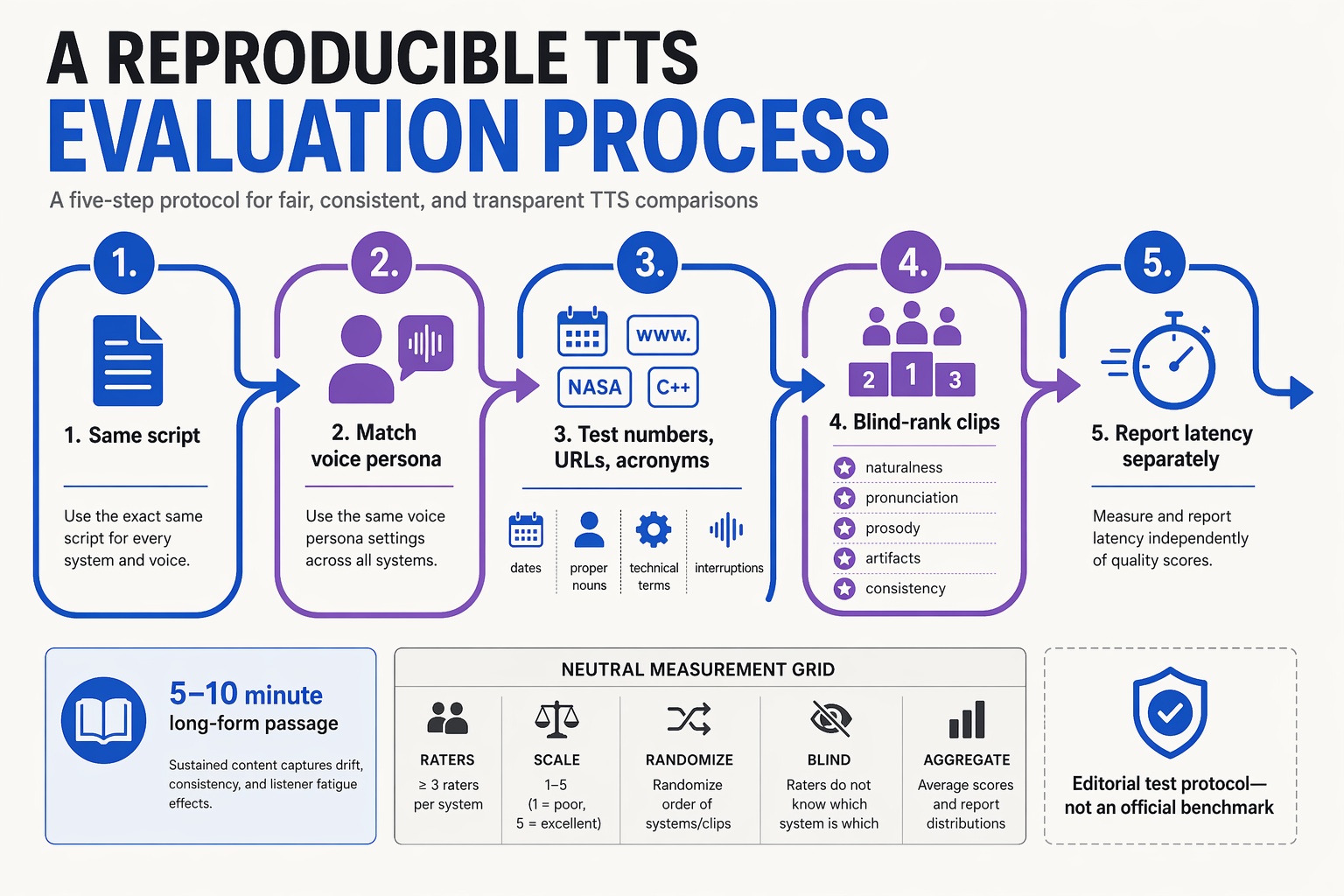
A fair Aura-2 versus ElevenLabs test must first verify the exact ElevenLabs model ID: researched official materials do not establish “Turbo v3” as a verifiable model, so no direct quality winner can be claimed. The test should separate voice quality, latency, price, language coverage, and API behavior rather than treating one score as decisive.
Test dimensions that produce a fair result
- Model identity: Record the full provider model IDs, voice IDs, generation settings, and API version; do not substitute Eleven v3 or Flash v2.5 for an unverified “Turbo v3.”
- Identical scripts: Use the same 500–1,000-word test set across transactional dialogue, technical terms, numbers, dates, questions, interruptions, and emotionally expressive narration.
- Human quality scoring: Have at least 10 blinded listeners rate pronunciation, naturalness, prosody, emotional control, and conversational suitability on a 1–5 scale; report averages and confidence intervals rather than a single subjective winner.
- Latency measurement: Measure time to first audio byte and full utterance completion over at least 100 requests. Deepgram’s 2026 API comparison lists Aura-2 at approximately 90 ms and ElevenLabs Flash v2.5 at approximately 75 ms—figures that should not be presented as “Turbo v3” results.
- Cost normalization: Calculate price per 1 million characters, including retries and unusable output. Deepgram’s pricing page lists Aura TTS at $0.015 per 1,000 characters, while Deepgram’s Aura-2 announcement cites $0.03 per 1,000 characters, so the tested endpoint and rate card must be documented.
- Production fit: Compare streaming, concurrency, voice consistency, pronunciation controls, language coverage, failure handling, and WebSocket/API integration; platforms such as CallMissed can help teams evaluate these requirements across a broader voice infrastructure stack.
Frequently Asked Questions: Is Aura-2 better, is Turbo v3 real, and which is cheapest?
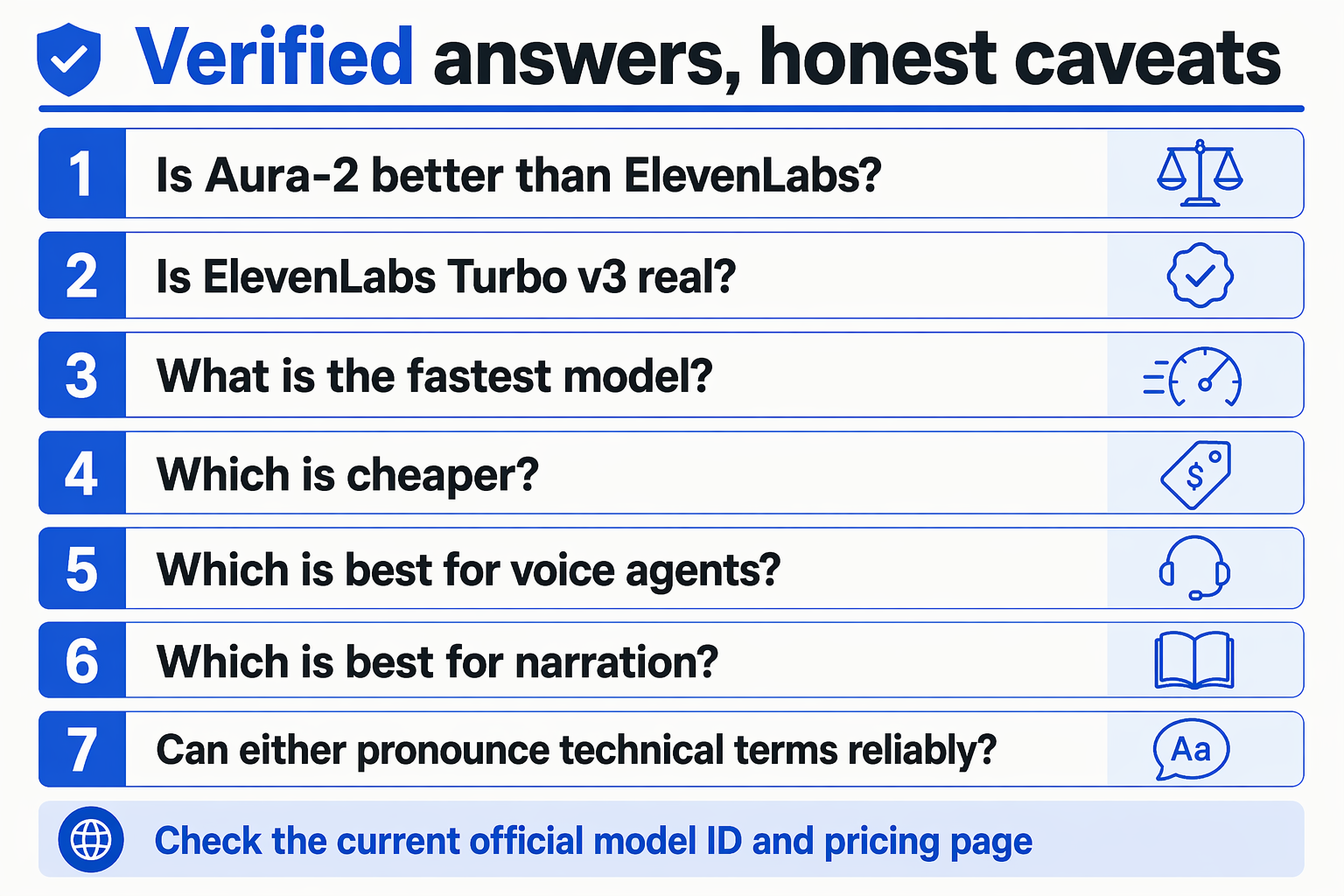
The short answer: Aura-2 is the safer documented choice for real-time business voice, but no verified “ElevenLabs Turbo v3” benchmark supports declaring a quality winner. Treat Turbo v3 as an unverified label until ElevenLabs confirms the exact model ID and rate card.
- Q: Is Aura-2 better than ElevenLabs Turbo v3 for TTS quality?
A: No definitive winner can be established because the researched official sources contain no reliable head-to-head benchmark for “Turbo v3.” Deepgram documents Aura-2 for business agents and conversational voice, while ElevenLabs’ verified Eleven v3 is positioned for expressive, creative audio.
- Q: Is ElevenLabs Turbo v3 a real official model?
A: The researched ElevenLabs materials identify Eleven v3 as the latest expressive model and describe its low-latency model separately; they do not verify “Turbo v3” as an official model name. Confirm the model ID in ElevenLabs documentation or your provider dashboard before comparing quality or cost.
- Q: Which is faster, Aura-2 or ElevenLabs Turbo v3?
A: Deepgram’s 2026 API comparison lists Aura-2 at approximately 90 ms latency and ElevenLabs Flash v2.5 at approximately 75 ms. That is a latency comparison—not evidence that either system produces better-sounding speech.
- Q: Which is cheaper: Aura-2 or ElevenLabs Turbo v3?
A: Deepgram’s pricing page lists Aura TTS at $0.015 per 1,000 characters, while Deepgram’s Aura-2 announcement cites $0.03 per 1,000 characters. Because these figures may apply to different endpoints or pricing contexts, verify the live rate card and the exact ElevenLabs model before calculating total cost.
- Q: Should I choose Aura-2 for an AI voice agent?
A: Choose Aura-2 when predictable, low-latency business dialogue is the priority; Deepgram describes Aura-2 for real-time agents, voicebots, and enterprise applications. For Indian deployments, platforms such as CallMissed add broader communication infrastructure, including AI voice agents and multilingual engagement.
- Q: What is the best way to compare Aura-2 and ElevenLabs Turbo v3?
A: Test the exact verified model IDs with identical scripts, voice styles, streaming settings, and network conditions. Measure time to first audio, interruption recovery, character cost, pronunciation accuracy, and human-rated naturalness rather than relying on the “Turbo v3” label alone.
Conclusion
There is no verified official “ElevenLabs Turbo v3” model or public head-to-head benchmark, so no definitive quality winner exists under that label. Aura-2 is the safer documented choice for real-time business voice, while ElevenLabs’ verified expressive models suit narration and creative audio.
- Deepgram’s 2026 comparison lists approximately 90 ms for Aura-2 versus 75 ms for ElevenLabs Flash v2.5—latency, not quality.
- Deepgram lists Aura TTS at $0.015 per 1,000 characters; verify the endpoint and current rate card.
- Test exact model IDs with identical scripts and human listening.
- Watch for clearer naming and independent 2026 benchmarks.
Explore CallMissed to track multilingual AI communication infrastructure—and ask: which voice model best fits your production workflow?
Related Reading
Discussion
Related Posts
Ready to automate customer conversations?
Launch AI voice agents and WhatsApp bots with CallMissed — one API, 22+ Indian languages.