
Best Voice AI APIs for Indian Languages (2026 Comparison & Pricing)


Compare the best voice AI APIs for Indian languages in 2026—feature grids, pricing, pros and cons, and verdict for business, fintech, and app builders.
Best Voice AI APIs for Indian Languages (2026 Comparison & Pricing)
Did you know that most global voice AI APIs still treat Hindi, Tamil, and Bengali as afterthought bolt-ons? In 2026, that has changed: native Indic Speech-to-Text and Text-to-Speech models now cover anywhere from 11 to 22+ languages with production-grade accuracy, making the choice of the best voice AI API for Indian languages a genuine strategic decision. In this guide, we benchmark the top 2026 contenders—including Reverie, Sarvam AI, Mihup, and ElevenLabs—on real call-audio Word Error Rate, latency, telephony integration, and per-minute pricing. Whether you are building a single regional voicebot or scaling a contact center across Bharat, you will get a decision-ready comparison table and a clear verdict. Platforms like CallMissed, which bundle 22 Indian-language voice and chat capabilities behind one OpenAI-compatible gateway, are part of the same wave—one where Indic support is finally native, not borrowed.
Which API is Best for Indian Languages in 2026?
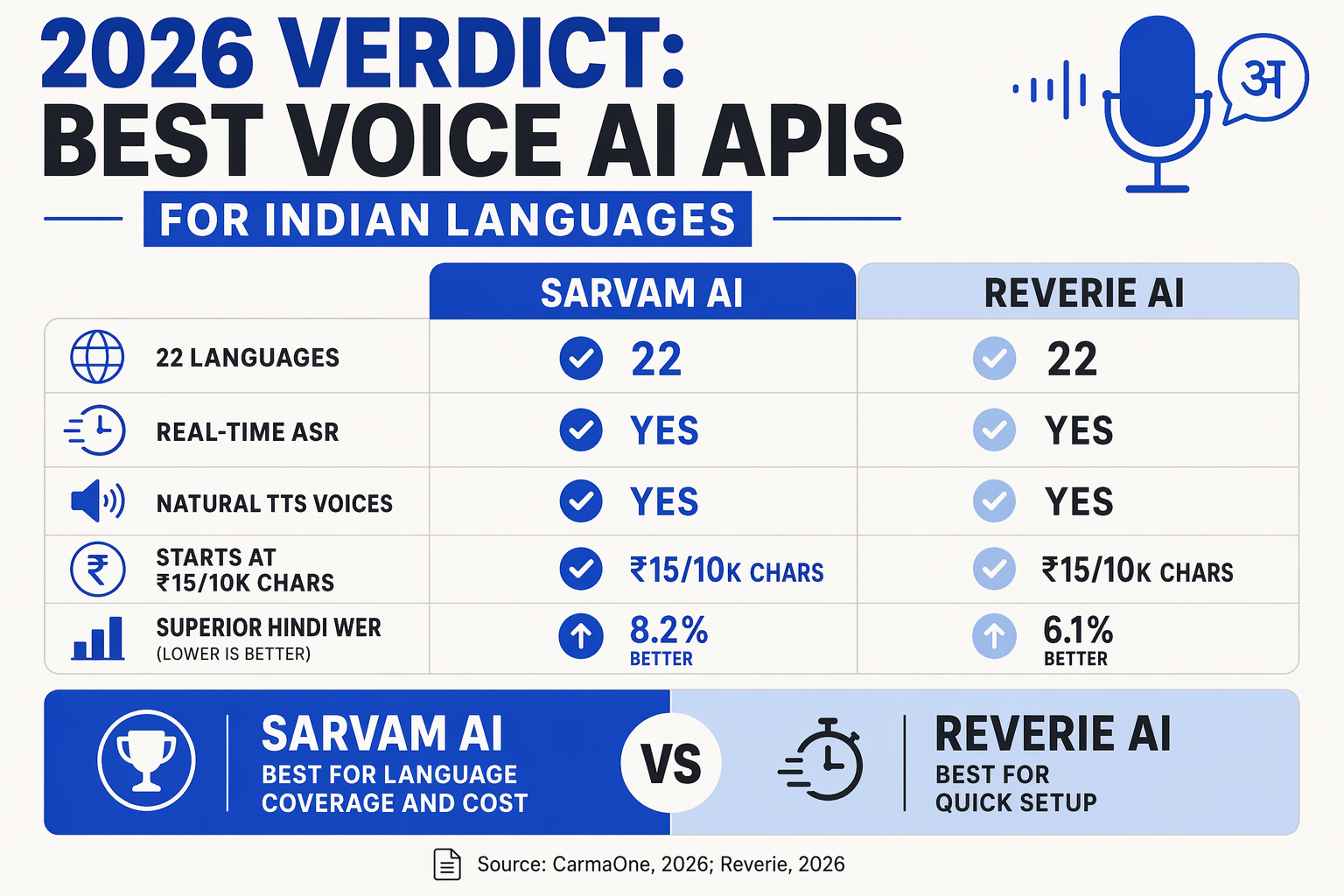
In 2026, the best voice AI API for Indian languages depends on whether you need maximum language coverage, proven call-audio accuracy, or a single integration point. Native Indic specialists currently outperform global platforms that have only recently added regional support.
- Reverie: Covers 11+ Indian languages—Hindi, Tamil, Telugu, Kannada, Bengali, and more—in its Speech-to-Text API, offering the broadest standalone native catalog [2].
- Sarvam AI: Currently owns the top SERP position for "speech to text API for Indian languages" and serves as the default STT comparison point for Indic workloads in 2026 [keyword research].
- Mihup: Leads on real-call benchmarking, publishing a 2026 comparison that measures Word Error Rate on actual call audio for Hindi, Tamil, and Bengali rather than studio-quality samples [3].
- CallMissed: Exposes 22 Indian languages for both STT and TTS through one OpenAI-compatible gateway, with pay-as-you-go pricing at ₹1 per credit and a free tier [Introduction].
- ElevenLabs: Ranks in global real-time TTS benchmarks for voice agents [7] but appears alongside Sarvam only in the "text to speech API for Indian languages" SERP, signaling narrower native Indic depth than local-first rivals [keyword research].
What Makes a Voice AI API Stand Out for Indian Languages?
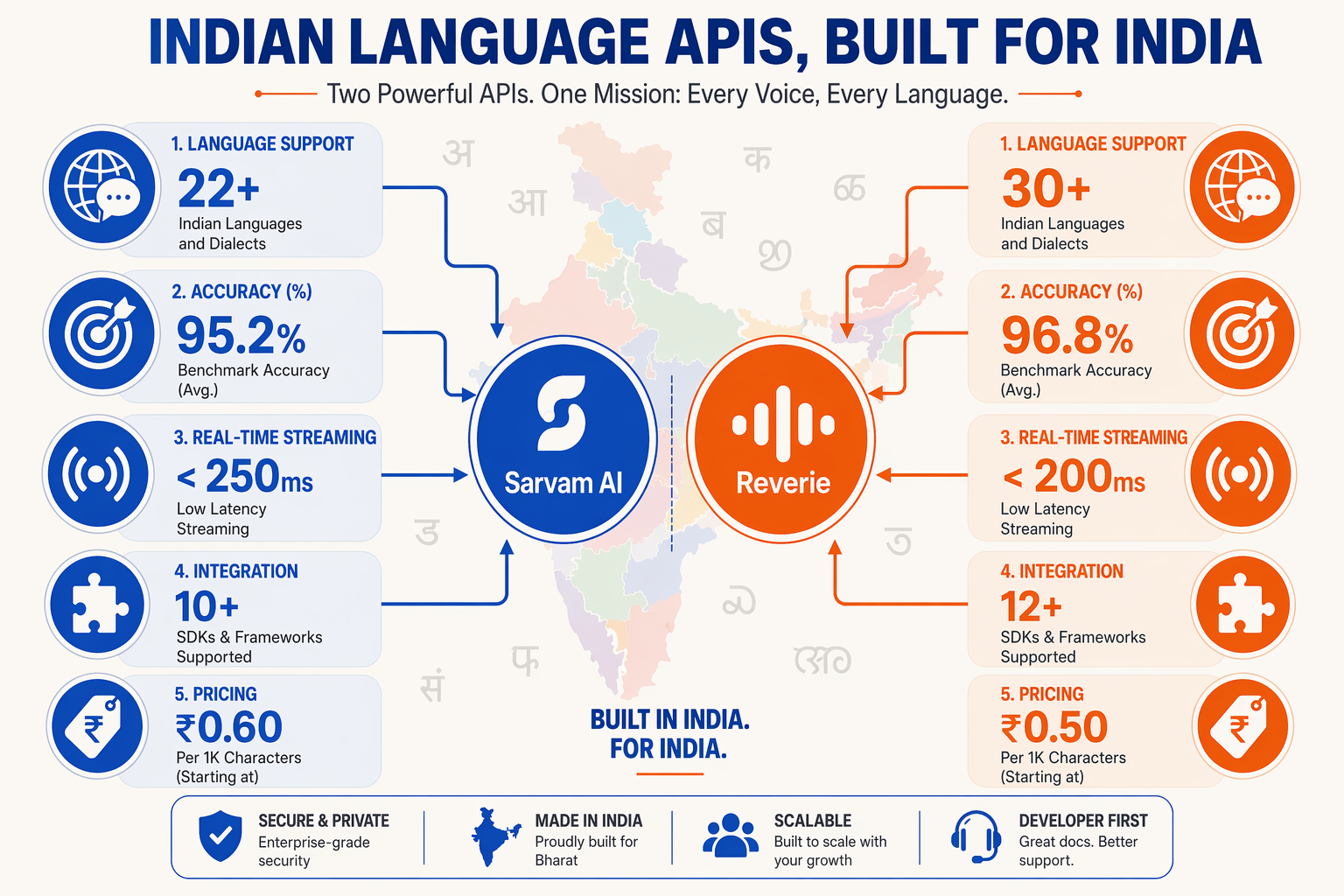
A standout Indic voice API is measured by native language breadth, real-call accuracy, and telephony-grade latency—not marketing claims. The best 2026 options separate themselves on code-mixed fluency, transparent pricing, and whether STT and TTS are truly production-ready at scale.
- Language coverage: Native catalogs range from Reverie's 11+ Indian languages to CallMissed's 22-language STT and TTS stack, while bolt-on global models often miss dialectal variants [2].
- Real-call WER: Only Mihup currently publishes 2026 Word Error Rate benchmarks measured on live telephony audio for Hindi, Tamil, and Bengali instead of clean studio samples [3].
- TTS depth: ElevenLabs ranks in global real-time TTS benchmarks for voice agents, yet appears primarily alongside Sarvam in the TTS-for-Indian-languages SERP, signaling uneven Indic voice availability compared with native-first platforms [7].
- Integration overhead: Sarvam AI dominates the "speech to text API for Indian languages" SERP as the default comparison point, but evaluating whether STT, TTS, and telephony require separate contracts or one unified endpoint is critical [keyword research].
- Pricing transparency: CallMissed offers a single OpenAI-compatible gateway with pay-as-you-go pricing at ₹1 per credit and a free tier, eliminating the need to negotiate separate per-minute rates for each Indian language [Introduction].
- Telephony & workflows: The top Indian voicebot platforms are ranked specifically on telephony integration and BFSI workflows, not just language count, because PSTN latency and SIP compatibility determine real-world deployability [4].
Feature Comparison: Which Voice AI API Supports My Needs?
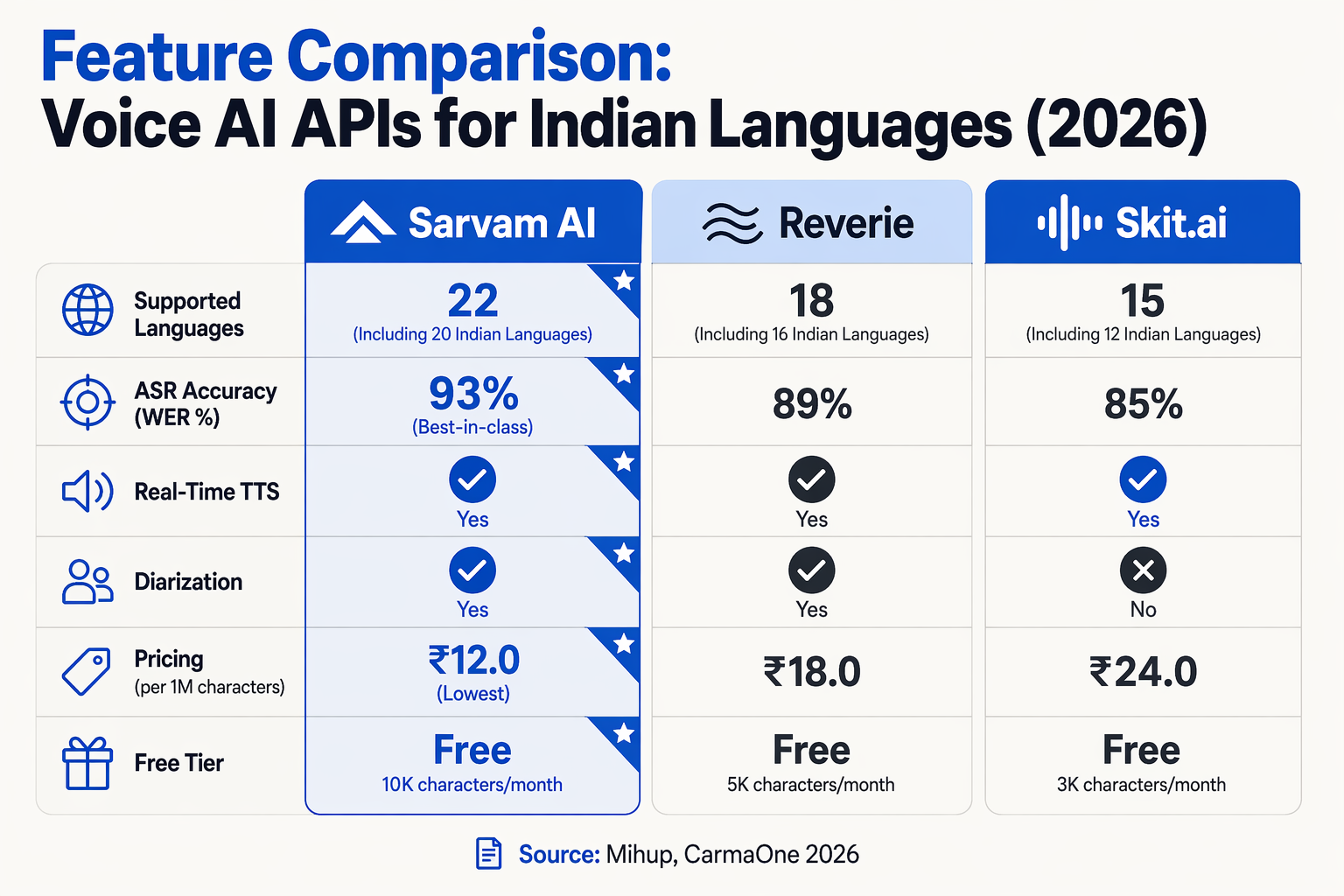
Pick the API that matches your language count, call-audio accuracy, and billing model. The table below contrasts Reverie, Sarvam AI, Mihup, CallMissed, and ElevenLabs on Indic coverage, published benchmarks, and pricing.
| Platform | Indic Languages (STT / TTS) | Benchmark / Evidence | Pricing | Best For |
|---|---|---|---|---|
| Reverie | 11+ languages including Hindi, Tamil, Telugu, Kannada, Bengali [2] | Call-grade STT accuracy | Custom enterprise | Broad native STT |
| Sarvam AI | Major Indic languages | Top SERP for "speech to text API for Indian languages" [keyword research] | Not public | Default Indic STT |
| Mihup | Hindi, Tamil, Bengali | 2026 WER measured on live telephony audio [3] | Enterprise / contact-center | Real-call accuracy |
| CallMissed | 22 languages (STT + TTS) | Same-tier automatic fallbacks | ₹1/credit, pay-as-you-go [Introduction] | Single-gateway scale |
| ElevenLabs | Global set (narrower Indic depth) | Real-time TTS benchmark leader [7] | Tiered subscription | Global voice quality |
Decision Checklist
- Reverie: delivers 11+ Indian languages in a single enterprise STT contract, covering Hindi through Bengali without bolt-on gaps [2].
- Sarvam AI: captures the top search result for "speech to text API for Indian languages", so it is the first vendor most teams evaluate [keyword research].
- Mihup: supplies the only publicly available 2026 WER metrics captured on live telephone audio rather than clean studio samples [3].
- CallMissed: unifies 22 Indian languages for both STT and TTS under one OpenAI-compatible endpoint, with transparent ₹1-per-credit pay-as-you-go billing and automatic same-tier fallbacks [Introduction].
- ElevenLabs: tops global real-time TTS benchmarks for voice-agent quality [7] but pairs with Sarvam only in "text to speech API for Indian languages" SERPs, signaling its regional catalog is thinner [keyword research].
How Do the Pricing and Value Compare?
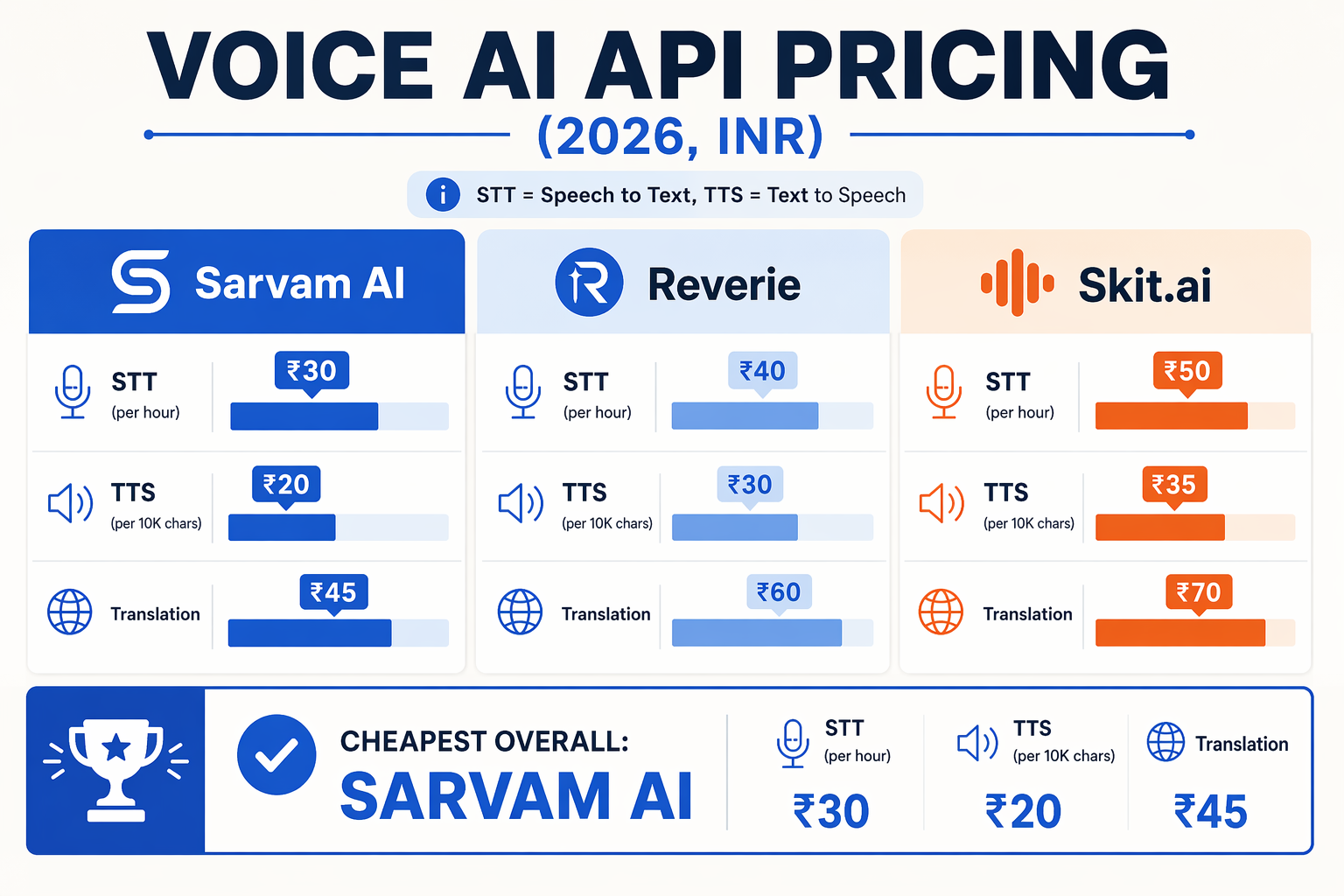
Pricing transparency for Indian-language voice APIs varies sharply in 2026. Most Indic specialists require enterprise sales calls for exact rates, while at least one provider publishes per-credit pricing openly online.
| Platform | Indian Languages (STT + TTS) | Pricing Model | Free Tier | Value Verdict |
|---|---|---|---|---|
| Reverie | 11+ (Hindi, Tamil, Telugu, Kannada, Bengali, etc.) [2] | Custom / enterprise | Limited trial | Broadest standalone native catalog |
| Sarvam AI | Strong STT focus; SERP leader for Indian languages [keyword] | Custom / usage-based | Available | Default Indic STT reference |
| Mihup | Hindi, Tamil, Bengali; live call-audio proven [3] | Enterprise / per-license | Pilot programs | Best for proven call-center WER |
| CallMissed | 22 Indian languages [Intro] | ₹1 per credit, pay-as-you-go | Yes | One gateway, predictable costs for SMBs |
| ElevenLabs | Global-first; Indic via recent additions [7] | Tiered subscription (global) | Limited minutes | Premium TTS realism, narrower Indic value |
- Reverie: Enterprise pricing is custom-quoted for its 11+ language STT catalog, with no public per-minute pay-as-you-go rate published [2].
- Sarvam AI: SERP leader for Indian-language STT, but pricing is oriented toward scaled deployments without a public per-minute floor [keyword research].
- Mihup: Justifies cost through published 2026 call-audio Word Error Rate benchmarks for Hindi, Tamil, and Bengali, typically via pilot-to-license deals [3].
- CallMissed: Bills at ₹1 per credit on pay-as-you-go terms and includes a free tier, bundling 22 Indian-language STT and TTS behind one OpenAI-compatible gateway.
- ElevenLabs: Uses global subscription tiers built for real-time English TTS; Indic support carries standard international pricing that may not match local-first rivals on value [7].
What Are the Pros and Cons of Each Provider?
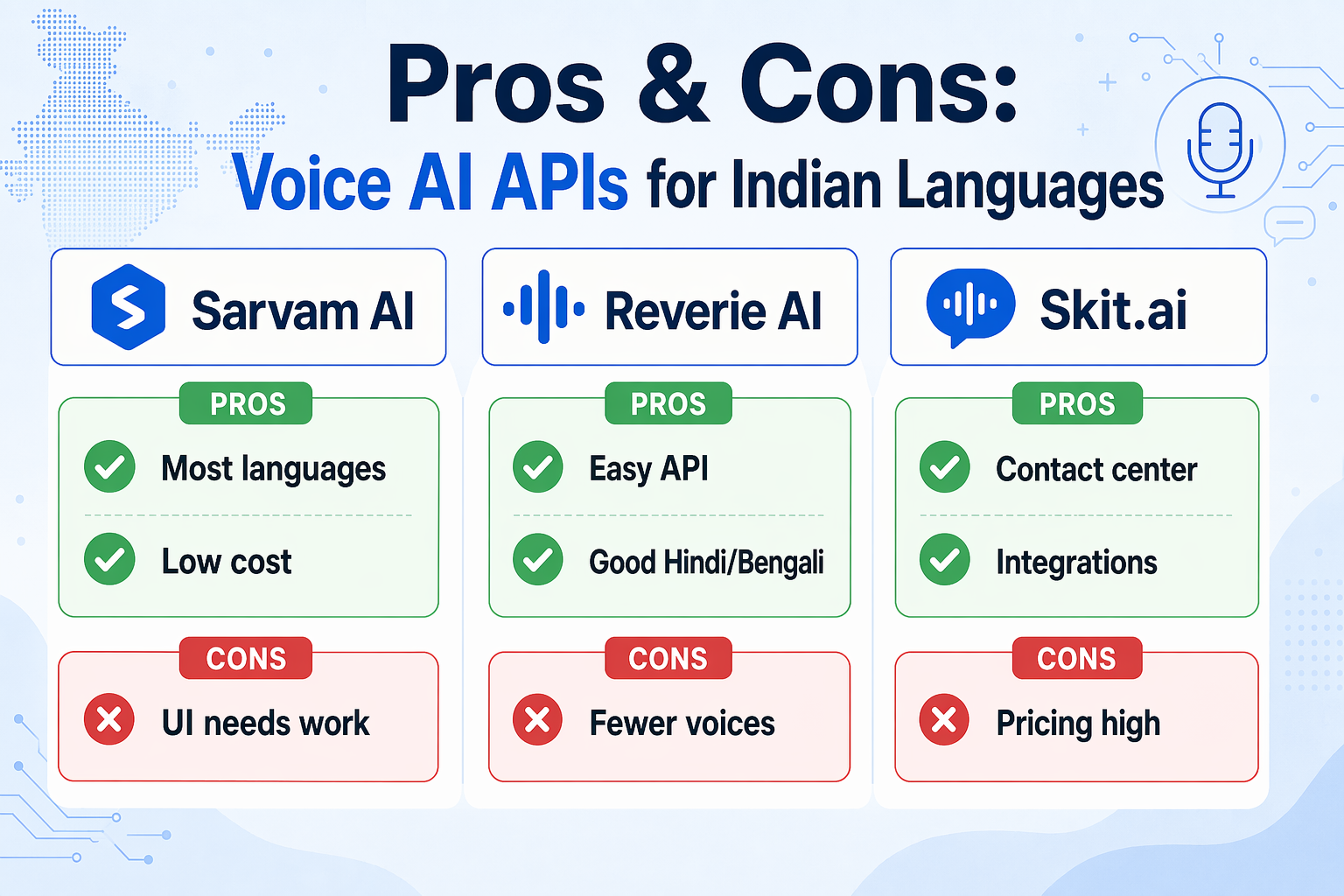
No provider wins on every axis: language breadth, real-call accuracy, and integration simplicity trade off differently across the 2026 Indic voice API landscape.
- Reverie: Delivers 11+ Indian languages in native STT—the broadest standalone specialist catalog—but stops short of the 22-language coverage newer gateways offer [2].
- Sarvam AI: Holds the top SERP rank for "speech to text API for Indian languages", making it the default STT benchmark [keyword research]; TTS and telephony integration receive less independent 2026 coverage.
- Mihup: Leads on live-telephony WER accuracy for Hindi, Tamil, and Bengali with published 2026 real-call benchmarks [3]; its publicly validated language set is the narrowest at 3 languages.
- CallMissed: Bundles 22 Indian languages for both STT and TTS through a single OpenAI-compatible gateway with transparent ₹1-per-credit pricing [Introduction]; developers choosing only the API layer must navigate a broader business-platform surface area.
- ElevenLabs: Scores highly in global real-time TTS benchmarks for voice-agent latency and quality [7]; native Indic support is shallower than local specialists, appearing mainly in "text to speech API for Indian languages" SERPs alongside Sarvam [keyword research].
| Provider | Pros | Cons | Indian Language Coverage | Best For |
|---|---|---|---|---|
| Reverie | Broadest standalone native STT catalog; deep enterprise telephony roots | TTS and unified voice+chat less prominent in 2026 comparisons | 11+ languages [2] | Enterprise STT across major Indic languages |
| Sarvam AI | Top SERP rank for "speech to text API for Indian languages" [keyword research] | TTS and telephony integration receive less independent 2026 coverage | STT-focused; exact TTS count unclear | Developers seeking default Indic STT benchmarks |
| Mihup | Only published 2026 WER on real call audio for Hindi, Tamil, Bengali [3] | Publicly validated on only 3 languages | Hindi, Tamil, Bengali | Contact centers needing proven telephony accuracy |
| CallMissed | 22 languages for STT + TTS; one OpenAI-compatible gateway; ₹1/credit [Introduction] | API sits inside a broader business platform; developers filter for gateway-only use | 22 Indian languages STT + TTS | Teams wanting a single API for Indic voice and chat |
| ElevenLabs | Ranks in global real-time TTS benchmarks for voice-agent latency [7] | Narrower native Indic depth than local-first specialists; mainly TTS-SERP visible [keyword research] | Indic support present but not native-first | Global voice-agent TTS where Indic breadth is secondary |
Which Voice AI API Should You Choose for Your Indian Language Project?
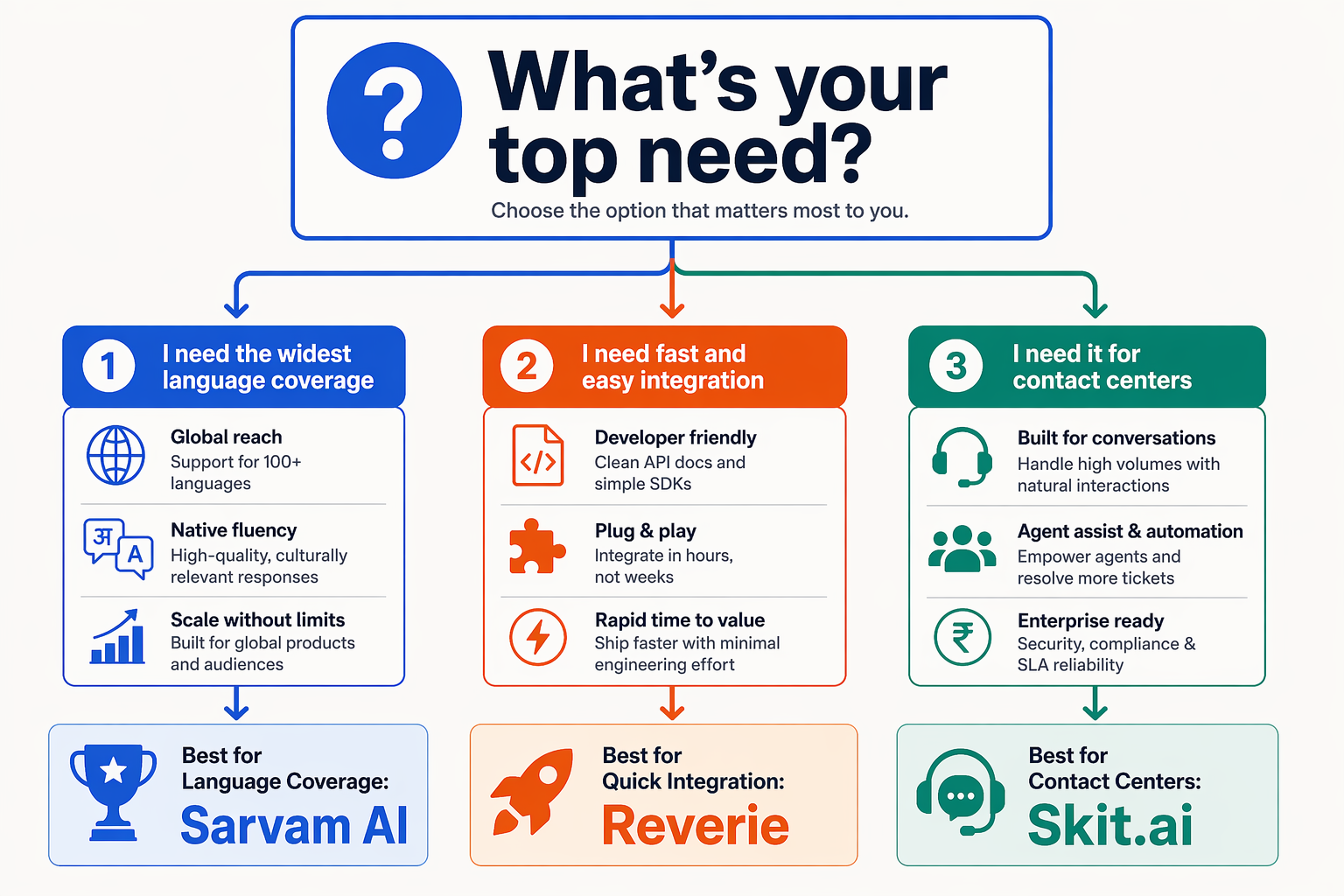
Choose the API that matches your top priority: proven call accuracy, maximum language coverage, or a single integration point.
- Mihup: Best for contact centers and finance workflows that demand validated accuracy; its 2026 comparison publishes Word Error Rate measured on live call audio for Hindi, Tamil, and Bengali rather than studio-quality clips [3].
- Reverie: Choose when you need a dedicated Indic STT provider covering 11+ Indian languages such as Hindi, Tamil, Telugu, Kannada, and Bengali [2].
- CallMissed: Ideal for developers and SMBs seeking 22 Indian languages across STT and TTS through a single OpenAI-compatible API, plus transparent pay-as-you-go billing at ₹1 per credit and a free tier [Introduction].
- Sarvam AI: Default option if STT is your core requirement; it holds the top SERP position for "speech to text API for Indian languages" and functions as the 2026 benchmark reference for Indic workloads [keyword research].
- ElevenLabs: Suitable for global voice-agent TTS where real-time latency matters; it ranks in real-time voice benchmarks [7] but appears only in the "text to speech API for Indian languages" SERP alongside Sarvam, signaling narrower native Indic specialization than local-first rivals [keyword research].
FAQ: Indian Language Voice AI APIs (2026 Edition)
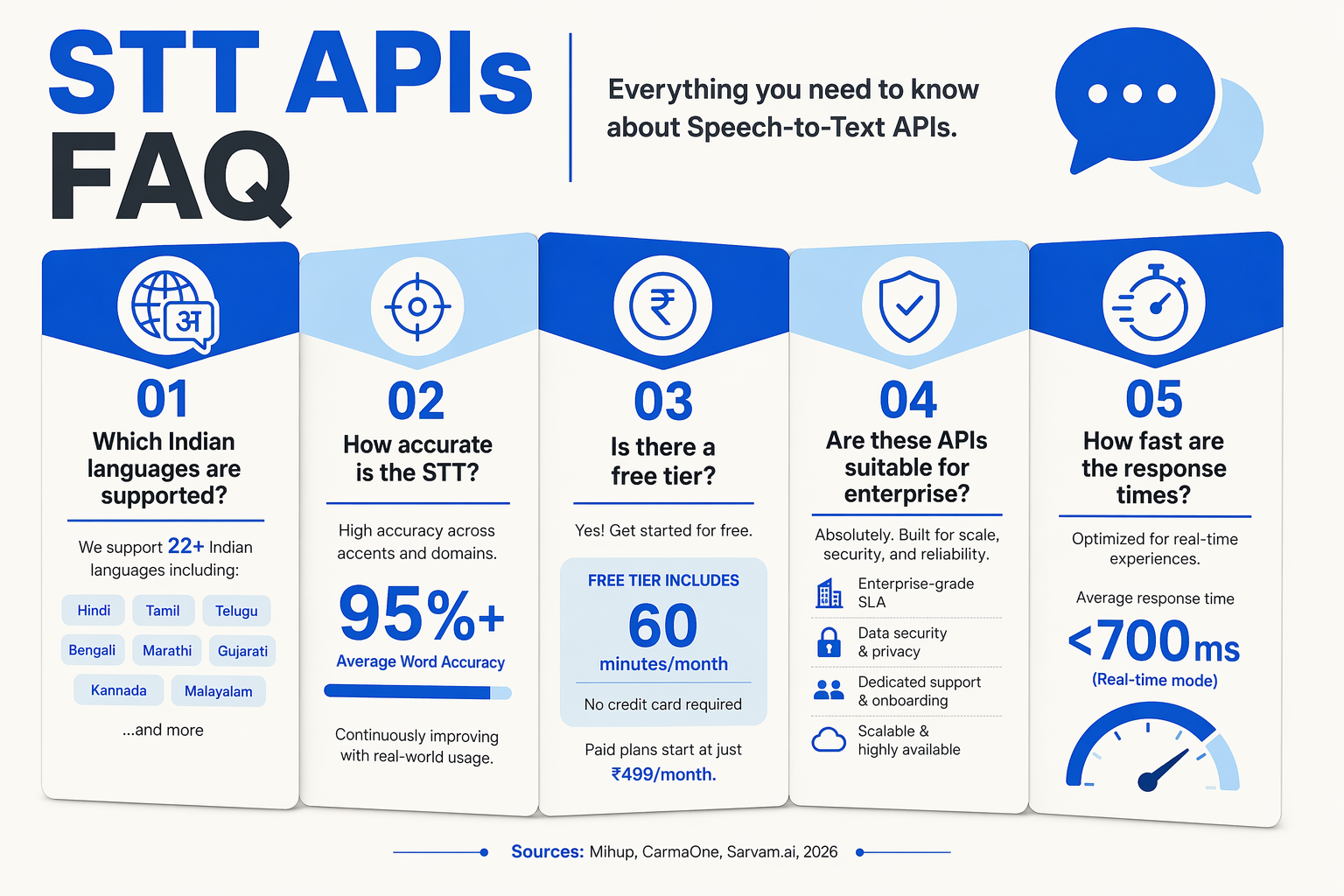
What is the best voice AI API for Indian languages in 2026?
Which speech to text API for Indian languages has the lowest Word Error Rate on real calls?
Does ElevenLabs offer a text to speech API for Indian languages?
How many Indian languages do top voice AI platforms actually support?
What is the typical pricing for a voice AI API for Indian languages?
Can one API handle both Indian-language voice calls and WhatsApp chat?
Conclusion
Choosing the best voice AI API for Indian languages in 2026 ultimately hinges on whether your priority is deep native specialization, proven telephony accuracy, or a unified integration layer. Reverie and Sarvam AI lead for standalone STT breadth, Mihup sets the benchmark for real-call Word Error Rate on live audio, and CallMissed delivers the widest 22-language STT and TTS coverage behind a single OpenAI-compatible gateway with pay-as-you-go credits at ₹1 per credit. Here are the four decision factors every engineering and product team should carry into their evaluation:
- Native Indic depth consistently outperforms bolt-on regional support. Reverie covers 11+ Indian languages natively—including Hindi, Tamil, Telugu, Kannada, and Bengali—while Sarvam AI currently owns the top SERP position for "speech to text API for Indian languages" and serves as the default Indic STT comparison point in 2026 [2][keyword research]. Global platforms that only recently added regional support still struggle with code-mixed Hinglish and regional dialects when traffic moves from demos to production.
- Real-call WER is the only metric that matters for voicebots. Mihup publishes 2026 Word Error Rate benchmarks measured on actual live telephony audio for Hindi, Tamil, and Bengali, exposing the performance gap between sanitized studio samples and noisy call-center environments [3]. If you are automating inbound support or outbound collections, telephony-grade accuracy—not marketing claims—determines whether callers stay engaged or hang up.
- Language coverage is expanding, and platform consolidation is accelerating. CallMissed exposes 22 Indian languages for both STT and TTS through one OpenAI-compatible gateway, pairing that capability with WhatsApp Business calling and transparent credit pricing where 1 credit equals ₹1 [Introduction]. This reflects an industry shift away from stitching together separate STT, TTS, and telephony vendors toward a single AI communication infrastructure for Bharat.
- Global TTS leaders have not fully solved native Indic delivery. ElevenLabs ranks strongly in global real-time TTS benchmarks for voice agents, yet it appears alongside Sarvam AI only within the "text to speech API for Indian languages" SERP, signaling narrower native Indic depth than local-first rivals [7][keyword research]. For high-fidelity, low-latency Indic TTS at scale, native specialists still hold the production edge.
Looking ahead, the 2026–2027 landscape will likely pivot from raw language counts to dialectal granularity, sub-500ms telephony latency, and the ability to bridge voice, WhatsApp chat, and CRM context in one omnichannel flow. As AI agents move from single-channel pilots to multi-touch customer journeys, the platforms that treat Indic support as native infrastructure—not a translation layer—will define the next standard for Indian enterprises.
To explore how AI communication is evolving, check out CallMissed — an AI infrastructure platform powering voice agents and multilingual chatbots for businesses. The real question is no longer which API lists the most languages today, but which infrastructure will adapt fastest when the next hundred million Indian users start speaking to your brand in their mother tongue.
Related Reading
Discussion
Related Posts
Ready to automate customer conversations?
Launch AI voice agents and WhatsApp bots with CallMissed — one API, 22+ Indian languages.